Why the Darknet Matters

shutterstock_251313145-650

By Luther Blissett and J. F. Sebastian of Arkesoul

In February 2015 Ross Ulbricht was convicted of money laundering, computer hacking and conspiracy to traffic narcotics for his role (either with or as Dread Pirate Roberts) in creating and administrating the darknet market Silk Road. For this, U.S. District Judge Katherine Forrest sentenced Ulbricht to life in prison without possibility for parole. Why was Ulbricht treated more severely than most murderers and child molesters (not to mention wall street and state criminals who do far more societal harm than all others combined)? The only logical explanation is that they needed to make an example out of him not just for his actions but for what he represented. The draconian sentence sends a message that the government is doubling down on its destructive and wasteful war on drugs and is clearly threatened by agorists (ie. those advocating for a society of voluntary exchanges and counter-economics without violence or authority) who utilize the darknet to make their ideas manifest. To understand the scope of the threat this poses to governments one must understand what the darknet is.

The darknet is an anonymous overlay network accessed through special software, configurations and/or protocols. It was created in the 1970s to designate anonymous networks isolated from ARPANET (an early form of the internet) which, for security purposes, had addresses hidden from network lists and were unresponsive to pings or other inquiries. The World Wide Web content that exists on darknets (known as the dark web) can only be accessed through anonymous browsers such as the Freenet or TOR Browser Bundle. The darknet and dark web are part of the deep web, the content of the World Wide Web not discoverable by means of standard search engines.

Interest in and use of the darknet has grown dramatically since TOR was released to the public in 2003. Much like when the internet was new, the darknet is often slow, though it has more to do with the complex random rerouting necessary for anonymity than the hardware or infrastructure. And like the early internet, the darknet is widely viewed as the new “wild west”. The darknet does attract its share of fringe subcultures including cryptoanarchists, transhumanists, digital pirates, sexual fetishists, drug users and dealers of different types, etc., but the groups that have arguably been the most empowered by the technology are political dissidents such as whistleblowers and activists.

As governments and corporations gain increasing power over the physical realm through laws, economics, violence and surveillance, one of the few remaining options for anyone wanting to bring about systemic change without fear of retribution, is the darknet. The government would of course never openly admit their fear of such a threat, though it’s apparent that law enforcement and intelligence agencies (who behave as if they’re entitled to the right to monitor all activity) are threatened enough even by less overtly political darknet sites such as Silk Road. They may claim concern over drug gang violence and addiction justifies the crackdown, but if that were actually the case they would have ended the war on (some) drugs years ago when more than enough data was available proving harm reduction to be a more humane and effective strategy.

Of course violent and cruel behavior can be found on the darknet, just as it exists offline. One could argue such cases should be investigated in ways that don’t jeopardize the anonymity of all users. What about the safety of victims attempting to evade dangerous individuals and groups? Whistleblowers need anonymity as well if releasing information on crimes committed by people in power.

As law enforcement struggles to defeat darknet anonymity with new tools such as Memex (a data-trawling program), programmers innovate to make darknet sites more decentralized, private, secure, and user friendly. Improved user interface will draw more users to the darknet, especially as awareness of internet privacy and security issues increase. Government efforts to police and regulate the darknet will also increase further as aspects of the darknet become both more mainstream and fringe, the darknet marketplace expands exponentially and improved cryptocurrencies are developed to meet demand.

As is, the Darknet is a system that is continually evolving. And, inasmuch as it poses a threat and a risk to authority, there is friction between the two. On the one hand, there is the axiom for control and security, which often times conflates manipulation with exploitation. On the other, freedom and liberty of expression, which often times conflates a lack of cohesion with relativism.

Regarding the first side of the debate, it’s a natural product of strategic rationality to calculate safe scenarios as to ensure survival. Vertical hierarchies often times result in perverse agendas that funnel the interests of the few on the top. However, these exist to ensure safety for a particular collective. That is the very paradox of government: The criterion for peace, however illusory, is to make up a contract with the State and its people. “I give up certain rights in exchange of safety”. This is game theory: Predict the behavior of others so as to ensure safety. The government fulfills this need through law and order. Let’s minimise risk, and up control as well as safety, which produces a space to live and grow. In this model, the assumption is to always expect the worst, while paradoxically ensuring productivity through an illusory cohesion and identity. In a collective that is afraid of itself, everybody is “doing their part”, but as well miss out on having a say on the big issues. Government is a fail switch for everything absurd, illogical, and different. The infamous saying applies: “Fear what you don’t understand”.

On the other side of the debate, the inverse is suiting. Greater freedom involves having a voice. The trade off is becoming segregated as an outsider, because having an opinion comes with a price. Refusing to accept the “game rules” of “law and order”, is anathema to cohesion and identity. This philosophy is natural to fringe culture, because often times fringe culture is made up of victims of a system that doesn’t respond to the needs and demands of its people. That’s the problem: If everybody played by the rules, including those at the top, then the big illusion would make sense. There’d be intrinsic justice to the operational structures of society. That’s another paradox, power perverts when it should essentially allow and protect human flourishing and expression. That’s what we are taught, right? Civilization is supposed to be good. But it seems more and more evident that we haven’t yet learnt how to keep our governments at bay and working for the people. Because ideas fracture models by confronting power structures of domination and corruption, we essentially have a duty to be creative and protect what we rightfully are as a species. Ideas are revolutionary, because they add to the frame of possibilities and suggest ways in which the old modes of thinking are outdated. They pose a danger for the status quo, insofar as they fragment cultural psyches. They allow people to think. This is not what Government wants. Our freedom in exchange for safety. Censorship in exchange for control. Our voices in exchange for capital.

At odds, therefore, is the fear for different things versus the need for expression. The Darknet is an idea. It’s not perfect. It fails in many ways, particularly in allowing terrible transactions to happen. However, these are already there with or without the Darknet. If the government was smarter, it would learn to cooperate with the Darknet. It would stop trying to silence voices by hammering the stick. It would offer incentives for creativity and solutions. Yes, the Darknet might be a channel for people to do bad things. But it also allows for new and positive changes. Change is good. Change is evolution. We move forward as we learn. At some point, the Darknet will learn how to push the bad and to cohere the good. If we admonish the Darknet we also chastise our right to expression. We need to challenge our governments, and the Darknet meets that demand. One could argue there’s many pressing problems as important (if not more so) as electronic freedom, but few could have as much of an effect on the outcome of every other struggle. Government can’t silence our voices, it must adapt to them. The battle over the Darknet symbolizes a crossroads in history where decisions made now will have an increasingly large impact on our lives in the future. If freedom prevails, we have an opportunity to make a great idea function for an even greater and much more illuminating goal.


Some day, we could be a shining beacon of hope for the oppressed people of the world just as so many oppressed and violated souls have found refuge here already. Will it happen overnight? No. Will it happen in a lifetime? I don’t know. Is it worth fighting for until my last breath. Of course. Once you’ve seen what’s possible, how can you do otherwise? How can you plug yourself into the tax eating, life sucking, violent, sadistic, war mongering, oppressive machine ever again? How can you kneel when you’ve felt the power of your own legs? Felt them stretch and flex as you learn to walk and think as a free person? I would rather live my life in rags now than in golden chains. And now we can have both! Now it is profitable to throw off one’s chains, with amazing crypto technology reducing the risk of doing so dramatically. How many niches have yet to be filled in the world of anonymous online markets? The opportunity to prosper and take part in a revolution of epic proportions is at our fingertips!

I have no one to share my thoughts with in physical space. Security does not permit it, so thanks for listening. I hope my words can be an inspiration just as I am given so much by everyone here.
Dread Pirate Roberts  [3/20/2012]

Everything You Think You Know About Addiction is Wrong: Smashing the Drug War Paradigm

war-on-drugs

By Matt Agorist

Source: The Free Thought Project

“Overwhelming evidence points to not just the failure of the drug control regime to attain its stated goals but also the horrific unintended consequences of punitive and prohibitionist laws and policies,” states a study, published by the Global Commission on Drug Policy (GCDP).

“A new and improved global drug control regime is needed that better protects the health and safety of individuals and communities around the world,”
 the report says. “Harsh measures grounded in repressive ideologies must be replaced by more humane and effective policies shaped by scientific evidence, public health principles and human rights standards.”

This sudden onset of logic by political bodies across the globe is likely due to the realization of the cruel and inhumane way governments deal with addiction. Arbitrary substances are deemed “illegal” and then anyone caught in possession of those substances is then kidnapped and locked in a cage, or even killed.

The fact that this barbaric and downright immoral practice has been going on for so long speaks to the sheer ignorance of the state and its dependence upon violence to solve society’s ills.

The good news is that the drug war’s days are numbered, especially seeing that it’s reached the White House, and they are taking action, even if it is symbolic. Evidence of this is everywhere. States are defying the federal government and refusing to lock people in cages for marijuana. Colorado and Washington served as a catalyst in a seemingly exponential awakening to the government’s immoral war.

Following suit were Oregon, D.C., and Alaska. Medical marijuana initiatives are becoming a constant part of legislative debates nationwide. We’ve even seen bills that would not only completely legalize marijuana but deregulate it entirely, like corn.

As more and more states refuse to kidnap and cage marijuana users, the drug war will continue to implode.

Knowledge is a key role in this battle against addiction tyranny and investigative journalist Johann Hari, has some vital information to share. In a recent TEDx talk, Hari smashes the paradigm of the war on drugs.

What really causes addiction — to everything from cocaine to smart-phones? And how can we overcome it? Johann Hari has seen our current methods fail firsthand, as he has watched loved ones struggle to manage their addictions. He started to wonder why we treat addicts the way we do — and if there might be a better way. As he shares in this deeply personal talk, his questions took him around the world, and unearthed some surprising and hopeful ways of thinking about an age-old problem.

What?!? Private prisons suing states for millions if they don’t stay full

national-occupy-day-in-support-of-prisoners-022012-by-kevin-rashid-johnson-web

By Terry Shropshire

Source: rollingout.com

The prison-industrial complex is so out of control that private prisons have the sheer audacity to order states to keep beds full or face their wrath with stiff financial penalties, according to reports. Private prisons in some states have language in their contracts that state if they fall below a certain percentage of capacity that the states must pay the private prisons millions of dollars, lest they face a lawsuit for millions more.

And guess what? The private prisons, which are holding cash-starved states hostage, are getting away with it, says advocacy group, In the Public Interest.

In the Public Interest has reviewed more than 60 contracts between private prison companies and state and local governments across the country, and found language mentioning “quotas” for prisoners in nearly two-thirds of those contracts reviewed. Those quotas can range from a mandatory occupancy of, for example, 70 percent occupancy in California to up to 100 percent in some prisons in Arizona.

It is very interesting and telling that so few major national news organization are willing to report on the monstrous, ravenous and criminal system that is devouring hundreds of thousands of black and brown boys. Even those who do not subscribe to conspiracy theories have looked askance at this shocking report.

Welcome to the greatest manifestation of modern-day slavery, ladies and gentlemen.

One of those private prisons, The Corrections Corporation of America, made an offer last year to the governors of 48 states to operate their prisons on 20-year contracts, according to In the Public Interest.

What makes these deals so odious and unscrupulous? Take a look:

1) The offer included a demand that those prisons remain 90 percent full for the duration of the operating agreement. You know what that means: if there are not enough prisoners then there will be an unspoken push for police to arrest more people and to have the courts send more to prison for petty, frivolous and nonviolent crimes. There will also be a “nudge” for judges to hand down longer or maximum sentences to satisfy this “quota.”

2) Private prison companies have also backed measures such as “three-strike” laws to maintain high prison occupancy.

3) When the crime rate drops so low that the occupancy requirements can’t be met, taxpayers are left footing the bill for unused facilities.

The report found that 41 of 62 contracts reviewed contained occupancy requirements, with the highest occupancy rates found in Arizona, Oklahoma and Virginia.

In Colorado, Democratic Gov. John Hinklooper agreed to close down five state-run prisons and instead send inmates to CCA’s three corrections facilities. That cost taxpayers at least $2 million to maintain the unused facilities.

It is getting more difficult to rationalize the societal cost of keeping prisons full just to satisfy private investors who treat prisoners as commodity and cattle .

Land of the Unfree – Police and Prosecutors Fight Aggressively to Retain Barbaric Right of “Civil Asset Forfeiture”

images

By Mike Krieger

Source: Washingtons Blog

Efforts to limit seizures of money, homes and other property from people who may never be convicted of a crime are stalling out amid a wave of pressure from prosecutors and police.

Their effort, at least at the state level, appears to be working. At least a dozen states considered bills restricting or even abolishing forfeiture that isn’t accompanied by a conviction or gives law enforcement less control over forfeited proceeds. But most measures failed to pass.

– From the Wall Street Journal article: Efforts to Curb Asset Seizures by Law Enforcement Hit Headwinds

The fact that civil asset forfeiture continues to exist across the American landscape despite outrage and considerable media attention, is as good an example as any as to how far fallen and uncivilized our so-called “society” has become. It also proves the point demonstrated in a Princeton University study that the U.S. is not a democracy, and the desires of the people have no impact on how the country is governed.

Civil asset forfeiture was first highlighted on these pages in the 2013 post, Why You Should Never, Ever Drive Through Tenaha, Texas, in which I explained:

In a nutshell, civil forfeiture is the practice of confiscating items from people, ranging from cash, cars, even homes based on no criminal conviction or charges, merely suspicion. This practice first became widespread for use against pirates, as a way to take possession of contraband goods despite the fact that the ships’ owners in many cases were located thousands of miles away and couldn’t easily be prosecuted. As is often the case, what starts out reasonable becomes a gigantic organized crime ring of criminality, particularly in a society where the rule of law no longer exists for the “elite,” yet anything goes when it comes to pillaging the average citizen.

One of the major reasons these programs have become so abused is that the police departments themselves are able to keep much of the confiscated money. So they actually have a perverse incentive to steal. As might be expected, a program that is often touted as being effective against going after major drug kingpins, actually targets the poor and disenfranchised more than anything else.

Civil asset forfeiture is state-sanctioned theft. There is no other way around it. The entire concept violates the spirit of the 4th, 5th and 6th amendments to the Constitution. In case you have any doubt:

The 4th Amendment: The right of the people to be secure in their persons, houses, papers, and effects, against unreasonable searches and seizures, shall not be violated, and no Warrants shall issue, but upon probable cause, supported by Oath or affirmation, and particularly describing the place to be searched, and the persons or things to be seized.

The 5th Amendment: No person shall be held to answer for a capital, or otherwise infamous crime, unless on a presentment or indictment of a Grand Jury, except in cases arising in the land or naval forces, or in the Militia, when in actual service in time of War or public danger; nor shall any person be subject for the same offense to be twice put in jeopardy of life or limb; nor shall be compelled in any criminal case to be a witness against himself, nor be deprived of life, liberty, or property, without due process of law; nor shall private property be taken for public use, without just compensation.

The 6th Amendment: In all criminal prosecutions, the accused shall enjoy the right to a speedy and public trial, by an impartial jury of the State and district wherein the crime shall have been committed, which district shall have been previously ascertained by law, and to be informed of the nature and cause of the accusation; to be confronted with the witnesses against him; to have compulsory process for obtaining witnesses in his favor, and to have the Assistance of Counsel for his defense.

Civil asset forfeiture is a civil rights issue, and it should be seen as such by everyone. Just because it targets the entire population as opposed to a specific race, gender or sexual orientation doesn’t make it less important.

The problem with opposition in America today is that people aren’t seeing modern battle lines clearly. The greatest friction and abuse occurring in these United States today comes from the corporate-fascist state’s attack against average citizens. It doesn’t matter what color or gender you are. If you are weak, poor and vulnerable you are ripe for the picking. Until people see the battle lines clearly, it will be very difficult to achieve real change. Most people are divided and conquered along their superficial little tribal affiliations, and they completely miss the bigger picture to the peril of society. Which is why women will support Hillary just because she’s a woman, not caring in the least that she is a compromised, corrupt oligarch stooge.

In case you have any doubt about how little your opinion matters when it comes to the rights of police to rob you blind, read the following excerpts from the Wall Street Journal:

Efforts to limit seizures of money, homes and other property from people who may never be convicted of a crime are stalling out amid a wave of pressure from prosecutors and police.

Read that sentence over and over again until you get it. This is a free country?

Critics have taken aim at the confiscatory powers over concerns that authorities have too much latitude and often too strong a financial incentive when deciding whether to seize property suspected of being tied to criminal activity.

But after New Mexico passed a law this spring hailed by civil-liberties groups as a breakthrough in their effort to rein in states’ forfeiture programs, prosecutor and police associations stepped up their own lobbying campaign, warning legislators that passing such laws would deprive them of a potent crime-fighting tool and rip a hole in law-enforcement budgets.

Their effort, at least at the state level, appears to be working. At least a dozen states considered bills restricting or even abolishing forfeiture that isn’t accompanied by a conviction or gives law enforcement less control over forfeited proceeds. But most measures failed to pass.

“What happened in those states is a testament to the power of the law-enforcement lobby,” said Scott Bullock, a senior attorney at the Institute for Justice, a libertarian-leaning advocacy group that has led a push for laws giving property owners more protections. 

It seems the only people in America without a powerful lobby group are actual American citizens. See: Charting the American Oligarchy – How 0.01% of the Population Contributes 42% of All Campaign Cash

Prosecutors say forfeiture laws help ensure that drug traffickers, white-collar thieves and other wrongdoers can’t enjoy the fruits of their misdeeds and help curb crime by depriving criminals of the “tools” of their trade. Under federal law and in many states, a conviction isn’t required.

“White-collar thieves,” they say. Yet I haven’t seen a single bank executive’s assets confiscated. Rather, they received taxpayer bailout funds with which to pay themselves record bonuses after wrecking the global economy. Don’t forget:

The U.S. Department of Justice Handles Banker Criminals Like Juvenile Offenders…Literally

In Texas, lawmakers introduced more than a dozen bills addressing forfeiture during this year’s legislative session, which ended Monday. Some would either force the government to meet a higher burden of proof or subject forfeiture programs to more stringent financial disclosure rules and audits. 

But only one bill, which law-enforcement officials didn’t object to, ultimately passed. It requires the state attorney general to publish an annual report of forfeited funds based on data submitted by local authorities. That information, at the moment, is only accessible through freedom-of-information requests.

This is what a corporate-statist oligarchy looks like.

Shannon Edmonds, a lobbyist for the Texas District and County Attorneys Association, said local enforcement officers and prosecutors “educated their legislators about how asset forfeiture really works in Texas.”

Maryland Gov. Larry Hogan last month vetoed a bill that would, among other things, prohibit the state from turning over seized property to the federal government unless the owner has been charged with a federal crime or gives consent.

Remember, the terrorists hate us for our freedom.

Prosecutors said the Tenaha episode was an isolated breakdown in the system. “Everybody knows there are bad eggs out there,” Karen Morris, who supervises the Harris County district attorney’s forfeiture unit, told Texas lawmakers at a hearing this spring. “But we don’t stop prosecuting people for murder just because some district attorneys have made mistakes.”

When police aren’t out there stealing your hard earned assets without a trial or charges, they can often be found pounding on citizens for kicks. I came across the following three headlines this morning alone as I was the scanning news.

Cop Exonerated After Being Caught on Video Brutally Beating A Tourist Who Asked For A Tampon

Kids in Police-Run Youth Camp Allegedly Beaten, Threatened By Cops

Florida Cop Charged With On-Duty Child Abuse; Suspended With Pay

This is not what freedom looks like.

For related articles, see:

The DEA Strikes Again – Agents Seize Man’s Life Savings Under Civil Asset Forfeiture Without Charges

Asset Forfeiture – How Cops Continue to Steal Americans’ Hard Earned Cash with Zero Repercussions

Quote of the Day – An Incredible Statement from the City Attorney of Las Cruces, New Mexico

“Common People Do Not Carry This Much U.S. Currency…” – This is How Police Justify Stealing American Citizens’ Money

The Consciousness Revolution

GrahamHancockReconnectWithSpirit

By Graham Hancock

Source: Reality Sandwich

The following is excerpted from The Divine Spark: Psychedelics, Consciousness, and the Birth of Civilization, edited by Graham Hancock (Disinformation Books, April 2015).

Consciousness is one of the great mysteries of science—perhaps the greatest mystery. We all know we have it, when we think, when we dream, when we savor tastes and aromas, when we hear a great symphony, when we fall in love, and it is surely the most intimate, the most sapient, the most personal part of ourselves. Yet no one can really claim to have understood and explained it completely. There’s no doubt it’s associated with the brain in some way, but the nature of that association is far from clear. In particular, how do these three pounds of material stuff inside our skulls allow us to have experiences?

Professor David Chalmers of the Australian National University has dubbed this the “hard problem” of consciousness, but many scientists, partic­ularly those (still in the majority) who are philosophically inclined to believe that all phenomena can be reduced to material interactions, deny that any problem exists. To them, it seems self-evident that physical processes within the stuff of the brain produce consciousness rather in the way that a genera­tor produces electricity—i.e., consciousness is an “epiphenomenon” of brain activity. And they see it as equally obvious that there cannot be such things as conscious survival of death or out-of-body experiences since both con­sciousness and experience are confined to the brain and must die when the brain dies.

Yet other scientists with equally impressive credentials are not so sure and are increasingly willing to consider a very different analogy—namely that the relationship of consciousness to the brain may be less like the rela­tionship of the generator to the electricity it produces and more like the relationship of the TV signal to the TV set. In that case, when the TV set is destroyed—dead—the signal still continues. Nothing in the present state of knowledge of neuroscience rules this revolutionary possibility out. True, if you damage certain areas of the brain, certain areas of consciousness are compromised, but this does not prove that those areas of the brain generate the relevant areas of consciousness. If you were to damage certain areas of your TV set, the picture would deteriorate or vanish but the TV signal would remain intact.

We are, in other words, confronted by at least as much mystery as fact around the subject of consciousness, and this being the case, we should remember that what seems obvious and self-evident to one generation may not seem at all obvious or self-evident to the next. For hundreds of years, it was obvious and self-evident to the greatest human minds that the Sun moved around the Earth—one need only look to the sky, they said, to see the truth of this proposition. Indeed, those who maintained the revolutionary view that the Earth moved around the Sun faced the Inquisition and death by burning at the stake. Yet as it turned out, the revolutionaries were right and orthodoxy was terribly, ridiculously wrong.

The same may well prove to be true with the mystery of consciousness. Yes, it does seem obvious and self-evident that the brain produces it (the generator analogy), but this is a deduction from incomplete data and cat­egorically not yet an established and irrefutable fact. New discoveries may force materialist science to rescind this theory in favor of something more like the TV analogy in which the brain comes to be understood as a trans­ceiver rather than as a generator of consciousness and in which conscious­ness is recognized as fundamentally “nonlocal” in nature—perhaps even as one of the basic driving forces of the universe. At the very least, we should withhold judgment on this “hard problem” until more evidence is in and view with suspicion those who hold dogmatic and ideological views about the nature of consciousness.

It’s at this point that the whole seemingly academic issue becomes intensely political and current because modern technological society ideal­izes and is monopolistically focused on only one state of consciousness—the alert, problem-solving state of consciousness that makes us efficient pro­ducers and consumers of material goods and services. At the same time, our society seeks to police and control a wide range of other “altered” states of consciousness on the basis of the unproven proposition that consciousness is generated by the brain.

I refer here to the so-called “war on drugs” which is really better under­stood as a war on consciousness and which maintains, supposedly in the interests of society, that we as adults do not have the right or maturity to make sovereign decisions about our own consciousness and about the states of consciousness we wish to explore and embrace. This extraordinary impo­sition on adult cognitive liberty is justified by the idea that our brain activity, disturbed by drugs, will adversely impact our behavior toward others. Yet anyone who pauses to think seriously for even a moment must realize that we already have adequate laws that govern adverse behavior toward others and that the real purpose of the “war on drugs” must therefore be to bear down on consciousness itself.

Confirmation that this is so came from the last British Labour govern­ment. It declared that its drug policy would be based on scientific evidence, yet in 2009 it sacked Professor David Nutt, chair of the Advisory Council on the Misuse of Drugs, for stating the simple statistical fact that cannabis is less dangerous (in terms of measured “harms”) than tobacco and alcohol and that ecstasy is less dangerous than horse riding. Clearly what was at play here were ideological issues of great importance to the powers that be. And this is an ideology that sticks stubbornly in place regardless of changes in the complexion of the government of the day. The present Conservative-Liberal coalition remains just as adamant in its enforcement of the so-called war on drugs as its Labour predecessor and continues, in the name of this “war,” to pour public money—our money—into large, armed, drug-enforcement bureaucracies which are entitled to break down our doors at dead of night, invade our homes, ruin our reputations, and put us behind bars.

All of this, we have been persuaded, is in our own interests. Yet if we as adults are not free to make sovereign decisions—right or wrong—about our own consciousness, that most intimate, that most sapient, that most personal part of ourselves, then in what useful sense can we be said to be free at all? And how are we to begin to take real and meaningful responsibility for all the other aspects of our lives when our governments seek to disenfranchise us from this most fundamental of all human rights and responsibilities?

In this connection, it is interesting to note that our society has no objec­tion to altering consciousness per se. On the contrary, many consciousness-altering drugs, such as Prozac, Seroxat, Ritalin, and alcohol are either mas­sively overprescribed or freely available today, and they make huge fortunes for their manufacturers but remain entirely legal despite causing obvious harms. Could this be because such legal drugs do not alter consciousness in ways that threaten the monopolistic dominance of the alert problem-solving state of consciousness, while a good number of illegal drugs, such as canna­bis, LSD, DMT, and psilocybin, do?

There is a revolution in the making here, and what is at stake transcends the case for cognitive liberty as an essential and inalienable adult human right. If it turns out that the brain is not a generator but a transceiver of consciousness, then we must consider some little-known scientific research that points to a seemingly outlandish possibility, namely that a particular category of illegal drugs, the hallucinogens such as LSD, DMT, and psilo­cybin, may alter the receiver wavelength of the brain and allow us to gain contact with intelligent nonmaterial entities, “light beings,” “spirits,” “machine elves” (as Terence McKenna called them)—perhaps even the inhabitants of other dimensions. This possibility is regarded as plain fact by shamans in hunter-gatherer societies who for thousands of years made use of visionary plants and fungi to enter and interact with what they construed as the “spirit world.” Intriguingly, it was also specifically envisaged by Dr. Rick Strass­man, professor of psychiatry at the University of New Mexico, following his groundbreaking research with human volunteers and DMT carried out in the 1990s—a project that produced findings with shattering implications for our understanding of the nature of reality. For further information on Strass­man’s revolutionary work, see his book DMT: The Spirit Molecule.

When Drug Users Aren’t People

d90d9d221dc48be6739092bcee48b1c9

By Ryan Calhoun

Source: Center for a Stateless Society

Judge Katherine Forrest’s decision to lock up Ross Ulbricht for the rest of his life is a momentous tragedy. There were other tragic circumstances on display during Ulbricht’s trial, however. Submitted as evidence against the integrity of the Silk Road were stories of drug overdoses that were allegedly tied to products bought on the darknet drug market. The loss of life in these cases is something we should never look at as unimportant, but their use in condemning Ulbricht’s market are seriously problematic.

“I have no doubt in my mind, that if Preston had not taken that drug which one of his friends had purchased off the internet Silk Road, he would still be alive today,” wrote one grieving mother from Australia. Her son had jumped to his death after purchasing what he may have thought was LSD, but was actually a synthetic known as NBOMe. First please let us take note of where such synthetics come from, a need to produce new designer chemicals which are often more unstable, untested, and easily passed off as what we know to be much safer psychoactive chemicals. The parents and siblings grieving in these cases misplace their ire. What truly led to many people ingesting dangerous chemicals was in fact the laws that are now being used to send Ross Ulbricht to prison. Also worth recognizing is that at the time of ingestion, there was no federal ban on these substances and, at least in America, they could be found or sold discreetly in wholly legal forms of exchange.

Notice also the subtle dehumanization of drug users masquerading as compassion. When someone overdoses people do not recognize the choice of the individual. They do not talk about these people as individual agents, but as symptoms of the individual. In the Silk Road case, parents condemn what Ulbricht’s venue provided for their children — a safe and discreet way to obtain psychoactive chemicals. They would have never sought out these drugs had it not been for Silk Road. This is doubly dehumanizing. They characterize their son’s purchase as somehow inevitable, that he was too weak to help himself and too ignorant to know the dangers inherent in hard drug use. But what compounds the dehumanization of drug consumers in this treatment is that they declare that drug markets OUGHT to be unsafe, ought to be insecure. Their son is a mere exception to the scummy and disposable drug world, he was corrupted by looking through a window to a drug trade which didn’t pose enormous risk to his safety. Drug users, drug distributors, they don’t deserve safety to these people.

Many who are involved in drug subcultures aim to make consumption safer for those who choose freely to consume these substances. Along with being able to read customer reviews that keep merchants within these bazaars held accountable by reputation, there is frequent encouragement to buy test kits for these chemicals. Across the internet you will find no shortage of FAQs on how to prudently go into an experience with drugs, especially for psychedelic experiences which are often delicate and require a good deal of coaching to ensure the best set and setting. At raves across the country people are encouraged by their peers to consume judiciously, to stay hydrated, and most of all to enjoy their experience — which is a frame of mind directly hindered by drug laws and cultural taboos.

These are all voluntary, spontaneous modes of behavior, many born out of a genuine concern for one’s fellow drug users. They are treated as individuals, not addicts. They are met with care, compassion, and resources both physical and mental. What drove these markets underground, what made them more dangerous than they ever needed to be is the intention behind these laws and tragically behind the condemnation of Ulbricht and others as “psychopaths” from people who lost those they loved. It is this legislation, this judicial process, and these cultural norms that must change. We must recognize drug users not as inherently sick and lascivious, but as people who come from the same world as we do, who sought these chemicals not out of an alien urge that overtook them, but because drugs come with a great deal of reward to the user. We can’t let that reward go unchecked from the dangers that are there for those who choose willingly to accept it. We must abolish not only the laws, but the puritanical attitudes which make us see our neighbors and our loved ones as fraught with illness for wanting to get high. It’s time. We must step out of the shadows, break the back of the system that has kept us there, and bring this enormous wealth of human experience into its proper social context. Free Ross Ulbricht, free all drug criminals, and end this dehumanization campaign once and for all.

Assassination as Policy in Washington and How It Failed: 1990-2015

War on Drugs

By Andrew Cockburn

Source: Counterpunch

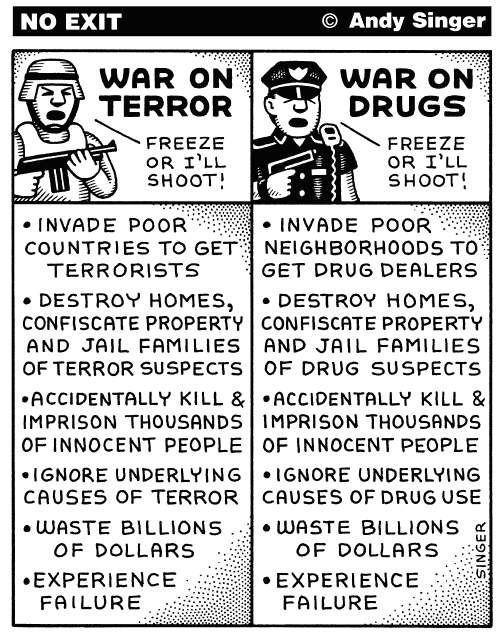
As the war on terror nears its 14th anniversary — a war we seem to be losing, given jihadist advances in Iraq, Syria, and Yemen — the U.S. sticks stolidly to its strategy of “high-value targeting,” our preferred euphemism for assassination.  Secretary of State John Kerry has proudly cited the elimination of “fifty percent” of the Islamic State’s “top commanders” as a recent indication of progress. Abu Bakr al-Baghdadi himself, “Caliph” of the Islamic State, was reportedly seriously wounded in a March airstrike and thereby removed from day-to-day control of the organization. In January, as the White House belatedly admitted, a strike targeting al-Qaeda leadership in Pakistan also managed to kill an American, Warren Weinstein, and his fellow hostage, Giovanni Lo Porto.

More recently in Yemen, even as al-Qaeda in the Arabian Peninsula took control of a key airport, an American drone strike killed Ibrahim Suleiman al-Rubaish, allegedly an important figure in the group’s hierarchy.  Meanwhile, the Saudi news channel al-Arabiya has featured a deck of cards bearing pictures of that country’s principal enemies in Yemen in emulation of the infamous cards issued by the U.S. military prior to the 2003 invasion of Iraq as an aid to targeting its leaders.  (Saddam Hussein was the ace of spades.)

Whatever the euphemism — the Israelis prefer to call it “focused prevention” — assassination has clearly been Washington’s favored strategy in the twenty-first century.   Methods of implementation, including drones, cruise missiles, and Special Operations forces hunter-killer teams, may vary, but the core notion that the path to success lies in directly attacking and taking out your enemy’s leadership has become deeply embedded.  As then-Secretary of State Hillary Clinton put it in 2010, “We believe that the use of intelligence-driven, precision-targeted operations against high-value insurgents and their networks is a key component” of U.S. strategy.

Analyses of this policy often refer, correctly, to the blood-drenched precedent of the CIA’s Vietnam-era Phoenix Program — at least 20,000 “neutralized.” But there was a more recent and far more direct, if less noted, source of inspiration for the contemporary American program of murder in the Greater Middle East and Africa, the “kingpin strategy” of Washington’s drug wars of the 1990s. As a former senior White House counterterrorism official confirmed to me in a 2013 interview, “The idea had its origins in the drug war.  So that precedent was already in the system as a shaper of our thinking.  We had a high degree of confidence in the utility of targeted killing. There was a strong sense that this was a tool to be used.”

Had that official known a little more about just how this feature of the drug wars actually played out, he might have had less confidence in the utility of his chosen instrument.  In fact, the strangest part of the story is that a strategy that failed utterly back then, achieving the very opposite of its intended goal, would later be applied full scale to the war on terror — with exactly the same results.

The Kingpin Strategy Arrives

At the beginning of the 1990s, the Drug Enforcement Administration (DEA) was the poor stepsister of federal law enforcement agencies.  Called into being by President Richard Nixon two decades earlier, it had languished in the shadow of more powerful siblings, notably the FBI.  But the future offered hope.  President George H.W. Bush had only recently re-launched the war on drugs first proclaimed by Nixon, and there were rich budgetary pickings in prospect.  Furthermore, in contrast to the shadowy drug trafficking groups of Nixon’s day, it was now possible to put a face, or faces, on the enemy.  The Colombian cocaine cartels were already infamous, their power and ruthless efficiency well covered in the media.

For Robert Bonner, a former prosecutor and federal judge appointed to head the DEA in 1990, the opportunity couldn’t have been clearer.  Although Nixon had nurtured fantasies of deploying his fledgling anti-drug force to assassinate traffickers, even soliciting anti-Castro Cuban leaders to provide the necessary killers, Bonner had something more systematic in mind.  He called it a “kingpin strategy,” whose aim would be the elimination either by death or capture of the “kingpins” dominating those cartels.

Implicit in the concept was the assumption that the United States faced a hierarchically structured threat that could be defeated by removing key leadership components.  In this, Bonner echoed a traditional U.S. Air Force doctrine: that any enemy system must contain “critical nodes,” the destruction of which would lead to the enemy’s collapse.

In a revealing address to a 2012 meeting of DEA veterans held to commemorate the 20th anniversary of the kingpin strategy’s inauguration, Bonner spoke of the corporate enemy they had confronted.  Major drug trafficking outfits, he said, “by any measure are large organizations. They operate by definition transnationally. They are vertically integrated in terms of production and distribution. They usually have, by the way, fairly smart albeit quite ruthless people at the top and they have a command and control structure. And they also have people with expertise that run certain essential functions of the organization such as logistics, sales and distribution, finances, and enforcement.”  It followed therefore that the removal of those smart people at the top, not to mention the experts in logistics, would render the cartel ineffective and so cut off the flow of narcotics to the United States.

Pursuit of the kingpins promised rich institutional rewards.  Aside from the overbearing presence of the FBI, Bonner had to contend with another carnivore in the Washington bureaucratic jungle eager to encroach on his agency’s territory. “DEA and CIA were butting heads,” recalled the former DEA chief in a 2013 interview. “There was real tension.” Artfully, he managed to negotiate peace with the powerful intelligence agency, “so now we had a very important ally. CIA could use DEA and vice versa.”

By this he meant that the senior agency could use the DEA’s legal powers for domestic operations to good advantage.  This burgeoning relationship brought additional potent allies. Not only was his agency now closer to the CIA, Bonner told me, but “through them, the NSA.” A new Special Operations Division created to work with these senior agencies was to oversee the assault on the kingpins, relying heavily on electronic intelligence.

This new direction would swiftly gain credibility after the successful elimination of the most famous cartel leader of all.  Pablo Escobar, the dominant figure of the Medellín cartel, was an object of obsessive interest to American law enforcement.  He had long evaded U.S.-assisted manhunts before negotiating an agreement with the Colombian government in 1991 under which he took up residence in a “prison” he himself had built in the hills above his home city. A year later, fearing that the government was going to welsh on its deal and turn him over to the Americans, Escobar walked out of that prison and went into hiding.

The subsequent search for the fugitive drug lord marked a turning point. The Cold War was over; Saddam Hussein was defeated in the first Gulf War in 1991; credible threats to the U.S. were scarce; and the danger of budget cuts was in the air. Now, however, the U.S. deployed the full panoply of surveillance technology originally developed to confront the Soviet foe against a single human target. The Air Force sent in an assortment of reconnaissance planes, including SR-71s, which were capable of flying at three times the speed of sound. The Navy sent its own spy planes; the CIA dispatched a helicopter drone.

At one point there were 17 of these surveillance aircraft simultaneously in the air over Medellín although, as it turned out, none of them were any help in tracking down Escobar.  Nor did the DEA make any crucial contribution. Instead, his deadly rivals from Cali, Colombia’s other major trafficking group, played the decisive role in the destruction of that drug lord’s power and support systems, combining well-funded intelligence with bloodthirsty ruthlessness.

His once all-powerful network of informers and bodyguards destroyed, Escobar was eventually located by homing in on his radio and gunned down as he fled across a rooftop on December 2, 1993.  Though the matter is open to debate, a former senior U.S. drug enforcement official assured me unequivocally that a sniper from the U.S. Army’s Special Operations Delta Force had fired the killing shot.

Following this triumph, the DEA turned its attention to the Cali cartel, pursuing it with every resource available: “We really developed the use of wiretaps,” Bonner told me.  Patience and the provision of enormous resources eventually yielded results. In June and July 1995, six of the seven heads of the Cali cartel were arrested, including the brothers Gilberto and Miguel Rodríguez-Orijuela, and the cartel’s cofounder, José “Chepe” Santacruz Londoño.  Although Londoño subsequently escaped from jail, he would in the end be hunted down and killed.  Continued U.S. pressure for the rest of the decade and beyond resulted in a steady flow of cartel bosses into prisons with life sentences or into coffins.

Cartel Heads Go Down and Drugs Go Up

The strategy, it appeared, had been an unqualified success.  “When Pablo Escobar was on the run, for all practical purposes, his organization started going down… ultimately it was destroyed.  And that’s the strategy we have called the kingpin strategy,” crowed Lee Brown, Bill Clinton’s “drug czar,” in 1994.

In public at least, no officials bothered to point out that if that strategy’s aim was to counter drug use among Americans, it had achieved precisely the opposite of its intended goal.  The giveaway to this failure lay in the on-the-street cost of cocaine in this country.  In those years, the DEA put enormous effort into monitoring its price, using undercover agents to make buys and then laboriously compiling and cross-referencing the amounts paid.

The drugs obtained by these surreptitious means, however, were of wildly varying purity, the cocaine itself often having been adulterated with some worthless substitute. That meant that the price of a gram of pure cocaine varied enormously, since a few bad deals of very low purity could cause wide swings in the average. Dealers tended to compensate for higher prices by reducing the purity of their product rather than charging more per gram. As a result, the agency’s price charts showed little movement and so gave no indication of what events were affecting the price and therefore the supply.

In 1994, however, a numbers-cruncher with the Institute for Defense Analysis, the Pentagon’s in-house think tank, began subjecting the data to more searching scrutiny. The analyst, a former Air Force fighter pilot named Rex Rivolo, had been tasked to take an independent look at the drug war at the request of Brian Sheridan, the hardheaded director of the Defense Department’s Office of Drug Control Policy who had developed a healthy disrespect for the DEA and its operations.

Having tartly informed DEA officials that their statistics were worthless, mere “random noise,” Rivolo set to work developing a statistical tool that would eliminate the effect of the swings in purity of the samples collected by the undercover agents. Once he had succeeded, some interesting conclusions began to emerge: the pursuit of the kingpins was most certainly having an effect on prices, and by extension supply, but not in the way advertised by the DEA. Far from impeding the flow of cocaine onto the street and up the nostrils of America, it was accelerating it. Eliminating kingpins actually increased supply.

It was a momentous revelation, running entirely counter to law enforcement cultural attitudes that reached back to the days of Eliot Ness’s war against bootleggers in the 1920s and that would become the basis for Washington’s twenty-first-century counterinsurgency wars. Such a verdict might have been reached intuitively, especially once the kingpin strategy in its most lethal form came to be applied to terrorists and insurgents, but on this rare occasion the conclusion was based on hard, undeniable data.

In the last month of 1993, for example, Pablo Escobar’s once massive cocaine smuggling organization was already in tatters and he was being hunted through the streets of Medellín. If the premise of the DEA strategy — that eliminating kingpins would cut drug supplies — had been correct, supply to the U.S. should by then have been disrupted.

In fact, the opposite occurred: in that period, the U.S. street price dropped from roughly $80 to $60 a gram because of a flood of new supplies coming into the U.S. market, and it would continue to drop after his death.  Similarly, when the top tier of the Cali cartel was swept up in mid-1995, cocaine prices, which had been rising sharply earlier that year, went into a precipitous decline that continued into 1996.

Confident that the price drop and the kingpin eliminations were linked, Rivolo went looking for an explanation and found it in an arcane economic theory he called monopolistic competition. “It hadn’t been heard of for years,” he explained. “It essentially says if you have two producers of something, there’s a certain price. If you double the number of producers, the price gets cut in half, because they share the market.

“So the question was,” he continued, “how many monopolies are there? We had three or four major monopolies, but if you split them into twenty and you believe in this monopolistic competition, you know the price is going to drop. And sure enough, through the nineties the price of cocaine was plummeting because competition was coming in and we were driving the competition. The best thing would have been to keep one cartel over which we had some control. If your goal is to lower consumption on the street, then that’s the mechanism. But if you’re a cop, then that’s not your goal. So we were constantly fighting the cop mentality in these provincial organizations like DEA.”

The Kingpin Strategy Joins the War on Terror

Deep in the jungles of southern Colombia, coca farmers didn’t need obscure economic theories to understand the consequences of the kingpin strategy. When the news arrived that Gilberto Rodríguez-Orijuela had been arrested, small traders in the remote settlement of Calamar erupted in cheers. “Thank the blessed virgin!” exclaimed one grandmother to a visiting American reporter.

“Wait till the United States figures out what it really means,” added another local resident. “Hell, maybe they’ll approve, since it’s really a victory for free enterprise. No more monopoly controlling the market and dictating what growers get paid. It’s just like when they shot Pablo Escobar: now money will flow to everybody.”

This assessment proved entirely correct. As the big cartels disappeared, the business reverted to smaller and even more ruthless groups that managed to maintain production and distribution quite satisfactorily, especially as they were closely linked either to Colombia’s Marxist FARC guerrillas or to the fascist anti-guerrilla paramilitary groups allied with the government and tacitly supported by the United States.

Much of Rivolo’s work on the subject remains classified. This is hardly surprising, given that it not only undercuts the official rationale for the kingpin strategy in the drug wars of the 1990s, but strikes a body blow at the doctrine of high-value targeting that so obsesses the Obama administration in its drone assassination campaigns across the Greater Middle East and parts of Africa today.

Rivolo was, in fact, able to monitor the application of the kingpin strategy in the following decade.  In 2007, he was assigned to a small but high-powered intelligence cell attached to the Baghdad headquarters of General Ray Odierno, who was, at the time, the operational U.S. commander in Iraq.  While there he made it his business to inquire into the ongoing targeting of “high-value individuals,” or HVIs.  Accordingly, he put together a list of 200 HVIs — local insurgent leaders — killed or captured between June and October 2007.  Then he looked to see what happened in their localities following their elimination.

The results, he discovered when he graphed them out, offered a simple, unequivocal message: the strategy was indeed making a difference, just not the one intended. It was, however, the very same message that the kingpin strategy had offered in the drug wars of the 1990s.  Hitting HVIs did not reduce attacks and save American lives; it increased them. Each killing quickly prompted mayhem. Within three kilometers of the target’s base of operation, attacks over the following 30 days shot up by 40%. Within a radius of five kilometers, a typical area of operations for an insurgent cell, they were still up 20%. Summarizing his findings for Odierno, Rivolo added an emphatic punch line: “Conclusion: HVI Strategy, our principal strategy in Iraq, is counter-productive and needs to be re-evaluated.”

As with the kingpin strategy, the causes of this apparently counter-intuitive result became obvious upon reflection.  Dead commanders were immediately replaced, and the newcomers were almost always younger and more aggressive than their predecessors, eager to “make their bones” and prove their worth.

Rivolo’s research and conclusions, though briefed at the highest levels, made no difference.  The kingpin strategy might have failed on the streets of American cities, but it had been a roaring success when it came to the prosperity of the DEA.  The agency budget, always the surest sign of an institution’s standing, soared by 240% during the 1990s, rising from $654 million in 1990 to over $1.5 billion a decade later.  In the same way, albeit on a vaster scale, high-value targeting failed in its stated goals in the Greater Middle East, where terror recruits grew and terror groups only multiplied under the shadow of the drone.  (The removal of al-Baghdadi from day-to-day control of the Islamic State, for instance, has apparently done nothing to retard its operations.)  The strategy has, however, been of inestimable benefit to a host of interested parties, ranging from drone manufacturers to the CIA counterterrorism officials who so signally failed to ward off 9/11 only to adopt assassination as their raison d’être.

No wonder the Saudis want to follow in our footsteps in Yemen. It’s a big world. Who’s next?

Andrew Cockburn is the Washington editor of Harper’s Magazine.  An Irishman, he has covered national security topics in this country for many years.  In addition to publishing numerous books, he co-produced the 1997 feature film The Peacemaker and the 2009 documentary on the financial crisis American Casino.  His latest book is Kill Chain: The Rise of the High-Tech Assassins (Henry Holt).


The Root of Support for the Drug War

war-on-drugs

By Laurence M. Vance

Source: The Future of Freedom Foundation

Although many states have legalized the use of marijuana for medical purposes, some states have decriminalized the possession of certain amounts of marijuana, and four states (Alaska, Colorado, Oregon, and Washington) have legalized the recreational use of marijuana, bipartisan support for the drug war throughout the United States continues unabated and unquestioned.

Why?

Why do so many Americans think that the property of other Americans should be confiscated, and that some of their fellow Americans should be fined, arrested, put on probation, subject to no-knock SWAT team raids, be treated as criminals, or locked in a cage for growing, manufacturing, processing, buying, selling, distributing, “trafficking in,” using, or possessing some substance the government doesn’t approve of?

Why do so many Americans support a war on drugs that

  • unnecessarily makes criminals out of otherwise law-abiding Americans, clogs the judicial system with noncrimes, and expands the prison population with nonviolent offenders;
  • violates the Constitution, the principle of federalism, and increases the size and scope of government;
  • has utterly failed to prevent drug use, reduce drug abuse, or end drug overdoses;
  • fosters violence, corrupts law enforcement, and militarizes the police;
  • hinders legitimate pain management, hampers the treatment of debilitating diseases, and turns doctors into criminals;
  • destroys personal and financial privacy, and negates personal responsibility and accountability;
  • has been unsuccessful in keeping drugs out of the hands of addicts, teenagers, and convicts;
  • assaults individual liberty, private property, and the free market; or
  • wastes billions of taxpayer dollars and has financial and human costs that far exceed any of its supposed benefits?

I see a number of reasons that Americans in general support a government war on the mind-altering and mood-altering substances we refer to as drugs.

For some the reason is history. As far as many Americans are concerned, drugs have always been illegal and should therefore always remain so. It is simply unthinkable that it should be any other way. Yet, for the first half of our nation’s history there were no prohibitions against anyone’s possessing or using any drug.

For some the reason is society. The use of marijuana — for medical reasons or not — is still viewed negatively. And of course the use of other drugs such as cocaine, LSD, and heroin is disparaged even more. There is almost universal support for the drug war among all facets of society: engineers, teachers, preachers, physicians, clerks, accountants, secretaries, and housewives. But, of course, it doesn’t follow that because a majority of society supports something the power of government should be used against those who don’t.

For some the reason is political. The war on drugs enjoys widespread bipartisan support. Liberals, conservatives, Democrats, Republicans, moderates, populists, progressives, centrists, Tea Partiers — they all generally support government prohibition of certain drugs. The drug war is never an issue in any congressional primary or general election. As long as their party or their political group supports the drug war, most Americans will follow suit. The decision to use drugs should be an ethical, religious, medical, or moral decision, not a political decision.

For some the reason is religion. Support for the drug war can be found across the religious spectrum, encompassing Christians and Jews, Protestants and Catholics, liberals and conservatives, fundamentalists and progressives, and Trinitarians and Unitarians. Yet, there is no ethical precept in any religion that should lead anyone to believe that it is the job of government to prohibit, prevent, regulate, restrict, or otherwise control any substance that any adult desires to ingest of his own free will.

For some the reason is morality. Because, some assert, it is immoral to alter one’s mind or mood with illegal drugs, the government should ban the use of these substances. Do drug warriors likewise believe that it is immoral to alter one’s mind or mood with alcohol? If not, then they are woefully inconsistent in their proscription; if so, then they are woefully inconsistent in their prescription.

Dangers and vices

For some the reason is safety. Because it can be dangerous to use illicit drugs, some think the government should ban them. Yet there is no question that smoking marijuana is less dangerous than drinking alcohol. Alcohol abuse is a factor in many drownings; home, pedestrian, car, and boating accidents; and fires. How many drug warriors propose that the government ban alcohol? There are plenty of things that are much more dangerous than using illicit drugs: skydiving, bungee jumping, coal mining, boxing, mountain climbing, cliff diving, drag racing — even crossing the street at a busy intersection. According to the Journal of Forensic Sciences, there are more than 28,000 chainsaw-related injuries annually in the United States. Shouldn’t governments across the country declare war on chainsaws?

For some the reason is vice. Using drugs is said to be a vice like gambling, profanity, drunkenness, using pornography, and prostitution. But as only the latter is actually banned outright by the government, arguments for government action against select drugs are extremely weak. And what about the vices of pride, envy, wrath, sloth, avarice, gluttony, and lust? Why don’t drug warriors advocate government action against them? Vices in 2014 are still as the 19th-century political philosopher Lysander Spooner explained:

Vices are those acts by which a man harms himself or his property. Crimes are those acts by which one man harms the person or property of another. Vices are simply the errors which a man makes in his search after his own happiness. Unlike crimes, they imply no malice toward others, and no interference with their persons or property.

For some the reason is health. The use of mind-altering and mood-altering substances is said to be unhealthy. The federal government classifies marijuana as a Schedule I drug with “no currently accepted medical use in treatment in the United States.” But even if drugs such as marijuana don’t provide benefits for certain diseases and medical conditions, they are certainly not nearly as deadly as the drugs administered by physicians that kill thousands of Americans every year, the drugs that cause thousands of hospital patients every year to have adverse reactions, and nonsteroidal anti-inflammatory drugs such as aspirin that kill thousands every year. The most unhealthy drug is alcohol, which is a contributing factor in many cases of cancer, mental illness, fetal abnormalities, and cirrhosis of the liver. Alcohol abuse is one of the leading causes of premature deaths in the United States. There is no question that smoking marijuana is less dangerous than smoking tobacco. Common sense would dictate that it is tobacco that should be banned, not marijuana. And of course, the greatest health threat Americans face is obesity, not illegal drugs.

For some the reason is addiction. Certain drugs should be illegal, we are told, because they are addictive. The federal government says that marijuana “has a high potential for abuse.” But is that because it is addictive or because some people just want to get high? Legal drugs prescribed by physicians are certainly just as addictive as any drugs that are illegal. And of course, pornography, smoking, gambling, sex, shopping, and eating can be addictive. Drug warriors are very selective about which addictive behaviors deserve government action.

For some the reason is irrationality. Although every bad thing that could be said about drugs could also be said about alcohol, some drug warriors hold the irrational belief that drugs are just different from alcohol. Why? Because they just are.

For all, the reason is government. I believe the root of support for the drug war is simply this: trust in government. Unnecessary, irrational, and naive trust in government.

What’s so disturbing is that nowhere does the Constitution authorize the federal government to intrude itself into the personal eating, drinking, or smoking habits of Americans or concern itself with the nature and quantity of any substance Americans want to ingest. The Constitution is supposed to be the foundation of American government. The federal government is not supposed to have the authority to do anything unless it is included in the limited, enumerated powers granted to it in the Constitution. Yet some of the ardent enthusiasts of the Constitution are some of the most rabid drug warriors.

The war on drugs is a war on individual liberty, private property, limited government, the Constitution, American taxpayers, personal responsibility, the free market, and a free society that has ruined more lives than drugs themselves.

Every facet of government that contributes in some way to the monstrous evil that is the war on drugs should be dismembered, root and branch, and cast to the four winds.

This article was originally published in the January 2015 edition of Future of Freedom.