The Growing Acceptance of Marijuana Smoking in Society

group-adults-marijuana-watching-movie_7515

By Keith Stroup, NORML Legal Counsel

Source: NORML Blog

We are at a tipping point in this country regarding the legalization of marijuana, and it is exhilarating to experience the ending of prohibition and the start of legalization. Even as the changes in marijuana policy evolve, however, I find it disturbing that many Americans and most elected officials are still not comfortable with the idea of adults smoking marijuana.

I have always been honest about my marijuana smoking, something relatively easy for me because for much of my adult life I have lived in a protective NORML bubble. We sometimes joke that at NORML we drug test employees, and if they don’t fail, they do not get hired!

In my world, people are not judged by their choice of intoxicants and whether or not they smoke themselves as marijuana smoking is simply no big deal. I realize that my world is atypical. Many Americans, perhaps most, are now willing to permit adults to smoke marijuana, but they would like for us to stay in the closet and keep our marijuana smoking to ourselves. It continues to carry a negative social stigma.

As we approach 4/20, the unofficial national holiday for marijuana smokers, I was asked how the public acceptance of marijuana smoking had changed since I first began smoking 50 years ago.

Enormous Gains in Acceptance

The easy answer, of course, is that we have seen enormous positive gains in the way the general public perceives marijuana smokers and marijuana smoking. The reality is actually more nuanced, and there are issues surrounding the use of marijuana that remain problematic and contribute to the prejudice we continue to experience.

The 1930s, 40s and 50s were the Dark Ages of marijuana prohibition, when marijuana was seen as a serious threat to the public health and safety, presumed to be evil, dangerous and capable of turning ordinary people into violent killers and rapists as well as ultimately leading to insanity. Marijuana smoking was seen as deviant behavior that reflected poorly on one’s character and morality.

Most Americans at the time had never smoked marijuana, knew almost nothing about it and had formed their opinions largely on the exaggerated anti-marijuana propaganda advanced by the government and reflected in major newspapers. While a few “reefer maniacs” remain, the country has moved beyond this ignorant phase of our drug policy history.

By the 1960s, marijuana smoking began to be popular among those on the cutting edge of the cultural revolution then taking place. Use was closely identified with those referred to as “long-haired hippies,” who were seen as lazy, rebellious and undisciplined, often involved in the growing anti-Vietnam War movement and therefore un-American.

The dominant culture feared the changes they were seeing among America’s youth and sometimes blamed marijuana as the cause. Young people were challenging traditional values and lifestyles, experimenting with “free sex” and communal living, trying hallucinogens (encouraged by Tim Leary’s call to “turn-on, tune-in and drop-out”), learning about eastern religions and generally seeking a “higher consciousness.” Marijuana was seen as a symbol for those who were challenging authority.

I first smoked marijuana in 1965 when I was a first year law student at Georgetown Law School in Washington, DC, and I can attest to the necessary fear and paranoia we all felt when we did get together with friends to smoke some weed. People were still being sent to jail for several years for the possession or use of even a little marijuana in many states, and those who took the risk to sell us marijuana were especially vulnerable to long prison sentences.

Naturally, everyone tried to be careful when deciding with whom and where they felt comfortable smoking. At that time, there was no public acceptance of marijuana smoking, and it was considered by most to be the first step towards a heroin habit, There was little tolerance for those who ignored the rules.

When we founded NORML in late 1970, only 12% of the public supported the legalization of marijuana. To most of the other 88%, marijuana smoking was seen as something that would disqualify one from being taken seriously by the mainstream culture. No employer would hire someone who acknowledged their marijuana use, assuming they would be an unfit employee. Most would call the police if they somehow discovered a neighbor was a marijuana smoker, fearing they might present a threat to the neighborhood if left to their own devices.

I recall vividly the reaction from many of my friends and associates when, having graduated from a prestigious law school, I began to be publicly identified with NORML and with marijuana smoking. Most reflected disappointment that I would “waste my time” on such a frivolous issue and some presumed I had lost my moral compass and was advancing an agenda that was misguided and bound to fail. Why would someone who had the good fortune to achieve a good education throw it all away in an effort to legalize marijuana?

Attitudes Today

Compared to those years, we have indeed come a long distance, and the world today seems relatively more enlightened towards marijuana smoking. Even today the President of the United States can joke about his earlier marijuana use without the slightest harm to his standing or credibility. In fact, to some degree it adds to his cachet and makes him more relevant than he might otherwise seem to younger Americans.

Roughly 60% of the country today support full legalization, regardless of why one smokes. While that obviously reflects a higher level of acceptance of marijuana smoking, it does not mean the prejudice against marijuana smokers has ended.

When one digs deeper into the survey data, we find that many of the non-smokers who now support full marijuana legalization do so because they see prohibition as a failed public policy and not because they approve of marijuana smoking. Although they oppose prohibition and favor regulation and control, 64% of those non-smokers have an unfavorable opinion of those of us who smoke. To them, the fact that we choose to smoke marijuana does not justify treating us as criminals but nonetheless causes them to think poorly of us.

The Fight for Social Clubs

We see the continued bias against marijuana smoking as even the first states to legalize marijuana for all adults have made no provisions to permit smoking outside the home. I don’t mean public smoking but rather clubs or venues where marijuana smokers can gather to socialize with other marijuana smokers and share their marijuana with friends.

Led by Denver NORML, efforts are currently underway to pass an initiative that would authorize licenses for marijuana social clubs and special events (think 4/20 and Cannabis Cups), because the city council has balked at efforts to pass similar legislation. Remember, most elected officials in Colorado opposed Amendment 64 when it was on the ballot.

Even in a state that has now largely embraced legal marijuana, that has a thriving legal marijuana industry providing more than $100 million in tax revenue annually to the state, and that encourages marijuana tourism, elected officials are still reticent to do anything that might officially acknowledge that marijuana smoking is acceptable conduct. We are begrudgingly allowed to smoke marijuana, so long as we stay in our homes and out of sight. Permitting us to smoke in a social setting apparently threatens the established social order.

Moving Forward

We clearly have more work ahead and need to consider why this anti-marijuana prejudice still exists and what we can do to move beyond it.

We will win this battle for totally fair treatment only when we improve the public perception of marijuana smokers. We have to overcome the “Cheech and Chong” stoner image of a pot smoker who sits on the sofa all day eating junk food.

Because marijuana remains illegal in most states and under federal law, most smokers who hold good jobs in business or industry or the professions simply cannot stand up and be counted, because they would lose their jobs and their ability to support their families. As a result, the majority of middle class smokers are largely invisible to the non-smoking public.

We have to find ways to let America know that marijuana smokers are just ordinary Americans who work hard, raise families, pay taxes and contribute in a positive way to our communities. We need to do a better job of letting our non-smoking friends and neighbors know that those of us who smoke are otherwise just like them, with varied interests and hobbies. Marijuana smoking is not the dominant facet of our lives. We are not slackers in any way, nor do we pose any threat to those in society who choose not to smoke.

For those smokers who are self-employed or who are otherwise not subject to drug testing, it is crucial that you come out of the closet and let your community and your professional colleagues see that you are good neighbors as well as responsible marijuana smokers. There should be no social stigma attached to the responsible use of marijuana.

I am confident that within a few years, marijuana smoking will be seen by most Americans as the equivalent of drinking alcohol but safer, and I look forward to that day.

We are not there yet.


Saturday Matinee: Reefer Madness the Movie Musical

MI0000825539

The earliest version of Reefer Madness was released in 1936. It was financed by a church group who intended it to be a morality tale warning parents of supposed dangers of cannabis use and helped prime the public for prohibitionist Harry Anslinger’s Marihuana Tax Act introduced a year later. In spring of 72, the founder of NORML, Keith Stroup, rediscovered the film and organized college campus screenings throughout California to raise funds for the California Marijuana Initiative which would potentially legalize cannabis in the 1972 fall elections. Though the initiative failed to pass, Reefer Madness was soon after elevated to the status of cult classic and became notorious for midnight movie screenings with spirited audience participation including mass pot smoking during key scenes.

Reefer Madness was “re-imagined” as a musical comedy by Kevin Murphy and premiered in Los Angeles in 1998 and in 2005 Showtime created the cable movie version directed by Andy Fickman and starring Kristen Bell, Christian Campbell, and John Kassir reprising their stage roles.

On the Drug War, and Other “Mistakes”

nixon-war-on-drugs-quote

By Kevin Carson

Source: Center for a Stateless Society

In a new article at Harper’s (“Legalize It All,” April 2016), Dan Baum recalls a 1994 confession by former Nixon domestic policy adviser John Ehrlichmann, about Nixon’s motives in first launching the War on Drugs. Baum, interviewing Ehrlichman for a book on drug prohibition, asked a “series of earnest, wonky questions, that he impatiently waved away”:

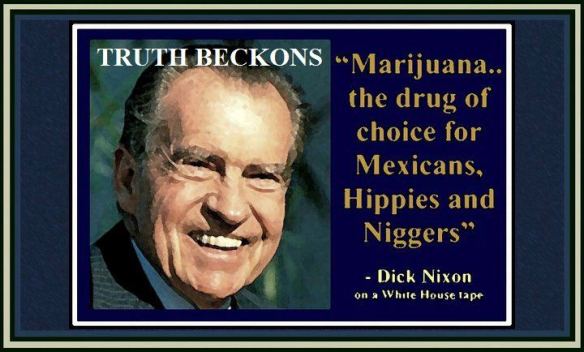
“The Nixon campaign in 1968, and the Nixon White House after that, had two enemies:  the antiwar Left, and black people…. We knew we couldn’t make it illegal to be either against the war or black. But by getting the public to associate the hippies with marijuana and blacks with heroin, and then criminalizing both heavily, we could disrupt those communities. We could arrest their leaders, raid their homes, break up their meetings, and vilify them night after night on the evening news. Did we know we were lying about the drugs? Of course we did.”

Judged by those objectives, Nixon’s War on Drugs and its subsequent dramatic escalation under Reagan have been resounding successes.

Many liberals, unfortunately, are prone to describing the War on Drugs as a “failure” — much as the Vietnam or Iraq War was “a mistake” — implicitly accepting the general goals of the American state as good and well-meaning, and merely unfortunate in their execution. The liberals who frame the wars in this way, as Noam Chomsky has argued, share the hawks’ view that “America owns the world” and has the right to define as a “threat” any country that defies its authority or attempts to undermine the global corporate order. And liberals and progressives are nauseatingly prone to referring to criminal foreign wars of aggression and domestic police wars on civil society as something “we” did.

But if you genuinely think the actions of the American state have anything to do with “we” or “us,” either you belong to the economic classes served by the state, or you probably still ask the dentist to save your extracted molars to put under your pillow.

Long before I saw Ehrlichman’s admission, I noted that the expanded War on Drugs against crack and meth under Reagan and Clinton had had a disruptive effect on two of the demographic groups (inner city black people and rural poor whites) that, as it happens, are least socialized to cheerfully accept direction from authority figures behind desks.

Going back to the passage of the Virginia Slave Code after the defeat of Bacon’s Rebellion, running through the use of racial divisions to split and defeat the southern tenant farmers’ unions, and right up to the present, the possibility of a strategic political alliance between poor black and white people has been one of the major fears of the propertied classes who control the American state.

So whether it be Nixon’s or Reagan’s War on Drugs, or the Clintons’ support for a Crime Bill (to “bring to heel” so-called black “super-predators”) that completed America’s growth into the largest carceral state in the world, the fact that a third of the urban black male population is in some phase of the “criminal justice” system and deprived of the franchise has had an enormous effect on radical political possibilities in this country. It has gone a long way towards nullifying the effects of the Voting Rights Act, in much the same way that Black Codes nullified the effects of Emancipation. Jeb Bush’s purge of 70,000 alleged “felons” — mostly not felons, but mostly black — from the Florida voting rolls was the main factor in handing the presidency to his brother.

I’m not, by the way, the kind of conspiracist who thinks every government policy fits into some larger, malign strategy that serves as the “real” motivation for all officials. I don’t doubt a great deal of legislation and executive action is intended as a good faith response to the stated concerns of policy-makers. Of course even such “well-meaning” policies are subject to the law of unintended consequences, mission creep, refusal to reassess in response to feedback on their effectiveness, and abusive or self-dealing execution by the bureaucracies tasked with enforcement.

But even when policies are sincerely “well-meaning,” they still tend to serve vested interests through a sort of structural “invisible hand” effect. The “well-meaning” policies that get passed are those that structurally benefit the economic ruling class, and those that get repealed are those that no longer do so.

The state does not represent “us,” and the destructive and genocidal effects of its policies are not “mistakes.”

Prison Town Selling Its Jails to Grow Cannabis to Save their Economy — And It’s Working

Screen-shot-2012-08-31-at-9.55.31-PM

By Justin Gardner

Source: Activist Post

A tiny California desert town is making a drastic change to reverse its downward spiral and embrace an enlightened future. For 24 years, Adelanto tried unsuccessfully to sustain its economy through prisons, but now it will be hosting a very different kind of business—cannabis cultivation.

The town became only the second city in California to permit commercial cultivation of medical cannabis, after a year of heated debate in the City Council. The persistence of John “Bug” Woodard, Jr. paid off in a 4-1 vote on Nov. 23 to allow cultivation.

“I had nothing to lose,” said Woodard. “The city could not get in any worse shape than it was. It was broke.”

Brooke Edwards Staggs of The Orange County Register describes Adelanto’s declining prison economy and the land rush that is now taking place after their decision to go to pot.

Its first prison was built in 1991, as the city braced itself for the closure of nearby George Air Force Base.

That didn’t stop Adelanto’s long slide into high unemployment and depressed property values. More than a third of the city’s nearly 33,000 residents now live below the poverty line. So it kept welcoming more prisons, banking on the promise of jobs and steady revenue in the form of an annual bed tax.

The town sold one of its four prisons to a private firm in 2010 for $28 million, and that cash is about to run out. Solar energy developers also had an interest in Adelanto, but only four projects have been constructed, producing a handful of jobs.

Now, a new kind of developer is flocking to the town.

Ky-Mani Marley, one of Bob Marley’s sons, has already signed on to license a strain of cannabis that will be grown there, according to Freddy Sayegh, the attorney on the project. Tommy Chong has also shown interest. So has B-Real of Cypress Hill fame, plus other high-profile musicians and professional athletes whose names are being kept under wraps.

One commercial real estate firm says they went from one call a week to five calls a day about purchasing land in Adelanto. Real estate prices have skyrocketed as “investors, cultivators, doctors, architects and record executives” fly across the country to see about getting in on the budding industry.

Twenty-seven companies have been permitted to set up grow operations in Adelanto, with two more pending. The first crop is expected to be produced by summer, and when it reaches full capacity, the town will be producing about 50,000 pounds of cannabis six times a year for the medical industry.

Since California approved medical cannabis use in 1996, it has finally gotten around to creating a licensing program for cannabis businesses under the Medical Marijuana Regulations and Safety Act. The state is expected to legalize recreational use this November, which will greatly increase demand for legitimate operations.

The trend of cities allowing commercial-scale cannabis cultivation is a relief for those concerned about the environmental impact of illegal grow operations. Last year we reported how many growers are carelessly polluting aquatic ecosystems with rat poison and other toxic chemicals, while drying up already stressed streams.

As more towns and cities in California permit large-scale cannabis cultivation, demand will shift to these responsible growers, which should begin to reduce the pressure on the state’s fragile aquatic ecosystems.

Adelanto, which means “progress” in Spanish, will indeed prove to be a model of progress as it transitions from a depressing economy of prisons to one that actually helps human and environmental health.

“Tomorrow, they’ll be on the correct side of history and be recognized as a city that actually embraced safety and embraced something that heals people,” said Randall Longwith, an attorney representing investors.

Not only will cannabis businesses be producing exclusive strains for distribution, but Adelanto will also serve as a hub of medical research for ailments such as pediatric epilepsy, brain tumors, and post-traumatic stress disorder. Cannabis is showing great promise in all of these areas.

As a bonus, the medical cannabis research company Ecologies Laboratories will be pushing out a merchant of death. General Atomics Aeronautical Systems, which makes the Predator drone, will have to give up its storage facility in Adelanto as the landlord has decided to lease it to Ecologies Laboratories instead.

Adelanto joins another California city, Desert Hot Springs, to become a new kind of western pioneer. It will save its economy by making millions in tax revenue and securing hundreds of jobs, and, more importantly, is embracing a future where cannabis will prove to be a medical wonder.

War fraud: The great lies behind imperial warfare in the 21st century

By Mark Taliano

Source: Intrepid Report

The “War On Terror” and “The War On Drugs” are both fraudulent, and they are both related. In a classic example of “reverse projection”, ”the War on Terror” is literally a “War for Terror,” and the “War on Drugs” is literally a “War for Drugs.”

Terror, coupled with the illegal trade in narcotics, particularly heroin, is enabling the orchestration, and funding, of illegal warfare which serves the interests of an international oligarch class as it destroys humanity.

The barbarity of the military operations conducted by the West is beyond the imagination of most domestic audiences, even when details are publicized.

Broadly speaking, we can decode the 9/11 terror wars using a simple formula:

  • Problem
  • Reaction
  • Solution

NATO imperialists engineer or exploit problems to create reactions, with a view to creating previously planned solutions. Typically, problems (i.e, 9/11 crimes) serve to engineer public consent (reaction) for illegal invasions (solution).

The “end-game” also contradicts publically stated goals. Evidence demonstrates that the invasions of Afghanistan, Iraq, Libya, and Syria, as well as the war in Ukraine, were launched and prosecuted with a view to destroy each country through invasion, occupation, plunder, and to establish military footholds. The popular notion that the wars are being prosecuted for humanitarian purposes is absolutely ridiculous.

Afghanistan

In Afghanistan, for example, drug-trafficking warlords such as Gulbuddin Hekmatyar were used to create extremist “jihadist” armies (mujahideen) to destroy the Soviet-protected socialist republic. The long-standing CIA-terror group alliance, which pre-dates Afghanistan, continues to be empowered by profits from illegal drug trafficking: According to U.S sources, the production of opium (which is eventually processed into heroin) has increased “40-fold” since the initial invasion of Afghanistan.

So, the invasion destroyed a secular, socialist government and filled the vacuum with extremist drug-trafficking terrorist warlords. But imperialists gained a military foothold in the country.

Iraq

We all know now that the fraudulent “Weapons Of Mass Destruction” pretext was used for the criminal invasion of Iraq. The engineered problem was followed by mixed reactions from a less gullible public, but the invasion (solution), was launched (on the heels of genocidal sanctions) anyway.

Joe Quinn reports that in this invasion, US Death Squads manufactured a civil war to divert attention from the real culprits: the occupiers. A 10,000 strong “Shia militia” under US command is used to terrorize the population and to destroy Iraqi grassroots resistance. Often, the terrorists bomb civilian targets and falsely blame innocent groups—false flag tactics—which in turn create engineered friction and retaliation. Black propaganda operations are a CIA specialty. Consequently, Iraq is now an unstable terrorist quagmire, whereas before the invasion it was a modern, well-developed country free of any identifiable terror groups.

Libya

The NATO invasion of Libya, previously the wealthiest country in Africa, was also a product of repeated Western lies, and now, it too, is a hotbed of terrorism, vice, and drug trafficking. Erin Banco reports in “Drug And Human Trafficking In ‘Lawless’ Libya Is Funding ISIS” that the West’s “lack of foresight has enabled different groups of fighters to traffic a continuous supply of arms, drugs and people across Libya’s borders, helping to bankroll some of the world’s most violent terrorists.”

Syria

The invasion of Syria is following predictable patterns as well. A constellation of extremist, mercenary terror groups, including ISIS—all supported by the West—are trying to destroy Syria. Drug trafficking, stolen oil and artifacts are being used to finance the mass murder, and death squads, often under the cover of the Free Syrian Army (FSA) are being used to create a “civil war,” and to destroy President Assad’s government. The terror and mass murder are primarily orchestrated externally with a view to making Syria safe for Wahhabism, barbarity, and a NATO military presence.

A Wikileaks cable indicates that since 2011, more than 230,000 people have died and a million have been injured. But despite the so-far-successful alliance of Syria, Iran, and Russia in destroying the mercenary terrorists and in saving Syria, the West can take some consolation: the US already has a military foothold in the country. Only time will tell if the West succeeds in creating and sustaining yet another unstable, terrorist-infested vassal state.

Despite what naysayers might think, the NATO-perpetrated holocaust is in many respects a neocon success story: a succession of previously independent countries have been destroyed, and a NATO presence has been installed. In fact, the wars for Terror and Drugs are winning, despite ostensible setbacks.

The whole process of death and destruction is not rational or moral, and the degeneracy is beyond evil. Commentators call it imperialism.


The Hate-Filled Origins of the War on Drugs they Don’t Want you to Know

war-on-drugs-poster

By Jay Syrmopoulos

Source: The Free Thought Project

An eye-opening video produced by the folks at ATTN, lays out how cocaine was banned as a means of social engineering, using racism as the main tool in driving this agenda. The desired results were achieved by utilizing stereotypically false racist attributions, perpetuated in the media as a means of turning public opinion against specific substances.Cannabis was attributed to Hispanics, hence the coining of the term “marijuana,” as a means of correlating the drug with Mexicans immigrants. Cocaine was attributed to blacks while opium was linked to the Chinese, with each being associated with racist depictions relating to use of the drug in question.

As hysteria grew, mainly due to the racial demonization of drugs, Congress took action with the passage of the Harrison Act of 1914, which outlawed the production, distribution or importation of opium and cocaine.

These actions were then followed up with the outlawing of marijuana on a federal level with the Marihuana Tax Act of 1937.

The modern “War on Drugs,” which has been waged disproportionately upon urban minorities, has its roots in the Nixon administration.

Nixon dramatically increased the size and presence of federal drug control agencies and pushed through measures such as mandatory sentencing and no-knock warrants.

In the early 1980’s the crack cocaine epidemic hit the inner cities of urban America with a vengeance. It began the devastation of black communities and the disenfranchising of many of the socially conscious organizations, such as the Black Panthers, which were working towards ending institutionalized racism.

Journalist Gary Webb in his groundbreaking investigative series, Dark Alliance, exposed deep connection between the CIA and large scale drug trafficking, which many attribute to the crack cocaine epidemic.

The violence associated with the crack scourge was steadily fed to the living rooms of middle America on the nightly news, which once again manifested as fear in the public. The public then begged the politicians to save them from the media spoon fed menace.

Thus began the approach to “get tough on crime,” which can be seen in the disparate penalties for crack cocaine vs. powder cocaine. Crack, which was primarily used by blacks, was given a penalty 100 times more severe than that of powder cocaine, which was primarily used by whites. This sentencing difference was in spite of the drugs being the same pharmacologically speaking.

In 2010, the Fair Sentencing Act reduced this disparity down to an 18 times more severe penalty for crack vs. powder cocaine, but a massive difference in the way these almost identical substances are treated remains.

It’s quite clear what the impetus for making drugs illegal has historically been, racial fear. The violence perpetrated upon innocent people under the guise of a “War on Drugs” clearly shows that it’s actually a war being waged on all freedom loving Americans.

The manner in which racial prejudice has been used by the state to forward its agenda throughout history is consistent with the divide and conquer approach that continues to be used domestically and abroad, with the mainstream media seemingly ever ready to assist.

Jay Syrmopoulos is an investigative journalist, free thinker, researcher, and ardent opponent of authoritarianism. He is currently a graduate student at University of Denver pursuing a masters in Global Affairs. Jay’s work has previously been published on BenSwann.com and WeAreChange.org. You can follow him on Twitter @sirmetropolis, on Facebook at Sir Metropolis and now on tsu.

Related Video:

Why the Drug War Has Been a Forty-Year Lynching

nixon-war-on-drugs-quote

By Bob Fitrakis and Harvey Wasserman

Source: FreePress.org

The Drug War has been a forty-year lynching….
…the corporate/GOP response to the peace and civil rights movements.

It’s used the Drug Enforcement Administration and other policing operations as a high-tech Ku Klux Klan, meant to gut America’s communities of youth and color.

It has never been about suppressing drugs. Quite the opposite.

And now that it may be winding down, the focus on suppressing minority votes will shift even stronger to electronic election theft.

The Drug War was officially born June 17, 1971, (http://www.drugpolicy.org/new-solutions-drug-policy/brief-history-drug-war) when Richard Nixon pronounced drugs to be “Public Enemy Number One.” In a nation wracked by poverty, racial tension, injustice, civil strife, ecological disaster, corporate domination, a hated Vietnam War and much more, drugs seemed an odd choice.
In fact, the Drug War’s primary target was black and young voters.

It was the second, secret leg of Nixon’s “Southern Strategy” meant to bring the former Confederacy into the Republican Party.

Part One was about the white vote.

America’s original party of race and slavery (https://zinnedproject.org/materials/a-peoples-history-of-the-united-states-updated-and-expanded-edition/)was Andrew Jackson’s Democrats (born 1828).

After the Civil War the Party’s terror wing, the KKK, made sure former slaves and their descendants “stayed in their place.”

A century of lynchings (at least 3200 of them) (http://www.yale.edu/ynhti/curriculum/units/1979/2/79.02.04.x.html)efficiently suppressed the southern black community.

In the 1930s Franklin Roosevelt’s New Deal social programs began to attract black voters to the Democratic Party. John Kennedy and Lyndon Johnson’s support for civil and voting rights legislation, plus the 24th Amendment ending the poll tax, sealed the deal. Today blacks, who once largely supported the Party of Lincoln,  vote 90% or more Democrat (http://blackdemographics.com/culture/black-politics/).

But the Democrats’ lean to civil rights angered southern whites. Though overt racist language was no longer acceptable in the 1970s, Nixon’s Republicans clearly signaled an open door to the former Confederacy (https://www.thenation.com/article/why-todays-gop-crackup-is-the-final-unraveling-of-nixons-southern-strategy/).

But recruiting angry southern whites would not be enough for the Republicans to take the south. In many southern states more than 40% of potential voters were black. If they were allowed to vote, and if their votes were actually counted, all the reconstructed Democrat Party would need to hold the south would be a sliver of moderate white support.

That’s where the Drug War came in.

Reliable exact national arrest numbers from 1970 through 1979 are hard to come by.

But according to Michelle Alexander’s superb, transformative The New Jim Crow, and according to research by Marc Mauer and Ryan King of the Sentencing Project, more than 31,000,000 Americans were arrested for drugs between 1980 and 2007 (http://newjimcrow.com).

Further federal uniform crime report statistics compiled by www.freepress.org indicate that, between 2008 and 2014, another 9,166,000 were arrested for drug possession.
Taken together, than means well over 40,000,000 American citizens have been arrested for drugs in the four decades since Nixon’s announcement.
It is a staggering number: more than 10% of the entire United States, nearly four times the current population of Ohio, far in excess of more than 100 countries worldwide.
A number that has gutted the African-American community.  A national terror campaign far beyond the reach of even the old KKK.
Justice Department statistics indicate than half of those arrests have been for simple possession of marijuana.
According to US Bureau of Justice statistics, between 1980 and 2013, while blacks were 12% of the population, blacks constituted 30% of those arrested for drug law violations and nearly 40% of those incarcerated in all U.S. prisons.  Thus some 20,000,000 African-American men have been sent to prison for non-violent “crimes” in the past forty years.
If the Hispanic population is added in, as much as 60% of drug arrests are of racial or ethnic minorities.
On the 40th anniversary of the Drug War in 2010, the Associated Press used public records to calculate that the taxpayer cost of arresting and imprisoning all these human beings has been in excess of $1,000,000,000.
Sending them all to college would have been far cheaper.  It also would have allowed them to enhance and transform their communities.
Instead, they were taken from their families.  Their children were robbed of their parents.  They were assaulted by the prison culture, stripped of their right to vote and stopped from leading the kind of lives that might have moved the nation in a very different direction.
Nixon also hated hippies and the peace movement. So in addition to disenfranchising 20,000,000 African-Americans, the Drug War has imprisoned additional millions of young white and Hispanic pot smokers.
Thus the DEA has been the ultra-violent vanguard of the corporate culture war.
In 1983 Ronald Reagan took the Drug War to a new level.  Using profits from his illegal arms sales to Iran, he illegally funded the Contra thugs who were fighting Nicaragua’s duly elected Sandinista government.
The Contras were drug dealers who shipped large quantities of cocaine into the US—-primarily in the Los Angeles area—-where it was mostly converted to crack.
That served a double function for the GOP.
First, it decimated the inner city.
Then Reagan’s “Just Say No” assault—-based on the drugs his Contra allies were injecting into our body politic—-imposed penalties on crack far more severe than those aimed at the powdered cocaine used in the white community.
In 1970 the US prison population was roughly 300,000 people.  Today it’s more than 2.2 million, the largest in world history by both absolute number and percentage of the general population.  There are more people in prison in the US than in China, which has five times the population (http://www.bjs.gov/index.cfm?ty=tp&tid=11).

According to the Sentencing Project, one in seventeen white males has been incarcerated, one in six Latinos, and one in three blacks.
By all accounts the Drug War has had little impact on drug consumption in the US, except to make it more profitable for drug dealers (http://www.bjs.gov/index.cfm?ty=tp&tid=11).  It’s spawned a multi-billion-dollar industry in prison construction, policing, prison guards, lawyers, judges and more, all of them invested in prolonging the drug war despite its negative impacts on public health.

For them, the stream of ruined lives of non-violent offenders is just another form of cash flow.
Like the Klan since the Civil War, the Drug War has accomplished its primary political goal of suppressing the black vote and assaulting the African-American community.
It’s shifted control of the South from the Democrats back to the Republican Party. By slashing voter eligibility and suppressing black turnout, the Drug War crusade has helped the GOP take full control of both houses of the US Congress and a majority of state governments across the US.
But the repressive impacts hit everyone, and ultimately enhance the power of the corporate state.
Toward that end, the southern corporate Democrat Bill Clinton’s two terms as a Drug Warrior further broadened the official attack on grassroots America. Clinton was determined to make sure nobody appeared tougher on “crime.”  He escalated the decimation of our democracy far beyond mere party politics, deepening the assault on the black community, and the basic rights of all Americans for the benefit of his Wall Street funders.  Obama has been barely marginally better.
In political terms, the Nixon-Reagan GOP remains the Drug War’s prime beneficiary. Today’s Republicans are poised to continue dominating our electoral process through the use of rigged electronic registration rolls and voting machines. That’s a core reality we all must face.
But no matter which party controls the White House or Congress, by prosecuting a behavior engaged in by tens of millions of Americans, the Drug War lets the corporate state arrest (and seize assets from) virtually anyone it wants at any time. It has empowered a de facto corporate police state beyond public control.

Regardless of race, we all suffer from the fear, repression and random assaults of a drug-fueled repressive police force with no real accountability.
In the interim, the Drug War is not now and never has been about drugs.
Legalizing pot is just the beginning of our recovery process.
Until we end the Drug War as a whole, America will never know democracy, peace or justice.
____________________
THE SIXTH JIM CROW: ELECTRONIC ELECTION THEFT & THE 2016 SELECTION will be released by Bob Fitrakis & Harvey Wasserman by January, 2016. Their CITIZEN KASICH will follow soon thereafter. Bob’s FITRAKIS FILES are at www.freepress.org; Harvey’s ORGANIC SPIRAL OF US HISTORY will appear in 2016.

Related video: