ARCHITECTS OF POWER: HOW THE GLOBAL ELITE PROFIT FROM EXTREME INEQUALITY & PRE-EMPT THE BACKLASH

By Dr. Tim Coles

Source: Waking Times

There is a new, mega-rich global elite consisting of a small number of billionaires and multibillionaires. Many of them made their money in the technology sector. Others play financial markets or inherit fortunes. They are wealthier and more powerful than some entire nation-states.

The British Ministry of Defence (MoD) says:

“Whilst there have always been differences between the wealthier, better educated and the less privileged, these differences appear likely to widen in the coming decades.”

The mega-rich deliberately order the world in ways that guarantee their wealth by institutionalising inequality. Occasionally, this is admitted. In 1997, a book published by the Royal Institute for International Affairs in the UK acknowledged:

“The present international order may not be the best of all possible worlds, but for one of the ‘fat cats of the West’ enjoying a privileged position in an international society that is structured and organised in ways which perpetuate those privileges, there are good reasons for not pursuing radical change.”

This is also true of internal policymaking. The third richest man in the world, Warren Buffett (worth over $80bn), confirmed this: “There’s been class warfare for the last 20 years, and my class has won.” This echoes his statement in 2006, just prior to the global financial crisis: “There’s class warfare all right… but it’s my class, the rich class, that’s making war, and we’re winning.” Around the same time, the liquidity firm Citigroup circulated an investor memo, stating: “Society and governments need to be amenable to disproportionately allow/encourage the few to retain that fatter profit share.” More recently, the UK MoD admitted: “In the coming decades, the very highest earners will almost certainly remain rich, entrenching the power of a small elite. Vested interests could reduce the prospect of economic reforms that would benefit the poorest.”

Consider the enormous concentration of wealth and power that results from this imbalance.

Ever-Increasing Power

Global and national inequality is staggering and getting worse. By 2011, a mere 147 – mainly US and European – corporations owned and controlled 40% of world trade and investment. Just four corporations influence the profitability and power of these 147: McGraw-Hill, which owns Standard & Poor’s ratings agency; Northwestern Mutual, owner of the indexer Russell Investments; the CME Group, which owns 90% of the Dow Jones market index; and Barclay’s bond fund index. Evaluative decisions by analysts at these firms affect the wealth and performance of each of the 147 giants.

That’s corporate wealth concentration. But what about wealth concentration among individuals?

There are 7.7 billion people in the world. Of those, just 2,153 are billionaires. According to Forbes, their combined wealth totals $8.7 trillion. The list of billionaires reflects where power is most concentrated: in the US. While China and Europe’s number of billionaires declined in the previous 12 months, the US and Brazil gained billionaires. The US is home to 607 billionaires or 0.000001% of the population. It is worth noting that President Donald Trump was a billionaire before he came to power. Trump has cut taxes for his fellow billionaires. As an indication of continued wealth concentration, consider the wealth disparity among the billionaire class itself. He Xiangjian, founder of the Midea Group, is the joint-50th richest person, worth over $19.8bn. Jeff Bezos, by comparison, the founder of Amazon, is the richest man in the world, worth over $131bn – more than six times He Xiangjian.

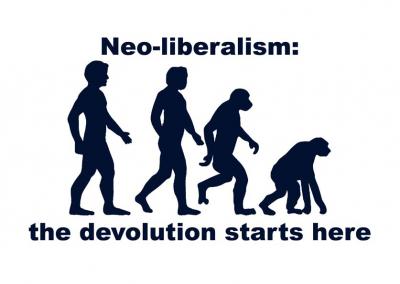
Part of the problem has been the US-led imposition of an economic dogma called “neoliberalism” (which is neither new nor liberal) on much of the rest of the world.

Neoliberalism can be roughly defined as:

1) Financialisation, i.e., allowing investors to make money from money as opposed to tangible things;

2) Deregulating financial services;

3) Taking out government insurance policies so that working people bail out financial institutions;

4) Cutting taxes for the wealthy;

5) Privatising public services to reduce social mobility;

6) Imposing austerity to make markets more attractive to investors.

Neoliberalism has cut taxes for the super-rich, enabling them to hold onto their wealth at the expense of others. According to Oxfam, the average rate of personal income tax for the wealthy was 62% in 1970. In 2013, it was 38%. In the UK, the poorest 10% pay a higher proportion of their income in taxes than the richest 10%. Global GDP, i.e., how much money there is in the world, is $80 trillion. But, of this, $7.6 trillion is untaxed. In the decade since the financial crisis, the number of billionaires doubled. This reveals that the system rewards greed. In 2017, 43 people owned as much wealth as half the world’s poorest. In 2018, the number was 26.

To put all this into perspective, Jeff Bezos owns as much wealth as the poorest fifty countries. When it comes to more ‘developed’ nations, Bezos’s wealth equals the entire GDP of Hungary. Consider how Bezos makes his money. Amazon is a corporation that primarily advertises and delivers products. The innovation, design, and investment in and of those products is the work of others. Amazon treats “workers like robots” by spying on them, discouraging unions, offering insecure contracts, and encouraging long hours. Amazon is also notorious for paying little or no corporation tax. Amazon is an online retailer. The Internet was developed by the US Defense Department in the 1960s as ARPANET, with public money. The satellites that enable online transactions are first and foremost military hardware. Not only did Amazon take advantage of state-funded innovation, but it also rewards government investors by selling the CIA cloud technology and the Pentagon artificial intelligence.

Bezos is far from being the only one. Bill Gates’s Microsoft and the late Steve Jobs’s Apple, which became the first trillion-dollar company, also enjoy low taxes, technologies developed with government grants, and procurement contracts.

Consider also the immoral activities of other hi-tech nouvelle méga riche. Without making it clear to users, Facebook founder Mark Zuckerberg (worth $66bn) has made his money by selling personal data to insurers and advertisers. Scientists have used Facebook in social media experiments without the knowledge or consent of users in an effort to see how memes affect mood.

Other mega-rich, including the hedge fund manager Robert Mercer of Renaissance Technologies, used Facebook to market political candidates. Other tech billionaires include Google founders Larry Page and Sergey Brin. Google technology was funded by the CIA’s venture capital firm In-Q-Tel. Also relying on technologies developed by the Pentagon with workers’ tax dollars, the company cooperates with the National Security Agency to spy on citizens and it has even enabled US assassination programmes.

Consequences

How do the billionaires get away with it, and what are the social and political consequences? The examples below are from the US, but it should be noted that the US exports its mega-wealth model.

A study by Martin Gilens and Benjamin I. Page on plutocracy (government by the rich) notes that the rich buy political parties. Politicians draft and/or vote for laws that help the rich. The authors analysed 1,779 policy issues in the US and conclude that “average citizens and mass-based interest groups have little or no independent influence.” Unlike the public, “economic elites and organised groups representing business interests have substantial independent impacts on US government policy.” Other research into wealth inequality in the US finds that “[c]ertain policies, such as the decreased support for unions and tax cuts favouring the relatively well-off and corporations, have benefitted a small minority of the population at the expense of the majority and have thus contributed to widening income inequality.”

At the turn of the last century, 9% of American families owned 71% of the nation’s wealth. The elite of the day included familiar names: John D. Rockefeller (oil), J.P. Morgan (banking), W. Averell Harriman (industry), and so on. Things balanced out after the Second World War, with the majority of Americans becoming middle class. Gradually, state controls over the economy were removed, and the situation reverted to the inequality of bygone centuries.

Since the 1970s, the US middle class has been shrinking. Until recently, the middle classes of Asia grew, precisely because strong Asian economies (notably China, South Korea, and Singapore) either retained some state controls or refused to adopt the US neoliberal model.

Alan B. Krueger, a labour economist and key Obama advisor, explains that, “since the 1970s income has grown more for families at the top of the income distribution than in the middle, and it has shrunk for those at the bottom.” Between 1979 and 2007, the top 1% ((multi)millionaires and (multi)billionaires) enjoyed a 278% increase in their after-tax incomes. But 60% of Americans saw their incomes rise by just 40%, which when adjusted for rising living costs means stagnation. Krueger notes that during that period, $1.1 trillion of annual income was moved to the top 1%. “Put another way, the increase in the share of income going to the top 1% over this period exceeds the total amount of income that the entire bottom 40 percent of households receives.”

The exportation of this model means that Australia, Britain, and Canada became what the billionaire-dollar liquidity firm Citigroup calls “plutonomies,” economies in which the rich drive luxury goods markets such as jewellery, fashion, cruises, and sports cars: hence the recent entry of celebrity Kylie Jenner into the billionaire class. The Citigroup document also notes that in plutonomies the top 1% owns 40% as much wealth as the bottom 95%. No matter where you live, you can’t escape the institutional structures that create inequality.

The US military exists, in part, to maintain the unjust status quo. Yet, it acknowledges the dangers of dominance: “A global populace that is increasingly attuned and sensitive to disparities in economic resources and the diffusion of social influence,” thanks in part to the very technologies that enrich the rich, “will lead to further challenges to the status quo and lead to system rattling events,” like Brexit or the Yellow Vest protestors in France.

The mega-rich and international think tanks and forums they sponsor are beginning to reluctantly accept that their status quo political puppets might get voted out of office and give way to so-called far-left or far-right parties unless they address wealth inequality.

New Paradigms of Control

The question, then, is how to deal with the restless and disaffected majority while not radically altering the system and taking away the privileges of the elite. In 1961, US President John F Kennedy said: “If a free society cannot help the many who are poor, it cannot save the few who are rich.” In the 1980s, World Economic Forum founder Klaus Schwab said: “Economic globalisation has entered a critical phase. A mounting backlash against its effects… is threatening a very disruptive impact on economic activity and social stability in many countries… This can easily turn into revolt.” More recently, he said: “Today, we face a backlash against that system and the elites who are considered to be its unilateral beneficiaries.” Likewise, the billionaire Johann Rupert of Cartier jewellery (one of the many luxury services driving plutonomies) said: “We are destroying the middle classes at this stage and it will affect us.” Similarly, the British MoD discusses “[m]anagement of societal inequalities,” as opposed to the elimination of social inequality.

Many of the new elites make people redundant by automating the workplace. While Amazon still relies on human shelf-stackers and delivery drivers, it uses an increasing number of physical robots to stack shelves and algorithmic robots to assist online customers. Likewise, Facebook and Google’s content filters rely on heavy automation. This is creating precarious employment conditions. According to the Washington Post (which is owned by Bezos): “…the modern emerging workforce of tech, urbanised professionals, and ‘gig economy’ labourers all represent an entirely new political demographic.” Politicians then “focus more on education, research and entrepreneurship, and less on regulations and the priorities of labour unions.”

But there are many problems. For one thing, the financial services economy, which markets everything, has made “education” a form of unsustainable debt. The quality of US education is notoriously low by world standards, and many young people are “overqualified” for menial jobs, like delivering for Uber or stacking shelves in Amazon warehouses. The UK MoD acknowledges that, “Freelance work is… often low-paid, lacking the benefits and security of formal employment and, therefore, the growth of the gig economy could increase inequality.”

The crisis of what to do with a young, indebted, restless population automated out of steady work by – and competing with – algorithms and physical robots has been considered for at least 50 years.

Traditionally, ‘education’ meant brainwashing children to work in menial jobs for life in adulthood. But as the economy changes and employment becomes less stable, new methods of ‘education’ for re-skilling adults are required. In the late 1960s, future political advisor Zbigniew Brzezinski authored a book in which he advocated for lifelong learning as a way of re-skilling an aging population that finds its employment opportunities diminished, as small-to-medium-sized businesses get overtaken by tech giants. Around the same time, the British Labour Party (when it was a real labour party) introduced the Open University with the aim of providing lifelong learning. Likewise, in the 1980s, futurist Alvin Toffler envisaged an “electronic village” in which flexible working hours and lifelong learning would be required in a hi-tech economy.

To keep the poor from rioting while trapping them in a system that works for those who design it, today’s multibillionaire elites help to privatise public services and education by offering scholarships and infrastructure investments. In doing so, they train poor people to work for their system by developing others’ technology skills while hiding their own taxable wealth in charity foundations.

Howard G. Buffett is the son of Warren. While enjoying largely tax-free wealth that further impoverishes the global poor, the Buffetts, via Howard’s foundation, invest in dams and irrigation in the poorest nations of Africa. Bezos’s foundation awards scholarships for STEM courses (Science, Technology, Engineering, Mathematics). Zuckerberg’s foundation seeks “to find new ways to leverage technology, community-driven solutions, and collaboration to accelerate progress in Science, Education, and within our Justice & Opportunity work.”

Conclusion

By using free online services, we have allowed ourselves to be the products that tech giants sell to advertisers. By not organising to raise taxes on the mega-wealthy, we have underfunded our public services. By not keeping an eye on who’s funding what, we’ve allowed our political parties to hoover up donations from elites. By failing to understand the economy, we’ve allowed a new normal of instability and political uncertainty to flourish to the advantage of asset managers and hedge fund investors. As the US pursues global domination, this model will continue to be exported. It’s time to wake up.
Colonizing the Western Mind

By Jason Hirthler

Source: CounterPunch

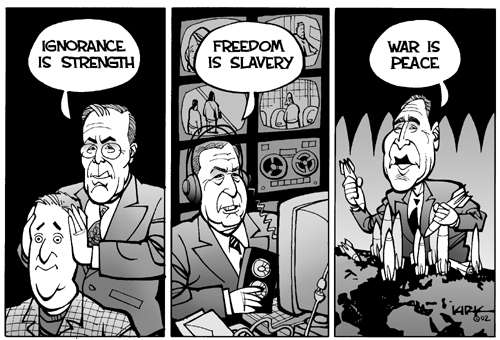
In Christopher Nolan’s captivating and visually dazzling film Inception, a practitioner of psychic corporate espionage must plant and idea inside a CEO’s head. The process is called inception, and it represents the frontier of corporate influence, in which mind spies no longer just “extract” ideas from the dreams of others, but seed useful ideas in a target’s subconscious. Inception is a well-crafted piece of futuristic sci-fi drama, but some of the ideas it imparts are already deeply embedded in the American subconscious. The notion of inception, of hatching an idea in the mind of a man or woman without his or her knowledge, is the kernel of propaganda, a black art practiced in the States since the First World War. Today we live beneath an invisible cultural hegemony, a set of ideas implanted in the mass mind by the U.S. state and its corporate media over decades. Invisibility seems to happen when something is either obscure or ubiquitous. In a propaganda system, an overarching objective is to render the messaging invisible by universalizing it within the culture. Difference is known by contrast. If there are no contrasting views in your field of vision, it’s easier to accept the ubiquitous explanation. The good news is that the ideology is well-known to some who have, for one lucky reason or another, found themselves outside the hegemonic field and are thus able to contrast the dominant worldview with alternative opinions. On the left, the ruling ideology might be described as neoliberalism, a particularly vicious form of imperial capitalism that, as would be expected, is camouflaged in the lineaments of humanitarian aid and succor.

Inception 1971

In a short span of time in the 1970s, dozens of think tanks were established across the western world and billions of dollars were spent proselytizing the tenets of the Powell Memo in 1971, which galvanized a counter-revolution to the liberal upswing of the Sixties. The neoliberal economic model of deregulation, downsizing, and privatization was preached by the Reagan-Thatcher junta, liberalized by the Clinton regime, temporarily given a bad name by the unhinged Bush administration, and saved by telegenic restoration of the Obama years. The ideology that underlay the model saturated academia, notably at the University of Chicago, and the mainstream media, principally at The New York Times. Since then it has trickled down to the general populace, to whom it now feels second nature. Today think tanks like the Heritage Foundation, the Brookings Institute, Stratfor, Cato Institute, American Enterprise Institute, Council on Foreign Relations, Carnegie Endowment, the Open Society Foundation, and the Atlantic Council, among many others, funnel millions of dollars in donations into cementing neoliberal attitudes in the American mind.

The ideological assumptions, which serve to justify what you could call neocolonial tactics, are relatively clear: the rights of the individual to be free of overreach from monolithic institutions like the state. Activist governments are inherently inefficient and lead directly to totalitarianism. Markets must be free and individuals must be free to act in those markets. People must be free to choose, both politically and commercially, in the voting booth and at the cash register. This conception of markets and individuals is most often formulated as “free-market democracy,” a misleading conceit that conflates individual freedom with the economic freedom of capital to exploit labor. So when it comes to foreign relations, American and western aid would only be given on the condition that the borrowers accepted the tenets of an (highly manipulable) electoral system and vowed to establish the institutions and legal structures required to fully realize a western market economy. These demands were supplemented with notions of the individual right to be free of oppression, some fine rhetoric about women and minorities, and somewhat more quietly, a judicial understanding that corporations were people, too. Together, an unshackled economy and an unfettered populace, newly equipped with individual rights, would produce the same flourishing and nourishing demos of mid-century America that had been the envy of humanity.

A False Promise

This ‘Washington Consensus’ is the false promise promoted by the West. The reality is quite different. The crux of neoliberalism is to eliminate democratic government by downsizing, privatizing, and deregulating it. Proponents of neoliberalism recognize that the state is the last bulwark of protection for the common people against the predations of capital. Remove the state and they’ll be left defenseless. Think about it. Deregulation eliminates the laws. Downsizing eliminates departments and their funding. Privatizing eliminates the very purpose of the state by having the private sector take over its traditional responsibilities. Ultimately, nation-states would dissolve except perhaps for armies and tax systems. A large, open-border global free market would be left, not subject to popular control but managed by a globally dispersed, transnational one percent. And the whole process of making this happen would be camouflaged beneath the altruistic stylings of a benign humanitarianism.

Globalists, as neoliberal capitalists are often called, also understood that democracy, defined by a smattering of individual rights and a voting booth, was the ideal vehicle to usher neoliberalism into the emerging world. Namely because democracy, as commonly practiced, makes no demands in the economic sphere. Socialism does. Communism does. These models directly address ownership of the means of production. Not so democratic capitalism. This permits the globalists to continue to own the means of production while proclaiming human rights triumphant in nations where interventions are staged. The enduring lie is that there is no democracy without economic democracy.

What matters to the one percent and the media conglomerates that disseminate their worldview is that the official definitions are accepted by the masses. The real effects need never be known. The neoliberal ideology (theory) thus conceals the neoliberal reality (practice). And for the masses to accept it, it must be mass produced. Then it becomes more or less invisible by virtue of its universality.

A Pretext for Pillage

Thanks to this artful disguise, the West can stage interventions in nations reluctant to adopt its platform of exploitation, knowing that on top of the depredations of an exploitative economic model, they will be asked to call it progress and celebrate it.

Washington, the metropolitan heart of neoliberal hegemony, has numerous methods of convincing reluctant developing nations to accept its neighborly advice. To be sure, the goal of modern colonialism is to find a pretext to intervene in a country, to restore by other means the extractive relations that first brought wealth to the colonial north. The most common pretexts for intervention depict the target nation in three distinct fashions.

First, as an economic basket case, a condition often engineered by the West in what is sometimes called, “creating facts on the ground.” By sanctioning the target economy, Washington can “make the economy scream,” to using war criminal Henry Kissinger’s elegant phrasing. Iran, Syria, and Venezuela are relevant examples here. Second, the West funds violent opposition to the government, producing unrest, often violent riots of the kind witnessed in Dara, Kiev, and Caracas. The goal is either to capsize a tottering administration or provoke a violent crackdown, at which point western embassies and institutions will send up simultaneously cries of tyranny and brutality and insist the leader step aside. Libya, Syria, and Venezuela are instructive in this regard. Third, the country will be pressured to accept some sort of military fettering thanks to either a false flag or manufactured hysteria over some domestic program, such as the WMD restrictions on Iraq, chemical weapons restrictions on Syria, or the civilian nuclear energy restrictions on Iran. Given that the U.S. traffics in WMDs, bioweapons, and nuclear energy itself, insisting others forsake all of these is perhaps little more than racially motivated despotry. But significant fear mongering in the international media will provide sufficient moral momentum to ram through sanctions, resolutions, and inspection regimes with little fanfare.

Schooling the Savages

Once the pretext is established, the appropriate intervention is made. There’s no lack of latent racism embedded in each intervention. Something of Edward Said’s Orientalism is surely at play here; the West is often responding to a crude caricature rather than a living people. One writer, Robert Dale Parker, described western views of Asia as little more than, “a sink of despotism on the margins of the world.” Iran is incessantly lensed through a fearful distrust of the ‘other’, those abyssal Persians. Likewise, North Korea is mythologized as a kingdom of miniature madmen, possessed of a curious psychosis that surely bears no relation to the genocidal cleansing of 20 percent of its population in the Fifties, itself an imperial coda to the madness of Hiroshima.

The interventions, then, are little different than the missionary work of early colonizers, who sought to entrap the minds of men in order to ensnare the soul. Salvation is the order of the day. The mission worker felt the same sense of superiority and exceptionalism that inhabits the mind of the neoliberal. Two zealots of the age peddling different editions of a common book. One must carry the gospel of the invisible hand to the unlettered minions. But the gifts of the enlightened interloper are consistently dubious.

It might be the loan package that effectively transfers economic control out of the hands of political officials and into the hands of loan officers, those mealy-mouthed creditors referred to earlier. It may be the sanctions that prevent the country from engaging in dollar transactions and trade with numberless nations on which it depends for goods and services. Or it might be that controversial UNSC resolution that leads to a comprehensive agreement to ban certain weapons from a country. Stipulations of the agreement will often include a byzantine inspections regime full of consciously-inserted trip wires designed to catch the country out of compliance and leverage that miscue to intensify confrontational rhetoric and implement even more far-reaching inspections.

Cracking the Shell

The benign-sounding structural adjustments of the West have fairly predictable results: cultural and economic chaos, rapid impoverishment, resource extraction with its attendant ecological ruin, transfer of ownership from local hands to foreign entities, and death from a thousand causes. We are currently sanctioning around 30 nations in some fashion; dozens of countries have fallen into ‘protracted arrears’ with western creditors; and entire continents are witnessing huge outflows of capital–on the order of $100B annually–to the global north as debt service. The profiteering colonialists of the West make out like bandits. The usual suspects include Washington and its loyal lapdogs, the IMF, World Bank, EU, NATO, and other international institutions, and the energy and defense multinationals whose shareholders and executive class effectively run the show.

So why aren’t Americans more aware of this complicated web of neocolonial domination? Italian communist Antonio Gramsci, who pioneered the concept of cultural hegemony, suggested that the ruling ideologies of the bourgeoisie were so deeply embedded in popular consciousness that the working classes often supported leaders and ideas that were antithetical to their own interests. Today, that cultural hegemony is neoliberalism. Few can slip its grasp long enough to see the world from an uncolored vantage point. You’ll very rarely encounter arguments like this leafing through the Times or related broadsheets. They don’t fit the ruling dogma, the Weltanschauung (worldview) that keeps the public mind in its sleepy repose.

But French-Algerian philosopher Louis Althusser, following Gramsci, believed that, unlike the militarized state, the ideologies of the ruling class were penetrable. He felt that the comparatively fluid zones of Ideological State Apparatuses (ISAs) were contexts of class struggle. Within them, groups might attain a kind of ‘relative autonomy’, by which they could step outside of the monolithic cultural ideology. The scales would fall. Then, equipped with new knowledge, people might stage an inception of their own, cracking open the cultural hegemony and reshaping its mythos in a more humane direction. This seems like an imperative for modern American culture, buried as it is beneath the hegemonic heft of the neoliberal credo. These articles of false faith, this ideology of deceit, ought to be replaced with new declarations of independence, of the mind if not the mainstream.


Jason Hirthler is a veteran of the communications industry and author of The Sins of Empire: Unmasking American Imperialism. He lives in New York City and can be reached at jasonhirthler@gmail.com.

The US economy has not recovered and will not recover

6a00d83451d87169e2014e8c142d89970d

By Paul Craig Roberts

Source: Intrepid Report

The US economy died when middle class jobs were offshored and when the financial system was deregulated.

Jobs offshoring benefitted Wall Street, corporate executives, and shareholders, because lower labor and compliance costs resulted in higher profits. These profits flowed through to shareholders in the form of capital gains and to executives in the form of “performance bonuses.” Wall Street benefitted from the bull market generated by higher profits.

However, jobs offshoring also offshored US GDP and consumer purchasing power. Despite promises of a “New Economy” and better jobs, the replacement jobs have been increasingly part-time, lowly-paid jobs in domestic services, such as retail clerks, waitresses and bartenders.

The offshoring of US manufacturing and professional service jobs to Asia stopped the growth of consumer demand in the US, decimated the middle class, and left insufficient employment for college graduates to be able to service their student loans. The ladders of upward mobility that had made the United States an “opportunity society” were taken down in the interest of higher short-term profits.

Without growth in consumer incomes to drive the economy, the Federal Reserve under Alan Greenspan substituted the growth in consumer debt to take the place of the missing growth in consumer income. Under the Greenspan regime, Americans’ stagnant and declining incomes were augmented with the ability to spend on credit. One source of this credit was the rise in housing prices that the Federal Reserve’s low interest rate policy made possible. Consumers could refinance their now higher-valued home at lower interest rates and take out the “equity” and spend it.

The debt expansion, tied heavily to housing mortgages, came to a halt when the fraud perpetrated by a deregulated financial system crashed the real estate and stock markets. The bailout of the guilty imposed further costs on the very people that the guilty had victimized.

Under Fed Chairman Bernanke, the economy was kept going with Quantitative Easing, a massive increase in the money supply in order to bail out the “banks too big to fail.” Liquidity supplied by the Federal Reserve found its way into stock and bond prices and made those invested in these financial instruments richer. Corporate executives helped to boost the stock market by using the companies’ profits and by taking out loans in order to buy back the companies’ stocks, thus further expanding debt.

Those few benefitting from inflated financial asset prices produced by Quantitative Easing and buy-backs are a much smaller percentage of the population than was affected by the Greenspan consumer credit expansion. A relatively few rich people are an insufficient number to drive the economy.

The Federal Reserve’s zero interest rate policy was designed to support the balance sheets of the mega-banks and denied Americans interest income on their savings. This policy decreased the incomes of retirees and forced the elderly to reduce their consumption and/or draw down their savings more rapidly, leaving no safety net for heirs.

Using the smoke and mirrors of under-reported inflation and unemployment, the US government kept alive the appearance of economic recovery. Foreigners fooled by the deception continue to support the US dollar by holding US financial instruments.

The official inflation measures were “reformed” during the Clinton era in order to dramatically understate inflation. The measures do this in two ways. One way is to discard from the weighted basket of goods that comprises the inflation index those goods whose price rises. In their place, inferior lower-priced goods are substituted.

For example, if the price of New York strip steak rises, round steak is substituted in its place. The former official inflation index measured the cost of a constant standard of living. The “reformed” index measures the cost of a falling standard of living.

The other way the “reformed” measure of inflation understates the cost of living is to discard price rises as “quality improvements.” It is true that quality improvements can result in higher prices. However, it is still a price rise for the consumer as the former product is no longer available. Moreover, not all price rises are quality improvements; yet many prices rises that are not can be misinterpreted as “quality improvements.”

These two “reforms” resulted in no reported inflation and a halt to cost-of-living adjustments for Social Security recipients. The fall in Social Security real incomes also negatively impacted aggregate consumer demand.

The rigged understatement of inflation deceived people into believing that the US economy was in recovery. The lower the measure of inflation, the higher is real GDP when nominal GDP is deflated by the inflation measure. By understating inflation, the US government has overstated GDP growth.

What I have written is easily ascertained and proven; yet the financial press does not question the propaganda that sustains the psychology that the US economy is sound. This carefully cultivated psychology keeps the rest of the world invested in dollars, thus sustaining the House of Cards.

John Maynard Keynes understood that the Great Depression was the product of an insufficiency of consumer demand to take off the shelves the goods produced by industry. The post-WW II macroeconomic policy focused on maintaining the adequacy of aggregate demand in order to avoid high unemployment. The supply-side policy of President Reagan successfully corrected a defect in Keynesian macroeconomic policy and kept the US economy functioning without the “stagflation” from worsening “Philips Curve” trade-offs between inflation and employment. In the 21st century, jobs offshoring has depleted consumer demand’s ability to maintain US full employment.

The unemployment measure that the presstitute press reports is meaningless as it counts no discouraged workers, and discouraged workers are a huge part of American unemployment. The reported unemployment rate is about 5%, which is the U-3 measure that does not count as unemployed workers who are too discouraged to continue searching for jobs.

The US government has a second official unemployment measure, U-6, that counts workers discouraged for less than one-year. This official rate of unemployment is 10%.

When long term (more than one year) discouraged workers are included in the measure of unemployment, as once was done, the US unemployment rate is 23%. (See John Williams, shadowstats.com)

Fiscal and monetary stimulus can pull the unemployed back to work if jobs for them still exist domestically. But if the jobs have been sent offshore, monetary and fiscal policy cannot work.

What jobs offshoring does is to give away US GDP to the countries to which US corporations move the jobs. In other words, with the jobs go American careers, consumer purchasing power and the tax base of state, local, and federal governments. There are only a few American winners, and they are the shareholders of the companies that offshored the jobs and the executives of the companies who receive multi-million dollar “performance bonuses” for raising profits by lowering labor costs. And, of course, the economists, who get grants, speaking engagements, and corporate board memberships for shilling for the offshoring policy that worsens the distribution of income and wealth. An economy run for a few only benefits the few, and the few, no matter how large their incomes, cannot consume enough to keep the economy growing.

In the 21st century US economic policy has destroyed the ability of real aggregate demand in the US to increase. Economists will deny this, because they are shills for globalism and jobs offshoring. They misrepresent jobs offshoring as free trade and, as in their ideology, free trade benefits everyone, claim that America is benefitting from jobs offshoring. Yet, they cannot show any evidence whatsoever of these alleged benefits. (See my book, The Failure of Laissez Faire Capitalism and Economic Dissolution of the West.)

As an economist, it is a mystery to me how any economist can think that a population that does not produce the larger part of the goods that it consumes can afford to purchase the goods that it consumes. Where does the income come from to pay for imports when imports are swollen by the products of offshored production?

We were told that the income would come from better-paid replacement jobs provided by the “New Economy,” but neither the payroll jobs reports nor the US Labor Department’s projections of future jobs show any sign of this mythical “New Economy.”

There is no “New Economy.” The “New Economy” is like the neoconservatives promise that the Iraq war would be a six-week “cake walk” paid for by Iraqi oil revenues, not a $3 trillion dollar expense to American taxpayers (according to Joseph Stiglitz and Linda Bilmes) and a war that has lasted the entirety of the 21st century to date, and is getting more dangerous.

The American “New Economy” is the American Third World economy in which the only jobs created are low productivity, low paid nontradable domestic service jobs incapable of producing export earnings with which to pay for the goods and services produced offshore for US consumption.

The massive debt arising from Washington’s endless wars for neoconservative hegemony now threaten Social Security and the entirety of the social safety net. The presstitute media are blaming not the policy that has devastated Americans, but, instead, the Americans who have been devastated by the policy.

Earlier this month I posted readers’ reports on the dismal job situation in Ohio, Southern Illinois, and Texas. In the March issue of Chronicles, Wayne Allensworth describes America’s declining rural towns and once great industrial cities as consequences of “globalizing capitalism.” A thin layer of very rich people rule over those “who have been left behind”—a shrinking middle class and a growing underclass. According to a poll last autumn, 53 percent of Americans say that they feel like strangers in their own country.

Most certainly these Americans have no political representation. As Republicans and Democrats work to raise the retirement age in order to reduce Social Security outlays, Princeton University experts report that the mortality rates for the white working class are rising. The US government will not be happy until no one lives long enough to collect Social Security.

The United States government has abandoned everyone except the rich.

In the opening sentence of this article, I said that the two murderers of the American economy were jobs offshoring and financial deregulation. Deregulation greatly enhanced the ability of the large banks to financialize the economy. Financialization is the diversion of income streams into debt service. When debt service absorbs a large amount of the available income, the economy experiences debt deflation. The service of debt leaves too little income for purchases of goods and services and prices fall.

Michael Hudson, whom I recently wrote about, is the expert on financialization. His book, Killing the Host, which I recommended to you, tells the complete story. Briefly, financialization is the process by which creditors capitalize an economy’s economic surplus into interest payments to themselves. Perhaps an example would be a corporation that goes into debt in order to buy back its shares. The corporation achieves a temporary boost in its share prices at the cost of years of interest payments that drain the corporation of profits and deflate its share price.

Michael Hudson stresses the conversion of the rental value of real estate into mortgage payments. He emphasizes that classical economists wanted to base taxation not on production, but on economic rent. Economic rent is value due to location or to a monopoly position. For example, beachfront property has a higher price because of location. The difference in value between beachfront and non-beachfront property is economic rent, not a produced value. An unregulated monopoly can charge a price for a service that is higher than the price that would bring that service unto the market.

The proposal to tax economic rent does not mean taxing you on the rent that you pay your landlord or taxing your landlord on the rent that you pay him such that he ceases to provide the housing. By economic rent Hudson means, for example, the rise in land values due to public infrastructure projects such as roads and subway systems. The rise in the value of land opened by a new road and housing and in commercial space along a new subway line is not due to any action of the property owners. This rise in value could be taxed in order to pay for the project instead of taxing the income of the population in general. Instead, the rise in land values raises appraisals and the amount that creditors are willing to lend on the property. New purchasers and existing owners can borrow more on the property, and the larger mortgages divert the increased land valuation into interest payments to creditors. Lenders end up as the major beneficiaries of public projects that raise real estate prices.

Similarly, unless the economy is financialized to such an extent that mortgage debt can no longer be serviced, when central banks lower interest rates property values rise, and this rise can be capitalized into a larger mortgage.

Another example would be property tax reductions and legislation such as California’s Proposition 13 that freeze in whole or part the property tax base. The rise in real estate values that escape taxation are capitalized into larger mortgages. New buyers do not benefit. The beneficiaries are the lenders who capture the rise in real estate prices in interest payments.

Taxing economic rent would prevent the financial system from capitalizing the rent into debt instruments that pay interest to the financial sector. Considering the amount of rents available to be taxed, taxing rents would free production from income and sales taxation, thus lowering consumer prices and freeing labor and productive capital from taxation.

With so much of land rent already capitalized into debt instruments shifting the tax burden to economic rent would be challenging. Nevertheless, Hudson’s analysis shows that financialization, not wage suppression, is the main instrument of exploitation and takes place via the financial system’s conversion of income streams into interest payments on debt.

I remember when mortgage service was restricted to one-quarter of household income. Today mortgage service can eat up half of household income. This extraordinary growth crowds out the production of goods and services as less of household income is available for other purchases.

Michael Hudson and I bring a total indictment of the neoliberal economics profession, “junk economists” as Hudson calls them.

The Rise of “Criminal Capitalism”

corporate-crime-525

By James Petras

Source: Dissident Voice

About 75% of US employees work 40 hours or longer, the second longest among all OECD countries, exceeded only by Poland and tied with South Korea. In contrast, only 10% of Danish workers, 15% of Norwegian, 30% of French, 43% of UK and 50% of German workers work 40 or more hours. With the longest work day, US workers score lower on the ‘living well’ scale than most western European workers. Moreover, despite those long workdays US employees receive the shortest paid holidays or vacation time (one to two weeks compared to the average of five weeks in Western Europe). US employees pay for the costliest health plans and their children face the highest university fees among the 34 countries in the Organization for Economic Cooperation and Development (OECD).

In class terms, US employees face the greatest jump in income inequalities over the past decade, the longest period of wage and salary decline or stagnation (1970 to 2014) and the greatest collapse of private sector union membership, from 30% in 1950 down to 8% in 2014.

On the other hand, profits, as a percentage of national income, have increased significantly. The share of income and profits going to the financial sector, especially the banks and investment houses, has increased at a faster rate than any other sector of the US economy.

There are two polar opposite trends: Employees working longer hours, with costlier services and declining living standards while finance capitalists enjoy rapidly rising profits and incomes.

Paradoxically, these trends are not directly based on greater ‘workplace exploitation’ in the US.

The historic employee-finance capitalist polarization is the direct result of the grand success of the trillion dollar financial swindles, the tax payer-funded trillion dollar Federal bailouts of the crooked bankers, and the illegal bank manipulation of interest rates. These uncorrected and unpunished crimes have driven up the costs of living and producing for employees and their employers.

Financial ‘rents’ (the bankers and brokers are ‘rentiers’ in this economy) drive up the costs of production for non-financial capital (manufacturing). Non-financial capitalists resort to reducing wages, cutting benefits and extending working hours for their employees, in order to maintain their own profits.

In other words, pervasive, enduring and systematic large-scale financial criminality is a major reason why US employees are working longer and receiving less – the ‘trickle down’ effect of mega-swindles committed by finance capital.

Mega-Swindles, Leading Banks and Complicit State Regulators

Mega-swindles, involving trillions of dollars, are routine practices involving the top fifty banks, trading houses, currency speculators, management fund firms and foreign exchange traders.

These ‘white collar’ crimes have hurt hundreds of millions of investors and credit-card holders, millions of mortgage debtors, thousands of pension funds and most industrial and service firms that depend on bank credit to meet payrolls, to finance capital expansion and technological upgrades and raw materials.

Big banks, which have been ‘convicted and fined’ for mega-swindles, include Citi Bank, Bank of America, HSBC, UBS, JP Morgan, Barclay, Goldman Sachs, Royal Bank of Scotland, Deutsche Bank and forty other ‘leading’ financial institutions.

The mega-swindlers have repeatedly engaged in a great variety of misdeeds, including accounting fraud, insider trading, fraudulent issue of mortgage based securities and the laundering of hundreds of billions of illegal dollars for Colombian, Mexican, African and Asian drug and human traffickers.

They have rigged the London Interbank Official Rate (LIBOR), which serves as the global interest benchmark to which hundreds of trillions of dollars of financial contracts are tied. By raising LIBOR, the financial swindlers have defrauded hundreds of millions of mortgage and credit-card holders, student loan recipients and pensions.

Bloomberg News (5/20/2015) reported on an ongoing swindle involving the manipulation of the multi-trillion-dollar International Swaps and Derivatives Association (ISDA) fix, a global interest rate benchmark used by banks, corporate treasurers and money managers to determine borrowing costs and to value much of the $381 trillion of outstanding interest rate swaps.

The Financial Times (5/23/15, p. 10) reported how the top seven banks engaged in manipulating fraudulent information to their clients, practiced illegal insider trading to profit in the foreign exchange market (forex), whose daily average turnover volume for 2013 exceeded $5 trillion dollars.

These seven convicted banks ended up paying less than $10 billion in fines, which is less than 0.05% of their daily turnover. No banker or high executive ever went to jail, despite undermining the security of millions of retail investors, pensioners and thousands of companies.

The Direct Impact of Financial Swindles on Declining Living Standards

Each and every major financial swindle has had a perverse ripple effect throughout the entire economy. This is especially the case where the negative consequences have spread downward through local banks, local manufacturing and service industries to employees, students and the self-employed.

The most obvious example of the downward ripple effect was the so-called ‘sub-prime mortgage’ swindle. Big banks deliberately sold worthless, fraudulent mortgage-backed securities (MBS) and collateralized debt obligation (CDO) to smaller banks, pension funds and local investors, which eventually foreclosed on overpriced houses causing low income mortgage holders to lose their down payments (amounting to most of their savings).

While the effects of the swindle spread outward and downward, the US Treasury propped up the mega-swindlers with a trillion-dollar bailout in working people’s tax money. They anointed their mega-give-away as the bail out for ‘banks that are just too big to fail”! They transferred funds from the public treasury for social services to the swindlers.

In effect, the banks profited from their widely exposed crimes while US employees lost their jobs, homes, savings and social services. As the US Treasury pumped trillions of dollars into the coffers of the criminal banks (especially on Wall Street), the builders, major construction companies and manufacturers faced an unprecedented credit squeeze and laid off millions of workers, and reduced wages and increased the hours of un-paid work.

Service employees in consumer industries were hit hard as wages and salaries declined or remained frozen. The costs of the FOREX, LIBOR and ISDA fix swindles’ fell heavily on big business, which passed the pain onto labor: cutting pension and health coverage, hiring millions of ‘contingent or temp’ workers at minimum wages with no benefits.

The bank bailouts forced the Treasury to shift funds from ‘job-creating’ social programs and national infrastructure investment to the FIRE (finance, insurance and real estate) sector with its highly concentrated income structure.

As a result of the increasing concentration of wealth among the financial swindlers, inequalities in income grew; wages and salaries were frozen or reduced and manufacturers outsourced production, resulting in declines in production.

Employees, suffering from the loss of income brought on by the mega-swindles, found that they were working longer hours for less pay and fewer benefits. Productivity suffered. With the total breakdown of the ‘capitalist rules of the game’, investors lost confidence and trust in the system. Mega-swindles eroded ‘confidence’ between investors and traders, and made a mockery of any link between performance at work and rewards. This severed the nexus between highly motivated workers, engaged in ‘hard work, long hours’ and rising living standards, and between investment and productivity.

As a result, profits in the finance sector grew while the domestic economy floundered and living standards stagnated.

Financial Impunity: Regulatees Controlling the Regulators

Despite the proliferation of mega-swindles and their pervasive ripple effects throughout the economy and society, none of the dozens of federal or state regulatory agencies intervened to stop the swindle before it undermined the domestic economy. No CEO or banker was ever arrested for their part in the swindle of trillions. The regulators only reacted after trillions had ‘disappeared’ and swindles were ‘a done deal’. The impunity of the swindlers in planning and executing the pillage of hundreds of millions of employees, taxpayers and mortgage holders was because the federal and state regulatory agencies are populated by ‘regulatory administrators’ who came from or aspired to join the financial sector they were tasked with ‘regulating’.

Most of the high officials appointed to lead the regulatory agencies had been selected by the ‘Lords of Wall Street, Frankfurt, the City of London or Zurich.’ Appointees are chosen on the basis of their willingness to enable financial swindles. It therefore came as no surprise on May 28 2015 when US President Obama approved the appointment of Andrew Donahue, Managing Director and Associate General Council for the repeatedly felonious, mega-swindling banking house of Goldman Sachs to be the ‘Chief of Staff’ of the Security and Exchange Commission. His career has been typical of the Washington-Wall Street ‘Revolving Door’.

Only after fraud and swindles evoked the nationwide public fury of mortgage holders, investors and finance companies did the regulators ‘investigate’ the crimes and even then not a single major banker was jailed, not a single major bank was closed down.

There were a few low-level bond traders and bank employees who were fired or jailed as scapegoats. The banks paid puny (for them) fines, which they passed on to their customers. Despite pledges to ‘mend their ways’ the bankers concocted new schemes with their windfalls of billions of Federal ‘bailout’ money while the regulators looked on or polished their CV’s for the next pass through the ‘revolving door’.

Every top official in Treasury, Commerce and Trade, and every regulator in the Security Exchange Commission (SEC) who ‘retired to the private sector’ has ended up working for the same mega-criminal banks and finance houses they had investigated, regulated and ‘slapped on the wrist’.

As one banker, who insists on anonymity, told me: ‘The most successful swindlers are those who investigated financial transgressions’.

Conclusion

Mega-swindles define the nature of contemporary capitalism. The profits and power of financial capital is not the outcome of ‘market forces’. They are the result of a system of criminal behavior that pillages the Treasury, exploits the producers and consumers, evicts homeowners and robs taxpayers.

The mega swindlers represent much less than 1% of the class structure. Yet they hold over 40% of personal wealth in this country and control over 80% of capital liquidity.

They grow inexorably rich and richer, even as the rest of the economy wallows in crisis and stagnation. Their swindles send powerful ripples across the national economy, which ultimately freeze or reduce the income of the skilled (middle class) employees and undermine the living conditions for poor working-class whites, and especially under and unemployed Afro-American and Latino American young workers.

Efforts to ‘moralize’ capital have failed repeatedly since the regulators are controlled by those they claim to ‘regulate’.

The rare arrest and prosecution of any among the current tribe of mega-swindlers would only results in their being replaced by new swindlers. The problem is systemic and requires deep structural changes.

The only answer is to build a political movement independent of the two party system, willing to nationalize the banks and to pass legislation outlawing derivatives, forex trading and other unnatural parasitic speculative activities.

James Petras is author of Extractive Imperialism in the Americas: Capitalism’s New Frontier (with Henry Veltmeyer) and The Politics of Empire: The US, Israel and the Middle East. Read other articles by James, or visit James’s website.

Neoliberalism Is Changing Our World Without Our Even Noticing

neo_liberalism_devolution_via_permanentculturenow.com_

Wendy Brown charts the ‘stealth revolution’ that’s transforming every aspect of society — and now has democracy in its sights.

By Hans Rollmann

Source: PopMatters

‘Neoliberalism’ is a much confused and maligned term these days. Progressive activists deploy it derisively as a general sort of derogatory label; learned professors write articles on the topic without really saying anything more penetrating. It’s as over-used an idiom as globalization (or as capitalism and socialism were 70 years ago). Even Anti-Flag take up the subject in their 2012 track “The Neoliberal Anthem”: “Strap in and watch the world decay!” they proclaim. Blunt, but not inaccurate.

Yet for all its confounded usages, what exactly does it signify?

In a 2013 review essay in the Los Angeles Review of Books that is more useful – if less straightforward – than Anti-Flag, Michael W. Clune described neoliberalism as “an economic doctrine that favors privatization, deregulation, and unfettered free markets over public institutions and government.” (”What Was Neoliberalism?”, 26 February 2013)

But it’s much more than that. Now, in Undoing the Demos: Neoliberalism’s Stealth Revolution, political theorist Wendy Brown contributes a truly useful text on an over-wrought topic, and one which focuses not only on the economic manifestations of neoliberalism, but on its broader effects on our political and social thinking. “Neoliberalism is a distinctive mode of reason, of the production of subjects, a ‘conduct of conduct,’ and a ‘scheme of valuation,’” she writes. It’s a mode of thinking, and the manner in which it emerges can be infinitely varied. We must be alert to neoliberalism’s “inconstancy and plasticity”, she warns, and its ability to reconfigure itself in new guises. Neoliberalism “takes diverse shapes and spawns diverse content and normative details, even different idioms. It is globally ubiquitous, yet disunified and nonidentical with itself in space and over time.” It’s a slippery beast, in other words – hard to define and even harder to see when it’s happening.

Brown’s work is an important and vital contribution at this time insofar as it takes aim at the beating heart of neoliberalism: its insinuation in the very institutions and identities which were hitherto used to limit its spread; institutions which, it was once hoped, would sustain deeper and more profound values implicit to democratic society and human sociality.

Brown is less interested than other scholars in the grim economics of neoliberalism: what she focuses on is its implicit threat to democracy. She opens her book by charting the emergence and contestation between ‘homo politicus’ and ‘homo oeconomicus’; between the human who uses politics to shape their world, and the human who is driven by self-interest and sees the world as always already shaped by economics. French philosopher Michel Foucault discussed this dichotomy in his 1978-79 College de France lectures on the Birth of Biopolitics, and Brown analyzes what Foucault saw – and failed to see – about this early emergence of neoliberal rationality.

In a superb if lamentably short section on gender she also discusses the question: “Does homo economicus have a gender? Does human capital? Is there a femina domestica invisibly striating or supplementing these figures…?” Her point is that “liberalism’s old gender problem is intensified by neoliberalism”, or that neoliberalism impacts women with particular vehemence.

Having discussed Foucault’s early charting of neoliberal political rationality, and expanded on his ideas in light of neoliberalism’s trajectory in the past 30 years, Brown analyzes some modern examples of neoliberalism’s diverse expressions. She looks at how it has insinuated itself in governance – in the notion of building consensus, rather than appreciating contestation; in the depoliticization of government; in the valorization of benchmarking and best practices. All of these deliver destructive blows against democratic political will, against the notion that humans can determine their own destiny and ought to shape their own reality. Instead of making their own decisions, governments appoint ‘external consultants’ to tell them what they should be doing; instead of inventing new ideas and ways of doing things, governments survey ‘best practices’ and see what everyone else is doing. It represents, in many ways, the triumph of mediocrity.

Neoliberal rationality infects law and legal reason, as well. Brown offers an in-depth analysis of the Citizens United case, which protected the right of corporations and the wealthy to dominate democratic elections in the US with their overwhelming power of capital. She also offers one of the best and most thorough analyses of how neoliberal rationality is destroying higher education: the post-WWII dream of an educated and equal society has been twisted into an economistic view, which holds that universities exist only to enhance capital; and that the purpose of an education is not to become better able to contribute to the broader political community, but rather to enhance one’s own ability to generate further capital.

Brown’s book is theoretical yet accessible; it’s an important and vital interjection which reveals and casts bare the neoliberal rationality that increasingly governs our world.

Dismantling Neoliberal Rationality

There’s an implicit warning in Brown’s text, which she addresses briefly but is worth some additional reflection. Audre Lorde famously cautioned against using the master’s tools to dismantle the master’s house, and increasingly this is precisely the direction in which efforts to limit the ravages of neoliberal thinking have turned, using economistic arguments in an effort to preserve institutions and principles that are premised on other-than-economistic values. Some examples serve to illustrate this.

In the ‘80s and ‘90s, public-private partnerships (P3’s) emerged as a neoliberal strategy transferring control and responsibility for public infrastructure – roads, bridges, hospitals, schools – into private hands. The basic argument held that the private sector, not beholden to political interests but rather to principles of efficiency and maximization of cost and utility, would prove more efficient custodians of public infrastructure. This neoliberal argument piggybacked nicely onto the drive to lower taxes. In an environment where lower taxes resulted in reduced state budgets, maximizing cost and efficiency would ensure public dollars stretched as far as possible.

This argument was received sympathetically by a public which had been worked up (by conservative pundits and politicians) into a collective sense of outrage over personal tax obligations and a sense of diminishing consumer power. It struck an affective chord, even though it was not based on any solid research. Yet P3’s became a dominant and accepted approach to building and maintaining public infrastructure and services.

In the past decade, efforts to fight back against public-private partnerships have achieved some limited success and have taken as their point of departure the fact that these partnerships are in fact not very efficient or effective. The private sector, it turns out, is often even more inefficient and ineffective than the public sector, given that it is driven by values such as greed and profit as opposed to public accountability. Analyses of several P3 projects have revealed massive cost over-runs, invariably subsidized by taxpayers to a cost far in excess of what it would have cost the state to produce the infrastructure on its own. (”The Problem with Public-Private Partnerships”, by Toby Sanger and Corina Crawley, CCPA, 1 April 2009) Contractual stipulations often guarantee corporate profits at public expense, requiring the state to assume all the risk, using public funds to rescue projects when private partners fail or walk away, and in some cases even using public funds to top-up corporate profits that fail to meet agreed-upon projections. (”Ontario Auditor breaks new ground with review of public private partnerships methodology”, by Keith Reynolds, Policy Note, 5 January 2015)

All this is true, and revealing the truly ineffective and inefficient nature of P3s has been critical to turning them back in many cases. However, there’s a problem with this. These campaigns against P3s adopt the same economistic principles as were used to promote the notion of P3s in the first place: namely, that efficiency, cost maximization and capital enhancement ought to be the driving principles of the demos, or public state. The implicit argument is that P3s are wrong not because they transfer public ownership into private hands, but because they do so inefficiently and at the expense of the taxpayer. Granted, there is often a reference to P3s being ‘unaccountable’ to the public, but this is rarely interrogated or explored as deeply as it should be. In fact, it ought to lie at the core of public resistance to P3s. Public-private partnerships are wrong simply because the state ought never to allow public goods to fall under private control, even if it might save more money. Economization ought never to hold sway over the values, principles and political power of the public.

Similarly, neoliberal logic has infected other efforts to fight back against neoliberal initiatives. Labour unions – a common target of neoliberalism—are increasingly defended on the basis that they benefit the economy (through ensuring consistent and safe workplace practices as well as strong wages to bolster consumer spending in the community), rather than on the simpler basis that workers deserve the right to control their working conditions. Efforts to reduce tuition fees for out-of-province/state or international students are often predicated on the notion that their economic contribution to the local economy exceeds the value of their fiscal contribution to the university through tuition fees. Nowhere – or rarely – is the argument presented that post-secondary ought to be a public good and universal right in and of itself.

The danger, in other words, is that efforts to resist neoliberalism are increasingly being expressed in such a way that they serve to entrench and legitimize neoliberal values – economization, efficiency, capital enhancement—rather than questioning or challenging the desirability and social and political consequences of those values in the first place.

Brown acknowledges the urgency of the problem. It’s quite possible, she observes, for neoliberal economic policy to be paused or reversed but for “the deleterious effects of neoliberal reason on democracy” to survive, undermining the potential for substantive, entrenched change. Without tackling neoliberal reason, neoliberal economics and governance will inevitably emerge again. It is the ongoing sense of surrender to the inevitability of economics; of the bottom line; of finance as key determiner of what is politically possible, that dooms the political potential of democracy. Although only emerging at the end of the book, this is one of the key lessons it offers: that efforts to resist or reverse the ravages of neoliberal economics are fatally flawed when “NGOs, nonprofits, schools, neighborhood organizations, and even social movements that understand themselves as opposing neoliberal economic policies may nonetheless be organized by neoliberal rationality.”

Fascism’s Forbidden Face

Brown comes close to a forbidden truth in closing. She notes, with great delicacy and hesitation, the similarities between neoliberal rationality and fascism. “This is not to say that neoliberalism is fascism or that we live in fascist times,” comes the inevitable caveat. But what if it is an emerging form of fascism?

One of the troubling trends that’s emerged in recent decades and needs to be challenged more forcefully is the notion that it’s intellectually taboo, inaccurate or excessive to call something ‘fascist’, or to draw analogies to fascist states like Nazi Germany. An example of this taboo is ‘Godwin’s Law’ – the notion that referring to Hitler (or by extension, fascism broadly) destroys the credibility of your argument. It’s a trendy term, but intellectually dangerous. The fact is, fascism was – and is – very real, and the notion that no one should talk about fascism as seriously emerging in the present day is very much a product of our neoliberal era.

In fact we do need to talk about it. The skepticism with which the term ‘fascism’ is treated; the dismissal of arguments which make reference to Nazis, all collaborate in erasing and masking the very real resemblances that exist between historical fascism and contemporary forms of governance like neoliberalism. In its demand for self-sacrifice to the heartless whole – a demand iterated, for instance, in the sacrifice of millions of homeowners and mortgage defaulters in order to save the banks during the subprime mortgage crisis – neoliberal rationality resembles the demand for citizen self-sacrifice that characterized fascism.

George Orwell (in his remarkable book review of Adolf Hitler’s Mein Kampf) warned against underrating the emotional appeal of fascism. While socialism and even capitalism offered a vision of the good life – fewer working-hours, health and education, leisure and pleasure – people appear inevitably lured by the attraction of struggle and self-sacrifice. “Whereas Socialism, and even capitalism in a more grudging way, have said to people ‘I offer you a good time,’ Hitler has said to them ‘I offer you struggle, danger and death,’ and as a result a whole nation flings itself at his feet,” he wrote. The same could easily be said of neoliberalism: people have a remarkable knack of voting for economic tough-guys who promise to make life harder on individuals and communities in order to ‘save the economy’, whatever that’s supposed to mean.

Brown’s book is essential reading not only for academics but for anyone concerned with our collective political future, and with the defense of democratic politics. Her book ends on a grim note: “Despair” is the title of its final section. Brown has eloquently elucidated the problem, and made a profound contribution to understanding the complex nature of neoliberal rationality and its threat to democracy.

So what is the solution? Brown doesn’t have one, but notes there is no alternative but to keep struggling to find an alternative. We have reached a state of “civilizational despair”, she writes; modernism is dead and with it the hope and belief that we can create a better world. How do we counter this despair, and re-inject hope and alternatives into the world? Such a task “is incalculably difficult, bears no immediate reward, and carries no guarantee of success. Yet what, apart from this work, could afford the slightest hope for a just, sustainable, and habitable future?”


Hans Rollmann is a writer and editor based in Eastern Canada. He’s a columnist, writer and opinions editor with the online news magazine TheIndependent.ca as well as editor of Landwash, a journal of literary and creative arts published out of Newfoundland and Labrador. His work has appeared in a range of other publications both print and online, from Briarpatch Magazine to Feral Feminisms. In addition to a background in radio-broadcasting, union organizing and archaeology, he’s currently completing a PhD in Gender, Feminist & Women’s Studies in Toronto. He can be reached by email at hansnf@gmail.com or @hansnf on Twitter.