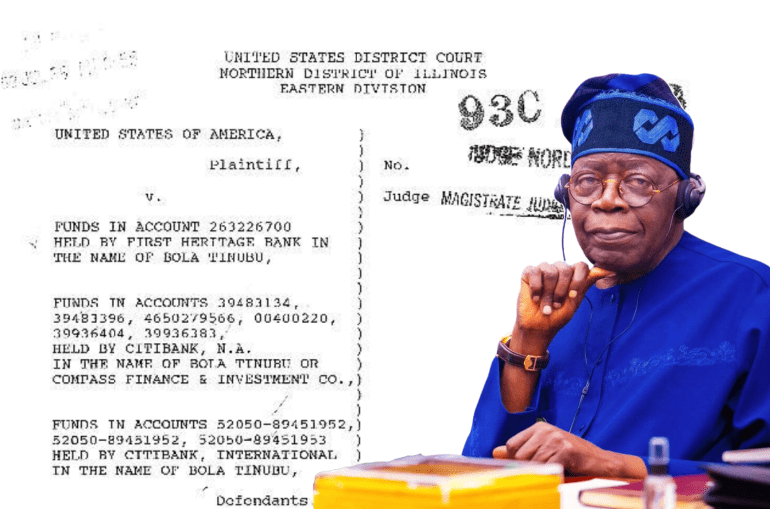
From Chi-Town bagman to ECOWAS chairman: meet the former money launderer leading the push to invade Niger

By Alexander Rubinsteain and Kit Klarenberg

Source: The Grayzone

Since the overthrow of Niger’s US-friendly government, West African nations of the ECOWAS bloc have threatened an invasion of their neighbor.

Before leading the charge for intervention, ECOWAS chair Bola Tinubu spent years laundering millions for heroin dealers in Chicago, and has since been ensnared in numerous corruption scandals.

Hours after Niger’s Western-backed leader was detained by the country’s presidential guard on July 28, Nigerian President and chair of the Economic Community of West African States (ECOWAS) Bola Tinubu leapt into action, warning that the group of nations “will not tolerate any situation that incapacitates the democratically-elected government.”

“As the Chairperson of ECOWAS…I state without equivocation that Nigeria stands firmly with the elected government in Niger.”

Two days later, ECOWAS imposed severe sanctions on Niger, and the bloc issued a stark ultimatum: if the newly-inaugurated junta won’t reinstall the ousted president in a week’s time, the group’s pro-Western African governments will — by military means, if necessary. 

On Saturday, July 6 — one day before the deadline — ECOWAS leaders approved a plan to invade the country, with the ominous caveat that they are “not going to tell the coup plotters when and where we are going to strike.”

If ECOWAS gets its way, member states Benin, Cabo Verde, Côte d’Ivoire, The Gambia, Ghana, Guinea Bissau, Liberia, Nigeria, Sierra Leone, Sénégal and Togo will be pressured to send their soldiers to invade Niger.

These developments have thrust the typically-overlooked West African country of Niger into the Western media spotlight. But if hostilities break out, it wouldn’t just be one single impoverished African state in the crosshairs.

Neighboring Burkina Faso, Mali and Guinea, which are also governed by military administrations that recently seized power by force, have all warned that any attack on Niger will be viewed as an attack on them too. If their ECOWAS rivals make the first move, the nations which mainstream media have dubbed Africa’s “coup belt” have pledged to unleash their military forces as well — an announcement which should end any illusions that restoring the country’s previous president would be a painless process.

Leading the pro-Western coalition is the president of its most powerful country, Nigeria: Bola Tinubu. One of Nigeria’s wealthiest men, the source of the scandal-plagued president’s fortune remains unclear.

Documents reviewed by The Grayzone reveal Tinubu as a longtime US asset who was named as an accomplice in a massive drug running operation that saw him launder millions on behalf of a heroin-dealing relative. 

Bola Tinubu’s career marred by drug-trafficking, corruption allegations

For over 30 years, Bola Tinubu has been a major force in Nigeria’s political scene and the country’s economy, with local nicknames ranging from “the Mother of the Market” to “the Godfather of Lagos” and “the Lion of Bourdillon.” But his power inside Nigeria went largely unnoticed by international audiences until 2023, when he became ECOWAS chair after winning the presidency in an election closely tracked by the US government.

As president, Tinubu quickly instituted a regime of economic reforms backed by the US-controlled International Monetary Fund and the World Bank. Over the course of Tinubu’s political career in Nigeria, the African operator has cultivated a close relationship with the US embassy. According to a slew of classified State Department cables released by WikiLeaks, American officials relied heavily on Tinubu’s assessments of the domestic political landscape.

The ECOWAS chair’s early life is shrouded in mystery, and even his exact age is unknown. Nearly every detail of Tinubu’s personal history — prior to his appearance in Chicago on a student visa — is in dispute, including his legal birth name.

Records from Chicago State University show that Tinubu received a degree in Business Administration in 1979. In the following years, media reports indicate that Tinubu was employed in some capacity at a number of major US-based multinationals, including Mobil Oil Nigeria, consulting firm Deloitte, and GTE, which was the largest communication and utilities company in the US at the time.

Of the few details about the Nigerian President’s early exploits which can be confirmed, many are derived from a 1993 court docket naming Tinubu as an accomplice in a massive midwestern drug smuggling operation. 

As journalist David Hundeyin has detailed, court documents from the US District Court’s Northern District of Illinois make it clear that Tinubu amassed a small fortune laundering money for a heroin-trafficking relative in Chicago, and that US government officials ultimately seized well over a million dollars from various bank accounts registered under the current Nigerian president’s name.

A 1993 report by IRS Special Agent Kevin Moss explained that “there is probable cause to believe that funds in certain bank accounts controlled by Bola Tinubu… represent proceeds of drug trafficking; therefore these funds are forfeitable to the United States.”

In the documents, Moss describes an extremely close working relationship between the future Nigerian president and two Nigerian heroin dealers named Abiodun Olasuyi Agbele and Adegboyega Mueez Akande, the latter of whom was listed as Tinubu’s cousin on an application for a vehicle loan.

“According to bank employees, when Bola Tinubu came to First Heritage Bank in December 1989 to open the accounts, he was introduced to them by Adegboyega Mueez Akande, who at that time maintained an account at the bank.” What’s more, bank records indicate that “Bola Tinubu also opened a joint checking account in his name and the name of his wife, Oluremi Tinubu,” who had “previously opened a joint bank account also at this bank with Audrey Akande, the wife of Adegboyega Mueez Akande,” Moss explained. In several of the applications, the addresses used by Tinubu exactly matched those previously used by Akande.
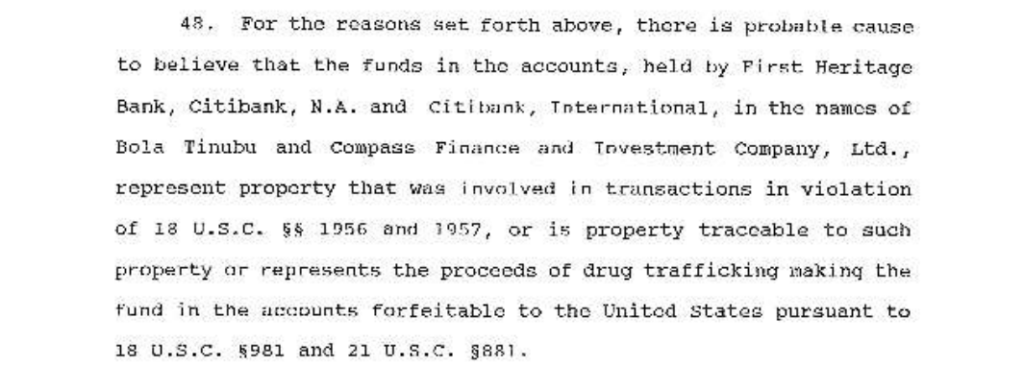
“According to bank records… Tinubu opened an individual money market account and a NOW account” at First Heritage Bank in December 1989, the special agent noted. “In the application, Tinubu stated that his address was 7504 South Stewart, Chicago, Illinois” — “the same address used previously by Akande.”
“Bank records disclosed that five days after the account was opened, on January 4, 1990, $80,000 was deposited into the NOW account at First Heritage Bank by wire transfer through First Chicago from Banc One Houston,” the report continues. According to the IRS, the money was sent by Akande.

But the Nigerian president’s financial dealings with the heroin traffickers went even further, according to the IRS special agent. He wrote that Citibank records documented “two additional corporate accounts held in the name of Compass Finance and Investment Company, Ltd. which were controlled by Bola Tinubu.”

“When Bola Tinubu opened these accounts,” he provided “a memorandum of association and articles of association” which “identified Mueez Adegboyega Akande and Abiodun Olasuyi Agbele as directors of Compass Finance and Investment Company, Ltd.,” Moss wrote.

In the end, Tinubu somehow managed to deposit over $660,000 in his First Heritage Bank account in 1990, and more than $1.2 million the next year — all while claiming to take home just $2,400 a month from his position at Mobil Oil Nigeria.

As the investigation into the money laundering scheme began to gain traction, Tinubu left the US and returned to Nigeria. Ultimately, Moss was able to speak to Tinubu by telephone on a number of occasions, and the special agent reported that the future president initially acknowledged his personal and financial dealings with the pair of drug traffickers. 

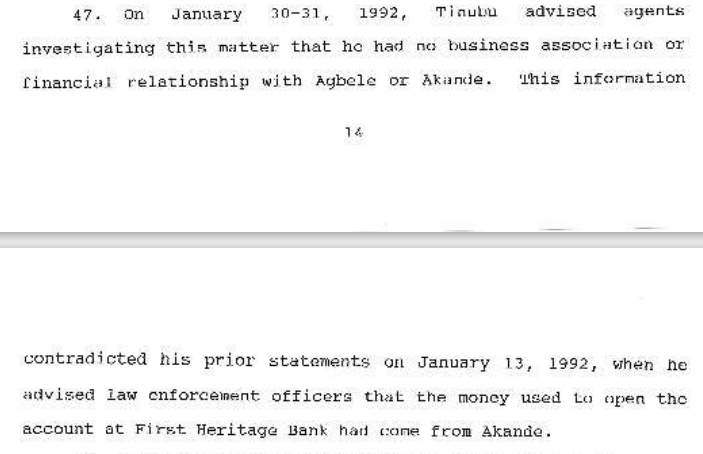
But in late January of 1992, “Tinubu advised agents investigating this matter that he had no business association or financial relationship with Abele or Akande,” Moss wrote. “This information contradicted his prior statements on January 13, 1992, when he advised law enforcement officers that the money used to open the account at First Heritage Bank had come from Akande.”

Back in Nigeria, Tinubu had already begun to transition into the political arena. By 1992, he’d been elected to the Senate, and in 1999 he became the Governor of Lagos State, a position he retained until 2007. At some point in his tenure, Tinubu established a relationship with the US Embassy which would last for years to come, according to a trove of diplomatic cables released by Wikileaks.

But even his State Department allies couldn’t help noticing Tinubu’s penchant for dishonesty. One particularly noteworthy cable pointed out that the politician was “known to play fast and loose with the facts” and “has been caught in the past embellishing his educational achievements.”

In the end, however, Tinubu’s usefulness seemed to outweigh his casual relationship with the truth, and the future Nigerian president went on to provide American officials with a near-continuous assessment of the political situation in his country. One typically intimate meeting with Tinubu ended with the US ambassador to Nigeria commenting: “as always, we found his take on the national political scene to be insightful.”

When the cables came to light in 2011, many Nigerians were shocked at the candor with which their elected officials spoke to Washington’s envoys. “The willingness of our elites to divulge unsolicited information about the nation to U.S. officials betrays an infantile thirst for a paternal dictatorship,” Nigerian-American professor and columnist Farooq Kperogi wrote.

Though Tinubu appeared to have escaped justice for his alleged role in a heroin trafficking conspiracy, accusations of corruption would continue to dog the ECOWAS chair throughout his political career in Nigeria. Since leaving office as governor of Lagos in 2007, Tinubu “picked every subsequent winning candidate,” according to German broadcaster DW, which noted earlier this year that the tycoon “is believed to be one of Nigeria’s richest politicians but the source of his wealth is unknown.”

In recent years, clues about the origins of the fortune amassed by one of Africa’s leading political players have begun to come to light.

In 2009, Tinubu came under investigation by the Metropolitan Police of London, who were probing allegations that the politician had pooled money with two other Nigerian governors to create a front company known as the “African Development Fund Incorporation.”

Investigators alleged the unusual business arrangement was actually a joint effort to illegally acquire shares of ECONET, a telecommunications firm founded by US intelligence asset and Gates Foundation trustee Strive Masiyiwa. But attempts to probe the legitimacy of the transactions in question were sidelined when the Nigerian federal government stonewalled the British investigation, which ultimately concluded without a single arrest. To this day, Nigerian authorities have yet to release the evidence requested by UK authorities.

In 2011, Tinubu was tried before the Code of Conduct Tribunal in Nigeria for illegally operating 16 foreign bank accounts. Eager to avoid the embarrassment he’d previously suffered when being photographed in court, the ECOWAS chair reportedly refused to take his place at the dock in a judicial hearing.

But the unwelcome attention appears to have done little to rein in the politician’s extravagant taste, and Tinubu once again found himself embroiled in a corruption scandal following an investigation into the luxurious 7,000-square foot mansion where the Nigerian president stays when receiving medical care in London.
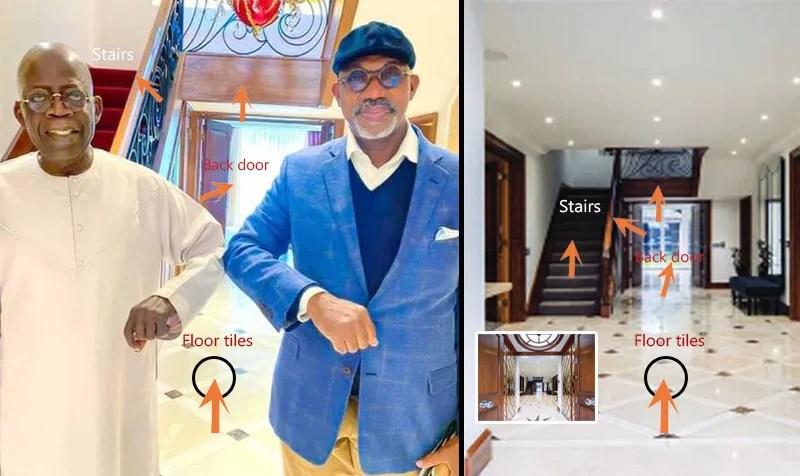
According to Nigerian outlet Premium Times, the massive villa in London’s exclusive Westminster borough was picked up for a song by Tinubu’s son, who somehow managed to purchase the property at a discount of approximately $10 million from a wealthy fugitive – even though the seller’s assets, including the mansion in question, had been frozen by a Nigerian court. Photos published on social media in 2017 show Tinubu posing inside the villa alongside Nigeria’s president at the time, Muhammadu Buhari.

The current and previous president worked closely for decades, and Tinubu has publicly claimed sole credit for Buhari’s presidency while campaigning. “If it were not for me standing before you leading the army, saying ‘Buhari, go ahead, we’re behind you,’ he could never have become the president,” he told supporters at a rally last year.

But the suspicious confluence of money and influence didn’t end with the mysterious mansion in London. During Nigeria’s 2019 general election, footage of armored trucks entering Tinubu’s residence went viral on social media, and the incident was widely seen as proof that the politician was engaged in a fraudulent vote-buying scheme. But Tinubu remained defiant, telling reporters, “I keep money wherever I want.”

“Excuse me, is it my money or government money?” he asked. “If I don’t represent any agency of government and I have money to spend, if I have money, if I like, I give it to the people free of charge,” he insisted.

This January, the official explanation for the episode evolved again when one of his party’s representatives told a Nigerian TV station that the armored trucks in question had simply “missed [their] way” and arrived at the wrong address. Asked why Tinubu had seemingly admitted to dispensing cash to the public, the party’s organizing secretary in Lagos offered the bemused presenters an equally improbable explanation: “he said that jokingly.”

ECOWAS as a neocolonial weapon

While ECOWAS was officially founded via the Treaty of Lagos in 1975, its official history notes the bloc’s origins date back to the creation of the CFA Franc in 1945, which consolidated France’s West African empire into a single-currency union. Publicly, the move was described as a benevolent attempt to shield these colonies from the consequences of the French franc’s sharp devaluation in 1945, following the creation of the US-dominated Bretton Woods system. As the French finance minister said at the time:

“In a show of her generosity and selflessness, metropolitan France, wishing not to impose on her faraway daughters the consequences of her own poverty, is setting different exchange rates for their currency.”

In reality, the introduction of the CFA Franc meant that Paris was able to maintain highly unequal trading relationships with its African colonies, at a time when its economy was ravaged by World War II and its overseas empire was rapidly disintegrating. The currency made it cheap for member states to import from France and vice versa, but prohibitively expensive for them to export anything anywhere else.

This forced dependency in Francophone West Africa created a captive market for the French, and by extension the rest of Europe. That dynamic, which has stunted regional economic development for decades, persists to this day. The CFA Franc’s continued dominance ensures West African states remain under the economic and political control of France. Those African nations are powerless to enact meaningful policy changes, as they lack control over their own monetary policy.

That the currency features so prominently in the authorized history of ECOWAS is instructive, because the bloc has long-been criticized as an extension of French imperialism. It was not for nothing that in 1960, then-French President Charles de Gaulle made membership of the CFA Franc a precondition for decolonization in Africa.

Though ECOWAS is theoretically meant to maximize member states’ collective bargaining power by fostering “interstate economic and political cooperation,” such harmonization makes it easier for former imperial powers like France to exploit and enfeeble their constituent countries. The bloc imposes a strict, Western-approved legal and financial framework upon its members, and any state deviating from these rules is harshly punished.

In January 2022, ECOWAS imposed strict sanctions on Mali, prompting thousands to take to the streets in support of the military government that seized power in January the previous year. The new government’s efforts to purge the country of malign foreign influence saw a complete ban on French media imposed, a decision which was slammed by the UN but cheered by average Malians.

ECOWAS applied similar measures to Burkina Faso in response to a September 2022 military coup, which saw Paul-Henri Sandaogo Damiba removed after just eight months in power. Though Damiba himself seized via military coup, there was little condemnation from Western officials and few suggestions that ECOWAS impose sanctions — perhaps due to the ousted leader’s pro-Western orientation and status as a graduate of multiple elite US military and State Department training courses.

Since 1990, ECOWAS has waged seven separate conflicts in West Africa, in order to protect the West’s preferred despots across the region. Meanwhile, between 1960 and 2020, Paris launched 50 separate overt interventions in Africa. Figures for clandestine activities conducted during this time are unavailable, but the country’s fingerprints are plastered all over multiple rigged elections, coups, and assassinations that have sustained compliant, corrupt governments in power throughout the continent.

As President Jacques Chirac remarked in 2008, “without Africa, France will slide down into the rank of a third [world] power.” This perspective was reaffirmed in a 2013 French Senate report, Africa is Our Future. Indeed, the mere existence of anti-imperialist governments anywhere in the region is intolerable to Paris. 

Luckily for the French elite, compromised figures like Bola Tinubu are still on hand to do their dirty work for them.
The Dynamics of War Insanity: NATO’s Ukraine Roulette

By Alfred de Zayas

Source: Information Clearing House

Deliberate provocations of a nuclear rival, coups d’état, colour revolutions, broken promises, broken treaties, escalation of tensions, demonization, invective, double-standards — all this while asserting adherence to international legal norms and playing innocent about our aggressions, our violations of the Hague and Geneva Conventions, of articles 1(2)[1], 2(3)[2], 2(4)[3] and 39[4] of the UN Charter.

Abrams tanks, Leopard tanks, F-16, indiscriminate weapons, depleted uranium, cluster bombs. Summits illustrate how the moral compass of the collective West is lost in the avalanche of fake news[5], fake history, fake law, bellicose rhetoric, media hyperbole, serial mobbing of dissenters, persecution of whistleblowers, censorship. The Western binary mindset continues to divide the world into good and bad countries, democracies and autocracies. There is little room to accommodate a comprehensive picture of the pre-history, root causes of conflicts, and nuances. One observes an almost total absence of a sense for proportions.

The Global Majority in Latin America, Africa and Asia is increasingly alarmed by the surrealistic spectacle of a collective West that seems out of control, developing its own lethal dynamic, displaying a paroxysm of Russophobia and Sinophobia, incitement to hatred, cancel culture, refusal to entertain serious dialogue, doubling-down on eschatological demands. Many non-Western thinkers and politicians are articulating justified warnings that the on-going intestinal conflicts in the West are adversely impacting the economies of third-world countries and may ultimately result in Apocalypse for the entire planet. The West is not playing the classical Russian roulette – it has developed its own version: Ukrainian roulette, compulsive apocalyptic vabanque.

Meanwhile the Western media, notably Reuters, AP, CNN, Fox, New York Times, Washington Post, BBC, Le Monde, Figaro, FAZ, der Spiegel, even the Swiss NZZ ensure the daily indoctrination doses for the Western public, purveying skewed narratives that repeat and embellish what Washington and Brussels ordain, blithely ignoring other views and perspectives and the principle audiatur et altera pars. Freedom of the media in the collective West seems to mean the right to repeat NATO narratives ad nauseam, even when they have been proven wrong. This “freedom” also includes the freedom to ignore every critical voice about NATO and to refrain from asking critical questions at NATO press conferences.

Western media systematically fail to report on the fears of billions of human beings in the rest of the world, Brazilians, Mexicans, South Africans, Ugandans, Indians, Chinese, who want peace and stability in the world as well as a chance for sustainable development. Many in these countries blame not Russia but Washington and Brussels for provoking the Ukraine conflict. This Global majority is not interested in whether Crimea lies in Russia or Ukraine. They demand a peaceful solution to an internal Western strife, so that the spill-over does not dislocate the economies of non-Western countries. Peace must be sought and achieved at the negotiating table and not on the battlefield.

The power of propaganda

On the legal, moral and political arenas, truth is less important than the perception of truth. Since time immemorial language has shaped our perception of reality, coloured it according to the political agenda of the powerful. Propaganda was not invented in the 21st century. It has always existed and generated an opportunistic pseudo-reality, an epistemology that subverts our understanding of facts and events. Labels, caricatures, generalizations serve as shortcuts to judgment and influence our daily behaviour in making choices. We are not obliged to use these templates, but most people unthinkingly do so.

The narrative managers of the mainstream media are bent on persuading us into believing who is good and who is bad, what politicians we should like, whom we should despise, what “metaphysic” we should consider valid within the mainstream epistemology. Of course, we still have our own brains and can use them – sapere aude! As Horatius used to say[6]. The sad thing is that even highly educated persons, graduates of Harvard, Oxford, Science-Po, continue to put their trust in media outlets that do not deserve our trust. As Julius Caesar put it: quae volumus, ea credimus libenter — we believe what we want to believe[7]. Indeed, it takes temerity to realize that our own politicians and media lie to us, that they are purveyors of dis-information and practitioners of Orwellian doublethink.

The human being has an innate desire to believe in a positive metaphysic, wants to look up to some authority, needs to have benchmarks, orientation points. That is why we are all to some degree negationists, resilient to bad news. In spite of the egregious official dis-information that preceded Western aggressions in Vietnam, Yugoslavia, Afghanistan, Iraq, Libya and Syria, we still want to believe that our governments are really champions of the rule of law and human rights, that they “mean well”, even if occasionally they inadvertently “make mistakes.”

Of course, it is painful to accept that some things that affect us are ugly, but the realization actually opens new vistas. If we reject blind faith in our leaders and practice a healthy scepticism, if we pro-actively look for other views and perspective, we grow up, become mature and experience a sense of liberation from illusions, acquiring a new purpose based on the facts as they stand, and not as we would like them to be.

The function of law

Law has an epistemological function in defining what is allowed and what is reprehensible. Law is not immutable or God-given, but constitutes a codification of the rules of the game at a particular moment in time and in a particular context. Law should not be confused with justice. Law is only the expression of a certain order of things, past and future generations and other civilizations may have entirely different legal orders and different ideas as to what justice entails.

Education teaches us to respect certain “red lines” established by the scribes of our society – the law makers in Parliaments, in the United Nations, in international conferences, such as those organized by the International Committee of the Red Cross, which have concretized the ius in bello, the laws of war. These codifications include the rejection of indiscriminate weapons such as land mines and cluster bombs. The international Convention banning Cluster Munition (123 signatories, 111 states parties)[8] of 3 December 2008 was signed by many states that now consider furnishing cluster bombs to Ukraine. Go figure!

Judges apply the laws that have been codified by institutions possessing law-making authority. This is what we like to call the “rule of law”, which must not be confused with the “rule of justice”. Moreover, the “rule of law” is systematically undermined when the legal profession engages in brazen double-standards and international tribunals like the International Criminal Court[9] practice selectivity, investigating only some crimes, while letting the crimes committed by Western countries go unpunished.

Criminal Organizations

Articles 9 and 10 of the London Agreement of 8 August 1945, the Statute of the International Military Tribunal at Nuremberg, as well as the Nuremberg judgment of 1 October 1946[10] created a precedent for a previously uncodified crime – membership in a “criminal organization”. Several NAZI organizations including the SS, the Gestapo and the Reich Cabinet were found to be criminal organizations, a problematic concept that flies in the face of the legal principle of the presumption of innocence.

If we fast-forward to the 21st century and consider the activities of the CIA, MI6, Mossad, targeted assassinations, overt and covert actions in violation of the Hague and Geneva Conventions, what is the relevance of the Nuremberg precedent to these organizations and to the North Atlantic Treaty Organization itself. If we compile the evidence of war crimes and crimes against humanity committed by NATO forces over the past 30 years, this would largely suffice for the International Criminal Court to issue indictments for violations of article 7 (crimes against humanity) and 8 (war crimes) of the Statute of Rome.

Initially NATO had its raison d’être under its 1949 Treaty. But the moment that the Warsaw Pact was dismantled in 1991 this justification fell away, and it gradually morphed into an imperialistic hegemonic military bloc, bent on imposing the Weltanschauung of the collective West on the rest of the world.

While Chapter VIII of the UN Charter recognizes the legitimacy of “regional arrangements” (articles 52-54) in the field of collective security, this requires that these regional arrangements be subordinated to the higher authority of the Security Council, which has a monopoly over the legal use of force. Since the 1990’s NATO has conspired to usurp the functions of the Security Council and thus far gotten away with it, although the NATO treaty must yield to the primacy of the UN Charter, pursuant to article 103 of the Charter, the “supremacy clause”. If States are dissatisfied with the current state of international law, it is for them to seek an amendment to the UN Charter pursuant to article 108.

Undoubtedly it was contrary to the UN Charter for NATO countries to use military force against Yugoslavia in 1999 in the absence of a Security Council resolution under Chapter VII and a finding under article 39 of the Charter that there had been a previous threat or breach of international peace and security and a failure of peaceful negotiations under the auspices of the United Nations. Without approval by the Security Council, NATO’s actions in Yugoslavia and elsewhere were simply illegal and engaged State civil and penal responsibility, including the obligation to pay reparations to the victims of the aggression. NATO actions since the entry into force of the Statute of Rome in 2001 deserve to be investigated under the rubric “crime of aggression” (article 5 off the Rome Statute) as complemented by the Kampala definition of aggression, and, of course under articles 7 and 8.

The end never justifies the means

The Florentine diplomat Nicolo Machiavelli never wrote the phrase “the end justifies the means” in his famous book The Prince. However, the thrust of the entire book is precisely that. Throughout the ages wielders of power have always claimed that because their goals were supposedly noble, the means to achieve those ends should be allowed. The same idea is expressed in the common idiom that you cannot make an omelette without cracking some eggs. But this is a lame excuse. What must be understood is that the evil means contaminate the end and render it evil as well.

Politicians and media in the collective West try to justify the unjustifiable, including the delivery of indiscriminate weapons to Ukraine, covering up the US involvement in the blowing up of the Nordstream pipelines[11], the responsibility of Ukraine for the bombing of the Zaporozhe nuclear plant and the Kakhovka dam[12] and other dams[13]. Politicians and media systematically engage in apologetics about the war crimes committed by NATO forces. Beyond merely whitewashing the crimes, they engage in a form of totalitarian censorship and practice a vicious persecution of whistleblowers who tell us what crimes are being committed in our name. Indeed, secrecy is an enabler of crime. Few people know that the Holocaust, the greatest crime of the twentieth century, was largely perpetrated under the cover of secrecy, that Hitler’s Führerbefehl Nr. 1 required absolute secrecy about government practices[14], that the killers of the Einzatzgruppen had to sign on pain of death that they would never reveal anything about the killings, why Heinrich Himmler reminded the killers in his 1943 Posen speech of the absolute necessity of secrecy. That is why there was the Nazi Operation 1005[15] to attempt to erase the evidence of the killings by the Einsatzgruppen, digging up mass graves and churning the skeletons, why most concentration camps in the East were evacuated and destroyed before their capture by the Soviet Army. Secrecy and denial were indispensable elements of the criminal conspiracy[16].

UN Rapporteur Nils Melzer’s book The Trial of Julian Assange[17] documents the egregious violations of the rule of law in the US, UK, Sweden, Ecuador in connection with the Assange frame-up and “prosecution”. Indeed, Nils Melzer is the Emile Zola of the 21st century, demonstrating far worse judicial misconduct than Zola revealed in the 1890’s in connection with the frame-up of Alfred Dreyfus by a French military court. The Assange scandal is much worse than the Dreyfus Affair[18], but the mainstream media today has totally failed in its watchdog duty and many journalists have even joined the wolves.

What future for NATO?

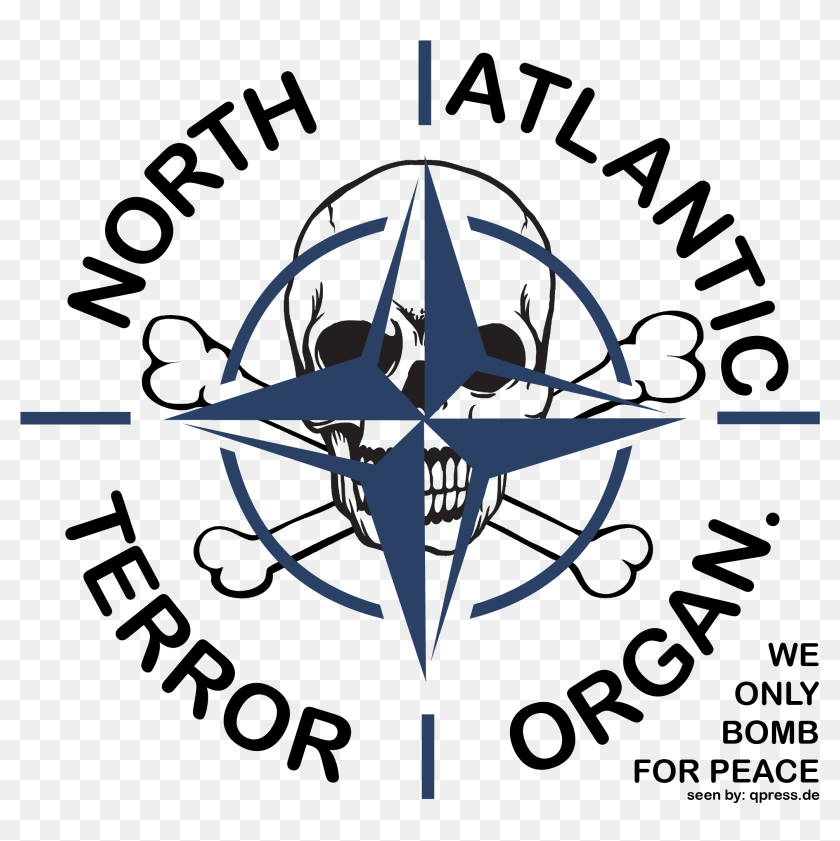
Professors like John Mearsheimer[19], Richard Falk[20], Jeffrey Sachs[21], Stephen Kinzer[22] and others have expressed their concern about the dangers that NATO poses for the survival of humanity, of the logic that it should be dismantled. The best that could be hoped for is that NATO be phased out and that the Global Majority will succeed in rejecting NATO’s ambition to further expand not only in Europe but also in the Asia-Pacific region. Perhaps if the Global Majority exposes the multiple war crimes of NATO forces over the past 30 years and demands accountability from NATO countries, the perception of NATO as a “defence alliance” will be replaced by the label “criminal organization”.

When the media indoctrination and propaganda about NATO is exposed as false, when the perception in Western countries moves from positive to negative, when people realize that NATO is a Machiavellian institution that has exhausted its usefulness, it will be possible to gradually wind it down.

Ultimately, NATO must be recognized not only as a criminal organization, a blustering vestige of a moribund Western imperialism, but as a mortal danger to the survival of civilization on Earth. NATO is on the wrong side of history.

==== 

1. Among the purposes of the UN “To develop friendly relations among nations based on respect for the principle of equal rights and self-determination of peoples, and to take other appropriate measures to strengthen universal peace” 

2. All Members shall settle their international disputes by peaceful means in such a manner that international peace and security, and justice, are not endangered. 

3. All Members shall refrain in their international relations from the threat or use of force against the territorial integrity or political independence of any state, or in any other manner inconsistent with the Purposes of the United Nations. 

4. The Security Council shall determine the existence of any threat to the peace, breach of the peace…. 

5. https://www.abc.net.au/news/2023-07-13/key-takeaways-from-nato-day-two-putin-zelenskyy-matter/102595358.

https://edition.cnn.com/2023/07/12/politics/biden-nato-summit/index.html.Compare https://www.normanfinkelstein.com/the-mask-is-off-why-ukraine-will-never-be-a-nato-member/ 

6. Dare to think by yourself, dare to know! Horatius, First book of Letters (20 BC). Immanuel Kant also used the expression in his 1784 essay “What is Enlightenment?”

7. De bello civile, 2, 27, 2 

8. https://www.clusterconvention.org/ 

9. A. de Zayas, Chapter 4, The Human Rights History, Clarity Press, Atlanta 2023. 

10. https://avalon.law.yale.edu/imt/judgen.asp 

11. https://seymourhersh.substack.com/p/how-america-took-out-the-nord-stream 

12. https://abcnews.go.com/International/strategically-vital-nova-khakovka-dam-blown-border-ukraine/story?id=99863763

https://www.reuters.com/world/europe/putin-accuses-ukraine-destroying-kakhovka-dam-behest-west-2023-06-07  / 

13. https://www.npr.org/2022/09/06/1121201310/ukraine-flooded-village-dam-blown-up  

14. https://www.tagesspiegel.de/kultur/staatsgeheimnis-1989490.html  

15. https://www.jewishvirtuallibrary.org/aktion-1005  

16. A de Zayas, Völkermord als Staatsgeheimnis, Olzog Verlag, Munich 2011. 

17. Verso Books, New York, 2022. 

18. https://www.britannica.com/place/France/The-Dreyfus-Affair  

19. The Great Delusion, Yale University Press, 2018. https://www.jstor.org/stable/24483306
https://www.jstor.org/stable/24483306  

20. https://richardfalk.org/2022/03/31/make-peace-not-war-in-ukraine/  

21. https://www.commondreams.org/opinion/the-war-in-ukraine-was-provoked-and-why-that-matters-if-we-want-peace  

22. https://podcasts.apple.com/us/podcast/stephen-kinzer-on-the-uss-immoral-proxy-war-in-ukraine/id1525433436?i=1000605659299   

More Warmongers Elevated In The Biden Administration

By Caitlin Johnstone

Source: CaitlinJohnstone.com.au

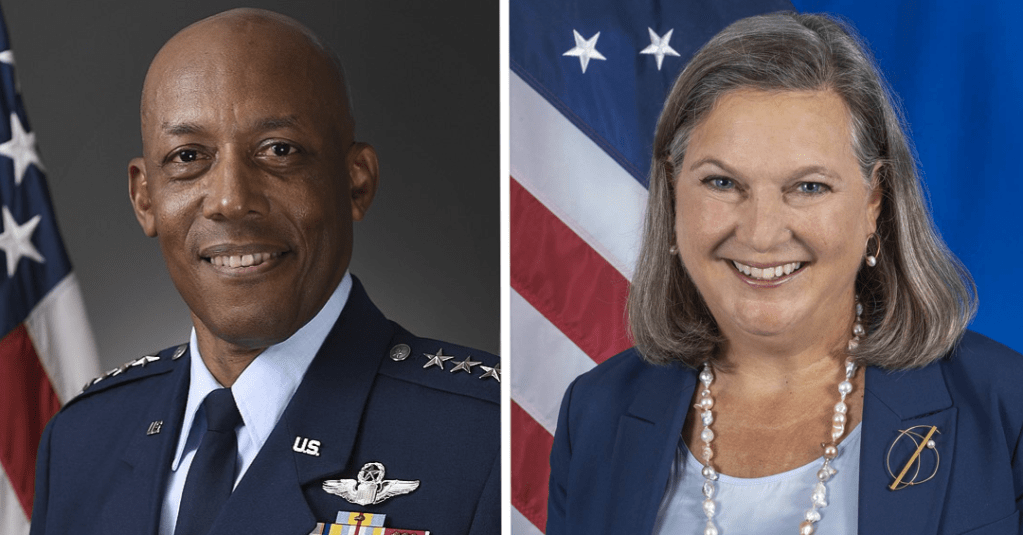
The Biden administration looks set to become even more warlike than it already was if you can imagine, with virulent Russia hawk Victoria Nuland and virulent China hawk Charles Q Brown now being elevated to lofty positions by the White House.

Nuland, the wife of alpha neocon Robert Kagan, has been named acting deputy secretary of state by President Biden, at least until a new deputy secretary has been named. This places her at second in command within the State Department, second only to Tony Blinken.

In an article about Nuland’s unique role in souring relations between the US and Russia during her previous tenure in the State Department under Obama, Responsible Statecraft’s Connor Echols writes the following of the latest news:

Nuland’s appointment will be a boon for Russia hawks who want to turn up the heat on the Kremlin. But, for those who favor a negotiated end to the conflict in Ukraine, a promotion for the notoriously “undiplomatic diplomat” will be a bitter pill.

A few quick reminders are in order. When Nuland was serving in the Obama administration, she had a now-infamous leaked call with the U.S. ambassador to Ukraine. As the Maidan Uprising roiled the country, the pair of American diplomats discussed conversations with opposition leaders, and Nuland expressed support for putting Arseniy Yatseniuk into power. (Yatseniuk would become prime minister later that month, after Russia-friendly former President Viktor Yanukovych fled the country.) At one memorable point in the call, Nuland said “Fu–k the EU” in response to Europe’s softer stance on the protests.

The controversy surrounding the call — and larger implications of U.S. involvement in the ouster of Yanukovych — kicked up tensions with Russia and contributed to Russian President Vladimir Putin’s decision to seize Crimea and support an insurgency in eastern Ukraine. Her handing out  food to demonstrators on the ground in Kyiv probably didn’t help either. Nuland, along with State Department sanctions czar Daniel Fried, then led the effort to punish Putin through sanctions. Another official at State reportedly asked Fried if “the Russians realize that the two hardest-line people in the entire U.S. government are now in a position to go after them?”

In a 2015 Consortium News article titled “The Mess That Nuland Made,” the late Robert Parry singled out Nuland as the primary architect of the 2014 regime change operation in Ukraine, which, as Aaron Maté explained last year, paved the way to the war we’re seeing there today. Hopefully her position winds up being temporary.

In other news, the Senate Arms Services Committee has voted to confirm Biden’s selection of General Charles Q Brown Jr as the next chairman of the Joint Chiefs of Staff, replacing Mark Milley. A full senate vote will now take place on whether to confirm Brown — currently the Air Force Chief of Staff — for the nation’s highest military office.

Brown is unambiguous about his belief that the US must hasten to militarize against China in the so-called Indo-Pacific to prepare for confrontation between the two powers, calling for more US bases in the region and increased efforts to arm Taiwan during his hearing before the Senate Arms Services Committee earlier this month.

Back in May, Moon of Alabama flagged Brown’s nomination in an article which also noted that several advocates of military restraint had been resigning from their positions within the administration, including Wendy Sherman, the deputy secretary of state who Nuland has taken over for.

It’s too soon to draw any firm conclusions, but to see voices of restraint stepping down and proponents of escalation stepping up could be a bad portent of things to come.

America’s Constitutional Government Is Gone

By Eric Zuesse

Source: The Duran

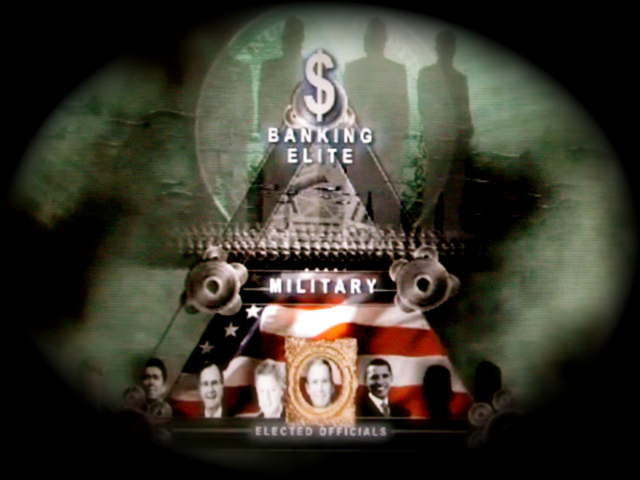
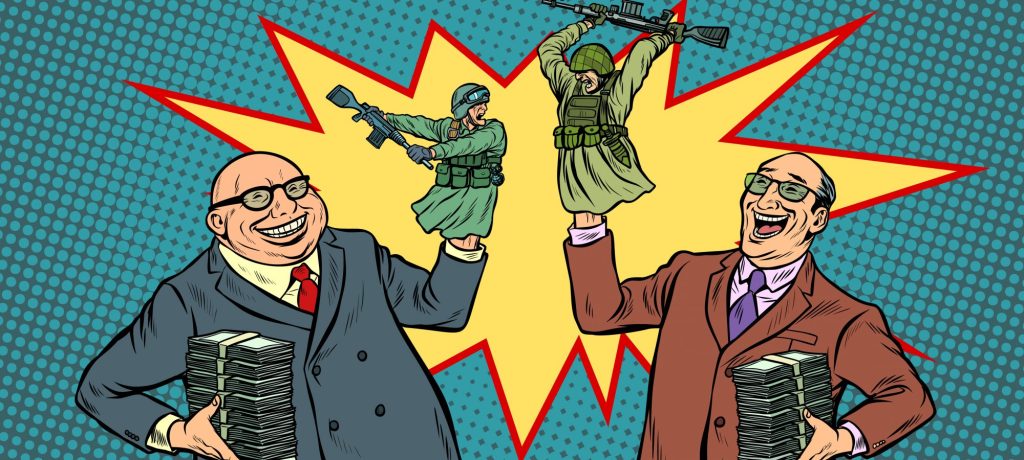
The few people who benefit from the U.S. Government’s being the world’s most powerful are U.S.-and-allied billionaires, who profit from the enormous sales of U.S.-made war-weapons and from the international extraction corporations such as Exxon-Mobil which rely upon its military, but all of this comes at the expense of the publics in every country including that of America itself. Any empire serves only its aristocracy, at the expense of the public. In modern times, the publics need to be deceived by the media and by the billionaires’ other agencies, so as to become deceived to vote for the billionaires’ candidates. This requires massive censorship, notwithstanding that America’s Constitution bans such censorship.

Freedom of the press, and freedom of expression, are ‘guaranteed’ in the U.S. Constitution, but if the controlling owners of the press are a small group of people who benefit from the fact that the wealthiest 1% of the wealthiest 1% of Americans — the wealthiest ten-thousandth of Americans — donate 57.16% of all the money that funds U.S. political campaigns, and that the “Top 400 Donors” (all of whom are multi-billionaires, not merely billionaires) donate 29.86%, or virtually 30%, of all political money, in the U.S., then how likely will the ‘news’-media be to accept for publication or to broadcast news reports that threaten this status-quo from which all of them have made and keep their enormous wealth? Not only do those billionaires own or control virtually all of the ‘news’-media, but the other corporations that they also own or control advertise in them; and, so, they select to hire editors and producers who will reject job-applicants who would report the types of things that those controllers want the public not to know — things such as these. The most-important realities are thus effectively censored-out.

For an example of the most-important realities, here is an entirely truthful 10-minute-long entirely independently produced compendium video that shows the key evidences that the overthrow of Ukraine’s Government in February 2014 was definitely not the democratic revolution that all of the U.S.-and-allied press pretend it was, but was instead a U.S. coup. And here is the complete showing of the smoking-gun piece of evidence in it, so that one can now see this crucial item of evidence within its broader context, and understand how it fits into that context, to produce crucial history instead of the ‘news’-media-promulgated myth that strings together lie-upon-lie. It’s documentation of how the war inside Ukraine (and to which U.S. taxpayers donated over a hundred billion dollars last year) actually started — via this U.S. coup. And here is an even broader contextual documentation of how that U.S. coup started this war, which U.S.-and-allied Governments and their ‘news’-media blame against Russia — as-if it were the case that Russia had expanded up to NATO’s border, instead of NATO’s having expanded up to Russia’s border.

Is that evidence consistent with what has been widely reported by the ‘news’-media about the overthrow of Ukraine’s Government in February 2014 and about how the war in Ukraine started (supposedly on 24 February 2022)? Did America’s Government start this war, or did Russia’s Government start it? And how important is the answer to that question, to the public’s ability to make fact-based choices when elections are held to determine whom will be occuping seats in Congress, and in the White House? As the brilliant geostrategist who anonymously writes the “Moon of Alabama” blog headlined on July 25th, “Who Can Give Security Guarantees To Ukraine?”, and he concluded there that the U.S. Government and its stooges in its NATO military alliance against Russia now clearly have no intention of providing any such, but that Russia can — and that the longer that America’s war against Russia in the battlefields of Ukraine and killing Ukraine’s soldiers continues, the more onerous to the people of Ukraine will be the peace-terms that Russia will be able to offer to Ukraine for there to be any peace at all in Ukraine. It’s America’s war, but Russia will settle it.

Here is an interview of a very successful Asian journalist for major news-media, who had been participating in the so-called ‘democracy’ demonstrations in Hong Kong until he discovered that they had been initiated behind-the-scenes by the U.S. Government, and then he wrote a book about that, and he describes in this interview how the news-reporting that he and the rest of the press were doing had been fooled by the U.S. Government’s very elaborate and highly bribe-based operation against (i.e., to weaken) China’s Government.

The broader picture of that deeply corrupt management of ‘the news’ by America’s very wealthiest, is documented in detail here. It all started when U.S. President FDR died and his successor, Harry Truman (influenced by the advice from Winston Churchill and especially General Dwight Eisenhower), decided on 25 July 1945 for the U.S. Government to ultimately take control over all nations. This hegemonic or global-imperialist U.S. Government has made the world we live in today. But what percentage of the public know anything about this reality, of the world in which all of us are living? The ignorance and deception of the masses is the basis for these ‘democracies’.

Another key provision of the U.S. Constitution is that ONLY the U.S. Congress can authorize a war and the sending of U.S. forces abroad in order to participate in a war. However, this provision of the U.S. Constitution is likewise now being routinely violated by the U.S. Government. It has to be done because the key beneficiaries of U.S. imperialism are America’s billionaires, who control the U.S. Government. And this is the reason why after WW II, the U.S. Government has invaded and otherwise participated in 297 wars though none of them were ever declared by the U.S. Congress as the U.S. Constitution requires.

Politics is now a puppet-show in these ‘democracies’; and the ‘news’-media are merely a part of that puppet-show.

These realities are ugly, but they are real.

—————

Investigative historian Eric Zuesse’s new book, AMERICA’S EMPIRE OF EVIL: Hitler’s Posthumous Victory, and Why the Social Sciences Need to Change, is about how America took over the world after World War II in order to enslave it to U.S.-and-allied billionaires. Their cartels extract the world’s wealth by control of not only their ‘news’ media but the social ‘sciences’ — duping the public.

Ukraine and the great revival of American empire

By Andrew J. Bacevich

Source: Information Clearing House

Amidst the dross that clutters the New York Times op-ed page on most days, glimmers of enlightenment occasionally appear. A recent guest column by Grey Anderson and Thomas Meaney offers a case in point.

“NATO Isn’t What It Says It Is,” declares the headline. Contrary to the claims of its architects and defenders, Anderson and Meaney argue persuasively that the central purpose of the alliance from its founding was not to deter aggression from the East and certainly not to promote democracy, but to “bind Western Europe to a far vaster project of a U.S.-led world order.” In return for Cold War-era security guarantees, America’s European allies offered deference and concessions on issues like trade and monetary policy. “In that mission,” they write, NATO “has proved remarkably successful.” A plot of real estate especially valued by members of the American elite, Europe thereby became the centerpiece of the postwar American imperium.

The end of the Cold War called these arrangements into question. Desperate to preserve NATO’s viability, proponents claimed that the alliance needed to go “out of area or out of business.” NATO embraced an activist posture, leading to reckless state building interventions in Libya and Afghanistan. The results were not favorable. Acceding to U.S. pressure to venture out of area proved to be costly and served chiefly to undermine NATO’s credibility as a militarily capable enterprise.

Enter Vladimir Putin to save the day. Just as Russia’s invasion of Ukraine provided the U.S. with an excuse to forget its own post-9/11 military failures, so too it has enabled NATO to once more constitute itself as the chief instrument for defending the West—and, crucially, to do so without actually exacting a blood sacrifice from either Americans or Europeans.

In this context, the actual fate of Ukraine itself figures as something of an afterthought. The real issue centers on reviving damaged aspirations of American global primacy. With something like unanimity, the U.S. national security establishment is devoted to the proposition that the United States must remain the world’s sole superpower, even if this requires ignoring a vast accumulation of contrary evidence suggesting the emergence of a multipolar order. On that score, Putin’s recklessness came as an impeccably timed gift.

There is an element of genius at work here. Defeating Russia without having to do any actual fighting becomes the means to restore the image of American indispensability squandered during the decades that followed the fall of the Berlin Wall. For Washington, as Anderson and Meaney appreciate, the true stakes in Ukraine go far beyond the question of whose flag flies over Crimea. If Ukraine “wins” its war with Russia—however “winning” is defined and however great the price Ukrainians must pay—NATO itself (and the NATO lobby in Washington) will claim vindication.

Rest assured that major European nations will then quietly renege on promises to boost their military spending, with actual responsibility for European security once more falling to the United States. With the centennial of World War II now within hailing distance, U.S. troops will remain permanently garrisoned in Europe. This will serve as cause for celebration throughout the U.S. military industrial complex, which will prosper.

Flexing its muscles, the United States will inevitably prod a greatly expanded NATO into turning its attention to enforcing the “rules-based international order” in the Asia-Pacific, with China as the chosen adversary. Ukraine will thereby serve as a template of sorts as the U.S. and its allies throw their weight around many thousands of miles from Europe proper.

The U.S. global military footprint will expand. U.S. efforts to put its house in order domestically will founder. Pressing global problems like the climate crisis will be treated as afterthoughts. But the empire that has no name will persist, which ultimately is the purpose of the game.

President Biden is fond of saying that the world has arrived at an “inflection point,” implying the need to change directions. Yet the overarching theme of his approach to foreign policy is stasis. He clings to the geopolitical logic that prompted NATO’s founding in 1949.

Back then, when Europe was weak and Stalin ruled the Soviet Union, that logic may have possessed some merit. But today the importance attributed to NATO testifies chiefly to the bankruptcy of American strategic thought and an inability to prioritize actually existing U.S. national interests, both foreign and domestic.

A sound revision of U.S. national security strategy would begin with announcing a timeline for withdrawing from NATO, converting it into an arrangement wholly owned and operated by Europe. The near impossibility of even imagining such an action by the United States testifies to the dearth of imagination that prevails in Washington.

Why the political West still doesn’t want Ukraine to join NATO

By Drago Bosnic

Source: InfoBrics.org

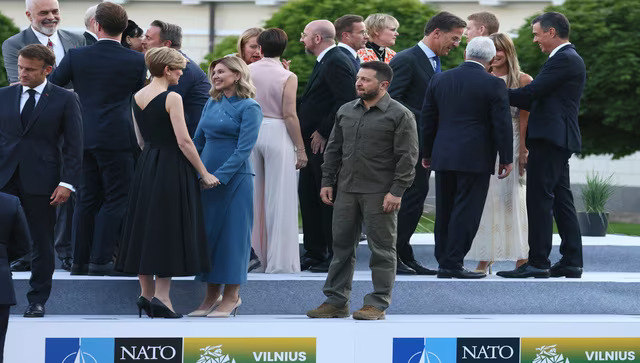
For approximately 20-25 years, the political West has been flirting with the idea of Ukraine joining NATO. And yet, Kiev is as far from joining the belligerent alliance as it was a few decades ago, as evidenced by Zelensky’s unconcealed, almost painful frustration at the latest NATO summit in Lithuania’s Vilnius. The very idea that Ukraine might join the aggressive alliance is hardly a new concept. The CIA had plans for such a scenario long before the Soviet Union’s dismantling during the late 1980s and early 1990s. And yet, the country never became part of NATO, not even after approximately two decades of close cooperation, including the Ukrainian military’s direct participation in illegal US invasions of Iraq and Afghanistan.

So, why is the political West sending so many mixed messages about “Ukraine’s future in NATO”, but then demands Kiev to defeat a military superpower next door as a prerequisite for potential future membership? The only logical conclusion is that the belligerent alliance simply doesn’t want Ukraine to become a member yet. The primary reason for this is that Moscow is just too strong for that to become a reality, meaning that the political West wants Russia to be weakened to the point where it will not be able to resist NATO’s crawling aggression. For that purpose, the political West needs what experts have rightfully called “a crash test dummy“. Unfortunately for Ukrainians, they’ve been given that exceedingly unflattering role.

And indeed, during the Vilnius summit, NATO offered Ukraine “an alternative to full membership” that can only be called TTLU (To the last Ukrainian). The belligerent alliance simply cannot offer any sort of security guarantees to a country with so many territorial issues, to say nothing of its ongoing direct confrontation with Russia, a military superpower with a thermonuclear arsenal exceeding the combined power of NATO’s entire strategic might. The TTLU concept allows NATO to keep providing weapons, funds, logistics, ISR (intelligence, surveillance, reconnaissance), etc. while not having to send its own troops. For the political West, this is seen as a win-win, as Ukrainians (seen as “former” Russians) are fighting (other) Russians for the sake of NATO.

This war by proxy is the belligerent alliance’s best bet to conduct its crawling “Barbarossa 2.0” against Russia while avoiding complete destruction by Moscow’s second-to-none ICBMs (intercontinental ballistic missiles). And it’s most definitely not even the first time the political West has been probing the Kremlin in this way. Back in 2008, Georgia was the first “crash test dummy” and a litmus test of Russia’s reaction. Tbilisi was promised full membership, but all it got was a loss of approximately 20% of its former territory, as well as the long-term loss of centuries-old virtually brotherly relations with its northern neighbor. The leading Georgian political “crash test dummy” Mikheil Saakashvili served his purpose and was then “recycled” in Ukraine only to later be cast away as a useless burden.

Saakashvili’s fate can serve as a stark reminder to the Kiev regime frontman Volodymyr Zelensky, which perfectly explains his perpetually depressed bearing. He understands that the political West wants the war to last for as long as possible and that’s certainly not an appealing prospect for someone who will eventually have to take all the blame for Ukraine’s unrelenting collapse. NATO’s mixed messages are designed for this exact purpose. The belligerent alliance has openly stated that it will not accept Kiev regime’s membership until hostilities cease, meaning that Moscow will simply have no incentive to stop its counteroffensive against NATO aggression until most or all of Ukraine is under its control.

The fact that the political West has prevented a peaceful settlement speaks volumes about how it sees Ukraine and its people. Zelensky and his clique are there just to execute commands, regardless of the cost for the Ukrainians or even the Neo-Nazi junta itself. In his op-ed for Politico, Wolfgang Ischinger, one of Germany’s most prominent diplomats, recently suggested that the Kiev regime might be given all aspects of membership, only without actual membership. According to Ischinger, “[NATO] could grant Ukraine all the practical and concrete options and opportunities that NATO membership includes, but without official treaty membership”. In other words, Kiev would effectively have all the commitments of a member, but no benefits. Hence – TTLU.

It should also be noted that the US-led political West is certainly not shying away from (ab)using Ukrainians for whatever purpose it finds profitable and/or useful for itself. Whether it’s the easier recruitment of spies, less stringent control of sex trafficking (including of underage children) or the immense profit for NATO’s Military Industrial Complex (MIC), it’s all up for sale and war drives down the prices. In such a scenario, why would the political West ever want to have any legal commitments that would require it to enter a direct confrontation with Russia, a country that’s still the world’s only true near-peer military rival to NATO? Thus, it’s up to the Ukrainian people to finally reject such suicidal servitude that has resulted in nothing but misery for their country and has effectively robbed them of their future.

Is Sleepy Joe Biden Trying to Outdo Hitler and History?

By Phil Butler

Source: New Eastern Outlook

History is the most interesting subject for many reasons. Not the least of which is the fact it tends to repeat itself. And the fact that some are doomed by ignorance of this is an important lesson for today. Take German tanks, for instance. First, let’s rehash a little history about the steppes of Russia and Eastern Ukraine and unlearned lessons.

From the 5th of July 1943 until the 23rd of August 1943, the largest tank battle in history took place in what became known as the “Kursk Salient,” an area that stretched from the tiny town of Kirov on the Bolva River in the north, through Belgorod in Russia, Kharkiv, which Ukraine currently controls. The line reached deep into the Donbas region, the focal point of Ukraine’s Nazi hostilities since 2014.

Hitler’s Operation Zitadelle (“Citadel”) was carried out over a 700-mile-long front, where the best Germans tried to outgun and outmaneuver the advancing Soviet forces. It became the largest tank battle in history, pitting the most advanced weaponry Nazi Germany had against prepared and dug-in, superior Soviet resistance. The reader will find it interesting that the German high command chose Belgorod as one of the first key objectives.

Numerous parallels exist between the battle of Kursk and the current proxy war in Ukraine. First, I’d like to deal with tanks. In 1943, Germany manufactured what can be argued as the finest medium and heavy armor of World War II. Though not numerous at Kursk, the deadly Tiger played a big role. The all-new Panther and the giant Ferdinand tank destroyer were supposed to blast the Soviets off the battlefield.

Ironically, many of their burning hulks littered the countryside once the battle ended. The battle raged for months, with neither side gaining a clear advantage. The Soviets, not unlike their modern-day counterparts on the Russian lines, created massive defensive works to sap the German offensive until a counterattack would gain a decisive effect.

When I read the other day about almost all of the highly touted German Leopards sent to Zelensky having been destroyed, this seemed like Deja Vu as a student of history. An article in the Berliner Zeitung cited Alexander Sosnowski, who used data from pro-Ukraine media channels to determine that 41 Leopard-2s, 49 T72 tanks, 31 Bradlys, 7 German Marders, 23 howitzers, and 40 MRAP infantry fighting vehicles have already been turned to scrap by the Russians. In 1943, the great Nazi war machine faced similar despair.

But what other parallels can we draw? What is going to happen next? If you ask most experts, Europe is out of ammo, tanks, and guts. The Germans cannot even crank up and run half their remaining Leopard 2s for lack of repair, Paris is on fire, Germans are ready for any Chancellor but Scholz, Hungary seems about ready to leave the NATO alliance, the dollar may crumble toon, and even Americans grow weary of cheering a losing team.

We can understand how idiotic Joe Biden’s war on Russia will end if we recollect what happened after the Kursk failure. The Germans had been progressing in fighting through the defensive layers the Soviets had built. The northern front of the pincer bogged down, and the southern one was halted by bitter Soviet resistance. Hitler, who the legendary Heinz Guderian had warned against Operation Citadel, lost heart when decisive victory was not at hand and focused elsewhere. Meanwhile, the Soviets had gained momentum in the ground war and never relinquished it after Kursk.

As we know, once the Axis began its retreat from Kursk, the Soviets, and their allies from the West marched into the heart of Europe, taking Berlin and destroying the dream of Leibensraum, at least for the moment. Today, we find Germany’s best tanks strewn all over the battle lines in the regions reclaimed by Russia. Of course, they are not the Tigers or Panthers of legend. Four Tiger tanks held off tank brigades at Kursk. Now a lightweight drone seemed capable of knocking one out. The same seems true for NATO, a military alliance that has never shown it could beat its way out of a wet paper bag, let alone conquer Russia.

Whoever devised this genius plan to create Operation Barbarossa 2 is not even as clever as a drugged Hitler on his worst day. All that has happened is that the Russians are preparing again. Factories are shifting to creating T-14 Armata tanks instead of luxury Lada 4x4s. Far from the front, the Russians ramp up their military complex as before. For Westerners, we can only hope they do so for defensive rather than offensive operations. For certain, as the fires of discontent burning in Paris, there is nothing behind the Donetsk River to stop the Russians if they choose to widen their breathing space.

Funny, isn’t it, how history repeats itself and does so in the same places with the same idiotic mistakes being made?

House Passes $886 Billion National Defense Authorization Act

The bill narrowly passed in a vote of 219-210 due to a partisan divide over amendments included by Republicans

By Dave DeCamp

Source: AntiWar.com

The House on Friday passed its version 2024 National Defense Authorization Act in a vote of 219-210, which largely fell along partisan lines due to amendments added by Republicans relating to social policies in the military.

The Republican amendments covered abortion, transgender surgery, and diversity initiatives. Only four Democrats voted in favor of the bill, and four Republicans voted against it. The four Republicans who opposed the NDAA are Reps. Thomas Massie (KY), Eli Crane (AZ), Andy Biggs (AZ), and Ken Buck (CO).

The Senate still needs to pass its version of the NDAA, then the two chambers will negotiate the final version that will go to President Biden’s desk. The Republican amendments packed into the House version will set up a fight between the two chambers as Senate Majority Leader Chuck Schumer (D-NY) and other Democrats will reject them.

The 2024 NDAA is for a record $886 billion, the same amount President Biden requested. The debt ceiling deal reached between House Republicans in the White House did not limit military spending and put no caps on emergency supplemental funds, which is how the US has been spending on the war in Ukraine.

As the House was debating the NDAA, several amendments introduced by Republicans looking to rein in US support for Ukraine were voted down. One amendment sponsored by Rep. Warren Davidson (R-OH) would have required the Biden administration to develop a strategy for the war in Ukraine. It was rejected in a vote of 129-301, with only Republicans supporting it.

One amendment introduced by Rep. Marjorie Taylor Greene would have cut $300 million in military aid for Ukraine that’s packed into the NDAA, but it failed in a vote of 89-341. Rep. Matt Gaetz (R-FL) put forward an amendment to cut off all military assistance for Ukraine, which failed in a vote of 70-358. Only Republicans supported the two amendments.

Greene sponsored another amendment that would have prohibited the transfer of cluster munitions to Ukraine, although US cluster bombs have already arrived in the country. The effort failed in a vote of 147-276. It received support from 98 Republicans and 49 Democrats.