Newsletter: From Neoliberal Injustice To Economic Democracy

By Kevin Zeese and Margaret Flowers

Source: Dissident Voice

The work to transform society involves two parallel paths: resisting harmful systems and institutions and creating new systems and institutions to replace them. Our focus in this article is on positive work that people are doing to change current systems in ways that reduce the wealth divide, meet basic needs, ensure sustainability, create economic and racial justice and provide people with greater control over their lives.

When we and others organized the Occupation of Washington, DC in 2011, we subtitled the encampment ‘Stop the Machine, Create a New World’, to highlight both aspects of movement tasks — resistance and creation. One Popular Resistance project, It’s Our Economy, reports on economic democracy and new forms of ownership and economic development.

Throughout US history, resistance movements have coincided with the growth of economic democracy alternatives such as worker cooperatives, mutual aid and credit unions. John Curl writes about this parallel path in “For All the People,” which we summarized in “Cooperatives and Community Work are Part of American DNA.”

Mahatma Gandhi’s program of nonviolent resistance, satyagraha, had two components: obstructive resistance and constructive programs. Gandhi promoted Swaraj, a form of “self-rule” that would bring independence not just from the British Empire but also from the state through building community-based systems of self-sufficiency. He envisioned economic democracy at the village level. With his approach, economics is tied to ethics and justice — an economy that hurts the moral well-being of an individual or nation is immoral and business and industry should be measured not by shareholder profit but by their impact on people and community.

Today, we suffer from an Empire Economy. We can use Swaraj to break free from it. Many people are working to build a new economy and many cities are putting in place examples of economic democracy. One city attempting an overall transformation is Cooperation Jackson in Jackson, Mississippi.

Economic Democracy in response to neoliberalism

In his new book, Out of the Wreckage: A New Politics for an Age of Crisis, George Monbiot argues that a toxic ideology of greed and self–interest resulting in extreme competition and individualism rules the current economic and political culture. It is built on a misrepresentation of human nature. Evolutionary biology and psychology show that humans are actually supreme altruists and cooperators.  Monbiot argues that the economy and government can be radically reorganized from the bottom up, enabling people to take back control and overthrow the forces that have thwarted human ambitions for a more just and equal society.

In an interview with Mark Karlin, Monbiot describes how neolibealism arose over decades, beginning in the 1930s and 40s with John Maynard Keynes, Friedrich Hayek and others, and is now losing steam, as ideologies do. Monbiot says we need a new “Restoration Story.”

We are in the midst of writing that new story as people experience the injustice of the current system with economic and racial inequality, destruction of the environment and never ending wars. Indeed, we are further ahead in creating the new Restoration Story than we realize.

Cooperatives

New research from the University of Wisconsin–Madison’s Center for Cooperatives (UWCC) has found there are 39,594 cooperatives in the United States, excluding the housing sector, and there are 7 million employer businesses that remain “potential co-op candidates.” These cooperatives account for more than $3 trillion in assets, more than $500 billion in annual revenue and sustain nearly two million jobs. This May, the Office of Management and Budget approved including coop questions in the Economic Census so that next year the US should have more accurate figures. The massive growth of cooperatives impacts many segments of the economy including banking, food, energy, transit and housing among others.

In cooperatives, workers or consumers decide directly how their business operate and work together to achieve their goals; it is a culture change from the competitive extreme capitalist view dominated by self-interest.

In Energy Democracy: Advancing Equity in Clean Energy Solutions, editors Denise Fairchild and Al Weinrub describe energy cooperatives that are creating a new model for how we organize the production and distribution of energy, which is decentralized, multi-racial and multi-class.

Lyn Benander of Co-op Power, a network of many cooperatives in New England and New York, writes that they transform not just energy but also their communities:

First, people come together across class and race to make change in their community by using their power as investors, workers, consumers, and citizens ready to take action together. Then, they work together to build community-owned enterprises with local capital and local jobs to serve local energy needs. It’s a proven strategy for making a real difference.

In Lancaster, CA, the mayor has turned the town into a solar energy capital where they produce power not just for themselves, but also to sell to other cities. They are also moving to create manufacturing jobs in electric buses, which more cities are buying, and energy storage. Research finds that rooftop solar and net-metering programs reduce electricity prices for all utility customers, not just those with solar panels. The rapid growth of rooftop solar is creating well-paying jobs at a rate that’s 17 times faster than the total U.S. economy. Rooftop solar, built on existing structures, such as homes and schools, puts energy choices in the hands of customers rather than centralized monopolies, thereby democratizing energy.

Including housing cooperatives would greatly increase the number of cooperatives. According to the National Association of Housing Cooperatives, “Housing cooperatives offer the more than one million families who live in them several benefits such as: a collective and democratic ownership structure, limited liability, lower costs and non-profit status.”  Residents of a mobile home park in Massachusetts decided to create a housing cooperative to put the residents in charge of the community when the owner planned to sell it.

Related to this are community land trusts. A section of land is owned in a trust run as a non-profit that represents the interests of local residents and businesses. Although the land is owned by the trust, buildings can be bought and sold. The trust lowers prices and can prevent gentrification.

Universal Basic Income

Another tool gaining greater traction is a universal basic income.  James King writes in People’s Policy Project that “. . . a universal basic income (UBI) – a cash payment made to every person in the country with no strings attached – is becoming increasingly popular in experimental policy circles. . . payments  [would be] large enough to guarantee a minimum standard of living to every person independent of work. In the US, that would be roughly $12,000 per person based on the poverty line.”

The wealth divide has become so extreme in the United States that nearly half of all people are living in poverty. A small UBI would provide peace of mind, financial security and the possibility of saving money and building some wealth. A report by the Roosevelt Institute, this week, found that a conservative analysis of the impact of a UBI of $1,000 per month would grow the economy by 12.56 percent after an eight-year implementation, this translates to a total growth of $2.48 trillion.

Public Finance

Another major area of economic democracy is the finance sector. At the end of 2016 there were 2,479 credit unions with assets under 20 million dollars in the United States. Members who bank in credit unions are part of a cooperative bank where the members vote for the board and participate in other decisions.

Another economic democracy approach is a public bank where a city, state or even the national government creates a bank using public dollars such as taxes and fee revenues. Public banks save millions of dollars that are usually paid in fees to Wall Street banks, and the savings can be used to fund projects such as infrastructure, transit, housing, healthcare and education, among other social needs. Public banks can also partner with community banks or credit unions to fund local projects. This could help to offset one of the negative impacts of Dodd-Frank, which has been a reduction in community banks. In testimony, the Secretary of Treasury, Stephen Munchin, said we could “end up in a world where we have four big banks in this country.”

North Dakota is the only state with a public bank, and it has the most diverse, locally-owned banking system in the country. Stacey Mitchell writes that “North Dakota has six times as many locally owned financial institutions per person as the rest of the nation. And these local banks and credit unions control a resounding 83 percent of deposits in the state, more than twice the 30 percent market share such banks have nationally.” Public banking campaigns are making progress in many parts of the country, among them are Oakland, Los Angeles, Philadelphia, Santa Fe, and other areas.

Mutual Aid

When crises occur, no matter what their cause, people can work together cooperatively and outside of slow and unresponsive state systems to meet their needs. This is happening in Athens, Greece, which has been wracked by financial crisis and austerity for years. People have formed “networks of resistance” that meet in community assemblies organized around needs of the community, such as health care and food. They started with time banks as a base for a new non-consumer society.

Similar efforts are underway in Puerto Rico following the devastation of Hurricane Maria. A group called El Llamado is coordinating more than 20 mutual aid efforts, and providing political education and support for self-organizing at the same time.

As George Monbiot describes it, this is consistent with the truth about what human beings are:

We survived despite being weaker and slower than both our potential predators and most of our prey. We did so through developing, to an extraordinary degree, a capacity for mutual aid. As it was essential to our survival, this urge to cooperate was hard-wired into our brains through natural selection.

As we face more crises, whether in lack of access to health care, education, housing, food or economic and climate disasters, let’s remember that we have the capacity to meet our needs collectively.  In fact, every day, people are putting in place a new economic democracy that allows people to participate based on economic and racial justice as well as real democracy. As these alternatives are put in place, they may become dominant in our economy, communities and politics and bring real democracy and security to our lives.


Kevin Zeese and Margaret Flowers are co-directors of Popular Resistance. Read other articles by Kevin Zeese and Margaret Flowers.

Sweat Shops, GMOs and Neoliberal Fundamentalism: The Agroecological Alternative to Global Capitalism

By Colin Todhunter

Source: Global Research

Much of the argument in favour of GM agriculture involves little more than misrepresentations and un scrupulous attacks on those who express concerns about the technology and its impacts. These attacks are in part designed to whip up populist sentiment and denigrate critics so that corporate interests can secure further control over agriculture. They also serve to divert attention from the underlying issues pertaining to hunger and poverty and genuine solutions, as well as the self-interest of the pro-GMO lobby itself.

The very foundation of the GMO agritech sector is based on a fraud. The sector and the wider transnational agribusiness cartel to which it belongs have also successfully captured for their own interests many international and national bodies and policies, including the WTO, various trade deals, governments institutions and regulators. From fraud to duplicity, little wonder then the sector is ridden with fear and paranoia.

“They are scared to death,” says Marion Nestle, professor of nutrition, food studies, and public health at New York University and author of several books on food policy. She adds: “They have an industry to defend and are attacking in the hope that they’ll neutralize critics … It’s a paranoid industry and has been from the beginning.”

War against reason

Global corporations like Monsanto are waging an ideological war against not only critics but the public too. For instance, consider that the majority of the British public and the Canadian public have valid concerns about GM food and do not want them. However, the British government was found to have been secretly colluding with the industry and the Canadian government is attempting to soften up the public to try to get people to change their opinions.

Instead of respecting public opinion and serving the public interest by holding powerful corporations to account, officials seem more inclined to serve the interests of the sector, regardless of genuine concerns about GM that, despite what the industry would like to have believe, are grounded in facts and involve rational discourse.

Whether via the roll-out of GMOs or an associated chemical-intensive industrialised monocrop system of agriculture, the agritech/agribusiness sector wants to further expand its influence throughout the globe. Beneath the superficial façade of working in the interest of humanity, however, the sector is driven by a neoliberal fundamentalism which demands the entrenchment of capitalist agriculture via deregulation and the corporate control of seeds, land, fertilisers, water, pesticides and food processing.

If anything matters to the corporate agribusiness/agritech industry, contrary to the public image it tries to convey, it clearly has little to do with ‘choice’, ‘democracy’ or objective science. It has more to do with undermining and debasing these concepts and displacing existing systems of production: economies are “opened up through the concurrent displacement of a pre-existing productive system. Small and medium-sized enterprises are pushed into bankruptcy or obliged to produce for a global distributor, state enterprises are privatised or closed down, independent agricultural producers are impoverished” (Michel Chossudovsky in The Globalization of Poverty, p16).

Critics are highlighting not only how the industry has subverted and debased science and has infiltrated key public institutions and regulatory bodies, but they are also showing how trade and aid is used to subjugate regions and the most productive components of global agriculture – the small/peasant farmer – to the needs of powerful commercial entities.

Critics stab at the heart of neoliberalism

By doing this, critics stab hard at the heart such corporate interests and their neoliberal agenda.

According to Eric Holt-Giménez:

“The World Bank, the World Trade Organization, the World Food Program, the Millennium Challenge, The Alliance for a Green Revolution in Africa, the U.S. Department of Agriculture, and industrial giants like Yara Fertilizer, Cargill, Archer Daniels Midland, Syngenta, DuPont, and Monsanto, carefully avoid addressing the root causes of the food crisis. The ‘solutions’ they prescribe are rooted in the same policies and technologies that created the problem in the first place: increased food aid, de-regulated global trade in agricultural commodities, and more technological and genetic fixes. These measures only strengthen the corporate status quo controlling the world’s food… The future of our food-and fuel-systems are being decided de facto by unregulated global markets, financial speculators, and global monopolies.”

The geopolitics of food and agriculture has played a significant role in creating food-deficit regions. For instance, African agriculture has been reshaped on behalf of the interests described in the above extract. The Gates Foundation is currently spearheading the ambitions of corporate America and the scramble for Africa by global agribusiness. And in India, there has been an ongoing attempt to do the same: a project that is now reaching a critical phase as the motives of the state acting on behalf of private (foreign) capital are laid bare and the devastating effects on health, environment and social conditions are clear for all to see.

Any serious commitment to feeding the world sustainably and equitably must work to challenge a globalised system of capitalism that has produced structural inequality and poverty; a system which fuels the marginalisation of small-scale farms and their vitally important cropping systems and is responsible for the devastating impacts of food commodity speculationland takeoversrigged trade and an industrial system of agriculture.

And embedded within the system is a certain mentality. Whether it is the likes of Monsanto’s High GrantRobb Fraley or Bill Gates, highly paid (multi-millionaire) white men with an ideological commitment to corporate power are trying to force a profitable but bogus model of food production on the world.

They do so while conveniently ignoring the effects of a system of capitalism that they so clearly promote and have financially profited from.

It is a capitalism and a system of agriculture propped up by the blood money of militarism (Ukraine and Iraq), ‘structural adjustment’ and strings-attached loans (Africa) or slanted trade deals (India) whereby transnational agribusiness drives a global agenda to suit its interests and eradicate impediments to profit. And it doesn’t matter how much devastation ensues or how unsustainable their model is, ‘crisis management’ and ‘innovation’ fuel the corporate-controlled treadmill they seek to impose.

Genuine solutions: agroecology, decentralisation and localism

However, what really irks the corporate interests which fuel the current GMO/chemical-intensive industrialised model of agriculture is that critics are offering genuine alternatives and solutions. They advocate a shift towards more organic-based systems of agriculture, which includes providing support to small farms and an agroecology movement that is empowering to people politically, socially and economically.

This represents a challenge to all good neoliberal evangelists (and outright hypocrites) with a stake in corporate agriculture who rely on smears to attack those who advocate for such things.

To understand what agroecology involves, let us turn to Raj Patel:

“To understand what agro-ecology is, it helps first to understand why today’s agriculture is called “industrial.” Modern farming turns fields into factories. Inorganic fertilizer adds nitrogen, potassium, and phosphorous to the soil; pesticides kill anything that crawls; herbicides nuke anything green and unwanted—all to create an assembly line that spits out a single crop… Agro-ecology uses nature’s far more complex systems to do the same thing more efficiently and without the chemistry set. Nitrogen-fixing beans are grown instead of inorganic fertilizer; flowers are used to attract beneficial insects to manage pests; weeds are crowded out with more intensive planting. The result is a sophisticated polyculture—that is, it produces many crops simultaneously, instead of just one.”

And it works. Look no further than what Cuba has achieved and the successes outlined in this article. Indeed, much has been written about agroecology and its potential for radical social change, its successes and the challenges it faces (see thisthis and this). And now there a major new book from Food First and Groundswell International: Fertile Ground: Scaling agroecology from the ground up.

Executive Director of Food First Eric Holtz-Gimenez argues that agroecology offers concrete, practical solutions to many of the world’s problems that move beyond (but which are linked to) agriculture. In doing so, it challenges – and offers alternatives to – the prevailing moribund doctrinaire economics of a neoliberalism that drives a failing system (also see this and this) of GM/chemical-intensive industrial agriculture.

He adds that the scaling up of agroecology can tackle hunger, malnutrition, environmental degradation and climate change. By creating securely paid labour-intensive agricultural work, it can also address the interrelated links between labour offshoring by rich countries and the removal of rural populations elsewhere who end up in sweat shops to carry out the outsourced jobs: the two-pronged process of neoliberal globalisation that has devastated the economies of the US and UK and which is displacing existing indigenous food production systems and undermining the rural infrastructure in places like India to produce a reserve army of cheap labour.

When you fail to understand capitalism and the central importance of agriculture, you fail to grasp many of the issues currently affecting humanity. At the same time, when you are part of the problem and fuel and benefit from it, you will do your best to attack and denigrate anything or anyone that challenges your interests.

Our Political Parties Are Obsolete

By Charles Hugh Smith

Source: Of Two Minds

When the parties do finally implode, the general mood will be: good riddance.

History informs us that once something is obsolete, it can disappear far faster than anyone expected. While we generally think of obsoleted technologies vanishing, social and political systems can become obsolete as well.

Should a poor soul who entered a deep coma a year ago awaken today, we must forgive his/her astonishment at the political wreckage left by the 2016 election. The Democratic Party, a mere year ago an absurdly over-funded machine confident in an easy victory in the presidential race, is now a complete shambles: its leadership in free-fall, its Fat-Cat donors disgusted, and its demented intoxication with pinning collaboration with Russia on the Trump camp eroding whatever feeble legacy legitimacy it still holds. What the party stands for is a mystery, as its Elites are clearly beholden to insiders, special interests and Corporate donors while glorifying the worst excesses of globalism and the National Security State’s endless war on civil liberties.

The newly awakened citizen would also marvel at the chaotic war zone of the Republican Party, in which the Insider Warlords are battling insurgent Outsiders, while the same Elites that fund the Democratic machine are wondering what they’re buying with their millions of dollars in contributions, for it’s unclear what the Republican Party stands for: it’s for Small Government, except when it’s for Bigger Government, which is 95% of the time; it’s for more law enforcement and the militarization of local police, and more intrusion into the lives of the citizenry; it’s for stricter standards for welfare, except for Corporate Welfare; it’s for tax reform, except the thousands of pages of give-aways, loopholes and tax breaks for the wealthy and corporations all remain untouched, and so on: a smelly tangle of special interests masked by a few sprays of PR air freshener to the millions left behind by the globalization that has so enriched Corporate America and the class of financier-owners, bankers, insiders and technocrats–the same group that funds and controls both political parties.

Political parties arose to consolidate centralized control of the central state.We have now reached the perfection of this teleology: the political elites and the financial elites are now one class. In our pay-to-play “democracy,” only the votes of wealth and institutional power count.

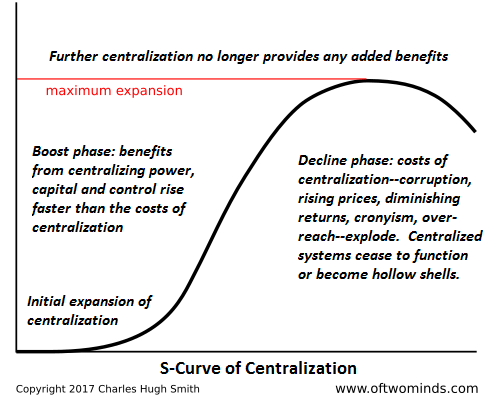
As I have often noted here, the returns on centralization are diminishing to less than zero. The initial returns on centralizing capital, production and social-political power were robust, but now the centralized cartel-state is eating its own tail, masking its financial bankruptcy by borrowing from the future, and cloaking its political bankruptcy behind the crumbling facades of the legacy parties.

Now that technology has enabled decentralized currency, markets and governance, the centralized political parties are obsolete. They are the political equivalent of buggy whips, and those holding tight to the fantasy that their current dissolution will magically be transformed into unity by some future leadership will be disappointed.

The fragmentation of the political parties is not temporary–it is permanent. As I discussed yesterday, political and social fragmentation are the consequence of economic fragmentation–these are self-reinforcing dynamics, as fragmentation in one feeds fragmentation in the others.

Those who have gotten rich inside the bloated machinery of the parties will never accept their era has ended. The dreams of private jets and millions of dollars in contributions die hard. But the voters and donors are both waking up to the cold reality that the parties are nothing but wealth distribution machines that sluice millions from financial elites to various political elites.

All the legacy claims of both parties ring false; neither party gives a hoot about the working class, small business or civil liberties. Their entire game plan is to whip up hot-button social issues to distract a fragmented citizenry and arouse last-gasp emotional loyalty to empty slogans.

Is it any wonder that people are abandoning both parties and claiming Independent status? All the core systems of the nation are failing, visibly, painfully, badly, and yet all the parties can dredge up is more of the same and TINA–there is no alternative.

The citizen who just awakened also awakened to the truth: the legacy parties have no solutions; their game plan is to milk the system as long as they can before it collapses in a rotten heap of corruption, fraud, collusion, debt and profiteering that benefits the few at the expense of the many.

When the parties do finally implode, the general mood will be: good riddance. A centralized spoils system is no longer a viable way to govern the nation. Political systems everywhere are facing a choice: Decentralize or die.

Decentralization and the Future World Order – Part I: The Revolution Is On

Bitcoin-Decentralized-World

Source: Thought Infection

A technological revolution is underway. An array of technologies are being developed that aim to do nothing less than disrupt the deepest fabric of the current world order. In a world where trust is power, decentralization steals the power from the hands of centralized institutions like corporations, banks, and even governments and puts it into the hands of the network. The revolution is beginning with a race to build the next generation of decentralized technologies that may soon replace internet giants like Dropbox or Facebook, but this is only the beginning of a transition to a future world order of decentralized power.

Lets start with a simple question: What is decentralization?

Many people equate decentralization with cryptographic networks like Bitcoin, which combine cryptography with decentralization, but decentralized applications do not inherently require encryption. The prototypical example of a modern decentralized technology would be Bittorrent, a technology with no inherent requirement for encryption. At its base, decentralization is the simple process of taking information and distributing copies among some sort of network so as to enhance data accessibility, security, redundancy, and congruence (consistency between parties).

The idea of decentralization is actually as old as communication itself. Cavemen would share their knowledge of hunting techniques and weapon technology among their tribe in order to be sure that the loss of no single individual would mean the loss of vital information. As humans created increasingly elaborate systems of exchange, organizations learned that keeping two or more copies of important documents was essential to ensuring their security.

The central problem of decentralization is that it also greatly increases the likelihood that information could fall into the hands of untrusted individuals. Thus, balancing the need for privacy and security meant finding a balance between centralized and decentralized structures for information sharing. To solve the age-old problem of privacy in shared information, cryptographic encoding or information was developed. Since at least Medieval times, people have been using simple ciphers to encode messages which they wished to share with only specific individuals.

In the 20th century, cryptography advanced greatly particularly during the world wars, when warring nations needed to be able to move around large amounts of information while preventing it from falling into the hands of the enemy. This spurned great innovations in both encryption and decryption, with both sides pouring resources into figuring out what their enemy was planning. It is widely believed, that the breaking of the Enigma code by British code-breakers which included one of the greatest minds of the 20th century, Alan Turing, was key to winning the war.

With the help of the universal computers Alan Turing helped invent, increasingly secure encryption algorithms were developed over the last half of the 20th century. Using these modern encryption algorithms, we can hide information well enough to confidently exchange sensitive financial information over a network which is essentially open (the internet). Thus, cryptography means that anyone eavesdropping on your web communications with your bank would have no way to understand the messages.

The Bitcoin blockchain is a distributed, encrypted ledger which stores the holdings of users of the network in individually encrypted data. This way, those using the network can be sure to agree on what amount of Bitcoin each user has, while only allowing those with the keys to be able to unlock their data and send some amount of Bitcoin to another user (see more here). Using the encrypted blockchain, Bitcoin is able to seamlessly transfer a limited supply of units of value between individuals in a way which does not rely on backing from any one central authority to provide value to the currency.

The core advance of the blockchain is that it allows the distribution of highly secure and highly congruent information throughout a network with no need for a centralizing authority.

As a side-thought, I would like to point out that although the software instantiation of the blockchain which underlies Bitcoin is totally dependent on digital computation, I see no reason a similar system based on mechanical encryption could not also be possible. Even if we never had invented computers I think we eventually would have come up with a sort of steam punk Bitcoin through which we could distribute value or congruent information using a cryptographic ledger system. 

Bittorrent was the first application to show that sharing of encrypted information over a decentralized network could be used to transfer value securely and efficiently, but there is no reason that decentralized technology could not be used to share any kind of information in a trustless network.

The MaidSafe and Storj projects have the ambitious goal of allowing anyone to share anything securely and efficiently over a decentralized network, something that could have deep consequences for the way that the internet works. If anyone can use the distributed network to share a website, then this could eliminate the needs for centralized servers which currently serve up websites when you visit them. Under these protocols, the cost of storing and sharing data with other users of the network who donate some part of their bandwidth and hard-drive space in exchange for the right to use the network. While some might worry that such a network would be used primarily for content piracy (as has been the case for Bittorrent), the integration of the Safecoin cryptocurrency with the MaidSafe network may actually make it easier than ever for content producers to monetize their content.

According to the project leader, both Maidsafe and Storj could be used to develop alternative, distributed versions of popular services such as Dropbox, Facebook, or even Google. Distributed versions of these centralized services could offer advantages for security and failure resistance. MaidSafe could also dramatically lower the barriers to entry for new players trying to compete such internet institutions as Facebook. While I have doubts whether the massive data-crunching necessary for Google could be pulled off on a decentralized network, a decentralized social network seems an obvious applications for MaidSafe.

Whereas MaidSafe, Storj and Bitcoin are specific applications of distributed technology, the Ethereum project aims to go much further and create a general distributed computer language on top of which anyone could easily develop an application like MaidSafe or Bitcoin. They are essentially trying to create a sort of decentralization operating system on top of which it would be possible to build any sort of program. By allowing the secure sharing of computer programs, Ethereum could allow the creation of advanced smart contracts with defined limits on how and when their funds could be disperse, or potentially even much more complex entities such a corporations.

2014 was a bit of a down year for Bitcoin, with coins falling from a value as high as $1000 to around $230 today. While this might be taken as a sign that the future of Bitcoin is in some danger, it is absolutely clear that it does not reflect at all on the wider cryptocurrency ecosystem. The ability to distribute trust through a network through the use of a Blockchain is a world changing technology, and the value of one currency does nothing to change its utility as a method of exchange. Saying that a drop in the price of bitcoin makes it irrelevant is like saying that the drop in the price of computer chips makes them irrelevant. Bitcoin is just the first in a series of decentralized applications that are already beginning to compete with centralized services.

Decentralization is becoming the gold standard for when you truly need to trust something, and in a world where trust is power it seems inevitable that decentralized technologies are destined to become the new nexus of power. In my next post I will discuss the past present and future of trust and power, and how that has been reshaped by decentralization.

————-

I would like to make a recommendation for a subreddit and a podcast that I think that those stimulated by this article might enjoy following, /r/Rad_Decentralization and the Decentralize Podcast