We are Closening to a Move Through the Cycle – But First Will Come Disorder

By Alastair Crooke

Source: Strategic Culture Foundation

Is the collective West nearing the end of a cycle? Or are we still in mid-cycle? And could it be an epochal point of inflection?

The question posed at this point is: Is the collective West nearing the end of a cycle? Or are we still in mid-cycle? And is this a four-generational mini-cycle, or an epochal point of inflection?

Is Russo-Chinese Entente and the global tectonic discontent with the ‘Rules Order’ – on the heels of a long trajectory of catastrophes from Viet Nam, through Iraq to Ukraine – sufficient to move the West on to the next stage of cyclical change from apex to disillusionment, retrenchment and eventual stabilisation? Or not?

A major inflection point is typically a period in history when all the negative components from the outgoing era ‘come into play’ – all at once, and all together; and when an anxious ruling class resorts to widespread repression.

Elements of such crises of inflection are today everywhere present: Deep schism in the U.S.; mass protest in France, and across Europe. A crisis in Israel. Faltering economies; and the threat of some, as yet undefined, financial crisis chilling the air.

Yet, anger erupts at the very suggestion that the West is in difficulties; that its ‘moment in the sun’ must give place to others,and to other cultures’ ways of doing things. The consequence to such a moment of epochal ‘in-betweeness’ has been characterised historically by the irruption of disorder, the breakdown of ethical norms, and the loss of a grip on what is real: Black becomes white; right becomes wrong; up becomes down.

That’s where we are – in the grip of western élite anxiety and a desperation to keep the ‘old machinery’s’ wheels spinning; its ratchets loudly opening and closing, and its levers clanging into, and out of place – all to give the impression of forward motion when, in truth, practically all of western energy is consumed in simply keeping the mechanism noisily aloft, and not crashing to an irreversible, dysfunctional stop.

So, this is the paradigm that governs western politics today: Doubling-down on the Rules Order with no strategic blueprint of what it is supposed to achieve – in fact no blueprint at all, except for ‘fingers crossed’ that something beneficial for the West will emerge, ex machina. The various foreign policy ‘narratives’ (Taiwan, Ukraine, Iran, Israel) contain little of substance. They are all clever linguistics; appeals to emotion, and with no real substance.

All this is hard to assimilate for those living in the non-West. For they do not come face-to-face with western Europe’s repeat re-anactment of the French Revolution’s iconic secular, egalitarian reform of human society – with ‘the specific timbre, flavour and ideology’ shifting, according to prevailing historic conditions.

Other nations unafflicted by this ideology (i.e., effectively the non-West) find it perplexing. The West’s culture war barely touches cultures outside its own. Yet, paradoxically, it dominates global geo-politics – for now.

Today’s ‘flavour’ is termed ‘our’ liberal democracy – the ‘our’ signifying its link to a set of precepts that defies clear definition or nomenclature; but one, that from the 1970s, has drifted into a radical enmity towards the traditional European and American cultural legacy.

What is singular about the present re-enactment is that whereas the French Revolution was about achieving class equality;ending the division between aristocracy and their vassals, liberalism today represents a modification of ideology” that U.S. writer Christopher Rufo suggests, “says that we want to categorize people based on group identity and then equalize outcomes across every axis – predominantly the economic axis, health axis, employment axis, criminal justice axis—and then formalize and enforce a general levelling”.

They want absolute democratic levelling of every societal discrepancy – reaching even, back into history, to historic discrimination and inequalities; and to have history re-written to highlight such ancient practice so that they can be routed out through enforced reverse discrimination.

What has this to do with foreign policy? Well, pretty well everything (so long as ‘our’ liberalism) retains its capture of the western institutional framework.

Bear this background in mind when thinking of the western political class’s reaction to events, say, in the Middle East, or in Ukraine. Although the cognitive élite contends that they are tolerant, inclusive, and pluralistic, they will not accept the moral legitimacy of their opponents. That is why in the U.S. – where the Cultural War is most developed – the language deployed by its foreign policy practitioners is so intemperate and inflammatory towards non-compliant states.

The point here is that, as Professor Frank Furedi has emphasised, the contemporary ‘timbre’ is one no longer merely adversarial, but unremittingly hegemonic. It is not a ‘turn’. It is a rupture: The determination to displace other sets of values by a western inspired ‘Rules-Based Order’.

Being a ‘liberal’ (in this strictly narrow sense) isn’t something you ‘do’; it is what you ‘are’. You think ‘right thoughts’ and utter ‘right speak’. Persuasion and compromise reflect only moral weakness in this vision. Ask the U.S. neocons!

We are used to hearing western officials talk about the ‘Rules-Based Order’ and the Multi-Polar System as rivals in a new global framework of intense ‘competition’. That however, would be to misconceive the nature of the ‘liberal’ project. They are not rivals: There cannot be ‘rivals’; they can only be recalcitrant other societies that have refused the analysis and the need to root out all cultural and psychological structures of inequity from their own domains. (Hence, China is hounded on its alleged deficiency in respect to the Uyghurs).

The cognitive privilege of ‘awareness’ is what lies behind the western ‘doubling-down’ on imposing a global Rules-BasedOrder: No compromise. The moral enterprise is more intent on its elevated moral station than on coming to terms with or managing, say, a defeat in Ukraine.

Just yesterday, the Bank of America in London was forced to cut short a two-day, online conference on geopolitics; and apologised to attendees following the outrage expressed at a speaker’s comments that were deemed ‘pro-Russian’ by some attendees.

What was said? Professor Nicolai Petro’s remarks at the session where he said: “Under any scenario, Ukraine would be the overwhelming loser in the war: Its industrial capacity devastated … and its population shrunk as people departed to look for employment abroad. If this is what is meant by removing Ukraine’s capacity to wage war against Russia, then it [Russia] will have won”. Professor Petro added that the U.S. government had no interest in a ceasefire, as it had the most to gain from a prolonged conflict.

No compromise is allowed. To speak thus, to inhabit the western moral high ground creating ‘villains’, clearly is more important than coming to terms with reality. Professor Petro’s comments were condemned as “rolling through Moscow’s talking points”.

Yet, these cultural revolutionaries face a pitfall, Christopher Rufo writes,

Theirs is actually, not an easy task. This is very difficult, and, in fact, I think is somewhat impossible. If you look at even the Chinese Cultural Revolution in the 1960s … They had a program of economic and social levelling that was more totalitarian and more drastic than anything that had ever happened in the past. [Yet] after the Revolution collapsed, after the period of retrenchment, social scientists looked at the data and discovered that a generation later, those initial inequalities had stabilized … The point is that forced levelling is very elusive. It’s very difficult to achieve, even when you are doing it at the tip of a spear or at the point of a gun.

The levelling project being essentially nihilistic becomes captured by the destructive side of the revolution – its authors so absorbed with dismantling structures that they do not attend to the need to think policies through, before launching into them. The latter are not adept at doing politics: at making politics ‘work’.

Thus, discontent at the welling string of western foreign policy flops grows. Crises multiply, both in number and across different societal dimensions. Perhaps, we are closening to a point of beginning to move through the cycle – toward disillusionment, retrenchment, and stabilization; the prerequisite step to catharsis and ultimate renewal. Yet, it would be a mistake to underestimate the longevity and tenacity of the western revolutionary impulse.

“The revolution does not operate as an explicit political movement. It operates laterally through the bureaucracy and it filters its revolutionary language through the language of the therapeutic, the language of the pedagogical, or the language of the corporate HR department”, Professor Furedi writes. “And then, it establishes power anti-democratically, bypassing the democratic structure: using this manipulative and soft language – to continue the revolution from within the institutions.”

Wokeness is a Product of Neoliberalism

Why don’t more people make this connection?

By Chad C. Mulligan

Source: The Hipcrime Vocab Substack

One thing I haven’t seen people point out anywhere else is how much the current atmosphere of “wokeness” is an outcome of neoliberalism.

Let me explain.

There was a lot of analysis written about neoliberalism back in the 1990s when it was still a relatively new phenomenon, having only been enshrined as the dominant economic paradigm in the 1980s. Now that neoliberalism has become simply the water in which we swim and the horizon upon which we gaze, we don’t even notice it anymore. The idea that there could be other ways to organize the economy and society has completely vanished from the discourse even on the nominal “Left”—so utterly complete has been its intellectual victory.

I can’t recall all the books and articles I read during that time, but a couple of standouts were One Market Under God by Thomas Frank and No Logo by Naomi Klein. Frank’s The Baffler magazine published a lot of good articles about neoliberalism back in those days, and Klein’s subsequent The Shock Doctrine is indispensable for understanding how neoliberalism took over the world.

One of the things that those analyses pointed out was the fact that neoliberalism derided governments as universally incompetent and inefficient and argued that only market competition could distribute goods and services effectively.

Furthermore, those markets had to be global in scope and free from “interference,” which was broadly defined as anything that hindered profit maximization including worker and environmental protections. This, in theory, would lead to ideal outcomes—or at least as close to ideal as they could be in a world of inherent scarcity.

As a corollary of this, neoliberals argued that democratic politics—the idea that citizens could express their wishes and desires via their elected representatives—was a hopelessly naive and outdated notion in the age of globalism. Rather, they argued that people’s preferences and desires would be more accurately reflected by how people spent their money in “free and open” markets. People’s spending patterns—aggregated and allocated by markets—would therefore be a better agent of social change than ineffective political action according to neoliberal theory1.

The One Big Market under neoliberalism, therefore, was seen not just a method for coordinating economic activities and allocating goods and services, but as the highest expression of people’s fundamental valuesWe were now expected to change the world thru shopping. As a result of this, you were expected to be an “ethical consumer.” You were exhorted to “spend your values.” Markets, neoliberals argued—and not popularly elected governments—were the true expression of the democratic will. As our choices at the voting booth began to narrow and seem more and more alike, we were told to vote with your dollar!

Here’s a concrete, real-world example. If you were concerned about dolphins being ensnared and killed in fishing nets used to dredge the ocean for tuna, the solution was not to ban the practice. No, the solution was to spend ethically on products labeled “dolphin safe.” Since consumers would express their preferences via buying dolphin safe tuna instead of the ones not so labeled, eventually the Invisible Hand of the Market would cause this practice to die out without a single government regulation. Similarly, if you wanted to support sustainable farming practices, you would spend preferentially on products labeled “organic” rather than the alternatives.

So in the neoliberal world view, the best way to bring about positive social change was by individuals spending their money in markets. That’s why in a modern shopping center you see all kinds of labels festooned on every conceivable product proclaiming how it is “responsibly sourced,” or how environmentally-friendly it is, or how the package is biodegradable, or how the farmers were fairly compensated, or whatever. You never saw that in the 1960s or 1970s—this change was ushered in by neoliberalism.

Now when you went to the grocery store it was no longer just to buy groceries—you had the obligation to save the world! (As if your life wasn’t stressful enough with the ever-longer working hours that were also the result of neoliberalism). A recurring theme of those analyses I read back in the day was the replacement of citizens with consumers.

(Of course, what’s to stop corporations from slapping any old claim onto their products? How can shoppers evaluate these claims? How can they possibly know what’s accurate and what’s not? Into this void stepped literally hundreds of different (private) certification agencies to try and make sure that these labels accurately reflected what they claimed. Thus, in the effort to avoid regulating markets, neoliberalism actually caused a proliferation of far more regulations and regulatory agencies than ever before. And often these privatized agencies have nonexistent oversight, poor standards and lax enforcement).

Another fundamental aspect of neoliberalism was the notion that competition would bring about ideal social outcomes. Therefore competition, neoliberals argued, had to be introduced into absolutely every aspect of human affairs. In this regard, neoliberalism a was really not just about economics, but was rather a radical totalitarian vision for remaking human society.

This extended even to social issues. For example, the philosophy behind “school choice” came from the notion that the problem with public schools was the lack of free market competition because schools were a state-owned monopoly. State-owned monopolies are the greatest possible evil under neoliberalism because they are not subject to market competition. By unleashing “choice,” schools would be forced to compete for students just like businesses compete for customers. This would make public education better, the thinking went, by eliminating bad schools and teachers and creating “lean and mean” educational institutions.

Even environmentalism has been colonized by neoliberalism. Instead of limiting the emission of fossil fuels, for example, new and exotic markets would be established so that polluters could trade opaque “carbon credits” in order to theoretically allocate pollution the same way we allocate any other resource under neoliberalism. This also demonstrates how neoliberalism is not anti-regulation or “small government” as is often portrayed, since creating these kinds of artificial markets takes massive amounts of government regulation and bureaucracy.

As this all-encompassing philosophy gradually took over the world, social protections were dismantled, regulations were abolished, and untrammeled, cutthroat competition was unleashed in every arena of life.

But it was Karl Polanyi who pointed out that such a vision of turning over society to anarchic markets with no protections and no refuge from its capricious dictates would lead to the “demolition of society.” No one could long withstand the never-ending whipsaws and bullwhips of “pure”relentless market competition—not consumers, not workers, and not even the businesses themselves! That’s why its has never existed, he said, and cannot exist.

So what actually happened in the real world due to unleashing this radical philosophy was an unprecedented wave of mergers, acquisitions, and consolidations in every sector of the economy, enabled by high finance (which was also “unleashed” thanks to neoliberalism).

You see, competition is expensive. It is also highly inefficientIt’s much more effective for parties to cooperate than to compete. That’s just game theory 101. It’s true of human affairs just as it is in nature. That’s why you see cooperation everywhere throughout the animal kingdom as Peter Kropotkin pointed out long ago. Any species where every single member was perennially locked in existential competition with every other member of the species would quickly die out, he said. Even where competition does exist in nature, it is in very limited in scope and in circumscribed contexts like mate choice.

Competition is also inherently unstable. You can’t just have an endless tournament going on forever and ever as free market theory depicts. Eventually there has to be a winner. Again, this is simply game theory 101. You can observe this everywhere you look.

So the current wave of consolidations and mergers in every sector of the economy can be seen as the logical outcome of neoliberal philosophy when applied to the real world as opposed to the world depicted in economic textbooks and think-tank policy papers. Want to know why the entire economy is dominated by a handful of mega-monopolies these days? That’s the reason why.

But getting back to our initial topic, here’s the point that’s absolutely critical: as a result of this neoliberal transformation, corporations had to portray themselves as agents of positive social change.

Read that again. And again and again and again until it sinks in.

This is what has lead to the rise of the modern “socially conscious” corporation and to so-called “woke capitalism.”

Think about it. Back in the pre-neoliberal 1960s, did any company bend over backwards to convey what it believed about absolutely anything? About any social issue whatsoever? No, because corporations weren’t expected to do that. Corporations were widely seen as anonymous entities devoid of values designed to make money by producing the goods and services consumers wanted. Back in the 1960’s—an era of rapid social change—no one cared about what IBM, Boeing, McDonalds, DuPont, General Electric, Coca Cola, General Motors, Prudential, Chevron, or any other big corporation thought about anything, much less the prevailing social issues of the day. That’s what politics was for! Businesses were expected to make money, full stop. Besides, how could a corporation really “think” anything? A corporation is a faceless bureaucratic enterprise composed of hundreds, or even thousands of individuals, each with their own personal set of values and beliefs. The very idea that a corporation could “believe” anything would have been seen as preposterous and absurd back then.

Spending money in “free” markets has subsequently become the only acceptable form of social protest or fomenting change under globalized neoliberalism—and not, for example, people banding together in popular movements to advocate for a better world. Government and politics have become passé and irrelevant—or so we’re told by those in charge. The sole option you have as a lone individual in the face of this relentless onslaught is to become an ethical consumer—in other words, to “spend your values.” Therefore, in order to meet this solemn obligation, you have to be sure that when you hand your money over to a corporation, that corporation reflects your values! That is a fundamental tenet of neoliberalism and its emphasis on markets—and not governments—as the highest arbiter of social values and preferences.

Yet very few commentators on the (fake) Left and the (pseudo) populist Right seem to grasp this. Instead they just shake their fists and rage.

So in order to get their hands on those precious “ethical” dollars, faceless bureaucratic corporations have to fashion themselves as “socially responsible.” As “ethical.” As being “positive change agents.” To that end they have launched wave after wave of PR campaigns designed to proclaim just how ethical and virtuous they are, from Amazon to Dove to Gillette, and every other big business has to follow suit.

Consider, for instance, those Dove advertisements that promised to let plus-size women believe they were beautiful—and publicly paraded them in their bras and panties in a commercial for cellulite-reducing cream. Or the Heineken “Worlds Apart” ad that showed people of disparate backgrounds and races coming together (eventually) over the beer. Or—to bring things back to the strategic positioning of carbonated sugar water as a proto-revolutionary product—the (thankfully short-lived) Kendall Jenner Pepsi spot that portrayed the soda as the means to bring Occupy-style protesters back into a grateful posture of consumer-abundance connoisseurship…

Believe in Something (The Baffler)

This also ties in with the “doing well by doing good” ethos of philanthropic capitalism as described by Anand Giridharadas in his book, Winners Take All. Once again, elected governments and politicians are portrayed as hopelessly inept and incompetent (sense a pattern?). In place of governments installed by the will of the people, therefore, “social entrepreneurs” will step into the void and solve the most pressing social problems of the day—and make a killing $$$ by doing so. This is portrayed as a “win-win” scenario in the media, which is owned and controlled by those same rich people (the fact that every single social problem seems to be getting exponentially worse has not deterred this policy approach in the slightest).

So if you wonder where all that cloying, patronizing Silicon Valley bullshit about “changing the world” and “making the world a better place” comes from—that’s where it comes from. It’s basically a form of neofeudalism in practice.

So the end result of all this is that under neoliberalism corporations are now obligated to portray themselves as ethical and moral in order to attract precious consumer dollars. Hence the rise of the modern “woke” corporation expressing it’s opinion on absolutely every hot-button issue of the day—from Black Lives Matter, to gay marriage, to the abortion debate, to transgender rights, to sexual harassment, to gun control, to multiculturalism, to whatever contentious wedge issue the political Right will dream up next.

And whether you like it or not, the people who tend to earn the most under globalized, technocratic monopoly capitalism really do strongly support cosmopolitan values like diversity, tolerance and inclusiveness. And since we are obligated to “spend our values” under neoliberalism, corporations have to cater to them—and to make sure that everyone knows about it. Thus they have to “officially” support things like Black Lives Matter. They have to speak out against discrimination against gay and transgender people. They have to be “antiracist.” They have to extol “empowering women and girls.” All because they need to attract the kinds of people who “spend their values,” and those values are more likely to be socially liberal for the kinds of people that corporations want to attract both as employees and consumers. That’s just the reality, and it’s not likely to change anytime soon.

And even though conservatives may not like it, socially regressive people and reactionaries tend to be poorer and less educated overall—and hence are less desirable as workers and consumers. That’s also just how it is. Therefore, corporations are “woke” based on a cynical, self-interested calculation of what will net them the most consumer dollars under neoliberal capitalism, and no amount of conservative grousing is going to change that. As a result, reactionaries and authoritarians are increasingly turning to politics to force their values upon people which they can’t enforce via the kinds of free market choices that they believe should dictate every other aspect of life.

When it became clear that the NFL supporters—largely white, male, and older—were outnumbered by the corporation’s brand loyalists—more diverse and younger—Nike went ahead and now even claims that it inaugurated the campaign because it believes that Kaepernick “is one of the most inspirational athletes of his generation.”

Believe in Something (The Baffler)

Of course, if we had a healthy and functioning political system none of this would be necessary. And it follows that if neoliberalism had not become the dominant social and economic paradigm of the twenty-first century there would be no such thing as “woke” capitalism in the first place.

So it’s truly amusing to watch the political Right rage to the heavens at the result of their own economic philosophy being applied in practice.

It’s also funny that, to my knowledge, no one appears to have made this connection. After all, why did corporations only relatively recently (i.e. after the 1990s) begin virtue signalling at every opportunity? It’s not just because everyone suddenly became “based” at approximately the same time. It’s the economic system, stupid!

Of course, it’s a win-win situation for political conservatives since they now have something to permanently complain about to rally people to their side, even though they are still just as pro-wealth and anti-worker as ever, and even though they still fervently believe in the most toxic tenets of neoliberalism (such as its contempt for democratically elected governments and its antipathy toward regulations and constraining the rich in any way). That’s the natural result of gutting civil society in favor of apotheosizing an all-powerful Market.

Of course, the bad news is that the end result of neoliberalism will probably be the rise of a twenty-first century form of fascist authoritarianism based on what I’m seeing in the media and across the political spectrum these days.

In conclusion, I find all of these “culture war” topics utterly inane and ridiculous (despite all the money you can make by endlessly bellyaching about them on Sub$tack). In a country where many citizens can’t even access basic health care, homelessness is endemic and rising, higher education is unaffordable, crime and suicide are rampant, people are mired in debt, wages have stagnated and mass shootings occur on a weekly basis2, I find it hard to get worked up over “wokeness” and “cancel culture.” And, as many besides me have pointed out, the idea that this cynical virtue signalling by mega-corporations means that they are in any way “left-of-center” by any reasonable definition of that term is absurd. After all, we’re talking about some of the most vile, sociopathic billionaires since the Gilded Age and some of the most brutal working conditions since the era of George Pullman. And the saddest thing is, we’ll never be able to unite to stop them since—thanks to neoliberalism—we will be kept perennially at each other’s throats while they continue to Tweet from their luxury yachts, penthouses, villas, and private jets about diversity and inclusiveness for ever and ever.

1 A good book about this is Undoing the Demos: Neoliberalism’s Stealth Revolution by Wendy Brown. Here’s an interview with the author.

2 It’s worth noting that I wrote this post before the latest massacre in Texas.

Brave New Cancel Culture World

By Pepe Escobar

Source: The Unz Review

In 2020, we saw the enshrinement of techno-feudalism – one of the overarching themes of my latest book, Raging Twenties.

In lightning speed, the techno-feudalism virus is metastasizing into an even more lethal, wilderness of mirrors variant, where cancel culture is enforced by Big Tech all across the spectrum, science is routinely debased as fake news in social media, and the average citizen is discombobulated to the point of lobotomy.

Giorgio Agamben has defined it as a new totalitarianism.

Top political analyst Alastair Crooke has attempted a sharp breakdown of the broader configuration.

Geopoliticallly, the Hegemon would even resort to 5G war to maintain its primacy, while seeking moral legitimization via the woke revolution, duly exported to its Western satrapies.

The woke revolution is a culture war – in symbiosis with Big Tech and Big Business – that has smashed the real thing: class war. The atomized working classes, struggling to barely survive, have been left to wallow in anomie.

The great panacea, actually the ultimate “opportunity” offered by Covid-19, is the Great Reset advanced by Herr Schwab of Davos: essentially the replacement of a dwindling manufacturing base by automation, in tandem with a reset of the financial system.

The concomitant wishful thinking envisages a world economy that will “move closer to a cleaner capitalist model”. One of its features is a delightfully benign Council for Inclusive Capitalism in partnership with the Catholic Church.

As much as the pandemic – the “opportunity” for the Reset – was somewhat rehearsed by Event 201 in October 2019, additional strategies are already in place for the next steps, such as Cyber Polygon, which warns against the “key risks of digitalization”. Don’t miss their “technical exercise” on July 9th, when “participants will hone their practical skills in mitigating a targeted supply chain attack on a corporate ecosystem in real time.”

A New Concert of Powers?

Sovereignty is a lethal threat to the ongoing cultural revolution. That concerns the role of the European Union institutions – especially the European Commission – going no holds barred to dissolve the national interests of nation states. And that largely explains the weaponizing, in varying degrees, of Russophobia, Sinophobia and Iranophobia.

The anchoring essay in Raging Twenties analyzes the stakes in Eurasia exactly in terms of the Hegemon pitted against the Three Sovereigns – which are Russia, China and Iran.

It’s under this framework, for instance, that a massive, 270-plus page bill, the Strategic Competition Act , has been recently passed at the US Senate. That goes way beyond geopolitical competition, charting a road map to fight China across the full spectrum. It’s bound to become law, as Sinophobia is a bipartisan sport in D.C.

Hegemon oracles such as the perennial Henry Kissinger at least are taking a pause from their customary Divide and Rule shenanigans to warn that the escalation of “endless” competition may derail into hot war – especially considering AI and the latest generations of smart weapons.

On the incandescent US-Russia front, where Foreign Minister Sergey Lavrov sees the lack of mutual trust, no to mention respect, as much worse than during the Cold War, analyst Glenn Diesen notes how the Hegemon “strives to convert the security dependence of the Europeans into geoeconomic loyalty”.

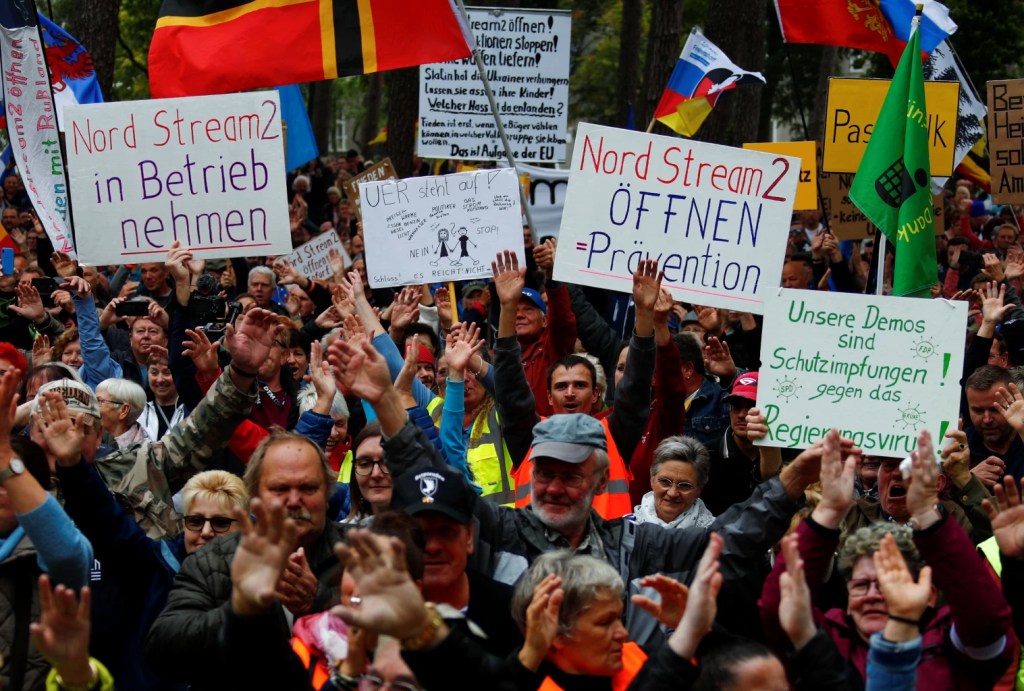
That’s at the heart of a make-or-break saga: Nord Stream 2. The Hegemon uses every weapon – including cultural war, where convicted crook Navalny is a major pawn – to derail an energy deal that is essential for Germany’s industrial interests. Simultaneously, pressure increases against Europe buying Chinese technology.

Meanwhile, NATO – which lords over the EU – keeps being built up as a global Robocop, via the NATO 2030 project – even after turning Libya into a militia-ridden wasteland and having its collective behind humiliatingly spanked in Afghanistan.

For all the sound and fury of sanction hysteria and declinations of cultural war, the Hegemon establishment is not exactly blind to the West “losing not only its material dominance but also its ideological sway”.

So the Council on Foreign Relations – in a sort of Bismarckian hangover – is now proposing a New Concert of Powers to deal with “angry populism” and “illiberal temptations”, conducted of course by those malign actors such as “pugnacious Russia” who dare to “challenge the West’s authority”.

As much as this geopolitical proposal may be couched in benign rhetoric, the endgame remains the same: to “restore US leadership”, under US terms. Damn those “illiberals” Russia, China and Iran.

Crooke evokes exactly a Russian and a Chinese example to illustrate where the woke cultural revolution may lead to.

In the case of the Chinese cultural revolution, the end result was chaos, fomented by the Red Guards, which started to wreak their own particular havoc independent of the Communist Party leadership.

And then there’s Dostoevsky in The Possessed, which showed how the secular Russian liberals of the 1840s created the conditions for the emergence of the 1860s generation: ideological radicals bent on burning down the house.

No question: “revolutions” always eat their children. It usually starts with a ruling elite imposing their newfound Platonic Forms on others. Remember Robespierre. He formulated his politics in a very Platonic way – “the peaceful enjoyment of liberty and equality, the reign of eternal justice” with laws “engraved in the hearts of all men”.

Well, when others disagreed with Robespierre’s vision of Virtue, we all know what happened: the Terror. Just like Plato, incidentally, recommended in Laws. So it’s fair to expect that the children of the woke revolution will eventually be eaten alive by their zeal.

Canceling freedom of speech

As it stands, it’s fair to argue when the “West” started to go seriously wrong – in a cancel culture sense. Allow me to offer the Cynic/Stoic point of view of a 21st century global nomad.

If we need a date, let’s start with Rome – the epitome of the West – in the early 5th century. Follow the money. That’s the time when income from properties owned by temples were transferred to the Catholic Church – thus boosting its economic power. By the end of the century, even gifts to temples were forbidden.

In parallel, a destruction overdrive was in progress – fueled by Christian iconoclasm, ranging from crosses carved in pagan statues to bathhouses converted into churches. Bathing naked? Quelle horreur!

The devastation was quite something. One of the very few survivors was the fabulous bronze statue of Marcus Aurelius on horseback, in the Campidoglio/ Capitoline Hill (today it’s housed in the museum). The statue survived only because the pious mobs thought the emperor was Constantine.

The very urban fabric of Rome was destroyed: rituals, the sense of community, singin’ and dancin’. We should remember that people still lower their voices when entering a church.

For centuries we did not hear the voices of the dispossessed. A glaring exception is to be found in an early 6th century text by an Athenian philosopher, quoted by Ramsay MacMullen in Christianity and Paganism in the Fourth to Eight Centuries.

The Greek philosopher wrote that Christians are “a race dissolved in every passion, destroyed by controlled self-indulgence, cringing and womanish in its thinking, close to cowardice, wallowing in all swinishness, debased, content with servitude in security.”

If that sounds like a proto-definition of 21st century Western cancel culture, that’s because it is.

Things were also pretty bad in Alexandria. A Christian mob killed and dismembered the alluring Hypatia, mathematician and philosopher. That de facto ended the era of great Greek mathematics. No wonder Gibbon turned the assassination of Hypatia into a remarkable set piece in Decline and Fall of the Roman Empire (“In the bloom of beauty, and in the maturity of wisdom, the modest maid refused her lovers and instructed her disciples; the persons most illustrious for their rank or merit were impatient to visit the female philosopher”).

Under Justinian – emperor from 527 to 565 – cancel culture went after paganism no holds barred. One of his laws ended imperial toleration of all religions, which was in effect since Constantine in 313.

If you were a pagan, you’d better get ready for the death penalty. Pagan teachers – especially philosophers – were banned. They lost their parrhesia: their license to teach (here is Foucault’s brilliant analysis).

Parrhesia – loosely translated as “frank criticism” – is a tremendously serious issue: for no less than a thousand years, this was the definition of freedom of speech (italics mine).

There you go: first half of the 6th century. This was when freedom of speech was canceled in the West.

The last Egyptian temple – to Isis, in an island in southern Egypt – was shut down in 526. The legendary Plato’s Academy – with no less than 900 years of teaching in its curriculum – was shut down in Athens in 529.

Guess where the Greek philosophers chose to go into exile: Persia.

Those were the days – in the early 2nd century – when the greatest Stoic, Epictetus, a freed slave from Phrygia, admirer of both Socrates and Diogenes, was consulted by an emperor, Hadrian; and became the role model of another emperor, Marcus Aurelius.

History tells us that the Greek intellectual tradition simply did not fade away in the West. It was a target of cancel culture.