
Untying PropOrNot: Who They Are … and a Look at 2017’s Biggest Fake News Story

By George Eliason, an American journalist living in Ukraine.

Source: Washington’s Blog

Preface by Washington’s Blog: A leading cybersecurity expert has publicly said that Mr. Eliason’s research as  presented in this article does not violate the law.  Washington’s Blog does not express an opinion about whether or not the claims set forth in this article are accurate or not. Make up your own mind.

A little over a year ago, the deep-state graced the world with Propornot. Thanks to them, 2017 became the year of fake news. Every news website and opinion column now had the potential to be linked to the Steele dossier and Trump collusion with Russia. Every journalist was either with us or against us. Every one that was against us became Russia’s trolls.

Fortunately for the free world, the anonymous group known as Propornot that tried to “out” every website as a potential Russian colluder, in the end only implicated themselves.

Turnabout is fair play and that’s always the fun part, isn’t it? With that in mind, I know the dogs are going to howl this evening over this one.

The damage Propornot did to scores of news and opinions websites in late 2016-2017 provides the basis of a massive civil suit. I mean huge, as in the potential is there for a tobacco company sized  class-action sized lawsuit. I can say that because I know a lot about a number of entities that are involved and the enormous amount of money behind them.

How serious is this? In 2016, a $10,000 reward was put out for the identities of Propornot players. No one has claimed it yet, and now, I guess no one will. There are times in your life that taking a stand has a cost. To make sure the story gets out and is taken seriously, this is one of those times.

If that’s what it takes for you to understand the danger Propornot and the groups around them pose to everyone you love, if you understand it, everything will have been well worth it.

In this article, you’ll meet some of the people staffing Propornot. You’ll meet the people and publications that provide their expenses and cover the logistics. You’ll meet a few of the deep state players. We’ll deal with them very soon. They need to see this as the warning shot over the bow and start playing nice with regular people.  After that, you’ll meet the NGO’s that are funding and orchestrating all of it. How am I doing so far?

The image that you see is the clincher or game winner that supplies the necessary proof up front and the direct path to Propornot. This was a passive scan of propornot.com showing the administrative dashboard belongs to the InterpreterMag.com as shown on the left of the image. On the right, it shows that uploads to Propornot.com come from InterpreterMag.com and is a product of that publication.

Now we have the first layer of Propornot, fake news, and our 1st four contestants. We havea slew of new media organizations that are influenced by, or feeding Propornot. Remember, fake news got off the ground and got its wings because of the attention this website received from the Washington Post in Dec. 2016.

At the Interpreter Mag level, here are the people:

  • Michael Weiss is the Editor-in-Chief at the InterpreterMag.com. According to his Linkd profile, he is also a National Security Analyst for CNN since Jul 2017 as well as an Investigative Reporter for International Affairs for CNN since Apr 2017. He has been a contributor there since 2015. He has been a Senior Editor at The Daily Beast since Jun 2015.

With the lengthy CNN cred’s, how much involvement does CNN have in fake news? Yes, I know, but we’re talking about Propornot.

  • James Miller’s bio at the InterpreterMag.com includes Managing Editor of The Interpreter where he reports on Russia, Ukraine, and Syria. James runs the “Under The Black Flag” column at RFE/RL which provides news, opinion, and analysis about the impact of the Islamic State extremist group in Syria, Iraq, and beyond. He is a contributor at Reuters, The Daily Beast, Foreign Policy, and other publications. He is an expert on verifying citizen journalism and has been covering developments in the Middle East, specifically Syria and Iran, since 2009. Follow him on Twitter: @MillerMENA- Miller even works for the US Embassy in Kiev “diplo-page” the Kiev Post.

The Interpreter is a product of the Atlantic Council. The Digital Forensics Research Lab has been carrying the weight in Ukrainian-Russian affairs for the Atlantic Council. Fellows working with the Atlantic Council in this area include:

  • Bellingcat- Aric Toler and Eliot Higgins- This linked article shows how an underwear salesman became one of the most important faces of the deep state.  Don’t laugh, the image is really appropriate. Higgins’ insecurity runs so deep because of his failures that Higgins tries to get publications censured that question his author-i-tie.
  • Anne Applebaum
  • StopFake- Irena Chalupa- Chalupa is the sister to the same Alexandra Chalupa that brought the term Russian hacking to worldwide attention. Irena Chalupa is a nonresident fellow with the Atlantic Council’s Dinu Patriciu Eurasia Center. She is also a senior correspondent at Radio Free Europe/Radio Liberty (RFE/RL), where she has worked for more than twenty years. Ms. Chalupa previously served as an editor for the Atlantic Council, where she covered Ukraine and Eastern Europe. Irena Chalupa is also the news anchor for Ukraine’s propaganda channel Stopfake.org She is a Ukrainian Diaspora leader. The Chalupa’s are the 1st family of Ukrainian propaganda. She works with and for Ukrainian Intelligence through the Atlantic Council, Stopfake, and her sisters Andrea (Euromaidanpr) and Alexandra.

The strand that ties this crew together is they all work for Ukrainian Intelligence. If you hit the links, the ties are documented very clearly. We’ll get to that point again shortly, but let’s go further:

Propornot-> Atlantic Council -> Broadcasting Board of Governors (BBG)

Who are the BBG? According to Wikipedia- “The Broadcasting Board of Governors (BBG) is an independent agency of the United States government. According to its website, its mission is to “inform, engage, and connect people around the world in support of freedom and democracy. The BBG supervised Voice of America (VOA), Radio Free Europe/Radio Liberty, Radio y Television Marti, Radio Free Asia, and the Middle East Broadcast Networks.

The board of the BBG was eliminated and replaced with a single appointed chief executive officer as part of the National Defense Authorization Act for Fiscal Year 2017, which was passed in December 2016.”
On January 1, 2016, the  Interpreter became a special project of RFE/RL and under the oversight of the BBG. The Secretary of State had a seat on the board of the BBG until December 2016. Why the change?

During the 2016 election, the BBG developed a major conflict of interest. At least two BBG board members worked actively for the Hillary Clinton presidential campaign. These government officials were working against the president-elect after the election. It looks like it didn’t go unnoticed. In the following linked article, it shows that they should be investigated for their part in an attempted coup.

From a Nov 7, 2016, article– “Karen Kornbluh is helping refine and to get Hillary Clinton’s message out. ” All of them are names to watch if Clinton wins — and key jobs at the FCC and other federal agencies are up for grabs.”

According to her bio: Karen founded the New America Foundation’s Work and Family Program and is a senior fellow for Digital Policy at the Council on Foreign Relations. Karen has written extensively about technology policy, women, and family policy for The AtlanticThe New York Times and The Washington PostNew York Times columnist David Brooks cited her Democracy article “Families Valued,” focused on “juggler families” as one of the best magazine articles of 2006.

Michael Kempner is the founder, President and Chief Executive Officer of MWW Group, a staunch Hillary Clinton supporter, and may get a greater role if she is elected.  Kempner is a member of the Public Relations Hall of Fame. Michael Kempner hired Anthony Weiner after the sexting scandal broke in 2011.

Jeff Shell, chairman of the BBG and  Universal Filmed Entertainment is supporting a secondary role by being an honor roll donor to the Atlantic Council. While the BBG is supposed to be neutral it has continuously helped increase tensions in Eastern Europe. While giving to the Atlantic Council may not be illegal while in his position, currently, the Atlantic Council’s main effort is to ignite a war with Russia. This may set up a major conflict of interest.

According to journalist Robert Parry “The people that will be taking senior positions and especially in foreign policy believe “This consensus is driven by a broad-based backlash against a president who has repeatedly stressed the dangers of overreach and the need for restraint, especially in the Middle East.”

Parry goes on to say that at the forefront of this is the Atlantic Council, a think tank associated with NATO. Their main goal is a major confrontation with nuclear-armed Russia.”

So, to make sense of all this, most of the people listed would have held cabinet positions in a Hillary Clinton presidency. If the Interpreter is a project of RFE/RL then the decision to go ahead with Propornot would have to go across their desk. That includes then Sec of State, John Kerry.

The unasked question of why would a US Government Agency do this (?) needs to be addressed. All the people listed above were actively working for Clinton to get her elected and throw Donald Trump’s campaign off the rails.

After the election, they were going to take care of Clinton’s “deplorables” by dissecting alternative media. I wrote about this before the election and I warned several major new sites what they could expect. I was right on the money. After she lost, it was already in motion. The deplorable media didn’t fall into a particular political pattern other than they did not promote Hillary Clinton.

The purpose of Propornot has been to get people to demand freedom of speech be rolled back. This was/is to be done by destroying fact-based media. If you read further, the entire plan is laid out starting from 2015 when it started coming together.

These people want reality shaped on what the perceived majority (louder) group believes to be true, regardless of what the facts are. Perception based reality is only a Facebook like away from killing one person or elevating another to hero status regardless of what they have done.

That little statement about the free speech rally says it all. It’s something that would hardly be noticed unless you were looking for it because it is part of the meta-data.

Now you can say it’s only a sentence and who cares? Nobody communicates through metadata do they? Wasn’t that what Propornot was all about? Yes, they do communicate through metadata. That’s why I look at it.

Do you see it? No? Look again. There in the metadata, at the bottom of the image is an ad for a job. Go for it and remember to mention the header. It could just as easily be hacking instructions, or a do not disturb sign. That’s why it pays to really research carefully.

The Boston ‘Free Speech’ Rally was billed by the social networks and MSM as a fascist rally. It was really a Free Speech Rally. What they learned is that with just a little nudge, they can make you demand nationalist repression. Nice going Boston!

Hey, is this starting to sound a little conspiratorial? If it is, we need ruskie hackers with Guy Fawkes masks to make this work. They have to admit to changing international politics through hacking in 2016, belong to a foreign country, code in Russian, and use spear phishing techniques to lure people in. Let’s not forget that they also have to work for some form of Intelligence.

Most importantly, they have to work with and influence all of the people above. They will definitely impact US foreign policy toward Russia. Let’s raise the stakes even more. The hackers have to answer to whoever is funding a lot of the illegal and immoral activities.
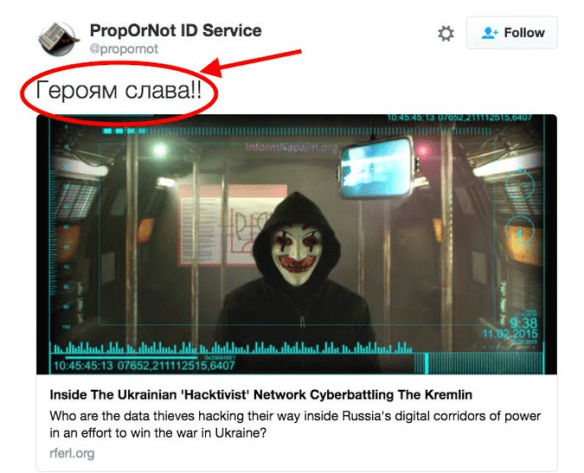
They are not even savvy enough to stay clear of outing each other. This is the Pravy Sektor hacker RUH8.  The common thread for these hackers is clear if you read the linked material on the profiles that make up these organizations. They work for Bellingcat, Informnapalm, the Atlantic Council, Ukrainian Intel, and the Diaspora.

In a follow-up article, I have reason to ask if they were given access to United States Government Top Secret Secure Servers. I’m not kidding.

In a Euromaidan Press article dated November 2nd, 2016, the hackers state enthusiastically “Ukrainian hackers have a rather high level of work. So the help of the USA… I don’t know, why would we need it? We have all the talent and special means for this. And I don’t think that the USA or any NATO country would make such sharp movements in international politics.”

And we have a winner. In 2016 the sharp movement in international politics was caused by…survey says….hacking!!!!

According to Donna Brazille, the Democratic Party servers were hacked multiple times and the hacking didn’t stop until December 2016. At this juncture, we should be able to agree that Seth Rich leaked the information to Wikileaks. But, now we are talking about other hacks. In the above linked article, these hacker specifically say their favorite route is spear phishing email accounts.

In the article, you’ll also see they work directly for Ukrainian Intel. Bellingcat works directly for Ukrainian Intel and works with them and the Atlantic Council. Stopfake is a product of Irena Chalupa who works for RFE/RL, the Atlantic Council and the Ukrainian government. Stopfake works directly with them and is a product of the Ukrainian government. Crowdstrike has an ongoing relationship with Ukrainian Intel and these particular hackers. Crowdstrike conjured up Fancy Bear. Well say, hello to the real fancy bear of 2016 (*fancybear is technically a set of tools and not people).

This means that former Secretary of State John Kerry approved of Ukrainian Intelligence hackers having access to servers inside a US Government Agency because of Propornot and the Atlantic Councils reliance on the hackers.

How are the Ukrainian hackers tied into Propornot at any level? James Miller isn’t shy about using their work. Propornot relies on the work of the Atlantic Council, Aric Toler, Aaron Weisburd, Clint Watts, and Joel Harding. The Ukrainian hackers work directly with InformNapalm and are the go-to resource for most of the people involved and all of the people just named.

Below we have assessed the details of the reports from InformNapalm, and have expanded on their investigation. — James Miller

Americans are attacking Americans for a foreign country for what amounts to pennies. We’ll deal with them again soon.

Who does the Atlantic Council work for? It’s the same people that staff RFE/RL.

“On 29 January 2016 in Washington, U.S.A., Ukrainian World Congress (UWC) President Eugene Czolij and Atlantic Council President and CEO Frederick Kempe officially signed a Memorandum of Agreement to renew the cooperation between the UWC and the Atlantic Council, that began in September 2014.

In accordance with this Memorandum, the UWC will continue its cooperation with the Atlantic Council on implementing the “Ukraine in Europe Initiative”, which aims to galvanize international support for an independent, sovereign and territorially integral Ukraine, including Crimea. This initiative is also intended to support reforms in Ukraine and its EuroAtlantic integration, and to counter Russian disinformation.”

This one little paragraph spells out clearly what I have shown in detail throughout this article.

The Ukrainian World Congress is represented in the US Congress by the Ukrainian Caucus headed up by ISIS supporter and Nazi cheerleader Marcy Kaptur. Her Ukrainian Caucus represents people  with political positions that scared Adolf Hitler in WWII.

The obvious takeaway is that a lawsuit is a bare minimum that needs to happen. People need to be investigated for crimes against the state. When we take a closer look at who had potential access to top-secret servers, that will become painfully obvious.

These people have tried and are trying to rip the fabric of society in pieces. At the very least, they have earned a good tarring…and feathering. When you look at the financial end of this a lawsuit in the billions would barely touch it.

Just one company the Ukrainian Diaspora started for this is valued over 100 million dollars. This will need to be a class action suit with a cease and desist to the BBG.

In early 2015, almost 2 years before most people took the idea of censorship seriously, I documented its inception. In the same way, it happens with many of the biggest stories of our times, I stumbled onto it by accident.

In early March 2015, Ukrainian Information Policy designer Joel Harding laid out what to expect going forward in the following statements: “In military IIO operations center on the ability to influence foreign audiences, US, and global audiences, and adversely affect enemy decision making through an integrated approach. Even current event news is released in this fashion. Each portal is given messages that follow the same themes because it is an across the board mainstream effort that fills the information space entirely when it is working correctly.

The purpose of “Inform and Influence Operations”  is not to provide a perspective, opinion, or lay out a policy. It is defined as the ability to make audiences “think and act” in a manner favorable to the mission objectives. This is done through applying perception management techniques which target the audiences emotions, motives, and reasoning.

These techniques are not geared for debate. It is to overwhelm and change the target psyche.

Using these techniques information sources can be manipulated and those that write, speak, or think counter to the objective are relegated as propaganda, ill-informed, or irrelevant.”- Harding

While the above sounds gloriously overoptimistic, Harding, along with his little band of Kremlin Troll hunters personally started developing the idea of organizations capable of blackballing journalists and publications in a way that could not be construed as censorship.

From another March 2015 articleA “Disinformation Charter” for Media and BloggersTop-down censorship should be avoided. But rival media, from Al-Jazeera to the BBC, Fox and beyond, need to get together to create a charter of acceptable and unacceptable behavior. Vigorous debate and disagreement qre ,of course, to be encouraged—but media organizations that practice conscious deception should be excluded from the community. A similar code can be accepted by bloggers and other online influencers.

This “Disinformation Charter” for responsible behavior (Ministry of Truth?) he describes is to fight “conscious deception” can only be weighed against how he describes Propaganda. “The word is frequently used to describe any news emerging one’s opponent.”– Harding

Journalists that need to be excluded are those “our side” label as propagandists or active measure agents.”

Harding’s connections in media are very large. Through his friend Mathew Armstrong, Harding had access to and the ear of the board of the Broadcasting Board of Governors (BBG). The BBG board is staffed by the who’s who of network and radio broadcast, print media and shortwave CEO’s and heavy hitters. They are behind RFE/RL (Radio Free Europe/ Radio Liberty).

On the other end of this in 2015, Joel Harding was assembling a group of miscreants to attack the social networks of different journalist and publications. The crude logic behind a direct assault was that by developing, training, and overseeing vast troll networks they could speak over their opposition (people that their employers wanted to be silenced) and subdue dissident online conversation and control the information.

Where this wasn’t feasible, they set up hack and harass attacks at various publication to get them to stop publishing hard-hitting journalists. This still hasn’t been effective because it caused publishers to dig in and harden their internet properties instead.

The softer more indirect approach Harding pushed in March 2015 quickly developed into the unified media strategy he wanted for the US and Europe. Control the information and don’t allow contradicting information or news into the media stream. When it does get in, call it propaganda.

Enter Propornot.


The Acceleration of Censorship in America

By Joe Lauria

Source: The Unz Review

Under increasing pressure from a population angry about endless wars and the transfer of wealth to the one percent, American plutocrats are defending themselves by suppressing critical news in the corporate media they own. But as that news emerges on RT and dissident websites, they’ve resorted to the brazen move of censorship, which is rapidly spreading in the U.S. and Europe. I know because I was a victim of it.

At the end of October, I wrote an article for Consortium News about the Democratic National Committee and Hillary Clinton’s campaign paying for unvetted opposition research that became the basis for much of the disputed story about Russia allegedly interfering in the 2016 presidential election.

The piece showed that the Democrats’ two paid-for sources that have engendered belief in Russia-gate are at best shaky. First was former British spy Christopher Steele’s largely unverified dossier of second- and third-hand opposition research portraying Donald Trump as something of a Russian Manchurian candidate.

And the second was CrowdStrike, an anti-Putin private company, examining the DNC’s computer server to dubiously claim discovery of a Russian “hack.” CrowdStrike, it was later discovered, had used faulty software it was later forced to rewrite. The company was hired after the DNC refused to allow the FBI to look at the server.

My piece also described the dangerous consequences of partisan Democratic faith in Russia-gate: a sharp increase in geopolitical tensions between nuclear-armed Russia and the U.S., and a New McCarthyism that is spreading fear — especially in academia, journalism and civil rights organizations — about questioning the enforced orthodoxy of Russia’s alleged guilt.

After the article appeared at Consortium News, I tried to penetrate the mainstream by then publishing a version of the article on the HuffPost, which was rebranded from the Huffington Post in April this year by new management. As a contributor to the site since February 2006, I am trusted by HuffPost editors to post my stories directly online. However, within 24 hours of publication on Nov. 4, HuffPost editors retracted the article without any explanation.

This broke with the earlier principles of journalism that the Web site espoused. For instance, in 2008, Arianna Huffington told radio host Don Debar that, “We welcome all opinions, except conspiracy theories.” She said: “Facts are sacred. That’s part of our philosophy of journalism.”

But Huffington stepped down as editor in August 2016 and has nothing to do with the site now. It is run by Lydia Polgreen, a former New York Times reporter and editor, who evidently has very different ideas. In April, she completely redesigned the site and renamed it HuffPost.

Before the management change, I had published several articles on the Huffington Post about Russia without controversy. For instance, The Huffington Post published my piece on Nov. 5, 2016, that predicted three days before the election that if Clinton lost she’d blame Russia. My point was confirmed by the campaign-insider book Shattered, which revealed that immediately after Clinton’s loss, senior campaign advisers decided to blame Russia for her defeat.

On Dec. 12, 2016, I published another piece, which the Huffington Post editors promoted, called, “Blaming Russia To Overturn The Election Goes Into Overdrive.” I argued that “Russia has been blamed in the U.S. for many things and though proof never seems to be supplied, it is widely believed anyway.”

After I posted an updated version of the Consortium News piece — renamed “On the Origins of Russia-gate” — I was informed 23 hours later by a Facebook friend that the piece had been retracted by HuffPost editors. As a reporter for mainstream media for more than a quarter century, I know that a newsroom rule is that before the serious decision is made to retract an article the writer is contacted to be allowed to defend the piece. This never happened. There was no due process. A HuffPost editor ignored my email asking why it was taken down.

Support from Independent Media

Like the word “fascism,” “censorship” is an over-used and mis-used accusation, and I usually avoid using it. But without any explanation, I could only conclude that the decision to retract was political, not editorial.

I am non-partisan as I oppose both major parties for failing to represent millions of Americans’ interests. I follow facts where they lead. In this case, the facts led to an understanding that the Jan. 6 FBI/NSA/CIA intelligenceassessment” on alleged Russian election interference, prepared by what then-Director of National Intelligence James Clapper called “hand-picked” analysts, was based substantially on unvetted opposition research and speculation, not serious intelligence work.

The assessment even made the point that the analysts were not asserting that the alleged Russian interference was a fact. The report contained this disclaimer: “Judgments are not intended to imply that we have proof that shows something to be a fact. Assessments are based on collected information, which is often incomplete or fragmentary, as well as logic, argumentation, and precedents.”

Under deadline pressure on Jan. 6, Scott Shane of The New York Times instinctively wrote what many readers of the report must have been thinking: “What is missing from the public report is what many Americans most eagerly anticipated: hard evidence to back up the agencies’ claims that the Russian government engineered the election attack. … Instead, the message from the agencies essentially amounts to ‘trust us.’”

Yet, after the Jan. 6 report was published, leading Democrats asserted falsely that the “assessment” represented the consensus judgment of all 17 U.S. intelligence agencies – not just the views of “hand-picked” analysts from three – and much of the U.S. mainstream media began treating the allegations of Russian “hacking” as fact, not as an uncertain conclusion denied by both the Russian government and WikiLeaks, which insists that it did not get the two batches of Democratic emails from the Russian government.

Yet, because of the oft-repeated “17 intelligence agencies” canard and the mainstream media’s over-hyped reporting, the public impression has built up that the accusations against Russia are indisputable. If you ask a Russia-gate believer today what their faith is based on, they will invariably point to the Jan. 6 assessment and mock anyone who still expresses any doubt.

For instance, an unnamed former CIA officer told The Intercept last month, “You’ve got all these intelligence agencies saying the Russians did the hack. To deny that is like coming out with the theory that the Japanese didn’t bomb Pearl Harbor.”

That the supposedly dissident Intercept would use this quote is instructive about how unbalanced the media’s reporting on Russia-gate has been. We have film of Japanese planes attacking Pearl Harbor and American ships burning – and we have eyewitness accounts of thousands of U.S. soldiers and sailors. Yet, on Russia-gate, we have only the opinions of “hand-picked” intelligence officials who themselves admit their opinions aren’t fact. No serious editor would allow a self-interested and unnamed source to equate Russia-gate and Pearl Harbor in print.

In this atmosphere, it was easy for HuffPost editors to hear complaints from readers and blithely ban my story. But before it was pulled, 125 people had shared it. Ray McGovern, a former CIA analyst, then took up my cause, being the first to write about the HuffPost censorship on his blog. McGovern included a link to a .pdf file that I captured of the censored HuffPost story. It has since been republished on numerous other websites.

Journalist Max Blumenthal tweeted about it. British filmmaker and writer Tariq Ali posted it on his Facebook page. Ron Paul and Daniel McAdams interviewed me at length about the censorship on their TV program. ZeroHedge wrote a widely shared piece and someone actually took the time, 27 minutes and 13 seconds to be exact, to read the entire article on YouTube. I began a petition to HuffPost’s Polgreen to either explain the retraction or restore the article. It has gained more than 2,000 signatures so far. If a serious fact-check analysis was made of my article, it must exist and can and should be produced.

Watchdogs & Media Defending Censorship

Despite this support from independent media, a senior official at Fairness and Accuracy in Reporting, I learned, declined to take up my cause because he believes in the Russia-gate story. I also learned that a senior officer at the American Civil Liberties Union rejected my case because he too believes in Russia-gate. Both of these serious organizations were set up precisely to defend individuals in such situations on principle, not preference.

In terms of their responsibilities for defending journalism and protecting civil liberties, their personal opinions about whether Russia-gate is real or not are irrelevant. The point is whether a journalist has the right to publish an article skeptical of it. I worry that amid the irrational fear spreading about Russia that concerns about careers and funding are behind these decisions.

One online publication decidedly took the HuffPost’s side. Steven Perlberg, a media reporter for BuzzFeed, asked the HuffPost why they retracted my article. While ignoring me, the editors issued a statement to BuzzFeed saying that “Mr. Lauria’s self-published” piece was “later flagged by readers, and after deciding that the post contained multiple factually inaccurate or misleading claims, our editors removed the post per our contributor terms of use.” Those terms include retraction for “any reason,” including, apparently, censorship.

Perlberg posted the HuffPost statement on Twitter. I asked him if he inquired of the editors what those “multiple” errors and “misleading claims” were. I asked him to contact me to get my side of the story. Perlberg totally ignored me. He wrote nothing about the matter. He apparently believed the HuffPost and that was that. In this way, he acquiesced with the censorship.

BuzzFeed, of course, is the sensationalist outlet that irresponsibly published the Steele dossier in full, even though the accusations – not just about Donald Trump but also many other individuals – weren’t verified. Then on Nov. 14, BuzzFeed reporter Jason Leopold wrote one of the most ludicrous of a long line of fantastic Russia-gate stories, reporting that the Russian foreign ministry had sent money to Russian consulates in the U.S. “to finance the election campaign of 2016.” The scoop generated some screaming headlines before it became clear that the money was to pay for Russian citizens in the U.S. to vote in the 2016 Duma election.

That Russia-gate has reached this point, based on faith and not fact, was further illustrated by a Facebook exchange I had with Gary Sick, an academic who served on the Ford and Carter national security staffs. When I pressed Sick for evidence of Russian interference, he eventually replied: “If it walks like a duck and talks like a duck…” When I told him that was a very low-bar for such serious accusations, he angrily cut off debate.

When belief in a story becomes faith-based or is driven by intense self-interest, honest skeptics are pushed aside and trampled. True-believers disdain facts that force them to think about what they believe. They won’t waste time making a painstaking examination of the facts or engage in a detailed debate even on something as important and dangerous as a new Cold War with Russia.

This is the most likely explanation for the HuffPost‘s censorship: a visceral reaction to having their Russia-gate faith challenged.

Why Critical News is Suppressed

But the HuffPost’s action is hardly isolated. It is part of a rapidly growing landscape of censorship of news critical of American corporate and political leaders who are trying to defend themselves from an increasingly angry population. It’s a story as old as civilization: a wealthy and powerful elite fending off popular unrest by trying to contain knowledge of how the elite gain at the others’ expense, at home and abroad.

A lesson of the 2016 campaign was that growing numbers of Americans are fed up with three decades of neoliberal policies that have fabulously enriched the top tier of Americans and debased a huge majority of everyone else. The population has likewise grown tired of the elite’s senseless wars to expand their own interests, which they to conflate with the entire country’s interests.

America’s bipartisan rulers are threatened by popular discontent from both left and right. They were alarmed by the Bernie Sanders insurgency and by Donald Trump’s victory, even if Trump is now betraying the discontented masses who voted for him by advancing tax and health insurance plans designed to further crush them and benefit the rich.

Trump’s false campaign promises will only make the rulers’ problem of controlling a restless population more difficult. Americans are subjected to economic inequality greater than in the first Gilded Age. They are also subjected today to more war than in the first Gilded Age, which led to the launch of American overseas empire. Today American rulers are engaged in multiple conflicts following decades of post-World War II invasions and coups to expand their global interests.

People with wealth and power always seem to be nervous about losing both. So plutocrats use the concentrated media they own to suppress news critical of their wars and domestic repression. For example, almost nothing was reported about militarized police forces until the story broke out into the open in the Ferguson protests and now the story has been buried again.

Careerist journalists readily acquiesce in this suppression of news to maintain their jobs, their status and their lifestyles. Meanwhile, a growing body of poorly paid freelancers compete for the few remaining decent-paying gigs for which they must report from the viewpoint of the mainstream news organizations and their wealthy owners.

To operate in this media structure, most journalists know to excise out the historical context of America’s wars of domination. They know to uncritically accept American officials’ bromides about spreading democracy, while hiding the real war aims.

Examples abound: America’s role in the Ukraine coup was denied or downplayed; a British parliamentary report exposing American lies that led to the destruction of Libya was suppressed; and most infamously, the media promoted the WMD hoax and the fable of “bringing democracy” to Iraq, leading to the illegal invasion and devastation of that country. A recent example from November is a 60 Minutes reporton the Saudi destruction of Yemen, conspicuously failing to mention America’s crucial role in the carnage.

I’ve pitched numerous news stories critical of U.S. foreign policy to a major American newspaper that were rejected or changed in the editorial process. One example is the declassified Defense Intelligence Agency document of August 2012 that accurately predicted the rise of the Islamic State two years later.

The document, which I confirmed with a Pentagon spokesman, said the U.S. and its Turkish, European and Gulf Arab allies, were supporting the establishment of a Salafist principality in eastern Syria to put pressure on the Syrian government, but the document warned that this Salafist base could turn into an “Islamic State.”

But such a story would undermine the U.S. government’s “war on terrorism” narrative by revealing that the U.S.-backed strategy actually was risking the expansion of jihadist-held territory in Syria. The story was twice rejected by my editors and to my knowledge has never appeared in corporate media.

Another story rejected in June 2012, just a year into the Syrian war, was about Russia’s motives in Syria being guided by a desire to defeat the growing jihadist threat there. Corporate media wanted to keep the myth of Russia’s “imperial” aims in Syria alive. I had to publish the article outside the U.S., in a South African daily newspaper.

In September 2015 at the U.N. General Assembly, Russian President Vladimir Putin confirmed my story about Russia’s motives in Syria to stop jihadists from taking over. Putin invited the U.S. to join this effort as Moscow was about to launch its military intervention at the invitation of the Syrian government. The Obama administration, still insisting on “regime change” in Syria, refused. And the U.S. corporate media continued promoting the myth that Russia intervened to recapture its “imperial glory.”

It was much easier to promote the “imperial” narrative than report Putin’s clear explanation to French TV channel TF1, which was not picked up by American media.

“Remember what Libya or Iraq looked like before these countries and their organizations were destroyed as states by our Western partners’ forces?” Putin said. “These states showed no signs of terrorism. They were not a threat for Paris, for the Cote d’Azur, for Belgium, for Russia, or for the United States. Now, they are the source of terrorist threats. Our goal is to prevent the same from happening in Syria.”

But don’t take Putin’s word for it. Then Secretary of State John Kerry knew why Russia intervened. In a leaked audio conversation with Syrian opposition figures in September 2016, Kerry said: “The reason Russia came in is because ISIL was getting stronger, Daesh was threatening the pos­sibility of going to Damascus, and that’s why Russia came in because they didn’t want a Daesh government and they supported Assad.”

Kerry admitted that rather than seriously fight the Islamic State in Syria, the U.S. was ready to use its growing strength to pressure Assad to resign, just as the DIA document that I was unable to report said it would. “We know that this was growing, we were watching, we saw that Daesh was growing in strength, and we thought Assad was threatened. We thought, how­ever, we could probably manage that Assad might then negotiate, but instead of negotiating he got Putin to support him.” Kerry’s com­ment suggests that the U.S. was willing to risk the Islamic State and its jihadist allies gaining power in order to force out Assad.

Why Russia Is Targeted

Where are independent-minded Western journalists to turn if their stories critical of the U.S. government and corporations are suppressed? The imperative is to get these stories out – and Russian media has provided an opening. But this has presented a new problem for the plutocracy. The suppression of critical news in their corporate-owned media is no longer working if it’s seeping out in Russian media and through dissident Western news sites.

Their solution has been to brand the content of the Russian television network, RT, as “propaganda” since it presents facts and viewpoints that most Americans have been kept from hearing.

As a Russian-government-financed English-language news channel, RT also gives a Russian perspective on the news, the way CNN and The New York Times give an American perspective and the BBC a British one. American mainstream journalists, from my experience, arrogantly deny suppressing news and believe they present a universal perspective, rather than a narrow American view of the world.

The viewpoints of Iranians, Palestinians, Russians, North Koreans and others are never fully reported in the Western media although the supposed mission of journalism is to help citizens understand a frighteningly complex world from multiple points of view. It’s impossible to do so without those voices included. Routinely or systematically shutting them out also dehumanizes people in those countries, making it easier to gain popular support to go to war against them.

Russia is scapegoated by charging that RT or Sputnik are sowing divisions in the U.S. by focusing on issues like homelessness, racism, or out-of-control militarized police forces, as if these divisive issues didn’t already exist. The U.S. mainstream media also seems to forget that the U.S. government has engaged in at least 70 years of interference in other countries’ elections, foreign invasions, coups, planting stories in foreign media and cyber-warfare, which Russian media crucially points out.

Now, these American transgressions are projected exclusively onto Moscow. There’s also a measure of self-reverence in this for “successful” people, like some journalists, with a stake in an establishment that underpins the elite, demonstrating how wonderfully democratic they are compared to those ogres in Russia.

The overriding point about the “Russian propaganda” complaint is that when America’s democratic institutions, including the press and the electoral process, are crumbling under the weight of corruption that the American elites have created or maintained, someone else needs to be blamed.

The Jan. 6 intelligence assessment on alleged Russian election meddling is a good example of this. A third of its content is an attack on RT for “undermining American democracy” by reporting on Occupy Wall Street, the protest over the Dakota pipeline and, of all things, holding a “third party candidate debates,” at a time when 71% of American millennials say they want a third party.

According to the Jan. 6 assessment, RT’s offenses include reporting that “the US two-party system does not represent the views of at least one-third of the population and is a ‘sham.’” RT also “highlights criticism of alleged US shortcomings in democracy and civil liberties.” In other words, reporting newsworthy events and giving third-party candidates a voice undermines democracy.

The assessment also says all this amounts to “a Kremlin-directed campaign to undermine faith in the US Government and fuel political protest,” but those protests by are against privileges of the wealthy and the well-connected, a status quo that the intelligence agencies were in essence created to protect.

There are also deeper reasons why Russia is being targeted. The Russia-gate story fits neatly into a geopolitical strategy that long predates the 2016 election. Since Wall Street and the U.S. government lost the dominant position in Russia that existed under the pliable President Boris Yeltsin, the strategy has been to put pressure on getting rid of Putin to restore a U.S. friendly leader in Moscow. There is substance to Russia’s concerns about American designs for “regime change” in the Kremlin.

Moscow sees an aggressive America expanding NATO and putting 30,000 NATO troops on its borders; trying to overthrow a secular ally in Syria with terrorists who threaten Russia itself; backing a coup in Ukraine as a possible prelude to moves against Russia; and using American NGOs to foment unrest inside Russia before they were forced to register as foreign agents.

Accelerated Censorship in the Private Sector

The Constitution prohibits government from prior-restraint, or censorship, though such tactics were imposed, largely unchallenged, during the two world wars. American newspapers voluntarily agreed to censor themselves in the Second World War before the government dictated it.

In the Korean War, General Douglas MacArthur said he didn’t “desire to reestablish wartime censorship” and instead asked the press for self-censorship. He largely got it until the papers began reporting American battlefield losses. On July 25, 1950, “the army ordered that reporters were not allowed to publish ‘unwarranted’ criticism of command decisions, and that the army would be ‘the sole judge and jury’ on what ‘unwarranted’ criticism entailed,” according to a Yale University study on military censorship.

After excellent on-the-ground reporting from Vietnam brought the war home to America, the military reacted by instituting, initially in the first Gulf War, serious control of the press by “embedding” reporters from private media companies. They accepted the arrangement, much as World War II newspapers censored themselves.

It is important to realize that the First Amendment does not apply to private companies, including the media. It is not illegal for them to practice censorship. I never made a First Amendment argument against the HuffPost, for instance. However, under pressure from Washington, even in peacetime, media companies can do the government’s dirty work to censor or limit free speech for the government.

In the past few weeks, we’ve seen an acceleration of attempts by corporations to inhibit Russian media in the U.S. Both Google and Facebook, which dominate the Web with more than 50 percent of ad revenue, were at first resistant to government pressure to censor “Russian propaganda.” But they are coming around.

Eric Schmidt, executive chairman of Alphabet, Google’s parent company, said on Nov. 18 that Google would “derank” articles from RT and Sputnik in the Google searches, making the stories harder for readers to find. The billionaire Schmidt claimed Russian information can be “repetitive, exploitative, false, [or] likely to have been weaponized,” he said. That is how factual news critical of U.S. corporate and political leadership is seen by them: as a weapon threatening their rule.

“My own view is that these patterns can be detected, and that they can be taken down or deprioritized,” Schmidt said.

Though Google would essentially be hiding news produced by RT and Sputnik, Schmidt is sensitive to the charge of censorship, even though there’s nothing legally to stop him.

“We don’t want to ban the sites. That’s not how we operate,” Schmidt said cynically. “I am strongly not in favor of censorship. I am very strongly in favor of ranking. It’s what we do.”

But the “deranking” isn’t only aimed at Russian sites; Google algorithms also are taking aim at independent news sites that don’t follow the mainstream herd – and thus are accused of spreading Russian or other “propaganda” if they question the dominant Western narratives on, say, the Ukraine crisis or the war in Syria. A number of alternative websites have begun reporting a sharp fall-off of traffic directed to their sites from Google’s search engines.

Responding to a deadline from Congress to act, Facebook on Nov. 22 announced that it would inform users if they have been “targeted” by Russian “propaganda.” Facebook’s help center will tell users if they liked or shared ads allegedly from the St. Petersburg-based Internet Research Agency, which supposedly bought $100,000 in ads over a two-year period, with more than half these ads coming after the 2016 U.S. election and many not related to politics.

The $100,000 sum over two years compares to Facebook’s $27 billion in annual revenue. Plus, Facebook only says it “believes” or it’s “likely” that the ads came from that firm, whose links to the Kremlin also have yet to be proved.

Facebook described the move as “part of our ongoing effort to protect our platforms and the people who use them from bad actors who try to undermine our democracy.” Congress wants more from Facebook, so it will not be surprising if users will eventually be alerted to Russian media reports as “propaganda” in the future.

While the government can’t openly shut down a news site, the Federal Communications Commission’s upcoming vote on whether to deregulate the Internet by ending net neutrality will free private Internet companies in the U.S. to further marginalize Russian and dissident websites by slowing them down and thus discouraging readers from viewing them.

Likewise, as the U.S. government doesn’t want to be openly seen shutting down RT operations, it is working around the edges to accomplish that.

After the Department of Justice forced, under threat of arrest, RT to register its employees as foreign agents under the Foreign Agents Registration Act, State Department spokeswoman Heather Nuaert said that “FARA does not police the content of information disseminated, does not limit the publication of information or advocacy materials, and does not restrict an organization’s ability to operate.” She’d earlier said that registering would not “impact or affect the ability of them to report news and information. We just have them register. It’s as simple as that.”

The day after Nuaert spoke the Congressional press office stripped RT correspondents of their Capitol Hill press passes, citing the FARA registration. “The rules of the Galleries state clearly that news credentials may not be issued to any applicant employed ‘by any foreign government or representative thereof.’ Upon its registration as a foreign agent under the Foreign Agents Registration Act (FARA), RT Network became ineligible to hold news credentials,” read the letter to RT.

But Russia-gate faithful ignore these aggressive moves and issue calls for even harsher action. After forcing RT to register, Keir Giles, a Chatham House senior consulting fellow, acted as though it never happened. He said in a Council on Foreign Relations Cyber Brief on Nov. 27: “Although the Trump administration seems unlikely to pursue action against Russian information operations, there are steps the U.S. Congress and other governments should consider.”

I commented on this development on RT America. It would also have been good to have the State Department’s Nuaert answer for this discrepancy about the claim that forced FARA registrations would not affect news gathering when it already has. My criticism of RT is that they should be interviewing U.S. decision-makers to hold them accountable, rather than mostly guests outside the power structure. The decision-makers could be called out on air if they refuse to appear.

Growing McCarthyite Attacks

Western rulers’ wariness about popular unrest can be seen in the extraordinary and scurrilous attack on the Canadian website globalresearch.ca. It began with a chilling study by the North Atlantic Treaty Organization into the relatively obscure website, followed by a vicious hit piece on Nov. 18 by the Globe and Mail, Canada’s largest newspaper. The headline was: “How a Canadian website is being used to amplify the Kremlin’s view of the world.”

“What once appeared to be a relatively harmless online refuge for conspiracy theorists is now seen by NATO’s information warfare specialists as a link in a concerted effort to undermine the credibility of mainstream Western media – as well as the North American and European public’s trust in government and public institutions,” the Globe and Mail reported.

“Global Research is viewed by NATO’s Strategic Communications Centre of Excellence – or StratCom – as playing a key accelerant role in helping popularize articles with little basis in fact that also happen to fit the narratives being pushed by the Kremlin, in particular, and the Assad regime.” The website never knew it had such powers.

I’ve not agreed with everything I’ve read on the site. But it is a useful clearinghouse for alternative media.

Numerous Consortium News articles are republished there, including a handful of mine. But the site’s typical sharing and reposting on the Internet is seen by NATO as a plot to undermine the Free World.

“It uses that reach to push not only its own opinion pieces, but ‘news’ reports from little-known websites that regularly carry dubious or false information,” the he Globe and Mail reported. “At times, the site’s regular variety of international-affairs stories is replaced with a flurry of items that bolster dubious reportage with a series of opinion pieces, promoted on social media and retweeted and shared by active bots.”

The newspaper continued, “’That way, they increase the Google ranking of the story and create the illusion of multi-source verification,’ said Donara Barojan, who does digital forensic research for [StratCom]. But she said she did not yet have proof that Global Research is connected to any government.”

This sort of smear is nothing more than a blatant attack on free speech by the most powerful military alliance in the world, based on the unfounded conviction that Russia is a fundamental force for evil and that anyone who has contacts with Russia or shares even a part of its multilateral world view is suspect.

Such tactics are spreading to Europe. La Repubblica newspaper in Italy wrote a similar hit piece against L’Antidiplomatico, a dissident website. And the European Union is spending €3.8 million to counter Russian “propaganda.” It is targeting Eurosceptic politicians who repeat what they hear on Russian media.

High-profile individuals in the U.S. are also now in the crosshairs of the neo-McCarthyite witch hunt. On Nov. 25 The Washington Post ran a nasty hit piece on Washington Capitals’ hockey player Alex Ovechkin, one of the most revered sports figures in the Washington area, simply because he, like 86 percent of other Russians, supports his president.

“Alex Ovechkin is one of Putin’s biggest fans. The question is, why?” ran the headline. The story insidiously implied that Ovechkin was a dupe of his own president, being used to set up a media campaign to support Putin, who is under fierce and relentless attack in the United States where Ovechkin plays professional ice hockey.

“He has given an unwavering endorsement to a man who U.S. intelligence agencies say sanctioned Russian meddling in last year’s presidential election,” write the Post reporters, once again showing their gullibility to U.S. intelligence agencies that have provided no proof for their assertions (and even admit that they are not asserting their opinion as fact).

Less prominent figures are targeted too. John Kiriakou, a former CIA agent who blew the whistle on torture and was jailed for it, was kicked off a panel in Europe on Nov. 10 by a Bernie Sanders supporter who refused to appear with Kiriakou because he co-hosts a show on Radio Sputnik.

At the end of November, Reporters Without Borders, an organization supposedly devoted to press freedom, tried to kick journalist Vanessa Beeley off a panel in Geneva to prevent her from presenting evidence that the White Helmets, a group that sells itself as a rescue organization inside rebel-controlled territory in Syria, has ties to Al Qaeda. The Swiss Press Club, which hosted the event, resisted the pressure and let Beeley speak.

But as a consequence the club director said its funding was slashed from the Swiss government.

Russia-gate’s Hurdles

Much of this spreading mania and intensifying censorship traces back to Russia-gate. Yet, it remains remarkable that the corporate media has failed so far to prove any significant Russian interference in the U.S. election at all. Nor have the intelligence agencies, Congressional investigations and special prosecutor Robert Mueller. His criminal charges so far have been for financial crimes and lying to federal authorities on topics unrelated to any “collusion” between the Trump campaign and Russians to “hack” Democratic emails.

There will likely be more indictments from Mueller, even perhaps a complaint about Trump committing obstruction of justice because he said on TV that he fired Comey, in part, because of the “Russia thing.” But Trump’s clumsy reaction to the “scandal,” which he calls “fake news” and a “witch hunt,” still is not proof that Putin and the Russians interfered in the U.S. election to achieve the unlikely outcome of Trump’s victory.

The Russia-gate faithful assured us to wait for the indictment of retired Lt. Gen. Michael Flynn, briefly Trump’s national security adviser. But again there was nothing about pre-election “collusion,” only charges that Flynn had lied to the FBI about conversations with the Russian ambassador regarding policy matters during the presidential transition, i.e., after the election.

One of Flynn’s conversations was about trying unsuccessfully to comply with an Israeli request to get Russia to block a United Nations resolution censuring Israel’s settlements on Palestinian land.

As journalist Yasha Levine tweeted: “So the country that influenced US policy through Michael Flynn is Israel, not Russia. But Flynn did try to influence Russia, not the other way around. Ha-ha. This is the smoking gun? What a farce.”

The media is becoming a victim of its own mania. In its zeal to push this story reporters are making a huge number of amateurish mistakes on stories that are later corrected. Brian Ross of ABC News was suspended for erroneously reporting that Trump had told Flynn to contact the Russians before the election, and not after.

There remain a number of key hurdles to prove the Russia-gate story. First, convincing evidence is needed that the Russian government indeed did “hack” the Democratic emails, both those of the DNC and Clinton’s campaign chairman John Podesta – and gave them to WikiLeaks. Then it must be linked somehow to the Trump campaign. If it were a Russian hack it would have been an intelligence operation on a need-to-know basis, and no one in the Trump team needed to know. It’s not clear how any campaign member could have even helped with an overseas hack or could have been an intermediary to WikiLeaks.

There’s also the question of how significant the release of those emails was anyway. They did provide evidence that the DNC tilted the primary campaign in favor of Clinton over Sanders; they exposed the contents of Clinton’s paid speeches to Wall Street, which she was trying to hide from the voters; and they revealed some pay-to-play features of the Clinton Foundation and its foreign donations. But – even if the Russians were involved in providing that information to the American people – those issues were not considered decisive in the campaign.

Clinton principally pinned her loss on FBI Director James Comey for closing and then reopening the investigation into her improper use of a private email server while Secretary of State. She also spread the blame to Russia (repeating the canard about “seventeen [U.S. intelligence] agencies, all in agreement”), Bernie Sanders, the inept DNC and other factors.

As for vaguer concerns about some Russian group “probably” buying $100,000 in ads, mostly after Americans had voted, as a factor in swaying a $6 billion election, it is too silly to contemplate. That RT and Sputnik ran pieces critical of Hillary Clinton was their right, and they were hardly alone. RT and Sputnik‘s reach in the U.S. is minuscule compared to Fox News, which slammed Clinton throughout the campaign, or for that matter, MSNBC, CNN and other mainstream news outlets, which often expressed open disdain for Republican Donald Trump but also gave extensive coverage to issues such as the security concerns about Clinton’s private email server.

Another vague Russia-gate suspicion stemming largely from Steele’s opposition research is that somehow Russia bribed or blackmailed Trump because of past business with Russians. But there are evidentiary and logical problems with these theories, since some lucrative deals fell through (and presumably wouldn’t have if Trump was being paid off).

Some have questioned how Trump could have supported detente with Russia without being beholden to Moscow in some way. But Jeffrey Sommers, a political scientist at the University of Wisconsin, wrote a convincing essay explaining adviser Steve Bannon’s influence on Trump’s thinking about Russia and the need for cooperation between the two powers to solve international problems.

Without convincing evidence, I remain a Russia-gate skeptic. I am not defending Russia. Russia can defend itself. However, amid the growing censorship and the dangerous new McCarthyism, I am trying to defend America — from itself.


An earlier version of this story appeared on Consortium News.

From Russia, with Panic

Cozy bears, unsourced hacks—and a Silicon Valley shakedown

By Yasha Levine

Source: The Baffler

The Russians hacked America.

After Donald Trump’s surprise victory in November, these four words reverberated across the nation. Democratic Party insiders, liberal pundits, economists, members of Congress, spies, Hollywood celebrities, and neocons of every stripe and classification level—all these worthy souls reeled in horror at the horribly compromised new American electoral order. In unison, the centers of responsible opinion concurred that Vladimir Putin carried off a brazen and successful plan to throw the most important election in the most powerful democracy in the world to a candidate of his choosing.

It seemed like a plotline from a vintage James Bond film. From his Moscow lair, Vladimir Putin struck up an alliance with Julian Assange to mount a massive cyber-offensive to discredit Hillary Clinton and her retinue of loyal Democratic Party operatives in the eyes of the American public.

The plot was full of twists and turns and hair-raising tangents, including tales of Russian-American retiree-agents sunning in Miami while collecting payoffs from Russia’s impoverished pension system. But the central ruse, it appears, was to enter the email server of the Democratic National Committee and then tap into the Gmail account belonging to John Podesta, founder of the Center for American Progress and premier D.C. Democratic insider.

As the long 2016 general election campaign unwound, WikiLeaks released a steady stream of embarrassing revelations from the DNC—though the disclosures were no more compromising than what you’d find in the correspondence of any mid-sized private-sector company: dumb boardroom gossip, petty press intrigues, and sleazy attempts to undermine a well-placed executive rival (namely Bernie Sanders). Truly, it would have been astonishing to learn that the DNC went about its business in any other way. But the sheer fact of the data breach was dispositive in the eyes of Democratic operatives and their many defenders in the liberal press. After all, WikiLeaks also reportedly collected data from the Republican National Committee, and did nothing with it. Clearly this was cyber-espionage of the most sophisticated variety.

On the Trump side of the ledger, things were murkier. Trump’s political advisers indeed had ties to Russia and Ukraine—but this was hardly surprising given the authoritarian-friendly lobbying climate within Washington. During the campaign the GOP nominee was disinclined to say anything critical about Putin. Indeed, breaking with decades of Republican tradition, Trump openly praised the Russian leader as a powerful, charismatic figure who got things done. But since the candidate also refused to disclose his tax returns, a commercial alliance with the Russian autocrat was necessarily a matter of conjecture. That didn’t stop theories from running wild, culminating in January with the titillating report from BuzzFeed that U.S. intelligence agencies believed that Putin had compromising footage of Trump cavorting with prostitutes at a Moscow hotel previously patronized by Barack and Michelle Obama. Not only was the Yank stooge defiling the very room where the first couple had stayed, but he allegedly had his rented amorous companions urinate in the bed. Behold, virtuous American republic, the degradation Vladimir Putin has in store for you!

Taking the Piss

The dossier published by BuzzFeed had been circulating for a while; on closer inspection, it appeared to be repurposed opposition research from the doomed Jeb Bush campaign. Its author was a former British intelligence operative apparently overeager to market salacious speculation. By the end of this latest lurid installment of the Russian hacking saga, no one knew anything more than they had when the heavy-breathing allegations first began to make their way through the political press. Nevertheless, the Obama White House had expelled Russian diplomats and expanded sanctions against Putin’s regime, while the FBI continued to investigate reported contacts between Trump campaign officials and Russian intelligence operatives during the campaign.

This latter development doesn’t exactly inspire confidence. As allegations of Russian responsibility for the DNC hack flew fast and furious, we learned that the FBI never actually carried out an independent investigation of the claims. Instead, agency officials carelessly signed off on the findings of CrowdStrike, a private cybersecurity firm retained by the Democratic National Committee. Far from establishing an airtight case for Russian espionage, CrowdStrike made a point of telling its DNC clients what it already knew they wanted to hear: after a cursory probe, it pronounced the Russians the culprits. Mainstream press outlets, primed for any faint whiff of great-power scandal and poorly versed in online threat detection, likewise treated the CrowdStrike report as all but incontrovertible.

Other intelligence players haven’t fared much better. The Director of National Intelligence produced a risible account of an alleged Russian disinformation campaign to disrupt the 2016 presidential process, which hinged on such revelations as the state-sponsored TV news outlet Russia Today airing uncomplimentary reports on the Clinton campaign and reporting critically on the controversial U.S. oil-industry practice of fracking as a diabolical plot to expand the market for Russian natural gas exports. In a frustratingly vague statement to Congress on the report, then-DNI director James Clapper hinted at deeper and more definitive findings that proved serious and rampant Russian interference in America’s presidential balloting—but insisted that all this underlying proof must remain classified. For observers of the D.C. intelligence scene, Clapper’s performance harkened back to his role in touting definitive proof of the imminent threat of Saddam Hussein’s WMD arsenal in the run-up to the U.S. invasion of Iraq.

It’s been easy, amid the accusations and counteraccusations, to lose sight of the underlying seriousness of the charges. If the hacking claims are true, we are looking at a truly dangerous crisis that puts America’s democratic system at risk.

The gravity of the allegation calls for a calm, measured, meticulously documented inquiry—pretty much the opposite of what we’ve seen so far. The level of wild assertion has gotten to the point that some of the most respected pro-Western voices in Russia’s opposition have expressed alarm. As much as they despise Putin, they don’t buy the bungled investigations. “In the real world outside of soap operas and spy novels . . . any conclusions concerning the hackers’ identity, motives and goals need to be based on solid, demonstrable evidence,” wrote Leonid Bershidsky. “At this point, it’s inadequate. This is particularly unfortunate given that the DNC hacks were among the defining events of the raging propaganda wars of 2016.”

The lack of credible evidence, the opaque nature of cyber attacks, the partisan squabbles and smears, and the national-security fearmongering have all made this particular scandal very difficult to navigate. It may be years before we find out what really happened. Meanwhile, I’d like to tell a cautionary tale. It’s a story about the last time American and European cyber experts accused Russia of launching an attack against another country—and nearly provoked a war with a nuclear power. The moral of the tale is that cyberwarfare is a fraught and high-stakes theater of conflict, in which the uncertain nature of cyber-attack attribution can be exploited to support any politicized version of events that one chooses.

All Georgians Now

On August 8, 2008, war broke out between Georgia and Russia. Backed up by heavy artillery, truck-mounted Grad rockets, and tanks, Georgia launched a surprise invasion of South Ossetia, a tiny mountainous breakaway republic on its northern flank that had been at the center of a long-simmering regional territorial dispute. A prolonged artillery barrage reduced parts of Tskhinvali, South Ossetia’s capital, to rubble. Civilians were given no warning—those not killed in the initial assault hid in basements or fled on foot. A Russian peacekeeping force, which had been stationed in South Ossetia under an Organization for Security and Cooperation in Europe agreement since 1992, was targeted in the attack. By the end of the first day, Georgian troops were on the verge of taking the whole city.

Mikheil Saakashvili, Georgia’s charismatic nationalist president, had campaigned on a nationalistic platform, promising to reabsorb the country’s breakaway regions. His initial success did not last long. Russian jets pounded Georgian military command posts and communications, while Russian troops streamed into South Ossetia. By the end of day two, the tide had turned: Georgian forces began retreating. By day five, Russian forces had control over South Ossetia and huge swaths of northern Georgia. Tanks and infantry entered several northern towns and moved around unimpeded just an hour away from Tbilisi, Georgia’s capital, where euphoria and jubilation turned to sickly fear. News footage showed Saakashvili cowering as Russian jets flew overhead. He appeared on television nervously chewing his tie, prompting the BBC to ask wryly: “The Georgian president chews over his next move. Is he weaker or stronger than before?”

Weaker, definitely. But in the war’s aftermath, Russia and Georgia were each determined to claim victim status. Russia pointed out that Georgia had started the war; Georgia blamed Russia for launching a full-scale invasion. President Saakashvili appealed to the United States, hoping it would intervene militarily on Georgia’s behalf.

The Bush White House was firmly aligned with Georgia. For years, Georgia had been an important neocon project in a grander scheme to peel away former Soviet Republics from Moscow’s influence. American NGOs and soft-power outfits like USAID backed Saakashvili’s rise to power during the country’s “Rose Revolution.” Since 2004, the Bush administration had lavished military aid on Saakashvili’s government, outfitted its army, and trained its soldiers. John McCain and Hillary Clinton jointly nominated Saakashvili for the Nobel Peace Prize in 2005. Support for Georgia was bipartisan and continued right up to Georgia’s attack on South Ossetia; more than a thousand American troops held a joint exercise with Georgia near the South Ossetian border in July.

As a complement to the Georgia PR offensive, the Bush White House continued to hammer away at its stable of anti-Putin talking points. For years, the United States had portrayed Vladimir Putin as a strongman leader bent on world domination. The invasion of Georgia seemed to confirm the official narrative: Russia would stop at nothing to crush the democratic aspirations of its neighbors.

It was a dangerous moment. Vice president Dick Cheney pushed for directly engaging the Russians in “limited military options”—including aerial bombardment to seal the Roki Tunnel linking North Ossetia and South Ossetia that was being used to transport reinforcements. Luckily, president George W. Bush, who had a street in Tbilisi named after him, wavered, sensibly fearing a real war with Russia.

The episode occurred during a U.S. presidential election. Senator John McCain used the conflict to showcase his hawkish foreign policy bona fides, arguing that America needed to intervene to protect Georgia’s budding democratic society from the authoritarian Putin. Claiming that “today, we are all Georgians,” McCain called for NATO forces to be deployed against Russia, which would have triggered a war with a nuclear power.

I was in Moscow at the time, reporting on the war. Those who had covered the region understood that Georgia was no innocent. The ethnic conflict between Ossetians and Georgians has old, festering roots—indeed, Georgia’s invasion of South Ossetia was centuries in the making. The Ossetians consider the territory of South Ossetia to be native lands they have occupied for centuries, while Georgians view Ossetians as relatively recent interlopers. When South Ossetia declared its independence after the breakup of the Soviet Union, Georgia’s ultra-nationalistic first president attempted to quash the independence movement by force. After a short war, South Ossetia stood its ground—and Georgia and South Ossetia squared off in an uneasy peace administered by Russian, Georgian, and South Ossetian peacekeepers. Two-thirds of the breakaway republic were ethnic Ossetians. They feared Georgia and favored Russia as a military bulwark. Russia handed out Russian passports to South Ossetians and provided military protection, making the territory a de facto member of the Russian Federation.

Seasoned observers of the region’s tangled geopolitics understood that Russia shared amply in the blame but that the fault lay primarily with President Saakashvili. When he came to power, he took on the mantle of a medieval Georgian king who had unified the country. “Today Georgia is split and humiliated. We should unite to restore Georgia’s territorial integrity. Georgia has existed and will exist. Georgia will become a united strong country,” he declared in 2004. With deteriorating political support at home, Saakashvili was itching for a popular war. Skirmishes increased along Georgia’s border with Abkhazia and South Ossetia; finally, Georgia fired the first shot.

Suddenly, America found itself at the edge of a precipice: a war over a complex sectarian conflict in a remote part of the world. American policymakers wanted a simple explanation, and conveniently, they were offered one: cyber-aggression.

The Sites Go Out in Georgia

When war broke out, a slew of Georgian websites came under attack. The Central Bank of Georgia was hacked, according to Russian reports. Its internal networks were not penetrated, but the hackers tinkered with the homepage to give the Georgian unit of currency, the lari, a less than favorable exchange rate, forcing the government to issue an order that suspended all electronic banking services. Georgia’s Ministry of Foreign Affairs was hacked, its homepage replaced with a slideshow depicting Mikhail Saakashvili as Hitler. “And he will suffer the same fate,” read an ominous message beside it.

A Russian-language forum called “Stop Georgia” suddenly came online, hosted in, of all places, the United States. Against a green camouflage-inspired background, its creators decried Georgia’s propaganda war against Russia. “We, as representatives of the Russian hacker-underground, will not tolerate provocations from Georgia.” The forum was crude and looked like it had been put together in a few hours. Its primary function was to distribute a simple, easily available program permitting anyone with a computer and an internet connection to become part of a denial-of-service attack swarm. The forum conveniently provided a list of Georgian target websites and helped organize and direct the cyber-mob action.

Georgian officials proclaimed these cyber attacks a strategic maneuver by the Russian military designed to take out the country’s communication system, facilitating the Russians’ armed invasion. The coordinated nature of the attacks, they insisted, showed that Russia had planned the invasion long in advance. “The opening shots of the Russian invasion of Georgia were fired over the Internet, proving Russian online aggression predated Georgian actions,” declared an official report by the Georgian government. The government called the people behind the attack “cyber terrorists.”

Cybersecurity experts came out of the woodwork to confirm and expand on Georgia’s allegations. Some implicated a shadowy cybercrime group from St. Petersburg that analysts had dubbed the “Russian Business Network” and linked it to the FSB, Russia’s secret police. Others claimed that Nashi, a Kremlin-backed young nationalist group, was involved. American military officials weighed in, agreeing that Russia had used cyber attacks to confuse and disorient the Georgian government. “The Russians just shot down the government command nets so they could cover their incursion,” Michael Wynne, former U.S. Air Force Secretary, told the AP on August 13.

One hack in particular became a sort of poster action for the sinister Russian cyber-offensive and conveniently doubled as a warning signal for greater Russian-authored threats ahead. In July, just after secretary of state Condoleezza Rice had visited Georgia and reaffirmed America’s support for the country’s desire to exit Russia’s sphere of influence, President Saakashvili’s site had been taken down by a stream of junk requests with a string of text that read: “win+love+in+Rusia.”

What did it all mean? The war had barely ended, but John Markoff, longtime technology reporter for the New York Times, offered an answer: “As it turns out, the July attack may have been a dress rehearsal for an all-out cyberwar once the shooting started between Georgia and Russia. According to Internet technical experts, it was the first time a known cyber attack had coincided with a shooting war.” Other journalists chimed in as well: the Wall Street Journal, CNN, the Washington Post. The consensus, according to cyber experts, was that Russia was indeed behind the attacks—and the rhetoric was getting more and more belligerent.

And so, within the space of a news cycle or two, internet analysts turned into warmongers and cyber-hawks, comparing rudimentary internet attacks to atomic weapons. “These attacks in effect had the same effect that a military attack would have. That suddenly means that in cyberspace anyone can build an A-bomb,” Rafal Rohozinski, a respected cyber analyst with Citizen Lab, told the Washington Post. The Financial Times concurred: “The crisis in Georgia has not only stoked fears of a belligerent Russia. It has also served as a reminder that a new style of warfare—potentially as devastating as those that terrified previous generations—is almost upon us: cyberwar.”

That’s right: defacing a government website with a repetitive string of crude slogans was now the twenty-first-century equivalent of a nuclear first strike. The hysteria sloshed around and spilled over into fears that America was defenseless against similar attacks from Russia. “It’s a grave concern be the same thing could happen here in America,” CNN host John Roberts exclaimed.

Point, Click, Panic

I began investigating the cyberwar as soon as it erupted. I knew something about the way computers, websites, and the internet worked, having spent two years studying computer science at UC Berkeley, and I had serious doubts about the cyber dimension of the Russia-Georgia War. The hacks and attacks all seemed rather crude and for the most part targeted non-critical cyber portals: ceremonial government websites, several news sites, the public-facing website of a central bank. This was hardly the ruinous infrastructure offensive that cybersecurity experts were warning people about. As I got deeper into the story—interrogating my contacts in Moscow, traveling to Georgia, interviewing hackers, politicians, and cyber experts in Europe, Russia, and the United States—the cyberwar battle cries sounded more and more like ideologically manufactured hysteria.

To be sure, the assaults were troubling. Hacks against Georgian websites took place, they were in some way connected to the war, and Russia’s cyber criminal world had ties to the country’s security establishment. But it was an enormous—and dangerous—leap to interpret these attacks as a pre-planned Russian intelligence operation, possibly justifying an American military response. What’s more, it seemed clear that most of the people doing the investigating were working backward. They started from the premise that Russia started the war and then proceeded to show that the cyber attacks were an element of this premeditated invasion.

Living in Moscow, I saw a striking split-screen effect taking hold around the Georgia crisis. America was freaking out about the danger of Russian cyber attacks, while people I talked to in Russia mocked the hysteria. Looking at my reporting notes from that time, I can’t find a single Russian source who took it seriously. Nikita Kislitsin, former editor of Russia’s Hacker magazine, laughed at Western cybersecurity experts who suggested that the Georgian attacks were the entering wedge of a sophisticated plan for complete Russian takeover, explaining that hackers can have all sorts of unconventional motives for taking part in a political web war. One regular contributor to his magazine’s how-to break-in section, for example, had hacked into a few Georgian sites just so he had something to write—and brag—about. Kris Kaspersky, a well-known Russian hacker and security expert, also ridiculed the notion that the Georgia hacks were hatched as part of a military intelligence campaign. “A prepubescent kid could have carried out the attacks,” Kaspersky told me. “A well-funded organization like the FSB can pull off much more effective Web site attacks.” Bringing down a few rinky-dink government and newspaper websites is a far cry from network warfare, Kaspersky argued. Indeed, it was at least as plausible that the hacks could have been self-inflicted: “In these kinds of conflicts, you have to look at who benefits,” he said. “If I was Georgia, I would attack myself.”

The Fog of the Data Log

There was a second, underreported side to the conflict: the cyber attacks went in both directions.

Even before the war broke out in August, South Ossetian websites came under attack. A few days before the shelling of South Ossetia began, someone skillfully broke into the website of the Republic’s television station, replacing news items on the number of Georgian troops killed in a shootout with South Ossetian troops with ones that claimed Russian mercenary fighters were among the casualties. As Georgian tanks rolled across the border, other South Ossetian news sites—some of which were hosted in Moscow—came under cyber attack. The website of South Ossetia’s Ministry of Information, a clearinghouse for South Ossetian news, buckled under a denial-of-service attack. At the same time, Russian news sites—including the Kremlin-funded Russia Today—were hit and suffered downtime during the war.

If you squinted at the conflict and looked at it from Russia’s and South Ossetia’s perspective, you could use the cyber attacks to prove the opposite of what Georgia and Western cyber experts were claiming: the cyber attacks proved that Georgia had planned its military invasion. And that was exactly what the South Ossetians were telling me. “They hoped that a media blackout of the atrocities they were committing against a civilian population would reduce resistance to the invasion, both locally and globally,” Yuri Beteyev, the founder and editor in chief of OsInform, South Ossetia’s only news agency, told me. He had been in Tskhinvali when Georgia’s heavy artillery rolled into town.

I traveled to Tbilisi, looking for evidence of the alleged Russian attack. I had scheduled interviews with newspapers, government agencies, and internet service providers. They all made grand claims about Russian cyber attacks, all of them short on specific evidence. Caucasus Online, one of Georgia’s largest ISPs, claimed the attacks started the day before the military action—which served in the company’s view as undeniable proof that the Russian government was coordinating them. But ISP officials could not provide any supporting data, and when I requested a sample of their logs from that day, company spokesmen claimed the data had been deleted.

I was shown a former Soviet government compound in the center of Tbilisi. The building was a modernist fortress: a slab of granite and concrete perched at the top of a steep hill. The seventh floor housed Georgia’s National Security Council, the coordinating body for the country’s military and intelligence agencies. In this ultrasecure location, Georgian officials spun a series of talking points about how the cyberwar proved Russian aggression. “For a small country like ours, information is the most powerful tool with which you can protect yourself. The Russians knew this,” Security Council director Alexander Lomaia told me. “One day, we find out that we are cut off from the world. All major websites—including government and media—were attacked. Their aim was to limit our ability to electronically communicate, and they succeeded.”

But Georgia is a poor, largely rural country with low internet connectivity outside the capital. Its level of cyber-activity ranked below that of countries like Nigeria, Bangladesh, Bolivia, and El Salvador. You could hardly launch a real cyber attack if you wanted too, since few Georgians outside Tbilisi used the internet at all, let alone for anything important. It was all hype and bluster—and very superficial.

Indeed, as in Moscow, critical journalists and techies in Georgia dismissed much of the hype. Yes, there were cyber attacks. Yes, they could have been directed by the Russian government. But they were so amateur and inconsequential that they had little effect. Their biggest contribution, in fact, was to bolster Georgian counter-propaganda claims, as each little hack was taken up by the Georgian government and broadcast as proof of Russian aggression. One journalist told me his colleagues had cheered news of Georgia-based cyber attacks against Russia. “A wave of jubilation spread through the forum when they managed to take down Russia Today for a few hours.” Patriotic hackers doing their part to fight Russia? This is exactly what cyber experts accused Russian security services of orchestrating against Georgia as part of the military invasion.

Following the Money

By the time I left Georgia in October, the cyberwar story was no longer obsessing political leaders and media producers in the West. Congress had voted to bail out Wall Street. The Georgia-Russia War dropped out of America’s collective memory almost as quickly as it had appeared, eclipsed by a scarier and much more direct threat to America: the meltdown of our financial system and the threat of a new Great Depression.

A year later, a European Union commission issued a detailed report that showed just how empty all the talk about cyber attacks and premeditated Russian war really was. The report put the blame for starting the war squarely on Georgia. But by then the Georgia-Russia War was ancient news. No one cared, and the report barely got a mention in the press. But Silicon Valley noticed.

While the financial industry was teetering on the brink of oblivion, another industry was being born: the cybersecurity complex. By now it is a multibillion-dollar boondoggle, employing shoddy forensic techniques and politicized investigations. But it is highly profitable. The boom has been driven by the grim leaky reality of our digital world. Not a month goes by without some huge corporation or government agency getting hacked, its data splattered across the internet or siphoned off for the exclusive use of scammers, corporate spies, and intelligence agencies.

Cybersecurity firms have stepped up to the challenge. They’ve attracted funding from the biggest and most powerful venture capital houses: Sequoia, Google Capital, and the like. Not surprisingly, the CIA’s in-house VC outfit, In-Q-Tel, has been a leading investor in this space. All these firms position themselves as objective forensic investigators, patiently sifting through the evidence to find the guilty party and then figuring out how to defend against it. They have been involved with diagnosing and attributing big hacks for shamefaced clients like Target, J.P. Morgan, and Sony Pictures. Investors and intelligence agencies sing the praises of the critical services these outfits offer in an online environment teeming with hostile threats.

But in private conversations, as well as little-noticed public discussions, security professionals take a dimmer view of the cybersecurity complex. And the more I’ve looked at the hysteria surrounding Russia’s supposed hacking of our elections, the more I’ve come to see it as a case study of everything wrong and dangerous about the cyber-attribution business.

Fancy Bears, Cozy Bears—Oh My!

Take CrowdStrike, the hottest cybersecurity firm operating today. Based in Irvine, California, CrowdStrike was launched in 2012 by two veterans of the cyber-attribution business: George Kurtz and Dmitri Alperovitch. Both previously worked for McAfee, an antivirus-turned-massive-cybersecurity firm now partially owned by Intel. But Kurtz and Alperovitch saw a market opportunity for a new boutique type of cyber-defense outfit and decided to strike out on their own. They also brought on board Shawn Henry, a top FBI official who had been in charge of running the agency’s worldwide cyber investigations.

CrowdStrike positioned itself as a next-generation full-service cybersecurity firm. Company officials argued that cybersecurity was no longer just about defense—there was too much data and too many ways of getting at it to protect everything all the time. You had to know your attacker. “Knowing their capabilities, objectives, and the way they go about executing on them is the missing piece of the puzzle in today’s defensive security technologies,” wrote CrowdStrike cofounder George Kurtz. “By identifying the adversary . . . we can hit them where it counts.”

CrowdStrike hit the big time in 2015 with a $100 million infusion from Google Capital (now Capital G), Google’s first-ever investment in a cybersecurity company. It was good timing, because CrowdStrike was about to be catapulted into the front ranks of cyber-threat assessors. Sometime in April or May, CrowdStrike got a call from the Democratic National Committee to investigate a possible intrusion into their servers. The company’s investigators worked with surprising efficiency. As one DNC insider explained to the New York Times, the company was able to make a definite attribution within a day. There was no doubt, CrowdStrike told its DNC clients—the Russian government did it.

The results of CrowdStrike’s investigation were first broken by the Washington Post and then followed up in greater detail by CrowdStrike itself. In a post entitled “Bears in the Midst,” Dmitri Alperovitch attributed the hack to two distinct and very nefarious “Russian espionage” groups: Cozy Bear and Fancy Bear, among the most sophisticated cyber-operators CrowdStrike had ever come across. “In fact, our team considers them some of the best adversaries out of all the numerous nation-state, criminal and hacktivist/terrorist groups we encounter on a daily basis,” he wrote. “Their tradecraft is superb, operational security second to none and the extensive usage of ‘living-off-the-land’ techniques enables them to easily bypass many security solutions they encounter.”

These cyberspooks were allegedly behind a string of recent attacks on American corporations and think tanks, as well as recent penetrations of the unclassified networks of the State Department, the White House, and the U.S. Joint Chiefs of Staff. According to CrowdStrike, Cozy Bear was most likely the FSB, while Fancy Bear was linked to the “GRU, Russia’s premier military intelligence service.”

Here, the cyber experts were telling us, was conclusive evidence that both the FSB and the GRU targeted the central apparatus of the Democratic Party. CrowdStrike’s findings didn’t just cause a sensation; they carpet-bombed the news cycle. Reports that Vladimir Putin had tried to hack America’s democratic process raced around the world, making newspaper front pages and setting off nonstop cable news chatter.

The story got even hotter after a hacker who called himself Guccifer 2.0 suddenly appeared. He took credit for the DNC hack, called CrowdStrike’s investigation a fraud, and began leaking select documents pilfered from the DNC—including a spreadsheet containing names and addresses of the DNC’s biggest donors. The story finally started going nuclear when WikiLeaks somehow got hold of the entire DNC email archive and began dribbling the data out to the public.

A Terrible System

CrowdStrike stuck to its guns, and other cybersecurity firms and experts likewise clamored to confirm its findings: Russia was behind the attack. Most journalists took these security savants at their word, not bothering to investigate or vet their forensic methods or look at the way CrowdStrike arrived at its conclusions. And how could they? They were the experts. If you couldn’t trust CrowdStrike and company, who could you trust?

Unfortunately, there were big problems with CrowdStrike’s account. For one thing, the names of the two Russian espionage groups that CrowdStrike supposedly caught, Cozy Bear and Fancy Bear, were a fiction. Cozy Bear and Fancy Bear are what cyber monitors call “Advanced Persistent Threats,” or APTs. When investigators analyze an intrusion, they look at the tools and methods that the hackers used to get inside: source code, language settings, compiler times, time zones, IP settings, and so on. They then compare all these things against a database of previously recorded hacks that is shared among cyber professionals. If the attack fits an old profile, they assign it to an existing APT. If they find something new, they create a group and give it an official name (say, APT911) and then a cooler moniker they can throw around in their reports (say, TrumpDump).

CrowdStrike followed the protocols for existing APTs. Its investigation of DNC servers turned up two known threat actor groups: APT28 and APT29. Depending on the cybersecurity firm doing the analysis, these two APTs have been called by all sorts of names: Pawn Storm, Sofacy, Sednit, CozyCar, The Dukes, CozyDuke, Office Monkeys. Neither of them has ever been linked by any cybersecurity firm to the Russian government with certainty. Some firms have tried—most notably FireEye, CrowdStrike’s bigger and wealthier competitor. But FireEye’s evidence was ridiculously thin and inferential—in nearly any other industry, it would have been an embarrassment. Consider, for example, FireEye’s report on APT29:

We suspect the Russian government sponsors the group because of the organizations it targets and the data it steals. Additionally, APT29 appeared to cease operations on Russian holidays, and their work hours seem to align with the UTC +3 time zone, which contains cities such as Moscow and St. Petersburg.

Or consider FireEye’s report on APT28—which, among other things, attributes this attack group to a Russian intelligence unit active in Russia’s “invasion of Georgia,” an invasion that we know never took place.

They compile malware samples with Russian language settings during working hours consistent with the time zone of Russia’s major cities, including Moscow and St. Petersburg.While we don’t have pictures of a building, personas to reveal, or a government agency to name, what we do have is evidence of long-standing, focused operations that indicate a government sponsor—specifically, a government based in Moscow.

So, FireEye knows that these two APTs are run by the Russian government because a few language settings are in Russian and because of the telltale timestamps on the hackers’ activity? First off, what kind of hacker—especially a sophisticated Russian spy hacker—keeps to standard 9-to-5 working hours and observes official state holidays? Second, just what other locations are in Moscow’s time zone and full of Russians? Let’s see: Israel, Belarus, Estonia, Latvia, Moldova, Romania, Lithuania, Ukraine. If non-Russian-speaking countries are included (after all, language settings could easily be switched as a decoy tactic), that list grows longer still: Greece, Finland, Turkey, Jordan, Lebanon, Syria, Iraq, Saudi Arabia, Somalia, Yemen, Ethiopia, Kenya—the countries go on and on.

The flimsiness of this evidence didn’t stop CrowdStrike. Its analysts matched some of the tools and methods used in the DNC hack to APT28 and APT29, slapped a couple of Russian-sounding names with “bear” in them on their report, and claimed that the FSB and GRU did it. And most journalists covering this beat ate it all up without gagging.

“You don’t know there is anybody there. It’s not like it’s a club and everyone has a membership card that says Fancy Bear on it. It’s just a made-up name for a group of attacks and techniques and technical indicators associated with these attacks,” author and cybersecurity expert Jeffrey Carr told me. “There is rarely if ever any confirmation that these groups even exist or that the claim was proven as correct.”

Carr has been in the industry a long time. During the Russia-Georgia war, he led an open-source intelligence effort—backed by Palantir—in an attempt to attribute and understand the actors behind the cyberwar. I read his reports on the conflict back then and, even though I disagreed with some of his conclusions, I found his analysis nuanced and informative. His findings at the time tracked with those of the general cybersecurity industry and bent toward implicating the Russian government in the cyber attacks on Georgia. But these days Carr has broken with the cyberworld consensus:

Any time a cyber attack occurs nowadays you have cybersecurity companies looking back and seeing a historical record and seeing assignments on responsibility and attribution and they just keep plowing ahead. Whether they are right or wrong, nobody knows, and probably will never know. That’s how it works. It’s a terrible system.

This is forensic science in reverse: first you decide on the guilty party, then you find the evidence that confirms your belief.

Not for Attribution

Over time, bad evidence was piled on top of unsubstantiated claims and giant inductive leaps of logic to the point that, if you tried to figure out what was actually happening, you’d lose all sense of direction.

Matt Tait, a former GCHQ analyst and founder of Capital Alpha Security who blogs under the influential Twitter handle @pwnallthethings, found a Word document pilfered from the DNC and leaked by Guccifer 2.0. As he examined its data signatures, he discovered that it had been edited by Felix Edmundovich—a.k.a. Felix Dzerzhinsky, founder of the Cheka. To him, it was proof that Guccifer 2.0 was part of the same Russian intelligence operation. He really believed that the super sophisticated spy group trying to hide its Russian ties would register its Microsoft Word processor in the name of the leader of the infamously brutal Soviet security service.

Meanwhile, Thomas Rid, a cyber expert based in London, drew a straight line from the DNC hacks to the attempted hacking of the Germans and TV5 to attacks on Georgia and Baltic States—even though on closer inspection none of those efforts had been linked to the Russian government.

John Podesta’s Gmail account was hacked with a rudimentary spear-phishing attack that tricked him into entering his password with a fake Google login page. His emails ended up on WikiLeaks, too. All sorts of people linked this to Russian military intelligence, with no concrete evidence to speak of.

Sensing its moment had arrived, CrowdStrike went into frenetic PR mode. The company released a series of cyber-attribution reports illustrated with sexy communist robots wearing fur hats, using visual marketing techniques in lieu of solid evidence.

After Donald Trump won the presidency, all these outlandish claims were accepted as unassailable truth. The “hacking” of the 2016 presidential election was the ultimate damning conclusion that cybersecurity experts were now working backward from. Just as Georgia’s compromised net infrastructure provided conclusive proof of Russia’s concerted plan to invade Georgia, Trump’s improbably successful presidential run demonstrated that Russian subterfuge, rather than the collapse of American political institutions, had elected a dangerous outsider president.

Watching this new round of cyber-attribution hysteria, I got a queasy feeling. Even Dmitri Alperovitch’s name sounded familiar. I looked through my notes and remembered why: he was one of the minor online voices supporting the idea that the cyber attacks against Georgia were some kind of Russian plot. Back then, he was in charge of intelligence analysis at Secure Computing Corporation, a cybersecurity company that also made censorship tools used by countries like Saudi Arabia. He was now not only running his own big shop, but also playing a central role in a dangerous geopolitical game.

In other words, the election-hacking panic was a stateside extension of the battle first joined on the ISP frontiers of the Georgia-Russia war. Impressionable journalists and Democratic party hacks who ignore this background do so at their peril—and ours.

Indict Clinton For the Russian DNC and RNC Hack