
Why People Don’t Want To ‘Work’ Anymore

It’s not that people are lazy, there’s something much deeper going on that requires better questions.
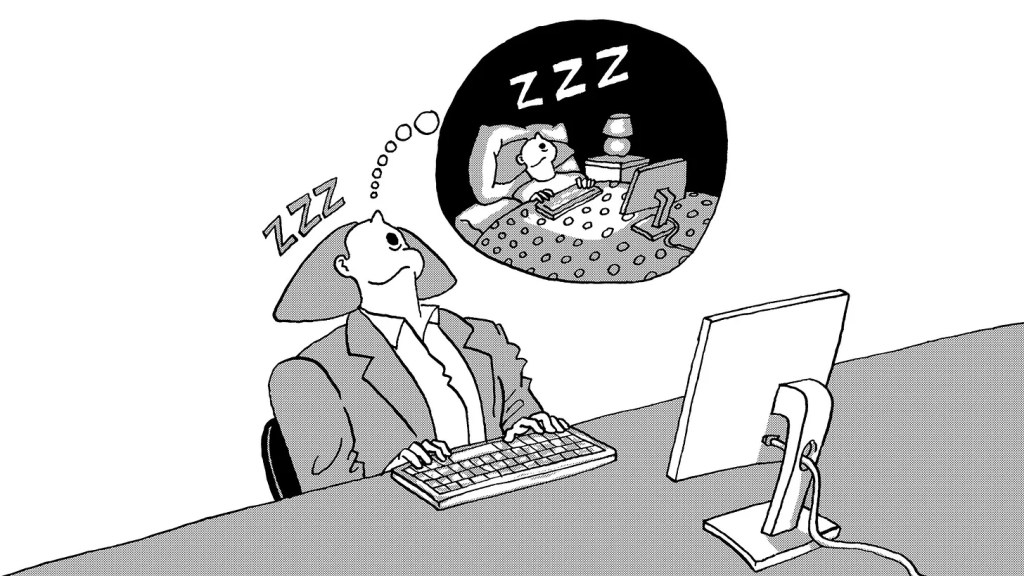
By Joe Martino

Source: The Pulse

Last time I wrote about the increasing mental health crisis happening around the world. I didn’t write it to bring about negativity but more so to bring awareness to the reality of our current moment. Awareness is the first step toward any change.

That piece coupled with a video I did the other day on a collectively felt sense of meaninglessness, I believe these two subjects go hand in hand.

Tied in with both of those subjects is the decade-over-decade increase in the difficulty of surviving financially in our modern world.

More and more younger people have been struggling to buy a home and make ends meet due to the high cost of living and stagnating wages. For many, affording necessities in life has become difficult despite working 40-60 hours per week.

This reality recently drove a viral TikTok video that highlights the frustration younger generations feel and the misconceptions associated with their position.

Before you watch it, conversations I have with people about this issue don’t just exist in the Gen Z and Millenial age group. I’ve spoken to people in their 50s and 60s who have also become completely disenfranchised about the state of work.

Also, Quiet Quitting is a trend on the rise. Simply put, people are going to work and doing the bare minimum to stay employed at greater and greater rates. Gallup estimates that in the US 50% of employees have Quiet Quit and that it’s an increasing crisis. In Japan, 94% of employees report being disengaged at work.

Perhaps unsurprisingly, Gallup blames the trend on poor management. This is where humans really have to start waking up and thinking bigger in my opinion, more on this shortly.

Alright, let’s get to the video.

She makes many good points, and if we take her words to heart, clearly she isn’t lazy and trying to ‘not work.’ She is passionate about her work but sees the gap between salary and the reality of living a comfortable life. She also sees the value in work… just not like how it is today.

Not surprisingly, many have agreed with her while many have attacked her. Let’s explore why she might feel this way about life and work. (Note: There is an element that sometimes people can judge, hate, and avoid work so much that it’s a self sabotage situation, I talk about that here.)

  1. She and the generation she represents, even people like her from other generations, are just lazy or may even grow out of this idea.
  2. She’s lying about enjoying her job and if she were to quit and do something she likes she’d find just enough satisfaction to not care about the fact that she can’t afford to do anything beyond eat, have shelter, and enjoy a few things.
  3. Maybe she’s just permanently unhappy and therefore no matter what she does, she will find a way to frame it as negative and bad.
  4. From a position of common sense and orienting to our current environment, this girl realizes the losing game she is part of and is making the observation that this isn’t a reasonable game to play.

As an extension to number 4, the fact that multiple generations of people not only realize how rigged the game is, don’t want to play the game AND are saying something about it provides an evolutionary pressure for society to address it.

The key is, can we listen vs. sitting in judgment?

Oddly, reaction videos are all the craze on YouTube these days. When people make videos like hers or when something happens, creators turn on their cameras and watch the video while simultaneously reacting to it.

Usually, creators reacting to videos like this from Gen Z’ers are well off themselves or conservatives. Their career often stems around having a ‘hot take,’ creating polarity, and leaning into drama so their content can get a lot of views and thus pay their bills.

Sadly, this dynamic in content creation is often missed by the user, not realizing that the host of the video says what they say primarily because they know it will make them money even if it’s not entirely what they think.

Further, we never get to the bottom of what people bring forth because we are skipping the step of coming to the table in good faith and empathizing with each other’s position. Instead, we get a culture stuck in a debating/debunking/warring mindset. Good luck getting good faith conversation to go viral when most out there are focused on hi-jacking your attention.

Sensing Beyond The Surface

Sensing Beyond The Surface

  1. ‘Working’ is Important – Being part of something, contributing to something, living in a community and having a role, all add meaning and purpose to life.

    Being a creative, productive person is a necessity for human well-being, even if only for a few hours a day. No one is saying let’s sit around and do nothing all day. But should we have to work 40 or 50 hours a week to simply survive? No, that is the result of poor system design. We have advanced our technology incredibly to provide the necessities of life yet we work more than we ever have. Doesn’t something seem wrong there?
    Our cultural idea of needing to work 40 hours a week for most of our lives ‘just to be a contributor’ is rather warped. Many cultures have thrived working a few hours a day, yet look at us – working constantly yet experiencing mental illness, poor health, and meaninglessness at massive rates.
    It would benefit us to have a deeper look at WHY our society is currently producing results no one wants all while destroying our environment and people. Too many discussions about this topic think small and are limited to lazy questions from system protectors or political ideologies. This won’t get us to the root of the issue and why people feel the way they do.
  2. Cost of Living is Too High, But Why? – I’m 36, when my parents were my age one worked a mid-level job in corporate and the other a grocery store. They made enough to buy a fairly big house near Toronto, pay off the mortgage by 40 and raise two kids. These days, they’d need to make $100,000+ each just to buy the same house, and forget about paying off the mortgage by 40. Even when interest rates were 22% back then, things were a lot easier.

    Often, when I talk about mortgage rates with older generations, and how it is becoming hard to afford homes, they say “Back in my day rates were 18% – 22%.” The sense that people aren’t listening to what is being said is palatable. We’re not thinking clearly. In 1945 a US citizen dedicated on average 25% of his salary to pay rent/mortgage. In 2019 it was 47%. It’s higher now. And of course in that time interest rates have come down dramatically. Plain and simple, the cost of living has risen incredibly and wages didn’t climb at anywhere near the same rate.

    This is a losing game, and only set to get worse given the path we’re on. That said, this is what anyone should expect in a system driven by fractional reserve banking. When we understand the design of our system, we understand this isn’t about one political view or another, it’s about bad system design. We have to think deeper.
  3. Evolutionary Pressure – As our society declines more and more, younger people who look ahead to their future see something undesirable. The life their parents lived is no longer possible and they see the game is rigged. They aren’t lazy, they are demoralized.
    A left hemisphere reductionist and othering view, who sees humans as cogs in a system might say “Nah, people are lazy. Grow up. Things are fine.” Yet when we take a step back and include a sense of something sacred, our entire perspective changes. Why are we seeing life and merely working to uphold a rigged economy? Is this really all we are capable of? Why are we always trying to protect societal design producing results we don’t like? Do we realize we made all this up and it can be different?
    Sure, there are aspects of younger generations that I think are immature too, we’ve all been through it, but at the same time, younger people are not buying the rigged game and thus are not dying to play it. They are right. They are smart to speak up.
    And to tie things back to meaninglessness and mental health issues, I think we’re seeing now how this all ties into our current moment. People don’t thrive playing a losing game where basic needs are gated behind 100 foot walls.

    Movements toward system redesign have been around for many many decades. It’s not a new idea to discuss how rigged, limiting, and problematic our existing societal design is, but more people are waking up to it now.
    When I spoke about this stuff in 2009 and 2010, most people laughed at me thinking I was nuts. Now, they mostly agree with me. We’re on fertile ground for something new. For a while, we’ll likely live feeling and sensing the possibility of a new society while living in the old. Feeling that we’re not sure we quite belong to a visible society entirely.
    This is the Metacrisis. This is the shift in consciousness as I’ve always called it. It’s an evolutionary pressure that begs us to look deeper than political ideology and hot takes on why someone we don’t agree with is wrong. It begs us to re-taste the sacred. To examine what it means to be human and why we’re here.
    I believe the speed at which it unfolds is intimately connected to the quality of our attention, consciousness and state of being. The more capacity we have to steward a better world, the more it will unfold.
    Change starts within.

The Cost Of Living Has Become Extremely Oppressive And 57 Percent Of Americans Cannot Afford A $1,000 Emergency Expense

By Michael Snyder

Source: Activist Post

I don’t have to tell you that your money doesn’t go as far as it once did.  You see it every time that you go shopping.  Our leaders flooded the system with money and pursued highly inflationary policies for years, and now we are all paying the price.  The cost of living has been rising much faster than our incomes have, and this is systematically destroying the middle class.  Survey after survey has shown that a solid majority of the population is living paycheck to paycheck, and at this point most U.S. consumers are tapped out.  In fact, one brand new survey just discovered that 57 percent of Americans cannot even afford to pay a $1,000 emergency expense

According to Bankrate’s Annual Emergency Fund Report, 68% of people are worried they wouldn’t be able to cover their living expenses for just one month if they lost their primary source of income. And when push comes to shove, the majority (57%) of U.S. adults are currently unable to afford a $1,000 emergency expense.

When broken down by generation, Gen Zers (85%) and Millennials (79%) are more likely to be worried about covering an emergency expense.

These numbers are quite ominous, because they clearly demonstrate that we are completely and utterly unprepared for any sort of a major economic downturn.

And thanks to the rapidly rising cost of living, we are losing even more ground with each passing month.

Another survey that was recently released found that “earnings are falling behind the cost of living” for 72 percent of middle income families…

Nearly three-quarters, or 72%, of middle-income families say their earnings are falling behind the cost of living, up from 68% a year ago, according to a separate report by Primerica based on a survey of households with incomes between $30,000 and $100,000. A similar share, 74%, said they are unable to save for their future, up from 66% a year ago.

We haven’t experienced anything like this in the United States in decades.

When I walked into a Walmart store the other day, I was shocked by how high the prices are now.

Isn’t Walmart supposed to be the place with “low prices every day”?

Well, the prices were certainly not “low” when I walked through the store.

And I was stunned to learn that McDonald’s is now selling one hash brown for three dollars.

Are you kidding me?

I am sure that many of you can remember a time when they were 50 cents.

Sadly, those days are not coming back.

Food prices are going to continue to go up, and the CEO of Unilever recently admitted that his company has actually “been accelerating the rate of price increases that we’ve had to put into the market”…

“For the last 18 months we’ve seen extraordinary input cost pressure … it runs across petrochemical derived products, agricultural derived products, energy, transport, logistics,” he said.

“It’s been feeding through for quite some time now and we’ve been accelerating the rate of price increases that we’ve had to put into the market,” he added.

That doesn’t sound good at all.

And he also ominously warned that “there’s more inflationary pressure coming”

Unilever’s view, he said, was that “we know for sure there’s more inflationary pressure coming through in our input costs.”

As food prices continue to rise, these big companies are going to look for ways to reduce input costs.

One way that they are going to do that is by starting to put crushed bugs in our food.

I know that this may sound really bizarre to you, but this is already happening in Europe

As of yesterday, a food additive made out of powdered crickets began appearing in foods from pizza, to pasta to cereals across the European Union.

Yes, really.

Defatted house crickets are on the menu for Europeans across the continent, without the vast majority of them knowing it is now in their food.

So you might want to start reading labels a lot more carefully from now on.

Of course it isn’t just the cost of food that has become extremely oppressive.

Just about everything has gotten more expensive, and this has broken the remaining strength of the U.S. consumer.

If you doubt this, just consider some of the latest economic numbers that we have seen.

-U.S. retail sales fell once again last month…

US retail sales continued their fall in December, dropping by 1.1% as inflation remained high, the Commerce Department reported Wednesday.

That’s the largest monthly decline since December 2021, and practically every category (except for building materials, groceries and sporting goods) saw sales drop from the prior month.

-Sales of existing homes have now fallen for 11 months in a row

U.S. existing home sales slowed for the 11th consecutive month in December as higher mortgage rates, surging inflation and steep home prices sapped consumer demand from the housing market.

-More Americans than ever before are being forced to pay at least 30 percent of their incomes on rent

The average US household is now considered ‘rent-burdened’ as a record-high number of people are spending more than 30 percent of their income on rent.

According to Moody’s Analytics’ latest affordability report, the national average rent-to-income (RTI) ratio reached 30 percent for the first time since the company began tracking the data more than 20 years ago.

U.S. consumers are being stretched financially like never before, and many are turning to debt to help them maintain their current lifestyles.

As a result, the savings rate has plunged to a historic low, credit card debt has surged to a record high, and the average rate of interest on credit card balances has also risen to a record high.  As Zero Hedge has aptly noted, this is “nothing short of catastrophic”…

The combination of record high credit card debt and record high credit card interest is nothing short of catastrophic for both the US economy, and the strapped consumer who has no choice but to keep buying on credit while hoping next month’s bill will somehow not come. Unfortunately, it will and at some point in the very near future, this will also translate into massive loan losses for US consumer banks; that’s when Powell will finally panic.

For a long time, we have been warned that the very foolish economic policies that our leaders were implementing would have deeply tragic consequences.

And now it is starting to happen right in front of our eyes.

Sadly, the truth is that this is just the beginning.

The entire system is cracking and crumbling all around us, and there is much more pain ahead.

Pillage and Class Polarization: The Rise of “Criminal Capitalism”

wealth

By Prof. James Petras

Source: GlobalResearch.ca

About 75% of US employees work 40 hours or longer, the second longest among all OECD countries, exceeded only by Poland and tied with South Korea.  In contrast, only 10% of Danish workers, 15% of Norwegian, 30% of French, 43% of UK and 50% of German workers work 40 or more hours.  With the longest work day, US workers score lower on the ‘living well’ scale than most western European workers. 

Moreover, despite those long workdays US employees receive the shortest paid holidays or vacation time (one to two weeks compared to the average of five weeks in Western Europe).  US employees pay for the costliest health plans and their children face the highest university fees among the 34 countries in the Organization for Economic Cooperation and Development (OECD).

In class terms, US employees face the greatest jump in income inequalities over the past decade, the longest period of wage and salary decline or stagnation (1970 to 2014) and the greatest collapse of private sector union membership, from 30% in 1950 down to 8% in 2014.

On the other hand, profits, as a percentage of national income, have increased significantly.  The share of income and profits going to the financial sector, especially the banks and investment houses, has increased at a faster rate than any other sector of the US economy.

There are two polar opposite trends: Employees working longer hours, with costlier services and declining living standards  while finance capitalists enjoy rapidly rising profits and incomes.

Paradoxically, these trends are not directly based on greater ‘workplace exploitation’ in the US.

The historic employee-finance capitalist polarization is the direct result of the grand success of the trillion dollar financial swindles, the tax payer-funded trillion dollar Federal bailouts of thecrooked bankers, and the illegal bank manipulation of interest rates.  These uncorrected and unpunished crimes have driven up the costs of living and producing for employees and their employers.

Financial ‘rents’ (the bankers and brokers are ‘rentiers’ in this economy) drive up the costs of production for non-financial capital (manufacturing).   Non-financial capitalists resort to reducing wages, cutting benefits and extending working hours for their employees, in order to maintain their own profits.

In other words, pervasive, enduring and systematic large-scale financial criminality is a major reason why US employees are working longer and receiving less – the ‘trickle down’ effect of mega-swindles committed by finance capital.

Mega-Swindles, Leading Banks and Complicit State Regulators

Mega-swindles, involving trillions of dollars, are routine practices involving the top fifty banks, trading houses, currency speculators, management fund firms and foreign exchange traders.

These ‘white collar’ crimes have hurt hundreds of millionsof investors and credit-card holders, millions of mortgage debtors, thousands of pension funds and most industrial and service firms that depend on bank credit to meet payrolls, to finance capital expansion and  technological upgrades and raw materials.

Big banks, which have been ‘convicted and fined’ for mega-swindles, include Citi Bank, Bank of America, HSBC, UBS, JP Morgan, Barclay, Goldman Sachs, Royal Bank of Scotland, Deutsch Bank and forty other ‘leading’ financial institutions.

The mega-swindlers have repeatedly engaged in a great variety of misdeeds, including accounting fraud, insider trading, fraudulent issue of mortgage based securities and the laundering of hundreds of billions of illegal dollars for Colombian, Mexican, African and Asian drug  and human traffickers.

They have rigged the London Interbank Official Rate (LIBOR), which serves as the global interest benchmark to which hundreds of trillions of dollars of financial contracts are tied.  By raising LIBOR, the financial swindlers have defrauded hundreds of millions of mortgage and credit-card holders, student loan recipients and pensions.

Bloomberg News (5/20/2015) reported on an ongoing swindle involving the manipulation of the multi-trillion-dollar International Swaps and Derivatives Association (ISDA) fix, a global interest rate benchmark used by banks, corporate treasurers and money managers to determine borrowing costs and to value much of the $381 trillion of outstanding interest rate swaps.

The Financial Times (5/23/15, p. 10)   reported how the top seven banks engaged in manipulating fraudulent information to their clients, practiced illegal insider trading to profit in the foreign exchange market (forex), whose daily average turnover volume for 2013 exceeded $5 trillion dollars.

These seven convicted banks ended up paying less than $10 billion in fines, which is less than 0.05% of their daily turnover.  No banker or high executive ever went to jail, despite undermining the security of millions of retail investors, pensioners and thousands of companies.

The Direct Impact of Financial Swindles on Declining Living Standards

Each and every major financial swindle has had a perverse ripple effect throughout the entire economy.  This is especially the case where the negative consequences have spread downward through local banks, local manufacturing and service industries to employees, students and the self-employed.

The most obvious example of the downward ripple effect was the so-called ‘sub-prime mortgage’ swindle.  Big banks deliberately sold worthless, fraudulent mortgage-backed securities(MBS) and collateralized debt obligation (CDO)  to smaller banks, pension funds and local investors, which eventually foreclosed on overpriced houses causing low income mortgage holders to lose their down payments (amounting to most of their savings).

While the effects of the swindle spread outward and downward, the US Treasury propped up the mega-swindlers with a trillion-dollar bailout in working people’s tax money.  They anointed their mega-give-away as the bail out for ‘banks that are just too big to fail”!  They transferred funds from the public treasury for social services to the swindlers.

In effect, the banks profited from their widely exposed crimes while US employees lost their jobs, homes, savings and social services.  As the US Treasury pumped trillions of dollars into the coffers of the criminal banks (especially on Wall Street), the builders, major construction companies and manufacturers faced an unprecedented credit squeeze and laid off millions of workers, and  reduced wages and increased the hours of un-paid work.

Service employees in consumer industries were hit hard as wages and salaries declined or remained frozen.  The costs of theFOREX, LIBOR and ISDA fix swindles’ fell heavily on big  business, which passed the pain onto labor: cutting pension and health coverage, hiring millions of ‘contingent or temp’ workers at minimum wages with no benefits.

The bank bailouts forced the Treasury to shift funds from ‘job-creating’ social programs and national infrastructure investment to the FIRE (finance, insurance and real estate) sector with its highly concentrated income structure.

As a result of the increasing concentration of wealth among the financial swindlers, inequalities in income grew; wages and salaries were frozen or reduced and manufacturers outsourced production, resulting in declines in production.

Employees, suffering from the loss of income brought on by the mega-swindles, found that they were working longer hours for less pay and fewer benefits.  Productivity suffered.  With the total breakdown of the ‘capitalist rules of the game’, investors lost confidence and trust in the system.  Mega-swindles eroded ‘confidence’ between investors and traders, and made a mockery of any link between performance at work and rewards.  This severed the nexus between highly motivated workers, engaged in ‘hard work, long hours’ and rising living standards, and between investment and productivity.

As a result, profits in the finance sector grew while the domestic economy floundered and living standards stagnated.

Financial Impunity:  Regulatees Controlling the Regulators

Despite the proliferation of mega-swindles and their pervasive ripple effects throughout the economy and society, none of the dozens of federal or state regulatory agencies intervened to stop the swindle before it undermined the domestic economy.  No CEO or banker was ever arrested for their part in the swindle of trillions.  The regulators only reacted after trillions had ‘disappeared’ and swindles were ‘a done deal’.  The impunity of the swindlers in planning and executing the pillage of hundreds of millions of employees, taxpayers and mortgage holders was because the federal and state regulatory agencies are populated by ‘regulatory administrators’ who came from or aspired to join the financial sector they were tasked with ‘regulating’.

Most of the high officials appointed to lead the regulatory agencies had been selected by the ‘Lords of Wall Street, Frankfurt, the City of London or Zurich.’  Appointees are chosen on the basis of their willingness to enable financial swindles.  It therefore came as no surprise on May 28 2015 when US President Obama approved the appointment of Andrew Donahue, Managing Director and Associate General Council for the repeatedly felonious, mega-swindling banking house of Goldman Sachs to be the ‘Chief of Staff’ of the Security and Exchange Commission. His career has been typical of the Washington-Wall Street ‘Revolving Door’.

Only after fraud and swindles evoked the nationwide public fury of mortgage holders, investors and finance companies did the regulators ‘investigate’ the crimes and even then not a single major banker was jailed, not a single major bank was closed down.

There were a few low-level bond traders and bank employees who were fired or jailed as scapegoats.  The banks paid puny (for them) fines, which they passed on to their customers.  Despite pledges to ‘mend their ways’ the bankers concocted new schemes with their windfalls of billions of  Federal ‘bailout’ money while the  regulators looked on or polished their CV’s for the next pass through the ‘revolving door’.

Every top official in Treasury, Commerce and Trade, and every regulator in the Security Exchange Commission (SEC) who ‘retired to the private sector’ has ended up working for the same mega-criminal banks and finance houses they had investigated, regulated and ‘slapped on the wrist’.

As one banker, who insists on anonymity, told me: ‘The most successful swindlers are those who investigated financial transgressions’.

Conclusion

Mega-swindles define the nature of contemporary capitalism.  The profits and power of financial capital is not the outcome of ‘market forces’.  They are the result of a system of criminal behavior that pillages the Treasury, exploits the producers and consumers, evicts homeowners and robs taxpayers.

The mega swindlers represent much less than 1% of the class structure.  Yet they hold over 40% of personal wealth in this country and control over 80% of capital liquidity.

They grow inexorably rich and richer, even as the rest of the economy wallows in crisis and stagnation.  Their swindles send powerful ripples across the national economy, which ultimately freeze or reduce the income of the skilled (middle class) employees and undermine the living conditions for poor working-class whites,   and especially under and unemployed Afro-American and Latino American young workers.

Efforts to ‘moralize’ capital have failed repeatedly since the regulators are controlled by those they claim to ‘regulate’.

The rare arrest and prosecution of any among the current tribe of mega-swindlers would only results in their being replaced by new swindlers.  The problem is systemic and requires deep structural changes.

The only answer is to build a political movement independent of the two party system, willing to nationalize the banks and to pass legislation outlawing derivatives, forex trading and other unnatural parasitic speculative activities.

Collapsing Standard of Living: Kleptocrats and Militarists Fleece Americans

117142

By Prof. James Petras

Source: GlobalResearch.ca

American living standards are plunging and it’s not simply because they are paid less, work longer (or shorter hours) under highly stressful workplace conditions and pay a higher percentage of their income for health and pension coverage.  The ‘workplace’ is only one of several locations where American working people are experiencing a sharp decline in living standards.  The new oligarchical Kleptocrats and political elites have elaborated new ways to fleece Americans.  These include: 

(1)   Increased costs and declining quality of internet, cable and other communication systems.

(2)   Intensive pervasive and perpetual surveillance by punitive espionage agencies eroding personal freedoms and violating the confidentiality of personal, political and business decisions affecting everyday life.

(3)   Large scale, repeated financial swindles by the most active and influential private and publicly trading investment companies resulting in the loss of hundreds of billions of dollars in pensions and savings for tens of millions of middle and working class investors.

(4)   Increases in taxes and charges, including sales taxes, social security deductions, medical co-payments and reductions in social services.  This is a result of the government’s commitment to finance US corporate investments and bail-outs.  Big business hoards their cash holdings abroad to avoid taxes on overseas profits.  To pay dividends they borrow.  The growth of corporate debt, concentrated in a few large corporations, holds the US taxpayer liable for any present or future collapse of the financial markets.  This corporate-induced ‘hoarding of capital’ compromises present and future living standards.  It plays a major role in the deterioration of employment, wages, social services and public infrastructure.

(5)   The astronomical growth of state spending on wars of conquest, financial giveaways propping up right-wing dictatorships and building a vast network of global military bases, proxy wars and other empire building measures reduce living standards of Americans.  By militarizing everyday life, citizens are subject to mindless repetitive propaganda designed to lower their mental capacity.  State terror-mongering propagandists in the mass media distract citizens from their declining living standards.  Political elites bully citizens to continue ‘sacrificing’ basic living standards.  Video games reproduce the worlds of war and terror, reflecting the real world policies of the ruling class.

Video games allow Americans who know they no longer have influence on political decisions and whose living standards are in decline, to vicariously exercise power and realize favorable outcomes on their mobiles.  Purchasing mobiles, video games and other gadgets enrich billionaires’— so-called “high tech” capitalists – and convert citizens into impoverished consumers.  They inhabit a bubble of illusions and passivity in the face of growing economic inequalities and political-cultural impoverishment.

The Political Bases of Declining Living Standards

The case of Comcast, the communication monopoly’s seizure of internet, is illustrative of how politics and plunder converge.  Comcast TWC, the largest communications company, presently will control 40% of the US broadband and one-third of the US cable television market.  By controlling the internet, Comcast will monopolize the principal means of communication of most Americans.  The Federal Communications Commissions (FCC), which is supposed to regulate the industry and prevent price gouging monopolies, is “dominated by senior former industry officials” (Financial Times, (FT) 4/14/, pg. 9).  Almost every elected national politician from Obama down has received substantial campaign funds from Comcast.  During Senate hearings on Comcast’s bid to monopolize the internet through the take-over of Time Warner Cable, Comcast CEO David Cohen smirked and brushed off the Senators puff-questions.  FCC complicity, Senatorial whitewashing of the private monopoly, is only part of the story.  The internet was developed largely by public funds as was Google’s search engine:  the public sector took  the risk and the private monopolists , in this case Comcast, harvest the profits.

Comcast charges Americans several times greater then what it costs to use the internet in Sweden, South Korea, Singapore and elsewhere.  Yet, US average internet speed is as little as a tenth as fast as that in Japan.  In other words the hundreds of millions of US citizens who rely on the internet spend more money for less internet quality in their work day and everyday life.  Their work life is intensified, their free time is reduced and their living standards are diminished.  With greater concentration of ownership, come greater inequalities in power and income, and a greater disparity of living standards.  All of which is obscured by the main beneficiaries – the communication barons and their political cronies.

Declining Living Standards in the Era of the Police State

‘Living’ in the deepest and most intimate sense of the term, means the ability to share ideas, feelings and experiences with individuals, families, friends and citizens  without the intrusive and pervasive presence of a punitive state apparatus.  When a state spy apparatus intercepts, collects, files, analyzes and makes a police evaluation of citizen’s communications, scientists refer to it as a police-state.  The gigantic growth of a police state and its permeation of civil society has dramatically changed for the worse the fundamental bases of inter-personal life and communications.  Police state rule, has sharply deteriorated cultural, social, political and economic living conditions.  The ‘standards’ for living have been harshly reduced.  The ‘legal’, but arbitrary, executive prerogatives of the state have been enhanced.  The parameters of the basic rights of citizens have shrunk.  As police state expenditures grow and the subjects of surveillance increase, so do budgets and taxes.

Kleptocracy:  The Highest Stage of Capitalism

Marx and Marxists for the greater part of the 19th and 20th century, focused on capital’s exploitation of labor and the resources of overseas colonies and neo-colonies.  In the 21st century a new more dynamic and totally parasitic form of economy has emerged based in the dominant financial sector.  Kleptocrats engaged in large-scale, perpetual financial swindles and the pillage of the public treasury greatly impoverish  small  investors, and the pension funds of  employees and workers.

For the better part of two decades, major financial institutions have been engaged in systematic large scale swindles, involving the sale of fraudulent financial packets (dubbed ironically “securities”), profiteering based on insider trading and other illicit activity which is prejudicial to productive activity, investors, tax payers, salary, and wage workers.

Every major investment banks in the US and Europe has been repeatedly investigated, fined and rarely prosecuted.  They pay a relatively light fine and return to criminal activity.  Looking only at the mega-swindles, involving hundreds of billions of dollars, we would include Enron, the Information Tech “bubble” of the 1990’s to 2000, the Home Mortgage fraud, the Barron, Lehman and Bear Sterns scam. In the run-up to the 2008-9 financial crash , Goldman Sachs, JP Morgan, Wells Fargo, Bank of America were part of the “pump and dump” of low grade home mortgage bonds and equities.  The swindlers are recidivists and are so because of the complicity of top Government officials at every moment.  State officials design the rules promoting Kleptocracy (deregulation), suspend safeguards, provide tax incentives, and eliminate risk via trillion dollar bailouts of the biggest investment kleptocrats when the swindlers cannibalize their assets and run out of new victims to swindle.

Under kleptocratic capitalism the apex of the system is occupied by the top fifty investment banks, hedge funds and speculators who ‘make markets’.  They determine what ‘stocks or investment objects are targeted, to be pumped or dumped, at what rate and for what period of time.  The entire activity of the kleptocratic elite has nothing to do with financing the ‘real economy’.  Kleptocrats creates paper ‘values’ – paper assets at paper prices, for real victims and huge profits.  The kleptocratic system operates like a chain.  Kleptocratic speculators extract the savings and investments of a second tier of financial houses. They draw on real resources:  savings, trust and pension funds.  The second tier speculators are the ‘bag men’ for the dominant kleptocrats and they receive a minor share of the booty in exchange for conning the savings of producers.  They write the prospectus to entice investment funds; they formulate the promise of lucrative returns. They send progress reports to clients in exchange for ‘commissions. They also ‘take the rap”, when the crises hits and bankruptcies, foreclosures and scams unfold.

The pension funds, the individual trusts and savings of workers and employees, resulting from decades of creating value in the real economy, forms the base of the pyramid.  They have no influence on the political officials who promote, protect and bailout the kleptocrats.  Under the kleptocratic elite ideology of “too big to fail”, the state eliminates all the risk for the klepto’s and imposes the losses on the second tier, who pass the losses on to the wage and salaried workers as taxpayers, via trillion dollar transfers from Treasury. Investors suffer  via the loss of equity;  workers via the loss of jobs, homes, income and social services.  Given the vast chasm between the perpetual fraudulent transactions in the mega paper economy and the daily work routines at the bottom, there is great uncertainty, volatility, and insecurity in the work-life of the wage and salaried classes.  The uncertainty and capriciousness of the ‘normal’ capitalist economic cycle, is vastly exacerbated by the turbulence caused by the mega-swindles, endless frauds and crooked trades, endemic to the kleptocratic stage of capital.

Kleptocrats and Militarists Together:  They Shall Overcome

Just as kleptocrats rule the paper economy, political confidence men and women engage in imperial wars prejudicing the real economy.  Imperial militarists extract wealth from the Treasury (the taxpayer) via perpetual political swindles.  Imperial invasions and interventions of sovereign countries are ‘sold’ to the taxpayers as “wars on terror”; non-nuclear Iran is sold as a nuclear threat; the violent overthrow of the democratically elected Ukraine government by a pro Washington junta is sold as a “democratic transition”.  Just as the kleptocracy’s “driving force” is repeated, large scale swindles, so the governing militarist elite’s “driving force” is the perpetual need to engage in warfare.

The ‘bridge’ between the kleptocrats and the militarists is the respectable financial press (Financial Times (FT), the Wall Street Journal(WSJ).  They publicize and praise high level paper transactions (buy outs and mergers) and encourage imperial warfare everywhere and all the time.  They editorialize in favor of wars which destroys lucrative trade and investment markets in the real economy because they are aligned with the kleptocrats   linked to the paper economy.  The Financial Times should change its name to the Military Times.  The editors and columnists have supported wars destroying the Libyan, Iraq, Syrian and Ukrainian economies and back sanctions prejudicing trade with Iran.  The financial press no longer promotes market relations of the real economy; it is embedded in the paper economy of the kleptos.

Kleptocratic activities have become ‘routinized’ and based on advanced technology and have created highly respected billionaires.  Even as I write today (4/14/14) the FT reports that ‘insiders at some of the hottest private and publically traded web companies sold big personal stakes before the slump in stock companies’ (my emphasis) taking advantage of a bubble of their own creation (“pump”) to reap billions at the expense of small investors.  Tell it to Jeff Bezos, CEO of Amazon, and Sheryl Sandberg, CEO of Facebook, who sold at the pre-slump peak, prior to the tech bubble bursting

Domestic Corporate Debt and Overseas Corporate Tax Havens

According to Standards and Poor (S and P), the rating agency, “the biggest US companies have added significantly to their debts during the past three years, at the same time as corporate cash piles have increased” (FT 4/14/14).  The total cash holding of the 1,100 companies rated by S and P rose by $204 billion to 1.23 trillion between 2010-13.  However, during the same time span their gross debts grew fivefold, rising from $748 billion to $4 trillion.  Their net debt (gross debt minus cash holdings) rose 24 percent to $2.78 trillion.  By holding cash overseas, US corporations avoid domestic taxes – increasing fiscal pressures, the tax burden on domestic producers and workers, heightening the regressive nature of the tax system  Secondly, by loading up on domestic debt, the corporate elite crowds out local borrowers.  Piling up debt increases corporate vulnerability to bankruptcy if and when interest rates rise.  The corporate elite evading taxes via overseas cash piles include Apple, Microsoft, Cisco Systems, Chevron, and Merck among others.  All told the top 25 multi nationals account for 43 percent of the total debt (FT 4/14/14).

Hoarding profits overseas avoids taxes.  High domestic indebtedness results from the need to pay dividends and inflate returns to big shareholders.  In other words, corporate elites escape taxes and increase economic insecurity for domestic job holders, both of which contribute to a decline in the material and psychological dimensions of ‘living standards’.

Kleptocracy and Militarism:  Declining Living Standards

The rise of a powerful kleptocratic economic elite which ‘interpenetrates’ and shares power with a militarist political elite have joined forces to pillage the productive economy and the US Treasury.  Their powerful links are the main reason for heightening class inequalities, political and social insecurities.  They have driven American society into a permanent state of crises and wars. Over the past quarter century, Americans have lived through two major economic crashes, prolonged periods of stagnation and declining income, three major wars and a multitude of overt and covert military operations – all of which have eroded living standards.

Military propaganda saturates the mass media and permeates all mass spectacles. Stock reports, dominate the economic news.  Investment speculators and swindlers are presented as cultural heroes.  The gap between elite opinion and interests and those of the majority of citizens widens.

This leads politicians to greater dependence on billionaire campaign funders.  The electoral process is unabashedly and totally controlled by the economic oligarchy. The vast majority of Americans recognizes and publically admit their total lack of political influence on all public issues of interest including those privileging the kleptocrats and the warlords.

The deeply felt and pervasive malaise resulting from social impotence in vital spheres of life is the clearest expression of the decline of political living standards.  The shrinking of public involvement, the narrow focus of isolated individuals manipulating computerized gadgets , the replacement of face to face public engagement by impersonal electronic communications, are an expression of the decline of social living standards.  The rise of ethno-religious chauvinism among klepto-elites is matched by the political warlords’ reliance on systematic deception and espionage of American citizens. Warlords and kleptocrats are enclosed in privileged living enclaves, including the private appropriation of former public spaces, but their  intrusion into private communications define the diminished world of everyday life for the most Americans.  Life expectancy may have increased but human life has decreased, drastically, over the past quarter of a century.

Conclusion

Blood and gore does not drip off the Saville suited clever inside trader.  They never see or hear their victims, nor do they have an interest in them, except to fleece them collectively and anonymously.

America is ruled by a division of labor. The financial speculators, corporate tax evaders, investment bankers – the kleptocratic ruling class– pillage the treasury and productive economy.  Their political counterparts manipulate, distract and police their exploited victims – to ensure that they submit or are intimidated if they protest.

When they political elites come up short, there are the new “opiums of the people’ videos, painkillers, terror threats, entertainment and sports spectacles.

But citizens are restless– as living standards continue to decline.  Nobody believes in bailing out speculators because they are ‘too big to fail”.  Nobody trusts the political leaders who lied their way to twelve year wars, adding others along the way.  No one follows media pundit extremists in defense of kleptocrats and warlords.  Passive resistance is widespread because it is clear to most Americans that living standards are in a free fall.  Time awaits a popular backlash. Will it happen in our lifetime?