Billionaires are a Sign of Economic Failure

Inherited wealth and crony capitalism have created an aristocratic class that undermines social mobility and democracy

By Max Lawson

Source: Inequality.org

The New York Times published an editorial comment on its front page in January 2019, provocatively entitled “abolish billionaires.” The editorial raised a serious question: what if instead of being a sign of economic success, billionaires are a sign of economic failure?  In what ways can the boom in billionaires, and the dramatic increase in extreme wealth generally, be harmful?

To answer this question, we need to understand the origins of billionaire wealth, and to understand how that wealth is used once it is gained.  The answer to both these questions I think rightly casts doubt on the value of the super-rich in our society.

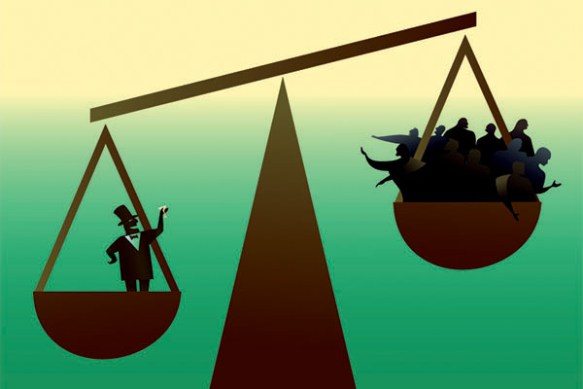
Approximately one third of billionaire wealth comes from inheritance. It is very hard to make the case for the economic utility of inherited wealth, and instead there is a strong case for the fact that it undermines social mobility and economic progress. It creates instead a new aristocracy who are rich simply because their parents were rich which is hard to see as a good thing.

Whether inherited or secured in other ways, extreme wealth takes on a momentum of its own.  The super-rich have the money to spend on the best investment advice, and billionaire wealth has increased since 2009 by an average of 11 percent a year, far higher than rates ordinary savers can obtain.

Bill Gates is worth nearly $100 billion dollars in 2019, almost twice what he was worth when he stepped down as head of Microsoft.  This is despite his admirable commitment to giving his money away.  As Thomas Piketty said in his book Capital in the 21st Century, “No matter how justified inequalities of wealth may be initially, fortunes can grow beyond any rational justification in terms of social utility.”

My Oxfam colleague Didier Jacobs calculated a few years ago that another third of billionaire wealth comes from crony connections to government and monopoly.  This could be for example when billionaires secure concessions to provide services exclusively from government, using crony connections and corruption.  The Economist has developed a similar measure of crony capitalism with similar findings. What is clear it seems to me is that corruption and crony connections to governments are behind a significant proportion of billionaire wealth.

Almost all sectors of our global economy are also now characterized by monopoly power, as is detailed by Nick Shaxson in his great new book, the Finance Curse. Whether food, pharmaceuticals, media, finance, or technology, each sector is characterized by a handful of huge corporations.

Decades of largely unquestioned mergers and acquisitions, where corporations have bought up competitors, have led to this.  Historically, and especially in the United States in the early part of the 20th century, monopoly power was rightly viewed as a serious threat to the economy and to society, and steps were taken to break up monopolies.  It was President Franklin Roosevelt who famously said that “government by organized money is just as dangerous as government by organized mob.” However, in recent decades, neoliberal economics has led a much more benign view of monopoly power, and very little action is now taken to dismantle them. I think this is a key distinction between neoliberalism and classical liberal economics.  These monopolies impose hidden monopoly taxes on every consumer, as it enables these companies, and their wealthy shareholders, to extract excessive profits from the market, directly fueling the growth in extreme wealth at the expense of ordinary citizens.

The actions of corporations, including the move towards monopoly, are driven by a relentless focus on ever-increasing returns to shareholders — shareholders who are primarily the very same extremely wealthy people.  Our new Oxfam paper on the “Seven Deadly Sins” of the G7, released this week, shows how returns to shareholders have increased dramatically whilst real wages have barely increased.

Behind corporate power and corporate actions is increasingly the power of super-rich shareholders.

Once billionaire wealth is accumulated, the way it is used also casts doubt on how useful it is to have billionaires.  The super-rich use their wealth to pay as little tax as possible, making active use of a secretive global network of tax havens, as revealed by the Panama Papers and other exposes.

One ground-breaking study that made use of this leaked information showed that the super-rich are paying as much as 30 percent less tax than they should, denying governments billions in lost tax revenue, that could have been spent on schools or on hospitals.  The super-rich are supported in this by the Society of Trust and Estate Practitioners (STEP), a secretive organization of over 20,000 wealth managers that actively pressures governments to reduce taxes on the richest.

Billions are not just used to ensure lower taxes. They can also be used to buy impunity from justice, to buy politicians, or to buy a pliant media.  The use of “dark” money to influence elections and public policy is a growing problem all over the world. The Koch brothers — Charles and the recently deceased David — two of the richest men in the world, have had a huge influence over conservative politics in the United States.

Another recent Oxfam study  showed the many ways in which politics has been captured by the very rich in Latin America.  Many of today’s new breed of nationalist, racist leaders have substantial financial backing.

This active political influencing by the super-rich directly drives greater inequality, by constructing reinforcing feedback loops, in which the winners of the game get even more resources to win even bigger next time.

For all these reasons, I think there is a strong case to be made that rather than being celebrated, as one U.S. commentator recently said, “every billionaire is a policy failure,” and that in particular if we are to end poverty and build fairer societies, we need to bring an end to extreme wealth.

Welcome to 1984

1984

By Chris Hedges

Source: truthdig

The artifice of corporate totalitarianism has been exposed. The citizens, disgusted by the lies and manipulation, have turned on the political establishment. But the game is not over. Corporate power has within its arsenal potent forms of control. It will use them. As the pretense of democracy is unmasked, the naked fist of state repression takes its place. America is about—unless we act quickly—to get ugly.

“Our political system is decaying,” said Ralph Nader when I reached him by phone in Washington, D.C. “It’s on the way to gangrene. It’s reaching a critical mass of citizen revolt.”

This moment in American history is what Antonio Gramsci called the “interregnum”—the period when a discredited regime is collapsing but a new one has yet to take its place. There is no guarantee that what comes next will be better. But this space, which will close soon, offers citizens the final chance to embrace a new vision and a new direction.

This vision will only be obtained through mass acts of civic mobilization and civil disobedience across the country. Nader, who sees this period in American history as crucial, perhaps the last opportunity to save us from tyranny, is planning to rally the left for three days, from May 23 to May 26 at Constitution Hall in Washington, D.C., in what he is calling “Breaking Through Power” or “Citizen’s Revolutionary Week.” He is bringing to the capital scores of activists and community leaders to speak, organize and attempt to mobilize to halt our slide into despotism.

“The two parties can implode politically,” Nader said. “They can be divided by different candidates and super PACs. But this doesn’t implode their paymasters.”

“Elections have become off-limits to democracy,” he went on. “They have become off-limits to democracy’s fundamental civil community or civil society. When that happens, the very roots shrivel and dry up. Politics is now a sideshow. Politics does not bother corporate power. Whoever wins, they win. Both parties represent Wall Street over Main Street. Wall Street is embedded in the federal government.”

Donald Trump, like Hillary Clinton, has no plans to disrupt the corporate machinery, although Wall Street has rallied around Clinton because of her predictability and long service to the financial and military elites. What Trump has done, Nader points out, is channel “the racist, right-wing militants” within the electorate, embodied in large part by the white working poor, into the election process, perhaps for one last time.

Much of the left, Nader argues, especially with the Democratic Party’s blatant rigging of the primaries to deny Bernie Sanders the nomination, grasps that change will come only by building mass movements. This gives the left, at least until these protofascist forces also give up on the political process, a window of opportunity. If we do not seize it, he warns, we may be doomed.

He despairs over the collapse of the commercial media, now governed by the primacy of corporate profit.

“Trump’s campaign has enormous appeal to the commercial mass media,” Nader said. “He brought huge ratings during the debates. He taunted the networks. He said, ‘I’m boycotting this debate. It’s going to cost you profit.’ Has this ever happened before in American history? It shows you the decay, the commercialization of public elections.”

The impoverished national discourse, fostered by a commercial mass media that does not see serious political debate as profitable and focuses on the trivial, the salacious and the inane, has empowered showmen and con artists such as Trump.

“Trump speaks in a very plain language, at the third-grade level, according to some linguists,” Nader said. “He speaks like a father figure. He says, ‘I’ll get you jobs. I’ll bring back industry. I’ll bring back manufacturing. I’ll protect you from immigrants.’ The media never challenges him. He is not asked, ‘How are we going do all of this? What is step one? Step two? Is the White House going to ignore the Congress and the courts?’ He astonishes his audience. He amazes them with his bullying, his lying, his insults, like ‘Little Marco,’ the wall Mexico is going to pay for, no more entry in the country by Muslims—a quarter of the human race—until we figure it out. The media never catches up with him. He is always on the offensive. He is always news. The commercial media wants the circus. It gives them high ratings and high profit.”

The focus on info-entertainment has left not only left the public uninformed and easily manipulated but has locked out the voices that advocate genuine reform and change.

“The commercial media does not have time for citizen groups and citizen leaders who are really trying to make America great, whether by advancing health safety or economic well-being,” Nader bemoaned. “These groups are overwhelmed. They’re marginalized. They’re kept from nourishing the contents of national, state and local elections. Look at the Sunday news shows. No one can get on to demonstrate that the majority of the people want full Medicare for all with the free choice of doctors and hospitals, not only more efficient but more life-saving. There was a major press conference a few days ago at the National Press Club. The leading advocates of full Medicare for all, or single-payer, were there, Dr. Steffie Woolhandler and Dr. Sidney Wolfe, the heads of Physicians for a National Health Program. This is a group with about 15,000 physicians on board. Nobody came. There was a stringer for an indie media outlet and the corporate crime reporter. There are all kinds of major demonstrations, 1,300 arrests outside the Congress protesting the corruption of money in politics. Again no coverage, except a little on NPR and on ‘Democracy Now!’ ”

“The system is gamed,” he said. “The only way out of it is to mobilize the civil society.

“We are organizing the greatest gathering of accomplished citizen advocacy groups on the greatest number of redirections and reforms ever brought together in American history under one roof,” he said of his upcoming event. “The first day is called Breaking Through Power, How it Happens. We have 18 groups who have demonstrated it with tiny budgets for over three decades on issues such as road safety, removing hundreds of hazardous or ineffective pharmaceuticals from the market, changing food habits from junk food to nutrition and rescuing people from death row who were falsely convicted of homicides. What if we tripled the budgets and the staffs of these groups? Eighteen of these groups have a total budget that is less than what one of dozens of CEOs make in a year.”

Nader called on Sanders to join in the building of a nationwide civic mobilization. He said that while Clinton may borrow some of his rhetoric, she and the Democratic Party establishment would not incorporate Sander’s populist appeals against Wall Street into the party platform. If Sanders does not join a civic mobilization, Nader warned, there would be “a complete disintegration of his movement.”

Nader also said he was worried that Clinton’s high negativity ratings, along with potential scandals, including the possible release of her highly paid speeches to corporations such as Goldman Sachs, could see Trump win the presidency.

“I have her lecture contract with the Harry Walker lecture agency,” he said. “She had a clause in the contract with these business sponsors, which basically said the doors will be closed. There will be no press. You will pay $1,000 for a stenographer to give me, for my exclusive use, a stenographic record of what I said. You will pay me $5,000 a minute. She has it all. She can’t say, ‘We will look into it or we’ll see if we can find it.’ She has been dissembling. And her latest rant is, ‘I’ll release the transcripts if everyone else does.’ ‘Who is everybody else?’ as Bernie Sanders rebutted. He doesn’t give highly paid speeches behind closed doors to Wall Street firms, business executives or business trade groups. Trump doesn’t give quarter-of-a-million-dollar speeches behind closed doors to business. So by saying ‘I will release all of my transcripts if everyone else does,’ she makes a null and void assertion. This is characteristic of the Clintons’ dissembling and slipperiness. It’s transcripts for Hillary. It’s tax returns for Trump.”

While Nader supports the building of third parties, he cautions that these parties—he singles out the Green Party and the Libertarian Party—will go nowhere without mass mobilization to pressure the centers of power. He called on the left to reach out to the right in a joint campaign to dismantle the corporate state. Sanders could play a large role in this mobilization, Nader said, because “he is in the eye of the mass media. He is building this rumble from the people.”

“What does he have to lose?” Nader asked of Sanders. “He’s 74. He can lead this massive movement. I don’t think he wants to let go. His campaign has exceeded his expectations. He is enormously energized. If he leads the civic mobilization before the election, whom is he going to help? He’s going to help the Democratic Party, without having to go around being a one-line toady expressing his loyalty to Hillary. He is going to be undermining the Republican Party. He is going to be saying to the Democratic Party, ‘You better face up to the majoritarian crowds and their agenda, or you’re going to continue losing in these gerrymandered districts to the Republicans in Congress.’ These gerrymandered districts can be overcome with a shift of 10 percent of the vote. Once the rumble from the people gets underway, nothing can stop it. No one person can, of course, lead this. There has to be a groundswell, although Sanders can provide a focal point”

Nader said that a Clinton presidency would further enflame the right wing and push larger segments of the country toward extremism.

“We will get more quagmires abroad, more blowback, more slaughter around the world and more training of fighters against us who will be more skilled to bring their fight here,” he said of a Clinton presidency. “Budgets will be more screwed against civilian necessities. There will be more Wall Street speculation. She will be a handmaiden of the corporatists and the military industrial complex. There comes a time, in any society, where the rubber band snaps, where society can’t take it anymore.”

The Media and the Corporate State

THINK_for_yourself_Question_Everything_Anonymous_raising_awareness__113654

By Kevin Carson

Source: Center for a Stateless Society

In an interview with Cenk Uygur March 23, Bernie Sanders noted, “The media is an arm of the ruling class of this country,” going on to point out its concentrated corporate ownership (for example, Disney’s ownership of ABC, Comcast’s of NBC, etc). This corporate media has a vested interest in not covering real news in a way that examines the root causes of problems. Such coverage might lead to radical threats to the power structure. Of course he’s quite right. And it’s not a situation that came about by accident; the state played a central role in bringing it about.

The mainstream media — network news shows, cable news networks, major newspapers and wire services — is part of an interlocking set of governing institutions that also includes government agencies, large corporations, and universities, think tanks and charitable foundations. These institutions share a common organizational style — top-down hierarchies and enormous managerial bureaucracies, Weberian rules, million-dollar executives — and tend to shuffle their personnel back and forth from one such institution to the other.

This whole interlocking complex of institutions goes back to the rise of such institutions in the late 19th century as the dominant organizational form — a top-down transformation of the American economy and society that the state and the plutocratic interests controlling it imposed on the country.

From the beginning of radio, the state’s regulatory approach fostered a cartelized system of nationwide media networks. The FCC licensing system permitted a limited number of radio stations compared to what the spectrum permitted. Had the full spectrum been opened up on a first-come first-served basis, with something like the common law of riparian rights preventing new stations from broadcasting on frequencies that might disrupt broadcasts of existing stations, there would have been many more stations. And had the spectrum been open to all homesteaders, there would have been a variety of participants including amateurs and hobbyists, and community and labor groups. For that matter the FCC itself might have awarded its licenses to such a variety of groups; but instead it awarded them almost entirely to commercial interests. And given a limited number of salable licenses, they inevitably appreciated in value just like taxicab medallions, so that only plutocratic interests could afford them.

But before the mass broadcast media ever came into existence, there was already a nationwide advertising market in place fostered by the corporate centralization of the economy, and a complex of corporate and government institutions to influence the content of media.

The existence of a nationwide advertising market, coupled with “intellectual property” in content and rebroadcast rights, further reinforced the concentration of broadcast media into nationwide networks.

And the pre-existence of an interlocking system of corporate, state and civil society institutions into which the media could be assimilated, created the systemic pressures and filters behind what Noam Chomsky and Edward Herman called the media’s “Propaganda Model.” This doesn’t just mean the cruder forms of influence like direct advertiser vetoes of stories, or even editorial fear of offending advertisers — although that obviously plays a real part in filtering content. More important is the common class background and affinity, and common social ties of those in charge of the media and governing institutions, and the symbiotic organizational structures of the institutions themselves.

Network executives, talk show hosts, and newspaper publishers and editors travel in the same social circle as the powerful state and corporate figures whom they’re theoretically supposed to serve as watchdogs over. So you have “responsible” and “patriotic” news organizations refusing to report on government war crimes, and people like publisher Katherine Graham of the Washington Post telling an appreciative audience of CIA spooks that “there are some things the public doesn’t need to know.”

You have a “professional” journalistic culture, since Walter Lippmann’s time, dominated by the same managerial ethos as other governing institutions, seeing their job as simply reporting “objectively” what “both sides” say without regard to facts. And given the limited (and dwindling) resources for actual reporting, you have the majority of TV news anchor scripts and newspaper column inches taken up either by quotes from public figures or the output of public spokespersons and corporate and state PR departments. You have wire service correspondents in countries where the U.S. is backing local death squads or military coups, sitting in hotel rooms writing their copy directly from U.S. embassy handouts.

The cumulative effect of all these filters, without much central direction, is a sort of “invisible hand” mechanism with exactly the result Chomsky and Herman described:  a corporate media that reports news from the perspective of the state and the corporations in control of it almost the same as if they were officially censoring it.

So Sanders is right: the media is an arm of the ruling class — and the state is at the heart of it.

Glenn Greenwald Stands by the Official Narrative

2014_09_Screen-Shot-2014-09-12-at-12.35.03-PM

By William A. Blunden

Source: Dissident Voice

Glenn Greenwald has written an op-ed piece for the Los Angeles Times. In this editorial he asserts that American spies are motivated primarily by the desire to thwart terrorist plots. Such that their inability to do so (i.e., the attacks in Paris) coupled with the associated embarrassment motivates a public relations campaign against Ed Snowden. Greenwald further concludes that recent events are being opportunistically leveraged by spy masters to pressure tech companies into installing back doors in their products. Over the course of this article what emerges is a worldview which demonstrates a remarkable tendency to accept events at face value, a stance that’s largely at odds with Snowden’s own documents and statements.

For example, Greenwald states that American spies have a single overriding goal, to “find and stop people who are plotting terrorist attacks.” To a degree this concurs with the official posture of the intelligence community. Specifically, the Office of the Director of National Intelligence specifies four topical missions in its National Intelligence Strategy: Cyber Intelligence, Counterterrorism, Counterproliferation, and Counterintelligence.

Yet Snowden himself dispels this notion. In an open letter to Brazil he explained that “these [mass surveillance] programs were never about terrorism: they’re about economic spying, social control, and diplomatic manipulation. They’re about power.”

And the public record tends to support Snowden’s observation. If the NSA is truly focused on combatting terrorism it has an odd habit of spying on oil companies in Brazil and Venezuela. In addition anyone who does their homework understands that the CIA has a long history of overthrowing governments. This has absolutely nothing to do with stopping terrorism and much more to do with catering to powerful business interests in places like Iran (British Petroleum), Guatemala (United Fruit), and Chile (ITT Corporation). The late Michael Ruppert characterized the historical links between spies and the moneyed elite as follows: “The CIA is Wall Street, and Wall Street is the CIA.”1

The fact that Greenwald appears to accept the whole “stopping terrorism” rationale is extraordinary all by itself. But things get even more interesting…

Near the end of his article Greenwald notes that the underlying motivation behind the recent uproar of spy masters “is to depict Silicon Valley as terrorist-helpers for the crime of offering privacy protections to Internet users, in order to force those companies to give the U.S. government ‘backdoor’ access into everyone’s communications.”

But if history shows anything, it’s that the perception of an adversarial relationship between government spies and corporate executives has often concealed secret cooperation. Has Greenwald never heard of Crypto AG, or RSA, or even Google? These are companies who at the time of their complicity marketed themselves as protecting user privacy. In light of these clandestine arrangements Cryptome’s John Young comments that it’s “hard to believe anything crypto advocates have to say due to the far greater number of crypto sleazeball hominids reaping rewards of aiding governments than crypto hominid honorables aiding one another.”

It’s as if Greenwald presumes that the denizens of Silicon Valley, many of whose origins are deeply entrenched in government programs, have magically turned over a new leaf. As though the litany of past betrayals can conveniently be overlooked because things are different. Now tech vendors are here to defend our privacy. Or at least that’s what they’d like us to believe. In the aftermath of the PRISM scandal, which was disclosed by none other than Greenwald and Snowden, the big tech of Silicon Valley is desperate to portray itself as a victim of big government.

You see, the envoys of the Bay Area’s new economy have formulated a convincing argument. That’s what they get paid to do. The representatives of Silicon Valley explain in measured tones that tech companies have stopped working with spies because it’s bad for their bottom line. Thus aligning the interests of private capital with user privacy. But the record shows that spies often serve private capital. To help open up markets and provide access to resources in foreign countries. And make no mistake there’s big money to be made helping spies. Both groups do each other a lot of favors.

And so a question for Glenn Greenwald: what pray tell is there to prevent certain CEOs in Silicon Valley from betraying us yet again, secretly via covert backdoors, while engaged in a reassuring Kabuki Theater with government officials about overt backdoors? Giving voice to public outrage while making deals behind closed doors. It’s not like that hasn’t happened before during an earlier debate about allegedly strong cryptography. Subtle zero-day flaws are, after all, plausibly deniable.

How can the self-professed advocate of adversarial journalism be so credulous? How could a company like Apple, despite its bold public rhetoric, resist overtures from spy masters any more than Mohammad Mosaddegh, Jacobo Árbenz, or Salvador Allende? Doesn’t adversarial journalism mean scrutinizing corporate power as well as government power?

Glenn? Hello?

Methinks Mr. Greenwald has some explaining to do. Whether he actually responds with anything other than casual dismissal has yet to be seen.

  1. Michael C. Ruppert, Crossing the Rubicon: The Decline of the American Empire at the End of the Age of Oil, New Society Publishers, 2004, Chapter 3, page 53.

Bill Blunden is an independent investigator whose current areas of inquiry include information security, anti-forensics, and institutional analysis. He is the author of several books, including The Rootkit Arsenal and Behold a Pale Farce: Cyberwar, Threat Inflation, and the Malware-Industrial Complex. He is the lead investigator at Below Gotham Labs. 

Perceptions of Power

Fascism-s-b-called-Corporatism-Mussolini

By

Source: Center for a Stateless Society

Parsing Political Divides in the Mainstream and in Anarchism

CNBC describes the Corporate Perception Indicator as “a far-reaching survey of business executives and the general population from 25 markets,” “research firm Penn Schoen Berland survey[ing] 25,012 individuals and 1,816 business executives.” The results of the survey show quite unsurprisingly that the general public associates government with words like “corruption,” “lies,” “incompetence,” and “thieves.” As for big business, the words that came to the minds of those surveyed included, again, “corruption” and “thieves,” also “monopoly” and “power.” Interestingly, overall perceptions of both corporations and government appear to be largely negative. In American political discourse, the political right is characterized by a perceptible overpraise of business, devoted to a view of corporations that sees them as essentially free market actors, “creators” and “doers” that give us progress and innovation. Even if this is not true of everyone on the American right, certainly such sentiments are important to the right’s narrative on free markets. The right looks on government, in contrast, as the bungling and inept meddler attempting to hold back our industrious and our productive, the supporter of the lazy and parasitic who would rather live on the government dole than work for a living.

On the left, corporations are perceived as putting profits above people, as willing to do anything to suck more and more of the world’s natural wealth into the hands of a grasping, extravagant one percent. Government, on the other hand, is treated as the agent of “the greater good” or “the public good,” a kind of benevolent, altruistic mother to us all.

In the United States, people who identify themselves as free marketers or libertarians are much more likely to align with the former of these competing narratives, the right’s assertion that the corporation is the home of the movers and the shakers, the creative and energetic champions of free enterprise. This relationship between self-identified libertarians and the American right helps explain the broader anarchist movement’s pardonable reluctance to accept individualist or market anarchists as the genuine article. Further, hostility toward communism has a long history in individualist anarchism, typified by Benjamin Tucker’s frequent denunciations, yet certainly preceding them.[1]

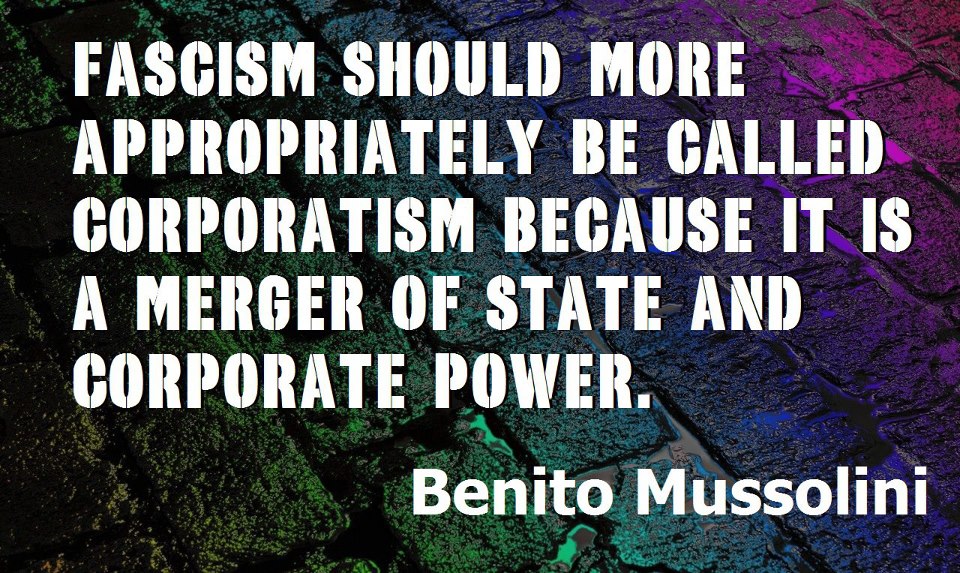
We may observe at this juncture that both the right and the left share the historically and empirically ridiculous theory that government and corporate power are locked in an eternal war. But it is a great politico-economic myth that governments and large corporations operate at variance with one another, that one must align herself in her political commitments with one or the other, never both, never neither. For left wing individualists, surveys which demonstrate dissatisfaction with and negative attitudes toward both actually make perfect sense. That big business should be associated with greed and governments with corruption is hardly astonishing or remarkable. Further, these results underline the problem with seeing corporate power and government power as rivals, rather than seeing them much more accurately as codependent partners in crime, mutually reinforcing components parts of a larger phenomenon we might call a ruling class or power elite.

We needn’t risk the cognitive dissonance that comes with treating the State as the great restraint upon the socially destructive avarice of multinational corporations. For we find, whenever we bother to look, that elites in the business community regularly work with the public sector to create conditions accommodating to monopolism. The ideal of free and open competition, however championed in corporate press releases and political campaigning, is nowhere to be found and indeed never has been. Thus do market anarchists prosecute our laissez faire critique of capitalism. We come from an older tradition of American libertarians, radicals who contemned capitalism as much as any communist, but understood the importance of individual rights and mutually beneficial trade.

It is interesting to witness anarchist communists and syndicalists develop strict, exclusionary criteria for anarchism, particularly insofar as the arguable father of our doctrine, Pierre-Joseph Proudhon, was neither, his mutualism containing many market-friendly if not outright pro-market elements. No less important for anarchism as it developed in America is Josiah Warren, whose first forays into anarchist thought antedate Proudhon. If market or individualist anarchism represents a form of “pseudo-intellectualism,” then some of the anarchist tradition’s brightest lights must apparently be relegated to the dustbin of history. Granting that opposition to not only political but also economic authority is a necessary condition for the true anarchist, individualists like Warren (and his followers such as Benjamin Tucker) more than qualify.

Whether our communist and syndicalist comrades admit it or not, free market ideas figured prominently in fledgling anarchist thought, regarded as perfectly consistent with and a natural outgrowth of, to quote Warren, “the absolute right of supreme individuality.” Considering Warren as an example, many contemporary anarchists may not know that anarchist luminary Peter Kropotkin acknowledged Warren as an inspiration and, in the words of Crispin Sartwell, “a precursor of (and influence on?) Proudhon.” In discussing Warren’s legacy, Sartwell observes one of the major, continuing tensions between the individualist and communist strains of anarchism, the debate on “lifestyle anarchism.” Sartwell argues, quite correctly in the author’s view, that Warren “belongs squarely in what is called by its opponents ‘lifestyle anarchism’: that strain concerned with creating alternatives within the interstices in the existing system rather than arming to overthrow it.” “Peaceful Revolutionist” that he was, Warren emphasized experiments in the creation of practical alternatives to dominant economic and social modalities. To Warren, the whole of life was open to and the subject of reform. This holistic approach, the universality of his critique of the existing state of affairs, he likely inherited from Robert Owen, even while dispensing with other aspects of Owenite thinking. Indeed, Warren’s departure from Owen and his ideas offers us an illuminative proxy for the tensions and debates that still divide individualist from communist elements within anarchism. Warren worried about the overwhelming of the individual within combinations and, paraphrasing Sartwell, imposed a priori schemes. Communists often tend to see the undisciplined “lifestylism” of Warren-type experimentation as essentially bourgeois, outside of or ancillary to genuine class struggle.

Discussing early figures in anarchism such as Warren opens opportunities to reflect on the similarities that unite all anarchists. We can pause to wonder what someone with Warren’s breadth of interests and hopes for reform might think of twenty-first century problems and perceptions thereof.

As all anarchists understand, politics is at bottom conquest, spoliation and rape. Everything else, everything peaceful, voluntary and consensual is something different, throwing the distinction between the “politics means” and the “economic means” once again into sharp relief. The economic means to wealth is defined by the normal, even obvious standards we refer to in interactions with merchants, our friends, and family, the mutually beneficial guidelines we use to cooperate and trade with coequals. The political means, by contrast, is the acquisition of wealth by aggression, by forcible extraction through systematic privilege. The State, being the organization with a monopoly on the legal use of force, is the wellspring of such privilege. As Josiah Warren pointed out in Equitable Commerce:

Theorists have told us that laws and governments are made for the security of person and property; but it must be evident to most minds, that they never have, never will accomplish this professed object; although they have had the world at their control for thousands of years, they have brought it to a worse condition than that in which they found it, in spite of immense improvements in mechanism, division of labor, and other elements of civilization to aid them. On the contrary, under the plausible pretext of securing person and property, they have spread wholesale destruction, famine, and wretchedness in every frightful form over all parts of the earth, where peace and security might otherwise have prevailed. They have shed more blood, committed more murders, tortures, and other frightful crimes in the struggles against each other for the privilege of governing, than society ever would or could have suffered in the total absence of all government whatever.

A deep, principled loathing of both big business and government unites all anarchists. Confronted with the alarming realities of the present moment, its authoritarian repressions and economic maladies, anarchists ought to help one another in peaceful projects to build a freer, better world. Data such as those contained in the Corporate Perception Indicator survey show a world fully primed for our anti-authoritarian, anti-capitalist critiques. It falls upon us to communicate our message, to do the constructive work of inaugurating a new order.

[1] Relatedly, in True Civilization, Josiah Warren wrote, “What is called conservatism has all the time been entirely right in its objections to communism, and in insisting on individual ownership and individual responsibilities both of which communism annihilates; conservatism has also shown wisdom in its aversion to sudden and great changes, for none have been devised that contained the elements of success.”