The modern food system is being shaped by the capitalist imperative for profit. Aside from losing their land to global investors and big agribusiness concerns, people are being sickened by corporations and a system that thrives on the promotion of ‘junk’ (ultra-processed) food laced with harmful chemicals and cultivated with the use of toxic agrochemicals.
It’s a highly profitable situation for investment firms like BlackRock, Vanguard, State Street, Fidelity and Capital Group and the food and agribusiness conglomerates they invest in. But BlackRock and others are not just heavily invested in the food industry. They also profit from illnesses and diseases resulting from the food system by having stakes in the pharmaceuticals sector as well. For them, it’s a win-win situation.
Lobbying by agrifood corporations and their well-placed, well-funded front groups ensures this situation prevails. They continue to capture policy-making and regulatory space at international and national levels and promote the (false) narrative that without their products the world would starve.
They are now also pushing a fake-green, ecomodernist agenda and rolling out their new proprietary technologies in order to further entrench their grip on a global food system that produces poor food, illness, environmental degradation, dependency and dispossession.
The prevailing globalised agrifood model is built on unjust trade policies, the leveraging of sovereign debt to benefit powerful interests, population displacement and land dispossession. It fuels export-oriented commodity monocropping and regional food insecurity.
This model is responsible for increasing rates of illness, nutrient-deficient diets, a narrowing of the range of food crops, chemical runoffs, increasing levels of farmer indebtedness and the eradication of biodiversity. And it relies on a policy paradigm that privileges urbanisation, global markets and agrifood corporations’ needs ahead of rural communities, local markets, on-farm resources and food sovereignty.
In addition, there are also the broader geopolitical aspects of food and agriculture in a post-COVID world characterised by food inflation, hardship and multi-trillion-dollar global debt.
There are huge environmental, political, social and health issues that stem from how much of our food is currently produced and consumed. A paradigm shift is required.
That book contains substantial sections on the agrarian crisis in India and issues affecting the agriculture sector. Aruna Rodrigues — prominent campaigner and lead petitioner in the GMO Mustard Public Interest Litigation in the Supreme Court of India — stated the following about the book:
This is graphic, a detailed horror tale in the making for India, an exposé on what is planned, to hand over Indian sovereignty and food security to big business.”
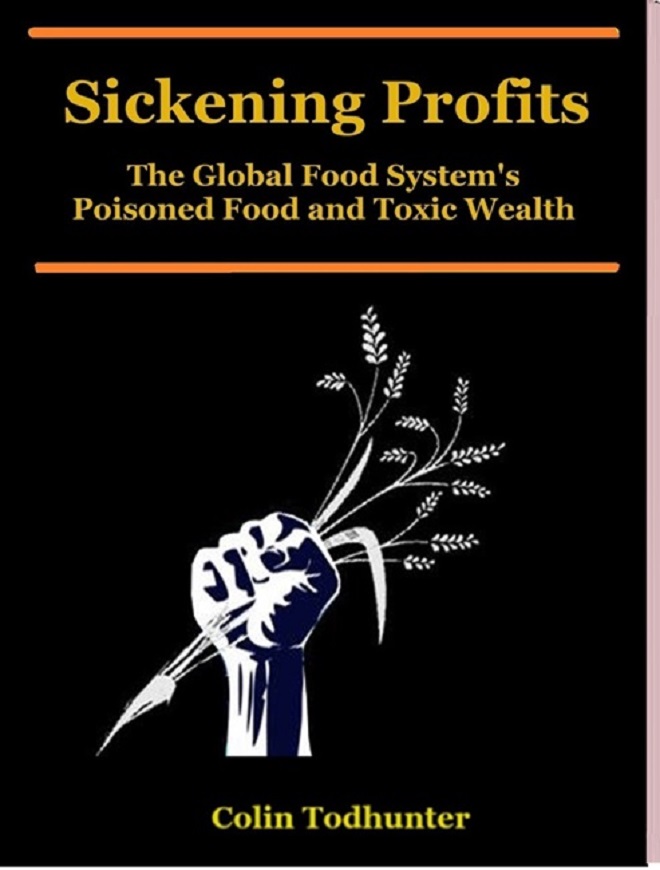
‘Sickening Profits’ continues in a similar vein. By describing situations in Ukraine, India, the Netherlands and elsewhere, it is another graphic horror tale in the making that is being intensified across the globe. The question is: Can it be stopped?
Small farmers produce up to 80% of the food in the non-industrialised countries. However, they are currently squeezed onto less than a quarter of the world’s farmland. The period 1974-2014 saw 140 million hectares – more than all the farmland in China – being taken over for soybean, oil palm, rapeseed and sugar cane plantations.
GRAIN noted that the concentration of fertile agricultural land in fewer and fewer hands is directly related to the increasing number of people going hungry every day. While industrial farms have enormous power, influence and resources, GRAIN’s data showed that small farms almost everywhere outperform big farms in terms of productivity.
In the same year, policy think tank the Oakland Institute released a report stating that the first years of the 21 century will be remembered for a global land rush of nearly unprecedented scale. An estimated 500 million acres, an area eight times the size of Britain, were reported bought or leased across the developing world between 2000 and 2011, often at the expense of local food security and land rights.
Institutional investors, including hedge funds, private equity, pension funds and university endowments, were eager to capitalise on global farmland as a new and highly desirable asset class.
This trend was not confined to buying up agricultural land in low-income countries. Oakland Institute’s Anuradha Mittal argued that there was a new rush for US farmland. One industry leader estimated that $10 billion in institutional capital was looking for access to this land in the US.
Although investors believed that there is roughly $1.8 trillion worth of farmland across the US, of this between $300 billion and $500 billion (2014 figures) is considered to be of “institutional quality” – a combination of factors relating to size, water access, soil quality and location that determine the investment appeal of a property.
In 2014, Mittal said that if action is not taken, then a perfect storm of global and national trends could converge to permanently shift farm ownership from family businesses to institutional investors and other consolidated corporate operations.
WHY THIS MATTERS
Peasant/smallholder agriculture prioritises food production for local and national markets as well as for farmers’ own families, whereas corporations take over fertile land and prioritise commodities or export crops for profit and markets far away that tend to cater for the needs of more affluent sections of the global population.
In 2013, a UN report stated that farming in rich and poor nations alike should shift from monocultures towards greater varieties of crops, reduced use of fertilisers and other inputs, increased support for small-scale farmers and more locally focused production and consumption of food. The report stated that monoculture and industrial farming methods were not providing sufficient affordable food where it is needed.
In September 2020, however, GRAIN showed an acceleration of the trend that it had warned of six years earlier: institutional investments via private equity funds being used to lease or buy up farms on the cheap and aggregate them into industrial-scale concerns. One of the firms spearheading this is the investment asset management firm BlackRock, which exists to put its funds to work to make money for its clients.
BlackRock holds shares in a number of the world’s largest food companies, including Nestlé, Coca-Cola, PepsiCo, Walmart, Danone and Kraft Heinz and also has significant shares in most of the top publicly traded food and agriculture firms: those which focus on providing inputs (seeds, chemicals, fertilisers) and farm equipment as well as agricultural trading companies, such as Deere, Bunge, ADM and Tyson (based on BlackRock’s own data from 2018).
Together, the world’s top five asset managers – BlackRock, Vanguard, State Street, Fidelity and Capital Group – own around 10–30% of the shares of the top firms in the agrifood sector.
The article Who is Driving the Destructive Industrial Agriculture Model? (2022) by Frederic Mousseau of the Oakland Institute showed that BlackRock and Vanguard are by far the biggest shareholders in eight of the largest pesticides and fertiliser companies: Yara, CF Industries Holdings K+S Aktiengesellschaft, Nutrien, The Mosaic Company, Corteva and Bayer.
These companies’ profits were projected to double, from US$19 billion in 2021 to $38 billion in 2022, and will continue to grow as long as the industrial agriculture production model on which they rely keeps expanding. Other major shareholders include investment firms, banks and pension funds from Europe and North America.
Through their capital injections, BlackRock et al fuel and make huge profits from a globalised food system that has been responsible for eradicating indigenous systems of production, expropriating seeds, land and knowledge, impoverishing, displacing or proletarianizing farmers and destroying rural communities and cultures. This has resulted in poor-quality food and illness, human rights abuses and ecological destruction.
SYSTEMIC COMPULSION
Post-1945, the Rockefeller Chase Manhattan bank with the World Bank helped roll out what has become the prevailing modern-day agrifood system under the guise of a supposedly ‘miraculous’ corporate-controlled, chemical-intensive Green Revolution (its much-heralded but seldom challenged ‘miracles’ of increased food production are nothing of the sort; for instance, see the What the Green Revolution Did for India and New Histories of the Green Revolution).
Ever since, the IMF, the World Bank and the WTO have helped consolidate an export-oriented industrial agriculture based on Green Revolution thinking and practices. A model that uses loan conditionalities to compel nations to ‘structurally adjust’ their economies and sacrifice food self-sufficiency.
Countries are placed on commodity crop production treadmills to earn foreign currency (US dollars) to buy oil and food on the global market (benefitting global commodity traders like Cargill, which helped write the WTO trade regime – the Agreement on Agriculture), entrenching the need to increase cash crop cultivation for exports.
Today, investment financing is helping to drive and further embed this system of corporate dependency worldwide. BlackRock is ideally positioned to create the political and legislative framework to maintain this system and increase the returns from its investments in the agrifood sector.
The firm has around $10 trillion in assets under its management and has, according to William Engdahl, positioned itself to effectively control the US Federal Reserve, many Wall Street mega-banks and the Biden administration: a number of former top people at BlackRock are in key government positions, shaping economic policy.
So, it is no surprise that we are seeing an intensification of the lop-sided battle being waged against local markets, local communities and indigenous systems of production for the benefit of global private equity and big agribusiness.
For example, while ordinary Ukrainians are currently defending their land, financial institutions are supporting the consolidation of farmland by rich individuals and Western financial interests. It is similar in India (see the article The Kisans Are Right: Their Land Is at Stake) where a land market is being prepared and global investors are no doubt poised to swoop.
In both countries, debt and loan conditionalities on the back of economic crises are helping to push such policies through. For instance, there has been a 30+ year plan to restructure India’s economy and agriculture. This stems from the country’s 1991 foreign exchange crisis, which was used to impose IMF-World Bank debt-related ‘structural adjustment’ conditionalities. The Mumbai-based Research Unit for Political Economy locates agricultural ‘reforms’ within a broader process of Western imperialism’s increasing capture of the Indian economy.
Yet ‘imperialism’ is a dirty word never to be used in ‘polite’ circles. Such a notion is to be brushed aside as ideological by the corporations that benefit from it. Instead, what we constantly hear from these conglomerates is that countries are choosing to embrace their entry and proprietary inputs into the domestic market as well as ‘neoliberal reforms’ because these are essential if we are to feed a growing global population. The reality is that these firms and their investors are attempting to deliver a knockout blow to smallholder farmers and local enterprises in places like India.
But the claim that these corporations, their inputs and their model of agriculture is vital for ensuring global food security is a proven falsehood. However, in an age of censorship and doublespeak, truth has become the lie and the lie is truth. Dispossession is growth, dependency is market integration, population displacement is land mobility, serving the needs of agrifood corporations is modern agriculture and the availability of adulterated, toxic food as part of a monoculture diet is feeding the world.
And when a ‘pandemic’ was announced and those who appeared to be dying in greater numbers were the elderly and people with obesity, diabetes and cardio-vascular disease, few were willing to point the finger at the food system and its powerful corporations, practices and products that are responsible for the increasing prevalence of these conditions (see campaigner Rosemary Mason’s numerous papers documenting this on Academia.edu). Because this is the real public health crisis that has been building for decades.
But who cares? BlackRock, Vanguard and other institutional investors? Highly debatable because if we turn to the pharmaceuticals industry, we see similar patterns of ownership involving the same players.
A December 2020 paper on ownership of the major pharmaceuticals companies, by researchers Albert Banal-Estanol, Melissa Newham and Jo Seldeslachts, found the following (reported on the website of TRT World, a Turkish news media outlet):
Public companies are increasingly owned by a handful of large institutional investors, so we expected to see many ownership links between companies — what was more surprising was the magnitude of common ownership… We frequently find that more than 50 per cent of a company is owned by ‘common’ shareholders who also own stakes in rival pharma companies.”
The three largest shareholders of Pfizer, J&J and Merck are Vanguard, SSGA and BlackRock.
In 2019, the Centre for Research on Multinational Corporations reported that payouts to shareholders had increased by almost 400 per cent — from $30 billion in 2000 to $146 billion in 2018. Shareholders made $1.54 trillion in profits over that 18-year period.
So, for institutional investors, the link between poor food and bad health is good for profit. While investing in the food system rakes in enormous returns, you can perhaps double your gains if you invest in pharma too.
These findings predate the 2021 documentary Monopoly: An Overview of the Great Reset, which also shows that the stock of the world’s largest corporations are owned by the same institutional investors. ‘Competing’ brands, like Coke and Pepsi, are not really competitors, since their stock is owned by the same investment companies, investment funds, insurance companies and banks.
Smaller investors are owned by larger investors. Those are owned by even bigger investors. The visible top of this pyramid shows only Vanguard and Black Rock.
A 2017 Bloomberg report states that both these companies in the year 2028 together will have investments amounting to $20 trillion.
While individual corporations – like Pfizer and Monsanto/Bayer, for instance – should be (and at times have been) held to account for some of their many wrongdoings, their actions are symptomatic of a system that increasingly leads back to the boardrooms of the likes of BlackRock and Vanguard.
Today, capitalist power can be summed up with the names of the three biggest investment funds in the world: BlackRock, Vanguard and State Street Global Advisor. These giants, sitting at the centre of a huge galaxy of financial entities, manage a mass of value close to half the global GDP, and are major shareholders in around 90% of listed companies.”
These firms help shape and fuel the dynamics of the economic system and the globalised food regime, ably assisted by the World Bank, the IMF, the WTO and other supranational institutions. A system that leverages debt, uses coercion and employs militarism to secure continued expansion.
So what are conventional pundits missing today? I would start with three dynamics.
Only old people experienced real recessions–those in 1973-74 and 1980-82. Recessions since then have been shorter and less systemic.
In the good old days, a recession laid waste to entire industries which never recovered their previous employment. People who were laid off couldn’t find another job. Major sectors of the economy dried up and blew away. Jobs were scarce and there was an oversupply of people looking for work.
We’re told consumer confidence is in the dumps and everyone expects the worst: recession! Oh Lordy. Interestingly, there isn’t much evidence of this near-panic behaviorally. Everyone’s tightening their belts and battening down the hatches, but it’s not the cliff-dive we see in a real recession.
There’s certainly a lot of froth to be scraped off the latte, but what I’m curious about are the armatures of the economy and what I’m seeing is the crowd ignoring key dynamics because they’re so busy pushing the Recessionary Play-Doh into the old playboard.
The entire notion that there is a hard and fast line indicating “recession” is not realistic or useful. The economy dropped 1% for two quarters in a row, quick hit the alarm, go to DefCon 1. Uh, OK, right.
The more useful approach is to look at data points as mostly signal noise that fail to reflect or illuminate the core dynamics of the economy. Here’s an example: the stagflation of the 1970s is a hot topic as the financial punditry compares then to now, seeking evidence of similarities strong enough to predict a Lost Decade ahead.
One key factor that’s rarely (if ever) mentioned was the staggering cost of cleaning up America’s industrial sector and polluted skies and waterways at the same time that the Cold War required the U.S. to strengthen its allies by allowing them unfettered access to the U.S. marketplace–exports to the U.S. that had a price advantage due to the dominance of the dollar and the relative weakness of allies’ currencies.
1972 exchange rates indicate that the Japanese yen was 302 to $1–an enormous advantage when compared to recent exchange rates of around 110 yen to the USD.
What few current pundits seem to grasp is the dominant dynamic of the entire era of 1945-1992 was the Cold War with the Soviet Union and its client states and allies. Strengthening allies’ economies was a core goal and so the costs to the domestic economy had to be absorbed: there was no choice.
The costs of cleaning up the nation and its vast industrial base was an enormous drag on the economy. The value of the trillions of dollars (in current dollars) invested was not in boosting profits, it was in restoring what had been heedlessly destroyed and damaged by rampant dumping of waste and pollutants and improving the health and well-being of the citizenry.
Check out the smog in early 1970s TV series filmed in Los Angeles for a taste of what was cleaned up.
But in a mind-boggling failure of conventional economics, our financial punditry is blind to the impact of the most consequential economic realities of the 1970s–the Cold War and the lengthy, painful, costly clean-up of the nation and its industrial base–on stagflation.
One reason for this abject failure is these dynamics were difficult to measure, so they weren’t measured.We only manage what we measure and so if we don’t measure it, it doesn’t exist. If we measure things in a no-longer-relevant manner, for example GDP, we continue to act as if this misguided measure is of supreme importance when the reality is it’s dangerously misleading.
So what are conventional pundits missing today? I would start with three dynamics:
1. For the first time in multiple generations, there is a structural scarcity of labor. For a variety of reasons, there are fewer people willing to do the work at the offered wage than there are jobs. This is not temporary, it is demographic and social, not simply economic. All the supposedly easy fixes– automate everything, etc.–are not that easy.
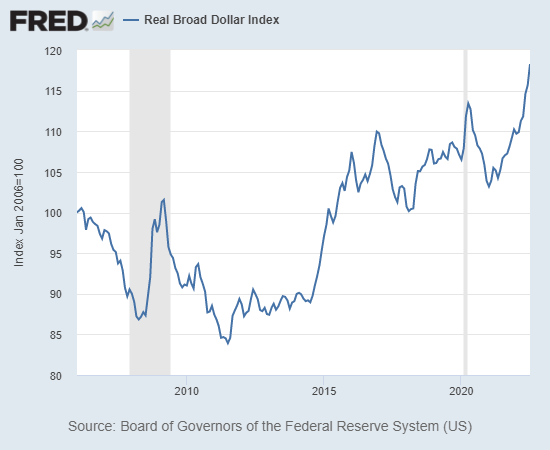
2. The strength of the U.S. dollar is exporting inflation, to the benefit of the domestic economy. After offshoring critical supply chains–a disaster that will take years to reverse–now the U.S. is offshoring inflation and the resulting demand destruction.
3. Global capital flows are reversing. capital flowed from the Core to the Periphery to reap the gains of globalization. Now the flow is reversing and capital is flowing from the Periphery to the Core to preserve capital and lock in lower-risk returns. What looks expensive to those earning U.S. dollars may look cheap and secure to those fleeing depreciating currencies and assets.
In my analysis, these are consequential dynamics that merit little attention in conventional financial analysis.
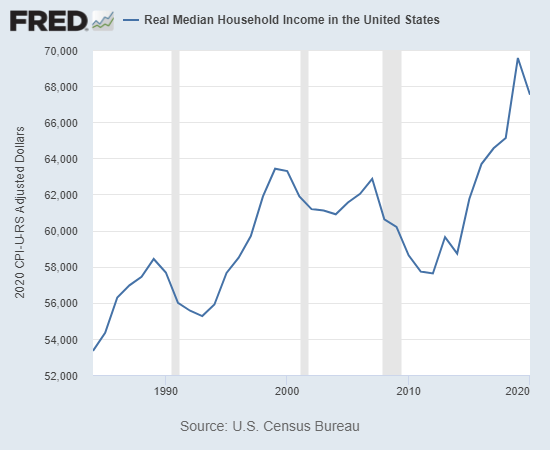
There is much more to say but glance at these two charts: real (i.e. adjusted for official inflation) median household income and real Broad U.S. Dollar Index.
If we’re not measuring or pondering the core structural dynamics of the economy, we’re not going to make sense of no-longer-relevant data. This is a most peculiar recession, and few seem to be asking if the reason is we’re missing what’s changed structurally.
Charts courtesy of St. Louis Federal Reserve Database (FRED))
The US financial sector has long looted other countries. A number of participants have described the process. First a country is enticed with bribes to the leaders to take out loans that cannot be serviced or repaid. Then in comes the IMF. Austerity is imposed on the population. Public services and employment are cut to free resources for debt service, and public assets are sold to repay the loan. Living standards fall, and US corporations take over the country’s economy.
As foreign governments, having experienced or witnessed the economic carnage and fearing accountability, are less willing to be bribed into indebting their countries, American finance is now applying this technique to Americans. Contrary to the narrative in the financial press, the Federal Reserve is not raising interest rates in order to fight inflation. It is ludicrous to think that a three-quarters of one percent rise in a very low interest rate is going to have any impact on a 9.1% rate of consumer inflation or that speculation that the Federal Reserve has in mind another three-quarters of one percent possibly followed by one half of one percent comprise an anti-inflation policy. If all these increases occur, it still leaves the interest rate below the inflation rate.
Moreover, as I have previously explained, the inflation is not monetary. The higher prices are the result of supply disruptions caused by Washington’s Covid lockdowns and Russian sanctions. Production was stopped and supply chains are broken.
The Federal Reserve’s rise in interest rates is just a continuation of its policy of concentrating income and wealth in the hands of the One Percent. Quantitative Easing was the cloak for the Federal Reserve to print $8.2 trillion in new money which was directed or found its way into the prices of stocks and bonds, thus enriching the small number who own most of these financial instruments. Having maxed out this avenue of wealth concentration, the Federal Reserve is now raising interest rates in order to drive up mortgage costs to aspiring home owners. The Federal Reserve is driving individuals out of the housing market in order to free up properties for “private equity” firms to purchase homes for their rental values. That private equity firms see rental income from the existing stock of houses as the best investment opportunity tells us that the US economy has played out. When investment goes into existing assets, not into producing new assets, the economy ceases to grow.
The Obama regimes policy of bailing out the financial fraudsters responsible for the 2008 crash while foreclosing on their victims, reduced American homeownership from 70% to 63 percent. The Urban Institute predicts further declines. Today homeowners’ equity has declined from 85% after World War II to one-third, leaving two-thirds of homeowner equity in the hands of creditors. This makes it completely clear that a financialized economy indebts the people for the sake of rentier income to the One Percent. Indeed, the financialized economy created by the Federal Reserve has reimposed a class system akin to the landed British aristocracy that was overthrown. Indeed, we have an economically far worst class system. The landed British aristocrats produced food that fed the nation. The American class system produces interest and fees for the financial system.
As Michael Hudson has shown us, a no-growth economy is the end result of a financialized economy. A financialized economy is one in which consumer income is diverted by debt expansion away from the purchase of new goods and services into debt service and fees–interest on mortgages, car loans, credit card debt, student loan debt. With such a large share of household income spent on debt service, little is left for driving the economy forward.
If American economists were capable of escaping from their neoliberal junk economics, they would realize that “the world’s largest economy” they attribute to the United States is total fiction. The fact is that the United States does not have an economy. Corporations driven by Wall Street located American manufacturing in Asia so that the One Percent could benefit from higher profits from lower labor costs, while the deserted city and states had to sell their income streams, such as Chicago’s parking meter revenues for 75 years, to foreigners for one lump sum payment to solve one year’s budget crisis.
The offshoring of American production, carried out under the cloak of “globalism,” destroyed the American economy and the tax bases of cities and states. While the real economy declines, the Democrat Party, seeking permanent power, has imposed a policy of open borders for immigrant-invaders. How are these millions of peoples to support themselves in an economy whose manufacturing has been moved abroad? How can a population, deserted by American corporations, that is experiencing debt deflation absorb the costs of support and social infrastructure for tens of millions of third world immigrant-invaders?
You will never hear it from the whores in the financial press, but the United States is on the precipice of economic and social collapse. And what are the fools in Washington doing? The idiots are ginning up wars with Russia, China, and Iran.
One thing I haven’t seen people point out anywhere else is how much the current atmosphere of “wokeness” is an outcome of neoliberalism.
Let me explain.
There was a lot of analysis written about neoliberalism back in the 1990s when it was still a relatively new phenomenon, having only been enshrined as the dominant economic paradigm in the 1980s. Now that neoliberalism has become simply the water in which we swim and the horizon upon which we gaze, we don’t even notice it anymore. The idea that there could be other ways to organize the economy and society has completely vanished from the discourse even on the nominal “Left”—so utterly complete has been its intellectual victory.
I can’t recall all the books and articles I read during that time, but a couple of standouts were One Market Under God by Thomas Frank and No Logo by Naomi Klein. Frank’s The Baffler magazine published a lot of good articles about neoliberalism back in those days, and Klein’s subsequent The Shock Doctrine is indispensable for understanding how neoliberalism took over the world.
One of the things that those analyses pointed out was the fact that neoliberalism derided governments as universally incompetent and inefficient and argued that only market competition could distribute goods and services effectively.
Furthermore, those markets had to be global in scope and free from “interference,” which was broadly defined as anything that hindered profit maximization including worker and environmental protections. This, in theory, would lead to ideal outcomes—or at least as close to ideal as they could be in a world of inherent scarcity.
As a corollary of this, neoliberals argued that democratic politics—the idea that citizens could express their wishes and desires via their elected representatives—was a hopelessly naive and outdated notion in the age of globalism. Rather, they argued that people’s preferences and desires would be more accurately reflected by how people spent their money in “free and open” markets. People’s spending patterns—aggregated and allocated by markets—would therefore be a better agent of social change than ineffective political action according to neoliberal theory1.
The One Big Market under neoliberalism, therefore, was seen not just a method for coordinating economic activities and allocating goods and services, but as the highest expression of people’s fundamental values. We were now expected to change the world thru shopping. As a result of this, you were expected to be an “ethical consumer.” You were exhorted to “spend your values.” Markets, neoliberals argued—and not popularly elected governments—were the true expression of the democratic will. As our choices at the voting booth began to narrow and seem more and more alike, we were told to vote with your dollar!
Here’s a concrete, real-world example. If you were concerned about dolphins being ensnared and killed in fishing nets used to dredge the ocean for tuna, the solution was not to ban the practice. No, the solution was to spend ethically on products labeled “dolphin safe.” Since consumers would express their preferences via buying dolphin safe tuna instead of the ones not so labeled, eventually the Invisible Hand of the Market would cause this practice to die out without a single government regulation. Similarly, if you wanted to support sustainable farming practices, you would spend preferentially on products labeled “organic” rather than the alternatives.
So in the neoliberal world view, the best way to bring about positive social change was by individuals spending their money in markets. That’s why in a modern shopping center you see all kinds of labels festooned on every conceivable product proclaiming how it is “responsibly sourced,” or how environmentally-friendly it is, or how the package is biodegradable, or how the farmers were fairly compensated, or whatever. You never saw that in the 1960s or 1970s—this change was ushered in by neoliberalism.
Now when you went to the grocery store it was no longer just to buy groceries—you had the obligation to save the world! (As if your life wasn’t stressful enough with the ever-longer working hours that were also the result of neoliberalism). A recurring theme of those analyses I read back in the day was the replacement of citizens with consumers.
(Of course, what’s to stop corporations from slapping any old claim onto their products? How can shoppers evaluate these claims? How can they possibly know what’s accurate and what’s not? Into this void stepped literally hundreds of different (private) certification agencies to try and make sure that these labels accurately reflected what they claimed. Thus, in the effort to avoid regulating markets, neoliberalism actually caused a proliferation of far more regulations and regulatory agencies than ever before. And often these privatized agencies have nonexistent oversight, poor standards and lax enforcement).
Another fundamental aspect of neoliberalism was the notion that competition would bring about ideal social outcomes. Therefore competition, neoliberals argued, had to be introduced into absolutely every aspect of human affairs. In this regard, neoliberalism a was really not just about economics, but was rather a radical totalitarian vision for remaking human society.
This extended even to social issues. For example, the philosophy behind “school choice” came from the notion that the problem with public schools was the lack of free market competition because schools were a state-owned monopoly. State-owned monopolies are the greatest possible evil under neoliberalism because they are not subject to market competition. By unleashing “choice,” schools would be forced to compete for students just like businesses compete for customers. This would make public education better, the thinking went, by eliminating bad schools and teachers and creating “lean and mean” educational institutions.
Even environmentalism has been colonized by neoliberalism. Instead of limiting the emission of fossil fuels, for example, new and exotic markets would be established so that polluters could trade opaque “carbon credits” in order to theoretically allocate pollution the same way we allocate any other resource under neoliberalism. This also demonstrates how neoliberalism is not anti-regulation or “small government” as is often portrayed, since creating these kinds of artificial markets takes massive amounts of government regulation and bureaucracy.
As this all-encompassing philosophy gradually took over the world, social protections were dismantled, regulations were abolished, and untrammeled, cutthroat competition was unleashed in every arena of life.
But it was Karl Polanyi who pointed out that such a vision of turning over society to anarchic markets with no protections and no refuge from its capricious dictates would lead to the “demolition of society.” No one could long withstand the never-ending whipsaws and bullwhips of “pure”relentless market competition—not consumers, not workers, and not even the businesses themselves! That’s why its has never existed, he said, and cannot exist.
So what actually happened in the real world due to unleashing this radical philosophy was an unprecedented wave of mergers, acquisitions, and consolidations in every sector of the economy, enabled by high finance (which was also “unleashed” thanks to neoliberalism).
You see, competition is expensive. It is also highly inefficient. It’s much more effective for parties to cooperate than to compete. That’s just game theory 101. It’s true of human affairs just as it is in nature. That’s why you see cooperation everywhere throughout the animal kingdom as Peter Kropotkin pointed out long ago. Any species where every single member was perennially locked in existential competition with every other member of the species would quickly die out, he said. Even where competition does exist in nature, it is in very limited in scope and in circumscribed contexts like mate choice.
Competition is also inherently unstable. You can’t just have an endless tournament going on forever and ever as free market theory depicts. Eventually there has to be a winner. Again, this is simply game theory 101. You can observe this everywhere you look.
So the current wave of consolidations and mergers in every sector of the economy can be seen as the logical outcome of neoliberal philosophy when applied to the real world as opposed to the world depicted in economic textbooks and think-tank policy papers. Want to know why the entire economy is dominated by a handful of mega-monopolies these days? That’s the reason why.
But getting back to our initial topic, here’s the point that’s absolutely critical: as a result of this neoliberal transformation, corporations had to portray themselves as agents of positive social change.
Read that again. And again and again and again until it sinks in.
This is what has lead to the rise of the modern “socially conscious” corporation and to so-called “woke capitalism.”
Think about it. Back in the pre-neoliberal 1960s, did any company bend over backwards to convey what it believed about absolutely anything? About any social issue whatsoever? No, because corporations weren’t expected to do that. Corporations were widely seen as anonymous entities devoid of values designed to make money by producing the goods and services consumers wanted. Back in the 1960’s—an era of rapid social change—no one cared about what IBM, Boeing, McDonalds, DuPont, General Electric, Coca Cola, General Motors, Prudential, Chevron, or any other big corporation thought about anything, much less the prevailing social issues of the day. That’s what politics was for! Businesses were expected to make money, full stop. Besides, how could a corporation really “think” anything? A corporation is a faceless bureaucratic enterprise composed of hundreds, or even thousands of individuals, each with their own personal set of values and beliefs. The very idea that a corporation could “believe” anything would have been seen as preposterous and absurd back then.
Spending money in “free” markets has subsequently become the only acceptable form of social protest or fomenting change under globalized neoliberalism—and not, for example, people banding together in popular movements to advocate for a better world. Government and politics have become passé and irrelevant—or so we’re told by those in charge. The sole option you have as a lone individual in the face of this relentless onslaught is to become an ethical consumer—in other words, to “spend your values.” Therefore, in order to meet this solemn obligation, you have to be sure that when you hand your money over to a corporation, that corporation reflects your values! That is a fundamental tenet of neoliberalism and its emphasis on markets—and not governments—as the highest arbiter of social values and preferences.
Yet very few commentators on the (fake) Left and the (pseudo) populist Right seem to grasp this. Instead they just shake their fists and rage.
So in order to get their hands on those precious “ethical” dollars, faceless bureaucratic corporations have to fashion themselves as “socially responsible.” As “ethical.” As being “positive change agents.” To that end they have launched wave after wave of PR campaigns designed to proclaim just how ethical and virtuous they are, from Amazon to Dove to Gillette, and every other big business has to follow suit.
Consider, for instance, those Dove advertisements that promised to let plus-size women believe they were beautiful—and publicly paraded them in their bras and panties in a commercial for cellulite-reducing cream. Or the Heineken “Worlds Apart” ad that showed people of disparate backgrounds and races coming together (eventually) over the beer. Or—to bring things back to the strategic positioning of carbonated sugar water as a proto-revolutionary product—the (thankfully short-lived) Kendall Jenner Pepsi spot that portrayed the soda as the means to bring Occupy-style protesters back into a grateful posture of consumer-abundance connoisseurship…
This also ties in with the “doing well by doing good” ethos of philanthropic capitalism as described by Anand Giridharadas in his book, Winners Take All. Once again, elected governments and politicians are portrayed as hopelessly inept and incompetent (sense a pattern?). In place of governments installed by the will of the people, therefore, “social entrepreneurs” will step into the void and solve the most pressing social problems of the day—and make a killing $$$ by doing so. This is portrayed as a “win-win” scenario in the media, which is owned and controlled by those same rich people (the fact that every single social problem seems to be getting exponentially worse has not deterred this policy approach in the slightest).
So if you wonder where all that cloying, patronizing Silicon Valley bullshit about “changing the world” and “making the world a better place” comes from—that’s where it comes from. It’s basically a form of neofeudalism in practice.
So the end result of all this is that under neoliberalism corporations are now obligated to portray themselves as ethical and moral in order to attract precious consumer dollars. Hence the rise of the modern “woke” corporation expressing it’s opinion on absolutely every hot-button issue of the day—from Black Lives Matter, to gay marriage, to the abortion debate, to transgender rights, to sexual harassment, to gun control, to multiculturalism, to whatever contentious wedge issue the political Right will dream up next.
And whether you like it or not, the people who tend to earn the most under globalized, technocratic monopoly capitalism really do strongly support cosmopolitan values like diversity, tolerance and inclusiveness. And since we are obligated to “spend our values” under neoliberalism, corporations have to cater to them—and to make sure that everyone knows about it. Thus they have to “officially” support things like Black Lives Matter. They have to speak out against discrimination against gay and transgender people. They have to be “antiracist.” They have to extol “empowering women and girls.” All because they need to attract the kinds of people who “spend their values,” and those values are more likely to be socially liberal for the kinds of people that corporations want to attract both as employees and consumers. That’s just the reality, and it’s not likely to change anytime soon.
And even though conservatives may not like it, socially regressive people and reactionaries tend to be poorer and less educated overall—and hence are less desirable as workers and consumers. That’s also just how it is. Therefore, corporations are “woke” based on a cynical, self-interested calculation of what will net them the most consumer dollars under neoliberal capitalism, and no amount of conservative grousing is going to change that. As a result, reactionaries and authoritarians are increasingly turning to politics to force their values upon people which they can’t enforce via the kinds of free market choices that they believe should dictate every other aspect of life.
When it became clear that the NFL supporters—largely white, male, and older—were outnumbered by the corporation’s brand loyalists—more diverse and younger—Nike went ahead and now even claims that it inaugurated the campaign because it believes that Kaepernick “is one of the most inspirational athletes of his generation.”
Of course, if we had a healthy and functioning political system none of this would be necessary. And it follows that if neoliberalism had not become the dominant social and economic paradigm of the twenty-first century there would be no such thing as “woke” capitalism in the first place.
So it’s truly amusing to watch the political Right rage to the heavens at the result of their own economic philosophy being applied in practice.
It’s also funny that, to my knowledge, no one appears to have made this connection. After all, why did corporations only relatively recently (i.e. after the 1990s) begin virtue signalling at every opportunity? It’s not just because everyone suddenly became “based” at approximately the same time. It’s the economic system, stupid!
Of course, it’s a win-win situation for political conservatives since they now have something to permanently complain about to rally people to their side, even though they are still just as pro-wealth and anti-worker as ever, and even though they still fervently believe in the most toxic tenets of neoliberalism (such as its contempt for democratically elected governments and its antipathy toward regulations and constraining the rich in any way). That’s the natural result of gutting civil society in favor of apotheosizing an all-powerful Market.
Of course, the bad news is that the end result of neoliberalism will probably be the rise of a twenty-first century form of fascist authoritarianism based on what I’m seeing in the media and across the political spectrum these days.
In conclusion, I find all of these “culture war” topics utterly inane and ridiculous (despite all the money you can make by endlessly bellyaching about them on Sub$tack). In a country where many citizens can’t even access basic health care, homelessness is endemic and rising, higher education is unaffordable, crime and suicide are rampant, people are mired in debt, wages have stagnated and mass shootings occur on a weekly basis2, I find it hard to get worked up over “wokeness” and “cancel culture.” And, as many besides me have pointed out, the idea that this cynical virtue signalling by mega-corporations means that they are in any way “left-of-center” by any reasonable definition of that term is absurd. After all, we’re talking about some of the most vile, sociopathic billionaires since the Gilded Age and some of the most brutal working conditions since the era of George Pullman. And the saddest thing is, we’ll never be able to unite to stop them since—thanks to neoliberalism—we will be kept perennially at each other’s throats while they continue to Tweet from their luxury yachts, penthouses, villas, and private jets about diversity and inclusiveness for ever and ever.
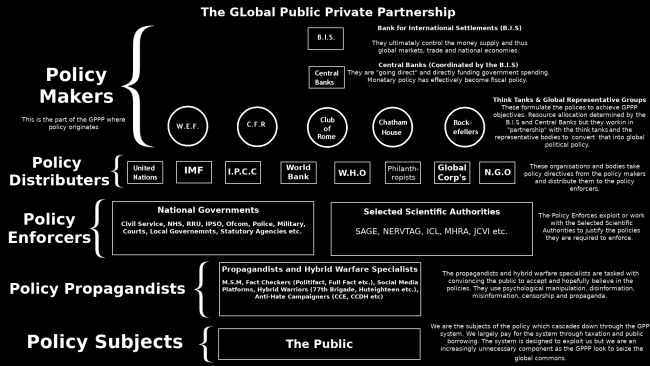
The Global Public-Private Partnership (GPPP) is a world-wide network of stakeholder capitalists and their partners.
This collective of stakeholders (the capitalists and their partners) comprises global corporations (including central banks), philanthropic foundations (multi-billionaire philanthropists), policy think-tanks, governments (and their agencies), non-governmental organisations, selected academic & scientific institutions, global charities, the labour unions and other chosen “thought leaders.”
The GPPP controls global finance and the world’s economy. It sets world, national and local policy (via global governance) and then promotes those policies using the mainstream media (MSM) corporations who are also “partners” within the GPPP.
Often those policies are devised by the think-tanks before being adopted by governments, who are also GPPP partners. Government is the process of transforming GPPP global governance into hard policy, legislation and law.
Under our current model of Westphalian national sovereignty, the government of one nation cannot make legislation or law in another. However, through global governance, the GPPP create policy initiatives at the global level which then cascade down to people in every nation. This typically occurs via an intermediary policy distributor, such as the IMF or IPCC, and national government then enact the recommended policies.
The policy trajectory is set internationally by the authorised definition of problems and their prescribed solutions. Once the GPPP enforce the consensus internationally, the policy framework is set. The GPPP stakeholder partners then collaborate to ensure the desired policies are developed, implemented and enforced. This is the oft quoted “international rules based system.”
In this way the GPPP control many nations at once without having to resort to legislation. This has the added advantage of making any legal challenge to the decisions made by the most senior partners in the GPPP (it is an authoritarian hierarchy) extremely difficult.
The GPPP has traditionally been referenced in the context of public health and specifically in a number of United Nation’s (UN) documents, including those from their agencies such as the World Health Organisation (WHO).
In their 2005 document Connecting For Health, the WHO, in noting what the Millennium Development Goals meant for global health, revealed the emerging GPPP:
These changes occurred in a world of revised expectations about the role of government: that the public sector has neither the financial nor the institutional resources to meet their challenges, and that a mix of public and private resources is required……Building a global culture of security and cooperation is vital….The beginnings of a global health infrastructure are already in place. Information and communication technologies have opened opportunities for change in health, with or without policy-makers leading the way…….Governments can create an enabling environment, and invest in equity, access and innovation.”
The revised role of governments meant that they were no longer leading the way. The traditional policymakers weren’t making policy anymore, other GPPP partners were. National government had been relegated to creating the GPPP’s enabling environment by taxing the public and increasing government borrowing debt.
This is a debt owed to the senior partners in the GPPP. They are also the beneficiaries of the loans and use this comically misnamed “public investment” to create markets for themselves and the wider the GPPP.
The researchers Buse & Walt 2000 offers a good official history of the development of the GPPP concept. They suggest it was a response to the growing disillusionment in the UN project as a whole and the emerging realisation that global corporations were increasingly key to policy implementation. This correlates to the development of the stakeholder capitalism concept, first popularised in the 1970s.
Buse & Walt outlined how GPPP’s were designed to facilitate the participation of new breed of corporations. These entities had recognised the folly of their previously destructive business practices. They were ready to own their mistakes and make amends. They decided they would achieve this by partnering with government to solve global problems. These existential threats were defined by the GPPP and the selected scientists, academics and economists they funded.
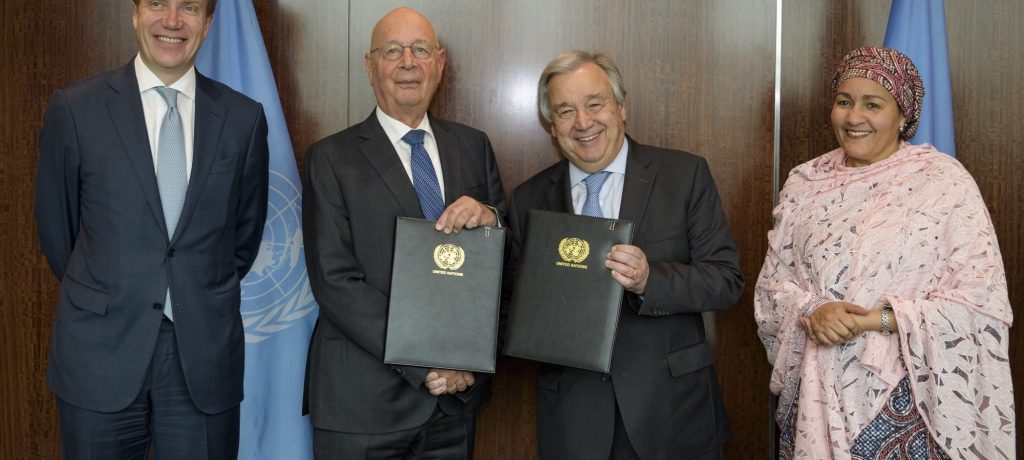
The two researchers identified a key Davos address, delivered by then UN Secretary General Kofi Annan to the WEF in 1998, as marking the transition to a GPPP based global governance model:
The United Nations has been transformed since we last met here in Davos. The Organization has undergone a complete overhaul that I have described as a ‘quiet revolution’…A fundamental shift has occurred. The United Nations once dealt only with governments. By now we know that peace and prosperity cannot be achieved without partnerships involving governments, international organizations, the business community and civil society…The business of the United Nations involves the businesses of the world.”
Buse & Walt claimed that this signified the arrival of a new type of responsible global capitalism. As we shall see, that is not how the corporations viewed this arrangement. Indeed, Buse and Walt acknowledged why the GPPP was such an enticing prospect for the global giants of banking, industry, finance and commerce:
Shifting ideologies and trends in globalization have highlighted the need for closer global governance, an issue for both private and public sectors. We suggest that at least some of the support for GPPPs stems from this recognition, and a desire on the part of the private sector to be part of global regulatory decision-making processes.”
The conflict of interest is obvious. We are simply expected to accept, without question, that global corporations are committed to putting humanitarian and environmental causes before profit. Supposedly, a GPPP led system of global governance is somehow beneficial for us.
Believing this requires a considerable degree of naivety. Many of the stakeholder corporations have been convicted, or publicly held accountable, for the crimes they have commited. These include war crimes. The apparent passive agreement of the political class that these “partners” should effectively set global policy, regulations and spending priorities seems like infantile credulity.
This naivety is, in itself, a charade. As many academics, economists, historians and researchers have pointed out, corporate influence, even dominance of the political system had been increasing for generations. Elected politicians have long-been the junior partners in this arrangement.
With the arrival of GPPP’s we were witnessing the birth of the process to formalise this relationship, the creation of a cohesive world order. The politicians have simply stuck to the script ever since. They didn’t write it.
It is important to understand the difference between government and governance in the global context. Government claims the right, perhaps through a quasi-democratic mandate, to set policy and decree legislation (law.)
The alleged western representative democracies, which aren’t democracies at all, are a model of national government where elected representatives form the executive who enact legislation. For example, in the UK this is achieved through the parliamentary process.
Perhaps the closest thing to this form of national government on an international scale is the United Nations General Assembly. It has a tenuous claim to democratic accountability and can pass resolutions which, while they don’t bind member states, can create “new principles” which may become international law when later applied by the International Court of Justice.
However, this isn’t really world “government.” The UN lacks the authority to decree legislation and form law. The only way its “principles” can become law is via judicial ruling. The non-judicial power to create law is reserved for governments and their legislative reach only extends to their own national borders.
Due to the often fraught relationships between national governments, world government starts to become impractical. With both the non-binding nature of UN resolutions and the international jockeying for geopolitical and economic advantage, there isn’t currently anything we could call a world government.
There is the additional problem of national and cultural identity. Most populations aren’t ready for a distant, unelected world government. People generally want the political class to have more democratic accountability, not less.
The GPPP would certainly like to run a world government, but imposition by overt force is beyond their capability. Therefore, they have employed other means, such as deception and propaganda, to promote the notion of global governance.
Former Carter administration advisor and Trilateral Commission founder Zbigniew Brzezinski recognised how this approach would be easier to implement. In his 1970 book Between Two Ages: Americas Role In The Technetronic Era, he wrote:
Though the objective of shaping a community of the developed nations is less ambitious than the goal of world government, it is more attainable.”
The last 30 years have seen numerous GPPP’s form as the concept of global governance has evolved. A major turning point was the WEF’s conspectus of multistakeholder governance. With their 2010 publication of Everybody’s Business: Strengthening International Cooperation in a More Interdependent World, the WEF outlined the elements of GPPP stakeholder’s form of global governance.
They established their Global Agenda Councils to deliberate and suggest policy covering practically every aspect of our existence. The WEF created a corresponding global governance body for every aspect of our society. From our values and economy, through to our security and public health, our welfare systems, consumption, access to water, food security, crime, our rights, sustainable development and the global financial and monetary system, nothing was left untouched.
The executive chairman of the WEF, Klaus Schwab, spelled out what the objective of global governance was:
Our purpose has been to stimulate a strategic thought process among all stakeholders about ways in which international institutions and arrangements should be adapted to contemporary challenges…the world’s leading authorities have been working in interdisciplinary, multistakeholder Global Agenda Councils to identify gaps and deficiencies in international cooperation and to formulate specific proposals for improvement…
These discussions have run through the Forum’s Regional Summits during 2009 as well as the Forum’s recent Annual Meeting 2010 in Davos-Klosters, where many of the emerging proposals were tested with ministers, CEOs, heads of NGOs and trade unions, leading academics and other members of the Davos community…
The Global Redesign process has provided an informal working laboratory or marketplace for a number of good policy ideas and partnership opportunities…We have sought to expand international governance discussions…to take more pre-emptive and coordinated action on the full range of risks that have been accumulating in the international system.
By 2010 the WEF had taken it upon themselves to begin the Global Redesign process. They defined the international challenges and they proposed the solutions. Fortunately for the GPPP, their proposals meant more control and partnership opportunities for them. The WEF sought to spearhead the expansion of this international governance.
In just one example, in 2019 the UK Government announced its partnership with the WEF to develop future business, economic and industrial regulations. The UK government were committed to supporting a regulatory environment created by the global corporations who would then be regulated by the same regulations they had designed.
The WEF do not have an electoral mandate of any kind. None of us have any opportunity to influence or even question their judgments and yet they are working in partnership with our supposedly democratically elected governments, and other GPPP stakeholders, to redesign the planet we all live on.
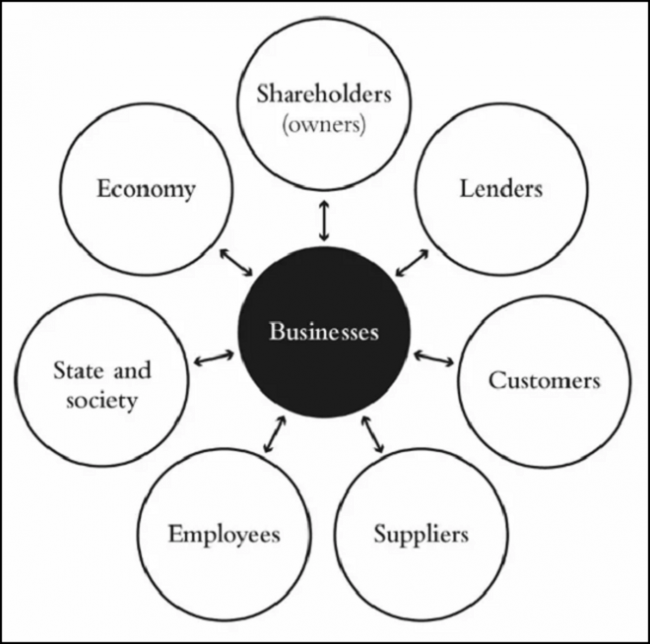
Stakeholder capitalism lies at the heart of the GPPP. Essentially it usurps democratic government (or indeed government of any kind) by placing global corporations at the centre of decision making. Despite deriving authority from no one but themselves, the leaders of the GPPP assume their own modern interpretation of the “divine right of kings” and rule absolutely.
The most important characteristic of the stakeholder model today is that the stakes of our system are now more clearly global.. What was once seen as externalities in national economic policy making and individual corporate decision making will now need to be incorporated or internalized in the operations of every government, company, community, and individual. The planet is.. the center of the global economic system, and its health should be optimized in the decisions made by all other stakeholders.”
The GPPP will oversee everything. Every government, all business, our so-called communities (where we live) and each of us individually. We are not the priority. The priority is the planet. Or so the WEF claim.
Centralised control of the entire planet, all its resources and everyone that lives on it is the core ethos of the GPPP. There is no need to interpret GPPP intentions, we don’t have to read between the lines. It is stated plainly in the introduction to the WEF’s Great Reset initiative:
To improve the state of the world, the World Economic Forum is starting The Great Reset initiative.. The Covid-19 crisis.. is fundamentally changing the traditional context for decision-making. The inconsistencies, inadequacies and contradictions of multiple systems –from health and financial to energy and education – are more exposed than ever.. Leaders find themselves at a historic crossroads.. As we enter a unique window of opportunity to shape the recovery, this initiative will offer insights to help inform all those determining the future state of global relations, the direction of national economies, the priorities of societies, the nature of business models and the management of a global commons.”
It should be noted that the WEF are just one partner organisation among many in the GPPP. However, they have been perhaps the most influential in terms of public relations throughout the pseudopandemic. Contrary to the hopes of Buse & Walt, we see an emergent global, corporate dictatorship, not caring stewardship of the planet.
The GPPP will determine the future state of global relations, the direction of national economies, the priorities of societies, the nature of business models and the management of a global commons. There is no opportunity for any of us to participate in either their project or the subsequent formation of policy.
While, in theory, governments do not have to implement GPPP policy, the reality is that they do. Global policies have been an increasing facet of our lives in the post WW2 era. The mechanism of translating GPPP policy initiatives, first into national and then regional and eventually local policy, can be clearly identified by looking at sustainable development.
In 1972 the privately funded, independent policy think-tank the Club of Rome (CoR) published the Limits of Growth. As we saw with the roll-out out of the pseudopandemic, the CoR used computer models to predict what they decreed were the complex problems faced by the entire planet: the “world problematique.”
Their offered opinions derived from the commissioned work of the Massachusetts Institute of Technology’s (MIT’s) system dynamic “World3 model.” This assumed global population would deplete natural resources and pollute the environment to the point where “overshoot and collapse” would inevitably occur.
This is not a scientific “fact” but rather a suggested scenario. So far, none of the predictions made have come to pass.
The scientific and statistical to-and-fro on the claims made in the Limits to Growth has been prolific. However, ignoring all doubts, the World3 model was firmly planted at the centre of the sustainable development policy environment.
In 1983 the Brundtland Commission was convened by former Norwegian Prime Minister Gro Harland Brundlandt and then Secretary General of the UN Javier Pérez de Cuéllar. Both were Club of Rome members. Based upon the highly questionable assumptions in the World3 model, they set about uniting governments from around the world to pursue sustainable development policies.
In 1987 the Commission published the Brundtland Report, also known as Our Common Future. Central to the idea of sustainable development, outlined in the report, was population control (reduction.) This policy decision, to get rid of people, won international acclaim and awards for the authors.
The underlying assumptions for these policy proposals weren’t publicly challenged at all. The academic and scientific debate raged but remained almost completely unreported. As far as the public knew, scientific assumption and speculation was a proven fact. It is now impossible to question these unproven assumptions and obviously inaccurate models without being accused of “climate denial.”
This resulted in the Millenium Development Goals and eventually, in 2015, they gave way to the United Nation’s full adoption of Sustainable Development Goals (SDGs), In turn, these have been translated into government policy. For example, the UK government proudly announced their Net Zero policy commitment to sustainable development goals in 2019.
SDGs were already making an impact at the regional and local level in counties, cities, towns and boroughs across the UK. Nearly every council across the country has a “sustainable development plan.”
Regardless of what you think about the global threats we may or may not face, the origin and the distribution pathway of the resultant policy is clear. A privately funded, globalist think-tank was the driver of a policy agenda which led to the creation of a global policy framework, adopted by governments the world over, which has impacted communities in nearly every corner of the Earth.
SDGs are just one among numerous examples of GPPP global governance in action. The elected politician’s role in this process is negligible. They merely serve to implement and sell the policy to the public.
It doesn’t matter who you elect, the policy trajectory is set at the global governance level. This is the dictatorial nature of the GPPP and nothing could be less democratic.
Setting aside the “transitory inflation” parlor game for a moment, let’s look at what happens when critical parts are unavailable for whatever reason, for example, they’re on back order or indefinite back order, i.e. the supplier has no visibility on when the parts will be available.
If the part that blew out is 0.1% of the entire machine, and the other 99.9% still works perfectly, the entire machine is still dead in the water without that critical component. That is a pretty good definition of systemic vulnerability and fragility, a fragility that becomes much, much worse if there are two or three components which are on indefinite back order.
This is the problem with shipping much of your supply chain overseas: you create extreme systemic vulnerability and fragility even as you rake in big profits from reducing costs. Speaking of costs, let’s look at the costs of having a large, costly, complex mechanism sitting idle in a non-functioning state due to some broken element for which there is no substitute available. Whatever productive capacity the mechanism, process, etc. had is now stuck at zero.
Buying a new replacement is extremely costly, and that’s not always available for all the same reasons that parts and components aren’t available. Finding someone to fabricate a new component is not easy due to the wholesale transfer of manufacturing moxie and capability overseas.
You might be able to find someone to weld a replacement strut, but try finding someone to fab a new bicycle derailleur or better yet, a multilayer semiconductor chip. What about 3-D fabrication? Doesn’t that solve this problem? If the part can be “printed,” yes, but there are limits on what can be 3-D fabbed. You can’t 3-D fab a complex thermostat or controller, for example. You can’t 3-D fab a rubber gasket, either, or a great many other bits of petrochemical-based manufacturing.
Scarcities are not limited to parts and components; skilled people can be scarce, too. For example, there is a limited supply of ICU doctors and nurses. The training required to work in an ICU is specialized and experiential; throwing someone with minimal training in is not a substitution that’s going to work. You can’t order an ICU staff from China or print one digitally the way the Federal Reserve creates currency out of thin air. It takes many years to train the staff to function at a high level in ICU.
A great many such labor scarcities exist for skilled workers who cannot be replaced except by someone with the same training and years of experience. This is one reason ICUs can break down: there is no replacement staff available, and no way to “print more.”
It turns out there’s also a scarcity of people willing to do the dirty-work jobs America needs done for wages that haven’t kept up with inflation. As I have explained here, the $1.65 minimum wage I earned in 1970, if factored for real-world inflation, is around $18 per hour, and arguably closer to $20 per hour.
The solution is to raise the pay to levels that attract workers, but then this requires raising prices on the good and services to the point that customers can no longer afford them.
But wait, can’t we automate all work and deliver full-gee-whiz free-money, no-work communism to everyone? I invite everyone who reckons this is in the realm of the do-able to design, program and manufacture an automated robot that can trundle out to the laundry room, pop open a broken clothes dryer, diagnose the problem, manage to find a new controller board, fit it correctly and properly reconnect all the little wiring bits, close it up, test it, lift the dryer back on the washing machine and do all that for the relatively modest cost of a human repairperson. When you accomplish fabricating and programming that robot to do all the work without instruction or oversight, by all means let us all know how much it cost to design, program and manufacture, what the payback of the development and manufacturing process will cost amortized over the (short) life of the robot and how reliable it is in the real world.
The point is, fantasies are nice but reality is far more demanding.
There can also be scarcities of competence. There may be replacements who claim competence, but when reality intrudes on the shuck-and-jive, their competence was illusory, and the net result is the entire institution can be described by President G.W. Bush’s memorable phrase, this sucker’s going down.
There can also be scarcities of institutional infrastructure and capacity. Once the institution, enterprise, state agency, etc. has been stripmined of redundancy, institutional memory and competence, then the first scarcity that cannot be replaced is the first domino that topples all the other dominoes of systemic vulnerability and fragility.
The Federal Reserve can print trillions of dollars and the federal government can borrow and blow trillions of dollars, but neither can print or borrow supply chains, scarce skills, institutional depth or competence. That nice shiny new semiconductor fab you reckon will resolve the chip shortage? You can print the billions of dollars needed in an instant, but the machinery, expertise and time can’t be conjured quite so easily. That fab is years away from completion no matter how many freshly conjured dollars you throw into the air.
When Critical Parts Are On “Indefinite Back Order,” the Machine Grinds to a Halt: that’s the U.S. economy in a nutshell.
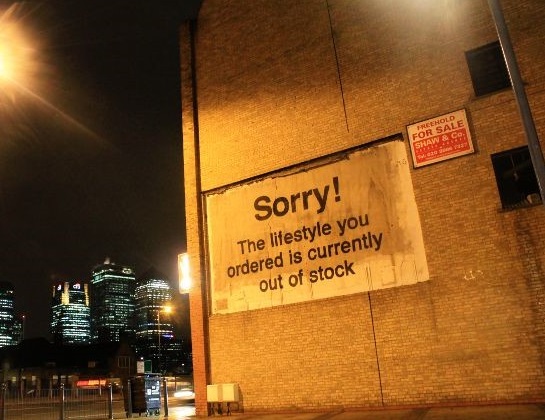
A great many essential components in America are on indefinite back order, including the lifestyle of endless globally sourced goodies at low, low prices. That lifestyle is out of stock and cannot be replaced with financialization fakery.
Hey, Federal Reserve, can you conjure up a non-corrupt financial system, a domestic supply chain, and an economy of open competition, transparency, accountability and competence? If not, you are even more worthless than we feared.
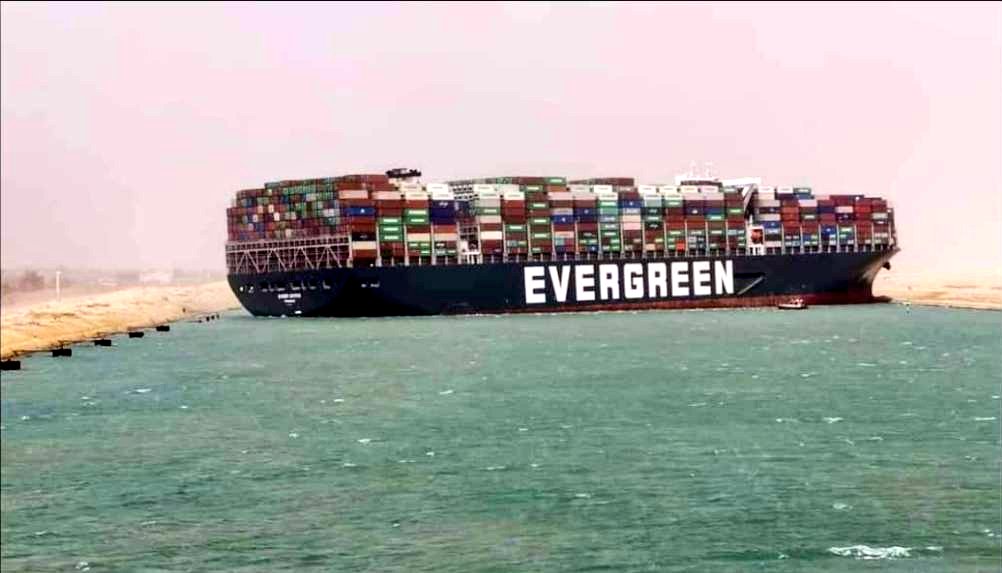
Did you hear? A supersized cargo ship got wedged in the Suez Canal on March 23rd? If you didn’t, you must do pretty well at avoiding the news, social media, and late night TV. But the short of it is: the Ever Given somehow lost control (sandstorm strength winds have been blamed, as have human errors) and crashed into the bank of the canal and lodged itself in.
So what? Is this really news? Or just a sensational story to distract us from the pandemic, which, one might argue, is itself a distraction from the rapid unraveling of Earth’s systems and thus human civilization? Perhaps. But then again perhaps not. Here’s why this incident is worth understanding.
But the main reason is because this is an excellent metaphor on how fragile our entire globalized system has become.
It makes you wonder where Dirk Gently is to help straighten all this out. If you haven’t heard of Gently, he is a holistic detective, who uses “the fundamental interconnectedness of all things” to find missing persons (and cats) and solve mysteries. In fact, the novel Dirk Gently’s Holistic Detective Agency includes him trying to figure out how a sofa got “irrevocably stuck” halfway up a staircase.
Similar story here: the Ever Given was jammed in tight—though fortunately with the help of the full moon and tides, unstuck without resorting to time travel (which was needed to free the errant sofa). And while the supernatural wasn’t at the root cause of this mishap as with the couch, instead of focusing just on the bad luck of a sandstorm (which are not uncommon in Egypt) combined with bad piloting, we should still investigate the root causes at play. So let’s peel back the layers one at a time.
Bigger is better!
At the surface, we might simply say the problem stems from the fact that we keep making bigger container ships. The Ever Given is a quarter mile long (one lap around a track or the height of the Empire State Building). And it weighs 220,000 tons and holds 20,000 containers (each 20-40 feet long). High oil prices (especially 2005-8), combined with cheap debt after the 2008 crash led shipping companies to invest in bigger and bigger ships. The Ever Given holds four times the cargo a ship carried in 2000. In fact, these containers were stacked so high that they acted like a giant sail and caught the intense winds that drove the Ever Given into the banks. So, yes, there’s more risk involved, but it’s cheaper to add more containers. To get as much on there as possible. Sometimes that means losing a load of containers to a storm or other incident (about 1600 containers are lost on average each year). Not to mention the fluke canal accident—not that this was a widely recognized risk. (However, this OECD report from 2015 did raise the challenges of burgeoning cargo ship sizes). But now this threat will need to be considered, including terrorists doing this intentionally to disrupt trade.
Now more concentrated!
But of course, looking holistically, let’s ask why do we even need these big ships? So, peeling another layer, we see that we have concentrated our manufacturing to a few major locations and promoted the consumer culture worldwide so we need to get goods of all types to rich Europeans, we need to get oil to run cars and planes in every country, we need to get livestock to the Middle East to feed this affluent desert population. Our globalized system depends on big old cargo ships. Even this incident is a reflection of our extreme globalization: the ship is owned by a Japanese company; run by a Taiwanese company (Evergreen); piloted by Indians; operating under a Panamanian flag; navigating through an Egyptian waterway, shipping brand name goods from all over the globe, and rescued by a Dutch salvage company. That’s kind of neat—a global Kumbaya moment—or a revelation of just how deeply aligned nations are in converting Earth’s forests, lands, water, and life into the latest in consumer products.
But wait, there’s more!
Peeling another layer, we find that the movement of all these consumer goods is driven by a culture fixated on growth, profit, and consumerism. We move factories to exploit cheaper labor, lax environmental rules; we spend $763 billion a year on advertising to convince people they need a new iPhone or a new car or a trip to wherever; we convert landscapes wholesale into resources; and we panic if our economies don’t grow. We’re trapped in a pursuit of material happiness, manipulated by the admen and politicians, driven now by our addictions to sweets, tobacco, alcohol, drugs, social media, and entertainment, to the point we’re “amusing ourselves to death.” But worse, we’re so amused we hardly even notice the death part any longer.
Free disconnect with every purchase!
And arriving at the inner layers of the onion, we find this: that our disconnection from the Earth is so deep, so profound, so complete, that we no longer even consider the planet in our decisions to manufacture items or ship them or buy them. We think instead about expanding our economies, upsizing our homes, upgrading our cars and phones, even stockpiling toilet paper (which again became a thing in the Suez Canal story as wood pulp supplies were potentially delayed). Even as scientists warn of ecological collapse, of cities lost to flooding seas, of regions abandoned due to perpetual drought, to the inevitable violence that all this will cause, to the countless species lost—many of whom we depend on directly for our survival—we focus on making memes, writing essays (guilty), and trying to live slightly-greener-around-the-edges-consumer-lifestyles.
Dealing with this metaphorical couch
Perhaps that’s why the struggling bulldozer became the source of so many memes. Except the most important one: The bulldozer as the environmental movement and the ship as Consumer Capitalism. Ultimately, trying to free the ship, or even convert it to run on green fuels or the latest in sail technology is treating the superficial layers. Instead, we need to dig deeper (yuk yuk). We need to re-regionalize production; reduce production; degrow our economies, find ways to disincentivize and discourage a consumer lifestyle; or better yet, make it clear that this whole culture of consumerism is suicidal and worse, anti-life, and must go in order to prevent future ship jams or far worse global disruptions. And even deeper, we need to reconnect people to the living Earth to make them understand that every sin against the planet, against other creatures, and against other humans who we exploit, we do to ourselves. That if we fail to change paths, we will run head first into the proverbial canal wall. And there will be no one to dig us out.

 After the Crash