“Dark Star” (1974) is a science fiction comedy directed and produced by John Carpenter and co-written with Dan O’Bannon. The film originated as a USC film project from 1970 to 1972 and expanded to a feature length project in 1974. It plot follows the mentally deteriorating crew of the starship Dark Star, twenty years into their mission to destroy unstable planets that might threaten future colonization of other planets.
Dark Star was the feature directorial debut for Carpenter, who also scored and produced the film. It was also the feature debut for O’Bannon, who also served as editor, production designer, visual effects supervisor and actor.
Though it rarely gets mentioned in round ups of rock and roll movies, Get Crazy is one of that genre’s best outings. The script offers a savvy satire of the rock business, put forth in an appealing lighthearted style that makes it accessible. Allan Arkush directs the proceedings with flair, keeping the multiple plotlines moving forward while still delivering plenty of music and laughs. Get Crazy further benefits from a fun cast: Daniel Stern makes an appealing average-joe lead, Malcolm McDowell delivers a sly comedic turn as an egotistical Mick Jagger-styled rocker and Ed Begley Jr. is a deadpan delight as an evil mogul trying to steal the concert hall’s real estate. Rock fans will also want to look out for punker Lee Ving and alternative-rock legend Lou Reed in fun cameo roles (Reed in particular has fun satirizing Bob Dylan). In short, Get Crazy is a funny and fast-paced rock and roll flick that deserves a bigger cult following.
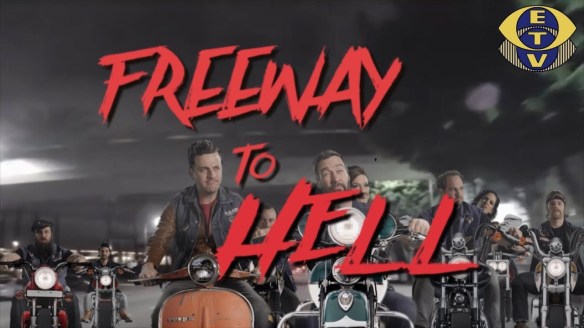
Mike Upchurch is a comedy writer who got his start working on Mr. Show and The Chris Rock Show in the late nineties. In recent years he has written, directed and edited a series of short films, the best of which are presented here. They share in common an acerbic wit skewering various genres of pop culture detritus using brilliant editing and low-tech CGI techniques to insert whimsical performances, dialogue and plotlines into found footage.
The Quiz Broadcast: a post-apocalyptic television quiz show hosted by Mitchell (who constantly reminds viewers to “remain indoors”) and transmitted by the British Emergency Broadcasting System. The show is being aired in the immediate years after “The Event”, an unexplained disaster that left most of the human race dead, including all of the children. The sickly contestants on the show are survivors “trying to enjoy themselves” whilst avoiding any traumatic memories of “the Event”–Peter (a blind man played by Webb), Sheila, and Unknown Male 282. Prizes in the game consist of the sparse food and fuel supplies they have in their bunker. The questions asked often revolve around “pre-Event” subject matter, which the contestants have little to no knowledge of, while later sketches demonstrate the increasing deterioration of society, morale and health, and suggest that a cannibalistic race referred to as “Them” had overrun the area. The sketch ends on a somber note with Peter and the host being the last survivors of the bunker and possibly even the human race; Peter remains hopeful that help will come, but the host knows that it won’t. In March 2020, 13 years after the original broadcast, these sketches and the ‘Remain Indoors’ banner in particular, began trending heavily on social media in light of the Coronavirus pandemic and the associated national lockdowns.
Acrobat, musician, composer, clown, mime, movie star, director and producer, Academy Award winner for lifetime achievement, but still driven from the United States for his backing of the Soviet Union, Charlie Chaplin should need little introduction, except perhaps for Millennials and other late alphabet generations. He was the global star in the crossover from silent films to talkies, making an astonishing $10,000 a week during the Depression, with $150,000 in signing bonuses. Knighted by the Queen, Charlot was universally loved and admired.
But is he relevant today beyond his reputation as a comic icon?
During a recent visit to the magnificent Manoir de Ban near Lausanne, Switzerland, which was his home from 1952 until his death in 1977 and now houses a museum in his honor, I was impressed how his films were political, and how they speak to today’s human rights agenda.
In 1954 Chaplin was awarded the International Peace Prize by the World Peace Council for his outstanding contribution to the cause of peace and friendship among nations. Who can forget his mocking of Hitler in The Dictator when he spins a globe and dances with the world at his fingertips?)
Two examples from his classics show how his films relate to human rights:
The 1921 production The Kid is the story of an unwed, down-and-out mother who abandons her child because she cannot afford to look after him. She places him in an expensive car with a note to the owner to take care of him. After some intrigue, a tramp, Charlie Chaplin, finds the boy and raises and loves him like his own, cementing the idea of the kindness of the fellow impoverished. The tramp and the kid work together against the moneyed class; the kid breaking windows and the tramp repairing them.
The kid is eventually taken away from the tramp by the authorities – border police separating children from their loved ones on the U.S. southern border? – to be returned to his mother. In the end, the kid, the tramp and the mother are re-united.
The Kid was chosen to be preserved in the Library of Congress’s National Film Registry in 2011. It was praised as “an artful melding of touching drama, social commentary and inventive comedy.” The social commentary is what today we would call human rights: the right to a decent life for the mother when she is poor; the right for the mother to have minimum support to raise her boy and not to have to abandon him; the right of the tramp to have a decent wage for his job so he would be able to live properly without having to use illegal means to earn a living; the right to have proper housing for the tramp and the kid; the right to have affordable medical care; the right for the boy to stay with the tramp instead of being sent to an orphanage.
All of these we would call basic social, economic and cultural rights. They are at the heart of Chaplin’s advocacy; they are what make the film so endearing and why we are so relieved when the tramp, kid and mother unite at the end to live happily together. According to Chaplin, and The Kid, there is justice in this world. The good guys overcome injustices and the cruel indifference of the rich with their expensive cars (a foreboding of the 1%?). Although the mother became a rich actress, she takes in the tramp to form a supportive family for the kid, re-uniting him with her son (without the son’s losing the support of the foster father who had raised him, a win-win situation that no family judge could have better decided).
And how does Modern Times, Chaplin’s critique of industrialization, relate to human rights and our modern times of numeric technology? The tramp in Modern Times is a factory worker slaving away on mechanical assembly line. Is this different from today’s information workers tied to their computer screens, forced to work at accelerated speeds as the information flow gets faster and faster, like the quickening assembly line? The hero suffers a nervous breakdown after which he is unemployed, again suffering from having no unemployment insurance or other benefits to carry him over. He is mistakenly arrested with no legal recourse but wishes to stay in jail since he has had no vocational training and is living better in jail than in the street.
The remainder of the film deals with his romance with a fellow hobo who is fleeing punishment because she stole a single loaf of bread (proportional justice?). The film recounts the couple’s various adventures to escape poverty and the desperation of those with no guaranteed income, no right to food or right to housing. Whenever authorities are presented, they are unsympathetic. The poor have no recourse to representation and are left to their own devices to survive. The police – the authorities – are constantly trying to arrest the downtrodden who must seek refuge outside the authoritative system. There is no hope for them within the system; they are left to their own devices in a world with no guaranteed rights.
There is little justice in Modern Times in terms of a happy ending where the heroes overcome injustices. At the end, there is only the love between Chaplin and Ellen. But in the film, as in The Kid, struggles of the underclass represent all the injustices that the 99% of the world today must endure. While economic inequality continues to grow, Chaplin’s films have an important lesson of the struggles of the disenfranchised if one can view the horrors of industrialization and the Depression in our modern context. When 26 individuals are worth as much as 50% of the world’s population, Chaplin’s comic/tragic hero is a pertinent reminder of what it means to live in poverty.
The Manoir de Ban is a beautiful domaine with a lovely park and spectacular view of Lake Geneva. Chaplin died a very rich man. His vision of and advocacy for the poor should remain his greatest legacy. A visit to his museum is a reminder of the schism between the haves and have nots and how a talented, rich genius was able to give such a profound representation of all those who couldn’t afford to live in Vevey and to have the human rights he and many of us enjoy.
Three years in the making, AMERICAN: The Bill Hicks Story brings the tale of one of modern culture’s most iconic heroes to the big screen.
Like many who have a strong sense of their place in history, Hicks left a large unseen legacy; his collection of video recordings and hundreds of photographs and these became the starting point for this feature-length animated documentary.
But why animation? Bill Hicks’ complex story had never been adequately told and this demanded pushing documentary storytelling in a new direction to boldly recreate the key unseen scenes of Bill’s life and, for the first time fully reveal the worlds that shaped his character and his comedy.
Real locations, such as the bedroom window he snuck out of to perform with comedy partner Dwight Slade, the dark alleys of Houston where he nearly met his end, and the spellbinding theatre auditoriums where he played his most famous concerts; are all meticulously recreated in stunning three dimensional photorealism to provide a fresh new sense of the challenges the lone comedian faces and a real sense of what his journey was like.
Bill’s story is told by the 10 people who knew him best; his family and closest friends who recount the twists & turns of his life with a freshness that hadn’t faded in 15 years. They had never all spoken at one time before, and never at such length. A diverse group of individuals, but with one thing in common – Bill’s personality, humanity and humour shone from every one of them…
From Kevin Booth, Bill’s talented lifelong friend to the Outlaw Comics who introduced Bill into their heady world of drugs & alcohol, to photographer David Johndrow who perceptively captures some of the most revelatory moments of Bill’s life, each speaker is a compelling narrator who still carries a piece of Bill with them and, woven together, they bring a palpable sense of Bill’s presence to the screen.
Their story provides the platform for Bill’s own voice and for the first time, his 17 years of material are combined in a powerful chronology with his offstage journey. With each of his routines now bedded in the context of his life, a fascinating insight into the growth and development of an artist is revealed, as Bill’s early character work found first a comedic aim and then a truly powerful voice when he beat addiction to enthrall and challenge audiences, often touring 300 nights a year.Recreating Bill’s story has been a journey all of it’s own; traveling all across America to record extensive new interviews, watching hundreds of performances and developing the animation technique over thousands of hours to fully realize the cinematic vision required.
With a little help and a few orbits of the sun, these raw materials – video clips, photographs & personal recollections – have now been put together to recreate a full sense of Bill’s life, ambitions and achievements and a lasting testament as to why he will remain one of the enduring cultural cornerstones of our age.
“John Dies at the End” (2012) is a sci-fi/horror/comedy written and directed by Don Coscarelli and based on David Wong’s novel of the same name. Like Phantasm, it’s a cross-genre cult film involving an inter-dimensional invasion by body-snatching aliens, but this time with the added complication of hallucinogenic drugs and time travel. It also features relatively unknown actors Chase Williamson and Rob Mayes as the two main protagonists with strong supporting performances by Paul Giamatti (who was also executive producer), Clancy Brown and Doug Jones.
Jimmy Dore is a comic who has taken on Russiagate, a deadly serious matter. He is one of those brave souls who count themselves as progressives but dared to call into question Russiagate.
There are those who will tell you that Trump is a despicable human; and so if Russiagate tarnished Trump, the argument goes, what did it matter whether it was true. (The proposition that Trump is more monstrous than his predecessors, Obama, W or the Clintons is highly dubious to say the least – but that is a different topic.). There is, however, a very good reason why it does matter whether the charges making up Russiagate are true; for opposing Trump over his tax policies or stance on health care is quite a different matter from labeling him a Manchurian Candidate who colluded with Vlad Putin in 2016. Russiagate put a US President in a position where he was unable to negotiate crucial issues with the other nuclear superpower. To do so invited charges of being a Putin puppet, as evidenced by the howls that went up from the Establishment and most progressives over the Helsinki Summit.
What if the tensions between the US and Russia were to spin out of control in hot spots like Syria, where troops from the two nuclear superpowers pass within a whisker of one another, or Ukraine or even Venezuela? To extract us from such a predicament, Putin and Trump would need to make concessions to one another, as Kennedy and Krushchev did successfully in the Cuban Missile Crisis. But with the cloud of Russiagate hanging over his head Trump could make no such concession without being labelled a treasonous Putin puppet. So Russiagate took away from Trump the ability to negotiate his way out of an existential threat should one emerge. As such it should have been based on the highest levels of evidence. In fact, it was not based on any hard evidence at all – there was none for the central charge of collusion. And the Mueller investigation finally admitted this. Given this, those who knowingly concocted Russiagate owe us all a great apology, for they committed the most serious of crimes by creating a situation that potentially threatened the existence of the American and Russian peoples – and perhaps all of humanity.
The absurdity of Russiagate and the absence of evidence for it was evident from the start. But very few on the progressive side broke with the mainstream media and the Democratic Party political herd to say so. That carried the risk of being shunned in progressive circles. Or as one brave Russiagate dissident said under his breath, “I don’t have much social life any longer.” That fact, in itself, is a sad commentary on what is called “progressivism” in the U.S.
Nevertheless, a handful of Russiagate debunkers emerged on the left, including Robert Parry and others at Consortium News, Aaron Maté now at The Nation, Pulitzer Prize winner Glenn Greenwald at the Intercept, Michael Tracey, Stephen F. Cohen of EastWestAccord.com, Ray McGovern of Veteran Intelligence Professionals for Sanity, Matt Taibi of Rolling Stone, Craig Murray and others. They deserve enormous credit for poring over the detritus that the media dumped on us 24/7 for over two years and refuting it, one noxious bit at a time.
A standout among these dissidents is Jimmy Dore, a nightclub comic with a YouTube show run out of his garage in Pasadena. Dore took on Russiagate just as he took on the Dem Establishment and backed Bernie in 2016, and as he now offers high praise for Tulsi Gabbard, the peace candidate for 2020. Jimmy Dore made the exposure of Russiagate fun.
Dore enjoys raising a simple question in the wake of the Mueller report: How did a “jagoff comedian,” as he calls himself, who claims on occasion to smoke marijuana when he gets out of bed in the morning, get Russiagate right when grads of the Columbia School of Journalism and pundits like Rhodes Scholar Rachel Maddow and David Corn got it so wrong?
Dore has the answer, taking Maddow as an example who earns $30,000 for every single show. For that and the celebrity career that goes with it, she lies – simple as that. Dore even allows that he might be willing to lie at $30,000 an hour. But, he laments, the invitation has not been forthcoming. And what is true of Maddow and the other Cable “News” talking heads is just as true of the upscale propagandists who dump their extrusions into gilded receptacles like the NYT, WaPo, New Yorker, NPR. In contrast to be a Jimmy Dore or any of the other truth tellers requires a considerable dose of courage, because swimming against the mainstream can be a career terminator as Chris Hedges once of the NYT and a number of others can testify.
One of Dore’s approaches is especially powerful. He provides a quote from the mainstream media, an establishment journalist or a faux progressive, reads it and then tears it apart. Dore likes to play down his intellect – a good comic shtick – but the precision of his takedowns tells another story. The takedown is followed by invective that is as accurate as it is impassioned. Dore’s invective for which he has considerable talent would turn Jeremiah green with envy. In this task he is usually aided by his fellow comic, the insightful Ron Placone and Dore’s wife Stefane Zamorano, who styles herself The Miserable Liberal.
It is very satisfying to watch Dore in action – and funny. In fact, at the gym I watch Jimmy on my iPad to save me from looking up at the omnipresent fake news on CNN. My cardiac health, as well as my mental health, over the past two years has depended on his show. If Dore were a physician, he could bill me.
You can best appreciate the Jimmy Dore show by going to YouTube and watching an episode. I recommend this one, “Mueller Report Drops! Aaron Maté Explains.” Here Maté also names the names of the fake progressives who caved to the Establishment narrative and some of the heroes who did not. Dore expresses his usual sympathy for Mate’ for having to live among journalists most of whom compromise themselves whereas Dore gets to dwell among comics.
For a dose of truth, sanity and fun – catch the Jimmy Dore Show. Russiagate is behind us but Dore already has the bogus basis for war on Venezuela and Iran clearly in his sites – along with the 2020 election and its rich veins of hypocrisy to mine.






 After the Crash