This holiday season, American workers have little to celebrate

By Danny Haiphong

Source: Intrepid Report

Every year, much of the U.S. population celebrates Thanksgiving and Christmas to show appreciation for their families and friends. Thanksgiving normalizes the colonial origins of the United States and erases the brutality of the English settlers who massacred indigenous people to prepare the land for capitalist accumulation. Christmas is the annual holiday of big business. On no other day are workers more encouraged to spend their wages on the latest consumer product to gift to their loved ones. The holidays bring with them a deep pressure to be merry. Yet on this holiday season, workers have little to celebrate.

A new study by Brookings Institution provides a snapshot into the devastation wrought on the working class by American capitalism. Forty-four percent of all workers between the ages of 18-64 are employed in low-wage sectors and earn an average of $16 or less per hour. The study excluded workers who logged over 98 hours per week over the last year as well as certain sections of the college-educated population such as those living in dormitories and attending graduate school. Had these groups of workers been counted, the percentage of low-wage workers out of the total population would likely be even higher. This verifies prior datasets which proved that around half of the U.S. population makes less $30,000 per year.

The growing poverty of the American worker is a major contributor to the growth of toxic stress and mental illness. Half of all U.S. adults will develop a mental illness over the course of their life. Serious mental health conditions afflict nearly ten million people in the United States and over a quarter of these individuals live below the official poverty line. Suicide rates are at a thirty-year high. An obvious connection exists between rising poverty and the worsening mental health of the American worker.

Workers in the United States see no future under the current stage of capitalism. They struggle to afford rent in a nation where the federal minimum wage cannot pay for a two-bedroom apartment anywhere in the country. They indebt themselves in the trillions to attend college and obtain healthcare. They work in redundant, service sector jobs where hours are long and mistreatment, abuse, and injury are all too common. The American worker is increasingly alienated from themselves and each other. Union density rates in the U.S. have fallen to just ten percent of all workers since World War II.

The shrinking labor movement has followed a larger trend in U.S. society. Privatization has decimated the public sector. Workers have few places to socially convene independent of the machinations of consumer capitalism. Workers are competing for fewer jobs, most of which are not worth competing for at all. Homelessness, mass incarceration, and endless war remind workers that they can easily be turned into cannon fodder if they step out of line. In such an environment, addiction and self-destruction is encouraged while organizing for justice is discouraged.

Economic insecurity and alienation place more pressure on families to make up for stagnant wages and exorbitant amounts of debt. More young workers are living with their parents than at any other time in the last one hundred years. Older workers are not only forestalling retirement but also finding themselves without family or community support as siblings and adult children chase the highest paying jobs and the lowest rents and property values. Couples feel compelled to remain in toxic relationships for economic reasons. A strong link exists between domestic violence and poverty.

Contrary to the messages in Hallmark cards or the corporate media, the holidays are far from a time of celebration. Many workers view the holiday season as a harsh reminder of the loss, alienation, and despair that they’ve experienced over the course of their lives. Holidays place added pressure on workers to dismiss the ills of capitalism and the personal stressors associated with them. It should come as no surprise that most workers already struggling with mental health conditions report that the holidays only worsen their symptoms. Instead of embracing humanity, the holidays encourage workers to embrace rampant commercialism and the nuclear family.

To break from a culture steeped in the profit motive, workers will need to create their own traditions based upon solidarity and social transformation. Not everything about the holidays needs to be thrown out in the process. Spending time with family and friends during a day off from work can and should be rewarding to the psyche and to society. The conditions of capitalism prevent the holidays from serving a social purpose. Holidays under capitalism breed despair but brand themselves as moments of pure joy.

While workers may have little to celebrate this holiday season, there are reasons for the working class to be optimistic in the years to come. Teachers in cities such as Chicago and Los Angeles have won key gains in 2019 by using the most powerful weapon at the disposal of organized labor: the strike. At the beginning of the year, the Los Angeles Teachers won smaller class sizes and more support staff. The Chicago Teachers Union massively increased the number of nurses in the school district by forcing the city to hire nurses rather than continue the inefficient and harmful practice of hiring private contractors. The UAW’s strike of General Motors (GM) earlier this Fall made global headlines even if it was unable to win every demand that the workers put forth. These strikes reflect a growth of class consciousness in the United States. The continued growth of class consciousness will be critical toward building the kind of struggle capable of bringing about massive political and economic change for the working class.

Furthermore, workers around the world are leading the way in the struggle against class inequality and foreign-sponsored wars. Massive protests in Haiti, Chile, Honduras, and Algeria are just a few of many occurring around the globe. The protests have mainly targeted repressive U.S.-backed governments and their neoliberal economic agenda. China is leading the world in poverty reduction. Cuba is the most sustainably developed nation in the world. A vast majority of workers around the world want to see an end of the miseries imposed by global capital and are actively fighting to make their demands a reality.

The question is whether workers in the United States can decisively break from the despair, the racism, and the extreme alienation shaping their current condition. Being determines consciousness. At this moment, the neoliberal race to the bottom has rendered most workers too fearful, disorganized, and full of self-blame to fight back. However, millions of workers have rallied behind the political campaign of Bernie Sanders. Labor unrest is likely to continue as neither political party appears interested in implementing Bernie Sanders’ social democratic agenda. Workers in the United States are in desperate need of a revived labor movement to quench their thirst for a better life. Putting our energies into building this movement will go a long way toward shaking the Holiday Blues and giving workers something to really celebrate: a society run by workers, in the interests of workers.

And So This Is Christmas

By David Swanson

Source: Let’s Try Democracy

Christmas Day. Very late on this day and into the morning of the 26th in 1776, George Washington led a surprise night crossing of the Delaware River and bloody pre-dawn attack on unarmed hung-over-from-Christmas troops still in their underwear — a founding act of violence for the new nation to proudly remember as the progenitor of either the crimes of its “special” forces all over the globe or of peace on earth, I can never recall which.

A more useful memory is certainly that of the 1914 Christmas truce, which was actually more than one truce that year and in the subsequent years of the Great War. This is a true story of people not just managing to speak to each other but actually becoming friends with not just people they had a disagreement with but people who a moment before and for a longtime running had been trying to murder them. It’s a story of war enemies figuring out that the actual enemy is not any people but war itself. And they did it on Christmas. Maybe we can do something good on Christmas too.

Better still is the memory of Jesus, whether fictional character or real man, stripped of all the magical powers, but understood as an innovative and courageous nonviolent activist, or — if you prefer — engager in active nonviolence. In the account Terrence Rynne gives in Choosing Peace: The Catholic Church Returns to Gospel Nonviolence, edited by Marie Dennis, Jesus lived in a violent time and place, the people around him full of rage at the Roman occupiers and their proxy tyrants. (Maybe I should just say a violent time, as the place is still violent and full of rage at distant occupiers and their proxy tyrants.) Jesus predicted catastrophe if the violence was escalated, and he was not heeded, and he was proved right. But his unheeded advice has often been put to use and can still be put to use.

If an occupying soldier smacks you, you can calmly and courageously and lovingly look him in the eye and offer your other cheek. If he takes your coat, you can expose his cruelty by offering your shirt too. If he forces you to carry his pack for a mile, you can make him see your humanity by offering to carry it a second mile. Those of us in the heart of the empire can block distant operations and ask that only the person who has never done anything wrong fire the first missile. We can confront fictional humanitarian justifications with the principled clarity of Jesus who preferred to be killed rather than condone the use of violence against the Romans. We can reject the morality that places politeness above saving the world from climate chaos or nuclear war, with the righteous loving anger of a nonviolent activist overturning the tables of the oligarchs.

A still better memory, though we don’t quite have it and need to create it, is the memory of the cultures displaced by the war-mad Western culture that adopted Christianity and turned it into a powerful argument for both war and sloppy thinking through just war theory. I’m reading right now a book called Kayanerenko:Wa The Great Law of Peace by Kayanesenh Paul Williams, about the law of peace created among the Mohawk, Oneida, Onondaga, Cayuga, and Seneca who became collectively the Haudenosaunee. There is as much to be learned from cultures that did not invent imperialism as from those that invented both it and ways to resist it.

There is the possibility of something being done for peace. President Donald Trump claims he will remove all U.S. troops from Syria. There is very little correlation between what he says and what he does, but if he does this, we need to be prepared to thank him, to celebrate such an action, and to insist that bombing cease as well, and that actual humanitarian aid and unarmed peace workers replace the military force, and that weapons sales and gifts to the region be ended. Trump needs to be shocked by the support for this act from unexpected places.

The U.S. Congress is making a lot of noise about possibly for the very first time using the 1973 War Powers Resolution to end a war, the war on Yemen. We need to make sure this happens and then celebrate it, while insisting that the law be complied with, that all loopholes in it be closed, and that weapons sales and gifts to the region be ended. Similar talk is beginning about also ending the war on Afghanistan. Our responsibility there is the same.

If any of these wars can be ended, we need to rapidly build on that success to end more wars, and more wars, and the funding of the preparations for wars. The United Nations says that $11 billion per year could end the lack of clean drinking water globally. The United States is building a single ugly boat for $13 billion that has no defensive purpose but is likely to start wars. It’s time to change course.

Three years ago, the Pope said this to the U.S. Congress which stood and cheered for it:

“Being at the service of dialogue and peace also means being truly determined to minimize and, in the long term, to end the many armed conflicts throughout our world. Here we have to ask ourselves: Why are deadly weapons being sold to those who plan to inflict untold suffering on individuals and society? Sadly, the answer, as we all know, is simply for money: money that is drenched in blood, often innocent blood. In the face of this shameful and culpable silence, it is our duty to confront the problem and to stop the arms trade.”

If anyone else had said that — I mean anyone else at all — he or she would have been denounced and mocked by members of Congress and by the corporate communications system in the United States. The Pope was cheered instead (and then ignored rather than heeded) not because he has established himself as a moral leader. It’s not that he hasn’t, so much as that we just don’t have those in U.S. corporate media; it isn’t done. The Pope was cheered and tolerated because he is understood to be speaking as a moral leader and is widely believed to be associated in some way with magical powers.

This makes the project that so many great Catholic peace activists are engaged in of trying to move the Catholic Church toward a complete rejection of war very valuable. It also makes it valuable for us all to use Christmas as an occasion to urge the consideration of morality in the question of war or peace, and to demand an end to weapons dealing and death dealing, base building and occupying, killing and maiming and destroying, and threatening fire and fury, in every corner of the world.

Jesus Was Born in a Police State

By John W. Whitehead

Source: The Rutherford Institute

“Jesus is too much for us. The church’s later treatment of the gospels is one long effort to rescue Jesus from ‘extremism.’”—author Gary Wills, What Jesus Meant

The Christmas narrative of a baby born in a manger is a familiar one.

The Roman Empire, a police state in its own right, had ordered that a census be conducted. Joseph and his pregnant wife Mary traveled to the little town of Bethlehem so that they could be counted. There being no room for the couple at any of the inns, they stayed in a stable, where Mary gave birth to a baby boy, Jesus.

Unfortunately, Jesus was born into a police state not unlike the growing menace of the American police state. When he grew up, he had powerful, profound things to say—things that would change how we view people, alter government policies and change the world. “Blessed are the merciful,” “Blessed are the peacemakers,” and “Love your enemies” are just a few examples of his most profound and revolutionary teachings.

When confronted by those in authority, Jesus did not shy away from speaking truth to power. Indeed, his teachings undermined the political and religious establishment of his day. It cost him his life. He was eventually crucified as a warning to others not to challenge the powers-that-be.

Yet what if Jesus, the revered preacher, teacher, radical and prophet, had been born 2,000 years later? What if, instead of being born into the Roman police state, he had been born and raised in the American police state?

Consider the following if you will.

Had Jesus been born in the era of the America police state, rather than traveling to Bethlehem for a census, Jesus’ parents would have been mailed a 28-page American Community Survey, a mandatory government questionnaire documenting their habits, household inhabitants, work schedule, how many toilets were in their home, etc. The penalty for not responding to this invasive survey can go as high as $5,000.

Instead of being born in a manger, Jesus might have been born at home. Rather than wise men and shepherds bringing gifts, however, the baby’s parents might have been forced to ward off visits from state social workers intent on prosecuting them for the home birth. One couple in Washington had all three of their children removed after social services objected to the two youngest being birthed in an unassisted home delivery.

Had Jesus been born in a hospital, his blood and DNA would have been taken without his parents’ knowledge or consent and entered into a government biobank. While most states require newborn screening, a growing number are holding onto that genetic material long-term for research, analysis and purposes yet to be disclosed.

Then again, had Jesus’ parents been undocumented immigrants, they and the newborn baby might have been shuffled to a profit-driven, private prison for illegals where they would have been turned into cheap, forced laborers for corporations such as Starbucks, Microsoft, Walmart, and Victoria’s Secret. There’s quite a lot of money to be made from imprisoning immigrants, especially when taxpayers are footing the bill.

From the time he was old enough to attend school, Jesus would have been drilled in lessons of compliance and obedience to government authorities, while learning little about his own rights. Had he been daring enough to speak out against injustice while still in school, he might have found himself tasered or beaten by a school resource officer, or at the very least suspended under a school zero tolerance policy that punishes minor infractions as harshly as more serious offenses.

Had Jesus disappeared for a few hours let alone days as a 12-year-old, his parents would have been handcuffed, arrested and jailed for parental negligence. Parents across the country have been arrested for far less “offenses” such as allowing their children to walk to the park unaccompanied and play in their front yard alone.

Rather than disappearing from the history books from his early teenaged years to adulthood, Jesus’ movements and personal data—including his biometrics—would have been documented, tracked, monitored and filed by governmental agencies and corporations such as Google and Microsoft. Incredibly, 95 percent of school districts share their student records with outside companies that are contracted to manage data, which they then use to market products to us.

From the moment Jesus made contact with an “extremist” such as John the Baptist, he would have been flagged for surveillance because of his association with a prominent activist, peaceful or otherwise. Since 9/11, the FBI has actively carried out surveillance and intelligence-gathering operations on a broad range of activist groups, from animal rights groups to poverty relief, anti-war groups and other such “extremist” organizations.

Jesus’ anti-government views would certainly have resulted in him being labeled a domestic extremist. Law enforcement agencies are being trained to recognize signs of anti-government extremism during interactions with potential extremists who share a “belief in the approaching collapse of government and the economy.”

While traveling from community to community, Jesus might have been reported to government officials as “suspicious” under the Department of Homeland Security’s “See Something, Say Something” programs. Many states, including New York, are providing individuals with phone apps that allow them to take photos of suspicious activity and report them to their state Intelligence Center, where they are reviewed and forwarded to law-enforcement agencies.

Rather than being permitted to live as an itinerant preacher, Jesus might have found himself threatened with arrest for daring to live off the grid or sleeping outside. In fact, the number of cities that have resorted to criminalizing homelessness by enacting bans on camping, sleeping in vehicles, loitering and begging in public has doubled.

Viewed by the government as a dissident and a potential threat to its power, Jesus might have had government spies planted among his followers to monitor his activities, report on his movements, and entrap him into breaking the law. Such Judases today—called informants—often receive hefty paychecks from the government for their treachery.

Had Jesus used the internet to spread his radical message of peace and love, he might have found his blog posts infiltrated by government spies attempting to undermine his integrity, discredit him or plant incriminating information online about him. At the very least, he would have had his website hacked and his email monitored.

Had Jesus attempted to feed large crowds of people, he would have been threatened with arrest for violating various ordinances prohibiting the distribution of food without a permit. Florida officials arrested a 90-year-old man for feeding the homeless on a public beach.

Had Jesus spoken publicly about his 40 days in the desert and his conversations with the devil, he might have been labeled mentally ill and detained in a psych ward against his will for a mandatory involuntary psychiatric hold with no access to family or friends. One Virginia man was arrested, strip searched, handcuffed to a table, diagnosed as having “mental health issues,” and locked up for five days in a mental health facility against his will apparently because of his slurred speech and unsteady gait.

Without a doubt, had Jesus attempted to overturn tables in a Jewish temple and rage against the materialism of religious institutions, he would have been charged with a hate crime. Currently, 45 states and the federal government have hate crime laws on the books.

Had anyone reported Jesus to the police as being potentially dangerous, he might have found himself confronted—and killed—by police officers for whom any perceived act of non-compliance (a twitch, a question, a frown) can result in them shooting first and asking questions later. Daniel Shaver, 26 years old, was crawling on the floor, sobbing and begging for his life, and had just reached down to pull up his shorts when a police officer opened fire on him with an AR-15 rifle. “If you move, we’re going to consider that a threat and we are going to deal with it and you may not survive it,” the cop shouted at Shaver before his partner started shooting.

Rather than having armed guards capture Jesus in a public place, government officials would have ordered that a SWAT team carry out a raid on Jesus and his followers, complete with flash-bang grenades and military equipment. There are upwards of 80,000 such SWAT team raids carried out every year, many on unsuspecting Americans who have no defense against such government invaders, even when such raids are done in error.

Instead of being detained by Roman guards, Jesus might have been made to “disappear” into a secret government detention center where he would have been interrogated, tortured and subjected to all manner of abuses. Chicago police “disappeared” more than 7,000 people into a secret, off-the-books interrogation warehouse at Homan Square.

Charged with treason and labeled a domestic terrorist, Jesus might have been sentenced to a life-term in a private prison where he would have been forced to provide slave labor for corporations or put to death by way of the electric chair or a lethal mixture of drugs.

Either way, whether Jesus had been born in our modern age or his own, he still would have died at the hands of a police state.

Indeed, as I show in my book Battlefield America: The War on the American People, what Jesus and other activists suffered in their day is happening to those who choose to speak truth to power today.

For those who celebrate Christmas as a season of miracles, it is indeed a time for joy and thanksgiving. Yet it should also be a time of reckoning, re-awakening and re-commitment to making this world a better place for all humanity.

Remember, what happened on that starry night in Bethlehem is only part of the story. That baby in the manger grew up to be a man who did not turn away from evil but instead spoke out against it, and we must do no less.

Thus, we are faced with a choice: remain silent in the face of evil or speak out against it. As Nobel Prize-winning author Albert Camus proclaimed:

What the world expects of Christians is that Christians should speak out, loud and clear, and that they should voice their condemnation in such a way that never a doubt, never the slightest doubt, could rise in the heart of the simplest man. That they should get away from abstraction and confront the blood-stained face history has taken on today. The grouping we need is a grouping of men resolved to speak out clearly and to pay up personally.

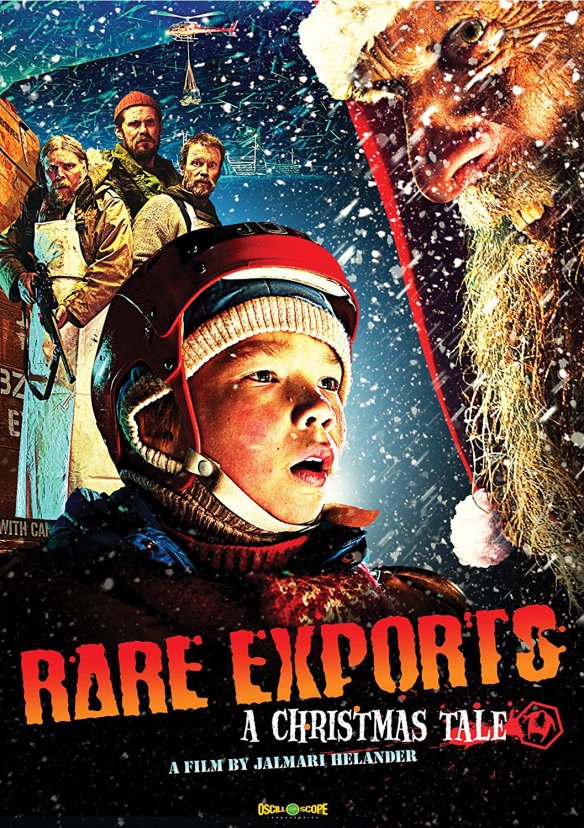
Saturday Matinee: Rare Exports

“Rare Exports: A Christmas Tale” (2010) is a Finnish holiday horror satire written and directed by Jalmari Helander. Combining Santa folklore with “The Thing”, the film explore the dark side of Christmas through the eyes of  Pieteri, a kid who discovers not only that everything he’s been told about Santa was a lie, but the truth is stranger and more horrific than he could have imagined.

Watch the full film here. (Video may be slowed by pop-up ads.)

Santa, the Reindeer Shaman

origins-of-santa-claus-01

By Jerry B. Brown Ph.D. and Julie M. Brown M.A.

Source: Reality Sandwich

The following is excerpted from The Psychedelic Gospels by Jerry B. Brown, Ph.D. and Julie M. Brown, M.A., published by Inner Traditions. 

On Christmas Eve, when the streets are all covered with snow and a hush falls over the land, parents recite the story of Santa Claus to wide-eyed children. They discreetly wink as they tell the timeworn tale of a jolly old elf who is dressed all in red and white from his head to his toes. Miraculously, Santa travels around the world in one night, in a sleigh pulled by flying reindeer, stopping at each home to place gifts under the Christmas tree festively decorated in tinsel and colorful ornaments with a star on top.

How improbable! How curious! But what if this snow-white lie, which we dutifully recount each year, was grounded in an ancient reality whose roots reach back thousands of years to the vast forests of Siberia? What if the real story of Santa was even stranger than that of the commercial myth of Saint Nick, the little sleigh driver “so lively and quick”? What if it was stranger than most of us could ever imagine?

It was high in the Cairngorms in the heart of the Scottish Highlands that Julie first heard the true story of Santa Claus and his flying ­reindeer. Driving east from the Isle of Skye, where we spent our twenty-fifth anniversary, Julie and I stopped in Inverness, located at the north end of Loch Ness. From there, we followed route A9 as it twisted and turned up into Cairngorms National Park. After lunch in the alpine resort town of Aviemore, Julie made a few phone calls and found lodging at the Braeriach Guest House. Sitting on the banks of the River Spey in the quaint village of Kingcraig, this two-story stone-walled Victorian inn has five guest rooms, all furnished with wooden sleigh beds. The view from our bedroom window looked out past a flower garden to the fast-moving river, on to a wide pastoral valley dotted with black-and-white cows, and up to the peaks of the snow-capped mountains. Over tea that afternoon, we asked our innkeeper Fiona, a refugee from the hubbub of London, what we should see during our stay.

“Oh, my favorite place would be to visit the wild reindeer. When you return, you can have dinner at the Boathouse Restaurant, only a twenty-minute walk from here through the forest.”

The following morning we drove to the long wooden cabin that housed the Cairngorm Reindeer Center. There we met three other couples and our guides, Beth and William, who would lead us up into the mountains. Beth explained that the “reindeer were reintroduced into Scotland in 1952 by a Swedish reindeer herder, Mikel Utsi. Starting from a few reindeer, the herd has grown in numbers over the years and is currently held at between a hundred and thirty and a hundred and fifty by controlling breeding.”1 About fifty of these reindeer live in a natural environment in the forests and highland plateaus nearby. The region is rich with lichen, the chief food of reindeer.

After the orientation we drove in a car caravan up a steep, curvy road. After parking in a small clearing, everyone donned knee-high Wellington boots. It was a cold day, and the trail was wet and muddy from a drizzling rain. We were excited and a bit apprehensive at the thought of encountering creatures in the wild. As the trail opened onto a large pasture, bordered by a dense dark-green forest, the sun broke through the clouds and the rain lifted. As we shed our rain gear, Will put down the sack of food he had carried on his shoulder and instructed us how to behave around the reindeer—who were still nowhere to be seen. “You can pet them, even touch their noses, but not their antlers. They grow very fast, a couple of inches a week, and are very sensitive.”

Just then, Beth began bellowing loudly. It felt eerie to be huddled together on a chilly hilltop while our guide howled into the wilderness. It took a minute before we realized that she was rounding up reindeer. Suddenly, we saw a huge light-brown stag emerge from the woods. He strode majestically toward us, his giant antlers swaying to and fro. Another reindeer followed and then another, slowly walking toward us, a plodding procession of caribou.

As the males, females, and calves drew closer Beth began calling them by name: Sting, Marley, Cranna, Oryx, Gandhi, Magnus . . . Elvis. As the herd approached, Will opened the sack and scooped pellets of food into our hands, telling us to pick a reindeer and go up to him slowly with outstretched arms. I walked up to a large bull. He nuzzled his warm, silky nose into my palms, gently licking them clean. Julie stood back and observed. Soon, everyone was talking, smiling, and even giggling at the sheer delight of being in the presence of these gentle caribou.

Julie noticed an albino reindeer standing off to the side, away from the herd. She asked Beth why he did not join the group.

“Oh, him. Sircus is his name,” Beth replied. “He only takes food from me or Will. He’s a real loner.”

“Really? Do you know why?” Julie inquired.

“I think it’s because he loves mushrooms so much,” Beth said.

At the mention of mushrooms, Julie’s ears perked up. She glanced over at me with a knowing look. Aha, she thought.

“Now, don’t get me wrong,” Beth continued. “All reindeer love fly agaric, but for Sircus they are his favorite food, even more than lichen. Sometimes, during the summer mushroom season, he eats so many that he just stands there mesmerized, staring into the sun, swaying back and forth. That’s why his face is so blotched and pink. It’s sunburned.”

As Beth finished speaking, Sircus turned toward Julie and without hesitation walked up to her. He placed his soft muzzle into her palms and ate slowly, all the while looking into her eyes. Julie glanced toward me, her face beaming. She stood still for a long while, gently petting Sircus. Then, just as quickly as they had appeared, the reindeer turned and ambled back toward the forest. Sircus followed. Everyone was silent on the downhill walk back to the cars.

“Jer,” Julie said softly to me, taking my hand along the trail, “I swear I had a real connection with Sircus, as if we knew each other. Don’t you think it strange that I could have such a spiritual encounter with a reindeer?”

“Yes, you must be Saint Francis of the animals,” I said.

Julie laughed and nodded her head in affirmation.

Rudolph, the Red-Nosed Reindeer

Once back at the inn, I was tired from our excursion and lay down to take a nap. But when I happened to glance over at the bookshelf next to the bed, I noticed the Field Guide to Mushrooms of Great Britain. Soon, I was turning its richly illustrated pages. After finding Sircus’s favorite, the red-and-white Amanita muscaria, I eventually fell into a deep and restful sleep.

When I awoke, I carried the field guide downstairs, planning to show it to Julie. I found her sitting near a roaring fireplace. She was engaged in animated conversation about our reindeer adventure with the other houseguests: Anne and John, a well-groomed, middle-aged couple from Devon, whose English accent I could understand if I listened carefully, and Bonny and Sid, young punk bikers from Liverpool whom I could barely understand at all. No wonder George Bernard Shaw observed, “England and America are two countries separated by a common language.”

After Julie mentioned that the Reindeer Center rented the caribou out during the Yuletide season to pull sleighs bearing gifts for children across Great Britain, the conversation turned to Christmas and Santa Claus.

“Does anyone know what Santa has to do with Christmas, the birth of Jesus, and this?” I asked, opening the mushroom field guide and showing everyone the photo of the bright red Amanita mushroom covered with snowy white dots.

Before I could finish the sentence, I felt Julie’s two hands firmly tugging on my arm, as she said in her calming therapist’s voice, “Sorry to interrupt, honey, but if we don’t leave now, we won’t be able to walk to dinner and back before dark.”

We strolled under tall trees whose leaves sparkled in the late afternoon sunlight. The air carried a sweet scent of wildflowers. Soon we came to the rustic restaurant on the banks of an alpine lake. After finishing the delectable grilled trout fresh from the lake, Julie asked pointedly, “What were you thinking back there?”

“I was just trying to explain my theory of Santa Claus,” I said defensively.

“I . . .” “Come on. You know what I’m talking about,” Julie objected. “What about our vow of secrecy, the one we made to each other at the beginning of this trip? Right before I escorted you out the door, you were about to blurt out that we were searching for the psychedelic roots of Christianity. I need to know that you won’t go around talking to people about our work while we are on this research trip.”

“Okay, I promise,” I replied.

“Now, tell me,” Julie said with a sigh of relief, “what were you trying to say about Santa back there at the inn?”

“While most people think of Christmas in terms of the quintessential Christian celebration,” I began, “the truth is that nearly all of the symbols associated with Santa Claus are based on the shamanic traditions of pre-Christian Europe.”

“I always thought of shamanism as a tribal religion,” Julie said. “I certainly never thought of Santa as a shaman! What do you mean?”

Archaic Techniques of Ecstasy

The classic anthropological definition of shamanism comes from ­Mircea Eliade (1907–1986), who described it as “archaic techniques of ecstasy.” By “ecstasy” he was invoking the Greek term ekstasis, which literally means “to be outside oneself” and in this context figuratively means “flight of the soul.” In essence, shamanism refers to ancient methods for inducing the flight of the soul, for both the living and the recently deceased. One of the most concise descriptions of the ­universal ­foundations of shamanism is found in Peter Furst’s Hallucinogens and Culture. These foundations include “the skeletal soul of man and animal and the restitution of life from the bones; all phenomena in the environment as animate; [and] separability of the soul from the body during life.”

At the very center of these belief systems stands the persona of the shaman and his or her unique ecstatic experience. With the aid of spirit helpers he can travel to and intercede with the supernatural forces of the Upperworld and Underworld whose mystical geography he has traversed through training and trance. Frequently, although not always, his mastery comes from the use of sacred psychoactive plants, which serve both as a portal to other realms and as a source of transforming power or “soul stuff.” With the concept of “transformation” so fundamental to this worldview, it is easy to see why sacred plants with the power to radically alter consciousness and provide direct access to these supernatural realms would be universally revered in ancient religions. Throughout prehistory the religions of our ancestors were shamanistic.

“But how does shamanism work?” Julie asked.

Seeing a puzzled look on Julie’s face, I searched for an analogy.

“Imagine yourself,” I replied, “as a Koryak reindeer herder living a nomadic existence in the endless boreal forest belt of Siberia. You live in a world without maps, compasses, or clocks and certainly without GPS. Season upon season you travel with your clan and reindeer herd through a seamless landscape of green and brown forests sometimes interrupted by the blues and grays of lakes and rivers. Then one day you watch your favorite reindeer nibble on a bright red-and-white mushroom that popped up out of the moist ground overnight. Suddenly, the reindeer begins to cavort about in a very un-reindeer-like fashion. You try the mushroom and soon find yourself transported through magical landscapes filled with talking spirits who instruct you how to live well and prosper.”

Julie was listening intently as I asked her, “So what would you think about this world?”

“That it was showing me a spirit world that could help me thrive in the natural world,” Julie replied.

“Precisely,” I agreed, “and that’s the point. For tribal peoples, these supernatural realms were accessed through the shamanic flight of the soul. It’s only within the context of shamanism that we can understand the true origins of Santa Claus.”

Mushroom Rock Art of the Chukchi

Often overlooked and certainly overshadowed by Wasson’s cracking of the Soma code in the Rigveda is his equally surprising discovery of an ancient “Siberian fly-agaric complex” among the ancient indigenous peoples of the Arctic Circle. Peering deep into the wellsprings of time long before the Aryan invasion on the Indus Valley,* Wasson traced the roots of Aryan worship of the Soma mushroom back some six thousand years to the semi-nomadic reindeer herders of Eurasia known to anthropologists as the fathers of shamanism. Today there remain some three hundred thousand reindeer herders divided into thirty ethnolinguistic groups.

*According to the widely accepted Aryan invasion theory, between the fourth and second centuries BCE, several migrations occurred involving different Proto-Indo-Aryan groups from the steppes of central Asia toward the alluvial plains and valleys of northwest India. However, academics continue to debate whether the Indo-Aryans invaded and assimilated the less sophisticated Indus Valley cultures, or whether the Indo-Aryans moved in as the superior Indus Valley civilization was in a state of decline, adopting their mythologies and technologies. They inhabit three far-flung, forest-belt regions of Russia and Scandinavia. Among them are the Lapps and Nenets in the Far West; the Ostyak, Samoyed, and Vogul of the central tundra and taiga zones; and the Chukchi, Koryak, and Kamchadal who live in the extreme Far East of Russia.

When Wasson published Soma in 1968, he had to rely on secondhand data derived from folk tales and linguistic analysis and on the firsthand accounts of “explorers, travelers, and anthropologists” who visited these remote regions as far back as the late eighteenth century.4 At that time he was unaware of recent Russian archaeological expeditions that had found iconic evidence—dramatic images etched in stone—of the use of psychoactive mushrooms among the ancient Chukchi.

During field expeditions in 1967 and 1968, Russian archaeologist N. N. Dikov discovered numerous mushroom and reindeer petroglyphs (rock carvings dating from 1000 BCE) on the banks of the Pegtymel River in the Far Eastern Chukotka region, located across the Bering Sea from Alaska. These rock drawings graphically reflect the worldview of nomadic herders and their traditional shamanic practice of ingesting Amanita muscaria. Since that initial discovery, Russian researchers have identified more than two hundred similar compositions at rock art centers in northern Russian, mainly in areas inhabited by reindeer herders.

The central images of these carvings are reindeer and an increasing number of “incomparable” anthropomorphic images of people, mainly women, wearing huge mushroom-shaped hats or, in another interpretation, dancing women with mushrooms hovering over or emanating from the crowns of their heads.

The northern region where these figures are found is one where fly agaric thrive. In a later work, observing that these “doubtless” Amanita muscaria “mushrooms were much larger in scale than normal,” certainly when compared to the humanlike figures, Wasson concurs that this suggests “mushroom possession.” A common theme in these visions is the personification of the spirit (wapaq) of the mushroom as “little men or women.” The Koryak believe that the spirits residing in the fly agaric appear in the form of tiny mushroom folk who give instructions to the be-mushroomed person. One observer reports that among the Ob-Ungrians, “the mushroom eater enters the realm of the little people, talks with them, learns from them what he wishes to know—the future, the outlook for a sick person, etc.”

Santa, the Reindeer Shaman

“So are you saying that the story of Santa Claus originated with the reindeer herders?” Julie asked.

“Not at all,” I replied, “simply this: while most people think of Christmas in terms of the classic Christian holiday, the truth is that most of the symbols associated with Santa Claus are based on the religious traditions of pre-Christian Europe. In fact, every major meme of our modern myth of Santa Claus can be found in Wasson’s pioneering description of a Siberian fly agaric–reindeer culture.

“Convince me,” Julie insisted.

“Okay, I will,” I replied.

Flying Reindeer

In Soma, Wasson notes that “reindeer have a passion for mushrooms and especially for the fly-agaric, on which they inebriate themselves. Reindeer have a passion for urine and especially human urine. (When the human urine is impregnated with fly-agaric, what regal cate is there, to be served to a favored reindeer!)”9 In fact, some herders carry sealskins filled with their own urine to lure stray reindeer back to the herd.

Reindeer have a seminal place in the lives of these semi-nomadic herders as the primary source of useful everyday articles and of spiritual significance. Practically, the reindeer provide transporation by sleigh, food and milk, clothing, shelter in the form of skins for yurts, tools, and many other necessities. Spiritually, flying reindeer serve as guides for shamans, transporting them through the spirit world. The hundreds of flying reindeer megaliths found in Siberia and Mongolia offer graphic representations of myths and legends about winged reindeer who transport their ecstatic riders up into the highest branches of the Cosmic Tree, universally revered by ancient peoples as the Tree of Life.

Christmas Tree as Cosmic Tree

In addition to the nearly universal flood myth similar to the story of Noah in the Bible, many tribal cultures have a deep belief in a sacred Cosmic Tree. In the context of shamanism, this tree provides a cosmic axis around which the three planes of the universe revolve. Its roots run deep into the Underworld, its trunk holds Middle Earth, and its branches reach skyward into the Upperworld.

The birch, pine, cedar, and fir trees play a conspicuous role among Siberian cultures and serve as the nodal points for shamanism. But it was Wasson who first pointed out that birches and evergreens play an essential role in the life cycle of the fly agaric. This is because fly agaric has a symbiotic relationship with these trees in that its invisible spores colonize the host trees’ roots prior to the mushroom bursting into view aboveground as an early stage Amanita muscaria, wrapped in a pure white veil. As a result, tribespeople were amazed to witness how these mushrooms apparently sprang from the earth without any visible seeds in what appears to be a virgin birth.

Like the Cosmic Tree, the center point between heaven and earth, the North Star is also considered sacred. Among reindeer herders, it is also known as the “Immobile Star” or the “Pole Star,” because all the stars in the heavens revolve around it. Thus today we symbolically place a star at the tippy-top of the Christmas tree, and for this reason Santa makes his home in the North Pole.

Santa, the Archetypal Shaman

Our contemporary image of Santa Claus as a rotund, jolly, white-bearded fellow in a red suit (or robe) with white fir trim is a modern version of the archetypal Siberian mushroom shaman. In fact, even today some Siberian male shamans and female mushroom gatherers still dress in ceremonial red-and-white trimmed jackets when they go to gather the sacred mushrooms. The biochemical effects of Soma are most pleasant and transformative when the mushrooms are dried before consumption. For this reason, the shaman initially hangs the fresh fungi to dry in the branches of pine trees (like the colorful ornaments that decorate the Christmas tree).

After the mushroom harvest is complete, the shaman collects his gifts in a sack and places them on his sleigh, which a team of reindeer pulls back to his yurt (Santa’s sleigh full of toys, pulled by flying reindeer). A yurt is the nomad’s teepee-like dwelling typically made out of birch branches and reindeer hides. In winter, snow drifts can cover the yurt’s main entrance, so the shaman enters through the smoke hole at the top (Santa coming down the chimney) to deliver his gifts to appreciative clan members. To further dry the mushrooms, they string them up around the fireplace, and in the morning they awaken to a ritual feast of dried magic mushrooms (Christmas gifts placed in stockings over the fireplace). Once they ingest the mushrooms, the celebrants leave the physical plane and are transported to the mystical realms of the Cosmic Tree, guided by spirits that live within the mushrooms (Santa’s helpers, elves that live in the North Pole).

All of these Christmas themes include the image of Santa Claus: the Christmas tree, the flying reindeer pulling Santa’s sleigh, Santa coming down the chimney, the exchange of gifts—even the elves who live in Santa’s workshop at the North Pole.

Dusk was falling as we started to walk back around the lake toward the inn. The Santa Claus conversation had sparked Julie’s inquisitiveness. “What about the Christian Saint Nicholas?”

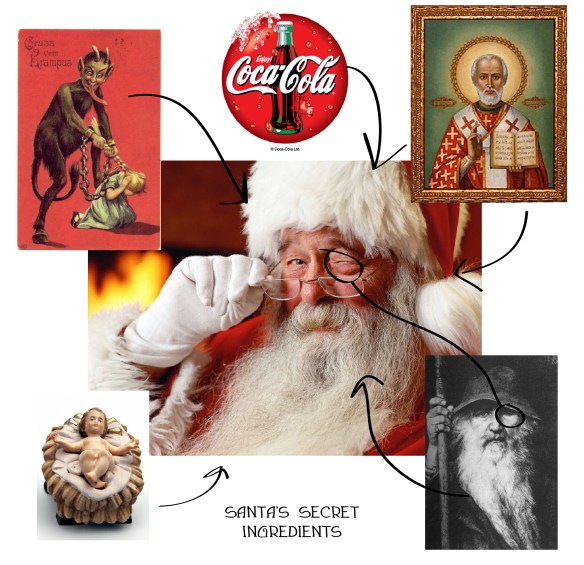
“To be sure, religious historians argue that many saints were simply Christian versions of earlier pagan gods, adapted by the church to encourage heathens to accept the new religion of Rome. It is said that Saint Nicholas’s legends were created mainly out of folk tales about the Teutonic god Hold Nickar, a malevolent water spirit who tips over boats and torments sailors, or even about Alte Hoerner, which stands for ‘Old Horney.’

Julie smiled at the sexual reference to Santa Claus.

“No, no, it’s not what you’re thinking. In old German, Alte Hoerner literally means ‘old horned one’ and in this case the ‘ancient horned god,’ referring to the headdress of reindeer antlers worn by Eurasian shamans. Later on, when pagan deities were demonized by the medieval church under Pope Gregory, the horned god of shamanism became the devil of Christianity. And ‘Santa’ became ‘Satan.’”

“Rings of Smoke through the Trees”

“Look, look around us!” whispered Julie. A low-hanging cloud was slowly creeping through the woods, completely encircling us in a ring of ghostly white gossamer. The mist moved silent as cat paws, covering the ground and the trunks of the trees in a blanket of clouds. The tops of trees stood bare, silhouetted against the gun-metal sky and the fading sun, silent sentinels of the forest.

“Jer,” Julie spoke, in hushed tones, “this is unearthly. All evening, we’ve been talking about the way of the shaman, portals between the worlds, about how all things are alive with spirit.”

“Look,” I said, patiently, “just because this rare cloud rolls in just as we were discussing shamanism doesn’t mean there’s a connection. You can’t prove that; no one can.”

“No, I can’t prove it,” Julie spoke quietly, “but think about what’s happened today! We came to the mountains for vacation, and I met Sircus, an albino, Amanita-loving reindeer, who walks up to me and peers into my soul. We spend the evening talking about mystical realms. And now all around us the forest is alive, as if the living spirit of nature was welcoming us to the world of the shaman . . . affirming our decision to retrace Wasson’s steps.”

I was about to object, but just then these lines from Led Zeppelin’s “Stairway to Heaven” ran through my head: “There’s a feeling I get when I look to the west/ And my spirit is crying for leaving. In my thoughts I have seen rings of smoke through the trees/ And the voices of those who stand looking. Ooh, it makes me wonder/ Ooh, it really makes me wonder.”

We stood silently in the middle of the mist-filled forest, wondering what the future would bring. At our next stop in Greece, the cradle of Western civilization, we walked among the monumental ruins of Eleusis, where rituals involving entheogens had been practiced for two thousand years.

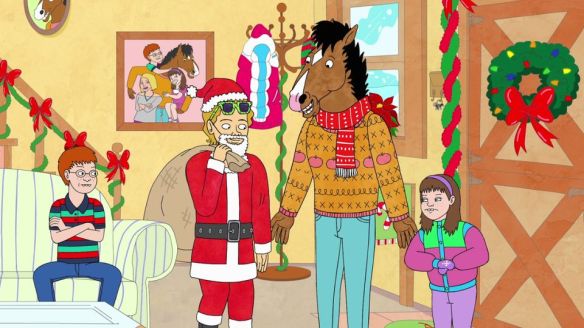
Saturday Matinee: BoJack Horseman Christmas Special

960

For those not familiar with the animated series “BoJack Horseman”, it’s a satire of Hollywood and celebrity culture centering on BoJack, a washed-out and self-destructive former star of a 90’s sitcom. In the BoJack Horseman Christmas Special: Sabrina’s Wish, BoJack and slacker friend Todd attempt to overcome holiday depression with a viewing of a Christmas episode of his old sitcom “Horsin’ Around”. Features the voices of Will Arnett, Amy Sedaris, Alison Brie, Aaron Paul, Fred Savage and Stanley Tucci.

Watch the full episode here:

Saturday Matinee: Tokyo Godfathers

tokyo_godfathers_04

Who would have guessed that the greatest animated Christmas story would be an anime set in Tokyo? I would have had my doubts before seeing Satoshi Kon’s “Tokyo Godfathers” (2003). Unlike the majority of Kon’s filmography, the film’s relatively simple plot centers on three homeless friends who upon finding an abandoned baby set out on a quest to track down the parents. The homeless protagonists are not mere stereotypes but complex individuals with unique backstories which is especially remarkable since homeless people continue to be underrepresented in films (despite growing numbers). Like other Christmas fables, it has its share of sentimentality and reliance on convenient coincidences (ie. miracles), but it’s elevated by beautiful artwork and a finely crafted blend of realism, humor, action and earned emotional uplift. This was only Satoshi Kon’s third feature production and his penultimate film. Kon passed away much too soon from pancreatic cancer on August 24, 2010 at the age of 46.

Tokyo Godfathers (Full Film)

The Santa Claus Syndrome

origins-of-santa-claus-01By Ethan Indigo Smith

Source: ZenGardner.com

The Santa Clause: Lying is OK, so long as everyone else is doing it.

The Santa Claus Syndrome is the effect of societal complicity in, and/or complacency to, lies and the belief that’s ok.

Take a moment to imagine yourself an outsider and visitor to a new culture. Imagine if you will an annual global celebration so fantastic that people excitedly await it all year long. Imagine the celebration correlates the winter solstice. Imagine the celebration is so spectacular and grandiose that it spurs the sales of products worldwide and some businesses exist solely because of it. Imagine that nearly all businesses profit from it and promote it. Imagine that the main part of the celebration, for most people, aside from sparkling decorations and elaborate gift giving, is openly lying to young children!

Most everyone celebrates the holiday, but those who do not celebrate it are expected to go along with the tradition of broadly lying to children and accepting the excessive materialism out of consideration for cultural tradition.

Conjuring, Consumerism and Conditioning

Although some call Christmas today a ‘Pagan’ holiday, in reality it is nothing of the kind. The pagans I know want nothing to do with it.
Christmas is a children’s consumption holiday. They look forward to it the most. Well, children and the profiting corporations, of course. Children receive countless presents, rewarded for accepting as truth impossible fictions about a fat man from the North Pole, an omnipotence external being who “sees you when you’re sleeping”, who judges children, and who withholds or grants material incentives accordingly.

It is better to give than to receive, they are told.

Celebration and happiness is in the receiving, they observe.

Reward is earned by modelling behavior and suspending critical thinking, they learn.

Generally speaking, telling children fiction as fact is counter-productive to their developing minds. But children do of course eventually inquire of their parents and strangers alike about the phenomenon of the holiday and the fat man. For a period of time after that first enquiry, many children are lied to further – to prolong the “magic”. Finally, they get their answer and find that majority of adults are in on the lie. Even institutions like schools lie, and local and national news. And now they will lie, too. And it’s all okay… so long as everyone else is doing it.

And that, kids, is the magic of Christmas!

Other celebration rituals involve cutting down young trees for indoor decorations, wrapping gifts in paper from other trees and putting them under the dying, decorated tree on the last night of the celebration and saying the fat man did it. The children are told the fat man traverses the world on an inadequately sized sled powered by flying reindeer (the lead one featuring an inexplicable glowing nose) and stops by the homes of children, entering through chimneys yet staying crispy clean, having cookies at each house as he drops off plastic weapons and impossibly thin dolls.

And the fat man, old Santa Claus, he isn’t just generous, he’s mysterious. He doesn’t simply give because it’s better than receiving. He and his elf workers in the North Pole watch all the children of Earth all year long. He decides which children receive the promise of abundance based on who’s been naughty and nice.

Sounds a bit like the other Big Guy, who decides who receives the promise of abundance in the ‘afterlife’, based on who’s been naughty and nice.

First Lies

The Santa Claus story is an unnecessary social conjuration of a blatantly un-sacred holiday. Those of us who grew up in in ‘Christmas’ homes were all influenced by it in one way or another; even the ‘not Christmas’ kids were openly encouraged to withhold the truth from the ‘Christmas’ kids – to prolong the magic.
Abstract and nuanced, it is the first load of garbage young humans in Christian-influenced societies have to mentally digest. For many kids, it is the first time they come to doubt their parents on a point of truth, and the first time they are knowingly lied to if their suspicions are deflected. Then, once entrusted with continuing the Santa Claus myth with younger children, it is the first time they learn that the caveat to the long held ‘no lying’ rule is … ‘so long as everyone else is doing it’.

Just play along kids, and you’ll still get the gifts.

Amid all the Christmas hoopla, which starts to build in stores as early as October, children are normally so occupied with shiny lights and the prospect of gifts that there really is no impetus to question it. Eventually, despite the enticements on offer, the lie is realized of course, for some kids much sooner than others, and the specifics and nuances come undone as a natural function of their maturing minds.

Tradition or Parody?

Regardless of any magical intention, the blunt reality is that parents, teachers, strangers, radio hosts, and local weathermen are deceiving children in perfect synchronization, steering them into immense emotional and material attachment to a collective (unnecessary) illusory figure that withholds from the ‘naughty’ and rewards the ‘nice’.

The holiday in its current formation gives us all practice at complicity, passing on cultural fictions because they were passed onto us, and because that’s what adults do. It is effectively a child-friendly celebration of the doctrines — It’s better to receive than to give, and you’re expected to lie so long as everyone else is doing it — proudly brought to you by your favorite sugary drink, Coca-Cola.

The worst part of the celebration of this vile conjuration is not the lie itself, but the results of it. Lying to kids in this way creates a parody of genuine human tradition, substituting meaningful ritual with an illusory commercial mockery. But that’s only stage one of the Santa Claus Syndrome…

Learning the Santa Clause is the the first test of adulthood. Left unresolved, the experience can manifest to varying degrees, in a number of ways.

The Santa Claus Syndrome

The Santa Clause: Lying is OK, so long as everyone else is doing it.

If you don’t question what you’ve been told, accept incomplete information, and don’t proceed with your natural impulse, you quite likely have the Santa Claus Syndrome to some degree. Quite simply, it makes people ignore serious issues.

The Santa Claus Syndrome manifests in a number of stages:

Stage One:
It manifests as insistence on celebrating lies posing as tradition, elaborate intent on the deception of youth including distraction with sparkling decoration and gifts, and instilling ‘the Santa Clause’ in children.

Beyond that, ;the Santa Clause’ teaches us to conform to widely-accepted untruths.

Stage Two:
Stage two is the acceptance of adult lies, servitude to authority and unquestioning belief in whatever the ‘proper authority’ states. The childhood belief in Santa Claus and trust of authority leads to an adulthood belief that the government, corporate and religious institutions they trust do not lie.

Just like a kid sees the local weather reporter tracking Santa’s flight path, an adult with stage two Santa Claus Syndrome will see as real other fictions in the news and media (such as chemically treated food is just as healthy as organic, or nuclear is a safe energy system).

Stage Three:
Telling adult lies. Stage Three Santa Claus Syndrome is also indicated by people who continue adult likes, such as nuclear is safe… or cannabis has no medicinal value… or insert any number of lies here _____ that many people perpetuate on behalf of our corrupted institutions.

Stage Four:
In Stage Four, one has all the symptoms of stages One through Three. Further, those in Stage Four are likely to lash out at those who question the status quo or expose lies (and forcing change) in anyway. Stage Four can involved the conjuration of adult lies, instituting great and broad fictions for trifle and temporary gains, often as a way to psychologically rationalize not just with others but themselves, to believe what they are doing – and who they are – is ok.

Trading why for what

It is no coincidence that around the time when young children begin to ask the eternal why, a series of ‘whys’ in regard to every subject, they are taught ‘the Santa Clause’, which teaches them, teaches us, to replace the endless series of why into an endless series of what. Where the Santa Claus fiction is concerned, knowing is less important than obtaining. It is the first true test of our ‘adulthood’; once you are entrusted with the truth of the lie, adults check that you repeat the lie to those younger than you; those who aren’t to know.

Then in adulthood, we are exposed to big and sometimes seriously dark and disturbing lies. And adult lies – lies told by authorities – are often backed up by the local news reporters and retailers, just like Santa Claus. And just like the children we were, and the children we raise, we adults too stop asking why in exchange for what.

The materialistic enticement of ‘the Santa Clause’ has contributed to a culture where understanding is inhibited, and truth undervalued. We teach our children not to tell the truth so as not to make the babies cry. We reward materialistic impulses, confusing gratification with what is right and wrong. But worst of all, we teach little people to accept that we are lied to, and to contribute to broadly accepted lies — as long as we have bright shiny things.

Evidence of the Santa Clause Syndrome is everywhere in our society. Many personal and societal problems can be theoretically traced to it, but also many institutions can be rationally broken down as disturbingly negative or outright useless when considering it. Most evidently, Santa Claus Syndrome does not promote individuation, but conformity – at a very impressionable stage of childhood development.

Santa Claus is Dead

Christmas today doesn’t celebrate the humanity nor the amazing world around us – in other words, anything real – and that is a direct reflection of our sick society. Although I risk being accused of some ridiculous thinking here, I believe we need to heal and re-create our culture through sacred, nutritious traditions grounded in love, simplicity and gratitude.

In contrast, the fiction of Santa doesn’t encourage a sense of gratitude in children. Children “earn” gifts from Santa Claus by adhering to social norms – naughty or nice – and any innate sense of gratitude a child may feel for this annual abundance is intentionally misdirected at a magical, fictional patriarch, until a comprehensive deception is finally realized. Sadly, that realization is where, for most kids, their broader sense of magic is hindered a learned distrust of their developing senses.

Arguably the most underestimated and psychologically disturbing rites of passage for children in Christian-based cultures today, ‘the Santa Clause’ is another failing institutionalization, much like the religions that spawned it. And so, many of us are now facing the decision to keep perpetuating ‘the Santa Clause’ within our family circles, or begin the process of transforming this ritualized nonsense into a genuinely sacred, annual celebration of peace, renewal and gratitude.

This year Santa is dead to me. There will be no false idol. This year, children will learn the truth if they come around here. And with that, healing from the Santa Clause Syndrome can begin.

This holiday season, be sure to not tell your kids a pack of lies and cater only to their material desires – no matter the tradition.

Let’s create a new holiday.

Peace on Earth… only for real.

Merry Christmas!