It’s A Trap! The Wave Of Repercussions As The Middle East Fights “The Last War”

By Brandon Smith

Source: Activist Post

Few people are familiar with a little event around 1200 BC called the Bronze Age Collapse in the region known as the Levant (now known as the Middle East). Most folks are taught that history and progress travel in a straight line and that each generation improves upon the culture and innovations of previous generations. This delusion is constructed around a Smithsonian-influenced view of the past. In reality, history tends to go in a circle, or a spiral, with innovation leading to ease, ease leading to laziness and corruption, and corruption leading to weakness and collapse.

Over and over again, humanity reaches for Elysium on Earth only to be slapped back down. The survivors then build grass huts on top of the ruins of the old empires and they start over from scratch.  Why does the Bronze Age catastrophe matter?  Obviously, because history tends to rhyme.

The Levant at this time was rich with civilization and trade, composed of a host of kingdoms that represented the known world including the Egyptians, Babylonians, Minoans, Mycenaeans, Hittites, etc.  They had vast economic networks, agriculture, industry and written libraries. The proximity of the kingdoms allowed for such extensive trade relations that this period is often referred to by modern historians as the first “globalized economy” (sound familiar?).

What took centuries to build was destroyed in a single generation by a series of disasters. A “mega-drought” caused kingdoms without consistent water resources to lose agricultural production leading to widespread famine and disease (yes, the climate can and does change dramatically regardless of human carbon footprint). Trade was disrupted by internal disputes, and a mysterious invasion of a group of roaming raiders called the “sea people” is documented as a primary factor in collapse.

The Sea People attacked numerous kingdoms, but many of them were also refugees flooding into the region. They disrupted cultures and economies and dragged a number of empires into the dust. This all happened in less than 30 years. Sadly, because only the elites of these civilizations were able to read and write, languages and historical documentation were lost.

This initiated a dark age which lasted for centuries. Humanity was set back, essentially to zero, while scratching and surviving among temples and pyramids of past generations. They must have looked up at those decaying marvels of architecture from hundreds of years ago and wondered “What the hell happened to us?”

Not everything perished, of course. The Egyptian dynasties were in decline, but they managed to hold together far better than their counterparts across the Levant.  However, the event represented a setback to human knowledge that was detrimental. One might suggest that if the Bronze Age Collapse never occurred we might be a space borne species traveling the stars by now.

Then again, maybe these cultures were so corrupt that they needed to fail so that something better could be built in their place?

What does any of this have to do with the state of the Middle East today? The smart readers out there surely see what I’m getting at. The intricate relationships and trade mechanisms of the Bronze Age led to great wealth and prosperity, but they were terribly fragile. That same interdependency resulted in their demise as they tumbled like dominoes on top of each other.

The globalization and collectivist war mongering of today is leading to a similar worldwide implosion. Our irrational ties to foreign entanglements and economies could very well destroy civilization again. Consider what are we about to see as the Israel/Palestine war unfolds…

Multiple Nations Dragged Into The Conflict

If you were wondering what the “October surprise” was going to be, well, now you know.  I will make my position on this situation clear – I don’t care about either side.  I care about innocent civilians, but other than that the war is irrelevant.  I am an American and I care about America. The same goes for Ukraine and Russia. Their wars are not our wars, and I am highly suspicious every time our political leaders try to lure us into choosing a side when foreigners start shooting each other. To summarize:  All wars are banker wars.

The Israelis enjoy our money but they have a history of proven elicit operations to lure us into war (USS Liberty, anyone?). The Palestinians and most of the Muslim world despise the West and Christianity in general (and I don’t really care who started it, the fact remains that our cultures are completely incompatible and this will never change).  Just because we happen to find common ground on fighting back against the insane trans agenda does not mean I’m willing to accept draconian Sharia Law in my community.

Both sides use tactics that deliberately target civilians. I’m not talking about collateral damage like we saw in Iraq and Afghanistan, I’m talking about groups that are consciously and brazenly engaged in plans for genocide. Bottom line? There are no “good guys” to join with. It’s a complete sh*t show of ancient tribal nonsense that Westerners should stay away from.

For those who disagree, ask yourselves this – Are you truly willing to go pick up a rifle and fly to Israel or Gaza to fight and die for either side?  If so, then go do it and stop demanding others do it for you.  If not, then shut up.

But here’s what’s going to happen:  the establishment will seek to force Americans and Europeans into these wars regardless.  The corporate media and some political leaders are already suggesting that the recent full-scale attack on Israel was planned by governments outside of Gaza. Some are accusing Iran, and others accuse Lebanon. From the extensive amount of footage of the attack that I have examined, I have no doubt that someone other than the Palestinians orchestrated the event. The tactics were far too advanced and far too coordinated; the Palestinians have never been all that smart when it comes to military strategy.

Who drafted the attack is another question entirely. So far there are a lot of rumors but no hard evidence leading to any specific governments. Another big question is, how did the Palestinians manage to organize all of this and execute the invasion WITHOUT Israeli intel services knowing about it? Mossad is known to be one of the most intrusive and pervasive covert agencies in the world, yet they were caught completely off guard by this unprecedented attack?  I think not.

I’m reminded of the events of 9/11 and the strange series of intelligence failures that preceded it. I’m also reminded of the lies, propaganda and the reactionary response which led to two decades of meaningless war.

I’m going to call it here – in a couple of weeks we will hear reports that many of the soldiers involved in the incursion were NOT Palestinian. They will claim some of them are from Iran, Syria, Lebanon, etc. There will be intel that says Iran was a major backer of the plan (The Wall Street Journal already claims this is the case, but they have not provided any compelling proof, yet).

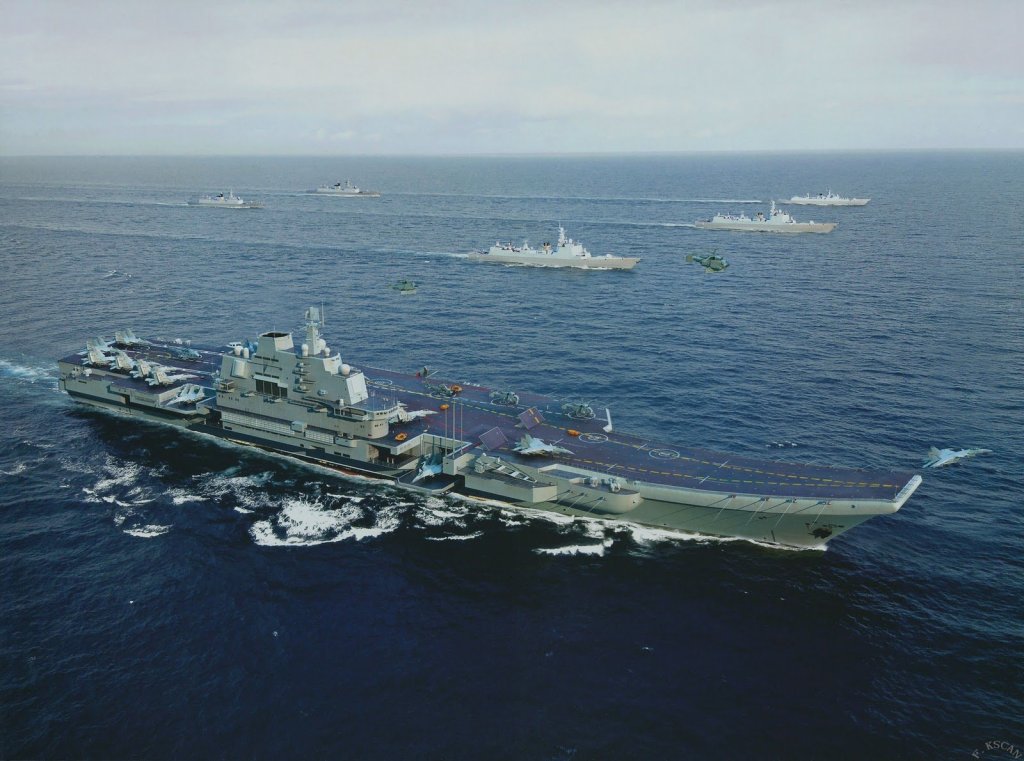
A US carrier strike group is on the way to the region now, and this is just the beginning. Europeans will be pressured to go to war, American conservatives in particular will be waterboarded with propaganda telling us that an “attack on Israel is an attack on the US.” It will be a lot like the rhetoric Neo-cons and leftists used during the initial invasion of Ukraine, but multiplied by a thousand. To be clear, both Biden and Trump have been rattling sabers and testing the waters of war, so don’t think that we can avoid this simply by voting.

Multiple Fronts

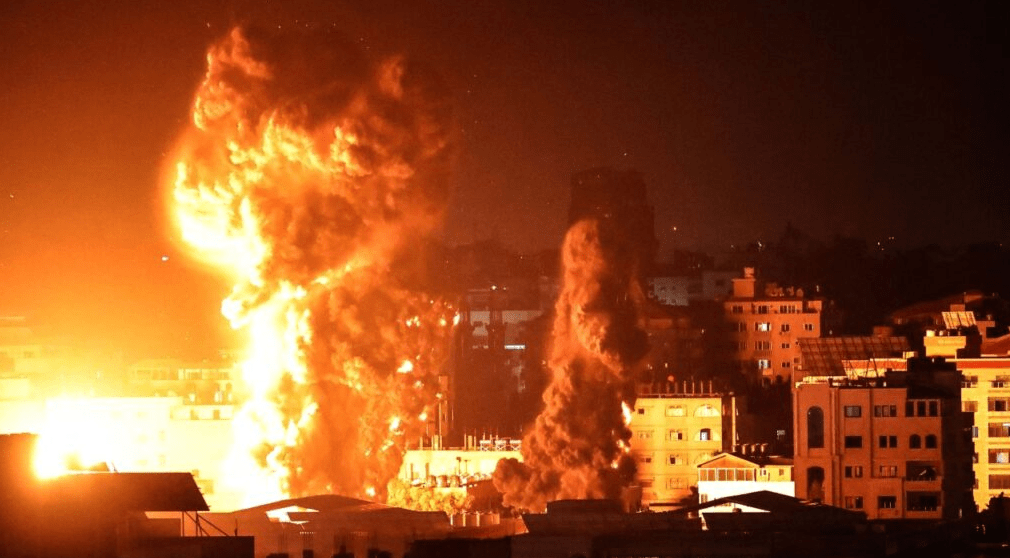
Israel is going to pound Gaza into gravel, there’s no doubt about that.  A ground invasion will meet far more resistance than the Israelis seem to expect, but Israel controls the air and Gaza is a fixed target with limited territory.  The problem for them is not the Palestinians, but the multiple war fronts that will open up if they do what I think they are about to do (attempted sanitization).  Lebanon, Iran and Syria will all immediately engage and Israel will not be able to fight them all – Hell, the Israelis got their asses handed to them by Lebanon alone in 2006.

This will result in inevitable demands for US/EU intervention.

East vs West

Depending on the extent of the Western reaction, the BRICS nations may be compelled to get involved. This may not be on a kinetic level, but there is a chance. Russia has strategic security treaties with Iran and Syria. China has numerous economic interests and influence in the region as the world’s largest importer/exporter.

These nations might retaliate with the same kind of financial warfare that the West used against Russia – with China and the BRICS cutting off the dollar as the world reserve currency. This would add to the crippling inflation we are already experiencing.

Terror Attacks And False Flags

If you thought things might be eerily quiet on the terrorism front lately, that’s now over. I would be shocked if we made it another six months without multiple attacks tied back to Islamic groups. Some of them will be real and some of them will be staged, and telling which is which will be difficult.

The thing is, wide open borders in the West have made this far more likely and the establishment knows it. In my opinion they WELCOMED IT. If they can get at least one crazy Muslim to shoot up a strip mall or blow up a football stadium, they will have all the leverage they need to con Americans into another ground war in the Middle East.  Do we need to “fight them over there so we don’t have to fight them here?”  That’s garbage thinking.  We should not be letting them over here in the first place.

Europe in particular is playing with fire. National governments and the EU have invited tens-of-millions of these people to their doorsteps and now they face a serious conundrum. There are Sharia Law communities all over Europe, there are millions of military-age Muslim men with every opportunity to do great harm. And, there are millions of woke leftists currently cheering them on, thinking that this is some form of “decolonization.”

Closure Of The Strait Of Hormuz, Skyrocketing Oil Prices

I have been warning about this scenario for many years; it was only a matter of time before tensions with Iran gave them a rationale to close the Strait Of Hormuz and shut down 30% of all oil exports from the Middle East to the rest of the world. Keep in mind, Europe is suffering from extensive energy inflation, in part because of the economic crisis and also because of sanctions against Russia.

Biden has been trying to hide inflation by dumping oil from the strategic reserves onto the market, but now those reserves are the lowest they have been since 1983.  Conveniently, this happened right before the strike on Israel. Our reserves are depleted as we go to war. Oil prices and gasoline prices will explode if Iran is implicated in the Israel attack. Iran will run a few giant oil tankers into the Hormuz, sink them, and make the strait impassable for months. Don’t be surprised of we see $200 per barrel oil next year, which will translate to around $7 per gallon gas or higher for much of the US.

A Push For A New Draft

Let’s be honest, current US recruitment numbers are a joke and the wokification of our military is making it weaker by the month. No American citizen with a legit warrior mindset or combat aptitude is going to join that circus freak show voluntarily. The establishment will try to regale conservatives and patriots with visions of “fighting the good fight for family and country” but most will not buy in. With attempts to ignite multiple fronts against Russia, China and the Middle East, they will start talking about a new draft system.

My belief is that this will fail miserably and would start a civil war rather than fill the ranks of the Army or Marines, but they may have a scheme to deal with this outcome…

Is This The Real Reason Why US Officials Are Encouraging The Migrant Invasion?

The reality is, America has its own invasion to deal with.  During the Bronze Age Collapse certain empires (like Egypt) survived using an odd tactic – instead of fighting off the invading hordes of refugees, nomads and sea people, they HIRED them and inducted them into important positions within their military. Corrupt authoritarian rulers ultimately found that they faced more of a threat from their own starving peasants than they did from the outsiders, so they joined with them to put down local rebellions.

This might not be as useful in Europe, but in America I wonder if this was the intention all along; to bring in millions of military-age foreigners with little sympathy for the existing culture, then in the midst of collapse and conflict offer them automatic citizenship and benefits if they join the military. Not on the small scale the federal government has going today, but on an enormous scale the likes of which we have never seen.

Maybe the plan was always to leave the gates open and allow illegals to stroll in so that they could act as a mercenary contingent to fight in foreign wars or fight against American citizens should rebellion arise…

Plan C

The timing of the conflict in Israel is incredibly beneficial to globalists, and this might explain Israel’s bizarre intel failure. Just as US and British leaders had prior knowledge of a potential Japanese attack on Pearl Harbor in 1941 but warned no one because they WANTED to compel Americans to fight in WWII, the Palestinian incursion serves a similar purpose.

The covid pandemic and mandates failed to get the desired result of a global medical tyranny. The war in Ukraine failed to get desired results as the warhawks’ demands for boots on the ground against Russia fell apart. Perhaps this is just Plan C?

The establishment seems particularly obsessed with convincing US conservatives and patriots to participate in the chaos; there are a number of Neo-cons and even a few supposed liberty media personalities calling for Americans to answer the call of blood in Israel. Some have described the coming conflagration as “the war to end all wars.”

I believe that the real war is yet to truly start, and that is the war to erase the globalists from existence. They want us to fight overseas in endless quagmires in the hopes we will die out. And when we do, there will be no one left to oppose them. It’s a predictable strategy, but its success is doubtful. Another interesting fact about the Bronze Age Collapse – the elites were some of the first groups to be wiped out after the system broke down.
‘Al-Aqsa Storm’ Operation: Far-reaching Geopolitical Implications

By Lucas Leiroz de Almeida

Source: GlobalResearch.ca

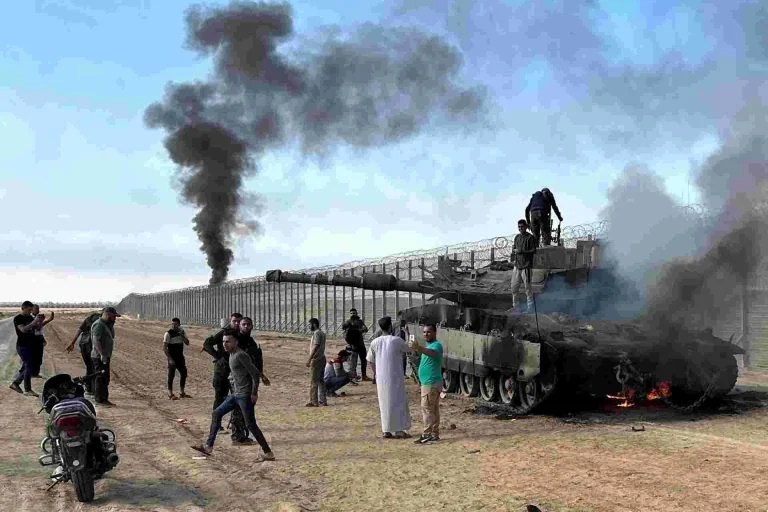
A major conflict is beginning in Palestine. On October 7, Hamas launched a military operation against the Israeli occupation forces. Using missiles, drones and paragliders, Palestinian soldiers managed to surprisingly attack Israeli troops and advance through occupied territory, liberating many areas. Tel Aviv responded with a declaration of war and several brutal attacks on civilian areas in Gaza, however, the Jewish State’s forces still appear unable to expel Palestinian soldiers from their occupied territory, with Hamas advancing rapidly.

In addition to territorial disputes, the attack seems to have direct religious reasons. Palestinians call the assault “Al-Aqsa Storm Operation“, referring to the famous Al-Aqsa Mosque, an important Islamic holy site. Jewish militants have frequently attacked the site and extremist religious groups have pressured the state to demolish the Mosque and build a Jewish temple in the region. The constant desecration of Al-Aqsa appears to have been a red line for Palestinian Muslims.

The surprise effect of the Hamas attack shocked Israeli authorities and Tel Aviv’s supporters around the world. Hamas’ ability to destroy the illegal siege imposed by Zionist forces was seen as a historic defeat for Israel. Furthermore, many experts are criticizing the intelligence capabilities of the Jewish State after the start of the battle, as the country’s spy forces were inefficient in predicting Palestinian moves and taking preventive measures against Hamas, which is a militia, not a regular national army, therefore having much more limited resources than Israeli Defense Forces.

Immediately after the start of hostilities, many videos and images began to be shared on social media showing the violence of the clashes. Many of these images are spread out of context, mainly by the Western pro-Zionist propaganda machine. Anti-Palestine activists accuse Hamas of murdering civilians, while anti-Zionists claim [erronously] that all those killed are military targets – even though some of them are unarmed. It is important to remember that in Israel military service is mandatory for almost all citizens (including women), with most of the Gaza borders’ settlers being actually military, even if they were eventually killed or captured while off duty.

Israel’s reactions were harsh. Netanyahu declared a state of war and ordered a series of bombings against the Gaza Strip.

Hundreds of Palestinian civilians died, non-military facilities were destroyed, and a severe blockade is being imposed on any type of food, energy or water supply. The retaliation, did not prevent Hamas’ advance into the occupation zone. There is still a strong presence of Palestinian troops and an absolute Israeli inability to expel them. Furthermore, thousands of Israeli citizens are leaving the country, creating an unprecedented crisis.

Around the world, reactions to the escalation were as expected. Most Arab and Islamic countries have expressed support for the Palestinian resistance, but without committing to direct military cooperation. The Collective West has voiced support for Israel, with the US, EU, UK and their allies harshly criticizing Hamas, which they consider a “terrorist group”. On the other hand, Russia and China called for an immediate ceasefire and emphasized the importance of recognizing a Palestinian State as an existential condition for peace in the Middle East.

Washington is moving significant extra military aid to Tel Aviv. The Jewish State already receives 3 billion dollars in military assistance annually from the US, but with the escalation of hostilities, the tendency is for this assistance to increase substantially. Obviously, this will have a severe impact on the proxy war against Russia, as it will be impossible for the US to continue backing two high-intensity conflicts at the same time. The pro-Israel agenda is unanimous among American politicians, bringing together Republicans and Democrats much more cohesively than Ukraine, which many conservative politicians dislike. So, it is most likely that Kiev will be progressively “abandoned” by Washington as the crisis in Palestine worsens.

However, it is unlikely that American aid will automatically be a “game-changer” for Israel. There will be many local reprisals as Iran will certainly exponentially boost its participation in the conflict and send weapons and irregular troops to help the Palestinians. Furthermore, Hezbollah from Lebanon and some Syrian military units are also on combat readiness and could openly enter the conflict if it escalates. Iran also controls Houthi dissidents in Yemen, who could also take part in hostilities. So, instead of an “easy” military effort, with systematic killing of civilians and territorial expansionism (as seen on other occasions), this time, Israel may be facing a serious security crisis, putting its very existence at risk.

To avoid this disastrous scenario, the right thing to do for Tel Aviv is to stop territorial expansionism and the illegal occupation of Palestinian territories. The Jewish State needs to respect international law and start thinking seriously about returning its borders to the limits of the 1948 UN plan – with possible changes, as long as they are negotiated with the Arabs under mutually beneficial circumstances. Aggressive policies of apartheid and territorial annexation, as well as desecration of Islamic religious sites, will only result in more conflicts.

However, Tel Aviv seems not only committed to the most extreme wings of Zionism but also shows a willingness to act as an American proxy against Iran in the Middle East, which brings very negative expectations. If Israel chooses the path of war, it could become a “new Ukraine”.

Countering NATO’s Efforts to Destroy China

NATO’s efforts to destroy Russia’s Black Sea fleet is a practice run to destroy China’s, Declan Hayes writes.

By Declan Hayes

Source: Strategic Culture Foundation

NATO’s efforts to destroy Russia’s Black Sea fleet is a practice run to destroy China’s. Although some of the soldiers guiding those air and sea drones towards Crimea may be Ukrainians, most of them are undoubtedly British and American. As, of course, are the spy planes pinpointing their Russian targets.

Although Russia has adopted a softly softly approach to all this unprecedented aggression, our focus is on the longer game where NATO is trying to contain the Russian navy and coral the Russian army and air force. To NATO, Ukrainian sovereignty is of no account one way or the other. The main objective is to herd Russia’s Armed Forces into a strategic stockade from which they have no way to drive forward. That seems to be working a charm in this NATO naval guerilla campaign against Sevastopol where NATO has exploited the grain deal corridors in much the same way that the Israeli air force hides behind civilian planes to bomb civilian Syrian targets.

Having steadied their Russian front, NATO can then turn their attention to the Chinese front which they hope will play out in a similar fashion. Because the Chinese Army has no need to cross the Russian border, it is redundant to external calculations unless it once again crosses the Yalu River.

Should a token force of 100,000 crack CPLA advisors, with Pyongyang’s blessing, sweep southwards towards the 38th Parallel, that would considerably complicate matters for China’s American friends as more maritime waters than they could presently handle would then be in play. Given that North Korea has thrown its weight behind Russia, Pyongyang would undoubtedly welcome such military help as China could provide in upgrading their missile and related technologies.

As the war against China will undoubtedly be primarily a maritime war, the Korean peninsula may not be quite in the eye of the storm, which will zero in on breaking China’s main shipping routes. As things currently stand, North Korea is just a card China can keep in reserve until it is time to play it.

Josh Kozlov, the leader of the U.S. Army’s 350th Spectrum Warfare Wing, and the British Royal United Services Institute (RUSI) are amongst the NATO worthies who have opined on the crucial role advanced electronic warfare is playing in the Black Sea and will play in the South China Sea. Given that Hansard has British Defence Secretary Ben Wallace on record calling Ukraine a “battle lab”, a good try out for the best of British hardware and software, no doubt Wallace will enjoy a good stress test against Blighty’s North Korean and Chinese electronic warfare peers.

Unelected European Union dictator Ursula von der Leyen, meanwhile, is complaining that China produces cheap electric cars. Those Chinese cads! How dare they copy Japan’s economic growth tactics.

Japan, remember Japan, when the U.S. Occupation troops used to buy their imitation watches and battery radios as a joke during the Korean war. Seiko, Mitsubishi, Toshiba and Panasonic had the last laugh there.

As will the Chinese, unless von der Leyen’s American bosses implement a naval blockade on China and thereby cut China off from her shipping routes to protect obsolete European competitors and “the rules based order”.

Although the Yanks have proposed the alternative India-Middle East-Europe Economic Corridor (IMEC) with the backing of the United Arab Emirates, Saudi Arabia, Israel, and Jordan, the world and his mother know that is all hot air to pretend that NATO has a viable alternative to China’s various economic infrastructural initiatives and that all this shadow boxing is a repeat of the prelude to The Great War when the rise of the German Navy’s dreadnoughts and the proposed Berlin Baghdad railway were seen as fatal threats to the Royal Navy’s maritime dominance.

Saudi Arabia, the UAE and the CIA hub of Jordan, which are all signed up to Team BRIICS, can expect plenty of NATO threats to come their way if they do not play ball and abandon the Chinese and, in Saudi’s case, the Indians as well, who would also want to send cargo through Saudi waters as part of China’s BRI initiative.

And though therailroad infrastructure linking Greece with Central Europe is a part of the BRI and Pakistan’s Gwadar Port is part of the China-Pakistan Economic Corridor (CPEC), NATO would feel itself entitled to hijack them as part of their mercurial “rules-based order” just as, for the same Nordstream related reasons, the oil and gas pipes beneath the Black Sea are prime targets for NATO’s Ukrainian proxies.

This is no conjecture. Senator Tom Cotton’s report spells out in great detail that NATO need to decouple from China and the Cato Institute, the Bipartisan Policy Center and Australian nut job Dr Ross Babbage have all kindly informed us how this war with China will play out more or less as we previously outlined.

Writing for AsiaNikkei, Admiral James Stavridis, who was formerly the 16th Supreme Allied Commander of NATO, tells us that that, as in Ukraine, NATO’s key advantage is in its allies, in its Filipino, Taiwanese, Korean and Japanese cannon fodder, in other words, and Forbes tells us that the key to success would be, as we said, a naval blockade.

Assuming, of course, China was not bullied into making the same mistakes Admiral Yamamoto’s Imperial Japanese Navy were forced to make when they attacked Pearl Harbor and the American colony of the Philippines. All American bluster about their god-like omnipotence aside, the Chinese High Command has a full and comprehensive appreciation of the capabilities of America’s military industrial complex and how it has progressed since China defanged it during the Korean war.

But let’s also not forget the Indo China wars where the Viêt Minh had their HQ in a Hanoi ice cream bar and the Viêt Cong had their HQ in a Saigon noodle shop and where the great British travel writer Norman Lewis made some very pertinent comments about the Chinese, the Cambodians, the Laotians and particularly the Vietnamese when he documented his experiences in French Indo China at the start of the Second IndoChina war.

Advantage at Sea—Prevailing With Integrated All-Domain Naval Power spells out how the U.S. Navy, Marine Corps and Coast Guard will, like Britannia before Yamamoto showed up, rule the waves. Because NATO is making contingency plans to lace “the straits of Hormuz, Suez, Gibraltar, Malacca, Panama, and Dover” with mines to disrupt supply chains, so must China.

But, if we leave such primitively effective sabotage operations to one side, we can expect NATO to target the digital infrastructure which underwrites the movement of some six million containers transported in approximately 61,000 ships that comprise the world’s trade outside of oil, gas and raw materials. American puppet von der Leyen, as indicated above, has already hinted at that tactic which, given China’s disproportionate power over the infrastructure through which international trade flows, makes sense from the Pentagon’s viewpoint. As they have already run many such pilot programs in insurance and banking against Russia over Ukraine, such efforts must also be factored into China’s calculus which, given China’s geographic and economic size, will be monumentally global in nature.

But then, because all politics is local, China must entice rather than coerce North Korea and Vietnam into its orbit, leaving the Vietnamese in particular with as much ambiguity as those inscrutable masters of intrigue need to defend their own interests in the East (South China) Sea. And, after Vietnam comes the Philippines, which has suffered as much from the Americans as have the Vietnamese. As with Hanoi, so also must China quietly make major diplomatic and economic inroads with Manila, whilst going easy on the jingoism. More carrot, less stick, in other words.

As regards Taiwan, all major players know there is no Chinese hurry there and that it is America and America alone which is using Taiwan as a casus belli. Finally, as regards the long-suffering people of Okinawa and all of Japan Yamamoto, in case they have not heard, is dead, assassinated by the Yanks in 1943. Not only can Japan, with or without another Yamamoto, not prevail in another war but there is no need for Japan to engage in such adventurism as there are much easier ways to commit hara-kiri than picking an unwinnable war with China to the south and Russia to the north.

The Japanese, like the Chinese, should hone their diplomatic skills, perhaps with the help of their good friends in Hanoi and Bangkok and the good people of Taiwan, where Japan and the Japanese are both much admired.

The governments of China, Vietnam, Thailand, Korea, Japan, the Philippines and those close to them have much more important things to attend to than killing each other to enhance the bottom lines of Lockheed Martin, Northrop, and BAE Systems and ensure further kickbacks for the Capitol Hill war hawks those gangsters bribe. The way forward for all of them is to work together for mutual and mutually respectful economic development, to enhance their military capabilities as needed and to ignore, as much as they can, the tone deaf war drums the Yanks and their toadies are never done beating to death.

The Third World Revolt vs American Greatness

By Christopher Roach

Source: Covert Geopolitics

Although losing a war and taking a blow to prestige can be a painful process, the American people’s interests require the dismantling of the American empire.

Back in my high-school debating days, policy debate teams frequently concluded their arguments with an extreme and somewhat absurd parade of horribles. This was a testament to their intelligence and creativity, plus being dead wrong carried few consequences. Through convoluted chains of logic, they argued that some small change in environmental or trade policy would lead to nuclear war or America’s domination by the “global south.”

Even then, this all struck me as ridiculous. How could the Third World, with its periodic famines and coups, ever threaten the United States? Back then we were fully dominant over the entire world after the collapse of the Soviet Union and the Warsaw Pact.

A lot has changed.

The Birth of the Nonaligned Movement

During the Cold War, the various nations on the periphery acted, in some ways, as judges of the two competing systems. While the United States and Soviet Union were accused of manipulating the Third World for selfish reasons, the manipulation went both ways. Being coy, Third World leaders often managed to squeeze real benefits, like infrastructure projectsdiscounted military equipment, and other forms of aid by siding with one side or the other.

During the Cold War, the nations of the Third World were wary of being compelled to take sides, risking conflicts orthogonal to their own interests and sacrificing their sovereignty through excessive dependence on a patron. This is why the nonaligned movement gained power, with India in particular at the forefront, where it was joined by interested Middle Eastern, African, and Latin American nations.

These nations, which had gained sovereignty only very recently from their colonial masters, were understandably touchy about their independence. They did not want to exchange a formal colonial structure for an informal one.

When the Cold War ended, the United States remained the sole superpower for some time, but, rather than achieving worldwide assent, this instead fueled envy, fear, and resentment. No longer able to chart their own path, every nation became subordinate on some level to American power.

Aggressive Idealism Fuels Anti-Americanism

At the height of its military power, starting during the Clinton presidency, American leaders began to embrace an aggressive “idealism” that set out to change the character, values, and customs of other countries. Purely “humanitarian” interventions like Kosovo and Somalia became common.

In Iraq and Afghanistan, this idealism meant feminism and democracy. In Eastern Europe, it meant the promotion of gay rights and secularism, alienating the conservative and religious people who once idealized the United States. In Latin America, idealism demanded capitalism and loosened trade restrictions.

The invocation of “Freedom” and “Democracy,” while it sounds noble and idealistic to our ears, began to sound like a threat to nations who were out of step with the West’s ruling classes. Unilateral American military intervention in such diverse places as Panama, Iraq, Serbia, Syria, and Libya made nations on the sidelines wary that they could be next.

Brazil, Russia, China, India and South Africa—the so-called BRICS—do not have much in common. They have diverse economic and political systems, distinct languages, very different histories, and members appeared on both sides of Cold War alliances. But they share a common orientation to American power:  our aspirations to maintain “sole superpower” status threatens their national power and independence.  Perceiving this as a zero-sum game, they seek to pivot world attention, prosperity, and power away from the United States and its Western European allies.

Among these American competitors, China and Russia stand out most of all. Through their de facto alliance, they now dominate the Eurasian landmass. Their industrial capacity has revealed significant advantages in a war of attrition. And, finally, with their history as former American enemies, they have a habitual and strong resistance to American interference with their destinies.

While Russia and China’s conduct is easily understood, the growing and diverse anti-American coalition, along with these other nations’ willingness to accept Russian and Chinese leadership, needs explanation.  The heart of the matter is sovereignty. American demands and desires currently constrain each of the BRICS nations and the many smaller nations of the Third World, whether it is in energy, central banking, sanctions, trade, or even domestic policies on issues like feminism and gay rights.

The proposed “multipolar world” has a lot of momentum because it does not require submission to a particular Chinese or Russian model for internal governance. Russia and China are mostly agnostic about internal affairs, unlike the “idealistic” United States. Rather, the alternative promotes a more organic (and potentially chaotic) distribution of power from the current system.

Finally, neither Russia nor China could displace the United States. Thus, at most, they can usher in a world of “multipolarity,” where all countries will be less constrained, and larger countries like them have, at most, regional strength.

Ukraine War Now Existential for the American Empire

The current war in Ukraine is bringing a lot of things to a head. The United States and Europe imagined the rest of the world would view the conflict as a morality play: a big, powerful bully dominating its innocent and unassuming neighbor. This, indeed, is how most leaders and many people in the West perceive events.

But this has been a tough sell in the Third World, which is the chief reason sanctions have faced resistance. While Russia is bigger than Ukraine, Ukraine is big relative to its separatist eastern provinces, with whom it has had a conflict since 2014. Since most developing nations began as anti-colonial movements for national liberation, Ukraine’s attempts to forcibly reintegrate the East does not look so different from the types of struggles Brazil and India had during their independence movements.

Moreover, with Ukraine aligned so closely with the West—using NATO tanks, NATO mercenaries, and NATO money to prosecute its defense—much of the world does not perceive a bully pushing around its stalwart neighbor, but rather an American bully using its Ukrainian lackey for realpolitik designs against Russia. This is a particularly popular view in China, of course. But, judging from editorials and open source comments, it is also widely held in places like Africa and India, where many people view Russia in a positive light because of its opposition to the United States.

Until now, American power rested on actual American superiority in economics, military power, and cultural influence.  The United States soundly defeated Iraq in the first Gulf War, emerged from the Cold War intact and wealthy, and soon proceeded to project power with great skill in the early days of the Afghanistan and Iraq campaigns. But since that time, we have departed Afghanistan and Iraq without a victory. In parallel, we spread chaos in Libya and Syria, failing to conclude regime change operations in the latter.

American military prowess is no longer undisputed or inevitable, undermining the broader claim of America as the “sole superpower.” This was all avoidable, but having overextended itself, the visible evidence of American decline is now confirmed. This is what happens when a nation is ruled by disloyal, short-sighted, and foolish people.

To state the obvious, losing wars is never good for an empire. The Ottoman and Russian empires dissolved under the stresses of the First World War. While part of the victorious allies, World War II cemented the subordinate status of France and the United Kingdom, and their empires fell apart after the war. Finally, and most recently, the Soviet Union broke apart after its costly and controversial campaign in Afghanistan.

Russia’s attempts to assert power in its near-abroad fueled America’s interest in the current Ukraine War.  The theory was that we would pursue our interests on the cheap, prevent challenges to American hegemony, with the added benefit that Ukrainians would be doing the dying. Because of our military and economic superiority, supporters claimed the war would kill Russians, weaken their military, and destabilize Putin’s hold on power.

Proponents of the war did not really consider what would happen in the reverse case. What if not Russia, but the United States found itself strained economically, losing critical and hard-to-replace weapons in a war of attrition, visibly demonstrating its impotence and weakness on the world stage? Wouldn’t the same dire consequences intended for Russia now happen to us?

Indeed, they would. Luckily, actual American security does not depend on the continuation of America’s dominance of the globe, nor does American prosperity. Indeed, our prosperity has declined as the requirements of the military industrial complex and the behemoth welfare state devalue our currency and impoverish taxpayers. Further, our aspirations to maintain sole superpower status has endangered us by fueling anti-Americanism, while encouraging significant moral compromise at home.

Although losing a war and taking a blow to prestige can be a painful process, the American people’s interests require the dismantling of the American empire. Our current course risks manifesting the dire and once-implausible scenarios popular on the high school debate circuit. It is time to change course.

Summer of the Hawks

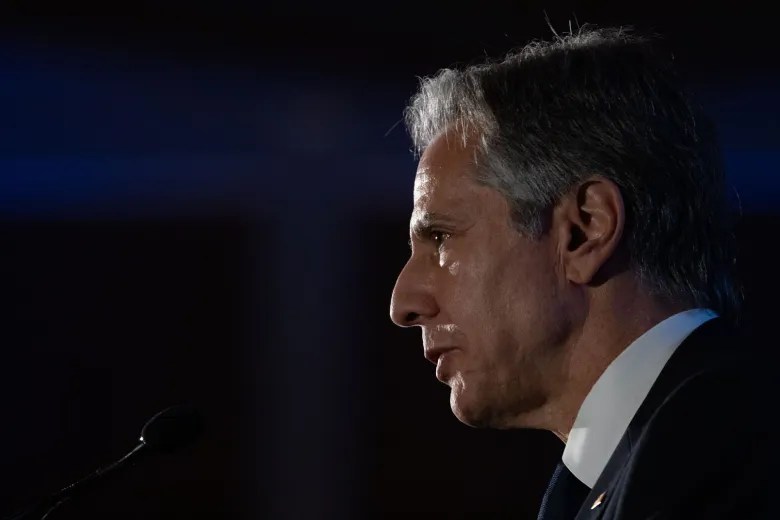
Secretary of State Antony Blinken speaks during the Mandela Washington Fellowship Summit for Young African Leaders in Washington, DC, August 2, 2023. (Official State Department photo by Chuck Kennedy)

By Seymour Hersh

Source: Rise Up Times

It’s been weeks since we looked into the adventures of the Biden administration’s foreign policy cluster, led by Tony Blinken, Jake Sullivan, and Victoria Nuland. How has the trio of war hawks spent the summer?

Sullivan, the national security adviser, recently brought an American delegation to the second international peace summit earlier this month at Jeddah in Saudi Arabia. The summit was led by Crown Prince Mohammed bin Salman, known as MBS, who in June announced a merger between his state-backed golf tour and the PGA. Four years earlier MBS was accused of ordering the assassination and dismemberment of the journalist Jamal Khashoggi at the Saudi consulate in Istanbul, for perceived disloyalty to the state.

As unlikely as it sounds, there was such a peace summit and its stars did include MBS, Sullivan, and President Volodymyr Zelensky of Ukraine. What was missing was a representative of Russia, which was not invited to the summit. It included just a handful of heads of state from the fewer than fifty nations that sent delegates. The conference lasted two days, and attracted what could only be described as little international attention.

Reuters reported that Zelensky’s goal was to get international support for “the principles” that that he will consider as a basis for the settlement of the war, including “the withdrawal of all Russian troops and the return of all Ukrainian territory.” Russia’s formal response to the non-event came not from President Vladimir Putin but from Deputy Minister of Foreign Affairs Sergei Ryabkov. He called the summit “a reflection of the West’s attempt to continue futile, doomed efforts” to mobilize the Global South behind Zelensky.

India and China both sent delegations to the session, perhaps drawn to Saudi Arabia for its immense oil reserves. One Indian academic observer dismissed the event as achieving little more than “good advertising for MBS’s convening power within the Global South; the kingdom’s positioning in the same; and perhaps more narrowly, aiding American efforts to build consensus by making sure China attends the meeting with . . . Jake Sullivan in the same room.”

Meanwhile, far away on the battlefield in Ukraine, Russia continued to thwart Zelensky’s ongoing counteroffensive. I asked an American intelligence official why it was Sullivan who emerged from the Biden administration’s foreign policy circle to preside over the inconsequential conference in Saudi Arabia.

“Jeddah was Sullivan’s baby,” the official said. “He planned it to be Biden’s equivalent of [President Woodrow] Wilson’s Versailles. The grand alliance of the free world meeting in a victory celebration after the humiliating defeat of the hated foe to determine the shape of nations for the next generation. Fame and Glory. Promotion and re-election. The jewel in the crown was to be Zelensky’s achievement of Putin’s unconditional surrender after the lightning spring offensive. They were even planning a Nuremberg type trial at the world court, with Jake as our representative. Just one more fuck-up, but who is counting? Forty nations showed up, all but six looking for free food after the Odessa shutdown”—a reference to Putin’s curtailing of Ukrainian wheat shipments in response to Zelensky’s renewed attacks on the bridge linking Crimea to the Russian mainland.

Enough about Sullivan. Let us now turn to Victoria Nuland, an architect of the 2014 overthrow of the pro-Russian government in Ukraine, one of the American moves that led us to where we are, though it was Putin who initiated the horrid current war. The ultra-hawkish Nuland was promoted early this summer by Biden, over the heated objections of many in the State Department, to be the acting deputy secretary of state. She has not been formally nominated as the deputy for fear that her nomination would lead to a hellish fight in the Senate.

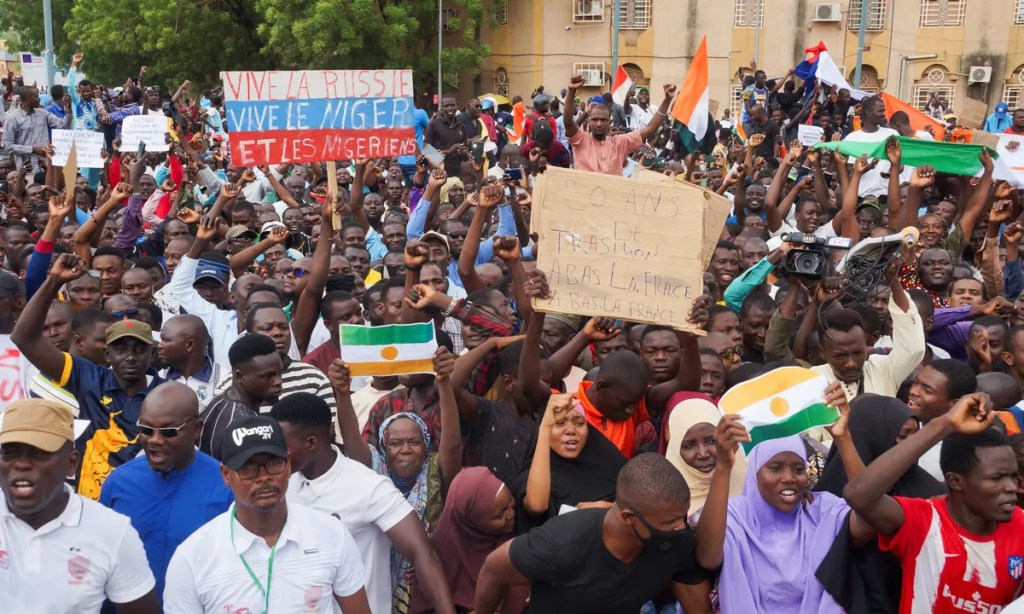
It was Nuland who was sent last week to see what could be salvaged after a coup led to the overthrow of a pro-Western government in Niger, one of a group of former French colonies in West Africa that have remained in the French sphere of influence. President Mohamed Bazoum, who was democratically elected, was tossed out of office by a junta led by the head of his presidential guard, General Abdourahmane Tchiani. The general suspended the constitution and jailed potential political opponents. Five other military officers were named to his cabinet. All of this generated enormous public support on the streets in Niamey, Niger’s capital—enough support to discourage outside Western intervention.

There were grim reports in the Western press that initially viewed the upheaval in East-West terms: some of the supporters of the coup were carrying Russian flags as they marched in the streets. The New York Times saw the coup as a blow to the main US ally in the region, Nigerian President Bola Ahmed Tinubu, who controls vast oil and gas reserves. Tinubu threatened the new government in Niger with military action unless they returned power to Bazoum. He set a deadline that passed without any outside intervention.

The revolution in Niger was not seen by those living in the region in east-west terms but as a long needed rejection of long-standing French economic and political control. It is a scenario that may be repeated again and again throughout the French-dominated Sahel nations in sub-Saharan Africa.

There are distinctions that do not bode well for the new government in Niger. The nation is blessed, or perhaps cursed, by having a significant amount of the remaining natural uranium deposits in the world. As the world warms up, a return to nuclear generated power is seen as inevitable, with obvious implications for the value of the stuff underground in Niger. The raw uranium ore, when separated, filtered and processed is known worldwide as yellowcake.

The corruption so often “talked about in Niger is not about petty bribes by government officials, but about an entire structure—developed during French colonial rule—that prevents Niger from establishing sovereignty over its raw materials and over its development,” according to a recent analysis published by Baltimore’s Real News Network. Three out of four laptops in France are powered by nuclear energy, much of which is derived from uranium mines in Niger effectively controlled by its former colonial overlord.

Niger is also the home of three American drone bases targeting Islamic radicals throughout the region. There  are also undeclared Special Forces outposts in the region, whose soldiers receive double pay while on their risky combat assignments. The American official told me that “the 1,500 US troops now in Niger are exactly the number of American troops who were in South Vietnam at the time John F. Kennedy took over the presidency in 1961.”

Into this scene came Victoria Nuland, who must have drawn the short straw inside the Biden Administration. She was sent to negotiate with the new regime and to arrange a meeting with the ousted President Bazoum, whose life remains under constant threat from the governing junta. The New York Times reported that she got nowhere after talks she described as “extremely frank and at times quite difficult.” The intelligence official put her remarks to the Times in American military lingo: “Victoria set out to save the Niger uranium owners from the barbaric Russians and got a huge single-finger salute.”

Quieter in recent weeks than Sullivan and Nuland has been Secretary of State Tony Blinken. Where was he? I asked that question of the official, who said that Blinken “has figured out that the United States”—that is, our ally Ukraine—“will not win the war” against Russia. “The word was getting to him through the Agency [CIA] that the Ukrainian offense was not going to work. It was a show by Zelensky and there were some in the administration who believed his bullshit.

“Blinken wanted to broker a peace deal between Russia and Ukraine as Kissinger did in Paris to end the Vietnam war.” Instead, the official said, “it was going to be a big lose and Blinken found himself way over his skis. But he does not want to go down as the court jester.”

It was at this moment of doubt, the official said, that Bill Burns, the CIA director, “made his move to join the sinking ship.” He was referring to Burns’s speech earlier this summer at the annual Ditchley conference near London. He appeared to put aside his earlier doubts about expanding NATO to the east and affirmed his support at least five times for Biden’s program.

“Burns does not lack self-confidence and ambition,” the intelligence official said, especially when Blinken, the ardent war hawk, was suddenly having doubts. Burns served in a prior administration as deputy secretary of state and running the CIA was hardly a just reward.

Burns would not replace a disillusioned Blinken, but only get a token promotion: an appointment to Biden’s cabinet. The cabinet meets no more than once a month and, as recorded by C-SPAN, the meetings tend to be tightly scripted affairs and to begin with the president reading from a prepared text.

Tony Blinken, who publicly vowed just a few months ago that there would be no immediate ceasefire in Ukraine, is still in office and, if asked, would certainly dispute any notion of discontent with Zelensky or the administration’s murderous and failing war policy in Ukraine.

So the White House’s wishful approach to the war, when it comes to realistic talk to the American people, will continue apace. But the end is nearing, even if the assessments supplied by Biden to the public are out of a comic strip.

This piece is from Seymour Hersh’s Substack, you may subscribe to it here.

BRICS 11 – Strategic Tour de Force

By Pepe Escobar

Source: The Unz Review

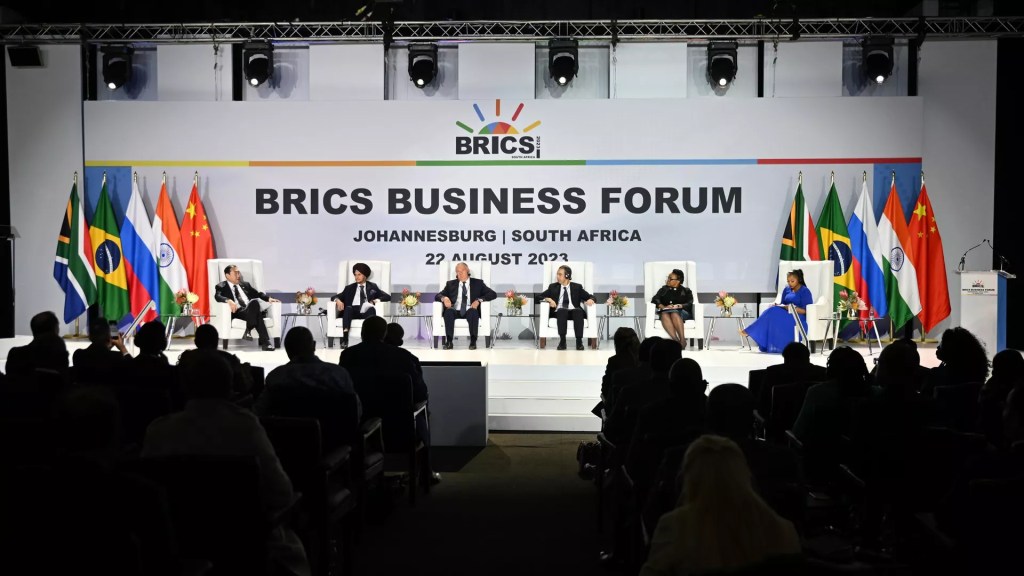
Chinese President Xi Jinping defined all the major decisions embedded in the 15th BRICS summit in South Africa as “historic”. That may be seen as an understatement.

It will take time for the Global South, or Global Majority, or “Global Globe” (copyright President Lukashenko), not to mention the stunned collective West, to fully grasp the enormity of the new strategic stakes.

President Putin, for his part, described the negotiations on BRICS expansion as quite difficult. By now a relatively accurate picture is emerging of what really went down on that table in Johannesburg.

India wanted 3 new members. China wanted as many as 10. A compromise was finally reached, with 6 members: Egypt, Iran, Saudi Arabia, United Arab Emirates (UAE), Argentina and Ethiopia.

So from now on it’s BRICS 11. And that’s just the beginning. Starting with the rotating Russian presidency of BRICS on January 1, 2024, more partners will be progressively included, and most certainly a new round of full members will be announced at the BRICS 11 summit in Kazan in October next year.

So we may soon progress to BRICS 20 – on the way to BRICS 40. The G7, for all practical purposes, is sliding towards oblivion.

Bur first things first. At that fateful table in Johannesburg, Russia supported Egypt. China went all out for Persian Gulf magic: Iran, UAE and the Saudis. Of course: Iran-China are already deep into a strategic partnership, and Riyadh is already accepting payment for energy in yuan.

Brazil and China supported Argentina, Brazil’s troubled neighbor, running the risk of having its economy fully dollarized, and also a key commodity provider to Beijing. South Africa supported Ethiopia. India, for a series of very complex reasons, was not exactly comfortable with 3 Arab/Muslim members (Saudi Arabia, UAE, Egypt). Russia assuaged New Delhi’s fears.

All of the above respects geographic principles and imprints the notion of BRICS representing the Global South. But it goes way beyond that, blending cunning strategy and no-nonsense realpolitik.

India was mollified because Russian Foreign Minister Sergey Lavrov, at the table in Johannesburg negotiating on behalf of President Putin, and highly respected by New Delhi, fully understood that a new, single BRICS currency is a long way away. What really matters, short and medium term, is expanding intra-BRICS trade in their national currencies.

That was stressed by New Development Bank (NDB) president Dilma Rousseff in her report to the South African summit hosts – even as Brazilian President Lula once again emphasized the importance of setting up a work group to discuss a BRICS currency.

Lavrov understood how New Delhi is absolutely terrified of secondary sanctions by the US, in case its BRICS role gets too ambitious. Prime Minister Modi is essentially hedging between BRICS and the completely artificial imperial obsession embedded in the terminology “Indo-Pacific” – which masks renewed containment of China. The Straussian neo-con psychos in charge of US foreign policy are already furious with India buying loads of discounted Russian oil.

New Delhi’s support for a new BRICS currency would be interpreted in Washington as all-out trade war – and sanctions dementia would follow. In contrast, Saudi Arabia’s MbS doesn’t care: he’s a top energy producer, not consumer like India, and one of his priorities is to fully court his top energy client, Beijing, and pave the way for the petroyuan.

It Takes Just a Single Strategic Move

Now let’s get into the strategic stakes. For all practical purposes, in Eurasian terms, BRICS 11 is now on the way to lord over the Arctic Sea Route; the International North South Transportation Corridor (INSTC); BRI’s East West Corridors; the Persian Gulf; the Red Sea; and the Suez Canal.

That blends several overland corridors with several nodes of the Maritime Silk Roads. Nearly total integration in the Heartland and the Rimland. All with just a single strategic move in the geopolitical/geoeconomic chessboard.

Much more than an increase of BRICS 11 collective GDP to 36% of the world’s total (already larger than the G7), with the group now encompassing 47% of the world’s population, the top geopolitical and geoeconomic breakthrough is how BRICS 11 is about to literally break the bank on the energy and commodities market fronts.

By incorporating Iran, Saudi Arabia and the UAE, BRICS 11 instantly shines on as an oil and gas powerhouse. BRICS 11 now controls 39% of global oil exports; 45.9% of proven reserves; and at least 47.6% of all oil produced globally, according to InfoTEK.

With BRICS 11 possibly including Venezuela, Algeria and Kazakhstan as new members as early as in 2024, it may control as much as 90% of all oil and gas traded globally.

Inevitable corollary: operations settled in local currencies bypassing the US dollar. And inevitable conclusion: petrodollar in a coma. The Empire of Chaos and Plunder will lose its free lunch menu: control of global oil prices and means to enforce “diplomacy” via a tsunami of unilateral sanctions.

Already in the horizon, direct BRICS 11-OPEC+ symbiosis is inevitable. OPEC+ is effectively run by Russia and Saudi Arabia.

A ground-shaking geoeconomic reorientation is at hand, involving everything from routes plied by global supply chains and new BRICS roads to the progressive interconnection of BRI, the Saudi Vision 2030 and massive port expansion in the UAE.

By choosing Ethiopia, BRICS expands its African reach on mining, minerals and metals. Ethiopia is rich in gold, platinum, tantalum, copper, niobium and offers vast potential in oil and natural gas exploration. Saudi Arabia and the UAE, incidentally, are also involved in mining.

This all spells out fast, progressive integration of North Africa and West Asia.

How Diplomacy Goes a Long Way

The BRICS 11 Shock of the New, in the energy sphere, is a sharp historical counterpoint to the 1973 oil shock, after which Riyadh started wallowing in petrodollars. Now Saudi Arabia under MbS is operating a tectonic shift, in the process of becoming strategically aligned with Russia-China-India-Iran.

Diplomatic coup does not even begin to describe it. This is the second stage of the Russian-initiated and Chinese-finalized rapprochement between Riyadh and Tehran, recently sealed in Beijing. The Russia-China strategic leadership, working patiently in synch, never lost sight of the ball.

Now compare it with collective West’s “strategies”, such as the G7-imposed oil price cap. Essentially the G7 “coalition of the willing” self-imposed a price cap on Russian crude imported by sea. The result is that they had to start buying way more oil products from Global South nations which ignored the price cap and duly increased their purchase of Russian crude.

Guess who are the top two: BRICS members China and India.

After wallowing in several stages of denial, the collective West may – or may not – realize it’s a fool’s dream to attempt to “de-couple” the West-ruled part of the global economy from China, whatever is spewed out by Washington.

BRICS 11 now shows, graphically, how the “Global South/Global Majority/”Global Globe” is more non-aligned with the West than anytime in recent history.

By the way, the president of the G77, Cuban leader Diaz-Canel, was at the BRICS summit representing the de-facto new Non-Aligned Movement (NAM): the G77 actually incorporates no less than 134 nations. Most are African. Xi Jinping in Johannesburg met in person with the leaders of most of them.

The collective West, in panic, regards all of the above as “dangerous”. So the last refuge is, predictably, rhetorical: “de-coupling”, “de-risking”, and similar idiocies.

Yet that may also get practically dangerous. As in the first ever trilateral summit in Camp David on August 18 between the Empire and two Asian vassals, Japan and South Korea. That may be interpreted as the first move towards a military-political Asian NATO even more toxic than Quad or AUKUS, obsessed to simultaneously contain China, Russia and the DPRK.

The Collective Outstripping of the Global North

The UN lists 152 nations in the world as “developing countries”. BRICS 11 is aiming at them – as they outstrip the Global North on everything from population growth to overall contribution to global GDP growth measured by PPP.

In the past 10 years since the announcement of BRI first in Astana and then in Jakarta, Chinese financial institutions have lent nearly $1 trillion for infrastructure connectivity projects across the Global South. The upcoming BRI forum in Beijing will signal a renewed drive. That’s the BRI-BRICS symbiosis.

In the G20 last year, China was the first nation to lobby for the inclusion of the 55-member African Union (AU). That may happen at the G20 summit next month in New Delhi; in that case, Global South representation will be close to parity with the Global North.

Claims that Beijing was organizing a malign conspiracy to turn BRICS into a weapon against the G7 are infantile. Realpolitik – and geoeconomic indicators – are dictating the terms, configuring the Shock of the New: the G7’s irreversible irrelevance with the rise of BRICS 11.

Neocons and Other Malignancies in the American Body Politic

They will never give up until we’re all dead

By Philip Giraldi

Source: The Unz Review

It is interesting to observe how, over the past twenty-five years, the United States has become not only a participant in wars in various places on the planet but has also evolved into being the prime initiator of most of the armed conflict. Going back to the Balkans in the nineteen-nineties and moving forward in Afghanistan, Iraq, Libya, Syria, Lebanon and Somalia there is almost always an American leading role where there is bombing and killing. And where there is no actual war, there are threats and sanctions intended to make other nations come to heel, be they in Latin America like Venezuela, or Iran in the Middle East, or North Korea in Asia. And then there is the completely senseless act of turning major competitors like Russia and China, as we are now seeing, into enemies, with a proxy war raging in Ukraine, threats over Taiwan, and the world moving one step closer to a nuclear disaster.

It seems to me that the transition from an America bumbling its way into war and the current situation where wars are pursued as a matter of course coincides with a certain political development in the United States, which is the rise of neoconservatives as the foreign and national security policy makers in both major parties. This has developed together with the evolution of the view that the United States can do no wrong by definition, indeed, that it has a unique and God-given right to establish and police the globe through something that it invented, exploits and has dubbed the “rules based international order.”

Who would have thought that a bunch of Jewish student-activists, mostly leftists, originally conspiring in a corner of the cafeteria in the City College of New York would create a cult type following that now aspires to rule the world? The neocons became politically most active in the 1960s and eventually some of them attached themselves to the Republican Party under Ronald Reagan, declaring their evolution had come about because they were “liberals mugged by reality.” The neoconservative label was first used to describe their political philosophy in 1973. Since that time, they have diversified and succeeded in selling their view to a bipartisan audience that the US should embrace an aggressive interventionist foreign policy and must be the world hegemon. To be sure their desire for overwhelming military power has been strongly shaped by their tribal cohesion which has fed a compulsion to have Washington serve as the eternal protector of Israel, but the hegemonistic approach has inevitably led to expanding conflict all over the world and a willingness to challenge, confront and defeat other existing great powers. Hence the support for a needless and pointless war in Ukraine to “weaken Russia” and a growing conflict with China over Taiwan to do the same in Asia. To make sure that the Republicans do not waver on that mission, leading neocon Bill Kristol has recently raised $2 million to do some heavy lobbying to make sure that they stay on track to confront the Kremlin in Europe.

One of the leading neocon families is the Kagans, who have successfully penetrated and come to dominate the establishment foreign policy centers in both the Republican and Democratic Parties. Victoria Nuland nee Nudelman, the wife of Robert Kagan, is entrenched at the State Department where she is now the Deputy Secretary, the number two position. Up until recently, she was one of the top three officials at State, all of whom were and are Jewish Zionists. Indeed, under Joe Biden Zionist Jews dominate the national security structure, to include the top level of the State Department, the head of Homeland Security, the Attorney General, the National Security Adviser, the Director of National Intelligence, the President’s Chief of Staff, and the Deputy Director of the Central Intelligence Agency. Nuland’s hawkish appeal is apparently bipartisan as she has served in senior positions under Bill Clinton, Dick Cheney, George W. Bush, Barack Obama and now Joe Biden. As adviser to Cheney, she was a leading advocate of war with Iraq, working with other Jewish neocons Doug Feith and Paul Wolfowitz at Defense and also Scooter Libby in the Vice President’s office. As there was no actual threat to the US from Saddam Hussein she and her colleagues invented one, the WMD that they sold to the media and to idiots like Secretary of State Condoleezza Rice. Nuland is also considered to be close to Hillary Clinton and the recently deceased ghastly former Secretary of State Madeleine Albright. All of her government assignments have included either invading or severely sanctioning some country considered by her and her colleagues to be unfriendly. She particularly hates the Russians and anyone who is hostile to Israel.

Apparently, Nuland’s record of being seriously wrong in the policies she promoted has only served to improve her resume in Washington’s hawkish foreign policy establishment and when Biden came into the presidency she found herself appointed to the number three position at the State Department as the Under Secretary of State for Political Affairs. Her return to power with the Democrats might also be due in part to the activism of her husband Robert, currently a senior fellow at the Brookings Institute, who was one of the first neocons to get on the NeverTrump band wagon back in 2016 when he endorsed Hillary Clinton for president and spoke at a Washington fundraiser for her, complaining about the “isolationist” tendency in the Republican Party exemplified by Trump. Robert famously has never seen a war he disapproved of and, while urging Europe to do more defense spending, commented that “When it comes to use of military force “Americans are from Mars, and Europeans are from Venus.” Robert’s brother Frederick, a Senior Fellow at the neocon American Enterprise Institute, and Frederick’s wife Kimberly, who heads the bizarrely named Institute for the Study of War, are also regarded as neocon royalty.

Nuland is particularly well known for her being the driving force behind the regime change in Ukraine in 2014 that replaced the fairly-elected but friendly-to-Russia President Viktor Yanukovych with a selected candidate more accommodating to the US and Western Europe. Ukraine, the most corrupt country in Europe, has been unstable ever since and the current war, also initiated by interference from the US and UK, has brought about the deaths and wounding of an estimated half million Ukrainians and Russians.

Nuland was recently in Africa, stirring up developments in Niger, which has experienced a recent military coup that removed a president who was corrupt but also a friend of the US and France, both of which have troops stationed in the country. As I write this, a number of African nations (ECOWAS) friendly to US and French interests in the region are gathering together their own military force to reverse the coup, but there is little enthusiasm for the project. We will see how that turns out, but predictably Nuland is advertising a possible intervention as a “restoration of democracy.”

And there is more over the horizon with neocons like Secretary of State Antony Blinken and Nuland in charge of US foreign policy and supported by most of congress and a Jewish dominated media and entertainment industry. Joe Biden is too weak and too much under the thumb of the Israel Lobby to pursue any policies that would be beneficial to the American people in general, so the course will be set by the current crop of zealots, just as Donald Trump was guided by his Christian Zionist advisers.

If you want to understand just how what remains of our republic is in a bus being driven over the cliff by a group that has no regard for most of the citizens of the country that they reside in, one only has to read some of what passes for neocon analysis of what must be done to make America “safe.” Not surprisingly, it also involves Israel and a war on behalf of the Jewish state.

One astonishingly audacious article that appeared on August 13th in The Hill entitled “If Israel strikes Iran over its nuclear program, the US must have its back,” gives Israel the option of starting a war for any or no reason with the United States compelled to join in in support. It was written Michael Makovsky, a well-known Jewish neocon, and Chuck Wald. Makovsky is President and CEO of the Jewish Institute for National Security of America (JINSA) while Wald is a former general who also is affiliated with that group as a “distinguished fellow,” which means he is getting paid generously to serve as a mouthpiece providing credibility for the group. For those unfamiliar with The Hill, it is an inside the beltway defense contractor funded online magazine that pretends to be serious but which is actually an integral part of the status quo Zionist and war-on-demand network. That the Jewish Institute for National Security is “of America” is, of course, a characteristically clever euphemism.

The article begins with “The Biden administration should learn from its unpreparedness for the Russia-Ukraine war and begin to prepare for a major Israel-Iran conflict. The administration needs to set aside its differences with the Israeli government, overcome its aversion to conflict with Iran, and begin to work closely with Jerusalem to prepare for the growing likelihood that Israel will feel it has no choice but to initiate a military campaign against Iran’s nuclear program. In ‘No Daylight,’ a new report from the Jewish Institute for National Security of America (JINSA)…retired senior military officers and national security experts explain that whatever differences the US might now have with Israel over Iran policy, our two countries’ interests will be aligned after an Israeli strike. Consequently, in preparing its response, the U.S. guiding principle should be ‘no daylight with Israel,’ to ensure Israeli military success, mitigate Iranian retaliation and limit the scope of the conflict — vital interests for both countries.”

That war with Iran is a “vital interest” for the United States is, of course, not really explained as the point is to let Israel to decide on the issue of war and peace for the United States. The article then trots out the old “credibility” argument, i.e. that if we don’t go to war no one will ever trust our security guarantees: “A US betrayal of its close Israeli ally, at a time of great peril for the Jewish state, would be ‘one of the greatest catastrophes ever,’ an Arab leader told us privately recently. Because Israel is widely perceived as a close American ally, the US stance as Israel risks thousands of casualties in defense of its very existence, will resound broadly. Strong American support will reassure allies from Warsaw to Abu Dhabi and Taipei; American equivocation will shred Washington’s credibility and embolden adversaries from Tehran to Moscow and Beijing.”

One would love to know who the anonymous Arab leader so concerned about Israel is and, of course, the Jewish state is not in fact an American ally apart from in the fertile imaginations of congressmen, the media and the White House. And Israel will, of course, need more weapons and money from the US taxpayer to include “expediting delivery to Israel of KC-46A tankers, precision-guided munitions, F-15 and F-35 aircraft, and air and missile defenses…. Washington should accelerate building integrated regional air, missile and maritime defenses against persistent Iranian threats.” And America must be prepared to expand the war: “Privately, Iranian and Hezbollah leadership should be warned that heavy retaliation against Israel…will prompt severe Israeli and/or American responses that could threaten their very grasp on power. Upon commencement of an Israeli strike, the United States should promptly resupply Israel with Iron Dome interceptors, precision-guided munitions, ammunition and spare parts, and deploy Patriot air defenses to Israel…”

So the United States must be prepared to turn over its national security to Israel in exchange for what gain for Americans? In part it would apparently involve “finding a permanent solution to Iran’s illegal nuclear weapons program” which is based on a lie even if Prime Minister Benjamin Netanyahu has been repeating for over 20 years that Iran is only six months away from a weapon. Both the CIA and Mossad have confirmed that Iran has no such program while Israel does have a secret illegal nuclear arsenal built using enriched uranium and nuclear triggers stolen from the US. The article concludes with another reference to the non-existing program, claiming “the most effective way to address Iran’s nuclear program already has been articulated by President Biden and communicated by America’s ambassador in Jerusalem: ‘Israel can and should do whatever they need to deal with it, and we’ve got their back.’”

Supporting Israeli war crimes is not the way to go. As Chris Hedges puts it correctly, there is no compelling American interest in damaging itself by supporting Israel blindly, quite the contrary: “The long nightmare of oppression of Palestinians is not a tangential issue. It is a black and white issue of a settler-colonial state imposing a military occupation, horrific violence and apartheidbacked by billions of US dollars, on the indigenous population of Palestine. It is the all powerful against the all powerless. Israel uses its modern weaponry against a captive population that has no army, no navy, no air force, no mechanized military units, no command and control and no heavy artillery, while pretending intermittent acts of wholesale slaughter are wars.”

And, of course, while Israel engages in slaughter and torture it always portrays itself as the victim only engaged in fighting against “terrorists.” I have a better idea for where we should go with all of this. President Joe Biden should be impeached for ignoring war powers legislation and indicating that he is willing to sacrifice US interests and kill American soldiers, few or plausibly none of whom will actually be Jewish since it is not an occupation that attracts them, to please and support a manifestly evil foreign government. And Donald Trump should also be punished for having done much the same type of pandering to a foreign country while in office. Meanwhile, haul Makovsky and Wald together with their buddies at the American-Israel Public Affairs Committee (AIPAC) and the Anti-Defamation League (ADL) down to the Justice Department and put them in jail for violation of the Foreign Agents Registration Act of 1938 (FARA) in that they are willfully acting as agents of a foreign government and are operating corruptly to serve the interests of that government. The criminals at AIPAC are already using their associated PACs to oust targeted members of Congress up for re-election in 2024 who have in any way been critical of Israel or pro-Palestinian. And while you’re at it Mr. Attorney General Merrick Garland nee Garfinkel, please have Mr. Blinken and Ms. Nuland pop by for a chat just for starters and see how far you can make the laws apply to those in power. There is some confusion evident here as Israel is not part of the United States, no matter how politically dominant and wealthy its lobby might be. Time to put an end to this nonsense and call it out for what it is – it is treason.

France never stopped looting Africa, now the tables are turning

As developments in West Africa demonstrate, the francophone countries are no longer willing to accept French neo-colonialism. With the fear factor finally removed, Africa’s quest for genuine independence is steadily coming to fruition.

By Brad Pearce

Source: TheCradle.co

The 26 July coup in the West African nation of Niger, which threatens to undermine French and US military presence in the region, has shed light on the historical exploitation and continued practices of Francafrique – the term used to describe the persistent exploitation by the former French Empire in Africa.

France heavily relies on nuclear energy, with 68 percent of its power coming from nuclear plants. It obtains 19 percent of the uranium required to run these plants from Niger. Despite this significant contribution toward France’s energy needs, only 14.3 percent of Nigeriens have access to a power grid, and even that is often unreliable. This stark contrast highlights the disparities and ongoing exploitation by rapine foreign powers throughout the African continent. 

The Legacy of Francafrique

Francafrique has been known for its exploitative systems designed to profit from African resources, using pressure, capital, and frequently outright force to maintain control over its former empire. As a result, many African states, including Niger, continue to face poverty and underdevelopment.

Burkina Faso’s young, charismatic leader Ibrahim Traore recently spoke at the Russia-Africa summit in St. Petersburg and decried the fact that Africa is resource-rich, but its people are poor, and criticized African leaders seeking hand-outs from the west, as they perpetuate dependency and poverty. He also described what is being imposed on Africa as a form of slavery, stating:

“As far as what concerns Burkina Faso today, for more than eight years we’ve been confronted with the most barbaric, the most violent form of imperialist neo-colonialism. Slavery continues to impose itself on us. Our predecessors taught us one thing: a slave who cannot assume his own revolt does not deserve to be pitied. We do not feel sorry for ourselves, we do not ask anyone to feel sorry for us.”

France’s inability to justify its presence in Africa with a coherent narrative further complicates the situation. Paris cannot openly confess its greed, feign a “civilizing mission,” or admit to any responsibility due to its past crimes. This lack of purpose weakens French power on the continent, leading to violence and poverty in its wake.

West Africa’s drive for further independence has left Atlanticists concerned about the opening this leaves for Eurasian powers like Russia and China to increase their influence in Africa. The west’s reaction reflects a lack of respect for the sovereignty of African countries, viewing the continent merely as a theater to maintain global dominance.

Since the Ukraine war’s onset in early 2022, Atlanticists have expressed alarm over the unwillingness of Global South states to support the west’s anti-Russia policies, a trend further amplified by the shift to multipolarism everywhere. This weakening of western hegemony has opened a path for many nations to avidly explore their geopolitical options and diversify their economies.

A report from the Munich Security Conference held in February highlighted this very real schism with the west:

“Many countries in Africa, Asia, and Latin America have steadily lost faith in the legitimacy and fairness of an international system which has neither granted them an appropriate voice in global affairs, nor sufficiently addressed their core concerns. To many states, these failures are deeply tied to the west. They find that the western-led order has been characterized by post-colonial domination, double standards, and neglect for developing countries’ concerns.”

Fleeced by the CFA Franc

The aftermath of the Second World War marked a significant shift in global power dynamics, and the victorious powers sought to establish a new world order that would maintain peace and promote economic balance. 

In the context of African colonies, where colonial troops played a major role in the allied victory, the victorious powers, including France, aimed to retain economic control and benefit from their former colonies even as the world moved towards decolonization.

This included the establishment of new currency systems, with French leader Charles De Gaulle creating two currencies collectively known as the CFA Franc in 1945 for former colonies in the Western and Central zone.

As the push for political independence grew stronger in the late 1950s, France organized referendums in its African colonies to vote on accepting a constitution drafted by the French. 

Guinea, led by former trade unionist Sekou Toure, opposed accepting the French constitution and voted overwhelmingly against it. In a furious response, De Gaulle’s government withdrew all French administrators from Guinea and took action to sabotage the country’s infrastructure and resources. The harsh measures by Paris aimed to serve as an example of what would happen to any former French colony that resisted France’s agenda.

During the Cold War, the Communist states exploited such actions by presenting themselves as liberators and allies of African countries that sought independence from European influence. This stance has led to some Africans viewing countries like Russia as more equitable partners compared to France.

Over the years, France has demonstrated a pattern of intervening militarily – over 50 times since 1960 – in African countries to secure governments that remain compliant with French economic interests, particularly related to the continued use of the CFA Franc.

The system by which the CFA Franc operates has historically been one of a fixed exchange rate where the currency has unlimited convertibility but is permanently pegged to the French currency, previously the Franc and then the Euro. 

African currency under French control

This means that African countries cannot influence the value of their own currency, and the difference in value makes it so that France can buy African products artificially cheap while Africans are able to buy fewer goods with the money they exchange.

Worse yet, France had requirements to store, and thus profit from, the foreign reserves owned by its former colonies, though the requirement of holding 50 percent of their foreign exchange reserves in a French-ran bank was dropped for the western zone in 2019. 

Under this scheme, African states received a nominal amount of interest, but the bank benefited from lending that capital out at higher rates and attaining massive profits off of African resources and labor. This is despite the fact that many countries in Francophone Africa are major gold exporters and thus have a multitude of options for storing wealth to back a currency in alternative central banks.

While the CFA Franc system has provided some benefits in terms of stability and preventing Zimbabwean-style hyperinflation, it has also come under scrutiny for imposing requirements on African countries that are not placed on more powerful nations. The lack of control over their own currency has hindered economic growth and made these countries vulnerable to global economic shocks.

Northern African states such as Tunisia, Algeria, and Morocco chose to leave the CFA Franc upon gaining independence and have experienced relatively higher prosperity. Similarly, Botswana’s success with its own national currency demonstrates that proper management can lead to stable democracy and economic growth, even for less developed nations.

Exclusive rights and privileges

The CFA Franc system has been the geopolitical equivalent of one’s father insisting he manages their savings while leaving them out of his will. There are benefits to having a trade and currency zone, such as the current ECOWAS union that covers the Western part of the continent, but by design under the CFA Franc system, independence has been an illusion by which France has fleeced these countries. 

France has been dependent on Africa for its status as a world power for more than a century. Among other privileges it has carved out for itself in post-colonial treaties, France has had the exclusive right to sell military equipment to former colonies, and enjoys the first right to any natural resources discovered. Paris makes great use of these privileges: as just one example, 36.4 percent of France’s gas is sourced from the African continent.

Moreover, a vast network of French business interests, which include major multinational companies, dominate industries such as energy, communications, and transportation in many African countries. France’s government also supports French businesses in Africa in several ways, including through an enormous public company called COFACE which guarantees French exports into these underdeveloped markets. 

Towards independence and self-reliance

This economic dependence has contributed to the perpetuation of a system where African states remain weak, pliant, and reliant on resource exports, primarily benefiting French companies and interests. Additionally, African states are obligated to ally with France in any major conflict, further eroding their national sovereignty. 

The African continent suffers from many ailments, but perhaps the most persistent and nefarious are a lack of sovereignty and access to capital. Meanwhile, much of Europe’s prosperity has been derived from looting the Global South for centuries. 

The case of Brussels, built on the wealth derived from the brutal exploitation of the Congo under Belgian King Leopold II, is a stark reminder of the deep-rooted impact of colonialism. When the monarch’s crimes against humanity were discovered, he was ultimately forced to bequeath the majority of his fortune to the Belgian state upon his death. 

Not wanting to do so, he embarked on an enormous series of public works to spend his ill-gotten gains, creating modern Brussels. Now the EU and NATO meet there and audaciously give disingenuous lectures about universal human rights while surrounded by the profits of some of the most brutal cases of oppression in human history. 

While military governments often face challenges in achieving their stated goals, it is evident that western-backed “civil democracies” have also struggled to significantly improve the security and well-being of the African public. 

The path to solving Africa’s problems lies in transformative leaders who can shrug off the legacy and remaining shackles of colonialism and enable the continent to carve out a genuine, homegrown path to independence and self-reliance.