No, This Is Not Another 1929, 1973, 1987, 2000, or 2008

By Charles Hugh Smith

Source: Of Two Minds

Basing one’s decisions on analogs from the past is entering a fool’s paradise of folly.

Like addicts who cannot control their cravings, financial analysts cannot stop themselves from seeking some analog situation in the past which will clarify the swirling chaos in their crystal balls. So we’ve been swamped with charts overlaying recent stock market action over 1929, 1987,2000 and 2008–though the closest analogy is actually the Oil Shock of 1973, an exogenous shock to a weakening, fragile economy.

But the reality is there is no analogous situation in the past to the present, and so all the predictions based on past performance will be misleading. The chartists and analysts claim that all markets act on the same patterns, which are reflections of human nature, and so seeking correlations of volatility and valuation that “worked” in the past will work in 2020.

Does anyone really believe the correlations of the past decade or two are high-probability predictors of the future as the entire brittle construct of fictional capital and extremes of globalization and financialization all unravel at once?

Here are a few of the many consequential differences between all previous recessions and the current situation:

1. Households have never been so dependent on debt as a substitute for stagnating wages.

2. Real earnings (adjusted for inflation) have never been so stagnant for the bottom 90% for so long.

3. Corporations have never been so dependent on debt (selling bonds or taking on loans) to fund money-losing operations (see Netflix) or stock buybacks designed to saddle the company with debt service expenses to enrich insiders.

4. The stock market has never been so dependent on what amounts to fraud–stock buybacks–to push valuations higher.

5. The economy has never been so dependent on absurdly overvalued stock valuations to prop up pension funds and the spending of the top 10% who own 85% of all stocks, i.e. “the wealth effect.”

6. The economy and the stock market have never been so dependent on central bank free money for financiers and corporations, money creation for the few at the expense of the many, what amounts to an embezzlement scheme.

7. Federal statistics have never been so gamed, rigged or distorted to support a neofeudal agenda of claiming a level of wide-spread prosperity that is entirely fictitious.

8. Major sectors of the economy have never been such rackets, i.e. cartels and quasi-monopolies that use obscure pricing and manipulation of government mandates to maximize profits while the quality and quantity of the goods and services they produce declines.

9. The economy has never been in such thrall to sociopaths who have mastered the exploitation of the letter of the law while completely overturning the spirit of the law.

10. Households and companies have never been so dependent on “free money” gained from asset appreciation based on speculation, not an actual increase in productivity or value.

11. The ascendancy of self-interest as the one organizing directive in politics and finance has never been so complete, and the resulting moral rot never more pervasive.

12. The dependence on fictitious capital masquerading as “wealth” has never been greater.

13. The dependence on simulacra, simulations and false fronts to hide the decay of trust, credibility, transparency and accountability has never been so pervasive and complete.

14. The corrupt linkage of political power, media ownership, “national security” agencies and corporate power has never been so widely accepted as “normal” and “unavoidable.”

15. Primary institutions such as higher education, healthcare and national defense have never been so dysfunctional, ineffective, sclerotic, resistant to reform or costly.

16. The economy has never been so dependent on constant central bank manipulation of the stock and housing markets.

17. The economy has never been so fragile or brittle, and so dependent on convenient fictions to stave off a crash in asset valuations.

18. Never before in U.S. history have the most valuable corporations all been engaged in selling goods and services that actively reduce productivity and human happiness.

This is only a selection of a much longer list, but you get the idea. Basing one’s decisions on analogs from the past is entering a fool’s paradise of folly.

Power Grab

By Michael Krieger

Source: Liberty Blitzkrieg

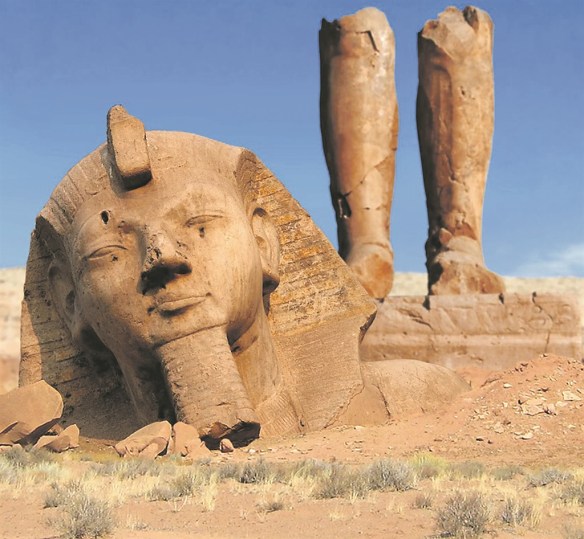
I met a traveller from an antique land
Who said: Two vast and trunkless legs of stone
Stand in the desert. Near them, on the sand,
Half sunk, a shattered visage lies, whose frown,
And wrinkled lip, and sneer of cold command,
Tell that its sculptor well those passions read
Which yet survive, stamped on these lifeless things,
The hand that mocked them and the heart that fed:
And on the pedestal these words appear:
‘My name is Ozymandias, king of kings:
Look on my works, ye Mighty, and despair!’
Nothing beside remains. Round the decay
Of that colossal wreck, boundless and bare
The lone and level sands stretch far away

– Percy Shelley, Ozymandias

It didn’t take long for the most opportunistic, nefarious and corrupt actors in the U.S. to turn a pandemic crisis into another massive power grab attempt. We’ve seen it before; after 9/11 and also throughout the response to the financial crisis a decade ago. The irredeemable sociopaths who always make the big, important decisions used those crises to consolidate wealth and power. They’re going for it again.

There are many examples, but let me list a few:

– The EARN IT bill, by which senators are attempting to destroy widespread public use of encryption, i.e. private communications. (EFF)

– The White House and the CDC are asking Facebook, Google and other tech giants to give them greater access to Americans’ smartphone location data. (CNBC)

– The Justice Department has quietly asked Congress for the ability to ask chief judges to detain people indefinitely without trial during emergencies. (Politico)

– U.S. Senators are attempting to use the crisis as an opportunity to pull off a gigantic corporate coup. (Matt Stoller, BIG)

Then there’s the really big one, the Federal Reserve. An institution with more unaccountable power to shape and manipulate our world than any other, yet whose actions remain subject to virtually zero public debate.

While we’re at it…

I wrote about the scam that is the Federal Reserve last year in the post, Monetary Looting, and what they’re doing now makes those repo operations look like child’s play.

We often get distracted debating the implications of Fed actions, and in the process lose sight of the bigger picture. The real question we need to be asking is why do we allow a handful of unelected banker welfare agents the right to shape our entire world? It’s a crazy system, and until we start questioning the underlying premises of everything about our world, we’ll remain confused and subjugated.

That said, I remain more optimistic than ever that once we get through this crisis and a rough transition period, a far better era awaits on the other side. I say this because I believe this pandemic will shake enough people to such an extent they’ll emerge from it very different people with a more enlightened understanding of the world and their roles in it. An event like this can make people less conscious, or it can make them more conscious. I think humanity will expand its consciousness.

Of course, the future is not written in stone. Each and every one of us needs to grow up and step up if we’re going to build a better world. We each have our skillsets, so I ask everyone reading this to think about how they can repurpose their talents to the great work of ushering in a new era. I don’t do any of this to change the world. I can’t do that. I do this to inspire as many people as possible to change their own worlds. Then everything changes.

If I had to summarize where we’ve been and where I think we’re going, it would be with the following.

The world you lived in no longer exists, but the world to come has not yet been created. The worst people in society will attempt to create it in their image, but we can’t allow that. We must step up and create it ourselves. It’s entirely possible. Get to work.

Defending Humanity Against the Elite Coup

By Robert J. Burrowes

In a recent article I reported existing evidence on the way in which COVID-19 is being used to implement, but also divert attention from, initiatives being taken by the global elite to consolidate and expand its power in significant ways, and perhaps to make the final drive to take total control of global society. See ‘Observing Elites Manipulate Our Fear: COVID-19, Propaganda and Knowledge’.

Moreover, while global attention is focused on COVID-19, attention has been distracted from the many other ongoing crises – particularly including the vast range of threats that constitute an imminent danger to human existence: see ‘Human Extinction Now Imminent and Inevitable? A Report on the State of Planet Earth’ – and no doubt other undesirable initiatives being carried out by the global elite outside our view. In addition, activism has been stymied as activists are either themselves distracted by COVID-19 or hindered by the measures (such as ‘social distancing’ and bans on public gatherings) introduced to supposedly deal with it.

Before and since writing ‘Observing Elites Manipulate Our Fear’, more evidence has been published pointing at an elite coup with governments around the world introducing draconian measures severely curtailing human rights and freedoms (including those involving the internet) and destroying national economies.

For just a taste of this literature and these videos, see ‘The “Lock Step” Simulation Scenario: “A Coronavirus-like Pandemic that Becomes Trigger for Police State Controls”’, ‘The EARN IT Bill is the Government’s Plan to Scan Every Message Online’, ‘What more could he do? A look at Trump’s extreme powers’, ‘Police in California Plan to Use Drones to Enforce Quarantine Lockdown’, ‘DOJ seeks new emergency powers amid coronavirus pandemic’, ‘Does the Coronavirus Pandemic Serve a Global Agenda?’, ‘Two Hundred and Thirty Years of Rights and Liberties Shredded: Why I Oppose The Lockdown’, ‘Martial Law is Coming to the USA?’, ‘After the Lockdown: A Global Coronavirus Vaccination Program…’, ‘Planetary Hysteria: Manufactured COVID-19 “Health Crisis” Pushes Humanity, Global Society to Total Shutdown’, ‘COVID-19 – The Fight for a Cure: One Gigantic Western Pharma Rip-Off’, ‘Police State Uses Crises to Expand Its Lockdown Powers: Suspending the Constitution’, ‘Whither Coronavirus? When Will It End and What Will Happen Along the Way’, ‘Covid-19: The Panic Is Worse Than the Pathogen’ and ‘Rockefeller Blueprint For Police State Triggered By Pandemic Exposed’ which cites the Rockefeller Foundation’s 2010 document ‘Scenarios for the Future of Technology and International Development’ with its prescient description of what is taking place now: ‘LOCK STEP – A world of tighter top-down government control and more authoritarian leadership, with limited innovation and growing citizen pushback.’

As Helen Buyniski notes, using the example of the US Patriot Act, passed by Congress a short time after the 9/11 false flag event that destroyed World Trade Center buildings 1, 2 and 7 in New York: ‘They always declare a state of emergency, they never undeclare the state of emergency or repeal any of the emergency measures.’ See ‘Rockefeller Blueprint For Police State Triggered By Pandemic Exposed’. In any case, with the corporate media endlessly promoting panic, most people prefer to be ‘saved’ by having even more severe restrictions placed on their freedom. See ‘As Trump Eyes Restarting Economy, Nearly 3 in 4 Voters Support National Quarantine’.

In this article I would like to outline a strategic response to prevent this takeover before we find ourselves moving from a version of the dystopian society described in the novel Brave New World to that outlined in the novel 1984 that many of us read as students. We might have been happy with the drugs but Big Brother is now poised with the sword held high above our necks.

‘It won’t happen’, you might say. And perhaps you are right. But my own long and extensive study of the global elite revealing the progressive manner in which it is endlessly consolidating and expanding its power is also matched by others who share my interest in this subject. So I invite you to consider the evidence presented above with the hope that we can mobilize a sufficient response from the wider population to avoid this being the final move in the elite’s strategy to take total control of our lives.

If you would like to better understand the origin, identity and behaviour of the global elite and why it is insane, see the section headed ‘How the World Works’ in ‘Why Activists Fail’ and the articles ‘Exposing the Giants: The Global Power Elite’ and ‘The Global Elite is Insane Revisited’ and the many references cited in these documents. For a deeper understanding of why elite and other human violence is so pervasive, see Why Violence? and Fearless Psychology and Fearful Psychology: Principles and Practice.

Moreover, to highlight brief excerpts from three of the scholars cited above, the distinguished and award-winning author and geopolitical analyst Professor Michel Chossudovsky states: ‘The tendency is towards a Worldwide lockdown spearheaded by fear and media disinformation. Currently, hundreds of millions of people Worldwide are under lockdown…. This is an act of “economic warfare” against humanity.’ See ‘After the Lockdown: A Global Coronavirus Vaccination Program…’.

In the view of economist and geopolitical analyst Peter Koenig, who spent more than 30 years working for the World Bank and the World Health Organization: ‘We are moving towards a totalitarian state of the world…. [which includes ID2020]. What is the infamous ID2020? It is an alliance of public-private partners, including UN agencies and civil society. It’s an electronic ID program that uses generalized vaccination as a platform for digital identity. The program harnesses existing birth registration and vaccination operations to provide newborns with a portable and persistent biometrically-linked digital identity…. Population reduction is among the goals of the elite within the WEF, the Rockefellers, Rothschilds, Morgans – and a few more. The objective: fewer people (a small elite) can live longer and better with the reduced and limited resources Mother Earth is generously offering.’ See ‘The Coronavirus COVID-19 Pandemic: The Real Danger is “Agenda ID2020”’.

And here is the assessment of what COVID-19 means to John W. Whitehead, US Constitutional attorney and author of Battlefield America: The War On the American People:

This coronavirus epidemic, which has brought China’s Orwellian surveillance out of the shadows and caused Italy to declare a nationwide lockdown, threatens to bring the American Police State out into the open on a scale we’ve not seen before.

If and when a nationwide lockdown finally hits – if and when we are forced to shelter in place – if and when militarized police are patrolling the streets – if and when security checkpoints have been established – if and when the media’s ability to broadcast the news has been curtailed by government censors – if and when public systems of communication (phone lines, internet, text messaging, etc.) have been restricted – if and when those FEMA camps the government has been surreptitiously building finally get used as quarantine detention centers for American citizens – if and when military “snatch and grab” teams are deployed on local, state, and federal levels as part of the activated Continuity of Government plans to isolate anyone suspected of being infected with COVID-19 – and if and when martial law is enacted with little real outcry or resistance from the public – then we will truly understand the extent to which the government has fully succeeded in recalibrating our general distaste for anything that smacks too overtly of tyranny. See ‘This Is a Test: How Will the Constitution Fare During a Nationwide Lockdown?’

But envisaging such a dystopian future would not be complete without the Pentagon’s take on how it might turn out, with this graphic video describing a future in which citizens, with rights, no longer exist. See ‘Pentagon Video Warns of “Unavoidable” Dystopian Future for World’s Biggest Cities’.

The path on which we are traveling ends with our confinement in ghettos, locked down in one area of the elite’s totalitarian police state, or death.

I am one of those who intends to fight to the end to get us off this path to tyranny.

Fighting for our Humanity

And that is why the primary purpose of this article is to identify the components of a comprehensive nonviolent strategy to defeat a coup attempt conducted by the global elite against humanity.

What does a nonviolent strategy entail? In essence, it works by strategically altering the will or undermining the power of the global elite to repress, exploit or kill us. While the global elite is our ultimate target, we can more immediately impact this elite by targeting its agents including governments, the corporate media, the medical and pharmaceutical industries, retail corporations, the banking industry as well as its military and police forces. Hence, from a strategic perspective, it is imperative that we noncooperate with these institutions and corporations in ways that have strategic (not simply tokenistic) impact. This means that our nonviolent actions – which will involve some risk but without requiring effort that overwhelms us – will both consolidate and build our capacity to resist, while also functionally altering the will or undermining the power of key institutions and corporations to control us.

Here are five examples:

First, if we seek out news from progressive news sources – such as the site on which you are reading this article – that are committed to giving us accurate information about what is taking place, while boycotting corporate media outlets (television, radio, newspapers, Facebook, Twitter…) which are essentially peddling a combination of propaganda and fear in order to scare us into submitting to (or even asking for) greater government control (lockdowns, martial law), then we will reallocate power in society away from a key elite instrument that is being used to manipulate and control us.

Second, given the power of the medical and pharmaceutical industries, which are peddling fear and profit-making drugs, it is important to seek out advice and remedies offered by natural health practitioners who will prescribe dietary measures and nutritional supplements to prevent and/or treat any infection. Given the push for compulsory vaccination which has serious social control implications and entails a high risk of adverse health consequences – see, for example, ‘COVID-19 – The Fight for a Cure: One Gigantic Western Pharma Rip-Off’, ‘The National Plan to Vaccinate Every American’ and ‘A Serious Warning about the Toxicity of Aluminum-Adjuvanted Vaccines – Especially for Infants and the Elderly’ – it is particularly important that we resist this.

Third, the propaganda campaign is destroying small and family businesses which will consolidate the power of large corporate chainstores. We need to support the smaller and family businesses wherever we can and boycott the elite’s corporate stores.

Fourth, the major banks are participating in this coup, particularly by supporting efforts to force all monetary exchange to occur via electronic means rather than cash. Under the guise of helping to halt the spread of the infection, cash is being refused as a means of payment in an increasing number of outlets and contexts. As soon as possible, we need to transfer all of our banking to small, community-owned banks and credit unions that act in the interests of their members and not the corporations and the elite.

Fifth, the elite must use the police, military forces and security personnel to enforce its laws in relation to lockdown, martial law and whatever else unfolds as this crisis deepens. These individuals live in our communities; they are part of us even if the elite controls their behaviour during their employment hours. Engaging with these people, listening to them carefully, will open space for them to reconsider their own involvement in what is taking place. In the end they are on our side; they just don’t know it yet.

So you are probably starting to get the idea: Collectively, we have enormous power if we deploy it to defend what we want to preserve while undermining the power of those who wish to exploit us. There are 7.8 billion of us and few of them. Their power is an outcome of institutions they control; we can change that, as I explain more fully below.

One other point worth mentioning first, however, is this: So that we can identify those who choose to be part of the resistance, it will be useful to have a symbol that represents our human solidarity: we are all in this together. My own suggestion is that any image that shows several people of different genders/races/religions/abilities/classes holding hands or just being close together represents this solidarity. Of course, the elite might start using this symbol in an attempt to co-opt it. This doesn’t matter.

The point, of course, is that it is our behaviour that defines our allegiance, not the symbol itself. While the elite is encouraging our separation (‘social distancing’) it has always been physical closeness that is the essence of human solidarity. Let our symbol represent that.

The Strategy in More Detail

I have outlined this nonviolent strategy, identifying its political purpose – obviously ‘To defend humanity against a political/military coup conducted by the global elite’ – and I have set out a basic list of 26 strategic goals, of which eleven are as follows:

(1) To cause people and groups all around the world to join the resistance strategy by wearing a global symbol of human solidarity, such as an image of several people of different genders/races/religions/abilities/classes holding hands.

(2) To cause people and groups all around the world to join the resistance strategy by boycotting all corporate media outlets (television, radio, newspapers, Facebook, Twitter…) and by seeking news from progressive news outlets committed to telling the truth.

(3) To cause people and groups all around the world to join the resistance strategy by withdrawing all funds from the corporate banks that are supporting the coup and to deposit their money in local community banks or credit unions.

(4) To cause people and groups all around the world to join the resistance strategy by boycotting the medical and pharmaceutical industries – including by conscientiously refusing to submit to vaccination – and by seeking health advice and treatment from natural therapists.

(5) To cause people and groups all around the world to join the resistance strategy by boycotting corporate supermarkets and by supporting small and family businesses, and local markets.

(6) To cause people and groups all around the world to join the resistance strategy by participating in other locally relevant nonviolent action(s)/campaign(s) and/or constructive program activities. For this item and many subsequent, see the list of possible nonviolent actions in the document ‘198 Tactics of Nonviolent Action’.

(7) To cause the workers [in trade unions or labor organizations T1, T2, T…] all around the world to join the resistance strategy by participating in locally relevant nonviolent action(s)/campaign(s) and/or constructive program activities. For example, this might include withdrawing labor from an elite-controlled bank, media, pharmaceutical or other corporation operating in your country.

(8) To cause the small farmers and farmworkers [in organizations F1, F2, F…] all around the world to join the resistance strategy by participating in locally relevant nonviolent action(s)/campaign(s) and/or constructive program activities. For example, this might include distributing farm produce through (existing or created) grassroots networks to small and family businesses as well as local markets rather than through corporate supply chains.

(9) To cause the indigenous peoples [in organizations IP1,IP2, IP…] all around the world to join the resistance strategy by participating in locally relevant nonviolent action(s)/campaign(s) and/or constructive program activities. For example, this might include utilizing indigenous knowledge to improve local self-reliance in food production and in other ways.

(10) To cause the soldiers and military police [in army units AU1, AU2, AU… and MP1, MP2, MP…], wherever stationed around the world, to refuse to obey orders from the global elite and its agents to arrest, assault, torture and shoot nonviolent activists and the other citizens of [your country].

(11) To cause the police [in police units P1, P2, P…], wherever stationed around the world, to refuse to obey orders from the global elite and its agents to arrest, assault, torture and shoot nonviolent activists and the other citizens of [your country].

Rather than detail all 26 strategic goals here, you can read the ‘Strategic goals for defeating a political/military coup conducted by the global elite against humanity’ by scrolling down the page at ‘Strategic Aims.

Remaining pages on the website fully explain the twelve components of the strategy, as illustrated by the Nonviolent Strategy Wheel. These include the need to provide leadership and mutual aid at local levels, which are already happening in many places, as part of the overall effort.

The website also has articles and videos explaining all of the vital points of strategy and tactics, including articles to help you understand ‘Nonviolent Action: Why and How it Works’, the difference between ‘The Political Objective and Strategic Goal of Nonviolent Actions’ and how to prepare, frame and conduct any nonviolent action to minimize the risk of violent repression. See ‘Nonviolent Action: Minimizing the Risk of Violent Repression’.

It is worth emphasizing that, in some contexts, there is a place for large public nonviolent actions for those who are inclined to plan and conduct them. And the article just referenced will assist you to conduct it with minimal risk of violent repression. However, because the bans on public gatherings are being implemented widely, I have concentrated on providing tactical options in the examples above that do not depend on gathering in one place.

Equally importantly to any of the points above, particularly given the pressing threat of human extinction – see ‘Human Extinction Now Imminent and Inevitable? A Report on the State of Planet Earth’ – but also because becoming more self-reliant is vital to our ongoing capacity to resist elite encroachments on our rights and freedom, consider joining those participating in The Flame Tree Project to Save Life on Earth. This project also explains how to take full advantage of non-monetary forms of community where goods and services are exchanged directly, without money as a medium of exchange. Money only has value in certain types of economy and this economy must definitely be superseded if humans are to survive.

And given the enormous pressure on children at the moment, as their lives are upended, it would be useful to spend time listening to them. Of course, if you know an adult who is having trouble coping, it will help them enormously if you listen while giving them the opportunity to talk about, and focus on feeling, their own emotional reactions to what is happening. See ‘Nisteling: The Art of Deep Listening’.

If you have suggestions that you believe might improve this strategy, please let me know. My email address is in my biodata below.

And while I have a full backup copy of the strategy website, given the obvious vulnerability of websites to removal from the internet by the elite, if people are interested in creating mirror sites of this website, I would be pleased to hear from them. In addition, people are welcome to print copies of this article and pages from the website. The home page of the website is here: Nonviolent Defense/Liberation Strategy. It is extracted/adapted from the book The Strategy of Nonviolent Defense: A Gandhian Approach.

If, at any point, the internet is taken down and/or we are prevented from communicating using the electronic means to which we have become accustomed, printed copies of key documents should still be able to be easily copied to share by one means or another. In the worst case scenario: if everyone is confined to their house permanently and receives a routine allocation of food that is delivered to their door, the delivery person might be willing to transfer messages. And so might other service people who will inevitably be necessary. Obviously, until such extreme measures are taken, while we have any freedom to move, even to go shopping, there will be opportunities to communicate and to arrange further opportunities to communicate.

As I mentioned above, however, apart from the ongoing elite coup, the Earth is under siege from our assaults on a vast range of fronts. If we are serious about tackling this crisis too, we must be willing to consider committing to:

The Earth Pledge

Out of love for the Earth and all of its creatures, and my respect for their needs, from this day onwards I pledge that:

  1. I will listen deeply to children (see explanation above)
  2. I will not travel by plane
  3. I will not travel by car
  4. I will not eat meat and fish
  5. I will only eat organically/biodynamically grown food
  6. I will minimize the amount of fresh water I use, including by minimizing my ownership and use of electronic devices
  7. I will not buy rainforest timber
  8. I will not buy or use single-use plastic, such as bags, bottles, containers, cups and straws
  9. I will not use banks, superannuation (pension) funds or insurance companies that provide any service to corporations involved in fossil fuels, nuclear power and/or weapons
  10. I will not accept employment from, or invest in, any organization that supports or participates in the exploitation of fellow human beings or profits from killing and/or destruction of the biosphere
  11. I will not get news from the corporate media (mainstream newspapers, television, radio, Google, Facebook, Twitter…)
  12. I will make the effort to learn a skill, such as food gardening or sewing, that makes me more self-reliant
  13. I will gently encourage my family and friends to consider signing this pledge.

Conclusion

Humanity is at a crossroads it has never before faced.

The global elite has engineered this latest crisis after many years of planning so that it can take control of the Earth and everything on it. While some ‘sweeteners’ in the short term, such as minimal income support for individuals and businesses in some countries, are being offered to make it look as if governments are responding to the crisis with our best interests in mind, whatever palliative measures are being taken are simply designed to ensure that we remain submissive as we are led to our fate. In any case, of course, the vast bulk of government handouts are going to wealthy corporations. See ‘The Coronavirus Aid, Relief, and Economic Security, CARES Act Is Business Giveaway, “Handout” to Monied Interests’.

If you lack the inclination or courage to do the research to understand the nature and depth of this crisis and/or to join the struggle to resist the elite takeover of our world, you are encouraged to support those who do have the inclination and courage. If you simply believe that the ‘COVID-19 crisis’ will pass and everything will revert to how it was, it might be worth reading some political history (focusing on life in those countries that suffered or still suffer under dictatorship or occupation) or simply checking out what Israel is doing now. See ‘Americans Beware: Trump Could Emulate Netanyahu’s Coronavirus Coup’. We are already so far beyond the possibility of ‘a return to how it was’ that the only realistic question worth asking now is ‘How bad will it be?’

In short, this struggle to restore our rights, economic well-being and freedoms will not be won easily. And it will come at significant cost. But it is only if enough people are willing to risk paying that cost, and apply their energy strategically, that this struggle for our humanity can actually be won.

I intend to do everything I can to ensure that we succeed. I hope that you will too.


Biodata: Robert J. Burrowes has a lifetime commitment to understanding and ending human violence. He has done extensive research since 1966 in an effort to understand why human beings are violent and has been a nonviolent activist since 1981. He is the author of Why Violence? His email address is flametree@riseup.net and his website is here.

The Economic Cataclysm Ahead

By Charles Hugh Smith

Source: Of Two Minds

The economic storm hasn’t passed; the false calm is only the eye of the financial hurricane.

To understand the economic cataclysm ahead, do the math. Those expecting the Covid-19 pandemic to leave the U.S. economy untouched are implicitly making these preposterously unlikely claims:

1. China will resume full pre-pandemic production and shipping within the next two weeks.

2. Chinese consumers will resume borrowing and spending at pre-pandemic rates in a few weeks.

3. Every factory and every worker in China will resume full pre-pandemic production without any permanent closures or disruptions.

4. Corporate America’s just-in-time inventories will magically expand to cover weeks or months of supply chain disruption.

5. Not a single one of the thousands of people who flew direct from Wuhan to the U.S. in January is an asymptomatic carrier of the coronavirus who escaped detection at the airport.

6. Not a single one of the thousands of people who flew from China to the U.S. in February is an asymptomatic carrier of the coronavirus.

7. Not a single one of the thousands of people who are in self-quarantine broke the quarantine to go to Safeway for milk and eggs.

8. Not a single person who came down with Covid-19 after arriving in the U.S. feared being deported so they did not go to a hospital and are therefore unknown to authorities.

9. Even though U.S. officials have only tested a relative handful of the thousands of people who came from Covid-19 hotspots in China, they caught every single asymptomatic carrier.

10. Not a single asymptomatic carrier caught a flight from China to Southeast Asia and then promptly boarded a flight for the U.S.

I could go on but you get the picture: an extremely contagious pathogen that is spread by carriers who don’t know they have the virus to people who then infect others in a rapidly expanding circle has been completely controlled by U.S. authorities who haven’t tested or even tracked tens of thousands of potential carriers in the U.S.

These same authorities are quick to claim the risk of Covid-19 spreading in the U.S. is low even as the 14 infected people they put on a plane ended up infecting 25 passengers on the flight. These same authorities tried to transfer quarantined people to a rundown facility in Costa Mesa CA that was not suitable for quarantine, forcing the city to file a lawsuit to stop the transfer.

Do these actions instill unwavering confidence in the official U.S. response? You must be joking.

Do the math, people. The coronavirus is already in the U.S. but authorities have no way to track it due to its spread by asymptomatic carriers. People who don’t even know they have the virus are flying to intermediate airports outside China and then catching flights to the U.S.

None of the known characteristics of the virus support the confidence being projected by authorities. The tests are not reliable, few are being tested, carriers can’t be detected because they don’t have any symptoms, the virus is highly contagious, thousands of potential carriers continue to arrive in the U.S., etc. etc. etc.

The network of global travel remains intact. Removing a few nodes (Wuhan, etc.) does not reduce the entire network’s connectedness that enables the rapid and invisible spread of the virus.

Second, what authorities call over-reaction is simply prudent risk management. As I noted yesterday in How Many Cases of Covid-19 Will It Take For You to Decide Not to Frequent Public Places?, when an abstract pandemic becomes real, shelves are emptied and streets are deserted.

It doesn’t take thousands of cases to trigger a dramatic reduction in the willingness to mix with crowds of strangers. A relative handful of cases is enough to be consequential.

Many of the new jobs created in the U.S. economy over the past decade are in the food and beverage services sector, the sector that is immediately impacted when people decide to lower their risk by staying home rather than going out to crowded restaurants, theaters, bars, etc.

Many of these establishments are hanging on by a thread due to soaring rents, taxes, fees, healthcare and wages. Many of the employees are also hanging on by a thread, only making rent if they collect big tips.

Central banks can borrow money into existence but they can’t replace lost income. A significant percentage of America’s food and beverage establishments are financially precarious, and their exhausted owners are burned out by the stresses of keeping their business afloat as costs continue rising. The initial financial hit as people reduce their public exposure will be more than enough to cause many to close their doors forever.

As small businesses fold, local tax revenues crater, triggering fiscal crises in local government budgets dependent on ever-higher tax and fee revenues.

A significant percentage of America’s borrowers are financially precarious, one paycheck or unexpected expense away from defaulting on student loans, subprime auto loans, credit card payments, etc.

A significant percentage of America’s corporations are financially precarious, dependent on expanding debt and rising cash flow to service their expanding debt load. Any hit to their revenues will trigger defaults that will then unleash second-order effects in the global financial system.

The global economy is so dependent on speculative euphoria, leverage and debt that any external shock will tip it over the cliff. The U.S. economy is far more precarious than advertised as well.

The economic storm hasn’t passed; the false calm is only the eye of the financial hurricane.

Costs Are Spiraling Out of Control

By Charles Hugh Smith

Source: Of Two Minds

And how do we pay for these spiraling out of control costs? By borrowing more, of course.

If we had to choose one “big picture” reason why the vast majority of households are losing ground, it would be: the costs of essentials are spiraling out of control. I’ve often covered the dynamics of stagnating income for the bottom 90%, and real-world inflation, i.e. a decline in purchasing power.

But neither of these dynamics fully describes the relentless upward spiral of the cost basis of our economy, that is, the cost of big-ticket essentials: housing, education and healthcare.

The costs of education are spiraling out of control, stripping households of income as an entire generation is transformed into debt-serfs by student loan debt. The soaring costs of healthcare are a core driver of higher costs in the education complex (and government in general), and to cover these higher costs, counties raise property taxes, which add additional cost burdens to households and enterprises as rents rise.

Rising rents push the cost structure of almost every enterprise and agency higher.

Then there’s the asset inflation created by central bank ZIRP (zero interest rate policy) which has inflated a second echo-bubble in housing that has pushed home ownership out of reach of many, adding demand for rental housing that has pushed rents into the stratosphere in Left and Right Coast cities.

The increasing dominance of monopolies and cartels has eliminated competition in sector after sector. Monopolies and cartels skim immense profits even as the value, quality and quantity of their products and services decline: The U.S. Only Pretends to Have Free Markets From plane tickets to cellphone bills, monopoly power costs American consumers billions of dollars a year.

Thanks to their political influence, monopolies and cartels have legalized looting, raising prices and evading anti-trust regulations because they can pay whatever it takes in our pay-to-play political system.

Let’s look at a few charts that illustrate the relentless rise in costs:

Do you reckon these two charts are connected–soaring costs and ballooning administrative payrolls?

Student loan debt is soaring above $1.5 trillion, guaranteeing profits to lenders and debt-serfdom to the students exiting with degrees that are in over-supply, i.e. possessing little scarcity value in an over-credentialed economy:

The echo housing bubbles in many locales exceed the nosebleed valuations of the previous bubble:

And how do we pay for these spiraling out of control costs? By borrowing more, of course:

Even at low rates of interest, the cost of servicing skyrocketing debt increases, leaving less net income to support additional borrowing.

What will it take to radically reduce the cost basis of our economy? A fundamental re-ordering that breaks up all the cartels and monopolies that push prices higher even as they deliver lower quality goods and services would be a good start.

Survival of the Richest

All Are Equal, Except Those Who Aren’t

By Nomi Prins

Source: TomDispatch.com

Like a gilded coating that makes the dullest things glitter, today’s thin veneer of political populism covers a grotesque underbelly of growing inequality that’s hiding in plain sight. And this phenomenon of ever more concentrated wealth and power has both Newtonian and Darwinian components to it.

In terms of Newton’s first law of motion: those in power will remain in power unless acted upon by an external force. Those who are wealthy will only gain in wealth as long as nothing deflects them from their present course. As for Darwin, in the world of financial evolution, those with wealth or power will do what’s in their best interest to protect that wealth, even if it’s in no one else’s interest at all.

In George Orwell’s iconic 1945 novel, Animal Farm, the pigs who gain control in a rebellion against a human farmer eventually impose a dictatorship on the other animals on the basis of a single commandment: “All animals are equal, but some animals are more equal than others.” In terms of the American republic, the modern equivalent would be: “All citizens are equal, but the wealthy are so much more equal than anyone else (and plan to remain that way).”

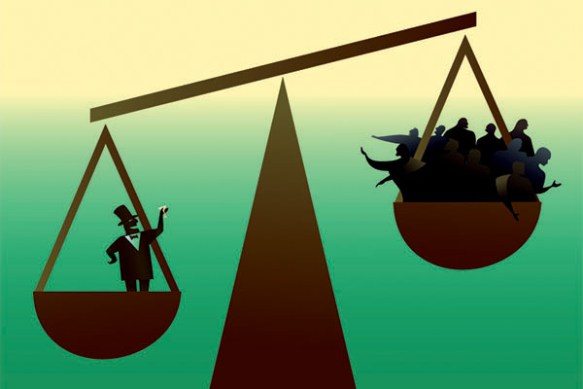
Certainly, inequality is the economic great wall between those with power and those without it.

As the animals of Orwell’s farm grew ever less equal, so in the present moment in a country that still claims equal opportunity for its citizens, one in which three Americans now have as much wealth as the bottom half of society (160 million people), you could certainly say that we live in an increasingly Orwellian society. Or perhaps an increasingly Twainian one.

After all, Mark Twain and Charles Dudley Warner wrote a classic 1873 novel that put an unforgettable label on their moment and could do the same for ours. The Gilded Age: A Tale of Today depicted the greed and political corruption of post-Civil War America. Its title caught the spirit of what proved to be a long moment when the uber-rich came to dominate Washington and the rest of America. It was a period saturated with robber barons, professional grifters, and incomprehensibly wealthy banking magnates. (Anything sound familiar?) The main difference between that last century’s gilded moment and this one was that those robber barons built tangible things like railroads. Today’s equivalent crew of the mega-wealthy build remarkably intangible things like tech and electronic platforms, while a grifter of a president opts for the only new infrastructure in sight, a great wall to nowhere.

In Twain’s epoch, the U.S. was emerging from the Civil War. Opportunists were rising from the ashes of the nation’s battered soul. Land speculation, government lobbying, and shady deals soon converged to create an unequal society of the first order (at least until now). Soon after their novel came out, a series of recessions ravaged the country, followed by a 1907 financial panic in New York City caused by a speculator-led copper-market scam.

From the late 1890s on, the most powerful banker on the planet, J.P. Morgan, was called upon multiple times to bail out a country on the economic edge. In 1907, Treasury Secretary George Cortelyou provided him with $25 million in bailout money at the request of President Theodore Roosevelt to stabilize Wall Street and calm frantic citizens trying to withdraw their deposits from banks around the country. And this Morgan did — by helping his friends and their companies, while skimming money off the top himself. As for the most troubled banks holding the savings of ordinary people? Well, they folded. (Shades of the 2007-2008 meltdown and bailout anyone?)

The leading bankers who had received that bounty from the government went on to cause the Crash of 1929. Not surprisingly, much speculation and fraud preceded it. In those years, the novelist F. Scott Fitzgerald caught the era’s spirit of grotesque inequality in The Great Gatsby when one of his characters comments: “Let me tell you about the very rich. They are different from you and me.” The same could certainly be said of today when it comes to the gaping maw between the have-nots and have-a-lots.

Income vs. Wealth

To fully grasp the nature of inequality in our twenty-first-century gilded age, it’s important to understand the difference between wealth and income and what kinds of inequality stem from each. Simply put, income is how much money you make in terms of paid work or any return on investments or assets (or other things you own that have the potential to change in value). Wealth is simply the gross accumulation of those very assets and any return or appreciation on them. The more wealth you have, the easier it is to have a higher annual income.

Let’s break that down. If you earn $31,000 a year, the median salary for an individual in the United States today, your income would be that amount minus associated taxes (including federal, state, social security, and Medicare ones). On average, that means you would be left with about $26,000 before other expenses kicked in.

If your wealth is $1,000,000, however, and you put that into a savings account paying 2.25% interest, you could receive about $22,500 and, after taxes, be left with about $19,000, for doing nothing whatsoever.

To put all this in perspective, the top 1% of Americans now take home, on average, more than 40 times the incomes of the bottom 90%. And if you head for the top 0.1%, those figures only radically worsen. That tiny crew takes home more than 198 times the income of the bottom 90% percent. They also possess as much wealth as the nation’s bottom 90%. “Wealth,” as Adam Smith so classically noted almost two-and-a-half-centuries ago in The Wealth of Nations, “is power,” an adage that seldom, sadly, seems outdated.

A Case Study: Wealth, Inequality, and the Federal Reserve

Obviously, if you inherit wealth in this country, you’re instantly ahead of the game. In America, a third to nearly a half of all wealth is inherited rather than self-made. According to a New York Times investigation, for instance, President Donald Trump, from birth, received an estimated $413 million (in today’s dollars, that is) from his dear old dad and another $140 million (in today’s dollars) in loans. Not a bad way for a “businessman” to begin building the empire (of bankruptcies) that became the platform for a presidential campaign that oozed into actually running the country. Trump did it, in other words, the old-fashioned way — through inheritance.

In his megalomaniacal zeal to declare a national emergency at the southern border, that gilded millionaire-turned-billionaire-turned-president provides but one of many examples of a long record of abusing power. Unfortunately, in this country, few people consider record inequality (which is still growing) as another kind of abuse of power, another kind of great wall, in this case keeping not Central Americans but most U.S. citizens out.

The Federal Reserve, the country’s central bank that dictates the cost of money and that sustained Wall Street in the wake of the financial crisis of 2007-2008 (and since), has finally pointed out that such extreme levels of inequality are bad news for the rest of the country. As Fed Chairman Jerome Powell said at a town hall in Washington in early February, “We want prosperity to be widely shared. We need policies to make that happen.” Sadly, the Fed has largely contributed to increasing the systemic inequality now engrained in the financial and, by extension, political system. In a recent research paper, the Fed did, at least, underscore the consequences of inequality to the economy, showing that “income inequality can generate low aggregate demand, deflation pressure, excessive credit growth, and financial instability.”

In the wake of the global economic meltdown, however, the Fed took it upon itself to reduce the cost of money for big banks by chopping interest rates to zero (before eventually raising them to 2.5%) and buying $4.5 trillion in Treasury and mortgage bonds to lower it further. All this so that banks could ostensibly lend money more easily to Main Street and stimulate the economy. As Senator Bernie Sanders noted though, “The Federal Reserve provided more than $16 trillion in total financial assistance to some of the largest financial institutions and corporations in the United States and throughout the world… a clear case of socialism for the rich and rugged, you’re-on-your-own individualism for everyone else.”

The economy has been treading water ever since (especially compared to the stock market). Annual gross domestic product growth has not surpassed 3%in any year since the financial crisis, even as the level of the stock market tripled, grotesquely increasing the country’s inequality gap. None of this should have been surprising, since much of the excess money went straight to big banks, rich investors, and speculators.  They then used it to invest in the stock and bond markets, but not in things that would matter to all the Americans outside that great wall of wealth.

The question is: Why are inequality and a flawed economic system mutually reinforcing? As a starting point, those able to invest in a stock market buoyed by the Fed’s policies only increased their wealth exponentially. In contrast, those relying on the economy to sustain them via wages and other income got shafted. Most people aren’t, of course, invested in the stock market, or really in anything. They can’t afford to be. It’s important to remember that nearly 80% of the population lives paycheck to paycheck.

The net result: an acute post-financial-crisis increase in wealth inequality — on top of the income inequality that was global but especially true in the United States. The crew in the top 1% that doesn’t rely on salaries to increase their wealth prospered fabulously. They, after all, now own more than half of all national wealth invested in stocks and mutual funds, so a soaring stock market disproportionately helps them. It’s also why the Federal Reserve subsidy policies to Wall Street banks have only added to the extreme wealth of those extreme few.

The Ramifications of Inequality

The list of negatives resulting from such inequality is long indeed. As a start, the only thing the majority of Americans possess a greater proportion of than that top 1% is a mountain of debt.

The bottom 90% are the lucky owners of about three-quarters of the country’s household debt. Mortgages, auto loans, student loans, and credit-card debt are cumulatively at a record-high $13.5 trillion.

And that’s just to start down a slippery slope. As Inequality.org reports, wealth and income inequality impact “everything from life expectancy to infant mortality and obesity.” High economic inequality and poor health, for instance, go hand and hand, or put another way, inequality compromises the overall health of the country. According to academic findings, income inequality is, in the most literal sense, making Americans sick. As one study put it, “Diseased and impoverished economic infrastructures [help] lead to diseased or impoverished or unbalanced bodies or minds.”

Then there’s Social Security, established in 1935 as a federal supplement for those in need who have also paid into the system through a tax on their wages. Today, all workers contribute 6.2% of their annual earnings and employers pay the other 6.2% (up to a cap of $132,900) into the Social Security system. Those making far more than that, specifically millionaires and billionaires, don’t have to pay a dime more on a proportional basis. In practice, that means about 94% of American workers and their employers paid the full 12.4% of their annual earnings toward Social Security, while the other 6% paid an often significantly smaller fraction of their earnings.

According to his own claims about his 2016 income, for instance, President Trump “contributed a mere 0.002 percent of his income to Social Security in 2016.” That means it would take nearly 22,000 additional workers earning the median U.S. salary to make up for what he doesn’t have to pay. And the greater the income inequality in this country, the more money those who make less have to put into the Social Security system on a proportional basis. In recent years, a staggering $1.4 trillion could have gone into that system, if there were no arbitrary payroll cap favoring the wealthy.

Inequality: A Dilemma With Global Implications

America is great at minting millionaires. It has the highest concentration of them, globally speaking, at 41%. (Another 24% of that millionaires’ club can be found in Europe.) And the top 1% of U.S. citizens earn 40 times the national average and own about 38.6% of the country’s total wealth. The highest figure in any other developed country is “only” 28%.

However, while the U.S. boasts of epic levels of inequality, it’s also a global trend. Consider this: the world’s richest 1% own 45% of total wealth on this planet. In contrast, 64% of the population (with an average of $10,000 in wealth to their name) holds less than 2%. And to widen the inequality picture a bit more, the world’s richest 10%, those having at least $100,000 in assets, own 84% of total global wealth.

The billionaires’ club is where it’s really at, though. According to Oxfam, the richest 42 billionaires have a combined wealth equal to that of the poorest 50% of humanity. Rest assured, however, that in this gilded century there’s inequality even among billionaires. After all, the 10 richest among them possess $745 billion in total global wealth. The next 10 down the list possess a mere $451.5 billion, and why even bother tallying the next 10 when you get the picture?

Oxfam also recently reported that “the number of billionaires has almost doubled, with a new billionaire created every two days between 2017 and 2018. They have now more wealth than ever before while almost half of humanity have barely escaped extreme poverty, living on less than $5.50 a day.”

How Does It End?

In sum, the rich are only getting richer and it’s happening at a historic rate. Worse yet, over the past decade, there was an extra perk for the truly wealthy. They could bulk up on assets that had been devalued due to the financial crisis, while so many of their peers on the other side of that great wall of wealth were economically decimated by the 2007-2008 meltdown and have yet to fully recover.

What we’ve seen ever since is how money just keeps flowing upward through banks and massive speculation, while the economic lives of those not at the top of the financial food chain have largely remained stagnant or worse. The result is, of course, sweeping inequality of a kind that, in much of the last century, might have seemed inconceivable.

Eventually, we will all have to face the black cloud this throws over the entire economy. Real people in the real world, those not at the top, have experienced a decade of ever greater instability, while the inequality gap of this beyond-gilded age is sure to shape a truly messy world ahead. In other words, this can’t end well.


Nomi Prins, a former Wall Street executive, is a TomDispatch regular. Her latest book is Collusion: How Central Bankers Rigged the World (Nation Books). She is also the author of All the Presidents’ Bankers: The Hidden Alliances That Drive American Power and five other books. Special thanks go to researcher Craig Wilson for his superb work on this piece.

Elite Banking at Your Expense: How Secretive Tax Havens are Used to Steal Your Money

By Robert J. Burrowes

Tax havens are locations around the world where wealthy individuals, criminals and terrorists, as well as governments and government agencies (such as the CIA), banks, corporations, hedge funds, international organizations (such as the Vatican) and crime syndicates (such as the Mafia), can stash their money so that they can avoid regulation and oversight and, very often, evade tax. According to Nicholas Shaxson: ‘Tax havens are now at the heart of the global economy.’

Which is why, as he explains it: ‘The term “tax haven” is a bit of a misnomer, because such places aren’t just about tax. What they sell is escape: from the laws, rules and taxes of jurisdictions elsewhere, usually with secrecy as their prime offering.’ See ‘The tax haven in the heart of Britain’. A tax haven (or ‘secrecy jurisdiction’) then is a ‘place that seeks to attract business by offering politically stable facilities to help people or entities get around the rules, laws and regulations of jurisdictions elsewhere’. See Treasure Islands: Tax Havens and the Men Who Stole the World.

Tax havens are a vitally important part of the global infrastructure of corruption and criminality – see ‘Giant Leak of Offshore Financial Records Exposes Global Array of Crime and Corruption’ – that enables privileged individuals and their organizations to legally and illegally steal money from the rest of us, particularly those in developing countries, and to have the services of a vast network of accountants, bankers, lawyers and politicians (often from captured legislatures) to help them do it, and to ensure that they get away with it.

How many tax havens are there? Where are they? How much money do they have? Who uses them? Why? How do they work? Why does all this matter to us? And what can we do about them?

Tax Havens: how many and where are they?

In his book Treasure Islands: Tax Havens and the Men Who Stole the World, author and financial journalist Nicholas Shaxson identified about sixty ‘secrecy jurisdictions’ or ‘offshore groups’ around the world which he divided into four categories, as follows.

The most important category, by far, is those tax havens that form the spider’s network of havens centred on the City of London. It has three main layers: there are two inner rings – Britain’s Crown Dependencies of Jersey, Guernsey (which includes the sub-havens of Sark, Alderney and Brecqhou) and the Isle of Man, and its overseas territories such as the Cayman Islands, Bermuda, the British Virgin Islands and Gibralter – which are substantially controlled by Britain. The third layer is an outer ring with a more diverse array of havens, like Hong Kong, Singapore, the Bahamas, Dubai and Ireland, which are outside Britain’s direct control but have strong historical and current links to that country and the City of London (which I will discuss below). This network controls almost one half of all international bank assets.

The second category of tax havens is those in Europe notably including Switzerland, Luxembourg – see ‘Explore the Documents: Luxembourg Leaks Database’ – the Netherlands, Belgium and Austria, as well as microstates such as Liechtenstein and Monaco. While ‘Geneva bankers had sheltered the secret money of European elites since at least the eighteenth century’, the European havens ‘got going’ during World War I as governments raised taxes sharply to pay for the war.

The third category of tax havens is that focused on the United States. It has three tiers as well. At the federal level, the US government offers a range of tax exemptions, secrecy provisions and laws designed to attract foreign money. This means, for example, that US banks can legally accept proceeds from a range of crimes as long as the crimes are committed overseas. The second tier involves individual US states such as Florida (where Central/South American elites do their banking and the countries adversely impacted are prevented by US secrecy provisions from accessing relevant data, and where much Mob and drugs money is hidden too), Delaware, Nevada and Wyoming, where even terrorist money is protected by secrecy provisions. The third tier of the US network is the overseas satellites such as the American Virgin Islands, the Marshall Islands, Liberia and Panama, with the latter, according to Jeffrey Robinson, being ‘one of the filthiest money laundering sinks in the world’. See The Sink: Terror, Crime and Dirty Money in the Offshore World.

As Shaxson notes: ‘offshore finance has quietly been at the heart of Neoconservative schemes to project US power around the globe for years. Few people have noticed.’

The fourth category of tax havens identified by Shaxson includes those that do not fit in the categories above, such as Somalia and Uganda.

The (incomplete) list of tax havens on the website ‘Tax Havens of the World’ will give you some idea of where these secrecy jurisdictions are located but there are important omissions in this list, notably including the City of London Corporation.

For a brief look at 15 tax havens (again, notably excluding some of the most important) and some of the corporations that use them, see ‘What Are the World’s Best Tax Havens?’

And for a highly instructive and utterly sobering video documentary on British Tax Havens, see ‘The Spider’s Web: Britain’s Second Empire’. This documentary will inform you, among many more important things, that the building housing Her Majesty’s Revenue and Customs, the UK tax office, is owned by an offshore company in Bermuda!

To summarize the central aspect of the development of tax havens following World War II: ‘The British Establishment – an old boys network of privileged elites – had carved out a lucrative vehicle for themselves in the offshore world after the demise of Empire. They transformed themselves from administrators of Empire to financial handlers for the global elite and multinational corporations.’ See ‘The Spider’s Web: Britain’s Second Empire’.

Before concluding this section, it is worth emphasizing that, as Shaxson explains it, ‘the offshore world is not a bunch of independent states exercising their sovereign rights to set their laws and tax systems as they see fit. It is a set of networks of influence controlled by the world’s major powers, notably Britain and the United States. Each network is deeply interconnected with the others.’ He goes on: ‘The world’s most important tax havens are not exotic palm-fringed islands, as many people suppose, but some of the world’s most powerful countries.’ Shaxson quotes Marshall Langer, a prominent supporter of secrecy jurisdictions: ‘It does not surprise anyone when I tell them that the most important tax haven in the world is an island. They are surprised, however, when I tell them that … the island is Manhattan. Moreover, the second most-important tax haven … is located on an island. It is called the City of London.’

The City of London Corporation

What is the City of London Corporation, also known as the ‘Square Mile’? It is ‘a 1.22-square-mile slab of prime central London real estate that stretches from the Thames at Victoria Embankment, clockwise up through Fleet Street, the Barbican Centre, then to Liverpool Street in the north-east, then back down to the Thames just west of the Tower of London.’ See Treasure Islands: Tax Havens and the Men Who Stole the World.

According to Shaxson, the City of London Corporation, the ‘modern period’ of which dates from 1067 (yes, that is not a typing error), is ‘the local-government authority for the 1.2-square-mile slab of prime real estate in central London that is the City of London. The corporation is an ancient, semi-alien entity lodged inside the British nation state; a “prehistoric monster which had mysteriously survived into the modern world”, as a 19th-century would-be City reformer put it.’

Importantly, Shaxson explains, ‘the role of the City of London Corporation as a municipal authority is its least important attribute. This is a hugely resourced international offshore lobbying group pushing for international financial deregulation, tax-cutting and tax havenry around the world.’ Moreover, it is ‘the hub of a global network of tax havens sucking up offshore trillions from around the world and sending it, or the business of handling it, to London’. Notably, so powerful is the City of London that no sovereign or government of Britain in a thousand years has had the courage to seriously take it on and attempt to subject it to British government control. See ‘The tax haven in the heart of Britain’.

How much money is in Tax Havens?

So how much of the world’s wealth is stashed in tax havens around the globe? According to the Tax Justice Network in its 2012 report written by James S. Henry ‘The Price of Offshore Revisited: New Estimates for “Missing” Global Private Wealth, Income, Inequality, and Lost Taxes’: ‘A significant fraction of global private financial wealth – by our estimates, at least $21 to $32 trillion as of 2010 – has been invested virtually tax-free through the world’s still-expanding black hole of more than 80 “offshore” secrecy jurisdictions. We believe this range to be conservative…’ He goes on to emphasize that ‘this is just financial wealth. A big share of the real estate, yachts, racehorses, gold bricks – and many other things that count as non-financial wealth – are also owned via offshore structures where it is impossible to identify the owners’.

Henry also notes that given that Credit Suisse estimated global wealth in 2011 at $231 trillion, the amount of money in secrecy jurisdictions is conservatively estimated at 10% of global wealth.

But other figures do indeed suggest this estimate is low. Shaxson cites compelling evidence that ‘More than half of world trade passes, at least on paper, through tax havens. Over half of all banking assets and a third of foreign direct investment by multinational corporations, are routed offshore.’ Moreover, as long ago as 2008, the US Government Accountability Office reported that 83 of the 100 biggest corporations in the USA had subsidiaries in tax havens and the following year, using a broader definition, the Tax Justice Network discovered that ninety-nine of Europe’s hundred largest companies used offshore subsidiaries. And in each country, ‘the largest user by far was a bank’. See Treasure Islands: Tax Havens and the Men Who Stole the World.

In any case, the most recent estimate by the Tax Justice Network indicates ‘tax losses to profit shifting by multinational companies (a)pplying a methodology developed by researchers at the International Monetary Fund to an improved dataset… of around $500 billion a year’. See ‘New estimates reveal the extent of tax avoidance by multinationals’.

To reiterate then, on the understanding that these estimates are probably quite low, by 2010, between $US21 and $US32 trillion had been taken out of circulation so that it was beyond the laws, financial regulations and taxes that the rest of us cannot escape. But that figure has been added to by half a trillion dollars each year since, by moving more money into tax havens. And don’t forget: this figure does not include non-financial wealth. How many gold bricks, yachts, artworks and racehorses do you own and have stashed away somewhere free of scrutiny?

Who uses Tax Havens? And why?

As I mentioned above, tax havens are used by wealthy individuals (including businesspeople, sports and pop stars), criminals and terrorists, as well as governments (and their agencies), banks, corporations (such as Amazon and Google), international organizations and crime syndicates (such as the Medellin Cartel). While motives vary, in essence the lack of regulation and oversight, as well as tax evasion, are the reasons that individuals and organizations use them.

An individual might want to hide stolen wealth, to evade tax or cheat a divorced spouse out of their share of the family fortune. A bank, corporation, crime syndicate, international or terrorist organization might want to evade scrutiny of the source of their money and/or evade tax on windfall or even ongoing profits (legal and/or otherwise). A government might want to hide the ‘dirty money’ it uses to finance ‘black ops’ (that is, illegal and secret military violence such as that carried out by the CIA). But there are myriad explanations.

In John Christensen’s analysis of over 100 offshore clients of accounting firm Deloitte Touche he studied in Jersey, he found that the clients were engaging in insider trading, market rigging, failure to disclose conflicts of interest, weapons trading, illicit political donations, contract kickbacks, bribery, fraudulent invoicing, trade mispricing and tax evasion. See ‘The Spider’s Web: Britain’s Second Empire’.

Most people have heard of the money stashed away by corrupt dictators like Suharto in Indonesia, Ferdinand Marcos in the Philippines and Mobuto Sese Seko of Zaire (now Democratic Republic of the Congo) each of whom stole from the people of their country. However, they could only do this with the help of western enablers and ongoing elite resistance to developing country attempts to create a more transparent and fairer process for collecting tax on cross-border financial flows. As a result, Alex Cobham of the Tax Justice Network observes, worldwide, developing nations lose in excess of $1trillion per year in ‘capital flight’ and tax evasion to wealthy countries. See ‘The Spider’s Web: Britain’s Second Empire’.

But these more public examples, while terrible, tend to obscure two important facts. The amount stolen from sub-Saharan Africans, for example, between 1970 and 2008 was at least five times the total amount of their foreign debt during that period – see ‘The Spider’s Web: Britain’s Second Empire’ – and, by highlighting these examples, attention is drawn away from even worse and ongoing examples of such criminality by those corrupt/criminal individuals and organizations (including banks, accountancy and legal firms, corporations, international organizations, crime syndicates and governments) committed to using outright theft, fraud, money laundering and other devices to steal wealth from ordinary people all over the world.

So, for example, if one follows the money trails of various lucrative financial operations, some technically legal but immoral and others simply illegal, apart from the world’s major corporations, one quickly comes across the names of the major (and well known) banks and financial institutions (such as the Bank of England, Barclays, Goldman Sachs, JPMorgan Chase…), the ‘big four’ accountancy firms (Deloitte, Ernst & Young (EY), KPMG and PricewaterhouseCoopers), and elite lawyers (such as those in London’s ‘Magic Circle’, like Clifford Chance, Mourant du Feu & Jeune, and Slaughter and May). See, for example, Treasure Islands: Tax Havens and the Men Who Stole the World, ‘New estimates reveal the extent of tax avoidance by multinationals’ and ‘Looting with Putin’.

Apparently, like major corporations and crime syndicates, few banks, accountancy firms and lawyers have ethics policies that require them to follow the law and to exercise ‘due diligence’ (check out a client before signing a contract) so that they can steer clear of handling illegal and immoral profits, especially if they are monstrous.

In fact, according to a US Senate report, ‘virtually every major bank in the world – especially the biggest in North America and Europe – holds accounts for offshore banks and/or banks in suspect jurisdictions’. See The Sink: Terror, Crime and Dirty Money in the Offshore World.

As Eva Joly MEP, vice-chair of the Panama Papers Committee of the European Parliament, succinctly puts it: ‘Ordinary people are paying taxes. Rich people are not.’ See ‘The Spider’s Web: Britain’s Second Empire’.

The Vatican

But perhaps the example which best illustrates the moral depravity of those who use tax havens is the Vatican. In his carefully researched book Operation Gladio: The Unholy Alliance between the Vatican, the CIA and the Mafia author Paul L. Williams recounts the efforts of the CIA, former Nazis, the Sicilian/American Mafia, the Vatican and even Freemasonry to resist an anticipated postwar invasion of western Europe by those ‘Godless communists’ in the Soviet Union by establishing ‘stay-behind units’ (clandestine military and paramilitary units) throughout the countries of Europe (Belgium, Denmark, Italy, Netherlands, Norway, Portugal…) led by former Nazis and composed of ‘die-hard fascist fanatics’.

This alliance to fight the Cold War against the former Soviet Union and the rising tide of progressive governments in Europe and the rest of the world, particularly as the US war on Vietnam gathered pace, led, as Williams chillingly puts it, to ‘the toppling of governments, wholesale slaughter and financial devastation’ around the world. It was also, of course, the forerunner to its equivalent – Operation Condor – to resist, and destroy if possible, the spread of progressive movements, ranging from communism to liberation theology, throughout Central/South America.

While the Vatican played a number of unsavory roles in this alliance, including its facilitation of massive numbers of heroin addictions, its use of counterfeit securities, participation in false flag attacks that killed thousands and strings of gangland slayings, support of military juntas (that massacred tens of thousands) and the ‘purging’ of progressive priests (including Archbishop Óscar Romero of San Salvador and two Jesuit priests denounced by Fr. Jorge Mario Bergoglio, now Pope Francis, in Argentina: see ‘Who is Pope Francis? Jorge Mario Bergoglio and Argentina’s “Dirty War”’) while causing the financial destitution of thousands of families, one of its key ongoing functions, designed to maximize the Vatican’s power while highlighting its moral and spiritual bankruptcy, was to act as ‘God’s banker’ for many of these operations. See Operation Gladio: The Unholy Alliance between the Vatican, the CIA and the Mafia.

It did this, for example, by accepting Mafia/Medellin Cartel-collected drugs money (for a 15-20% cut) into the Vatican Bank (technically: Istituto per le Opere di Religione or Institute for the Works of Religion) and then laundering it through its shell companies – such as Cisalpine Overseas Bank, Astolfine SA, United Trading Corporation, Erin SA, Bellatrix SA, Belrose SA, Starfield SA and Nordeurop Establishment – in tax havens in the Bahamas, Liechtenstein, Luxembourg, Panama and Switzerland.

With the CIA providing services, such as the transport of Mafia/Medellin cocaine to drug dealers in the US, its share of the drug profits (cycled through its own CIA-controlled banks including Continental Illinois, Castle Bank & Trust, and Bank of Credit and Commerce International but eventually involving many of the most prestigious banks in the US, as the money was passed to the Vatican Bank) were used to finance key aspects of Operations Gladio and Condor with weapons also supplied by the CIA from NATO arsenals. But there was plenty of Vatican money in these Operations too.

As an aside, so devastating was the fallout from the ongoing exposure of the many aspects of Vatican corruption that, by the beginning of the twenty-first century, Roman Catholic membership was falling by 400,000 per year in the USA alone but the trend was even stronger in Europe with ‘magnificent churches and cathedrals’ becoming museums visited solely by tourists, parishes being boarded up, seminaries and convents closed, and parochial schools consolidated. And this was before the ‘plague of pedophilia’ had fully hit further decimating the Church’s tattered reputation. To this day, the Vatican Bank remains ‘one of the world’s leading laundries for dirty money’. See Operation Gladio: The Unholy Alliance between the Vatican, the CIA and the Mafia.

How do Tax Havens work?

Each tax haven offers its own unique combination of services. After all, it is a tough market competing for the world’s wealth and so each jurisdiction has developed its own set of services designed to maximize its attractiveness to potential clients. In essence, this means that there is some ongoing ‘competition’ to reduce regulatory and oversight requirements so that each tax haven can attract clientele. This has become so extreme that basic requirements of banking for those who do it legally, such as proof of identity, are not required in the offshore world. In fact, even your true name can be withheld if you wish. It is easier to avoid any risk of embarrassment from exposure this way.

As a result, virtually any jurisdiction will open an account (or as many accounts as you want) in whatever names you specify. Then, usually employing a variety of devices, ranging from secret bank accounts, nominee directors (usually locals who play no part in the organization bar give it their name) and structures such as shell companies (that exist on paper and perhaps a wall plaque somewhere, but nothing else) and trusts (which, unlike the legitimate version, appear to separate responsibility and control from the benefits of ownership but actually do not), to processes such as transfer pricing (a technique by which companies ‘shift paper profits into low-tax countries and costs into high-tax countries’ to minimize – or eliminate – tax payments) and often employing a convoluted process that rapidly shifts monies through several jurisdictions so that it becomes ‘untraceable’ (because authorities must get permission to access each jurisdiction in turn in any effort to trace the money), profits are effectively hidden and any accountability to authorities of any kind utterly eliminated. See Treasure Islands: Tax Havens and the Men Who Stole the World.

For one simple example of such a strategy, employing a technique known as the ‘double Irish, Dutch sandwich’ (which is legal), see Google shifted $23bn to tax haven Bermuda in 2017, filing shows. But you can read other examples here: ‘The tech giants will never pay their fair share of taxes – unless we make them’ and ‘7 Corporate Giants Accused of Evading Billions in Taxes’.

Why does the existence of Tax Havens matter to us?

Well, the simple answer to this question is that just a fraction of the money hidden in tax havens would feed, clothe, house and provide clean water, medical care and educational opportunities to everyone on Earth. It would eliminate the 100,000 deaths by starvation-related diseases each day. It would eliminate poverty and homelessness. And, as one byproduct of having these material needs met, it would facilitate the emergence of an informed, engaged and empowered human population to tackle the vast range of environmental, climate and military threats that currently threaten biosphere collapse and imminent human extinction. See ‘Human Extinction by 2026? A Last Ditch Strategy to Fight for Human Survival’.

As Professor Prem Sikka puts it more simply: Because of the penetration by financial services executives of the British state, including the Treasury ‘It deprives people of opportunities to have healthcare, education, security, justice and, ultimately, a fulfilling life.’ See ‘The Spider’s Web: Britain’s Second Empire’.

Fundamentally, then, tax havens and their secrecy are at the heart of those elite institutions and processes that functionally undermine democracy and give extraordinary power to certain anonymous individuals and their entities without accountability. See ‘The Spider’s Web: Britain’s Second Empire’.

Of course, the elites that control the tax haven networks are not about to let this change. Tax havens are simply too important as part of the global infrastructure for maintaining elite profit, power and privilege and for resisting grassroots efforts to bring peace, justice and ecological sanity to our world. And that is why they are protected by government legislation and legal systems, with an ‘army’ of accountants, auditors, bankers, businesspeople, lawyers and politicians ensuring that they remain protected.

So don’t forget: laws are designed to control and punish you, no matter how trivial your infringement: a parking fine, a littering offence, a petty theft. But if you have enough money, the law simply does not exist. And you can evade taxes legally and in the full knowledge that your vast profits (even from immorally-acquired wealth such as sex trafficking, gun-running, endangered species trafficking, conflict diamonds and drug trafficking) are ‘lawful’ and will escape regulation and oversight of any kind. See ‘The Rule of Law: Unjust and Violent’.

Let me give a personal example. I have been a war tax resister since 1983: I have a conscientious objection to paying taxes to the Australian government to deploy military forces in other countries to kill people in my name. So, instead of paying taxes to kill, for many years I donated the equivalent amount to organizations engaged in peace, development, environment and human rights work, and to ‘pay the rent’ for my use of indigenous land. As some of many outcomes to this conscientious and highly public resistance (garnering national media attention at times), in 1991 I was bankrupted, in 1992 I was convicted of contempt of court (for my conscientious refusal to cooperate with the bankruptcy trustee) and in 1993 my passport was seized. In 1999, I was advised that I will be ‘bankrupt forever’ because of my ongoing conscientious refusal to finance the killing.

In the same period, since 1983, trillions and trillions of dollars of tax have been illegally and secretly evaded as wealthy individuals and corporations, criminals and crime syndicates, international organizations and governments channel their incomes and profits through tax havens. Laws and legal systems throughout the world make this possible and, provided it is done correctly, it is quite straightforward to avoid any penalties for secretly evading payment of taxes or hiding money acquired through criminal activity. But the point, as you can see, is that tax evasion by wealthy individuals and corporations meant that many of these individuals and corporations didn’t pay taxes to kill people either. They just didn’t pay taxes at all.

Of course, their motive was personal gain, their way was legal, they incurred no penalty and, of course, they didn’t pay an equivalent amount to support peace and justice causes. More fundamentally, however, the trillions of dollars they took from the global economy were made by killing and exploiting people and the planet in a significant variety of other ways, ranging from sex trafficking, gun-running, conflict diamonds and trafficking in drugs and endangered species, to simply starving people to death at the rate of 100,000 people each day by managing the global economy, using tax havens as a primary tool, to extract maximum profit.

Richard Brooks documents how this legal exploitation occurs in another way in his book The Great Tax Robbery: How Britain Became a Tax Haven for Fat Cats and Big Business. The vast tax evasion by elites in Britain, including by diverting funds through tax havens, attracts just five prosecutions each year per £1 billion of evasion of direct taxes. In contrast, benefits fraud by those on unemployment and disability pensions attract 9,000 prosecutions each year per £1 billion of fraud. ‘So theft by the poor warrants the full force of the law’. But not theft by elites who write the law and largely control the political and legal processes in relation to it.

Hence, under the guise of ‘relationship taxing’ (that is, building a relationship between tax authorities and corporate executives and ‘tailoring’ tax payments to corporate wishes to the extent the law allows), corporations have long known that ‘If you don’t like the law… we’ll see what we can do’.

As is obvious from this example, attempts at government reform, including to defeat tax havens, in the direction of making elites financially and legally accountable, both nationally and internationally, for the responsibilities which the rest of us cannot escape, are invariably for show and, in any case, achieve zero of substance. For example, the attempt to ‘approve’ a blacklist of tax havens at the G20 gathering in 2009 was resisted by the Chinese premier on behalf of Chinese elites who, like other national elites keen to have political control but ‘judicial separation’ from their offshore centres, opposed the listing of notorious havens Hong Kong and Macau: see Treasure Islands: Tax Havens and the Men Who Stole the World. The global elite is clearly in control with national governments and international organizations powerlessly doing as instructed. So complete is this control, in fact, that Brooks notes that, in Britain, ‘Anti-tax avoidance laws had to be relaxed to accommodate companies’ tax avoidance schemes.’

Brooks concludes that ‘British taxation policy really had been so comprehensively captured by the world’s biggest corporations that screw-the-poor policies… could be written into the statute books at their whim, without a pang of conscience being felt anywhere in Whitehall.’ Clearly, however, his comment can be applied to virtually any government in the world.

So does it matter to you that these tax havens exist and do what they do?

What can be done about Tax Havens?

Authors such as Nicholas Shaxson and Richard Brooks suggest a raft of measures to correct the large number of ‘faults’ that facilitate the secrecy, protection from regulation and tax evasion that individuals, corporations, organizations, criminals and terrorists utilize in tax havens.

For Shaxson, these include financial reforms such as ‘blacklisting’ of tax havens so that their rogue state status is public knowledge; greater transparency, for example, through government sharing of information about the local income and assets of each other’s citizens and by requiring multinational corporate activities in each country to be made visible (rather than hidden behind ‘international’ figures); promoting the needs of developing countries which need their tax bases protected far more than they need aid or debt relief; confronting the British ‘spider’s web’ of tax havens by abolishing the City of London Corporation and submerging it into a unified and fully democratic London; taxing an entire multinational ‘group’ as a single unit and then allocating the appropriate amounts of its income out to the different jurisdictions in which it was earned and allow it to be taxed as each jurisdiction decides; onshore tax reform such as a land value tax (because land cannot be moved offshore and so tax on it must be paid locally), and by a direct distribution of mineral wealth in any country to each of its inhabitants (who can then be taxed); tackling the ‘enablers’ – the accountants, lawyers, individual bankers, businesspeople – and not just the clients, so that they go to jail; rethinking the meaning of ‘corporate responsibility’ (because corporations are given a wealth of capital in public infrastructure, an educated and healthy workforce… with which to work) so that corporations are transparent about their affairs and pay tax as part of their corporate responsibility; re-evaluating the meaning of corruption – insiders abusing the common good in secrecy and getting away with it and so worsening inequality and entrenching vested interests and unaccountable power – so that we see, more clearly, all of the actors and their activities; and changing the culture that fawns over people who abuse the system for personal gain. See Treasure Islands: Tax Havens and the Men Who Stole the World.

And some progress appears to be occurring along lines he suggests. For example, a version of automatic information exchange (AIE), by which governments make sure that essential information is made available to other jurisdictions as a matter of routine, has been discussed by the OECD and, while full of loopholes – see ‘Loophole USA: the vortex-shaped hole in global financial transparency’ – some commitments have been made. For the list of commitments as at November 2018, see ‘AEOI commitments’.

However, the USA has not made this commitment and while Switzerland, for example, finds this objectionable – see ‘The U.S. hasn’t signed the AEoI Agreement: Reciprocity demanded’ – the reality is that it makes little difference. For example, ICO Services, which specializes in the formation of offshore companies and offshore banking, will assist you to get around the AEoI requirement. Their website advertises that ‘asset holders need to start looking for alternative jurisdictions for protecting their assets. There are some reputable jurisdictions that are still outside the AEoI  – e.g. Cyprus  –  but U.S. states of Delaware and some others shouldn’t be dismissed.’

But if you want a more established name to help you take advantage of a tax haven in the USA, you really can’t go past Rothschild & Co. So, to check out what they are offering: ‘Here Is Rothschild’s Primer How To Launder Money In U.S. Real Estate And Avoid “Blacklists”’.

Moreover, the AEoI agreement ‘outlaws’ bank secrecy but not trust secrecy (which dates from the Crusades) on which the British model is based – ‘The Trust lies at the core of the British secrecy model’ – so it does not address the cornerstone of British tax haven secrecy and explains why the British were happy to see the Cayman Islands commit to the AEoI. In short: the British government would be happy to kill off bank secrecy so that they can capture a larger market share (based on Trust secrecy). See ‘The Spider’s Web: Britain’s Second Empire’.

Separately from this initiative, in 2018 the UK parliament enacted a new law requiring its overseas territories – including notorious tax havens like Bermuda, the Cayman Islands and the British Virgin Islands – to start disclosing the owners of corporations they register by 2020. In theory: ‘This could shut down a huge amount of offshore tax evasion and other financial crimes because individuals from anywhere in the world, including the United States, have long been able to set up secret corporations in these tax havens to stash their money.’ See ‘New UK Law May Shut Down the Biggest Tax Havens – Aside from the U.S.’

However, while the report pointed out that the new law obviously does not impact the USA (or, of course, Switzerland or …) and the easy rerouting options available if these havens are effectively (or even actually) shut down, it failed to mention that this initiative does not in any way address the City of London Corporation so the impact of this initiative must be very limited unless it is followed by some pretty drastic initiatives in Westminster, Washington, Bern and elsewhere.

In summary, while one cannot disagree with any of Shaxson’s fine suggestions or be displeased that public pressure has led to some effort being made by the OECD and the UK parliament to address elements of the tax haven scourge, the reality is that the extent of the changes necessary are not going to happen without enormous grassroots pressure, strategically applied, and they are very unlikely to happen as reforms of the existing capitalist system. This is simply because the global elite is solidly in control of the institutions and processes of global capitalism, including its compliant governments and international organizations, and will readily stymie any attempt at serious reform of tax havenry particularly given the number of major reforms needed and the number of nations in which these reforms must be enacted. To state two obvious examples: The City of London Corporation has not existed for 1,000 years because it has no defense. And the changes noted above have only made the US more attractive as a secrecy jurisdiction.

Meanwhile, with the aim of promoting ‘financial innovation’, Switzerland has recently made things easier for smaller financial technology companies thus making tax havenry more attractive to those who might not have otherwise considered it. See ‘Swiss watchdog to propose looser anti-money laundering rules for fintechs’.

So, given that most tax havens are protected by host government legislation and there is no international mechanism to control them, the tax haven industry generally is not under threat of being held to account in any significant way.

And, despite the more elaborate explanation offered above, there is a simple reason for this. Unofficially, of course, illegal money, laundered through tax havens, has become an essential and sometimes stabilizing element of the global financial system. See ‘Drug money saved banks in global crisis, claims UN advisor’.

So what can we do that will make a difference?

Given the deeply entrenched and long-standing nature of this problem, clearly it needs to be addressed at various levels.

Fundamentally, we can nurture our children so that we do not destroy their conscience. See ‘My Promise to Children’. Remember all of those corrupt/criminal accountants, bankers, businesspeople, priests and popes, lawyers and politicians that kept creeping up in the discussion above? The people who maintain the entire infrastructure that allows tax havens to exist and those who manage and profit from it too?

Do they care about you? Do they care about the people in Africa, Asia and Central/South America who starve as a result of the types of policies that allow tax havens to exist and function? Do they care about those driven into poverty and homelessness in modern industrial economies because vast sums are drained out of them and hidden in secrecy jurisdictions? Do they care about the people killed by the military and other violence from which they profit and then hide the proceeds to evade tax? Do they care about the Earth? Fundamentally, do they care about themselves?

Of course not! But this is only because they are extraordinarily psychologically damaged individuals. See ‘The Global Elite is Insane Revisited’ with a more complete explanation in Why Violence? and Fearless Psychology and Fearful Psychology: Principles and Practice.

If we inflict enormous violence on a child throughout their childhood to compel their obedience, how can we expect them to grow up to lead a life of integrity based on their conscience, courage, compassion, empathy and love? Those who use tax havens are truly ‘poor little rich boys’ (and girls). See ‘Love Denied: The Psychology of Materialism, Violence and War’ and ‘Why Set Up a Shell Company in Panama? The Psychology Driving Illicit Financial Flows’.

Beyond tackling the problem at its source however, we can also tackle manifestations of the problem but not by lobbying elites – and their political agents: there are no votes in it, in any case – to control this depravity for which they are well rewarded.

For a start we can boycott all of the major private banks in favor of those smaller or member-owned banks that have a serious commitment to peace, justice and ecological sustainability, or we can seek out equivalent institutions like credit unions. We can also create public banks based on ethical principles. See ‘What are Public Banks and How Do They Operate? An Introduction’.

We can boycott large corporations – like Amazon, Apple, Gap, Google, Ikea, Microsoft and Starbucks – that use tax havens. None of these corporations is a monopoly: there are alternatives which can be investigated and employed, assuming we can’t go without some version of the product or service they offer. Whenever you can, find a locally-owned outlet that offers a local product or service.

We can boycott the Catholic Church. God does not ask that you morally or financially support a corrupt organization that doesn’t understand or represent morality and spirituality. Remember, it was Jesus who threw the moneychangers out of the temple.

If our conscience speaks loudly enough, we can decline employment by any organization that is unethical, such as those that use tax havens.

We can refuse to gamble, refuse to buy the services of a sex worker (who might even be illegally trafficked into the work), refuse to buy the products of endangered species – see, for example, ‘Killing Elephants “for Pet Food” Condemned’ – and refuse to use illicit drugs. These products and services are virtually always offered by industries controlled by criminal organizations so by buying them you are only harming yourself and/or other people or species about whom you could choose to exercise a duty of care while also not contributing to the diversion of financial resources into tax havens.

We can encourage unions, with members who work for organizations using tax havens, to take a stand on the issue.

We can support existing organizations that work on the problem, preferably those that offer grassroots alternatives. The Tax Justice Network, an ‘activist think tank’, and its sister organization, the Global Alliance for Tax Justice, campaign for systemic change.

If we are genuinely ambitious, we can develop comprehensive nonviolent strategies to compel particular individuals and organizations to desist from using tax havens or even compel countries to close down tax havens. See Nonviolent Campaign Strategy. This can easily be part of a larger strategy to transform the global economy into one that satisfies human and ecological needs, particularly given the imminence of biosphere collapse, as noted above. See The Flame Tree Project to Save Life on Earth.

If violence and exploitation in all of their guises concern you, consider signing the online pledge of ‘The People’s Charter to Create a Nonviolent World’.

So here is a final question for you to consider: What might the world look like if all those trillions of dollars were being shared and spent where they are most needed?


Biodata: Robert J. Burrowes has a lifetime commitment to understanding and ending human violence. He has done extensive research since 1966 in an effort to understand why human beings are violent and has been a nonviolent activist since 1981. He is the author of Why Violence? His email address is flametree@riseup.net and his website is here.

Robert J. Burrowes
P.O. Box 68
Daylesford, Victoria 3460
Australia

Email: flametree@riseup.net

Websites:
Nonviolence Charter
Flame Tree Project to Save Life on Earth
‘Why Violence?’
Feelings First
Nonviolent Campaign Strategy
Nonviolent Defense/Liberation Strategy
Anita: Songs of Nonviolence
Robert Burrowes
Global Nonviolence Network

Wall Street, Banks, and Angry Citizens

The Inequality Gap on a Planet Growing More Extreme

By Nomi Prins

Source: TomDispatch.com

As we head into 2019, leaving the chaos of this year behind, a major question remains unanswered when it comes to the state of Main Street, not just here but across the planet. If the global economy really is booming, as many politicians claim, why are leaders and their parties around the world continuing to get booted out of office in such a sweeping fashion?

One obvious answer: the post-Great Recession economic “recovery” was largely reserved for the few who could participate in the rising financial markets of those years, not the majority who continued to work longer hours, sometimes at multiple jobs, to stay afloat. In other words, the good times have left out so many people, like those struggling to keep even a few hundred dollars in their bank accounts to cover an emergency or the 80% of American workers who live paycheck to paycheck.

In today’s global economy, financial security is increasingly the property of the 1%. No surprise, then, that, as a sense of economic instability continued to grow over the past decade, angst turned to anger, a transition that — from the U.S. to the Philippines, Hungary to Brazil, Poland to Mexico — has provoked a plethora of voter upheavals. In the process, a 1930s-style brew of rising nationalism and blaming the “other” — whether that other was an immigrant, a religious group, a country, or the rest of the world — emerged.

This phenomenon offered a series of Trumpian figures, including of course The Donald himself, an opening to ride a wave of “populism” to the heights of the political system. That the backgrounds and records of none of them — whether you’re talking about Donald Trump, Viktor Orbán, Rodrigo Duterte, or Jair Bolsonaro (among others) — reflected the daily concerns of the “common people,” as the classic definition of populism might have it, hardly mattered. Even a billionaire could, it turned out, exploit economic insecurity effectively and use it to rise to ultimate power.

Ironically, as that American master at evoking the fears of apprentices everywhere showed, to assume the highest office in the land was only to begin a process of creating yet more fear and insecurity. Trump’s trade wars, for instance, have typically infused the world with increased anxiety and distrust toward the U.S., even as they thwarted the ability of domestic business leaders and ordinary people to plan for the future. Meanwhile, just under the surface of the reputed good times, the damage to that future only intensified. In other words, the groundwork has already been laid for what could be a frightening transformation, both domestically and globally.

That Old Financial Crisis

To understand how we got here, let’s take a step back. Only a decade ago, the world experienced a genuine global financial crisis, a meltdown of the first order. Economic growth ended; shrinking economies threatened to collapse; countless jobs were cut; homes were foreclosed upon and lives wrecked. For regular people, access to credit suddenly disappeared. No wonder fears rose. No wonder for so many a brighter tomorrow ceased to exist.

The details of just why the Great Recession happened have since been glossed over by time and partisan spin. This September, when the 10th anniversary of the collapse of the global financial services firm Lehman Brothers came around, major business news channels considered whether the world might be at risk of another such crisis. However, coverage of such fears, like so many other topics, was quickly tossed aside in favor of paying yet more attention to Donald Trump’s latest tweets, complaints, insults, and lies. Why? Because such a crisis was so 2008 in a year in which, it was claimed, we were enjoying a first class economic high and edging toward the longest bull-market in Wall Street history. When it came to “boom versus gloom,” boom won hands down.

None of that changed one thing, though: most people still feel left behind both in the U.S. and globally. Thanks to the massive accumulation of wealth by a 1% skilled at gaming the system, the roots of a crisis that didn’t end with the end of the Great Recession have spread across the planet, while the dividing line between the “have-nots” and the “have-a-lots” only sharpened and widened.

Though the media hasn’t been paying much attention to the resulting inequality, the statistics (when you see them) on that ever-widening wealth gap are mind-boggling. According to Inequality.org, for instance, those with at least $30 million in wealth globally had the fastest growth rate of any group between 2016 and 2017. The size of that club rose by 25.5% during those years, to 174,800 members. Or if you really want to grasp what’s been happening, consider that, between 2009 and 2017, the number of billionaires whose combined wealth was greater than that of the world’s poorest 50% fell from 380 to just eight. And by the way, despite claims by the president that every other country is screwing America, the U.S. leads the pack when it comes to the growth of inequality. As Inequality.org notes, it has “much greater shares of national wealth and income going to the richest 1% than any other country.”

That, in part, is due to an institution many in the U.S. normally pay little attention to: the U.S. central bank, the Federal Reserve. It helped spark that increase in wealth disparity domestically and globally by adopting a post-crisis monetary policy in which electronically fabricated money (via a program called quantitative easing, or QE) was offered to banks and corporations at significantly cheaper rates than to ordinary Americans.

Pumped into financial markets, that money sent stock prices soaring, which naturally ballooned the wealth of the small percentage of the population that actually owned stocks. According to economist Stephen Roach, considering the Fed’s Survey of Consumer Finances, “It is hardly a stretch to conclude that QE exacerbated America’s already severe income disparities.”

Wall Street, Central Banks, and Everyday People

What has since taken place around the world seems right out of the 1930s. At that time, as the world was emerging from the Great Depression, a sense of broad economic security was slow to return. Instead, fascism and other forms of nationalism only gained steam as people turned on the usual cast of politicians, on other countries, and on each other. (If that sounds faintly Trumpian to you, it should.)

In our post-2008 era, people have witnessed trillions of dollars flowing into bank bailouts and other financial subsidies, not just from governments but from the world’s major central banks. Theoretically, private banks, as a result, would have more money and pay less interest to get it. They would then lend that money to Main Street. Businesses, big and small, would tap into those funds and, in turn, produce real economic growth through expansion, hiring sprees, and wage increases. People would then have more dollars in their pockets and, feeling more financially secure, would spend that money driving the economy to new heights — and all, of course, would then be well.

That fairy tale was pitched around the globe. In fact, cheap money also pushed debt to epic levels, while the share prices of banks rose, as did those of all sorts of other firms, to record-shattering heights.

Even in the U.S., however, where a magnificent recovery was supposed to have been in place for years, actual economic growth simply didn’t materialize at the levels promised. At 2% per year, the average growth of the American gross domestic product over the past decade, for instance, has been half the average of 4% before the 2008 crisis. Similar numbers were repeated throughout the developed world and most emerging markets. In the meantime, total global debt hit $247 trillion in the first quarter of 2018. As the Institute of International Finance found, countries were, on average, borrowing about three dollars for every dollar of goods or services created.

Global Consequences

What the Fed (along with central banks from Europe to Japan) ignited, in fact, was a disproportionate rise in the stock and bond markets with the money they created. That capital sought higher and faster returns than could be achieved in crucial infrastructure or social strengthening projects like building roads, high-speed railways, hospitals, or schools.

What followed was anything but fair. As former Federal Reserve Chair Janet Yellen noted four years ago, “It is no secret that the past few decades of widening inequality can be summed up as significant income and wealth gains for those at the very top and stagnant living standards for the majority.” And, of course, continuing to pour money into the highest levels of the private banking system was anything but a formula for walking that back.

Instead, as more citizens fell behind, a sense of disenfranchisement and bitterness with existing governments only grew. In the U.S., that meant Donald Trump. In the United Kingdom, similar discontent was reflected in the June 2016 Brexit vote to leave the European Union (EU), which those who felt economically squeezed to death clearly meant as a slap at both the establishment domestically and EU leaders abroad.

Since then, multiple governments in the European Union, too, have shifted toward the populist right. In Germany, recent elections swung both right and left just six years after, in July 2012, European Central Bank (ECB) head Mario Draghi exuded optimism over the ability of such banks to protect the financial system, the Euro, and generally hold things together.

Like the Fed in the U.S., the ECB went on to manufacture money, adding another $3 trillion to its books that would be deployed to buy bonds from favored countries and companies. That artificial stimulus, too, only increased inequality within and between countries in Europe. Meanwhile, Brexit negotiations remain ruinously divisive, threatening to rip Great Britain apart.

Nor was such a story the captive of the North Atlantic. In Brazil, where left-wing president Dilma Rouseff was ousted from power in 2016, her successor Michel Temer oversaw plummeting economic growth and escalating unemployment. That, in turn, led to the election of that country’s own Donald Trump, nationalistic far-right candidate Jair Bolsonaro who won a striking 55.2% of the vote against a backdrop of popular discontent. In true Trumpian style, he is disposed against both the very idea of climate change and multilateral trade agreements.

In Mexico, dissatisfied voters similarly rejected the political known, but by swinging left for the first time in 70 years. New president Andrés Manuel López Obrador, popularly known by his initials AMLO, promised to put the needs of ordinary Mexicans first. However, he has the U.S. — and the whims of Donald Trump and his “great wall” — to contend with, which could hamper those efforts.

As AMLO took office on December 1st, the G20 summit of world leaders was unfolding in Argentina. There, amid a glittering backdrop of power and influence, the trade war between the U.S. and the world’s rising superpower, China, came even more clearly into focus. While its president, Xi Jinping, having fully consolidated power amid a wave of Chinese nationalism, could become his country’s longest serving leader, he faces an international landscape that would have amazed and befuddled Mao Zedong.

Though Trump declared his meeting with Xi a success because the two sides agreed on a 90-day tariff truce, his prompt appointment of an anti-Chinese hardliner, Robert Lighthizer, to head negotiations, a tweet in which he referred to himself in superhero fashion as a “Tariff Man,” and news that the U.S. had requested that Canada arrest and extradite an executive of a key Chinese tech company, caused the Dow to take its fourth largest plunge in history and then fluctuate wildly as economic fears of a future “Great Something” rose. More uncertainty and distrust were the true product of that meeting.

In fact, we are now in a world whose key leaders, especially the president of the United States, remain willfully oblivious to its long-term problems, putting policies like deregulation, fake nationalist solutions, and profits for the already grotesquely wealthy ahead of the future lives of the mass of citizens. Consider the yellow-vest protests that have broken out in France, where protestors identifying with left and right political parties are calling for the resignation of neoliberal French President Emmanuel Macron. Many of them, from financially starved provincial towns, are angry that their purchasing power has dropped so low they can barely make ends meet.

Ultimately, what transcends geography and geopolitics is an underlying level of economic discontent sparked by twenty-first-century economics and a resulting Grand Canyon-sized global inequality gap that is still widening. Whether the protests go left or right, what continues to lie at the heart of the matter is the way failed policies and stop-gap measures put in place around the world are no longer working, not when it comes to the non-1% anyway. People from Washington to Paris, London to Beijing, increasingly grasp that their economic circumstances are not getting better and are not likely to in any presently imaginable future, given those now in power.

A Dangerous Recipe

The financial crisis of 2008 initially fostered a policy of bailing out banks with cheap money that went not into Main Street economies but into markets enriching the few. As a result, large numbers of people increasingly felt that they were being left behind and so turned against their leaders and sometimes each other as well.

This situation was then exploited by a set of self-appointed politicians of the people, including a billionaire TV personality who capitalized on an increasingly widespread fear of a future at risk. Their promises of economic prosperity were wrapped in populist platitudes, normally (but not always) of a right-wing sort. Lost in this shift away from previously dominant political parties and the systems that went with them was a true form of populism, which would genuinely put the needs of the majority of people over the elite few, build real things including infrastructure, foster organic wealth distribution, and stabilize economies above financial markets.

In the meantime, what we have is, of course, a recipe for an increasingly unstable and vicious world.