The Great Battle for the Future

By Cory Morningstar

Source: Organic Radicals

A nightmare totalitarian industrial world, in which everything living is being poisoned to death and in which dehumanised people are subjected to full-spectrum physical and psychological control by slave-masters they never dare question.

So here is where the modern world and its self-mythologising cult of “progress” was leading us… Who’d have thought it, eh?

The warnings have been there, of course, whether from science fiction writers and filmmakers (They Live!The Terminator,  Equals...), musicians or the dozens of thinkers featured on this website.

They warned us where this would end up if we didn’t do something, but we collectively spurned their advice and here we are, on the very brink of a long-term and probably fatal dystopia.

The important question now is how we are going to get out of this global hi-tech concentration camp.

Part of the answer is that we need to keep alive, and spread as widely as possible, a vision of how the world could be, of another way of living which is utterly different from the sterile and robotic hell currently lined up for us and those who will come after.

It is very much part of the ruling elite’s propaganda to insist that their future is the only future, that no other possibility even exists.

They are always keen to dismiss the idea of a different society as totally fanciful, empty-headed or even positively dangerous, removing us from the protective bliss of the prison they have built around us.

This lie is reinforced in people’s minds by the way that the other, possible, world is increasingly distant from contemporary reality.

It is hard to imagine a transition from where we are today (let alone where we are heading) to where many of us would like to be.

It is particularly hard, even impossible, if you go along with the ruling elite’s deliberate confusion of the passing of time with the strengthening of their industrial profit-system.

If you see “the future” as necessarily an extension of the path that has brought us from the past to the present, then their version seems inevitable. It is therefore crucial to break free from this idea of some kind of predestined vector taking us towards a hyper-industrial destiny.

Industrial capitalist development was never the only possible form which human society could have taken over the last few centuries. The shape our present has taken is not due to the passing of time but to very specific processes and actions which have occurred.

If we want to reconnect with the “other world” in our hearts, and understand why it seems so unattainable, we would therefore do well to look back at how we landed up on the disastrous path of industrialised tyranny.

A key period to analyse is the Middle Ages, when capitalism first started to take over our lives.

Silvia Federici makes some very interesting observations on this period in her book Caliban and the Witch. (1)

She rejects the conventional wisdom that a “transition to capitalism” occurred as some kind of natural social evolution.

Instead, she points out that the power of the ruling elite was being threatened by the growing confidence of the 99%, who were increasingly rebelling against authority and servitude.

With the outright slavery of the Roman Empire left behind, these medieval rebels saw ahead of them a better future, one based on social justice, freedom and local autonomy.

They were on the path leading towards the light, towards genuine social progress rather than to the fake “progress” of technological sophistication and profusion.

But this didn’t go down well with the ruling class, who feared that their power and privilege would be lost for ever.

Instead of escaping from slavery into freedom, our ancestors therefore found themselves engaged in a Great Battle for the Future with the dark forces of tyranny.

This battle raged for centuries all over Europe and in the parts of the world colonised and occupied by the dominant system.

In England the most famous uprising was the peasants’ revolt of 1381, during which radical preacher John Ball told his contemporaries that the time had come when they could “cast off the yoke they have borne so long and win the freedom they have always yearned for”. (2)

But there were plenty of others, such as the Kett’s Rebellion of 1549 in which the rebels seized control of Norwich, then the second biggest city in the country.

The 17th century radicals of the English Revolution, such as Gerrard Winstanley, represent perhaps the last flowering of this wave of revolt.

The Great Battle for the Future was even fiercer on continental Europe. As Federici points out, the uprisings of the Cathars in France and the Anabaptists in Germany were not just about isolated local grievances but represented an ideological and metaphysical challenge to the world of authority, power and property. (3)

Federici argues that capitalism was in fact the reaction of the ruling elite against their potential loss of control.

She writes: “Capitalism was the counter-revolution that destroyed the possibilities that had emerged from the anti-feudal struggle – possibilities which, if realized, might have spared us the immense destruction of lives and the natural environment that has marked the advance of capitalist relations worldwide. This much must be stressed, for the belief that capitalism ‘evolved’ from feudalism and represents a higher form of social life has not yet been dispelled”. (4)

There is a strange echo here with the 20th century, when fascism emerged at a moment when the ruling elite (by this stage firmly capitalist) again faced the threat of popular insurrection.

The parallel even extends to the way in which the medieval bourgeoisie, often depicted as leading the radical onslaught against feudal power, sought common cause with their supposed enemies in the nobility in order to stamp out popular revolt.

This same bourgeoisie, which by the 20th century liked to think of itself as “liberal“, was likewise happy to see the boot of fascism keep the rabble in their place.

Capitalism – the new form taken by malevolent ruling-class domination – subjugated our ancestors by cutting them off from their sources of subsistence and autonomy.

Common land was confiscated – enclosed – making self-sufficiency impossible. Food could no longer be freely gathered or hunted, rivers could no longer be fished, wood for fuel could no longer be picked up in the privatised forests.

People were forced into the money system, forced to earn “wages” just to live, forced into factories and workhouses, reduced to craven dependency on the capitalist system.

Federici describes the period as one of “relentless class struggle” in which “the medieval village was the theater of daily warfare”. (5)

“Everywhere masses of people resisted the destruction of their former ways of existence, fighting against land privatization, the abolition of customary rights, the imposition of new taxes, wage-dependence, and the continuous presence of armies in their neighbourhoods, which was so hated that people rushed to close the gates of their towns to prevent soldiers from settling among them”. (6)

In order to impose the New Normal of capitalism on the unwilling people, the power elite used what Federici terms “social enclosure”, (7) a precursor of today’s “social distancing”.

She writes: “In pursuit of social discipline, an attack was launched against all forms of collective sociality and sexuality including sports, games, dances, ale-wakes, festivals, and other group-rituals that had been a source of bonding and solidarity among workers”. (8)

“Taverns were closed, along with public baths. Nakedness was penalized, as were many other ‘unproductive’ forms of sexuality and sociality. It was forbidden to drink, swear, curse”. (9)

In another striking parallel with the 2020s (and indeed the 1920s/1930s) the rich elite tried to create “a new type of individual” (10) – a servile, malleable and thus profitable type.

To this end it set out to separate us from our bodies and from our very sense of who we are.

“According to Max Weber, the reform of the body is at the core of the bourgeois ethic because capitalism makes acquisition ‘the ultimate purpose of life,’ instead of treating it as a means for the satisfaction of our needs; thus it requires that we forfeit all spontaneous enjoyment of life. Capitalism also attempts to overcome our ‘natural state,’ by breaking the barriers of nature and by lengthening the working day beyond the limits set by the sun, the seasonal cycles, and the body itself, as constituted in pre-industrial society”. (11)

The communal cohesion traditionally woven by, and among, women was specifically targeted by the ruling class in their efforts to disempower and enslave the common people, says Federici.

This took the form of the notorious fearmongering over “witches”, resulting in the murder of untold numbers of innocent women: “The witch-hunt destroyed a whole world of female practices, collective relations and systems of knowledge that had been the foundation of women’s power in pre-capitalist Europe, and the condition for their resistance in the struggle against feudalism”. (12)

She adds: “The witch-hunt deepened the divisions between women and men, teaching men to fear the power of women, and destroyed a universe of practices, beliefs, and social subjects whose existence was incompatible with the capitalist work discipline”. (13)

The witch hunts were thus part of the general philosophical war being waged by industrial capitalism on any way of thinking not flattened and reduced to the pitiful level of its own limited, sterile and life-hating slave-dogma.

Explains Federici: “This is how we must read the attack against witchcraft and against that magical view of the world which, despite the efforts of the Church, had continued to prevail on a popular level through the Middle Ages. At the basis of magic was an animistic conception of nature that did not admit to any separation between matter and spirit, and thus imagined the cosmos as a living organism, populated by occult forces, where every element was in ‘sympathetic’ relation with the rest”. (14)

The primary tool used by the ultra-rich minority to oppress the majority was, of course, the state.

Far from representing some kind of benign collective self-interest, as some absurdly persist in maintaining, the modern state emerged in the 14th century “as the only agency capable of confronting a working class that was regionally unified, armed and no longer confined in its demands to the political economy of the manor”. (15)

Whether claiming to be fighting “heresy”, “witchcraft” or disorder, the ruling elite deployed all the violence and propaganda of its inquisitions, wars and laws to bring the population to heel. And, as we all know to our cost, it won that Great Battle for the Future.

But because its sociopathic greed knows no end, because its “growth” is based on ever-increasing profit for the ultra-rich, it can never stop treading us further and further into the toxic industrial dust of its total control.

Today we have reached another key moment in history, when the ruling elite – under the feeble pretext of combatting a flu virus – hopes to essentially return us to the slave status we escaped a thousand years ago.

All its liberal pretence at “democracy” is going out of the window as the brutal reality of elite power becomes clear to those who have eyes to see.

There will be resistance, you can be sure of that, even if the advance disabling of certain potential sources of dissent means it may take a while for rebels to regroup and find their common voice.

Those of us who do resist will be embarking on another Great Battle for the Future.

We will be fighting for the same world of freedom and humanity and closeness to nature which inspired our ancestors hundreds of years ago.

Moreover, awareness of this historical context will be key to the way we resist.

We can never go back to the past but we can refer back to it and take our sense of direction from it.

It is clear that our defeat in the last Great Battle for the Future (and many subsequent struggles) saw us shunted down the wrong path, away from the bright future of which we dreamed and deeper and deeper into the gloom of enslavement.

We will not be able to reach our lost future by continuing along this path as it can only take us further and further from our desired destination.

The key realisation here is that industrialism, including all its technology and infrastructure, is simply an aspect of capitalism, of the slavery imposed upon us hundreds of years ago when we looked set to break free from the domination of the ruling elite.

Industrialism is not neutral. It is not something that can be turned around and used for our good. It is the prison in which we are locked.

The newnormalist technological tyranny currently being unleashed will hopefully make this inconvenient truth more evident and widely understood.

However, the underlying problem does not lie in industrialism’s excesses but in its very essence and raison d’être, as a means of control and exploitation.

We will not find the better future of which we dream in a world still polluted by factories, airports, motorways, pipelines, pylons, refineries and power stations.

The long-term happiness and self-fulfilment of humankind will not arrive via internet connections, phone networks and electricity supplies, but from their absence.

We need to destroy the whole industrial capitalist machine at the same time as we shake off this latest notching-up of repression, otherwise it will all just happen again and we will never be free.

Our victory in this 21st century Great Battle for the Future has got to be final and conclusive.

1. Silvia Federici, Caliban and the Witch (Brooklyn: Autonomedia, 2004).
2. Peter Marshall, Demanding the Impossible: A History of Anarchism (London: Fontana, 1993), p. 91.
3. See also Paul Cudenec, The Stifled Soul of Humankind (Sussex, Winter Oak Press, 2014).
4. Federici, pp. 21-22
5. Federici, p. 26.
6. Federici, p. 82.
7. Federici, p. 84.
8. Federici, p. 83.
9. Federici, p. 137.
10. Federici, p. 135.
11. Ibid
12. Federici, p. 103.
13. Federici, p. 165.
14. Federici, pp. 141-42.
15. Federici, p. 84.

The War on Reality

By CJ Hopkins

Source: Consent Factory, Inc.

So, the War on Reality is going splendidly. Societies all across the world have been split into opposing, irreconcilable realities. Neighbors, friends, and even family members are bitterly divided into two hostile camps, each regarding the other as paranoid psychotics, delusional fanatics, dangerous idiots, and, in any event, as mortal enemies.

In the UK, Germany, and many other countries, and in numerous states throughout the US, a “state of emergency” remains in effect. An apocalyptic virus is on the loose. Mutant variants are spreading like wildfire. Most of society is still shut down or subject to emergency health restrictions. People are still walking around in public with plastic face shields and medical-looking masks. The police are showing up at people’s homes to arrest them for “illegally gathering outdoors.” Any deviation from official reality is being censored by the Internet corporations. Constitutional rights are still suspended. Entire populations are being coerced into being injected with experimental “vaccines.” Pseudo-medical segregation systems are being brought online. And so on … you’re familiar with the details.

Meanwhile, in Sweden, and a few other countries, and in various other states throughout the US, there is no apocalyptic pandemic. People are just going about their lives as normal. OK, sure, there is a nasty virus going around, so people are taking common sense precautions, as people typically do for any nasty virus, but there is no “state of emergency” in effect, and no reason to radically transform society into a paranoid, pathologized-totalitarian dystopia.

This state of affairs, in which two contradictory, mutually-exclusive realities exist, is … well, it’s impossible, and so it cannot continue. Either there exists a devastating global pandemic that justifies a global “state of emergency,” the suspension of constitutional rights, and the other totalitarian “emergency measures” we have been subjected to since March of 2020 or there doesn’t. It really is as simple as that.

Except that it isn’t as simple as that. It is easy to forget, given the last 16 months, that people have been bitterly divided, and inhabiting mutually-exclusive realities, and regarding people who don’t conform to their realities as enemies for the last five years. I’m not talking about political disagreements, or even socio-cultural differences. I’m talking about contradictory realities. Things that actually happened, or didn’t happen. Things that exist, or do not exist.

I’m not going rehash the whole War on Populism — I covered it extensively at the time — but that’s when the current global-capitalist War on Reality was officially launched. It wasn’t just the usual lies and propaganda. It was a full-scale ideological assault. By the end of it, people actually believed that (a) Donald Trump was a Russian agent, (b) that he was literally Hitler, and so was going to stage some sort of “coup,” declare himself American Führer, and launch the “Trumpian-White-Supremacist Fourth Reich,” and (c) that he had actually attempted this by sending a few hundred unarmed protesters — violent domestic extremist grandmothersfather-and-son kill squads, and bison hat loonies — to “storm the Capitol” and overthrow the government during the so-called “January 6 Insurrection.”

So, when GloboCap rolled out the “New Normal” reality, they weren’t exactly starting from scratch. Millions of people — not just Americans, because the War on Populism was a global campaign — were already living in a new reality in which facts no longer mattered at all, where things that never happened officially happened, and other things that obviously happened never happened, not officially, or were “far-right extremist conspiracy theories,” “fake news,” or “disinformation,” or whatever, despite the fact that people knew that they weren’t.

But the goal of GloboCap’s War on Reality isn’t simply to deceive the masses and divide them into opposing camps. Rulers have been deceiving the masses and dividing them into opposing camps since the dawn of human civilization. This time, it’s a bit more complicated than that.

OK, bear with me now, because this gets kind of heady.

The War on Reality is not an attempt to replace reality with a fake reality. Or it is that, but that is only one part of it. Its real goal is to render reality arbitrary, to strip it of its epistemological authority, to turn it into a “floating signifier,” a word that has no objective referent, which, of course, technically, it already is. You cannot take a picture of reality. It is a concept. It is not a physical object that exists somewhere in time and space.

But let’s leave that last point for a later discussion. This is not the time to get lost in semiotics. For most people, for most practical purposes, reality is … well, reality. It’s objective. Material. It actually exists. It exists independent of our beliefs. It isn’t just an arbitrary, empty signifier that doesn’t actually refer to anything, but which we use, strategically, to assert authority, or to impose ideology on society. If that were the case, there would be no reality. Nothing would be true, everything would be permitted … which is a bunch of postmodern Marxist nonsense.

But just imagine, for a moment, if that were the case … if what determined reality was actually just a question of power rather than facts. Imagine that reality was just a concept that we used to mark the current limits of our knowledge and ideological beliefs. Our doctors — oncologists and virologists, for example, but they could be any kind of doctors or scientists — would be not all that different from medieval alchemists, who totally believed in their reality at the time, as did the patients they were treating, but which we know now was not reality at all, because our reality is the real reality. I mean, it’s not as if people, five hundred years from now, are going to look back at our medical practices and scientific knowledge, and laugh, like we do at those medieval alchemists, right?

Sorry, I got a little off track there. I was trying to explain the ultimate purpose of this global-capitalist War on Reality, and I wandered off into an ontological swamp, which isn’t going to get us anywhere. So, let’s get back to imagining reality, not as what we all know it is (i.e., an actual, material thing that exists), but as a construct people use to validate certain officially-sanctioned beliefs and perceptions and invalidate other beliefs and perceptions, more or less like a system of morals, except instead of dividing things into to “good” and “evil,” it divides things into “real” and “fake.”

Now imagine that you were an immensely powerful, globally hegemonic ideological system, and you wanted to impose your ideology on as much of the entire world as possible, but you didn’t have an ideology per se, or any actual values at all, because exchange value was your only real value, and so your mission was to erase all ideologies, and values, and truths, and belief systems, and so on, and transform everything and everyone in existence into de facto commodities that you could manipulate any way you wanted, because they had no inherent value whatsoever, because their only real value was assigned by the market.

How would you go about doing that, erasing all existing values, religious, cultural, and social values, and rendering everything a valueless commodity?

Well, you wouldn’t want to destroy reality completely, because people wouldn’t stand for that. They would freak right out. Things would get ugly. So, instead, you might want to go the other way, and generate a lot of contradictory realities, not just contradictory ideologies, but actual mutually-exclusive realities, which could not possibly simultaneously exist … which would still freak people out pretty badly.

Naturally, there would be one official reality that you would force everyone to rigidly conform to at any given moment in time, but you would change the official reality frequently, and force everyone to conform to the new one (and pretend that they’d never conformed to the old one), and then, once they had settled into that one, you would change the official reality again, until people’s brains just shut down completely, and they gave up trying to make sense of anything, and just tried to figure out what you wanted them to believe on any given day.

If you repeated that process long enough, eventually, nothing would mean anything anymore, because everything could potentially mean anything … at which point, you could basically tell people anything you wanted and they would go along with it, because what the hell difference would it make? A narcissistic billionaire ass-clown could be a Russian agent and literally Hitler. A half-assed riot could be an “insurrection.” Children could be born “systemically racist.” Men could menstruate. But wait … it’s gets better.

You could stage an apocalyptic global pandemic that only happened in certain countries, or in certain parts of certain countries, and that more or less mirrored natural mortality, and that didn’t drastically increase historical death rates, but was nonetheless totally apocalyptic.

Perfectly healthy people could become “medical cases.” You could count anyone who died of anything as having died of your apocalyptic virus. You could tell people in no uncertain terms that medical-looking masks will not protect them from viruses, and then turn around and tell them that they will, and then, later, publicly admit you were lying in order to manipulate them, and then deny you ever said that, and tell them to wear masks.

You could experimentally “vaccinate” millions of people whose risk of becoming seriously ill or dying from your apocalyptic virus was minuscule or non-existent, and kill tens or hundreds of thousands in the process, and the people whose brains you had methodically broken would thank you for murdering their friends and neighbors, and then rush out to their local discount drugstore to experimentally “vaccinate” their own kids and post pictures of it on the Internet.

At that point, you wouldn’t really have to worry about “populist uprisings,” or “terrorism,” or any other type of insurgent activity, because the vast majority of the global population would be scramble-headed automatons who were totally incapable of independent thought, and who had no idea what was real and what wasn’t, so just repeated whatever new script you fed them like customer-service representatives on Haldol.

It doesn’t get much better than that for globally hegemonic ideological systems!

OK, sorry, I think I got lost there again. I’m not sure what I was trying to say. I’ve been a little foggy lately. I’m not sleeping so well. It’s probably Long Covid. Or maybe it’s just that time of month. Whatever. It’s not like it matters anyway. Still, I think I’ll go down to my former local bookshop and get myself tested.

Have a nice day in … you know, reality!

USA 2021: Capitalism For The Powerless, Crony-Socialism For The Powerful

By Tyler Durden

Source: Zero Hedge

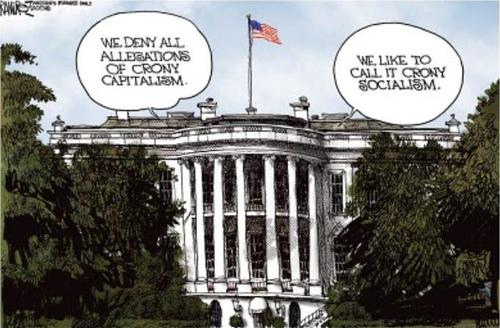
The supposed “choice” between “capitalism” and “socialism” is a useful fabrication masking the worst of all possible worlds we inhabit: Capitalism for the powerless and Crony-Socialism for the powerful. Capitalism’s primary dynamics are reserved solely for the powerless: market price of money, capital’s exploitive potential, free-for-all competition and creative destruction.

The powerful, on the other hand, bask in the warm glow of socialism: The Federal Reserve protects them from the market cost of money–financiers and the super-wealthy get their money for virtually nothing from the Fed, in virtually unlimited quantities–and the Treasury, Congress and the Executive branch protect them from any losses: their gains are private, but their losses are transferred to the public. The Supreme Court ensures the super-rich maintain this cozy crony-socialism by ensuring they can buy political power via lobbying and campaign contributions–under the laughable excuse of free speech.

Cronies get the best political system money can buy and you–well, you get to carry a sign on the street corner, just before you’re hauled off to jail for disturbing the peace (and you’re banned by social media/search Big Tech, i.e. privatized totalitarianism, for good measure).

The Federal Reserve is America’s financial Politburo: cronies get a free pass, the powerless get nothing. While the three billionaires who own more wealth than the bottom 165 million Americans can borrow unlimited sums for next to nothing thanks to the Fed (i.e. Crony-Socialist Politburo), the 165 million Americans pay exorbitant interest on payday loans, used car loans, student loans, credit cards and so on.

Capitalism (market sets price of money) for the powerless, Crony-Socialism (nearly free money) for the powerful–thanks to America’s Crony-Socialist Politburo, the Fed. Consider the “free market” plight of America’s working poor: earning low wages that are rapidly losing their purchasing power makes them a credit risk, i.e. prone to defaulting, so lenders (i.e. capital’s exploitive potential) charge high interest rates on loans to the working poor.

Since they pay such high rates of interest and earn so little, they default on their debt at higher rates–just what the lenders expected, and what the lenders created by charging sky-high rates of interest: gee, you’re having trouble paying 24% interest? Too bad you’re poor. You see the point: low wages, poverty and exorbitant rates of interest are mutually reinforcing: a primary driver of defaults and poverty is paying sky-high rates of interest and all the late fees, bounced check fees, etc. that go with 24% interest rates.

The Crony-Socialists have a much different deal with the Fed and its crony-bankers: the super-wealthy arrange for the corporations they own shares in to borrow billions of dollars to fund stock buybacks (which in a less exploitive era were illegal market manipulation). The super-wealthy Crony-Socialist’s personal wealth rises by $100 million thanks to the stock buybacks, and then the super-wealthy Crony-Socialist borrows $10 million for next to nothing against this newly conjured “wealth” (thanks, Fed!) to fund living large.

Crony-Socialist corporations pay no income tax thanks to loopholes and the Crony-Socialists who own the shares report $1 in salary and zero income because they borrowed their living expenses against their Fed-conjured wealth. Do you discern the difference between capitalism for the powerless and crony-socialism for the super-wealthy?

If you can’t yet discern the difference, then ask yourself: can you borrow $1 billion from the Fed’s cronies to buy back shares of your own company, and then borrow $10 million for near-zero rates of interest against the newly conjured “wealth”? You can’t? Well, why not?

If you answer “I don’t have enough collateral,” you missed the key point here: thanks to America’s Crony-Socialist Politburo (the Fed), the super-wealthy have no exposure to the market price of money. The Fed manipulates the cost of money to near-zero, and then funnels unlimited sums of this nearly-free money to corporations, financiers and the super-wealthy.

Collateral is unnecessary in Crony-Socialism; that’s just a excuse given to the powerless. Crony-Socialists borrow $1 billion for next to nothing, buy Treasuries with the free money, put the Treasuries up as collateral (but wait, didn’t they borrow the money? Never mind, it doesn’t matter), originate some financial instruments (CDOs, etc.), post those as collateral, and then leverage up another bet on that fictitious collateral.

If the bets all go bad, the Crony-Socialist claims the whole fraud is now a systemic risk and so the losses are transferred to the public / taxpayers to “save the financial system from collapse.” Isn’t Crony-Socialism fantastic?

Just as the rich kid caught with smack gets a suspended sentence and probation while the powerless kid gets a tenner in the War on Drugs Gulag, the super-wealthy Crony-Socialists avoid all the consequences of their gambles and frauds. America’s Crony-Socialist Politburo (the Fed) takes care of its cronies and the powerless bear the brunt of predatory exploitation that’s passed off as “capitalism.”

The only dynamic that’s even faintly “capitalist” about America’s Crony-Socialism is the price of political corruption is still a “market”: what’s the current price of protecting your monopoly or cartel from competition? It’s moving up fast, so better get those bribes (oops, I mean campaign contributions for the 2022 election) in now before the price of corrupting “democracy” goes even higher.

Where’s Dirk Gently When You Need Him?

By Erik Assadourian

Source: Resilience

Did you hear? A supersized cargo ship got wedged in the Suez Canal on March 23rd? If you didn’t, you must do pretty well at avoiding the news, social media, and late night TV. But the short of it is: the Ever Given somehow lost control (sandstorm strength winds have been blamed, as have human errors) and crashed into the bank of the canal and lodged itself in.

So what? Is this really news? Or just a sensational story to distract us from the pandemic, which, one might argue, is itself a distraction from the rapid unraveling of Earth’s systems and thus human civilization? Perhaps. But then again perhaps not. Here’s why this incident is worth understanding.

First, a ship single-bowedly disrupted global trade for six days. It was finally freed on March 29th. However, there is now a backlog of over 300 ships while many ships rerouted around the Cape of Good Hope. The Suez Canal is part of a trade route that carries more than 10 percent of global trade, including 7 percent of the world’s oil. Each day 30 percent of the world’s shipping container freight moves through the canal. Thus it created backlogs in shipping (including some 200,000 live animals who could have overheated or run out of food). It raised the price of oil briefly. It created shortages in factories—not just of parts but of shipping containers. And of course, it felt like a freak occurrence. Last year, of the 18,840 ships that moved through the canal, there were no incidents.

But the main reason is because this is an excellent metaphor on how fragile our entire globalized system has become.

It makes you wonder where Dirk Gently is to help straighten all this out. If you haven’t heard of Gently, he is a holistic detective, who uses “the fundamental interconnectedness of all things” to find missing persons (and cats) and solve mysteries. In fact, the novel Dirk Gently’s Holistic Detective Agency includes him trying to figure out how a sofa got “irrevocably stuck” halfway up a staircase.

Similar story here: the Ever Given was jammed in tight—though fortunately with the help of the full moon and tides, unstuck without resorting to time travel (which was needed to free the errant sofa). And while the supernatural wasn’t at the root cause of this mishap as with the couch, instead of focusing just on the bad luck of a sandstorm (which are not uncommon in Egypt) combined with bad piloting, we should still investigate the root causes at play. So let’s peel back the layers one at a time.

Bigger is better!

At the surface, we might simply say the problem stems from the fact that we keep making bigger container ships. The Ever Given is a quarter mile long (one lap around a track or the height of the Empire State Building). And it weighs 220,000 tons and holds 20,000 containers (each 20-40 feet long). High oil prices (especially 2005-8), combined with cheap debt after the 2008 crash led shipping companies to invest in bigger and bigger ships. The Ever Given holds four times the cargo a ship carried in 2000. In fact, these containers were stacked so high that they acted like a giant sail and caught the intense winds that drove the Ever Given into the banks. So, yes, there’s more risk involved, but it’s cheaper to add more containers. To get as much on there as possible. Sometimes that means losing a load of containers to a storm or other incident (about 1600 containers are lost on average each year). Not to mention the fluke canal accident—not that this was a widely recognized risk. (However, this OECD report from 2015 did raise the challenges of burgeoning cargo ship sizes). But now this threat will need to be considered, including terrorists doing this intentionally to disrupt trade.

Now more concentrated!

But of course, looking holistically, let’s ask why do we even need these big ships? So, peeling another layer, we see that we have concentrated our manufacturing to a few major locations and promoted the consumer culture worldwide so we need to get goods of all types to rich Europeans, we need to get oil to run cars and planes in every country, we need to get livestock to the Middle East to feed this affluent desert population. Our globalized system depends on big old cargo ships. Even this incident is a reflection of our extreme globalization: the ship is owned by a Japanese company; run by a Taiwanese company (Evergreen); piloted by Indians; operating under a Panamanian flag; navigating through an Egyptian waterway, shipping brand name goods from all over the globe, and rescued by a Dutch salvage company. That’s kind of neat—a global Kumbaya moment—or a revelation of just how deeply aligned nations are in converting Earth’s forests, lands, water, and life into the latest in consumer products.

But wait, there’s more!

Peeling another layer, we find that the movement of all these consumer goods is driven by a culture fixated on growth, profit, and consumerism. We move factories to exploit cheaper labor, lax environmental rules; we spend $763 billion a year on advertising to convince people they need a new iPhone or a new car or a trip to wherever; we convert landscapes wholesale into resources; and we panic if our economies don’t grow. We’re trapped in a pursuit of material happiness, manipulated by the admen and politicians, driven now by our addictions to sweets, tobacco, alcohol, drugs, social media, and entertainment, to the point we’re “amusing ourselves to death.” But worse, we’re so amused we hardly even notice the death part any longer.

Free disconnect with every purchase!

And arriving at the inner layers of the onion, we find this: that our disconnection from the Earth is so deep, so profound, so complete, that we no longer even consider the planet in our decisions to manufacture items or ship them or buy them. We think instead about expanding our economies, upsizing our homes, upgrading our cars and phones, even stockpiling toilet paper (which again became a thing in the Suez Canal story as wood pulp supplies were potentially delayed). Even as scientists warn of ecological collapse, of cities lost to flooding seas, of regions abandoned due to perpetual drought, to the inevitable violence that all this will cause, to the countless species lost—many of whom we depend on directly for our survival—we focus on making memes, writing essays (guilty), and trying to live slightly-greener-around-the-edges-consumer-lifestyles.

Dealing with this metaphorical couch

Perhaps that’s why the struggling bulldozer became the source of so many memes. Except the most important one: The bulldozer as the environmental movement and the ship as Consumer Capitalism. Ultimately, trying to free the ship, or even convert it to run on green fuels or the latest in sail technology is treating the superficial layers. Instead, we need to dig deeper (yuk yuk). We need to re-regionalize production; reduce production; degrow our economies, find ways to disincentivize and discourage a consumer lifestyle; or better yet, make it clear that this whole culture of consumerism is suicidal and worse, anti-life, and must go in order to prevent future ship jams or far worse global disruptions. And even deeper, we need to reconnect people to the living Earth to make them understand that every sin against the planet, against other creatures, and against other humans who we exploit, we do to ourselves. That if we fail to change paths, we will run head first into the proverbial canal wall. And there will be no one to dig us out.

Lee Camp: It’s Time for Major Wealth Redistribution — Yes, I Mean It.

No need to be all apologetic about it, either, since we would just be reclaiming the trillions taken by the billionaires.

By Lee Camp

Source: ScheerPost.org

It’s time for wealth redistribution. There, I said it.

I know it’s the third rail of politics, but I’m not running for a damn thing, which makes me free to speak the truth. (Well, I am running for president of my neighborhood elementary school’s PTA, but I’m pretty sure I’ll win easily since my campaign slogan is “Extend the school day to 20 hours because we don’t want to deal with those little monsters. You take ‘em!” . . . Well, I’ll win as long as they don’t find out I don’t have a child.)

Anyway, we desperately need wealth redistribution. And before anyone starts yelling something about Joseph Stalin, here’s the part that’s going to blow your mind — in the United States we’ve already had wealth redistribution for decades.

Fifty trillion dollars has been redistributed from the poorest Americans to the top one percent over the past several decades. That’s right, a new study shows the richest people in the world have stolen trillions from average Americans. To put this in easier to access terms — you know how mad you get when someone takes the last donut? Well, imagine that multiplied by 50 trillion. (Quick reminder: If you make $40,000 a year, it would take you 1.25 Billion years to make $50 trillion.)

The new study reveals, “…that the cumulative tab for our four-decade-long experiment in radical inequality has grown to over $47 trillion from 1975 through 2018. At a recent pace of about $2.5 trillion a year, that number we estimate crossed the $50 trillion mark by early 2020.”

And to be clear, this money has been stolen from nearly every American. Had income distribution and buying power remained the same as it was from the end of World War II to 1975, ” . . . the aggregate annual income of Americans earning below the 90th percentile would have been $2.5 trillion higher in the year 2018 alone. That is … enough to pay every single working American in the bottom nine deciles an additional $1,144 a month. Every month. Every single year.”

The richest people in America are pilfering over $1,100 from you personally and everyone you know every single month of every single year. Just imagine what each living soul in America could do with an extra $13,700 per year — how many people that would feed, how much less stressful their lives would be, how many fewer foreclosures there would be, and how many more people would get the healthcare they need. Yet every time the most modest tax increases are proposed on the richest Americans, or every time someone so much as mumbles about putting in a public jungle gym or putting in filters to take the metal chunks out of the water or fixing the holes in our bridges that are bigger than the ones in Maria Bartiromo’s head — every time someone brings up these common sense solutions, the elites of our society (who own the media outlets and the levers of the state and the law enforcement and the courts) start screaming from their wine-soaked ski resort orgy balconies, “That’s wealth redistribution! That’s class war!”

Meanwhile, most so-called “progressives” tip-toe around this subject, saying things like, “Well, we just want to slightly increase the taxes on the giant swimming pools filled with money of the wealthiest people. It would only impact people with billions of dollars, which is only a few individuals. We’re sorry. We’re so sorry to ask for this, Mr. Boss Man. Please forgive us.”

Enough of the pussy-footing. It’s time to demand true, full-on wealth redistribution. It’s time to say to the billionaires, “We’re taking your shit, and we’re giving it back to the society you stole it from. We’re taking your cars and your marble statues of your own ass and your boats that park inside your other boats and your emerald bathtubs filled with naked man servants and your inbred cross eyed ugly-ass dogs! . . . But you can keep your children. We don’t want those sociopaths in training. But other than that, we’re taking your stuff because this level of inequality is what most rational economists call ‘fucking nuts’.”

I will however give one caveat to make this go smoother. We only take back everything over $10 million. It’s estimated that there are about 1.4 million American households who have over $10 million. So that means what I’m proposing would impact less than one-half of one percent of Americans. The average American has never even met someone with over $10 million unless they shook Jim Carrey’s hand one time on a sidewalk in New York.

So we — the 99 percent — would take everything over $10 million from the people who have over $10 million. And we would give it out with the bottom 50 percent getting the vast majority of it. This means 99.5 percent of Americans would benefit from this redistribution of wealth. So, before you argue against this idea — Remember: you benefit. You would receive money. Because I promise there is no one with over $10 million reading this column right now, unless one banker accidentally clicked on this because it was next to the Wall Street Journal in his Twitter feed.

Do you need more numbers to hammer home the point? The billionaires in this country have increased their wealth by over $1.3 Trillion, an increase of 44 percent, just since the beginning of the pandemic.

One out of every three people in America have had trouble paying their bills during this pandemic.

Nearly 15 million people have lost their healthcare coverage just since the beginning of this pandemic.

And if you are the one person with over $10 million reading this, don’t give me that horse shit about, “I worked for that money. I earned that money.” No, no, no, no, you did not earn over $10 million. I know you didn’t because that’s impossible. It’s madness. It’s Gary Busey inside Charlie Sheen inside Ted Nugent. Taking the laws of physics into account, there is no way you worked a thousand times harder than a janitor or a sanitation worker or a nurse or a busboy or a fluffer or a fluffer’s second assistant fluffer intern. It’s physically impossible that you worked a thousand times harder than every “essential worker.” (Yes, fluffers are essential.)

What you did was merely take advantage of a system that is set up to exploit the vast majority of the society while most people don’t even realize what happened. That’s what you did because you’re a sociopath. Indeed, most of the Americans with over $10 million are sociopaths. They would kick a puppy down a flight of stairs into the teeth of a wool thresher if it meant they could make an extra $1,000. But I will acknowledge that not all of them are sociopaths. Some of them are relatively okay people working inside a breathtakingly corrupt system. So for the ones who are sociopaths, why should we feel bad for taking their wealth — over $10 million — and redistributing it? (They’re sociopaths after all. Lest we forget: they kick puppies.)

And then for the other ones, who are not sociopaths but still have over $10 million, they’re not going suffer because at the end of the day, they still have ten million goddamn dollars! It’s not like they’d suddenly be scraping by, clothing their children with cardboard boxes painted to look like shirts and bow ties.

So the next time someone says to you, “You can’t raise the taxes on the top 1% because that’s class war. It’s redistribution of wealth,” don’t respond the way most squishy liberals respond — “Ummm, ahhh, errr, no, uhhhh, I’m sorry.” Instead respond, “You’re damn right it is! I want redistribution of wealth. I want a nonviolent class war — because it has been done to the rest of us for the past 50 years at least. We have been exploited and abused, beaten down and defeated, kicked and slapped and scratched and drained and sucked dry and extracted and even burgled!” (Oh man, do I hate being burgled.)

Now is our time to fight back against this terrible machine that has allowed this unbelievable level of exploitation. Screw this system that allows some people to have enough money to end world hunger (literally Jeff Bezos could end world hunger many times over) and yet never do it, while other individuals sleep on a bench hoping no one steals their one box of cereal in the night. To put my conclusion into more sophisticated academic language — Fuck that.

This is an abusive relationship, and it’s time to get out.

The Top 10% Is Doing Just Fine, The Middle Class Is Dying on the Vine

By Charles Hugh Smith

Source: Of Two Minds

Please study these charts as a means of understanding the inevitability of economic stagnation and a revolt of the decapitalized middle class.

I’ve been covering the decline of America’s middle class for over a decade with charts, data and commentary on the social depression that has accompanied the decline.

While there are many mutually reinforcing dynamics in this 45-year decline–demographics, global energy costs, financialization and globalization, to name a few– one term describes the accelerating erosion of America’s middle class: decapitalization.

To understand decapitalization, we need to start with the fundamentals of any economy between labor (wages) and capital and between investment and speculation. Although it’s tempting to oversimplify and demonize one or the other of these basics (speculators bad! etc.), they each provide an essential role in a healthy economy, one which is in dynamic equilibrium, a state analogous to a healthy ecosystem with constantly changing interactions of numerous species, individuals and inputs (weather, etc.). This variability enables the order of fluctuations (to use Ilya Prigogine’s profound phrase), a dynamic stability / equilibrium.

If labor’s share of the economy drops too low, the workforce cannot consume enough to support their households and the economy as a whole. If capital can no longer earn an attractive return, investment dries up and production stagnates. If speculators are not allowed to take on risk, liquidity dries up and risk crushes investment. But if speculation becomes the foundation of the economy’s “growth,” then the inevitable collapse of speculative bubbles will crash the economy.

In modern social-capitalist systems, the core stabilizer of the system is the wage-earning middle class which provides the stable workforce driving production and the stable pool of consumers needed to borrow money and consume enough to soak up the production of goods and services at a profit to producers.

Without a stable, dominant middle class, capital has few opportunities to invest in productive capacity. Without a stable, dominant middle class, the economy stagnates and is prone to collapse as it is far from equilibrium.

The process of middle class decline is best explained as decapitalization because the middle class is fundamentally a means of transforming labor into capital via savings and investment. The traditional ladder of social mobility from the working class to the middle class is one of capitalizing work: time and savings are invested in higher education, in effect capitalizing future labor by increasing productivity.

Capital isn’t limited to cash, land or tools; in an information economy, knowledge and skills are also capital, as is the social capital of social networking and relationships formed with mentors, suppliers, lenders, colleagues, investors, etc.

The second way to capitalize work is to save earnings and invest the savings in assets that produce income or gain value: a house, land, rental property, small business and income-producing financial assets such as bonds or dividend-paying stocks.

Thrift, investing, long-term planning and deferred consumption are all essential to capitalizing work by turning that labor into income-producing assets. As the household’s ownership of these assets that yield unearned income rises, so does their income and wealth. These increase the financial security of the household and build a nestegg which can be passed down to the next generation, improving their security via inheritance of income-producing assets.

As long as productivity is increasing the value of their labor, the middle class can leverage future earnings into assets by borrowing money to invest in assets: to buy a house, a mortgage is borrowed against future earnings. As long as the mortgage is a fixed-interest loan and income can be expected to rise with productivity, then this is a win-win situation: capital earns a predictable, low-risk return from the mortgage and the middle class household has stake in a family home, an asset which acts as a savings mechanism as the mortgage slowly pays down the debt and increases the household’s home equity–a form of savings.

The processes of decapitalization have upended this entire structure. In the systems context outlined above, our economy is out of balance and far from equilibrium and thus prone to collapse.

For the bottom 90%, which of course includes the middle class however you define it, it’s increasingly difficult to capitalize labor into capital. There are a number of factors driving this decapitalization:

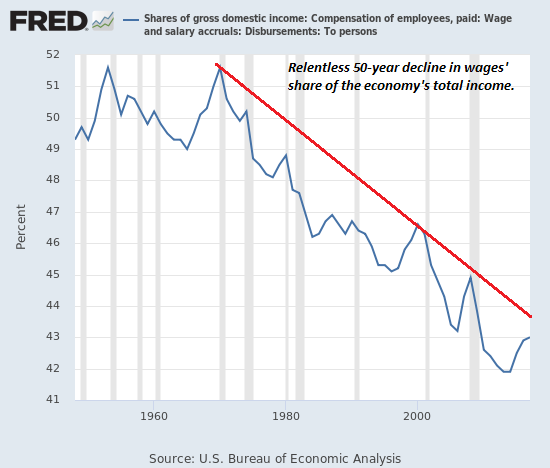
1. Wages’ share of the national income has continued a five-decade downtrend. (See chart below) National income since 1973 has shifted from labor (wages) to capital and more specifically, to debt and speculative gaming of the system, a.k.a. financialization.

Total household income in the U.S. in 2018 was $17.6 trillion. The decline in wages’ share of the national income from 1973 to 2018 is about 8.5%, which equals $1.5 trillion, the sum shifted from labor to capital every year. (See chart below)(source: https://www.statista.com/statistics/216756/us-personal-income/)

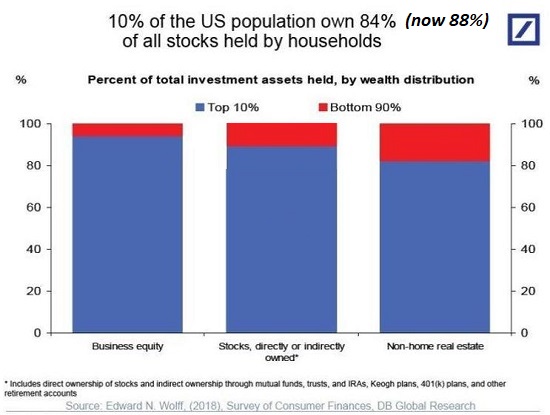
No, this is not a typo. As this RAND report documents, $50 trillion has been siphoned from labor (the lower 90% of the workforce) to the Financial Aristocracy and their technocrat lackeys (the top 10%) who own the vast majority of the capital (see charts below): Trends in Income From 1975 to 2018.

2. Within the workforce, wages have shifted to the top 10% who now earn 50% of all taxable income. (See RAND chart below) Financialization and globalization have decapitalized the skills of entire sectors of the workforce as automation and offshoring reduced the human capital of workers’ skills and experience and the value of their social capital. When the entire industry is offshored, skills and professional relationships lose their market value.

In a fully globalized economy, every worker producing tradable goods/services is competing with the entire global workforce, a reality that reduces wages in high-cost developed nations such as the U.S.

Financialization has heavily rewarded workers with specialized gaming the financial system skills and devalued every other skill as only the skills of financialization are highly profitable in a globalized, financialized economy.

3. As the high-wage jobs and capital shifted to coastal urban centers, middle class owners of homes and capital elsewhere saw the value of their assets decline. If a home valued at $100,000 in the late 1990s is now worth $150,000, the owners lost ground even with “official” inflation. In terms of real-world purchasing power, their home actually lost significant value in the past 23 years.

Meanwhile, middle class owners who bought their home in a coastal hot-spot for $100,000 23 years ago are now enjoying home valuations close to $1 million. Homes, along with every other asset, have been shifted into a casino where almost everyone is sorted into winners and losers, less often by skill and more often by luck.

For those who were too young to buy in 1997, sorry–the opportunity to buy a home for three times average middle class income is gone. The lucky generation who bought in the late 1990s in booming coastal magnets for global capital joined the top 10% and their colleagues in less desirable regions lost ground.

4. As capital siphoned off income and appreciation from labor (human and social capital), the gains accruing to capital accelerated. Those who already owned income-producing assets reaped both income and asset appreciation gains as yields on savings collapsed to near-zero as the Federal Reserve and other central banks dropped yields to near-zero in 2009 and kept them low for the following 13 years.

This had two devastating effects on the middle class: hundreds of billions of dollars that once flowed to savers and money markets disappeared, swallowed by the banks as a direct (and intentional) effect of the Fed’s ZIRP (zero-interest rate policy).

Since the Fed destroyed low-risk yields, anyone seeking any real yield (i.e. above inflation) would have to enter the casino and compete with hedge funds, insiders and the Financial Aristocracy. Very few middle class workers have the skills and experience to beat the pros in the casino, and so income and wealth accrued to those who already owned capital.

This is a key reason why the rich got richer and the poor got poorer. Those with capital accrued the majority of gains in income and wealth, leaving the bottom 90% in the dust.

A recent Foreign Affairs essay Monopoly Versus Democracy included these stunning statistics:

Ten percent of Americans now control 97 percent of all capital income in the country. Nearly half of the new income generated since the global financial crisis of 2008 has gone to the wealthiest one percent of U.S. citizens. The richest three Americans collectively have more wealth than the poorest 160 million Americans. (emphasis added.)

The 3% of income from capital collected by the bottom 90%–which includes the middle class– is basically signal noise: the middle class collects inconsequential crumbs of income from capital.

Prior to the Fed’s ZIRP and financialization of the economy, the middle class could both collect income from capital they owned and they could afford to acquire assets that yielded low-risk solid returns. Now they can do neither. Even worse, the puchasing power of their labor continues to decline, leaving them less able to save and buy assets.

This is why The Top 10% Is Doing Just Fine, The Middle Class Is Dying on the Vine. Please study these charts as a means of understanding the inevitability of economic stagnation and a revolt of the decapitalized middle class.


On Capitalism and the Machine

By Megan Sherman

Source: Global Research

In 1935, reflecting on the creed of productivity which prevailed in modern technological societies, Bertrand Russell, philosopher, pacifist and devout humanist wrote that:

I think that there is far too much work done in the world, that immense harm is caused by the belief that work is virtuous, and that what needs to be preached in modern industrial countries is quite different from what always has been preached.”

‘In Praise of Idleness and other essays’ is a collection of striking power and originality. Whereas the receieved wisdom of his era held that virtue consisted in yielding to work, monotony and routine, Russell maintained it was not the sole end of life, that beyond work, people needed leisure and pleasure in order to fully live, that what was sought to truly advance society and fortify the human condition was the “organized diminution of work.”

Through the 1920s and 30s Fordism advocated the exact opposite and the cult of productivity began to exert a strong hold on economic and social organization in Europe, the USA and Soviet Union. In the story Brave New World, Aldous Huxley envisioned a society of tyrannical collectivism which raised hell on Earth. In this dehumanizing, nihilistic oblivion, Henry Ford was worshipped as a deity and the fundamentalism of mass production crept in to all spheres of life, rigidly classifying people whose whole lives were planned out on a callow basis of crude economic worth. It was a study in how powerful forces of sublimation and repression incarnate in the edifice of the modern world mutilate our most vital, human instincts and wrench us from our roots.

Huxley’s main belief was that technological ‘progress’ had empowered the worst bureaucrats to assimilate citizens in to a sophisticated machine of repression and control which blocked and frustrated their freedom. Although, as Russell observes, in truth “with modern technique it would be possible to distribute leisure justly without injury to civilization“, the owners of the means of production in the capitalist economy absorb modern technique in to their arsenal against collective liberation. It is not in their interests to free us from bonds.

Of the proprietary class, Russell says:

their desire for comfortable idleness is historically the source of the whole gospel of work. The last thing they have ever wished is that others should follow their example. “

That is to say that freedom and unfreedom aren’t opposites. The affluence and freedom of the proprietors actively depends on the subjugation of workers who create value.

Throughout his life Bertrand Russell was keenly involved with communities of students, activists and workers who organized against imperialism and the war machine. His belief that people could work less and live more was part of his belief that the economic system could be harnessed to more altruistic ends, justified more reasonably, attuned to satisfy people’s needs and fit to unleash their inherent creative power, instead of conforming to bourgeois imperatives.

Lately Professor Stephen Hawking has weighed in on the question of modern social organization and proffered the view that people need not be scared of machines, but ought to be wary of the systems and people who wield them. Why be scared of the unknown power of machines when what we know about the people who own them is far, far scarier?

Hawking said:

If machines produce everything we need, the outcome will depend on how things are distributed. Everyone can enjoy a life of luxurious leisure if the machine-produced wealth is shared, or most people can end up miserably poor if the machine-owners successfully lobby against wealth redistribution. So far, the trend seems to be toward the second option, with technology driving ever-increasing inequality.”

Hawking’s view is much like Russell’s and would be called post-scarcity economics. The crux of this view is that competition for resources is not a necessary feature of an economy, that material abundance may be universal instead of there being a socially imposed monopoly of access, regulated by money and work. Like trickle-down theory, scarcity economics is not necessarily based in reality. It goes without saying that obviously we need to find a way reach this economy and mode of production in accordance with environmental protection, which models after the Industrial Revolution got disastrously wrong.

The challenge of the future is to make machines our allies and not our jailers.

No Escape from Our Techno-Feudal World

By Pepe Escobar

Source: Global Research

The political economy of the Digital Age remains virtually terra incognita. In Techno-Feudalism, published three months ago in France (no English translation yet), Cedric Durand, an economist at the Sorbonne, provides a crucial, global public service as he sifts through the new Matrix that controls all our lives.

Durand places the Digital Age in the larger context of the historical evolution of capitalism to show how the Washington consensus ended up metastasized into the Silicon Valley consensus. In a delightful twist, he brands the new grove as the “Californian ideology”.

We’re far away from Jefferson Airplane and the Beach Boys; it’s more like Schumpeter’s “creative destruction” on steroids, complete with IMF-style “structural reforms” emphasizing “flexibilization” of work and  outright marketization/financialization of everyday life.

The Digital Age was crucially associated with right-wing ideology from the very start. The incubation was provided by the Progress and Freedom Foundation (PFF), active from 1993 to 2010 and conveniently funded, among others, by Microsoft, At&T, Disney, Sony, Oracle, Google and Yahoo.

In 1994, PFF held a ground-breaking conference in Atlanta that eventually led to a seminal Magna Carta: literally, Cyberspace and the American Dream: a Magna Carta for the Knowledge Era, published in 1996, during the first Clinton term.

Not by accident the magazine Wired was founded, just like PFF, in 1993, instantly becoming the house organ of the “Californian ideology”.

Among the authors of the Magna Carta we find futurist Alvin “Future Shock” Toffler and Reagan’s former scientific counselor George Keyworth. Before anyone else, they were already conceptualizing how “cyberspace is a bioelectronic environment which is literally universal”. Their Magna Carta was the privileged road map to explore the new frontier.

Those Randian heroes

Also not by accident the intellectual guru of the new frontier was Ayn Rand and her quite primitive dichotomy between “pioneers” and the mob. Rand declared that egotism is good, altruism is evil, and empathy is irrational.

When it comes to the new property rights of the new Eldorado, all power should be exercised by the Silicon Valley “pioneers”, a Narcissus bunch in love with their mirror image as superior Randian heroes. In the name of innovation they should be allowed to destroy any established rules, in a Schumpeterian “creative destruction” rampage.

That has led to our current environment, where Google, Facebook, Uber and co. can overstep any legal framework, imposing their innovations like a fait accompli.

Durand goes to the heart of the matter when it comes to the true nature of “digital domination”: US leadership was never achieved because of spontaneous market forces.

On the contrary. The history of Silicon Valley is absolutely dependent on state intervention – especially via the industrial-military complex and the aero-spatial complex. The Ames Research Center, one of NASA’s top labs, is in Mountain View. Stanford was always awarded juicy military research contracts. During WWII, Hewlett Packard, for instance, was flourishing thanks to their electronics being used to manufacture radars. Throughout the 1960s, the US military bought the bulk of the still infant semiconductor production.

The Rise of Data Capitala 2016 MIT Technological Review report produced “in partnership” with Oracle, showed how digital networks open access to a new, virgin underground brimming with resources: “Those that arrive first and take control obtain the resources they’re seeking” – in the form of data.

So everything from video-surveillance images and electronic banking to DNA samples and supermarket tickets implies some form of territorial appropriation. Here we see in all its glory the extractivist logic inbuilt in the development of Big Data.

Durand gives us the example of Android to illustrate the extractivist logic in action. Google made Android free for all smartphones so it would acquire a strategic market position, beating the Apple ecosystem and thus becoming the default internet entry point for virtually the whole planet. That’s how a de facto, immensely valuable,  online real estate empire is built.

The key point is that whatever the original business – Google, Amazon, Uber – strategies of conquering cyberspace all point to the same target: take control of “spaces of observation and capture” of data.

About the Chinese credit system…

Durand offers a finely balanced analysis of the Chinese credit system – a public/private hybrid system launched in 2013 during the 3rd plenum of the 18th Congress of the CCP, under the motto “to value sincerity and punish insincerity”.

For the State Council, the supreme government authority in China, what really mattered was to encourage behavior deemed responsible in the financial, economic and socio-political spheres, and sanction what is not. It’s all about trust. Beijing defines it as “a method of perfecting the socialist market economy system that improves social governance”.

The Chinese term – shehui xinyong – is totally lost in translation in the West. Way more complex than “social credit”, it’s more about  “trustworthiness”, in the sense of integrity. Instead of the pedestrian Western accusations of being an Orwellian system, priorities include the fight against fraud and corruption at the national, regional and local levels, violations of environmental rules, disrespect of food security norms.

Cybernetic management of social life is being seriously discussed in China since the 1980s. In fact, since the 1940s, as we see in Mao’s Little Red Book. It could be seen as inspired by the Maoist principle of “mass lines”, as in “start with the masses to come back to the masses: to amass the ideas of the masses (which are dispersed, non-systematic), concentrate them (in general ideas and systematic), then come back to the masses to diffuse and explain them, make sure the masses assimilate them and translate them into action, and verify in the action of the masses the pertinence of these ideas”.

Durand’s analysis goes one step beyond Soshana Zuboff’s

The Age of Surveillance Capitalism when he finally reaches the core of his thesis, showing how digital platforms become “fiefdoms”: they live out of, and profit from, their vast “digital territory” peopled with data even as they lock in power over their services, which are deemed indispensable.

And just as in feudalism, fiefdoms dominate territory by attaching serfs. Masters made their living profiting from the social power derived from the exploitation of their domain, and that implied unlimited power over the serfs.

It all spells out total concentration. Silicon Valley stalwart Peter Thiel has always stressed the target of the digital entrepreneur is exactly to bypass competition. As quoted in Crashed: How a Decade of Financial Crises Changed the World, Thiel declared, “Capitalism and competition are antagonistic. Competition is for losers.”

So now we are facing not a mere clash between Silicon Valley capitalism and finance capital, but actually a new mode of production:

a turbo-capitalist survival as rentier capitalism, where Silicon giants take the place of estates, and also the State. That is the “techno-feudal” option, as defined by Durand.

Blake meets Burroughs

Durand’s book is extremely relevant to show how the theoretical and political critique of the Digital Age is still rarified. There is no precise cartography of all those dodgy circuits of revenue extraction. No analysis of how do they profit from the financial casino – especially mega investment funds that facilitate hyper-concentration. Or how do they profit from the hardcore exploitation of workers in the gig economy.

The total concentration of the digital glebe is leading to a scenario, as Durand recalls, already dreamed up by Stuart Mill, where every land in a country belonged to a single master. Our generalized dependency on the digital masters seems to be “the cannibal future of liberalism in the age of algorithms”.

Is there a possible way out? The temptation is to go radical – a Blake/Burroughs crossover. We have to expand our scope of comprehension – and stop confusing the map (as shown in the Magna Carta) with the territory (our perception).

William Blake, in his proto-psychedelic visions, was all about liberation and subordination – depicting an authoritarian deity imposing conformity via a sort of source code of mass influence. Looks like a proto-analysis of the Digital Age.

William Burroughs conceptualized Control – an array of manipulations including mass media (he would be horrified by social media). To break down Control, we must be able to hack into and disrupt its core programs. Burroughs showed how all forms of Control must be rejected – and defeated: “Authority figures are seen for what they are:  dead empty masks manipulated by computers”.

Here’s our future: hackers or slaves.


*

Note to readers: please click the share buttons above or below. Forward this article to your email lists. Crosspost on your blog site, internet forums. etc.