On the Drug War, and Other “Mistakes”

nixon-war-on-drugs-quote

By Kevin Carson

Source: Center for a Stateless Society

In a new article at Harper’s (“Legalize It All,” April 2016), Dan Baum recalls a 1994 confession by former Nixon domestic policy adviser John Ehrlichmann, about Nixon’s motives in first launching the War on Drugs. Baum, interviewing Ehrlichman for a book on drug prohibition, asked a “series of earnest, wonky questions, that he impatiently waved away”:

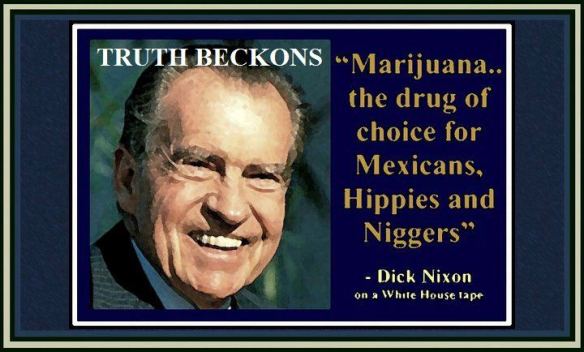
“The Nixon campaign in 1968, and the Nixon White House after that, had two enemies:  the antiwar Left, and black people…. We knew we couldn’t make it illegal to be either against the war or black. But by getting the public to associate the hippies with marijuana and blacks with heroin, and then criminalizing both heavily, we could disrupt those communities. We could arrest their leaders, raid their homes, break up their meetings, and vilify them night after night on the evening news. Did we know we were lying about the drugs? Of course we did.”

Judged by those objectives, Nixon’s War on Drugs and its subsequent dramatic escalation under Reagan have been resounding successes.

Many liberals, unfortunately, are prone to describing the War on Drugs as a “failure” — much as the Vietnam or Iraq War was “a mistake” — implicitly accepting the general goals of the American state as good and well-meaning, and merely unfortunate in their execution. The liberals who frame the wars in this way, as Noam Chomsky has argued, share the hawks’ view that “America owns the world” and has the right to define as a “threat” any country that defies its authority or attempts to undermine the global corporate order. And liberals and progressives are nauseatingly prone to referring to criminal foreign wars of aggression and domestic police wars on civil society as something “we” did.

But if you genuinely think the actions of the American state have anything to do with “we” or “us,” either you belong to the economic classes served by the state, or you probably still ask the dentist to save your extracted molars to put under your pillow.

Long before I saw Ehrlichman’s admission, I noted that the expanded War on Drugs against crack and meth under Reagan and Clinton had had a disruptive effect on two of the demographic groups (inner city black people and rural poor whites) that, as it happens, are least socialized to cheerfully accept direction from authority figures behind desks.

Going back to the passage of the Virginia Slave Code after the defeat of Bacon’s Rebellion, running through the use of racial divisions to split and defeat the southern tenant farmers’ unions, and right up to the present, the possibility of a strategic political alliance between poor black and white people has been one of the major fears of the propertied classes who control the American state.

So whether it be Nixon’s or Reagan’s War on Drugs, or the Clintons’ support for a Crime Bill (to “bring to heel” so-called black “super-predators”) that completed America’s growth into the largest carceral state in the world, the fact that a third of the urban black male population is in some phase of the “criminal justice” system and deprived of the franchise has had an enormous effect on radical political possibilities in this country. It has gone a long way towards nullifying the effects of the Voting Rights Act, in much the same way that Black Codes nullified the effects of Emancipation. Jeb Bush’s purge of 70,000 alleged “felons” — mostly not felons, but mostly black — from the Florida voting rolls was the main factor in handing the presidency to his brother.

I’m not, by the way, the kind of conspiracist who thinks every government policy fits into some larger, malign strategy that serves as the “real” motivation for all officials. I don’t doubt a great deal of legislation and executive action is intended as a good faith response to the stated concerns of policy-makers. Of course even such “well-meaning” policies are subject to the law of unintended consequences, mission creep, refusal to reassess in response to feedback on their effectiveness, and abusive or self-dealing execution by the bureaucracies tasked with enforcement.

But even when policies are sincerely “well-meaning,” they still tend to serve vested interests through a sort of structural “invisible hand” effect. The “well-meaning” policies that get passed are those that structurally benefit the economic ruling class, and those that get repealed are those that no longer do so.

The state does not represent “us,” and the destructive and genocidal effects of its policies are not “mistakes.”

Prison Town Selling Its Jails to Grow Cannabis to Save their Economy — And It’s Working

Screen-shot-2012-08-31-at-9.55.31-PM

By Justin Gardner

Source: Activist Post

A tiny California desert town is making a drastic change to reverse its downward spiral and embrace an enlightened future. For 24 years, Adelanto tried unsuccessfully to sustain its economy through prisons, but now it will be hosting a very different kind of business—cannabis cultivation.

The town became only the second city in California to permit commercial cultivation of medical cannabis, after a year of heated debate in the City Council. The persistence of John “Bug” Woodard, Jr. paid off in a 4-1 vote on Nov. 23 to allow cultivation.

“I had nothing to lose,” said Woodard. “The city could not get in any worse shape than it was. It was broke.”

Brooke Edwards Staggs of The Orange County Register describes Adelanto’s declining prison economy and the land rush that is now taking place after their decision to go to pot.

Its first prison was built in 1991, as the city braced itself for the closure of nearby George Air Force Base.

That didn’t stop Adelanto’s long slide into high unemployment and depressed property values. More than a third of the city’s nearly 33,000 residents now live below the poverty line. So it kept welcoming more prisons, banking on the promise of jobs and steady revenue in the form of an annual bed tax.

The town sold one of its four prisons to a private firm in 2010 for $28 million, and that cash is about to run out. Solar energy developers also had an interest in Adelanto, but only four projects have been constructed, producing a handful of jobs.

Now, a new kind of developer is flocking to the town.

Ky-Mani Marley, one of Bob Marley’s sons, has already signed on to license a strain of cannabis that will be grown there, according to Freddy Sayegh, the attorney on the project. Tommy Chong has also shown interest. So has B-Real of Cypress Hill fame, plus other high-profile musicians and professional athletes whose names are being kept under wraps.

One commercial real estate firm says they went from one call a week to five calls a day about purchasing land in Adelanto. Real estate prices have skyrocketed as “investors, cultivators, doctors, architects and record executives” fly across the country to see about getting in on the budding industry.

Twenty-seven companies have been permitted to set up grow operations in Adelanto, with two more pending. The first crop is expected to be produced by summer, and when it reaches full capacity, the town will be producing about 50,000 pounds of cannabis six times a year for the medical industry.

Since California approved medical cannabis use in 1996, it has finally gotten around to creating a licensing program for cannabis businesses under the Medical Marijuana Regulations and Safety Act. The state is expected to legalize recreational use this November, which will greatly increase demand for legitimate operations.

The trend of cities allowing commercial-scale cannabis cultivation is a relief for those concerned about the environmental impact of illegal grow operations. Last year we reported how many growers are carelessly polluting aquatic ecosystems with rat poison and other toxic chemicals, while drying up already stressed streams.

As more towns and cities in California permit large-scale cannabis cultivation, demand will shift to these responsible growers, which should begin to reduce the pressure on the state’s fragile aquatic ecosystems.

Adelanto, which means “progress” in Spanish, will indeed prove to be a model of progress as it transitions from a depressing economy of prisons to one that actually helps human and environmental health.

“Tomorrow, they’ll be on the correct side of history and be recognized as a city that actually embraced safety and embraced something that heals people,” said Randall Longwith, an attorney representing investors.

Not only will cannabis businesses be producing exclusive strains for distribution, but Adelanto will also serve as a hub of medical research for ailments such as pediatric epilepsy, brain tumors, and post-traumatic stress disorder. Cannabis is showing great promise in all of these areas.

As a bonus, the medical cannabis research company Ecologies Laboratories will be pushing out a merchant of death. General Atomics Aeronautical Systems, which makes the Predator drone, will have to give up its storage facility in Adelanto as the landlord has decided to lease it to Ecologies Laboratories instead.

Adelanto joins another California city, Desert Hot Springs, to become a new kind of western pioneer. It will save its economy by making millions in tax revenue and securing hundreds of jobs, and, more importantly, is embracing a future where cannabis will prove to be a medical wonder.

The Hate-Filled Origins of the War on Drugs they Don’t Want you to Know

war-on-drugs-poster

By Jay Syrmopoulos

Source: The Free Thought Project

An eye-opening video produced by the folks at ATTN, lays out how cocaine was banned as a means of social engineering, using racism as the main tool in driving this agenda. The desired results were achieved by utilizing stereotypically false racist attributions, perpetuated in the media as a means of turning public opinion against specific substances.Cannabis was attributed to Hispanics, hence the coining of the term “marijuana,” as a means of correlating the drug with Mexicans immigrants. Cocaine was attributed to blacks while opium was linked to the Chinese, with each being associated with racist depictions relating to use of the drug in question.

As hysteria grew, mainly due to the racial demonization of drugs, Congress took action with the passage of the Harrison Act of 1914, which outlawed the production, distribution or importation of opium and cocaine.

These actions were then followed up with the outlawing of marijuana on a federal level with the Marihuana Tax Act of 1937.

The modern “War on Drugs,” which has been waged disproportionately upon urban minorities, has its roots in the Nixon administration.

Nixon dramatically increased the size and presence of federal drug control agencies and pushed through measures such as mandatory sentencing and no-knock warrants.

In the early 1980’s the crack cocaine epidemic hit the inner cities of urban America with a vengeance. It began the devastation of black communities and the disenfranchising of many of the socially conscious organizations, such as the Black Panthers, which were working towards ending institutionalized racism.

Journalist Gary Webb in his groundbreaking investigative series, Dark Alliance, exposed deep connection between the CIA and large scale drug trafficking, which many attribute to the crack cocaine epidemic.

The violence associated with the crack scourge was steadily fed to the living rooms of middle America on the nightly news, which once again manifested as fear in the public. The public then begged the politicians to save them from the media spoon fed menace.

Thus began the approach to “get tough on crime,” which can be seen in the disparate penalties for crack cocaine vs. powder cocaine. Crack, which was primarily used by blacks, was given a penalty 100 times more severe than that of powder cocaine, which was primarily used by whites. This sentencing difference was in spite of the drugs being the same pharmacologically speaking.

In 2010, the Fair Sentencing Act reduced this disparity down to an 18 times more severe penalty for crack vs. powder cocaine, but a massive difference in the way these almost identical substances are treated remains.

It’s quite clear what the impetus for making drugs illegal has historically been, racial fear. The violence perpetrated upon innocent people under the guise of a “War on Drugs” clearly shows that it’s actually a war being waged on all freedom loving Americans.

The manner in which racial prejudice has been used by the state to forward its agenda throughout history is consistent with the divide and conquer approach that continues to be used domestically and abroad, with the mainstream media seemingly ever ready to assist.

Jay Syrmopoulos is an investigative journalist, free thinker, researcher, and ardent opponent of authoritarianism. He is currently a graduate student at University of Denver pursuing a masters in Global Affairs. Jay’s work has previously been published on BenSwann.com and WeAreChange.org. You can follow him on Twitter @sirmetropolis, on Facebook at Sir Metropolis and now on tsu.

Related Video:

15 News Stories from 2015 You Should Have Heard About But Probably Didn’t

Year_end_cropped_1_.560d8b1a89b8b

By Carey Wedler

Source: AntiMedia

In 2015, the iron fist of power clamped down on humanity, from warfare to terrorism (I repeat myself) to surveillance, police brutality, and corporate hegemony. The environment was repeatedly decimated, the health of citizens was constantly put at risk, and the justice system and media alike were perverted to serve the interests of the powers that be.

However, while 2015 was discouraging for more reasons than most of us can count, many of the year’s most underreported stories evidence not only a widespread pattern that explicitly reveals the nature of power, but pushback from human beings worldwide on a path toward a better world.

 1. CISA Pushed Through the Senate, Effectively Clamping Down on Internet Freedom: For years, Congress has attempted to legalize corporate and state control of the internet. First, in 2011, they attempted to pass PIPA and SOPA, companion bills slammed by internet and tech companies and ultimately defeated after overwhelming public outcry. Then they passed  CISPA — which the president had threatened to veto, having caught wind of the public’s opposition to heavy regulation of the internet (earlier this year, Obama reversed his position). However, corporate interests, like Hollywood’s studio monopoly, kept lawmakers’ tenacity afloat.

In October, Congress passed CISA, the Cybersecurity Information Sharing Act, but as the Electronic Freedom Foundation explained: “CISA is fundamentally flawed. The bill’s broad immunity clauses, vague definitions, and aggressive spying powers combine to make the bill a surveillance bill in disguise. Further, the bill does not address problems from the recent highly publicized computer data breaches that were caused by unencrypted files, poor computer architecture, un-updated servers, and employees (or contractors) clicking malware links.” Just before Christmas, Congress went even further, adding an amendment to the annual omnibus budget bill that strips CISA’s minimal privacy provisions even more. That budget bill was approved, though Representative Justin Amash of Michigan has vowed to introduce legislation to repeal the CISA provisions when Congress reconvenes.

But CISA wasn’t the only attack on citizens’ privacy this year. Though lawmakers touted the USA Freedom Act as a repeal of the mass surveillance state, in reality, it simply added a bureaucratic step to the process by which government agencies obtain private information. Further, a hack on Italian security firm, aptly called Hacker Tools, revealed that various agencies — including the DEA, NSA, Army, and FBI — possess software that enables them to, as Anti-Media reported, “view suspects’ photos, emails, listen to and record their conversations, and activate the cameras on their computers…” At the same time, the United Kingdom and France moved to tighten their already comprehensive surveillance States in the wake of multiple terrorist attacks. Though governments claim systematic surveillance is necessary to protect citizens — and Snowden’s leaks endangered that safety — the United States government has been unable to produce sufficient evidence the programs work. Instead, the documents the Department of Defense released this year as proof of the alleged endangerment were entirely redacted.

2. CIA Whistleblower Sent to Prison for Revealing Damning Information to a Journalist: While the government has no problem invading the privacy of its citizens, it offers swift backlash for those who attempt to violate its own clandestine operations. Jeffrey Sterling, a former CIA agent, had his first altercation with the CIA when he sued for racial discrimination in 2001. He was subsequently fired. Years later, the CIA filed espionage charges against him for speaking with New York Times journalist, James Risen. Sterling had revealed a botched CIA scheme, Operation Merlin, to infiltrate Iranian intelligence that ultimately worsened the situation, gave Iran a nuclear blueprint, and was deemed espionage, itself. Rather than acknowledge the woeful misstep, the CIA arrested him, charged him, and ultimately sentenced him to 42 months in prison. The trial was reportedly biased, but nevertheless, was severely underreported by the media. Sterling’s conviction reflects the ongoing war on whistleblowers, which Obama has successfully expanded during his presidency. Sterling joins the ranks of Edward Snowden, Chelsea (formerly Bradley) Manning, and others, including a whistleblower who worked for OSHA’s Whistleblower Protection Program and was fired for exposing dysfunction and incompetence within the ranks.

3. Press Freedom Continued to Deteriorate: An annual report from the World Press Freedom Index saw the United States slip 29 spots from last year, landing 49th out of 180 total. Investigative journalist Barrett Brown was sentenced to five years in prison for exposing the findings of hacker Jeremy Hammond. Brown was charged with obstructing justice, aiding and abetting, and separate charges of allegedly threatening the FBI in a rant. Hammond, who exposed severe violations of privacy on the part of Stratfor, a CIA contractor, was sentenced to ten years in prison. Brown’s experience was not an isolated incident. Journalists around the world, like several journalists who were killed while investigating ISIS in Turkey, faced increased danger. One small-town journalist in India was burned alive after exposing a corrupt politician.

4. Multiple Activists Arrested, Charged with Felonies for Educating Jurors About Their Rights: In an ongoing trend, otherwise peaceful, non-violent individuals were harassed by police and courts — not for exposing clandestine information, but for providing information to potential jurors about their rights in the courtroom. One Denver jury nullification activist, followed by another, was charged with multiple felonies for handing out pamphlets that explain a juror’s right to vote “not guilty” in a verdict, even if the defendant is clearly guilty. This right was established to allow jurors to vote with their conscience and question the morality of laws, from the 19th century’s Fugitive Slave Act to Prohibition, both of alcohol in the 1920s and of marijuana today. The Denver activists are awaiting trial, while more recently, a former pastor was charged with a felony for the same reason.

In other unjust convictions and failings of the “justice” system, an African-American man was sentenced to seven years in prison for barking at a police dog, a Kansas mother faces decades in prison for using marijuana to treat her debilitating Crohn’s disease, and a mentally ill man died in jail after being held for stealing five dollars worth of snacks from a convenience store. He was inexplicably awaiting transfer to a medical facility. Ross Ulbricht, founder of the dark web marketplace, the Silk Road, was sentenced to life in prison in spite of the fact that he committed no violent crimes — though the FBI attempted to paint a false picture that he did, albeit without filing formal charges. The prosecution was rife with corruption and scandal; two FBI agents involved in the case were charged with stealing Bitcoin during the investigation. In July, one admitted to stealing $700,000 worth of the digital currency.

5. Six-year-old Autistic Boy Killed by Police: 2015 established not only that the justice system remains broken, but the the enforcement class — police officers — continues to terrorize citizens. In one underreported case, a six-year-old boy was fatally caught in the crossfire of a police shootout against his father, who was unarmed. In another case, an African-American motorist was shot and killed by University of Cincinnati police over a missing front license plate. While high-profile cases of misconduct, including Freddie Gray and Sandra Bland, rightly dominated the news cycle, many more cases of police brutality received little attention. In fact, in 2015, it was revealed not only that the media-propagated “War on Cops” in America was a myth, but that American police kill exponentially more people in weeks than other countries’ police kill in years. On the bright side, many police officers did face charges — and even prosecution — in 2015, including one repeat rapist who cried upon being convicted of his crimes. The officers involved in the shooting of the six-year-old boy were also charged with murder.

6. Earth Enters Sixth Mass Extinction: 2015, like many years before, was disastrous for the environment. Researchers from Stanford University, University of California, Berkeley, and Princeton determined Earth is entering its sixth mass extinction, citing that species are disappearing at a rate 100 times faster than the normal rate between mass extinctions. Further, thanks, in part, to the widespread use of Monsanto’s glyphosate-based Roundup herbicide, populations of bees and Monarch butterflies dwindled — though, happily, the Monarchs appear to have bounced back. Polar bears also met continued endangerment.

The much-anticipated Paris Climate Conference yielded what many environmental activists deemed weak, if not fraudulent, solutions. Meanwhile, man-made environmental catastrophes endangered humans. In Flint, Michigan, lead levels in the water led to increased rates of contamination in children’s blood, prompting the mayor to declare a state of emergency. A massive methane gas leak in the San Fernando Valley, located just north of Los Angeles, has sickened residents and forced countless families to relocate. Authorities have been unable to stop the leak.

Thankfully, some measures to help the environment were taken, including creative solutions to stop animal poaching, the first flight of a solar-powered plane, the launch of a solar-powered airport in India, and Costa Rica’s successful effort to draw 99% of its energy from renewable sources.

7. Civilian Casualties in Western Wars Continue: Though ISIS and other terrorist groups were rightly condemned for killing civilians in 2015, the West pointed fingers while committing the same crimes. In fact, one U.N. report released in September found U.S. drone strikes have killed more civilians in Yemen than al-Qaeda. Another analysis released this year proved Obama’s drone wars have killed more people than were murdered during the Spanish Inquisition. Though the U.S. military’s bombing of a Doctors Without Borders (MSF) hospital received global attention and outrage, many other incidents went underreported. In May, one U.S. airstrike on Syria killed 52 civilians in one fell swoop. Additionally, U.S.-backed coalitions have bombed civilian populations, like in Yemen, where Saudi Arabia killed at least 500 children, not to mention thousands more adult civilians. In other egregious misdeeds, it was revealed that the U.S. military sanctions pedophilia in Afghanistan.

8. Insurrection at the Pentagon’s Defense Intelligence Agency Over Misleading Reports on ISIS: Over the summer, dissent grew within the ranks of the DIA, the Pentagon’s internal intelligence agency. In September, news broke that 50 intelligence analysts filed a report with the Department of Defense’s Inspector General to expose their superiors’ alleged manipulation of intelligence. The intention of the coverup was to downplay the threat of ISIS and the U.S.’s losing effort to fight it, all to maintain the Obama administration’s narrative the bombing campaigns have been successful.

Similar mishandlings of foreign affairs plagued 2015. It was revealed that the Pentagon had no idea what it did with $8.5 trillion, lost track of $500 million worth of weapons and equipment, and spent $43 million on a single gas station in Afghanistan. A DIA report released in June intimated the military was aware of the rising threat of ISIS, and not only allowed it, but welcomed it. The program to train moderate rebels in the fight cost half a billion dollars but yielded only four or five fighters. Further, multiple generals spoke out this year about the U.S. military’s role in creating ISIS. Additionally, news broke in 2015, that one ISIS recruiter had previously been trained by infamous Iraq War profiteer, Blackwater.

9. Activists Inch a Small Step Closer to Exposing the Actors Behind 9/11: Though few Americans heard about it, in August, a New York judge allowed a trial to move forward that could expose a potential government cover-up in the notorious terrorist attack. The ruling was tepid, allowing a 60 to 90 day window for the case to be dismissed or proceed. A later ruling hindered the effort, citing a reported lack of evidence; but activists have not stopped fighting for the release of 28 redacted pages from the 9/11 commission report that allegedly implicate Saudi Arabia (a majority of the hijackers on 9/11 were of Saudi origin).

Whatever the truth may be, 2015 witnessed growing doubts about the Saudi government, which beheaded more people than ISIS this year. It also sentenced a poet to beheading for writing poetry about his experience as a refugee from Palestine, sentenced a young man, Ali al-Nimr, to crucifixion for participating in anti-government protests, attempted to issue 350 lashings to a British man in possession of wine (though the U.K. intervened on his behalf, and that of al-Nimr; neither will be punished), and initiated a punishment of 1,000 lashings for a pro-democracy blogger, Raif Badawi.

10. The FDA Approved OxyContin for Use in Children: Though the approval of the powerful, addictive painkiller for use in 11-year-olds and younger children was unsurprising, the FDA’s justification was shocking. After lawmakers wrote a letter expressing concern to the FDA, the agency’s spokesperson, Eric Pahon, said the news was, in fact, not that serious because it was already standard practice. It’s important to stress that this approval was not intended to expand or otherwise change the pattern of use of extended-release opioids in pediatric patients,” Pahon said. “Doctors were already prescribing it to children, without the safety and efficacy data in hand with regard to the pediatric population.

However disturbing, the FDA’s decision comported with other events this year: President Obama appointed a pharmaceutical lobbyist Deputy Commissioner of medical and tobacco products, a study found swaths of heroin users graduate from prescription painkillers, and similarly, 75% of high school students who used heroin had previously abused pharmaceuticals.

In other stories regarding the misconduct of agencies tasked with keeping people safe, the FDA continued to allow meat companies to use a pharmaceutical additive banned in 150 countries, while whistleblowers at the USDA revealed several plants were producing pork filled with fingernails, hair, bile, and feces.

11. The Federal Government Finally Admitted Cannabis May Help Fight Brain Cancer: Though the government has long known about the medical benefits of cannabis — it holds patents on several medicinal qualities — the National Institute on Drug Abuse made waves this year when it published a document acknowledging the healing properties of cannabidiol, a non-psychoactive endocannabinoid. In particular, it noted “[e]vidence from one animal study suggests that extracts from whole-plant marijuana can shrink one of the most serious types of brain tumors.” Though more research is needed, the government’s admission was unexpected, albeit welcomed by many cannabis enthusiasts. Other studies this year revealed cannabis may help heal broken bones and is associated with lower rates of obesity.

Though many Americans still faced criminal prosecution for treating themselves and their children with cannabis, 2015 demonstrated the long-term trend of decriminalization and legalization will not be reversed. Nations around the world, from Ireland to Costa Rica to Canada laid groundwork to legalize marijuana to various degrees, while a majority of Americans now support legalization.

12. Nestle Paid $524 to Plunder the Public’s Water Resources: This year, Anti-Media reported on the insidious relationship between Nestle and the Forest Service in California. The investigation found not only that Nestle was using an expired permit to turn exponential profit on 27 million gallons of water, but that a former Forest Service official went on to consult for the company.

While corporate exploitation ran rampant in 2015, many countries around the world fought back. India banned one Nestle product for containing lead, while nations around the world banned Monsanto and GE products. Scotland, Denmark, and Bulgaria, among others, all moved to ban GE crops, while multiple lawsuits highlighted the serious potential health consequences of the widespread use of pesticides. Though corporate power remains all but monolithic, 2015 saw humans across the world rise up to resist it. Most recently (and comically), a proposed initiative in California is about to enter the next phase — signature gathering — to place it on the 2016 ballot. If placed on the ballot and passed, it will force California legislators to wear the logos of their top ten donors while they participate in legislative activities. The effort has drawn widespread praise and enthusiasm.

13. Establishment Caught Manipulating News to Fit Narratives: Following the death of Freddie Gray in Baltimore, contentious protests broke out, eventually resulting in limited rioting and looting. However, while the media attempted to paint protesters as aggressive, it failed to report officers’ systemic prohibition of their physical movement, to say nothing of the riot gear police showed up wearing. After being unable to move, a brick was thrown, but the media failed to reporting the instigation and discrimination law enforcement imposed that ultimately led the students and protesters to grow unruly.

In other manipulations, it was revealed that one Fox News contributor lied about his experience as a CIA agent; he had never been employed at the agency, and only obtained later national security jobs by lying about his CIA experience. Further, CBS edited out comments from Muslims, who discussed U.S. foreign policy as a driver of Islamic extremism during a televised focus group.

A study by fact checker, Politifact, revealed that all the major outlets surveyed — Fox News, CNN, and MSNBC— consistently report half-truths and lies. It is little wonder, then, that another survey found only 7% of Americans still harbor “a great deal of trust” in the mainstream media.

Still, it wasn’t just the media that lied. On multiple occasions, government agencies were caught attempting to distort facts. In March, news emerged that an IP address linked to the NYPD had attempted to edit the Wikipedia page on Eric Garner. Computers inside Britain’s parliament were linked to attempted edits on pages detailing sex scandals, among other transgressions. In a related story, the FBI reported it had foiled yet another terrorist plot, and once again, it was revealed the culprits were provided support from an informant working for the bureau.

14. TPP: In one of the most widely-contested pieces of legislation in recent memory, the Trans-Pacific Partnership moved forward, often in secret. The TPP has been condemned as a corporate power grab that ensures profit for pharmaceutical companies, among many other loathed industries. From clamping down on internet freedom to effectively sanctioning sex trafficking, TPP signals an ominous fate for the future of freedom.

15. Sharp Uptick in Islamophobia: Amid the carnage of the Paris terror attacks, the recent shooting in San Bernardino, and the surge in Syrian refugees seeking asylum in Western nations, attacks against Muslims skyrocketed in 2015. In the United States, Muslims have been attacked for praying in public, wearing traditional head scarves, and for simply being out in public. Sikhs have been caught in the crossfire for the crime of being brown and wearing cloth on their heads — and thus being confused with Muslims — while at least one Christian has been terrorized as a result of the unmitigated hate currently permeating modern society. Many European nations and U.S. states have rejected the influx of refugees from war-torn Syria.

Amid the increased hate against Muslims, however, has come an outpouring of love and tolerance. Muslim groups across the world have condemned terror attacks, raised money to help the families of victims, and promoted programs to discourage extremism. At the same time, citizens across Europe and throughout the United States have welcomed Syrian refugees with open arms.

2015 was a year of chaos, violence, hate, and an ongoing struggle of freedom versus oppression. In many ways, it was like the years, decades, and even centuries and millenia that came before. But amid the conflict and often discouraging headlines, humanity has continued to persevere, offering resistance to seemingly all-powerful forces and paving the way for, if nothing else, potential peace, freedom, and respect for human life.

Why the Drug War Has Been a Forty-Year Lynching

nixon-war-on-drugs-quote

By Bob Fitrakis and Harvey Wasserman

Source: FreePress.org

The Drug War has been a forty-year lynching….
…the corporate/GOP response to the peace and civil rights movements.

It’s used the Drug Enforcement Administration and other policing operations as a high-tech Ku Klux Klan, meant to gut America’s communities of youth and color.

It has never been about suppressing drugs. Quite the opposite.

And now that it may be winding down, the focus on suppressing minority votes will shift even stronger to electronic election theft.

The Drug War was officially born June 17, 1971, (http://www.drugpolicy.org/new-solutions-drug-policy/brief-history-drug-war) when Richard Nixon pronounced drugs to be “Public Enemy Number One.” In a nation wracked by poverty, racial tension, injustice, civil strife, ecological disaster, corporate domination, a hated Vietnam War and much more, drugs seemed an odd choice.
In fact, the Drug War’s primary target was black and young voters.

It was the second, secret leg of Nixon’s “Southern Strategy” meant to bring the former Confederacy into the Republican Party.

Part One was about the white vote.

America’s original party of race and slavery (https://zinnedproject.org/materials/a-peoples-history-of-the-united-states-updated-and-expanded-edition/)was Andrew Jackson’s Democrats (born 1828).

After the Civil War the Party’s terror wing, the KKK, made sure former slaves and their descendants “stayed in their place.”

A century of lynchings (at least 3200 of them) (http://www.yale.edu/ynhti/curriculum/units/1979/2/79.02.04.x.html)efficiently suppressed the southern black community.

In the 1930s Franklin Roosevelt’s New Deal social programs began to attract black voters to the Democratic Party. John Kennedy and Lyndon Johnson’s support for civil and voting rights legislation, plus the 24th Amendment ending the poll tax, sealed the deal. Today blacks, who once largely supported the Party of Lincoln,  vote 90% or more Democrat (http://blackdemographics.com/culture/black-politics/).

But the Democrats’ lean to civil rights angered southern whites. Though overt racist language was no longer acceptable in the 1970s, Nixon’s Republicans clearly signaled an open door to the former Confederacy (https://www.thenation.com/article/why-todays-gop-crackup-is-the-final-unraveling-of-nixons-southern-strategy/).

But recruiting angry southern whites would not be enough for the Republicans to take the south. In many southern states more than 40% of potential voters were black. If they were allowed to vote, and if their votes were actually counted, all the reconstructed Democrat Party would need to hold the south would be a sliver of moderate white support.

That’s where the Drug War came in.

Reliable exact national arrest numbers from 1970 through 1979 are hard to come by.

But according to Michelle Alexander’s superb, transformative The New Jim Crow, and according to research by Marc Mauer and Ryan King of the Sentencing Project, more than 31,000,000 Americans were arrested for drugs between 1980 and 2007 (http://newjimcrow.com).

Further federal uniform crime report statistics compiled by www.freepress.org indicate that, between 2008 and 2014, another 9,166,000 were arrested for drug possession.
Taken together, than means well over 40,000,000 American citizens have been arrested for drugs in the four decades since Nixon’s announcement.
It is a staggering number: more than 10% of the entire United States, nearly four times the current population of Ohio, far in excess of more than 100 countries worldwide.
A number that has gutted the African-American community.  A national terror campaign far beyond the reach of even the old KKK.
Justice Department statistics indicate than half of those arrests have been for simple possession of marijuana.
According to US Bureau of Justice statistics, between 1980 and 2013, while blacks were 12% of the population, blacks constituted 30% of those arrested for drug law violations and nearly 40% of those incarcerated in all U.S. prisons.  Thus some 20,000,000 African-American men have been sent to prison for non-violent “crimes” in the past forty years.
If the Hispanic population is added in, as much as 60% of drug arrests are of racial or ethnic minorities.
On the 40th anniversary of the Drug War in 2010, the Associated Press used public records to calculate that the taxpayer cost of arresting and imprisoning all these human beings has been in excess of $1,000,000,000.
Sending them all to college would have been far cheaper.  It also would have allowed them to enhance and transform their communities.
Instead, they were taken from their families.  Their children were robbed of their parents.  They were assaulted by the prison culture, stripped of their right to vote and stopped from leading the kind of lives that might have moved the nation in a very different direction.
Nixon also hated hippies and the peace movement. So in addition to disenfranchising 20,000,000 African-Americans, the Drug War has imprisoned additional millions of young white and Hispanic pot smokers.
Thus the DEA has been the ultra-violent vanguard of the corporate culture war.
In 1983 Ronald Reagan took the Drug War to a new level.  Using profits from his illegal arms sales to Iran, he illegally funded the Contra thugs who were fighting Nicaragua’s duly elected Sandinista government.
The Contras were drug dealers who shipped large quantities of cocaine into the US—-primarily in the Los Angeles area—-where it was mostly converted to crack.
That served a double function for the GOP.
First, it decimated the inner city.
Then Reagan’s “Just Say No” assault—-based on the drugs his Contra allies were injecting into our body politic—-imposed penalties on crack far more severe than those aimed at the powdered cocaine used in the white community.
In 1970 the US prison population was roughly 300,000 people.  Today it’s more than 2.2 million, the largest in world history by both absolute number and percentage of the general population.  There are more people in prison in the US than in China, which has five times the population (http://www.bjs.gov/index.cfm?ty=tp&tid=11).

According to the Sentencing Project, one in seventeen white males has been incarcerated, one in six Latinos, and one in three blacks.
By all accounts the Drug War has had little impact on drug consumption in the US, except to make it more profitable for drug dealers (http://www.bjs.gov/index.cfm?ty=tp&tid=11).  It’s spawned a multi-billion-dollar industry in prison construction, policing, prison guards, lawyers, judges and more, all of them invested in prolonging the drug war despite its negative impacts on public health.

For them, the stream of ruined lives of non-violent offenders is just another form of cash flow.
Like the Klan since the Civil War, the Drug War has accomplished its primary political goal of suppressing the black vote and assaulting the African-American community.
It’s shifted control of the South from the Democrats back to the Republican Party. By slashing voter eligibility and suppressing black turnout, the Drug War crusade has helped the GOP take full control of both houses of the US Congress and a majority of state governments across the US.
But the repressive impacts hit everyone, and ultimately enhance the power of the corporate state.
Toward that end, the southern corporate Democrat Bill Clinton’s two terms as a Drug Warrior further broadened the official attack on grassroots America. Clinton was determined to make sure nobody appeared tougher on “crime.”  He escalated the decimation of our democracy far beyond mere party politics, deepening the assault on the black community, and the basic rights of all Americans for the benefit of his Wall Street funders.  Obama has been barely marginally better.
In political terms, the Nixon-Reagan GOP remains the Drug War’s prime beneficiary. Today’s Republicans are poised to continue dominating our electoral process through the use of rigged electronic registration rolls and voting machines. That’s a core reality we all must face.
But no matter which party controls the White House or Congress, by prosecuting a behavior engaged in by tens of millions of Americans, the Drug War lets the corporate state arrest (and seize assets from) virtually anyone it wants at any time. It has empowered a de facto corporate police state beyond public control.

Regardless of race, we all suffer from the fear, repression and random assaults of a drug-fueled repressive police force with no real accountability.
In the interim, the Drug War is not now and never has been about drugs.
Legalizing pot is just the beginning of our recovery process.
Until we end the Drug War as a whole, America will never know democracy, peace or justice.
____________________
THE SIXTH JIM CROW: ELECTRONIC ELECTION THEFT & THE 2016 SELECTION will be released by Bob Fitrakis & Harvey Wasserman by January, 2016. Their CITIZEN KASICH will follow soon thereafter. Bob’s FITRAKIS FILES are at www.freepress.org; Harvey’s ORGANIC SPIRAL OF US HISTORY will appear in 2016.

Related video:

Govt Denies Hungry Families Thanksgiving Food Because a Pro-Cannabis Group Donated It

Govt-Denies-Hungry-Families-Food-on-Thanksgiving-Because-a-Pro-Cannabis-Group-Donated-It

By John Vibes

Source: TheFreeThoughtProject.com

In the state of Oregon, where marijuana was recently legalized, a government agency has rejected food donations for the holidays because the donations came on the behalf of a marijuana-related organization. A group called Women Leaders in Cannabis was able to raise considerable food donations for people in need and initially their contributions were accepted by Oregon’s Department of Human Services.

However, the agency later changed their mind and decided that they did not want to accept the donations because they did not want to be associated with a substance that is now legal in the state.

Lindsey Jacobsen, the executive director of Women Leaders in Cannabis in Eugene, told KATU that the agency actually gave them a different excuse at first.

“The first place I reached out to was the Department of Human Services because when I was in high school I was in Future Business Leaders of America and we did the same type of program and that’s who we worked with. We discussed in detail how we would make it happen, and a few days later we got a phone call back stating that they wouldn’t be able to work with us due to too much time being spent on it,” she said.

It’s disheartening. We have lives just like everybody else, families, jobs. We’re just happy to be able to give back now that we have the opportunity to,” she added.

Gene Evans, a DHS spokesman later admitted in a statement to KATU that the donations would be an embarrassment for the government.

“Their decision not to accept the donations was based on discomfort with the connection of a marijuana organization to DHS human services. … The Eugene office felt that baskets sponsored by this organization could create the impression that we endorsed cannabis,” the statement said.

“I don’t see how being involved in a positive way could do any harm. We’ll keep finding people that want to work with us and I think in the future people will be reaching out to us, hopefully,” Jacobsen said after hearing the reason why their donations were rejected.


Legalizing Marijuana Now More Popular Than All Political Candidates

yes-we-cannabis-marijuana-poster

By John Vibes

Source: TheAntiMedia.org

It is no secret that Americans are losing faith in the US political system. With the potential of a choice between a Clinton and a Bush in 2016, it is likely that even more people will stop participating.

Now that there have been states where people have been allowed to vote for the legalization of marijuana, that topic has actually become more popular than the candidates themselves.

According to a Quinnipiac University poll conducted in March, in the key swing states of Ohio, Pennsylvania and Florida, marijuana is far more popular than all the major political candidates. The survey found that over 80% of people in all states supported medical marijuana, with over 50% also supporting full legalized recreational marijuana.

Meanwhile, all of the major political candidates have the approval of less than 50% of the people polled.

In some ways marijuana policy is the perfect issue for a presidential campaign. It has far reaching consequences that both parties have reason to engage,” John Hudak of the Brookings Institution told the Washington Post, in response to the poll.

Prohibition of any kind should be opposed for the reasons I have laid out in the past. However, marijuana is of specific immediate importance because of its ability to heal sick people and create environmentally friendly industrial products. It is also one of the safest drugs known to our species.

A recent Gallup poll found that major political parties in the United States are seeing their lowest popularity levels in recent memory.

Both the Democrats and the Republicans fall well below 50% in terms of approval, with 39% viewing the Democratic party favorable and 37% viewing the Republican party favorable.


John Vibes is an author, researcher and investigative journalist who takes a special interest in the counter culture and the drug war. In addition to his writing and activist work he organizes a number of large events including the Free Your Mind Conference, which features top caliber speakers and whistle-blowers from all over the world. You can contact him and stay connected to his work at his Facebook page. You can find his 65 chapter Book entitled “Alchemy of the Timeless Renaissance” at bookpatch.com.


Cannabis Wars: Lebanese Pot Growers Arm-Up Against ISIS Invaders

cannabis-syria

Source: 21st Century Wire

Ask any hippie or smuggler from 1950 onwards – tales of Lebanese hashish are legendary. Today, ISIS is providing the latest twist along the Silk Road…

As the saying goes, “A breeze in Syria becomes a storm in Lebanon”.

Lebanon’s pot growers have found themselves on the frontline in their country’s defense against an ISIS surge over their eastern border.

Farmers say they are armed and ready to fight off any ISIS encroachment into the Bekaa Valley.

Already in Syria, near Aleppo, ISIS gangs have been torching cannabis fields, labeling the plant as haram, or ‘forbidden’ in their version of Islam. ISIS militants in northern Syria posted their anti-drug exploits on YouTube in late August.

Watch their propaganda video below:

(If only ISIS stood downwind and could inhale some of the smoke – they might adopt a mellower approach to jihad):

The cannabis industry has always been an integral part of the Lebanese farming economy.

Dating all the way back to the Ottoman era, for centuries Lebanon’s fertile Bekaa Valley, just 40 kilometers from the Syrian border, has produced one of the world’s finest cannabis products, Lebanese Red and Blonde hashish and ‘pollen’.

The late 20th century episode of Lebanon’s hashish empire is as complicated as it is colourful. Syria occupied a large portion of the Bekaa, during and after the Lebanese Civil War, from 1976 – 2005, with an estimated half of all available agricultural land being used to grow both cannabis (processed into hashish) and opium poppy (processed into heroin). Once the civil war ended in 1990, Syria, Lebanon and the UN went through the motions of eradicating the cannabis crops the Bekaa. According to Sensi Seeds:

“Between 1991 and 1994, around 30,000 hectares of cannabis was destroyed, leaving 250,000 people and 23,000 family farms bereft of a primary source of income. It is alleged that (while thousands of small-scale farmers were left impoverished) the largest smuggling organisations were compensated with seats in the government.”

In 2001, Hezbollah took a more assertive role in lobbying in Beirut to preserve the Bekaa Valley’s local Shia farmers’ cannabis crop livelihoods, but critics also point out that their role wasn’t purely altruistic, but also had a profit motive through a type of protection racket.

“Control of the volatile region is an ongoing challenge. Violent clashes between rival gangs and with the armed forces have increased since 2005; Hezbollah has generally left it to the army to deal with the unrest, and has been slow to enact decisive policies regarding the future of the region.”

Whatever it is, it seems to be working, and an added bonus has been that because of the destablization and ‘ISIS crisis’ in Syria next door, Lebanese Security Services patrols have become over-stretched along the porous border, leaving cannabis growers and distributors with record profits in 2014.

Fiercely independent residents of the Bekaa know the economic power of their crops, and see them as a national asset, rather than a hazard. Pot kingpin Noah Zaiter, of the Zaiter Clan, once stated publicly that, “Make Marijuana and hashish legal for six months and I’ll pay down all government debt ($36 billion)”.

SBS.au spoke to one grower, 65-year-old farmer Abo Hamoudi, about the current situation, reporting, “In the past, the Lebanese army would descend yearly on this area to destroy the illicit crop, leading to heavy clashes with cannabis farmers. Mr Hamoudi says for the last two years, the army has looked the other way.”

“They’re distracted with Islamic State and are fighting on the border. And we also fight with the army. In two days my turn to fight will come on the border between here and Syria. We fight them on the border so they don’t come inside here.”

Meanwhile, the trade is expanding. Farmer Ali Nasri Shamas, explains, “Every year we are increasing the areas we are planting. We are doing what we have said we would do. Three years ago, we told them [the Lebanese authorities] we will plant double. We did, and we will confront them. The next year, we promised them we would plant five times that amount. We did and we confronted them. And we will increase it every year.”

“Either they provide an alternative, they legalize it or it will be a confrontation between us and them.”

Contributors to this report were 21WIRE senior researcher Peter Sterry, sub editor Jason Smith and writer Patrick Henningsen.