A respected investigative journalist explains how the U.S. sabotaged the Nord Stream pipelines. But corporate media working in service to the state ignore the story and endanger the world.
“If a tree falls in the forest and no one is around to hear it, does it make a sound?” The idea behind this old thought experiment should not be relegated to the realm of philosophy. Present day reality can be used in place of hypothetical falling trees. If the United States blows up the Nord Stream pipelines but the media ignores it, did the attack ever happen?
Seymour Hersh has all of the credentials that usually give one gravitas in the world of journalism. As a freelance reporter he exposed the U.S. army’s 1969 massacre of Vietnamese civilians at My Lai and won a Pulitzer Prize for his efforts. He later worked at the New York Times and reported on high profile stories such as the Watergate revelations, and the CIA coup against the government of Chile. In 2004 Hersh exposed torture of Iraqis at Abu Ghraib prison for The New Yorker.
None of these accomplishments helped Hersh when he recently provided evidence of what had long been obvious, that the Biden administration blew up the Nord Stream pipelines on September 26, 2022. In a 5,200 word article published on his Substack entitled How America Took Out the Nord Stream Pipeline , Hersh utilized highly placed sources who presented as one might say the “receipts” of how the deed was done.
Joe Biden and his foreign policy team at the State Department, National Security Agency, and the Central Intelligence Agency first discussed the operation one year before carrying it out, and months before Russia’s special military operation in Ukraine began. The fear of deepening integration between Russia and Germany was the cause of alarm. They wanted to end Europe’s resource and financial connections to Russia, and decided that exploding the means of transporting natural gas was a good idea. According to Hersh’s source(s) the plot was carried out with help from Norway, a NATO member nation that made itself the sole source of natural gas in the region by helping in the attack. The current Secretary General of NATO, Jens Stoltenberg, was formerly a prime minister of Norway.
The U.S. had the motive, means, and opportunity and spent many months confessing to the plot and then to the crime after it took place. In February 2022 Biden pledged to stop the Nord Stream 2 project and added for good measure, “I promise you we’ll be able to do it.” After the explosion Secretary of State Antony Blinken said , “It’s a tremendous opportunity to once and for all end the dependence on Russian energy.” Under Secretary of State Victoria Nuland smugly said at a Senate hearing, “Senator Cruz, like you I am and I think the administration is very gratified to know that Nord Stream 2 is now as you like to say, a hunk of metal at the bottom of the sea.”
Hersh’s article was a sensation online when it was published on February 8, 2023 but it has been ignored by major corporate media ever since. One has to ask if it really happened when the New York Times, Washington Post and television networks ignore what ought to be a huge news story.
It isn’t hard to understand why the same individuals and institutions who act as state mouthpieces would want to sweep Hersh’s reporting under the rug. For months they have acted as scribes instead of as journalists. The days when they would compete to break a scoop that a president wanted covered up are long gone. They now go along with establishment narratives, and promote imperialism as much as the people they are tasked with covering and confronting. Not one person asked about Hersh’s revelations at the daily white house press briefing the day after it was published.
Not only have the media ignored what Hersh reported but Republicans who claim to oppose Biden and the Democrats have also been silent. There are impeachable offenses committed in Hersh’s account but the people who should be asking questions have demurred. Republicans were as eager as Democrats to end Nord Stream’s existence. The word collusion which was bandied about so much in recent years is apropos here and that means the Hersh story is now at the bottom of the sea politically.
Biden is the fox in charge of the hen house, preparing to ask congress for the biggest defense budget in history, in large part to replenish the weapons used in Ukraine. The people who are asked to accept austerity for themselves are largely ignorant of how the conflict started and why their money is used for every purpose except for those that benefit them.
The Nord Stream sabotage is not the only news story which has been deep sized. The decision to sabotage Nord Stream was very reckless, and a sign that Biden and his team are willing to risk a wider war in order to do what they cannot, weaken Russia or get Vladimir Putin out of office, or destroy Russia economically. At the very moment that people in this country need to know the hard truth, it is being kept from them.
So complete is the indoctrination that Biden’s obvious instability is never discussed, even when the public see it for themselves unfiltered. At the State of the Union address he made this odd remark , “Name me a world leader who’d change places with Xi Jinping! Name me one! Name me one!” The strange outburst was never given the attention that it deserved.
The media are behaving in a manner that violates their own ethics and that may in fact be criminal. Lest anyone forget, the post-World War II Nuremberg trials charged the German press with committing “propaganda as an instrument of war.” Now in the nuclear age the media in what is known as the “collective west” are acting in a similar fashion, covering up crimes and repeating lies as truth in the name of making and continuing war.
The Biden administration did sabotage Nord Stream whether the media say so or not. Their lack of attention doesn’t change facts, but it does disappear them and that is incredibly dangerous to the entire world.
“Everything that can be engineered is being engineered dishonestly.” —Truman Verdun
If you think the reasons behind the First World War were incomprehensible, imagine what historians of the future — pan-fraying peccary loins over their camp fires — will think about World War Three. Some people started something in Ukraine… and then the USA blew up the main energy supply line of its NATO ally, Germany… say, what…?!?
Weird, a little bit. A sane person in a sane world would call sabotaging the Nord Stream pipelines an act-of-war against a friendly nation, since the result was to virtually destroy the basis of Germany’s industry, not to mention the domestic comfort of German citizens. Now, thanks to 85-year-old Seymour Hersh, the independent investigator who uncovered the My Lai Massacre in 1969 and reported on the depraved antics of American jailers at the Abu Ghraib prison in Iraq in 2004, we have a pretty good idea how the Nord Stream caper went down.
For a year before the op, “Joe Biden” and Undersecretary of State Victoria Nuland — architect of the 2014 Maidan Coup in Ukraine, which kicked-off the present fiasco there — blabbed about “ending” the Nord Streams. Curiously, the Germans said nothing. Meanwhile, the US made a deal to beef up military bases in Norway, an original NATO signatory (1949), for staging the Nord Stream sabotage op. Of course, Norway, being Western Europe’s remaining sole oil-and-gas exporter, had an interest in eliminating its competition.
In June of 2022, under cover of an annual NATO naval exercise in the Baltic Sea, US Navy divers attached mines to the Nord Stream pipelines. The mines had triggers that could be activated remotely at any time of choosing, and that moment came on September 26… kaboom. Ms. Nuland and Secretary of State Antony Blinken gloated publicly. Naturally, the US blamed Russia. America’s news media — catamite of the Intel Community — amplified the charge, despite the absurdity of Russia blowing up its most lucrative source of export revenue. The New York Times has so far made no mention of Mr. Hersh’s recent update of the Nord Stream sabotage.
Germany, too, hardly made a peep, nor did the rest of Western Europe, which now faces a future that looks, energy-wise, like a return to the Fourteenth Century. Maybe they’re all jaded with modern life, all that tiresome bathing and malingering in the brightly-lit cafes. Under the sagacious guidance of the WEF they were all going “green,” anyway — but was that green like the heart-shaped leaves of the linden tree or green like the moldy veins in Roquefort cheese? I guess they’ll find out.
Luckily, America had the Chinese balloon to distract them, and then “Joe B’s” State-of-the-Union extravaganza where the nation learned that we are living in the most extraordinary economic boom since the days of Babe Ruth and Charlie Chaplin. The perpetually-vacationing Leader of the Free World has apparently made America great again, despite the dastardly plots and ongoing insurrections of his far-right, white supremacist adversaries. Did the annual SOTU smell a little bit like a reelection pitch, though? I hope so.
Speaking of insurrection, the House commenced hearings this past week, debuting with the Oversight Committee’s witness panel of Twitter execs who carried out a years-long censorship campaign against the First Amendment in cahoots with the FBI, CIA, DOD, DOJ, DOS, DHS… well you get the picture. A more arrogant crew of dedicated fascists would be hard to find in any other corner of the world today, except perhaps Canada, than the likes of Vijaya Gadde, Yoel Roth, Anika Collier Navaroli, and James Baker, former chief counsel of the FBI. They “moderated” speech on the chat app for the good of the American people, you understand, lest the public succumb to “misinformation” — otherwise known as reality.
One reality being that the sedulously-repressed news of Hunter Biden’s crime-stuffed laptop represented interference in the 2020 election. James Baker told the committee he could not recall at the time (October 2020) whether he spoke to anyone back in his old haunts at the FBI about the matter — though there is no question that, as chief counsel, he knew the agency had possession of the laptop since 2019, and what was in it. Rep. Clay Higgins (R-La.) warned the four former Twitter employees that “this is the investigation part, later comes the arrest part.” Let’s hope so on that one, too.
Meanwhile, the House Special Subcommittee on the Weaponization of the Federal Government held a lively colloquy with four “experts” including former FBI agents Nicole Parker and Thomas Baker, GWU Law Professor Jonathan Turley, and one Elliot Williams, former DOJ Assistant AG and currently shill for DC Lawfare tank the Raban Group. The theme, generally, was the change-in-mission in the FBI-DOJ nexus from law enforcement to harassment of US citizens who oppose Democratic Party policy.
Most instructive in Thursday’s session, though, was the political debut of Rep. Danial Sachs Goldman (real name), newly elected member for New York’s Tenth District (which encompasses Wall Street). Among other distinctions, Mr. Goldman is an heir to the Levi-Strauss blue jeans fortune, and was lead counsel during the 2019 impeachment hearings against Donald Trump in the House Intelligence Committee. This vicious prick, an apt replacement for the inveterate liar and seditionist, Rep. Adam Schiff (CA), put on a florid demonstration of hectoring witnesses, cutting them off, and re-directing the committee’s attention at every opportunity to the so-called “insurrection” at the Capitol of 1/6/20.
Mr. Goldman is a man to watch, especially as the House actually does give its complete attention later this year to the 1/6/20 matter and the true facts behind the FBI’s engineering of the event, including the nefarious actions of former Speaker Nancy Pelosi and her Capitol Police. When it comes, I can’t wait to watch Mr. Goldman unwind like one of those cheap counterfeit Rolex watchers that peddlers hawk on Wall Street’s sidewalk.
The U.S. Navy’s Diving and Salvage Center can be found in a location as obscure as its name—down what was once a country lane in rural Panama City, a now-booming resort city in the southwestern panhandle of Florida, 70 miles south of the Alabama border. The center’s complex is as nondescript as its location—a drab concrete post-World War II structure that has the look of a vocational high school on the west side of Chicago. A coin-operated laundromat and a dance school are across what is now a four-lane road.
The center has been training highly skilled deep-water divers for decades who, once assigned to American military units worldwide, are capable of technical diving to do the good—using C4 explosives to clear harbors and beaches of debris and unexploded ordinance—as well as the bad, like blowing up foreign oil rigs, fouling intake valves for undersea power plants, destroying locks on crucial shipping canals. The Panama City center, which boasts the second largest indoor pool in America, was the perfect place to recruit the best, and most taciturn, graduates of the diving school who successfully did last summer what they had been authorized to do 260 feet under the surface of the Baltic Sea.
Last June, the Navy divers, operating under the cover of a widely publicized mid-summer NATO exercise known as BALTOPS 22, planted the remotely triggered explosives that, three months later, destroyed three of the four Nord Stream pipelines, according to a source with direct knowledge of the operational planning.
Two of the pipelines, which were known collectively as Nord Stream 1, had been providing Germany and much of Western Europe with cheap Russian natural gas for more than a decade. A second pair of pipelines, called Nord Stream 2, had been built but were not yet operational. Now, with Russian troops massing on the Ukrainian border and the bloodiest war in Europe since 1945 looming, President Joseph Biden saw the pipelines as a vehicle for Vladimir Putin to weaponize natural gas for his political and territorial ambitions.
Asked for comment, Adrienne Watson, a White House spokesperson, said in an email, “This is false and complete fiction.” Tammy Thorp, a spokesperson for the Central Intelligence Agency, similarly wrote: “This claim is completely and utterly false.”
Biden’s decision to sabotage the pipelines came after more than nine months of highly secret back and forth debate inside Washington’s national security community about how to best achieve that goal. For much of that time, the issue was not whether to do the mission, but how to get it done with no overt clue as to who was responsible.
There was a vital bureaucratic reason for relying on the graduates of the center’s hardcore diving school in Panama City. The divers were Navy only, and not members of America’s Special Operations Command, whose covert operations must be reported to Congress and briefed in advance to the Senate and House leadership—the so-called Gang of Eight. The Biden Administration was doing everything possible to avoid leaks as the planning took place late in 2021 and into the first months of 2022.
President Biden and his foreign policy team—National Security Adviser Jake Sullivan, Secretary of State Tony Blinken, and Victoria Nuland, the Undersecretary of State for Policy—had been vocal and consistent in their hostility to the two pipelines, which ran side by side for 750 miles under the Baltic Sea from two different ports in northeastern Russia near the Estonian border, passing close to the Danish island of Bornholm before ending in northern Germany.
The direct route, which bypassed any need to transit Ukraine, had been a boon for the German economy, which enjoyed an abundance of cheap Russian natural gas—enough to run its factories and heat its homes while enabling German distributors to sell excess gas, at a profit, throughout Western Europe. Action that could be traced to the administration would violate US promises to minimize direct conflict with Russia. Secrecy was essential.
From its earliest days, Nord Stream 1 was seen by Washington and its anti-Russian NATO partners as a threat to western dominance. The holding company behind it, Nord Stream AG, was incorporated in Switzerland in 2005 in partnership with Gazprom, a publicly traded Russian company producing enormous profits for shareholders which is dominated by oligarchs known to be in the thrall of Putin. Gazprom controlled 51 percent of the company, with four European energy firms—one in France, one in the Netherlands and two in Germany—sharing the remaining 49 percent of stock, and having the right to control downstream sales of the inexpensive natural gas to local distributors in Germany and Western Europe. Gazprom’s profits were shared with the Russian government, and state gas and oil revenues were estimated in some years to amount to as much as 45 percent of Russia’s annual budget.
America’s political fears were real: Putin would now have an additional and much-needed major source of income, and Germany and the rest of Western Europe would become addicted to low-cost natural gas supplied by Russia—while diminishing European reliance on America. In fact, that’s exactly what happened. Many Germans saw Nord Stream 1 as part of the deliverance of former Chancellor Willy Brandt’s famed Ostpolitik theory, which would enable postwar Germany to rehabilitate itself and other European nations destroyed in World War II by, among other initiatives, utilizing cheap Russian gas to fuel a prosperous Western European market and trading economy.
Nord Stream 1 was dangerous enough, in the view of NATO and Washington, but Nord Stream 2, whose construction was completed in September of 2021, would, if approved by German regulators, double the amount of cheap gas that would be available to Germany and Western Europe. The second pipeline also would provide enough gas for more than 50 percent of Germany’s annual consumption. Tensions were constantly escalating between Russia and NATO, backed by the aggressive foreign policy of the Biden Administration.
Opposition to Nord Stream 2 flared on the eve of the Biden inauguration in January 2021, when Senate Republicans, led by Ted Cruz of Texas, repeatedly raised the political threat of cheap Russian natural gas during the confirmation hearing of Blinken as Secretary of State. By then a unified Senate had successfully passed a law that, as Cruz told Blinken, “halted [the pipeline] in its tracks.” There would be enormous political and economic pressure from the German government, then headed by Angela Merkel, to get the second pipeline online.
Would Biden stand up to the Germans? Blinken said yes, but added that he had not discussed the specifics of the incoming President’s views. “I know his strong conviction that this is a bad idea, the Nord Stream 2,” he said. “I know that he would have us use every persuasive tool that we have to convince our friends and partners, including Germany, not to move forward with it.”
A few months later, as the construction of the second pipeline neared completion, Biden blinked. That May, in a stunning turnaround, the administration waived sanctions against Nord Stream AG, with a State Department official conceding that trying to stop the pipeline through sanctions and diplomacy had “always been a long shot.” Behind the scenes, administration officials reportedly urged Ukrainian President Volodymyr Zelensky, by then facing a threat of Russian invasion, not to criticize the move.
There were immediate consequences. Senate Republicans, led by Cruz, announced an immediate blockade of all of Biden’s foreign policy nominees and delayed passage of the annual defense bill for months, deep into the fall. Politico later depicted Biden’s turnabout on the second Russian pipeline as “the one decision, arguably more than the chaotic military withdrawal from Afghanistan, that has imperiled Biden’s agenda.”
The administration was floundering, despite getting a reprieve on the crisis in mid-November, when Germany’s energy regulators suspended approval of the second Nord Stream pipeline. Natural gas prices surged 8% within days, amid growing fears in Germany and Europe that the pipeline suspension and the growing possibility of a war between Russia and Ukraine would lead to a very much unwanted cold winter. It was not clear to Washington just where Olaf Scholz, Germany’s newly appointed chancellor, stood. Months earlier, after the fall of Afghanistan, Scholtz had publicly endorsed French President Emmanuel Macron’s call for a more autonomous European foreign policy in a speech in Prague—clearly suggesting less reliance on Washington and its mercurial actions.
Throughout all of this, Russian troops had been steadily and ominously building up on the borders of Ukraine, and by the end of December more than 100,000 soldiers were in position to strike from Belarus and Crimea. Alarm was growing in Washington, including an assessment from Blinken that those troop numbers could be “doubled in short order.”
The administration’s attention once again was focused on Nord Stream. As long as Europe remained dependent on the pipelines for cheap natural gas, Washington was afraid that countries like Germany would be reluctant to supply Ukraine with the money and weapons it needed to defeat Russia.
It was at this unsettled moment that Biden authorized Jake Sullivan to bring together an interagency group to come up with a plan.
All options were to be on the table. But only one would emerge.
PLANNING
In December of 2021, two months before the first Russian tanks rolled into Ukraine, Jake Sullivan convened a meeting of a newly formed task force—men and women from the Joint Chiefs of Staff, the CIA, and the State and Treasury Departments—and asked for recommendations about how to respond to Putin’s impending invasion.
It would be the first of a series of top-secret meetings, in a secure room on a top floor of the Old Executive Office Building, adjacent to the White House, that was also the home of the President’s Foreign Intelligence Advisory Board (PFIAB). There was the usual back and forth chatter that eventually led to a crucial preliminary question: Would the recommendation forwarded by the group to the President be reversible—such as another layer of sanctions and currency restrictions—or irreversible—that is, kinetic actions, which could not be undone?
What became clear to participants, according to the source with direct knowledge of the process, is that Sullivan intended for the group to come up with a plan for the destruction of the two Nord Stream pipelines—and that he was delivering on the desires of the President.
THE PLAYERS Left to right: Victoria Nuland, Anthony Blinken, and Jake Sullivan.
Over the next several meetings, the participants debated options for an attack. The Navy proposed using a newly commissioned submarine to assault the pipeline directly. The Air Force discussed dropping bombs with delayed fuses that could be set off remotely. The CIA argued that whatever was done, it would have to be covert. Everyone involved understood the stakes. “This is not kiddie stuff,” the source said. If the attack were traceable to the United States, “It’s an act of war.”
At the time, the CIA was directed by William Burns, a mild-mannered former ambassador to Russia who had served as deputy secretary of state in the Obama Administration. Burns quickly authorized an Agency working group whose ad hoc members included—by chance—someone who was familiar with the capabilities of the Navy’s deep-sea divers in Panama City. Over the next few weeks, members of the CIA’s working group began to craft a plan for a covert operation that would use deep-sea divers to trigger an explosion along the pipeline.
Something like this had been done before. In 1971, the American intelligence community learned from still undisclosed sources that two important units of the Russian Navy were communicating via an undersea cable buried in the Sea of Okhotsk, on Russia’s Far East Coast. The cable linked a regional Navy command to the mainland headquarters at Vladivostok.
A hand-picked team of Central Intelligence Agency and National Security Agency operatives was assembled somewhere in the Washington area, under deep cover, and worked out a plan, using Navy divers, modified submarines and a deep-submarine rescue vehicle, that succeeded, after much trial and error, in locating the Russian cable. The divers planted a sophisticated listening device on the cable that successfully intercepted the Russian traffic and recorded it on a taping system.
The NSA learned that senior Russian navy officers, convinced of the security of their communication link, chatted away with their peers without encryption. The recording device and its tape had to be replaced monthly and the project rolled on merrily for a decade until it was compromised by a forty-four-year-old civilian NSA technician named Ronald Pelton who was fluent in Russian. Pelton was betrayed by a Russian defector in 1985 and sentenced to prison. He was paid just $5,000 by the Russians for his revelations about the operation, along with $35,000 for other Russian operational data he provided that was never made public.
That underwater success, codenamed Ivy Bells, was innovative and risky, and produced invaluable intelligence about the Russian Navy’s intentions and planning.
Still, the interagency group was initially skeptical of the CIA’s enthusiasm for a covert deep-sea attack. There were too many unanswered questions. The waters of the Baltic Sea were heavily patrolled by the Russian navy, and there were no oil rigs that could be used as cover for a diving operation. Would the divers have to go to Estonia, right across the border from Russia’s natural gas loading docks, to train for the mission? “It would be a goat fuck,” the Agency was told.
Throughout “all of this scheming,” the source said, “some working guys in the CIA and the State Department were saying, ‘Don’t do this. It’s stupid and will be a political nightmare if it comes out.’”
Nevertheless, in early 2022, the CIA working group reported back to Sullivan’s interagency group: “We have a way to blow up the pipelines.”
What came next was stunning. On February 7, less than three weeks before the seemingly inevitable Russian invasion of Ukraine, Biden met in his White House office with German Chancellor Olaf Scholz, who, after some wobbling, was now firmly on the American team. At the press briefing that followed, Biden defiantly said, “If Russia invades . . . there will be no longer a Nord Stream 2. We will bring an end to it.”
Twenty days earlier, Undersecretary Nuland had delivered essentially the same message at a State Department briefing, with little press coverage. “I want to be very clear to you today,” she said in response to a question. “If Russia invades Ukraine, one way or another Nord Stream 2 will not move forward.”
Several of those involved in planning the pipeline mission were dismayed by what they viewed as indirect references to the attack.
“It was like putting an atomic bomb on the ground in Tokyo and telling the Japanese that we are going to detonate it,” the source said. “The plan was for the options to be executed post invasion and not advertised publicly. Biden simply didn’t get it or ignored it.”
Biden’s and Nuland’s indiscretion, if that is what it was, might have frustrated some of the planners. But it also created an opportunity. According to the source, some of the senior officials of the CIA determined that blowing up the pipeline “no longer could be considered a covert option because the President just announced that we knew how to do it.”
The plan to blow up Nord Stream 1 and 2 was suddenly downgraded from a covert operation requiring that Congress be informed to one that was deemed as a highly classified intelligence operation with U.S. military support. Under the law, the source explained, “There was no longer a legal requirement to report the operation to Congress. All they had to do now is just do it—but it still had to be secret. The Russians have superlative surveillance of the Baltic Sea.”
The Agency working group members had no direct contact with the White House, and were eager to find out if the President meant what he’d said—that is, if the mission was now a go. The source recalled, “Bill Burns comes back and says, ‘Do it.’”
THE OPERATION
Norway was the perfect place to base the mission.
In the past few years of East-West crisis, the U.S. military has vastly expanded its presence inside Norway, whose western border runs 1,400 miles along the north Atlantic Ocean and merges above the Arctic Circle with Russia. The Pentagon has created high paying jobs and contracts, amid some local controversy, by investing hundreds of millions of dollars to upgrade and expand American Navy and Air Force facilities in Norway. The new works included, most importantly, an advanced synthetic aperture radar far up north that was capable of penetrating deep into Russia and came online just as the American intelligence community lost access to a series of long-range listening sites inside China.
In return, the Norwegian government angered liberals and some moderates in its parliament last November by passing the Supplementary Defense Cooperation Agreement (SDCA). Under the new deal, the U.S. legal system would have jurisdiction in certain “agreed areas” in the North over American soldiers accused of crimes off base, as well as over those Norwegian citizens accused or suspected of interfering with the work at the base.
Norway was one of the original signatories of the NATO Treaty in 1949, in the early days of the Cold War. Today, the supreme commander of NATO is Jens Stoltenberg, a committed anti-communist, who served as Norway’s prime minister for eight years before moving to his high NATO post, with American backing, in 2014. He was a hardliner on all things Putin and Russia who had cooperated with the American intelligence community since the Vietnam War. He has been trusted completely since. “He is the glove that fits the American hand,” the source said.
Back in Washington, planners knew they had to go to Norway. “They hated the Russians, and the Norwegian navy was full of superb sailors and divers who had generations of experience in highly profitable deep-sea oil and gas exploration,” the source said. They also could be trusted to keep the mission secret. (The Norwegians may have had other interests as well. The destruction of Nord Stream—if the Americans could pull it off—would allow Norway to sell vastly more of its own natural gas to Europe.)
Sometime in March, a few members of the team flew to Norway to meet with the Norwegian Secret Service and Navy. One of the key questions was where exactly in the Baltic Sea was the best place to plant the explosives. Nord Stream 1 and 2, each with two sets of pipelines, were separated much of the way by little more than a mile as they made their run to the port of Greifswald in the far northeast of Germany.
The Norwegian navy was quick to find the right spot, in the shallow waters of the Baltic sea a few miles off Denmark’s Bornholm Island. The pipelines ran more than a mile apart along a seafloor that was only 260 feet deep. That would be well within the range of the divers, who, operating from a Norwegian Alta class mine hunter, would dive with a mixture of oxygen, nitrogen and helium streaming from their tanks, and plant shaped C4 charges on the four pipelines with concrete protective covers. It would be tedious, time consuming and dangerous work, but the waters off Bornholm had another advantage: there were no major tidal currents, which would have made the task of diving much more difficult.
After a bit of research, the Americans were all in.
At this point, the Navy’s obscure deep-diving group in Panama City once again came into play. The deep-sea schools at Panama City, whose trainees participated in Ivy Bells, are seen as an unwanted backwater by the elite graduates of the Naval Academy in Annapolis, who typically seek the glory of being assigned as a Seal, fighter pilot, or submariner. If one must become a “Black Shoe”—that is, a member of the less desirable surface ship command—there is always at least duty on a destroyer, cruiser or amphibious ship. The least glamorous of all is mine warfare. Its divers never appear in Hollywood movies, or on the cover of popular magazines.
“The best divers with deep diving qualifications are a tight community, and only the very best are recruited for the operation and told to be prepared to be summoned to the CIA in Washington,” the source said.
The Norwegians and Americans had a location and the operatives, but there was another concern: any unusual underwater activity in the waters off Bornholm might draw the attention of the Swedish or Danish navies, which could report it.
Denmark had also been one of the original NATO signatories and was known in the intelligence community for its special ties to the United Kingdom. Sweden had applied for membership into NATO, and had demonstrated its great skill in managing its underwater sound and magnetic sensor systems that successfully tracked Russian submarines that would occasionally show up in remote waters of the Swedish archipelago and be forced to the surface.
The Norwegians joined the Americans in insisting that some senior officials in Denmark and Sweden had to be briefed in general terms about possible diving activity in the area. In that way, someone higher up could intervene and keep a report out of the chain of command, thus insulating the pipeline operation. “What they were told and what they knew were purposely different,” the source told me. (The Norwegian embassy, asked to comment on this story, did not respond.)
The Norwegians were key to solving other hurdles. The Russian navy was known to possess surveillance technology capable of spotting, and triggering, underwater mines. The American explosive devices needed to be camouflaged in a way that would make them appear to the Russian system as part of the natural background—something that required adapting to the specific salinity of the water. The Norwegians had a fix.
The Norwegians also had a solution to the crucial question of when the operation should take place. Every June, for the past 21 years, the American Sixth Fleet, whose flagship is based in Gaeta, Italy, south of Rome, has sponsored a major NATO exercise in the Baltic Sea involving scores of allied ships throughout the region. The current exercise, held in June, would be known as Baltic Operations 22, or BALTOPS 22. The Norwegians proposed this would be the ideal cover to plant the mines.
The Americans provided one vital element: they convinced the Sixth Fleet planners to add a research and development exercise to the program. The exercise, as made public by the Navy, involved the Sixth Fleet in collaboration with the Navy’s “research and warfare centers.” The at-sea event would be held off the coast of Bornholm Island and involve NATO teams of divers planting mines, with competing teams using the latest underwater technology to find and destroy them.
It was both a useful exercise and ingenious cover. The Panama City boys would do their thing and the C4 explosives would be in place by the end of BALTOPS22, with a 48-hour timer attached. All of the Americans and Norwegians would be long gone by the first explosion.
The days were counting down. “The clock was ticking, and we were nearing mission accomplished,” the source said.
And then: Washington had second thoughts. The bombs would still be planted during BALTOPS, but the White House worried that a two-day window for their detonation would be too close to the end of the exercise, and it would be obvious that America had been involved.
Instead, the White House had a new request: “Can the guys in the field come up with some way to blow the pipelines later on command?”
Some members of the planning team were angered and frustrated by the President’s seeming indecision. The Panama City divers had repeatedly practiced planting the C4 on pipelines, as they would during BALTOPS, but now the team in Norway had to come up with a way to give Biden what he wanted—the ability to issue a successful execution order at a time of his choosing.
Being tasked with an arbitrary, last-minute change was something the CIA was accustomed to managing. But it also renewed the concerns some shared over the necessity, and legality, of the entire operation.
The President’s secret orders also evoked the CIA’s dilemma in the Vietnam War days, when President Johnson, confronted by growing anti-Vietnam War sentiment, ordered the Agency to violate its charter—which specifically barred it from operating inside America—by spying on antiwar leaders to determine whether they were being controlled by Communist Russia.
The agency ultimately acquiesced, and throughout the 1970s it became clear just how far it had been willing to go. There were subsequent newspaper revelations in the aftermath of the Watergate scandals about the Agency’s spying on American citizens, its involvement in the assassination of foreign leaders and its undermining of the socialist government of Salvador Allende.
Those revelations led to a dramatic series of hearings in the mid-1970s in the Senate, led by Frank Church of Idaho, that made it clear that Richard Helms, the Agency director at the time, accepted that he had an obligation to do what the President wanted, even if it meant violating the law.
In unpublished, closed-door testimony, Helms ruefully explained that “you almost have an Immaculate Conception when you do something” under secret orders from a President. “Whether it’s right that you should have it, or wrong that you shall have it, [the CIA] works under different rules and ground rules than any other part of the government.” He was essentially telling the Senators that he, as head of the CIA, understood that he had been working for the Crown, and not the Constitution.
The Americans at work in Norway operated under the same dynamic, and dutifully began working on the new problem—how to remotely detonate the C4 explosives on Biden’s order. It was a much more demanding assignment than those in Washington understood. There was no way for the team in Norway to know when the President might push the button. Would it be in a few weeks, in many months or in half a year or longer?
The C4 attached to the pipelines would be triggered by a sonar buoy dropped by a plane on short notice, but the procedure involved the most advanced signal processing technology. Once in place, the delayed timing devices attached to any of the four pipelines could be accidentally triggered by the complex mix of ocean background noises throughout the heavily trafficked Baltic Sea—from near and distant ships, underwater drilling, seismic events, waves and even sea creatures. To avoid this, the sonar buoy, once in place, would emit a sequence of unique low frequency tonal sounds—much like those emitted by a flute or a piano—that would be recognized by the timing device and, after a pre-set hours of delay, trigger the explosives. (“You want a signal that is robust enough so that no other signal could accidentally send a pulse that detonated the explosives,” I was told by Dr. Theodore Postol, professor emeritus of science, technology and national security policy at MIT. Postol, who has served as the science adviser to the Pentagon’s Chief of Naval Operations, said the issue facing the group in Norway because of Biden’s delay was one of chance: “The longer the explosives are in the water the greater risk there would be of a random signal that would launch the bombs.”)
On September 26, 2022, a Norwegian Navy P8 surveillance plane made a seemingly routine flight and dropped a sonar buoy. The signal spread underwater, initially to Nord Stream 2 and then on to Nord Stream 1. A few hours later, the high-powered C4 explosives were triggered and three of the four pipelines were put out of commission. Within a few minutes, pools of methane gas that remained in the shuttered pipelines could be seen spreading on the water’s surface and the world learned that something irreversible had taken place.
FALLOUT
In the immediate aftermath of the pipeline bombing, the American media treated it like an unsolved mystery. Russia was repeatedly cited as a likely culprit, spurred on by calculated leaks from the White House—but without ever establishing a clear motive for such an act of self-sabotage, beyond simple retribution. A few months later, when it emerged that Russian authorities had been quietly getting estimates for the cost to repair the pipelines, the New York Times described the news as “complicating theories about who was behind” the attack. No major American newspaper dug into the earlier threats to the pipelines made by Biden and Undersecretary of State Nuland.
While it was never clear why Russia would seek to destroy its own lucrative pipeline, a more telling rationale for the President’s action came from Secretary of State Blinken.
Asked at a press conference last September about the consequences of the worsening energy crisis in Western Europe, Blinken described the moment as a potentially good one:
“It’s a tremendous opportunity to once and for all remove the dependence on Russian energy and thus to take away from Vladimir Putin the weaponization of energy as a means of advancing his imperial designs. That’s very significant and that offers tremendous strategic opportunity for the years to come, but meanwhile we’re determined to do everything we possibly can to make sure the consequences of all of this are not borne by citizens in our countries or, for that matter, around the world.”
More recently, Victoria Nuland expressed satisfaction at the demise of the newest of the pipelines. Testifying at a Senate Foreign Relations Committee hearing in late January she told Senator Ted Cruz, “Like you, I am, and I think the Administration is, very gratified to know that Nord Stream 2 is now, as you like to say, a hunk of metal at the bottom of the sea.”
The source had a much more streetwise view of Biden’s decision to sabotage more than 1500 miles of Gazprom pipeline as winter approached. “Well,” he said, speaking of the President, “I gotta admit the guy has a pair of balls. He said he was going to do it, and he did.”
Asked why he thought the Russians failed to respond, he said cynically, “Maybe they want the capability to do the same things the U.S. did.
“It was a beautiful cover story,” he went on. “Behind it was a covert operation that placed experts in the field and equipment that operated on a covert signal.
A former US intelligence official has confirmed that the shambolic Maidan remix staged in Brasilia on 8 January was a CIA operation, and linked it to the recent attempts at color revolution in Iran.
On Sunday, alleged supporters of former right-wing President Jair Bolsonaro stormed Brazil’s Congress, Supreme Court, and presidential palace, bypassing flimsy security barricades, climbing on roofs, smashing windows, destroying public property including precious paintings, while calling for a military coup as part of a regime change scheme targeting elected President Luis Inacio “Lula” da Silva.
According to the US source, the reason for staging the operation – which bears visible signs of hasty planning – now, is that Brazil is set to reassert itself in global geopolitics alongside fellow BRICS states Russia, India, and China.
That suggests CIA planners are avid readers of Credit Suisse strategist Zoltan Pozsar, formerly of the New York Fed. In his ground-breaking 27 December report titled War and Commodity Encumbrance, Pozsar states that “the multipolar world order is being built not by G7 heads of state but by the ‘G7 of the East’ (the BRICS heads of state), which is a G5 really but because of ‘BRICSpansion’, I took the liberty to round up.”
He refers here to reports that Algeria, Argentina, Iran have already applied to join the BRICS – or rather its expanded version “BRICS+” – with further interest expressed by Saudi Arabia, Turkiye, Egypt, Afghanistan, and Indonesia.
The US source drew a parallel between the CIA’s Maidan in Brazil and a series of recent street demonstrations in Iran instrumentalized by the agency as part of a new color revolution drive: “These CIA operations in Brazil and Iran parallel the operation in Venezuela in 2002 that was highly successful at the start as rioters managed to seize Hugo Chavez.”
Enter the “G7 of the East”
Straussian neo-cons placed at the top of the CIA, irrespective of their political affiliation, are livid that the “G7 of the East” – as in the BRICS+ configuration of the near future – are fast moving out of the US dollar orbit.
Straussian John Bolton – who has just publicized his interest in running for the US presidency – is now demanding the ouster of Turkey from NATO as the Global South realigns rapidly within new multipolar institutions.
Russian Foreign Minister Sergey Lavrov and his new Chinese counterpart Qin Gang have just announced the merging of the China-driven Belt and Road Initiative (BRI) and the Russia-driven Eurasia Economic Union (EAEU). This means that the largest 21st century trade/connectivity/development project – the Chinese New Silk Roads – is now even more complex, and keeps expanding.
That sets the stage for the introduction, already being designed at various levels, of a new international trading currency aimed at supplanting then replacing the US dollar. Apart from an internal debate among the BRICS, one of the key vectors is the discussion team set up between the EAEU and China. When concluded, these deliberations will be presented to BRI-EAEU partner nations and of course the expanded BRICS+.
Lula at the helm in Brazil, in what is now his third non-successive presidential term, will offer a tremendous boost to BRICS+, In the 2000s, side by side with Russian President Putin and former Chinese President Hu Jintao, Lula was a key conceptualizer of a deeper role for BRICS, including trade in their own currencies.
BRICS as “the new G7 of the East,” as defined by Pozsar, is beyond anathema – as much for Straussian neo-cons as for neoliberal.
The US is being slowly but surely expelled from wider Eurasia by concerted actions of the Russia-China strategic partnership.
Ukraine is a black hole – where NATO faces a humiliation that will make Afghanistan look like Alice in Wonderland. A feeble EU being forced by Washington to de-industrialize and buy US Liquified Natural Gas (LNG) at absurdly high cost has no essential resources for the Empire to plunder.
Geoeconomically, that leaves the US-denominated “Western Hemisphere,” especially immense energy-rich Venezuela as the key target. And geopolitically, the key regional actor is Brazil.
The Straussian neo-con play is to pull all stops to prevent Chinese and Russian trade expansion and political influence in Latin America, which Washington – irrespective of international law and the concept of sovereignty, continues to call “our backyard.” In times where neoliberalism is so “inclusive” that Zionists wear swastikas, the Monroe Doctrine is back, on steroids.
All about the ‘strategy of tension’
Clues for Maidan in Brazil can be obtained, for instance, at the US Army Cyber Command at Fort Gordon, where it’s no secret the CIA deployed hundreds of assets across Brazil ahead of the recent presidential election – faithful to the “strategy of tension” playbook.
CIA chatter was intercepted at Fort Gordon since mid-2022. The main theme then was the imposition of the widespread narrative that ‘Lula could only win by cheating.’
A key target of the CIA operation was to discredit by all means the Brazilian electoral process, paving the way for a prepackaged narrative that is now unraveling: a defeated Bolsonaro fleeing Brazil and seeking refuge at former US president Donald Trump’s Mar-a-Lago mansion. Bolsonaro, advised by Steve Bannon, did flee Brazil, skipping Lula’s inauguration, but because he’s terrified he may be facing the slammer sooner rather than later. And by the way, he is in Orlando, not Mar-a-Lago.
The icing on the stale Maidan cake was what happened this past Sunday: fabricating a 8 January in Brasilia mirroring the events of 6 January, 2021 in Washington, and of course imprinting the Bolsonaro-Trump link on people’s minds.
The amateurish nature of 8 January in Brasilia suggests CIA planners got lost in their own plot. The whole farce had to be anticipated because of Pozsar’s report, which everyone-who-matters has read across the New York-Beltway axis.
What is clear, is that for some factions of the powerful US establishment, getting rid of Trump at all costs is even more crucial than crippling Brazil’s role in BRICS+.
When it comes to the internal factors of Maidan in Brazil, borrowing from novelist Gabriel Garcia Marquez, everything walks and talks like the Chronicle of a Coup Foretold. It is impossible that the security apparatus around Lula could not have foreseen these events, especially considering the tsunami of signs on social networks.
So there must have been a concerted effort to act softly – without any preventive big sticks – while just emitting the usual neoliberal babble.
After all, Lula’s cabinet is a mess, with ministers constantly clashing and some members supporting Bolsonaro even a few months ago. Lula calls it a “national unity government,” but it is more like a tawdry patchwork job.
Brazilian analyst Quantum Bird, a globally respected physics scholar who has returned home after a long stint in NATO lands, notes how there are “too many actors in play and too many antagonistic interests. Among Lula’s ministers, we find Bolsonarists, neoliberal-rentiers, climate interventionism converts, identity politics practitioners and a vast fauna of political neophytes and social climbers, all well aligned with Washington’s imperial interests.”
CIA-stoked ‘militants’ on the prowl
One plausible scenario is that powerful sectors of the Brazilian military – at the service of the usual Straussian neo-con think tanks, plus global finance capital – could not really pull off a real coup, considering massive popular rejection, and had to settle at best for a “soft” farce. That illustrates just how much this self-aggrandizing and highly corrupt military faction is isolated from Brazilian society.
What is deeply worrying, as Quantum Bird notes, is that the unanimity in condemning 8 January from all quarters, while no one took responsibility, “shows how Lula navigates virtually alone in a shallow sea infested by sharpened corals and hungry sharks.”
Lula’s position, he adds, “decreeing a federal intervention all by himself, without strong faces of his own government or relevant authorities, shows an improvised, disorganized and amateurish reaction.”
And all that, once again, after CIA-stoked “militants” had been organizing the “protests” openly on social media for days.
The same old CIA playbook though remains at work. It still boggles the mind how easy it is to subvert Brazil, one of the natural leaders of the Global South. Attempted old school coups cum regime change/color revolution scripts will keep being played – remember Kazakhstan in early 2021, and Iran only a few months ago.
As much as the self-aggrandizing faction of the Brazilian military may believe they control the nation, if Lula’s significant masses hit the streets in full force against the 8 January farce, the army’s impotence will be graphically imprinted. And since this is a CIA operation, the handlers will order their tropical military vassals to behave like ostriches.
The future, unfortunately, is ominous. The US establishment will not allow Brazil, the BRICS economy with the best potential after China, to be back in business with full force and in synch with the Russia-China strategic partnership.
Straussian neo-cons and neoliberals, certified geopolitical jackals and hyenas, will get even more ferocious as the “G7 of the East,” Brazil included, moves to end the suzerainty of the US dollar as imperial control of the world vanishes.
The ongoing US war against Russia has elevated American-allied Nazis to the international stage as ‘freedom fighters,’ resulted in the deaths of tens of thousands of Ukrainian civilians, raised the risk of nuclear war, ended any effective international cooperation on environmental issues through rekindling energy geopolitics, assured Europe of one or more Great Depression type winters with limited heating fuel, and more probably than not will soon produce the total annihilation of Ukraine as a modern state by the Russians.
The ‘American view’ towards the war, informed domestically by an absence of the political violence that the US so regularly visits upon innocents around the globe, rank ideology, state propaganda, ignorance of world history, and the narrow economic interests of American oligarchs, imagines that it is fighting Frankenstein’s monster when it is that monster. What is the strategic interest of Ukraine to the US? More importantly, is it worth a potentially world-ending war?
In recent history, the US could have abided by the 1991 promise made by the George H.W. Bush administration to keep NATO away from Russia’s border. The US could have negotiated a security agreement with the Russians— as they have regularly requested over the last three decades. The US could have made Ukraine abide by the Minsk Accord(s) to which the Ukrainians and Russians had in principle agreed. There have been so many requests from the Russians to negotiate a lasting peace with the US that there is no convincing argument that the US didn’t want this war.
And yet the American anti-war left continues to insist, with decades of evidence to the contrary, that German and French guardians of the oligarchs (Scholz, Macron) would / could have overridden the (Joe) Biden administration’s drive to war when, as I predicted here in 2019, Biden was brought to power by the national security state to launch a war against Russia. Biden was up to his eyeballs in the US-led coup in Ukraine in 2014, was subsequently appointed to be the American prefect in Ukraine; and began preparing for war the day he entered office.
The reason why the US wants a war with Russia is first and foremost that the poor policy choices of the US political leadership over the last five decades ended American economic and political dominance somewhere around 2008. Starting in the 1970s, market fundamentalist ideology became the American tool of choice for extracting wealth from poor and working people and nations around the globe. The political class, acting at the behest of industrialists and Wall Street, believed its own fantasy that ‘nature,’ and not imperialist looting, had made rich Americans rich.
The result since the 1970s has been a shift from political leaders governing to the ideological use of government to serve business interests. The logic is that business makes ‘us’ rich, despite the fact that most of ‘us’ aren’t rich. The insight that emerged from the Great Depression— that unhindered capitalism was both unstable and destabilizing, was flipped to the disproven logic that it is government that destabilizes capitalism. In economic terms, this shift placed American liberals well to the political right of the historical American political right.
The response from power was to redefine left and right in terms that flattered power. Capitalism could be made ‘just’ by making it fairer, went the new political project of the liberal – left. This, despite half-a-millennium of capitalism causing the very illiberalism that it is now expected to ameliorate. This imagined flat society, where one ‘equal’ earns a few billion dollars a year scamming widows and orphans while another ‘equal’ begs for money on a highway off-ramp, defines the political project of this new left.
To the social democracy that young liberals eternally call for, the US had that in the 1970s, just before it was abandoned by liberals. The (Ronald) Reaganite effort to shift resources, and with it, power, from the public sphere to the private was matched by liberals using an ideological market fundamentalism to accomplish similarly motivated outcomes from a better-hidden position. Wall Street and the largely privatized US military were re-elevated to be the economic bludgeon / capital allocation device of militarized capitalist-imperialism.
More to the point, social-democratic governments have been the vanguard of neoliberalism since the 1970s. Recall, the Biden administration was going to broaden economic distribution through raising the minimum wage, govern on the side of labor, enact environmental programs that might actually stabilize, or even reverse, environmental decline, and it was going to keep the US out of forever wars. While Democrats may need another twenty or thirty years to acquaint themselves with their actual policies, the other 80% of the country has already come to different conclusions.
In the meantime, the US has two political parties to represent the interests of capital and the radical right, but none to support the interests of ‘the people’ more broadly considered. Quickly, what are the metrics by which quasi-privatized public schools (Charter Schools) are measured? Well, most have been exempted from having to demonstrate that they are successfully educating students for a decade or more. How about healthcare? Since the ACA was implemented in 2015, 3 – 5 million Americans have died who wouldn’t have if the US had a functioning healthcare system.
The point is that, as these metrics suggest, raising profits for ‘American’ corporations has been the singular goal of social-democratic policies in the US, and similarly in Europe. The easiest way to sell ruling class interests as those of ‘the people’ is to claim that they are for the people— while setting them up to benefit only executives and oligarchs. Question: if Americans understood that the American war against Ukraine was provoked by the Americans, would they still support it? If so, why are the Biden administration and the state-affiliated press (NYT, WP) continuing to lie about the causes of the war?
With Ukraine being supplied with weapons by the US; being central to American oil geopolitics in Europe; and key to the neo-colonial wealth extraction from Ukraine that the US imagines it will exert after the conflict ends, US arms and materiel makers started shopping for larger houses the day that Joe Biden was elected president. But again, the cost is being paid by others. Russians and Ukrainians (and Poles, etc.) are dying to raise profits for ‘American’ corporations. And the Ukrainians that manage to survive the war will rue the day that they handed control of Ukraine to the Americans.
An historical analogy: during WWII the OUN-B (Organization of Ukrainian Nationalists- Bandera) had Ukrainian nationalists join with the German Nazis to commit racist / antisemitic atrocities across Eastern Europe and ultimately, to attack the Soviets. These Banderites—followers of Ukrainian nationalist and enthusiastic Nazi Stepan Bandera, imagined that Adolf Hitler would want like-minded Nazis to rule Ukraine as a racialized Nazi state. Surprise: Hitler was using the Banderites to further the Nazi goal of defeating the Soviets. The German Nazis reportedly shot OUN-B leaders when they dared to suggest that they be allowed to rule Ukraine.
This brings us to the current geopolitical predicament. The American war against Russia comes as the US political leadership tries to recover a functioning economy using the same logic and institutions that produced the dysfunction in the first place. Deindustrialization? Check. Financialization? Check. Militarization? Check. The American economic and political leadership spent five decades ending what it was that America ‘does’ without any apparent plan to address the (predictable) consequences that are now upon us.
The American war against Russia has been framed by the Americans in terms of oil geopolitics and humanitarian intervention. A seven-year-old with a map of the world could see easily enough that geography favors the Russians in terms of both prosecuting a major war in Europe and providing oil and gas to Europeans and to European industry. The effort by the American political and military leadership to cleave Europe from Russia faces this insurmountable problem of geography. Add 4,000 miles of supply lines, the distance from the US to Germany, to the Nazi Siege of Leningrad for insight into the nature of the problem.
Moreover, the American plan reeks of desperation. The explanation given by the Biden administration, by CIA linked commercial news outlets like the New York Times, and by what is claimed to be a dissident left in the US, depends on a stopping point in history that few outside of the US find plausible. The Russians were rebuffed by the Americans for three decades as they tried to negotiate security guarantees, including immediately prior to the launch of Russia’s SMO (Special Military Operation) and again in April 2022, when UK PM Boris Johnson told the Ukrainian political leadership that the Americans had refused any negotiations.
(Here is a background history of the US – Russia conflict that I wrote a couple of weeks after the conflict started. Here is where I correctly predicted in 2019 that Joe Biden would be brought to power by the national security state to launch a war against Russia. And here is a history of the American alliance with German and Ukrainian Nazis for purposes of enticing them to commit terrorist attacks against the Soviets, now the Russians, since the mid-1940s).
(Here is American historian and Cold Warrior George Kennan explaining US President Woodrow Wilson’s use of the American Expeditionary Force in 1919 to launch a stealth American war against the Bolsheviks with the goal of reversing the October Revolution. As ideologically and constitutionally inconvenient as this might be for American liberals and ‘the left,’ there is history to the US – Russia relationship that preceded the launch of Russia’s SMO (Special Military Operation) in 2022.
Likewise, American claims of Ukrainian sovereignty are almost too stupid to countenance. Starting in 2013, the US State Department, likely with direct or indirect assistance from the CIA and its stealth cut-outs like NED (National Endowment for Democracy), stoked a burgeoning uprising by the Ukrainian people to turn it into an American regime change operation. Around this same time Ukrainian Nazis from Right Sector and Svoboda committed suspiciously well-timed atrocities against Ukrainian citizens that de-legitimated the democratically elected president of Ukraine to install a government chosen by the American State Department.
The ‘American view’ has it that the Ukrainian people ousted the Ukrainian President, after which Ukraine returned to being the liberal democracy that it never was. In fact, an early act by the US was to retain predatory and potentially extractive loans from the IMF for Ukraine that the Ukrainian people are on the hook to repay. From 2014 forward the US was arming, supplying, and training Ukrainian militias, including significant contingents of self-described Nazis, to fight in the civil war that the US instigated.
At the time of the launch of Russia’s SMO, US-armed Nazis had surrounded Russian ethnic enclaves in Eastern Ukraine and were preparing to ethnically-cleanse Russian-speaking Ukrainians from Eastern Ukraine. This followed eight-years of civil war where the Americans supplied, armed, and trained Ukrainian Nazis to do exactly that. Why Russia’s SMO doesn’t qualify as ‘humanitarian intervention’ in the American view, while far more destructive American interventions in Syria, Serbia, Iraq, Libya, Afghanistan, etc. do, would be a puzzle if it were a puzzle.
For those who missed it, here is the infamous ‘fuck the EU’ call from 2014 where former US Assistant Secretary of State for European Affairs, Victoria Nuland, lays out US plans to install a US-allied puppet government to run Ukraine following the US-led coup there. To my knowledge, this (link above) is the only clip that includes mention of Joe Biden’s future role as the American prefect in Ukraine. Recall: the first Trump impeachment was over Trump halting weapons shipments that the US was sending to Ukraine to commit terrorist attacks against Russia with.
While Joe Biden appears to have played largely a figure-head role in the coup and subsequent CIA / Nazi civil war against Russian-speaking Ukrainians, what he represents to not-Americans is the persistence of an adversarial foreign policy towards Russia that re-emerged when US President Bill Clinton reneged on the George H.W. Bush administration’s promise to keep NATO away from Russia’s border. Biden’s response has been to censor press accounts that contradict the official storyline while using state propaganda to convince gullible liberals that Nazis doing the bidding of American capital are ‘freedom fighters.’
The question for most of us is: why? What possible interest does American capital have in destroying Ukraine? Well, there is the means— weapons and materiel ‘lent’ to the Ukrainian-Nazi leadership by the Americans that they (the Ukrainians) will spend the next several decades paying for. There is the replacement of Russian oil and gas with more expensive and environmentally-destructive-to-transport ‘American’ oil and gas. There is the rebuilding of Ukraine by American corporations at Ukrainian expense after it has been destroyed. And there is the regional control over Europe currently imagined to accrue to the Americans from the war.
But how realistic is this? If the Americans can blow up the Nord Stream pipeline supplying Russian LNG to Europe, why can’t the Russians blow up LNG transport ships crossing the Atlantic Ocean to deliver ‘American’ oil and gas to Europe? More to the point, how will European industry be affected by rising energy prices that disproportionately affect it? Reminder: Adolf Hitler was appointed Chancellor of Germany in 1933, the pit of the Great Depression. Is another Great Depression in Europe really what the Americans want?
The Wall Street meltdown of 2008 raised very basic questions regarding the future role of the US in the world. The child-like / aggressively implausible stage of neoliberal capitalism (1980s – today), where the US abandoned its industrial policy while deindustrializing the nation in order to foster money-manager capitalism where bankers allocate capital— mostly to themselves, raises the question of what it is that Americans ‘do?’ In history, the trajectory ran from manufacturing to service jobs to gig jobs.
Joe Biden has been a part of every bad policy decision that the American political leadership has made from the 1970s to today. The neoliberal turn? Check. Resources wars for ‘American’ business interests? Check. Repressive social policies to create the largest carceral population in world history? Check. Promoting George W. Bush’s lie that Iraq possessed WMDs? Check. Privatizing and cutting Social Security? Check. Funding executive bonus pools under the guise of solving environmental problems? Check.
Biden was elected to start a war with Russia. If you follow the history, he has been in place at critical junctures to do just that. That he was a right-wing, neoliberal, war hawk for forty-eight of his fifty years of public self-service— until he ran for president in 2020, should have been a clue that he was the wrong politician for this time. And while the warm embrace of American liberals with self-described Nazis is no surprise here, the broader political context suggests that those interested in political solutions should stop calling each other names and end the war.
This written, the US is in a bad way. And it will remain so no matter who is president. These problems will be intractable until the existing distribution of wealth and power has been reconsidered (redistributed). As long as Lockheed Martin, Goldman Sachs, and Amazon rule the nation, ‘public’ policies will be for their benefit, not ours. Younger readers don’t have twenty or thirty years to figure this out. The problem with low and mid-level conflicts that persist is that they can escalate in the blink of an eye. This war has to be ended quickly. The Americans need to end the bullshit and negotiate a peace.
Question 1—You think that Putin should have acted more forcefully from the beginning in order to end the war quickly. Is that an accurate assessment of your view on the war? And—if it is—then what do you think is the downside of allowing the conflict to drag on with no end in sight?
Paul Craig Roberts—Yes, you have correctly stated my position. But as my position can seem “unAmerican” to the indoctrinated and brainwashed many, those who watch CNN, listen to NPR, and read the New York Times, I am going to provide some of my background before going on with my answer.
I was involved in the 20th century Cold War in many ways: As a Wall Street Journal editor; as an appointee to an endowed chair in the Center for Strategic and International Studies, part of Georgetown University at the time of my appointment, where my colleagues were Henry Kissinger, National Security Advisor and Secretary of State, Zbigniew Brzezinski, National Security Advisor, and James Schlesinger, a Secretary of Defense and CIA director who was one of my professors in graduate school at the University of Virginia; as a member of the Cold War Committee on the Present Danger; and as a member of a secret presidential committee with power to investigate the CIA’s opposition to President Reagan’s plan to end the Cold War.
With a history such as mine, I was surprised when I took an objective position on Russian President Putin’s disavowal of US hegemony, and found myself labeled a “Russian dupe/agent” on a website, “PropOrNot,” which may have been financed by the US Department of State, the National Endowment for Democracy, or the CIA itself, still harboring old resentments against me for helping President Reagan end the Cold War, which had the potential of reducing the CIA’s budget and power. I still wonder what the CIA might do to me, despite the agency inviting me to address the agency, which I did, and explain why they went wrong in their reasoning.
I will also say that in my articles I am defending truth, not Putin, although Putin is, in my considered opinion, the most honest player, and perhaps the most naive, in the current game that could end in nuclear Armageddon. My purpose is to prevent nuclear Armageddon, not to take sides. I remember well President Reagan’s hatred of “those godawful nuclear weapons” and his directive that the purpose was not to win the Cold War but to end it.
Now to Mike’s question, which is to the point. Perhaps to understand Putin we need to remember life, or how it was presented by the West to the Soviet Union and the American broadcasts into the Soviet Union of the freedom of life in the West where streets were paved with gold and food markets had every conceivable delicacy. Possibly this created in the minds of many Soviets, not all, that life in the Western world was heavenly compared to the hell in which Russians existed. I still remember being on a bus in Uzbekistan in 1961 when a meat delivery truck appeared on the street. All traffic followed the truck to the delivery store where a several block long line already waited. When you compare this life with a visit to an American supermarket, Western superiority stands out. Russian hankerings toward the West have little doubt constrained Putin, but Putin himself has been affected by the differences in life between the US in those times and the Soviet Union.
Putin is a good leader, a human person, perhaps too human for the evil he faces. One way to look at my position that Putin does too little instead of too much is to remember the World War II era when British Prime Minister Chamberlin was accused of encouraging Hitler by accepting provocation after provocation. My own view of this history is that it is false, but it remains widely believed. Putin accepts provocations despite having declared red lines that he does not enforce. Consequently, his red lines are not believed. Here is one report:
RT reported on December 10 that “The US has quietly given Ukraine the go-ahead to launch long-range strikes against targets inside Russian territory, the Times reported on Friday, citing sources. The Pentagon has apparently changed its stance on the matter as it has become less concerned that such attacks could escalate the conflict.”
In other words, by his inaction Putin has convinced Washington and its European puppet states that he doesn’t mean what he says and will endlessly accept ever worsening provocations, which have gone from sanctions to Western financial help to Ukraine, weapons supply, training and targeting information, provision of missiles capable of attacking internal Russia, attack on the Crimea bridge, destruction of the Nord Stream pipelines, torture of Russian POWs, attacks on Russian parts of Ukraine reincorporated into the Russian Federation, and attacks on internal Russia.
At some point there will be a provocation that is too much. That’s when the SHTF.
Putin’s goal has been to avoid war. Thus, his limited military objective in Ukraine to throw the Ukrainian forces out of Donbass meant a limited operation that left Ukrainian war infrastructure intact, able to receive and deploy advanced weapons from the West, and to force Russian withdrawals to lines more defensible with the very limited forces Putin committed to the conflict. The Ukrainian offensives convinced the West that Russia could be defeated, thus making the war a primary way of undermining Russia as an obstacle to Washington’s hegemony. The British press proclaimed that the Ukrainian Army would be in Crimea by Christmas.
What Putin needed was a quick victory that made it completely clear that Russia had enforceable red lines that Ukraine had violated. A show of Russian military force would have stopped all provocations. The decadent West would have learned that it must leave the bear alone. Instead the Kremlin, misreading the West, wasted eight years on the Minsk Agreement that former German Chancellor Merket said was a deception to keep Russia from acting when Russia could have easily succeeded. Putin now agrees with me that it was his mistake not to have intervened in Donbass before the US created a Ukrainian army.
My last word to Mike’s question is that Putin has misread the West. He still thinks the West has in its “leadership” reasonable people, who no doubt act the role for Putin’s benefit, with whom he can have negotiations. Putin should go read the Wolfowitz Doctrine. If Putin doesn’t soon wake up, Armageddon is upon us, unless Russia surrenders.
Question 2—I agree with much of what you say here, particularly this: “Putin’s inaction has convinced Washington… that he doesn’t mean what he says and will endlessly accept ever worsening provocations.”
You’re right, this is a problem. But I’m not sure what Putin can do about it. Take, for example, the drone attacks on airfields on Russian territory. Should Putin have responded tit-for-tat by bombing supplylines in Poland? That seems like a fair response but it also risks NATO retaliation and a broader war which is definitely not in Russia’s interests.
Now, perhaps, Putin would not have faced these flashpoints had he deployed 500,000 combat troops to begin and leveled a number of cities on his way to Kiev, but keep in mind, Russian public opinion about the war was mixed at the beginning, and only grew more supportive as it became apparent that Washington was determined to defeat Russia, topple its government, and weaken it to the point where it could not project power beyond its borders. The vast majority of the Russian people now understand what the US is up-to which explains why Putin’s public approval ratings are presently at 79.4% while support for the war is nearly universal. In my opinion, Putin needs this level of support to sustain the war effort; so, postponing the mobilization of additional troops has actually worked to his benefit.
More importantly, Putin must be perceived to be the rational player in this conflict. This is absolutely essential. He must be seen as a cautious and reasonable actor who operates with restraint and within the confines of international law. This is the only way he will be able to win the continued support of China, India etc. We must not forget that the effort to build a multipolar world order requires coalition building which is undermined by impulsive, violent behavior. In short, I think Putin’s “go-slow” approach (your words) is actually the correct course of action. I think if he had run roughshod across Ukraine like Sherman on his way to the sea, he would have lost critical allies that will help him establish the institutions and economic infrastructure he needs to create a new order.
So, my question to you is this: What does a Russian victory look like? Is it just a matter of pushing the Ukrainian army out of the Donbas or should Russian forces clear the entire region east of the Dnieper River? And what about the west of Ukraine? What if the western region is reduced to rubble but the US and NATO continue to use it as a launching pad for their war against Russia?
I can imagine many scenarios in which the fighting continues for years to come, but hardly any that end in either a diplomatic settlement or an armistice. Your thoughts?
Paul Craig Roberts—I think, Mike, that you have identified the reasoning that explains Putin’s approach to the conflict in Ukraine. But I think Putin is losing confidence in his approach. Caution about approaching war is imperative. But when war begins it must be won quickly, especially if the enemy has prospects of gaining allies and their support. Putin’s caution delayed Russia’s rescue of Donbass for eight years, during which Washington created and equipped an Ukrainian army that turned what would have been an easy rescue in 2014 like Crimea into the current war approaching a year in duration. Putin’s caution in waging the war has given Washington and the Western media plenty of time to create and control the narrative, which is unfavorable to Putin, and to widen the war with US and NATO direct participation, now admitted by Foreign Minister Lavrov. The war has widened into direct attacks on Russia herself.
These attacks on Russia might bring the pro-Western Russian liberals into alignment with Putin, but the ability of a corrupt third world US puppet state to attack Russia is anathema to Russian patriots. The Russians who will do the fighting see in the ability of Ukraine to attack Mother Russia the failure of the Putin government.
As for China and India, the two countries with the largest populations, they have witnessed Washington’s indiscriminate use of force without domestic or international consequence to Washington. They don’t want to ally with a week-kneed Russia.
I will also say that as Washington and NATO were not constrained by public opinion in their two decades of wars in the Middle East and North Africa, based entirely on lies and secret agendas, what reason does Putin have to fear a lack of Russian public support for rescuing Donbass, formerly a part of Russia, from neo-Nazi persecution? If Putin must fear this, it shows his mistake in tolerating US-financed NGOs at work in Russia brainwashing Russians.
No, Putin should not engage in tit-for-tat. There is no need for him to send missiles into Poland, Germany, the UK, or the US. All Putin needs to do is to close down Ukrainian infrastructure so that Ukraine, despite Western help, cannot carry on the war. Putin is starting to do this, but not on a total basis.
The fact of the matter is that Putin never needed to send any troops to the rescue of Donbass. All he needed to do was to send the American puppet, Zelensky, a one hour ultimatum and if surrender was not forthcoming shut down with conventional precision missiles, and air attacks if necessary, the entirety of the power, water, and transportation infrastructure of Ukraine, and send special forces into Kiev to make a public hanging of Zelensky and the US puppet government.
The effect on the degenerate Woke West, which teaches in its own universities and public schools hatred of itself, would have been electric. The cost of messing with Russia would have been clear to all the morons who talk about Ukraine being in Crimea by Christmas. NATO would have dissolved. Washington would have removed all sanctions and shut up the stupid, war-crazy neoconservatives. The world would be at peace.
The question you have asked is, after all of Putin’s mistakes, what does a Russian victory look like? First of all, we don’t know if there is going to be a Russian victory. The cautious way that Putin reasons and acts, as you explained, is likely to deny Russia a victory. Instead, there could be a negotiated demilitarized zone and the conflict will be set on simmer, like the unresolved conflict in Korea.
On the other hand, if Putin is waiting the full deployment of Russia’s hypersonic nuclear missiles that no defense system can intercept and, following Washington, moves to first use of nuclear weapons, Putin will have the power to put the West on notice and be able to use the power of Russian military force to instantly end the conflict.
Question 3—You make some very good points, but I still think that Putin’s slower approach has helped to build public support at home and abroad. But, of course, I could be wrong. I do disagree strongly with your assertion that China and India “don’t want to ally with weak-kneed Russia”. In my opinion, both leaders see Putin as a bright and reliable statesman who is perhaps the greatest defender of sovereign rights in the last century. Both India and China are all-too-familiar with Washington’s coercive diplomacy and I’m sure they appreciate the efforts of a leader who has become the world’s biggest proponent of self-determination and independence. I’m sure the last thing they want, is to become cowering houseboys like the leaders in Europe who are, apparently, unable to decide anything without a ‘nod’ from Washington. (Note: Earlier today Putin said that EU leaders were allowing themselves to be treated like a doormat. Putin: “Today, the EU’s main partner, the US, is pursuing policies leading directly to the de-industrialization of Europe. They even try to complain about that to their American overlord. Sometimes even with resentment they ask ‘Why are you doing this to us?’ I want to ask: ‘What did you expect?’ What else happens to those who allow feet to be wiped on them?”)
Paul Craig Roberts—Mike, I agree that Russia for the reasons you provide is the choice partner of China and India. What I meant is that China and India want to see a powerful Russia that shields them from Washington’s interference. China and India are not reassured by what at times seems to be Putin’s irresolution and hesitancy. The rules that Putin plays by are no longer respected in the West.
Putin is correct that all European, and the Canadian, Australian, Japanese, and New Zealand governments, are doormats for Washington. What escapes Putin is that Washington’s puppets are comfortable in this role. Therefore, how much chance does he have in scolding them for their subservience and promising them independence? A reader recently reminded me about the Asch experiment in the 1950s, which found that people tended to conform to the prevalent narratives, and of the use to which Edward Bernays analysis of propaganda is put. And there is the information given me in the 1970s by a high government official that European governments do what we want because we “give the leaders bags of money. We own them. They report to us.”
In other words, our puppets live in a comfort zone. Putin will have a hard time breaking into this with merely exemplary behavior.
Question 4—For my final question, I’d like to tap into your broader knowledge of the US economy and how economic weakness might be a factor in Washington’s decision to provoke Russia. Over the last 10 months, we’ve heard numerous pundits say that NATO’s expansion to Ukraine creates an “existential crisis” for Russia. I just wonder if the same could be said about the United States? It seems like everyone from Jamie Diamond to Nouriel Roubini has been predicting a bigger financial cataclysm than the full-system meltdown of 2008. In your opinion, is this the reason why the media and virtually the entire political establishment are pushing so hard for a confrontation with Russia? Do they see war as the only way the US can preserve its exalted position in the global order?
Paul Craig Roberts—The idea that governments turn to war to focus attention away from a failing economy is popular, but my answer to your question is that the operating motive is US hegemony. The Wolfowitz Doctrine states it clearly. The doctrine says the principal goal of US foreign policy is to prevent the rise of any country that could serve as a constraint on US unilateralism. At the 2007 Munich security conference Putin made it clear that Russia will not subordinate its interest to the interest of the US.
There are some crazed neoconservatives in Washington who believe nuclear war can be won and who have shaped US nuclear weapons policy into a pre-emptive attack mode focused on reducing the ability of the recipient of a first strike to retaliate. The US is not seeking a war with Russia, but might blunder into one. The operative neoconservative policy is to cause problems for Russia that can cause internal problems, distract the Kremlin from Washington’s power moves, isolate Russia with propaganda, and even possibly pull off a color revolution inside Russia or in a former Russian province, such as Belarus, as was done in Georgia and Ukraine. People have forgot the US-instigated invasion of South Ossetia by the Georgian army that Putin sent in Russian forces to stop, and they have forgot the recent disturbances in Kazakhstan that were calmed by the arrival of Russian troops. The plan is to keep picking away at the Kremlin. Even if Washington doesn’t meet in every case with the success enjoyed in the Maidan Revolution in Ukraine, the incidents succeed as distractions that use up Kremlin time and energy, result in dissenting opinions within the government, and that require military contingency planning. As Washington controls the narratives, the incidents also serve to blacken Russia as an aggressor and portray Putin as “the new Hitler.” The propaganda successes are considerable–the exclusion of Russian athletes from competitions, refusals of orchestras to play music of Russian composers, exclusion of Russian literature, and a general refusal to cooperate with Russia in any way. This has a humiliating effect on Russians and might be corrosive of public support for the government. It has to be highly frustrating for Russian athletes, ice skaters, entertainers, and their fans.
Nevertheless, the conflict in Ukraine can turn into a general war intended or not. This is my concern and is the reason I think the Kremlin’s limited go-slow operation is a mistake. It offers too many opportunities for Washington’s provocations to go too far.
There is an economic element. Washington is determined to prevent its European empire from being drawn into closer relations with Russia from energy dependence and business relationships. Indeed, some explain the economic sanctions as de-industrializing Europe in behalf of Washington’s economic and financial hegemony. See: https://www.unz.com/mhudson/german-interview/
Reports that Ukraine is launching modified drones to strike airbases deep in Russia highlight the unpredictability and escalatory nature of wars. Ukraine is no longer content at defending itself against Russian aggression; Russia itself must be made a target, which will likely provoke harsher Russian counterattacks. Meanwhile, the U.S. Congress continues to authorize billions in military aid to Ukraine, which is pitched as defending democracy and freedom.
War is many things but it is rarely democratic. Indeed, as James Madison warned, war is inherently anti-democratic. It strengthens authoritarian forces and contributes to abuses of power and corruption. As the Russia-Ukraine War goes on, with no clear resolution in sight, Ukraine suffers more even as the chances of escalation rise.
James Madison warned that no nation can preserve its freedom in the midst of continual warfare
What’s needed now is resolute diplomacy — a committed effort to end the war by all parties involved, obviously Russia and Ukraine but also the U.S. and NATO. The longer this disastrous war lasts, the more unpredictable it will become, the more atrocious it will prove, and the more likely ordinary Ukrainians and Russians will suffer and die, whether at various battlefronts or on the homefront.
Negotiation is not weakness nor is it appeasement. Negotiation is sensible, rational, and life-affirming. But there’s little reason for Ukraine to negotiate when it’s enjoying a blank check of support from the U.S. and NATO.
Meanwhile, as Ukraine continues striking deep into Russia, one wonders to what extent the U.S. military and intelligence agencies are involved. Did the U.S. provide technology? Targeting information? Intelligence? Or is Ukraine doing this entirely on its own, a scenario that is less than comforting?
I sure hope the U.S. and Russia are talking. In the confusion and chaos of war, how is Russia to know for sure that an attack on one of their strategic air bases is coming from Ukraine and not from NATO territory? Even if it’s clearly coming from Ukraine, if these attacks are enabled or approved by the U.S./NATO, will the Russians see them as an act of war? Will they respond militarily, creating even more escalatory pressure?
Bizarrely, Ukraine’s defensive war against Russia has been sold as America’s “good” war, a chance to weaken Russia and Putin in the cause of defending Ukrainian “democracy.” But as Ukraine’s tactics turn more offensive, and as the Ukrainian government likely becomes more authoritarian due to the pressures of war, how wise is it for the United States to continue to send massive amounts of military aid there while discouraging diplomacy?
Policies that end in prolonging the Russia-Ukraine War in the name of teaching Putin a lesson and eroding his power may teach us all a lesson in how war is not just anti-democratic. War runs to extremes, and only fools believe they can control it in a way that is conducive to liberty and freedom and justice.
Let’s be honest about what is really going on in Ukraine. The United States is providing most of the funding, most of the equipment, most of the ammunition, most of the high level intelligence and much of the training. That makes the United States a direct participant in the conflict. Yes, many other NATO countries are also contributing in various ways, and that makes them direct participants as well. But the mainstream media here in the western world continues to insist that this is Ukraine’s war and that we are just helping them out. Without a doubt, Ukraine has lost an enormous number of soldiers over the course of 2022, but at this point the Ukrainians are really a junior partner in the war. If the U.S. and NATO had not intervened on an epic scale, the war would already be over and Russia would have won. Unfortunately, now that we are so deeply invested in the conflict there is no easy way out, and that has very serious implications for all of us.
So much of the death and destruction that we have already witnessed could have been avoided so easily, and we should be constantly pushing our politicians to find a peaceful way out of this mess before nuclear weapons are used. Back in 2020, I published a book in which I specifically warned that war with Russia would be coming, and a lot of people thought that I was nuts to say such a thing. But sure enough we now have a war with Russia.
And the Russians are very clear about who they are really fighting. Earlier this month, Russian Foreign Minister Sergey Lavrov boldly declared that the U.S. and NATO are “directly participating” in the conflict in Ukraine…
“You shouldn’t say that the US and NATO aren’t taking part in this war, you are directly participating in it,” Lavrov said in a video call with reporters. “And not just by providing weapons but also by training personnel. You are training their military on your territory, on the territories of Britain, Germany, Italy, and other countries.”
I wish that this wasn’t true.
Sadly, in this particular case Lavrov is quite correct.
Most Americans don’t realize this, but Ukrainian soldiers are being flown into the United States all the time. The following comes from a BBC article about one location in Kansas where Ukrainian officers have been receiving “strategic training”…
Senior-level Ukrainian officers have been studying in the US state of Kansas, thousands of miles from Russia’s invasion and the battlefields of Donbas.
Outside the Fort Leavenworth army base, wheat fields are starting to turn. Wide, open prairie land, with softly rolling hills, stretches for miles, and the sky is huge.
This quintessentially Kansas landscape has become the backdrop for generations of international soldiers, who head to the US base to receive strategic training.
Of course Ukrainians are also being trained in the UK and in other NATO countries as well.
Unless we actually want to be considered direct participants in the war, we should not be doing this.
All of us should also be deeply alarmed by how much money we are giving to Ukraine.
According to the Kiel Institute, as of October 3rd the U.S. had already given 54.43 billion dollars worth of military and non-military aid to the Ukrainians…
Eventually I tracked down a database operated by the Kiel Institute, a German think tank. They have been tracking total military and non-military aid to Ukraine since the beginning of the conflict. Their numbers include all aid from Jan. 24, 2022 to Oct. 3, 2022 (the data is scheduled for an update on Dec. 6).
According to Kiel, the U.S. has transferred military and non-military aid worth $54.43 billion to the government of Ukraine. The database Kiel has maintained is by far the most granular and detailed accounting of what the U.S. government has provided to Ukraine, including descriptions of the individual batches of military equipment. If you’re interested, you can check it out here.
Needless to say, more aid has been authorized for the Ukrainians since October 3rd.
So the grand total is even higher now.
At this point we have actually spent far, far more money on the war than the Ukrainians have.
The Ukraine military is now outfitted with cutting edge equipment and ammunition, but all of that money is being spent in other ways as well.
Vast hordes of international mercenaries have been hired to fight, and your tax dollars are paying for them.
You see, the truth is that the Ukrainian army that existed at the beginning of the war has mostly been destroyed. To replace them, Ukraine conscripted a whole bunch of new soldiers, and they also hired large numbers of mercenaries from other nations in Europe.
Yes, there are some western Europeans and Americans among the mercenaries, but the vast majority of them appear to be from the poorer countries of eastern Europe.
Unfortunately, most of us don’t seem to care that these poor mercenaries are being fed into an endless meatgrinder that is unlike anything that we have seen since the worst days of World War I…
As Russia moved fresh formations to the area in recent weeks, including reinforcements previously in the Kherson region, the fighting in the Bakhmut sector has descended into trench warfare reminiscent of the first world war.
Over the weekend, images emerged of Ukrainian soldiers in flooded, muddy trenches and battlefields dotted with the stumps of trees cut down by withering artillery barrages.
For a moment, I would like for you to consider what it is like to be a soldier on the front lines in eastern Ukraine.
Imagine standing in a muddy trench that is filled up with water up to your waist. Your teeth are chattering like crazy because of the bitter cold, but you don’t dare crawl out of the trench because you are likely to be killed. Your socks are soaked, your underwear is soaked and everything else you are wearing is soaked. Both sides are endlessly shelling one another, and so it is almost impossible for you to sleep. There are dead bodies all around you for as far as the eye can see, and you just hope that you will be able to make it through another day somehow.
At military hospitals all across eastern Ukraine, there is an endless parade of the dead and the wounded. The following comes from the New York Times…
For almost an hour, the stream of Ukrainian casualties in the eastern city of Bakhmut seemed unending: Ambulances, an armored personnel carrier and private vehicles all screamed to a halt, one after another, and disgorged the wounded in front of the city’s only military hospital.
A soldier propped up by his comrades, his face a mass of mangled flesh, walked in the main gate. The dark green stretcher that awaited him was one of several still covered in blood.
Sadly, there is no end to the war in sight.
In fact, both sides just continue to escalate matters. The Ukrainians are now regularly shelling targets inside Russian territory, and the Russians are now systematically going after power and water systems all over Ukraine.
This is going to be an extremely bitter winter for both the Ukrainians and the Russians.
And as this war intensifies, there is a growing risk that someone could eventually use weapons of mass destruction.


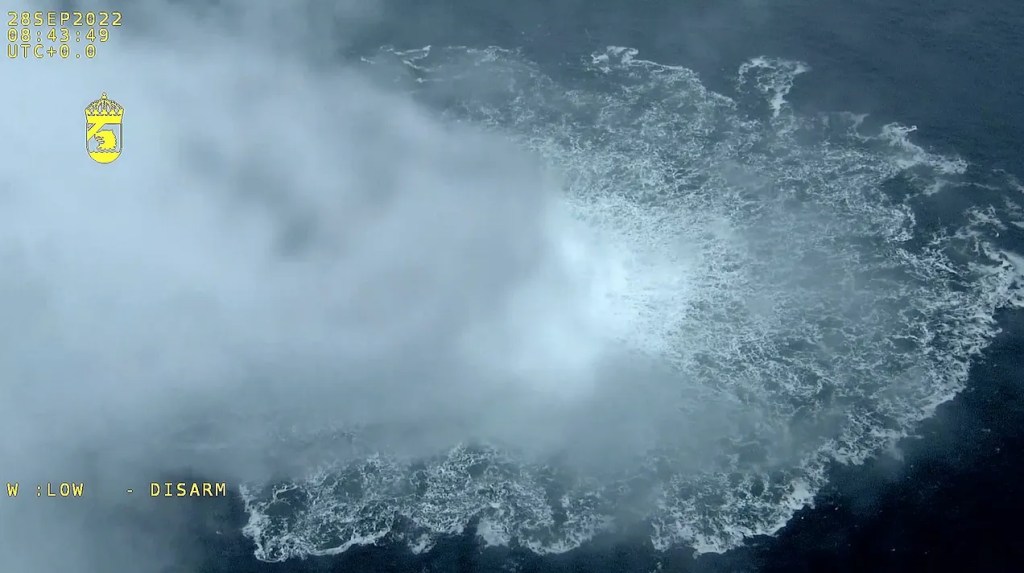
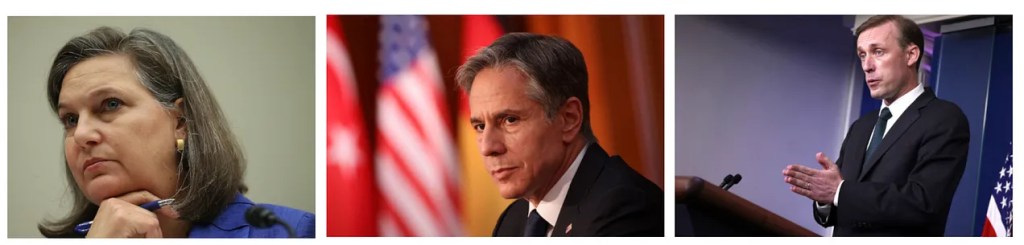
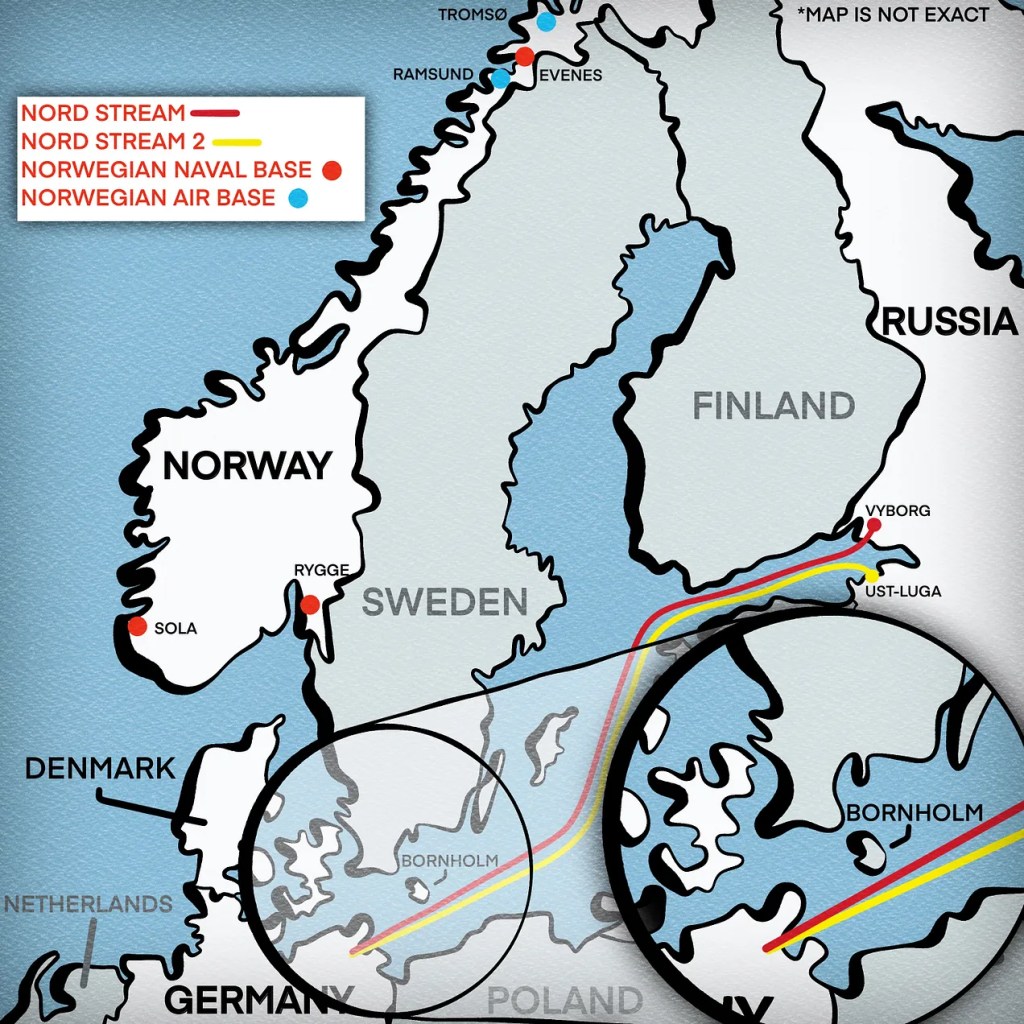
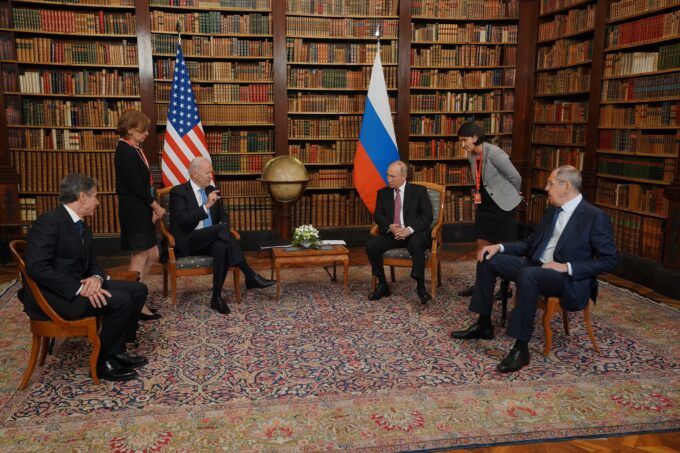
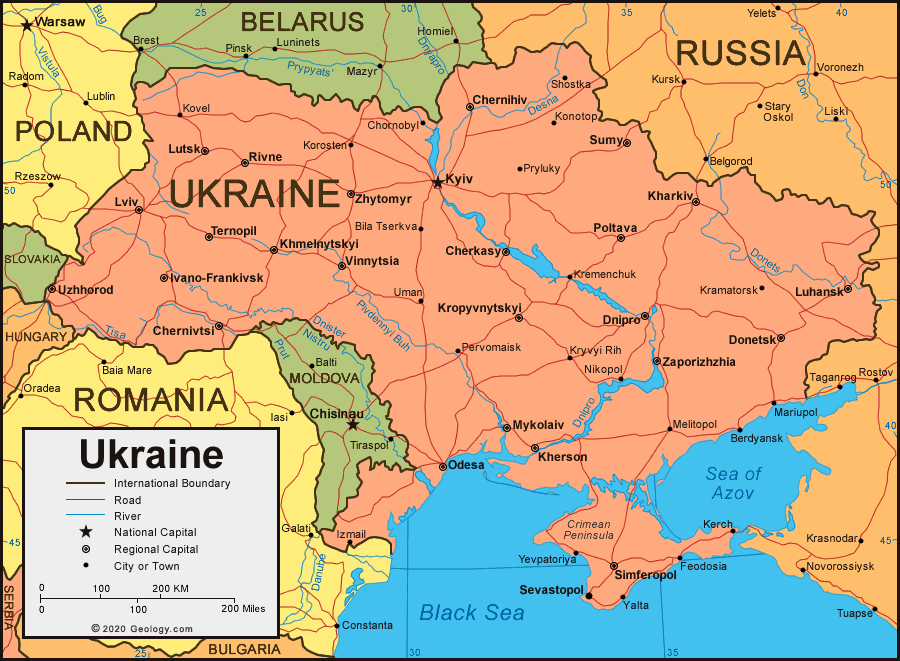
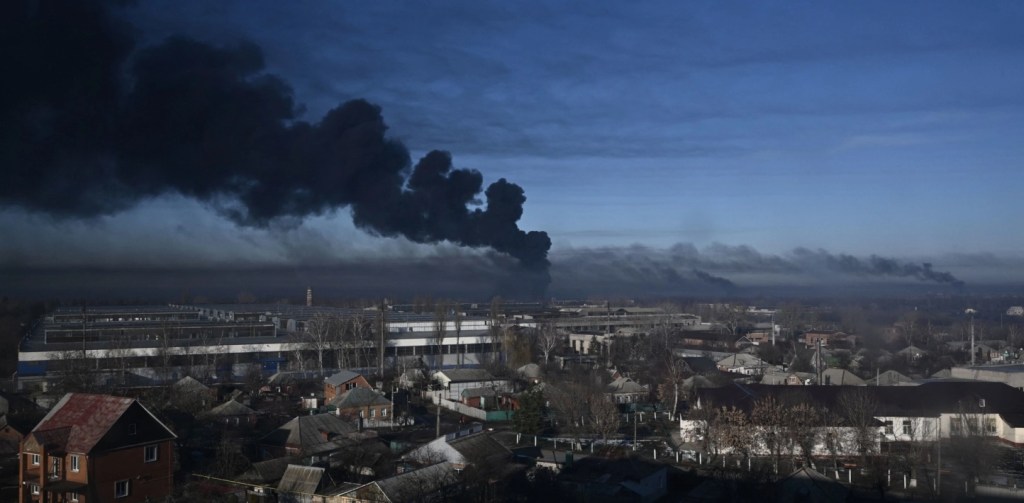

 After the Crash