DISMISSED: Trump Fires Scandal Plagued FBI Director James Comey – What Does It Mean?

Image (from Land Destroyer Report): The FBI has an impressive portfolio of intentionally created, then foiled terror plots. Its methods include allowing suspects to handle both real and inoperable weapons and explosives. These methods allow the FBI to switch entrapment cases “live” at any moment simply by switching out duds and arrests with real explosives and successful attacks. Because the FBI uses “informants,” when attacks go live, these confidential assets can be blamed, obfuscating the FBI’s involvement.

By Shawn Helton

Source: 21st Century Wire

US President Donald Trump has accepted a recommendation to ‘dismiss’ FBI director James Comey. Was this a reprisal for the suddenly widened Russia-gate probe into the White House or was there something else at play within the operations of the deep state?

Comey was at the center of a political controversy over much of the last year during the US presidential election cycle in 2016, and well into 2017. Throughout 2016, the former FBI director opened, closed and reopened (only to close again) a probe into Hillary Clinton, her email server and looking into accusations leveled at the Clinton Foundation, while also entertaining a dubious Russian probe into the Trump administration alleged ‘connections to Russia’ that helped mine various stories, including a so-called ‘dossier‘ regarding the newly elected president in early 2017.

In recent years, there have been many highly questionable actions under Comey’s leadership at the FBI, such as the Orlando nightclub shooting incident – who’s main suspect was previously interviewed by the FBI, as well as a highly questionable ‘ISIS inspired’ shooting event in Garland, Texas linked to an FBI informant case run out of Phoenix, Arizona, and the federal agency’s dramatic encroachment on public privacy following a suspicious San Bernardino mass shooting.  These are only just a few examples…

Grabien News highlights a list of scandals that were either attached to Comey or perpetuated under his watch:

“Here are 10 of Comey’s biggest embarrassments at the FBI:

1. Before he bombed the Boston Marathon, the FBI interviewed Tamerlan Tsarnaev but let him go. Russia sent the Obama Administration a second warning, but the FBI opted against investigating him again.

2. Shortly after the NSA scandal exploded in 2013, the FBI was exposed conducting its own data mining on innocent Americans; the agency, Bloomberg reported, retains that material for decades (even if no wrongdoing is found).

3. The FBI had possession of emails sent by Nidal Hasan saying he wanted to kill his fellow soldiers to protect the Taliban — but didn’t intervene, leading many critics to argue the tragedy that resulted in the death of 31 Americans at Fort Hood could have been prevented. 

4. During the Obama Administration, the FBI claimed that two private jets were being used primarily for counterterrorism, when in fact they were mostly being used for Eric Holder and Robert Mueller’s business and personal travel. 

5. When the FBI demanded Apple create a “backdoor” that would allow law enforcement agencies to unlock the cell phones of various suspects, the company refused, sparking a battle between the feds and America’s biggest tech company. What makes this incident indicative of Comey’s questionable management of the agency is that a) The FBI jumped the gun, as they were indeed ultimately able to crack the San Bernardino terrorist’s phone, and b) Almost every other major national security figure sided with Apple (from former CIA Director General Petraeus to former CIA Director James Woolsey to former director of the NSA, General Michael Hayden), warning that such a “crack” would inevitably wind up in the wrong hands.

6. In 2015, the FBI conducted a controversial raid on a Texas political meeting, finger printing, photographing, and seizing phones from attendees (some in the group believe in restoring Texas as an independent constitutional republic).

7. During its investigation into Hillary Clinton’s mishandling of classified material, the FBI made an unusual deal in which Clinton aides were both given immunity and allowed to destroy their laptops. 

8. The father of the radical Islamist who detonated a backpack bomb in New York City in 2016 alerted the FBI to his son’s radicalization. The FBI, however, cleared Ahmad Khan Rahami after a brief interview. 

9. The FBI also investigated the terrorist who killed 49 people and wounded 53 more at the Pulse Nightclub in Orlando, Fla. Despite a more than 10-month investigation of Omar Mateen — during which Mateen admitting lying to agents — the FBI opted against pressing further and closed its case. 

10. CBS recently reported that when two terrorists sought to kill Americans attending the “Draw Muhammad” event in Garland, Texas, the FBI not only had an understanding an attack was coming, but actually had an undercover agent traveling with the Islamists, Elton Simpson and Nadir Soofi. The FBI has refused to comment on why the agent on the scene did not intervene during the attack.”

It’s important to remember that Comey is not the only FBI director who bears responsibility for the controversial aspects of 2013’s Boston Bombing. Under FBI director Robert Mueller “Tamerlan Tsarnaev came to the attention of the FBI on at least two occasions” prior to allegedly being involved in what many researchers have described as a false flag terror event in Boston. A questionable event that has arguably been used as a pretext to further clamp down on individual rights in the US.

We should also be reminded that the FBI has been routinely caught foiling their very own ‘terror plots’ over the past several years.

In recent years, the investigative tactics of various intelligence agencies have come into question, none perhaps more dubious then the Newburgh FBI sting that involved entrapping four men to participate in a fabricated event created by the bureau. Here’s a 2011 passage from The Guardian describing how an FBI informant named Shahed Hussain coerced four others into a fake terror plot:

“The “Newburgh Four” now languish in jail. Hussain does not. For Hussain was a fake. In fact, Hussain worked for the FBI as an informant trawling mosques in hope of picking up radicals.

Yet far from being active militants, the four men he attracted were impoverished individuals struggling with Newburgh’s grim epidemic of crack, drug crime and poverty. One had mental issues so severe his apartment contained bottles of his own urine. He also believed Florida was a foreign country.

Hussain offered the men huge financial inducements to carry out the plot – including $250,000 to one man – and free holidays and expensive cars.

As defence lawyers poured through the evidence, the Newburgh Four came to represent the most extreme form of a controversial FBI policy to use invented terrorist plots to lure targets. “There has been no case as egregious as this. It is unique in the incentive the government provided. A quarter million dollars?” said Professor Karen Greenberg, a terrorism expert at Fordham University.”

The reputation of the FBI has suffered greatly in the recent past as well as over the past couple of decades. Incidentally, the FBI is on record as ‘handling’ Emad A. Salem, a former Egyptian army officer who was a prized undercover operative thrust into confidential informant status and person who played a key role in the 1993 WTC bombing.

All of this has happened under the watchful eye of the FBI…

Over last summer, 21WIRE observed some curious connections between the Clinton Foundation and FBI director James Comey, as well as his questionable handling of other cases related to the Clinton family. Here’s the following passage to consider in light of the new information related to the Clinton investigation:

“Many will also be unaware that before Comey was installed by the Obama Administration as FBI Director, he was on the board of Director at HSBC Bank – a bank implicated in international money laundering, including the laundering of billions on behalf of international drugs and narcotics trafficking cartels.Forbes also points out where Comey was also at the key choke-point during the case involving dodgy auditor KPMG which followed on by the HSBC criminal case:

“If Comey, and his boss Attorney General Alberto Gonzalez, had made a different decision about KPMG back in 2005, KPMG would not have been around to miss all the illegal acts HSBC and Standard Chartered SCBFF +% were committing on its watch. Bloomberg reported in 2007 that back in June of 2005, Comey was the man thrust into the position of deciding whether KPMG would live or die for its criminal tax shelter violations.”

Is this just a surface effort by the White House to clean the slate for an agency perpetually embroiled in controversy?

More from RT below…

Trump fires FBI Director James Comey

RT

President Donald Trump has fired FBI Director James Comey at the recommendation of US Attorney General Jeff Sessions and Deputy Attorney General Rod Rosenstein, according to a White House announcement.

“The FBI is one of our Nation’s most cherished and respected institutions and today will mark a new beginning for our crown jewel of law enforcement,” said President Trump.

“While I greatly appreciate you informing me, on three separate occasions, that I am not under investigation, I nevertheless concur with the judgment of the Department of Justice that you are not able to effectively lead the Bureau,” Trump told Comey in a letter.

The letter announcing the termination was hand-delivered to FBI headquarters by Keith Schiller, a Trump security aide, according to several reports citing a White House official.

A search for a new permanent FBI Director will begin immediately.

The firing of Comey comes days after he testified to Congress on investigations into alleged Russian meddling in the 2016 US election.

RT continues here

A valiant verbal warrior demythologizes the CIA

valentinecover-400x600

By Edward Curtin

Source: Intrepid Report

“Once there is a suspicion that a religion is a myth, its power has gone.”—Alan Watts, The Wisdom of Insecurity

Like Odysseus, Douglas Valentine is a wily warrior who managed to enter the enemy’s stronghold disguised as a gift. Not Troy, and not within a wooden horse, but in the guise of a nice young “Nobody,” he was able, thirty or so years ago, to breach the walls of the CIA through William Colby, a former director of the Central Intelligence Agency. The guileful thing he brought was his proposal to demystify the Phoenix program, “the controversial CIA assassination program that resulted in the deaths of thousands of civilians during the Vietnam War,” with which Colby was notably associated.

Colby naively assumed “demystify” meant justify, so he welcomed Valentine into his inner sanctum. As in days of yore, Colby, and the CIA officers he referred Valentine to, were so disarmed by the bright young trickster that they divulged their secrets without being asked, defeating themselves in the boastful ways of men drunk on their own youthful exploits. Wanting to be heroes in their own myths, they became unwitting accomplices in their own besmirchment. So much for intelligence.

When the Trojan Horse that became Valentine’s 1990 book, The Phoenix Program: America’s Use of Terror in Vietnam, was opened, and many truths rushed out to slay them, they reacted with shocked outrage that they had been double-crossed by an amateur counterspy.

Legends fall, of course, battles are lost, but when the self-anointed heroic warriors of the CIA fell, they summoned their acolytes and media scribes to silence the counterspy who did not love them. It was not the Valentine that these spurned lovers were expecting.

In this case, their defender was the media celebrity reporter, Morley Safer, who had reported from Vietnam and was friendly with William Colby. Safer owed Colby a favor. When he was in Vietnam, Safer had accepted Colby’s Mephistophelian offer to take a tour of the infamous Phoenix program’s interrogation centers and meet the counterterrorism teams, but with one stipulation. In Safer’s words, delivered to a conference in 2010: “I showed up and [Colby] said, ‘Okay, here are the rules. . . . You can’t take notes and you can’t report anything you hear. . . . to this day, I still feel constrained in terms of talking about’” (what he saw and heard).

Valentine: “And like Don Corleone dispensing favors in The Godfather, Colby knew that one day Safer would be obligated to return it. That is how the CIA, as the organized crime branch of the US government, functions like the Mafia through its old boy network of complicit media hacks.”

So The New York Times, which Valentine had criticized in his book for not reporting the truth about the CIA’s Phoenix program, had Safer write a book review of The Phoenix Program: America’s Use of Terror in Vietnam. He wrote a scathing review in which he said the book was “as turgid and dense and often incomprehensible book as I have ever had the misfortune to open.” Thus Valentine’s work was disappeared like the Vietnamese victims of the Phoenix program. (Safer’s “misfortune,” however, became our fortune when in 2014 Open Roads publishers announced a “Forbidden Bookshelves” series and resurrected Valentine’s exposé in a new edition.)

In his latest book, The CIA as Organized Crime: How Illegal Operations Corrupt America And The World, Valentine explains it thus: “But the left’s leadership is part of the CIA’s old boy network and like all American intellectuals, they look to the Times for direction and validation. So the word went out to ignore the book, not just because it revealed CIA secrets, but because it identified the media, and the Times in particular, as the reason why the public can’t see the CIA clearly for what it is: a criminal conspiracy on behalf of wealthy capitalists.”

But Valentine had been “neutralized,” and over the next quarter century the CIA, through its placement of its people throughout the media, including Hollywood and television, resurrected its mythic image—phoenix-like—from the fleeting and rarely examined ashes Valentine had reduced it to. Using what the CIA officer Frank Wisner called the agency’s “Mighty Wurlitzer”—its deep penetration of the news and cultural apparatus—it played the American people to a tune of CIA heroes defending the “homeland” from mad Muslim terrorists and evil drug dealers besieging the U.S. citadel through deception and direct attack. Movies, television shows, cognitive infiltration of the mainstream media across platforms repeated the message over and over again: We are the good guys in this mythic battle of good against evil. We are defenders of the “Homeland.”

But over these years Valentine had not disappeared, despite the CIA’s wish that he had. It took him fifteen years to recover from his “neutralization,” and then he wrote two books—The Strength of the Wolf and The Strength of the Pack—that examine the nexus between the CIA, the Federal Bureau of Narcotics, and the Drug Enforcement Administration in which he explains in documented detail how the CIA hijacked drug enforcement as it became a prime player in international drug trafficking. Joining hands with organized crime and corrupting law enforcement, the drug running and murder that was crucial to the CIA’s Phoenix program went international.

Most importantly, the Phoenix program’s organizational structure became the template for these world-wide bloody operations: among them, the Salvadoran Option, undertakings throughout South and Central America, the Middle-East, and later the war on terror, “the greatest covert op ever.” And the Phoenix became the conceptual model for The Department of Homeland Security, as “both are based on the principle that governments can manage societies through implicit and explicit terror.”

Valentine shows how the federal drug agencies protect the CIA’s drug running assets and operations, and spread addiction throughout the “homeland.” This is accomplished by CIA agents posing as federal narcotics agents. “The DEA has a public affairs branch staffed by creative writers who filter out anything bad and tell you only what the bosses want you to know. The media echoes what the DEA and the CIA PR people say. But it’s a big lie and it’s pervasive.”

But those important books had little effect on a drug addled population. They appeared in the midst of the dramatic rise in the use of “legal” pharmaceutical drugs (see Deadly Medicines and Organized Crime: How Big Pharma Has Corrupted Healthcare by Dr. Peter C. Gotzsche) and the epidemic of heroin (Greek, heros, hero + German chemical suffix, ine, coined in 1898 by the Bayer Company as a morphine substitute) that has reduced so many people to walking zombies, while minorities have long had their neighborhoods devastated by CIA facilitated crack cocaine. The zombie myth itself has become a staple of American culture—pure entertainment for a brain devouring and brain dead population—entertainment for dummies. It is no wonder. Because from 1990 when Valentine’s The Phoenix Program was trashed by the Times until today, the U.S. government and the scientific/media establishment have worked to convince Americans that all our lives revolve around our brains and that the answers to our problems lie with more brain research, drugs, genetic testing, etc. It’s been a quarter century deluge of propaganda of scientific materialism and biological determinism that we are not free but victims of our genes, neurotransmitters, brains/computers, and chemicals. Having lost our minds and fixated on our brains as instructed, we have chosen to be determined to be determined, not free. It is not coincidental that the U.S. government, beginning with ex-CIA Director and then President George H.W. Bush, declared the 1990s the decade of brain research, followed up with 2000–2010 as the decade of the behavior project, and our present decade being devoted to mapping the brain and artificial intelligence, organized by the Office of Science and Technology Project and the Defense Advanced Research Projects Agency. Brains and drugs, Big Pharma and the CIA, drug running and drug dealing, deaths at home and deaths abroad—a neat circle that has corrupted the country at the deepest levels.

This corruption is dependent on the creation of fictions that penetrate public consciousness to the level of myth. “The government,” Valentine writes, “is creating conditions across the board that are conducive to taking drugs. The pharmaceutical industry is part of the problem, along with its co-conspirators in the advertising industry; every time you turn on the TV there’s a commercial telling you to take a pill. The next commercial says don’t take that pill, take this pill. This is the free market at work, sucking the life out of people.”

But myths rise and fall, and recently the CIA’s invincibility has come under increased scrutiny. As the Greeks warned us long ago, hubris leads to humiliation. Today, more and more Americans are learning, through independent Internet sources and a growing list of books, how to deconstruct the ways the CIA “uses language and mythology to control political and social movements.” The fight is on.

Valentine, a warrior of astute knowledge from his wanderings in the CIA’s labyrinth, has reemerged with his new guidebook to the Minotaur’s deadly ways. The CIA As Organized Crime is a tour de force, a counterpuncher’s no-holds-barred passionate battle to reverse “the terrible truth . . . that a Cult of Death rules America and is hell-bent on world domination.” Unlike many writers, he holds back nothing. He names names. He is adamantine in his accusations against those he considers accomplices—in particular, “the compatible left”—“liberals and pseudo-intellectual status seekers who are easily influenced”—in the CIA/media/elite’s efforts at domination and mind-control. He claims that media celebrities of the left serve the function of pacifying the liberal bourgeoisie in these enterprises.

But knowing how leads on to way and one can easily get lost in a labyrinth, let me not tell the story of the man, Valentine, skilled in all ways of contending with such a formidable foe as the CIA. Better to give you a sampling of his words that explain what he has learned in his long wanderings in these strange and sick worlds.

“I have a very broad approach. . . . psychological, political, anthropological, sociological, historical, philosophical. When I look at a subject I look at it comprehensively from all those different points of view. Literary criticism teaches the power of symbolic transformation, or processing experience into ideas, into meaning. . . . one must, above all, understand the archetypal power of the myth of the hero. That way you can transform, through words, Joe the Plumber or even a mass murderer, into a national hero. When I decided to research and write about the CIA’s Phoenix program, that was how I went at it.”

“They [CIA] create the myths we believe. If we were allowed to understand the CIA, we’d realize it’s a criminal organization that is corrupting governments and societies around the world. It’s murdering civilians who haven’t done anything wrong.”

“Nowadays, the only way you can discern what’s going on is by studying and understanding the historical arc of these bureaucracies. Where did the CIA come from? Where is it going? If you look at it historically, you can see beyond the spin and it becomes demystified. And that is not a happy story. As power gets more concentrated in the security services, the media is no longer simply compliant, it’s functioning as their public relations arm. It simply ignores anything that contradicts the official line.”

“The most important fiction of all is the need for secrecy to preserve our national security.”

“If you want to understand the CIA, you have to understand how it’s organized. . . . The media organizes itself the way the CIA does.”

“Journalism in the US is a traditional cover for CIA officers. And when the owners of the media aren’t covering for the CIA, they’re selling commercial time slots to the multi-national corporations that in turn are selling you commodities made in sweatshops in foreign nations that have been subverted by the CIA. You could almost say there is no such thing as factual reporting. . . . The CIA and the media are part of the same criminal conspiracy. You’re never going to learn anything substantive by reading what mainstream reporters dish out about the CIA. You can’t take a journalism course in CIA Criminal Conspiracies 101.”

“I’m sure the anthrax scare after 9/11 was a CIA provocation designed to justify a mail intercept program codenamed HTLINGUAL.”

“The CIA and the military hire the smartest anthropologists, sociologists, and psychologists to figure out how to do this stuff [social engineering]. . . . That’s why you need a broad historical view. If you focus on just what’s happening now, you’re shocked every day by what you see.”

“When the United States took over drug law enforcement in Afghanistan, opium production increased dramatically. All of a sudden Afghan heroin is flooding the US and Europe. It still is. You can say it’s a coincidence, except all the opium warlords are on the CIA payroll. The DEA sends six hundred agents to Afghanistan to make sure nobody knows about it.”

“Phoenix is the conceptual model for the DHS [Department of Homeland Security]. Both are based on the principle that governments can manage societies through implicit and explicit terror. The strategic goal is to widen the gap between the elites and the mass of the citizenry, while expunging anyone who cannot be ideologically assimilated.”

“Through their control of the media, political and bureaucratic systems, America’s secret rulers engage in terrorism abroad and at home for economic purposes. . . . The objective is to maximize profits and concentrate wealth and political power in fewer and fewer hands. The global War on Terror and its domestic homeland security counterpart are flip sides of the same coin. They are the capitalist ideology applied to foreign and domestic security policy. And like the capitalist system it serves, an unstated national security policy is consolidated in fewer and fewer ideologically correct hands as the empire expands and its contradictions become more apparent.”

This sampling of Valentine’s insights should be enough to show the depth and breadth of his demythologization of this “religious” cult of death that is the CIA. Yet myths die hard. And even when they do, they often rise again, especially when one controls the levers of a society’s storytelling powers, as does the CIA to a great extent through its incestuous coupling with the mainstream corporate media. That is why it is so important for people to take the time to read Valentine’s work.

While The CIA As Organized Crime is filled with detailed information labyrinthine in its complexity, his primary goal is to help us grasp the big picture, to see how the myth and the mythmaking work and how we might break through these fictions. He repeatedly reminds us that we are truly caught in the belly of the whale, in the underworld that will overwhelm us if we do not make the sustained effort to get beyond the blur of daily events and understand how the illusionists who are deluding us create and structure their evil propaganda.

Perhaps the only way to heaven is through hell, as Dante told us. Virgil was his guide. The valiant Valentine can be ours, if we are willing to accompany him on the journey.

‘Conspiracy Theories’ and Clandestine Politics

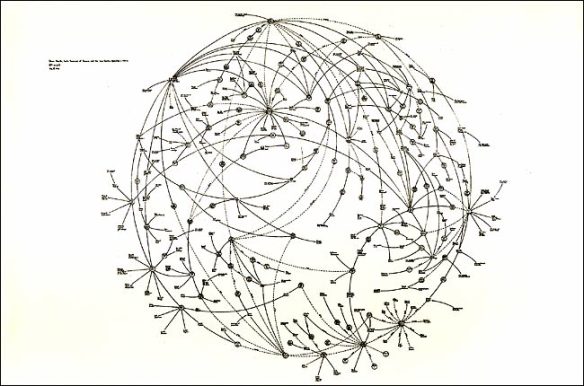
MarkLombardi

By Jeffrey M. Bale

Source: Lobster Magazine

Very few notions generate as much intellectual resistance, hostility, and derision within academic circles as a belief in the historical importance or efficacy of political conspiracies. Even when this belief is expressed in a very cautious manner, limited to specific and restricted contexts, supported by reliable evidence, and hedged about with all sort of qualifications, it still manages to transcend the boundaries of acceptable discourse and violate unspoken academic taboos. The idea that particular groups of people meet together secretly or in private to plan various courses of action, and that some of these plans actually exert a significant influence on particular historical developments, is typically rejected out of hand and assumed to be the figment of a paranoid imagination. The mere mention of the word ‘conspiracy’ seems to set off an internal alarm bell which causes scholars to close their minds in order to avoid cognitive dissonance and possible unpleasantness, since the popular image of conspiracy both fundamentally challenges the conception most educated, sophisticated people have about how the world operates and reminds them of the horrible persecutions that absurd and unfounded conspiracy theories have precipitated or sustained in the past. So strong is this prejudice among academics that even when clear evidence of a plot is inadvertently discovered in the course of their own research, they frequently feel compelled, either out of a sense of embarrassment or a desire to defuse anticipated criticism, to preface their account of it by ostentatiously disclaiming a belief in conspiracies. (1)

They then often attempt to downplay the significance of the plotting they have uncovered. To do otherwise, that is, to make a serious effort to incorporate the documented activities of conspiratorial groups into their general political or historical analyses, would force them to stretch their mental horizons beyond customary bounds and, not infrequently, delve even further into certain sordid and politically sensitive topics. Most academic researchers clearly prefer to ignore the implications of conspiratorial politics altogether rather than deal directly with such controversial matters.

A number of complex cultural and historical factors contribute to this reflexive and unwarranted reaction, but it is perhaps most often the direct result of a simple failure to distinguish between ‘conspiracy theories’ in the strict sense of the term, which are essentially elaborate fables even though they may well be based upon a kernel of truth, and the activities of actual clandestine and covert political groups, which are a common feature of modern politics. For this and other reasons, serious research into genuine conspiratorial networks has at worst been suppressed, as a rule been discouraged, and at best been looked upon with condescension by the academic community. (2) An entire dimension of political history and contemporary politics has thus been consistently neglected. (3)

For decades scholars interested in politics have directed their attention toward explicating and evaluating the merits of various political theories, or toward analyzing the more conventional, formal, and overt aspects of practical politics. Even a cursory examination of standard social science bibliographies reveals that tens of thousands of books and articles have been written about staple subjects such as the structure and functioning of government bureaucracies, voting patterns and electoral results, parliamentary procedures and activities, party organizations and factions, the impact of constitutional provisions or laws, and the like. In marked contrast, only a handful of scholarly publications have been devoted to the general theme of political conspiracies–as opposed to popular anti-conspiracy treatises, which are very numerous, and specific case studies of events in which conspiratorial groups have played some role — and virtually all of these concern themselves with the deleterious social impact of the ‘paranoid style’ of thought manifested in classic conspiracy theories rather than the characteristic features of real conspiratorial politics. (4)

Only the academic literature dealing with specialized topics like espionage, covert action, political corruption, terrorism, and revolutionary warfare touches upon clandestine and covert political activities on a more or less regular basis, probably because such activities cannot be avoided when dealing with these topics. But the analyses and information contained therein are rarely incorporated into standard works of history and social science, and much of that specialized literature is itself unsatisfactory. Hence there is an obvious need to place the study of conspiratorial politics on a sound theoretical, methodological, and empirical footing, since ignoring the influence of such politics can lead to severe errors of historical interpretation.

This situation can only be remedied when a clear-cut analytical distinction has been made between classic conspiracy theories and the more limited conspiratorial activities that are a regular feature of politics. ‘Conspiracy theories’ share a number of distinguishing characteristics, but in all of them the essential element is a belief in the existence of a ‘vast, insidious, preternaturally effective international conspiratorial network designed to perpetrate acts of the most fiendish character’, acts which aim to ‘undermine and destroy a way of life.’ (5)

Although this apocalyptic conception is generally regarded nowadays as the fantastic product of a paranoid mindset, in the past it was often accepted as an accurate description of reality by large numbers of people from all social strata, including intellectuals and heads of state. (6) The fact that a belief in sinister, all-powerful conspiratorial forces has not been restricted to small groups of clinical paranoids and mental defectives suggests that it fulfills certain important social functions and psychological needs.(7)

First of all, like many other intellectual constructs, conspiracy theories help to make complex patterns of cause-and-effect in human affairs more comprehensible by means of reductionism and oversimplification. Secondly, they purport to identify the underlying source of misery and injustice in the world, thereby accounting for current crises and upheavals and explaining why bad things are happening to good people or vice versa. Thirdly, by personifying that source they paradoxically help people to reaffirm their own potential ability to control the course of future historical developments. After all, if evil conspirators are consciously causing undesirable changes, the implication is that others, perhaps through the adoption of similar techniques, may also consciously intervene to protect a threatened way of life or otherwise alter the historical process. In short, a belief in conspiracy theories helps people to make sense out of a confusing, inhospitable reality, rationalize their present difficulties, and partially assuage their feelings of powerlessness. In this sense, it is no different than any number of religious, social, or political beliefs, and is deserving of the same serious study.

The image of conspiracies promoted by conspiracy theorists needs to be further illuminated before it can be contrasted with genuine conspiratorial politics. In the first place, conspiracy theorists consider the alleged conspirators to be Evil incarnate. They are not simply people with differing values or run-of-the-mill political opponents, but inhuman, superhuman, and/or anti-human beings who regularly commit abominable acts and are implacably attempting to subvert and destroy everything that is decent and worth preserving in the existing world. Thus, according to John Robison, the Bavarian Illuminati were formed ‘for the express purpose of ROOTING OUT ALL THE RELIGIOUS ESTABLISHMENTS, AND OVERTURNING ALL THE EXISTING GOVERNMENTS IN EUROPE.’ (8)

This grandiose claim is fairly representative, in the sense that most conspiracy theorists view the world in similarly Manichean and apocalyptic terms.

Secondly, conspiracy theorists perceive the conspiratorial group as both monolithic and unerring in the pursuit of its goals. This group is directed from a single conspiratorial centre, acting as a sort of general staff, which plans and coordinates all of its activities down to the last detail. Note, for example, Prince Clemens von Metternich’s claim that a ‘directing committee’ of the radicals from all over Europe had been established in Paris to pursue their insidious plotting against established governments. (9)

Given that presumption, it is no accident that many conspiracy theorists refer to ‘the Conspiracy’ rather than (lower case)conspiracies or conspiratorial factions, since they perceive no internal divisions among the conspirators. Rather, as a group the conspirators are believed to possess an extraordinary degree of internal solidarity, which produces a corresponding degree of counter solidarity vis-a-vis society at large, and indeed it is this very cohesion and singleness of purpose which enables them to effectively execute their plans to destroy existing institutions, seize power, and eliminate all opposition.

Thirdly, conspiracy theorists believe that the conspiratorial group is omnipresent, at least within its own sphere of operations. While some conspiracy theories postulate a relatively localized group of conspirators, most depict this group as both international in its spatial dimensions and continuous in its temporal dimensions. ‘[T]he conspirators planned and carried out evil in the past, they are successfully active in the present, and they will triumph in the future if they are not disturbed in their plans by those with information about their sinister designs.’(10)

The conspiratorial group is therefore capable of operating virtually everywhere. As a consequence of this ubiquitousness, anything that occurs which has a broadly negative impact or seems in anyway related to the purported aims of the conspirators can thus be plausibly attributed to them.

Fourthly, the conspiratorial group is viewed by conspiracy theorists as virtually omnipotent. In the past this group has successfully overthrown empires and nations, corrupted whole societies, and destroyed entire civilizations and cultures, and it is said to be in the process of accomplishing the same thing at this very moment. Its members are secretly working in every nook and cranny of society, and are making use of every subversive technique known to mankind to achieve their nefarious purposes. Nothing appears to be able to stand in their way–unless the warnings of the conspiracy theorists are heeded and acted upon at once. Even then there is no guarantee of ultimate victory against such powerful forces, but a failure to recognize the danger and take immediate countervailing action assures the success of those forces in the near future.

Finally, for conspiracy theorists conspiracies are not simply a regular feature of politics whose importance varies in different historical contexts, but rather the motive force of all historical change and development. The conspiratorial group can and does continually alter the course of history, invariably in negative and destructive ways, through conscious planning and direct intervention. Its members are not buffeted about by structural forces beyond their control and understanding, like everyone else, but are themselves capable of controlling events more or less at will. This supposed ability is usually attributed to some combination of demonic influence or sponsorship, the possession of arcane knowledge, the mastery of devilish techniques, and/or the creation of a preternaturally effective clandestine organization. As a result, unpleasant occurrences which are perceived by others to be the products of coincidence or chance are viewed by conspiracy theorists as further evidence of the secret workings of the conspiratorial group. For them, nothing that happens occurs by accident. Everything is the result of secret plotting in accordance with some sinister design.

This central characteristic of conspiracy theories has been aptly summed up by Donna Kossy in a popular book on fringe ideas:

Conspiracy theories are like black holes–they suck in everything that comes their way, regardless of content or origin…Everything you’ve ever known or experienced, no matter how ‘meaningless’, once it contacts the conspiratorial universe, is enveloped by and cloaked in sinister significance. Once inside, the vortex gains in size and strength, sucking in everything you touch. (11)

As an example of this sort of mechanism, one has only to mention the so-called ‘umbrella man’, a man who opened up an umbrella on a sunny day in Dealey Plaza just as President John F. Kennedy’s motorcade was passing. A number of ‘conspiracy theorists’ have assumed that this man was signalling to the assassins, thus tying a seemingly trivial and inconsequential act into the alleged plot to kill Kennedy. It is precisely this totalistic, all-encompassing quality that distinguishes ‘conspiracy theories’ from the secret but often mundane political planning that is carried out on a daily basis by all sorts of groups, both within and outside of government. It should, however, be pointed out that even if the ‘umbrella man’ was wholly innocent of any involvement in a plot, as he almost certainly was, this does not mean that the Warren Commission’s reconstruction of the assassination is accurate.

However that may be, real covert politics, although by definition hidden or disguised and often deleterious in their impact, simply do not correspond to the bleak, simplistic image propounded by conspiracy theorists. Far from embodying metaphysical evil, they are perfectly and recognizably human, with all the positive and negative characteristics and potentialities which that implies. At the most basic level, all the efforts of individuals to privately plan and secretly initiate actions for their own perceived mutual benefit –insofar as these are intentionally withheld from outsiders and require the maintenance of secrecy for their success–are conspiracies. Moreover, in contrast to the claims of conspiracy theorists, covert politics are anything but monolithic. At any given point in time, there are dozens if not thousands of competitive political and economic groups engaging in secret planning and activities, and most are doing so in an effort to gain some advantage over their rivals among the others. Such behind-the-scene operations are present on every level, from the mundane efforts of small-scale retailers to gain competitive advantage by being the first to develop new product lines to the crucially important attempts by rival secret services to penetrate and manipulate each other. Sometimes the patterns of these covert rivalries and struggles are relatively stable over time, whereas at other times they appear fluid and kaleidoscopic, as different groups secretly shift alliances and change tactics in accordance with their perceived interests. Even internally, within particular groups operating clandestinely, there are typically bitter disagreements between various factions over the specific courses of action to be adopted. Unanimity of opinioon historical judgements. There is probably no way to prevent this sort of unconscious reaction in the current intellectual climate, but the least that can be expected of serious scholars is that they carefully examine the available evidence before dismissing these matters out of hand.


Footnotes

1. Compare Robin Ramsay, ‘Conspiracy, Conspiracy Theories and Conspiracy Research’, Lobster 19 (1990), p. 25: ‘In intellectually respectable company it is necessary to preface any reference to actual political, economic, military or paramilitary conspiracies with the disclaimer that the speaker “doesn’t believe in the conspiracy theory of history (or politics)”.’This type of disclaimer quite clearly reveals the speaker’s inability to distinguish between bona fide conspiracy theories and actual conspiratorial politics.

2. The word ‘suppress’ is not too strong here. I personally know of at least one case in which a very bright graduate student at a prestigious East Coast university was unceremoniously told by his advisor that if he wanted to write a Ph.D. thesis on an interesting historical example of conspiratorial politics he would have to go elsewhere to do so. He ended up leaving academia altogether and became a professional journalist, in which capacity he has produced a number of interesting books and articles.

3. Complaints about this general academic neglect have often been made by those few scholars who have done research on key aspects of covert and clandestine politics which are directly relevant to this study. See, for example, Gary Marx, ‘Thoughts on a Neglected Category of Social Movement Participant: The Agent Provocateur and the Informant’, American Journal of Sociology 80:2 (September 1974), especially pp. 402-3. One of the few dissertations dealing directly with this topic, though not in a particularly skilful fashion, is Frederick A. Hoffman, ‘Secret Roles and Provocation: Covert Operations in Movements for social Change’ (Unpublished Ph.D. Dissertation: UCLA Sociology Department, 1979). There are, of course, some excellent academic studies which have given due weight to these matters–for example, Nurit Schleifman, Undercover Agents in the Russian Revolutionary Movement: The SR Party, 1902-1914 (Basingstoke: Macmillan/ St. Anthony’s College, 1988); and Jean-Paul Brunet, La police de l’ombre: Indicateurs et provocateurs dans la France contemporaine (Paris: Seuil, 1990)–but such studies areunfortunately few and far between.

4. The standard academic treatments of conspiracy theories are Richard Hofstadter, ‘The Paranoid Style in American Politics’, in Hofstadter, The Paranoid Style in American Politics and Other Essays (New York: Knopf, 1966), pp. 3-40; Norman Cohn, Warrant for Genocide: The Myth of the Jewish World-Conspiracy and the Protocols of the Elders of Zion (Chico, CA: Scholars, 1981 [1969]); J. M. Roberts, The Mythology of the Secret Societies (London: Secker & Warburg, 1972); Johannes Rogallavon Bieberstein, Die These von der Verschwrung, 1776-1945: Philosophen, Freimaurer, Juden, Liberale und Sozialisten als Verschwrergegen die Sozialordnung (Frankfurt am Main: Peter Lang, 1976); and Carl F. Graumann and Serge Moscovici, eds., Changing Conceptions of Conspiracy (New York: Springer, 1987). See also the journalistic studies by George Johnson, Architects of Fear: Conspiracy Theories and paranoia in American Politics (Los Angeles: Tarcher, 1983); and Jonathan Vankin, Conspiracies, Cover-Ups, and Crimes: Political Manipulation and Mind Control in America (New York: Paragon House, 1992).

5. See Hofstadter, ‘Paranoid Style’, pp. 14, 29.

6. Although conspiracy theories have been widely accepted in the most disparate eras and parts of the world, and thus probably have a certain universality as explanatory models, at certain points in time they have taken on an added salience due to particular historical circumstances. Their development and diffusion seems to be broadly correlated with the level of social, economic, and political upheaval or change, though indigenous cultural values and intellectual traditions determine their specific form and condition their level of popularity.

7. As many scholars have pointed out, if such ideas were restricted to clinical paranoids, they would have little or no historical importance. What makes the conspiratorial or paranoid style of thought interesting and historically significant is that it frequently tempts more or less normal people and has often been diffused among broad sections of the population in certain periods. Conspiracy theories are important as collective delusions, delusions which nevertheless reflect real fears and real social problems, rather than as evidence of individual pathologies. See, for example, Hofstadter,’Paranoid Style’, pp. 3-4.

8. See his Proofs of a Conspiracy Against All the Religions and Governments of Europe, Carried on in the Secret Meetings of free Masons, Illuminati, and Reading Societies, Collected from Good Authorities (New York: G. Forman, 1798), p. 14. This exhibits yet another characteristic of ‘conspiracy theorists’–the tendency to over-dramatize everything by using capital letters with reckless abandon.

9. See his ‘Geheime Denkschrift nber die Grundung eines Central-Comites der nordischen Machte in Wien’, in Aus Metternichs nachgelassenen Papieren, ed. by Richard Metternich-Winneburg (Vienna: 1881),vol. 1, p. 595, cited in Rogalla von Bieberstein, These von der Verschwrung, pp. 139-40.

10. Dieter Groh, ‘Temptation of Conspiracy Theory, Part I’, in Changing Conceptions of Conspiracy, p. 3. A classic example of conspiratorial works that view modern revolutionary movements as little more than the latest manifestations of subversive forces with a very long historical pedigree is the influential book by Nesta H. Webster, Secret Societies and Subversive Movements (London: Boswell, 1924). For more on Webster’s background, see the biographical study by Richard M. Gilman, Behind World Revolution: The Strange Career of Nesta H. Webster (Ann Arbor: Insight, 1982), of which only one volume has so far appeared.

11. Kooks: A Guide to the Outer Limits of Human Belief (Portland: Feral House, 1994), p. 191.

12. For more on P2, see above all the materials published by the Italian parliamentary commission investigating the organization, which are divided into the majority (Anselmi) report, five dissenting minority reports, and over one hundred thick volumes of attached documents and verbatim testimony before the commission. Compare also Martin Berger, Historia de la loggia masonica P2 (Buenos Aires: El Cid, 1983); Andrea Barbieri et al, L’Italia della P2 (Milan: Mondadori, 1981); Alberto Cecchi, Storia della P2 (Rome: Riuniti, 1985); Roberto Fabiani, I massoni in Italia (Milan: L’Espresso, 1978); Gianfranco Piazzesi, Gelli: La carriere di un eroe di questa Italia (Milan: Garzanti, 1983); Marco Ramat et al, La resistabile ascesa della P2: Poteri occulti e stato democratico (Bari: De Donato, 1983); Renato Risaliti, Licio Gelli, a carte scoperte (Florence: Fernando Brancato, 1991); and Gianni Rossi and Franceso Lombrassa, In nome della ‘loggia’: Le prove di come lamassoneria segreta ha tentato di impadronarsi dello stato italiano. Iretroscena della P2 (Rome: Napoleone, 1981). Pro P2 works include those of Gelli supporter Pier Carpi, Il caso Gelli: La verita sulla loggia P2 (Bologna: INEI, 1982); and the truly Orwellian work by Gelli himself, La verita (Lugano: Demetra, 1989), which in spite of its title bears little resemblance to the truth.

13. For the AB, see Ivor Wilkins and Hans Strydom, The Super-Afrikaners: Inside the Afrikaner Broederbond (Johannesburg: Jonathan Ball, 1978); and J.H.P.Serfontein, Brotherhood of Power: An Expose of the Secret Afrikaner Broederbond (Bloomington and London: Indiana University, 1978).Compare also B. M. Schoeman, Die Broederbond in die Afrikaner-politiek (Pretoria: Aktuele, 1982); and Adrien Pelzer, Die Afrikaner-Broederbond: Eerste 50 jaar (Cape Town: Tafelberg, 1979).

14. See his Historians’ Fallacies: Toward a Logic of Historical Thought (New York: Harper & Row, 1970), pp. 74-8.

American Pravda: How the CIA Invented “Conspiracy Theories”

index

By Ron Unz

Source: The Unz Review

A year or two ago, I saw the much-touted science fiction film Interstellar, and although the plot wasn’t any good, one early scene was quite amusing. For various reasons, the American government of the future claimed that our Moon Landings of the late 1960s had been faked, a trick aimed at winning the Cold War by bankrupting Russia into fruitless space efforts of its own. This inversion of historical reality was accepted as true by nearly everyone, and those few people who claimed that Neil Armstrong had indeed set foot on the Moon were universally ridiculed as “crazy conspiracy theorists.” This seems a realistic portrayal of human nature to me.

Obviously, a large fraction of everything described by our government leaders or presented in the pages of our most respectable newspapers—from the 9/11 attacks to the most insignificant local case of petty urban corruption—could objectively be categorized as a “conspiracy theory” but such words are never applied. Instead, use of that highly loaded phrase is reserved for those theories, whether plausible or fanciful, that do not possess the endorsement stamp of establishmentarian approval.

Put another way, there are good “conspiracy theories” and bad “conspiracy theories,” with the former being the ones promoted by pundits on mainstream television shows and hence never described as such. I’ve sometimes joked with people that if ownership and control of our television stations and other major media outlets suddenly changed, the new information regime would require only a few weeks of concerted effort to totally invert all of our most famous “conspiracy theories” in the minds of the gullible American public. The notion that nineteen Arabs armed with box-cutters hijacked several jetliners, easily evaded our NORAD air defenses, and reduced several landmark buildings to rubble would soon be universally ridiculed as the most preposterous “conspiracy theory” ever to have gone straight from the comic books into the minds of the mentally ill, easily surpassing the absurd “lone gunman” theory of the JFK assassination.

Even without such changes in media control, huge shifts in American public beliefs have frequently occurred in the recent past, merely on the basis of implied association. In the initial weeks and months following the 2001 attacks, every American media organ was enlisted to denounce and vilify Osama Bin Laden, the purported Islamicist master-mind, as our greatest national enemy, with his bearded visage endlessly appearing on television and in print, soon becoming one of the most recognizable faces in the world. But as the Bush Administration and its key media allies prepared a war against Iraq, the images of the Burning Towers were instead regularly juxtaposed with mustachioed photos of dictator Saddam Hussein, Bin Laden’s arch-enemy. As a consequence, by the time we attacked Iraq in 2003, polls revealed that some 70% of the American public believed that Saddam was personally involved in the destruction of our World Trade Center. By that date I don’t doubt that many millions of patriotic but low-information Americans would have angrily denounced and vilified as a “crazy conspiracy theorist” anyone with the temerity to suggest that Saddam hadnot been behind 9/11, despite almost no one in authority having ever explicitly made such a fallacious claim.

These factors of media manipulation were very much in my mind a couple of years ago when I stumbled across a short but fascinating book published by the University of Texas academic press. The author of Conspiracy Theory in America was Prof. Lance deHaven-Smith, a former president of the Florida Political Science Association.

Based on an important FOIA disclosure, the book’s headline revelation was that the CIA was very likely responsible for the widespread introduction of “conspiracy theory” as a term of political abuse, having orchestrated that development as a deliberate means of influencing public opinion.

During the mid-1960s there had been increasing public skepticism about the Warren Commission findings that a lone gunman, Lee Harvey Oswald, had been solely responsible for President Kennedy’s assassination, and growing suspicions that top-ranking American leaders had also been involved. So as a means of damage control, the CIA distributed a secret memo to all its field offices requesting that they enlist their media assets in efforts to ridicule and attack such critics as irrational supporters of “conspiracy theories.” Soon afterward, there suddenly appeared statements in the media making those exact points, with some of the wording, arguments, and patterns of usage closely matching those CIA guidelines. The result was a huge spike in the pejorative use of the phrase, which spread throughout the American media, with the residual impact continueing right down to the present day. Thus, there is considerable evidence in support of this particular “conspiracy theory” explaining the widespread appearance of attacks on “conspiracy theories” in the public media.

But although the CIA appears to have effectively manipulated public opinion in order to transform the phrase “conspiracy theory” into a powerful weapon of ideological combat, the author also describes how the necessary philosophical ground had actually been prepared a couple of decades earlier. Around the time of the Second World War, an important shift in political theory caused a huge decline in the respectability of any “conspiratorial” explanation of historical events.

For decades prior to that conflict, one of our most prominent scholars and public intellectuals had been historian Charles Beard, whose influential writings had heavily focused on the harmful role of various elite conspiracies in shaping American policy for the benefit of the few at the expense of the many, with his examples ranging from the earliest history of the United States down to the nation’s entry into WWI. Obviously, researchers never claimed that all major historical events had hidden causes, but it was widely accepted that some of them did, and attempting to investigate those possibilities was deemed a perfectly acceptable academic enterprise.

However, Beard was a strong opponent of American entry into the Second World War, and he was marginalized in the years that followed, even prior to his death in 1948. Many younger public intellectuals of a similar bent also suffered the same fate, or were even purged from respectability and denied any access to the mainstream media. At the same time, the totally contrary perspectives of two European political philosophers, Karl Popper and Leo Strauss, gradually gained ascendancy in American intellectual circles, and their ideas became dominant in public life.

Popper, the more widely influential, presented broad, largely theoretical objections to the very possibility of important conspiracies ever existing, suggesting that these would be implausibly difficult to implement given the fallibility of human agents; what might appear a conspiracy actually amounted to individual actors pursuing their narrow aims. Even more importantly, he regarded “conspiratorial beliefs” as an extremely dangerous social malady, a major contributing factor to the rise of Nazism and other deadly totalitarian ideologies. His own background as an individual of Jewish ancestry who had fled Austria in 1937 surely contributed to the depth of his feelings on these philosophical matters.

Meanwhile, Strauss, a founding figure in modern neo-conservative thought, was equally harsh in his attacks upon conspiracy analysis, but for polar-opposite reasons. In his mind, elite conspiracies were absolutely necessary and beneficial, a crucial social defense against anarchy or totalitarianism, but their effectiveness obviously depended upon keeping them hidden from the prying eyes of the ignorant masses. His main problem with “conspiracy theories” was not that they were always false, but they might often be true, and therefore their spread was potentially disruptive to the smooth functioning of society. So as a matter of self-defense, elites needed to actively suppress or otherwise undercut the unauthorized investigation of suspected conspiracies.

Even for most educated Americans, theorists such as Beard, Popper, and Strauss are probably no more than vague names mentioned in textbooks, and that was certainly true in my own case. But while the influence of Beard seems to have largely disappeared in elite circles, the same is hardly true of his rivals. Popper probably ranks as one of the founders of modern liberal thought, with an individual as politically influential as left-liberal financier George Soros claiming to be his intellectual disciple. Meanwhile, the neo-conservative thinkers who have totally dominated the Republican Party and the Conservative Movement for the last couple of decades often proudly trace their ideas back to Strauss.

So, through a mixture of Popperian and Straussian thinking, the traditional American tendency to regard elite conspiracies as a real but harmful aspect of our society was gradually stigmatized as either paranoid or politically dangerous, laying the conditions for its exclusion from respectable discourse.


By 1964, this intellectual revolution had largely been completed, as indicated by the overwhelmingly positive reaction to the famous article by political scientist Richard Hofstadter critiquing the so-called “paranoid style” in American politics, which he denounced as the underlying cause of widespread popular belief in implausible conspiracy theories. To a considerable extent, he seemed to be attacking straw men, recounting and ridiculing the most outlandish conspiratorial beliefs, while seeming to ignore the ones that had been proven correct. For example, he described how some of the more hysterical anti-Communists claimed that tens of thousands of Red Chinese troops were hidden in Mexico, preparing an attack on San Diego, while he failed to even acknowledge that for years Communist spies had indeed served near the very top of the U.S. government. Not even the most conspiratorially minded individual suggests that all conspiracies are true, merely that some of them might be.

Most of these shifts in public sentiment occurred before I was born or when I was a very young child, and my own views were shaped by the rather conventional media narratives that I absorbed. Hence, for nearly my entire life, I always automatically dismissed all of the so-called “conspiracy theories” as ridiculous, never once even considering that any of them might possibly be true.

To the extent that I ever thought about the matter, my reasoning was simple and based on what seemed like good, solid common sense. Any conspiracy responsible for some important public event must surely have many separate “moving parts” to it, whether actors or actions taken, let us say numbering at least 100 or more. Now given the imperfect nature of all attempts at concealment, it would surely be impossible for all of these to be kept entirely hidden. So even if a conspiracy were initially 95% successful in remaining undetected, five major clues would still be left in plain sight for investigators to find. And once the buzzing cloud of journalists noticed these, such blatant evidence of conspiracy would certainly attract an additional swarm of energetic investigators, tracing those items back to their origins, with more pieces gradually being uncovered until the entire cover-up likely collapsed. Even if not all the crucial facts were ever determined, at least the simple conclusion that there had indeed been some sort of conspiracy would quickly become established.

However, there was a tacit assumption in my reasoning, one that I have since decided was entirely false. Obviously, many potential conspiracies either involve powerful governmental officials or situations in which their disclosure would represent a source of considerable embarrassment to such individuals. But I had always assumed that even if government failed in its investigatory role, the dedicated bloodhounds of the Fourth Estate would invariably come through, tirelessly seeking truth, ratings, and Pulitzers. However, once I gradually began realizing that the media was merely “Our American Pravda” and perhaps had been so for decades, I suddenly recognized the flaw in my logic. If those five—or ten or twenty or fifty—initial clues were simply ignored by the media, whether through laziness, incompetence, or much less venal sins, then there would be absolutely nothing to prevent successful conspiracies from taking place and remaining undetected, perhaps even the most blatant and careless ones.

In fact, I would extend this notion to a general principle. Substantial control of the media is almost always an absolute prerequisite for any successful conspiracy, the greater the degree of control the better. So when weighing the plausibility of any conspiracy, the first matter to investigate is who controls the local media and to what extent.

Let us consider a simple thought-experiment. For various reasons these days, the entire American media is extraordinarily hostile to Russia, certainly much more so than it ever was toward the Communist Soviet Union during the 1970s and 1980s. Hence I would argue that the likelihood of any large-scale Russian conspiracy taking place within the operative zone of those media organs is virtually nil. Indeed, we are constantly bombarded with stories of alleged Russian conspiracies that appear to be “false positives,” dire allegations seemingly having little factual basis or actually being totally ridiculous. Meanwhile, even the crudest sort of anti-Russian conspiracy might easily occur without receiving any serious mainstream media notice or investigation.

This argument may be more than purely hypothetical. A crucial turning point in America’s renewed Cold War against Russia was the passage of the 2012 Magnitsky Act by Congress, punitively targeting various supposedly corrupt Russian officials for their alleged involvement in the illegal persecution and death of an employee of Bill Browder, an American hedge-fund manager with large Russian holdings. However, there’s actually quite a bit of evidence that it was Browder himself who was actually the mastermind and beneficiary of the gigantic corruption scheme, while his employee was planning to testify against him and was therefore fearful of his life for that reason. Naturally, the American media has provided scarcely a single mention of these remarkable revelations regarding what might amount to a gigantic Magnitsky Hoaxof geopolitical significance.

To some extent the creation of the Internet and the vast proliferation of alternative media outlets, including my own small webzine, have somewhat altered this depressing picture. So it is hardly surprising that a very substantial fraction of the discussion dominating these Samizdat-like publications concerns exactly those subjects regularly condemned as “crazy conspiracy theories” by our mainstream media organs. Such unfiltered speculation must surely be a source of considerable irritation and worry to government officials who have long relied upon the complicity of their tame media organs to allow their serious misdeeds to pass unnoticed and unpunished. Indeed, several years ago a senior Obama Administration official argued that the free discussion of various “conspiracy theories” on the Internet was so potentially harmful that government agents should be recruited to “cognitively infiltrate” and disrupt them, essentially proposing a high-tech version of the highly controversial Cointelpro operations undertaken by J. Edgar Hoover’s FBI.

Until just a few years ago I’d scarcely even heard of Charles Beard, once ranked among the towering figures of 20th century American intellectual life. But the more I’ve discovered the number of serious crimes and disasters that have completely escaped substantial media scrutiny, the more I wonder what other matters may still remain hidden. So perhaps Beard was correct all along in recognizing the respectability of “conspiracy theories,” and we should return to his traditional American way of thinking, notwithstanding endless conspiratorial propaganda campaigns by the CIA and others to persuade us that we should dismiss such notions without any serious consideration.

Indict Clinton For the Russian DNC and RNC Hack

The Trump Dossier: Created by Spies”R”Us?

chris-steele-1

By Phil Butler

Source: New Eastern Outlook

Chris Steele is a former MI6 and FBI asset who compiled a dossier of unsubstantiated allegations about President-elect Donald Trump. The current Director at the private security and investigation firm Orbis Business Intelligence, is a curious player in the sensational efforts of Trump adversaries. Here is what I discovered about the former British intelligence officer.

For Donald Trump’s part, his press conference this week revealed his righteous indignation at just how far his opponents will go to smear his coming administration. Shunning Buzzfeed and ostracizing CNN for their irresponsible broadcasting of the “dossier”, Mr. Trump was crystal clear in pointing the finger at crooked media and the people behind. The incoming president was also clear in identifying his adversaries, a fact that has been corroborated.

The Steele dossier was contracted by both Republican and Democratic adversaries of Mr. Trump. Senator John McCain, the notoriously hawkish Arizona arms industry puppet, admitted he turned over the dossier to the FBI. While McCain’s involvement is shocking enough, I believe other familiar faces funded the extended smear campaign. The Guardian has done some of the homework in tracking down how this dossier came into being, but this “Steele” character is still a bit of an enigma.

Chris Steele has only this week come into the limelight, but Mother Jones had actually reported on some of his activities back in October of 2016. By using The Guardian story, and what can be gleaned from the Mother Jones report, profiling Mr. Trump’s new nemesis is actually not so difficult. Steel’s LinkedIn profile and connections are telling. Steele has received some interesting endorsements on LinkedIn.

First, Jonathan Winer, who’s a Special Envoy at US Department of State, acknowledged the former MI6 agent on his international relations skills, it is key to note that Winer is not only the special envoy for Libya, but he was previously a senior director at Margery Kraus’ APCO Worldwide, a former Assistant Secretary of State, and Secretary of State John Kerry’s legislative assistant. Are your eyebrows raised?

Paul Andrews, who’s director of Ultrax Consulting Limited also recommended Steele. Of further interest is the fact Andrews was a member of Her Majesty’s Foreign Commonwealth Office for 15 years. Maybe a direct quote from Andrews’ security agency will shed more light:

“ULTRAX has, both directly and indirectly, been a leading provider of training services to Her Majesty’s Government and is one of a small number of private companies to have been entrusted with providing consultancy services and training to Ministry of Defence and Government Agencies with a National Security agenda.”

Clovis Meath Baker CMG OBE is a senior adviser to the UK Government’s so-called Stabilisation Unit. He recommended Steele for his “counterterrorism” capacity. As an interesting note here, Baker is an associate fellow at the Royal United Services Institute (RUSI) is the world’s oldest independent think tank on international defense and security.

Chris Burrows, Steele’s fellow director at Orbis, he’s in the same circles as the Trump dossier author, but with a wider reach within the LinkedIn community. Burrows was the First Secretary of the UK Foreign and Commonwealth Office for 9 years, and is perhaps tied in part to the Moscow element of this story. His recommendations include one from Fedor Zhavoronkov, who is the most intriguing figure in this loop of spooks I found so far. Zhavoronkov was a key security account manager for the famous Grant Vympel agency in Russia formed from the famous special operations Group “Vympel, which took part in storming the Russian “White House” in support of then President Boris Yeltsin. I mention this only because the 2nd October Revolution only narrowly failed with the reluctant help of elements of the Russian military. Of dissenters in Russia, there are still many.

Tyler Durden at Zero Hedge takes the same track I did in framing the connections of Christopher Steele, but he goes further in assessing the credibility of the so-called “Trump dossier”. Durden quotes one Andrew Wordsworth, co-founder of London-based investigations firm Raedas, who often works on Russian issues, who called the dossier “unconvincing” at best. What is most “convincing” for me is the fact Chris Steele was involved with Alexander Litvinenko, the man whose death the British leadership tried to pin on Vladmir Putin. According to today’s reports, Steele has now fled his multimillion pound sterling home fearing his own life. You read this correctly, the web of “Putin probably did it” macabre is growing huge.

The murdered Russian double agent Alexander Litvinenko, Ukraine revolution cheerleader and warmonger Senator John McCain, MI6 spooks out the ying yang, Fake News going rampant, the US intelligence community melting down, and Donald Trump accused of more infidelity than Putin himself – what else can we expect in the next few days? McCain visits the scene of his war crimes, then flies home to turn over make-believe dossiers on a new president? Oh well, just read this Daily Mail piece and find a copy of Alice in Wonderland, then come back and tell me which crazy world we live in.

Are You a Mind-Controlled CIA Stooge?

index

By Paul Craig Roberts

Source: PaulCraigRoberts.org

Do you smirk when you hear someone question the official stories of Orlando, San Bernardino, Paris or Nice? Do you feel superior to 2,500 architects and engineers, to firefighters, commercial and military pilots, physicists and chemists, and former high government officials who have raised doubts about 9/11? If so, you reflect the profile of a mind-controlled CIA stooge.

The term “conspiracy theory” was invented and put into public discourse by the CIA in 1964 in order to discredit the many skeptics who challenged the Warren Commission’s conclusion that President John F. Kennedy was assassinated by a lone gunman named Lee Harvey Oswald, who himself was assassinated while in police custody before he could be questioned. The CIA used its friends in the media to launch a campaign to make suspicion of the Warren Commission report a target of ridicule and hostility. This campaign was “one of the most successful propaganda initiatives of all time.”

So writes political science professor Lance deHaven-Smith, who in his peer-reviewed book, Conspiracy Theory in America, published by the University of Texas Press, tells the story of how the CIA succeeded in creating in the public mind reflexive, automatic, stigmatization of those who challenge government explanations. This is an extremely important and readable book, one of those rare books with the power to break you out of The Matrix.

Professor deHaven-Smith is able to write this book because the original CIA Dispatch #1035-960, which sets out the CIA plot, was obtained through a Freedom of Information Act request. Apparently, the bureaucracy did not regard a document this old as being of any importance. The document is marked “Destroy when no longer needed,” but somehow wasn’t. CIA Dispatch #1035-960 is reproduced in the book.

The success that the CIA has had in stigmatizing skepticism of government explanations has made it difficult to investigate State Crimes Against Democracy (SCAD) such as 9/11. With the public mind programmed to ridicule “conspiracy kooks,” even in the case of suspicious events such as 9/11 the government can destroy evidence, ignore prescribed procedures, delay an investigation, and then form a political committee to put its imprimatur on the official story. Professor deHaven-Smith notes that in such events as Kennedy’s assassination and 9/11 official police and prosecutorial investigations are never employed. The event is handed off to a political commission.

Professor deHaven-Smith’s book supports what I have told my readers: the government controls the story from the beginning by having the official explanation ready the moment a SCAD occurs. This makes any other explanation a “conspiracy theory.” This is the way Professor deHaven-Smith puts it:

“A SCAD approach to memes assumes further that the CIA and other possibly participating agencies are formulating memes well in advance of operations, and therefore SCAD memes appear and are popularized very quickly before any competing concepts are on the scene.”

The CIA’s success in controlling public perception of what our Founding Fathers would have regarded as suspicious events involving the government enables those in power positions within government to orchestrate events that serve hidden agendas. The events of September 11 created the new paradigm of endless war in behalf of a Washington-dominated world. The CIA’s success in controlling public perceptions has made it impossible to investigate elite political crimes. Consequently, it is now possible for treason to be official US government policy.

Professor deHaven-Smith’s book will tell you the story of the assassination of President Kennedy by elements of the US military, CIA, and Secret Service. Just as the Warren Commission covered up the State Crime Against Democracy, Professor deHaven-Smith shows why we should doubt the official 9/11 story. And anything else that the government tells us.

Read this book. It is short. It is affordable. It is reality preparation. It will innoculate you against being a dumbshit, insouciant, brainwashed American. I am surprised that the CIA has not purchased the entire print run and burned the books. Perhaps the CIA feels secure from its success in brainwashing the public and does not believe that American democracy and accountable government can be restored.

Decoding the Orlando Shooting, Cui Bono? Who Benefits?

problem-reaction-solution1

By Mark Taliano

Source: GlobalResearch.ca

The shooting in Orlando, Florida, is not about homosexuals, or Muslims, or assault rifles.

It is about waging aggressive warfare overseas, empowering the domestic police state, and electing a warmongering President.

Dr. Graeme McQueen, founding member of the Centre for Peace Studies at McMaster University, Canada and author of The 2001 Anthrax Deception, argues that the prime suspects in any such case should be intelligence agencies.

We don’t have to go far to see the hand of intelligence agencies in this catastrophe. The shooter himself was an employee of G4S, described by journalist Alex Emmons as “a giant, often controversial global contracting corporation that provides mercenary forces, prison guards and security services.”

Additionally, the shooter’s father is said to be a CIA asset.

Given that Intelligence agencies are well-positioned to engineer synthetic terror threats, author Naomi Wolf argues that it is “crazy” not to question new events, since “spectacles” drive “outcomes”.  Further, she observes that propagandizing the public includes films (i.e. “Zero Dark Thirty”) – arguing that the Pentagon must have “signed off” on it —which indirectly seek to “normalize” intelligence operations such as torture and mass surveillance.

Intelligence operatives know that synthetic terror events shock and anesthetize the public; that they make people susceptible to manipulation; and that they lay the groundwork for the terror event to be easily politicized.

Naomi Klein describes the same dynamic in The Shock Doctrine.  When people are shocked by a real or man-made event, they can be easily manipulated to support wars, or neoliberal market schemes, or any number of toxic agendas.

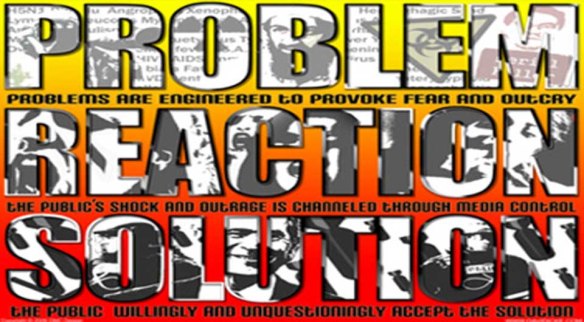
A simple formula underpins these operations:  problem, reaction, solution.

The problem from the perspective of criminal warmongers is that the public doesn’t want war or a police state.  The intended reaction of the operation is that the synthetic terror event will induce people to seek protection from the state, coupled with aggressive war to bomb the threat out of existence. The solution, or intended result, is already occurring.  Engineered fear and racism have set the stage for the public to be manipulated to accept a covert agenda that it would otherwise reject.

Cui Bono?  Who benefits? The police state apparatus, War Inc., and a warmongering Presidential agenda all benefit.

The manipulation of the public is further enabled by an amendment to the National Defense Authorization Act (NDAA) which negates the Smith-Mundt Act (SMA) of 1984 which prohibits government agencies from propagandizing domestic populations.

Susan Posel explains in “How the NDAA Allows US Gov to Use Propaganda Against Americans”:

“SMA  defines the prohibition of domestic access to influence information through a variety of means, from broadcast to publishing of books, media, and online sources by restricting the State Department.”

The Broadcasting Board of Governors was created from SMA. This agency claims to “inform, engage, and connect people around the world in support of ‘freedom and democracy’. They omit that their specialty is making sure propaganda is added to the informational flow we all depend on.”

Instead of succumbing to the shock of terror events, instead of allowing our “reptilian minds” to overrule rational decision-making processes, we need to decode the Orlando shooting, and other terror events, within the “problem, reaction, solution” framework, and be conscious of how they are being manipulated and politicized to suit covert agendas that do not serve the public interest. The “therapy” for the shock will allow us to subordinate our “reptilian” mindsets, and to act rationally.  A rational mindset will reject the racism, hatred, and warmongering which are intended off-shoots of these terror events.


Related Podcast:

Radio WhoWhatWhy – Russ Baker: Don’t Rush to Judgment in Orlando Shooting

Related Video: