
10 Signs Of Our Global Awakening

trueworldorder-1024x531

By Paul A. Philips

Source: Activist Post

Since time immemorial, under the ruling thumb of the world’s dark overlords, humanity has been hacked, stymied, suppressed and coerced into submission through mind-controlling, soul-destroying atrocities. Those unable to see that just about every subject under the sun is a deception and how their family and friends are affected don’t yet realize the extent to which the dark overlords have us snugly stitched up.

However, alternative media sources tell us that people are awakening exponentially to the realization that they’re being stitched up and in the swathe of these awakened souls, more and more are playing their dutiful part in enlightening others.

So, here are 10 signs of our global mass awakening.

1. The fall and further fall of the mainstream media

Trust in the mainstream media has fallen to an all-time low and continues to plummet. Much of this has to do with an increasingly aware and disgruntled public: More and more people are able to discern a mainstream media totally lacking in integrity, thanks to the rising popularity of the independent/alternative media exposing the dishonesty.

Unlike the alternative/independent sources, the servile corporate-controlled mainstream media has been a highly effective tool used to manipulate the consensus reality of the masses for a number of powerful individuals having political and financial self-interests. A number of us know we have seen attempts by these elitist individuals controlling the mainstream media to thwart the rising popularity of the independent/alternative media through false, baseless accusations of ‘fake news.’  Indeed, it’s an attempt to discredit because it exposes the truth about the elite and reveals their hidden agendas….

Essentially, the unjust ‘fake news’ labelling of the independent/alternative media has backfired on the manipulators: Instead of achieving censorship it has given rise to further increasing support for the alternative/independent media, while the mainstream media has taken an even bigger fall. As many of us know, the real fake news exists in the mainstream media with its propaganda and mind control…

Given that these 2 paradigms cannot live side by side each other, which one will win the information war?

Besides the mainstream media, worldwide, an increasingly aware public show a growing distrust for Big Government and Big Business institutions from multiple polls.

The distrust and unpopularity implicitly expressed by the public on these crooked institutions with their resident crooks mainly come from the truth revelations put out by the alternative/independent media.

Further, this is what happens when Big Government and Big Business not only ignores the people’s voice in decision making, but also demonizes their dissension and public opinion, which only serves to fuel the public’s uprising.

3. Marches against Monsanto have intensified

There couldn’t be a better example of the public’s growing distrust in Big Business than Monsanto. As the years roll by marches against Monsanto from people of many different backgrounds all over the world have risen significantly and don’t look to be cooling down….

Although there are signs of Monsanto clawing back, in recent years earnings have plummeted. The earnings drop for the biotech company suggests a growing public disdain for their GM seeds as more and more people realize the dangers of GMO and its glyphosate herbicide.

More and more realize that Monsanto are out to patent, own and control every seed in the world. This threatens the destruction and diversity of every natural God-given seed….

4. Increasing health awareness

Although still very popular, people’s awareness of the dangers of fast food has increased, as indicated by recent erratic share prices in some of the major fast food corporations who’ve had to pull out all marketing stops to claw back on fallen share prices.

Reports indicate that last year people have shown more interest than ever in organic non-GMO healthier food options. Besides how these choices affect health, people’s increased interest and awareness has extended into concerns over the environment, animals and the workers involved in food production.

5. Increasing recognition of disinformation

People are increasingly seeing right through those various media sources with their dogmatic unhealthy skeptics, shills, trolls, pseudo-debunkers, controlled opposition agents, biasing, filtering and in-your-face lies intended to sell you the spin of disinformation to keep you ignorant, deceived and helplessly anesthetized in the matrix control system…

6. Increasing support for social media

The social media outlet has greatly contributed to our awakening. It has indeed provided a unique and effective platform for the people’s voice. No wonder the mainstream media and elitists are unpopular:  It has allowed us to spread the word on subjects such as PizzaGate and the Clinton conspiracies….

Along with the alternative/independent media, the explosive interest in the social media outlet has not only changed our views but also continues to redefine journalism and how information is shared. How this is redefining media is a subject for another piece.

Simple to say we’re in a golden age of alternative/independent and social media which has contributed greatly to our global awakening.

7. Changing viewpoint towards the ‘Conspiracy Theorist’

Another blatant indicator confirming our awakening is a change in how the term ‘Conspiracy Theorist’ is now generally viewed.

Used frequently over the years in mainstream media the term ‘Conspiracy Theorist’ was invented in the ’60s by the CIA (Crooks IAction). It has been used as a cover up to discredit those aware of the facts on how the dark overlords and their associates have been involved in criminal activity….

No longer generally viewed as a label to slap on crazy kooks believing Richard Nixon was a werewolf… etc… Conspiracy Theory has become more generally viewed as either conspiracy fact or at least something worth investigating rather than flatly dismissing.

For more on this see: 9 Indisputable Truths about “Conspiracy Theorists”

8. Increasing attempts to shut us up

Our global mass awakening has got the dark overlords greatly concerned as they question the effectiveness of their control systems over us. How can they deal with our awakening in growing overwhelming numbers?

Desperately, in cahoots with their associates, they’re throwing everything at us ranging from the grossly suppressive, the extremely petty, the violent and the ridiculous to try to shut us up and deny our self-expression, keep us mentally, spiritually and physically enslaved in the matrix controlling system.

9. Awakening through unknown/unforeseen processes

Our awakening goes beyond the specific and measurable: We cannot simply quantify our awakening: There are circumstances occurring on a spiritual level that go beyond our limited understanding. Such as, for example, claims have been made recently of energetic emissions from our galactic centre that could affect our spirituality and transform us….

10. Rise in local meet-up groups

As already mentioned, the Internet and social media has indeed been great for exchanging information to wake people up but what if these set ups become censored? Further, large groups, virtual or real, run the risk of infiltration for dumbing down and deliberate disinformation.

So the solution lies (in part) in the forming of local community-based in-person groups to cultivate the resistance and humanity; and local meet-up group numbers are already growing.

In conclusion

Will our mass awakening to the deception produce a turnaround — a world that makes a difference for everyone? A world where there are no predators, no controlling hierarchy, no blood-sucking vampiric slave-drivers at the top ruling the numerous enslaved at the bottom… no more fight for self-sufficiency because it’s already been achieved in the communities… etc.

It is up to us all to play our part.


You can read more from Paul A. Philips at his site NewParadigm.ws, where this article first appeared.
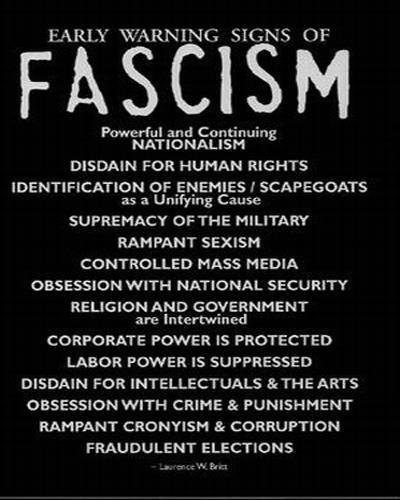
Fascism, American style

fascism1

By John W. Whitehead

Source: Intrepid Report

“If we define an American fascist as one who in case of conflict puts money and power ahead of human beings, then there are undoubtedly several million fascists in the United States.”―Henry A. Wallace, 33rd Vice President of the United States

This is an indictment of every politician who has ever sold us out for the sake of money and power, it is a condemnation of every politician who has ever lied to us in order to advance their careers, and it is a denunciation of every political shill who has sacrificed our freedoms on the altar of Corporate America.

They’re all fascists.

If Donald Trump is a fascist—as nearly half of Americans surveyed believe—then so is every other politician in office or running for office in America who has ever prioritized money and power over human beings.

Truly, apart from Trump’s virulently bombastic comments and his metaphorical willingness to spit in the wind in order to garner media coverage and notoriety, how is he any more of a fascist than Hillary Clinton and the millions she has amassed from the financial sector?

How is Trump any more of a fascist than Barack Obama, whose willingness to march in lockstep with the military industrial complex has resulted in endless wars, covert drone strikes that have killed hundreds of civilians abroad, and militarized police who have killed thousands of American citizens here at home?

How is Trump any more of a fascist than Congress, the majority of whom are millionaires and who are more inclined to do the bidding of their corporate sponsors and benefactors, all the while remaining deaf to their less affluent constituents?

For that matter, how is Trump any more of a fascist than the Supreme Court whose decisions in recent years have been characterized most often by an abject deference to government authority, military and corporate interests?

Writing for the New York Times in 1944, Vice President Henry A. Wallace noted that “American fascists are most easily recognized by their deliberate perversion of truth and fact. Their newspapers and propaganda carefully cultivate every fissure of disunity, every crack in the common front against fascism. They use every opportunity to impugn democracy. They use isolationism as a slogan to conceal their own selfish imperialism. They cultivate hate and distrust . . .”

As Wallace concluded, American fascists are not pro-Constitution:

They are patriotic in time of war because it is to their interest to be so, but in time of peace they follow power and the dollar wherever they may lead . . . They claim to be super-patriots, but they would destroy every liberty guaranteed by the Constitution. They demand free enterprise, but are the spokesmen for monopoly and vested interest. Their final objective toward which all their deceit is directed is to capture political power so that, using the power of the state and the power of the market simultaneously, they may keep the common man in eternal subjection.

We are being played for fools. Again.

The United States of America, that dream of what a democratic republic ought to be, has become the Fascist States of America. We have moved beyond the era of representative government and entered a new age. You can call it the age of authoritarianism. Or fascism. Or oligarchy. Or the American police state.

Whatever label you want to put on it, the end result is the same.

Driven by our fears, we have entered into a corporate-controlled, militaristic state where all citizens are suspects, security trumps freedom, and the U.S. government does not represent the majority of American citizens but instead is ruled by the rich and powerful.

Any semblance of constitutional government that we might still enjoy today is a mere shadow, a mockery of what the founders envisioned. Constitutional government today—much like the farcical circus that purports to be the presidential election—is a sham, a hoax, an elaborate ruse maintained by the powers-that-be to mollify us into believing that we still have a say in the workings of our government. We do not.

Shortly after World War II, historian William L. Shirer predicted that America may be the first country in which fascism comes to power through democratic elections.

Former presidential advisor Bertram Gross also warned that we would not recognize fascism when it took over:

Anyone looking for black shirts, mass parties, or men on horseback will miss the telltale clues of creeping fascism . . . In America, it would be supermodern and multi-ethnic—as American as Madison Avenue, executive luncheons, credit cards, and apple pie. It would be fascism with a smile. As a warning against its cosmetic facade, subtle manipulation, and velvet gloves, I call it friendly fascism. What scares me most is its subtle appeal.

They were both right.

However, what we failed to realize is that the fascist coup took place long ago. It was that subtle and that incremental.

We are now ruled by the velvet-gloved, technologically savvy, militarized iron fist of what Gross termed “friendly fascism” or fascism with a smile. Having studied Shirer and Gross, tracked the rise of fascism in past regimes, and assimilated the necessary ingredients for a fascist state, I can attest to the fact—as I document in my book Battlefield America: The War on the American People—that the parallels to modern America are impossible to ignore.

Under fascism, the government:

  • is managed by a powerful leader (even if he or she assumes office by way of the electoral process)
  • assumes it is not restrained in its power (this is authoritarianism, which eventually evolves into totalitarianism)
  • ostensibly operates under a capitalist system while being undergirded by an immense bureaucracy
  • emits powerful and continuing expressions of nationalism through its politicians
  • has an obsession with national security while constantly invoking terrifying internal and external enemies
  • establishes a domestic and invasive surveillance system and develops a paramilitary force that is not answerable to the citizenry
  • and its various agencies (federal, state, and local) develop an obsession with crime and punishment (this is overcriminalization)
  • becomes increasingly centralized while aligning closely with corporate powers to control all aspects of the country’s social, economic, military, and governmental structures
  • uses militarism as a center point of its economic and taxing structure
  • and is increasingly imperialistic in order to maintain the military-industrial corporate forces.

Compare that to America today where, as economist Jeffrey Tucker rightly observes, “every industry is regulated. Every profession is classified and organized. Every good or service is taxed. Endless debt accumulation is preserved. Immense doesn’t begin to describe the bureaucracy. Military preparedness never stops, and war with some evil foreign foe, remains a daily prospect.”

Fascism thrives by hiding behind the entertainment spectacle that is partisan politics. As Tucker points out, “It’s incorrect to call fascism either right wing or left wing. It is both and neither . . . fascism does not seek to overthrow institutions like commercial establishments, family, religious centers, and civic traditions. It seeks to control them . . . it preserves most of what people hold dear but promises to improve economic, social, and cultural life through unifying their operations under government control.”

In this way, American-style fascism is deceptively appealing.

It appears friendly.

The news media covers the entertainment and political trivia. The basic forms of government remain intact. The legislators remain in session. There are elections.

Consent of the governed, however, no longer applies. Actual control has finally passed to the oligarchic elite controlling the government behind the scenes.

Yet the most crucial ingredient for fascism to succeed in America is that the majority of the people would have to agree that it’s not only expedient but necessary for the government to assume greater powers in order to keep them safe and secure, whether it’s by militarizing the police, stripping them of basic constitutional rights, criminalizing virtually every form of behavior, or spying on their communications, movements and transactions.

Sound familiar?

When you really drill down to what the various presidential candidates believe about the issues that will impact the future of our freedoms long-term—war, surveillance, civil liberties—you’ll find that most of them support the government’s position, which, conveniently enough, profits the corporate sector.

This is not freedom.

It is despotism, which Gross refers to as “faceless oligarchs [who] sit at command posts of a corporate-government complex that has been slowly evolving over many decades.” Gross explains:

In efforts to enlarge their own powers and privileges, they are willing to have others suffer the intended or unintended consequences of their institutional or personal greed. For Americans, these consequences include chronic inflation, recurring recession, open and hidden unemployment, the poisoning of air, water, soil and bodies, and, more important, the subversion of our constitution. More broadly, consequences include widespread intervention in international politics through economic manipulation, covert action, or military invasion . . .

It is, in Gross’ words, “pretended patriots who desecrate the American flag by waving it while waiving the law”:

I see at present members of the Establishment or people on its fringes who, in the name of Americanism, betray the interests of most Americans by fomenting militarism, applauding rat-race individualism, protecting undeserved privilege, or stirring up nationalistic and ethnic hatreds.

It is, concludes Gross, Big Business and Big Government in bed together:

In this present, many highly intelligent people look with but one eye and see only one part of the emerging Leviathan. From the right, we are warned against the danger of state capitalism or state socialism, in which Big Business is dominated by Big Government. From the left, we hear that the future danger (or present reality) is monopoly capitalism, with finance capitalists dominating the state. I am prepared to offer a cheer and a half for each view; together, they make enough sense for a full three cheers.Big Business and Big Government have been learning how to live in bed together and despite arguments between them, enjoy the cohabitation. Who may be on top at any particular moment is a minor matter—and in any case can be determined only by those with privileged access to a well-positioned keyhole.

When the votes have all been counted, “we the people” will be the losers.

The joke will be on us. Whether we ever realize it not, the enemy is not across party lines, as they would have us believe. It has us surrounded on all sides.

Even so, we’re not yet defeated.

We could still overcome our oppressors if we cared enough to join forces and launch a militant nonviolent revolution—a people’s revolution that starts locally and trickles upwards—but that will take some doing.

It will mean turning our backs on the political jousting contests taking place on the national stage and rejecting their appointed jesters as false prophets. It will mean not allowing ourselves to be corralled like cattle and branded with political labels that have no meaning anymore. It will mean recognizing that all the evils that surround us today—endless wars, drone strikes, invasive surveillance, militarized police, poverty, asset forfeiture schemes, overcriminalization, etc.—were not of our making but came about as a way to control and profit from us.

It will mean “voting with our feet” through sustained, mass civil disobedience. As journalist Chris Hedges points out, “There were once radicals in America, people who held fast to moral imperatives. They fought for the oppressed because it was right, not because it was easy or practical. They were willing to accept the state persecution that comes with open defiance. They had the courage of their convictions. They were not afraid.”

Ultimately, it will mean refusing to be divided, one against each other, as Democrats versus Republicans, and instead uniting behind the only distinction that has ever mattered: “we the people” against tyranny.


Constitutional attorney and author John W. Whitehead is founder and president of The Rutherford Institute. His new book “The Freedom Wars” (TRI Press) is available online at www.amazon.com. Whitehead can be contacted at johnw@rutherford.org. Information about The Rutherford Institute is available at www.rutherford.org.


The Conflation Trap

By Roderick Long

Source: Bleeding Heart Libertarians

Left-libertarians differ from the (current) libertarian mainstream both in terms of what outcomes they regard as desirable, and in terms of what outcomes they think a freed market is likely to produce.

With regard to the latter issue, left-libertarians regard the current domination of the economic landscape by large hierarchical firms as the product not of free competition but of government intervention – including not only direct subsidies, grants of monopoly privilege, and barriers to entry, but also a regulatory framework that enables firms to socialise the scale costs associated with growth and the informational costs associated with hierarchy, while pocketing the benefits – and leaving employees and consumers with a straitened range of options. In the absence of government intervention, we maintain, firms could be expected to be smaller, flatter, and more numerous, with greater worker empowerment.

Thus we tend to wince when libertarians (or many of them, to varying degrees) rush to the defense of elite corporations and prevailing business models and practices as though these were free-market phenomena. First, we think this is factually inaccurate; and second, we think it’s strategically suicidal. Ordinary people generally know firsthand the petty tyranny and bureaucratic incompetence that all too often characterise the world of business; libertarians who try to glamourise that world as an arena of economic rationality and managerial heroism risk coming across as clueless at best, and shills for the ruling class at worse.

This is also why we tend to be less than enthusiastic about the word “capitalism” as the term for free-market society; as Friedrich Hayek notes, the term is“misleading,” since it “suggests a system which mainly benefits the capitalists,” whereas a genuine free market is “a system which imposes upon enterprise a discipline under which the managers chafe and which each endeavours to escape.” (Law, Legislation, and Liberty, vol.1, p. 62.)

But it is not only mainstream libertarians (and of course, to a far greater extent, conservatives) that tend to conflate the results of crony corporatism with those of free markets; such conflationism is all too common on the traditional left as well. The difference is that the evaluations are reversed; where the right-wing version of conflationism treats the virtues of free markets as reason to defend the fruits of corporatism , the left-wing version of conflationism treats the objectionable fruits of corporatism as reason to condemn free markets.

Central to both forms of conflationism is the myth that big business and big government are fundamentally at odds. As is often the case, the myth sustains itself by containing a kernel of truth; while big business and big government are partners, each serving to prop up the other, each side would like to be the dominant partner (as with church and state in the Middle Ages, or Dooku and Palpatine in the Star Wars prequels), so much – though not, I think, most – of the conflict between them is genuine. But we should not allow these squabbles between different wings of the ruling class, essentially over how to divide up the loot, to obscure the far greater extent to which the political elite and the corporate elite work together. Conservative politicians, largely agents of the corporate wing, wrap their policies in anti-big-government rhetoric, while liberal politicians, largely agents of the political wing, wrap their policies in anti-big-business rhetoric; the differences in policy often involve nudging the balance of power slightly in one direction or the other (will healthcare be mainly controlled by government directly, or instead by the private beneficiaries of government-granted privilege like insurance companies and the AMA?), but both wings systematically benefit from most of the policies propounded by each side. FDR’s presidency, for example, with its cartelising policies, gave a massive boost to corporate power, while the three chief indices of state power – taxes, spending, and debt – all skyrocketed under Reagan’s presidency.

But conflationism isn’t just a mistake about the prevailing system; it’s also a means by which that system perpetuates itself. People who are attracted to the idea of free markets are hoodwinked by conflationism into supporting big business, and thus becoming foot soldiers of the corporate wing of the ruling class; people who are repelled by the reality of corporatism on the ground are hoodwinked into supporting big government, and thus becoming foot soldiers of the political wing of the ruling class. Thus, thanks to the pincer-movement of right-conflationism and left-conflationism, those who seek to oppose the prevailing system end up in the ranks of its supporters – and the possibility of a radical challenge to the system as a whole is rendered effectively invisible. This is how conflationism functions.

My talk of “functioning” is not meant to imply that conflationism is deliberately propagated in order to divert potential enemies of the system into the ranks of its supporters (though of course it sometimes is).

In a broader sense, whenever some feature A of a system B tends reliably to produce a certain result C, and A’s being such as to produce C helps to explain the existence and/or persistence of B, and thereby of A, then we may say that the function of A is to produce C. Thus the fact that thorns tend to protect roses from being eaten explains why roses, with their thorns, exist and persist. It’s in that sense that I say that the function of conflationism within the prevailing state/corporate system is to bewilder its foes into becoming supporters, and to render alternatives invisible. Conflationism is an instance of malign spontaneous order.

Philosopher of science Thomas Kuhn describes an intriguing experiment:

Bruner and Postman asked experimental subjects to identify on short and controlled exposure a series of playing cards. Many of the cards were normal, but some were made anomalous, e.g., a red six of spades and a black four of hearts. … For the normal cards these identifications were usually correct, but the anomalous cards were almost always identified, without apparent hesitation or puzzlement, as normal. The black four of hearts might, for example, be identified as the four of either spades or hearts. Without any awareness of trouble, it was immediately fitted to one of the conceptual categories prepared by prior experience. … With a further increase of exposure to the anomalous cards, subjects did begin to hesitate and to display awareness of anomaly. Exposed, for example to the red six of spades, some would say: That’s the six of spades, but there’s something wrong with it – the black has a red border. … A few subjects … were never able to make the requisite adjustment of their categories. (Structure of Scientific Revolutions, pp. 62-63)

In short, people tend to have not only difficulty with, but even aversion to, recognising something that doesn’t fit their established categories. This creates a problem for libertarians generally; for many in the political mainstream, the first impulse is to assimilate libertarians to a more familiar “anti-government” category, namely conservatives. When, after longer exposure, mainstreamers realise that libertarians aren’t quite conservatives after all, then they begin to see libertarians as the equivalent of “black spades with red borders” – conventionally conservative on some issues, conventionally liberal on others, rather than representing a radical alternative to existing ideologies. (Libertarians’ use of the Nolan Chart as an outreach tool may contribute to this tendency.)

What holds true for libertarians generally, holds to a still greater extent in the case of left-libertarians. The prevalence of conflationism tends to reinforce the impression that anyone who attacks (what we consider) the fruits of corporatism must be anti-free-market, and that anyone who defends free markets must be undertaking a defense of (what we consider) the fruits of corporatism. Thus nonlibertarian leftists tend to see us as corporate apologists in leftist camouflage, while nonleftist libertarians tend to see us as commies in libertarian guise.

Even when mainstream libertarians acknowledge the existence (and badness) of corporatism, as most do, communication with left-libertarians still tends to come to grief. Left-libertarians are baffled when mainstream libertarians acknowledge cronyism in one breath, only to slide back in the next breath to into treating criticisms of big business as criticisms of free markets. More mainstream libertarians, for their part, are baffled as to why left-libertarians keep raising the issue of corporatism when the mainstream libertarians have already acknowledged its existence and badness.

Kuhn is helpful here too:

Since remote antiquity most people have seen one or another heavy body swinging back and forth on a string or chain until it finally comes to rest. To the Aristotelians, who believed that a heavy body is moved by its own nature from a higher position to a state of natural rest at a lower one, the swinging body was simply falling with difficulty. Constrained by the chain, it could achieve rest at its low point only after a tortuous motion and a considerable time. Galileo, on the other hand, looking at the swinging body, saw a pendulum, a body that almost succeeded in repeating the same motion over and over again ad infinitum. … [W]hen Aristotle and Galileo looked at swinging stones, the first saw constrained fall, the second a pendulum …. (Ibid., pp. 118-121)

Aristotle and Galileo were observing the same two facts: the stone keeps swinging back and forth for a while, and then it eventually hangs straight down. But for Galileo the swinging was essential and the eventual cessation accidental, a “friction” phenomenon; whereas for Aristotle, progress toward a state of rest was, and the sideways perturbations accidental.

Likewise, for those operating within a conceptual framework that sees conservative opposition to big government and liberal opposition to big business as essential and deviations from these norms as accidental, evidence that conservative policies promote big government or that liberal policies promote will be dismissed as inessential or anomalous or an excusable. (See, for example, this video in which Obama supporters condemn right-wing-sounding policies when they think they’re Romney’s, but either excuse them or go into denial when told that the policies are actually Obama’s.)

Similarly, for many mainstream libertarians, free exchange is what essentially characterises the existing economy, while the corporatist policies are so much friction; and just as there’s no need for constant references to friction when talking about how a mechanism works, such mainstream libertarians don’t constantly bring up corporatism when discussing the working of the existing economy. For left-libertarians, by contrast, corporatism is a far more central feature of the existing economy, and leaving it out radically distorts our understanding. In such cases left-libertarians and more conventional libertarians are arguing from opposite sides of a Gestalt shift, where what looks essential to one side looks accidental to the other.

I don’t mean to suggest that these disputes are rationally irresoluble, however. In the playing-card experiments, subjects did eventually come to see the suits correctly after sufficiently long exposure. And sufficient exposure to the evidence marshaled by left-libertarians can prompt the relevant Gestalt shift, as indeed it frequently does; most left-libertarians once started out either less leftist or less libertarian or both. But the prevailing conceptual framework, through which so many (both libertarian and not) look at the economy without seeing what we see, is, I think, no accident; it’s part of the means by which the big-government/big-business partnership maintains itself.