First There Were Neo-Nazis, Then There Were No Nazis, Then There Were

By Patrick Lawrence

Source: Scheerpost

I tell you, serving as a New York Times correspondent these days cannot be easy. You have to convey utter nonsense to your readers while maintaining a straight face and a serious demeanor. You have to suggest the Russians may have exploded a drone over the Kremlin, that they may have blown up their own gas pipeline, that their president is an out-of-touch psychotic, that their soldiers in Ukraine are drunkards using faulty equipment, that they attack with “human hordes” (Orientalism, anyone?) and on and on—all the while affecting the gravitas once associated with the traditional “Timesman.” You try it sometime.

I am reminded of that pithy passage in Daniel Boorstin’s regrettably overlooked book, The Image. “The reporter’s task,” Boorstin wrote in 1962, “is to find a way of weaving these threads of unreality into a fabric that the reader will not recognize as entirely unreal.”

Boorstin reflected on America’s resort to imagery, illusion, and distortion as Washington geared up its gruesome follies in Vietnam. The reporter’s task is a whole lot harder now, given how much farther we have wandered into illusion and distortion since Boorstin’s day.  

And now we have the case of Thomas Gibbons–Neff, a square-jawed former Marine covering the Ukraine war for The Times—strictly to the extent the Kyiv regime permits him to do so, as he explains with admirable honesty. This guy is serious times 10, he and his newspaper want us to know.  

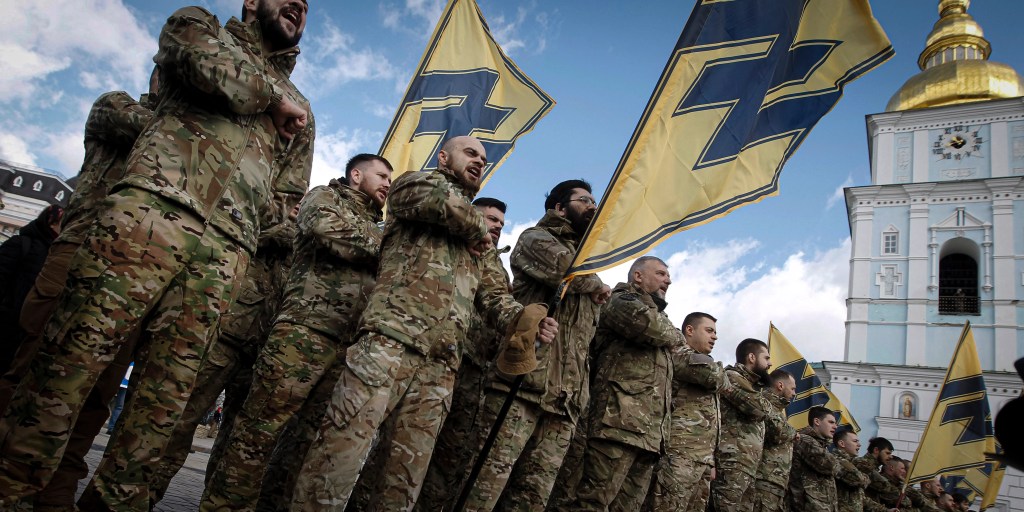
Tom’s job this week is to persuade us that all those Ukrainian soldiers wearing Nazi insignia, idolizing Jew-murdering, Russophobic collaborators with the Third Reich, gathering ritually in Nazi-inspired cabals, marching through Kyiv in Klan-like torch parades are not what you think. Nah, our Tom tells us. They look like neo–Nazis, they act like neo–Nazis, they dress like neo–Nazis, they profess Fascist and neo–Nazi ideologies, they wage this war with the Wehrmacht’s visceral hatred of Russians—O.K., but whyever would you think they are neo–Nazis? 

They are just regular guys. They wear the Wolfsangel, the Schwarze sonne, the black sun, the Totenkopf, or Death’s Head—all Nazi symbols—because they are proud of themselves, and these are the kinds of things proud people wear. I was just wearing mine the other day. 

The slipping and sliding starts early in “Nazi Symbols on Ukraine’s Front Lines Highlight Thorny Issues of History,” the piece Gibbons–Neff published in Monday’s editions. He begins with three photographs of neo–Nazi Ukrainian soldiers, SS insignia plainly visible, that the Kyiv regime has posted on social media, “then quietly deleted,” since the Russian intervention began last year. “The photographs, and their deletions,” Gibbons–Neff writes, “highlight the Ukrainian military’s complicated relationship with Nazi imagery, a relationship forged under both Soviet and German occupation during World War II.”

Complicated relationship with Nazi imagery? Stop right there, Mr. Semper fi.  Ukraine’s neo–Nazi problem is not about a few indiscreetly displayed images. Sorry. The Ukrainian army’s “complicated relationship” is with a century of ultra-right ideology drawn from Mussolini’s Fascism and then the German Reich. As is well-known and documented, the neo–Nazis who infest the Armed Forces of Ukraine, the AFU—among many other national institutions—have made idols of such figures as Stepan Bandera, the freakishly murderous nationalist who allied with the Nazi regime during the war.

This history is a matter of record, as briefly outlined here, but Gibbons–Neff alludes to none of it. It’s merely a matter of poor image-making, you see. In support of this offensive whitewash, Gibbons–Neff has the nerve to quote a source from none other than Bellingcat, which was long, long back exposed as a CIA and MI6 cutout and which is now supported by the Atlantic Council, the NATO–funded, spook-infested think tank based in Washington. 

“What worries me, in the Ukrainian context, is that people in Ukraine who are in leadership positions, either they don’t or they’re not willing to acknowledge and understand how these symbols are viewed outside of Ukraine,” a Bellingcat “researcher” named Michael Colborne tells Gibbons–Neff. “I think Ukrainians need to increasingly realize that these images undermine support for the country.”

Think about that. The presence of Nazi elements in the AFU is not a worry. The worry is merely whether clear signs of Nazi sympathies might cause some members of the Western alliance to decide they no longer want to support Nazi elements in the AFU. I am reminded of that Public Broadcasting news segment last year, wherein a provincial governor is featured with a portrait of Bandera behind him. PBS simply blurred the photograph and ran the interview with another of the courageous, admirable Ukrainians to which we are regularly treated.

I hardly need remind paying-attention readers that the neo–Nazis-who-are-not-neo–Nazis were for years well-reported as simply neo–Nazis in the years after the U.S.–cultivated coup in 2014. The Times, The Washington Post, PBS, CNN—the whole sorry lot—ran pieces on neo–Nazi elements in the AFU and elsewhere. In March 2018, Reuters published a commentary by Jeff Cohen under the headline “Ukraine’s Neo–Nazi Problem.” Three months later The Atlantic Council, for heaven’s sake, published a paper, also written by Cohen, titled, “Ukraine’s Got a Real Problem with Far–Right Violence (And no, RT Didn’t Write This Headline).” I recall, because it was so surprising coming from the council, that the original head on that paper was “Ukraine’s Got a Neo–Nazi Problem,” but that version now seems lost to the blur of stealth editing. 

Then came the Russian intervention, and Poof! There are no more neo–Nazis in Ukraine. There are only these errant images that are of no special account. And to assert there are neo–Nazis in Ukraine—to have some semblance of memory and a capacity to judge what is before one’s eyes—“plays into Russian propaganda,” Gibbons–Neff warns us. It is to “give fuel to his”—Vladimir Putin’s—“false claims that Ukraine must be de–Nazified.” For good measure Gibbons–Neff gets out the old Volodymyr-Zelensky-is-Jewish chestnut, as if this is proof of… of something or other.

My mind goes to that lovely Donovan lyric from the Scottish singer’s Zen enlightenment phase. Remember “There Is a Mountain?” The famous lines went, “First there is a mountain/ Then there is no mountain/ Then there is.” There were neo–Nazis in Ukraine, then there were no neo–Nazis, and now there are neo–Nazis but they aren’t neo–Nazis after all. 

There are a few things to think about as we consider Thomas Gibbons–Neff’s story, other than the fact that it is horse-droppings as a piece of journalism. For one thing, nowhere in it does he quote or reference any member of the AFU—no one wearing a uniform, no one sporting one of these troubling insignia. Various image-managing officials speak to him about the neo–Nazis who-are-not-neo–Nazis, but we never hear from any neo–Nazi-who-is-not-a-neo–Nazi to explain things as a primary source, so to say. I wager Gibbons–Neff never got within 20 miles of one: He wouldn’t dare, for then he would have to quote one of these insignia-sporting people saying that of course he was a neo–Nazi. Can’t you read, son? 

For another, Gibbons–Neff resolutely avoids dilating his lens such that the larger phenomenon comes into view. It all comes down to those three unfortunate insignia in those three deleted photographs. The parades, the corridors of neo–Nazi flags, the ever-present swastikas, the reenactments of all-night SS rituals, the glorification of Nazis and Nazi collaborators, the Russophobic blood lust: Sure, it can all be explained, except that our Timesman does not go anywhere near any of this.

Gibbons–Neff’s story follows by 10 days an even more contorted piece of pretzel-like rubbish published in The Kyiv Independent, a not-independent daily that has been supported by various Western governments. This is by one Illia Ponomarenko, a reporter much-lionized in the West, and appeared under the headline, “Why some Ukrainian soldiers use Nazi-related insignia.”

This is the kind of piece that is so bad it tips into fun. “No, Ukraine does not have ‘a Nazi problem,’” Ponomarenko states flatly, and this is the last flat sentence we get in this piece. “Just like in many places around the world, people with far-right and neo–Nazi views, driven by their ideology, are prone to joining the military and participating in conflicts,” he writes. And then this doozy, where begins a riot of irrationality:

It is, of course, true that, for instance, the Azov Battalion was originally founded by neo–Nazi and far-right groups (as well as many soccer ultra-fans), which brought along with it the typical aesthetics—not only neo–Nazi insignia but also things like Pagan rituals or names like “The Black Corps,” the official newspaper of Nazi Germany’s major paramilitary organization Schutzstaffel (SS).

But worry not, readers. It is merely an aesthetic, part of a harmless, misunderstood “subculture”: 

In the oversimplified memory of some around the world, particularly within various militaristic subcultures, symbols representing the Wehrmacht, Nazi Germany’s Armed Forces, and the SS are seen to reflect a super-effective war machine, not the perpetrators of one of the greatest crimes against humanity in human history.

But of course. SS insignia, Wehrmacht iconography: Seen it everywhere people admire super-effective war machines. Remember this logic next time some liberal flamer proposes to persecute a MAGA supporter who partakes of this “subculture.”

Has Tom Gibbons–Neff given us a rewrite job? Having been around the block for a good long time, I have seen this kind of thing often enough—correspondents scoring off the local dailies to look deep and penetrating back on the foreign desk. It is also possible, assuming for a moment Gibbons–Neff’s editors still read other newspapers, that they asked him for just such a piece after seeing Ponomarenko’s. Either way, we get this in Ponomarenko’s recognizably illogical style:

Questions over how to interpret such symbols are as divisive as they are persistent, and not just in Ukraine. In the American South, some have insisted that today, the Confederate flag symbolizes pride, not its history of racism and secession. The swastika was an important Hindu symbol before it was co-opted by the Nazis. 

If you are going to reach, Tom, may as well reach for the stars.

We have a New York Times correspondent quoting Ukraine’s Defense Ministry and Bellingcat, an intel cutout that is part of a NATO think tank, and then rather too closely, I would say, aping a Western-supported newspaper in Kyiv. Yes, Virginia, I believe we all got ourselves one of them there echo chambers, just the way the Deep State likes ’em.

Last March, Gibbons–Neff was interviewed by The New York Times. Yes, they do this sort of thing down there on Eighth Avenue, where they simply cannot get enough of themselves. It is enlightening. The unfortunate Times reporter assigned as the straight man asked, as our intrepid correspondent self-aggrandized, “What have been the biggest challenges in covering the war?” Gibbons–Neff’s reply is pricelessly revealing. 

“Wrestling with access and being allowed to go certain places to see things that you need the press officer for, or permission from the military unit,” the fearless ex–Marine explains. “Ukrainians know how to manage the press fairly well. So navigating those parameters and not rubbing anyone the wrong way has always been tough.”

Forget about bombs, missiles, gore, the fog of war, courageous sergeants, trench stench, grenades, or any of the other horrors of battle. Gibbons–Neff’s big problems as he pretends to cover the Ukraine war are maintaining access, getting the Kyiv gatekeepers’ permission to go someplace, and avoiding annoying the regime’s authorities. 

Does this tell you everything you want to know about our Timesman or what? 

It is always interesting to ask why a piece such as this appears when it does. Dead silence for months on the neo–Nazi question, and then suddenly a long explainer that does its best to avoid explaining anything. Always interesting to ask, never easy to answer. 

It could be that a lot of stuff on these awful people is sifting out from under the carpet. Or maybe something big is on the way and this piece is preemptive. Or maybe either Gibbons–Neff or his editors saw the Ponomarenko piece as an opportunity to dispose of one of the Kyiv regime’s most embarrassing features. 

Or maybe the larger context counts here. As mentioned in this space last week, The Times’s Steve Erlanger recently suggested from Brussels that NATO might do a postwar Germany job with Ukraine: Welcome the west of the country to the alliance and let the eastern provinces go for an indefinite period, unification the long-term objective. Late last week Foreign Affairs ran a fantastical piece by Andriy Zagorodnyuk, formerly a Ukrainian defense minister and now, yes indeedy, a distinguished fellow at the Atlantic Council. It appeared under the headline, “To Protect Europe, Let Ukraine Join NATO—Right Now.” 

Zagorodnyuk’s argument is as loopy as his subhead, “No Country Is Better at Stopping Russia.” But these kinds of assertions, dreamily hyperbolic as they may be, have a purpose. They serve to enlarge the field of acceptable discourse. They inch us closer to normalizing the thought that Ukraine must be accepted in the North Atlantic alliance for our sake, the sake of the West, no matter how provocative such a move will prove.

This suggest that Gibbons–Neff’s piece, along with the one he followed in the Kyiv paper, are by way of a cleanup job. The Western press, working closely with intelligence agencies, did its best to prettify the savage jihadists attempting to bring down the Assad government in Damascus, you will recall. Remember the “moderate rebels?” Maybe Gibbons–Neff is on an equally dishonorable errand. 

Semper fi, huh? Always faithful to what?

Did Bellingcat get Ukrainian forces killed?

By Kit Klarenberg

Source: The Grayzone

Christo Grozev of Bellingcat gained a front row seat to a bungled Ukrainian intelligence operation that left a friendly airfield destroyed and soldiers dead. His narrative about his role in the plot is filled with holes.

Criminal charges of treason and abuse of power have been leveled against an unspecified number of Ukrainian servicemen by the Security Service of Ukraine (SBU). In a bizarre plot to seize Russian aircraft and transfer the planes to Ukraine, the accused soldiers disclosed sensitive information that allowed Moscow to strike an important Ukrainian airfield with a Kalibr missile. A commander was killed, 17 airmen were wounded, two fighter jets destroyed, and “significant damage” was inflicted to the airstrip and several nearby buildings.

Will Ukrainian authorities now level criminal charges against members of Bellingcat, the Western government-funded open source investigations collective, for its role in the connivance? Christo Grozev, the organization’s “lead Russia investigator,” was inexplicably granted a front row seat to the chicanery by the individuals who attempted to carry it out. 

Once the plot unravelled spectacularly, Grozev attempted to spin it as an embarrassment for Russia, while denying the SBU or Ukraine’s Defense Intelligence Directorate (GUR) played any role in its execution. Instead, he claimed, it was the work of “maverick ex-operatives.” The criminal cases pursued by the SBU validate this narrative:

“These actions of individual servicemen [emphasis added], which led to serious consequences, death and injury of Ukraine’s defenders and harmed the country’s defence capabilities, require an appropriate legal assessment.”

As we will see, Grozev was far from a passive spectator in the scheme. Indeed, his framing of the event gives every appearance of a damage control exercise, shielding Bellingcat and the GUR and SBU from blame. Coincidentally, his Bellingcat website profile notes his interest in “the weaponization of information.”

Read Alex Rubinstein’s report on Christo Grozev’s defense of a terror attack on a St. Petersburg, Russia cafe, and his call for more of such actions.

Bulgarian journalist and Bellingcat’s “lead Russia investigator” Christo Grozev

Bellingcat’s proxy war blunders pile up

Since the war in Ukraine began, Christo Grozev and Bellingcat have played a lead role in disseminating and “verifying” dubious, if not outright fraudulent, material and claims related to the conflict. 

Just over a week after Russia’s February 24, 2022 invasion, Grozev confidently declared that Moscow’s war-fighting resources would be spent by March 6th, at which time Russian forces would “collapse.” Over a year later, the gears of the Russian war machine are still churning away.

By the end of March 2022, Bellingcat had fed the Wall Street Journal an entirely bogus tale, asserting that oligarch Roman Abramovich and two Ukrainian negotiators who had been trying to broker peace between their two countries were poisoned.

The finding was the result of an investigation reportedly organized by Grozev, who claimed to have seen the images of the effects of the attack. He further alleged that “too much time had passed for the suspected poison to be detected by the time a German forensic team was able to perform an examination,” accounting for why his assertions could not be verified by authorities.

“It was not intended to kill, it was just a warning,” Grozev falsely declared.

Though Ukrainian and US officials quickly dismissed the story as fantasy, Grozev was not deterred. In late April 2022, while appearing on a charity telethon for Kiev, he claimed to have “personally checked,” and found that Russia had already lost “90%” of the “highest quality, important and essential part of its army, without which it is impossible to conquer key infrastructure facilities.” 

For the families of those killed at Kanatove airfield, and the countless conscripts who have lost their lives under Russian artillery fire in Bakhmut, such comments must seem like a sick joke.

Bellingcat’s Grozev spins a cinematic yarn

On July 25th 2022, Moscow’s state-owned news agency TASS reported that Russia’s FSB security agency had thwarted a Ukrainian operation to steal Russian aircraft, “supervised by NATO.” 

Intelligence officers acting on behalf of Kiev’s political leadership reportedly approached Russian military pilots in secret, offering them millions of dollars and citizenship of an EU country of their choosing in return for deliveries of aircraft such as Su-24s and Su-34s. 

Several pilots appeared to take the bait. And it turned out that Bellingcat’s Christo Grozev had been helping to cultivate the turncoats through a series of exchanges on encrypted messaging apps. 

However, the FSB had apparently infiltrated the plot from the outset, and were using discussions over defection to glean sensitive information from the Ukrainians. This yield then helped the Russian air force to “inflict fire damage on a number of Ukrainian military facilities.”

The Russian strike on Ukraine’s Kanatove airfield, and the SBU’s criminal investigation of the incident, tends to confirm that version of events. However, in the wake of the TASS report, Grozev offered a radically different tale: a “crazier-than-fiction story of triple-agents, fake passports and faux girlfriends.” 

The Bellingcat staffer claimed that after Kiev passed a law in April offering financial incentives to Russians to surrender and hand over weapons and vehicles, “a team of Ukrainian operatives decided to approach Russian pilots with an offer based on this law.” Bellingcat miraculously “found out about the initiative” and secured a “front seat” to make a documentary about a “brazen operation.”

Grozev and company then watched as Russian pilots were successfully lured into providing “proof-of-access” videos from inside their planes, some of which were “quite detailed and enlightening,” as they prepared to defect. It was only then that the FSB became involved, as the Ukrainians learned later on. At this point, the plot morphed into a “double ‘operational game’ in which both sides were trying to extract maximum information from the other, while feeding them maximum disinfo.”

The Ukrainians peddled the FSB “fake maps of their anti-aircraft deployments, as well as disinfo on the operational airstrips.” They even convinced the security service to send one of the pilot’s wives, “along with a whole FSB tailing team,” to Minsk, Belarus for an in-person meeting. When nobody showed up, the Russians realized they had been “burned,” the Ukrainians realized they were not “getting a real pilot,” and the “mutual-deceit game came to an end.”

“While Russia is presenting today this as a coup for its counter intelligence, in fact the operation was a serious blunder for the FSB, disclosing unintentionally identities of dozens of counter intel officers, their methods of operation, and their undercover assets,” Grozev boldly declared.

After pushback, Grozev changes his story

The narrative Grozev spun out was marred by several obvious problems. How did Bellingcat learn of a secret Ukrainian operation? Why were outsiders – particularly ostensibly independent journalists – encouraged by the plotters to film a documentary on the operation as it was being conducted? Why did Grozev wait for the FSB to get the first word, if the plot was such a stunning success for the Ukrainians? 

Perhaps most pertinently of all, if Bellingcat played no active part in the connivance and were simply observers, how did the Russians learn of their presence, to be able to falsely accuse Grozev of involvement?

Even if Grozev’s version of events were true, it provides numerous indications that Bellingcat assisted the so-called “Ukrainian operatives.”

For example, one of the pilots sent the Ukrainians a photo of his “lover,” whom he wished to take with him when he defected. Grozev boasted that it took him “about five minutes” to discover that the woman was in reality “an FSB girlfriend-for-hire.” Did he keep this information siloed from the “operatives”? Would Grozev really not share this revelation with the supposed subjects of his “documentary”?

While many took Grozev’s unbelievable fable at face value, several of Bellingcat’s normally deferential mainstream boosters began asking if the organization’s involvement with “Ukrainian operatives” placed it in direct quarters with the SBU and GUR. At this point, Grozev felt compelled to issue a clarification. He claimed neither agency was involved, and if either had been, “there’d be no way we would – or want to – get access to it.”

Instead, Grozev contended the Ukrainians in contact with Bellingcat had been “maverick ex-operatives” who he met during a previous investigation, and that they were acting independently of the government and security services. As such, he claimed the FSB’s counterintelligence wing was “fighting tooth and nail against a bunch of, essentially, volunteers.”

Grozev’s clunky narrative raised far more suspicion than it allayed. It is inconceivable that such a sensitive attempt to secure defections during wartime would be conducted without state authorization or knowledge. This is particularly the case if defections are sought under the terms of a dedicated government program providing financial incentives for switching sides and handing over military hardware.

Offers of money and EU citizenship for the pilots and their “lovers” would have necessarily needed to be approved by Kiev. Even if the Ukrainian “ex-operatives” ultimately intended to betray the defectors and not provide what they promised, the Ukrainian military would have by definition needed to agree to the pilots’ arrival, and their planned flightpaths, in advance. Otherwise, their jets would be shot down before they landed.

In any event, not providing the pilots with what was offered would inevitably deter any further defections from the Russian side, therefore sabotaging the government’s high-profile incentive scheme outright.

Bonfire of security officials suggests state involvement

In a curious twist, just hours after Grozev deployed a blizzard of excuses, Ukrainian President Volodymyr Zelensky fired the First Deputy Secretary of the National Security and Defense Council, Ruslan Demchenko, and Special Operations Forces (SSO) commander Hryhoriy Halahan. Both positions are directly related to clandestine operations, such as attempts to facilitate Russian military defections.

The firings followed the surprise canning of Zelensky’s childhood friend and close confidante, Ivan Bakanov, as SBU chief on July 17th 2022. Bakanov was officially dismissed under Article 47 of the Disciplinary Statute of the Armed Forces of Ukraine: “non-performance (improper performance) of official duties, which caused human casualties or other serious consequences or created a threat of such consequences.” The grounds for his termination echo the charges faced by the unnamed Ukrainian servicemen.

It is not hard to imagine the righteous fury that would have erupted in Mariinskyi Palace if Zelensky were told the FSB had stitched up a plot to recruit Russian pilots and their cutting-edge fighter jets. Public confirmation on July 25 that the conspiracy had been a setup all along would have provided ample grounds for the firing of Demchenko and Halahan.

This March, Yahoo News published a lengthy investigation supporting Grozev’s claims that the Ukrainians involved were mere “volunteers,” and that Russian pilots had indeed been planning to defect, only for the FSB to catch them and step in. However, the report also revealed that substantial amounts of money had been sent to the pilots to convince them to defect. The sums were so high, it is almost inconceivable Kiev did not pay them, reinforcing the interpretation that the mission was state-approved.

While basing its story exclusively on testimony and material supplied by an unnamed “volunteer,” Yahoo News nonetheless acknowledged at least one of the pilots may have been working for the FSB all along. Moreover, it claimed some of the pilots could still be active in the Ukraine war, which obviously would not be the case if they had ever seriously intended to defect.

Did careless disclosures from the “volunteer” to Yahoo News play any role in triggering the SBU’s sudden move to prosecute the individuals involved? It would by definition silence them, killing off any and all suggestions the cataclysm was Kiev’s own doing. Alternatively, with Western military aid running out and the Pentagon and mainstream media alike acknowledging Russia’s air force will soon fly effectively unopposed in Ukrainian airspace, it may be necessary to find people to blame.

Grozev has remained eerily silent about the SBU’s criminal investigation. It would be reasonable to expect a “documentarian” with such a candid, insider view of what went down to be a suspect, or at least a witness, in such a probe. Should he and his fellow laptop jockeys not be charged with assisting reckless actions of “individual servicemen” that cost lives, it would strongly suggest Bellingcat enjoys some degree of protection from Ukrainian security and intelligence services.

While Bellingcat and Christo Grozev seek to downplay their role in a high-level Ukrainian intelligence operation, their website continues to refer to their organization as “an independent investigative collective.”

In Nord Stream attack, US officials use proxy media to blame proxy Ukraine

One month after Seymour Hersh reported that the US blew up the Nord Stream pipelines, US officials find a scapegoat in Ukraine and stenographers in the New York Times.

By Aaron Maté

Source: Aaron Maté Substack

Nearly six months after the Nord Stream pipelines exploded and one month after Seymour Hersh reported that the Biden administration was responsible, US officials have unveiled their defense. According to the New York Times, anonymous government sources claim that “newly collected intelligence” now “suggests” that the Nord Stream bomber was in fact a “pro-Ukrainian group.”

The only confirmed “intelligence” about this supposed “group” is that US officials have none to offer about them.

“U.S. officials said there was much they did not know about the perpetrators and their affiliations,” The Times reports. The supposed “newly collected” information “does not specify the members of the group, or who directed or paid for the operation.” Despite knowing nothing about them, the Times’ sources nonetheless speculate that “the saboteurs were most likely Ukrainian or Russian nationals, or some combination of the two.” They also leave open “the possibility that the operation might have been conducted off the books by a proxy force with connections to the Ukrainian government or its security services.” (emphasis added)

When no evidence is produced, anything is of course “possible.” But the Times’ sources are oddly certain on one critical matter: “U.S. officials said no American or British nationals were involved.” Also, there is “no evidence President Volodymyr Zelensky of Ukraine or his top lieutenants were involved in the operation, or that the perpetrators were acting at the direction of any Ukrainian government officials.”

Despite failing to obtain any concrete information about the perpetrators, the Times nonetheless declares that the US cover story planted in their pages “amounts to the first significant known lead about who was responsible for the attack on the Nord Stream pipelines.”

It is unclear why the Times has deemed their evidence-free “lead” to be “significant”, and not, by contrast, the Hersh story that came four weeks earlier. Not only does Hersh’s reporting predate the Times’, but his story contained extensive detail about how the US planned and executed the Nord Stream explosions.

Tellingly, the Times distorts the basis for Hersh’s reporting. “In making his case,” the Times claims, Hersh merely “cited” President Biden’s “preinvasion threat to ‘bring an end’ to Nord Stream 2, and similar statements by other senior U.S. officials.” In falsely suggesting that he relied solely on public statements, the Times completely omits that Hersh in fact cited a well-placed source.

By contrast, the Times has no information about its newfound perpetrators or about any other aspect of its “significant” lead.

“U.S. officials declined to disclose the nature of the intelligence, how it was obtained or any details of the strength of the evidence it contains,” The Times states. Accordingly, US officials admit that “that there are no firm conclusions” to be drawn, and that there are “enormous gaps in what U.S. spy agencies and their European partners knew about what transpired.” For that apparent reason, “U.S. officials who have been briefed on the intelligence are divided about how much weight to put on the new information.” The Times, by contrast, apparently feels no such evidentiary burden.

In sum, US officials have “much they did not know about the perpetrators” – i.e. everything; “enormous gaps” in their awareness of how the (unknown) “pro-Ukraine group” purportedly carried out a deep-sea bombing; uncertainty over “how much weight to put on” their “intelligence”; and even “no firm conclusions” to offer. Moreover, all of this supposed US “intelligence” happens to have been “newly collected” — after one of the most accomplished journalists in history published a detailed report on how US intelligence plotted and conducted the bombing.

Given the absence of evidence and curious timing, a reasonable conclusion is not that a Ukrainian “proxy force” was the culprit, but that the US is now using its Ukrainian proxy as a scapegoat.

As the standard bearer of establishment US media, the Times’ “reporting” is perfectly in character.  Days after the September 2022 bombing of the Nord Stream gas pipelines, the Times noted that “much of the speculation about responsibility has focused on Russia” – just as US officials would certainly hope. The narrative was echoed by former CIA Director John Brennan, who opined that “Russia certainly is the most likely suspect,” in the Nord Stream attack. Citing anonymous “Western intelligence officials”, CNN claimed that “European security officials observed Russian Navy ships in vicinity of Nord Stream pipeline leaks,” thus casting “further suspicion on Russia,” which is seen by “European and US officials as the only actor in the region believed to have both the capability and motivation to deliberately damage the pipelines.”

With the story that Russia blew up its own pipelines no longer tenable, the Times’ new narrative asks us to believe that some unnamed “pro-Ukraine group”, which “did not appear to be working for military or intelligence services” somehow managed to obtain the unique capability to plant multiple explosives on a heavily sealed pipeline at the bottom of the Baltic Sea.

That narrative is already being laundered through the German media. Hours after the Times story broke, the German outlet Die Zeit came out with a story, sourced to German officials, that claims the bombing operation was carried out by a group of six people, including just “two divers.” These supposed perpetrators, we are told, arrived at the crime scene via a yacht “apparently owned by two Ukrainians” that departed Germany. How a yacht managed to carry the equipment and explosives needed for the operation is left unexplained.

The saboteurs somehow possessed the capability to carry out a deep-sea bombing, but not the awareness to properly clean up their floating crime scene. According to Die Zeit, the boat was “returned to the owner in an uncleaned condition,” which allowed “investigators” to discover “traces of explosives on the table in the cabin.” Should this lean “pro-Ukraine” crack team of naval commandos conduct another act of deep-sea sabotage, they will only need to hire a cleaning professional to get away with it.

As for motivation, we are somehow also asked to forget that Biden administration officials not only expressed the motivation, but the post-facto satisfaction. “If Russia invades Ukraine, one way or another Nord Stream 2 will not move forward,” senior US official Victoria Nuland vowed in January 2022. President Biden added the following month that “if Russia invades… there will be no longer a Nord Stream 2. We will bring an end to it.” After the Nord Stream pipelines were bombed, Secretary of State Antony Blinken greeted the news as a “tremendous strategic opportunity.” Just days before Hersh’s story was published, Nuland informed Congress that both she and the White House are “very gratified” that Nord Stream is “a hunk of metal at the bottom of the sea.”

Not only are global audiences asked to ignore the public statements of Biden administration principals, but their blanket refusal to answer any questions. This was put on display in Washington this past weekend, when German Chancellor Olaf Scholz paid Biden a White House visit. Unlike Scholz’s last DC trip, there was no joint news conference. This was understandable: the last time they appeared together, Biden blurted out that he would “bring an end” to Nord Stream, leaving Scholz to stand next to him in awkward silence. This time around, the two briefly sat before a group of reporters who were quickly shooed out of the room, much to Biden’s apparent glee.

US media outlets got the memo: in a sit-down interview with Scholz, CNN’s Fareed Zakaria did not find the time to mention Hersh’s reporting. In covering the German Chancellor’s visit, US media outlets like the Times and the Washington Post adopted a similar vow of silence.   

Inadvertently, the Times’ account exposes new holes in the failed attempts to refute Hersh’s story.

Members of the NATO state-funded website Bellingcat, falsely presented to NATO state audiences as an independent investigative outlet, have attempted to cast doubt on Hersh’s claims by arguing that open-source tracking at the time of the bombing fails to detect the vessels he reported on. But as the Times story notes, investigators are seeking information about ships “whose location transponders were not on or were not working when they passed through the area, possibly to cloak their movements.” Hersh has made this same point in interviews, noting that when Biden flew into Poland before his visit to Kiev last month, his “plane switched off its transponder” to avoid detection, as the Associated Press reported. Unfortunately for self-styled digital sherlocks, major international crimes – particularly those involving intelligence agencies – cannot be solved from their laptops.

Hersh was also pilloried for citing a single anonymous source. The Times’ story, by contrast, relies on multiple anonymous sources, who, unlike Hersh, have no tangible information to offer. After ignoring Hersh’s story for a full month, the Times’ news section was forced to acknowledge it for the first time. And the best that its anonymous sources could come up with is not only an evidence-free, caveat-filled narrative, but a story that does not challenge a single aspect of Hersh’s detailed account.

In another contrast, Hersh is one of the most accomplished and impactful journalists in the history of the profession. Two of the journalists on the Times story, Julian E. Barnes and Adam Goldman, have bylined multiple stories that spread demonstrable falsehoods sourced to anonymous US officials.

In the summer of 2020, Barnes and Goldman were among the Times journalists who laundered CIA disinformation that Russia was paying bounties for dead US troops in Afghanistan. When the Biden administration was forced to acknowledge that the allegation was baseless, the Times tried to water down its initial claims in an attempt to save face.

In January, Barnes co-wrote a Times story which claimed, citing unnamed “U.S. officials” more than a dozen times, that “Russian military intelligence officers” were behind “a recent letter bomb campaign in Spain whose most prominent targets were the prime minister, the defense minister and foreign diplomats.” But days later, as the Washington Post reported, Spanish authorities arrested “a 74-year-old Spaniard who opposed his country’s support for Ukraine but appears to have acted alone.” (Moon of Alabama is one the few voices to have called out the Times’ fraudulent reporting).

That same month, Goldman shared a byline, alongside fellow “Russian bounties” stenographer Charlie Savage, on a Times story which argued that Special Counsel John Durham has “failed to find wrongdoing in the origins of the Russia inquiry,” even though Durham’s findings have yet to be released. As I reported for Real Clear Investigations, the Times made its case by omitting countervailing information and distorting the available facts – as is the norm for establishment media coverage of Russiagate.

The US officials behind the Times’ latest Nord Stream tale presumably believe that they have offered the best counter to Hersh that they could. That it is devoid of concrete information, and written by Times staffers with a track record of parroting US intelligence-furnished propaganda, ultimately has the opposite effect.

The Times’ narrative can only be seen as further confirmation that Hersh found the Nord Stream bomber in Washington. That explains why anonymous US officials are now using proxies in establishment media to scapegoat their proxy in Ukraine.

The Empire Is Showing More And More Of Its True Face

By Caitlin Johnstone

Source: CaitlinJohnstone.com

Genocide walrus John Bolton outright admitted to planning foreign coups with the US government in conversation with CNN’s Jake Tapper on Wednesday. That’s coups, plural.

While arguing that the Capitol riot on January 6th of last year was not an attempted coup but rather just Trump stumbling around trying to look after his own interests, Bolton hastened to pull authority on the matter when Tapper suggested that he might not be correct about how coups work.

“I disagree with that,” Bolton said. “As somebody who has helped plan coups d’etat — not here, but, you know, other places — it takes a lot of work, and that’s not what [Trump] did.”

Places. Plural.

Tapper just let Bolton’s remark slide like he didn’t just admit to something extraordinarily fiendish, but did eventually follow up with a request that the former National Security Advisor elaborate.

“I do want to ask a follow up,” Tapper said. “When we were talking about what is capable, or what you need to do to be able to plan a coup, and you cited your expertise having planned coups.”

“I’m not going to get into the specifics,” replied Bolton with a chuckle.

“Successful coups?” Tapper asked.

“Well, I wrote about Venezuela in the book,” Bolton answered. “And it turned out not to be successful – not that we had all that much to do with it, but I saw what it took for an opposition to try and overturn an illegally elected president, and they failed. The notion that Donald Trump was half as competent as the Venezuelan opposition is laughable.”

“I feel like there’s other stuff you’re not telling me, though,” Tapper responded.

“I’m sure there is,” Bolton said, grinning like he just finished boiling a puppy.

Tapper pursued the matter no further, because he is a propagandist first and a journalist second, and he would be acutely aware that Bolton was saying things that you are not supposed to admit to on television.

Bolton’s sole admission to coup plotting runs counter to his comments about the US government’s failed attempt to oust President Nicolas Maduro while he was facilitating that bizarre operation under the Trump administration, telling reporters in 2019 that the empire’s Venezuela shenanigans were “clearly not a coup.”

In other examples of the US empire just rearing its ugly head right out in broad daylight, an excellent new report by Alan MacLeod with Mintpress News shows that Facebook/Instagram parent company Meta has been hiring dozens of people who previously worked in the US intelligence cartel to help regulate what content gets seen on the social media giant’s platforms. Some were hired from straight out of the CIA or had (officially) left the agency very recently.

The CIA used to infiltrate the media. Now the CIA is the media. This trend of openly hiring US intelligence veterans to help teach the public what thoughts to think about the world began a few years ago in the legacy media, and now we’re seeing it in the new media as well.

This is part of a broader trend in which many of the ugly things the US empire used to do in secret it now does openly with the aid of propaganda spin. In addition to attempting coups right out in the open as we saw in Venezuela and just giving intelligence insiders positions of influence within both new and old media institutions, you’ve got things like the US government-funded National Endowment for Democracy (NED), which according to its own founding officials was set up to do overtly what the CIA used to do covertly.

We see NED’s fingerprints all over pretty much any situation where the western power alliance needs to manage public perception about a CIA-targeted government, from Ukraine to Russia to Hong Kong to Xinjiang, to the imperial propaganda firm known as Bellingcat. Rather than manipulate world narratives and foment discontent from behind the veil of hidden identities and cutouts as in CIA tactics of old, NED just manipulates them openly by pouring funds into narrative management operations which benefit the empire while framing it as promoting democracy and human rights.

Then you’ve got things like American officials telling the press that the US government has been circulating disinformation about Russia and Ukraine, Biden administration officials saying the proxy war in Ukraine is being used to “weaken” Russia and that they are fine with US brinkmanship with Russia causing global recession and hunger, and western officials telling the press that Ukraine is crawling with CIA personnel.

What the empire has found is that you don’t need to hide as much from public visibility as long as you can manipulate what people think they’re seeing. If the public is sufficiently propagandized and consent has been adequately manufactured, you can get away with just proclaiming some random guy the president of a foreign country and seeing if you can manipulate the rest of the world into playing along with you.

If your narrative control is strong enough, you can even keep the empire running smoothly when information gets out into the open that you’d rather stay hidden. Very often these days major stories about imperial malfeasance will come out that simply have no impact, either because the mainstream news media unite to ignore them or because they spin those revelations as coming from someone bad or not containing important information.

People tend to overrate the power of the US war machine and underrate the power of the US propaganda machine. While the US military finds itself losing a war to the Taliban, the awesome power of its propaganda engine has people marching in perfect alignment with the will of the oligarchic empire.

When I was in an abusive relationship, the more ground down and submitted I became the more my abuser would flaunt his abusiveness in the plain light of day. Toward the end he was just outright admitting he was a sociopath and a manipulator and openly telling me he was going to do monstrous things to me before he did them, because he was that confident that he had me wrapped around his finger.

Luckily, he was wrong. And hopefully the empire is wrong as it makes this same calculation with all of us.

Paul Mason Says Bellingcat Launders Information For Western Intelligence

By Caitlin Johnstone

Source: CaitlinJohnstone.com

The Grayzone has published leaked email communications between faux-left British commentator and aspiring parliamentarian Paul Mason and a shady intelligence contractor named Amil Khan which plainly shows the two plotting to use state power to subvert anti-imperialist media outlets like Consortium News and Grayzone, as well as “far left rogue academics” and the broader left more generally.

Mason has obliquely authenticated the contents of the emails with a weird, rambling Medium post claiming to have been victimized by a “Russian hack-and-leak operation.” The post does not deny the veracity of the emails. Instead, Mason bizarrely claims that they “may be altered or faked,” as though they are not his own personal communications whose accuracy he could instantly deny if they were altered or faked in any way.

This is the same as verifying the emails and then yelling “But look over there! It’s Putin!”

It would take a very silly person indeed to look at a bunch of authenticated emails showing a major British media figure conspiring with an intelligence contractor to subvert the antiwar left, and then conclude that the correct response to this would be to get angry at the Russians.

There will probably be a lot written about these leaks in the coming days, but for now I’d like to focus on the fact that, in these private communications between a media insider and an intelligence insider, the “independent investigative journalism” outlet known as Bellingcat is described as a “proxy” for western intelligence agencies and is said to receive “a steady stream of intel” from them.

“Just as Bellingcat get a steady stream of intel from Western agencies, I suspect the attacks on you and others are fed by Russian and Chinese intel,” Mason is seen telling Khan, who has been the subject of a previous Grayzone exposé.

On the team of spinmeisters Mason and Khan were plotting to assemble to undermine anti-imperialist media, Mason said that “what it really also needs is intel service input by proxy – eg Bellingcat.” Which certainly reads like an explicit call to work with western intelligence agencies to take down his perceived enemies on the left.

“Khan – a long-time advocate and associate of [Bellingcat] – did not once challenge Mason’s repeated characterization of the supposed citizen journalist collective as a clearing house for friendly spy agencies,” write Grayzone’s Kit Klarenberg and Max Blumenthal.

As of this writing there has been little in the way of denial from Bellingcat of those claims the closet CIA fan Paul Mason made when he believed he was communicating in privacy. The Twitter page of its executive director and founder Eliot Higgins tweeted, “I see the Gray Zone has acquired even more hacked emails, I wonder who keeps providing them with those, hmmmm.”

When asked by a commenter if intelligence agencies leak information to Bellingcat, Higgins replied, “No and never,” which he then immediately retreated from when pressed, saying instead, “Well if we use sources that aren’t open sources we’ll use multiple independent sources to acquire the same or related data and triangulate the data to confirm its authenticity.”

Which is a mighty long pace from “No and never,” if you look at it. It’s saying well if we do get information from someone who might work for an intelligence agency, we’ll use “related data” from other sources (who themselves may or may not also have intelligence ties) to “confirm” it.

People would be well advised to take anything Higgins says about his operation with a large grain of salt. In 2016 he dismissed the suggestion that his operation is funded by the CIA cutout known as the National Endowment for Democracy (NED) with a “Stop reading conspiracy websites.” Less than a year later he admitted when pressed that Bellingcat does indeed receive funding from NED.

This is not the first time it has been claimed that Bellingcat operates as a proxy for western intelligence information laundering, nor the second, nor the third. As Alan MacLeod documented last year for Mintpress News, there was already a mountain of evidence that the “independent” narrative management firm celebrated and beloved by the western political/media class operates as a proxy of the western intelligence cartel. Mason and Khan’s communications are just one more piece on the pile.

Western intelligence agencies have numerous pathways through which they can get information, misinformation and disinformation into the mainstream press without people noticing that the news media are publishing government propaganda. Mason’s emails are yet more evidence that Bellingcat is one such pipeline for intelligence cartel psyops.

If there’s something the cartel wants published, they launder it through proxies like Bellingcat and then the news media run it saying it’s been verified by an “independent” “OSINT” service. And presto, you’ve got yourself some good old fashioned Langley-cooked spook propaganda.

This doesn’t mean that everything Bellingcat publishes is entirely false (the best propaganda is generally a mixture of truth with half-truth, distortion, lies by omission, and the removal of context and perspective), it just means it’s generally untrustworthy. Because it operates at the direction, knowingly or unknowingly, of sociopathic government agencies whose only interest is in domination and control.

If the term “information laundering” sounds familiar to you, it might be because you heard it used in the news, like during the George W Bush administration when Dick Cheney’s inner circle was leaking false claims about Iraq to The New York Times, “verifying” that information when contacted to confirm it, and then citing those false news reports when continuing to make the case for invasion.

The term might also sound familiar to you because information laundering was the subject of the much-ridiculed Mary Poppins jingle sung by notorious imperial narrative manager Nina Jankowicz, who also featured in the Grayzone report. Apparently Mason contacted Khan in outrage over a Consortium News piece disputing the official imperial Ukraine narrative, and Khan reached out to Jankowicz for advise on what to do.

Jankowitz told Khan that Consortium was a case of “useful idiots rather than funding,” meaning it’s not paid by the Kremlin it just publishes things that empire managers don’t like. Khan then told Mason that there was a highly suspicious gap in Consortium News publications between 2005 and 2011, which Consortium editor Joe Lauria explained in The Grayzone piece was apparently the result of Khan not doing basic fact checking and not understanding how the internet works.

Lovely.

Sing it with me now:

“It’s how you hide a little, hide a little lie! It’s how you hide a little, hide a little lie!”

Related Videos:

Reuters, BBC, and Bellingcat participated in covert UK Foreign Office-funded programs to “weaken Russia,” leaked docs reveal

New leaked documents show Reuters’ and the BBC’s involvement in covert UK FCO programs to effect “attitudinal change” and “weaken the Russian state’s influence,” alongside intel contractors and Bellingcat.

By Max Blumenthal

Source: The Grayzone

The UK Foreign and Commonwealth Office (FCO) have sponsored Reuters and the BBC to conduct a series of covert programs aimed at promoting regime change inside Russia and undermining its government across Eastern Europe and Central Asia, according to a series of leaked documents.

The leaked materials show the Thomson Reuters Foundation and BBC Media Action participating in a covert information warfare campaign aimed at countering Russia. Working through a shadowy department within the UK FCO known as the Counter Disinformation & Media Development (CDMD), the media organizations operated alongside a collection of intelligence contractors in a secret entity known simply as “the Consortium.”

Through training programs of Russian journalists overseen by Reuters, the British Foreign Office sought to produce an “attitudinal change in the participants,” promoting a “positive impact” on their “perception of the UK.”

“These revelations show that when MPs were railing about Russia, British agents were using the BBC and Reuters to deploy precisely the same tactics that politicians and media commentators were accusing Russia of using,” Chris Williamson, a former UK Labour MP who attempted to apply public scrutiny to the CDMD’s covert activities and was stonewalled on national security grounds, told The Grayzone.

“The BBC and Reuters portray themselves as an unimpeachable, impartial, and authoritative source of world news,” Williamson continued, “but both are now hugely compromised by these disclosures. Double standards like this just bring establishment politicians and corporate media hacks into further disrepute.”

Thomson Reuters Foundation spokesperson Jenny Vereker implicitly confirmed the authenticity of the leaked documents in an emailed response to questions from The Grayzone. However, she contended, “The inference that the Thomson Reuters Foundation was engaged in ‘secret activities’ is inaccurate and misrepresents our work in the public interest. We have for decades openly supported a free press and have worked to help journalists globally to develop the skills needed to report with independence.”

The tranche of leaked files closely resemble UK FCO-related documented released between 2018 and 2020 by a hacking collective calling itself Anonymous. The same source has claimed credit for obtaining the latest round of documents.

The Grayzone reported in October 2020 on leaked materials released by Anonymous which exposed a massive propaganda campaign funded by the UK FCO to cultivate support for regime change in Syria. Soon after, the Foreign Office claimed its computer systems had been penetrated by hackers, thus confirming their authenticity.

The new leaks illustrate in alarming detail how Reuters and the BBC – two of the largest and most distinguished news organizations in the world – attempted to answer the British foreign ministry’s call for help in improving its “ability to respond and to promote our message across Russia,” and to “counter the Russian government’s narrative.” Among the UK FCO’s stated goals, according to the director of the CDMD, was to “weaken the Russian State’s influence on its near neighbours.”

Reuters and the BBC solicited multimillion-dollar contracts to advance the British state’s interventionist aims, promising to cultivate Russian journalists through FCO-funded tours and training sessions, establish influence networks in and around Russia, and promote pro-NATO narratives in Russian-speaking regions.

In several proposals to the British Foreign Office, Reuters boasted of a global influence network of 15,000 journalists and staff, including 400 inside Russia.

The UK FCO projects were carried out covertly, and in partnership with purportedly independent, high-profile online media outfits including Bellingcat, Meduza, and the Pussy Riot-founded Mediazona. Bellingcat’s participation apparently included a UK FCO intervention in North Macedonia’s 2019 elections on behalf of the pro-NATO candidate.

The intelligence contractors that oversaw that operation, the Zinc Network, boasted of establishing “a network of YouTubers in Russia and Central Asia” while “supporting participants [to] make and receive international payments without being registered as external sources of funding.” The firm also touted its ability to “activate a range of content” to support anti-government protests inside Russia.

The new documents provide critical background on the role of NATO member states like the UK in influencing the color revolution-style protests waged in Belarus in 2020, and raise unsettling questions about the intrigue and unrest surrounding jailed Russian opposition figure Alexei Navalny.

Further, the materials cast serious doubt on the independence of two of the world’s largest and most prestigious media organizations, revealing Reuters and the BBC as apparent intelligence cut-outs feasting at the trough of a British national security state that their news operations are increasingly averse to scrutinizing.

Reuters solicits secret British Foreign Office contract to infiltrate Russian media

A series of official documents declassified in January 2020 revealed that Reuters was secretly funded by the British government throughout the 1960s and 1970s to assist an anti-Soviet propaganda organization run by the MI6 intelligence agency. The UK government used the BBC as a pass-through to conceal payments to the news group.

The revelation prompted a Reuters spokesman to declare that “the arrangement in 1969 [with the MI6] was not in keeping with our Trust Principles and we would not do this today.”

The Trust Principles outline a mission of “preserving [Reuters’] independence, integrity, and freedom from bias in the gathering and dissemination of information and news.”

In its own statement of values, the BBC proclaims, “Trust is the foundation of the BBC. We’re independent, impartial and honest.”

However, the newly leaked documents analyzed by The Grayzone appear to reveal that both Reuters and the BBC are engaged yet again in a non-transparent relationship with the UK’s foreign ministry to counter and undermine Russia.

In 2017, the non-profit arm of the Reuters media empire, the Thomson Reuters Foundation (TRF), delivered a formal tender offering to “enter into a Contract with the Secretary of State for Foreign Affairs, as represented by the British Embassy Moscow, for the provision of a project ‘Capacity Building in Russian Media.’” The letter was signed by Reuters CEO Monique Ville on July 31, 2017.

Reuters’ tender was a response to a call for bids by the FCO, which sought help in implementing “a programme of themed tours to the UK by Russian journalists and online influencers.”

Working through the British Embassy in Moscow, the FCO sought to produce an “attitudinal change in the participants,” promoting a “positive impact” on their “perception of the UK.”

In 2019, the FCO put forward a similar initiative, this time articulating a more aggressive plan to “counter the Russian government’s narrative and domination of the media and information space.” In effect, the British government was seeking to infiltrate Russian media and propagate its own narrative through an influence network of Russian journalists trained in the UK.

Reuters responded to both calls by the FCO with detailed tenders. In its first bid, the media giant boasted of establishing a global network of 15,000 journalists and bloggers through “capacity building interventions.” In Russia, it claimed at least 400 journalists had been cultivated through its training programs.

Reuters claimed to have performed 10 previous training tours for 80 Russian journalists on behalf of the British embassy in Moscow. It proposed eight more, promising to promote “UK cultural and political values” and “create a network of journalists across Russia” bonded together by a shared “interest in British affairs.”

Reuters’ tender highlighted the institutional prejudices and interventionist agenda that underlined its training programs. Detailing a series of UK FCO-funded programs dedicated to “countering Russian state-funded propaganda,” Reuters conflated Russian government narratives with extremism. Ironically, it referred to its own efforts at weakening them as “unbiased journalism.”

At the same time, Reuters appeared to recognize that its covert collaboration with the British Embassy in Moscow was highly provocative and potentially destructive to diplomatic relations. Recounting a UK FCO-funded tour it ran for Russian journalists in the midst of the Sergei Skripal affair, after the British government accused Moscow of poisoning a turncoat Russian intelligence officer who spied for Britain, the tender stated, “[Thomson Reuters Foundation] was in constant communication with the British Embassy in Moscow, to assess levels of risk, including reputational risk to the embassy.”

The mention by Reuters of the Belarusian TV Station Belsat, and its particular relevance “to the UK Government Strategy’s capacity to detect and counter the spread of Russian information” was notable. While describing itself as “the first independent television channel in Belarus,” Belsat is, as the Reuters tender makes clear, a vehicle of NATO influence.

Based in Poland and funded by the Polish Foreign Ministry and other EU governments, Belsat played an influential role in promoting the color revolution-style protests that erupted in May 2020 to demand the ouster of Belarusian President Alexander Lukashenko.

Ultimately, Reuters’ bid appears to have been successful, as it received a July 2019 contract with the FCO’s Conflict, Stability & Security Fund (CSSF). But neither entity seemed to want the public to know about their collaboration on a project designed to counter Russia. The contract was marked “Strictly Confidential.”

“Weaken the Russian state’s influence”

The programs exposed through the latest leak of documents operate under the auspices of a shadowy division of the Foreign and Commonwealth Development Office called Counter Disinformation & Media Development (CDMD). Led by an intelligence operative named Andy Pryce, the program has shrouded in secrecy.

Indeed, the British government has denied freedom of information requests about the division’s budget and stonewalled members of parliament like Chris Williamson who sought data about its budget and agenda, citing national security to block their demands for information.

“When I tried to probe further,” former MP Williamson told The Grayzone, “ministers refused to let me have access to any documents or correspondence relating to this organization’s activities.  I was told that releasing this information could ‘disrupt and undermine the program’s effectiveness.’”

During a meeting convened in London on June 26, 2018, Pryce outlined a new FCO program “to weaken the Russian State’s influence on its near neighbors.” He solicited a consortium of firms to assist the British state in establishing new and seemingly independent media outlets to counter Russian government-backed media in Moscow’s immediate sphere of influence, and to amplify the messaging of NATO-aligned governments.

Justified on the basis of Russia’s supposed intention to “sow disunity and course[sic] disruption to democratic processes,” the campaign Pryce laid out was more aggressive and far-reaching than anything Russia has been caught doing in the West.

Pryce emphasized that secrecy was of the essence, warning that “some grantees will not wish to be linked to the FCO.”

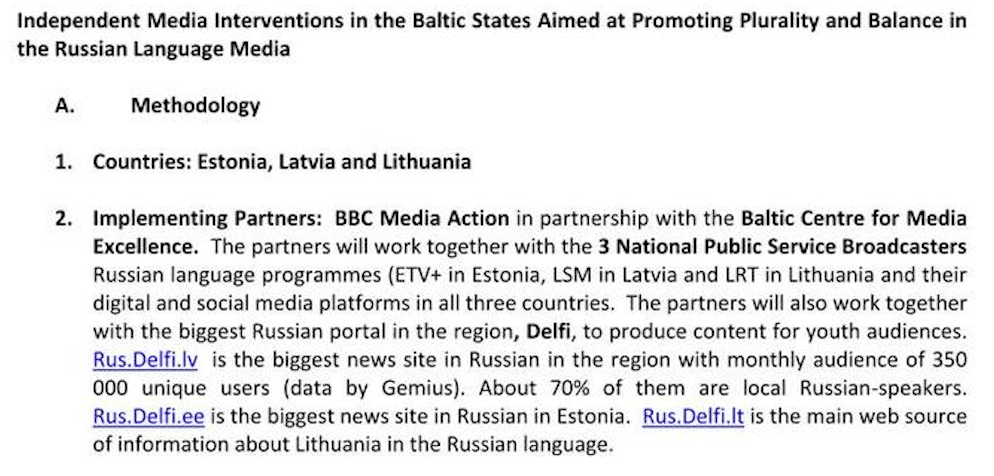
A year later, the FCO’s CDMD division outlined a program to run through 2022 at a cost of $8.3 million to the British taxpayer. It aimed to establish new outlets and support preexisting media operations “to counter Russia’s efforts to sow disunity” and “increase resilience to hostile Kremlin messaging in the Baltic states.”

Thus the British government set out with an array of intelligence contractors to dominate Baltic media with pro-NATO messaging – and perhaps sow some disunity of its own.

As seen below, the BBC placed an apparently successful bid to participate in the covert Baltic program through its non-profit arm, known as BBC Media Action.

The BBC also proposed to participate in a separate UK FCO media propaganda program in Ukraine, Moldova, and Georgia. It named Reuters and a now-defunct intelligence contractor called Aktis Strategy, which participated in previous FCO CDMD programs, as key allies in its consortium.

The BBC identified local partners like Hromadske, a Kiev-based broadcast network born in the midst of the so-called Maidan “Revolution of Dignity” in 2014 that relied on ultra-nationalist muscle to remove an elected president and install a pro-NATO regime. Hromadske materialized almost overnight with seed money and logistical support from the US Agency for International Development (USAID) and billionaire media mogul Pierre Omidyar’s Network Fund.

BBC Media Action proposed working through Aktis to cultivate and grow pro-NATO media in conflict areas like the Donbas region of eastern Ukraine, where a proxy war has raged since 2014 between the Western-backed Ukrainian military and pro-Russian separatists. It was textbook information warfare, weaponizing broadcast media to turn the tide of battle in a protracted, grinding conflict.

The UK FCO propaganda campaign warned that “Kremlin-affiliated structures” could undermine the project if it was exposed. For a media organization that claims to place trust at the heart of its charter of values, the BBC was certainly operating under a high degree of secrecy.

The UK FCO’s meddling in Eastern Europe and the Baltics created a feeding frenzy among contractors seeking to provide “capacity building” and media development assistance on Russia’s periphery. Among the bidders were Reuters and veteran FCO contractors that had participated in an array of information warfare campaigns from Syria to the British home front.

The Consortium

Among the intelligence contractors bidding to participate in the UK FCO-funded Consortium were the Zinc Network and Albany Communications. As journalist Kit Klarenberg noted in a February 18 report on the recent FCO leaks, these firms “boast staff possessed of [security] clearances, individuals who previously served at the highest levels of government, the military and security services. They furthermore have extensive experience in conducting information warfare operations on London’s behalf the world over.”

Previously known as Breakthrough, Zinc has contracted for the UK Home Office to covertly implement media projects propagandizing British Muslims under the auspices of the Prevent de-radicalization initiative. In Australia, Zinc was caught running a clandestine program to promote support for government policies among Muslims.

Ben Norton reported for The Grayzone on Albany’s record of “secur[ing] the participation of an extensive local network of over 55 stringers, reporters and videographers” to influence media narratives and advance Western regime-change goals in Syria, while conducting public relations services on behalf of extremist Syrian militias funded by NATO member states and Gulf monarchies to destabilize the country.

In its bid for the UK FCO media program in the Baltic region, Albany proposed a series of satirical “interactive games” like “Putin Bingo” to encourage opposition to the Russian government and exploit “frustrations experienced by Russians in the EU.”

Albany pitched a Latvia-based outlet called Meduza as “a leading proponent of these games.” A top website among Russian opposition supporters, Meduza has received financial support from the Swedish government and several billionaire-backed pro-NATO foundations.

As a UK FCO contractor, the Zinc Network said it was “delivering audience segmentation and targeting support” not only to Meduza, but also to Mediazona, a supposedly independent media venture founded by two members of the anti-Kremlin performance art group Pussy Riot.

One of Mediazona’s founders, Nadya Tolokonnikova, shared a stage with former US President Bill Clinton at the Clinton Foundation’s 2015 conference. The following year, Tolokonnikova trashed now-imprisoned Wikileaks founder Julian Assange, claiming, “He’s connected with the Russian government, and I feel that he’s proud of it.”

Besides delivering “targeting support” for “independent” outlets pushing the right line against the Kremlin, Zinc proposed leveraging UK FCO funding into a program of direct payments and gaming Google search results in their favor. The intelligence cut-out was explicit about its desire to reduce the search visibility of the Russian government-backed broadcaster RT.com.

The UK covertly funded and managed a network of Russian YouTubers and “activated” anti-government protest content

In a document marked “private and confidential,” Zinc revealed the Consortium’s role in setting up a “YouTuber network” in Russia and Central Asia designed to propagate the message of the UK and its NATO allies.

According to Zinc, the Consortium was “supporting participants mak[ing] and receiv[ing] international payments without being registered as external sources of funding,” presumably to circumvent Russian registration requirements for foreign-funded media outfits.

Zinc also helped the YouTube influencers “develop editorial strategies to deliver key messages” while working “to keep their involvement confidential.” And it carried out its entire program of covert propaganda in the name of “promoting media integrity and democratic values.”

Perhaps the most prominent Russian YouTube influencer is Alexei Navalny, a previously marginal nationalist opposition figure who was nominated for a Nobel Prize after becoming the target of a high-profile poisoning incident that brought relations between Russia and the West to its post-Cold War nadir.

The Russian government’s sentencing of Navalny to a 2.5-year prison term for evading parole has inspired a new wave of anti-government protests. Back in 2018, Navalny personally co-sponsored national demonstrations against the banning of the encrypted messaging app Telegram.

In its bid for a UK FCO contract, Zinc revealed that it played a behind-the-scenes role “to activate a range of content within 12 hours of the recent telegram protests.” Whether those activities involved Navalny or his immediate network was unclear, but the private disclosure by Zinc appeared confirm that British intelligence played a role in amplifying the 2018 protests.

Russian intelligence services have released sting video footage showing Vladimir Ashurkov, the executive director of Navalny’s FBK anti-corruption organization, meeting in 2013 with a suspected British MI6 agent named James William Thomas Ford, who was operating out of the British embassy in Moscow. During the rendezvous, Ashurkov can be heard asking for 10 to 20 million dollars to generate “quite a different picture” of the political landscape.

In 2018, Ashurkov’s name appeared in leaked documents exposing a covert, UK FCO influence network called the Integrity Initiative. As The Grayzone reported, the Integrity Initiative operated behind the cover of a think tank called the Institute for Statecraft, which concealed its own location through a fake office in Scotland.

Run by a group of military intelligence officers, the secret propaganda group worked through clusters of media and political influencers to escalate tensions between the West and Russia. Listed among the London cluster of anti-Russian influencers was Ashurkov.

The Integrity Initiative’s military directors outlined their agenda in stark, unequivocal terms. As the leaked memo below illustrates, they aimed to exploit the media, think tanks and their influence network to stir up as much hysteria about Russia’s supposedly malign influence as possible. Since they embarked on their covert campaign, nearly all their wishes have come true.

Bellingcat joins the Zinc Network, allegedly meddles in Moldova’s elections

After Alexei Navalny’s poisoning, he collaborated with the UK-based “open source” journalism outfit Bellingcat to pin the crime on Russia’s FSB intelligence services. Though it is well established that Bellingcat is funded by the National Endowment for Democracy, a US government entity that supports regime-change operations around the globe, the fact has never appeared in the reams of fawning profiles that corporate media outlets, including Reuters, have published about the organization.

Bellingcat’s role as a partner in the Zinc Network’s UK FCO-funded EXPOSE Consortium may add an additional layer of suspicion about the outlet’s claim to independence.

Indeed, Bellingcat was listed in leaked 2018 documents as a key member of Zinc’s “Network of NGOs.” Among the members in the network was the Institute for Statecraft, the front for the Integrity Initiative.

Bellingcat founder Eliot Higgins has vehemently denied accepting funding from the UK FCO or collaborating with it. But after Zinc documents leaked in early 2019, Higgins disclosed that some version of the Zinc proposal had received the green light from the Foreign Office.

Christian Triebbert, a Bellingcat staff member who was named as a potential trainer by the Zinc documents, and who now heads the New York Times’ video investigations unit, claimed the program consisted of benign workshops on “digital research and verification skills.”

What he and Higgins did not mention, however, was that Bellingcat had apparently been dispatched by the Zinc Network to “respond” to the 2019 parliamentary elections in North Macedonia. Stakes were high as the elections were likely to determine whether the tiny country would enter NATO and join the EU. The pro-NATO candidate triumphed, and not without a little help from the British Foreign Office and its allies.

According to the Zinc proposal, Bellingcat provided training to the Most Network, a Macedonian media outlet. It was joined by DFR Lab, a project of the NATO- and US government-funded Atlantic Council in Washington, DC.

After apparently participating in the covert UK FCO-funded intervention in North Macedonia, Bellingcat published an article ahead of the country’s 2020 parliamentary elections entitled, “Russia’s interference in North Macedonia.”

Several Zinc Network documents list Reuters as a member of the UK FCO-funded Consortium media intervention in the Baltic states.

Asked by The Grayzone how Reuters’ participation in UK FCO-funded programs aimed at countering Russia conformed to the news organization’s Trust Principles, spokesperson Jenny Vereker stated, “This funding supports our independent work to assist journalists and journalism all over the world, as part of our mission to strengthen a free and vibrant global media ecosystem to support a plurality of voices and preserve the flow of accurate and independent information. This is because accurate and balanced news coverage is a crucial pillar of any free, fair and informed society.”

In recent years, the BBC and Reuters have played an increasingly aggressive part in demonizing the governments of countries where London and Washington are seeking regime change. Meanwhile, high-profile online investigative outlets like Bellingcat have sprouted up seemingly overnight to assist these efforts.

With the release of the UK FCO documents, questions must be raised about whether these esteemed news organizations are truly the independent and ethical journalistic entities they claim to be. While they hammer away at “authoritarian” states and malign Russian activities, they have little to say about the machinations of the powerful Western governments in their immediate midst. Perhaps they are reluctant to bite the hand that feeds them.

The Art of Doublespeak: Bellingcat and Mind Control

By Edward Curtin

Source: Behind the Curtain

In the 1920s, the influential American intellectual Walter Lippman argued that the average person was incapable of seeing or understanding the world clearly and needed to be guided by experts behind the social curtain.  In a number of books he laid out the theoretical foundations for the practical work of Edward Bernays, who developed “public relations” (aka propaganda) to carry out this task for the ruling elites.  Bernays had honed his skills while working as a propagandist for the United States during World War I, and after the war he set himself up as a public relations counselor in New York City.

There is a fascinating exchange at the beginning of Adam Curtis’s documentary, The Century of Self, where Bernays, then nearly 100 years old but still very sharp, reveals his manipulative mindset and that of so many of those who have followed in his wake.  He says the reason he couldn’t call his new business “propaganda” was because the Germans had given propaganda a “bad name,” and so he came up with the euphemism “public relations.”  He then adds that “if you could use it [i.e. propaganda] for war, you certainly could use it for peace.”  Of course, he never used PR for peace but just to manipulate public opinion (he helped engineer the CIA coup against the democratically elected Arbenz government in Guatemala in 1954 with fake news broadcasts).  He says “the Germans gave propaganda a bad name,” not Bernays and the United States with their vast campaign of lies, mainly aimed at the American people to get their support for going to a war they opposed (think weapons of mass destruction).  He sounds proud of his war propaganda work that resounded to his credit since it led to support for the “war to end all wars” and subsequently to a hit movie about WWI, Yankee Doodle Dandy, made in 1942 to promote another war, since the first one somehow didn’t achieve its lofty goal.

As Bernays has said in his book Propaganda,

The American motion picture is the greatest unconscious carrier of propaganda in the world today.

He was a propagandist to the end.  I suspect most viewers of the film are taken in by these softly spoken words of an old man sipping a glass of wine at a dinner table with a woman who is asking him questions. I have shown this film to hundreds of students and none has noticed his legerdemain.  It is an example of the sort of hocus-pocus I will be getting to shortly, the sly insertion into seemingly liberal or matter-of-fact commentary of statements that imply a different story.  The placement of convincing or confusing disingenuous ingredients into a truth sandwich – for Bernays knew that the bread of truth is essential to conceal untruth.

In the following years, Bernays, Lippman, and their ilk were joined by social “scientists,” psychologists, and sundry others intent on making a sham out of the idea of democracy by developing strategies and techniques for the engineering of social consensus consonant with the wishes of the ruling classes.  Their techniques of propaganda developed exponentially with the development of technology, the creation of the CIA, its infiltration of all the major media, and that agency’s courting of what the CIA official Cord Meyer called in the 1950s “the compatible left,” having already had the right in its pocket. Today most people are, as is said, “wired,” and they get their information from the electronic media that is mostly controlled by giant corporations in cahoots with government propagandists.  Ask yourself: Has the power of the oligarchic, permanent warfare state with its propaganda and spy networks increased or decreased over your lifetime. The answer is obvious: the average people that Lippman and Bernays trashed are losing and the ruling elites are winning.

This is not just because powerful propagandists are good at controlling so-called “average” people’s thinking, but, perhaps more importantly, because they are also adept – probably more so – at confusing or directing the thinking of those who consider themselves above average, those who still might read a book or two or have the concentration to read multiple articles that offer different perspectives on a topic.  This is what some call the professional and intellectual classes, perhaps 15-20 % of the population, most of whom are not the ruling elites but their employees and sometimes their mouthpieces.  It is this segment of the population that considers itself “informed,” but the information they imbibe is often sprinkled with bits of misdirection, both intentional and not, that beclouds their understanding of important public matters but leaves them with the false impression that they are in the know.

Recently I have noticed a group of interconnected examples of how this group of the population that exerts influence incommensurate with their numbers has contributed to the blurring of lines between fact and fiction. Within this group there are opinion makers who are often journalists, writers, and cultural producers of some sort or other, and then the larger number of the intellectual or schooled class who follow their opinions.  This second group then passes on their received opinions to those who look up to them.

There is a notorious propaganda outfit called Bellingcat, started by an unemployed Englishman named Eliot Higgins, that has been funded by The Atlantic Council, a think-tank with deep ties to the U.S. government, NATO, war manufacturers, and their allies, and the National Endowment for Democracy (NED), another infamous U.S. front organization heavily involved in so-called color revolution regime change operations all around the world, that has just won the International Emmy Award for best documentary. The film with the Orwellian title, Bellingcat: Truth in a Post-Truth World, received its Emmy at a recent ceremony in New York City.  Bellingcat is an alleged group of amateur on-line researchers who have spent years shilling for the U.S. instigated war against the Syrian government, blaming the Douma chemical attack and others on the Assad government, and for the anti-Russian propaganda connected to, among other things, the Skripal poisoning case in England, and the downing of flight MH17 plane in Ukraine. It has been lauded by the corporate mainstream media in the west.  Its support for the equally fraudulent White Helmets (also funded by the US and the UK) in Syria has also been praised by the western corporate media while being dissected as propaganda by many excellent independent journalists such as Eva Bartlett, Vanessa Beeley, Catte Black, among others.  It’s had its work skewered by the likes of Seymour Hersh and MIT professor Theodore Postol, and its US government connections pointed out by many others, including Ben Norton and Max Blumenthal at The Gray Zone. And now we have the mainstream media’s wall of silence on the leaks from the Organization for the Prohibition on Chemical Weapons (OPCW) concerning the Douma chemical attack and the doctoring of their report that led to the illegal U.S. bombing of Syria in the spring of 2018.  Bellingcat was at the forefront of providing justification for such bombing, and now the journalists Peter Hitchens, Tareq Harrad (who recently resigned from Newsweek after accusing the publication of suppressing his revelations about the OPCW scandal) and others are fighting an uphill battle to get the truth out.

Yet Bellingcat: Truth in a Post-Truth World won the Emmy, fulfilling Bernays’ point about films being the greatest unconscious carriers of propaganda in the world today.

Who presented the Emmy Award to the film makers, but none other than the rebel journalist Chris Hedges.  Why he did so, I don’t know.  But that he did so clearly sends a message to those who follow his work and trust him that it’s okay to give a major cultural award to a propaganda outfit.  But then, perhaps he doesn’t consider Bellingcat to be that.

Nor, one presumes, does The Intercept, the billionaire Pierre Omidyar owned publication associated with Glen Greenwald and Jeremy Scahill, and also read by many progressive-minded people. The Intercept that earlier this year disbanded the small team that was tasked with reviewing and releasing more of the massive trove of documents they received from Edward Snowden six years ago, a minute number of which have ever been released or probably ever will be. As Whitney Webb pointed out, last year The Intercept  hosted a workshop for Bellingcat.  She wrote:

The Intercept, along with its parent company First Look Media, recently hosted a workshop for pro-war, Google-funded organization Bellingcat in New York. The workshop, which cost $2,500 per person to attend and lasted five days, aimed to instruct participants in how to perform investigations using “open source” tools — with Bellingcat’s past, controversial investigations for use as case studies…Thus, while The Intercept has long publicly promoted itself as an anti-interventionist and progressive media outlet, it is becoming clearer that – largely thanks to its ties to Omidyar – it is increasingly an organization that has more in common with Bellingcat, a group that launders NATO and U.S. propaganda and disguises it as “independent” and “investigative journalism.”

Then we have Jefferson Morley, the editor of The Deep State, former Washington Post journalist, and JFK assassination researcher, who has written a praiseworthy review of the Bellingcat film and who supports Bellingcat.  “In my experience, Bellingcat is credible,” he writes in an Alternet article, “Bellingcat documentary has the pace and plot of a thriller.”

Morley has also just written an article for Counterpunch“Why the Douma Chemical Attack Wasn’t a ‘Managed Massacre’” – in which he disputes the claim that the April 7, 2018 attack in the Damascus suburb was a false flag operation carried out by Assad’s opponents. “I do not see any evidence proving that Douma was a false flag incident,” he writes in this article that is written in a style that leaves one guessing as to what exactly he is saying.  It sounds convincing unless one concentrates, and then his double messages emerge.  Yet it is the kind of article that certain “sophisticated” left-wing readers might read and feel is insightful.  But then Morley, who has written considerably about the CIA, edits a website that advertises itself as “the thinking person’s portal to the world of secret government,” and recently had an exchange with former CIA Director John Brennan where “Brennan put a friendly finger on my chest,” said in February 2017, less than a month after Trump was sworn in as president, that:

With a docile Republican majority in Congress and a demoralized Democratic Party in opposition, the leaders of the Deep State are the most—perhaps the only—credible check in Washington on what Senator Bob Corker (R-Tenn.) calls Trump’s “wrecking ball presidency.”  

Is it any wonder that some people might be a bit confused?

“I know what you’re thinking about,” said Tweedledum; “but it isn’t so, nohow.”

“Contrariwise,” continued Tweedledee, “if it was so, it might be; and if it were so, it would be; but as it isn’t, it ain’t.  That’s logic.”

As a final case in point, there is a recent book by Stephen Kinzer, Poisoner in Chief: Sidney Gottlieb And The CIA Search For Mind Control, the story of the chemist known as Dr. Death who ran the CIA’s MK-ULTRA mind control project, using LSD, torture, electric shock therapy, hypnosis, etc.; developed sadistic methods of torture still used in black sites around the world; and invented various ingenious techniques for assassination, many of which were aimed at Fidel Castro.  Gottlieb was responsible for brutal prison and hospital experiments and untold death and suffering inflicted on all sorts of innocent people.  His work was depraved in the deepest sense; he worked with Nazis who experimented on Jews despite being Jewish himself.

Kinzer writes in depth about this man who considered himself a patriot and a spiritual person – a humane torturer and killer.  It is an eye-opening book for anyone who does not know about Gottlieb, who gave the CIA the essential tools they use in their “organized crime” activities around the world – in the words of Douglass Valentine, the author of The CIA as Organized Crime and The Phoenix Program. Kinzer’s book is good history on Gottlieb; however, he doesn’t venture into the present activities of the CIA and Gottlieb’s patriotic followers, who no doubt exist and go about their business in secret.

After recounting in detail the sordid history of Gottlieb’s secret work that is nauseating to read about, Kinzer leaves the reader with these strange words:

Gottlieb was not a sadist, but he might well have been…. Above all he was an instrument of history.  Understanding him is a deeply disturbing way of understanding ourselves.

What possibly could this mean?  Not a sadist?  An instrument of history?  Understanding ourselves?  These few sentences, dropped out of nowhere, pull the rug out from under what is generally an illuminating history and what seems like a moral indictment. This language is pure mystification.

Kinzer also concludes that because Gottlieb said so, the CIA failed in their efforts to develop methods of mind control and ended MK-ULTRA’s experiments long ago. Why would he believe the word of a man who personified the agency he worked for: a secret liar? He writes,

When Sydney Gottlieb brough MK-ULTRA to its end in the early 1960s, he told his CIA superiors that he had found no reliable way to wipe away memory, make people abandon their consciences, or commit crimes and then forget them.

As for those who might think otherwise, Kinzer suggests they have vivid imaginations and are caught up in conspiracy thinking: “This [convincing others that the CIA had developed methods of mind control when they hadn’t] is Sydney Gottlieb’s most unexpected legacy,” he asserts. He says this although Richard Helms, the CIA Director, destroyed all MK-Ultra records. He says that Allen Dulles, Gottlieb, and Helms themselves were caught up in a complete fantasy about mind control because they had seen too many movies and read too many books; mind control was impossible, a failure, a myth, he maintains. It is the stuff of popular culture, entertainment. In an interview with Chris Hedges, interestingly posted by Jefferson Morley at his website, The Deep State, Hedges agrees with Kinzer.  Gottlieb, Dulles, et al. were all deluded.  Mind control was impossible.  You couldn’t create a Manchurian Candidate; by implication, someone like Sirhan Sirhan could not have been programmed to be a fake Manchurian Candidate and to have no memory of what he did, as he claims.  He could not have been mind-controlled by the CIA to perform his part as the seeming assassin of Senator Robert Kennedy while the real killer shot RFK from behind. People who think like this should get real.

Furthermore, as is so common in books such as Kinzer’s, he repeats the canard that JFK and RFK knew about and pressured the CIA to assassinate Fidel Castro. This is demonstrably false, as shown by the Church Committee and the Assassinations Record Review Board, among many others. That Kinzer takes the word of notorious liars like Richard Helms and the top-level CIA operative Samuel Halpern is simple incredible, something that is hard to consider a mistake.  Slipped into a truth sandwich, it is devoured and passed on. But it is false. Bullshit meant to deceive.

But this is how these games are played. If you look carefully, you will see them widely.  Inform, enlighten, while throwing in doubletalk and untruths.  The small number of people who read such books and articles will come away knowing some history that has no current relevance and being misinformed on other history that does. They will then be in the know, ready to pass their “wisdom” on to those who care to listen. They will not think they are average.

But they will be mind controlled, and the killer cat will roam freely without a bell, ready to devour the unsuspecting mice.

US government drops case against Max Blumenthal after jailing journalist on false charges

As the mysterious disappearance of Secret Service records and complete absence of evidence supporting its case came to light, the US government dropped its bogus charges against journalist Max Blumenthal.

By Ben Norton

Source: Grayzone

The US government has dropped its bogus charge of “simple assault” against journalist Max Blumenthal, after having him arrested on a 5-month-old warrant and jailed for nearly two days.

The Grayzone has learned that Secret Service call logs recorded during the alleged incident were either not kept or destroyed. The mysteriously missing evidence included print documents and radio recordings that may have exposed collusion between Secret Service officers operating under the auspices of the US State Department and violent right-wing hooligans in an operation to besiege peace activists stationed inside Venezuela’s embassy in Washington, DC.

Blumenthal, who is the editor of The Grayzone, was arrested at his home on October 25 by a team of DC cops who had threatened to break down his door. He later learned that he was listed in his arrest warrant as “armed and dangerous,” a rare and completely unfounded designation that placed Blumenthal at risk of severe harm by the police.

The government’s case rested entirely on a false accusation by a right-wing Venezuelan opposition activist, Naylet Pacheco, that Blumenthal and Benjamin Rubinstein had assaulted her while they were delivering food to Venezuela’s embassy in Washington, DC in the early morning on May 8. (Rubinstein is the brother of journalist and Grayzone contributor Alexander Rubinstein, who was reporting from inside the embassy at the time.)

The Grayzone has reported extensively on the corruption of coup leader Juan Guaidó, whom Washington recognizes as “interim president” of Venezuela, as well as the scandals plaguing Guaidó’s “ambassador” to the United States, Carlos Vecchio.

Vecchio personally presided over the weeks-long siege of Venezuela’s embassy in Washington, DC, stage-managing efforts by a mob of rabid right-wing activists to prevent peace activists from receiving deliveries of food and sanitary supplies.

As The Grayzone reported, the Donald Trump administration has diverted USAID funding originally intended to assist Central American migrants to pay the salaries of Vecchio and his team in Washington.

The US Department of Justice dismissed its case against Blumenthal on December 6. On the same day, it also dropped charges against Rubinstein, who had been arrested on May 8, hours after the food delivery.

“I’m relieved the government has finally decided to drop these phony charges against me. But I’m also disgusted,” Max Blumenthal said, “because I should never have been hauled out of my house and thrown in jail for an obviously politically motivated, false allegation that the police failed to investigate.”

Disappeared Secret Service call logs ‘highly unusual’

Lawyers representing Blumenthal and Rubinstein placed multiple and highly specified discovery requests to the prosecutor for Secret Service call recordings and reports logged on May 8 at the location of the embassy food delivery. The US prosecutor was unable to satisfy the request, verbally confirming that if the documents had existed, they no longer did.

“This is highly unusual and highly notable, almost inexplicable in the ordinary course of operations that these records were not maintained and preserved,” said Carl Messineo, the counsel to Rubinstein and a co-founder of the Partnership for Civil Justice Fund. “Given the false nature of allegations and that they advanced a prosecution based on these it is really questionable that this information was not produced.”

Beyond the mysterious disappearance of the call logs, there was a complete dearth of evidence on the prosecution’s side.

William Moran, who served as Blumenthal’s attorney, wondered why law enforcement trusted Pacheco, an accuser with such clear credibility issues. “The local police advanced a fraudulent case against a journalist on the word of a complainant who told at least six different, increasingly exaggerated stories and made identical accusations that night about at least three other individuals,” he said.

One Venezuelan opposition member whose identity remains under a protective order provided testimony to police attempting to corroborate Pacheco’s claims about Blumenthal and Rubinstein. According to Moran, that person had been convicted for the impeachable offense of writing fraudulent checks.

“The DC police wholly failed to conduct a proper investigation before calling for the arrest and imprisonment of a dissident journalist that they labeled without any cause whatsoever as ‘armed and dangerous,’ placing him in mortal danger,” Moran stated.

A pattern of false assault allegations and police collusion

The arrest of Blumenthal was part of a wider pattern of political persecution of those who resisted the seizure of the Venezuelan embassy by a US-backed coup administration.

On November 13, police appeared at the home of Medea Benjamin to threaten her with arrest, after she too was falsely accused of assault. Benjamin, a co-founder and leader of the anti-war group CODEPINK, had been a prominent figure in the Venezuelan Embassy Protection Collective.

Benjamin was accused by members of the Venezuelan opposition of assaulting Representative Debbie Wasserman-Schultz, who had joined Carlos Vecchio for a press conference on Capitol Hill. The police eventually left without arresting Benjamin, because they did not have a warrant.

Video of the incident revealed that it was, in fact, Benjamin who was assaulted by Vecchio’s notoriously violent minions.

During the same press conference, a member of the Venezuelan opposition seized the phone of journalist Wyatt Reed. When Reed complained to a Secret Service officer on site, the officer brushed him off.

Diliana Bustillos, a Venezuelan opposition lobbyist who participated in a May 8 press conference falsely accusing peace activists of violence, threatened Reed after the incident, warning that he would “end up like [Max Blumenthal] and Ben [Rubinstein].”

Mara Verheyden-Hilliard, a civil liberties lawyer with the Partnership for Civil Justice Fund, was present throughout much of the embassy siege. She noticed clear collusion between the right-wing opposition mob outside and the Secret Service, who were operating at the time under the watch of the State Department.

“Throughout the siege of the peace activists at the Venezuelan embassy,” Verheyden-Hillard said, “it was apparent to those on the scene that there was what looked like a facilitated effort between the government and the mob besieging the embassy.”

Mainstream media silence, demonization by regime change activists

The Washington Post reported extensively on the siege of the Venezuelan embassy, presenting the situation largely from the opposition’s perspective. The paper’s correspondent, Marissa Lang, uncritically conveyed Pacheco’s false charges, writing that “she said she was pushed against a wall and kicked by several men, then spent hours at a hospital being treated.”

However, the Washington Post did not report on Blumenthal’s arrest and imprisonment five months later or any of his public comments about the high-profile incident.

Meanwhile, an assortment of malicious regime-change cheerleaders seized on Blumenthal’s arrest to defame him with false and now-discredited claims on social media:

  • Bellingcat founder Elliot Higgins promoted a Medium post by an anonymous author who has routinely smeared Blumenthal, which featured his arrest warrant and a video of the complainant’s false testimony. He then repeatedly criticized skeptics who expressed doubts about the completely unfounded allegations against Blumenthal. Higgins’ website Bellingcat is funded by the National Endowment for Democracy, a regime change arm of the US government, and the UK Foreign Office via the Zinc Network, among other entities.
  • Foreign Policy senior editor and anti-China hawk James Palmer declared without a scintilla of evidence that Blumenthal “assault[ed] people freely.”
  • Freelance journalist and longtime Syria regime-change activist Danny Gold claimed falsely and without proof that Blumenthal “kicked an old woman in the stomach.”
  • Idrees Ahmad, a Stirling University professor of journalism who has obsessively denigrated Blumenthal and even phoned him to threaten him against publishing a factual investigative report on the Syrian White Helmets, falsely accused Blumenthal of “manhandling an elderly woman.”
  • Istanbul-based TRT World contributor Wilson Dizard suggested that Blumenthal was guilty before being proven innocent, insisting that a Grayzone account of his arrest “does not actually provide an alternative version of events.”
  • Oz Katerji, the notorious regime change fanatic who was recently fired from the Daily Mail for denigrating its columnist Peter Hitchens on social media, declared that he would “probably buy the guys who shackled pro-Assad war crimes denier Max Blumenthal to the floor for assaulting a Venezuelan protester a beer or two.” Katerji later insisted without any basis that “there’s video evidence” to support the false charge against Blumenthal.
  • Dutch regime-change activist Thomas van Linge, who fancied himself a Syria expert before moving on to advocate for Western-backed right-wing opposition groups in Iran, Bolivia, Hong Kong, and beyond, denied that Blumenthal’s arrest was political and instead outrageously claimed he was “arrested for kicking a pregnant woman.” Even in the totally fabricated accusations against Blumenthal, no one ever claimed that the alleged victim, right-wing Venezuelan activist Naylet Pacheco, who is 58 years old, was pregnant. As of the publication of this article, van Linge still has not deleted this patently false, defamatory claim.
  • Neil Hauer, a self-described “freelance analyst” who has previously consulted for the European Union and US Marines, called journalist Jeet Heer a “moron” for publicly advocating for Blumenthal.
  • UK liberal interventionist Sunny Hundal also attacked Heer for defending Blumenthal, asserting that “given the person in question I think you should exercise some judgement before accepting his story at face value.”
  • The anonymous right-wing Reagan Battalion Twitter account falsely claimed that Blumenthal was “arrested for kicking a pregnant woman,” misrepresenting the identity of the complainant while not even bothering to frame the non-existent incident as an alleged assault. In a previous spasm of mendacity, the Reagan Battalion declared that Blumenthal “works for” foreign socialist governments and smeared him as “a puppet for every dictator around the globe.”
  • Liberal feminist Mona Eltahawy falsely smeared Blumenthal as a supposed abuser of women and a “piece of shit.”
  • Right-wing pro-Israel lobby group StopAntisemitism.org defamed Blumenthal, who is Jewish, as an “antisemite,” cheered his arrest, and falsely asserted he “assault[ed] a Venezuelan opposition figure.” This pro-Israel organization has also smeared left-wing Jewish activist Ariel Gold and Muslim American progressives Ilhan Omar, Rashida Tlaib, and Linda Sarsour as supposed “antisemites.”
  • Joshua Holland, a liberal contributor to The Nation, publicly lashed out at media critic Joe Emersberger and implied the false, totally unsubstantiated allegations could be true.
  • Joshua Frank, an editor of the former-muckraking website CounterPunch, downplayed the attack on Blumenthal, whitewashed the state repression, and called on people “to not blow this all out of proportion, as Max is likely to do for his own gain.” Frank, who has viciously maligned journalists and activists who opposed the international proxy war on Syria, also derided this present reporter, Ben Norton, with superficial ad hominem insults.
  • Sean Davis, a co-founder of the hard-right website The Federalist and a longtime conservative activist who has worked for numerous Republican politicians, spread the fake accusations. Davis’ website The Federalist has been widely criticized for blatant racism (it once had a tag devoted specifically to “black crime“), and it published an article defending far-right Alabama judge Roy Moore after he was accused of dating teenage girls as young as 14.

Asked about the wave of libelous attacks spurred by his arrest on false charges, Blumenthal commented, “The outpouring of support I’ve received from around the world has been more profound and meaningful than any of the smears from the usual suspects. But that does not mean that I will let this campaign of lies go unanswered. This whole episode began with a false, defamatory accusation, and I plan to take the necessary actions to see it ends with a sense of justice.