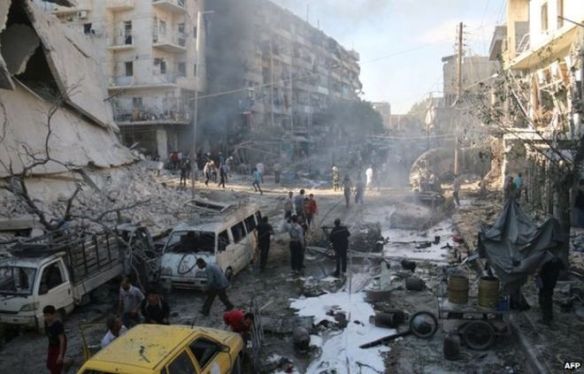
US, allies risk Russian retaliation in Syrian attack

By Editorial Board

Source: Global Times

US President Donald Trump announced on Friday he ordered strikes on the Syrian regime in response to a chemical attack last weekend. He said the strikes were in coordination with France and the United Kingdom. Syrian President Bashar al-Assad said his country is being “invaded” by the three countries. The Russian Embassy in the USA said in a statement that “insulting the President of Russia is unacceptable and inadmissible.”

In a sensational statement, Trump asserted the Bashar Assad government used chemical weapons on civilians. He said “The evil and the despicable attack left mothers and fathers, infants and children thrashing in pain and gasping for air. These are not the actions of a man. They are crimes of a monster instead.”Trump also warned “Russia must decide if it will continue down this dark path or if it will join with civilized nations as a force for stability and peace.”

The facts cannot be distorted. This military strike was not authorized by the UN, and the strikes targeted a legal government of a UN member state. The US and its European allies launched strikes to punish President Bashar al-Assad for a suspected chemical attack in Duma last weekend. However, it has not been confirmed if the chemical weapons attack happened or if it did, whether government forces or opposition forces launched it. International organizations have not carried out any authoritative investigation.

The Syrian government has repeatedly stressed that there is no need for it to use chemical weapons to capture the opposition-controlled Duma city and the use of chemical weapons has provided an excuse for Western intervention. The Syrian government’s argument or Trump’s accusations against the “evil” Assad regime, which one is in line with basic logic? The answer is quite obvious.

The US has a record of launching wars on deceptive grounds. The Bush government asserted the Saddam regime held chemical weapons before the US-British coalition troops invaded Iraq in 2003. However, the coalition forces didn’t find what they called weapons of mass destruction after overthrowing the Saddam regime. Both Washington and London admitted later that their intelligence was false.

Washington’s attack on Syria where Russian troops are stationed constitute serious contempt for Russia’s military capabilities and political dignity. Trump, like scolding a pupil, called on Moscow, one of the world’s leading nuclear powers, to abandon its “dark path.” Disturbingly, Washington seems to have become addicted to mocking Russia in this way. Russia is capable of launching a destructive retaliatory attack on the West. Russia’s weak economy is plagued by Western sanctions and squeezing of its strategic space. That the West provokes Russia in such a manner is irresponsible for world peace.

The situation is still fomenting. The Trump administration said it will sustain the strikes. But how long will the military action continue and whether Russia will fight back as it claimed previously remain uncertain. Western countries continue bullying Russia but are seemingly not afraid of its possible counterattack. Their arrogance breeds risk and danger.

State of Failure

By James Howard Kunstler

Source: Kunstler.com

BEIRUT, Lebanon — Days after President Trump said he wanted to pull the United States out of Syria, Syrian forces hit a suburb of Damascus with bombs that rescue workers said unleashed toxic gas.

Fool me once, shame on you; fool me twice, shame on me, the old saying goes. So, tread carefully through the minefields of propaganda laid for the credulous in such low organs as The New York Times. There are excellent reasons to suppose that the American Deep State wishes strenuously to keep meddling all around the Middle East. The record so far shows that the blunt instruments of US strategic policy produce a consistent result: failed states.

Syria was well on its way to that sorry condition — prompted by an inflow of Jihadi maniacs fleeing our previous nation un-building experiment in Iraq — when the Russians stepped in with an arrantly contrary idea: to support the Syrian government. Of course, the Russians had ulterior motives: a naval base on the Mediterranean, expanded influence in the region, and a Gazprom concession to develop and manage large natural gas fields near the Syrian city of Homs, for export to Europe. The latter would have competed with America’s client state, Qatar, a leading gas exporter to Europe.

But the US objected to supporting the government of Bashar al-Assad, as it had previously with Saddam Hussein and Muammar Gaddafi, as well as Russia’s presence there in the first place. So, the US cultivated anti-government forces in the Syrian civil war, a hodgepodge of Islamic psychopaths variously known as ISIS (Islamic State of Iraq and the Levant), Daesh, al-Qaeda, al-Nusra, Ansar al-Din, Jaysh al-Sunna, Nour al-Din al-Zenki, and what-have-you.

As it happened, US policy in Syria after 2013 became an exercise in waffling. It was clear that our support for the forces of Jihad against Assad was turning major Syrian cities into rubble-fields, with masses of civilians caught in the middle and ground up like so much dog food. President Barack Obama famously drew a line-in-the-sand on the use of chemical weapons. It was well-known that the Syrian army had stockpiles of chemical poisons. But the US also knew that our Jihadi consorts had plenty of their own. Incidents of chemical atrocities were carried out by… somebody… it was never altogether clear or proven… and Mr. Obama’s line-in-the-sand disappeared under dust-storms of equivocation.

Finally, a joint mission of the United Nations Human Rights Commission (UNHRC) and the Organization for the Prohibition of Chemical Weapons (OPCW) was called in to supervise the destruction of the Syrian government’s chemical weapons, and certified it as accomplished in late 2014. Yet, poison gas incidents continued — most notoriously in 2017 when President Donald Trump responded to one with a sortie of cruise missiles against a vacant Syrian government airfield. And now another incident in the Damascus suburb of Douma has provoked Mr. Trump to tweetstormed threats of retaliatory violence, just days after he proposed a swift withdrawal from that vexing corner of the world.

Surely by now the American public has developed some immunity to claims of nefarious doings in foreign lands (“weapons of mass destruction,” and all). The operative sentence in that New York Times report is “…Syrian forces hit a suburb of Damascus with bombs that rescue workers said unleashed toxic gas.” Yeah, well, how clear is it that the toxic gas was contained in the bombs, or rather that the bombs dropped by the Syrian military blew up a chemical weapon depot controlled by anti-government Jihadis? Does that hodgepodge of maniacs show any respect for the UN, or the Geneva Convention, or any other agency of international law? As in many previous such incidents, we don’t know who was responsible — though there is plenty of reason to believe that parties within the US establishment are against Mr. Trump’s idea of getting the hell out of that place, and might cook up a convenient reason to prevent it.

Lastly, how is it in Bashar al-Assad’s interests to provoke a fresh international uproar against him and his regime? I’d say it is not the least in his interest, since he is on the verge of putting an end to the awful conflict. He may not be a model of rectitude by Western standards, but he’s not a mental defective. And he has very able Russian support advising him in what has been so far a long and difficult effort to prevent his state from failing — or being failed for him.

Spies, Lies and War Propaganda: The Making of Another Conspiracy Theory

By Timothy Alexander Guzman

Source: Silent Crow News

What is insane is how Western governments and the mainstream media (MSM) is that they can tell you that they have the proof that their enemies committed an act of war, or how they interfere in the affairs of other countries but cannot release the evidence due to national security issues or they just outright know in their gut instincts that their enemies did whatever it is that they did, and then they expect us to believe them. While we in the alternative media can show you mountains of evidence including government documents, photos, quotes from world leaders, reports and analysis from respected journalists and researchers from all over the world who represent the facts, yet we are called conspiracy theorists by the same Western governments and the MSM.

Russia is now accused of poisoning another former Russian spy, this time it’s Sergei Skripal (the late Alexander Litvinenko was the last victim) and his daughter Yulia who was living in the Salisbury section of the UK with a military-grade nerve agent produced by..drum roll, please… Russia! How convenient, especially during a time when the U.S. and its allies accuse the Syrian government of launching chemical attacks on civilians, but in reality (which has been proven time and time again) it was the US-backed terrorists or who they call the “rebel forces” who launched the chemical attacks. It’s amazing how Western governments and the MSM constantly link their adversaries to Weapons of Mass Destruction (WMDs). For example, The New York Times published an article on February 27th titled ‘U.N. Links North Korea to Syria’s Chemical Weapons Program’ suggesting that North Korea shipped supplies to Syria to produce chemical weapons due to an investigation by United Nations:

North Korea has been shipping supplies to the Syrian government that could be used in the production of chemical weapons, United Nations experts contend.

The evidence of a North Korean connection comes as the United States and other countries have accused the Syrian government of using chemical weapons on civilians, including recent attacks on civilians in the Damascus suburb of eastern Ghouta using what appears to have been chlorine gas.

The supplies from North Korea include acid-resistant tiles, valves and thermometers, according to a report by United Nations investigators. North Korean missile technicians have also been spotted working at known chemical weapons and missile facilities inside Syria, according to the report, which was written by a panel of experts who looked at North Korea’s compliance with United Nations sanctions

O.K. So now North Korea is shipping supplies to help the Syrian government of Bashar al-Assad to produce chemical weapons? What is interesting about the accusation is that The New York Times reviewed the report, but would not release it themselves. The authors and other members of the UN security council would also not comment on the report:

The possible chemical weapons components were part of at least 40 previously unreported shipments by North Korea to Syria between 2012 and 2017 of prohibited ballistic missile parts and materials that could be used for both military and civilian purposes, according to the report, which has not been publicly released but which was reviewed by The New York Times.

Neither the report’s authors nor members of the United Nations Security Council who have seen it would comment, and neither would the United States’ mission to the international agency. It is unclear when, or even whether, the report will be released

Of course they are not even sure if they would release the report to the public because it would most likely be criticized by the alternative media who would view it as a propaganda plot to demonize Kim Jung-Un. We can call The New York Times article for what it really is, and that is fake news. North Korea would not get involved in a Middle East conflict because it would not be in their interest, politically or economically. It would give the US and South Korean governments more reasons to threaten North Korea with a military strike if something like that was true, but it’s not. Kim Jung -Un does not have a relationship with ISIS and other terrorist groups who have been launching chemical attacks throughout Syria since the start of the conflict, the U.S. and its allies do. So it’s ludicrous accusation.

On March 12th, British Prime Minister Theresa May spoke at the House of Commons about the Skripal incident in Salisbury, UK:

It is now clear that Mr Skripal and his daughter were poisoned with a military-grade nerve agent of a type developed by Russia. This is part of a group of nerve agents known as ‘Novichok’.

Based on the positive identification of this chemical agent by world-leading experts at the Defence Science and Technology Laboratory at Porton Down; our knowledge that Russia has previously produced this agent and would still be capable of doing so; Russia’s record of conducting state-sponsored assassinations; and our assessment that Russia views some defectors as legitimate targets for assassinations; the Government has concluded that it is highly likely that Russia was responsible for the act against Sergei and Yulia Skripal

The case of Sergei Skripal is becoming another farfetched conspiracy theory just like the Alexander Litvinenko case. If you remember Alexander Litvinenko who allegedly drank a cup tea at a business meeting with two other Russians (who were charged with his murder) which contained a fatal dose of Polonium-210. The editorial director of Antiwar.com, Justin Raimondo wrote an article on the assassination of Alexander Litvinenko titled ‘The Craziest Conspiracy Theory of Them All: The British government’s report on the death of Alexander Litvinenko reads like a bad thriller’:

To those of us who grew up during the cold war years, it’s just like old times again: Russian plots to subvert the West and poison our precious bodily fluids are apparently everywhere. Speaking of poisoning plots: the latest Russkie conspiracy – and the most imaginative by far – was the alleged assassination by poisoning of Alexander Litvinenko , a former agent of the Russian intelligence services who fled to the West to become a professional anti-Russian propagandist and conspiracy theorist with a talent for the improbable. According to his fantastic worldview, the many terrorist attacks that have occurred in Russia have all been committed by … Vladimir Putin. Aside from championing the Chechen Islamo-terrorists who actually committed these crimes, Litvinenko’s stock-in-trade was an elaborate conspiracy theory in which he regularly accused Putin of blowing up Russian apartment buildings and murdering schoolchildren and then diverting attention from his own nefarious plots by blaming those lovable Chechens. Not very believable – unless one is predisposed to believe anything, so long as it casts discredit on those satanic Russians.

The conspiracy theory promulgated by the British government – and now memorialized in this official report – surpasses anything the deceased fantasist might have come up with. According to the Brits, Litvinenko was poisoned on British soil whilst imbibing a cup of tea spiked with a massive dose of radioactive polonium-210 – and, since Russia is a prime source of this rare substance, and since the Russians were supposedly out to get Litvinenko, the FSB – successor to the KGB – is named as the “probable” culprit.

Looking at the report, one has to conclude that they don’t make propaganda the way they used to: the certitude of, say, a J. Edgar Hoover or a Robert Welch has given way to the tepid ambiguity of Lord Robert Owen, the author of this report, whose verdict of “probably” merely underscores the paucity of what passes for evidence in this case

Raimondo made his case with a common-sense approach to the conspiracy theory:

To begin with, if the Russians wanted to off Litvinenko, why would they poison him with a substance that left a radioactive trail traceable from Germany to Heathrow airport – and, in the process, contaminating scores of hotel rooms, offices, planes, restaurants, and homes? Why not just put a bullet through his head? It makes no sense.

But then conspiracy theories don’t have to make sense: they just have to take certain assumptions all the way to their implausible conclusions. If one starts with the premise that Putin and the Russians are a Satanic force capable of anything, and incompetent to boot, then it’s all perfectly “logical” – in the Bizarro World, at any rate.

The idea that Litvinenko was a dangerous opponent of the Russian government who had to be killed because he posed a credible threat to the existence of the regime is laughable: practically no one inside Russia knew anything about him, and as for his crackpot “truther” theories about how Putin was behind every terrorist attack ever carried out within Russia’s borders – to assert that they had any credence outside of the Western media echo chamber is a joke. So there was no real motive for the FSB to assassinate him, just as there is none for the FBI to go after David Ray Griffin

To assassinate Litvinenko with a dose of radioactive polonium-210 in his cup of tea is an incredibly ridiculous allegation by both the British and American establishment. Another anti-Putin crusader is the Hudson Institute’s own senior fellow, David Satter who wrote ‘The Russian State of Murder Under Putin’ in 2016 and said:

It is now imperative not only for the West but for the future of Russia that the Litvinenko inquiry set a precedent for the objective international review of the cases of political terrorism in Russia. These include the bloody sieges at Moscow’s Dubrovka theater in 2002 and at a school in Beslan in 2004, the assassinations of journalists and opposition leaders and, above all, the deadly 1999 apartment bombings that helped bring Mr. Putin to power.

In the Litvinenko case, the alleged assassins, Andrei Lugovoi and Dmitry Kovtun, were accused by the British inquiry of slipping polonium-210 into Litvinenko’s tea. A radioactive trail was left all over London. Traces of polonium were found in Mr. Lugovoi’s hotel room, at a sushi restaurant where Litvinenko dined with the two men, and on the seat occupied by Mr. Lugovoi on a British Airlines flight from Moscow to London

Satter’s view concerning Putin’s killing machine apparatus that uses chemical weapons to silence its opposition is pure nonsense. There are many ways to murder an individual if they really wanted to, so why would they use ‘Novichok’ a nerve agent that can be traced back to Russia? Novichok was produced in the former Soviet Union and then in Russia until 1993.

So who would benefit from such an attack? Putin himself? not really, it would somehow benefit the Anglo-American establishment by continuing the demonization of the Russian government. Sergei Skripal, was a former Russian military intelligence colonel who was found guilty of passing state secrets to the U.K. and was sentenced to 13 years in prison back in 2006. If Putin really wanted Skripal dead, he would have had him executed while in custody. The Western powers including the U.S., the U.K., Germany and France want to maintain their “International Order” as Prime Minister May had mentioned in a statement she gave last Monday:

“The UK does not stand alone in confronting Russian aggression. In the last 24 hours I have spoken to President (Donald) Trump, Chancellor (Angela) Merkel and President (Emmanuel) Macron. We have agreed to cooperate closely in responding to this barbaric act and to co-ordinate our efforts to stand up for the rules based international order which Russia seeks to undermine”

So Who Could Have Possibly Poisoned Sergei Skripal and his Daughter?

On March 4th, 2018 Sergei Skripal and his daughter Yulia were found unconscious on a public bench by a shopping centre in Salisbury by a doctor and nurse who happened to be passing by (what are the chances that happening?). It was soon discovered by a medical staff at the Salisbury District Hospital that Sergei Skripal and his daughter were poisoned with a nerve agent. They both remain in critical condition. Three police officers investigating the scene were also hospitalized. The poison discovered on the Skripal family was apparently ‘Novichok.’ According to a New York Times report titled ‘In Poisoning of Sergei Skripal, Russian Ex-Spy, U.K. Sees Cold War Echoes’ basically says Russia is the culprit:

With its echoes of stranger-than-fiction plots from the Cold War and earlier episodes from the Putin era, the case threatens to worsen the already tense relations between the West and a Russian government that has annexed Crimea, destabilized eastern Ukraine and propped up the government of Bashar al-Assad in Syria, all while being accused of disrupting elections and sowing discord within Western democracies.

“This is a form of soft war that Russia is now waging against the West,” said Tom Tugendhat, chairman of the Foreign Affairs Committee in the British Parliament. British officials have accused the Kremlin of only one assassination on British soil in recent years, but the Russian government has been suspected of being behind numerous other mysterious deaths in Britain and elsewhere.

In Mr. Litvinenko’s case, the weapon is believed to have been a poisoned teapot later found to contain polonium 210, a radioactive isotope; his death was slow and agonizing

Russia along with several other nations are not following the globalist’s blueprint because they want their sovereignty respected and therefore it is seen by the West as a threat to its World Order. If the Russian agents did poison Sergei Skripal (which is obviously, a false accusation) with a deadly military-grade nerve agent that can spread throughout the Salisbury community and traced back to Russia, then they must be the most idiotic and most incompetent intelligence agency on planet earth. There is no evidence of the Russian government being involved in Mr. Skripal’s poisoning, in fact, it sounds like a false-flag attack by using Mr. Skripal to blame Russia. Any of the Western intelligence agencies including MI6 or the CIA could have obtained the nerve agent or something close to it in order to poison Skripal. It is also most likely that we would never find out who actually committed the crimes against Skripal and Litvinenko, but according to the West, its Russia. The Alexander Litvinenko story told by the British government and the MSM (in this case, BBC News) is like a bad thriller and so does the Sergei Skripal case. Both cases will most likely make it to the big screen in the future since many of films produced by Hollywood is based on propaganda against America’s enemies including Russia (many Hollywood films, especially since the Cold War usually portray Russia as the enemy) and recently, North Korea made it to the big screen with the 2013 film, ‘Olympus Has Fallen’ about a North Korean terrorist organization who takes over the White House (yes, another really bad thriller). Rest assured, the Sergey Skripal case as well as the murder of Alexander Litvinenko will most likely make its way to the big screen someday.

The UK government along with its Western partners are spreading far-fetched conspiracy theories, but the MSM will cover their lies and deceit and tell you that it is the alternative media who needs to be censored because we are the ones who are spreading conspiracy theories and fake news. The American and the British governments accused Saddam Hussein of having “weapons of mass destruction” which as we all know, was not only a lie, but a lie that destroyed Iraq. Sooner or later, the facts of the Sergei Skripal case will show the world who are the liars and the conspiracy theorists really are, and once again, the Anglo-American establishment and its MSM representatives would lose even more credibility. In my opinion, they lost all of their credibility a very long time ago.

Who has Committed the Recent Gas Attack in Syria?

By Jean Perier

Source: New Eastern Outlook

Just a couple of days ago the better part of the Western media found themselves actively engaged in yet another propaganda campaign, provoked by allegations of “yet another” gas attack allegedly committed in the Syrian city of Khan Sheikhun in the northern province of Idlib, which remain under control of the Al Qaeda affiliated Jabhat Fatah al-Sham terrorist group. The group was formally known as Jabhat al-Nusra before being re-branded by its foreign sponsors. According to the reports distributed by the Western media, gas attacks in the city Khan Sheikhun resulted in the death of up to a 100 people due to suffocation and severe gas poisoning.

Once these allegations were published, the United States, Britain and France immediately distributed a draft resolution within the UN Security Council designed to condemn Damascus for the alleged chemical attack. At the same time, as it has repeatedly happened before, the White House was acting on a premise without demanding any sort of verification of such claims. Both US President Donald Trump and Secretary of State Rex Tillerson claimed that responsibility for the use of chemical weapons in the province of Idlib was solely of Syrian President Bashar al-Assad, even though the Pentagon recognized that it doesn’t possess any information to assign such blame, as it’s been stated, in particular, by the head of the US Air Mobility Command, General Carlton D. Everhart.

In tune with Washington’s position, a string of similar accusations were voiced by the United Kingdom’s Permanent Representative to UN, Matthew Rycroft who seems to be convinced of “the guilt of President Assad”.

However, if we try to trace these allegations back to their original source, we may found out that they were initially released by the so-called Syrian Observatory For Human Rights based in London, not Syria, which is widely known for its commitment to Western special interests and its funding received by American and British special services. After all, if the genuine defense of human rights was of any interests for this so-called “observatory” why would it choose to keep silent about the massive carnage of the civilian populations of Iraq and Syria when it is the United States and other NATO states killing civilians in air attacks?

A lot has been said about the repeated attempts to assign blame for the staged and alleged gas attacks in Syria on Damascus. Among others, such claims have been dissected by French journalists, who have managed to expose not only the trace of US special services in similar cases, but also traces of their own French colleagues.

The details of the Western criminal scheme aimed at the overthrow of the Syrian government has recently been uncovered by a Lebanese edition of the Middle East Panorama. In particular, this media source would present the information received about a criminal plot against Syria that was prepared by the special services of several countries, including those of Saudi Arabia, Qatar, Bahrain, Turkey, Israel, France, UK and the United States, which continue providing logistical support to various terrorist groups inside Syria. The last meeting of the representatives of the above mentioned intelligence agencies, where the plan to incriminate the Syrian government for the use of chemical weapons, was at an Israeli army camp deep inside the occupied territory of the Golan Heights. The meeting was also attended by the leaders of a number of terrorist groups.

As for the events that took place on April 4 in the vicinity of Idlib, the Syrian authorities have already announced that there was no chance that any of their forces took part in such a crime. The Syrian Air Force did carry out a number of strikes against a large ammunition depot near Khan Sheikhun controlled by terrorists. It turned out that this warehouse was used as a workshop for the production of landmines filled with poisonous substances. Once produced in large numbers, those munitions would be used by militants against both Syrian and Iraqi government forces.

The politicians who criticized the Syrian Air Force’s attack on the chemical weapons stockpiles, in fact, have completely compromised themselves, since they turn out to be protecting terrorist forces instead of waging a war on them and the Persian Gulf monarchies that are sponsoring their activities.

Of course, the truth will once again triumph. However, one cannot help but notice that yet another attempt was made to exacerbate the Syrian conflict with the use of various Western propaganda sources. Some political forces in this world could care less about the suffering that has been inflicted upon the Syrian people for years now by Western special interests. It’s imperative that the international community recognizes that such steps are unacceptable when serious attempts are being made to reconcile the parties amid the Syrian conflict at the Geneva talks.

Airstrikes Without Justice

By John Wight

Source: CounterPunch

To describe the US attack on Syria as a serious development is to be guilty of understatement.

Without any recourse to international law or the United Nations, the Trump administration has embarked on an act of international aggression against yet another sovereign state in the Middle East, confirming that neocons have reasserted their dominance over US foreign policy in Washington. It is an act of aggression that ends any prospect of détente between Washington and Moscow in the foreseeable future, considerably increasing tensions between Russia and the US not only in the Middle East but also in Eastern Europe, where NATO troops have been conducting military exercises for some time in striking distance of Russian territory.

In the wake of the horrific images that emerged from Idlib after the alleged sarin gas attack, the clamour for regime change in Damascus has reached a crescendo in the West, with politicians and media outlets rushing to judgement in ascribing responsibility for the attack to the Syrian government. No one knows with any certainty what happened in Idlib, which is why an independent investigation should have been agreed and undertaken in pursuit of the truth and, with it, justice.

However only the most naïve among us could believe that this US airstrike against Syria was unleashed with justice in mind. How could it be when US bombs have been killing civilians, including children, in Mosul recently? And how could it be given the ineffable suffering of Yemeni children as a result of Saudi Arabia’s brutal military campaign there?

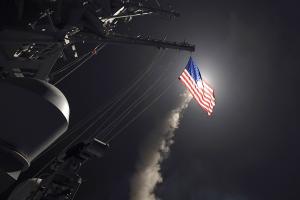
No, this US attack, reportedly involving 59 Tomahawk missiles being launched from ships in the eastern Mediterranean, was carried out with regime change in mind, setting a precedent that can only have serious ramifications for the entire region.

Regarding the attack in Idlib, what we can say with certainty is that a time when pro-government forces in Syria were in the ascendancy on the ground, and when the Syrian government was making significant progress on the diplomatic front, it would have constituted an act of ineffable self-harm to launch a chemical weapons attack of any kind, much less one of this magnitude. In fact it would have conformed to the actions of a government that was intent on bringing about its own demise. What also must be taken into consideration is the fact that the Organisation for the Prohibition of Chemical Weapons (OPCW), an organisation supported by the US, confirmed back in June 2014 that the process to destroy Syria’s entire stock of chemical weapons had been completed.

Moreover, the horrific images and eyewitness testimony that have emanated from Idlib in the wake of the attack have come from pro-opposition sources. No Western journalist or news crew would dare set foot in Idlib, or indeed any other part of opposition-held territory in Syria, knowing that as soon as they did they would be abducted and slaughtered.

Trump has proved with this unilateral military intervention that he can easily be dragged into conflict. Just a few days after his administration confirmed that regime change in Syria was off the table, that its focus was on defeating terrorism, he unleashes an airstrike that will only have emboldened the very forces of terrorism whose defeat he had stressed was the focus of his foreign policy previously.

So what now? Clearly, this military action places Russia in a very difficult position. Since joining the conflict in Syria at the end of September 2015, at the behest of the country’s government, Moscow had been working tirelessly to bring about a negotiated settlement, one involving opposition forces and parties deemed moderate relative to the Salafi-jihadi fanatics of ISIS and Nusra, etc. It is a diplomatic process that has just been dealt a shattering blow, with the opposition now undoubtedly convinced that regime change is in the offing via Washington and therefore encouraged to work towards this end.

Meanwhile, as for Washington’s regional allies – Israel, Saudi Arabia, Qatar, and Turkey (with Erdogan guaranteed to hitch his wagon to whoever appears to be in the driving seat) – they will most likely begin calling for more military action against Damascus now, viewing the US airstrike as the catalyst for open season on the country’s sovereignty.

As for Trump himself, having been under inordinate pressure since assuming office in January from the Washington media, political, and intelligence establishment, this action will earn him some much needed approval and, with it, respite. The signs with regard to his administration had been ominous for some time, starting with the forced resignation of Mike Flynn as his National Security Adviser in February, and continuing recent departure of Steve Bannon from the President’s National Security Council. It comes as further evidence that neocons have reasserted their dominance over the White House after a short and intense power struggle.

On a wider note, the lack of short-term memory in Washington is staggering to behold. Fourteen years after the disastrous US invasion of Iraq, which only succeeded in opening the gates of hell out of which ISIS and other Salfi-jihadi groups emerged, and six years after turning Libya into a failed state, in the process sparking a refugees crisis of biblical proportions, here we have yet another act of aggression against a sovereign state in the Middle East by the US.

Destroying countries in order to save them is the story of every empire there has been. But as history reveals, every empire carries within itself the seeds of its own destruction. Donald Trump is now on course to end up going down in history as a leader who rather than save the US from itself, may only have helped speed it down the path to its ultimate demise.

“Rome has grown since its humble beginning that it is now overwhelmed by its own greateness.” 

John Wight is the author of a politically incorrect and irreverent Hollywood memoir – Dreams That Die – published by Zero Books. He’s also written five novels, which are available as Kindle eBooks. You can follow him on Twitter at @JohnWight1

Syria: New U.S. Air Support On Request Scheme For Al-Qaeda

Source: Moon of Alabama

On this day one hundred years ago the U.S. joined World War I. Last night the U.S. attacked a Syrian government airport in an openly hostile and intentional manner. The strike established a mechanism by which al-Qaeda can “request” U.S. airstrikes on Syrian government targets. It severely damaged the main support base for Syria’s fight against the Islamic State in eastern Syria. The event will possibly lead to a much larger war.

On April 4 Syrian airplanes hit an al-Qaeda headquarter in Khan Sheikoun, Idleb governate. Idleb governate is under al-Qaeda control. After the air strike some chemical agent was released. The symptoms shown in videos from local aid stations point to a nerve-agent. The release probably killed between 50 and 90 people. It is unknown how the release happened.

It is unlikely that the Syrian government did this:

  • In 2013 the Syrian government had given up all its chemical weapons. UN inspectors verified this.
  • The target was militarily and strategically insignificant.
  • There was no immediate pressure on the Syrian military.
  • The international political atmosphere had recently turned positive for Syria.

Even if Syria had stashed away some last-resort weapon this would have been the totally wrong moment and totally wrong target for using it. Over the last six year of war the Syrian government army had followed a political and militarily logical path. It acted consistently. It did not act irrational. It is highly unlikely that it would have now take such an illogical step.

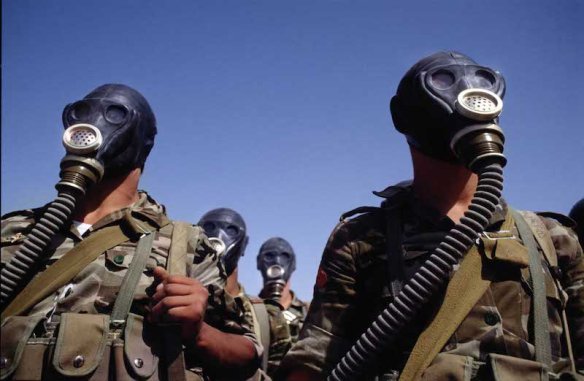
The chemical used, either Sarin or Soman, was not in a clean form. Multiple witnesses reported of a “rotten smell” and greenish color. While the color would point to a mixture with Chlorine the intense smell of Chlorine is easily identifiable, covers up most other odors and would have been recognized by witnesses. Both Sarin and Soman are in pure form colorless, tasteless and odorless. The Syrian government once produced nerve agents on a professional, large scale base. Amateurishly produced nerve-gases are not pure and can smell (example: Tokyo subway incident 1995). It is unlikely that the Syrian government experts would produce a “rotten smelling”, dirty, low quality stuff in an unprofessional and dangerous process.

The nerve agents in Khan Sheikoun, should they be confirmed, came either from stashed ammunition at the place attacked by the Syrian government or it was willfully released by the local ruling terrorist groups -al-Qaeda and Ahrar al-Sham- after the strike to implicate the Syrian government. The relatively low casualty numbers of mostly civilians point to the second variant.

Several reports over the years confirm that Al-Qaeda in Syria has the precursors and capabilities to produce and use Sarin as well as other chemical agents. This would not be their first use of such weapons. Al-Qaeda was under imminent pressure. It was losing the war. It is therefor highly likely that this was an intentional release by al-Qaeda to create public pressure on the Syrian government.

For a release incident of powerful chemical weapons the casualty numbers were low, lower than the casualty numbers of recent conventional U.S. air strikes in Syria and Iraq. Despite that fact a huge international media attack wave, seemingly prepared in advance, against the Syrian government was released. No evidence was presented that the incident was caused by the Syrian government. The only pictures and witness reports from the ground came from or through elements, like the White Helmets, who are known to by embedded with al-Qaeda and ISIS (video) and are acting as their propaganda arm.

Last night U.S. president Trump “responded” to the incident by ordering the launch of 59 cruise missiles on the Syrian military airport Al Syairat (vid). The cruise missiles were launched from sea in a volley designed to overwhelm air defenses. According to the Syrian and Russian military only 23 cruise missiles reached the airport. The others were shut down or failed. Six Syrian soldiers were Killed, nine civilians in a nearby village were killed or wounded and nine Syrian jets were destroyed. The airport infrastructure was severely damaged. The Syrian and Russian governments had been warned before the strikes hit and evacuated most men and critical equipment. (Was the warning part of a deal?) The air attack coincided with an Islamic State ground attack east of the airport.

The Pentagon alleges, without any evidence, that Sarin had been stored at the airport and a chemical attack launched from it. Both seems highly unlikely. The airport was accessible for UN inspectors. It is not as well covered by air defenses as other Syrian airports, for example in Latakia governate. Its ground approaches are not completely secured. Some medium range air defense system near al Syairat was recently used against Israeli planes attacking Syrian forces fighting ISIS near Palmyra.

Al Syairat lies in Homs governate, 150 km south of Khan Sheikoun in Idleb governate. It is the main support and supply airport for the besieged Syrian government enclave in Deir Ezzor which will now again be in even more serious trouble. It was also used to launch attacks on the Islamic State which fights the Syrian government troops in east Homs.

Al-Qaeda and its sidekick Ahra al-Sham welcomed the U.S. strikes and Abu Ivanka al Amriki on their side. The theocratic dictatorship of Saudi Arabia offered its full support as did its British creators.

The U.S. airstrike delivers a message to al-Qaeda. Whenever under military pressure al-Qaeda can now stage or fake a “chemical attack” and the U.S. will act to destroy its enemy, the Syrian government. Acts as the one last night are then direct military support by the U.S. on al-Qaeda’s request.

A similar scheme had earlier been established on the Golan heights. Al-Qaeda, fighting against Syrian government positions, would launch a mortar round that would land within Israeli controlled territory. Israel would then launch artillery strikes against Syrian government positions because “the Syrian government is responsible for what happens in the area”. Al-Qaeda then used the battle field advantage created by the Israeli strike. The scheme and the Israeli military “reasoning” was published several times in Israeli media:

A number of mortars have landed in Israeli territory as a result of spillover fighting over the last several years, raising fears among residents near the border.The IDF often responds to fire that crosses into Israel by striking Syrian army posts.

Israel maintains a policy of holding Damascus responsible for all fire from Syria into Israel regardless of the source of the fire.

The U.S. administration has now established a similar mechanism, on a larger scale, of direct military U.S. support for al-Qaeda and the Islamic State in Syria.

The Trump presidency had been held hostage by unfounded allegation of “Russian interference” in the U.S. elections in support of the Trump candidacy. The air strikes on Syria might have been the ransom that was demanded for the release of the hostage. His opponents are now gushing about him. The allegation of any Trump-Russia connections may now die down.

Yesterday major Democratic leaders in Congress supported strikes on Syria. Despite that they are also likely to attack Trump over them. The strikes are a “strong man” gamble. As Trump said when Obama ordered strikes such are a desperate move. Most parts of the State Department and the NSC were not consulted about them. The chances that these will “blow back” politically as well as strategically are high.

Trump is the third U.S. president in a row who promised less belligerence during his campaign only to deliver more after the election. The “democratic” veil of the U.S. oligarchic rule thus rips further apart.

Open U.S.-Russian cooperation in Syria will now cease. U.S. planes in Syrian airspace are from now on constantly under imminent danger. There will also be some larger revenge against the U.S. for last night’s strikes. Likely not in Syria but in Iraq, Afghanistan or at sea. A “message” will be send. The U.S. reaction to that “message” will be a decision over a much larger war.

Related Articles

US Missiles Strike Syrian Forces Fighting Al Qaeda

Syria’s alleged gas attack: An imperialist provocation

Putin believes US attack on Syria violates international law – spokesman

Top 10 Lies, Damn Lies, and Lies About Syria

Related Video:

Tulsi Gabbard vs. ‘Regime Change’ Wars

2

Rep. Tulsi Gabbard is a rare member of Congress willing to take heat for challenging U.S. “regime change” projects, in part, because as an Iraq War vet she saw the damage these schemes do, as retired Col. Ann Wright explains.

By Ann Wright

Source: Consortium News

I support Rep. Tulsi Gabbard, D-Hawaii, going to Syria and meeting with President Bashar al-Assad because the congresswoman is a brave person willing to take criticism for challenging U.S. policies that she believes are wrong.

It is important that we have representatives in our government who will go to countries where the United States is either killing citizens directly by U.S. intervention or indirectly by support of militia groups or by sanctions.

We need representatives to sift through what the U.S. government says and what the media reports to find out for themselves the truth, the shades of truth and the untruths.

We need representatives willing to take the heat from both their fellow members of Congress and from the media pundits who will not go to those areas and talk with those directly affected by U.S. actions. We need representatives who will be our eyes and ears to go to places where most citizens cannot go.

Tulsi Gabbard, an Iraq War veteran who has seen first-hand the chaos that can come from misguided “regime change” projects, is not the first international observer to come back with an assessment about the tragic effects of U.S. support for lethal “regime change” in Syria.

Nobel Peace Laureate Mairead Maguire began traveling to Syria three years ago and now having made three trips to Syria. She has come back hearing many of the same comments from Syrians that Rep. Gabbard heard — that U.S. support for “regime change” against the secular government of Syria is contributing to the deaths of hundreds of thousands of Syrians and – if the “regime change” succeeded – might result in the takeover by armed religious-driven fanatics who would slaughter many more Syrians and cause a mass migration of millions fleeing the carnage.

Since 2011, the Obama administration supported various rebel groups fighting for “regime change” in Syria while U.S. allies – Saudi Arabia, Qatar and Turkey – backed jihadist groups including Islamic State and Al Qaeda’s Syrian affiliate, some of the same extremists whom the U.S. military is fighting in Iraq and Afghanistan. If Assad were overthrown, these extremists might take power and create even worse conditions for Syrians.

This possibility of jihadists imposing perverted extremist religious views on the secular state of Syria remains high due to international meddling in the internal affairs of Syria. This “regime change” project also drew in Russia to provide air support for the Syrian military.

Critical of Obama’s ‘Regime Change’

During the Obama administration, Rep. Gabbard spoke critically of the U.S. propensity to attempt “regime change” in countries and thus provoking chaos and loss of civilian life.

On Dec. 8, 2016, she introduced a bill entitled the “Stop Arming Terrorists Act” which would prohibit the U.S. government from using U.S. funds to provide funding, weapons, training, and intelligence support to extremists groups, such as the ones fighting in Syria – or to countries that are providing direct or indirect support to those groups.

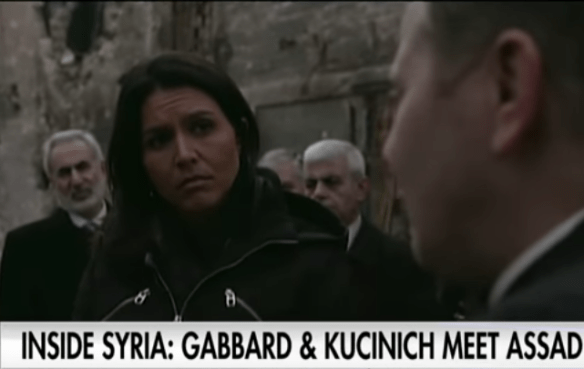
In the first days of the Trump administration, Rep. Gabbard traveled to Syria to see the effects of the attempted “regime change” and to offer a solution to reduce the deaths of civilians and the end of the war in Syria. A national organization Veterans For Peace, to which I belong, has endorsed her trip as a step toward resolution to the Syrian conflict.

Not surprisingly, back in Washington, Rep. Gabbard came under attack for the trip and for her meeting with President Assad, similar to criticism that I have faced because of visits that I have made to countries where the U.S. government did not want me to go — to Cuba, Iran, Gaza, Yemen, Pakistan, North Korea, Russia and back to Afghanistan, where I was assigned as a U.S. diplomat.

I served my country for 29 years in the U.S. Army/ Army Reserves and retired as a colonel. I also served 16 years in the U.S. diplomatic corps in U.S. Embassies in Nicaragua, Grenada, Somalia, Uzbekistan, Kyrgyzstan, Sierra Leone, Micronesia, Afghanistan and Mongolia. I resigned from the U.S. government nearly 14 years ago in March 2003 in opposition to President George W. Bush’s “regime change” war on Iraq.

In my travels since my resignation, I didn’t agree with many of the policies of the governments in power in those countries. But I wanted to see the effects of U.S. government policies and, in particular, the effects of attempts at “regime change.”

I wanted to talk with citizens and government officials about the effects of U.S. sanctions and whether the sanctions “worked” to lessen their support for the government that the U.S. was attempting to change or overthrow.

For making those trips, I have been criticized strongly. I have been called an apologist for the governments in power. Critics have said that my trips have given legitimacy to the abuses by those governments. And I have been called a traitor to the United States to dare question or challenge its policy of “regime change.”

But I am not an apologist, nor am I a traitor … nor is Congresswoman Tulsi Gabbard for her recent trip to Syria.


Ann Wright served 29 years in the US Army/Army Reserves and retired as a colonel. She also was a U.S. diplomat for 16 years and served in U.S. Embassies in Nicaragua, Grenada, Somalia, Uzbekistan, Kyrgyzstan, Sierra Leone, Micronesia, Afghanistan and Mongolia. She resigned in March 2003 in opposition to the war in Iraq. She has lived in Honolulu since 2003. [A version of this story originally appeared at

A Nonviolent Strategy to Liberate Syria

_74590478_00e0aa73-8303-4224-89de-0029b5e5eae1

Editor’s note: While we do not completely agree with the author’s analysis of factors leading to the strife in Syria, we share his desire for greater peace, freedom and stability in the region.

By Robert J. Burrowes

In early 2011, as the Arab Spring was moving across North Africa and the
Middle East, small groups of nonviolent activists in Syria, which has
been under martial law since 1963, started protesting against the brutal
dictatorship of Bashar al-Assad and demanding democratic reforms, the
release of political prisoners, an increase in freedoms, abolition of
the emergency law and an end to corruption.

By mid-March these protests, particularly in cities such as Damascus,
Aleppo and Daraa, had escalated and the ‘Day of Rage’ protest on 15
March 2011 is considered by many to mark the start of the nationwide
uprising against the Assad dictatorship. The dictatorship’s reaction to
the protests became violent on 16 March and on 18 March, after Friday
prayers, activists gathered at the al-Omari Mosque in Daraa were
attacked by security forces with water cannons and tear gas, followed by
live fire; four nonviolent activists were killed.

Within months, as the nonviolent protests expanded and spread, the
regime had killed hundreds of activists and arbitrarily arrested
thousands, subjecting many of them to brutal torture in detention. This
pattern has continued unchecked. For the earliest of a succession of
reports that document this regime violence against nonviolent activists,
see the Human Rights Watch report ‘”We’ve Never Seen Such Horror” Crimes
against Humanity by Syrian Security Forces‘.

For the most recent report, see the UN Human Rights Council report ‘Out
of Sight, Out of Mind: Deaths in Detention in the Syrian Arab Republic‘.

In recent commentaries on the war in Syria, both long-time solidarity
activist Terry Burke – see ‘U.S. Peace Activists Should Start Listening
to Progressive Syrian Voices
– and long-term Middle East scholar Professor Stephen Zunes have
encouraged the anti-war movement to listen to Syrian voices in framing
their response, particularly given the tendency within some sections of
it to support ‘the extraordinarily brutal Assad regime – a family
dictatorship rooted in the anti-leftist military wing of the Baath
Party’. See ‘Anti-war movement must listen to voices within Syria’s
civil war’.

One such Syrian voice is that of scholar and nonviolent activist
Professor Mohja Kahf. In her account of the Syrian uprising against the
Assad dictatorship – see ‘Then and Now: The Syrian Revolution to Date. A
young nonviolent resistance and the ensuing armed struggle
– Professor Kahf offers the following introductory paragraphs:

‘The Syrian uprising sprang from the country’s grassroots, especially
from youth in their teens, and adults in their twenties and thirties.
They, not seasoned oppositionists, began the uprising, and are its core
population. They share, rather than a particular ideology, a
generational experience of disenfranchisement and brutalization by a
corrupt, repressive, and massively armed ruling elite in Syria.

‘The uprising began nonviolently and the vast majority of its populace
maintained nonviolence as its path to pursue regime change and a
democratic Syria, until an armed flank emerged in August 2011.

‘The Syrian Revolution has morphed. From midsummer to autumn 2011, armed
resistance developed, political bodies formed to represent the
revolution outside Syria, and political Islamists of various sorts
entered the uprising scene. Since then, armed resistance has
overshadowed nonviolent resistance in Syria.

‘…political bodies and support groups for the revolution’s militarized
wing, have become venues for internal power struggles among opposition
factions and individuals, and entry-points for foreign powers attempting
to push their own agendas into a revolution sprung from Syrian
grievances, grown from the spilling of Syrian blood on Syrian soil.

‘Many in the global peace community can no longer discern the Syrian
uprising’s grassroots population through the smoke of armed conflict and
the troubling new actors on the scene. Further, some in the global left
or anti-imperialist camp understand the Syrian revolution only through
the endgame of geopolitics. In such a narrative, the uprising population
is nothing but the proxy of U.S. imperialism.

‘Such critics may acknowledge that the Assad regime is brutal, but
maintain from their armchairs that Syrians must bear this cost, because
this regime has its finger in the dike of U.S. imperialism, Zionism, and
Islamism. Or, perhaps they agree that a revolution against a brutal
dictator is not a bad idea, but wish for a nicer revolution, with better
players. Eyes riveted to their pencils and rulers and idées fixés, such
critics abandon a grassroots population of disenfranchised human beings
demanding basic human freedoms in Syria. This is a stunning and cruel
failure of vision.

‘The voices of the original grassroots revolution of Syria are
nonviolent, nonsectarian, noninterventionist, for the fall of the Assad
regime, and for the rise of a democratic, human rights upholding Syria
that is bound by the rule of law. They are still present in this
revolution. Who will hear them now, after so much dear blood has been
spilled, so much tender flesh crushed under blasted blocks of cement, so
much rightful anger unleashed?’

Other Syrian voices offer a similar account. See, for example, the
recent book by Robin Yassin-Kassab and Leila al-Shami titled ‘Burning
Country: Syrians in Revolution and War’
reviewed in ‘Book Review: Burning Country‘.

If Syrians and their solidarity allies are to develop and implement a
successful nonviolent grassroots strategy to end the war in/on Syria and
remove the Assad dictatorship, then we need a sound strategic framework
that guides the comprehensive planning of our strategy. Obviously, there
is no point designing a strategy that is incomplete or cannot be
successful.

A sound strategic framework simply enables us to think and plan
strategically so that once our strategy has been elaborated, it can be
widely shared and clearly understood by everyone involved. It also means
that nonviolent actions can then be implemented because they are known
to have strategic utility and that precise utility is understood in
advance. There is little point taking action at random, especially if
our opponent is powerful and committed (even if that ‘commitment’ is
insane, which is frequently the case).

There is a simple diagram presenting a 12-point strategic framework
illustrated here in the form of the ‘Nonviolent Strategy Wheel‘.

In order to think strategically about nonviolently resolving a violent
conflict, a clearly defined political purpose is needed; that is, a
simple summary statement of ‘what you want’. However, given the
complexity of the multifaceted conflict in the case of Syria, it is
strategically simpler to identify two political purposes. These might be
stated thus: 1. To end the war in/on Syria, and 2. To establish a
democratic form of government in Syria (which, obviously, requires
removal of the dictatorship).

Once the political purpose has been defined, the two strategic aims
(‘how you get what you want’) of the strategy acquire their meaning.
These two strategic aims (which are always the same whatever the
political purpose) are as follows: 1. To increase support for your
campaign by developing a network of groups who can assist you. 2. To
alter the will and undermine the power of those groups who support the
war/dictatorship.

While the two strategic aims are always the same, they are achieved via
a series of intermediate strategic goals which are always specific to
each struggle. To keep this article reasonably straightforward, I have
only identified a set of strategic goals that would be appropriate in
the context of ending the war in/on Syria below. For a basic set of
strategic goals appropriate for ending the dictatorship, see ‘Strategic
Aims‘.

Before listing the strategic goals for ending the war, I wish to
emphasize that I have only briefly discussed two aspects of a
comprehensive strategy to end the war in/on Syria: its political purpose
and its two strategic aims (with its many subsidiary strategic goals).
For the strategy to be effective, all twelve components of the strategic
framework should be planned (and then implemented). See Nonviolent
Defense/Liberation Strategy.
This will require, for example, that tactics that will achieve the
strategic goals must be carefully chosen and implemented bearing in mind
the vital distinction between the political objective and strategic goal
of any such tactic. See ‘The Political Objective and Strategic Goal of
Nonviolent Actions‘.

Strategic goals to end the war in/on Syria

I have outlined a basic list of strategic goals below although, it
should be noted, the list would be considerably longer as individual
organizations should be specified separately.

Many of these strategic goals would usually be tackled by action groups
working in solidarity with Syria campaigning within their own country.
Ideally they would be undertaken by activist groups with existing
expertise in the relevant area (for example, experience in campaigning
against a weapons corporation) but this is not essential.

Of course, individual activist groups would usually accept
responsibility for focusing their work on achieving just one or a few of
the strategic goals (which is why any single campaign within the overall
strategy is readily manageable).

It is the responsibility of the struggle’s strategic leadership to
ensure that each of the strategic goals, which should be identified and
prioritized according to their precise understanding of the
circumstances in Syria, (so, not necessarily precisely as identified
below) is being addressed (or to prioritize if resource limitations
require this).

So here is a set of strategic goals to end the war in/on Syria:

(1) To cause the women in [women’s organizations WO1, WO2, WO…] in Syria
to join the liberation strategy by participating in [your nominated
nonviolent action(s)/campaign(s) and/or constructive program
activities]. For example, simple nonviolent actions would be to wear a
national symbol (such as a badge of the Syrian revolutionary flag and/or
ribbons in the national colors) and/or to boycott all media outlets
supporting the war. For this item and many items hereafter, see the list
of possible actions that can be taken here: ‘198 Tactics of Nonviolent Action‘.

(2) To cause the workers in [trade unions T1, T2, T…] in Syria to join
the liberation strategy by participating in [your nominated nonviolent
action(s)/campaign(s) and/or constructive program activities]. For
example, this might include withdrawing their labor from occupations
that support the Syrian military forces.

(3) To cause young people in Syria to resist conscription into the
Syrian military forces.

(4) To cause young people in Syria to refuse recruitment into the Free
Syrian Army, al-Qaeda and its affiliates/allies, the Islamic State
(Daesh) and its allies.

(5) To cause the members of [religious denominations R1, R2, R…] in
Syria to join the liberation strategy by participating in [your
nominated nonviolent action(s)/campaign(s) and/or constructive program
activities].

(6) To cause the members of [ethnic communities EC1, EC2, EC…] in Syria
to join the liberation strategy by participating in [your nominated
nonviolent action(s)/campaign(s) and/or constructive program
activities].

(7) To cause the activists, artists, musicians, intellectuals and other
key social groups in [organizations O1, O2, O…] in Syria to join the
liberation strategy by participating in [your nominated nonviolent
action(s)/campaign(s) and/or constructive program activities].

(8) To cause the students in [student organizations S1, S2, S…] in Syria
to join the liberation strategy by participating in [your nominated
nonviolent action(s)/campaign(s) and/or constructive program
activities].

(9) To cause the soldiers in [military units M1, M2, M…] to refuse to
obey orders from the dictatorship to arrest, assault, torture and shoot
nonviolent activists and the other citizens of Syria.

(10) To cause the police in [police units P1, P2, P…] to refuse to obey
orders from the dictatorship to arrest, assault, torture and shoot
nonviolent activists and the other citizens of Syria.

(11) To cause young people in [the US, NATO countries, Russia and other
countries fighting in Syria] to refuse recruitment into their respective
military forces.

(12) To cause conscripts into the military forces of [NATO countries,
Russia and other countries fighting in Syria] that still use
conscription to conscientiously refuse to perform military duties.

(13) To cause military personnel in the military forces of [the US, NATO
countries, Russia and other countries fighting in Syria] to refuse
deployment to the war in/on Syria.

(14) To cause young people in [your country] to refuse recruitment into
the Free Syrian Army, al-Qaeda and its affiliates/allies, the Islamic
State (Daesh) and its allies.

(15) To cause former soldiers in [your country] to refuse recruitment as
mercenaries by corporations that supply ‘military contractors’ to fight
in Syria.

(16) To cause the activists in [peace groups P1, P2, P…] in [your
town/city/country] to resist the war on Syria by encouraging their
members to boycott [all/specified nonmilitary products] of [weapons
corporations W1, W2, W…]. For example, this might include boycotting all
commercial flights that use Boeing and Airbus passenger aircraft given
the heavy involvement of these corporations in the production of
military aircraft.

(17) To cause the activists in [environment groups E1, E2, E…] in [your
town/city/country] to resist the war on Syria by encouraging their
members to boycott [all/specified nonmilitary products] of [weapons
corporations W1, W2, W…]. For example, this might including boycotting
all commercial products of General Electric given the heavy involvement
of this corporation in the production of military engines, systems and
services.

(18) To cause the workers in [trade unions or labor organizations T1,
T2, T….] in [your town/city/country] to resist the war on Syria by
encouraging their members to boycott [all/specified nonmilitary
products] of [weapons corporations W1, W2, W…].

(19) To cause the women in [women’s organizations WO1, WO2, WO…] in
[your town/city/country] to resist the war on Syria by encouraging their
members to boycott [all/specified nonmilitary products] of [weapons
corporations W1, W2, W…].

(20) To cause the members of [religious denominations R1, R2, R…] in
[your town/city/country] to resist the war on Syria by encouraging their
members to boycott [all/specified nonmilitary products] of [weapons
corporations W1, W2, W…].

(21) To cause the members of [ethnic communities EC4, EC5, EC…] in [your
town/city/country] to resist the war on Syria by encouraging their
members to boycott [all/specified nonmilitary products] of [weapons
corporations W1, W2, W…].

(22) To cause the artists, musicians, intellectuals and other key social
groups in [organizations O4, O5, O…] in [your town/city/country] to
resist the war on Syria by encouraging their members to boycott
[all/specified nonmilitary products] of [weapons corporations W1, W2,
W…].

(23) To cause the students in [student organizations S1, S2, S…] in
[your town/city/country] to resist the war on Syria by encouraging their
members to boycott [all/specified nonmilitary products] of [weapons
corporations W1, W2, W…].

(24) To cause the consumers in [your town/city/country] to resist the
war on Syria by boycotting [all/specified nonmilitary products] of
[weapons corporations W1, W2, W…].

(25) To cause more individuals in [your town/city/country] to resist the
war on Syria by conscientiously resisting paying [part/all] of their
taxes for war.

(26) To cause more organizations in [your town/city/country] to resist
the war on Syria by conscientiously resisting paying [part/all] of their
taxes for war.

(27) To cause [weapons corporations W4, W5, W…] to convert from the
manufacture of military weapons to [the specified/negotiated
socially/environmentally beneficial products].

(28) To cause [banks B1, B2, B…] to cease financing the weapons
industry.

(29) To cause bank customers to shift their deposits to ethical banks
and credit unions that do not finance (or are otherwise involved in) the
weapons industry.

(30) To cause [religious organizations R4, R5, R…] to divest from the
weapons industry.

(31) To cause [superannuation funds S1, S2, S…] to divest from the
weapons industry.

(32) To cause superannuation fund customers to shift their money to
ethical funds that do not finance (or are otherwise involved in) the
weapons industry.

(33) To cause [insurance companies I1, I2, I…] to divest from the
weapons industry.

(34) To cause insurance customers to shift their policies to ethical
insurance companies that do not finance (or are otherwise involved in)
the weapons industry.

(35) To cause [corporations C1, C2, C…] that provide
[services/components] for [weapons corporations W1, W2, W…] to cease
doing so.

(36) To cause the workers in [trade unions or labor organizations T4,
T5, T…] to withdraw their labor from [weapons corporations W1, W2, W…]
[partially/wholly], [temporarily/permanently].

(37) To cause the workers in [trade unions or labor organizations T7,
T8, T…] to withdraw their labor from [corporations C1, C2, C…]
[partially/wholly], [temporarily/permanently].

(38) To cause [corporations C4, C5, C…] that provides
[services/supplies] to [military bases MB1, MB2, MB…] to cease doing so.

(39) To cause the workers in [trade unions or labor organizations T10,
T11, T…] who work in/supply [military bases MB1, MB2, MB…] to withdraw
their labor [partially/wholly], [temporarily/permanently].

(40) To cause the workers in [trade unions or labor organizations T13,
T14, T…] to withdraw their labor from [corporations C4, C5, C…]
[partially/wholly], [temporarily/permanently].

(41) To cause [corporations C7, C8, C…] that manufacture and supply spy
satellites for military purposes to cease doing so.

(42) To cause the workers in [trade unions or labor organizations T16,
T17, T…] to withdraw their labor from [corporations C7, C8, C…]
[partially/wholly], [temporarily/permanently].

(43) To cause [corporations C10, C11, C…] that provide
[services/components] for the militarization of space to cease doing so.

(44) To cause the workers in [trade unions or labor organizations T19,
T20, T…] to withdraw their labor from [corporations C10, C11, C…]
[partially/wholly], [temporarily/permanently].

(45) To cause [corporations C13, C14, C…] that provide private military
contractors (mercenaries) to fight in wars to cease doing so.

(46) To cause the private military contractors (mercenaries) who fight
in wars to withdraw their labor from [corporations C13, C14, C…].

(47) To cause the soldiers in [military units M1, M2, M…] in [your
town/city/country] to refuse to obey orders to [arrest, assault, torture
and shoot, depending on your local circumstances] nonviolent activists
campaigning against the war.

(48) To cause the police in [police units P1, P2, P…] in [your
town/city/country] to refuse to obey orders to [arrest, assault, torture
and shoot, depending on your local circumstances] nonviolent activists
campaigning against the war.

(49) To cause individual members of the military forces at [Military
Base MB1/Drone Base DB1/Navy Ship NS1/Air Force Base AFB1/Army unit
AU1/Marines unit MU1] in [your town/city/country] to resign.

(50) To cause individual members of those corporations that
employ/supply private military contractors (mercenaries) to resign.

As you can see, the two strategic aims are achieved via a series of
intermediate strategic goals.

Not all of the strategic goals will need to be achieved for the strategy
to be successful but each goal is focused in such a way that its
achievement functionally undermines the power of those conducting the
war.

The difference between success and failure in any struggle is the
soundness of the strategy.


Biodata: Robert J. Burrowes has a lifetime commitment to understanding and ending human violence. He has done extensive research since 1966 in an effort to understand why human beings are violent and has been a nonviolent activist since 1981. He is the author of ‘Why Violence?‘ His email address is flametree@riseup.netand his website is at http://robertjburrowes.wordpress.com

Robert J. Burrowes
P.O. Box 68
Daylesford
Victoria 3460
Australia
Email: flametree@riseup.net

Websites:
Nonviolence Charter
Flame Tree Project to Save Life on Earth
‘Why Violence?’
Nonviolent Campaign Strategy
Nonviolent Defense/Liberation Strategy
Anita: Songs of Nonviolence
Robert Burrowes
Global Nonviolence Network