
Putting an End to the Rent Economy

By Michael Hudson and Vlado Plaga

Source: Unz Review

Interview with Vlado Plaga in the German magazine FAIRCONOMY, September 2017.

Originally, you didn’t want to become an economist. How did it come that you changed your plans and digged so deep into economics?

I found economics aesthetic, as beautiful as astronomy. I came to New York expecting to become an orchestra conductor, but I met one of the leading Wall Street economists, who convinced me that economics and finance was beautiful.

I was intrigued by the concept of compound interest and by the autumnal drain of money from the banking system to move the crops at harvest time. That is when most crashes occurred. The flow of funds was the key.

I saw that these economic cycles were mainly financial: the build-up of debt and its cancellation or wipe-out and bankruptcy occurring again and again throughout history. I wanted to study the rise and fall of financial economies.

But when you studied at the New York University you were not taught the things that really interested you, were you?

I got a PhD as a union card. In order to work on Wall Street, I needed a PhD. But what I found in the textbooks was the opposite of everything that I experienced on Wall Street in the real world. Academic textbooks describe a parallel universe. When I tried to be helpful and pointed out to my professors that the textbooks had little to do with how the economy and Wall Street actually work, that did not help me get good grades. I think I got a C+ in money and banking.

So I scraped by, got a PhD and lived happily ever after in the real world.

So you had to find out on your own… Your first job was at the Savings Banks Trust Company, a trust established by the 127 savings banks that still existed in New York in the 1960s. And you somehow hit the bull’s eye and were set on the right track, right from the start: you’ve been exploring the relationship between money and land. You had an interesting job there. What was it?

Savings banks were much like Germany’s Landesbanks. They take local deposits and lend them out to home buyers. Savings and Loan Associations (S&Ls) did the same thing. They were restricted to lending to real estate, not personal loans or for corporate business loans. (Today, they have all been turned into commercial banks.)

I noticed two dynamics. One is that savings grew exponentially, almost entirely by depositors getting dividends every 3 months. So every three months I found a sudden jump in savings. This savings growth consisted mainly of the interest that accrued. So there was an exponential growth of savings simply by inertia.

The second dynamic was that all this exponential growth in savings was recycled into the real estate market. What has pushed up housing prices in the US is the availability of mortgage credit. In charting the growth of mortgage lending and savings in New York State, I found a recycling of savings into mortgages. That meant an exponential growth in savings to lend to buyers of real estate. So the cause of rising real estate prices wasn’t population or infrastructure. It was simply that properties are worth whatever banks are able and willing to lend against them.

As the banks have more and more money, they have lowered their lending standards.

It’s kind of automatic, it’s just a mathematical law…

Yes, a mathematical law that is independent of the economy. In other words, savings grow whether or not the economy is growing. The interest paid to bondholders, savers and other creditors continues to accrue. That turns out to be the key to understanding why today’s economy is polarizing between creditors and debtors.

You wrote in “Killing the Host” that your graphs looked like Hokusai’s “Great Wave off Konagawa” or even more like a cardiogram. Why?

Any rate of interest has a doubling time. One way or another any interest-bearing debt grows and grows. It usually grows whenever interest is paid. That’s why it looks like a cardiogram: Every three months there’s a jump. So it’s like the Hokusai wave with a zigzag to reflect the timing of interest payments every three months.

The exponential growth of finance capital and interest-bearing debt grows much faster then the rest oft he economy, which tends to taper off in an S-curve. That’s what causes the business cycle to turn down. It’s not really a cycle, it’s more like a slow buildup like a wave and then a sudden vertical crash downward.

This has been going on for a century. Repeated financial waves build up until the economy becomes so top-heavy with debt that it crashes. A crash used to occur every 11 years in the 19th century. But in the United States from 1945 to 2008, the exponential upswing was kept artificially long by creating more and more debt financing. So the crash was postponed until 2008.

Most crashes since the 19th century had a silver lining: They wiped out the bad debts. But this time the debts were left in place, leading to a massive wave of foreclosures. We are now suffering from debt deflation. Instead of a recovery, there’s just a flat line for 99% of the economy.

The only layer of the economy that is growing is the wealthiest 5% layer – mainly the Finance, Insurance and Real Estate (FIRE) sector. That is, creditors living of interest and economic rent: monopoly rent, land rent and financial interest. The rest of the economy is slowly but steadily shrinking.

And the compound interest that was accumulated was issued by the banks as new mortgages. Isn’t this only logical for the banks to do?

Savings banks and S&Ls were only allowed to lend for mortgages. Commercial banks now look for the largest parts of the economy as their customers. Despite the fact that most economic textbooks describe industry and manufacturing as being the main part of economy, real estate actually is the largest sector. So most bank lending is against real estate and, after that, oil, gas and mining.

That explains why the banking and financial interests have become the main lobbyists urging that real estate, mining and oil and gas be untaxed – so that there’ll be more economic rent left to pay the banks. Most land rent and natural resource rent is paid out as interest to the banks instead of as taxes to the government.

So instead of housing becoming cheaper and cheaper it turns out to be much less affordable in our days than in the 1960s?

Credit creation has inflated asset prices. The resulting asset-price inflation is the distinguishing financial feature of our time. In a race tot he bottom, banks have steadily lowered the terms on which they make loans. This has made the economy more risky.

In the 1960s, banks required a 25-30% down payment by the buyer, and limited the burden of mortgage debt service to only 25% of the borrower’s income. But interest is now federally guaranteed up to 43% of the home buyer’s income. And by 2008, banks were making loans no down payment at all. Finally, loans in the 1960s were self-amortizing over 30 years. Today we have interest-only loans that are never paid off.

So banks loan much more of the property’s market price. That is why most of the rental value of land isn’t paid to the homeowner or commercial landlord any more. It’s paid to the banks as interest.

Was this the reason for the savings and loan crisis that hit the US in 1986 and that was responsible for the failure of 1,043 out of the 3,234 savings and loan associations in the United States from 1986 to 1995?

The problem with the savings and loan crisis was mainly fraud! The large California S&L’s were run by crooks, topped by Charles Keating. Many were prosecuted for fraud and sent to jail. By the 1980s the financial sector as a whole had become basically a criminalized sector. My colleague Bill Black has documented most of that. He was a prosecutor of the S&L frauds in the 1980s, and wrote a book “The best way to rob a bank is to own one”.

That’s a famous quotation, I also heard that.

Fraud was the main financial problem, and remains so.

Since 2007 Americans were strangled by their mortgages in the sub-prime crisis…

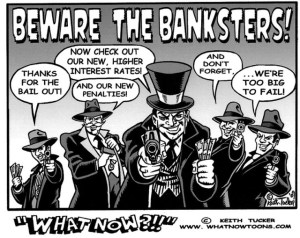
These were essentially junk mortgages, and once again it was fraud. Already in 2004 the FBI said that the American economy was suffering the worst wave of bank fraud in history. Yet there was no prosecution. Essentially in the United States today, financial fraud is de-criminalized. No banker has been sent to jail, despite banks paying hundreds of billions of dollars of fines for financial fraud. These fines are a small portion of what they took illegally. Such payments are merely a cost of doing business. The English language was expanded to recognize junk loans. Before the financial crash the popular press was using the word “junk mortgages” and “Ninjas”: “No Income, No Jobs, no Assets”. So everybody knew that there was fraud, and the bankers knew they would not go to jail, because Wall Street had become the main campaign contributor to the leading politicians, especially in the Democratic party. The Obama Administration came in basically as representatives of the bank fraudsters. And the fraud continues today. The crooks have taken over the banking system. It is hard for Europeans to realize that that this really has happened in America. The banks have turned into gangsters, which is why already in the 1930s President Roosevelt coined the word “banksters”.

I also heard the nice English sayings “Too big to fail” or “Too big to jail”…
But what has become of those 10 million households that ended up losing their homes to foreclosure? How are their economic and living conditions today? What has become of their houses? The economy has recovered…

Most of the houses that were foreclosed on have been bought out by hedge funds for all cash. In the wake of 2008, by 2009 and 2010 hedge funds were saying “If you have $5,000,000 to invest, we’re going to buy these houses that are being sold at distress prices. We’re going to buy foreclosed properties for all cash, because we can make a larger rate of return simply by renting them out.” So there has been a transfer of property from homeowners to the financial sector. The rate of home-ownership in America is dropping.

The economy itself has not recovered. All economic growth since 2008 has accrued only to the top 5% of the economy. 95% of the economy has been shrinking by about 3% per year… and continues to shrink, because the debts were kept in place. President Obama saved the banks and Wall Street instead of saving the economy.

That’s why we live in an “age of deception” as the sub-title of your latest book suggests, I guess?

“People have the idea that when house prices go up, somehow everybody’s getting richer. And it’s true that the entry to the middle class for the last hundred years has been to be able to own your own home…”

What is deceptive is the fact that attention is distracted away from how the real world works, and how unfair it is. Economics textbooks teach that the economy is in equilibrium and is balanced. But every economy in the world is polarizing between creditors and debtors. Wealth is being sucked up to the top of the economic pyramid mainly by bondholders and bankers. The textbooks act as if the economy operates on barter. Nobel prices for Paul Samuelson and his followers treat the economy as what they call the “real economy,” which is a fictitious economy that in theory would work without money or debt. But that isn’t the real economy at all. It is a parallel universe. So the textbooks talk about a parallel universe that might exist logically, but has very little to do with how the real economy works in today’s world.

If you had a picture you’d see me nodding all the time, because that’s what I also found out: if you look at the mathematics, it is polarizing all the time, it is de-stabilizing. Without government interference we’d have crash after crash… It is not under control anymore.

But you also suggest that there’s another factor that makes housing prices go up – and that’s property tax cuts. Why?

“Taxes were shifted off the Donald Trumps of the world and onto homeowners….”

Whatever the tax collector relinquishes leaves more rental income available to be paid to the banks. Commercial real estate investors have a motto: “Rent is for paying interest.” When buyers bid for an office building or a house, the buyer who wins is the one who is able to get the largest bank loan. And that person is the one who pays all the rent to the bank. The reason why commercial investors were willing to do this for so many decades is that they wanted to get the capital gain – which really was the inflation of real estate prices as a result of easier credit. But now that the economy is “loan up,” prospects for further capital gains are gone. So the prices are not rising much anymore. There is no reason to be borrowing. So the system is imploding.

So, how could we change the situation and make land a public utility?

There are two ways to do this. One way is to fully tax the land’s rental value. Public investment in infrastructure – roads, schools, parks, water and sewer systems – make a location more desirable. A subway line, like the Jubilee tube line in London, increases real estate prices all along the line. The resulting rise in rents increases prices for housing. This rental value could be taxed back by the community to pay for this infrastructure. Roads and subways, water and sewer systems could be financed by re-capturing the rental value of the land that this public investment creates. But that is not done. A free lunch is left in private hands.

The alternative is direct public ownership of the land, which would be leased out to whatever is deemed to be most socially desirable, keeping down the rental cost. In New York City, for instance, restaurants and small businesses are being forced out. They’re closing down because of the rising rents. The character of the economy is changing. It is getting rid of the bookstores, restaurants and low-profit enterprises. Either there should be a land tax, or public ownership of the land. Those are the alternatives. If you tax away the land’s rent, it would not be available to be paid to the banks. You could afford to cut taxes on labor. You could cut the income tax, and you could cut taxes on consumption. That would reduce the cost of living.

To me that’s pretty close to the position of Georgists on how to handle land, isn’t it?

I don’t like to mention Henry George, because he didn’t have a theory of land rent or of the role of the financial sector and debt creation. The idea of land tax came originally from the Physiocrats in France, François Quesnay, and then from Adam Smith, John Stuart Mill, and in America from Thorstein Veblen and Simon Patten. All of these economists clarified the analysis of land rent, who ended up with it, and how it should be taxed. In order to have a theory of how much land rent there is to tax, you need a value and price theory. Henry George’s value theory was quite confused. Worst of all, he spent the last two decades of his life fighting against socialists and labor reformers. He was an irascible journalist, not an economist.

The classical economists wrote everything you need to know about land rent and tax policy. That was the emphasis of Adam Smith, John Stuart Mill… all the classical economists. The purpose of their value and price theory was to isolate that part of the economy’s income that was unearned: economic rent, land rent, monopoly rent, and financial interest. I think it is necessary to put the discussion of tax policy and rent policy back in this classical economic context. Henry George was not part of that. He was simply a right-wing journalist whom libertarians use to promote neoliberal Thatcherite deregulation and anti-government ideology. In Germany, his followers were among the first to support the Nazi Party already in the early 1920s, for instance, Adolf Damaschke. Anti-Semitism also marked George’s leading American followers in the 1930s and ‚40s.

So I guess I have to go back a bit further in history, to read the original Physiocrats as well…

John Stuart Mill is good, Simon Patten is good, Thorstein Veblen is wonderful. Veblen was writing about the financialization of real estate in the 1920s in his Absentee Ownership. I recently edited a volume on him: Absentee Ownership and its Discontents (ISLET, Dresden, 2016).

Germany’s land tax reform seems to go in the wrong direction. Germany has to establish new rules for it’s “Grundsteuer” that in fact is a mingled tax on land and the buildings standing on it, based on outdated rateable values of 1964 (in the West) and 1935 (in the East). The current reform proposals of the federal states will maintain this improper mingling and intend a revenue neutral reform of this already very low tax. It brings about 11 billion Euro to the municipal authorities, but this is only 2% of the total German tax revenue, whereas wage tax and sales tax make up for 25% each. We need a complete tax shift, don’t we?

Germany is indeed suffering from rising housing prices. I think there are a number of reasons for this. One is that Germans have not had a real estate bubble like what occurred in the US or England. They did lose money in the stock market, and many decided simply to put their money in their own property. There is also a lot of foreign money coming into Germany to buy property, especially in Berlin.

The only way to keep housing prices down is to tax away the rise in the land value. If this is done, speculators are not going to buy. Only homeowners or commercial users will buy for themselves. You don’t want speculators or bank credit to push up prices. If Germany lets its housing prices rise, it is going to price its labor out of the market. It would lose its competitive advantage, because the largest expense in every wage-earner’s budget is the cost of housing. In Ricardo’s era it was food; today it is housing. So Germany should focus on how to keep its housing prices low.

I’d like to come back to the issue of interest once more. The English title of “Der Sektor” is “Killing the host – How Financial Parasites and Debt Bondage Destroy the Global Economy”. It’s much more coming to the point. It struck me that you mention John Brown. He wrote a book called “Parasitic wealth or Money Reform” in 1898. I came across his book some years ago and thought that he was somehow America’s Helmut Creutz of the 19th century. He was a supporter of Henry George, but in addition John Brown analyzed and criticized the interest money system and its redistribution of wealth. He said that labour is robbed of 33% of its earnings by the parasitic wealth with subtle and insidious methods, so that it’s not even suspected. Why does almost nobody know this John Brown?

John Brown’s book is interesting. It is somewhat like that of his contemporary Michael Flürscheim. Brown’s book was published by Charles Kerr, a Chicago cooperative that also published Marx’s Capital. So Brown was a part of the group of American reformers who became increasingly became Marxist in the 19th and early 20thcentury. Most of the books published by Kerr discussed finance and the exponential growth of debt.

The economist who wrote most clearly about how debt grew by its own mathematics was Marx in Vol. III of Capital and his Theories of Surplus Value . Most of these monetary writers were associated with Marxists and focused on the tendency of debt and finance to grow exponentially by purely mathematical laws, independently of the economy, not simply as a by-product of the economy as mainstream economics pretends.

So you recommend reading his book?

Sure, it is a good book, although only on one topic. Also good is Michael Flürscheim’s Clue to the Economic Labyrinth (1902). So is Vol. III of Capital.

Brown’s plan of reforms included the nationalization of banks and the establishment of a bank service charge in lieu of interest. The latter sounds remarkably up-to-date. In Germany the banks are raising charges because of the decrease in their interest margins. How is your view on the matter of declining interest rates?

Well, today declining interest rates are the aim of central bank Quantitative Easing. It hasn’t helped. The most important question to ask is: what are you going to make your loans for? Most lending at these declining interest rates has been parasitic and predatory. There’s a lot of corporate take-over lending to companies that borrow to buy other companies. There is an enormous amount of stock market credit that has helped bid up stock prices with low-interest credit and arbitrage. This has inflated asset prices for stocks, bonds and real estate. If the result of low interest rates is simply to inflate asset prices, the only way this can work is to have a heavy tax on capital gains, that is asset price gains. But in the US, England, and other countries there are very low taxes on capital gains, and so low interest rates simply make housing more expensive, and make stocks and buying a flow retirement income (in the form of stocks or bonds that yield dividends and interest) much more expensive.

I guess Brown is getting to the positive aspects of low interest also.

What Brown was talking about were the problems of finance. In the final analysis there is only one ultimate solution: to write down the debts. Nobody really wants to talk about debt cancellation, because they try to find a way to save the system. But it can’t be fixed so that debts can keep growing at compound rates ad infinitum. Any financial system tends to end in a crash. So the key question is how a society is NOT going not to pay debts that go bad. Will it let creditors foreclose, as has occurred in the US? Or are you going to write down the debts and wipe out this overgrowth of creditor claims? That’s the ultimate policy that every society has to face.

Very topical, the German Bundesbank sees the combination of low interest rates and a booming housing market as a dangerous cocktail for the banking sector. “The traffic lights have jumped to yellow or even to dark yellow”, Andreas Dombret said, after the Bundesbank had denied the problem in the last years by dismissing it as Germany’s legitimate catch-up effects. The residential property prices have gone up by 30% since 2010, in the major cities even by more than 60%. The share of real estate loans in the total credit portfolio is significantly rising. The mortgage loans of the households have increased in absolute terms as well as relative to their income. It’s only due to the low interest rates that the debt service has not increased yet. But the banks and savings companies are taking on the risk: the mortgages with terms of more than ten years have risen to more than 40% of the residential real estate loans. The interest-change risks lie with the banks. Don’t we have to face up to the truth that interest rates shouldn’t go up again?

What should be raised are taxes on the land, natural resource rent and monopoly rent. The aim should be to keep housing prices low instead of speculation. Land rent should serve as the tax base, as the classical economists said it should. Adam Smith, John Stuart Mill… all urged that the basis of the tax system should be real-estate and natural resource rent, not income taxes (which add to the cost of labor), the cost of labor and not value-added taxes (which increase consumer prices). So tax policy and debt write-downs today are basically the key to economic survival.

Banking should be a public utility. If you leave banking in the present hands, you’re leaving it in the hands of the kind of crooks that brought about the financial crisis of 2008.

Couldn’t the subprime-crisis have been prevented if the Fed had introduced negative interest rates in the 1990s?

No. The reason there was the crash was fraud and speculation. It was junk mortgages and the financialization of the economy. Pension funds and people’s savings were turned over to the financial sector, whose policy is short-term. It seeks gains mainly by speculation and asset price inflation. So the problem is the financial system. I think the Boeckler foundation has annual meetings in Berlin that focus on financialization and explain what the problem is.

Yes, that’s a big topic. The financial sector is interested, as you said, in short-term gains, but people who want to save for their retirement are interested in long-term stability – that is contradictory. Do you know the “Natural Economic Order by Free Land and Free Money” by Silvio Gesell?

It is not practical for today’s world, it is very abstract. The solution to the financial problem really has to be ultimately a debt write-down, and a shift to the tax system, as the classical economists talked about.

Gesell was also advocating the taxing of land. I think he had something in mind with bidding for the land, letting the market fix the prices.

He did not go beneath the surface to ask what kind of market do you want. Today, the market for real estate is a financialized market. As I said, the basic principle is that most rent is paid out as interest. The value of real estate is whatever a bank will lend against it. Unless you have a theory of finance and the overall economy, you really don’t have a theory of the market.

You are advocating a revival of classical economics. What did the classical economists understand by a free economy?

They all defined a free economy as one that is free from land rent, free from unearned income. Many also said that a free economy had to be free from private banking. They advocated full taxation of economic rent. Today’s idea of free market economics is the diametric opposite. In an Orwellian doublethink language, a free market now means an economy free for rent extractors, free for predators to make money, and essentially free for financial and corporate crime. The Obama Administration de-criminalized fraud. This has attracted the biggest criminals – and the wealthiest families – to the banking sector, because that’s where the money is. Crooks want to rob banks, and the best way to rob a bank is to own one. So criminals become bankers. You can look at Iceland, at HSBC, or at Citibank and Wells-Fargo in the news today. Their repeated lawbreaking and criminal activities have been shown to be endemic in the US. But nobody goes to jail. You can steal as much money as you want, and you’ll never go to jail if you’re a banker and pay off the political parties with campaign contribution. It’s much like drug dealers paying off crooked police forces. So crime is pouring into the financial system.

I think this is what’s going to cause a return to classical economics – the realization that you need government banks. Of course, government banks also can be corrupted, so you need some kind of checks and balances. What you need is an honest legal system. If you don’t have a legal system that throws crooks in jail, your economy is going to be transformed into something unpleasant. That’s what is happening today. I think that most Europeans don’t want to acknowledge that that’s what happened in America (USA). There is such an admiration of America that there is a hesitancy to see that it has been taken over by financial predators (a.k.a. “the market”).

We always hear that oligarchies are in the east, in Russia, but hardly anyone is calling America an oligarchy… although alternative media says that it’s just a few families that rule the country.

Yes.


Michael Hudson is the author of Killing the Host (published in e-format by CounterPunch Books and in print by Islet). His new book is J is For Junk Economics. He can be reached at mh@michael-hudson.com

 

What Happened to All Those Foreclosed Houses?

Wall Street bought them — and is now leasing them out and driving up rents.

By Jim Hightower

Source: OpEdNews.com

We know that millions of American families lost their homes after Wall Street’s 2007 financial crash. But where did all those houses go?

It turns out that Wall Streeters themselves formed profiteering investment groups that rushed out to scoop up tens of thousands of those foreclosed properties, usually grabbing them on the cheap at courthouse auctions in suburban metro areas that were hard-hit by the crash.

These moneyed syndicates have deep, deep pockets, so they easily outbid local buyers to take possession of the majority of the single-family homes being sold off in many distressed places.

Why are they buying? To turn the homes into rental properties and become the dominant suburban landlord, controlling the local market and constantly jacking up rents.

For example, the Wall Street Journal found that in Nashville’s suburb of Spring Hill, just four of these predatory giants own 700 houses — giving this oligopoly of absentee investors ownership of three-fourths of all rental houses in town.

One of these bulk buyers is an arm of Blackstone, the world’s largest private equity firm. Another is an equity outfit that was spun out of the housing speculation department of Goldman Sachs. And still another is a billionaire whose investors include the Alaska state oil fund.

Not only do rents jump dramatically when such outfits seize a market, but Wall Street’s intention is to impose “a new way” on housing America: They’re pushing a cultural shift in which homeownership is no longer part of the American Dream, and tenants are taught to accept annual rent increases as the price of having a home.

So the banksters crash the economy, you lose income and your home, they buy your house at auction, then they rent it to you at an ever-increasing price. The “new way” is the same old story: The rich robbing the rest of us.


Bank Crimes Pay: Under the Thumb of the Global Financial Mafiocracy

banksters-too-big-to-fail-640x509

By Andrew Gavin Marshall

Source: Occupy.com

On Nov. 13, the United Kingdom’s Serious Fraud Office (SFO) announced it was charging 10 individual bankers, working for two separate banks, Deutsche Bank and Barclays, with fraud over their rigging of the Euribor rates. The latest announcement shines the spotlight once again on the scandals and criminal behavior that have come to define the world of global banking.

To date, only a handful of the world’s largest banks have been repeatedly investigated, charged, fined or settled in relation to a succession of large financial scams, starting with mortgage fraud and the Libor scandal in 2012, the Euribor scandal and the Forex (foreign exchange) rate rigging. At the heart of these scandals, which involve the manipulation of interest rates on trillions of dollars in transactions, lie a handful of banks that collectively form a cartel in control of global financial markets – and the source of worldwide economic and financial crises.

Banks such as HSBC, JPMorgan Chase, Barclays, Bank of America, Citigroup, Deutsche Bank, Royal Bank of Scotland and UBS anchor the global financial power we have come to recognize as fraud. The two, after all, are not mutually exclusive. In more explicit terms, this cartel of banks functions as a type of global financial Mafia, manipulating markets and defrauding investors, consumers and countries while demanding their pound of flesh in the form of interest payments. The banks force nations to impose austerity measures and structural reforms under the threat of cutting off funding; meanwhile they launder drug money for other cartels and organized crime syndicates.

Call them the global Mafiocracy.

In May, six major global banks were fined nearly $6 billion for manipulation of the foreign exchange market, which handles over $5 trillion in daily transactions. Four of the six banks pleaded guilty to charges of “conspiring to manipulate the price of U.S. dollars and euros exchanged.” Those banks were Citigroup, JPMorgan Chase, Barclays and Royal Bank of Scotland, while two additional banks, UBS and Bank of America, were fined but did not plead guilty to the specific charges. Forex traders at Citigroup, JPMorgan Chase and other banks conspired to manipulate currency prices through chat room groups they established, where they arrogantly used names like “The Mafia” and “The Cartel.”

The FBI said the investigations and charges against the big banks revealed criminal behavior “on a massive scale.” The British bank Barclays paid the largest individual fine at around $2.3 billion. But as one trader at the bank wrote in a chat room conversation back in 2010, “If you aint cheating, you aint trying.” The total fines, while numerically large, were but a small fraction of the overall market capitalization of each bank – though the fine on Barclays amounted to some 3.4% of the bank’s market capitalization, the highest percentage by far among the group.

Despite the criminal conspiracy charges covering the years 2007 through 2013, the banks and their top officials continue to lay the blame squarely at the feet of individual traders. Axel Weber, the former president of the German Bundesbank (the central bank of Germany), who is now chairman of Switzerland’s largest bank, UBS, commented that “the conduct of a small number of employees was unacceptable and we have taken appropriate disciplinary actions.”

Looking at the larger scale of bank fines and fraud in the roughly eight years since the global financial crisis, the numbers increase substantially. In addition to a 2012 settlement for mortgage-related fraud in the U.S. housing market, which amounted to some $25 billion, several large banks paid individual fines related to mortgage and foreclosure fraud – including a $16 billion fine for Bank of America, and $13 billion for JPMorgan Chase. Added to these are fines related to the rigging of the Libor rate (the interest rate at which banks lend to each other) and the Forex rigging, as well as money laundering, violating sanctions, manipulating the price of gold, manipulating the U.S. electricity market and assisting tax evasion, among other crimes.

According to a research paper published in June, the total cost of litigation (fines, penalties, settlements, etc.) paid by 16 major global banks since 2010 has reached more than $300 billion. Bank of America paid the most, amounting to more than $66 billion, followed by JPMorgan Chase, Lloyds, Citigroup, Barclays, RBS, Deutsche Bank, HSBC, BNP Paribas, Santander, Goldman Sachs, Credit Suisse, UBS, National Australia Bank, Standard Chartered and Société Générale.

Virtually all of these banks also appear on a list of data, compiled through 2007, revealing them to be among the most interconnected and powerful financial institutions in the world. This core group of corporations forms part of a network of 147 financial institutions that Swiss scientists refer to as the “super-entity,” which, through their various shareholdings, collectively controland own each other and roughly 40% of the world’s 43,000 largest transnational corporations.

In other words, the big banks – along with large insurance companies and asset management firms – do not simply act as a cartel in terms of engaging in criminal activities, but they form a functionally interdependent network of global financial and corporate control. Further, the banks work together in various industry associations and lobbying groups where they officially represent their collective interests.

The largest European banks and financial institutions are represented by the European Financial Services Round Table (EFR), whose membership consists of the CEOs or Chairmen of roughly 25 of the top financial institutions on the continent, including Deutsche Bank, AXA, HSBC, Allianz, RBS, ING, Barclays, BNP Paribas, UBS, and Credit Suisse, among others.

In the United States, the Financial Services Forum (FSF) represents the largest American along with some European banks and financial institutions. The Forum’s membership consists of less than 20 executives, including the CEOs or Chairmen of such firms as Bank of America, Morgan Stanley, JPMorgan Chase, Goldman Sachs, Citigroup, UBS, HSBC, AIG, Bank of New York Mellon, State Street Corporation, Deutsche Bank and Wells Fargo, among others.

And on a truly global scale, there is the Institute of International Finance (IIF), the premier global association representing the financial industry, with a membership of nearly 500 different institutions from more than 70 countries around the world, including banks, insurance companies, asset management firms, sovereign wealth funds, central banks, credit ratings agencies, hedge funds and development banks.

In addition to these various groups and associations, many of the same large banks and their top executives also serve as members, leaders or participants in much more secretive groups and forums – for example, the International Monetary Conference (IMC), a yearly meeting of hundreds of the world’s top bankers hosted by the American Bankers Association, which invites selected politicians, central bankers and finance ministers to attend their off-the-record discussions. In addition, there is the Institut International d’Etudes Bancaires (International Institute of Banking Studies), or IIEB, which brings together the top officials from dozens of Europe’s major financial institutions for discussions with central bankers, presidents and prime ministers in “closed sessions” with virtually no coverage in the media.

These financial institutions are major owners of government debt, which gives them even greater leverage over the policies and priorities of governments. Exercising this power, they typically demand the same thing: austerity measures and “structural reforms” designed to advance a neoliberal market economy that ultimately benefits those same banks and corporations. The banks in turn create the very crises that require governments to bail them out, racking up large debts that banks turn into further crises, pressuring economic reforms in return for further loans. The cycle of crisis and control continues, and all the while, the big banks and financial institutions engage in criminal conspiracies, fraud, manipulation and money-laundering on a massive scale, including acting as the financial services arm of the world’s largest drug cartels and terrorists organizations.

Welcome to the world governed by the global financial Mafiocracy – because if you’re not concerned, you’re not paying attention.

Never Mind FIFA, How about a Crackdown on the Banksters?

banker-thief

By Finian Cunningham

Source: Strategic Culture Foundation

FIFA boss Sepp Blatter’s sudden resignation this week only days after being re-elected shows that the US campaign to bust the football federation over alleged financial corruption is probably going to intensify during the weeks and months ahead.

Blatter had been re-elected for the fifth time last Friday as the federation’s president. He had earlier brushed off calls for his resignation from the American and British governments, amid a storm of media allegations over corruption at the World Cup organising body. Now only four days after being re-elected, the FIFA chief executive is quitting, saying somewhat cryptically that he does not have a sufficient mandate in the world of football to continue at the helm of the organisation.

The dramatic bust in a Zurich hotel last week of FIFA executives is «just the beginning», top US law enforcement officials have warned. British authorities have also jumped on the bandwagon with their own announced probe into financial irregularities at the World Cup organiser.

With seven FIFA officials arrested so far and seven more indicted, and the US authorities vowing to pursue others in the footballing federation over alleged financial corruption, it can be anticipated that this scandal will run and run into interminable extra-time.

An ulterior political agenda behind the apparent American-led crackdown on the international footballing federation could very well be the desire by US and British governments to scupper the 2018 World Cup venue in Russia. Both the Americans and the British lost out when Russia won the bid back in 2010 to host the forthcoming quadrennial tournament, following last year’s event in Brazil. A re-run of the selection process would give the US and Britain a second chance to pitch their bids, and with a generated cloud hanging over Russia due to the FIFA scandal, they both stand a better chance of winning if it comes to a re-selection.

The sporting event is highly coveted, being the most popularly watched on the planet – even exceeding the Olympics. Billions of dollars are at stake for corporations, from construction, hospitality, sportswear and media. There is also the immense national prestige that comes with hosting the global spectacle.

A second, more important, political objective for Washington and its British ally is to augment their ongoing campaign to isolate Moscow over the Ukraine crisis. The West accuses Vladimir Putin’s government of annexing Crimea last year and they have mounted a barrage of economic sanctions on Russia seemingly in retribution. Washington and London have been most gung-ho among Western countries in pushing the anti-Russian agenda over Ukraine.

President Putin has shown no sign of weakening under this relentless Western pressure. Moscow denies any impropriety over Ukraine. Indeed, it accuses the West of fomenting an illegal coup in that country and of trying to use the resulting conflict as a way to destabilise Russia. Moscow has retaliated to Western sanctions by imposing its own bans on European trade exports and, in recent days, imposing travel restrictions on 89 European Union parliamentarians.

So, very plausibly, the Americans and their trusty British ally are using the issue of alleged corruption in World Cup organising body, FIFA, as a stalking horse to further get at Russia over the geopolitical tensions in Ukraine.

US law enforcement officials at the highest level – including attorney-general Loretta Lynch and FBI chief James Comey – say their investigation into FIFA will continue until all suspicions of corruption in the organisation are uncovered. This high-level US involvement in targeting FIFA strongly suggests a political direction being given by the Obama administration.

The concerted nature of the American corruption onslaught against FIFA also points to a top-level decision to go after the Swiss-based federation. The British government, from prime minister David Cameron to his foreign secretary Philip Hammond, quickly stepped into the FIFA scandal following the American lead, making highly unusual public calls for the federation’s president Sepp Blatter to resign.

Both the timing of the US-launched corruption probe – in the week of FIFA’s annual conference and leadership election – plus the way that senior American and British officials, not to mention the publicity of Western news media, have weighed-in to rebuke FIFA suggests that it is all part of a coordinated political campaign authored at the highest level of government. That, in turn, suggests that there is an ulterior political agenda behind the supposed criminal crackdown on FIFA, and that the ulterior agenda is the Western objective to undermine Russia.

Another measure for assessing the credibility of the US-led corruption campaign against FIFA is to put the alleged wrongdoing in perspective with other known spheres of financial corruption. Few people believe that FIFA is free from sleaze and dodgy kickbacks. With so much corporate advertising at stake and broadcasting rights for global media audiences, it would be naive to assume that large wads of money have not crossed palms with a wink and a nod.

The US authorities are throwing a book of charges at the organisation, ranging from bribery to commercial fixing, racketeering to tax evasion. It is claimed by the Americans that the corruption at FIFA amounts to $150 million.

That sounds like a lot of sleazy money, but this figure pales in significance to the amount of corruption and criminality attributable to Wall Street banks and other Western financial institutions. For example, British bank HSBC alone has been caught running tax evasion, money-laundering for drug cartels and other illicit schemes that is estimated at $180 billion – or more than a thousand-fold the scale of criminality alleged at FIFA.

Wall Street banks, including JP Morgan, are accused of massive, systematic rigging of gold price markets all in a shady bid to shield the US dollar value. That criminality, affecting the price of basic commodities and livelihoods for billions of people worldwide, is estimated to be in the order of trillions of dollars – or a thousand, thousand-fold the FIFA debacle.

Moreover, these same banks, along with a slew of other global names – Citibank, Bank of America, Goldman Sachs, Barclays, Deutsche Bank, Credit Agricole among many others – were all directly responsible for the explosion in toxic financial derivatives that made their executives multimillionaires but which led to the global financial and economic meltdown in 2008.

That meltdown – which persists seven years on from its inception – has resulted in millions of lives ruined from unemployment and the collapse of pensions and savings funds. Added to that are the myriad social hardships and crippled lives from the ensuing austerity imposed on the general Western public to pay for the financial catastrophe – a catastrophe that was deliberately and recklessly engineered by the major banks, hedge funds and other capitalist investment agencies.

As Michel Chossudovsky writes in his co-authored book, The Global Economic Crisis: «The meltdown of financial markets in 2008-2009 was the result of institutionalised fraud and financial manipulation. The ‘bank bailouts’ were implemented on the instruction of Wall Street, leading to the largest transfer of money wealth in recorded history, while simultaneously creating an unsurmountable public debt».

It is probable that generations of children to come will be forced to pay for the trillions of dollars of debt that was created by American and European banks, which have now been offloaded on to the public by governments in so-called «bail-outs». Make no mistake, thousands of people have already died from the austerity that Western governments have imposed on their public in order to pay for the corporate fraud, tax evasion, fixing and embezzlement that has taken place in front of our eyes on a massive scale in the order of trillions of dollars.

Yet in the face of this gargantuan, genocidal criminality not one board member or executive from the major banks involved in precipitating the global crash has been charged, let alone prosecuted or imprisoned. In fact, the Wall Street banking elite and their counterparts in the City of London are among the main political donors that helped to re-elect Barack Obama and David Cameron.

The belated focus of American and British authorities on the alleged wrongdoings at FIFA can thus be readily seen as both ludicrous and laughable when we compare that with the absolute dearth of interest by these same authorities in applying law enforcement where it ought to be applied – on the Wall Street and City of London banksters.

Obviously, then, the self-righteous campaign to «root out fraud at FIFA is just so much pious nonsense. The astounding hypocrisy of US and British authorities leaves one with the unmistakable conclusion that the whole media-driven campaign against FIFA is nothing but a self-serving and cynical political agenda. And top of that agenda is to score geopolitical points against Russia.

Until Washington and London governments go after priority financial crime in their midst, then anything they say about FIFA can be taken as very wide off the mark.

Dancing with The Bride of Dracula at the Ebola Debutante’s Ball

By Les Visible

Source: Reflections in a Petri Dish

Dog Poet Transmitting…….

May your noses always be cold and wet.

What Really Happened has got a s-load of Ebola news up at the beginning of the articles list today, from yesterday and that might change in a few hours but you can find them. Yes, the government invented it and the government is disseminating it and if their usual policies hold true they will soon be taxing you for the privilege of catching it. However, if you are rich you will not have to pay for hosting Ebola in your system because the rich don’t pay taxes. That’s why God made so many poor people, so that they could finance the system, which is designed to make things go real smooth for the rich. In fact, the gears that turn the mechanical assemblies that pump out financial profit for the rich are designed to run on human blood. Not only is human blood the fuel that runs the machinery but human blood is also what lubricates the gears. You would have to say it is seriously multipurpose, especially considering that people (people?) like Little Georgie Sorrows, David Rockefeller, Lloyd Blankfein, Michael Bloomfield and many others also drink it as a cordial, aperitif, general cocktail and food supplement served up in smoothies. This is as it should be because they are smoothies. They slide through existence, like a lizard on a greased, inclined mesa.

A short while ago, the government propaganda agency, also known as the Crass Media, was mentioning how Ebola was created by the Russians but… since the completely Zionist owned American government owns the patent on Ebola and since GKS and the CDC and others are blockading all natural means for treating Ebola, it is to be presumed that this is a multifaceted assault on the public. On one hand they want to kill off as many useless eaters as they can in Africa and they’ve been killing Africans for profit and sport for decades now, while also testing whatever toxic diseases they can think of on them so that they can screw them over with pharmaceutical vaccines and, of course, they tested AIDS on them and of course they test all their jungle warfare weapons on them too.

After awhile, depending on when they need access to whatever resources they intend to steal, from whatever country their professional thieves, lawyers, bean counters and Zionist overlords decide on, they jump right in and do what they do. They are joined at the hip with the IMF (Bride of Dracula Christine Lagarde country) and the most powerful Satanic family bloodline in the world, The Rothschilds. How bad are these last? The matron of the family once said if her sons didn’t want war there wouldn’t be any war. Familiar with war are you? War is when people get blown up into small pieces, women and children get gang-raped by two legged animals. Mass graves get filled with hundreds of bodies that were first tortured. All this takes place under orders from BANKERS. Bankers own the governments because they print the money. In any case, you are not dealing with human beings here. You are dealing with hollow shells inhabited by real demons. This is why and how they can do what they do and have no regrets, remorse, or twinge of conscience whatsoever. The nastier the enterprise, the more tumescent they get. The screams of the defenseless work upon their libido like Viagra.

These seemingly civilized men and women in expensive suits provide nothing of any value whatsoever. They are a plague upon existence. They don’t care who they hurt and they don’t care how many they hurt. I am incapable of finding an adjective that accurately describes them. The toxicity of a soul like Binliner WackoffYahoo, Skull Olmert, 9-11 Barack and the rest of these mass murdering crocodile swine, is as vile and poisonous as any poison or virus on the planet. There is no if and or but about these characters. For thousands of years these contemptible densities of darkness have been adding (life after life) to the black marks upon what might have once been their souls. They are so far past the boundaries of the ring pass not, of what composes anything human that it is only the costume they are wearing that conveys the impression that they are human. They ARE NOT human. Human beings do not behave as they do. These fiends just announced that their next assault on Gaza will be worse that the last one. Think about that. They intend to wipe The Palestinians from the face of the Earth because the Palestinians ARE the people that they are fraudulently pretending to be. The Palestinians are Semitic. They are not.

Take heart in the fact that everything going on these days is all part of an extended and complex demonstration of the good, the bad, the ugly and the beautiful. How are YOU carrying yourself in these times? WHAT are you up to? What do you say? What do you think? What do you do? What are you? The quality or lack of quality expressed in these actions defines you. Every moment of your life you are defining yourself. If you want to know what you are, look back the way you came and you will at least see what you thought you were. Look within and do it with the proper degree of intensity and perpetuating determination and you will see what you really are and there will be no concern about in what manner it gets expressed because it expresses itself without the need for thought or action, yet is bleeds through every single one.

I have screwed up any number of times. For a long while my judgment and level of self control were not what they should have been; in the ideal sense that is but… I have never stopped trying. I have never sugar coated my own behavior, in my own mind, so as to locate justification for anything. It is what it was but we are fluid creatures, unless we allow ourselves to become so stratified that change has become more difficult than we were capable of. That’s Curmudgeon Country. You don’t want to live there. Nothing has to be the way it is. Either we are stronger than our patterns or they are stronger than we are and that is singularly dependent on the degree to which we have surrendered to Material Nature.

The problem is that so many things passed off as spiritual behavior these days, are simply just another permutation of Material Nature. This can be determined by whether one operates according to self interest or not. Unless you have developed a sophisticated infrastructure of lies by which you have convinced yourself of what is not, in place of what is, you should be able to see through yourself. Self deprecation and humility are powerful tools. Don’t leave home without them.

If too much of your focus is outward it can’t help but impact on your inward view. Just because the mass of humanity is marching toward perdition does not mean you have to, nor does the mass create any kind of a measure for your own being. Simplicity is a killer app. It automatically engages as a continuing feature of an ‘uncluttered mind’, We’ve already discussed how you come into possession of one.

I am not here to tell you not to live in a city. I have no idea of the condition and direction of your personal Karma. There are countless tales of men in combat who moved completely unscathed through terrible circumstance, while everyone around them bought it. I will say that generally… generally, that is the location where the worst of what is coming will hit and you are remarkably dependent on the heat and other utilities; the trucks and trains that bring in the food and water. If you are resident in the pressure cooker of countless lives all compressed into a small space, the odds are… the odds are you had better be able to think on your feet.

It takes a very, very short period of time for formerly civilized, seemingly civilized people, to revert to ‘beast mode’. I submit that you will be stunned at the velocity at which this happens. For most people, the patina of civilization is very thin. It is a kind of Formica that is extremely heat sensitive. This laminated surface can burn off in no time and leave something truly terrifying. When it expresses itself in mob behavior well… good luck with that. I have been in several mob scenes and seen what happens. It ain’t pretty. You can forget reasoning with anyone. You have to go directly into toreador mode. There are things a person needs in times of great uncertainty and it is a certainty that you will experience the reality of whatever it is that you rely on so… make absolutely sure you trust whatever that is. You need both courage and restraint. These two have have a deep relationship with each other. Those who study the nature of desirable qualities, soon learn that there are all kinds of symbiotic relationships that exist between one quality and another. Raw courage is more of a liability than anything else if it isn’t tempered by other qualities.

My friends; Push and Shove are on the marquee and Howling Chaos is in the orchestra pit. Our job is and always has been to weave harmonics out of discord, to refine our Love to its most comprehensive and efficient expression and to understand that often enough, simple and sustained endurance is all you need. Before I go off on yet another tangent, let me go off altogether. Have a wonderful day!

End Transmission…….