AP Editor Said She “Can’t Imagine” A US Intelligence Official Being Wrong

By Caitlin Johnstone

Source: CaitlinJohnstone.com

The Associated Press journalist who reported a US intelligence official’s false claim that Russia had launched missiles at Poland last week has been fired.

As we discussed previously, AP’s anonymously sourced report which said “A senior U.S. intelligence official says Russian missiles crossed into NATO member Poland, killing two people” went viral because of the massive implications of direct hot warfare erupting between Russia and the NATO alliance. AP subsequently retracted its story as the mainstream political/media class came to accept that it was in fact a Ukrainian missile that had struck Poland.

AP’s firing of reporter James LaPorta looks at this time to be the end point of any accountability for the circulation of this extremely dangerous falsehood. AP spokesperson Lauren Easton says no disciplinary action will be taken against the editors who waved the bogus story through, and to this day the public has been kept in the dark about the identity of the US official who fed such extremely egregious misinformation/disinformation to the public through the mainstream press.

It is utterly inexcusable for AP to continue to protect the anonymity of a government official who fed them such a profoundly significant falsehood. This didn’t just affect AP staff, it affected the whole world; we deserve to know what happened and who was responsible, and AP has no business obstructing that knowledge from us.

LaPorta’s firing looks like this is yet another instance where the least powerful person involved in a debacle is being made to take the fall for it. A powerful intelligence official will suffer no consequences for feeding false information to the press — thereby ensuring that it will happen again — and no disciplinary action will be taken against LaPorta’s superiors, despite the absolute buffoonery that subsequent reporting has revealed on their part.

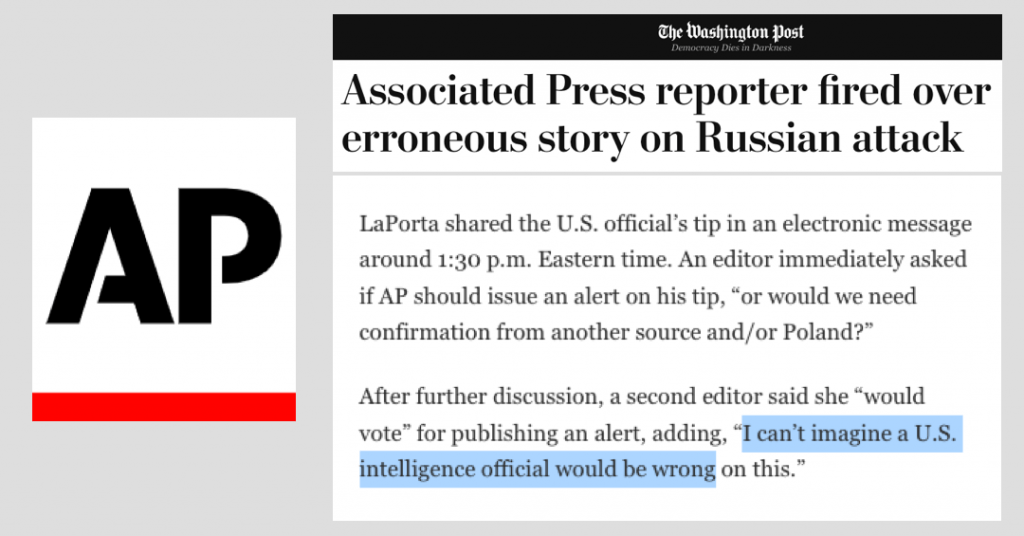
In an article titled “Associated Press reporter fired over erroneous story on Russian attack,” The Washington Post reports the following (emphasis added):

Internal AP communications viewed by The Post show some confusion and misunderstanding during the preparations of the erroneous report.

LaPorta shared the U.S. official’s tip in an electronic message around 1:30 p.m. Eastern time. An editor immediately asked if AP should issue an alert on his tip, “or would we need confirmation from another source and/or Poland?”

After further discussion, a second editor said she “would vote” for publishing an alert, adding, “I can’t imagine a U.S. intelligence official would be wrong on this.”

“I can’t imagine a US intelligence official would be wrong on this.”

Can you imagine not being able to imagine a US intelligence official being wrong? This would be an unacceptable position for any educated adult to hold, much less a journalist, still less an editor, and still less an editor of one of the most influential news agencies on earth.

These are the people who publish the news reports we read to find out what’s happening in the world. This is the baby-brained level of thinking these people are serving the public interest with.

Antiwar commentator Daniel Larison writes the following of the AP editor’s shocking quote:

Skepticism about official claims should always be the watchword for journalists and analysts. These are claims that need more scrutiny than usual rather than less. If you can’t imagine that an intelligence official could get something important wrong, whether by accident or on purpose, you are taking far too many things for granted that need to be questioned and checked out first.

Intelligence officials of many governments feed information to journalists and have done so practically ever since there was a popular press to feed information to, and that information certainly should not be trusted just because an official source hands it over. It is also always possible for intelligence officials to just get things wrong, whether it is because they are relying on faulty information or because they were too hasty in reaching conclusions about what they think they know.

Whether the AP’s source was feeding them a line or was simply mistaken, a claim as provocative and serious as this one should have been checked out much more thoroughly before it got anywhere near publication. The AP report in this case seems to have been a combination of a story that was “too good to check” and a culture of deference to official sources in which the editors didn’t feel compelled to make the effort to check.

Indeed, the only reason the press receive such explicit protections in the US Constitution is because they are supposed to hold the powerful to account. If the editors of a wildly influential news agency will just unquestioningly parrot whatever they are fed by government officials while simultaneously protecting those officials with anonymity, they are not holding the powerful to account, and are in fact not meaningfully different from state propagandists.

They are state propagandists. Which is probably why they are sipping lattes in the AP newsroom while Julian Assange languishes in prison.

As Jacobin’s Branko Marcetic observed, this is far from the first time AP has given the cover of anonymity to US government officials circulating bogus claims of potentially dangerous consequence, like the time it reported an official’s evidence-free assertion which later proved false that Iran had carried out an attack on four oil tankers off the coast of the United Arab Emirates, or the time it let another one anonymously claim that “Iran may try to take advantage of America’s troop withdrawals from Iraq and Afghanistan.”

So to recap  —

  • Powerful government official who fed AP a false story: Zero accountability
  • AP editor who asked if a report should immediately be published upon receipt of the story: Zero accountability
  • Second AP editor who says she can’t imagine a U.S. intelligence official would be wrong:  Zero accountability
  • Journalist who wrote the story: Singular accountability

In a sane society, power and responsibility would go hand in hand. A disaster would be blamed on the most powerful people involved in its occurrence. In our society it’s generally the exact opposite, with the rank-and-file taking all of the responsibility and none of the power.

Our rulers lie to us, propagandize us, endanger us, impoverish us, destroy journalism, start wars, kill our biosphere and make our world dark and confusing, and they suffer no consequences for it. We cannot allow them to continue holding all of the power and none of the responsibility. This is backwards and must end.

WikiLeaks’ 10 Most Damning Clinton Emails that Prove Mainstream Media is Scripted and Controlled

d435thf

By Jay Syrmopoulos

Source: The Free Thought Project

Washington, D.C. – With information coming out of WikiLeaks at a fast and furious pace, it’s difficult for the average person to keep up with the many bombshell revelations being exposed.  This is happening so much that the most damning evidence is ending up as background noise in the 24-hour election news cycle without ever making it into the mainstream news.

On October 7th, 2016, WikiLeaks publish thousands of emails belonging to John Podesta’s private email archives. More emails have been released in the days that followed. Podesta is Hillary Clinton’s 2016 presidential campaign Chairman. He previously served as Chief of Staff to President Bill Clinton and Counselor to President Barack Obama.

The Podesta emails give insight into why there has been such little fanfare in the mainstream media regarding many of the most damning allegations against Clinton.

The fact that most of the newsworthy information contained in the emails is not being reported by the corporate media is indicative of the incestuous relationship between the mainstream media and the Clinton campaign – and is on full display in the Podesta emails.

While there are dozens of bombshell revelations contained within the emails –including transcripts of speeches to Wall St. banks that Clinton had refused to release, hidden policy positions, and evidence of collusion with brutal regimes – the most damning is the collusion and control of the U.S. media on display in the emails.

Essentially, the media has been weaponized as a means of controlling public opinion by propagandizing the American people. World renowned academic Noam Chomsky, in his book “Manufacturing Consent: The Political Economy of the Mass Media,” detailed how U.S. media frequently serve as an errand boy for U.S. corporate, military and imperial interests.

Chomsky forwarded the idea of what he called a “propaganda model.” Although the book was written in 1988, it speaks precisely to what is currently taking place and clearly revealed  in the Podesta emails.

“The media serve, and propagandize on behalf of, the powerful societal interests that control and finance them. The representatives of these interests have important agendas and principles that they want to advance, and they are well positioned to shape and constrain media policy.” -Chomsky

With knowledge of what is currently transpiring, here are the ten most damning Clinton emails regarding the media’s collusion with her presidential campaign, with hotlinks to the original WikiLeaks release.

1. Clinton Staff hosts private “off-the-record cocktail party” with 38 “influential” reporters, journalists, editors, and anchors (from 16 different mainstream media outlets including CNN, NBC, CBS, NYT, MSNBC, & more) with the stated goal of “framing the race.”

2. Donna Brazile (CNN contributor at the time, and current DNC Chairman now) leaked CNN town hall questions to Hillary Clinton’s staff prior to the debate.

3. Clinton campaign and the New York Times coordinating attack strategy against Trump.

4. Glen Thrush, POLITICO’s chief political correspondent and senior staff writer for POLITICO Magazine, sends John Podesta an article for his approval. Writes: “Please don’t share or tell anyone I did this. Tell me if I fucked up anything.”

5. Huffington Post contributor Frank Islam writes to John Podesta in an email titled “My blogs in the Huffington Post”, says “I am committed to make sure she is elected the next president.” “Please let me know if I can be of any service to you.”

6. Clinton staffer “Placing a story” with Politico / New York Times: “place a story with a friendly journalist” “we have a very good relationship with Maggie Haberman of Politico” “we should shape likely leaks in the best light for HRC.”

7. John Podesta receiving drafts of New York Times articles before they’re published.

Clinton staff “placing a story with a friendly at the AP (Matt Lee or Bradley Klapper).”

More media collusion: NYT and AP “helpful” to Clinton campaign.

8. Clinton staff colluding with New York Times and Wall Street Journal to paint Hillary’s economic policies in a “progressive” light.

9. CNBC panelist colluding with John Podesta on what to ask Trump when he calls in for an interview.

10. Clinton staff appearing to control the release times of Associated Press articles.

The reality revealed in these emails is one of media collusion with powerful interests, which only serve to keep the American people in the dark about what is actually transpiring. The exact opposite of transparency.

Please share this article to wake people up to the fact that their news is scripted by powerful entities as a means of influencing people’s perceptions!

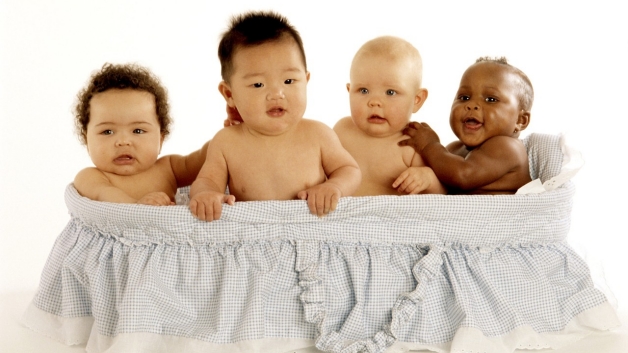
Are Babies Moral Beings?

051812-national-census-race-black-baby-white-baby-asian-baby-infant-pregnancy

By Leanne Italie, AP

Are we naturally good or naturally evil? Cognitive scientist Paul Bloom argues in a new book that we’re both.

In “Just Babies: The Origins of Good and Evil” (Crown), the developmental psychologist and Yale professor takes on the nature of morality and vast research spanning evolutionary biology to philosophy, drawing on everyone from Sigmund Freud to Louis C.K.

His conclusion? Babies have the capacity for empathy and compassion, possess a limited understanding of justice and have the ability to judge. Yet they navigate not along colour lines but as Us versus Them, usually landing squarely in the Us camp.

A conversation with Paul Bloom:

AP: What light do you shed on the “moral sense” of babies?

Bloom: We’re born with this extraordinary moral sense. A sense of right and wrong just comes naturally to humans and shows up in the youngest babies we can study. But this morality is limited. I think tragically limited. So we are morally attuned to those around us, to our kin, to our friends, to those we interact with, and we are utterly cold-blooded toward strangers. To some extent I think babies are natural-born bigots. They are strongly attuned to break the world into Us versus Them and have no moral feelings at all toward the Them, and this shows up all through development.

So in some way, although a lot of morality is inborn, I think the great success of humans … is expanding and transcending this inborn morality. You and I believe that, you know, not only is it wrong to kill somebody, it’s wrong to kill somebody from anywhere around the world. We might also agree that we’re obliged to help people in trouble, even if they look different from us or are from a different land.

We have notions of fairness and equity and justice that, again, extend more broadly, and although we might favour our own group in some ways, consciously or unconsciously, we’re probably not racist. We probably think that racism is wrong, and that a good moral system should treat all humans more or less the same, but none of that is present in the mind of a baby.

AP: Is it a revelation that we create the environments that can transform a partially moral baby into a very moral adult?

Bloom: I think in some sense it is not. I think any good parent knows that you raise a kid into a moral kid not by, you know, imparting moral lessons and making moral pronouncements, but by shaping the environment in ways that bring out our better selves. When you want to make people good people you don’t just say, ‘Oh, try real hard.’ You try to structure their environment so as to bring out their better aspects.

AP: Is that surprising?

Bloom: I think it’s surprising the extent to which it works and the extent to which the alternative fails. So, for instance, many people believe that giving people moral stories, expressing through literature moral values, has a profound effect on people’s lives. The actual evidence says it has no effect at all. It’s just zero. In fact, there are some studies showing that if you give kids stories about being generous and kind it paradoxically makes them a little bit meaner, roughly between the ages of 4 and 10. Preaching in general with kids often backfires.

AP: Where do serial killers come from?

Bloom: Serial killers are very unusual people. … We know that there’s genetic differences in people’s empathy, in people’s compassion and how much they care about other people, in their ability to control violent rages, for example, and I’m sure a serial killer is somebody who has the genetic short end of the stick. Then you toss in certain environments. Your typical serial killer had a very unhappy childhood.

AP: What about being hard-wired at birth?

Bloom: Some people are more likely to be serial killers than other people due to accidents of genes. I am far more likely to be a murderer or a rapist or a serial killer than you are because I’m a man. There’s some evidence that people who turn out to be psychopaths, even murderous psychopaths, have the short end of the genetic stick but there’s all sorts of environmental factors. … Fifty years ago, slapping one’s wife or raping one’s wife would be viewed as comical, legitimate, certainly not a crime. Now it’s the sort of thing that only a monster would do, and so we have tremendous evidence for profound changes that have nothing to do with genes.

AP: You discuss “hodgepodge morality.” Is there such a thing in babies?

Bloom: I think we naturally have multiple moral systems, multiple responses. Some of our responses are created by disgust, some by empathy, some by a sense of justice, some by a sense of fairness, some by self-interest. We respond to kin, to our family members in different ways than we respond to strangers in all sorts of ways that don’t fall into any elegant philosophical theory. And I think this is true for babies, too.

Babies are moral beings but they aren’t moral philosophers. They don’t have some sort of coherent theory. Rather they have a series of gut reactions, a series of moral triggers that they respond to. What we find in our research is all sorts of moral capacities on the part of babies. What we don’t find is some kind of careful, contemplative theory.

AP: Is that a bad thing?

Bloom: It isn’t. It’s the way we are, one way or another, but if you set yourself the task of constructing a society where everybody lives and everybody follows the same rules and adheres to the same notions, then you do want to some degree a consistent and coherent theory.

So it may be a good theory of psychology to say that a white person naturally cares a lot more toward another white person than toward a black person, and that’s an instinctive response that could develop in certain societies, but from the standpoint of constructing a theory of what actually is good, how we should live our lives, we would say, ‘Well that’s too hodgepodge for us. It’s inconsistent. It’s actually a cruel way for the mind to work.’

AP: You write about conflicts in research on racial bias in young children.

Bloom: For kids there’s a lot of evidence that they’re very strongly biased on Us versus Them if you get them to do it on the basis of things like different colored T-shirts, for example, but race and skin colour isn’t an automatic way of dividing up the world. So you take a two- or three-year-old and typically a two- or three-year-old shows no signs of being racist in any way. When you get older, if kids are in an environment when blacks and whites interact and they’re totally mellow with each other and there’s not much conflict, they’ll see black and white but it won’t matter at all. If you’re in an environment where it matters then it will matter.

Children are extremely prone and very ready to divide the world into groups, but the groups that they focus on is determined through learning.