Human Anxiety in Late-Stage Capitalism


By Phil Rockstroh

Source: Consortium News

A number of recent press articles, including an over 8,000-word feature piece in The New York Times have asked, to quote the Times’ headline, “Why Are More American Teenagers Than Ever Suffering From Severe Anxiety?”

Although the question was proffered, the reporters and editors responsible for the articles remain resolutely obtuse to the obvious: The bughouse crazy environment of late-stage capitalist culture evokes classic fight-or-flight responses attendant to episodes of severe anxiety and panic attacks.

The word panic has its derivation in reference to Pan, the Greek god of wilderness and wildness, of the animal body encoded within human beings and its attendant animalistic imperatives. To wit, deracinate an animal from its natural habitat and it will evince, on an instinctual basis, a fight-or-flight response.

If caged, the unfortunate creature will pace the confines of its imprisonment, chew and tear at its fur and flesh, become irritable, enervated, languish and even die from the deprivation of the environment it was born to inhabit. A caged animal, even if the unfortunate creature endures captivity, is not the entity nature conceived; the living being has been reduced to A Thing That Waits For Lunch.

Human beings, animals that we are, respond in a similar fashion. Experiencing anxiety is among the ways our innate animal spirits react to the capitalist cage. Inundate a teenager with the soul-defying criteria of the corporate/consumer state, with its overbearing, pre-careerist pressures, its paucity of communal eros, its demands, overt and implicit, to conform to a shallow, manic, nebulously defined yet oppressive societal order, and insist that those who cannot adapt, much less excel, are “losers” who are fated to become “basement dwellers” in their parents’ homes or, for those who lack the privilege, be cast into homelessness, then the minds of the young or old alike are apt to be inundated with feelings of angst and dread.

Worse, if teenagers are culturally conditioned to believe said feelings and responses are exclusively experienced by weaklings, parasites, and losers then their suffering might fester to the point of emotional paralysis and suicidal inclinations.

No Real Remedies

What does the capitalist state offer as remedy? Obscenely profitable, corporately manufactured and widely prescribed psychoactive medications. Treatment, which, at best, merely masks symptoms and bestows the illusion of recovery.

As R. D. Laing observed: “What we call ‘normal’ is a product of repression, denial, splitting, projection, introjection and other forms of destructive action on experience. It is radically estranged from the structure of being.”

In short, it is insanity to be expected to adapt to socially acceptable insanity. Yet we are pressured to adapt to, thus internalize odious, groupthink concepts and tenets. To cite one such groupthink example: homelessness is natural to the human condition and is a communally acceptable situation.

Closer to fact: The problem of homelessness is the result of a societal-wide perception problem — the phenomenon is the very emblem of the scrambling, twisting, dissociating, and displacing of perception that capitalist propagandists specialize in. Homelessness would be considered a relic of a barbaric past if this very simple principle was applied: Having access to permanent shelter is a human right and not a privilege.

What kind of a vile, vicious people would deny that simple proposition? Those conditioned by a lingering Puritan/Calvinist mindset to believe: Punishment for resisting the usurpation of the fleeting hours of one’s finite life must be severe. If the over-class can no longer get away with, as was once common practice in the Puritan/Calvinist tradition, public floggings to whip the labor force into line, then those who will not or cannot comply will be cast onto the cold, unforgiving concrete of a soulless cityscape.

It comes down to this, societies that are ridden with vast wealth inequity, due to the machinations of a rapacious over-class, create the obscenity known as homelessness. Moreover, the situation is only one of the numerous obscenities inherent to state capitalism. Obscenities that include, events that are dominating the present news cycle, e.g., the predations of a lecherous movie mogul, to the sub-cretinous doings and pronouncements of a Chief of State who is a bloated, bloviating, two-legged toxic waste dump.

Trump, No Aberration 

How is it then, liberals fail to grasp the fact that the Trump presidency is not an aberration; rather, his ascension to power should be regarded as being among the high probability variables of late-stage capitalism and empire building? The psychopathic, tangerine-tinged clown Trump is the embodiment of the Second Law of Thermodynamics, a development that is concomitant to over-expanded empires. Thus he will continue to flounce deeper into the quagmire of crash-engendering, economic legerdemain and perpetual war.

Empires are death cults, and death cults, on a subliminal basis, long for their own demise. Paradoxically, the collective mindset of imperium, even as it thrusts across the expanse of the world, renders itself insular, cut off from culturally enhancing novelty, as all the while, the homeland descends into a psychical swamp of churning madness.

A draining of the swamp of the collective mind cannot come to pass, for the swamp and citizenry are one. Withal, the likes of leaders such as Trump rise from and are made manifest by the morass of the culture itself. In a swamp, the gospel of rebirth and redemption is heard in the song of humus. New life rises from its compost.

In the presence of Trump’s debased mind and tombified carcass, one is privy to arias of rot. While Hillary Clinton’s monotonous tempo was the dirge of a taxidermist — cold, desiccated of heart, and devoid of life’s numinous spark — Trump’s voice carries the depraved cacophony of a Célinean fool’s parade … its trajectory trudging towards the end of empire.

As liberals new BFFL (Best Friend for Life) George W. Bush might ask, “Is our liberals learning.”

In a word, no. For example, the collective psyche of U.S. culture as been enflamed by the revelations that actresses were coerced into sexual encounters with a movie mogul whose power in the industry was only matched, even enhanced, by his sadistic nature. The staff of his company assisted, was complicit in, or remained silent about his lechery, as did the whole of the movie industry and the entertainment press. All as NFL athletes are being threatened with expulsion from the League if they kneel during the national anthem.

The Great Unspoken 

Yet the great unspoken remains: The enabling of and submission to the degradation, exploitation and tyranny, and the lack of resistance thereof share a common and singular factor: The careerism of all concerned. The cultural milieu concomitant to capitalism is at the rotten root and noxious blossoming of the situation.

Jean-Luc Godard’s 1967 cinematic barnburner “Two or Three Things I Know About Her” should be required viewing for those unaware or in denial of the acuity of the film’s theme i.e., becoming enmeshed within the psychical landscape of dominance, degradation, and submission inherent to and inseparable from capitalist/consumer culture will cause one to become party to societal sanctioned prostitution. When life is negotiated within a collective value system that devalues and deadens the individual’s inner life thus warps every human transaction, anomie descends, the worst among a people ascend to positions of power.

“Panic is the sudden realization that everything around you is alive.” — William S. Burroughs, from Ghost of Chance

When friends visited me in New York, where I lived for decades, I would take them on walking tours through the city. We would cross the Westside Highway and stroll the pedestrian walk along the Hudson River, or cross the East River by walking across the Brooklyn Bridge.

The effect of these excursions on people was often profound … the combined elements of the elemental beauty of the rivers and vastness of the city’s architecture and scope, clamor, and the dense interweaving of traditional ethnic customs and ad hoc social codes of New Yorkers often would heighten the visitors’ senses and open them to larger, more intricate awareness of themselves and extant reality … the freeways of the contemporary mind (conditioned to be constantly engaged in manic motion, with one’s mind either frenzied by an obsession with performing (ultimately futile) maneuvers directed to saving time — or stalled at a frustration inducing standstill) were replaced by the exigencies of life at street level, i.e., novel situations that had to be apprehended and negotiated.

The possibilities of life seemed greater. The crimped eros of insular suburban thought became loosened before the city’s intricacies and expansiveness. Although: Not all, or even a scant few, New Yorkers can maintain the state of being. Few of us can live by Rilke’s resolve to “make every moment holy.” Life, in the city, becomes grotesquely distorted … High rents, inflicted by hyper-gentrification, in combination with the deification of success and its cult of careerism overwhelm one’s psyche … There is so far to fall.

Angst (the word originally can be traced to the ancient Greek deity Ananke, the immovable by prayer and offering bitch Goddess of Necessity and the root word of anxiety) clamps down one’s sense of awareness. Ananke dominates the lives of the non-privileged citizenry while Narcissus, Trump’s, the Clintons’, et.al. and their financial and cultural elitists’ patron God rules the day. The pantheon of possibility has been decimated, a cultural cleansing has been perpetrated, by the egoist caprice of the beneficiaries of the late capitalist dictatorship of money.

Hence, we arrive at the primal wisdom tacitly conveyed by anxiety-borne states of fight or flight. Due to the reality that capitalism, on both an individual and collective basis, drives individuals into madness, all as the system destroys forest and field, ocean and sea and the soul-scape of all who live under its rapacious dominion, our plight comes down to this: We either struggle and strive, by and any and all means, to end the system — or it will end us.

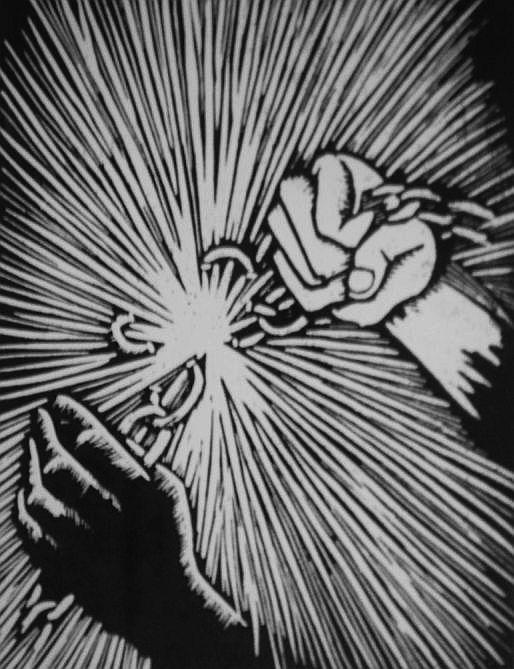
Breaking the chains: precarity in the Age of Anxiety

breaking-the-chainsBy Joseph Todd

Source: RoarMag.org

In our Age of Anxiety, society assaults us from every possible angle with an avalanche of uncertainty. How do we fight back under conditions of precarity?

­An Age of Anxiety is upon us, one where society assaults us from every possible angle with an avalanche of uncertainty, fear and alienation. We live with neither liberty nor security but instead precariousness. Our housing, our income and our play are temporary and contingent, forever at the whim of the landlord, policeman, bureaucrat or market. The only constant is that of insecurity itself. We are gifted the guarantee of perpetual flux, the knowledge that we will forever be flailing from one abyss to another, that true relaxation is a bourgeois luxury beyond our means.

Our very beings come to absorb this anxiety. We internalize society’s cruelty and contradiction and transform them into a problem of brain chemistry, one that is diagnosed and medicated away instead of being obliterated at root. All hope is blotted out. Authentic experience, unmediated conversation, distraction-free affection and truly relaxed association feel like relics of a bygone era, a sepia dream that perhaps never existed.

Instead we have the frenetic social arenas of late capitalism: the commodified hedonism of clubs and festivals, express lunches, binge culture and the escapist, dislocating experience of online video games, all underlined by either our desperate need to numb our anxieties or to create effective, time-efficient units of fun so we are available for work and worry.

This is assuming we have work, of course. Many of us are unemployed, or are instead held in constant precarity. Stuck on zero-hour contracts or wading through as jobbing freelancers in industries that used to employ but don’t anymore, we are unable to plan our lives any further than next week’s rota, unable to ever switch off as the search for work is sprawling and continuous.

And if we do have traditional employment, what then? We are imprisoned and surveilled in the office, coffee shop or back room, subject to constant assessment, re-assessment and self-assessment, tracked, monitored and looped in a perpetual performance review, one which even our managers think is worthless, but has to be done anyway because, hey, company policy.

Continuous is the effective probationary period and we are forever teetering on the edge of unemployment. We internalize the implications of our constant assessment, the knowledge that we’re always potentially being surveilled. We censor ourselves. We second-guess ourselves. We quash ourselves.

And thanks to the effective abolition of the traditional working day, work becomes unbearable and endless. The security of having delineated time — at work and then at play — has been eradicated. Often this is because individuals have to supplement their atrocious wages with work on the side. But it is also because traditional 9-to-5 jobs have suffered a continuous extension of working hours into out-of-office time, enabled and mediated by our laptops and smartphones. These gadgets demand immediacy and, when coupled with the knowledge that you are always reachable and thus available, they instill in us a frantic need to forever reply in the now.

And with this expectation comes obligation. Hyper-networked technologies gift our bosses the ability to demand action from us at any moment. Things that had to wait before become doable — and thus are done — in the now. If you are unwilling, then someone is ready to take your place. You must always be at their beck and call. From this, our only refuge is sleep, perhaps the last bastion of delineated time against frenetic capitalism, and one that is being gradually eroded and replaced.

For those that are out of work the situation is no better. They face the cruel bureaucracy of the Job Centre or the Atos assessment, institutions that have no interest in linking up job seekers with fulfilling employment but instead attempt only to lower the benefits bill through punitive, arbitrary sanctions and forcing the sick back to work. Insider accounts of these programs betray the mix of anxiety inducing micro-assessment and surveillance they employ.

Disabled claimants — always claimants, never patients, insists Atos — are assessed from the moment they enter the waiting room, noted as to whether they arrive alone, whether they can stand unassisted and whether they can hear their name when called. Compounding this is the hegemonic demonization of those that society has failed: if you are out of work, you are a scrounger, a benefit cheat and a liar. Utterly guilty of your failure, a situation individualized in its totality and attributable to no system, institution or individual but yourself.

We are surveilled, monitored and assessed from cradle to grave, fashioned by the demand that we must be empirical, computable and trackable, our souls transformed into a series of ones and zeros. This happens in the workplace, on the street and in various government institutions. But its ideological groundwork is laid in the nursery and the school.

These institutions bracket our imaginations while still in formation, normalizing a regime of continuous surveillance and assessment that is to last for the rest of our lives. Staff are increasingly taken away from educating and nurturing and instead are made to roam nurseries taking pictures and recording quotes, all to be computed and amalgamated so authorities can track, assess and predict a child’s trajectory.

It is true that this does not trouble the child in the same way traditional high intensity rote examination does. But what it instead achieves is the internalization of the surveillance/assessment nexus in our minds; laying the groundwork for an acquiescence to panoptical monitoring, a resignation to a private-less life and a buckling to regimes of continuous assessment.

Britain is particularly bad in this respect. Not only does our government have a fetish for closed-circuit television like no other, but also, GCHQ was at the heart of the Snowden revelations. Revelation, however, is slightly misleading — as what was most telling about the leaks wasn’t the brazen overstep by government institutions, but that few people were surprised. Although we didn’t know the details, we suspected such activity was going on. We acted as if we were being watched, tracked and monitored anyhow.

In this we see the paranoid fugitive of countless films, books and television dramas extrapolated to society writ large. We are all, to some extent, that person. Our growing distrust of governments, the knowledge that our technologically-integrated lives leave a heavy trace and the collection of “big” data for both commercial and authoritarian purposes contributes to our destabilized, anxious existence. An existence that impels us towards self-policing and control. One where we do the authority’s job for them.

Many individuals offer the amount of choice we have, or the amount of knowledge we can access at the click of a button, as the glorious consequences of late capitalist society. But our rampant choice society, one where we have to make an overwhelming number of choices — about the cereal we eat, the beer we drink, or the clothes we wear — is entirely one sided. While we have an incredible amount of choice over issues of little importance, we are utterly excluded from any choice about the things that matter; what we do with the majority of our time, how we relate to others or how society functions as a whole. Nearly always these choices are constricted by the market, the necessity of work, cultures of overwork and neoliberal ideology.

Again we find this ideology laid down in primary education. Over the years more and more “continuous” learning has been introduced whereby children, over a two week period or so, have to complete a set of tasks for which they can choose the order. This is an almost perfect example of how choice functions in our society, ubiquitous when insignificant but absent when important. The children can choose when they do an activity, which matters little as they will have to do it at some point anyway, but cannot choose not to do it, or to substitute one kind of activity with another.

Why does this matter? Because meaningful choices about our lives give us a sense of certainty and control. Avalanches of bullshit choices that still have to be made, as study after study has shown, make us incredibly anxious. Each of them takes mental effort. Each contains, implicitly, the multitude of choices that we didn’t make; all those denied experiences for every actual experience. This is fine if there are only one or two. But if there are hundreds, every act is riddled with disappointment, every decision shot with anxiety.

Compounding this orgy of choice, and in itself another root cause of anxiety, is the staggering amount of information that assaults us every day. Social media, 24-hour news, the encroachment of advertising into every crack — both spatially and temporally — and our cultures of efficiency that advocate consuming or working at every possible moment all combine to cause intense sensory overload. This world, for many, is just too much.

Although we’ve talked mostly about work, surveillance, assessment and choice, there are a multitude of factors one could add. The desolation of community due to the geographical dislocation of work, the increased transiency of populations and the growing privatization of previously public acts — drinking, eating and consuming entertainment are increasingly consigned to the home — shrinks our world to just our immediate families.

Camaraderie, extended community and solidarity are eroded in favor of mistrust, suspicion and competition. Outside of work our lives become little more than a series of privatized moments, tending to our property and ourselves rather than each other, flitting between the television shows, video games, home DIY and an incredible fetish for gardening with no hint towards the thought that perhaps these experiences would be better if they were held in common, if they appealed to the social and looked outward rather than in.

In the same way we could mention the ubiquity of debt — be it the mortgage, the credit card or the student loans — and the implicit moral judgment suffered by the debtor coupled with the anxiety-inducing knowledge that they could lose everything at any moment. Or we could consider the near-existential crises humanity faces, be it climate change, ISIS or the death throes of capitalism; all too abstract and total to comprehend, all contributing to a sense that there is no future, only a grainy, distant image of lawless brutality, flickering resolutely in our heads.

But the crux, and the reason anxiety could become a revolutionary battleground, is that neoliberal ideology has individualized our suffering, attributing it to imbalances in our brain chemistry, constructing it as a problem of the self, rather than an understandable human reaction to a myriad of cruel systemic causes. Instead of changing society the problem is medicalized and we change ourselves, popping pills to mold our subjectivities to late-capitalist structures, accepting the primacy of capitalism over humanity.

This is why “We Are All Very Anxious”, a pamphlet released by the Institute of Precarious Consciousness, is so explosively brilliant. Not only does it narrate the systemic causes of anxiety, but it situates the struggle within a revolutionary strategy, constructing a theory that is at once broad and personal, incorporating one’s own subjective experience into an explanatory framework, positing anxiety as a novel, contemporary revolutionary battleground, ripe for occupation.

It is, they claim, one of three eras spanning the last two-hundred years where we have progressed between different dominant societal affects. Until the postwar settlement we suffered from misery. The dominant narrative was that capitalism benefited everybody; while at the same time overcrowding, malnourishment and slum dwelling were rife. In response to this appropriate tactics such as strikes, mutual aid, cooperatives and formal political organization were adopted.

After the postwar settlement, until around the 1980s, a period of Fordist boredom ensued. Compared to the last era, most people had stable jobs, guaranteed welfare and access to mass consumerism and culture. But much of the work was boring, simple and repetitive. Life in the suburbs was beige and predictable. Capitalism, as they put it, “gave everything needed for survival, but no opportunities for life.” Again movements arose in opposition, positioned specifically against the boredom of the age. The Situationists and radical feminism can be mentioned, but also the counter-culture surrounding the anti-war movement in America and the flourishing DIY punk scene in the UK.

This period is now finished. Capitalism has co-opted the demand for excitement and stimulation both by appropriating formerly subversive avenues of entertainment — the festival, club and rave — while dramatically increasing both the amount and intensity of distractions and amusements.

In one sense we live in an age of sprawling consumerism that avoids superficial conformity by allowing you to ornament and construct your identity via hyper-customized, but still mass-produced products. But technological development also mean that entertainment is now more total, immersive and interactive; be it the video game or the full-color film watched on a widescreen, high-definition television.

Key to this linear conception is the idea of the public secret, the notion that anxiety, misery or boredom in these periods are ubiquitous but also hidden, excluded from public discourse, individualized and transformed into something unmentionable, a condition believed to be isolated and few because nobody really talked about it. Thus to even broach the subject in a public, systematic manner becomes not just an individual revelation but also a collective revolutionary act.

I’ve seen this first-hand when running workshops on the topic. Sessions, which were often argumentative and confrontational, became, when the subject was capitalism and anxiety, genuinely inquisitive and exploratory. Groups endeavored to broaden their knowledge of the subject, make theoretical links and root out its kernel rather than manning their usual academic ramparts and launching argument after rebuttal back and forth across the battlefield.

But more than this, there was a distinct edge of excitement, the feeling that we were onto something, a theory ripe with explosive newness, one that managed to combine our subjective experiences and situate them in a coherent theoretical framework.

However, we must be critical. To posit anxiety as a specifically modern affect, unique to our age, is contentious. What about the 1950s housewife, someone mentioned in one of the sessions, with her subjectivity rigidly dictated by the misogyny and overbearing cultural norms of the time? Didn’t this make her feel anxious?

Well, perhaps. But if we take anxiety to mean a general feeling of nervousness or unease about an uncertain outcome — with chronic anxiety being an actively debilitating form — then we can draw distinct differences. Although the housewife was oppressed, her oppression was codified and linear, her life depressingly mapped out with little room for choice or maneuver. Similarly with the slave — surely the universal symbol of oppression — hierarchies aren’t nebulous but explicit, domination is ensured by the whip and the gun, the master individualized and present.

This is in stark contrast to the current moment. While it is obvious that oppressions are distinct and incomparable, we can nevertheless see that the fug of the 21st century youth is of a different nature. Our only certainty is that of uncertainty. Our oppressor is not an individual but a diffuse and multiplicitous network of bureaucrats, institutions and global capital, hidden in its omnipotence and impossible to grasp.

We aren’t depressed by the inevitability of our oppression, but instead are baffled by its apparent (but unreal) absence, forever teetering on the brink, not knowing why, nor knowing who we should blame.

Similarly it is bold to claim that anxiety is the dominant affect of Western capitalism, tantamount to pitching it as the revolutionary issue of our age. Yet if we analyze the popular struggles of our time — housing, wages, work/life balance and welfare — they are often geared, in one way or another, towards promoting security over anxiety.

Housing for many is not about having a roof over their heads, but about security of tenure, be it via longer fixed-term tenancies or the guarantee that they won’t be priced out by rent rises that their precarious employment can’t possibly cover. In the same way struggles over welfare are often about material conditions, but what particularly strikes a chord is the cruel insecurity of a life on benefits, forever at the whim of sanction-wielding bureaucrats who are mandated to use any possible excuse to remove your only means of support.

Anxiety is also a struggle that unites diverse social strata, emanating from institutions such as the job center, loan shark, university, job market, landlord and mortgage lender, affecting the unemployed, precariously employed, office worker, indebted student and even the comparatively well-off. Again we find this unification in the near-universal adoption of the smartphone and other hyper-networked technologies. All of us, and especially our children, are beholden to a myriad of glowing screens, flitting between one identity and another, alienated and disconnected from our surroundings and each other.

This is not to say a movement against anxiety itself will ever arise. Such a rallying cry would be too abstract and fail to inspire. Instead, anxiety must be conceptualized both as an affect which underlies various different struggles, and a schema within which they can be assembled into a revolutionary strategy.

So, what is our tangible aim here? In part it must be to reduce the level of general anxiety so as to increase quality of life. Yet if we are to take a revolutionary rather than a mere humanitarian approach, this drop in anxiety must in some way translate into a rise in revolutionary disposition. In certain ways it obviously will. If there is a public realization that large swathes of the mentally ill are not as such because of their unfortunate brain chemistry but instead because of a misconfiguration of society, people are already thinking on an inherently challenging, systemic level.

Similarly, conflict with the state or capital — be it on the street, in the workplace or inside one’s own head — tends to be high-impact and anxiety-inducing. A drop in general anxiety will make it more likely that individuals will engage in such moments of conflict and, crucially, experience the intense radicalization and realization of hegemonic power that can only be achieved through such visceral moments. But a second part to this, hinted at already and integral to giving the struggle a revolutionary edge, is to emphasize that there is a public secret to be aired. As well as combating the sources of anxiety, we must say we are doing so; we must situate these struggles within larger frameworks and provide education on its systemic nature.

Thus, any strategy would need to be both abstract and practical. On one hand we must explode the public secret by raising consciousness. This would require a general onslaught of education, including, but not limited to, consciousness-raising sessions, participatory workshops, articles, books, pamphlets, leaflets, posters, YouTube videos and “subvertised” adverts. The emphasis would be to educate but also to listen, to intermingle theoretical understanding with subjective experience.

The second part would be to strategically support campaigns and make demands of politicians that specifically combat anxiety in its various different guises. When it comes to work, the abolition of zero-hour contracts, the raising of the minimum wage in line with the actual cost of living, and the tightening of laws on overwork as part of a broader campaign to assert the primacy of life over work, of love over pay, would be a good start.

For those out of work, underpaid or precarious, the introduction of a basic citizen’s income would represent a revolutionizing of the job market. In one move it would alleviate the cultural and practical anxieties of worklessness — ending the bureaucratic cruelty of the job center while removing the anxiety-inducing stigma associated with claiming benefits — while simultaneously allowing individuals to pursue culturally important and revolutionary activities such as art, music, writing or (dare I say it?) activism, without the crushing impossibility of trying to make them pay. When we look to housing obvious solutions include mandatory, secured five-year tenancies, capped rent increases and a guarantee of stable, suitable social housing for those who need it.

There are many more reforms I could list. You will notice, however, that these are indeed reforms; bread and butter social democracy. Does that mean such a program is counter-revolutionary? A mere placatory settlement between capital and the working class? No, it does not. Revolution does not emerge from the systematic subjection of individuals to increased misery, anxiety and hardship as accelerationist logic demands. Instead it flourishes when populations become aware of their chains, are given radical visions for the future and the means to achieve them. It is when leftists critique but also offer hope. It is when the population writ large are included in and are masters of their own liberation; not when they are viewed as a lumpen, otherly mass, of only instrumental importance in achieving the glorious revolution.

Look at the practicalities and this becomes obvious. How can we expect individuals to launch themselves into high-tension anxiety-inducing conflicts if the mere thought of such a situation causes them to have a panic attack? How can individuals, in the face of near panoptical surveillance and monitoring, combat the overwhelming desire to conform if they aren’t awarded some freedom from the practical anxieties of life? How are we to think and act in a revolutionary, and often abstract, manner if the very real and immediate anxieties of work, home and play fog our minds so totally?

This is not to say freedom will be given to us. It must always be taken, and we must not rely on electoral politics to hand us the revolution down from above. Nor will true struggle ever be an anxiety-free leisure pursuit. Genuine conflict with the state and capital will always entail danger, stress and the possibility of intensified precariousness.

Nevertheless, the dismissal of electoral politics in its totality represents abysmal revolutionary theory. The pursuit of reforms by progressive governments being bitten at the heels by sharp, vibrant social movements can produce real, tangible change.

It was what should have happened with Syriza, and it is what will hopefully happen with the new Labour leadership in the UK. And if, as individuals and communities, we are to puncture the distress, precariousness and general sense of cruel unknowing so particular to the moment in which we live, if we are to overcome the avalanche of bullshit and reclaim our confidence, if we to construct and disseminate a distinctly communal, hopeful revolutionary fervor, such changes are imminently needed.


Joseph Todd is a writer and an activist. Find more of his writings here or follow him on twitter.

Mutiny of the Soul

The-Prison-of-the-Mind-by-Blacksmiley-via-ArtCorgi

By Charles Eisenstein

Source: Reality Sandwich

Depression, anxiety, and fatigue are an essential part of a process of metamorphosis that is unfolding on the planet today, and highly significant for the light they shed on the transition from an old world to a new.

When a growing fatigue or depression becomes serious, and we get a diagnosis of Epstein-Barr or Chronic Fatigue Syndrome or hypothyroid or low serotonin, we typically feel relief and alarm. Alarm: something is wrong with me. Relief: at least I know I’m not imagining things; now that I have a diagnosis, I can be cured, and life can go back to normal. But of course, a cure for these conditions is elusive.

The notion of a cure starts with the question, “What has gone wrong?” But there is another, radically different way of seeing fatigue and depression that starts by asking, “What is the body, in its perfect wisdom, responding to?” When would it be the wisest choice for someone to be unable to summon the energy to fully participate in life?

The answer is staring us in the face. When our soul-body is saying No to life, through fatigue or depression, the first thing to ask is, “Is life as I am living it the right life for me right now?” When the soul-body is saying No to participation in the world, the first thing to ask is, “Does the world as it is presented me merit my full participation?”

What if there is something so fundamentally wrong with the world, the lives, and the way of being offered us, that withdrawal is the only sane response? Withdrawal, followed by a reentry into a world, a life, and a way of being wholly different from the one left behind?

The unspoken goal of modern life seems to be to live as long and as comfortably as possible, to minimize risk and to maximize security. We see this priority in the educational system, which tries to train us to be “competitive” so that we can “make a living”. We see it in the medical system, where the goal of prolonging life trumps any consideration of whether, sometimes, the time has come to die. We see it in our economic system, which assumes that all people are motivated by “rational self-interest”, defined in terms of money, associated with security and survival. (And have you ever thought about the phrase “the cost of living”?) We are supposed to be practical, not idealistic; we are supposed to put work before play. Ask someone why she stays in a job she hates, and as often as not the answer is, “For the health insurance.” In other words, we stay in jobs that leave us feeling dead in order to gain the assurance of staying alive. When we choose health insurance over passion, we are choosing survival over life.

On a deep level, which I call the soul level, we want none of that. We recognize that we are here on earth to enact a sacred purpose, and that most of the jobs on offer are beneath our dignity as human beings. But we might be too afraid to leave our jobs, our planned-out lives, our health insurance, or whatever other security and comfort we have received in exchange for our divine gifts. Deep down, we recognize this security and comfort as slaves’ wages, and we yearn to be free.

So, the soul rebels. Afraid to make the conscious choice to step away from a slave’s life, we make the choice unconsciously instead. We can no longer muster the energy to go through the motions. We enact this withdrawal from life through a variety of means. We might summon the Epstein-Barr virus into our bodies, or mononucleosis, or some other vector of chronic fatigue. We might shut down our thyroid or adrenal glands. We might shut down our production of serotonin in the brain. Other people take a different route, incinerating the excess life energy in the fires of addiction. Either way, we are in some way refusing to participate. We are shying away from ignoble complicity in a world gone wrong. We are refusing to contribute our divine gifts to the aggrandizement of that world.

That is why the conventional approach of fixing the problem so that we can return to normal life will not work. It might work temporarily, but the body will find other ways to resist. Raise serotonin levels with SSRIs, and the brain will prune some receptor sites, thinking in its wisdom, “Hey, I’m not supposed to feel good about the life I am living right now.” In the end, there is always suicide, a common endpoint of the pharmaceutical regimes that seek to make us happy with something inimical to our very purpose and being. You can only force yourself to abide in wrongness so long. When the soul’s rebellion is suppressed too long, it can explode outward in bloody revolution. Significantly, all of the school shootings in the last decade have involved people on anti-depression medication. All of them! For a jaw-dropping glimpse of the results of the pharmaceutical regime of control, scroll down this compilation of suicide/homicide cases involving SSRIs. I am not using “jaw-dropping” as a figure of speech. My jaw literally dropped open.

Back in the 1970s, dissidents in the Soviet Union were often hospitalized in mental institutions and given drugs similar to the ones used to treat depression today. The reasoning was that you had to be insane to be unhappy in the Socialist Workers’ Utopia. When the people treating depression receive status and prestige from the very system that their patients are unhappy with, they are unlikely to affirm the basic validity of the patient’s withdrawal from life. “The system has to be sound — after all, it validates my professional status — therefore the problem must be with you.”

Unfortunately, “holistic” approaches are no different, as long as they deny the wisdom of the body’s rebellion. When they do seem to work, usually that is because they coincide with some other shift. When someone goes out and gets help, or makes a radical switch of modalities, it works as a ritual communication to the unconscious mind of a genuine life change. Rituals have the power to make conscious decisions real to the unconscious. They can be part of taking back one’s power.

I have met countless people of great compassion and sensitivity, people who would describe themselves as “conscious” or “spiritual”, who have battled with CFS, depression, thyroid deficiency, and so on. These are people who have come to a transition point in their lives where they become physically incapable of living the old life in the old world. That is because, in fact, the world presented to us as normal and acceptable is anything but. It is a monstrosity. Ours is a planet in pain. If you need me to convince you of that, if you are unaware of the destruction of forests, oceans, wetlands, cultures, soil, health, beauty, dignity, and spirit that underlies the System we live in, then I have nothing to say to you. I only am speaking to you if you do believe that there is something deeply wrong with the way we are living on this planet.

A related syndrome comprises various “attention deficit” and anxiety “disorders” (forgive me, I cannot write down these words without the ironic quotation marks) which reflect an unconscious knowledge that something is wrong around here. Anxiety, like all emotions, has a proper function. Suppose you left a pot on the stove and you know you forgot something, you just can’t remember what. You cannot rest at ease. Something is bothering you, something is wrong. Subliminally you smell smoke. You obsess: did I leave the water running? Did I forget to pay the mortgage? The anxiety keeps you awake and alert; it doesn’t let you rest; it keeps your mind churning, worrying. This is good. This is what saves your life. Eventually you realize — the house is on fire! — and anxiety turns into panic, and action.

So if you suffer from anxiety, maybe you don’t have a “disorder” at all — maybe the house is on fire. Anxiety is simply the emotion corresponding to “Something is dangerously wrong and I don’t know what it is.” That is only a disorder if there is in fact nothing dangerously wrong. “Nothing is wrong, just you” is the message that any therapy gives when it tries to fix you. I disagree with that message. The problem is not with you. You have very good reason to be anxious. Anxiety keeps part of your attention away from your tasks of polishing the silverware as the house burns down, of playing the violin as the Titanic sinks. Unfortunately, the wrongness you are tapping into might be beyond the cognizance of the psychiatrists who treat you, who then conclude that the problem must be your brain.

Similarly, Attention Deficit Disorder, ADHD, and my favorite, Oppositional Defiant Disorder (ODD) are only disorders if we believe that the things presented for our attention are worth paying attention to. We cannot admit, without calling into question the whole edifice of our school system, that it may be completely healthy for a ten-year-old boy to not sit still for six hours in a classroom learning about long division and Vasco de Gama. Perhaps the current generation of children, that some call the Indigos, simply have a lower tolerance for school’s agenda of conformity, obedience, external motivation, right-and-wrong answers, the quantification of performance, rules and bells, report cards and grades and your permanent record. So we try to enforce their attention with stimulants, and subdue their heroic intuitive rebellion against the spirit-wrecking machine.

As I write about the “wrongness” against which we all rebel, I can hear some readers asking, “What about the metaphysical principle that it’s ‘all good’?” Just relax, I am told, nothing is wrong, all is part of the divine plan. You only perceive it as wrong because of your limited human perspective. All of this is only here for our own development. War: it gives people wonderful opportunities to make heroic choices and burn off bad karma. Life is wonderful, Charles, why do you have to make it wrong?

I am sorry, but usually such reasoning is just a sop to the conscience. If it is all good, then that is only because we perceive and experience it as terribly wrong. The perception of iniquity moves us to right it.

Nonetheless, it would be ignorant and fruitless to pass judgment upon those who do not see anything wrong, who, oblivious to the facts of destruction, think everything is basically fine. There is a natural awakening process, in which first we proceed full speed ahead participating in the world, believing in it, seeking to contribute to the Ascent of Humanity. Eventually, we encounter something that is undeniably wrong, perhaps a flagrant injustice or a serious health problem or a tragedy near at hand. Our first response is to think this is an isolated problem, remediable with some effort, within a system that is basically sound. But when we try to fix it, we discover deeper and deeper levels of wrongness. The rot spreads; we see that no injustice, no horror can stand in isolation. We see that the disappeared dissidents in South America, the child laborers in Pakistan, the clearcut forests of the Amazon, are all intimately linked together in a grotesque tapestry that includes every aspect of modern life. We realize that the problems are too big to fix. We are called to live in an entirely different way, starting with our most fundamental values and priorities.

All of us go through this process, repeatedly, in various realms of our lives; all parts of the process are right and necessary. The phase of full participation is a growth phase in which we develop gifts that will be applied very differently later. The phase of trying to fix, to endure, to soldier on with a life that isn’t working is a maturation phase that develops qualities of patience and determination and strength. The phase of discovering the all-encompassing nature of the problem is usually a phase of despair, but it need not be. Properly, it is a phase of rest, of stillness, of withdrawal, of preparation for a push. The push is a birth-push. Crises in our lives converge and propel us into a new life, a new being that we hardly imagine could exist, except that we’d heard rumors of it, echoes, and maybe even caught a glimpse of it here and there, been granted through grace a brief preview.

If you are in the midst of this process, you need not suffer if you cooperate with it. I can offer you two things. First is self-trust. Trust your own urge to withdraw even when a million messages are telling you, “The world is fine, what’s wrong with you? Get with the program.” Trust your innate belief that you are here on earth for something magnificent, even when a thousand disappointments have told you you are ordinary. Trust your idealism, buried in your eternal child’s heart, that says that a far more beautiful world than this is possible. Trust your impatience that says “good enough” is not good enough. Do not label your noble refusal to participate as laziness and do not medicalize it as an illness. Your heroic body has merely made a few sacrifices to serve your growth.

The second thing I can offer you is a map. The journey I have described is not always linear, and you may find yourself from time to time revisiting earlier territory. When you find the right life, when you find the right expression of your gifts, you will receive an unmistakable signal. You will feel excited and alive. Many people have preceded you on this journey, and many more will follow in times to come. Because the old world is falling apart, and the crises that initiate the journey are converging upon us. Soon many people will follow the paths we have pioneered. Each journey is unique, but all share the same basic dynamics I have described. When you have passed through it, and understood the necessity and rightness of each of its phases, you will be prepared to midwife others through it as well. Your condition, all the years of it, has prepared you for this. It has prepared you to ease the passage of those who will follow. Everything you have gone through, every bit of the despair, has been necessary to forge you into a healer and a guide. The need is great. The time is coming soon.