
America’s Real Red Scare

The Slow-Motion Collapse of the American Empire

By William J. Astore

Source: TomDispatch.com

Jump into your time machine and let me transport you back to another age.

It’s May 2001 and the Atlantic Monthly has just arrived in the mail.  I’m tantalized by the cover article.  “Russia is finished,” the magazine announces.  The subtitle minces no words: “The unstoppable descent into social catastrophe and strategic irrelevance.”  Could it be that the country I had worried most about as a military officer during all those grim years of the Cold War, the famed “Evil Empire” that had threatened us with annihilation, was truly kaput, even in its Russian rather than Soviet guise?

Sixteen years later, the article’s message seems just a tad premature.  Today’s Russia surely has its problems — from poverty to pollution to prostitution to a rickety petro-economy — but on the geopolitical world stage it is “finished” no longer.  Vladimir Putin’s Russia has recently been enjoying heightened influence, largely at the expense of a divided and disputatious superpower that now itself seems to be on an “unstoppable descent.”

Sixteen years after Russia was declared irrelevant, a catastrophe, finito, it is once again a colossus — at least on the American political scene, if nowhere else.  And that should disturb you far less than this: more than a generation after defeating the Soviet Union in the Cold War, the United States of 2017 seems to be doing its level best to emulate some of the worst aspects of its former foe and once rival superpower.

Yes, the U.S. has a Soviet problem, and I’m not referring to the allegations of the moment in Washington: that the Trump campaign and Russian officials colluded, that money may have flowed into that campaign via Russian oligarchs tied to Putin, that the Russians hacked the U.S. election to aid Donald Trump, that those close to the president-elect dreamed of setting up a secret back channel to Moscow and suggested to the Russian ambassador that it be done through the Russian embassy, or even that Putin has a genuine hold of some sort on Donald Trump.  All of this is, of course, generating attention galore, as well as outrage, in the mainstream media and among the chattering classes, leading some to talk of a new “red scare” in America.  All of it is also being investigated, whether by congressional intelligence committees or by former FBI director — now special counsel — Robert Mueller.

When it comes to what I’m talking about, though, you don’t need a committee or a counsel or a back channel or a leaker from some intelligence agency to ferret it out.  Whatever Trump campaign officials, Russian oligarchs, or Vladimir Putin himself did or didn’t do, America’s Soviet problem is all around us: a creeping (and creepy) version of authoritarianism that anyone who lived through the Cold War years should recognize.  It involves an erosion of democratic values; the ever-expanding powers exercised by a national security state operating as a shadow government and defined by militarism, surveillance, secrecy, prisons, and other structures of dominance and control; ever-widening gaps between the richest few and the impoverished many; and, of course, ever more weapons, along with ever more wars.

That’s a real red scare, America, and it’s right here in the homeland.

In February, if you remember — and given the deluge of news, half news, rumor, and innuendo, who can remember anything these days? — Donald Trump memorably compared the U.S. to Russia.  When Bill O’Reilly called Vladimir Putin “a killer” in an interview with the new president, he responded that there was little difference between us and them, for — as he put it — we had our killers, too, and weren’t exactly innocents abroad when it came to world affairs.  (“There are a lot of killers. You think our country’s so innocent?”)  The president has said a lot of outlandish things in his first months in office, but here he was on to something.

My Secret Briefing on the Soviet Union

When I was a young lieutenant in the Air Force, in 1986 if memory serves, I attended a secret briefing on the Soviet Union. Ronald Reagan was president, and we had no clue that we were living through the waning years of the Cold War.  Back then, believing that I should know my enemy, I was reading a lot about the Soviets in “open sources”; you know, books, magazines, and newspapers.  The “secret” briefing I attended revealed little that was new to me. (Classified information is often overhyped.)  I certainly heard no audacious predictions of a Soviet collapse in five years (though the Soviet Union would indeed implode in 1991).  Like nearly everyone at the time, the briefers assumed the USSR would be our archenemy for decades to come and it went without saying that the Berlin Wall was a permanent fixture in a divided Europe, a forever symbol of ruthless Communist oppression.

Little did we know that, three years later, the Soviet military would stand aside as East Germans tore down that wall.  And who then would have believed that a man might be elected president of the United States a generation later on the promise of building a “big, fat, beautiful wall” on our shared border with Mexico?

I wasn’t allowed to take notes during that briefing, but I remember the impression I was left with: that the USSR was deeply authoritarian, a grim surveillance state with an economy dependent on global weapons sales; that it was intent on nuclear domination; that it was imperialist and expansionist; that it persecuted its critics and dissidents; and that it had serious internal problems carefully suppressed in the cause of world mastery, including rampant alcohol and drug abuse, bad health care and declining longevity (notably for men), a poisoned environment, and an extensive prison system featuring gulags.  All of this was exacerbated by festering sores overseas, especially a costly and stalemated war in Afghanistan and client-states that absorbed its resources (think: Cuba) while offering little in return.

This list of Soviet problems, vintage 1986, should have a familiar ring to it, since it sounds uncannily like a description of what’s wrong with the United States today.

In case you think that’s an over-the-top statement, let’s take that list from the briefing — eight points in all — one item at a time.

1. An authoritarian, surveillance state: The last time the U.S. Congress formally declared war was in 1941.  Since then, American presidents have embarked on foreign wars and interventions ever more often with ever less oversight from Congress.  Power continues to grow and coalesce in the executive branch, strengthening an imperial presidency enhanced by staggering technologies of surveillance, greatly expanded in the aftermath of the 9/11 terrorist attacks.  Indeed, America now has 17 intelligence agencies with a combined yearly budget of $80 billion.  Unsurprisingly, Americans are surveilled more than ever, allegedly for our safety even if such a system breeds meekness and stifles dissent.

2. An economy dependent on global weapons sales: The U.S. continues to dominate the global arms trade in a striking fashion.  It was no mistake that a centerpiece of President Trump’s recent trip was a $110 billion arms deal with Saudi Arabia.  On the same trip, he told the Emir of Qatar that he was in the Middle East to facilitate “the purchase of lots of beautiful military equipment.”  Now more than ever, beautiful weaponry made in the U.S.A. is a significant driver of domestic economic growth as well as of the country’s foreign policy.

3. Bent on nuclear domination: Continuing the policies of President Obama, the Trump administration envisions a massive modernization of America’s nuclear arsenal, to the tune of at least a trillion dollars over the next generation.  Much like an old-guard Soviet premier, Trump has boasted that America will always remain at “the top of the pack” when it comes to nuclear weapons.

4. Imperialist and expansionist: Historians speak of America’s “informal” empire, by which they mean the U.S. is less hands-on than past imperial powers like the Romans and the British.  But there’s nothing informal or hands-off about America’s 800 overseas military bases or the fact that its Special Operations forces are being deployed in 130 or more countries yearly.  When the U.S. military speaks of global reach, global power, and full-spectrum dominance, this is traditional imperialism cloaked in banal catchphrases.  Put differently, Soviet imperialism, which American leaders always professed to fear, never had a reach of this sort.

5. Persecutes critics and dissidents: Whether it’s been the use of the Patriot Act under George W. Bush’s presidency, the persecution of whistleblowers using the World War I-era Espionage Act under the Obama administration, or the vilification of the media by the new Trump administration, the U.S. is far less tolerant of dissent today than it was prior to the Soviet collapse.  As Homeland Security Secretary and retired four-star Marine General John Kelly recently put it, speaking of news stories about the Trump administration based on anonymous intelligence sources, such leaks are “darn close to treason.”  Add to such an atmosphere Trump’s attacks on the media as the “enemy” of the people and on critical news stories as “fake” and you have an environment ripe for the future suppression of dissent.

In the Soviet Union, political opponents were often threatened with jail or worse, and those threats were regularly enforced by men wearing military or secret police uniforms.  In that context, let’s not forget the “Lock her up!” chants led by retired Lt. General Michael Flynn at the Republican National Convention and aimed at Donald Trump’s political opponent of that moment, Hillary Clinton.

6. Internal problems like drug abuse, inadequate health care, and a poisoned environment: Alcoholism is still rife in Russia and environmental damage widespread, but consider the U.S. today.  An opioid crisis is killing more than 30,000 people a year.  Lead poisoning in places like Flint, Michigan, and New Orleans is causing irreparable harm to the young.  The disposal of wastewater from fracking operations is generating earthquakes in Ohio and Oklahoma.  Even as environmental hazards proliferate, the Trump administration is gutting the Environmental Protection Agency.  As health crises grow more serious, the Trump administration, abetted by a Republican-led Congress, is attempting to cut health-care coverage and benefits, as well as the funding that might protect Americans from deadly pathogens.  Disturbingly, as with the Soviet Union in the era of its collapse, life expectancy among white men is declining, mainly due to drug abuse, suicide, and other despair-driven problems.

7. Extensive prison systems: As a percentage of its population, no country imprisons more of its own people than the United States.  While more than two million of their fellow citizens languish in prisons, Americans continue to see their nation as a beacon of freedom, ignoring Guantánamo Bay, Cuba.  In addition, the country now has a president who believes in torture, who has called for the murder of terrorists’ families, and who wants to refill Guantánamo with prisoners.  It also has an attorney general who wants to make prison terms for low-level drug offenders ever more draconian.

8. Stalemated wars: You have to hand it to the Soviets.  They did at least exhibit a learning curve in their disastrous war in Afghanistan and so the Red Army finally left that country in 1989 after a decade of high casualties and frustration (even if its troops returned to a land on the verge of implosion).  U.S. forces, on the other hand, have been in Afghanistan for 16 years, with the Taliban growing ever stronger, yet its military’s response has once again been to call for investing more money and sending in more troops to reverse the “stalemate” there.  Meanwhile, after 14 years, Iraq War 3.0 festers, bringing devastation to places like Mosul, even as its destabilizing results continue to manifest themselves in Syria and indeed throughout the greater Middle East.  Despite or rather because of these disastrous results, U.S. leaders continue to over-deploy U.S. Special Operations forces, contributing to exhaustion and higher suicide rates in the ranks.

In light of these eight points, that lighthearted Beatles tune and relic of the Cold War, “Back in the USSR,” takes on a new, and far harsher, meaning.

What Is to Be Done?

Slowly, seemingly inexorably, the U.S. is becoming more like the former Soviet Union.  Just to begin the list of similarities: too many resources are being devoted to the military and the national security state; too many over-decorated generals are being given too much authority in government; bleeding-ulcer wars continue unstanched in Afghanistan, Iraq, and elsewhere; infrastructure (roads, bridges, pipelines, dams, and so on) continues to crumble; restless “republics” grumble about separating from the union (Calexit!); rampant drug abuse and declining life expectancy are now American facts of life. Meanwhile, the latest U.S. president is, in temperament, authoritarian, even as government “services” take on an increasingly nepotistic flavor at the top.

I’m worried, comrade!  Echoing the cry of the great Lenin, what is to be done?  Given the list of symptoms, here’s one obvious 10-step approach to the de-sovietization of America:

1. Decrease “defense” spending by 10% annually for the next five years.  In the Soviet spirit, think of it as a five-year plan to restore our revolution (as in the American Revolution), which was, after all, directed against imperial policies exercised by a “bigly” king.

2. Cut the number of generals and admirals in the military by half, and get rid of all the meaningless ribbons, badges, and medals they wear.  In other words, don’t just cut down on the high command but on their tendency to look (and increasingly to act) like Soviet generals of old.  And don’t allow them to serve in high governmental positions until they’ve been retired for at least 10 years.

3. Get our military out of Afghanistan, Iraq, and other war-torn countries in the Greater Middle East and Africa.  Reduce that imperial footprint overseas by closing costly military bases.

4. Work to eliminate nuclear weapons globally by, as a first step, cutting the vast U.S. arsenal in half and forgetting about that trillion-dollar “modernization” program.  Eliminate land-based ICBMs first; they are no longer needed for any meaningful deterrent purposes.

5. Take the money saved on “modernizing” nukes and invest it in updating America’s infrastructure.

6. Curtail state surveillance.  Freedom needs privacy to flourish.  As a nation, we need to remember that security is not the bedrock of democracy — the U.S. Constitution is.

7. Work to curb drug abuse by cutting back on criminalization.  Leave the war mentality behind, including the “war on drugs,” and focus instead on providing better treatment programs for addicts.  Set a goal of cutting America’s prison population in half over the next decade.

8. Life expectancy will increase with better health care.  Provide health care coverage for all using a single-payer system.  Every American should have the same coverage as a member of Congress.  People shouldn’t be suffering and dying because they can’t afford to see a doctor or pay for their prescriptions.

9. Nothing is more fundamental to “national security” than clean air and water.  It’s folly to risk poisoning the environment in the name of either economic productivity or building up the military.  If you doubt this, ask citizens of Russia and the former Soviet Republics, who still struggle with the fallout from the poisonous environmental policies of Soviet days.

10. Congress needs to assert its constitutional authority over war and the budget, and begin to act like the “check and balance” it’s supposed to be when it comes to executive power.

There you have it.  These 10 steps should go some way toward solving America’s real Russian problem — the Soviet one.  Won’t you join me, comrade?


William J. Astore, a retired lieutenant colonel (USAF) and history professor, is a TomDispatch regular.  His personal blog is Bracing Views.
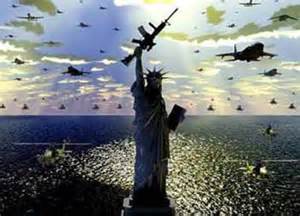
America the Epicenter of Pure Evil

aa-American-Empire-statue-of-liberty-and-military

By Stephen Lendman

Source: SteveLendmanBlog

No nation in world history harmed more people grievously over a longer duration than America – never beautiful, no bastion of democratic values, no advocate of world peace and stability.

Bipartisan lunatics run things, a criminal cabal, humanity’s greatest threat. The domestic and geopolitical agendas of each new administration is worse than its predecessors.

Elections when held are farcical. Duopoly power always wins, monied interests alone served, ordinary people increasingly harmed – full-blown tyranny and nuclear war perhaps following the next major state-sponsored false flag.

Americans have no say on how they’re governed, democracy a mirage. None whatever exists. Scoundrel media and self-serving politicians pretend otherwise – most people either unaware of how they’re ill-served or too indifferent to try changing things, going along with what harms them.

Intelligent people I know are too preoccupied in their daily lives to realize and get involved against the grave danger facing humanity.

The likelihood of a Hillary presidency should terrify everyone – a war goddess, the greatest threat to world peace of any leader in US history if she succeeds Obama.

Yet media scoundrels serve as her press agents. Polls show her ahead. US voters are so out-of-touch, uninformed and indifferent, they support what demands opposition.

I tremble at what’s coming with her in charge. Things may never be the same again. How many more wars will be waged?

How many victims will die or be gravely harmed with her as president? Will the remnants of social justice be entirely discarded? Will police state ruthlessness be harsher than ever? Is unthinkable nuclear war likely?

Is Orwell’s dystopian nightmare on steroids our future? Will Americans ever awaken to the clear and present danger they face? Will they revolt or remain dismissive?


Stephen Lendman lives in Chicago. He can be reached at lendmanstephen@sbcglobal.net.

His new book as editor and contributor is titled “Flashpoint in Ukraine: How the US Drive for Hegemony Risks WW III.” http://www.claritypress.com/LendmanIII.html

Visit his blog site at sjlendman.blogspot.com. 

Hillary Clinton and American Empire

1015636467

By

Source: CounterPunch

Despite the lack of evidence linking Orlando mass murderer Omar Mateen to Daesh (ISIS) in any operational (direct) sense, the first inclination of U.S. Presidential hopeful Hillary Clinton was to renew American bombing of Syria, Iraq and Libya— the very nations that were destroyed by U.S. bombs directed by Mrs. Clinton and from whence Daesh arose. In so doing Mrs. Clinton made it evident that she is an unrepentant militarist whose bloodlust, combined with her longstanding interest in promoting American business interests, ties her to the U.S. imperial project of the last century and one-half. The precise moral difference between mass murders for personal and state reasons depends on a theory of the state at odds with this imperial project.

The company that employed Omar Mateen, G4S, is a British-based ‘security’ company that operates in 120 countries and as a ‘private’ supplier of public services to the Department of Homeland Security, the U.S. Army and to the very same State Department that Mrs. Clinton led as Secretary of State. The company advertises itself capable of ‘mitigating liability’ for the U.S. government— the ruse used by the CIA and other clandestine and quasi-clandestine government agencies to circumvent civil prohibitions on their activities by employing ‘private’ companies to carry them out. The NSA’s domestic surveillance programs tie to those of the FBI, DEA and CIA through this legalistic dodge. And ‘private contractors’ were behind some of the more grotesque slaughters in recent American wars.

The classical liberal separation of economic from political interests used to legitimate state violence is one that the Clintons have spent their ‘public’ careers undermining. As leading proponents of neoliberalism, the Clintons have spent three decades conflating ‘private’ interests with the public interest. In history this tie of U.S. business interests to U.S. military incursions runs from residual European imperialism, including genocide against the indigenous population and slavery, to direct wars, proxy wars, coups, assassinations, murders and particularly odious ‘wars of attrition.’ What is corruption in the liberal worldview is the nature of the capitalist-state acting in / on imperial interests in a Marxian frame. If this corruption is ‘solvable,’ such has yet to be demonstrated in the U.S.

Hillary Clinton’s use of the horrific crime in Orlando to instigate further crimes against untold innocents abroad is hidden behind manufactured fears of a lunatic and craven enemy (ISIS) that is in fact both a product of earlier U.S. atrocities across the Middle East and but a pale ghost of the savagery of combined U.S. actions in the region. The American leadership’s practice of creating crises that it must then ‘respond’ to led the way to the sequential slaughters, disruptions and dislocations that now finds substantial portions of the Middle East in ruins and millions of refugees flooding an increasingly xenophobic Europe. That this leadership never seems to learn from its ‘mistakes’ suggests motivations at work other than those presented at press conferences.

Where G4S, Omar Mateen’s employer, fits in is that Mr. Mateen was in many respects the perfect mercenary— ‘our psychopath’ if we were paying for his services. Murdering 49 people and wounding 50 more is, in addition to being an atrocity, a crime and a moral calamity, a complicated logistical feat. In 2004 U.S. Colonel James Steele was brought to Iraq, in a war that Bill Clinton publicly supported and Hillary Clinton voted for, to engineer like atrocities. Mr. Mateen’s crimes would have been business-as-usual in U.S. led slaughters of innocent civilians in Nicaragua and El Salvador in the 1980s and in Iraq in the 2000s. And G4S is precisely the type of ‘public-private partnership’ favored by the Clintons to ‘mitigate liability’ behind a veil of ‘private’ actions.

This isn’t to suggest that Hillary Clinton had any part in the murders carried out by Mr. Mateen. It is to suggest that in any human and / or moral sense she is congenitally unfit for public office. The most generous explanation of her support for George W. Bush’s criminal slaughter in Iraq is that she was misled by the manufactured evidence proffered by the Bush administration. That the war tied through history to the Clinton’s own sanctions against Iraq that resulted in half a million innocents dying from privation and to eight years of bombing that left much of the country in ruins suggests that Mrs. Clinton probably well understood that Iraq posed no threat to the U.S. in 2001. That the war was coincidentally a boon to Western business interests was / is as grotesque as it was predictable.

If conceptual clarity around these issues seems wanting here— that is the point. Neoliberalism as some unified theory of political economy ties through history to the Washington Consensus that in turn ties to American imperial history. Western imperialism— state-corporatism as division of the global economic spoils through insertion / assertion of ‘national’ interests, has five centuries of reasonably well defined history behind it. In this regard Donald Trump’s relative rhetorical reticence to use military force as a first choice is a threat to this imperial order whereas Hillary Clinton’s willingness to destroy an entire region of the world on a whim to benefit Exxon Mobil and Goldman Sachs makes her the ‘safe’ choice from the institutional perspective.

Washington Consensus precepts are:

*Fiscal discipline

*A redirection of public expenditure priorities toward fields offering both high economic returns and the potential to improve income distribution, such as primary health care, primary education, and infrastructure

*Tax reform (to lower marginal rates and broaden the tax base)

*Interest rate liberalization

*A competitive exchange rate

*Trade liberalization

*Liberalization of inflows of foreign direct investment

*Privatization

*Deregulation (to abolish barriers to entry and exit)

*Secure property rights

Against this imperial history the U.S. view that national elections are an internal matter places U.S. voters as the nominal ‘choosers’ of political economy for much of the world. In political terms, the 800+ military bases that the U.S. keeps around the globe serve as quasi-private security forces to assure repatriation of ‘profits’ for multi-national corporations in the form of resources, plentiful, cheap labor and the broader economy of imperial conquest. In fact, as opposed to theory, these profits are the reciprocal of the death, misery, subjugation and immiseration inevitably put forward by Western economists and politicians as the result of ‘free-choice’ by those on the losing end of American imperial fortune. That increasing numbers of Americans are on this losing end helps explain current (and heretofore slight) political unrest and its reciprocal in establishment support for Mrs. Clinton.

Hillary Clinton’s toxic jargon that “America never stopped being great” poses a seeming conundrum for her supporters who aren’t dedicated sociopaths. If U.S. wars in Southeast Asia, Central America, the Middle East and Northern Africa are evidence of this greatness, then what are the moral and political bases of such a judgment? Mrs. Clinton’s nostalgia for the days of alleged national unity following the attacks of September 11, 2001 is apparently for the erasure of the history that led to the attacks and not for unity per se. Conversely, given the absence of any operational link to Daesh, Omar Mateen could just as well have claimed that his crimes were motivated by Napoleon Bonaparte or Jesus Christ were ISIS not such a well-implanted foe.

Externally, and in contradiction of to the exceptionalists, the democratists and Western neoliberals, the U.S. is broadly considered the greatest threat to world peace on the planet. Brought to the fore in the current Presidential election cycle is that Western elites— inherited wealth, bailout-dependent bankers, the corporate lootocracy dependent on wildly goosed (by the Federal Reserve) asset prices and various and sundry agents, functionaries and court pleaders, are now well-understood to have interests diametrically opposed to those of the vast majority of Americans. The conceptual leap not yet taken by the American electorate is the international nature of this class divide.

bipartychart

Chart: the bi-Party system of electoral control in the U.S. is put forward as representing majority political views when combined it represents less than one-third of voting-age political affiliation. In terms of global political reach, the American political leadership represents such a small minority’s interests that even relatively minor rebellions could quickly overwhelm it. Source: Gallup, Pew Research.

This international ‘footprint’ is fact regardless of whether or not Americans consider it when voting. Internal economic dislocations, such as jobs lost and stagnant wages from trade agreements, find their reciprocals in indigenous economies destroyed, in ‘developing market’ industries shut out through subsidized ‘competition,’ in IMF ‘workouts’ that place ownership of developing industries in Western hands and through commodification and expropriation of millennia of accumulated knowledge to be put back as alien product against the peoples and cultures that developed it. In this respect, the ‘Clinton model’ of sweatshop labor as economic development joins the ‘Obama model’ of subverting civil law in the interests of corporate-state plutocrats.

Calls to unify behind Hillary Clinton in her bid to become President pose the heavily engineered outcome of the Democratic primaries as the popular will. In this sense they are roughly analogous to the calls to unite behind George W. Bush following the Bush v. Gore Supreme Court decision in 2000. The Clintons paved the way for Mr. Bush’s brutal militarism much as Barack Obama maintained the institutional infrastructure of the ‘unitary Presidency’ and the capacity for launching criminal wars of opportunity. Between Hillary Clinton and Donald Trump, it is Mrs. Clinton who has the proven record as guardian of empire and imperial prerogative. Her unbridled militarism is an expression of this prerogative.

The question for Democrats is how evil can someone be to still be worthy of voting for? Alleged stark differences between Hillary Clinton and George W. Bush find very high degrees of synchronicity between their actual policies (and those of Barack Obama). And lest this be unclear, it is the Democratic establishment that chose Mrs. Clinton as its candidate (chart above), and not the politically and economically dispossessed electorate. The grift that American elections reflect the popular will, and therefore confer political legitimacy, contrasts with the facts that the dominant Parties are largely and increasingly unpopular and that the popular will bears no relation to the policies decided upon and enacted by the American political establishment.

Rob Urie is an artist and political economist. His book Zen Economics is published by CounterPunch Books.

US Empire: American Exceptionalism Is No Shining City On a Hill

american-arrogance

By Gilbert Mercier

Source: News Junkie Post

The concept of American exceptionalism is as old as the United States, and it implies that the country has a qualitative difference from other nations. This notion of being special gives Americans the sense that playing a lead role in world affair is part of their natural historic calling. However there is nothing historically exceptional about this: the Roman empire also viewed itself as a system superior to other nations and, more recently, so did the British and the French empires.

On the topic of American exceptionalism, which he often called “Americanism”, Seymour Martin Lipset noted that “America’s ideology can be described in five words: liberty, egalitarism, individualism, populism and laissez-faire. The revolutionary ideology, which became American creed, is liberalism in its eighteenth and nineteenth-century meaning. It departed from conservatism Toryism, statist communitarianism, mercantilism and noblesse-oblige dominant in monarchical state-church formed cultures.” Naturally identifying America’s system as a unique ideology, just like calling its successful colonial war against Britain a revolution, is a fallacy. For one, America was never based on social equality, as rigid class distinctions always remained through US history.

In reality, the US has never broken from European social models. American exceptionalism implies a sense of superiority, just like in the case of the British empire, the French empire and the Roman empire. In such imperialist systems, class inequality was never challenged and, as matter of fact, served as cornerstone of the imperial structure. In American history, the only exception to this system based on social inequality was during the post World War II era of the economic “miracle”. The period from 1945 to the mid 1970s was characterized by major economic growth, an absence of big economic downturns, and a much higher level of social mobility on a massive scale. This time frame saw a tremendous expansion of higher education: from 2.5 million people to 12 million going to colleges and universities, and this education explosion, naturally, fostered this upward mobility where the American dream became possible for the middle class.

Regardless of  real domestic social progress made in the United States after the birth of the empire in 1945, for the proponents of American exceptionalism — this includes the entire political class — the myth of the US being defined as a “shining city on a hill” has always been a rationale to justify the pursuit of imperialism. For example, when President Barack Obama addressed the nation to justify the US military intervention in Libya, he said that “America is different”, as if the US has a special role in history as a force for good. In a speech on US foreign policy, at West Point on May 28, 2014, Obama bluntly stated: “In fact, by most measures, America has rarely been stronger relative to the rest of the world. Those who argue otherwise — who suggest that America is in decline or has seen its global leadership slip away are misreading history. Our military has no peer….  I believe in American exceptionalism with every fiber of my being.”

In his book, Democracy In America, Frenchman Alexis de Tocqueville was lyrical in his propaganda-like adulation of American exceptionalism, defining it almost as divine providence. “When the earth was given to men by the Creator, the earth was inexhaustible. But men were weak and ignorant, and when they had learned to take advantage of the treasures which it contained, they already covered its surface and were soon obliged to earn by the sword an asylum for repose and freedom. Just then North America was discovered, as if it had been kept in reserve by the Deity and had risen from beneath the waters of the deluge”, wrote de Tocqueville.

This notion, originated by the French author, and amplified ever since, which defined the US as the “divine gift” of a moral and virtuous land, is a cruel fairy tale. It is mainly convenient to ease up America’s profound guilt. After all, the brutal birth of this nation took place under the curse of two cardinal sins: the theft of Native American lands after committing a genocide of their population; and the hideous crime of slavery, with slaves building an immense wealth for the few, in a new feudal system, with their sweat, tears and blood.

This American Empire, It Too Will Collapse

Imperial_Overreach

By Dave Lefcourt

Source: RINF.com

Here is my sense; like all empires before it this American one reached its apex after WWII. It’s on a downward trajectory and will eventually fall or be overtaken.

And I believe most Americans will be taken by surprise as in “How could this happen”?

That’s because most Americans are in the words of Paul Craig Roberts “insouciant”, without a care, too passively indifferent, too besotted with technological gadgetry, have feelings of entitlement and believe in American exceptionalism to bother to notice their government has become sinister-which most others in the world recognize, but their governments too intimidated or blackmailed into following us or they will be demonized. Think Iran, Iraq under Saddam-though earlier an ally in his war with Iran in the 80′s-now the newly announced new cold war with Russia and soon to be China.

As for us Americans take an honest look at what passes for our modern American “culture” nowadays-and contributes to maintaining domestic tranquility at all costs. In no particular order:

Consumerism-excessive and beyond all need. And in conjunction with it

Corporatism and commercialization of the public square i.e. the “mallization” of America.

Sports mania, particularly over Pro football and its marketing.

Popular movies featuring gore, crashes, mayhem, aliens, illusion, “virtual” characters replacing real people.

Celebrity gossip as “news”.

Government surveillance by way of technological gadgetry-cell phones, ipods, computers, email, GPS, EZ pass, toll cameras.

MSM becoming complicit in government actions and its propaganda

Addiction with drugs and alcohol

Incarceration-the highest rates of all 1 st world industrialized democraci

Militarization of local and state police

A trillion dollars in college student debt.

Though certainly not contributing to maintaining domestic tranquility, throw in the bailouts of the big banks too big to fail, income inequality worse than the 1920′s and clearly articulated in the 2011 occupy movement that coined the disparity between the 1% and the 99%, no single payer universal health insurance coverage for all, ignoring global warming and the further despoiling of the environment, the demise of domestic manufacturing, the outsourcing of jobs, home foreclosures and bankruptcy stemming from unscrupulous lenders et al and domestically its an America becoming unrecognizable to these old eyes.

As for the policies and actions of our government that unmistakably reveals its true nature, here again in no particular order are:

  • The war industry-the trillion dollar military/corporate/political complex and its revolving door of key players that move seamlessly between each to maintain its control. The other key element is the creation of,
  • “Enemies” contrived such as the “global war on terror”, and the new “cold war” with Russia.
  • Initiating unnecessary and illegal wars and occupations in Afghanistan and Iraq
  • CIA coups, assassinations to create instability to promote endless war
  • NSA surveillance of everyone in the world through “back doors” of computers and software
  • Absolute control of the political agenda and the enacting of laws, regulations oversight and enforcement to the benefit of corporate interests
  • Justice Department lawyers writing memos “legalizing” all executive actions but kept secret for reasons of national security with no oversight by the Congress or the courts
  • Exercise hegemony worldwide, surround Iran, Russia with “allies”, NATO, a thousand military bases worldwide and a floating armada of carrier task forces
  • Initiate cyberwarfare as was done in Iran in 2010 and its enrichment of uranium
  • Engage in extraordinary rendition, indefinite detention and torture of suspects
  • Targeting and prosecuting whistleblowers, hounding Edward Snowden for exposing the NSA‘s illegal surveillance practices.

These domestic and foreign policies and actions are not those of a government that is representative of the people in a democratic republic. These are policies and actions of a plutocracy of oligarchs and an empire willing to go to any length to maintain its hegemony worldwide and control domestically.

Incredibly, what’s propping up this edifice of domestic indulgence and propaganda and foreign villainy is the FED printing money, selling billions in treasury notes to China, Japan, even Russia underpinned by what else, our previous debt in the trillions and all based on the assumption these countries will continue to buy our debt. But it’s a form of blackmail these other countries have accepted, at least for the present. That can’t last forever.

For sure one can’t predict the actual demise of an empire, even the American one. But hubris, American exceptionalism, the sense of entitlement and the idea of it being the “indispensible nation” surely won’t save it from the trash heap of other empires long gone. Such illusions may contribute, even hasten that inevitable collapse.

Dave is the author of “DECEIT AND EXCESS IN AMERICA, HOW THE MONEYED INTERESTS HAVE STOLEN AMERICA AND HOW WE CAN GET IT BACK”, Authorhouse, 2009