
The Elite Coup to Kill or Enslave Us: Why Can’t Governments, Legal Actions and Protests Stop Them?

By Robert J. Burrowes

In 2020, under cover of the ‘virus’/‘vaccine’ narrative, the Global Elite launched its long-planned coup to capture total control of the human population.

Building on a history that dawned with human civilization some 5,000 years ago, and at least 50 years in the final planning, progressive efforts by elites in local, national and now the global context to kill off undesired populations and enslave those left alive are now culminating. See ‘The Final Battle for Humanity: It is “Now or Never” in the Long War Against Homo Sapiens’.

Unfortunately, however, awareness of what is really happening remains extraordinarily low, even among those who are resisting the ongoing destruction of our rights and freedom as well as the rapidly-mounting ‘vaccine’ death toll. See ‘Terrified of Freedom: Why Most Human Beings Are Embracing the Global Elite’s Technotyranny’.

So let me briefly explain, again, exactly what is happening and why the most popular responses – lobbying governments, contesting elections or forming new political parties, legal challenges and protests (in one form or another) – by those concerned cannot succeed. And what we must do, if we wish to defeat this coup.

What is Happening?

If one reads the website of the World Economic Forum as well as primary documents produced by that organization, and listens to the organization’s key spokespeople, such as Klaus Schwab – see ‘Now is the time for a “great reset”’ – and Yuval Noah Harari – see ‘Read Yuval Harari’s blistering warning to Davos in full’ – the elite agenda is quite clear.

Under the overall title of the ‘Great Reset’, the World Economic Forum has launched a series of deeply interrelated agendas which will impose substantial changes on 200 areas of human life for those left alive.

These interrelated agendas include implementation of the elite’s eugenics program – see ‘The Global Elite’s “Kill and Control” Agenda: Destroying Our Food Security’ – along with various programs in relation to the fourth industrial revolution and transhumanism that will deliver them total control of the remaining transhuman population in a world run by technocrats. See ‘Killing Off Humanity: How the Global Elite is using Eugenics and Transhumanism to Shape Our Future’.

These programs include efforts to develop and deploy relevant technologies – including those in relation to 5G (and, soon enough, 6G), military weapons, artificial intelligence [AI], digital identity, big data, nanotechnology and biotechnology, robotics, the Internet of Things [IoT], the Internet of Bodies [IoB], the Internet of Senses [IoS], quantum computing, surveillance and the metaverse – that will subvert human identity, human freedom, human dignity, human volition and/or human privacy. Among other adverse outcomes, these technologies will deprive us of control over our own banking and finances. See ‘Taking Control by Destroying Cash: Beware Cyber Polygon as Part of the Elite Coup’.

To reiterate: The net outcome of these programs will be a substantial human depopulation of Earth and the transhuman enslavement and imprisonment of those left alive, primarily in their ‘smart cities’.

As Mark Steele concluded in his extensive expert report on 5G Directed Energy Radiation Emissions, ‘The prima facie evidence of this globalist depopulation agenda is unequivocal… This is the greatest crime ever to be perpetrated on mankind and all of God’s creation.’ See ‘Expert Report: Fifth Generation (5G) Directed Energy Radiation Emissions in the context of Nanometal-contaminated Vaccines that include Covid-19 with Graphite Ferrous Oxide Antennas’.

Obviously, this is being done without any consultation with those of us who would identify as ‘ordinary’ people.

Who is Orchestrating This?

The coup has been planned by the Global Elite and its primary agents. It is being implemented through elite control of key international organizations (such as the World Health Organization and United Nations), relevant corporations (including those in the technology, pharmaceutical and media industries) and national governments.

The first point to note is simply this: The Global Elite is too wealthy and powerful to bother participating personally in well-known fora such as the World Economic Forum or even those that are less well-known such as the Council for Inclusive Capitalism. The people who ‘front’ organizations of this nature are elite agents. Wealthy and powerful, at one level, and happy to be publicly identified, but not the masters shaping our destinies, even if they work out many of the details. For one discussion of this, see ‘What Is The “Council For Inclusive Capitalism?” It’s The New World Order’.

But because this Global Elite is both insane and criminal, its members have no concept of what it means to experience ‘ordinary’ human life, with its daily struggles and occasional triumphs, its routine fears and simple joys. See ‘The Global Elite is Insane Revisited’. There is more information in ‘Why Violence?’ and ‘Fearless Psychology and Fearful Psychology: Principles and Practice’.

So let me briefly explain, yet again, why governments, legal challenges and protests in their various guises cannot save us from what is happening, although the elite is delighted to have us waste our energy on such efforts, as they intend.

Constitutions, Governments and the Delusion of ‘Democracy’

While so-called democratic processes have long been a sham, even the sham elements of democracies – the constitutional separation of powers (the division of the legislative, executive and judicial functions of government supposedly to limit the possibility of arbitrary excesses by government), respect for human rights (including freedom of speech, assembly and movement), obedience of laws and adherence to legal process – have been ignored by virtually all governments (national, provincial and local) around the world as measures decided by the elite and promulgated through its international organizations such as the World Economic Forum and the World Health Organization have simply been implemented by governments despite violating constitutional provisions in various ways and without so much as a public (or, in many cases, even a parliamentary) debate.

To reiterate this point more bluntly: given the eminent roles being played by elite organizations such as the World Economic Forum and the World Health Organization in the past two-and-a-half years, do you have much sense that governments are adhering to national constitutions and making independent decisions? Or are they just following orders?

And despite supposedly having the right to ‘freedom of speech’, even dissenting politicians attempting to present an alternative view in any mainstream forum, and plenty of ‘progressive’ ones besides, leads to one of a range of outcomes such as, at their most benign, censorship – with corporate and major social media leading the way – or howls of accusation such as ‘conspiracy theorist’ and ‘anti-vaxxer’ to discredit the dissenting voice.

This has happened, of course, because politicians are not beholden to voters, which is why lobbying politicians is a waste of time, unless the issue is of little significance geopolitically, militarily, economically and environmentally. As implied above, the elite controls the political fate of politicians, most of whom are well aware that their political survival has nothing to do with pleasing ordinary voters. Politicians are beholden to the elite that manipulates levers of power such as the corporate media and education systems, employs an army of lobbyists to ensure that elite preference is clearly understood (while using bribes where necessary), and has ready access to removal options such as, at its most basic, withdrawal of preselection endorsement.

Of course, the ultimate sanction, paid by five national presidents so far in this current context, is assassination. See ‘Five Presidents Who Opposed Covid Vaccines Have Conveniently Died, Been Replaced by Pro-Vaxxers’.

And Emanuel Pastreich makes a compelling argument that Shinzo Abe, the powerful immediate-past Prime Minister of Japan, suffered the same fate because of his ongoing resistance to fundamental elements of the Elite agenda. Moreover, there are other key political figures who are probably in this category, not to mention those sidelined rather than assassinated.

Abe was the highest ranking victim so far of the hidden cancer eating away at governance in nation states around the world, an institutional sickness that moves decision making away from national governments to a network of privately-held supercomputer banks, private equity groups, for-hire intelligence firms in Tel Aviv, London and Reston, and the strategic thinkers employed by the billionaires at the World Economic Forum, NATO, the World Bank and other such awesome institutions.

In parallel with the removal or sidelining of non-compliant leaders, elite wealth has long been deployed ‘to create invisible networks for secret global governance, best represented by the World Economic Forum’s Young Global Leaders program and the Schwarzman Scholars program. These rising figures in policy infiltrate the governments, the industries, and research institutions of nations to make sure that the globalist agenda goes forth unimpeded.’ See ‘The Assassination of Archduke Shinzo Abe: When the Globalists Crossed the Rubicon’.

As a result of formal political submission to the elite agenda, supposedly basic human rights – such as freedom of speech, assembly and movement – have been eviscerated under the various lockdown, curfew and martial law measures with many people attempting to exercise these rights quickly discovering that they no longer exist except, perhaps, in the very narrowest of circles or in particular contexts.

But perhaps constitutional lawyer John W. Whitehead, in collaboration with Nisha Whitehead, captures the true depth of what has transpired in these two paragraphs about the United States but equally applicable to other countries:

Not only have the federal and state governments unraveled the constitutional fabric of the nation with lockdown mandates that sent the economy into a tailspin and wrought havoc with our liberties, but they have almost persuaded the citizenry to depend on the government for financial handouts, medical intervention, protection and sustenance.

This past year under lockdown was a lesson in many things, but most of all, it was a lesson in how to indoctrinate a populace to love and obey Big Brother. See ‘After a Year Under Lockdown, Will Our Freedoms Survive the Tyranny of COVID-19?’

But ‘Big Brother’ isn’t the government. It is those elite figures who are largely, or completely, hidden from public view and about whom you hear nothing of substance, if you hear anything at all.

Still, this doesn’t stop their agents, such as those in the Council for Inclusive Capitalism, from telling you what they are doing. It’s just that not many people are paying attention.

As noted by Brandon Smith: ‘Members of the CIC, including the head of Bank of America, openly suggest that they don’t actually need governments to cooperate in order to meet their goals. They say corporations can implement most social engineering without political aid. In other words, it is the very definition of “shadow government” – A massive corporate cabal that works in tandem to implement social changes without any oversight.’ See ‘What Is The “Council For Inclusive Capitalism?” It’s The New World Order’.

If you still believe that we can get out of this mess by lobbying governments or electing a different political party into government, you can read more on how the world really works in ‘Killing Democracy Once and for All: The Global Elite’s Coup d’état That Is Destroying Life as We Know It’.

Legal Challenges

While ‘the law’ and legal processes are shrouded in a delusion suggesting that they play a role in making societies ‘just’, in fact, it has long been known that elite control of governments ensures that laws are written to consolidate predatory corporate control and that elite control over legal systems ensures that they function to maintain elite power, corporate profit and the personal privilege of that tiny minority that benefits enormously from the global system of violence, exploitation and destruction.

In 1748, Baron de Montesquieu penned The Spirit of Laws in which he noted ‘There is no greater tyranny than that which is perpetrated under the shield of the law and in the name of justice.’ Since that time, a notable and diverse series of authors starting well over 100 years ago, including Karl Marx, Leo Tolstoy and Mohandas K. Gandhi, have all written critiques exposing the injustice and violence of legal systems. Despite this, the delusion that the law is a neutral agency that delivers justice still widely prevails.

As a result, enormous time, energy and resources are wasted by fine, well-intentioned people who fail to make the distinction between what they have been led to believe and the truth: The legal system is designed to deliver an occasional win for justice in some relatively minor context in order to maintain the widespread popular delusion that ‘justice prevails’ while functioning to maintain elite social control over the population, oppress exploited constituencies and those who resist, and conceal and defend the vast network of elite and corporate criminality that pervades every facet of planetary life. This delusion is reinforced by films and television programs based on legal settings which often feature the ‘little person’ winning.

And this is why you have never heard the rallying cry ‘Fight for Justice: Abolish Legal Systems’.

If you think the law is really concerned with justice, then ask yourself why poverty and homelessness are not made illegal and those who suffer poverty and homelessness immediately provided with social housing and an adequate income. Of course, this would be easy if military budgets for killing were eliminated (and international conflicts were addressed meaningfully) or the estimated $US32 trillion of illegal wealth hidden in offshore tax havens was made available for the benefit of humanity. See ‘Elite Banking at Your Expense: How Secretive Tax Havens are Used to Steal Your Money’.

The bottom line is simple: The Global Elite operates beyond the rule of law. It will not be contained or held to account, in any way, by legal systems. Ever heard of a Rothschild, a Warburg, a Rockefeller or even a Windsor in court? Or organizations like the World Economic Forum and the United Nations?

And while any investigation will quickly reveal that attempts are sometimes made to hold to account a corporation for some illegal activity in a national context, the record also shows that the predominant outcomes in court cases against corporations are protracted legal battles seeking ways out of, or long delays in, being held accountable, fines that are easily ‘written off’ as a cost of doing business – see ‘Pfizer’s History of Fraud, Corruption, and Using Nigerian Children as “Human Guinea Pigs”’ – as well as refusal to pay fines and/or retribution against complainants and/or their agents. See ‘How the Environmental Lawyer Who Won a Massive Judgment Against Chevron Lost Everything’.

Of course, there is no international legal infrastructure that can hold corporations or international organizations accountable in any meaningful way either.

If you want to read more about this subject, see ‘The Rule of Law: Unjust and Violent’.

Demonstrations, Blockades, Convoys and other Mass Mobilizations

If we do not thoroughly analyze a conflict, it is impossible to develop a sound strategy, which includes identifying the appropriate strategic foci for action, and then planning tactics that address each focus. This inevitably means that we are essentially guessing what to do, not knowing in advance, as we should, the nature of the strategic impact the action will have.

Moreover, guessing what action to take, usually on the basis of what is familiar or what feels good – perhaps because we get out with a bunch of ‘good people’ – virtually inevitably leads to poor choices like organizing a mass mobilization, in one form or another (whether with people, trucks, tractors…), focused on governments. And elite agents love ignoring these, as the long record demonstrates!

As former US Secretary of State Alexander Haig once noted about a massive anti-war demonstration: ‘Let them march all they want, as long as they continue to pay their taxes.’ See Alexander Haig. As a four-star general, Haig, not regarded as the most intelligent Secretary of State in US history, certainly understood the importance of tactical choice. Most activists have no idea.

Which illustrates why demonstrations are notoriously ineffective, as world history’s largest demonstration on 15 February 2003 – involving demonstrations in more than 600 cities around the world, involving up to 30,000,000 people, against the imminent US-led war on Iraq – see ‘The World Says No to War: Demonstrations against the War on Iraq’ – illustrated yet again.

The point is simple: Single actions and numbers are not determinative; strategy is determinative. Obviously, large gatherings, in whatever form they take, could be effective, if they were strategically focused – never on governments though. See ‘Why Activists Fail’.

In essence, if any gathering is to have any strategic value whatsoever, it must be used to raise awareness of strategic means of resistance.

So if we want to take action that will be strategically effective, we must identity an appropriate strategic goal for the context and then plan an action that will achieve that goal. Anything else is guesswork. See ‘Nonviolent Action: Why and How it Works’.

Resisting the Elite Agenda Effectively

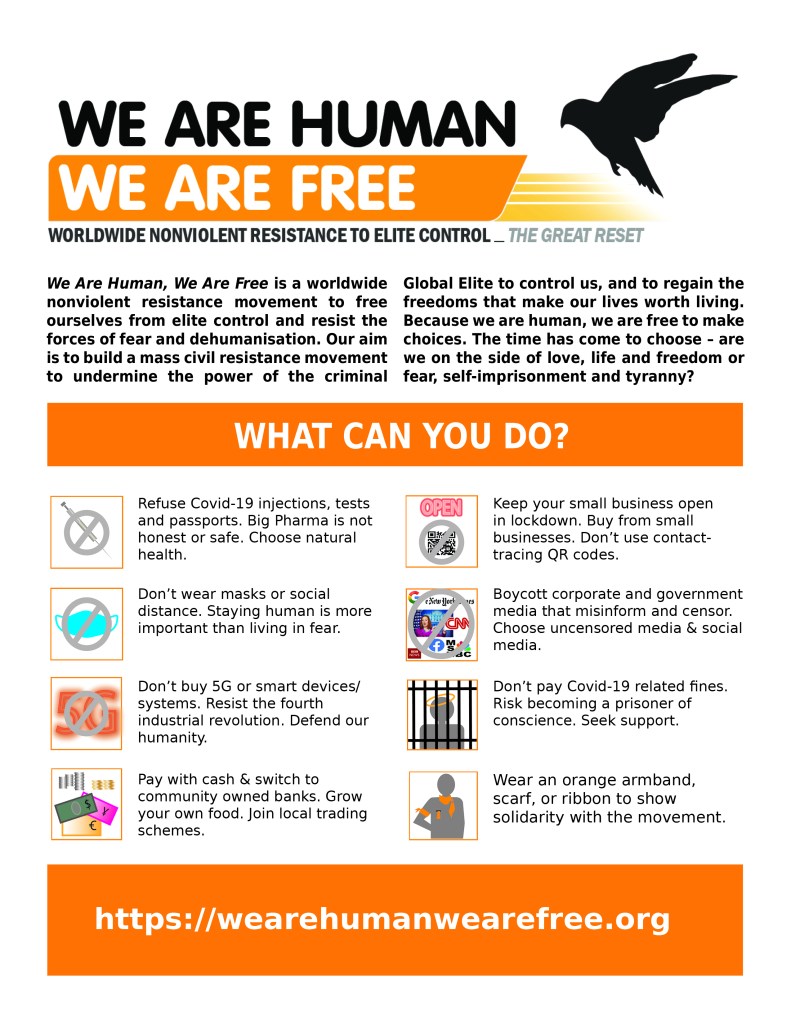
If you have the thoughtful courage to strategically resist the ‘Great Reset’ and its related agendas, you are welcome to participate in the ‘We Are Human, We Are Free’ campaign which identifies a list of 30 strategic goals for doing so.

In addition and more simply, you can download a one-page flyer that identifies a short series of crucial nonviolent actions that anyone can take. This flyer, now available in 17 languages (Czech, Danish, Dutch, English, Finnish, French, German, Greek, Hebrew, Hungarian, Italian, Polish, Romanian, Russian, Serbian, Spanish & Slovak) with several more languages in the pipeline, can be downloaded from here: ‘The 7 Days Campaign to Resist the Great Reset’.

If strategically resisting the ‘Great Reset’ (and related agendas) appeals to you, consider joining the ‘We Are Human, We Are Free’ Telegram group (with a link accessible from the website).

And if you want to organize a mass mobilization in some form, at least make sure that one or more of any team of organizers and/or speakers is responsible for inviting people to participate in this campaign and that some people at the event are designated to hand out the one-page flyer about the campaign.

If you like, you can also watch, share and/or organize to show, a short video about the campaign here: ‘We Are Human, We Are Free’ video.

Finally, while the timeframe for this to make any difference is now in doubt, if you want to raise children who are powerfully able to investigate, analyze and act, you are welcome to make ‘My Promise to Children’.

Conclusion

As the elite is well aware, critiques of what it is doing and advice regarding effective strategy to defeat it are not sought by those who aren’t interested in analysis, understanding and strategic impact. And this information is easily suppressed so that few of those who might be interested ever hear of it.

Hence, a primary challenge is getting relevant information to those keen to resist in ways that make a difference.

At the moment, virtually all effort being spent by those opposed to the various mandates and restrictions on our freedom and other rights is, strategically-speaking, wasted.

And the time to resist effectively is running out fast.

So I gently encourage all of you resisting to spend some time evaluating what you are doing and consider participating in the alternative offered just above.

If human beings are to have a future worth living, we must take on the Global Elite directly and undermine their power to impose their agenda upon us. No one else can save us.

Biodata: Robert J. Burrowes has a lifetime commitment to understanding and ending human violence. He has done extensive research since 1966 in an effort to understand why human beings are violent and has been a nonviolent activist since 1981. He is the author of ‘Why Violence?’ His email address is flametree@riseup.net and his website is at http://robertjburrowes.wordpress.com

Watch the new video for “We Are Human We Are Free“:
US – UK Intel Agencies Declare Cyber War on Independent Media

British and American state intelligence agencies are “weaponizing truth” to quash vaccine hesitancy as both nations prepare for mass inoculations, in a recently announced “cyber war” to be commanded by AI-powered arbiters of truth against information sources that challenge official narratives.

By Whitney Webb

Source: Unlimited Hangout

In just the past week, the national-security states of the United States and United Kingdom have discreetly let it be known that the cyber tools and online tactics previously designed for use in the post-9/11 “war on terror” are now being repurposed for use against information sources promoting “vaccine hesitancy” and information related to Covid-19 that runs counter to their state narratives. 

A new cyber offensive was launched on Monday by the UK’s signal intelligence agency, Government Communications Headquarters (GCHQ), which seeks to target websites that publish content deemed to be “propaganda” that raises concerns regarding state-sponsored Covid-19 vaccine development and the multi-national pharmaceutical corporations involved. 

Similar efforts are underway in the United States, with the US military recently funding a CIA-backed firm—stuffed with former counterterrorism officials who were behind the occupation of Iraq and the rise of the so-called Islamic State—to develop an AI algorithm aimed specifically at new websites promoting “suspected” disinformation related to the Covid-19 crisis and the US military–led Covid-19 vaccination effort known as Operation Warp Speed.

Both countries are preparing to silence independent journalists who raise legitimate concerns over pharmaceutical industry corruption or the extreme secrecy surrounding state-sponsored Covid-19 vaccination efforts, now that Pfizer’s vaccine candidate is slated to be approved by the US Food and Drug Administration (FDA) by month’s end. 

Pfizer’s history of being fined billions for illegal marketing and for bribing government officials to help them cover up an illegal drug trial that killed eleven children (among other crimes) has gone unmentioned by most mass media outlets, which instead have celebrated the apparently imminent approval of the company’s Covid-19 vaccine without questioning the company’s history or that the mRNA technology used in the vaccine has sped through normal safety trial protocols and has never been approved for human use. Also unmentioned is that the head of the FDA’s Center for Drug Evaluation and Research, Patrizia Cavazzoni, is the former Pfizer vice president for product safety who covered up the connection of one of its products to birth defects.

Essentially, the power of the state is being wielded like never before to police online speech and to deplatform news websites to protect the interests of powerful corporations like Pfizer and other scandal-ridden pharmaceutical giants as well as the interests of the US and UK national-security states, which themselves are intimately involved in the Covid-19 vaccination endeavor. 

UK Intelligence’s New Cyberwar Targeting “Anti-Vaccine Propaganda”

On Monday, the UK newspaper The Times reported that the UK’s GCHQ “has begun an offensive cyber-operation to disrupt anti-vaccine propaganda being spread by hostile states” and “is using a toolkit developed to tackle disinformation and recruitment material peddled by Islamic State” to do so. In addition, the UK government has ordered the British military’s 77th Brigade, which specializes in “information warfare,” to launch an online campaign to counter “deceptive narratives” about Covid-19 vaccine candidates.

The newly announced GCHQ “cyber war” will not only take down “anti-vaccine propaganda” but will also seek to “disrupt the operations of the cyberactors responsible for it, including encrypting their data so they cannot access it and blocking their communications with each other.”  The effort will also involve GCHQ reaching out to other countries in the “Five Eyes” alliance (US, Australia, New Zealand and Canada) to alert their partner agencies in those countries to target such “propaganda” sites hosted within their borders.

The Times stated that “the government regards tackling false information about inoculation as a rising priority as the prospect of a reliable vaccine against the coronavirus draws closer,” suggesting that efforts will continue to ramp up as a vaccine candidate gets closer to approval.

It seems that, from the perspective of the UK national-security state, those who question corruption in the pharmaceutical industry and its possible impact on the leading experimental Covid-19 vaccine candidates (all of which use experimental vaccine technologies that have never before been approved for human use) should be targeted with tools originally designed to combat terrorist propaganda. 

While The Times asserted that the effort would target content “that originated only from state adversaries” and would not target the sites of “ordinary citizens,” the newspaper suggested that the effort would rely on the US government for determining whether or not a site is part of a “foreign disinformation” operation. 

This is highly troubling given that the US recently seized the domains of many sites, including the American Herald Tribune, which it erroneously labeled as “Iranian propaganda,” despite its editor in chief, Anthony Hall, being based in Canada. The US government made this claim about the American Herald Tribune after the cybersecurity firm FireEye, a US government contractor, stated that it had “moderate confidence” that the site had been “founded in Iran.” 

In addition, the fact that GCHQ has alleged that most of the sites it plans to target are “linked to Moscow” gives further cause for concern given that the UK government was caught funding the Institute for Statecraft’s Integrity Initiative, which falsely labeled critics of the UK government’s actions as well as its narratives with respect to the Syria conflict as being related to “Russian disinformation” campaigns.

Given this precedent, it is certainly plausible that GCHQ could take the word of either an allied government, a government contractor, or perhaps even an allied media organization such as Bellingcat or the Atlantic Council’s DFRLab that a given site is “foreign propaganda” in order to launch a cyber offensive against it. Such concerns are only amplified when one of the main government sources for The Times article bluntly stated that “GCHQ has been told to take out antivaxers [sic] online and on social media. There are ways they have used to monitor and disrupt terrorist propaganda,” which suggests that the targets of GCHQ’s new cyber war will, in fact, be determined by the content itself rather than their suspected “foreign” origin. The “foreign” aspect instead appears to be a means of evading the prohibition in GCHQ’s operational mandate on targeting the speech or websites of ordinary citizens.

This larger pivot toward treating alleged “anti-vaxxers” as “national security threats” has been ongoing for much of this year, spearheaded in part by Imran Ahmed, the CEO of the UK-based Center for Countering Digital Hate, a member of the UK government’s Steering Committee on Countering Extremism Pilot Task Force, which is part of the UK government’s Commission for Countering Extremism. 

Ahmed told the UK newspaper The Independent in July that “I would go beyond calling anti-vaxxers conspiracy theorists to say they are an extremist group that pose a national security risk.” He then stated that “once someone has been exposed to one type of conspiracy it’s easy to lead them down a path where they embrace more radical world views that can lead to violent extremism,” thereby implying that “anti-vaxxers” might engage in acts of violent extremism. Among the websites cited by Ahmed’s organization as promoting such “extremism” that poses a “national security risk” were Children’s Health Defense, the National Vaccine Information Center, Informed Consent Action Network, and Mercola.com, among others.

Similarly, a think tank tied to US intelligence—whose GCHQ equivalent, the National Security Agency, will take part in the newly announced “cyber war”—argued in a research paper published just months before the onset of the Covid-19 crisis that “the US ‘anti-vaxxer’ movement would pose a threat to national security in the event of a ‘pandemic with a novel organism.’”

InfraGard, “a partnership between the Federal Bureau of Investigation (FBI) and members of the private sector,” warned in the paper published last June that “the US anti-vaccine movement would also be connected with ‘social media misinformation and propaganda campaigns’ orchestrated by the Russian government,” as cited by The Guardian. The InfraGard paper further claimed that prominent “anti-vaxxers” are aligned “with other conspiracy movements including the far right . . . and social media misinformation and propaganda campaigns by many foreign and domestic actors. Included among these actors is the Internet Research Agency, the Russian government–aligned organization.”

An article published just last month by the Washington Post argued that “vaccine hesitancy is mixing with coronavirus denial and merging with far-right American conspiracy theories, including Qanon,” which the FBI named a potential domestic terror threat last year. The article quoted Peter Hotez, dean of the School of Tropical Medicine at Baylor College of Medicine in Houston, as saying “The US anti-vaccination movement is globalizing and it’s going toward more-extremist tendencies.”

It is worth pointing out that many so-called “anti-vaxxers” are actually critics of the pharmaceutical industry and are not necessarily opposed to vaccines in and of themselves, making the labels “anti-vaxxer” and “anti-vaccine” misleading. Given that many pharmaceutical giants involved in making Covid-19 vaccines donate heavily to politiciansin both countries and have been involved in numerous safety scandals, using state intelligence agencies to wage cyber war against sites that investigate such concerns is not only troubling for the future of journalism but it suggests that the UK is taking a dangerous leap toward becoming a country that uses its state powers to treat the enemies of corporations as enemies of the state.

The CIA-Backed Firm “Weaponizing Truth” with AI

In early October, the US Air Force and US Special Operations Command announced that they had awarded a multimillion-dollar contract to the US-based “machine intelligence” company Primer. Per the press release, “Primer will develop the first-ever machine learning platform to automatically identify and assess suspected disinformation [emphasis added]. Primer will also enhance its natural language processing platform to automatically analyze tactical events to provide commanders with unprecedented insight as events unfold in near real-time.”

According to Primer, the company “builds software machines that read and write in English, Russian, and Chinese to automatically unearth trends and patterns across large volumes of data,” and their work “supports the mission of the intelligence community and broader DOD by automating reading and research tasks to enhance the speed and quality of decision-making.” In other words, Primer is developing an algorithm that would allow the national-security state to outsource many military and intelligence analyst positions to AI. In fact, the company openly admits this, stating that their current effort “will automate the work typically done by dozens of analysts in a security operations center to ingest all of the data relevant to an event as it happens and funnel it into a unified user interface.”

Primer’s ultimate goal is to use their AI to entirely automate the shaping of public perceptions and become the arbiter of “truth,” as defined by the state. Primer’s founder, Sean Gourley, who previously created AI programs for the military to track “insurgency” in post-invasion Iraq, asserted in an April blog post that “computational warfare and disinformation campaigns will, in 2020, become a more serious threat than physical war, and we will have to rethink the weapons we deploy to fight them.” 

In that same post, Gourley argued for the creation of a “Manhattan Project for truth” that would create a publicly available Wikipedia-style database built off of “knowledge bases [that] already exist inside many countries’ intelligence agencies for national security purposes.” Gourley then wrote that “this effort would be ultimately about building and enhancing our collective intelligence and establishing a baseline for what’s true or not” as established by intelligence agencies. He concludes his blog post by stating that “in 2020, we will begin to weaponize truth.”

Notably, on November 9, the same day that GCHQ announced its plans to target “anti-vaccine propaganda,” the US website NextGov reported that Primer’s Pentagon-funded effort had turned its attention specifically to “Covid-19 related disinformation.” According to Primer’s director of science, John Bohannon, “Primer will be integrating bot detection, synthetic text detection and unstructured textual claims analysis capabilities into our existing artificial intelligence platform currently in use with DOD. . . . This will create the first unified mission-ready platform to effectively counter Covid-19-related disinformation in near-real time.”

Bohannon, who previously worked as a mainstream journalist embedded with NATO forces in Afghanistan, also told NextGov that Primer’s new Covid-19–focused effort “automatically classifies documents into one of 10 categories to enable the detection of the impact of COVID” on areas such as “business, science and technology, employment, the global economy, and elections.” The final product is expected to be delivered to the Pentagon in the second quarter of next year.

Though a so-called private company, Primer is deeply linked to the national-security state it is designed to protect by “weaponizing truth.” Primer proudly promotes itself as having more than 15 percent of its staff hailing from the US intelligence community or military. The director of the company’s National Security Group is Brian Raymond, a former CIA intelligence officer who served as the Director for Iraq on the US National Security Council after leaving the agency. 

The company also recently added several prominent national-security officials to its board including:

  • Gen. Raymond Thomas (ret.), who led the command of all US and NATO Special Operations Forces in Afghanistan and is the former commander of both US Special Operations Command and Joint Special Operations Command (JSOC).
  • Lt. Gen. VeraLinn Jamieson (ret.), the former deputy chief of staff for Air Force Intelligence, Surveillance and Reconnaissance who led the Air Force’s intelligence and cyber forces. She also personally developed “strategic partnerships” between the Air Force and Microsoft, Amazon, Google, and IBM in order “to accelerate the Air Force’s digital transformation.”
  • Brett McGurk, one of the “chief architects” of the Iraq War “surge,” alongside the notorious Kagan family, as NSC Director for Iraq, and then as special assistant to the president and senior Director for Iraq and Afghanistan during the Bush administration. Under Obama and during part of the Trump administration, McGurk was the special presidential envoy for the Global Coalition to Defeat ISIS at the State Department, helping to manage the “dirty war” waged by the US, the UK, and other allies against Syria.

In addition to those recent board hires, Primer brought on Sue Gordon, the former principal deputy director of National Intelligence, as a strategic adviser. Gordon previously “drove partnerships within the US Intelligence Community and provided advice to the National Security Council in her role as deputy director of national intelligence” and had a twenty-seven-year career at the CIA. The deep links are unsurprising, given that Primer is financially backed by the CIA’s venture-capital arm In-Q-Tel and the venture-capital arm of billionaire Mike Bloomberg, Bloomberg Beta.

Operation Warp Speed’s Disinformation Blitzkrieg   

The rapid increase in interest by the US and UK national-security states toward Covid-19 “disinformation,” particularly as it relates to upcoming Covid-19 vaccination campaigns, is intimately related to the media-engagement strategy of the US government’s Operation Warp Speed. 

Officially a “public-private partnership,” Operation Warp Speed, which has the goal of vaccinating 300 million Americans by next January, is dominated by the US military and also involves several US intelligence agencies, including the National Security Agency (NSA) and the Department of Homeland Security (DHS), as well as intelligence-linked tech giants Google, Oracle, and Palantir. Several reports published in The Last American Vagabondby this author and journalist Derrick Broze have revealed the extreme secrecy of the operation, its numerous conflicts of interest, and its deep ties to Silicon Valley and Orwellian technocratic initiatives. 

Warp Speed’s official guidance discusses at length its phased plan for engaging the public and addressing issues of “vaccine hesitancy.” According to the Warp Speed document entitled “From the Factory to the Frontlines,” “strategic communications and public messaging are critical to ensure maximum acceptance of vaccines, requiring a saturation of messaging across the national media.” It also states that “working with established partners—especially those that are trusted sources for target audiences—is critical to advancing public understanding of, access to, and acceptance of eventual vaccines” and that “identifying the right messages to promote vaccine confidence, countering misinformation, and targeting outreach to vulnerable and at-risk populations will be necessary to achieve high coverage.”

The document also notes that Warp Speed will employ the CDC’s three-pronged strategic framework for its communications effort. The third pillar of that strategy is entitled “Stop Myths” and has as a main focus “establish[ing] partnerships to contain the spread of misinformation” as well as “work[ing] with local partners and trusted messengers to improve confidence in vaccines.”

Though that particular Warp Speed document is short on specifics, the CDC’s Covid-19 Vaccination Program Interim Playbook contains additional information. It states that Operation Warp Speed will “engage and use a wide range of partners, collaborations, and communication and news media channels to achieve communication goals, understanding that channel preferences and credible sources vary among audiences and people at higher risk for severe illness and critical populations, and channels vary in their capacity to achieve different communication objectives.” It states that it will focus its efforts in this regard on “traditional media channels” (print, radio, and TV) as well as “digital media” (internet, social media, and text messaging). 

The CDC document further reveals that the “public messaging” campaign to “promote vaccine uptake” and address “vaccine hesitancy” is divided into four phases and adds that the overall communication strategy of Warp Speed “should be timely and applicable for the current phase of the Covid-19 Vaccination program.” 

Those phases are:

  • Before a vaccine is available
  • The vaccine is available in limited supply for certain populations of early focus
  • The vaccine is increasingly available for other critical populations and the general public
  • The vaccine is widely available

Given that the Covid-19 vaccine candidate produced by Pfizer is expected to be approved by the end of November, it appears that the US national-security state, which is essentially running Operation Warp Speed, along with “trusted messengers” in mass media, is preparing to enter the second phase of its communications strategy, one in which news organizations and journalists who raise legitimate concerns about Warp Speed will be de-platformed to make way for the “required” saturation of pro-vaccine messaging across the English-speaking media landscape.

Techno-Tyranny: How The US National Security State Is Using Coronavirus To Fulfill An Orwellian Vision

Last year, a government commission called for the US to adopt an AI-driven mass surveillance system far beyond that used in any other country in order to ensure American hegemony in artificial intelligence. Now, many of the “obstacles” they had cited as preventing its implementation are rapidly being removed under the guise of combating the coronavirus crisis.

By Whitney Webb

Source: Unlimited Hangout

Last year, a U.S. government body dedicated to examining how artificial intelligence can “address the national security and defense needs of the United States” discussed in detail the “structural” changes that the American economy and society must undergo in order to ensure a technological advantage over China, according to a recent document acquired through a FOIA request. This document suggests that the U.S. follow China’s lead and even surpass them in many aspects related to AI-driven technologies, particularly their use of mass surveillance. This perspective clearly clashes with the public rhetoric of prominent U.S. government officials and politicians on China, who have labeled the Chinese government’s technology investments and export of its surveillance systems and other technologies as a major “threat” to Americans’ “way of life.”

In addition, many of the steps for the implementation of such a program in the U.S., as laid out in this newly available document, are currently being promoted and implemented as part of the government’s response to the current coronavirus (Covid-19) crisis. This likely due to the fact that many members of this same body have considerable overlap with the taskforces and advisors currently guiding the government’s plans to “re-open the economy” and efforts to use technology to respond to the current crisis.

The FOIA document, obtained by the Electronic Privacy Information Center (EPIC), was produced by a little-known U.S. government organization called the National Security Commission on Artificial Intelligence (NSCAI). It was created by the 2018 National Defense Authorization Act (NDAA) and its official purpose is “to consider the methods and means necessary to advance the development of artificial intelligence (AI), machine learning, and associated technologies to comprehensively address the national security and defense needs of the United States.”

The NSCAI is a key part of the government’s response to what is often referred to as the coming “fourth industrial revolution,” which has been described as “a revolution characterized by discontinuous technological development in areas like artificial intelligence (AI), big data, fifth-generation telecommunications networking (5G), nanotechnology and biotechnology, robotics, the Internet of Things (IoT), and quantum computing.”

However, their main focus is ensuring that “the United States … maintain a technological advantage in artificial intelligence, machine learning, and other associated technologies related to national security and defense.” The vice-chair of NSCAI, Robert Work – former Deputy Secretary of Defense and senior fellow at the hawkish Center for a New American Security (CNAS)described the commission’s purpose as determining “how the U.S. national security apparatus should approach artificial intelligence, including a focus on how the government can work with industry to compete with China’s ‘civil-military fusion’ concept.”

The recently released NSCAI document is a May 2019 presentation entitled “Chinese Tech Landscape Overview.” Throughout the presentation, the NSCAI promotes the overhaul of the U.S. economy and way of life as necessary for allowing the U.S. to ensure it holds a considerable technological advantage over China, as losing this advantage is currently deemed a major “national security” issue by the U.S. national security apparatus. This concern about maintaining a technological advantage can be seen in several other U.S. military documents and think tank reports, several of which have warned that the U.S.’ technological advantage is quickly eroding.

The U.S. government and establishment media outlets often blame alleged Chinese espionage or the Chinese government’s more explicit partnerships with private technology companies in support of their claim that the U.S. is losing this advantage over China. For instance, Chris Darby, the current CEO of the CIA’s In-Q-Tel, who is also on the NSCAI, told CBS News last year that China is the U.S.’ main competitor in terms of technology and that U.S. privacy laws were hampering the U.S.’ capacity to counter China in this regard, stating that:

“[D]ata is the new oil. And China is just awash with data. And they don’t have the same restraints that we do around collecting it and using it, because of the privacy difference between our countries. This notion that they have the largest labeled data set in the world is going to be a huge strength for them.”

In another example, Michael Dempsey – former acting Director of National Intelligence and currently a government-funded fellow at the Council on Foreign Relations – argued in The Hill that:

“It’s quite clear, though, that China is determined to erase our technological advantage, and is committing hundreds of billions of dollars to this effort. In particular, China is determined to be a world leader in such areas as artificial intelligence, high performance computing, and synthetic biology. These are the industries that will shape life on the planet and the military balance of power for the next several decades.”

In fact, the national security apparatus of the United States is so concerned about losing a technological edge over China that the Pentagon recently decided to join forces directly with the U.S. intelligence community in order “to get in front of Chinese advances in artificial intelligence.” This union resulted in the creation of the Joint Artificial Intelligence Center (JAIC), which ties together “the military’s efforts with those of the Intelligence Community, allowing them to combine efforts in a breakneck push to move government’s AI initiatives forward.” It also coordinates with other government agencies, industry, academics, and U.S. allies. Robert Work, who subsequently became the NSCAI vice-chair, said at the time that JAIC’s creation was a “welcome first step in response to Chinese, and to a lesser extent, Russian, plans to dominate these technologies.”

Similar concerns about “losing” technological advantage to China have also been voiced by the NSCAI chairman, Eric Schmidt, the former head of Alphabet – Google’s parent company, who argued in February in the New York Times that Silicon Valley could soon lose “the technology wars” to China if the U.S. government doesn’t take action. Thus, the three main groups represented within the NSCAI – the intelligence community, the Pentagon and Silicon Valley – all view China’s advancements in AI as a major national security threat (and in Silicon Valley’s case, threat to their bottom lines and market shares) that must be tackled quickly.

Targeting China’s “adoption advantage”

In the May 2019 “Chinese Tech Landscape Overview” presentation, the NSCAI discusses that, while the U.S. still leads in the “creation” stage of AI and related technologies, it lags behind China in the “adoption” stage due to “structural factors.” It says that “creation”, followed by “adoption” and “iteration” are the three phases of the “life cycle of new tech” and asserts that failing to dominate in the “adoption” stage will allow China to “leapfrog” the U.S. and dominate AI for the foreseeable future.

The presentation also argues that, in order to “leapfrog” competitors in emerging markets, what is needed is not “individual brilliance” but instead specific “structural conditions that exist within certain markets.” It cites several case studies where China is considered to be “leapfrogging” the U.S. due to major differences in these “structural factors.” Thus, the insinuation of the document (though not directly stated) is that the U.S. must alter the “structural factors” that are currently responsible for its lagging behind China in the “adoption” phase of AI-driven technologies.

Chief among the troublesome “structural factors” highlighted in this presentation are so-called “legacy systems” that are common in the U.S. but much less so in China. The NSCAI document states that examples of “legacy systems” include a financial system that still utilizes cash and card payments, individual car ownership and even receiving medical attention from a human doctor. It states that, while these “legacy systems” in the US are “good enough,” too many “good enough” systems “hinder the adoption of new things,” specifically AI-driven systems.

Another structural factor deemed by the NSCAI to be an obstacle to the U.S.’ ability to maintain a technological advantage over China is the “scale of the consumer market,” arguing that “extreme urban density = on-demand service adoption.” In other words, extreme urbanization results in more people using online or mobile-based “on-demand” services, ranging from ride-sharing to online shopping. It also cites the use of mass surveillance on China’s “huge population base” is an example of how China’s “scale of consumer market” advantage allowing “China to leap ahead” in the fields of related technologies, like facial recognition.

In addition to the alleged shortcomings of the U.S.’ “legacy systems” and lack of “extreme urban density,” the NSCAI also calls for more “explicit government support and involvement” as a means to speed up the adoption of these systems in the U.S. This includes the government lending its stores of data on civilians to train AI, specifically citing facial recognition databases, and mandating that cities be “re-architected around AVs [autonomous vehicles],” among others. Other examples given include the government investing large amounts of money in AI start-ups and adding tech behemoths to a national, public-private AI taskforce focused on smart city-implementation (among other things).

With regards to the latter, the document says “this level of public-private cooperation” in China is “outwardly embraced” by the parties involved, with this “serving as a stark contrast to the controversy around Silicon Valley selling to the U.S. government.” Examples of such controversy, from the NSCAI’s perspective, likely include Google employees petitioning to end the Google-Pentagon “Project Maven,” which uses Google’s AI software to analyze footage captured by drones. Google eventually chose not to renew its Maven contract as a result of the controversy, even though top Google executives viewed the project as a “golden opportunity” to collaborate more closely with the military and intelligence communities.

The document also defines another aspect of government support as the “clearing of regulatory barriers.” This term is used in the document specifically with respect to U.S. privacy laws, despite the fact that the U.S. national security state has long violated these laws with near complete impunity. However, the document seems to suggest that privacy laws in the U.S. should be altered so that what the U.S. government has done “in secret” with private citizen data can be done more openly and more extensively. The NSCAI document also discusses the removal of “regulatory barriers” in order to speed up the adoption of self-driving cars, even though autonomous driving technology has resulted in several deadly and horrific car accidents and presents other safety concerns.

Also discussed is how China’s “adoption advantage” will “allow it to leapfrog the U.S.” in several new fields, including “AI medical diagnosis” and “smart cities.” It then asserts that “the future will be decided at the intersection of private enterprise and policy leaders between China and the U.S.” If this coordination over the global AI market does not occur, the document warns that “we [the U.S.] risk being left out of the discussions where norms around AI are set for the rest of our lifetimes.”

The presentation also dwells considerably on how “the main battleground [in technology] are not the domestic Chinese and US markets,” but what it refers to as the NBU (next billion users) markets, where it states that “Chinese players will aggressively challenge Silicon Valley.” In order to challenge them more successfully, the presentation argues that, “just like we [view] the market of teenagers as a harbinger for new trends, we should look at China.”

The document also expresses concerns about China exporting AI more extensively and intensively than the U.S., saying that China is “already crossing borders” by helping to build facial databases in Zimbabwe and selling image recognition and smart city systems to Malaysia. If allowed to become “the unambiguous leader in AI,” it says that “China could end up writing much of the rulebook of international norms around the deployment of AI” and that it would “broaden China’s sphere of influence amongst an international community that increasingly looks to the pragmatic authoritarianism of China and Singapore as an alternative to Western liberal democracy.”

What will replace the US’ “legacy systems”?

Given that the document makes it quite clear that “legacy systems” in the U.S. are impeding its ability to prevent China from “leapfrogging” ahead in AI and then dominating it for the foreseeable future, it is also important to examine what the document suggests should replace these “legacy systems” in the U.S.

As previously mentioned, one “legacy system” cited early on in the presentation is the main means of payment for most Americans, cash and credit/debit cards. The presentation asserts, in contrast to these “legacy systems” that the best and most advanced system is moving entirely to smartphone-based digital wallets.

It notes specifically the main mobile wallet provider in India, PayTM, is majority owned by Chinese companies. It quotes an article, which states that “a big break came [in 2016] when India canceled 86% of currency in circulation in an effort to cut corruption and bring more people into the tax net by forcing them to use less cash.” At the time, claims that India’s 2016 “currency reform” would be used as a stepping stone towards a cashless society were dismissed by some as “conspiracy theory.” However, last year, a committee convened by India’s central bank (and led by an Indian tech oligarch who also created India’s massive civilian biometric database) resulted in the Indian government’s “Cashless India” program.

Regarding India’s 2016 “currency reform,” the NSCAI document then asserts that “this would be unfathomable in the West. And unsurprisingly, when 86% of the cash got cancelled and nobody had a credit card, mobile wallets in India exploded, laying the groundwork for a far more advanced payments ecosystem in India than the US.” However, it has become increasingly less unfathomable in light of the current coronavirus crisis, which has seen efforts to reduce the amount of cash used because paper bills may carry the virus as well as efforts to introduce a Federal Reserve-backed “digital dollar.”

In addition, the NSCAI document from last May calls for the end of in-person shopping and promotes moving towards all shopping being performed online. It argues that “American companies have a lot to gain by adopting ideas from Chinese companies” by shifting towards exclusive e-commerce purchasing options. It states that only shopping online provides a “great experience” and also adds that “when buying online is literally the only way to get what you want, consumers go online.”

Another “legacy system” that the NSCAI seeks to overhaul is car ownership, as it promotes autonomous, or self-driving vehicles and further asserts that “fleet ownership > individual ownership.” It specifically points to a need for “a centralized ride-sharing network,” which it says “is needed to coordinate cars to achieve near 100% utilization rates.” However, it warns against ride-sharing networks that “need a human operator paired with each vehicle” and also asserts that “fleet ownership makes more sense” than individual car ownership. It also specifically calls for these fleets to not only be composed of self-driving cars, but electric cars and cites reports that China “has the world’s most aggressive electric vehicle goals….and seek[s] the lead in an emerging industry.”

The document states that China leads in ride-sharing today even though ride-sharing was pioneered first in the U.S. It asserts once again that the U.S. “legacy system” of individual car ownership and lack of “extreme urban density” are responsible for China’s dominance in this area. It also predicts that China will “achieve mass autonomous [vehicle] adoption before the U.S.,” largely because “the lack of mass car ownership [in China] leads to far more consumer receptiveness to AVs [autonomous vehicles].” It then notes that “earlier mass adoption leads to a virtuous cycle that allows Chinese core self-driving tech to accelerate beyond [its] Western counterparts.”

In addition to their vision for a future financial system and future self-driving transport system, the NSCAI has a similarly dystopian vision for surveillance. The document calls mass surveillance “one of the ‘first-and-best customers’ for AI” and “a killer application for deep learning.” It also states that “having streets carpeted with cameras is good infrastructure.”

It then discusses how “an entire generation of AI unicorn” companies are “collecting the bulk of their early revenue from government security contracts” and praises the use of AI in facilitating policing activities. For instance, it lauds reports that “police are making convictions based on phone calls monitored with iFlyTek’s voice-recognition technology” and that “police departments are using [AI] facial recognition tech to assist in everything from catching traffic law violators to resolving murder cases.”

On the point of facial recognition technology specifically, the NSCAI document asserts that China has “leapt ahead” of the US on facial recognition, even though “breakthroughs in using machine learning for image recognition initially occurred in the US.” It claims that China’s advantage in this instance is because they have government-implemented mass surveillance (“clearing of regulatory barriers”), enormous government-provided stores of data (“explicit government support”) combined with private sector databases on a huge population base (“scale of consumer market”). As a consequence of this, the NSCAI argues, China is also set to leap ahead of the U.S. in both image/facial recognition and biometrics.

The document also points to another glaring difference between the U.S. and its rival, stating that: “In the press and politics of America and Europe, Al is painted as something to be feared that is eroding privacy and stealing jobs. Conversely, China views it as both a tool for solving major macroeconomic challenges in order to sustain their economic miracle, and an opportunity to take technological leadership on the global stage.”

The NSCAI document also touches on the area of healthcare, calling for the implementation of a system that seems to be becoming reality thanks to the current coronavirus crisis. In discussing the use of AI in healthcare (almost a year before the current crisis began), it states that “China could lead the world in this sector” and “this could lead to them exporting their tech and setting international norms.” One reason for this is also that China has “far too few doctors for the population” and calls having enough doctors for in-person visits a “legacy system.” It also cited U.S. regulatory measures such as “HIPPA compliance and FDA approval” as obstacles that don’t constrain Chinese authorities.

More troubling, it argues that “the potential impact of government supplied data is even more significant in biology and healthcare,” and says it is likely that “the Chinese government [will] require every single citizen to have their DNA sequenced and stored in government databases, something nearly impossible to imagine in places as privacy conscious as the U.S. and Europe.” It continues by saying that “the Chinese apparatus is well-equipped to take advantage” and calls these civilian DNA databases a “logical next step.”

Who are the NSCAI?

Given the sweeping changes to the U.S. that the NSCAI promoted in this presentation last May, it becomes important to examine who makes up the commission and to consider their influence over U.S. policy on these matters, particularly during the current crisis. As previously mentioned, the chairman of the NSCAI is Eric Schmidt, the former head of Alphabet (Google’s parent company) who has also invested heavily in Israeli intelligence-linked tech companies including the controversial start-up “incubator” Team8. In addition, the committee’s vice-chair is Robert Work, is not only a former top Pentagon official, but is currently working with the think tank CNAS, which is run by John McCain’s long-time foreign policy adviser and Joe Biden’s former national security adviser.

Other members of the NSCAI are as follows:

  • Safra Catz, CEO of Oracle, with close ties to Trump’s top donor Sheldon Adelson
  • Steve Chien, supervisor of the Artificial Intelligence Group at Caltech’s Jet Propulsion Lab
  • Mignon Clyburn, Open Society Foundation fellow and former FCC commissioner
  • Chris Darby, CEO of In-Q-Tel (CIA’s venture capital arm)
  • Ken Ford, CEO of the Florida Institute for Human and Machine Cognition
  • Jose-Marie Griffiths, president of Dakota State University and former National Science Board member
  • Eric Horvitz, director of Microsoft Research Labs
  • Andy Jassy, CEO of Amazon Web Services (CIA contractor)
  • Gilman Louie, partner at Alsop Louie Partners and former CEO of In-Q-Tel
  • William Mark, director of SRI International and former Lockheed Martin director
  • Jason Matheny, director of the Center for Security and Emerging Technology, former Assistant director of National Intelligence and former director of IARPA (Intelligence Advanced Research Project Agency)
  • Katharina McFarland, consultant at Cypress International and former Assistant Secretary of Defense for Acquisition
  • Andrew Moore, head of Google Cloud AI

As can be seen in the list above, there is a considerable amount of overlap between the NSCAI and the companies currently advising the White House on “re-opening” the economy (Microsoft, Amazon, Google, Lockheed Martin, Oracle) and one NSCAI member, Oracle’s Safra Katz, is on the White House’s “economic revival” taskforce. Also, there is also overlap between the NSCAI and the companies that are intimately involved in the implementation of the “contact tracing” “coronavirus surveillance system,” a mass surveillance system promoted by the Jared Kushner-led, private-sector coronavirus task force. That surveillance system is set to be constructed by companies with deep ties to Google and the U.S. national security state, and both Google and Apple, who create the operating systems for the vast majority of smartphones used in the U.S., have said they will now build that surveillance system directly into their smartphone operating systems.

Also notable is the fact that In-Q-Tel and the U.S. intelligence community has considerable representation on the NSCAI and that they also boast close ties with Google, Palantir and other Silicon Valley giants, having been early investors in those companies. Both Google and Palantir, as well as Amazon (also on the NSCAI) are also major contractors for U.S. intelligence agencies. In-Q-Tel’s involvement on the NSCAI is also significant because they have been heavily promoting mass surveillance of consumer electronic devices for use in pandemics for the past several years. Much of that push has come from In-Q-Tel’s current Executive Vice President Tara O’Toole, who was previously the director of the Johns Hopkins Center for Health Security and also co-authored several controversial biowarfare/pandemic simulations, such as Dark Winter.

In addition, since at least January, the U.S. intelligence community and the Pentagon have been at the forefront of developing the U.S. government’s still-classified “9/11-style” response plans for the coronavirus crisis, alongside the National Security Council. Few news organizations have noted that these classified response plans, which are set to be triggered if and when the U.S. reaches a certain number of coronavirus cases, has been created largely by elements of the national security state (i.e. the NSC, Pentagon, and intelligence), as opposed to civilian agencies or those focused on public health issues.

Furthermore, it has been reported that the U.S. intelligence community as well as U.S. military intelligence knew by at least January (though recent reports have said as early as last November) that the coronavirus crisis would reach “pandemic proportions” by March. The American public were not warned, but elite members of the business and political classes were apparently informed, given the record numbers of CEO resignations in January and several high-profile insider trading allegations that preceded the current crisis by a matter of weeks.

Perhaps even more disconcerting is the added fact that the U.S. government not only participated in the eerily prescient pandemic simulation last October known as Event 201, it also led a series of pandemic response simulations last year. Crimson Contagion was a series of four simulations that involved 19 U.S. federal agencies, including intelligence and the military, as well as 12 different states and a host of private sector companies that simulated a devastating pandemic influenza outbreak that had originated in China. It was led by the current HHS Assistant Secretary for Preparedness and Response, Robert Kadlec, who is a former lobbyist for military and intelligence contractors and a Bush-era homeland security “bioterrorism” advisor.

In addition, both Kadlec and the Johns Hopkins Center for Health Security, which was intimately involved in Event 201, have direct ties to the controversial June 2001 biowarfare exercise “Dark Winter,” which predicted the 2001 anthrax attacks that transpired just months later in disturbing ways. Though efforts by media and government were made to blame the anthrax attacks on a foreign source, the anthrax was later found to have originated at a U.S. bioweapons lab and the FBI investigation into the case has been widely regarded as a cover-up, including by the FBI’s once-lead investigator on that case.

Given the above, it is worth asking if those who share the NSCAI’s vision saw the coronavirus pandemic early on as an opportunity to make the “structural changes” it had deemed essential to countering China’s lead in the mass adoption of AI-driven technologies, especially considering that many of the changes in the May 2019 document are now quickly taking place under the guise of combatting the coronavirus crisis.

The NSCAI’s vision takes shape

Though the May 2019 NSCAI document was authored nearly a year ago, the coronavirus crisis has resulted in the implementation of many of the changes and the removal of many of the “structural” obstacles that the commission argued needed to be drastically altered in order to ensure a technological advantage over China in the field of AI. The aforementioned move away from cash, which is taking place not just in the U.S. but internationally, is just one example of many.

For instance, earlier this week CNN reported that grocery stores are now considering banning in-person shopping and that the U.S. Department of Labor has recommended that retailers nationwide start “‘using a drive-through window or offering curbside pick-up’ to protect workers for exposure to coronavirus.” In addition, last week, the state of Florida approved an online-purchase plan for low income families using the Supplemental Nutrition Assistance Program (SNAP). Other reports have argued that social distancing inside grocery stores is ineffective and endangering people’s lives. As previously mentioned, the May 2019 NSCAI document argues that moving away from in-person shopping is necessary to mitigate China’s “adoption advantage” and also argued that “when buying online is literally the only way to get what you want, consumers go online.”

Reports have also argued that these changes in shopping will last far beyond coronavirus, such as an article by Business Insider entitled “The coronavirus pandemic is pushing more people online and will forever change how Americans shop for groceries, experts say.” Those cited in the piece argue that this shift away from in-person shopping will be “permanent” and also states that “More people are trying these services than otherwise would have without this catalyst and gives online players a greater chance to acquire and keep a new customer base.” A similar article in Yahoo! News argues that, thanks to the current crisis, “our dependence on online shopping will only rise because no one wants to catch a virus at a shop.”

In addition, the push towards the mass use of self-driving cars has also gotten a boost thanks to coronavirus, with driverless cars now making on-demand deliveries in California. Two companies, one Chinese-owned and the other backed by Japan’s SoftBank, have since been approved to have their self-driving cars used on California roads and that approval was expedited due to the coronavirus crisis. The CPO of Nuro Inc., the SoftBank-backed company, was quoted in Bloomberg as saying that “The Covid-19 pandemic has expedited the public need for contactless delivery services. Our R2 fleet is custom-designed to change the very nature of driving and the movement of goods by allowing people to remain safely at home while their groceries, medicines, and packages are brought to them.” Notably, the May 2019 NSCAI document references the inter-connected web of SoftBank-backed companies, particularly those backed by its largely Saudi-funded “Vision Fund,” as forming “the connective tissue for a global federation of tech companies” set to dominate AI.

California isn’t the only state to start using self-driving cars, as the Mayo Clinic of Florida is now also using them. “Using artificial intelligence enables us to protect staff from exposure to this contagious virus by using cutting-edge autonomous vehicle technology and frees up staff time that can be dedicated to direct treatment and care for patients,” Kent Thielen, M.D., CEO of Mayo Clinic in Florida stated in a recent press release cited by Mic.

Like the changes to in-person shopping in the age of coronavirus, other reports assert that self-driving vehicles are here to stay. One report published by Mashable is entitled “It took a coronavirus outbreak for self-driving cars to become more appealing,” and opens by stating “Suddenly, a future full of self-driving cars isn’t just a sci-fi pipe dream. What used to be considered a scary, uncertain technology for many Americans looks more like an effective tool to protect ourselves from a fast-spreading, infectious disease.” It further argues that this is hardly a “fleeting shift” in driving habits and one tech CEO cited in the piece, Anuja Sonalker of Steer Tech, claims that “There has been a distinct warming up to human-less, contactless technology. Humans are biohazards, machines are not.”

Another focus of the NSCAI presentation, AI medicine, has also seen its star rise in recent weeks. For instance, several reports have touted how AI-driven drug discovery platforms have been able to identify potential treatments for coronavirus. Microsoft, whose research lab director is on the NSCAI, recently put $20 million into its “AI for health” program to speed up the use of AI in analyzing coronavirus data. In addition, “telemedicine”– a form of remote medical care – has also become widely adopted due to the coronavirus crisis.

Several other AI-driven technologies have similarly become more widely adopted thanks to coronavirus, including the use of mass surveillance for “contact tracing” as well as facial recognition technology and biometrics. A recent Wall Street Journal report stated that the government is seriously considering both contact tracing via phone geolocation data and facial recognition technology in order to track those who might have coronavirus. In addition, private businesses – like grocery stores and restaurants – are using sensors and facial recognition to see how many people and which people are entering their stores.

As far as biometrics go, university researchers are now working to determine if “smartphones and biometric wearables already contain the data we need to know if we have become infected with the novel coronavirus.” Those efforts seek to detect coronavirus infections early by analyzing “sleep schedules, oxygen levels, activity levels and heart rate” based on smartphone apps like FitBit and smartwatches. In countries outside the U.S., biometric IDs are being touted as a way to track those who have and lack immunity to coronavirus.

In addition, one report in The Edge argued that the current crisis is changing what types of biometrics should be used, asserting that a shift towards thermal scanning and facial recognition is necessary:

“At this critical juncture of the crisis, any integrated facial recognition and thermal scanning solution must be implemented easily, rapidly and in a cost-effective manner. Workers returning to offices or factories must not have to scramble to learn a new process or fumble with declaration forms. They must feel safe and healthy for them to work productively. They just have to look at the camera and smile. Cameras and thermal scanners, supported by a cloud-based solution and the appropriate software protocols, will do the rest.”

Also benefiting from the coronavirus crisis is the concept of “smart cities,” with Forbes recently writing that “Smart cities can help us combat the coronavirus pandemic.” That article states that “Governments and local authorities are using smart city technology, sensors and data to trace the contacts of people infected with the coronavirus. At the same time, smart cities are also helping in efforts to determine whether social distancing rules are being followed.”

That article in Forbes also contains the following passage:

“…[T]he use of masses of connected sensors makes it clear that the coronavirus pandemic is–intentionally or not–being used as a testbed for new surveillance technologies that may threaten privacy and civil liberties. So aside from being a global health crisis, the coronavirus has effectively become an experiment in how to monitor and control people at scale.”

Another report in The Guardian states that “If one of the government takeaways from coronavirus is that ‘smart cities’ including Songdo or Shenzhen are safer cities from a public health perspective, then we can expect greater efforts to digitally capture and record our behaviour in urban areas – and fiercer debates over the power such surveillance hands to corporations and states.” There have also been reports that assert that typical cities are “woefully unprepared” to face pandemics compared to “smart cities.”

Yet, beyond many of the NSCAI’s specific concerns regarding mass AI adoption being conveniently resolved by the current crisis, there has also been a concerted effort to change the public’s perception of AI in general. As previously mentioned, the NSCAI had pointed out last year that:

“In the press and politics of America and Europe, Al is painted as something to be feared that is eroding privacy and stealing jobs. Conversely, China views it as both a tool for solving major macroeconomic challenges in order to sustain their economic miracle, and an opportunity to take technological leadership on the global stage.”

Now, less than a year later, the coronavirus crisis has helped spawn a slew of headlines in just the last few weeks that paint AI very differently, including “How Artificial Intelligence Can Help Fight Coronavirus,” “How AI May Prevent the Next Coronavirus Outbreak,” “AI Becomes an Ally in the Fight Against COVID-19,” “Coronavirus: AI steps up in battle against COVID-19,” and “Here’s How AI Can Help Africa Fight the Coronavirus,” among numerous others.

It is indeed striking how the coronavirus crisis has seemingly fulfilled the NSCAI’s entire wishlist and removed many of the obstacles to the mass adoption of AI technologies in the United States. Like major crises of the past, the national security state appears to be using the chaos and fear to promote and implement initiatives that would be normally rejected by Americans and, if history is any indicator, these new changes will remain long after the coronavirus crisis fades from the news cycle. It is essential that these so-called “solutions” be recognized for what they are and that we consider what type of world they will end up creating – an authoritarian technocracy. We ignore the rapid advance of these NSCAI-promoted initiatives and the phasing out of so-called “legacy systems” (and with them, many long-cherished freedoms) at our own peril.

Warp Speed Ahead: COVID-19 Vaccines Pave the Way for a New Frontier in Surveillance

By John W. Whitehead

Source: The Rutherford Institute

Man’s conquest of Nature, if the dreams of some scientific planners are realized, means the rule of a few hundreds of men over billions upon billions of men.” —C. S. Lewis, The Abolition of Man

Like it or not, the COVID-19 pandemic with its veiled threat of forced vaccinations, contact tracing, and genetically encoded vaccines is propelling humanity at warp speed into a whole new frontier—a surveillance matrix—the likes of which we’ve only previously encountered in science fiction.

Those who eye these developments with lingering mistrust have good reason to be leery: the government has long had a tendency to unleash untold horrors upon the world in the name of global conquest, the acquisition of greater wealth, scientific experimentation, and technological advances, all packaged in the guise of the greater good.

Indeed, “we the people” have been treated like lab rats by government agencies for decades now: caged, branded, experimented upon without our knowledge or consent, and then conveniently discarded and left to suffer from the after-effects.

You don’t have to dig very deep or go very back in the nation’s history to uncover numerous cases in which the government deliberately conducted secret experiments on an unsuspecting populacemaking healthy people sick by spraying them with chemicals, injecting them with infectious diseases and exposing them to airborne toxins.

Now this same government—which has taken every bit of technology sold to us as being in our best interests (GPS devices, surveillance, nonlethal weapons, etc.) and used it against us, to track, control and trap us—wants us to fall in line as it prepares to roll out COVID-19 vaccines that owe a great debt to the Pentagon’s Defense Advanced Research Projects Agency for its past work on how to weaponize and defend against infectious diseases.

The Trump Administration by way of the National Institute of Health awarded $22.8 million to seven corporations to develop artificial intelligence (AI), machine learning, etc., with smart phone apps, wearable devices and software “that can identify and trace contacts of infected individuals, keep track of verified COVID-19 test results, and monitor the health status of infected and potentially infected individuals.”

This is all part of Operation Warp Speed, which President Trump has likened to the Manhattan Project, a covert government effort spearheaded by the military to engineer and build the world’s first atomic bomb.

There is every reason to tread cautiously.

There is a sinister world beyond that which we perceive, one in which power players jockey for control over the one commodity that is a necessary ingredient for total domination: you.

By you, I mean you the individual in all your singular humanness.

Remaining singularly human and retaining your individuality and dominion over yourself—mind, body and soul—in the face of corporate and government technologies that aim to invade, intrude, monitor, manipulate and control us may be one of the greatest challenges before us.

These COVID-19 vaccines, which rely on messenger RNA technology that influences everything from viruses to memory, are merely the tipping point.

The groundwork being laid with these vaccines is a prologue to what will become the police state’s conquest of a new, relatively uncharted, frontier: inner space, specifically, the inner workings (genetic, biological, biometric, mental, emotional) of the human race.

If you were unnerved by the rapid deterioration of privacy under the Surveillance State, prepare to be terrified by the surveillance matrix that will be ushered in on the heels of the government’s rollout of this COVID-19 vaccine.

The term “matrix” was introduced into our cultural lexicon by the 1999 film The Matrix in which Neo, a computer programmer/hacker, awakens to the reality that humans have been enslaved by artificial intelligence and are being harvested for their bio-electrical energy.

Hardwired to a neuro-interactive simulation of reality called the “Matrix,” humans are kept inactive and docile while robotic androids gather the electricity their bodies generate. In order for the machines who run the Matrix to maintain control, they impose what appears to be a perfect world for humans to keep them distracted, content, and submissive.

Here’s the thing: Neo’s Matrix is not so far removed from our own technologically-hardwired worlds in which we’re increasingly beholden to corporate giants such as Google for powering so much of our lives. As journalist Ben Thompson explains:

Google+ is about unifying all of Google’s services under a single log-in which can be tracked across the Internet on every site that serves Google ads, uses Google sign-in, or utilizes Google analytics. Every feature of Google+—or of YouTube, or Maps, or Gmail, or any other service—is a flytrap meant to ensure you are logged in and being logged by Google at all times.

Everything we do is increasingly dependent on and, ultimately, controlled by our internet-connected, electronic devices. For example, in 2007, there were an estimated 10 million sensor devices connecting human utilized electronic devices (cell phones, laptops, etc.) to the Internet. By 2013, it had increased to 3.5 billion. By 2030, it is estimated to reach 100 trillion.

Much, if not all, of our electronic devices will be connected to Google, a neural network that approximates a massive global brain.

Google’s resources, beyond anything the world has ever seen, includes the huge data sets that result from one billion people using Google every single day and the Google knowledge graph “which consists of 800 million concepts and billions of relationships between them.”

The end goal? The creation of a new “human” species, so to speak, and the NSA, the Pentagon and the “Matrix” of surveillance agencies are part of the plan. As William Binney, one of the highest-level whistleblowers to ever emerge from the NSA, said, “The ultimate goal of the NSA is total population control.”

Mind you, this isn’t population control in the classic sense. It’s more about controlling the population through singularity, a marriage of sorts between machine and human beings in which artificial intelligence and the human brain will merge to form a superhuman mind.

“Google will know the answer to your question before you have asked it,” predicts transhumanist scientist Ray Kurzweil. “It will have read every email you’ve ever written, every document, every idle thought you’ve ever tapped into a search-engine box. It will know you better than your intimate partner does. Better, perhaps, than even yourself.”

The term “singularity”—that is, computers simulating human life itself—was coined years ago by mathematical geniuses Stanislaw Ulam and John von Neumann. “The ever accelerating progress of technology,” warned von Neumann, “gives the appearance of approaching some essential singularity in the history of the race beyond which human affairs, as we know them, could not continue.”

The plan is to develop a computer network that will exhibit intelligent behavior equivalent to or indistinguishable from that of human beings by 2029. And this goal is to have computers that will be “a billion times more powerful than all of the human brains on earth.”

Neuralink, a brain-computer chip interface (BCI), paves the way for AI control of the human brain, at which point the disconnect between humans and AI-controlled computers will become blurred and human minds and computers will essentially become one and the same. “In the most severe scenario, hacking a Neuralink-like device could turn ‘hosts’ into programmable drone armies capable of doing anything their ‘master’ wanted,” writes Jason Lau for Forbes.

Advances in neuroscience indicate that future behavior can be predicted based upon activity in certain portions of the brain, potentially creating a nightmare scenario in which government officials select certain segments of the population for more invasive surveillance or quarantine based solely upon their brain chemistry.

Case in point: researchers at the Mind Research Center scanned the brains of thousands of prison inmates in order to track their brain chemistry and their behavior after release. In one experiment, researchers determined that inmates with lower levels of activity in the area of the brain associated with error processing allegedly had a higher likelihood of committing a crime within four years of being released from prison. While researchers have cautioned against using the results of their research as a method of predicting future crime, it will undoubtedly become a focus of study for government officials.

There’s no limit to what can be accomplished—for good or ill—using brain-computer interfaces.

Researchers at Duke University Medical Center have created a brain-to-brain interface between lab rats, which allows them to transfer information directly between brains. In one particular experiment, researchers trained a rat to perform a task where it would hit a lever when lit. The trained rat then had its brain connected to an untrained rat’s brain via electrodes. The untrained rat was then able to learn the trained rat’s behavior via electrical stimulation. This even worked over great distances using the Internet, with a lab rat in North Carolina guiding the actions of a lab rat in Brazil.

Clearly, we are rapidly moving into the “posthuman era,” one in which humans will become a new type of being. “Technological devices,” writes journalist Marcelo Gleiser, “will be implanted in our heads and bodies, or used peripherally, like Google Glass, extending our senses and cognitive abilities.”

Transhumanism—the fusing of machines and people—is here to stay and will continue to grow.

In fact, as science and technology continue to advance, the ability to control humans will only increase. In 2014, for example, it was revealed that scientists have discovered how to deactivate that part of our brains that controls whether we are conscious or not. When researchers at George Washington University sent high frequency electrical signals to the claustrum—that thin sheet of neurons running between the left and right sides of the brain—their patients lost consciousness. Indeed, one patient started speaking more slowly until she became silent and still. When she regained consciousness, she had no memory of the event.

Add to this the fact that increasingly humans will be implanted with microchips for such benign purposes as tracking children or as medical devices to assist with our health. Such devices “point to an uber-surveillance society that is Big Brother on the inside looking out,” warns Dr. Katina Michael. “Governments or large corporations would have the ability to track people’s actions and movements, categorize them into different socio-economic, political, racial, or consumer groups and ultimately even control them.”

As I make clear in my book Battlefield America: The War on the American People, control is the issue.

In fact, Facebook and the Department of Defense are working to manipulate our behavior. In a 2012 study, Facebook tracked the emotional states of over 600,000 of its users. The goal of the study was to see if the emotions of users could be manipulated based upon whether they were fed positive or negative information in their news feeds. The conclusion of the study was that “emotional states can be transferred to others via emotional contagion, leading people to experience the same emotions without their awareness.”

All of this indicates a new path forward for large corporations and government entities that want to achieve absolute social control. Instead of relying solely on marauding SWAT teams and full-fledged surveillance apparatuses, they will work to manipulate our emotions to keep us in lock step with the American police state.

Now add this warp speed-deployed vaccine to that mix, with all of the associated unknown and fearsome possibilities for altering or controlling human epigenetics, and you start to see the perils inherent in blindly adopting emerging technologies without any restrictions in place to guard against technological tyranny and abuse.

It’s one thing for the starship Enterprise to boldly go where no man has gone before, but even Mr. Spock recognized the dangers of a world dominated by AI. “Computers make excellent and efficient servants,” he observed in “The Ultimate Computer” episode of Star Trek, “but I have no wish to serve under them.”

Big Brother in Disguise: The Rise of a New, Technological World Order

By John Whitehead

Source: The Rutherford Institute

“You had to live—did live, from habit that became instinct—in the assumption that every sound you made was overheard, and, except in darkness, every movement scrutinized.”—George Orwell, 1984

It had the potential for disaster.

Early in the morning of Monday, December 15, 2020, Google suffered a major worldwide outage in which all of its internet-connected services crashed, including Nest, Google Calendar, Gmail, Docs, Hangouts, Maps, Meet and YouTube.

The outage only lasted an hour, but it was a chilling reminder of how reliant the world has become on internet-connected technologies to do everything from unlocking doors and turning up the heat to accessing work files, sending emails and making phone calls.

A year earlier, a Google outage resulted in Nest users being unable to access their Nest thermostats, Nest smart locks, and Nest cameras. As Fast Company reports, “This essentially meant that because of a cloud storage outage, people were prevented from getting inside their homes, using their AC, and monitoring their babies.”

Welcome to the Matrix.

Twenty-some years after the Wachowskis’ iconic film, The Matrix, introduced us to a futuristic world in which humans exist in a computer-simulated non-reality powered by authoritarian machines—a world where the choice between existing in a denial-ridden virtual dream-state or facing up to the harsh, difficult realities of life comes down to a blue pill or a red pill—we stand at the precipice of a technologically-dominated matrix of our own making.

We are living the prequel to The Matrix with each passing day, falling further under the spell of technologically-driven virtual communities, virtual realities and virtual conveniences managed by artificially intelligent machines that are on a fast track to replacing human beings and eventually dominating every aspect of our lives.

Science fiction has become fact.

In The Matrix, computer programmer Thomas Anderson a.k.a. hacker Neo is wakened from a virtual slumber by Morpheus, a freedom fighter seeking to liberate humanity from a lifelong hibernation state imposed by hyper-advanced artificial intelligence machines that rely on humans as an organic power source. With their minds plugged into a perfectly crafted virtual reality, few humans ever realize they are living in an artificial dream world.

Neo is given a choice: to take the red pill, wake up and join the resistance, or take the blue pill, remain asleep and serve as fodder for the powers-that-be.

Most people opt for the blue pill.

In our case, the blue pill—a one-way ticket to a life sentence in an electronic concentration camp—has been honey-coated to hide the bitter aftertaste, sold to us in the name of expediency and delivered by way of blazingly fast Internet, cell phone signals that never drop a call, thermostats that keep us at the perfect temperature without our having to raise a finger, and entertainment that can be simultaneously streamed to our TVs, tablets and cell phones.

Yet we are not merely in thrall with these technologies that were intended to make our lives easier. We have become enslaved by them.

Look around you. Everywhere you turn, people are so addicted to their internet-connected screen devices—smart phones, tablets, computers, televisions—that they can go for hours at a time submerged in a virtual world where human interaction is filtered through the medium of technology.

This is not freedom.

This is not even progress.

This is technological tyranny and iron-fisted control delivered by way of the surveillance state, corporate giants such as Google and Facebook, and government spy agencies such as the National Security Agency.

So consumed are we with availing ourselves of all the latest technologies that we have spared barely a thought for the ramifications of our heedless, headlong stumble towards a world in which our abject reliance on internet-connected gadgets and gizmos is grooming us for a future in which freedom is an illusion.

Yet it’s not just freedom that hangs in the balance. Humanity itself is on the line.

If ever Americans find themselves in bondage to technological tyrants, we will have only ourselves to blame for having forged the chains through our own lassitude, laziness and abject reliance on internet-connected gadgets and gizmos that render us wholly irrelevant.

Indeed, we’re fast approaching Philip K. Dick’s vision of the future as depicted in the film Minority Report. There, police agencies apprehend criminals before they can commit a crime, driverless cars populate the highways, and a person’s biometrics are constantly scanned and used to track their movements, target them for advertising, and keep them under perpetual surveillance.

Cue the dawning of the Age of the Internet of Things (IoT), in which internet-connected “things” monitor your home, your health and your habits in order to keep your pantry stocked, your utilities regulated and your life under control and relatively worry-free.

The key word here, however, is control.

In the not-too-distant future, “just about every device you have — and even products like chairs, that you don’t normally expect to see technology in — will be connected and talking to each other.”

By the end of 2018, “there were an estimated 22 billion internet of things connected devices in use around the world… Forecasts suggest that by 2030 around 50 billion of these IoT devices will be in use around the world, creating a massive web of interconnected devices spanning everything from smartphones to kitchen appliances.”

As the technologies powering these devices have become increasingly sophisticated, they have also become increasingly widespread, encompassing everything from toothbrushes and lightbulbs to cars, smart meters and medical equipment.

It is estimated that 127 new IoT devices are connected to the web every second.

This “connected” industry has become the next big societal transformation, right up there with the Industrial Revolution, a watershed moment in technology and culture.

Between driverless cars that completely lacking a steering wheel, accelerator, or brake pedal, and smart pills embedded with computer chips, sensors, cameras and robots, we are poised to outpace the imaginations of science fiction writers such as Philip K. Dick and Isaac Asimov. (By the way, there is no such thing as a driverless car. Someone or something will be driving, but it won’t be you.)

These Internet-connected techno gadgets include smart light bulbs that discourage burglars by making your house look occupied, smart thermostats that regulate the temperature of your home based on your activities, and smart doorbells that let you see who is at your front door without leaving the comfort of your couch.

Nest, Google’s suite of smart home products, has been at the forefront of the “connected” industry, with such technologically savvy conveniences as a smart lock that tells your thermostat who is home, what temperatures they like, and when your home is unoccupied; a home phone service system that interacts with your connected devices to “learn when you come and go” and alert you if your kids don’t come home; and a sleep system that will monitor when you fall asleep, when you wake up, and keep the house noises and temperature in a sleep-conducive state.

The aim of these internet-connected devices, as Nest proclaims, is to make “your house a more thoughtful and conscious home.” For example, your car can signal ahead that you’re on your way home, while Hue lights can flash on and off to get your attention if Nest Protect senses something’s wrong. Your coffeemaker, relying on data from fitness and sleep sensors, will brew a stronger pot of coffee for you if you’ve had a restless night.

Yet given the speed and trajectory at which these technologies are developing, it won’t be long before these devices are operating entirely independent of their human creators, which poses a whole new set of worries. As technology expert Nicholas Carr notes, “As soon as you allow robots, or software programs, to act freely in the world, they’re going to run up against ethically fraught situations and face hard choices that can’t be resolved through statistical models. That will be true of self-driving cars, self-flying drones, and battlefield robots, just as it’s already true, on a lesser scale, with automated vacuum cleaners and lawnmowers.”

For instance, just as the robotic vacuum, Roomba, “makes no distinction between a dust bunny and an insect,” weaponized drones—poised to take to the skies en masse this year—will be incapable of distinguishing between a fleeing criminal and someone merely jogging down a street. For that matter, how do you defend yourself against a robotic cop—such as the Atlas android being developed by the Pentagon—that has been programmed to respond to any perceived threat with violence?

Moreover, it’s not just our homes and personal devices that are being reordered and reimagined in this connected age: it’s our workplaces, our health systems, our government, our bodies and our innermost thoughts that are being plugged into a matrix over which we have no real control.

Indeed, it is expected that by 2030, we will all experience The Internet of Senses (IoS), enabled by Artificial Intelligence (AI), Virtual Reality (VR), Augmented Reality (AR), 5G, and automation. The Internet of Senses relies on connected technology interacting with our senses of sight, sound, taste, smell, and touch by way of the brain as the user interface. As journalist Susan Fourtane explains:

Many predict that by 2030, the lines between thinking and doing will blur. Fifty-nine percent of consumers believe that we will be able to see map routes on VR glasses by simply thinking of a destination… By 2030, technology is set to respond to our thoughts, and even share them with others… Using the brain as an interface could mean the end of keyboards, mice, game controllers, and ultimately user interfaces for any digital device. The user needs to only think about the commands, and they will just happen. Smartphones could even function without touch screens.

In other words, the IoS will rely on technology being able to access and act on your thoughts.

Fourtane outlines several trends related to the IoS that are expected to become a reality by 2030:

1: Thoughts become action: using the brain as the interface, for example, users will be able to see map routes on VR glasses by simply thinking of a destination.

2: Sounds will become an extension of the devised virtual reality: users could mimic anyone’s voice realistically enough to fool even family members.

3: Real food will become secondary to imagined tastes. A sensory device for your mouth could digitally enhance anything you eat, so that any food can taste like your favorite treat.

4: Smells will become a projection of this virtual reality so that virtual visits, to forests or the countryside for instance, would include experiencing all the natural smells of those places.

5: Total touch: Smartphones with screens will convey the shape and texture of the digital icons and buttons they are pressing.

6: Merged reality: VR game worlds will become indistinguishable from physical reality by 2030.

Unfortunately, in our race to the future, we have failed to consider what such dependence on technology might mean for our humanity, not to mention our freedoms.

Ingestible or implantable chips are a good example of how unprepared we are, morally and otherwise, to navigate this uncharted terrain. Hailed as revolutionary for their ability to access, analyze and manipulate your body from the inside, these smart pills can remind you to take your medication, search for cancer, and even send an alert to your doctor warning of an impending heart attack.

Sure, the technology could save lives, but is that all we need to know?

Have we done our due diligence in asking all the questions that need to be asked before unleashing such awesome technology on an unsuspecting populace?

For example, asks Washington Post reporter Ariana Eunjung Cha:

What kind of warnings should users receive about the risks of implanting chip technology inside a body, for instance? How will patients be assured that the technology won’t be used to compel them to take medications they don’t really want to take? Could law enforcement obtain data that would reveal which individuals abuse drugs or sell them on the black market? Could what started as a voluntary experiment be turned into a compulsory government identification program that could erode civil liberties?

Let me put it another way.

If you were shocked by Edward Snowden’s revelations about how NSA agents have used surveillance to spy on Americans’ phone calls, emails and text messages, can you imagine what unscrupulous government agents could do with access to your internet-connected car, home and medications? Imagine what a SWAT team could do with the ability to access, monitor and control your internet-connected home—locking you in, turning off the lights, activating alarms, etc.

While President Trump signed the Internet of Things Cybersecurity Improvement Act into law on Dec. 4, 2020, in order to establish a baseline for security protection for the billions of IoT devices flooding homes and businesses, the law does little to protect the American people against corporate and governmental surveillance.

In fact, the public response to concerns about government surveillance has amounted to a collective shrug.

After all, who cares if the government can track your whereabouts on your GPS-enabled device so long as it helps you find the fastest route from Point A to Point B? Who cares if the NSA is listening in on your phone calls and downloading your emails so long as you can get your phone calls and emails on the go and get lightning fast Internet on the fly? Who cares if the government can monitor your activities in your home by tapping into your internet-connected devices—thermostat, water, lights—so long as you can control those things with the flick of a finger, whether you’re across the house or across the country?

Control is the key here.

As I make clear in my book Battlefield America: The War on the American People, total control over every aspect of our lives, right down to our inner thoughts, is the objective of any totalitarian regime.

George Orwell understood this.

Orwell’s masterpiece, 1984, portrays a global society of total control in which people are not allowed to have thoughts that in any way disagree with the corporate state. There is no personal freedom, and advanced technology has become the driving force behind a surveillance-driven society. Snitches and cameras are everywhere. And people are subject to the Thought Police, who deal with anyone guilty of thought crimes. The government, or “Party,” is headed by Big Brother, who appears on posters everywhere with the words: “Big Brother is watching you.”

Make no mistake: the Internet of Things and its twin, the Internet of Senses, is just Big Brother in disguise.

New Pentagon-Google Partnership Suggests AI Will Soon Be Used to Diagnose Covid-19

Google recently teamed up with the Pentagon as part of the new, AI-driven “Predictive Health” program. Though only focused on “predictive cancer diagnoses” for now, Google and the military have apparent plans to expand the AI model for automating and predicting Covid-19 diagnoses.

By Whitney Webb

Source: Unlimited Hangout

At the beginning of September, Google Cloud announced that it had won a project from the Pentagon’s relatively new Defense Innovation Unit (DIU) to “prototype an AI-enabled digital pathology solution at select DoD [Department of Defense] facilities.” This prototype, per a Google Cloud press release, combines “augmented reality telescopes” with “AI-enabled” cancer detection tools that will allegedly improve the accuracy of “predictive cancer diagnoses.” It is the second DIU contract Google has won this year, with the first being related to combatting “cyber threats.”

The initial implementation of this Pentagon-funded, Google-created “digital pathology solution” will take place “at select Defense Health Agency (DHA) treatment facilities and Veterans Affairs hospitals in the United States,” and the program includes “future plans to expand across the broader U.S. Military Health System,” according to Google.

The initiative is part of a larger DIU-led program called “Predictive Health” that is also partnered with the joint AI effort of the US military and US intelligence community, the Joint Artificial Intelligence Center, and JAIC’s “Warfighter Health” initiative. The JAIC, which is currently led by a former Silicon Valley executive, is providing much of the funding for Predictive Health, while its related “Warfighter Health” initiative more broadly seeks “to field AI solutions that are aimed at transforming military health care.”

In addition to its stated goal of improving the accuracy of cancer diagnoses, the implementation of this Google-DIU AI-driven medical diagnosis tool aims to show “frontline health practitioners” that such tools “can improve the lives” of US troops, according to Google executives. As Mike Daniels, vice president of Global Public Sector at Google Cloud, noted in a statement, Google is “partnering with DIU to provide our machine learning and artificial intelligence technology to help frontline healthcare practitioners learn about capabilities that can improve the lives of our military men and women and their families.” Google also stated that the use of their tool at military health facilities would also “lower overall healthcare costs.”

The Google-DIU effort to outsource human doctor decision-making to a tailor-made artificial intelligence algorithm is, for now, only focused on the diagnosis of cancers. However, last Thursday, less than two weeks after winning the DIU contract, Google announced that it was donating $8.5 million to several organizations to advance the development and use of AI  “for monitoring and forecasting” Covid-19. That money is part of a larger $100 million donation from Google for financing “solutions” to Covid-19 that was announced in May.

Further evidence that Google soon plans to offer AI-driven “predictive diagnoses” for Covid-19 came in August, when Google Cloud partnered with Harvard’s Global Health Institute to provide “Covid-19 Public Forecasts,” which “provide a projection of Covid-19 cases, deaths, and other metrics over the next 14 days for US counties and states.” The announcement of the Google-Harvard collaboration coincided with an announcement from the National Institutes of Health (NIH) would begin “harness[ing] AI for COVID-19 diagnosis, treatment, and monitoring.”

Notably, other tech companies that have produced “predictive diagnosis” AI models for Covid-19 also began first by offering AI-created “forecasts” of “likely” Covid-19 outbreaks. For instance, the Israeli intelligence–linked Diagnostic Robotics initially offered AI-driven predictive “forecasts” of cities and districts to guide lockdown policy in Israel and the US state of Rhode Island before then teaming up with the US-based company Salesforce to develop a platform that uses AI to “predict” which individuals are likely to be diagnosed with Covid-19 and then uses AI to monitor and even “treat” those individuals.

Furthermore, in partnership with researchers at Mount Sinai healthcare centers in New York, tech giant Microsoft has already aided the development of an AI algorithm that “rapidly diagnoses” Covid-19. Mount Sinai’s AI model, supported by a recent grant from Microsoft’s “AI for Health” initiative, “was as accurate as an experienced radiologist in diagnosing the disease,” according to one of the lead researchers behind the model’s development. While its development was aided by Microsoft, the core of the Mount Sinai AI model is TensorFlow, which was developed by Google and is Google AI’s second-generation system for machine learning.

In addition, both Google and Microsoft are part of a Europe-based effort aimed at “automating diagnoses” for Covid-19 via an AI algorithm that analyzes CT scans, which is similar in several ways to the Mount Sinai AI model. Thus, it seems highly likely that Google’s efforts to offer AI-powered “predictive diagnoses” will soon expand to include tools that use algorithms to diagnose Covid-19, not just cancer.

The Merging of the Pentagon, the CIA, and Silicon Valley

Established in 2015, the Defense Innovation Unit of the Department of Defense officially exists to transfer “leading-edge commercial capabilities to the military faster and more cost-effectively than traditional defense acquisition methods” and to accelerate “the adoption of commercial technology throughout the military and [grow] the national security innovation base.” As the DIU makes clear on its website, the “national security innovation base” it seeks to “grow” consists of private tech companies, namely those based in Silicon Valley, that provide “advanced commercial solutions” to “national security challenges.” This, of course, includes the tech companies that already double as contractors for the national security state, such as Google, Microsoft, and Amazon, among numerous others.

The DIU boasts offices in Silicon Valley, Boston, Austin, and at the Pentagon itself and is largely led, not by career military men, but by former Silicon Valley executives. For instance, its current director—Michael Brown—is the former CEO of cybersecurity giant Symantec and, prior to that, led the Quantum corporation. In another example, the leader of the DIU’s artificial intelligence portfolio is Jeff Klugman, a former top executive at TiVo, the Quantum corporation, and Hewlett-Packard.

A year after the DIU was created, it was followed by the Defense Innovation Board (DIB), which is composed of “leaders from across the national security innovation base” and provides recommendations that “have been used to inform DoD leadership strategy and action, as well as congressional legislation.” Like the DIU, Silicon Valley is well represented on the DIB, as its members include former Google CEO Eric Schmidt and LinkedIn founder Reid Hoffman as well as top executives from Google, Microsoft, and Facebook.

Notably, just months before the DIU-led Predictive Health program was launched, the DIB noted in March 2020 that the Pentagon “owns the largest repository of disease- and cancer-related medical data in the world,” asserting further that “if the entire repository were leveraged to its fullest potential, it would advance diagnosis and treatment for thousands of illnesses, saving lives across DoD and the global population.” The DIB then specifically suggested that “artificial intelligence and machine learning models may help pathologists sort through this massive dataset more quickly and effectively to provide better care for patients in and out of the military,” adding that these troves of medical data should be used “to support DoD reform and modernization efforts in the field of AI/ML [Artificial Intelligence / Machine Learning].”

In other words, the Silicon Valley–dominated DIB called for what is now the Predictive Health program just months before the Silicon Valley–dominated DIU formally announced it. Also noteworthy is that Google—whose former CEO, current vice president, and several other Google-tied researchers and businessmen serve on the DIB—is the very company that won the DIU contract to have its AI models serve as the foundation for the Predictive Health program. This, of course, means that Google’s AI models will benefit immensely from the Pentagon’s “unique” and massive medical datasets, which the DIB previously stated was something that the Pentagon “must treat . . . as a strategic asset.”

It is also important to point out the considerable overlap between the Pentagon’s Defense Innovation Board and the National Security Commission on Artificial Intelligence. The NSCAI is chaired by Eric Schmidt (also on the DIB) and includes representatives from Google, Microsoft, Facebook, and Amazon as well as the current and former leaders of the CIA’s In-Q-Tel.

The official purpose of the NSCAI is “to consider the methods and means necessary to advance the development of artificial intelligence, machine learning, and associated technologies to comprehensively address the national security and defense needs of the United States.” As I previously reported for The Last American Vagabond, the vice-chair of NSCAI, Robert Work—former Deputy Secretary of Defense and senior fellow at the hawkish Center for a New American Security (CNAS)described the commission’s purpose as determining “how the U.S. national security apparatus should approach artificial intelligence, including a focus on how the government can work with industry to compete with China’s ‘civil-military fusion’ concept [my emphasis].”

For this reason, the NSCAI unites the US intelligence community and the military, which is already collaborating on AI initiatives via the Joint Artificial Intelligence Center and Silicon Valley companies. Notably, many of those Silicon Valley companies—like Google, for instance—are not only contractors to US intelligence, the military, or both but were initially created with funding from the CIA’s In-Q-Tel, which also has a considerable presence on the NSCAI. Thus, while the line between Silicon Valley and the US national-security state has always been murky, now that line is essentially nonexistent as entities like the NSCAI, DIB, and DIU, among several others, clearly show. Whereas China, as Robert Work noted, has the “civil-military fusion” model at its disposal, the NSCAI and the US government respond to that model by further fusing the US technology industry with the national-security state.

It is also certainly interesting that, just like the DIB, the NSCAI called for what would become the DIU’s Predictive Health program a few months before it was formally announced. In a NSCAI paper from June 2020 titled “The Role of AI Technology in Pandemic Response and Preparedness: Recommended Investments and Initiatives,” the commission recommends investments and initiatives aimed at using AI for diagnosing illnesses, including Covid-19. This seems to suggest that the Silicon Valley–led but Pentagon-housed DIU is the body that actually creates the government-industry partnerships and initiatives that are first planned out by the DIB and the NSCAI.

It’s All About the Data

While Google has stated that one of their main goals in participating in the Predictive Health program is showing health-care practitioners how AI can “improve lives,” the DIU was decidedly more direct regarding their intent in implementing this “predictive diagnosis” program. For instance, an article on the Google-DIU pilot program at DefenseOne, citing military officials, notes that the “enormous amount of healthcare data, unique to the Department of Defense, also presents a rare opportunity for the Department to train new machine learning tools.” It then adds that “there are 9.6 million beneficiaries in the Defense Health System, which means a lot of data to improve the accuracy of [AI] models.”

DIU’s chief medical officer, Niels Olsen, who created the Predictive Health program, recently stated that massive quantities of data planned to be obtained by the program and used for developing improved AI algorithms was a critical component of the project. In a Pentagon press release, Olsen stated that “the more data a tool has available to it, the more effective it is. That’s kind of what makes DOD unique. We have a larger pool of information [i. e., medical data] to draw from, so that you can select more diverse cases.”

Thus, the implementation of the Predictive Health program is expected to amass troves upon troves of medical data that offer both the DIU and its partners in Silicon Valley the “rare opportunity” for training new, improved AI models that can then be marketed commercially. This may explain part of the interest in partnering this initiative with the Defense Health Agency (DHA), which “owns the largest repository of disease- and cancer-related medical data in the world” through its management of the Joint Pathology Center, which was noted by the DIB in its March 2020 publication. In addition, as previously mentioned, Google will now be able to access that trove of sensitive data to refine its AI “health-focused” algorithms, thanks to it having won the DIU contract earlier this month.

Notably, the relatively new Predictive Health program builds on past DIU initiatives, such as an AI algorithm that predicts illnesses “48 hours before symptoms show.” That algorithm was developed by the Defense Threat Reduction Agency, the DIU, and the health IT company Royal Phillips. The Phillips team that developed that algorithm is now “refin[ing] the model at military hospitals and clinics managed by the Veterans Affairs Department.” According to the DTRA’s Edward Argenta, the focus of the program is to eventually use the AI algorithm to analyze data from devices that remotely monitor individual health, specifically “a wearable device that might sit on your body—like a watch-based one or a chest strap one.”

While various “innovation-focused” agencies at the Pentagon have been busy developing their own algorithms after harvesting mass amounts of medical data from military members and their families, a web of intelligence-linked tech companies, including those represented on the DIB and NSCAI, have gained access to the jackpot of medical data through partnering with the “Covid-19 Healthcare Coalition.”

According to its website, the Covid-19 Healthcare Coalition was established as “a coordinated public-interest, private-sector response to the Covid-19 pandemic, convening healthcare organizations, technology firms, nonprofits, academia, and startups.” The coalition, which was launched by the intelligence and defense contractor MITREalso includes tech giants like Google, Microsoft, Palantir, Salesforce, and Amazon and allows its member organizations to “collaborate, collect, analyze, visualize, and share data and insights.” With access to the data from partnered health-care institutions, such as the Mayo Clinic and the Cedars-Sinai Health System, these tech companies are “helping” the coalition “unlock large-scale analytics for Covid-19.” Institutions tied to the US government, and the NSCAI in particular, such as the CIA’s In-Q-Tel, are also members of the Covid-19 Healthcare Coalition.

Notably, the recent advances in US-based efforts to “predict” or “automate” Covid-19 diagnoses are all tied to this very coalition. Indeed, all of the companies and institutions mentioned thus far in this report have engaged in developing these tools, as Diagnostic Robotics, Salesforce, Google, Microsoft, Amazon, and Mount Sinai Medical Center are all coalition members.

Google, in the press release regarding its recent partnership with the DIU, noted that the prototype of the AI model set to make “predictive cancer diagnoses” had been “developed from [unspecified] public and private datasets,” making it possible—if not likely—that the private datasets were obtained through Google’s membership in this massive, yet relatively unknown, coalition of health-care institutions, tech companies, and US intelligence–linked entities like MITRE and In-Q-Tel.

This apparent obsession with medical data may explain the dramatic uptick in hacks of hospitals in the United States, which have been considerable in recent months and have largely targeted patient data. It is worth pointing out that the increase in these attacks seeking patient data coincides with the DIB-NSCAI policy recommendations regarding training AI algorithms on troves of medical data for automated and predictive diagnoses, among other applications.

Notably, the “solutions” offered to many of the health-care institutions that have been hacked have come from government-promoted yet opaque groups that are deeply tied to US and allied intelligence agencies as well as Silicon Valley. These “volunteer groups,” such as “the CTI League” and “the Cyber Alliance to Defend Our Healthcare,” offer their services for free but, notably, gain access to the patient data they are tasked with guarding. Are such groups, given their deep ties to Silicon Valley and intelligence agencies, helping acquire even more data to satisfy the Silicon Valley and national-security state’s endless hunger for more and more data?

“Bipartisan” Washington Insiders Reveal Their Plan for Chaos if Trump Wins the Election

A group of “bipartisan” neoconservative Republicans and establishment Democrats have been “simulating” multiple catastrophic scenarios for the 2020 election, including a simulation where a clear victory by the incumbent provokes “unprecedented” measures, which the Biden campaign could take to foil a new Trump inauguration.

By Whitney Webb

Source: Unlimited Hangout

A group of Democratic Party insiders and former Obama and Clinton era officials as well as a cadre of “Never Trump” neoconservative Republicans have spent the past few months conducting simulations and “war games” regarding different 2020 election “doomsday” scenarios.

Per several media reports on the group, called the Transition Integrity Project (TIP), they justify these exercises as specifically preparing for a scenario where President Trump loses the 2020 election and refuses to leave office, potentially resulting in a constitutional crisis. However, according to TIP’s own documents, even their simulations involving a “clear win” for Trump in the upcoming election resulted in a constitutional crisis, as they predicted that the Biden campaign would make bold moves aimed at securing the presidency, regardless of the election result.

This is particularly troubling given that TIP has considerable ties to the Obama administration, where Biden served as Vice President, as well as several groups that are adamantly pro-Biden in addition to the Biden campaign itself. Indeed, the fact that a group of openly pro-Biden Washington insiders and former government officials have gamed out scenarios for possible election outcomes and their aftermath, all of which either ended with Biden becoming president or a constitutional crisis, suggest that powerful forces influencing the Biden campaign are pushing the former Vice President to refuse to concede the election even if he loses.

This, of course, gravely undercuts the TIP’s claim to be ensuring “integrity” in the presidential transition process and instead suggests that the group is openly planning on how to ensure that Trump leaves office regardless of the result or to manufacture the very constitutional crisis they claim to be preventing through their simulations.

Such concerns are only magnified by the recent claims made by the 2016 Democratic presidential candidate and former Secretary of State under Obama, Hillary Clinton, that Biden “should not concede under any circumstances.” “I think this is going to drag out, and eventually I do believe he will win if we don’t give an inch, and if we are as focused and relentless as the other side is,” Clinton continued during an interview with Showtime a little over a week ago. The results of the TIP’s simulations notably echo Clinton’s claims that Biden will “eventually” win if the process to determine the election outcome is “dragged out.”

The Uniparty’s “war games”

Members of the TIP met in June to conduct four “war games” that simulated “a dark 11 weeks between Election Day and Inauguration Day” in which “Trump and his Republican allies used every apparatus of government — the Postal Service, state lawmakers, the Justice Department, federal agents, and the military — to hold onto power, and Democrats took to the courts and the streets to try to stop it,” according to a report from The Boston Globe. However, one of those simulations, which examined what would transpire between Election Day and Inauguration Day in the event of a “clear Trump win,” shows that the TIP simulated not only how Republicans could use every option at their disposal to “hold onto power”, but also how Democrats could do so if the 2020 election result is not in their favor.

While some, mostly right-leaning media outlets, such as this article from The National Pulse, did note that the TIP’s simulations involved the Biden campaign refusing to concede, the actual document from TIP on the exercises revealed the specific moves the Biden campaign would take following a “clear win” for the Trump campaign. Unsurprisingly, these moves would greatly exacerbate current political tensions in the United States, an end result that the TIP claims they were created to avoid, gravely undercutting the official justification for their simulations as well as the group’s official reason for existing.

In the TIP’s “clear Trump win” scenario (see page 17), Joe Biden – played in the war game by John Podesta, Hillary Clinton’s 2016 campaign manager and chief of staff to former President Bill Clinton – retracted his election night concession and subsequently convinced “three states with Democratic governors – North Carolina, Wisconsin and Michigan – to ask for recounts.” Then, the governors of Wisconsin and Michigan “sent separate slates of electors to counter those sent by the state legislature” to the Electoral College, which Trump had won, in an attempt to undermine, if not prevent, that win.

Next, “the Biden campaign encouraged Western states, particularly California but also Oregon and Washington, and collectively known as “Cascadia,” to secede from the Union unless Congressional Republications agreed to a set of structural reforms. (emphasis added)” Subsequently, “with advice from [former] President Obama,” the Biden campaign laid out those “reforms” as the following:

  1. Give statehood to Washington, DC and Puerto Rico
  2. Divide California into five states “to more accurately represent its population in the Senate”
  3. Require Supreme Court justices to retire at 70
  4. Eliminate the Electoral College

In other words, these “structural reforms” involve the creation of what essentially amounts to having the U.S. by composed 56 states, with the new states set to ensure a perpetual majority for Democrats, as only Democrat-majority areas (DC, Puerto Rico and California) are given statehood. Notably, in other scenarios where Biden won the Electoral College, Democrats did not support its elimination.

Also notable is the fact that, in this simulation, the TIP blamed the Trump campaign for the Democrats’ decision to take the “provocative, unprecedented actions” laid out above, asserting that Trump’s campaign had “created the conditions to force the Biden campaign” into taking these actions by doing things like giving “an interview to The Intercept in which he [Trump] stated that he would have lost the election if Bernie Sanders had been nominated” instead of Biden as the Democratic presidential candidate.

The TIP also claimed that the Trump campaign would seek to paint these “provocative, unpredecented actions” as “the Democrats attempting to orchestrate an illegal coup,” despite the fact that that is essentially what those actions entail. Indeed, in other simulations where the Trump campaign behaved along these lines, the TIP’s rhetoric about this category of extreme actions is decidedly different.

Yet, the simulated actions of the Biden campaign in this scenario did not end there, as the Biden campaign subsequently “provoked a breakdown in the joint session of Congress [on January 6th] by getting the House of Representatives to agree to award the presidency to Biden,” adding that this was “based on the alternative pro-Biden submissions sent by pro-Biden governors.” The Republican party obviously did not consent, noting that Trump had won the election through his Electoral College victory. The “clear Trump win” election simulation ended with no president-elect being inaugurated on January 20, with the TIP noting “it was unclear what the military would do in this situation.”

Of course, some TIP members, including its co-founder Rosa Brooks – a former advisor to the Obama era Pentagon and currently a fellow at the “New America” think tank, have their preference for “what the military would do in this situation.” For instance, Brooks, writing less than 2 weeks after Trump’s inauguration in 2017, argued in Foreign Policy that “a military coup, or at least a refusal by military leaders to obey certain orders” was one of four possibilities for removing Trump from office prior to the 2020 election.

Who is behind the TIP?

The TIP was created in late 2019, allegedly “out of concern that the Trump Administration may seek to manipulate, ignore, undermine or disrupt the 2020 presidential election and transition process.” It was co-founded by Rosa Brooks and Nils Gilman and its current director is Zoe Hudson. Brooks, as previously mentioned, was an advisor to the Pentagon and the Hillary Clinton-led State Department during the Obama administration. She was also previously the general counsel to the President of the Open Society Institute, part of the Open Society Foundations (OSF), a controversial organization funded by billionaire George Soros. Zoe Hudson, who is TIP’s director, is also a former top figure at OSF, serving assenior policy analyst and liaison between the foundations and the U.S. government for 11 years.

OSF ties to the TIP are a red flag for a number of reasons, namely due to the fact that OSF and other Soros-funded organizations played a critical role in fomenting so-called “color revolutions” to overthrow non-aligned governments, particularly during the Obama administration. Examples of OSF’s ties to these manufactured “revolutions” include Ukraine in 2014 and the “Arab Spring,” which began in 2011 and saw several governments in the Middle East and North Africa that were troublesome to Western interests conveniently removed from power.

Subsequent leaked emails revealed the cozy ties between Soros and former Secretary of State Hillary Clinton, including one email where Soros directed Clinton’s policy with respect to unrest in Albania, telling her that two things need to be done urgently,” which were to “bring the full weight of the international community to bear on Prime Minister Berisha” and appoint a senior European official as mediator.” Both “urgent” tasks were subsequently performed by Clinton, presumably at Soros’ behest.

In addition to her ties to the Obama administration and OSF, Brooks is currently a scholar at West Point’s Modern War Institute, where she focuses on “the relationship between the military and domestic policing” and also Georgetown’s Innovative Policing Program. She is a currently a key player in the documented OSF-led push to “capitalize” off of legitimate calls for police reform to justify the creation of a federalized police force under the guise of defunding and/or eliminating local police departments. Brooks’ interest in the “blurring line” between military and police is notable given her past advocacy of a military coup to remove Trump from office and the TIP’s subsequent conclusion that the military “may” have to step in if Trump manages to win the 2020 election, per the group’s “war games” described above.

Brooks is also a senior fellow at the think tank New America. New America’s mission statement notes that the organization is focused on “honestly confronting the challenges caused by rapid technological and social change, and seizing the opportunities those changes create.” It is largely funded by Silicon Valley billionaires, including Bill Gates (Microsoft), Eric Schmidt (Google), Reid Hoffman (LinkedIn), Jeffrey Skoll and Pierre Omidyar (eBay). In addition, it has received millions directly from the U.S. State Department to research “ranking digital rights.” Notably, of these funders, Reid Hoffman was caught “meddling” in the most recent Democratic primary to undercut Bernie Sanders’ candidacy during the Iowa caucus and while others, such as Eric Schmidt and Pierre Omidyar, are known for their cozy ties to the Clinton family and even ties to Hillary Clinton’s 2016 campaign.

The Never Trumpers

Aside from Brooks, the other co-founder of TIP is Nils Gilman, the current Vice President of Programs at the Berggruen Institute and, prior to that, worked for Salesforce, a major tech company and government contractor. Gilman is particularly focused on artificial intelligence and transhumanism, recently telling the New York Times that his work at the Berggruen Institute is focused on “building [a] transnational networks of philosophers + technologists + policy-makers + artists who are thinking about how A.I. and gene-editing are transfiguring what it means to be human.” Nicholas Berggruen, for whom the Berggruen Institute is named, is part of the billionaire-led faction, alongside Blackstone’s Steve Schwarzman and Eric Schmidt, who seek to develop A.I. and the so-called “Fourth Industrial Revolution” in conjunction with the political leaders and economic elite of China.

They are critics and rivals of those in the “nationalist” camp with respect to A.I. and China, who instead prefer to aggressively “leapfrog” China’s A.I. capabilities in order to maintain U.S. global hegemony as opposed to a “new order” promoted by Berggreun, Schmidt, Schwarzman and Henry Kissinger, another key member of the “cooperation” faction. The battle over the U.S.’ future A.I. policy with respect to China appears to be a major yet widely overlooked reason for some of the antipathy towards Trump by those in the “cooperation” faction, including those who employ TIP’s founders, given Trump’s tendency to, at least publicly, support “America First” policies and increased tensions with China. In contrast, the Biden family is invested in Chinese A.I. companies, suggesting that Biden would be more willing to pursue the interests of the “cooperation” faction than Trump.

While the identities of the TIP’s founders and current director have been made public, the full member list of the TIP has not. However, the TIP’s “sister” organization, called The National Task Force on Election Crises (NTFEC), does have a public membership list and several of its members are also known to be part of the TIP. Some of these overlapping members include Michael Chertoff, former head of the Department of Homeland Security (DHS), Michael Steele, former chairman of the RNC and Lawrence Wilkerson, chief of staff to former Secretary of State, Colin Powell. Chertoff, Steele and Wilkerson, though Republicans, are part of the so-called “Never Trump” Republican faction, as are the TIP’s other known Republican members. Thus, while the “bipartisan” nature of TIP may be accurate in terms of party affiliation, all of known TIP’s members – regardless of party – are united in their opposition to another term for the current president.

Other known members of the TIP include David Frum (the Atlantic), William Kristol (Project for a New American Century, The Bulwark), Max Boot (the Washington Post), Donna Brazile (ex-DNC), John Podesta (former campaign manager – Clinton 2016), Chuck Hagel (former Secretary of Defense), Reed Galen (co-founder of the Lincoln Project) and Norm Ornstein (American Enterprise Institute).

Of their known members, the most outspoken is Lawrence Wilkerson, who has fashioned himself the group’s “unofficial” spokesperson, having done the majority of media interviews promoting the group and its “war games.” In an interview in late June with journalist Paul Jay, Wilkerson notes that the TIP lacks transparency and that, aside from their “war games,” their other activities are largely confidential.

He specifically stated that:

“There is some confidentiality about what we agreed to, and what we’ve put out publicly, and who’s responsible for that, and other aspects of our doing that. The Transition Integrity Project is to this point very, very close, whole, and confidential.”

In that same interview, Wilkerson also noted that the current “combination of events” involving the recent unrest in several U.S. cities, the coronavirus crisis, the national debate over the future of policing, the economic recession and the 2020 election was the foundation for a revolution in the U.S. He told Jay that:

“I want to say this is how things like 1917 and Russia, like 1979 and Tehran, and like 1789 in France. This is how these sorts of things get started. So we’ve got to be very careful about how we deal with these things. And that worries me because we don’t have a very careful individual in the White House.”

Pre-planned chaos – who benefits?

While it certainly is possible that, in the event of a clear Biden win, President Trump could refuse to leave the White House or take other actions that would challenge the faith of many Americans in the national election system. However, while the TIP claims to be specifically concerned about this eventuality and about “safe guarding” democracy without favoring either candidate, that is clearly not the case, as their simulation of a clear Trump win shows that extreme, “undemocratic” behavior, in their view, is permissible if it prevents another four years of Trump. Yet, this clear double standard reveals that an influential group of “bipartisan” insiders are intent on creating a “constitutional crisis” if Trump wins and are planning for such a crisis regardless of the 2020 election’s results.

Well before the TIP or any of their affiliated groups emerged to conduct these doomsday election simulations, other groups were similarly engaged in “war games” that predicted complete chaos in the U.S. on election day as well as the imposition of martial law in the U.S. following the emergence of unprecedented unrest and disarray in the country.

Several of these I detailed in a series earlier this year, which mainly focused on the “Operation Blackout” simulations conducted by the U.S.-Israeli company, Cybereason. That company has considerable ties to the U.S. and Israeli intelligence and its largest investor is Softbank. Notably, Softbank is named by the Eric Schmidt-led National Security Commission on AI (NSCAI) as forming the “backbone” of a global framework of A.I.-driven companies favored by the “cooperation” faction as a means of enacting the “Fourth Industrial Revolution” in cooperation with China’s economic and political elite.

In addition to Cybereason, several mainstream media reports and a series of suspect “predictions” from U.S. intelligence and other federal agencies released last year had seeded the narrative that the 2020 election would not only fail spectacularly, but that U.S. democracy “would never recover.” Now, with the TIP’s simulations added to the mix and the advent of the previously predicted chaos throughout the country with the 2020 election just two months away, it is clear that the November 3rd election will not only be a complete disaster, but a pre-planned one.

The question then becomes, who benefits from complete chaos on and following the 2020 election? As the TIP suggested in several of their simulations, the post-election role of the military in terms of domestic policing, incidentally the exact expertise of the TIP’s co-founder Rosa Brooks, looms large, as most of the aforementioned doomsday election simulations ended with the imposition of martial law or the military “stepping in” to resolve order and oversee the transition.

The domestic framework for imposing martial law in the U.S., via “continuity of government” protocols, was activated earlier this year under the guise of the coronavirus crisis and it remains in effect. Now, a series of groups deeply tied to the Washington establishment and domestic and foreign intelligence agencies have predicted the exact ways in which to engineer a failed election and manipulate its aftermath.

Who would stand to benefit the most from the imposition of martial law in the United States? I would argue that one need look no further than the battle within Washington power factions over the future of AI, which has been deemed of critical importance to national security by the public sector, the private sector and prominent think tanks. The Schmidt-led NSCAI and other bodies determining the country’s AI policy plan to implement a series of policies that will be deeply resisted by most Americans – from the elimination of individual car ownership to the elimination of cash as well as the imposition of an Orwellian surveillance system, among other things.

All of these agendas have advanced under the guise of combatting coronavirus, but their advance can only continue to use that justification for so long. For groups like the NSCAI, Americans must welcome these AI-driven advances or else, even if it means Americans face losing their jobs or their civil liberties. Otherwise, these groups and their billionaire backers argue, the U.S. will be “left out” and “left behind” when it comes time to set the new global standards for AI technology, as the U.S. will then be left in the dust by China’s growing AI industry, which is fed by its own implementation of these technologies.

By keeping Americans angry and distracted by the partisan divide through pre-planned election chaos, a “New America” waits in the wings – one that is coming regardless of what happens on election day. That is, of course, unless Americans quickly wake up to the ruse.

The Real Reason Why Blackstone Is Courting The Pentagon

Photo credit: Financial Times / Flickr (CC BY 2.0) .

The sudden push by Wall Street’s largest private equity firm to heavily lobby the Pentagon and State Department for largely unspecified reasons is part of an increasingly visible conflict within the U.S. establishment regarding how to handle the Artificial Intelligence “arms race.”

By Whitney Webb

Source: Unlimited Hangout

One of Wall Street’s largest private equity firms, the Blackstone Group, has been making a series of moves that have left mainstream analysts puzzled, with the most recent being Blackstone’s hire of David Urban, a Washington lobbyist with close ties to the Trump administration.

Blackstone’s courting of a Trump ally was not surprising given that the firm’s CEO, Steven Schwarzman, recently donated $3 million to Trump’s re-election efforts and had previously chaired the President’s now-defunct Strategic and Policy Forum of “business leaders” and advisors. The close ties that have developed between Schwarzman and Trump following the latter’s election in late 2016 have led mainstream media to describe Schwarzman as a confidant of the President.

However, what was odd about Blackstone’s hiring of David Urban was its murky reason for doing so, as the firm plans to task Urban with lobbying the Pentagon and State Department on “issues related to military preparedness and training.” This is odd, as CNBC noted, because Blackstone “doesn’t have any publicly listed government contracts, and its known investments don’t appear to have direct links to the defense industry.” However, Urban has extensive experience in dealing with both Departments in addition to his close ties to the current administration and the fundraising apparatus of the Republican Party.

While media reports on Blackstone’s recent hire of Urban were unable to elucidate the motive behind Blackstone’s sudden desire to court the Pentagon and State Department, they did note that Blackstone’s previous hire of a Trump-connected fundraiser lobbyist, Jeff Miller, had been remarkably successful earlier this year, with Miller lobbying Congress specifically on coronavirus relief legislation like the CARES Act. The CARES Act ultimately allowed private equity giants like Blackstone to access funds designated for coronavirus relief, likely thanks to the efforts of Miller and other lobbyists hired by Blackstone as well as other private equity giants like the Carlyle Group.

Though CNBC was left looking for answers as to Blackstone’s sudden interest in aiding the Pentagon with “military preparedness” and wooing the State Department, the likely motive may be related to other recent moves made by the company, such as the hire of former Amazon and Microsoft executive Christine Feng. Feng, who was hired by Blackstone on August 3, previously led data and analytics mergers and acquisitions at Amazon Web Services (AWS), which is a contractor to the U.S. intelligence community and other U.S. federal agencies. Previously, Feng was a senior member of Microsoft’s Corporate Development team. Microsoft recently won lucrative contracts for information technology (IT) services and cloud computing for the State Department and Pentagon, respectively.

According to Blackstone executives, the decision to hire Feng was made due to her “deep relationships in Silicon Valley” and “her experience working at Amazon and Microsoft.” They also added that her hire was motivated by Blackstone’s push to “identify new opportunities to invest and partner with innovative companies reshaping the world” and Blackstone’s recent effort to “double down” on tech sector investments. Notably, Feng’s hire came just a few months after Blackstone had hired Vincent Letteri, another tech-focused investor experienced with growth-stage tech companies, and amid a series of recent investments by Blackstone in tech firms, including HealthEdge software and Chinese data center provider 21Vianet, among others.

Schwarzman’s Push for “Common Governance”

It strongly appears that Blackstone’s recent moves, including Urban’s hire, are part of the firm’s bid to become one of the top “innovative companies reshaping the world” as the Artificial Intelligence (AI) arms race becomes a key driver in the “reshaping” of the global economy. Blackstone’s Steven Schwarzman is a key part of the relatively tight-knit group of billionaires and influential political figures, like Henry Kissinger and Eric Schmidt, that are working to create a “global compact on the research, introduction, and deployment of AI,” and Schwarzman has heralded the coming age of AI as representing a “fourth revolution” for humanity.

Schwarzman argued for greater global collaboration on AI-driven technologies, particularly between the U.S. and China, in a July 2020 Op-Ed for Yahoo! Finance where he wrote that the establishment of “common governance structures” for the research, introduction and deployment of AI is necessary if “we are to avoid the negative consequences of AI,” ultimately comparing the current pace of development of AI to that of past arms races, such as those involving nuclear and biological weapons. Per Schwarzman, these “common governance structures” would produce “explicit global commitments, agreements, and eventually international laws with consequences for violation” that relate directly to AI and its use.

Blackstone’s head is convinced that these “common governance structures” should be built between the U.S. and China, hence his heavy investment in universities and artificial intelligence education in both countries. For instance, Schwarzman created the Schwarzman Scholars program in 2016 where around 100-200 students from around the world pursue a Master’s Degree in Global Affairs at Tsinghua University in Beijing annually. The official goal of the program, which was modeled after the Rhodes Scholars program, is to “create a growing network of global leaders that will build strong ties between China and the rest of the world.” The program’s advisors include former Secretary of States Henry Kissinger, Condoleezza Rice and Colin Powell and former UK Prime Minister Tony Blair as well as former World Bank President James Wolfensohn and former U.S. Secretary of the Treasury and Goldman Sachs executive Henry Paulson. Schwarzman has also donated hundreds of millions of dollars to create an AI-focused institute at Oxford University.

Then, in the U.S., Schwarzman gave $350 million to MIT, prompting the school to create the Schwarzman College of Computing, which aims to specifically “address the global opportunities and challenges presented by the ubiquity of computing — across industries and academic disciplines — and by the rise of artificial intelligence.” MIT News later noted that “the impulse behind the founding of the college came from trips he [Schwarzman] had taken to China, where he observed intensified Chinese investment in artificial intelligence, and wanted to make sure the U.S. was also on the leading edge of A.I.” The college’s inauguration also featured Henry Kissinger as a speaker, where Kissinger mulled the potential impacts of AI and stated that “AI makes it technically possible, easier, to control your population.”

Eric Schmidt, the former CEO of Google, credits Schwarzman’s lead to invest in AI education in the U.S. and abroad as determining “the future of American philanthropy.” “Steve’s donation triggered an arms race among all the universities to match him. This is the next trend in philanthropy, in my view,” Schmidt told Axios regarding Schwarzman’s MIT donation last May. Schmidt also stated that his own investment in Princeton University’s Computer Science department had been prompted by Schwarzman’s previous acts of “AI philanthropy.”

Last May, a federal commission that Schmidt chairs, called the National Security Commission on AI (NSCAI), produced a document that was obtained by a FOIA request earlier this year. One particularly important page made a point that was essentially repeated in Schwarzman’s July Op-Ed regarding a “global AI compact.” Titled “The Importance of a US/China AI Cooperation,” it begins with a quote from Kissinger, a key advisor to and “great friend” of Schmidt, about the need for “arms control negotiation” for AI and then states that “the future of [AI] will be decided at the intersection of private enterprise and policy leaders between China and the US.” In other words, the Schmidt-chaired NSCAI argues that the future of AI will be determined by the political leaders and business leaders of China and the U.S. The page also adds that “we [The United States] risk being left out of the discussions where norms around AI are set for the rest of our lifetimes. Apple, Amazon, Alibaba, and Microsoft will not be.”

This is particularly significant given the NSCAI is tasked with making recommendations to the federal government regarding how to move forward with AI regulations within the context of “national security” and its members include key members of the Pentagon, U.S. intelligence community and Silicon Valley behemoths that double as contractors to the U.S. military, U.S. intelligence or both. One of the NSCAI’s interests, per the FOIA-obtained document, is the use of “AI in diplomacy,” suggesting that it also seeks to explore potential State Department uses for AI. Notably, earlier this year, and a year after the aforementioned NSCAI document was written, the State Department saw key aspects of its IT infrastructure privatized and given over to NSCAI-linked companies like Microsoft.

The Establishment Divide over AI

Given Schwarzman’s views on AI, his AI-focused “philanthropy,” and Blackstone’s recent pivot towards technology, it becomes easier to understand why Blackstone has recently hired David Urban to lobby the Department of Defense and the State Department. Over the last few years, Schwarzman ally Eric Schmidt has “reinvented himself as the prime liaison between Silicon Valley and the national security community” through his chairing of the NSCAI and other positions and has been lobbying “to revamp America’s defense forces with more engineers, more software and more A.I.” Blackstone’s plans to use David Urban to woo the Pentagon are likely directly related to these efforts to speed up and determine not just when but how the U.S. military adopts A.I-driven technologies, particularly regarding the degree of collaboration with China.

Schwarzman, Schmidt, Kissinger and their allies, as pointed out above, appear to favor direct collaboration with China regarding A.I., seeing it as better for business and the best way to avert “catastrophe.” This is particularly true for Schwarzman who has close business ties to China and has been described as “Trump’s China whisperer” by mainstream media. Indeed, Schwarzman and Blackstone have completed numerous, multi-billion dollar deals in China, with a Hong Kong-based publication even claiming that “Schwarzman has become the go-to man for Chinese buyers.” In addition, Schwarzman has a strong personal relationship with Chinese leader Xi Jinping and is credited with softening Trump’s rhetoric and stance on certain issues related to China since 2017. Part of the reason for this, per Henry Kissinger, owes to Schwarzman’s “unique standing” in China where Schwarzman has “done so many useful things.”

Despite his close ties to Schwarzman, Trump has sent mixed signals regarding how much of Schwarzman’s advice regarding China he will take. Trump’s tendency, in public anyway, has been to bolster the nationalist rhetoric of the cadre of neoconservatives and other figures who compose the Committee on the Present Danger, China (CPDC), chief among them former Trump strategist Steve Bannon.

Bannon and other CPDC figures have described Schwarzman as a “rival,” with Bannon specifically singling Schwarzman out, asserting that the Blackstone founder threatened to “undo his efforts” at guiding the President towards more nationalist policies popular with his base, such as fighting an “economic war” with China. Bannon’s concerns are also echoed by some hardliners in the Trump administration and the Pentagon who, like Bannon, view China as an existential threat to U.S. hegemony and, therefore, “national security.”

Ultimately, with David Urban’s hire, Schwarzman and Blackstone appear to be taking their efforts to shape AI’s future by lobbying the Pentagon and State Department directly in the event that Trump’s nationalistic tendencies threaten their vision of U.S.-China collaboration in AI in the post-Coronavirus world.