18 SIGNS OF HIGH EMOTIONAL INTELLIGENCE

By Travis Bradberry

Source: Waking Times

“Emotional intelligence is the “something” in each of us that is a bit intangible. It affects how we manage behavior, navigate social complexities, and make personal decisions to achieve positive results.”

When emotional intelligence (EQ) first appeared to the masses, it served as the missing link in a peculiar finding: people with average IQs outperform those with the highest IQs 70 per cent of the time. This anomaly threw a massive wrench into the broadly held assumption that IQ was the sole source of success.

Decades of research now point to emotional intelligence as being the critical factor that sets star performers apart from the rest of the pack. The connection is so strong that 90 per cent of top performers have high emotional intelligence.

Emotional intelligence is the “something” in each of us that is a bit intangible. It affects how we manage behavior, navigate social complexities, and make personal decisions to achieve positive results.

Despite the significance of EQ, its intangible nature makes it very difficult to know how much you have and what you can do to improve if you’re lacking. You can always take a scientifically validated test, such as the one that comes with the Emotional Intelligence 2.0 book.

Unfortunately, quality (scientifically valid) EQ tests aren’t free. So, I’ve analyzed the data from the million-plus people TalentSmart has tested in order to identify the behaviors that are the hallmarks of a high EQ. What follows are sure signs that you have a high EQ.

1. You have a robust emotional vocabulary

All people experience emotions, but it is a select few who can accurately identify them as they occur. Our research shows that only 36 per cent of people can do this, which is problematic because unlabeled emotions often go misunderstood, which leads to irrational choices and counterproductive actions.

People with high EQs master their emotions because they understand them, and they use an extensive vocabulary of feelings to do so. While many people might describe themselves as simply feeling “bad,” emotionally intelligent people can pinpoint whether they feel “irritable,” “frustrated,” “downtrodden,” or “anxious.” The more specific your word choice, the better insight you have into exactly how you are feeling, what caused it, and what you should do about it.

2. You’re curious about people

It doesn’t matter if they’re introverted or extroverted, emotionally intelligent people are curious about everyone around them. This curiosity is the product of empathy, one of the most significant gateways to a high EQ. The more you care about other people and what they’re going through, the more curiosity you’re going to have about them.

3. You embrace change

Emotionally intelligent people are flexible and are constantly adapting. They know that fear of change is paralyzing and a major threat to their success and happiness. They look for change that is lurking just around the corner, and they form a plan of action should these changes occur.

4. You know your strengths and weaknesses

Emotionally intelligent people don’t just understand emotions; they know what they’re good at and what they’re terrible at. They also know who pushes their buttons and the environments (both situations and people) that enable them to succeed. Having a high EQ means you know your strengths and you know how to lean into them and use them to your full advantage while keeping your weaknesses from holding you back.

5. You’re a good judge of character

Much of emotional intelligence comes down to social awareness; the ability to read other people, know what they’re about, and understand what they’re going through. Over time, this skill makes you an exceptional judge of character. People are no mystery to you. You know what they’re all about and understand their motivations, even those that lie hidden beneath the surface.

6. You are difficult to offend

If you have a firm grasp of whom you are, it’s difficult for someone to say or do something that gets your goat. Emotionally intelligent people are self-confident and open-minded, which creates a pretty thick skin. You may even poke fun at yourself or let other people make jokes about you because you are able to mentally draw the line between humor and degradation.

7. You know how to say no (to yourself and others)

Emotional intelligence means knowing how to exert self-control. You delay gratification, and you avoid impulsive action. Research conducted at the University of California, San Francisco, shows that the more difficulty that you have saying no, the more likely you are to experience stress, burnout, and even depression. Saying no is indeed a major self-control challenge for many people. “No” is a powerful word that you should not be afraid to wield. When it’s time to say no, emotionally intelligent people avoid phrases such as “I don’t think I can” or “I’m not certain.” Saying no to a new commitment honors your existing commitments and gives you the opportunity to successfully fulfill them.

8. You let go of mistakes

Emotionally intelligent people distance themselves from their mistakes, but do so without forgetting them. By keeping their mistakes at a safe distance, yet still handy enough to refer to, they are able to adapt and adjust for future success. It takes refined self-awareness to walk this tightrope between dwelling and remembering. Dwelling too long on your mistakes makes you anxious and gun shy, while forgetting about them completely makes you bound to repeat them. The key to balance lies in your ability to transform failures into nuggets of improvement. This creates the tendency to get right back up every time you fall down.

9. You give and expect nothing in return

When someone gives you something spontaneously, without expecting anything in return, this leaves a powerful impression. For example, you might have an interesting conversation with someone about a book, and when you see them again a month later, you show up with the book in hand. Emotionally intelligent people build strong relationships because they are constantly thinking about others.

10. You don’t hold grudges

The negative emotions that come with holding onto a grudge are actually a stress response. Just thinking about the event sends your body into fight-or-flight mode, a survival mechanism that forces you to stand up and fight or run for the hills when faced with a threat. When the threat is imminent, this reaction is essential to your survival, but when the threat is ancient history, holding onto that stress wreaks havoc on your body and can have devastating health consequences over time. In fact, researchers at Emory University have shown that holding onto stress contributes to high blood pressure and heart disease. Holding onto a grudge means you’re holding onto stress, and emotionally intelligent people know to avoid this at all costs. Letting go of a grudge not only makes you feel better now but can also improve your health.

11. You neutralize toxic people

Dealing with difficult people is frustrating and exhausting for most. High EQ individuals control their interactions with toxic people by keeping their feelings in check. When they need to confront a toxic person, they approach the situation rationally. They identify their own emotions and don’t allow anger or frustration to fuel the chaos. They also consider the difficult person’s standpoint and are able to find solutions and common ground. Even when things completely derail, emotionally intelligent people are able to take the toxic person with a grain of salt to avoid letting him or her bring them down.

12. You don’t seek perfection

Emotionally intelligent people won’t set perfection as their target because they know that it doesn’t exist. Human beings, by our very nature, are fallible. When perfection is your goal, you’re always left with a nagging sense of failure that makes you want to give up or reduce your effort. You end up spending your time lamenting what you failed to accomplish and what you should have done differently instead of moving forward, excited about what you’ve achieved and what you will accomplish in the future.

13. You appreciate what you have

Taking time to contemplate what you’re grateful for isn’t merely the right thing to do; it also improves your mood because it reduces the stress hormone cortisol by 23 per cent. Research conducted at the University of California, Davis, found that people who worked daily to cultivate an attitude of gratitude experienced improved mood, energy, and physical well-being. It’s likely that lower levels of cortisol played a major role in this.

14. You disconnect

Taking regular time off the grid is a sign of a high EQ because it helps you to keep your stress under control and to live in the moment. When you make yourself available to your work 24/7, you expose yourself to a constant barrage of stressors. Forcing yourself offline and even–gulp!–turning off your phone gives your body and mind a break. Studies have shown that something as simple as an e-mail break can lower stress levels. Technology enables constant communication and the expectation that you should be available 24/7. It is extremely difficult to enjoy a stress-free moment outside of work when an e-mail that will change your train of thought and get you thinking (read: stressing) about work can drop onto your phone at any moment.

15. You limit your caffeine intake

Drinking excessive amounts of caffeine triggers the release of adrenaline, and adrenaline is the source of the fight-or-flight response. The fight-or-flight mechanism sidesteps rational thinking in favor of a faster response to ensure survival. This is great when a bear is chasing you, but not so great when you’re responding to a curt e-mail. When caffeine puts your brain and body into this hyper-aroused state of stress, your emotions overrun your behavior. Caffeine’s long half-life ensures you stay this way as it takes its sweet time working its way out of your body. High-EQ individuals know that caffeine is trouble, and they don’t let it get the better of them.

16. You get enough sleep

It’s difficult to overstate the importance of sleep to increasing your emotional intelligence and managing your stress levels. When you sleep, your brain literally recharges, shuffling through the day’s memories and storing or discarding them (which causes dreams) so that you wake up alert and clearheaded. High-EQ individuals know that their self-control, attention, and memory are all reduced when they don’t get enough–or the right kind–of sleep. So, they make sleep a top priority.

17. You stop negative self-talk in its tracks

The more you ruminate on negative thoughts, the more power you give them. Most of our negative thoughts are just that–thoughts, not facts. When it feels like something always or never happens, this is just your brain’s natural tendency to perceive threats (inflating the frequency or severity of an event). Emotionally intelligent people separate their thoughts from the facts in order to escape the cycle of negativity and move toward a positive, new outlook.

18. You won’t let anyone limit your joy

When your sense of pleasure and satisfaction are derived from the opinions of other people, you are no longer the master of your own happiness. When emotionally intelligent people feel good about something that they’ve done, they won’t let anyone’s opinions or snide remarks take that away from them. While it’s impossible to turn off your reactions to what others think of you, you don’t have to compare yourself to others, and you can always take people’s opinions with a grain of salt. That way, no matter what other people are thinking or doing, your self-worth comes from within.

Bull or Bear? The Ultimate Source of Market Instability

By Charles Hugh Smith

Source: Of Two Minds

Market commentators tend to focus on Bulls and Bears and Federal Reserve policies as drivers of stock market gyrations, but there’s a far more profound dynamic working beneath these veneers: the forces of adaptation and evolution transforming the economy and society as conditions change.

While the general expectation is that the post-Covid economy “should” revert to the stability of 2019, this ignores what was already unraveling in 2019. The global economy experienced fundamental shifts in technology, production, energy, capital flows, labor, currencies and geopolitics in the past 25 years, and all these forces are not just in motion but accelerating in ways that are destabilizing the status quo.

The necessity of adaptation and evolution can be summed up very simply: adapt or die. This is the natural state not just of Nature and species but of systems such as societies and economies. Those which cling on to failing models stagnate and decay, while those which embrace dissent, transparency and a constant churn of experimentation and trial-and-error will adapt and evolve and emerge stronger and more adaptable.

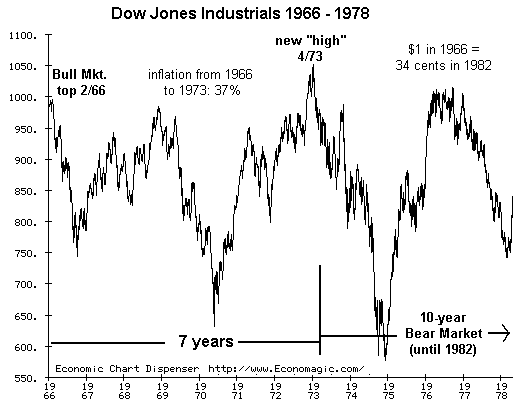
The US economy went through a comparable period of instability and forced adaptation in the 1970s, a dynamic I explored in The Forgotten History of the 1970s (January 13, 2023). Everyone benefiting from the status quo arrangements fought the much-needed changes tooth and nail, and so progress was uneven. Transitioning to a more efficient and responsive industrial base required tremendous capital investments and scaling up new technologies.

The transition is more costly and takes more time than we would like; the 1970s transition took about a decade. We can anticipate a similar scale of capital investment and time will be needed for this structural adaptation.

As the chart below illustrates, the 1970s was characterized by high inflation and big swings up and down in the stock market. Successful adaptations generated hope for quick recovery, while lagging adaptations tempered the hope with painful realities.

Again, it is likely that the decade ahead will track this same general dynamic of big swings generated by hope that the worst is over and the realities that progress is only partial and instability still reigns.

Everyone wants a trend they can trade for effortless gains. That may no longer be realistic.

Our Challenge Is To Transcend Our Evolutionary Ape Heritage

By Caitlin Johnstone

Source: CaitlinJohnstone.com

Did you know chimpanzees hunt smaller primates for food?

They do. They’re actually very skillful hunters due to their size, their strength, and especially their intelligence. They coordinate their attacks, working together to cut off the escape routes of their prey to greatly increase their success rate. Scientists have even frequently observed them using crude spears to kill a small primate species called the lesser bush baby for their meat.

One of the many interesting things about this behavior in our primate cousins is that they are so good at hunting they can become victims of their own success, wiping out entire populations of prey in their area. Red colobus monkeys have been hunted to the brink of local extinction in Uganda by chimpanzees hungry for a quick protein fix, solely because they’ve been gobbling up those delicious little guys faster than they can reproduce.

Sound familiar?

The tendency of homo sapiens to overburden our ecosystem with our consumption is not unique to us, and is not new. In fact, it looks like we’ve been on this trajectory toward ecocide since our ancient evolutionary ancestors began evolving extra brain matter.

And it is possible to just stop there and conclude that we are no different from our chimp relatives in this sense. That we will simply keep overhunting the red colobus monkey until there are none left, that we will keep depleting and destroying our biosphere until it can no longer sustain life. That the human brain differs from the chimpanzee’s only in intelligence, not in wisdom. That we are in essence no different from the cyanobacteria at the dawn of the Proterozoic Era, a new species showing up on the scene and causing a mass extinction event in an ecosystem overburdened by their rapid flourishing.

You do also however have the option of openness to the possibility that maybe, just maybe, our species is destined for greater things. That maybe, just maybe, we have within us the capacity to transcend the mindless patterning of our evolutionary ancestors and move into a mindful relationship with this planet and its life forms. That maybe, just maybe, this whole human adventure doesn’t need to end in disaster after all.

From what I can tell, the only people who find this idea outlandish are those who have never experienced a great unpatterning of their own. Who have never healed the wounds of their past and transcended the unwholesome mental habits which were given to them by their conditioning. To anyone who has experienced a dramatic transformation from dysfunction into health, it’s obvious that any human could potentially go through such transformations as well. Or even all humans.

It is possible that our descendents will look back on humanity’s existence on this planet from prehistoric times up until this crucial present moment as a kind of bridge between animal life and a new terrestrial expression that isn’t driven by the unconscious conditioning patterns that have driven the movements of every species on this planet from the very first single-celled organisms onward. That what we’re experiencing right now at this critical juncture is what it looks like before the emergence of the Earth’s first conscious species.

An unconscious human is one driven compulsively by deep-seated mental habits they don’t really see and can’t do much to control, so they’ll often find themselves engaged in unwholesome behavior patterns like addiction, unkindness, greed and neurosis, and making the same mistakes over and over for reasons they don’t quite understand.

A conscious human is one who doesn’t have unseen conditioning pulling the strings from behind the scenes in their subconscious mind, because they have done their work and drawn their inner demons into the light of consciousness where they can be healed. They are therefore able to move through life deliberately and in the interest of what’s best, rather than compulsively and in a way that spreads trauma to others.

A conscious humanity would mean that this way of functioning blossoms throughout the entire species.

Doesn’t it kind of look like that might be what’s happening? Like all the chaos and confusion of these strange times could simply be the birth pangs of a species whose relationship with consciousness is about to take a dramatic pivot? The increasingly shrill mass media narratives rapidly approaching white noise saturation? The increasingly widespread awareness that our society’s rules are made up and we can change them whenever we want? The mysterious increase in incidents of spiritual awakening as reported by teachers of enlightenment? Just how goddamn weird everything’s been getting these last few years?

I think it’s possible. I think it’s possible we are moving as a species toward an adaptation that will enable us to survive in a situation which is very different from the one we first emerged in, as every species eventually does if it doesn’t go extinct. If this is indeed what is happening, it stands to reason that it will be an adaptation that prevents us from wiping ourselves out via ecocide or nuclear war, and that a collective movement into consciousness is what that adaptation will look like.

A conscious species would be able to work in cooperation with its ecosystem, rather than compulsively consuming it due to primitive impulses to obtain and dominate and egoic impulses to be rich and have more. A conscious species would be able to convert civilization from competition-based models into collaboration-based models, where rather than trying to climb over each other to get ahead we all work together to make sure everyone has what they need to live. A conscious species would no longer see the sense in dividing itself up into separate competing nation-states which brandish armageddon weapons at each other out of fear and greed.

The more I learn about humanity, and the more I learn about myself, the more possible such a world appears to be. Sure the world’s a chaotic and distressing mess right now, but so is childbirth. However bad things get for us, as long as we’re still alive our problems are nothing that can’t be fixed with a collective movement into consciousness.

Anyway. That’s my pet theory right now. And the cool thing about my theory is that if you like it too, you don’t have to wait for it to come true. You can start becoming more conscious on your own right now and leading the charge for the rest of us. Investigate your true nature, heal your wounds, be responsible with your actions, and begin working to coax all your endarkened bits into the light.

And then hopefully the rest will follow. If they don’t, worst-case scenario is you wind up a lot more happy and functional than you otherwise would have been, because you brought so much more consciousness to your inner processes and your habits of perception and cognition.

This is where the real adventure is at, in my opinion. This is where the rubber meets the road.

I will meet you there.

Why We’re Doomed: Our Delusional Faith in Incremental Change

By Charles Hugh Smith

Source: Of Two Minds

Better not to risk any radical evolution that might fail, and so failure is thus assured.

When times are good, modest reforms are all that’s needed to maintain the ship’s course. By “good times,” I mean eras of rising prosperity which generate bigger budgets, profits, tax revenues, paychecks, etc., eras characterized by high levels of stability and predictability.

Since stability has been the norm for 75 years, institutions and conventional thinking have both been optimized for incremental change. This is an analog of natural selection in Nature: when the organism’s environment is stable, there’s little pressure to favor random mutations, as these can be risky.

Why risk big changes when everything’s working fine as is?

Absent any big changes in their environment, organisms’ genetic programming remains stable. Unlike natural selection’s process of generating random mutations and testing their efficacy and advantages over the existing programming, human organizations quickly habituate to stable eras by institutionalizing incremental changes as the only available process for reform / change.

Radical reforms are not just frowned on as 1) unneccesary and 2) needlessly risky, there is no institutionalized process to propose, test and adopt radical changes because there is no need for such a process.

Nature has such a process: punctuated equilibirium. When faced with a rapidly changing environment, organisms face intense evolutionary pressure to adapt or die. Mutations which confer a significant advantage in the new environment become part of the species’ genetic programming as those with the adaptation bear offspring who carry the advantageous adaptation. Those without the advantageous adaptation die and those with the adaptation thrive and multiply.

Once the environment stabilizes in “the new normal,” the evolutionary pressure lets up and the species returns to the stability of relatively few changes in its genetic programming.

Organisms which have lost the ability to adapt to rapid change die off once they encounter instability. Species that constantly face instability and rapid change will selectively favor genetic traits which optimize rapid evolution.

Nature tends to retain a basement closet full of fast-evolution tricks just in case the organism faces novel challenges.

Alas, human organizations and conventional thinking have no such closet of fast-evolution tricks. Rather, human organizations and conventional thinking marshal formidable forces to suppress anything which threatens the status quo, because why risk upsetting the feeding trough unless it’s absolutely necessary?

Therein lies the fatal problem: radical adaptation is never absolutely necessary in human organizations and conventional thinking until it’s too late–and even then, the leadership and conventional thinking will fatalistically accept oblivion rather than opt for a risky strategy of testing every mutation and fast-tracking whatever has promise, even though the odds of failure are high since 1) the challenge is novel and therefore unpredictable and 2) most mutations will fail to provide the radical advantages needed to meet the challenge.

In other words, what’s absolutely necessary to human organizations and conventional thinking is the suppression of potentially dangerous novel ideas because the worst-case scenario is that the novel ideas upset the feeding trough all the insiders have come to depend on.

Unfortunately for human organizations and conventional thinking, novel challenges demand precisely what they’re incapable of: risky rapid evolution. The risks will never seem worth it because some insiders might lose their spot at the feeding trough.

Since this loss is viewed as catastrophic by those at risk, they will fight with everything they have to stymie any radical reforms. Ironically, their resistance to rapid evolution only guarantees the demise of the entire organization / status quo, including the spot at the trough they were so eager to defend at all costs.

As the crisis deepens, the default setting in organizations and conventional thinking is that incremental changes and reforms will be enough, because they’ve been enough for four generations. I call this entirely natural default setting the delusional faith in incremental change because this faith isn’t guided by history or the logic of causality; it’s simply convenient and easy.

Nobody gets fired or demoted for agreeing to do more of what’s failed spectacularly.

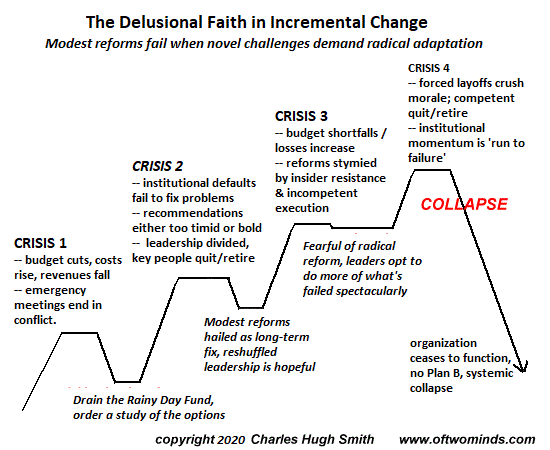
I’ve prepared a chart of the delusional faith in incremental change showing how each new crisis is met by incremental institutionalized defaults that are completely inadequate to the novel challenges that have arisen. The blindness to the need for radical adaption has been institutionalized as well: this is what worked in the past, so it will work nowWhy risk everything when we have procedures that have worked well?

Each stage of the crisis draws whatever conventional response causes the least pain. First, the “rainy day fund” is drained to keep everyone at the feeding trough. Studies of options are funded, and so on.

The recommendations are either too timid and clearly inadequate or they’re too bold and risky. So incremental policy and budget tweaks are adopted as acceptable institutional defaults.

But rifts open in the leadership as the farsighted few demand rapid, radical adaptations and the conventional risk-averse crowd digs in their heels. The farsighted few are pushed out or quit / retire, eliminating the only people who had the ability and experience to actually pull off a radical change of course.

A reshuffling of leadership evokes hope that the modest reforms will work magic. Alas, incremental tweaks only work in eras of stability. They fail miserably in unstable eras of rapidly-evolving challenges.

As everything runs to failure, the only acceptable path is to do more of what’s failed spectacularly, a default to low-risk incrementalism that only accelerates the final inevitable collapse.

The delusional faith in incremental change guarantees systemic failure. Better not to risk any radical evolution that might fail, and so failure is thus assured.

This is why our status quo is doomed:

Charlie Kaufman on Zombie Ants, Mind Control, and Consumerist Culture

By The Unknown

Source: High Existence

Charlie Kaufman has one of the most inventive and original minds in Hollywood. That’s probably why he has eluded mainstream success.

Mr. Kaufman is perhaps best known for writing the modern classic Eternal Sunshine of the Spotless Mind, for which he was awarded an Oscar for best original screenplay. He’s also the writer of Being John Malkovich, Adaptation, Anomalisa, and the writer-director of the little-known but brilliant Synecdoche, New York, which Roger Ebert named the “best film of the decade” (2000-2010).

In the words of fellow writer Jeremy Brock:

One of the few screenwriters to transcend his profession, Charlie Kaufman is responsible for some of the most unique, daring, and inventive screenplays in contemporary cinema. […] His films deal with identity, mortality, relationships, and the meaning or purpose of life. They are metaphysical, self-reflexive, hyper-aware, often using surrealist conceits to explore our fundamental anxieties. It is in this tradition of finding new, startling, and funny ways of exploring human psychology that Charlie Kaufman sits comfortably amongst the world’s greatest living writers.

Fans love him. Critics adore him. Mainstream audiences… ignore him.

And that’s a shame.

In a world filled with sequels, prequels, remakes, and reboots, creativity is dying in Hollywood.Worse than dying, I’d argue that creativity is being tied up, beaten, tortured, mocked, murdered, then thrown in a gutter and pissed on.

You could argue that I’m cynical.

You could also argue that I’m tired of being patronized by the regurgitated garbage Hollywood pukes up and tries to spoon feed us. We all know the difference between food and vomit, and Hollywood’s been steadily feeding us barf for the last ten years while distracting us with silly airplane noises like we’re babies.

But I’m getting sidetracked.

This isn’t about my personal disdain for Hollywood; this is about Charlie Kaufman’s views on consumerism, and Charlie Kaufman is much more polite, intelligent, and eloquent than I am.

I stumbled across a speech Charlie Kaufman delivered at a BAFTA lecture in 2011 and absolutely loved it.

Mr. Kaufman was supposed to deliver a speech about screenwriting, but gave the audience much more. The full speech covers a broad range of topics, but I spliced together a few of my favorites — Zombie Ants, Mind Control, and Consumerist Culture — and created the video below.

Watch and listen as Charlie Kaufman dissects and diagnoses the fallacies of our present-day culture, but rather than react with juvenile indignation (as I did in my brief rant earlier), he responds with poignant words of heartbroken yet hopeful wisdom.

Enjoy!

Charlie Kaufman BAFTA Speech

Charlie Kaufman is among the most brilliant and creative screenwriters today and is the mind behind modern cinematic masterpieces such as “Eternal Sunshine of the Spotless Mind” and “Synecdoche, New York”. In this address to the British Academy of Film and Television delivered a few years ago he shares insightful thoughts on his craft and the nature of thought itself. It’s a speech which everyone could potentially gain something of value from.