

By Robert J. Burrowes
Since the dawn of human civilization 5,000 years ago, ordinary people like you and me have been engaged in an endless struggle to resist efforts by elites, whether local, national, international or global, to assert complete control over us and the resources around us.
And for 5,000 years, with some wins and a great many losses, we have managed to stave off the worst.
Finally, in January 2020, the World Economic Forum launched its ‘Great Reset’: The final assault in the Elite’s long war against humankind and nature itself.
As we pass the third anniversary since this final battle was launched, it is well worth evaluating the progress of our resistance.
Is our resistance being effective? Are we succeeding?
Unfortunately, as is obvious from any serious evaluation, we are being smashed. Let me explain why.
[While they are not addressed in this article, I wish to acknowledge the range of other profound threats that pose a serious risk to any worthwhile human future, most notably the threat of nuclear war which arguably stands greater than at any previous time in human history.]
Evaluating Progress
Any strategy to resolve a conflict of this nature must begin with a sound analysis of what is happening:
Who is driving it (which answers the question ‘Who benefits?’) What do they intend? Why are they doing it? And how?
Only once these questions have been clearly answered is it possible to develop a strategy that will be adequate to the challenge posed by the threat.
So who is doing what?
Whatever we have been told by such organizations as the World Health Organization, national governments and the corporate media during the past three years, the most cursory investigation reveals that the World Economic Forum has been just behind the scenes effectively directing the response of governments to the threat supposedly posed by a ‘pathogenic virus’ labeled SARS-CoV-2.
However, any serious investigation will reveal that even the World Economic Forum is simply another ‘front’ for more powerful individuals and their organizations, which I call ‘the Global Elite’
– see ‘Historical Analysis of the Global Elite: Ransacking the World Economy Until “You’ll Own Nothing.”’
– and that no such thing as a ‘pathogenic virus’ has ever been isolated, including in the instance of SARS-CoV-2. See, for example, Christine Massey’s exhaustive attempts to identify a health or scientific institution anywhere in the world that has isolated the ‘virus’: ‘211 health/science institutions globally all failed to cite even 1 record of “SARS-COV-2” purification, by anyone, anywhere, ever’.
And if you want to watch or read other accounts carefully explaining why no ‘pathogenic virus’ has ever been isolated, here is a token sample of the extensive documentation of this point:
‘Dismantling the Virus Theory – The “measles virus” as an example’,
What Really Makes You Ill? Why everything you thought you knew about disease is wrong,
‘ZERO Evidence that COVID Fulfills Koch’s 4 Germ Theory Postulates – Dr. Andrew Kaufman & Sayer Ji’,
‘COVID-19: The virus does not exist – it is confirmed!’ and
‘Statement On Virus Isolation (SOVI)’.
In parallel with monumental efforts to convince us that we are living under enormous medical threat, and must submit to an onerous series of restrictions on our freedom, including multiple injections of a gene-altering bioweapon, a great deal has been going on that has been deliberately obscured from public view.
However, while information about this program is readily available to those who investigate – see, for example, the World Economic Forum’s ‘Great Reset’ – the reality is that few people have investigated because they were terrorized into believing the cover story: Their life was threatened by a ‘virus’.
But if we spend time investigating the material presented on the World Economic Forum’s ‘Great Reset’ website and reading critiques of it offered by well-informed researchers, one has no difficulty discovering that, on behalf of the Global Elite, the WEF is now implementing the Elite’s long-planned changes to 200 areas of human life.
To briefly elaborate just one set of changes being imposed as part of this program, consider the prospect of our technological imprisonment as transhuman slaves in ‘smart cities’.
What does this mean?
In essence: the Elite is rapidly building a complete technocracy based on surveillance and control technologies.
These technologies include (among many others) 5G, 6G, the Internet of Things (which will be connected to artificial intelligence [AI] programs that monitor the network of ‘smart’ devices you were deceived into implanting in your body and installing in your home),
geofencing (which will technologically confine you to five kilometres from where you live),
smart street poles and lights (which will gather data via facial recognition cameras and environmental sensors,
display digital signage and use speakers to instruct the immediate population how to behave), digital identity (which will be used to control your access to ‘approved’ activities),
central bank digital currencies (that will be used to control what you can buy,
how much of it and where),
surveillance and (3D) facial recognition cameras deployed in all public spaces (to monitor your movements and control your access), license plate readers, vehicle kill switches,
drones (used as aerial police), robots (including as a ‘deadly force option’) as well as autonomous and electromagnetic weapons. Beyond this, transhuman slaves will become ancilliary ‘workers’ in an increasingly robotized workforce.
To reiterate, these technologies will be used to monitor your every movement and completely control your behaviour, including by using the utterly transformed model of AI policing by drones and robots armed with electromagnetic weapons, as just touched upon.
In case it is not already obvious, this Elite-controlled technocratic prison will subvert human identity, human dignity, human volition, human privacy and human freedom.
Everything that makes human life worth living will be taken from you.
Why is the Elite doing this?
In brief, using a variety of means, this program based on a reduction of a substantial proportion of the human population, as is now happening, imprison those left alive as transhuman slaves in technocratic ‘smart cities’, enclose the Commons forever and deliver all remaining wealth into Elite hands.
Hence, according to the WEF, by 2030 ‘You’ll Own Nothing. And You’ll Be Happy.
’ See ‘3.5 BILLION could be injured or killed by the jab. Are YOU ready?’,
‘Killing Off Humanity: How The Global Elite Is Using Eugenics And Transhumanism To Shape Our Future’,
‘Beware the Transhumanists: How “Being Human” Is Being Re-Engineered by the Elite’s Coup’ and ‘8 predictions for the world in 2030’.
And how is the Elite implementing this heinous program?
While the brief discussion above highlights the responsibility of the Global Elite for planning this program and then having it implemented through Elite agents including the World Economic Forum, relevant international organizations such as the WHO, national governments, pharmaceutical corporations and national medical associations, a critically important role has long been played by education systems, the corporate entertainment industry as well as the corporate media in ensuring that what most people regard as ‘knowledge’ and what most people believe is ‘true’ is always consistent with the Elite-promoted narrative.
See, for example, ‘Do We Want School or Education?’ and Propaganda.
Hence, in the current context, government media channels and most corporate newspapers, television and radio news programs as well as corporate social media giants have heavily promoted the Elite-driven narrative and routinely censored those telling the truth in exposing the Elite program.
See ‘WHO Labels Unvaccinated People a “Major Killing Force Globally”’ and ‘Propaganda Perpetuates the Pandemic and Censorship’.
As a result, while some people resisted the onerous restrictions on human freedom, few of these people understood the genuine threat that we faced from the elite plan concealed behind the ‘virus’/‘vaccine’ narrative. Consequently, most resistance has been focused on the wrong people, using ineffective means and with negligible understanding of what is taking place.
Hence, we are three years into this crisis that portends profound changes to human society, including the death of billions of people and the transhuman enslavement of virtually all those left alive, with only negligible progress in resisting this long-planned and sophisticated Elite program.
Let me elaborate.
We Are Being Smashed Politically
With the vast bulk of the human population trapped in the delusion that governments make the important decisions that shape our lives, virtually all effort to halt the substantial encroachments on our identity, dignity, volition, rights and freedom, including the injection mandates, has been directed at protest demonstrations, lobbying politicians (or voting for them) and petition-signing with those mobilized demanding that governments withdraw the restrictions and mandates.
This has meant that three years of efforts to mobilize people to resist have been misdirected and the resulting demonstrations, lobbying/voting and petitions have absorbed and dissipated the dissent, as those who truly govern intend.
As has been systematically documented, Elites of a local, regional, national, international and, most recently, global reach have controlled the political destiny of the population over which they exercised jurisdiction making the word ‘government’ a meaningless term. For a brief elaboration of this point, see
‘The Elite Coup to Kill or Enslave Us: Why Can’t Governments, Legal Actions and Protests Stop Them?’
Beyond this, however, since World War II there has been an ongoing series of developments to create global infrastructure that subverts any remaining national sovereignty while shifting power to the Global Elite.
Among many initiatives, for example, the Global Public-Private Partnership has been presented by Klaus Schwab and Peter Vanham, on behalf of the World Economic Forum.
See Stakeholder Capitalism: A Global Economy that Works for Progress, People and Planet summarized in ‘What is stakeholder capitalism?’
While this sanitized account obscures the threat it poses to humankind, Iain Davis and Whitney Webb have thoughtfully critiqued it
– see ‘Sustainable Debt Slavery’
– noting that even a 2016 UN Department of Economic and Social Affairs report
– see ‘Public-Private Partnerships and the 2030 Agenda for Sustainable Development: Fit for purpose?’
– also found it ‘unfit for purpose’.
So what is it? According to Davis, the Global Public-Private Partnership (G3P) is a worldwide network of stakeholder capitalists and their partners:
the Bank for International Settlements,
central banks, global (including media) corporations,
the ‘philanthropic’ foundations of multi-billionaires,
policy think tanks,
governments (and their agencies),
key non-governmental organizations and global charities,
selected academic and scientific institutions, labour unions and other chosen ‘thought leaders’. (You can see an instructive diagram in the article cited below.)
The G3P controls the world economy and global finance.
‘It sets world, national and local policy (via global governance) and then promotes those policies using the mainstream media’, typically distributes the policies through an intermediary such as the IMF, WHO or IPCC and uses governments to transform G3P global governance into hard policy, legislation and law at the national level. ‘In this way, the G3P controls many nations at once without having to resort to legislation.
This has the added advantage of making any legal challenge to the decisions made by the most senior partners in the G3P (an authoritarian hierarchy) extremely difficult.’ In short: global governance has already superseded the national sovereignty of states: ‘National governments had been relegated to creating the G3P’s enabling environment by taxing the public and increasing government borrowing debt.’ See ‘What Is the Global Public-Private Partnership?’
As Davis notes:
We are supposed to believe that a G3P-led system of global governance is beneficial for us and to accept that global corporations are committed to putting humanitarian and environmental causes before profit, when the conflict of interest is obvious. ‘Believing this requires a considerable degree of naïveté.’
Davis clearly perceives ‘an emergent global, corporate dictatorship that cares not one whit about truly stewarding the planet.
The G3P will determine the future state of global relations, the direction of national economies, the priorities of societies, the nature of business models and the management of a global commons. There is no opportunity for any of us to participate in either their project or the subsequent formation of policy.’ Davis goes on:
‘in theory, governments do not have to implement G3P policy, in reality they do. Global policies have been an increasing facet of our lives in the post-WW2 era…. It doesn’t matter who you elect, the policy trajectory is set at the global governance level. This is the dictatorial nature of the G3P and nothing could be less democratic.’
But, as explained previously and despite the claim by Davis of ‘an emergent global, corporate dictatorship’, this is just one of the more recent manifestations of national sovereignty being usurped by a Global Elite intent on removing even the delusion of any form of citizen engagement in policy determination and implementation. See ‘Historical Analysis of the Global Elite: Ransacking the World Economy Until “You’ll Own Nothing.”’
And just to highlight the impotence of Presidents and Prime Ministers, let alone lesser government figures, if a political leader steps out of line, they are simply removed or killed, with an extensive historical list of uncooperative political leaders removed or killed in coups – see ‘Overthrowing Other People’s Governments: The Master List of U.S. “Regime Changes”’ – and, in the current context, five assassinated so far. See ‘Five Presidents Who Opposed Covid Vaccines Have Conveniently Died, Been Replaced by Pro-Vaxxers’.
But, obviously, it doesn’t usually get to this. The Elite has a multitude of measures that enable it to control what most people like to believe are ‘democratic’ processes. For example, have you heard of the World Economic Forum’s ‘Young Global Leaders’ program in which the Forum indoctrinates carefully recruited young people to play their lifetime part in implementing Elite initiatives. You don’t get chosen for this program, or graduate from it, if you don’t have impeccable credentials. Just ask people as ‘diverse’ as President Emmanuel Macron, President Vladimir Putin and Prime Minister Justin Trudeau.
As WEF head Klaus Schwab boasted at Harvard University’s John F. Kennedy School of Government in 2017:
‘What we are very proud of, is that we penetrate the global cabinets of countries with our WEF Young Global Leaders… like Justin Trudeau.’ Watch ‘WEF’s Klaus Schwab Boasts of Young Global Leaders Penetration of Western Cabinets’.
But the YGL isn’t the only program of this nature. Have you heard of Schwarzman Scholars?
And if you think that we have legal redress to defend all those rights and freedoms supposedly guaranteed by a plethora of treaties, conventions, national constitutions and human rights laws, then you haven’t been paying attention while these have long been systematically ignored, if not simply wiped out. After all, legal systems exist to defend Elite power, profit and privilege, as the record demonstrates. See ‘The Rule of Law: Unjust and Violent’.
Next time you hear of a legal ruling that appears to favour ‘ordinary’ people, check back some months and years later to see if it survived the usual appeal processes and was ever actually implemented. And, if it was, did it actually change anything or simply lead to more of the same, as happens, for example, when a corporation is occasionally fined for some outrageous behaviour but absorbs the fine as a ‘cost of doing business’.
In summary, if you believe that international or national legal processes will hold the Global Elite (and not just the occasional scapegoated minion) to account, strike down vaccine mandates and a vast range of other violations of human rights, or even allow some of us to get some form of genuine compensation for the vast death, injury and damage inflicted historically or even just during the last three years, then I simply encourage you to read some history to see if you can find any evidence to support your belief.
We Are Being Smashed Economically
While many people have noted the damage done to the world economy by a series of measures supposedly carried out in response to the threat posed by the ‘virus’, ranging from lockdowns (which shuttered vast areas of the economy by disrupting all parts of the global supply chain and stopped most people from working) to vaccine mandates, the fact is that these measures were just the latest and most visible in a 5,000-year history of Elite action to secure and consolidate economic control, progressively enclose the Commons, enslave the human population in work to achieve Elite ends and capture all wealth, among other outcomes explained elsewhere in this article.
I have explained and illustrated this point at great length in this study: ‘Historical Analysis of the Global Elite: Ransacking the World Economy Until “You’ll Own Nothing.”’
But the essence of this report is simple: Building on millennia of effort, since the late C19th a small group of extraordinarily politically powerful and wealthy families, that I call the Global Elite, has accelerated previous efforts to create a global political, economic and legal infrastructure that facilitates the unending concentration of Elite power. This includes effective ownership and control of all key components of the economy including the banking, asset management, weapons, energy, technology, agrochemical, food, mining, pharmaceutical and media industries.
In this world order, neither international governmental organizations such as the United Nations nor national organizations such as governments have any significant say in what takes place. And you don’t either.
We Are Being Smashed Medically
As noted above, there is no documented scientific proof that any such thing as a ‘pathogenic virus’ has ever been isolated, including in the instance of SARS-CoV-2.
But underlying this fact is a very lengthy story about how many long-standing traditional natural healing methods that are very powerful and were used for millennia were systematically discredited and destroyed, as well as how a conflict of ideas about how to approach the maintenance of human health – characterised by the opposing views of Antoine Béchamp and Louis Pasteur in the C19th – culminated in the success of the latter’s ideas, because they enabled a rapid advance in the development of the centralized control desired by Elites, thus replacing long-standing and effective systems of health with one designed to attack human health and kill the patient or precipitate their (highly profitable) lifetime dependency on drugs.
Beyond this, however, ongoing strenuous efforts have consistently been made since the late C19th to control the health, medical and pharmaceutical information available to the public to ensure the suppression of effective treatments for various illnesses, including cancer – see Gerson Therapy – and thus ensure the profitability of the lethal medical, pharmaceutical, processed (including junk) food and confectionery industries, among others, as well as to endlessly consolidate the ever-tightening control over the human population exercised through medical means including through the latest manifestation of this effort, the Covid-19 scam.
However, like many subjects of this nature, much of the documentation in relation to this history has been carefully suppressed or eliminated, one way or another. Nevertheless you can read a sample of books that document it here:
Medical Nemesis: The Expropriation of Health,
Murder by Injection: The Story of the Medical Conspiracy Against America and Death by Medicine;
check out the ‘Table Of Iatrogenic Deaths In The United States’; watch a reasonable summary of the disaster known as ‘modern medicine’ in ‘Rockefeller Medicine’ and watch Katherine Watt systematically outline the ‘authorization’ and illegalities of the Covid-19 measures in the USA. See ‘Katherine Watt presentation’.
In any case, as we discovered during the period supposedly marked by the Covid-19 ‘pandemic’ and, as noted above, despite the complete absence of any scientific evidence of the existence of any such thing as a ‘pathogenic virus’, including in the instance of SARS-CoV-2, we were nevertheless subjected to a wide range of measures that constituted martial law and violated a wide range of our human and constitutional rights.
In addition, just one of a host of ongoing measures is the World Health Organization’s current attempt to usurp national and individual sovereignty and capture full control of the human population through its ‘Pandemic Treaty’ and update of the International Health Regulations – see ‘Strengthening WHO preparedness for and response to health emergencies: Proposal for amendments to the International Health Regulations (2005)’ – which proposed the outright negation of a range of longstanding human rights, among other objectionable provisions, and has been critiqued by many authors. See, for example, ‘Amendments to WHO’s International Health Regulations: An Annotated Guide’, ‘“Pandemic Treaty” will hand WHO keys to global government’, ‘WHO Pandemic Treaty and the Banality of Evil’ and ‘The Top 100 REASONS to #StopTheTreaty, #StopTheAmendments, and #ExitTheWHO’.
Notably, for example, James Roguski characterized the proposed changes to the International Health Regulations as amounting to ‘medical martial law’ and, out of a list of 100 reasons he compiled for opposing the proposed changes, he highlighted ten that were particularly offensive. These included the facts that the proposed changes would alter the status of the WHO from an advisory body to one that made proclamations that are binding on governments; remove from Article 3 a provision requiring ‘respect for dignity, human rights and fundamental freedoms of people’; give the WHO the power to mandate medical examination, proof of prophylaxis, proof of vaccine, contact tracing, quarantine and treatment; institute an intrusive system of digital (or paper) health certificates; and greatly expand the WHO’s capacity to censor what they believe to be misinformation or disinformation, among many other onerous provisions. See ‘A World-Wide Call to Take Immediate and Massive Action’.
Given that these proposed changes to the draft Regulations violate long-standing laws, implemented following the Nuremberg trials of Nazi doctors – see ‘The Nuremberg Code, 1947’ – protecting people’s right to choose whether or not to seek the form of medical treatment of their choice, it is clear that the Elite interests that have exercised ever-deepening control of human society are intent on continuing to use the pharmaceutical and medical industries as key tools in their armory to kill off significant numbers of people and control those left alive.
As an aside, while Katherine Watt carefully details the ongoing militarization of public health since the 1960s and the use of US military ‘kill box’ planning and tactics in relation to Covid-19 – see ‘Kill Box: Multi-Service Tactics, Techniques and Procedures for Kill Box Planning and Employment’ – she attributes this approach to the ‘globalist central bankers’ realizing that pharmaceutical killing enabled a more credible ‘plausible deniability’ and more reliable basis for legal impunity, compared to some of its other measures – such as orchestrated wars, famines and financial crises – for killing off substantial human populations. See ‘Katherine Watt presentation’.
But, in fact, the Global Elite is well aware that there is no prospect of it being held accountable, legally or otherwise, just as its predecessor Elites have never been held accountable for their millennia-long rampage to kill off substantial human populations through wars, imperialism, colonialism, acts of genocide against indigenous and other peoples, the trans-Atlantic slave trade, precipitated famines, the functioning of capitalism, precipitation of depressions and other financial crises, as well as other measures. Why won’t the Global Elite be held accountable now? For the same reason Elites have never been held accountable, as illustrated above: A range of measures give it control over governments and legal systems, as well as control of the narrative (via ownership of the corporate media). See ‘Historical Analysis of the Global Elite: Ransacking the World Economy Until “You’ll Own Nothing.”’
And, just briefly on another initiative, Leo Hohmann has drawn attention to a new category added to the WHO’s International Classification of Diseases: a code specifically for those who are unvaxxed in relation to Covid-19 and another for those who have had inadequate booster shots. In short, your doctor will be required to advise your ‘disease’ if you have not been vaccinated.
As the past three years have demonstrated, after more than a century of harm and killing on a prodigious scale, with ‘medical error’ ranking third on the list of causes of death in the USA, the pharmaceutical-medical complex has been let loose to wreak havoc on humanity. And it is not over yet. See ‘Who’s Driving the Pandemic Express?’ and watch the plan for the next ‘pandemic’, already available: ‘Catastrophic Contagion’.
So if you think the threat to our health from the pharmaceutical-medical industry is over, the reality is that we have simply had the first, ‘warm-up’ round of what must be a very long fight.
We Are Being Smashed Technologically
While most people embrace any new technology without question, the most casual investigation soon reveals that most technologies being made now can be used to surveil and control us and/or to harm or kill us outright. And given that this is the explicit intention behind ‘smart’ technologies, the long-planned and incredibly detailed Elite program to kill off many of us and build a technocracy in which we are permanently enslaved is proceeding at a breathtaking pace.
If you doubt this, have a look at the extensive range of videos and ‘Transformation Maps’ accessible from the World Economic Forum’s ‘Strategic Intelligence’ website.
Among the critically important technologies that are making this transhuman enslavement possible, the deployment of 5G, introduction of Digital Identity and the shift to Central Bank Digital Currencies (CBDCs) are vital and are being rapidly rolled out around the world as you read this article. As a matter of interest, were you consulted about any of this? Were you shown the extensive documentation of the dangers of the electromagnetic radiation from 5G? See ‘Deadly Rainbow: Will 5G Precipitate the Extinction of All Life on Earth?’
Were you informed that your Digital ID will make your freedom and privacy a thing of the past, especially when your social credit score has been determined? See ‘Digitizing Your Identity is the Fast-Track to Slavery: How Can You Defend Your Freedom?’ And have you been told that, based on your social credit score, the CBDCs will be used to control where you can spend your ‘money’, on what it can be spent and how much you can spend at any one time in any one place?
Beyond this, have you been consulted about the facial recognition (which record and store a 3D representation of your face) and surveillance cameras being installed everywhere?
With some 20 billion cameras already installed, there will be plenty to keep an eye on you, wherever you are.
And did you know these cameras will be linked to artificial intelligence that will be keeping exact track of your movements. Of course, your phone, other smart household devices, along with the license plate readers and vehicle kill switches will make sure that you are kept within the 5 kilometres you are allowed to travel from your home, once you are technologically imprisoned in one of the Elite’s ‘smart’ (Self-Monitoring, Analysis and Reporting Technology) cities. With geofencing, that is simple.
In his thoughtful article on ‘smart’ cities, technocracy expert Patrick Wood briefly explains why smart cities are central to Elite plans: Because cities don’t have the physical resources – the land which makes it possible to farm, mine resources, harvest timber and so on – found in rural areas, the technocrats devised a strategy to force people from rural to urban settings and then imprison them there. See ‘Day 9: Technocracy And Smart Cities’.
And remember when you gave a voice recording as biometric evidence that it was your bank account? How safe was that, do you think? See
‘Neural Codec Language Models are Zero-Shot Text to Speech Synthesizers’,
‘VALL-E: Neural Codec Language Models are Zero-Shot Text to Speech Synthesizers’ and
‘Microsoft’s new AI can simulate anyone’s voice with 3 seconds of audio’.
While much more could be written about the technological hell that is being built around us, a little time reading about the Metaverse is well worth the effort if you want a clearer understanding of the technocratic dystopia in which we might soon live. See ‘Virtual Beauty, Virtual Freedom, Virtual Love: Is the Matrix Metaverse Our Future?’
If you still doubt the technological threat we face, the good news is that key Elite agents in this context are happy to spell it out. For example, consider reading this original World Government Summit report written in 2018 with Elite projections for 2071: ‘Government in 2071: Guidebook. Preparing for new frontiers’.
At the latest World Government Summit just held in Dubai from 13-15 February 2023, Klaus Schwab was his usual, straightforward self: ‘Our life 10 years from now will be completely different, very much affected, and who masters [fourth industrial revolution] technologies, in some way, will be the masters of the world’. He also warns that failure to master these advanced technologies could mean that people like you and me ‘escape our power’. Watch ‘Klaus Schwab Calls For Global Government To “Master” AI Technologies’.
So unless you see yourself in the category of those who will master and control these technologies, and hence the rest of us, you will not be one of the ‘masters of the world’. You can read another critique of the recent conference, outlining more of the horrors being planned for us, here:
‘World Government Summit: How the Merging of Humans and Technology Will Define the Next 50 Years’.
To summarize: Virtually all of us have been surrendering our personal data for decades and most of it is still stored on a government or corporate computer in a databank (referred to, misleadingly, as ‘the cloud’) where it can be accessed to determine your future social credit score (and everything that this score will, and will not, allow). Combined with the substantial range of technologies now available that are able to use this data in a multiplicity of ways, you will soon be imprisoned in a technocratic slave city, subject to the arbitrary rule of our ‘masters’, with escape virtually impossible.
In essence, we are endlessly being promised greater privacy, security and convenience. But all the evidence suggests that your data makes it very convenient for the Elite to invade your privacy and deny you security. And, of course, freedom simply won’t exist.
Why Fear Is Preventing Humanity from Resisting the Elite Program Strategically
As parents, teachers and religious figures, we are told we are responsible for socializing our children. In practice, as everyone unconsciously understands this, it means that we terrorize children into being submissively obedient.
How do we do this? We inflict an unending stream of violence – in three categories I have labeled ‘visible’, ‘invisible’ and ‘utterly invisible’ – on the children in our lives. The sophistication of this program of terrorizing children is obscured from public view because the bulk of the everyday violence we adults inflict is, literally, ‘invisible’ or even ‘utterly invisible’; that is, the behaviour is not perceived or acknowledged as violent even though that is how it is perceived by children who are on the receiving end of it. Moreover, it was perceived by us as violent when we were children but we were terrorized into suppressing our awareness of this reality. For a full explanation, see
‘Why Violence?’, ‘Fearless Psychology and Fearful Psychology: Principles and Practice’
and ‘Do We Want School or Education?’
So while other supposedly psychological explanations of what has transpired historically (the causes of war, imperialism, colonialism, genocide, slavery and a host of other heinous elements of human history) or even during the past three years, are routinely promulgated – see, for example, Mattias Desmet’s theory of ‘mass formation’:
‘The Psychology of Totalitarianism: From rationalism to mass formation – and towards Truth speech’ – any popularity they acquire is simply the result of the fact that they divert responsibility from us as individuals. After all, if we do not feel responsible for what is happening why should we do anything about it?
One needs courage to face the truth, and to respond to it powerfully, and courage is not an attribute that can be genuinely ascribed to many people.
It is difficult to investigate the truth when a childhood of being terrorized into obediently believing and doing what you are told stands in the way.
Hence, human history proceeds in a simple linear fashion: We use violence to terrorize children into submissive obedience while using more (particularly ‘invisible’ and ‘utterly invisible’) violence to force them to suppress awareness of that fact. The child grows up having unconsciously ‘learned’ to use violence to achieve many outcomes, but particularly how to use violence against their own children to make them obedient. So violence is endlessly recycled: wars and violence of all kinds – against ourselves, other people and nature in an infinite variety of ways and settings – repeat endlessly.
Because it is not the violence we end up being too terrorized to confront. It is our own fear. Again, see ‘Why Violence?’
So we are rapidly entering a world in which all of that terrorizing of children has left us with a world of submissively obedient adults who are doing what they are told by international agencies, their government and the corporate media: Get injected four, six, eight… times; remain ‘locked down’ or, soon, in your ‘smart’ city prison; submit your data for a digital ID and a social credit score; accept the surveillance and control technologies without question (although they will tell you it is for your convenience, privacy and security just as your parents told you obedience ‘was for your own good’ when you were a child), and accept the delusional symbols of ‘freedom’ represented by your ability to travel up to 5 kilometres from your home to do one of the approved activities and to wear a metaverse mask to delude yourself that you are in a place you would prefer to be.
Does this sound insane to you? Of course it is. Do you think the Elite is insane? Of course it is. See ‘The Global Elite is Insane Revisited’.
So while most people will fearfully delude themselves that ‘the worst is behind us’, those who are paying attention know that this fight has barely begun and that the Elite has a 50-year timeframe to impose their full program upon us, even if the worst will happen by 2030.
This means that if we are to survive not only the current onslaught but also maintain our commitment and capacity to sustain our struggle for years and, possibly, decades, we need to ensure that we are paying careful attention to our own emotional health and that of our family members and the people in our community too.
For adults generally, this means ‘Putting Feelings First’ and, when supporting others, using ‘Nisteling: The Art of Deep Listening’.
For parents and concerned adults, it means making ‘My Promise to Children’.
How Can We Resist Effectively?
A long-planned, vast range and parallel sequence of measures is being rapidly implemented to capture political, social, economic, medical and technological control of the human population. The intention is to kill off a substantial proportion of humanity and imprison those left alive as transhuman slaves in the Elite’s technocratic (surveillance and control) ‘smart’ cities, which will be policed by a range of current and emerging technologies.
And, as I have explained previously and above, because the Global Elite controls conventional political, economic, financial, technological, medical, educational, media and other important levers of society, the Elite has control of how events unfold while simultaneously giving it control of the narrative about what is taking place. As a result, the truth about the Elite plan is easily concealed. Consequently, effective resistance to this complex and sophisticated program requires a response based on a full understanding of the Elite’s deeper agenda and that is equally sophisticated.
This means that we cannot rely on any conventional channel, political, legal or otherwise.
It also means that those campaigns based on a disintegrated set of actions that lack strategic focus can achieve nothing, although they mislead those resisting into wasting their effort: a rapid path to disempowerment and disenchantment for those deceived by people deluding themselves that they understand strategy.
The only way we can defeat this long-planned, complex and multifaceted threat, is to mobilize sufficient people all over the world who are willing to nonviolently noncooperate with its foundational components, that is, those elements that make the entire Elite program possible.
So if you are interested in being strategic in your resistance to the ‘Great Reset’ and its related agendas, you are welcome to participate in the ‘We Are Human, We Are Free’ campaign which identifies a list of 30 strategic goals for doing so.
In addition and more simply, you can download the one-page flyer that identifies a short series of crucial nonviolent actions that anyone can take. This flyer, now available in 23 languages (Chinese, Croatian, Czech, Danish, Dutch, English, Finnish, French, German, Greek, Hebrew, Hungarian, Italian, Japanese, Malay, Polish, Portuguese, Romanian, Russian, Serbian, Spanish, Slovak and Turkish) with several more languages in the pipeline, can be downloaded from here: ‘One-page Flyer’.
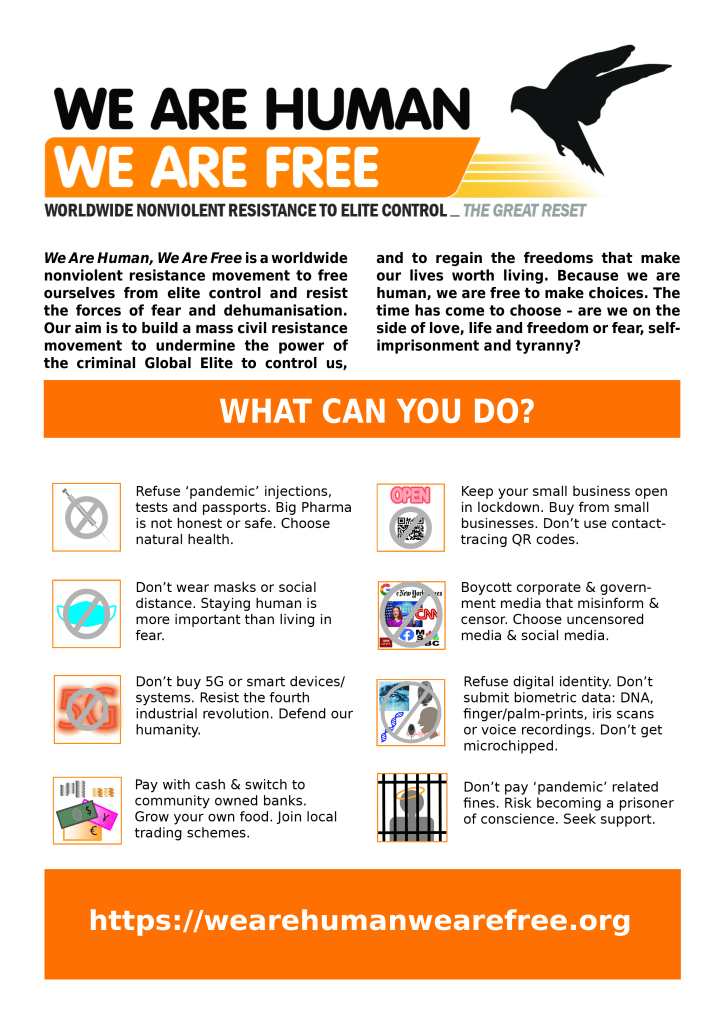
If this strategic resistance to the ‘Great Reset’ (and related agendas) appeals to you, consider joining the ‘We Are Human, We Are Free’ Telegram group (with a link accessible from the website).
And if you want to organize a mass mobilization, such as a rally, at least make sure that one or more of any team of organizers and/or speakers is responsible for inviting people to participate in this campaign and that some people at the event are designated to hand out the one-page flyer about the campaign.
If you like, you can also watch, share and/or organize to show, a short video about the campaign here: ‘We Are Human, We Are Free’ video.
In parallel with our resistance, we must create the political, economic and social structures that serve our needs, not those of the Elite. That is why long-standing efforts to encourage and support people to grow their own food – see ‘23 Reasons You Should Start a Garden in 2023’ – participate in local trading schemes (involving the exchange of knowledge, skills, services and products with or without a local medium of exchange) and develop structures for cooperation, governance, nonviolent defence and networking with other communities are so important.
Of course, indigenous peoples still have many of these capacities – lost to vast numbers of humans as civilization has expanded over the past five millennia – but many people are now engaged in renewed efforts to create local communities, such as ecovillages, and local trading schemes, including Community Exchange Systems. Obviously, we must initiate/expand these forms of individual and community engagement in city neighbourhoods too. And we must learn to defend them as well.
In addition, to reiterate, if you want to raise children who are powerfully able to investigate, analyze and act, you are welcome to make ‘My Promise to Children’.
Conclusion
We are currently living in the final phase of a 5,000 year effort to impose total control over the human population. There are many reasons why it has reached this point. Some key reasons are explained above. And despite the comfortable delusion that the most obvious and onerous restrictions that we have experienced over the past three years have temporarily receded, the fact remains that a vast range of political, economic, medical and technological measures are being implemented as you read these words and we have only just ended the first round of what must be, if we are to be successful, a protracted fight.
In essence, what we do between now and 2030 will determine the fate of humanity. If we can mobilize enough people to resist strategically, we will succeed. But there is little sign of that so far.
Understanding how power works in the world system as well as who, precisely, is driving what is happening, what they are doing, why, and how they are doing it are crucial prerequisites for developing an effective strategy to resist the current Elite program to kill off a substantial proportion of humanity, enslave those left alive in a technocratic prison, enclose the Commons forever and consolidate all wealth in Elite hands.
It is the failure to understand these crucial points that accounts for the ineffective ‘resistance’ that has characterized the past three years.
And this is complicated by the fact that fear makes most people unable to learn either from their own failed experience or to seriously investigate what is happening and how to resist it most effectively. So they fearfully repeat what is familiar, without even asking if it has worked in the past.
So each passing day we still witness fruitless attempts to convince one elite agent or another – a politician, a judge, a corporate media executive… – to take action that will turn the tide in our favour. But none of these individuals can help us.
The reality is simple: If we do not act strategically ourselves, and mobilize sufficient others to do so too, then human identity and freedom will be lost forever.
Biodata: Robert J. Burrowes has a lifetime commitment to understanding and ending human violence. He has done extensive research since 1966 in an effort to understand why human beings are violent and has been a nonviolent activist since 1981. He is the author of ‘Why Violence?’ http://tinyurl.com/whyviolence His email address is flametree@riseup.net and his website is here. http://robertjburrowes.wordpress.com




 After the Crash