Risings and Fallings

By James Howard Kunstler

Source: Kunstler.com

In the corkscrewing anguish of the social sequester, with careers, savings, futures, and dreams whirling down the drain, voices rise above the din of conflicting statistics to ask: what is going on here? To some, it looks like a deliberate attempt to demolish what’s left of the economy for political advantage. Clouds of suspicion gather over the two medical superstars of the Daily Briefing show, Doctors Fauci and Birx, as they somewhat sheepishly revise their numbers for contagion and death downward and attempt to “balance” the formula of modeled projections versus mitigation efforts. Was the stay-at-home panic necessary, after all? Will it save the day or kill off modern life as we knew it?

Well, everyplace else in the world was shutting down, weren’t they? Did they all go off their rockers, too? At least a hundred doctors died in Italy heroically tending the stricken, so they say. South Korea, Taiwan, and Singapore opted for flat-out medical Gestapo action. Britain, Spain, France, and Germany about the same, but minus testing at the grand scale and tracing of contacts. Honestly, how is it possible the whole planet punked itself?

I certainly don’t know the answer to all this, though readers are twanging on me to declare the whole Covid-19 story “a hoax,” which I’m not ready to do. I do know this: America has become utterly intolerant of uncertainty. And in the absence of certainty, that age-old human cognitive skill called pattern recognition, which has made us such a successful species, kicks into high gear scanning the field-of-view for answers. Any string-of-dots that affords even the slimmest plausibility goes on the table for review, including a lot of stories tagged as “conspiracy theories.”

I know this, too: the financial side of the gasping global economy was running off the rails well before Covid-19 flew out of its bat-cave into somebody’s soup bowl… or out of China’s Wuhan virus lab, if that’s how you like it… or before it seeped out of the Bill and Melinda Gates Foundation’s ark of world-saving secrets. In the USA and Europe, finance had come to mostly eclipse every other human endeavor of wealth production ­– with the catch that finance actually didn’t produce any real wealth, it only winkled and swindled wealth (or the mere ghosts of wealth) with its asset-stripping magic, from the places where wealth once did truly dwell. Or else it ginned up abstruse rackets that attempted to replace the utility of money with sheer math. Or, when all else failed, it just resorted to plain old accounting fraud… until, finally, there was so much there not actually there, that the whole holographic fantasy flickered out.

The pre-Easter bear market rally on Wall Street has been a wonder, don’t you think? As the numbers of able-bodied people out-of-work rocketed up past ten million during the same period, the stock indexes shot up three, five, six percent a day? Say, what? You’re telling me that’s based on the prospect of magnificent earnings in the third quarter? With every business on God’s green earth writhing in the dust like squashed bugs? And every supply line for basic goods and the gazillion spare parts for everything… all choked off?

And meanwhile, the American public sequesters and festers, waiting for those $1,200 checks that will fix… everything! Let’s face it: this is a twilight zone between stupor and fury. Nobody is paying anything to anyone. All obligations are suspended: rents, mortgages, bills, loans, bets, and vigs, all up in the air somewhere, but definitely not moving to their assigned destinations. The velocity of money is zero and all the various new term facilities and structured vehicles conjured by the Federal Reserve and Congress amount to a mere shadow of money moving ­– even though they are represented by trillions of brand-new alleged dollars. For every ten points that the Standard & Poor’s rose this week, somewhere down the line as many hedge funders will be dribbled like so many basketballs to the hoop of judgment.

The nation now has the long Easter weekend to stew and ruminate over its fate with spring achingly vivid and beckoning beyond the grim, streaked windows of sequestering. Those little cans of Easter Spam with pineapple rings won’t offer much consolation, combined with the abject discovery that even Netflix only has so many sequels to Frozen for children going catatonic with ennui. Kids are generally not so excited by stock and bond markets, but that’s probably where the genuine melodrama picks up on Monday. The weeks ahead there will give the phrase down-to-earth a whole new meaning.

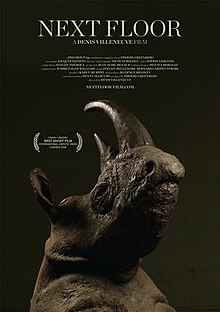
Saturday Matinee: Next Floor

“Next Floor” (2008) is a Canadian short directed by Denis Villeneuve. The mostly wordless film depicts a decadent banquet attended by servers and valets, with eleven gluttonous guests endlessly engorging themselves until they reach a sudden limit to their apparent abundance.

Bill Gates Crosses the Digital Rubicon, Says ‘Mass Gatherings’ May Not Return Without Global Vaccine

By Robert Bridge

Source: Strategic Culture Foundation

A recurring theme among conspiracy theorists is that the elite are just waiting for the right moment to roll out their ‘mark of the beast’ technology to remotely identify and control every single human being on the planet, thus sealing their plans for a one world government. And with many people willing to do just about anything to get back to some sense of normalcy, those fears appear more justified with each passing day.

In the Book of Revelation [13:16-17], there is a passage that has attracted the imagination of believers and disbelievers throughout the ages, and perhaps never more so than right now: “And he causeth all, both small and great, rich and poor, free and bond, to receive a mark in their right hand, or in their foreheads: And that no man might buy or sell, save he that had the mark…”

Was John of Patmos history’s first conspiracy theorist, or are we merely indulging ourselves today with a case of self-fulfilling prophecy? Whatever the case may be, many people would probably have serious reservations about being branded with an ID code even if it had never been mentioned in Holy Scripture. But that certainly has not stopped Microsoft founder Bill Gates, who has been warning about a global pandemic for years, from pushing such controversial technologies on all of us.

In September 2019, just three months before the coronavirus first appeared in China, ID2020, a San Francisco-based biometric company that counts Microsoft as one of its founding members, quietly announced it was undertaking a new project that involves the “exploration of multiple biometric identification technologies for infants” that is based on “infant immunization” and only uses the “most successful approaches”.

https://twitter.com/NewsAlternative/status/1246337502161416192

For anyone who may be wondering what one of those “most successful approaches” might look like, consider the following top contender for the contract. Researchers at the Massachusetts Institute of Technology (MIT) have developed what is essentially a hi-tech ‘tattoo’ that stores data in invisible dye under the skin. The ‘mark’ would be delivered together with a vaccine, most likely administered by Gavi, the global vaccine agency that also falls under the umbrella of the Bill & Melinda Gates Foundation.

“The researchers showed that their new dye, which consists of nanocrystals called quantum dots… emits near-infrared light that can be detected by a specially equipped smartphone,” MIT News reported.

And if the reader scrolls to the very bottom of the article, he will find that this study was funded first and foremost by the Bill and Melinda Gates Foundation.

Today, with the global service economy shut down to prevent large groups of infectious humans from assembling, it is easier to imagine a day when people are required to have their infrared ID ‘tattoo’ scanned in order to be granted access to any number of public venues. And from there, it requires little stretch of the imagination to see this same tracking nanotechnology being applied broadly across the global economy, where it could be used to eliminate the use of dirty money. After all, if reusable bags are being outlawed over the coronavirus panic-demic, why should reusable cash get special treatment?

Writing earlier this month in these pages, geopolitical analyst Pepe Escobar provided a compelling argument that the coronavirus, which is driving the world towards a New Great Depression, is “being used as cover for the advent of a new, digital financial system, complete with a forced vaccine cum nanochip creating a full, individual, digital identity.

As one possible future scenario, Escobar imagined “clusters of smart cities linked by AI, with people monitored full time and duly micro-chipped doing what they need with a unified digital currency…”

Those fears took on greater significance when Bill Gates sat down over the weekend for a breathtaking interview with CBS This Morning. Gates told host Anthony Mason that mass gatherings might have to be prohibited in the age of coronavirus unless and until a wide scale vaccination program is enacted.

“What does ‘opening up’ look like,” Gates asked rhetorically before essentially changing the entire social and cultural makeup of the United States in one fell swoop. “Which activities, like schools, have such benefit and can be done in a way that the risk of transmission is very low, and which activities, like mass gatherings, maybe, in a certain sense more optional. And so until you’re widely vaccinated those [activities] may not come back at all” [The interview can be watched in its entirety here].

According to Gates, anything that could be defined as a “mass gathering” – from spectators packed into a stadium for a sporting event, to protesters out on the street in demonstration – would be considered an act of civil disobedience without a vaccine. Little surprise that Gates chose the concept of “mass gathering” to snag all of us, for what is modern democratic society if not one big mass event after another? Indeed, since nobody will want to miss the next big happening, like the Super Bowl, or Comic-Con, or, heaven forbid, Eurovision, millions of people would predictably line up for miles to get their Microsoft-supported inoculation, even if it contains tracking technologies.

https://twitter.com/rooshv/status/1246507620405559301

All of this seems like sheer madness when it is remembered that there are other options for defeating the coronavirus than a mandatory global vaccine regime.

Just last month, Dr. Anthony Fauci, the Allergy and Infectious Diseases Director, told a Senate Subcommittee that over 80 percent of the people who get infected by the coronavirus “spontaneously recover” without any medical intervention. This makes one wonder why the global lockdown was designed for everyone instead of just the sick and elderly. Meanwhile, the drug hydroxychloroquine, which has been downplayed in the media despite being named as the most effective coronavirus treatment among physicians in a major survey, is starting to get a fresh look.

Just this week, following Nevada’s lead, Michigan just reversed course and is now the second democratic state to request the anti-malarial drug from the Trump administration.

So now it looks as though we are off to the races to see what will become the approved method of fighting the global pandemic – a hastily developed vaccine that may actually worsen the effects of the disease in those who contract it, or the already proven inexpensive drug hydroxychloroquine.

If the winner turns out to be a global vaccine, possibly one that carries ID nanotechnology, don’t expect the wealthy to be lining up with their kids to be the first to get it. In 2015, The American Journal of Public Heath surveyed some 6,200 schools in California – the epicenter of biometric ID research – and found vaccine exemptions were twice as common among kindergartners enrolled in private institutions.

It seems that the elite are betting heavily on the development of an ID-tracking vaccine that would bring all races and institutions together under one big happy roof, but clearly they will continue living in their own fenced-off neighborhood in this one world government. Whether or not they will get a ‘special pass’ from receiving the new-age mark is another question.

Power Grab

By Michael Krieger

Source: Liberty Blitzkrieg

I met a traveller from an antique land
Who said: Two vast and trunkless legs of stone
Stand in the desert. Near them, on the sand,
Half sunk, a shattered visage lies, whose frown,
And wrinkled lip, and sneer of cold command,
Tell that its sculptor well those passions read
Which yet survive, stamped on these lifeless things,
The hand that mocked them and the heart that fed:
And on the pedestal these words appear:
‘My name is Ozymandias, king of kings:
Look on my works, ye Mighty, and despair!’
Nothing beside remains. Round the decay
Of that colossal wreck, boundless and bare
The lone and level sands stretch far away

– Percy Shelley, Ozymandias

It didn’t take long for the most opportunistic, nefarious and corrupt actors in the U.S. to turn a pandemic crisis into another massive power grab attempt. We’ve seen it before; after 9/11 and also throughout the response to the financial crisis a decade ago. The irredeemable sociopaths who always make the big, important decisions used those crises to consolidate wealth and power. They’re going for it again.

There are many examples, but let me list a few:

– The EARN IT bill, by which senators are attempting to destroy widespread public use of encryption, i.e. private communications. (EFF)

– The White House and the CDC are asking Facebook, Google and other tech giants to give them greater access to Americans’ smartphone location data. (CNBC)

– The Justice Department has quietly asked Congress for the ability to ask chief judges to detain people indefinitely without trial during emergencies. (Politico)

– U.S. Senators are attempting to use the crisis as an opportunity to pull off a gigantic corporate coup. (Matt Stoller, BIG)

Then there’s the really big one, the Federal Reserve. An institution with more unaccountable power to shape and manipulate our world than any other, yet whose actions remain subject to virtually zero public debate.

While we’re at it…

I wrote about the scam that is the Federal Reserve last year in the post, Monetary Looting, and what they’re doing now makes those repo operations look like child’s play.

We often get distracted debating the implications of Fed actions, and in the process lose sight of the bigger picture. The real question we need to be asking is why do we allow a handful of unelected banker welfare agents the right to shape our entire world? It’s a crazy system, and until we start questioning the underlying premises of everything about our world, we’ll remain confused and subjugated.

That said, I remain more optimistic than ever that once we get through this crisis and a rough transition period, a far better era awaits on the other side. I say this because I believe this pandemic will shake enough people to such an extent they’ll emerge from it very different people with a more enlightened understanding of the world and their roles in it. An event like this can make people less conscious, or it can make them more conscious. I think humanity will expand its consciousness.

Of course, the future is not written in stone. Each and every one of us needs to grow up and step up if we’re going to build a better world. We each have our skillsets, so I ask everyone reading this to think about how they can repurpose their talents to the great work of ushering in a new era. I don’t do any of this to change the world. I can’t do that. I do this to inspire as many people as possible to change their own worlds. Then everything changes.

If I had to summarize where we’ve been and where I think we’re going, it would be with the following.

The world you lived in no longer exists, but the world to come has not yet been created. The worst people in society will attempt to create it in their image, but we can’t allow that. We must step up and create it ourselves. It’s entirely possible. Get to work.

A Debt Jubilee Is the Only Way to Avoid a Depression

By Michael Hudson

Source: The Unz Review

Even before the coronavirus appeared, many American families were falling behind on student loans, auto loans, credit card balances and other payments. America’s debt overhead was pricing its labor and industry out of world markets. A debt crisis was inevitable eventually, but covid-19 has made it immediate.

Massive social distancing, with its accompanying job losses, stock dives, and huge bailouts to debt-strapped corporations, raises the threat of a depression. But it doesn’t have to be this way. History offers us another alternative in such situations: a debt jubilee. This slate-cleaning, balance-restoring step recognizes the fundamental truth that when debts grow too large to be paid without reducing debtors to poverty, the way to hold society together and restore balance is simply to cancel the bad debts.

The word Jubilee comes from the Hebrew word for trumpet — yobel. In Mosaic Law, it was blown every fifty years to signal the Year of the Lord, in which personal debts were to be cancelled. The alternative, the prophet Isaiah warned, was for smallholders to forfeit their lands to creditors: “Woe to you who add house to house and join field to field till no space is left and you live alone in the land.” When Jesus delivered his first sermon, the Gospel of Luke describes him as unrolling the scroll of Isaiah and announcing that he had come to proclaim the Year of the Lord, the Jubilee Year.

Until recently, historians doubted that such a debt jubilee would have been possible in practice, or that such proclamations could have been enforced. But Assyriologists have found that from the beginning of recorded history in the Near East, it was normal for new rulers to proclaim a debt amnesty upon taking the throne. Instead of blowing a trumpet, the ruler “raised the sacred torch” to signal the amnesty.

It is now understood that these rulers were not being utopian or idealistic in forgiving debts. The alternative would have been for debtors to fall into bondage. Kingdoms would have lost their labor force, since so many would be working off debts to their creditors. Many debtors would have run away (much as Greeks emigrated en masse after their recent debt crisis) and communities would have been prone to attack from without.

The parallels to the current moment are notable. The U.S. economy has polarized sharply since the 2008 financial crisis. For far too many, the debts in place leave little income available for spending on goods and services or in the national interest. In a crashing economy, any demand that newly massive debts be paid to a financial class that has already absorbed most of the wealth gained since 2008 can only further split our society.

This has happened before in modern times — after World War I, the burden of war debts and reparations bankrupted Germany, contributing to the global financial collapse of 1929-31. Most of Germany was insolvent, and its politics polarized between the Nazis and Communists. We all know how that ended.

America’s 2008 bank crash offered a great opportunity to write down the often-fraudulent junk mortgages that burdened many lower-income families, especially minorities. But this was not done, and millions of American families were evicted.

The way to restore normalcy today is a debt writedown. The debts in deepest arrears, and most likely to default, are student debts, medical debts, general consumer debts and purely speculative debts. They block spending on goods and services, shrinking the “real” economy. A debt writedown would be pragmatic, not merely a moral sympathy with the less affluent.

In fact, it could create what the Germans called an “Economic Miracle” — their own modern debt jubilee in 1948, the currency reform administered by the Allied Powers. When the Deutsch Mark was introduced, replacing the Reichsmark, 90 percent of government and private debt was wiped out. Germany emerged as an almost debt-free economy, with low costs of production that jump-started its modern economy.

In the past, the politically powerful financial sector has blocked a writedown. Until now, the basic ethic of most people has been that debts must be repaid. But it is time to recognize that most debts now cannot be paid — through no real fault of the debtors in the face of today’s economic disaster.

The coronavirus outbreak is serving as a mind-expansion exercise, making hitherto unthinkable solutions thinkable. Debts that can’t be paid, won’t be. A debt jubilee may be the best way out.


Michael Hudson, author of “… and forgive them their debts” and “Killing the Host,” is president of the Institute for the Study of Long-Term Economic Trends and is Distinguished Research Professor of Economics at the University of Missouri–Kansas City.

America’s Despair

By Vladimir Odintsov

Source: New Eastern Outlook

More and more people in the United States are feeling let down by American capitalism, and the population is being plunged into depression. This was the alarming conclusion reached by two researchers from Princeton University, Anne Case and winner of the Nobel Prize in Economics Angus Deaton. Over the past fifty years, many have been left feeling disillusioned with the American economic model, hyped up extensively within the United States, which even affects life expectancy in America: it has been declining for three consecutive years, a very unusual trend for a developed country. There has been a marked increase in the mortality rate among the white population in particular since the beginning of the new millennium. The number of suicides, as well as deaths from drug and alcohol abuse has increased dramatically.

These are the bleak findings of the research on the situation in the USA conducted by well-known American economists Anne Case and Angus Deaton, who carried out a detailed analysis of the suicide and mortality epidemic that has engulfed America, noting that the United States has been experiencing a “deaths of despair” epidemic since the mid 1990s. The researchers point out that life expectancy for Americans declined for three consecutive years, from 2015 through 2017, something that had not happened since World War One, when the world was gripped by the Spanish influenza pandemic. Among the many different root causes leading to deaths of despair, the study highlights a significant fall in American wages in recent years and a dearth of good jobs, which is weakening core institutions of American life, such as marriage, faith and community. Social spending and housing-related expenses are an increasingly heavy burden for ordinary Americans.

This is despite the fact that the United States had once led the way as the number-one country in the world in terms of reducing mortality rates and increasing life expectancy in the 20th century, and many important discoveries and achievements in medicine have come from the United States.

However, the United States is now leading the way in the opposite direction.

Numerous US researchers believe that the Great Recession which began with the 2008 financial crisis is to blame for today’s greatest woes in America. However, the Great Recession was not what provoked the deaths of despair epidemic among ordinary Americans, although it did lead to the deterioration of living conditions for many people, which provoked anger and division in the United States. The deep-rooted causes of this epidemic can be traced back to a feeling of dissatisfaction with living conditions among Americans which has been there for a long time, and when inequality began to grow, young Americans began realizing that they would never be able to live the lives their parents could afford, while young people without highly professional skills have fallen even further behind.

America’s health care system which has been prescribing more and more opioids is also on the list of “culprits” responsible for the situation America has found itself in today. According to US research, one out of every two unemployed men in the US take painkillers on a daily basis, and these are usually addictive opioids. The national health-care crisis associated with substance abuse has plagued Americans for decades. The opioid epidemic in the United States is largely a failure of regulation and control. This is an area where pharmaceutical companies wield great political influence.

In recent years, there has been a sharp increase in the number of patients reporting pain, difficulties with communication, and depression. Pharmaceutical companies and distributors have taken advantage of people’s growing desperation, seeing an opportunity to promote and ramp up the sales of opioid pain medication such as OxyContin, a legal drug approved by the US Food and Drug Administration even though it is essentially no different to heroin. Between 1999 and 2018, more than 200,000 Americans died of opioid overdoses. Doctors are seeing the increasing amount of harm being caused by these drugs, and have begun prescribing them on a less frequent basis, but these opioids have opened the gateway to illegal drugs: heroin from Mexico, as well as fentanyl from China in more recent years, which is far deadlier. These drugs are causing a huge amount of damage and killing a lot of people. However, when ordinary Americans are faced with hardship and suffering, when there is social upheaval, and people begin to feel that their lives are meaningless, these drugs fill the void, and the number of deaths from drug overdoses goes up, adding to the number of suicides and alcohol-related deaths.

Alcohol-related deaths in American society today are simply ballooning out of control. According to a series of studies, “Alcohol-related deaths” have more than doubled in the last two decades. This is well ahead of the population growth rate over the same period. A study conducted over a twenty-year period found that alcohol had been the cause of more than one million deaths! Apart from people who simply drank themselves “to death”, half of the alcohol-related deaths were due to liver disease and drug overdoses from substances taken together with alcohol. Nine states — Maine, Indiana, Idaho, Montana, New Jersey, New York, North Dakota, Ohio and Virginia — have recorded a significant increase in the number of Americans binge drinking dangerous amounts of alcohol, which can lead to fatal car crashes and other fatal accidents, according to a report recently published by the CDC (The Centers for Disease Control and Prevention). Americans almost all over the country who are trying to “drown their sorrows in alcohol” are already addicted to these hard drinks, and have began drinking more heavily and more often, with a 12% increase seen in the last five years alone.

Historically, there have always been more “deaths of despair” among men than women. However, a study published in the journal Alcoholism: Clinical and Experimental Research, found that the largest annual increase in alcohol-related deaths in recent years was seen among non-Hispanic white women.

But these are not the only scourges of today’s American society. According to the January report published by the National Center for Homeless Education funded by the US Department of Education, over 1.5 million schoolchildren experienced homelessness in the 2017-2018 school year. 100,000 (7%) of these homeless schoolchildren spent the night in the open air and slept wherever they could, 7% slept in motels, 12% stayed in homeless shelters, and 74% stayed at a friend’s. And these are only the most modest estimates, but take figures from the American Institutes for Research, for example, which recorded that 2.5 million children had experienced homelessness in the year 2013. This could almost be considered some sort of historical “record”, with one in thirty American children experiencing homelessness! Criminal gangs, drug dealers, pimps and pedophiles are waiting for these children on the streets. In this context, does it really come as any surprise that crime is on the rise in the United States (especially juvenile crime)?

This grim situation in the US is hardly surprising if you look at the draft $4.8 trillion federal budget that US President Donald Trump is going to propose and use to pave the way for his re-election. After all, this budget is a continuation of a trend that has already been observed in federal budgets drafted in the United States, as we’ll see more big safety-net cuts and increased spending on defense, which even the Wall Street Journal has called out.

All of the Trump administration’s wall-to-wall “America First!” slogans cannot hide the glaringly ugly face of American reality we can see today.

The Coronavirus Is Not the Plague: The Plague Is US

By Edward Curtin

Source: Behind the Curtain

“Two categories of propaganda must be distinguished.  The first strives to create a permanent disposition in its objects and constantly needs to be reinforced.  Its goal is to make the masses ‘available,’ by working spells upon them and exercising a kind of fascination.  The second category involves the creation of a sort of temporary impulsiveness in its objects.  It operates by simple pressure and is often contradictory (since contradictory mass movement are sometimes necessary).”  – Jacques Ellul, The Technological Society

The French-Algerian writer Albert Camus’ great 1947 novel, The Plague, is a warning to us today, but a warning in disguise.  When he died sixty years ago at the young age of forty-six, he had already written The Stranger, The Fall, and The Plague, and had won the Nobel Prize for Literature.

The outward story of The Plague revolves around a malignant disease that breaks out in a town that is quarantined when the authorities issue a state of emergency.  After first denying that they have a problem, the people gradually panic and feel painfully isolated.  Death fear runs rampant, much like today with the coronavirus. The authorities declare martial law as they warn that the situation is dire, people must be careful of associating, especially in groups, and they better obey orders or very many will die.  So the town is cordoned off.

Before this happens and the first signs that something is amiss emerge, the citizens of the town of Oran, Algeria remain oblivious, for they “work hard, but solely with the object of getting rich.”  Bored by their habits, heavily drugging themselves with drink, and watching many movies to distract themselves, they failed to grasp the significance of “the squelchy roundness of a still-warm body” of the plague-bearing rats that emerge from their underworld to die in their streets.  “It was as if the earth on which our houses stood were being purged of their secret humors; thrusting up to the surface the abscesses and pus-clots that had been forming in its entrails.”  To them the plague is “unthinkable,” an abstraction, until all their denials are swept aside as the truth emerges from the sewers and their neighbors and families die from the disease.

“Stupidity has a way of getting its way;” the narrator, Dr. Rieux tells us, “as we should see if we were not always so wrapped up in ourselves …. plagues and wars take people equally by surprise.”

The American people are wrapped up in themselves.  Nor do they recognize the true rats.  They are easily surprised; fooled would be a better word.

Camus uses a physical plague to disguise his real subject, which is the way people react when they are physically trapped by human rats who demand they obey orders and stay physically and mentally compliant as their freedom is taken from them.

The Plague is an allegorical depiction of the German occupation of France during World War II.  Camus had lived through that experience as a member of the French Resistance.  He was a writer and editor of the underground Resistance newspaper Combat, and with his artist’s touch he later made The Plague a revelatory read for today, especially for citizens of the United States, the greatest purveyor of the plague of violence in the world.

We are all infected with the soul-destroying evil that our leaders have loosed upon the world, a plague of killing that is now hidden behind the coronavirus fear that is being used to institute tight government controls that many will come to rue in the months ahead, just as happened after the attacks of September 11, 2001.

Coronavirus is a perfect cover-story for the occupation of the public’s mind by a propaganda apparatus that has grown even more devious over the past 19 years.

Ask yourself: Where is the news about U.S. military operations in Syria, Afghanistan, Yemen, Iraq, eastern Europe, Africa, Latin America, Asia, etc.?  There is none in the corporate mainstream media, and little in the alternative media as well.  Have those operations ceased?  Of course not.  It’s just that the news about them, little that it was, has disappeared.

Now it is all about us and the coronavirus panic.  It is about how many of us might die. It is about stocking toilet paper.  For the rich, it is about getting to their second or third houses where they can isolate themselves in splendor. As I write, 150 or so Americans are said to have died of Covid-19, and by the time you will read this the number will have climbed, but the number will be minuscule compared to the number of people in the U.S.A. and those numbers will be full of contradictions that few comprehend unless, rather than reacting in fear, they did some comprehensive research.

But arguments are quite useless in a time of panic when people are consumed with fear and just react.

For we live in plague time, and the plague lives in us. But to most Americans, Covid-19 is the plague, because the government and media have said it is.  Like the inhabitants of Oran, the United States is “peopled with sleep walkers,” pseudo-innocents, who are “chiefly aware of what ruffled the normal tenor of their lives or affected their interests.”  That their own government, no matter what political party is in power (both working for “deep-state,” elite interests led by the organized criminals of the CIA), is the disseminator of a world-wide plague of virulent violence, must be denied and divorced from consensus reality.

That these same forces would use the fear of disease to cow the population should be no surprise for those who have come to realize the truth of the attacks of September 11, 2001 and the anthrax attacks that followed, both of which were used to justify the endless “wars on terror” that have killed so many around the world. It is a shock for so many people who can’t countenance the thought that their own government could possibly be implicated in the death of thousands of U.S. citizens and the release of the deadly anthrax, which we know came from a U.S. lab and was carried out by a group of inside government perpetrators.

When it comes to the plague-stricken deaths visited on millions around the world for decades by the American government, this must be denied by diverting attention to partisan presidential politics, and now the coronavirus that engenders fear, loathing, and a child-like tendency to believe Big Brother.  The true plague, the bedrock of a nation continually waging wars through various means – i.e. bombs and economic and medical sanctions, etc. – against the world, disappears from consciousness.  As U.S. Secretary of State Madeleine Albrecht said to 60 Minutes Lesley Stahl in 1996 when Stahl asked her if the U.S. sanctions on Iraq that had resulted in the death of 500,000 Iraqi children were worth it: “We think the price is worth it.”

For “decent folks must be allowed to sleep at night,” says the character Tarrou sarcastically; he is a man who has lost his ability to “sleep well” since he witnessed a man’s execution where the “bullets make a hole into which you could thrust your fist.”  He awakens to the realization that he “had an indirect hand in the deaths of thousands of people.”  He loses any peace he had and vows to resist the plague in every way he can.  “For many years I’ve been ashamed,” he says, “mortally ashamed, of having been, even with the best intentions, even at many removes, a murderer in my turn.”

The rats are dying in the streets. They are our rats, diseased by us. They have emerged from the underworld of a nation plagued by its denial.  Unconscious evil bubbles up.  We are an infected people. Worry and irritation – “these are not feelings with which to confront plague.” But we don’t seem ashamed of our complicity in our government’s crimes around the world.  For decades we have elected leaders who have killed millions, while business went on as usual. The killing didn’t touch us. As Camus said, “We fornicated and read the papers.”  He knew better. He warned us:

It’s a wearying business being plague-stricken.  But it’s still more wearying to refuse to be it. That’s why everybody in the world looks so tired; everyone is more or less sick of plague. But that is why some of us, those who want to get the plague out of their systems, feel such desperate weariness.

Yet the fight against the plague must go on.  Tarrou puts it thus:

All I maintain is that on this earth there are pestilences and there are victims, and it’s up to us, as far possible, not to join forces with the pestilences. That may sound simple to the point of childishness; I can’t judge if it’s simple, but I know it’s true. You see, I’d heard such quantities of arguments, which very nearly turned my head, and turned other people’s heads enough to make them approve of murder; and I’d come to realize that all our troubles spring from our failure to use plain, clear-cut language.  So I resolved always to speak – and to act – quite clearly, as this was the only way of setting myself on the right track.

These days, I keep thinking of an incident that occurred when I was a young investigator of sexually transmitted diseases, working for the U.S. Department of Health, Education, and Welfare through the Public Health Service as an epidemiologist.  My job was to track down sexually transmitted diseases by finding links of sexual contacts. One day I went to interview and take a blood sample from a poor woman who had been named as a sexual contact.  I knocked on her door on the third or fourth floor of a walkup apartment building.  She looked through the peep hole and asked who it was and I told her my name and what government agency I represented. I could tell she was very wary, but she opened the door. She stood there naked, a very heavy woman of perhaps 300 pounds. She nonchalantly welcomed me in and I followed her as she padded down the hall where she took a housecoat off a hook and put it on.

There is, as you know, an old tale by Hans Christian Anderson called “The Emperor’s New Clothes.” Although the emperor parades around naked, the adults make believe he is clothed.  Only a child sees the obvious. I was 23-years-old naïve young man at the time of this unforgettable incident, but it echoes in my mind as a reminder to myself that perhaps that woman was unconsciously teaching me a lesson in disguise.  The year was 1967, and when I went out to get into my government car with federal license plates, a white man in a white shirt in a white car in a poor black neighborhood, a hail of bricks rained down toward me and the car from the roof opposite.  I quickly jumped in and fled as the ghettos were exploding. Soon the National Guard would be called out to occupy them.

Intuition tells me that although the emperor has no clothes and a vast PSYOPS occupation is now underway, too many are too grown-up to see it.

It’s an old story continually updated.  Like The Plague.