Two for Tuesday
Reply

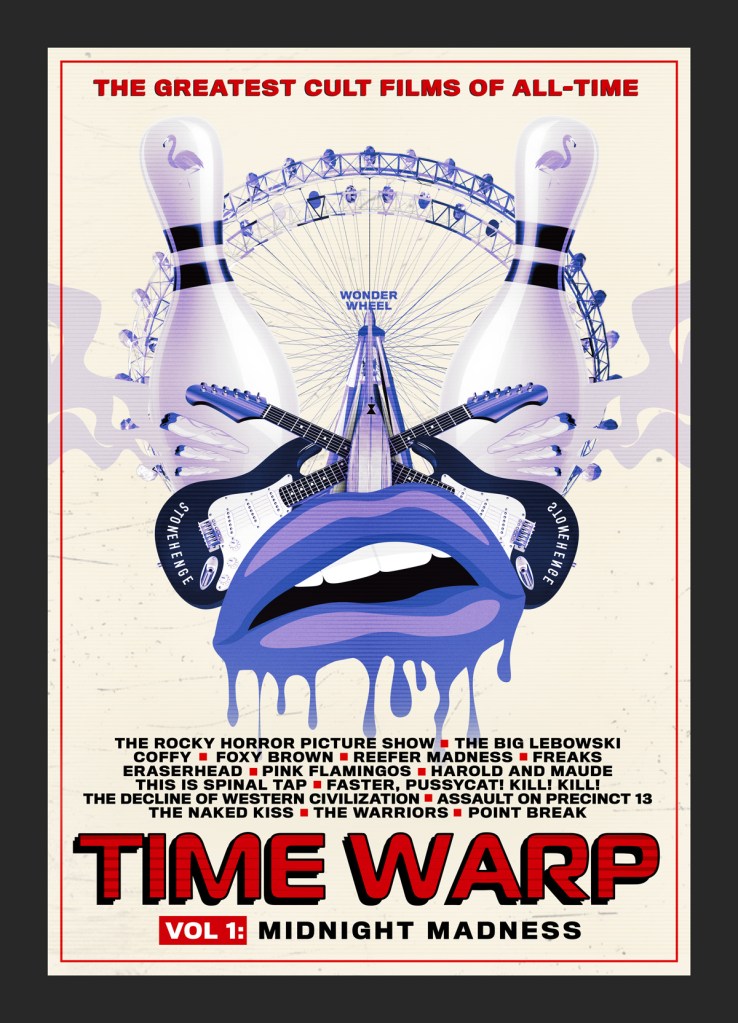


Documentary Review — “Time Warp: The Greatest Cult Films of All Time”
By Roger Moore
Source: Movie Nation
Ask a hundred film buffs what their favorite cult film is, and you’ll get 500 answers.
Because nobody wants to limit that pick to the obvious — “The Rocky Horror Picture Show,” “Harold & Maude,” “Eraserhead” — to admit how many times they’ve watched “The Evil Dead,” or to interrupt their latest trip to Lebowski Fest to give the question more serious thought.
So it’s no wonder that Quiver and director Danny Wolf couldn’t limit themselves to a single documentary, rounding up stars, directors, academics and critics to swoon over and deconstruct their favorites.
“Time Warp: The Greatest Cult Films of All Time” is a three-part mini-series, covering everything from “Freaks” to “The Warriors,” “Spinal Tap” to “Valley Girl.”
There are lots of opinions about the definition of a “cult” film, taking into account its “edge,” forbidden fruit “danger,” rejection by the mass movie audience (many were bonafide “flops” that found their audience over decades) and that ineffable “something” that makes you want to call your best friend and yell, “Friend, you have GOT to see this.”
I think John Cleese comes the closest to getting that definition right.
A cult film, Our Lord J.C. (of “Monty Python and the Holy Grail”) says, is one “that you think is much better than it is.”
“The Rocky Horror Picture Show (1975)” is celebrated as the greatest cult film of them all, a movie that opened to little notice, but which “never ever left the cinema,” as Patricia Quinn, one of several members of the cast speaking here, declares. Fans and critics and cult director John Waters (“Pink Flamingos”) talk of its impact on the culture, putting a “transvestite transexual” on screens where isolated, closeted fans could see someone that might be closer to their own sexuality than anything mainstream Hollywood was putting out.
Tod Browning’s still alarming “differently-abled” thriller “Freaks” (1932) is titled “the scariest movie ever made” by the likes of comic writer Bruce Vilanch and others.
Pam Grier talks of her glory days in Blaxploitation cinema like “Foxy Brown” and “Coffy.”
Gary Busey goes hyperbolic over “Point Break,” which has gained stature via a growing online fandom.
“Harold & Maude,” “The Decline of Western Civilization” punk documentaries, the films of the cleavage-cultist Russ Meyers and the down and dirty noir classics of Sam Fuller (“The Naked Kiss”), John Carpenter’s “Assault on Precinct 13” — a lot of ground is covered just in “Volume One: Midnight Madness.”
Everybody here is an enthusiast, and director Danny Wolf got Jeff Bridges and John Turturro to talk about “The Big Lebowski,” Rob Reiner and several others to speak about “Spinal Tap” and David Patrick Kelly to reminisce of the glory that was and remains “The Warriors.”
Those big names missing (Tim Curry, Keanu, Kathryn Bigelow, Tarantino, David Lynch, seen only in a ’70s interview) are barely missed.
Not all of it works. The conceit of having a “panel” consisting of directors Joe Dante (“Gremlins”) and John Waters, actress Ileana Douglas (?) and comic and actor Kevin Pollack (!?) could have left the hosting to Waters — the real authority, the Cult King.
There’s a whole subgenre of “revolting cult films” that aren’t so labeled but show up here. “Eraserhead” and any of the early warped Waters movies could turn your stomach.
Later installments will dwell on everything from masterpieces like “A Clockwork Orange” and “Blade Runner” to the obscure “Liquid Sky,” bonafide hits (no “cult” to them) like “Fast Times at Ridgemont High” to the zombie genre — “Living Dead” movies no longer having any cult appeal.
What, no “Stunt Man?” Well, they got to “Show Girls.” That’ll have to do.
But that’s the fun of it all, the arguments it starts. Because what really defines this sub-category of cinema is movies that have taken on a life of their own, taken over by fans.
And if the fans prefer “The Warriors” (popular, enduring, classic) to “Streets of Fire” (a lot more “cultish” for my money), they’re the arbiters.
“Time Warp,” in three installments, shows up via VOD and digital streaming, April 21 (ep. 1), May 19 (ep. 2) and June 23 (ep. 3).
Tune in. All the cool kids will be there.
Watch the Time Warp trilogy on Kanopy here:
Vol 1 – https://www.kanopy.com/en/product/11188290

Film Analysis: The Wailing (2016) by Na Hong-jin screening on Fantasia International Film Festival
By Panos Kotzathanasis
Source: Asian Movie Pulse
Na Hong-jin is one of those rare cases in S. Korean cinema, which, despite having enormous success with their films, are not exactly eager to follow up. In that fashion, he has shot just three films in eight years, with the previous one (The Yellow Sea) screening six years before. His absence was quite felt in the country’s cinema, but his return fully compensates. “The Wailing” is already an international success, amassing more the $51 million in international revenue, while it has also won five Blue Dragon Awards (Director, Supporting Actor, Popularity Award, Editing, and Music). Here are seven reasons for the film’s success.
In a seemingly peaceful village, a kind of epidemic suddenly breaks out, with people losing their minds and attacking their relatives and with their skin suffering from a hideous infection. Their attacks have resulted in violent deaths, and the local police seem unable to deal with the case, eventually concluding that poisonous mushrooms are causing this behavior. Among them is officer Jong-goo, who hears a rumor about a Japanese man living on the top of a nearby hill being the actual perpetrator, a suspicion that becomes stronger after a strange young woman, named Moo-myeong confirms the fact. Eventually, he tracks down the man’s house and comes across a series of truly horrific spectacles. Being kind of coward himself, he tries to avoid the situation as much as possible, but when his little daughter, Hyo-jin, comes down with similar symptoms, Jong-doo is willing to go to extremes to save her. Meanwhile, his mother-in-law invites Il- gwang, a shaman, to perform an exorcism on the girl while a deacon named Yang Yi-sam, is also involved, as a translator of Japanese for the police. The truth about what is really going on, and who the actual evil characters are, changes all the time, until the end. In that fashion, Na Hong-jin manages to retain the agony for the whole duration of the movie, as the twists are continuous and quite shocking.
Underneath the elaborate script, Na Hong-jin has hidden a very sharp, sociopolitical allegory, which my friend and expert on Korean film allegory, Bastian Meiresonne has pointed out to me. Moo-myeong, the shaman woman, is a direct reference to South Korea’s current president, Park Geun-hye, who has an intense connection with shamanism (or Muism, as is the Korean version of it) through the Eternal Life Church and her advisor, Choi Soon-sil, the instigator of the latest scandal that has led to her impeachment trial. In that fashion, Moo-myeong (shaman / white woman) is manipulating people to accuse the foreigner (or the past of South Korea in another interpretation). Her accusations make the people of the town become more and more racist, and to eventually kill the foreigner. It is always a dream sequence or a story told that has the Japanese man doing magic, or he is nearby, but he never actually does anything. The only time that he performs shamanism is in order to counter the woman’s sorcery.
The sequence where Moo-myeong is throwing stones at Jong-goo symbolizes how racism gets to people. It takes quite awhile, and lots of small “stones”, and people in the beginning are negative, like Jong-goo, who tells the woman to leave. Eventually though, it gets to them, and when they understand what is happening, it is too late. This allegory becomes clear during the sequence where the Japanese man turns into a monster in front of the wannabe priest, Yang Yi-sam. He says to him: “You only see me as you want to see me – and if I would tell you how I really look like (normal guy), you wouldn’t believe me anyway.” In that fashion, racism makes targeted people seem like monsters. The wannabe priest is an allegory regarding South Korea’s very troubled religious history, with Protestants and Catholics doing a lot of wrong in the country.
At one point, people call upon Korea’s traditional past – the shaman – (Il-Gwang) to help them, whose first question is how much he will be paid. As soon as the ritual is over (where he actually did nothing), he puts on his brand sportswear, in a symbolism of how old Korea has been left behind for money and western “values”. The only one who seems to realize the truth is the little girl, Hyo-jin, who symbolizes the children in general. She continuously yells “STOP”, but her parents continue to do the wrong thing and trust the shaman – Park Geun-hye – as they succumb to racism. In that fashion, Na Hong-jin means that the children will turn against their parents for the consequences they will have to pay, due to their mistakes.
Na Hong-jin directs and pens an agonizing thriller, building the tension gradually as the story progresses, until the utterly shocking finale, one of the film’s greatest sequences. He incorporates a plethora of horror-favorite elements and notions, including zombies, vampires, demons, and exorcists, although the only one majorly implemented is the latter, with the rest existing, for the most part, to create an atmosphere of supernatural horror. In that fashion, he avoids the reef of hyperbole, maintaining a very serious approach throughout the film, despite some minor moments of unexpected humor. The pace is neither fast nor slow, but has the most fitting speed for the story, which artfully escalates as the time passes, until the impressive ending with the continuous plot twists. Apart from that, there is much cursing, violence, and a number of truly grotesque bloodbaths and spectacles in general, which supplement the general aesthetics of the film. Lastly, the allegories are another element that moves the film beyond the typical horror movie, adding another level and more substance.
The cast is another point of excellence, with Kwak Do-won giving a wonderful performance as Jong-goo, an easily intimidated police officer who transforms into a relentless hunter for the sake of his daughter. Kwak has been mostly cast in secondary roles during his career, and he proves in this film that he is made of protagonist material. Hwang Jung-min is great as usual as Il-gwang, in his path to become the next Song Kang-ho. The exorcism scene is the highlight of his impressive performance. The one who truly steals the show, however, is Jun Kunimura as the mysterious Japanese man, whose acting and physique make him the perfect choice for the particular role, as he constantly exhibits a subtle but obvious threat, despite the fact that he does not speak very much. Kim Hwan-hee is also great as little Hyo-jin, in a rather difficult role that demanded her transformation from a cute and smart little girl to a violent, constantly cursing, possessed individual. Lastly, the gorgeous Chun Woo-hee shines particularly in the end, with a truly eerie performance.
Technically the film is magnificent, with Hong Kyung-pyo’s cinematography wonderfully presenting the grotesque atmosphere in the rural surroundings of the film, while exhibiting images of bucolic beauty as much as of onerous terror, particularly inside the various houses in the area. Furthermore, the extensive shooting in natural light gives the film an eerie essence that so suits its general atmosphere. Kim Sun-min’s editing is also great, retaining the agony throughout the film, while the sequencing is a work of art, particularly during the exorcism scene and the ending. Jang Young-gyu magnificently supplements the general atmosphere of the film, especially during the agonizing scenes.
All of the film’s aspects find their apogee in the exorcism scene, the movie’s most impressive and meaningful sequence. In terms of acting, Hwang Jung-min has the central role, presenting an exorcist performing a complicated ritual, as he dances around, killing a cock and chanting the whole time. Kw ak Do-won wonderfully portrays his character’s agony, particularly due to the reactions of his daughter, as Kim Hwan-hee is truly terrifying screaming and kicking as if she is being killed. Jun Kunimura is also great, as he presents his character’s stress over countering the ritual. The cinematography of the scene is extraordinary, as the difference in the two exorcisms is presented by the opposite colors (white and black) of the cocks sacrificed and the setting where they take place: the first in full light, and the second one in the darkness. Since the two rituals occur simultaneously, the editing is also masterful, as the two scenes alternate magnificently. The music, mainly produced through hand drums, heightens the tension even more.
“The Wailing” features many grotesque scenes. Cannibalism, violent killings, people acting like zombies, the terribly depicted skin infection, the cock killing ritual, and the amounts of blood all point towards an extreme horror film. The same applies to Hyo-jin’s behavior, which is very hard to watch, particularly during the ritual scene. The sequences involving the dog and the interior of the Japanese man’s house also move in the same direction. However, Na Hong-jin manages to “hide” this grotesqueness, as the other more artful elements of the film are the ones that dominate in the end. The intricate script with the deep and meaningful allegory, the well-analyzed characters, the fitting pace, and the elaborate cinematography that presents images of extreme beauty, alongside those of extreme grotesqueness, succeed in making the film watchable by anybody. The sporadic humor also moves in this direction, and this along with the aforementioned elements make “The Wailing” a great combination of artistry, meaningfulness, and entertainment, which even applies to fans of the extreme.
“The Wailing” is a truly great spectacle, a must-see for every fan of S. Korean cinema and a great return for a great filmmaker.
Watch The Wailing on Hoopla here: https://www.hoopladigital.com/title/11707489
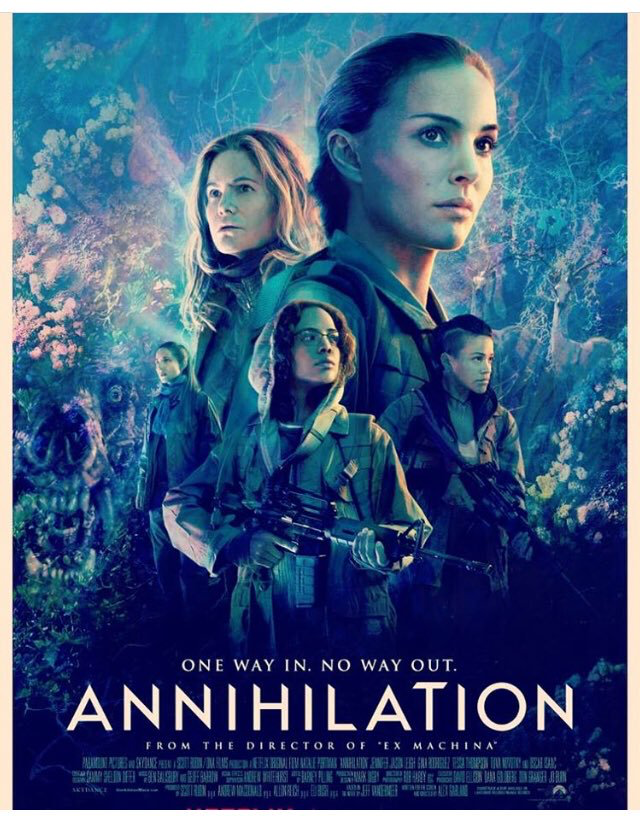
Movie review: Annihilation
By Frank Kaminski
Source: Resilience.org
Annihilation
Directed by Alex Garland; screenplay by Alex Garland; based on the novel Annihilation by Jeff VanderMeer; cinematographed by Rob Hardy; edited by Barney Pilling; music by Geoff Barrow and Ben Salisbury; production design by Mark Digby; produced by Eli Bush, Andrew Macdonald, Allon Reich and Scott Rudin. Released in Feb. 2018 by Paramount Pictures. Running time: 115 minutes. Rated NNN
Starring: Natalie Portman as Lena, Oscar Isaac as Kane, Jennifer Jason Leigh as Dr. Ventress, Gina Rodriguez as Anya Thorensen, Tuva Novotny as Cass Sheppard, Tessa Thompson as Josie Radek, David Gyasi as Daniel and Benedict Wong as Lomax
There are many layers to this smart, tense, slow-building science fiction drama. It’s at once a nuanced exploration of trauma and identity, a surreal excursion into high-concept cosmic horror and an endlessly rich subject for intellectual debate. It’s a movie that invites many interpretations, having been read as a metaphor for everything from depression to cancer to radioactive contamination following a nuclear accident. Perhaps its most poignant subtext is that of nature fighting back against the encroachments of human civilization.
Loosely based on an eponymous 2014 novel by Jeff VanderMeer, Annihilation centers around a journey to the heart of an anomalous region known as Area X on America’s southern coast. Three years earlier, a meteorite crashed into a lighthouse in a national park, bringing with it an extraterrestrial entity that has since been transforming everything around it. During its spread inland, the alien has forged new ecosystems filled with mutations like something out of a psychedelic vision. At the edge of the contaminated zone lies a hypnotic, pulsating electromagnetic field called The Shimmer, from which almost no one who enters ever emerges—the one man to have done so bearing little trace of his former personality or memories afterward.
A clandestine government organization called Southern Reach has been created to study Area X with the aim of halting and reversing its progress. But Area X is impervious to satellite surveillance, and no one has picked up radio transmissions from any of the numerous teams that have ventured inside. So far, Southern Reach has managed to keep Area X under wraps, using the pretext of a chemical spill to evacuate the sparsely populated swampland that has thus far been consumed. But it’s only a matter of months before Area X will begin to expand into population centers, raising the prospect of mass evacuations that will be much harder to explain.
In the movie’s opening scene, the sole survivor of the latest expedition into Area X, a cellular biologist named Lena (Natalie Portman), is being questioned in a small, bare room by Southern Reach agents in hazmat suits. It’s been four months since she and the rest of her team embarked on their mission to reach and study the lighthouse that appears to be The Shimmer’s epicenter. The other members of her group were psychologist Dr. Ventress (Jennifer Jason Leigh), paramedic Anya Thorensen (Gina Rodriguez), geomorphologist Cass Sheppard (Tuva Novotny) and physicist Josie Radek (Tessa Thompson). They left with food rations, camping gear, weapons and their various scientific instruments. Lena’s questioners want to know what became of the others, how Lena lasted for months on only two weeks’ worth of food and what transpired between her and the lighthouse entity. The movie then flashes backward to recount the saga.
Portman gives a strong, sympathetic performance. Her character’s personal journey—which involves coming to terms with the fate of her husband Kane (Oscar Isaac), a special forces officer who was part of an earlier mission—forms the emotional core of the story. Leigh, who plays the group’s stoic leader, seems strangely subdued at first, until we come to understand her character’s motivations for heading into Area X. All of the actresses excel as action heroines during the movie’s periodic swings into action-thriller mode.
Unfortunately, some of the characters are given more to do than others. Lena and Josie are the only ones who really put their respective areas of expertise to use, each making important discoveries that advance our understanding of the entity’s threat. The others might as well just be soldiers.
Though subtle at first, the aberrations to the landscape and its flora and fauna grow increasingly dreamlike the closer the group comes to the lighthouse. The early mutations are, to use Lena’s words, “Corruptions of form. Duplicates of form.” But eventually the women encounter humanoid shrubs, stems harboring multiple plant species, an alligator with shark-like concentric rows of teeth, deer with flowering branches for antlers and trees made of glass. Josie hypothesizes that the alien being is a prism that refracts not only light rays and energy waves, but molecular structures as well, including DNA. This explains how shark’s teeth ended up in the mouth of an alligator, how sand formed into glass trees and how plants have melded with one another and with humans and deer.
Freakish things soon begin happening to the bodies and minds of our protagonists. Examining a drop of her own blood under a microscope, Lena finds it suffused with rapidly dividing alien cells. Anya is unnerved to see her fingerprint patterns moving. Paranoia begins to overrun the group. Some of the women fall victim to the creatures of Area X, while others turn into them, like Gregor Samsa becoming a cockroach in Franz Kafka’s “The Metamorphosis.” Characterized by intense emotions and moments that seem to occur out of sequence and without logical explanation, these events play out much like a dream sequence. This feeling is heightened by Geoff Barrow and Ben Salisbury’s musical score, whose sounds become increasingly unnatural and mesmerizing.
The movie’s frights are a mixed bag. At their best, they’re superb at evoking a sense of incomprehensible horror such as one finds in the works of H. P. Lovecraft. Indeed, Annihilation has been likened to Lovecraft’s 1927 short story “The Colour Out of Space”—as well as its numerous film adaptations—in which a life form brought to Earth on a meteorite wreaks madness and all manner of physical deformities upon the wildlife and human residents of a tract of Massachusetts woodland. (Unlike Annihilation’s alien, however, the being in that tale decimates its surroundings rather than creating something new from them.) The film also contains some very effective Cronenberg-esque body horror. However, not all the scares arise naturally from the plot and the characters; there are some monster attacks and shoot ’em up scenes that belong in a less lofty movie, and which are nowhere to be found in the book.
Beyond its similarity to the Lovecraft story (and despite VanderMeer stoutly denying he was influenced by either of the following two works), Annihilation also has obvious echoes of Arkady and Boris Strugatsky’s 1972 novel Roadside Picnic and its 1979 movie adaptation, Stalker. These also involve journeys through a restricted zone rife with strange mutations and inexplicable phenomena brought on by contamination left by an extraterrestrial presence.
Annihilation’s screenwriter and director is Alex Garland, whose previous film was another landmark of intelligent sci-fi filmmaking—and his directorial debut, no less—2014’s Ex Machina. With Annihilation, he takes great liberties with his source material, changing much of the plot, premise and thematic emphasis. The film has more human connection, more emotional interplay among the characters, than the novel does. (The book’s characters don’t relate; they’ve completely shed their names and pasts.) The book begins in medias res and bypasses much of its backstory, whereas the film starts more conventionally, with a full act of setup that relies on clichés such as a getting-to-know-you session between Lena and her future fellow expeditioners and tearful flashbacks to Lena’s personal drama that led her to agree to the mission. Neither version of the story is superior, really; they’re more like “refractions” of a single underlying inspiration.
The novel repeatedly stresses the pristineness of Area X. It’s a region that has managed, even if by otherworldly means, to beat back humankind. In the real world, of course, industrial humanity faces pushback from nature in the form of droughts, floods, diminishing returns in soil fertility, emerging infectious diseases and uncountable other threats to human habitat. Clearly, annihilation runs both ways.
Watch Annihilation on Hoopla here: https://www.hoopladigital.com/title/15222198
INDIAN COUNTRY NEWS
"It is the duty of every man, as far as his ability extends, to detect and expose delusion and error"..Thomas Paine
Human in Algorithms
100% Accurate Google Sheets + KDP Book Formatting | 24hr Delivery
From the Roof Top
I See This
blog of the post capitalist transition.. Read or download the novel here + latest relevant posts
अध्ययन-अनुसन्धानको सार
 After the Crash