In “La Antena” (2007), a surreal Argentine parable written and directed by Esteban Sapir, the population of an unknown city is kept under the complete control of Mr. TV through his monopolization of the broadcast system and food supply. Everyone in the city except for a singer, La Voz, has lost their voice (yet are still able to communicate through visual words). With the help of his scientist henchman Dr. Y, Mr. TV kidnaps La Voz in a scheme to take away the last remaining means of communication from the the citizens. A TV repairman gets word of the plan and attempts to foil it using an abandoned antenna in the mountains.
The film is shot in a silent film style reminiscent of the works of Fritz Lang and F.W. Murnau, but also seems to incorporate influences from modern fantasy films such as Dark City and Pan’s Labyrinth. Unfortunately, the only complete version of the film I could find was without subtitles, but those who don’t know Spanish can still enjoy it because the story is conveyed mostly through (beautifully evocative) imagery and doesn’t rely heavily on dialogue.
As the nation approaches the first anniversary of the Sandy Hook Elementary School massacre, mainstream media are predictably excluding from their tragedy porn any substantive analysis of the idiosyncratic, misleading, and in some cases flagrantly propagandistic reportage of the event that might call the official story into question.
As with a majority of scandals and coverups over the past several decades where powerful interests are implicated, American journalism has become more and more complicit if not actively involved in delivering dubious information that establishes a dominant narrative, while thereafter failing to vigorously interrogate and amend faulty coverage that leads to vast public misconceptions.
The assassination of JFK, the falsely-reported Tonkin Gulf incident that sparked the costly Vietnam War, and the similarly questionable events of 9/11 that have together brought the US to the present national and geopolitical impasse all come to mind. One is left to ponder how the behavior of a wholly government-controlled media system would differ from our corporate-run consciousness industry that routinely and shamelessly showboats its First Amendment protections.
The consequences of such a communication breakdown are vast, with countless lives and entire nations having been undermined and destroyed. Moreover, the “first drafts of history” become plagued by myth and distortion that eventually cohere as collective memory, thus robbing a people of their self-determination, nullifying their humanity, and ensuring that the cycle repeats interminably.
Those rationally dissenting from the official record and who occupy positions to alter public opinion are usually written off by establishment-controlled media outlets as “conspiracy theorists,” “wackos,” and so on. If such individuals cannot be neutralized through defamation or blackmail, and if they possess information or occupy positions where they are capable of posing a serious and immediate threat to official fictions and thus the power structure itself, they are prone to becoming oddly “suicidal,” (see, for example, here, here, here, here, here, here, and here), or are simply killed outright (e.g. here, here, here, here, here, here, and here and here).
What else won’t we see in the corporate media’s series of heart-tugging memorials devoted to the anniversary of Sandy Hook? The two most recent and obvious indications that the event itself is at the very least a coverup include, first, the wholly unreported story of the Obama administration’s $2.5 million payout (read: bribe) to state and local law enforcement agencies directly involved in responding to the incident, and second, what is by almost any measure the entirely illegal destruction of pertinent evidence in the demolition of the crime scene itself.
Empowered by the internet as their primary means of communication, a broad array of independent researchers have conduced an impromptu “truth commission” that together calls the Sandy Hook narrative presented by corporate news media into serious question. For those with eyes to see and the ability to think critically they have also shamed the mainstream journalists directly involved in (mis)representing the event to the American public.
Yet without a genuinely independent investigation of the incident apart from the oversight and influence of the [Governor Dannel] Malloy and Obama administrations, the broader public will likely never know what actually took place on December 14, 2012 in Newtown Connecticut. As has too often been the case throughout the last half century, the prospects are high that yet another “big lie” has again taken root in the ever-malleable and somnambulent public mind.
Whenever there’s a cheerful jobs report propagated by corporate news, many of us know they’re lying (because it just doesn’t correspond to reality) though we might not know exactly how the numbers they use decieve us. At Counterpunch.org, Paul Craig Roberts dissects some of the figures cited by the Bureau of Labor Statistics as support for claims of an economic recovery. For example, their payroll jobs report says that the US economy created 203,000 jobs in November. Since it takes about 130,000 new jobs each month to keep up with population growth, the remaining 70,000 of the jobs would have only slightly reduced the unemployment rate yet it supposedly fell from 7.3 to 7.0 which is too much. It turns out the payroll survey counts a person holding two jobs as if it were two employed persons, while the unemployment rate is calculated from the household survey, which counts a person holding two or more jobs as one job. Though the two figures are often reported together, they actually have no connection.
Payroll numbers can be skewed by seasonal hiring and because the birth-death model used to estimate the numbers of unreported business shutdowns and startups often underestimate the former and overestimate the latter. The unemployment rate figures are innacurate because it leaves out people who have given up on looking for work. The greater the number of discouraged workers there are, the lower the rate of unemployment, according to the BLS.
So exactly where and what are the 203,000 new payroll jobs created in November? Paul Craig Roberts breaks down the figures as reported by the BLS and discovered that the majority are lowly-paid, part-time, nontradable (non exportable) domestic service jobs including:
…retail trade with 22,300 jobs, transportation and warehousing with 30,500 jobs, temporary help services with 16,400 jobs, ambulatory health care services with 26,300 jobs, home health care services with 11,800 jobs, and the old reliable waitresses and bartenders with 17,900 jobs.
This is the jobs profile of the American super economy. It is the profile of India 30 or 40 years ago.
PCR continues his analysis by citing the work of statistician John Williams (shadowstats.com), who found more misstated jobs that could be attributed to the government shutdown and reopening, the birth-death model, and concurrent-seasonal-adjustment errors. According to Williams, whose figures include long-term discouraged workers who cannot find a job, the US unemployment rate is actually 23.2%.
Of course there’s no recovery with a 23.2% unemployment rate, but to keep stocks and bonds at all-time record high levels, the Federal Reserve is printing $1,000 billion new dollars annually, potentially creating an economic bubble. Despite these issues, the BLS estimated a third quarter GDP growth of 3.6%. Paul Craig Roberts challenges this claim with the following figures:
US real per capita income has declined from $29,554 in 2007 to $27,319 in 2012, a drop of $2,235 or 7.5%.
According to the Bureau of Labor Statistics, there are 1,277,000 fewer seasonally adjusted payroll jobs in November 2013 than in December 2007.
He concludes by asking:
How it is possible for the economy to have been in recovery since June 2009 (according to the National Bureau of Economic Research) and there are 1,277,000 fewer jobs today than existed six years ago prior to the recession?
How has real Gross Domestic Product recovered when jobs and real consumer incomes have not?
Yesterday marked the 72nd anniversary of the Pearl Harbor attack, which from today’s perspective can be viewed as the template on which 9/11 was modeled after. In both cases, documentation exists implicating the U.S. government. In the case of Pearl Harbor, there’s the McCollum Memo which describes in detail the strategy used to successfully provoke the Japanese government into attacking. Shortly before the Pearl Harbor attack, Secretary of State Hull presented “peace terms” to the Japanese government that all but guaranteed an inevitable attack.
In the case of 9/11, there’s a policy document from Project for a New American Century called Rebuilding America’s Defenses, which provides a clear motive to create a “catastrophic and catalyzing event – like a new Pearl Harbor”. It’s not conclusive proof they were behind the attacks, but it’s suspicious to say the least that the people with established motives for conducting an event like 9/11 were responsible for national security at the time multiple unlikely and implausible coincidences made such a successful attack possible.
A number of other dubious aspects of the Pearl Harbor attack were compiled at Washington’s Blog last year, including:
Active Interference with Military’s Ability to Defend
It has also recently been discovered that the FDR administration took numerous affirmative steps to ensure that the Japanese attack would be successful. These steps included taking extraordinary measures to hide information from the commanders in Hawaii about the location of Japanese war ships (information of which they would normally be informed), denying their requests to allow them to scout for Japanese ships, and other actions to blind the commanders in Hawaii so that the attacks would succeed. See, for example, this book (page 186).
Just like 9/11, Pearl Harbor was used as a tool to focus mass hatred on a race demonized by propaganda. The attack created a culture of fear allowing for suspension of civil liberties while crushing opposition to the war. Most importantly (for powerful interests pushing for war) the attacks were a pretense for pursuing and expanding global political and economic hegemony.
“What to Do in Case of Fire?” (2001) opens with a montage of young anarchist squatters fighting police, making propaganda films, and constructing a homemade bomb in Berlin circa 1987. They plan to blow up a vacant mansion but the bomb is a dud, until thirteen years later when it injures a real estate broker and potential buyer in a fluke accident.
Only two of the original members of the anarchist collective, Tim and Hotte, are still squatting in the same communal housing since the 80s and are unable to prevent police from confiscating filmed evidence in a raid triggered by the bomb incident. Because all members of the collective are potentially linked to the bombing, Tim and Hotte scramble to track down former comrades and formulate an action plan before the evidence is examined. The reunion of old friends, including those who’ve settled into traditional family life or sold out for corporate jobs, stirs up a host of interpersonal conflicts which they must resolve in order to work together to remain free.
Though the film does at times seem to fall back on lazy stereotypes of anarchists, it at least puts them in a human light. Even less radical viewers could relate to certain struggles the protagonists are faced with, such as trying to balance freedom and security, being “successful” versus upholding one’s ideals, and coming to terms with friendships that change over time. It would have been interesting had the film delved deeper into Berlin’s anarchist and squatters movements, in my opinion, but it’s nevertheless a charming and fun mix of comedy, drama and heist genres.
Note: to activate English subtitles on the video, click on the Closed Captions (CC) icon on the bottom right corner while video is playing, click on the box that says “Portuguese (Brazil)”, click “Translate Captions”, click on “Afrikaans”, then you should be able to scroll down until you can click on “English”. The subtitle feature might not be available on some portable devices.
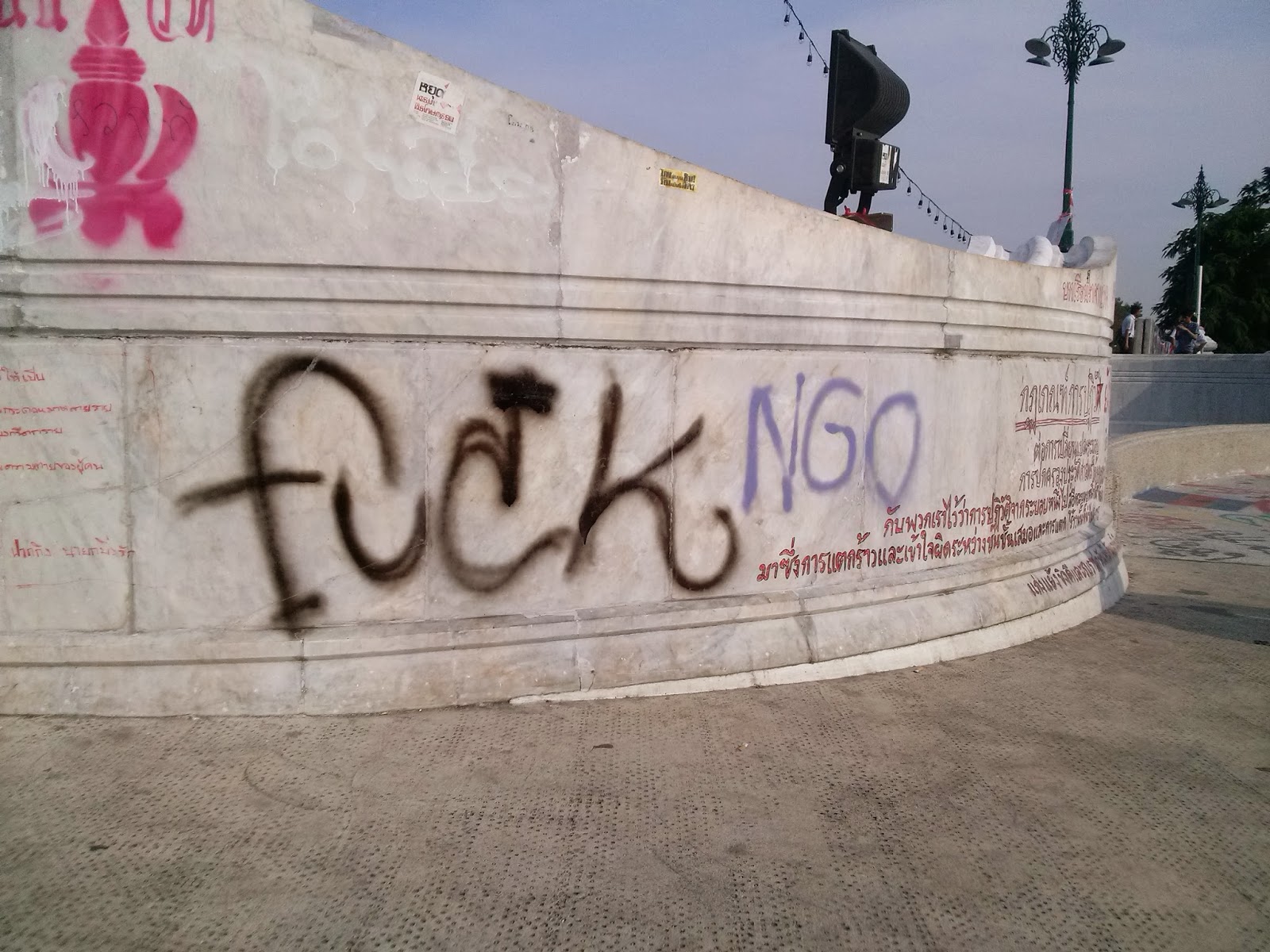
December 3, 2013 – After clashes with police in Bangkok and the taking of several government buildings, anti-regime protesters prepared for the next phase of their resistance – the protracted encampment of key governmental centers. Thousands of protesters are now permanently entrenched in an area winding for nearly a mile through the capital city. They have built up a city within a city at three main locations that are linked by the constant stream of protesters coming and going to and from the protest sites.
But who are these protesters and what do they want? Are they, as the Western media portrays them, anti-democratic elitists who refuse to to concede power to awakened rural masses? Or are they dangerously informed, socially and politically aware groups that are actively opposing the designs of foreign corporate-financiers and the proxy regime they have put into power in Thailand?
Who are Thailand’s Anti-Regime Protesters? Walking from one end of the protest to the other can become an all day affair. The sites are spaced out slightly, but occupy long stretches of road turned into permanent encampments complete with food, water, medical services, bathrooms, shower stalls, exhibition booths and support points, media centers, stages, and hawker stalls. There are thousands of permanently encamped protesters and thousands more who come and go – even at low points in the day.
The extensive infrastructure of these protest sites resemble a fair or an exhibition. While a single theme has brought them together, a large number of diverse groups have marshaled their resources to build the sprawling encampments. There of course is the main camp and stage set up by a group of political parties including the main opposition party, the Democrats, the People’s Democratic Reform Committee, and the Network of Students and People for Reform of Thailand.
The “Yellow Shirt” People’s Alliance for Democracy (PAD) also maintains a camp, as does Santi Asoke, a group that practices the Thai-equivalent of organic farming, homesteading, and grassroots community development.
Images: Labor unions have a strong showing in the anti-regime camps. While the Shinawatra regime has hijacked the color red for his mobs as well as the socialist rhetoric that goes with it, real labor unions flying the color red actually engage in the protection of workers’ rights.
….
There are throughout the camps, smaller student groups from across Bangkok, and a large number of labor unions. Some of the bigger unions include those working for state enterprises, THAI Airways, and the country’s nationalized telecom company, CAT.
And despite the most vitriolic and perhaps even racist accusations leveled against the protesters is that they represent ethnic Chinese-Thais. While there certainly are a lot of Thais of Chinese descent at the rallies, mainly because they have called Bangkok their home for generations, still the vast majority of the protesters are ethnic Thais and include people drawn to the capital to find better lives from Thaksin Shinawatra’s northeast political stronghold.
What Do They Want?
We are told by the Western media that this is a “people’s coup,” an attempt to overthrow democracy. In reality, and entirely unlike Thaksin’s red shirts who simplistically demand “democracy,” the anti-regime protesters have a list of cogent demands. 1. No Amnesty – This refers to an amnesty bill designed by and for Thaksin Shinawatra to absolve himself of a decade of plundering, lying, and mass murder. While the government eventually backed off, it was only because massive street protests were mobilized. When the Constitution Court declared the bill unconstitutional, the ruling regime announced that it no longer recognized the authority of the court – even while using constitutionality to condemn the protests. Even though it is considered “dead,” Thaksin’s entire future depends on it eventually passing. Protesters feel the only way to truly kill this bill, is to remove entirely the regime attempting such an absurd abuse of power.
2. Rollback Article 190 – Article 190 of the Thai constitution requires that all treaties be approved by the parliament before they can be signed. In 2004, this mechanism had prevented Thaksin Shinawatra from unilaterally passing a US-Thai free trade agreement, and was one of many attempted circumventions of the law that led to his ouster in 2006. His nepotist-appointed sister Yingluck Shinawatra, has now managed to amend it making it possible for her to unilateral approve treaties (specifically unpopular FTA’s). Protesters would like to see this reversed.
Image: Another issue protesters have is with the changing of article 190 which allows the regime to now unilaterally sign treaties without the parliament’s approval. This will be used specifically to pass through a series of extremely unpopular free trade agreements with the regime’s Western sponsors.
It becomes abundantly clear why corporate media houses like the BBC, Reuters, AP, AFP, CNN, MSNBC, and Australia’s ABC have attacked the protesters as “anti-democratic,” “elitist,” and “violent.” They represent for them a population they cannot trick, manipulate, and have their way with. They would like to see it marginalized and removed from Thailand’s political landscape so they can grind Thailand into the ground like so many other nations across the developing world. Thailand’s anti-regime protesters are making their stand – those that support true freedom and progress should stand with them.