

I was surprised and saddened to hear the news that counterculture comedian Rik Mayall died in his home in London yesterday. The cause of death hasn’t been released but Scotland Yard reported that it was not believed to be suspicious. Mayall was best known for his memorable roles in cult comedy shows such as “The Young Ones”, “Black Adder”, “The New Statesman” and “Bottom”. In a tribute published by The Guardian yesterday, some of his Young Ones colleagues had this to say about him:
“very, very sad and upset that we’ve lost Rik, who was inspirational, bonkers, and a great life force… a brilliant comedian and someone who made everyone else’s lives more fun. He will be really, really missed”. – Nigel Planer
“Comedy is truly great is when it comes out of nothing, and the greatest of comedians, like Rik, have that rare ability to conjure laugh after laugh, not from endless words, but from a single look or one absurd gesture … It was in his bones. Sweet Rik, much loved – what a loss.” – Alexei Sayle
“There were times when Rik and I were writing together when we almost died laughing. They were some of the most carefree, stupid days I ever had, and I feel privileged to have shared them with him. And now he’s died for real. Without me. Selfish bastard.” – Adrian Edmonson
Not sure exactly when this live performance was recorded, but though it seems to be early in his career it captures the manic energy of some of Mayall’s later roles:
The New Zealand Herald made a commendable attempt to compile some of Rik Mayall’s greatest televised moments (there’s too many to list): http://www.nzherald.co.nz/entertainment/news/article.cfm?c_id=1501119&objectid=11270946
Rik Mayall’s second-to-the-last televised work before his death was as the narrator of the following animation for Channel 4 written and produced by Louis Hudson and Ian Ravenscroft called Don’t Fear Death:
The following is a clip from One By One, an intriguing but difficult to find feature film directed by Diane Jessie Miller and featuring one of Mayall’s final performances:

“Paprika” (2006) was the final feature-length anime masterpiece directed by Satoshi Kon, who died a few years later at age 46 of pancreatic cancer. Paprika is seemingly influenced by the novels of Philip K. Dick and films of Terry Gilliam, with a plot involving a radical psychotherapy treatment using a technology which allows one to view and interact with other people’s dreams. When a mysterious culprit steals the technology and uses it to cause the deaths of two scientists, it’s up to a determined detective and Paprika, a dream world avatar, to solve the mystery and prevent a chaotic merging of dreams and reality.

Activist/comedian Lee Camp, best known for his Moment of Clarity YouTube channel and podcasts (and who follows the fine tradition of stand-up social critics such as George Carlin or Bill Hicks), is host of the new RT program “Redacted Tonight”. Not surprisingly it’s an expert blend of humor and news, and you can watch the entire premier episode here:
By Ron Kretsch
Source: Dangerous Minds
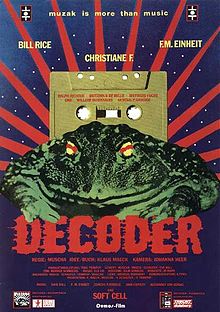
If your life needs a little-seen dystopian ‘80s German film about Industrial music sparking revolutionary change in a society of fast food and cultivated complacency—and I believe it does—then your life needs Decoder


Einheit uses this esoteric knowledge to cultivate increasingly widespread defiance and mayhem, attracting the attention of a Muzak corporate hit-man (I love the conceit that Muzak would have an assassin in its employ) whose task is complicated by his crush on F.M.’s peep-show dancer/amateur herpetologist girlfriend, played by Christiane F. The film’s themes and inspirations are illuminated by its writer Klaus Maeck in this interview from Jack Sargeant’s Naked Lens: Beat Cinema
I wanted to realize Burroughs’ ideas and the techniques which he described in the ‘Electronic Revolution’, and in The Revised Boy Scout Manual and in The Job. These were my favorite books … And I loved Johnny Rotten for his revolution in show business (and I still do). I was convinced that the only valuable political work must use the enemy’s techniques. From the ‘Foreword’ of the Decoder Handbook: “It’s all about subliminal manipulation, through words, pictures and sound. It is the task of the pirates to understand these techniques and use them in their own interest. To spread information is the task of all media. Media is power. And nowadays (1984!) the biggest revolution happen at the market for electronic media. To spread information is also your task. And we should learn in time to use our video and tape recorders as Weapons. The fun will come by itself.”
Being in the music business and participating in the punk and new wave explosion I became more interested in music. Muzak was one thing I found. Subliminal music to influence people’s moods, to make them function better, or buy more. So my conclusion was similar to that of ‘bands’ like Throbbing Gristle; by turning around the motivation, by cutting up the sounds, by distorting them etc. one should be able to provoke different reactions. Make people puke instead of feeling well, make people disobey instead of following, provoke riots.
Though it deals thoughtfully with provocative ideas, the film is laden with Euro art-film pretense that feels like fit matter for a “Sprockets” gag. Early on there’s a montage of video games cut with military stock footage, and another that alternates gore and erotica while Soft Cell’s “Seedy Films” plays.
But as strange as it can be, Decoder still holds a coherent, if dreamy, narrative, filled with captivating imagery and a gorgeous soundtrack
By Tom Karlson
they sang and prayed,
naming that day in May,
Decoration day they dis-interred 257 Union men
mass graved, dumped, piled broken bodies twisted,
a Charleston North Carolina Guernica
forgotten men dug up, re-interred
with honor, memory, celebration
by 10,000 in 1866
that first Memorial Day
it is Memorial Day 2010
the Turkish flotilla
bringing aid to Gaza
the attack, nine dead,
Americans, Turks
no aid delivered
Memorial Day 1937,
steelworkers striking Little Steel,
strikers with families march toward the Republic steel mill gate
police-guards open fire
ten dead
thirty shot
one hundred clubbed
today we are at Jones beach
it is Memorial Day
we are fifty souls
remembering our dead, the dead
hundreds of Long Islanders
thousands of North Americans
more than a million Iraqis and Afghanis
families stroll past
some look, others see without vision
all have come to eat, drink
and celebrate that insatiable beast
today the Blue Angles
spin flip dive swoop
begging boys and girls to sign up
the navy, the marines want you
as we call out the named and nameless
let us remember these days
past, present, and future
Tom Karlson is founder of Poets for Peace, Long Island, NY.
by Walter Brasch
Source: OpeEdNews.com
It’s the third and final day of the Memorial Day weekend.
Millions of Americans are visiting friends and relatives, perhaps taking a three- or four-day mini-vacation. They may be at pool parties and grilling burgers, hotdogs, veggies, and whatever else appeals to them.
The nation’s politicians are going to Memorial Day rallies. There will be speeches and music. American flags and bunting will drape the stages. The politicians will tell us about the “ultimate sacrifices” American servicemen and women made. They will tell us how wonderful America is, how we are the best country in the world, how we defend freedom and remember those who put their lives on the line to do so. The crowds, whether a few or thousands, will applaud vigorously.
Some will even say that the VA hospitals need a complete overhaul, that Gen. Eric Shinseki–who was wounded and earned three Bronze Stars for bravery, should be fired. These are some of the same politicians who had attacked Shinseki when he was Army chief of staff who warned that it would take hundreds of thousands of Americans, not thousands as the Bush-Cheney cabal had claimed, to successfully invade and control Iraq. For his military knowledge, he was forced into an early retirement. These are the politicians who are outraged that America is treating veterans poorly.
Here’s what the politicians also won’t say. They won’t tell us that 41 Republican senators blocked legislation this past year to provide necessary funding for veterans health. They won’t tell us that during the first years of the Iraq War, the quality of American-based hospitals had deteriorated to the point that it took a major newspaper series to expose what had happened and, finally, with politicians forced to look at despicable conditions, and shamed by their ignorance, there were some measures to improve the care for wounded soldiers after their lives were saved by courageous battlefield medics.
They won’t tell us that members of Congress blocked significant increases in the foodstamp program or that governors and legislatures have not done what they should to care for the homeless. After all, the impoverished and homeless don’t contribute to political campaigns. Of course, the politicians won’t tell us that one-fourth of all adult homeless are veterans.
They won’t tell us about veterans who came home from war, and then lost their jobs or homes during the Great Recession that followed the fraud and greed committed by the bankers and industrial giants who were able to become rich because government did little to protect the people.
With crocodile tears and shallow words, recorded by the news media, the politicians will tell us how much they mourn–but they won’t tell us they are part of the problem, for proudly claiming they voted time after time to block necessary funding and for demanding government not intrude upon the free enterprise system.
The politicians will wave flags and say how much they believe in America and our veterans, and how much they mourn the loss of our soldiers. The crowds will enthusiastically agree–and then go to their barbeques and picnics.
No, they won’t tell us that if we want to reduce these problem–DON’T THUMP YOUR CHESTS, UNFURL YOUR FEATHERS, AND SEND THE YOUTH TO WARS THAT SHOULD NEVER BE FOUGHT.
During the Vietnam War, John Prine recorded “Your Flag Decal Won’t Get You Into Heaven Anymore.” It was true then. It is still true. Please listen.
INDIAN COUNTRY NEWS
"It is the duty of every man, as far as his ability extends, to detect and expose delusion and error"..Thomas Paine
Human in Algorithms
100% Accurate Google Sheets + KDP Book Formatting | 24hr Delivery
From the Roof Top
I See This
blog of the post capitalist transition.. Read or download the novel here + latest relevant posts
अध्ययन-अनुसन्धानको सार

