Who would have guessed that the greatest animated Christmas story would be an anime set in Tokyo? I would have had my doubts before seeing Satoshi Kon’s “Tokyo Godfathers” (2003). Unlike the majority of Kon’s filmography, the film’s relatively simple plot centers on three homeless friends who upon finding an abandoned baby set out on a quest to track down the parents. The homeless protagonists are not mere stereotypes but complex individuals with unique backstories which is especially remarkable since homeless people continue to be underrepresented in films (despite growing numbers). Like other Christmas fables, it has its share of sentimentality and reliance on convenient coincidences (ie. miracles), but it’s elevated by beautiful artwork and a finely crafted blend of realism, humor, action and earned emotional uplift. This was only Satoshi Kon’s third feature production and his penultimate film. Kon passed away much too soon from pancreatic cancer on August 24, 2010 at the age of 46.
Media hype surrounding the release of the latest Star Wars film is similar to the release of the previous films in the series except for the fact that prior to the release of the first installment, few outside the sci-fi community predicted it’d be such a success. Though it’s too early to tell how much of an enduring cultural impact The Force Awakens will have, in hindsight the impact of A New Hope has been substantial. It definitely raised the bar for effects-laden “event” films and marked a transition point for Hollywood from releasing films with a more gritty pessimistic tone and European-influenced aesthetic of the early and mid seventies to films with larger budgets and more optimistic “retro” sensibilities of the late seventies and beyond.
Star Wars also upped the ante for the potential boon to be had not just for studios but from merchandising partnerships, multimedia spin-offs expanding the franchise universe and countless opportunists attempting to cash in. Kids growing up in the post-Star Wars era had no shortage of Star Wars toys and products to choose from (or Star Wars-like toys and products) which helped boost a generation’s interest in sci-fi, space and technology. On television kids and adults could get their sci-fi fix through such shows as Battlestar Galactica, Buck Rogers, Quark, and an anime from 1974 repackaged as Star Blazers for American audiences. Meanwhile Hollywood was diving head-first into the sci-fi/fantasy resurgence with Disney’s The Black Hole, a space-bound James Bond in Moonraker, new versions of Superman, Star Trek and Flash Gordon, Ridley Scott’s Alien, and Jimmy Murakami (When the Wind Blows) and Roger Corman’s Battle Beyond the Stars among others.
Movie producers around the world also jumped on the bandwagon with films as diverse as Os Trapalhões (The Dabblers) from Brazil and Dünyayı Kurtaran Adam (The Man Who Saved the World), also known as “Turkish Star Wars” due to the filmmaker’s liberal use of Star Wars footage for spliced in effects shots and backdrops. As many horrible examples of this subgenre of world cinema as there are, there’s at least two I’ve found to be charming and enjoyable in their own ways: Message From Space (Japan, 1978) and Starcrash (Italy, 1979). Both feature eclectic casts with hammy performances (eg Vic Morrow and Sonny Chiba in Message From Space and Caroline Munro, Christopher Plummer and David Hasselhoff in Starcrash), both have low-budget yet creative production design, and like Star Wars, they also make a decent attempt at recombining various mythological and cinematic tropes to create new fantasy worlds. Message From Space also had the benefit of having Kinji Fukasaku in charge, the auteur who also directed Black Lizard, Battles Without Honor and Humanity, and Battle Royale.
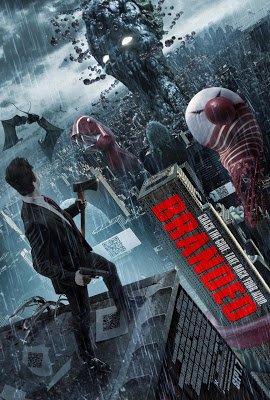
Branded (2012) is a Russian-US sci-fi parable written and directed by Jamie Bradshaw and Aleksandr Dulerayn. Much of the story is told in flashbacks documenting the rise, fall and rebirth of top-level advertising executive Misha (Ed Stoppard, son of playwright Tom Stoppard). Upon being scapegoated for a marketing disaster, Misha withdraws to the countryside where in a trance state he’s compelled to perform a bizarre ritual. Shortly after, he finds he has a unique ability to “see” strange parasitic creatures which are the embodiment of corporate influence. Horrified, Misha sets out to destroy the creatures of his visions, a quest which could ultimately liberate society but at the expense of his personal and professional life. Though the film is hindered by uneven tonal shifts and occasionally stilted performances, Branded is notable for its relevant social critique which mixes elements of Putney Swope,They Live and novels of Philip K. Dick.
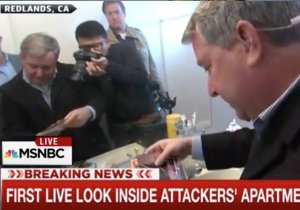
If the San Bernardino shooting were not being treated as an episode of Homeland Security Theater, why would the FBI – the lead investigative agency in what has been described as an ISIS-linked act of mass terrorism – allow an MSNBC News crew to contaminate a crime scene? Why would a reporter be allowed to handle evidence with un-gloved hands – picking up licenses, identification cards, and other credentials, credit cards, and riffling through copies of the Koran?
NBC Anchor Andrea Mitchell explained that the landlord of the apartment rented by Sayed Farook and his wife, Tashfeen Malik, had allowed “the media to enter … en masse” and examine what was still an active crime scene. If, as several media reports have suggested, the couple had received repeated, mysterious visits to their home by yet-unidentified co-conspirators, the mere presence of multiple news crews might be sufficient to destroy forensic evidence. Any investigator with even a modicum of knowledge and experience will recognize that allowing reporters to handle evidence with bare hands will adulterate fingerprints and DNA traces that could be useful in identifying additional suspects.
“That is not a cleared crime scene,” a spokesman for the San Bernardino Sheriff’s Office shortly after the landlord used a crowbar to break the plywood seal to let the media – and, apparently, several bystanders, including a woman with a dog and another carrying a newborn child — into the apartment.
“The most important aspect of evidence collection and preservation is protecting the crime scene,” explains George Schiro, a forensic scientist with the Louisiana State Police Crime Laboratory. “This is to keep the pertinent evidence uncontaminated until it can be recorded and collected. The successful prosecution of a case can hinge on the state of the physical evidence at the time it is collected. The protection of the scene begins with the arrival of the first police officer at the scene and ends when the scene is released from police custody.”
The personal effects that were pawed by dozens of curious reporters were not the only potential source of valuable clues as to potential accomplices in the deadly shooting.
“Particular attention should be paid to the floor since this is the most common repository of evidence and it poses the greatest potential for contamination,” Schiro advises. This is why “the arrival of additional personnel can cause problems in protecting the scene”; non-essential people “should never be allowed into a secured crime scene unless they can add something (other than contamination) to the crime scene investigation.”
In addition to the apartment’s floors, the curtilage – “driveways, surrounding yards, pathways, etc.” – could likewise provide valuable evidence, assuming that it isn’t trampled out of existence by an eager herd of media personnel and curiosity seekers.
According to the SBSO, once again, the apartment had not been “released” from police custody at the time of the “media tour.” The reported cache of pipe bombs and ammunition had been removed. Instead, the visitors saw “what would have looked like a relatively normal cluttered household, notwithstanding a shredded front door that had been ripped from its hinges and cast aside as law enforcement officers broke in,” summarized the New York Times. “There were signs throughout the home of the residents’ Muslim faith: The sticker pasted on a chest of drawers (`Praise be to Allah Who relieved me from suffering and gave me relief’). And there were the books: `The Characteristics of the Prophet Muhammad’ in a linen closet and `Common Mistakes Regarding Prayer’ on the bedside table.”
Rather than seeking to learn the truth and tell it without fear or favor, the Legacy Media’s role in this affair is to promote public suspicion that will result in the expansion of government power at the expense of individual liberty – whether in the form of expanded surveillance of Muslim houses of worship, or new restrictions on the right to armed self-defense.
It isn’t difficult to imagine a “bipartisan” push to promote such a “compromise” approach: Republican national security hawks might approve of expanded scrutiny of, and limitations on the personal liberties of, people who display symptoms of “incipient radicalization,” such as regular mosque attendance; anti-gun Democrats would favor new “common-sense” restrictions on gun ownership, while seeking to expand the “radicalization” profile to include other indicators, such as participation in anti-abortion protests. The corporate media, for its part, would frame the discussion in terms that would eventually lead to less freedom for everybody, rather than subjecting such proposals to intellectually rigorous scrutiny. That’s why the state-centered media cannot be considered trustworthy.
“Wave Twisters” (2001) is a mindbending homage to hip-hop culture set to the music of DJ Q-Bert. Using a mix of live-action, CG and cel animation, it tells the story of a heroic team who confronts an army of anti-hip-hop oppressors with the help of a powerful weapon known at the Wave Twister. Buckethead, D-Styles and Flare also contribute to the excellent soundtrack.




 After the Crash