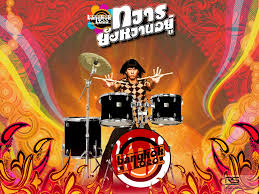
“Bangkok Loco” (2004) is a surreal Thai musical comedy (and feature film debut) from director Pornchai Hongrattanaporn. Actor/musician Krissada Terrence stars as Bay, a 70’s era drum prodigy with special skills taught to him by a monk. After getting framed for a murder, he becomes a fugitive but is aided by friend and fellow drummer Ton (Nountaka Warawanitchanoun). Together, they struggle to evade police, clear his name and win a climactic drum duel against “Devil’s Drums Master” Mr. David (Rang Sabian).
Watch the full film with English subtitles here. (May not stream on some portable devices.)
What is it that makes us human? And how best to ensure that we all get our fair say?
For director, photographer, and environmental activist Yann Arthus-Bertrand, the answers lay in framing all of his interview subjects using the same single image layout. The formal simplicity and unwavering gaze of his new documentary, Human, encourage viewers to perceive his 2,020 subjects as equals in the storytelling realm.
There’s a deep diversity of experiences on display here, arranged for maximum resonance.
The quietly content first wife of a polygamist marriage is followed by a polyamorous fellow, whose unconventional lifestyle is a source of both torment and joy.
There’s a death row inmate. A lady so confident she appears with her hair in curlers.
Where on earth did he find them?
His subjects hail from 60 countries. Arthus-Bertrand obviously went out of his way to be inclusive, resulting in a wide spectrum of gender and sexual orientations, and subjects with disabilities, one a Hiroshima survivor.
Tears, laughter, conflicting emotions… students of theater and psychiatry would do well to bookmark this page. There’s a lot one can glean from observing these subjects’ unguarded faces.
The project was inspired by an impromptu chat with a Malian farmer. The director was impressed by the frankness with which this stranger spoke of his life and dreams:
I dreamed of a film in which the power of words would resonate with the beauty of the world. Putting the ills of humanity at the heart of my work—poverty, war, immigration, homophobia—I made certain choices. Committed, political choices. But the men talked to me about everything: their difficulty in growing as well as their love and happiness. This richness of the human word lies at the heart of Human.
In Volume I, above, the interviewees consider love, women, work, and poverty. Volume II deals with war, forgiveness, homosexuality, family, and the afterlife. Happiness, education, disability, immigration, corruption, and the meaning of life are the concerns of the third volume .
The interview segments are broken up by aerial sequences, reminiscent of the images in Arthus-Bertrand’s book, The Earth from Above. It’s a good reminder of how small we all are in the grand scheme of things.
Appropriately, given the subject matter, and the director’s longtime interest in environmental issues, the filming and promotion were accomplished in the most sustainable way, with the support of the GoodPlanet Foundation and the United Carbon Action program. It would be lovely for all humanity if this is a feature of filmmaking going forward.
“Terror in Resonance” is an 11 episode anime series directed by Shinichirō Watanabe (director of a number of cult anime titles such as Cowboy Bebop, Space Dandy and Samurai Champloo). This latest series (known in Japan as Terror in Tokyo) centers on two teenage terrorist masterminds code-named Nine and Twelve who collectively go by the name Sphynx. They set off a number of targeted bombs around the city while releasing videos designed to communicate cryptic messages to authorities. What starts off as a conventional “cat & mouse” detective story gradually becomes an even more intriguing parapolitical parable. Terror in Resonance stands out for its mixture of elements from Akira,Dark Angel and V for Vendetta and references to familiar topics in the conspiracy milieu such as thermite bombs, remotely piloted planes, EMPs and human experimentation.
“Now it’s just an oligarchy, with unlimited political bribery being the essence of getting the nominations for president or to elect the president. And the same thing applies to governors, and U.S. senators and congress members.” – Former President Jimmy Carter
The 2016 election has been a wild ride, with two insurgent grassroots campaigns literally giving the political establishment a run for its money. But as the events of this presidential primary season play out, it’s becoming clear the U.S. election — and even more so, the presidential race — is a big scam being perpetrated on the American people.
Events from the last week have exposed the system as an illusion of choice and a farce. They have reinforced at least one study showing the U.S. is an oligarchy rather than a democratic republic.
The Wyoming democratic caucus took place on Saturday, purportedly to allow voters to have their voices heard in the race between Bernie Sanders and Hillary Clinton. Sanders lost the Wyoming caucus by winning it with a 12 percent margin.
Wait, what?
How does one lose by winning 56 percent of the votes? This happens when the political process is, according to the New York Post, “rigged” by superdelegates. The Post summed up this “strange” phenomenon:
“[U]nder the Democratic Party’s oddball delegate system, Sanders’ winning streak — he has won seven out of the past eight contests — counts for little.
“In fact, despite his win, he splits Wyoming’s 14 pledged delegates 7 to 7 under the caucus calculus.
“Clinton, meanwhile, also gets the state’s four superdelegates — who had already pledged their allegiance to her in January. So despite ‘losing,’ she triumphs 11-7 in the delegate tally.”
Even media pundits on MSNBC openly called the process rigged:
The superdelegate process is complicated, as we’ve noted before, but they have one essential function: to prevent candidates like Bernie Sanders from winning the Democratic nomination.
Don’t believe me? Here’s a video of Democratic National Committee chairwoman Debbie Wasserman Schultz explaining superdelegates:
Adding insult to injury, even when Sanders does win states (despite Hillary’s advantage in superdelegates), the media can be reliably counted on to discount Sanders’s wins as nothing more than prolonging the electoral process, which will inevitably elect the presumptive nominee, Hillary Clinton. This pervasive commentary continues despite the fact Sanders only trails her by several hundred pledged delegates.
Meanwhile, according to the same media, the non-establishment Trump campaign is threatened every time Ted Cruz beats him — even though Trump leads by a larger percentage of pledged delegates than Clinton does. When Clinton loses, it doesn’t matter because she already has the nomination locked up. When Trump loses, his campaign is in big trouble. Starting to see the problem with the media coverage?
When you examine these media narratives, a troubling pattern emerges that goes beyond the political establishment’s self-interest. You begin to see that American corporate media also functions as an arm of the political machine, protecting establishment candidates while attacking — or dismissing — candidates who seem non-establishment.
This brings us to the events that transpired during the Republican nomination process in Colorado on Saturday. The Republican Party of Colorado didn’t even bother letting people vote before using arcane rules to strip the democratic process of its democracy. According to the Denver Post:
“Colorado GOP leaders canceled the party’s presidential straw poll in August to avoid binding its delegates to a candidate who may not survive until the Republican National Convention in July.
“Instead, Republicans selected national delegates through the caucus process, a move that put the election of national delegates in the hands of party insiders and activists — leaving roughly 90 percent of the more than 1 million Republican voters on the sidelines.”
Unsurprisingly, Trump’s non-establishment campaign walked away with zero delegates. They were all “awarded” to Ted Cruz.
“How is it possible that the people of the great State of Colorado never got to vote in the Republican Primary? Great anger — totally unfair!”Trump said on Twitter. “The people of Colorado had their vote taken away from them by the phony politicians. Biggest story in politics. This will not be allowed!”
In an interview on Monday, Trump was even more frank. “The system is rigged, it’s crooked,” he said.
The Colorado GOP didn’t even bother hiding its intentions, tweeting — then quickly removing — what was possibly the most honest insight into the back-door dealing so far this election season:
The Republican party chooses the nominee, not the voting public. Still in disbelief? Watch a Republican National Committee member explain it better than I can:
What we are witnessing — for the first time on a large scale — is the political establishment’s true role in selecting the president of the United States. The illusion of choice has become apparent. The establishment anoints their two picks for president, and the country proceeds to argue vehemently over the two candidates they are spoon-fed. This dynamic is reminiscent of a prophetic 1998 quote from philosopher Noam Chomsky:
“The smart way to keep people passive and obedient is to strictly limit the spectrum of acceptable opinion, but allow very lively debate within that spectrum.”
Ahh, the illusion of choice. Sure, in reality there are third party candidates who should be given a fair shake, but in our mainstream media-augmented reality, third parties do not exist. They aren’t mentioned. They aren’t even included in presidential debates. This is another way the media stifles healthy debate, stamps out dissenting opinions, and preserves the status-quo.
“We The People” don’t choose our presidents; they are hand-picked by a powerful group of political party insiders — parties that have long since sold out to the highest bidders. What we have on our hands in America is a riggedoligarchy, and that’s not a conspiracy theory — it’s fact. Now, however, millions of Americans are becoming aware of it thanks to the populist campaigns of Bernie Sanders and Donald Trump. America’s elections are controlled by a big club, but unfortunately, “you ain’t in it!”
The earliest version of Reefer Madness was released in 1936. It was financed by a church group who intended it to be a morality tale warning parents of supposed dangers of cannabis use and helped prime the public for prohibitionist Harry Anslinger’s Marihuana Tax Act introduced a year later. In spring of 72, the founder of NORML, Keith Stroup, rediscovered the film and organized college campus screenings throughout California to raise funds for the California Marijuana Initiative which would potentially legalize cannabis in the 1972 fall elections. Though the initiative failed to pass, Reefer Madness was soon after elevated to the status of cult classic and became notorious for midnight movie screenings with spirited audience participation including mass pot smoking during key scenes.
Reefer Madness was “re-imagined” as a musical comedy by Kevin Murphy and premiered in Los Angeles in 1998 and in 2005 Showtime created the cable movie version directed by Andy Fickman and starring Kristen Bell, Christian Campbell, and John Kassir reprising their stage roles.



 After the Crash