“True Legend” (2010) was directed by legendary director/fight choreographer Yuen Woo-Ping (best known for Drunken Master, Iron Monkey, Wing Chun, and his work on films such as The Matrix, Kung Fu Hustle, and Fist of Legend among other classics of the genre). The film’s plot is not unlike countless old school martial arts films, following the journey of former general Su Can (Vincent Zhao of The Blade) whose life is shattered by a jealous adopted brother (Andy On). With support from his wife (Xun Zhou), his doctor (Michelle Yeoh), the God of Wushu (Jay Chou) and an old sage (Gordon Liu), Su Can strives to overcome great odds to reunite his family. If you ever hoped to see a Shaw Brothers film with a larger budget and made using modern film techniques, True Legend won’t disappoint. The cast of martial arts veterans are great across the board as are David Carradine (in one of his last roles) and assorted lesser-known western actors as minions.
“La Haine” (1995) is the second feature film written and directed by Mathieu Kassovitz. The plot follows 19 hours in the lives of a multi-ethnic 20-something trio of friends from the housing projects of Paris where racism, police brutality and poverty have created a social pressure cooker. After finding a police pistol in the aftermath of a riot in which one of their friends was severely beaten by police, they navigate a series of perilous situations exemplifying simmering race and class hatred in French society (often escalated by the presence of the weapon). Though set in France, the basic storyline is all too relatable for disenfranchised people everywhere including the US. The film features great performances from the three leads (Hubert Koundé, Vincent Cassel and Saïd Taghmaoui), striking black and white cinematography by Pierre Aïm, and excellent writing/direction by Mathieu Kassovitz.
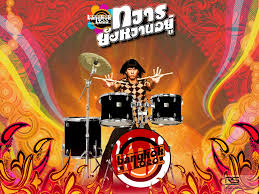
“Bangkok Loco” (2004) is a surreal Thai musical comedy (and feature film debut) from director Pornchai Hongrattanaporn. Actor/musician Krissada Terrence stars as Bay, a 70’s era drum prodigy with special skills taught to him by a monk. After getting framed for a murder, he becomes a fugitive but is aided by friend and fellow drummer Ton (Nountaka Warawanitchanoun). Together, they struggle to evade police, clear his name and win a climactic drum duel against “Devil’s Drums Master” Mr. David (Rang Sabian).
Watch the full film with English subtitles here. (May not stream on some portable devices.)
What is it that makes us human? And how best to ensure that we all get our fair say?
For director, photographer, and environmental activist Yann Arthus-Bertrand, the answers lay in framing all of his interview subjects using the same single image layout. The formal simplicity and unwavering gaze of his new documentary, Human, encourage viewers to perceive his 2,020 subjects as equals in the storytelling realm.
There’s a deep diversity of experiences on display here, arranged for maximum resonance.
The quietly content first wife of a polygamist marriage is followed by a polyamorous fellow, whose unconventional lifestyle is a source of both torment and joy.
There’s a death row inmate. A lady so confident she appears with her hair in curlers.
Where on earth did he find them?
His subjects hail from 60 countries. Arthus-Bertrand obviously went out of his way to be inclusive, resulting in a wide spectrum of gender and sexual orientations, and subjects with disabilities, one a Hiroshima survivor.
Tears, laughter, conflicting emotions… students of theater and psychiatry would do well to bookmark this page. There’s a lot one can glean from observing these subjects’ unguarded faces.
The project was inspired by an impromptu chat with a Malian farmer. The director was impressed by the frankness with which this stranger spoke of his life and dreams:
I dreamed of a film in which the power of words would resonate with the beauty of the world. Putting the ills of humanity at the heart of my work—poverty, war, immigration, homophobia—I made certain choices. Committed, political choices. But the men talked to me about everything: their difficulty in growing as well as their love and happiness. This richness of the human word lies at the heart of Human.
In Volume I, above, the interviewees consider love, women, work, and poverty. Volume II deals with war, forgiveness, homosexuality, family, and the afterlife. Happiness, education, disability, immigration, corruption, and the meaning of life are the concerns of the third volume .
The interview segments are broken up by aerial sequences, reminiscent of the images in Arthus-Bertrand’s book, The Earth from Above. It’s a good reminder of how small we all are in the grand scheme of things.
Appropriately, given the subject matter, and the director’s longtime interest in environmental issues, the filming and promotion were accomplished in the most sustainable way, with the support of the GoodPlanet Foundation and the United Carbon Action program. It would be lovely for all humanity if this is a feature of filmmaking going forward.




 After the Crash