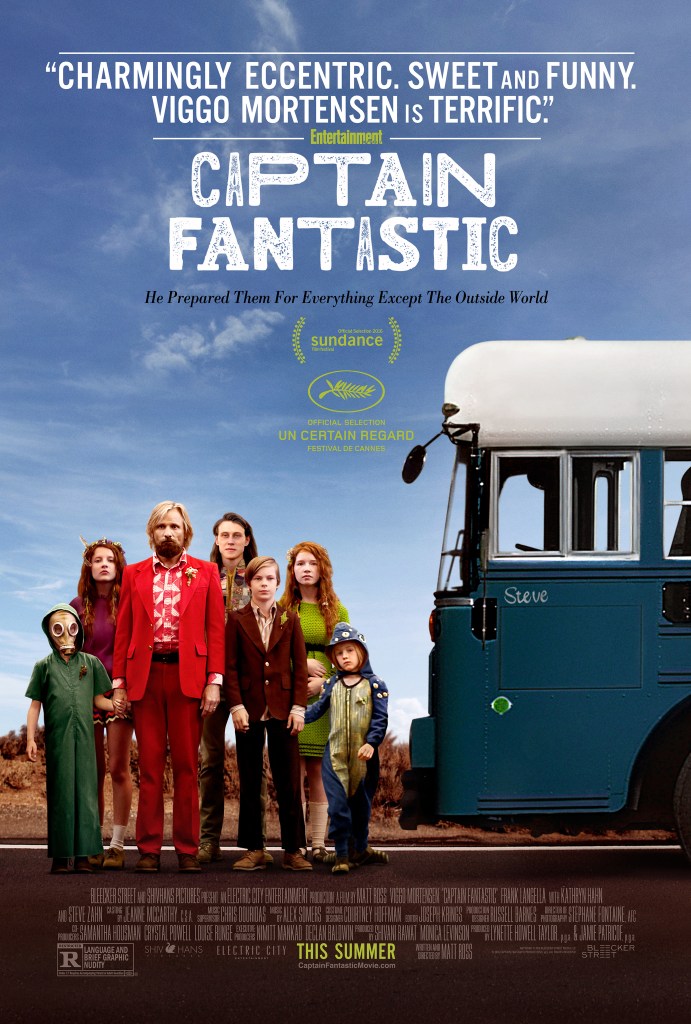
Saturday Matinee: Captain Fantastic

‘Captain Fantastic’ Review: Viggo Mortensen Turns a Hokey Premise Into Something Magical

By Eric Kohn

Source: IndieWire

The first time Viggo Mortensen surfaces in “Captain Fantastic,” he’s covered in mud, presenting a trophy to his shirtless son moments after the teen butchers a wild deer with his bare hands. It’s a spellbinding image that epitomizes the oddball tribalism that Mortensen’s character, Ben, has developed with his isolated clan of six children in the Pacific Northwest, and immediately establishes the striking intelligence of actor-director Matt Ross’ feature-length debut. Despite a premise that could easily turn hokey or farcical — radical parent raises kids in the woods, then suddenly must face reality when he takes them back to civilization — “Captain Fantastic” manages to inhabit the utopian highs of Ben’s unorthodox world even as it falls apart.

At first, the family’s idyllic existence seems untouchable. Ross imbues Ben’s self-contained universe with a magical atmosphere expertly captured by cinematographer Stéphane Fontaine (“A Prophet”). The deep greens of the dense forestry are matched by the tender shadows of the fireside jam sessions that define the clan’s evening activities. There’s only one thing missing from this giddy set of survivalists: A mother. Ben keeps his family busy with daytime calisthenics, and otherwise preoccupied with classic literature and philosophical debates that make them wise beyond their years. But his wife, with whom he created this unconventional setup, moved back to society in the aftermath of a mental breakdown. And moments after “Captain Fantastic” establishes Ben’s whimsical anarchist wonderland, Ross deals it a fatal blow as Ben learns that his wife has committed suicide.

So begins a tumultuous odyssey that’s alternately mopey and inspiring, as Ben crams his sheltered children into a ramshackle school bus and heads back to the city to reclaim his wife’s body. Awkwardly reengaging with his his upper-class suburban in-laws (Kathryn Hahn and Steve Zahn) while condescending to their capitalism-fueled lifestyles, Ben’s melancholic return builds to a confrontation with his wife’s affluent father (Frank Langella). Once it gets there, “Captain Fantastic” draws out a contrast between experimental parenting and traditional values a bit too bluntly, but Ross’ screenplay endows Ben’s family with such an endearing presence that the question surrounding the morality of their situation often seems superfluous. It’s just fun to hang out with them.

Although they inhabit certain hippy-dippy archetypes, they speak in eloquent terms far deeper than the stereotypes suggested by the material. “We’re in the unique position of hating those people,” says Vespyr (an angelic Annalise Basso), who becomes the strong female voice of the group in their mother’s absence. Ross gives “cute” an entirely new definition the moment Ben’s youngest child says the words “fascist capitalist.” And nobody stands out more than Ben’s oldest child, teenager Bodevan, portrayed by emerging star George MacKay with an intense gaze that suggests he’s just a few steps above total lunacy. His clumsy attempts to express his love to a random hookup when the family stops in a trailer park epitomizes the clever fish-out-of-water dynamic that carries Ross’ story along.

Above all else, however, Mortensen gives “Captain Fantastic” its underlying credibility. Spending most of the movie buried beneath an unkempt beard and peering out at his relatives with tired eyes, he exudes the convictions of a man eager to reject the standards surrounding him. Whether celebrating “Noam Chomsky Day” with his kids or casually serving wine to his child in the presence of his baffled in-laws (“it’s not crack”), Ben’s provocative behavior carries the whiff of purpose even when it plays for laughs. Mortensen creates a sense of mystery around the character that stems from the paradox of his idealism. His approach to raising a family is both blatantly impractical and just wondrous enough to embrace. When the family bonds together to trick a police officer on the tail of their school bus, their collective response (“Power to the people/Stick it to the man”) is downright adorable.

READ MORE: Viggo Mortensen and His Family Get Wild in Exclusive ‘Captain Fantastic’ Photos

As Ross cycles through their antics, “Captain Fantastic” arrives at a suspenseful conclusion that jeopardizes the family’s future prospects. And then it keeps going and going, with Ross so clearly in love with his creations that he has a hard time letting them go. Even at nearly two hours, not every character receives equal positioning, and at times some of the younger members of the brood seem more like ideas than full-fledged characters. But even as vessels for Ross’ broader ideas about the relationship between family and social pressures, “Captain Fantastic” is astonishingly better than its premise makes it sound. This is a feel-good road trip and family dramedy movie crowned by Sundance that actually makes the formula feel fresh.

When it went to Cannes, where Ross won best director in the Un Certain Regard section, it was perceived differently — as a savvy missive against American stupidity. In its own odd way, “Captain Fantastic” has it both ways. It’s a crowdpleaser about a world of contradictions.

Watch Captain Fantastic on Kanopy here: https://www.kanopy.com/en/product/5633108

Biden Wanted $33B More For Ukraine. Congress Quickly Raised it to $40B. Who Benefits?

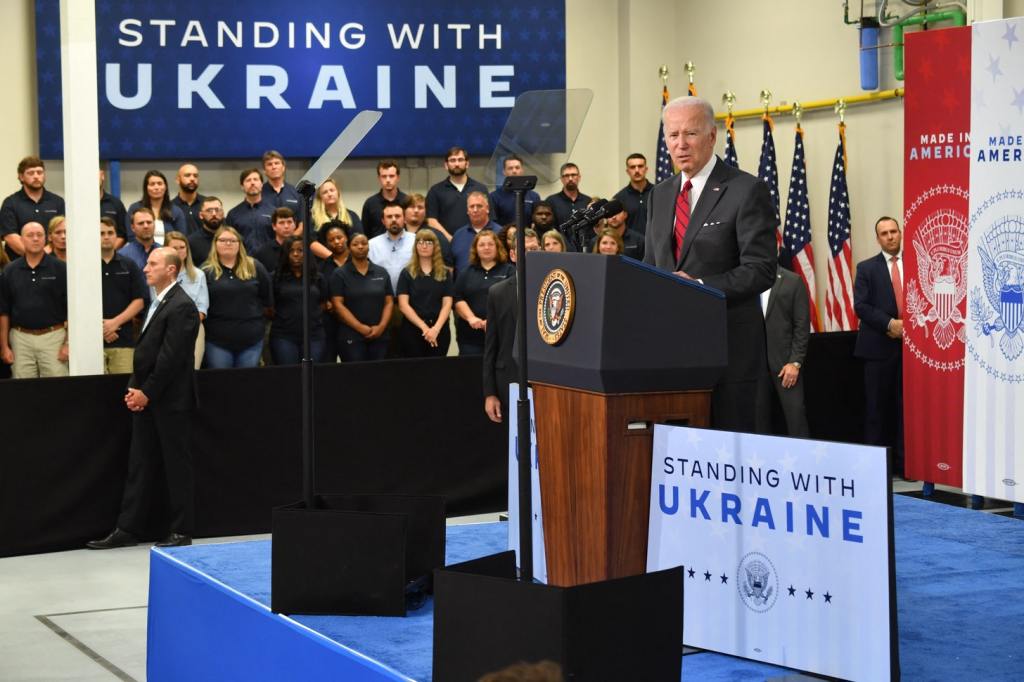
US President Joe Biden speaks about the conflict in Ukraine during a visit to the Lockheed Martins Pike County Operations facility on May 3, 2022 (Photo by Nicholas Kamm/AFP via Getty Images)

Tens of billions, soon to be much more, are flying out of U.S. coffers to Ukraine as Americans suffer, showing who runs the U.S. Government, and for whose benefit.

By Glenn Greenwald

Source: Substack

From the start of the Russian invasion of Ukraine on February 24, the Biden White House has repeatedly announced large and seemingly random amounts of money that it intends to send to fuel the war in Ukraine. The latest such dispatch, pursuant to an initial $3.5 billion fund authorized by Congress early on, was announced on Friday; “Biden says U.S. will send $1.3 billion in additional military and economic support to Ukraine,” read the CNBC headline. This was preceded by a series of new lavish spending packages for the war, unveiled every two to three weeks, starting on the third day of the war:

  • Feb. 26: “Biden approves $350 million in military aid for Ukraine”: Reuters;
  • Mar. 16: “Biden announces $800 million in military aid for Ukraine”: The New York Times;
  • Mar. 30: “Ukraine to receive additional $500 million in aid from U.S., Biden announces”: NBC News;
  • Apr. 12: “U.S. to announce $750 million more in weapons for Ukraine, officials say”: Reuters;
  • May 6: “Biden announces new $150 million weapons package for Ukraine”: Reuters.

Those amounts by themselves are in excess of $3 billion; by the end of April, the total U.S. expenditure on the war in Ukraine was close to $14 billion, drawn from the additional $13.5 billion Congress authorized in mid-March. While some of that is earmarked for economic and humanitarian assistance for Ukraine, most of it will go into the coffers of the weapons industry — including Raytheon, on whose Board of Directors the current Secretary of Defense, Lloyd Austin, sat immediately before being chosen by Biden to run the Pentagon. As CNN put it: “about $6.5 billion, roughly half of the aid package, will go to the US Department of Defense so it can deploy troops to the region and send defense equipment to Ukraine.”

As enormous as those sums already are, they were dwarfed by the Biden administration’s announcement on April 28 that it “is asking Congress for $33 billion in funding to respond to the Russian invasion of Ukraine, more than double the $14 billion in support authorized so far.” The White House itself acknowledges that the vast majority of that new spending package will go to the purchase of weaponry and other military assets: “$20.4 billion in additional security and military assistance for Ukraine and for U.S. efforts to strengthen European security in cooperation with our NATO allies and other partners in the region.”

It is difficult to put into context how enormous these expenditures are — particularly since the war is only ten weeks old, and U.S. officials predict/hope that this war will last not months but years. That ensures that the ultimate amounts will be significantly higher still.

The amounts allocated thus far — the new Biden request of $33 billion combined with the $14 billion already spent — already exceed the average annual amount the U.S. spent for its own war in Afghanistan ($46 billion). In the twenty-year U.S. war in Afghanistan which ended just eight months ago, there was at least some pretense of a self-defense rationale given the claim that the Taliban had harbored Osama bin Laden and Al Qaeda at the time of the 9/11 attack. Now the U.S. will spend more than that annual average after just ten weeks of a war in Ukraine that nobody claims has any remote connection to American self-defense.

Even more amazingly, the total amount spent by the U.S. on the Russia/Ukraine war in less than three months is close to Russia’s total military budget for the entire year ($65.9 billion). While Washington depicts Russia as some sort of grave and existential menace to the U.S., the reality is that the U.S. spends more than ten times on its military what Russia spends on its military each year; indeed, the U.S. spends three times more than the second-highest military spender, China, and more than the next twelve countries combined.

But as gargantuan as Biden’s already-spent and newly requested sums are — for a ten-week war in which the U.S. claims not to be a belligerent — it was apparently woefully inadequate in the eyes of the bipartisan establishment in Congress, who is ostensibly elected to serve the needs and interests of American citizens, not Ukrainians. Leaders of both parties instantly decreed that Biden’s $33 billion request was not enough. They thus raised it to $40 billion — a more than 20% increase over the White House’s request — and are now working together to create an accelerated procedure to ensure immediate passage and disbursement of these weapons and funds to the war zone in Ukraine. “Time is of the essence – and we cannot afford to wait,” House Speaker Nancy Pelosi said in a letter to House members, adding: “This package, which builds on the robust support already secured by Congress, will be pivotal in helping Ukraine defend not only its nation but democracy for the world.” (See update below).

We have long ago left the realm of debating why it is in the interest of American citizens to pour our country’s resources into this war, to say nothing of risking a direct war and possibly catastrophic nuclear escalation with Russia, the country with the largest nuclear stockpile, with the US close behind. Indeed, one could argue that the U.S. government entered this war and rapidly escalated its involvement without this critical question — which should be fundamental to any policy decision of the U.S. government — being asked at all.

This omission — a failure to address how the interests of ordinary Americans are served by the U.S. government’s escalating role in this conflict — is particularly glaring given the steadfast and oft-stated view of former President Barack Obama that Ukraine is and always will be of vital interest to Russia, but is not of vital interest to the U.S. For that reason, Obama repeatedly resisted bipartisan demands that he send lethal arms to Ukraine, a step he was deeply reluctant to take due to his belief that the U.S. should not provoke Moscow over an interest as remote as Ukraine (ironically, Trump — who was accused by the U.S. media for years of being a Kremlin asset, controlled by Putin through blackmail — did send lethal arms to Ukraine despite how provocative doing so was to Russia).

While it is extremely difficult to isolate any benefit to ordinary American citizens from all of this, it requires no effort to see that there is a tiny group of Americans who do benefit greatly from this massive expenditure of funds. That is the industry of weapons manufacturers. So fortunate are they that the White House has met with them on several occasions to urge them to expand their capacity to produce sophisticated weapons so that the U.S. government can buy them in massive quantities:

Top U.S. defense officials will meet with the chief executives of the eight largest U.S. defense contractors to discuss industry’s capacity to meet Ukraine’s weapons needs if the war with Russia continues for years.

Deputy Defense Secretary Kathleen Hicks told reporters Tuesday she plans to participate in a classified roundtable with defense CEOs on Wednesday to discuss “what can we do to help them, what do they need to generate supply”….

“We will discuss industry proposals to accelerate production of existing systems and develop new, modernized capabilities critical to the Department’s ongoing security assistance to Ukraine and long-term readiness of U.S. and ally/partner forces,” the official added.

On May 3, Biden visited a Lockheed Martin facility (see lead photo) and “praised the… plant that manufactures Javelin anti-tank missiles, saying their work was critical to the Ukrainian war effort and to the defense of democracy itself.”

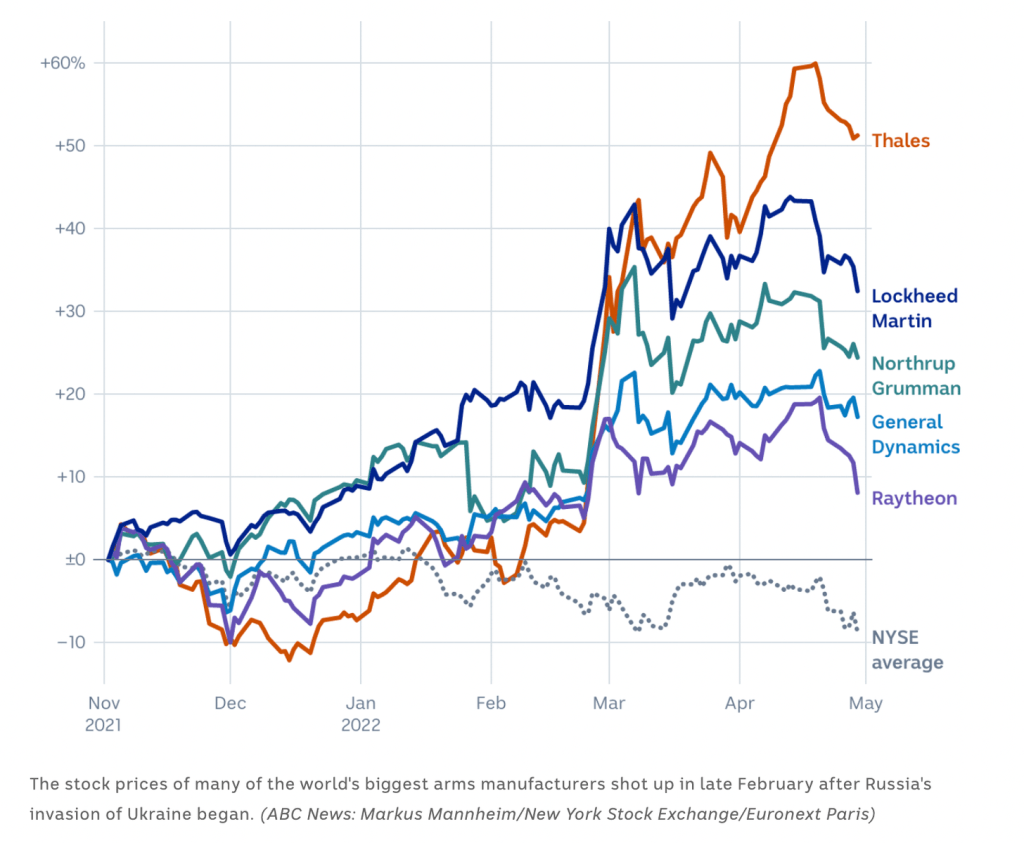
Indeed, by transferring so much military equipment to Ukraine, the U.S. has depleted its own stockpiles, necessitating their replenishment with mass government purchases. One need not be a conspiracy theorist to marvel at the great fortune of this industry, having lost their primary weapons market just eight months ago when the U.S. war in Afghanistan finally ended, only to now be gifted with an even greater and more lucrative opportunity to sell their weapons by virtue of the protracted and always-escalating U.S. role in Ukraine. Raytheon, the primary manufacturer of Javelins along with Lockheed, has been particularly fortunate that its large stockpile, no longer needed for Afghanistan, is now being ordered in larger-than-ever quantities by its former Board member, now running the Pentagon, for shipment to Ukraine. Their stock prices have bulged nicely since the start of the war:

But how does any of this benefit the vast majority of Americans? Does that even matter? As of 2020, almost 30 million Americans are without any health insurance. Over the weekend, USA Today warned of “the ongoing infant formula shortage,” in which “nearly 40% of popular baby formula brands were sold out at retailers across the U.S. during the week starting April 24.” So many Americans are unable to afford college for their children that close to a majority are delaying plans or eliminating them all together. Meanwhile, “monthly poverty remained elevated in February 2022, with a 14.4 percent poverty rate for the total US population….Overall, 6 million more individuals were in poverty in February relative to December.” The latest data from the U.S. Census Bureau found that “approximately 42.5 million Americans [are] living below the poverty line.” Americans with diabetes often struggle to buy life-saving insulin. And on and on and on.

Now, if the U.S. were invaded or otherwise attacked by another country, or its vital interests were directly threatened, one would of course expect the U.S. government to expend large sums in order to protect and defend the national security of the country and its citizens. But can anyone advance a cogent argument, let alone a persuasive one, that Americans are somehow endangered by the war in Ukraine? Clearly, they are far more endangered by the U.S. response to the war in Ukraine than the war itself; after all, a nuclear confrontation between the U.S. and Russia has long been ranked by the Bulletin of Atomic Scientists as one of the two greatest threats facing humanity.


One would usually expect the American left, or whatever passes it for these days, to be indignant about the expenditure of tens of billions of dollars for weapons while ordinary Americans suffer. But the American left, such that it exists, is barely visible when it comes to debates over the war in Ukraine, while American liberals stand in virtual unity with the establishment wing of the Republican Party behind the Biden administration in support for the escalating U.S. role in the war in Ukraine. A few stray voices (such as Noam Chomsky) have joined large parts of the international left in urging a diplomatic solution in lieu of war and criticizing Biden for insufficient efforts to forge one, but the U.S. left and American liberals are almost entirely silent if not supportive.

That has left the traditionally left-wing argument about war opposition to the populist right. “You can’t find baby formula in the United States right now but Congress is voting today to send $40 billion to Ukraine,” said Donald Trump, Jr. on Tuesday, echoing what one would expect to hear from the 2016 version of Bernie Sanders or the pre-victory AOC. “In the America LAST $40 BILLION Ukraine FIRST bill that we are voting on tonight, there is authorization for funds to be given to the CIA for who knows what and who knows how much? But NO BABY FORMULA for American mothers!” explained Rep. Marjorie Taylor Greene (R-GA). Christian Walker, the conservative influencer and son of GOP Senate candidate Herschel Walker in Georgia, today observed: “Biden should go apply to be the President of Ukraine since he clearly cares more about them than the U.S.” Chomsky himself caused controversy last week when he said that there is only one statesman of any stature in the West urging a diplomatic solution “and his name is Donald J. Trump.”

Meanwhile, the only place where dissent is heard over the Biden administration’s war policy is on the 8:00 p.m. and 10:00 p.m. programs on Fox News, hosted, respectively, by Tucker Carlson and Laura Ingraham, who routinely demand to know how ordinary Americans are benefiting from this increasing U.S. involvement. On CNN, NBC, and in the op-ed pages of The New York Times and The Washington Post, there is virtually lockstep unity in favor of the U.S. role in this war; the only question that is permitted, as usual, is whether the U.S. is doing enough or whether it should do more.

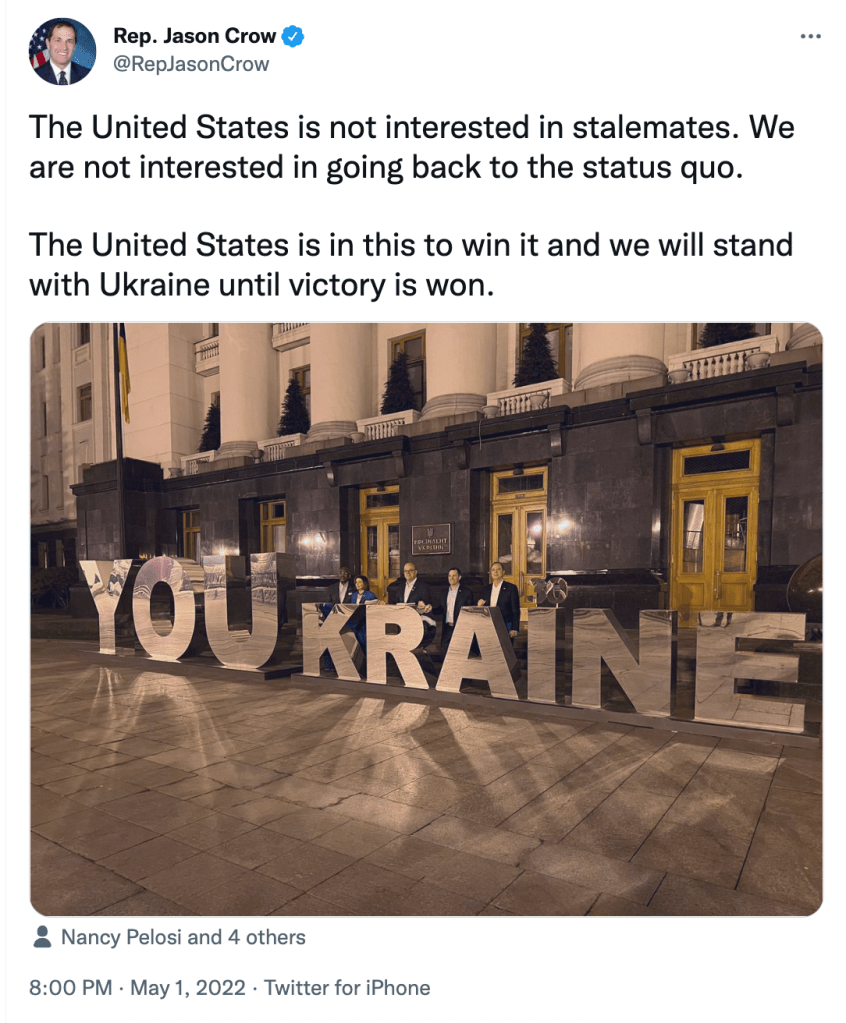
That the U.S. has no legitimate role to play in this war, or that its escalating involvement comes at the expense of American citizens, the people they are supposed to be serving, provokes immediate accusations that one is spreading Russian propaganda and is a Kremlin agent. That is therefore an anti-war view that is all but prohibited in those corporate liberal media venues. Meanwhile, mainstream Democratic House members, such as Rep. Jason Crow (D-CO), are now openly talking about the war in Ukraine as if it is the U.S.’s own:

Whatever else is true, the claim with which we are bombarded by the corporate press — the two parties agree on nothing; they are constantly at each other’s throats; they have radically different views of the world — is patently untrue, at least when it comes time for the U.S. to join in new wars. Typically, what we see in such situations is what we are seeing now: the establishment wings of both parties are in complete lockstep unity, always breathlessly supporting the new proposed U.S. role in any new war, eager to empty the coffers of the U.S. Treasury and transfer it to the weapons industry while their constituents suffer.

One can believe that Russia’s invasion of Ukraine is profoundly unjust and has produced horrific outcomes while still questioning what legitimate interests the U.S. has in participating in this war to this extent. Even if one fervently believes that helping Ukrainians fight Russia is a moral good, surely the U.S. government should be prioritizing the ability of its own citizens to live above the poverty line, have health insurance, send their kids to college, and buy insulin and baby formula.

There are always horrific wars raging, typically with a clear aggressor, but that does not mean that the U.S. can or should assume responsibility for the war absent its own vital interests and the interests of its citizens being directly at stake. In what conceivable sense are American citizens benefiting from this enormous expenditure of their resources and the increasing energy and attention being devoted by their leaders to Ukraine rather than to their lives and the multi-pronged deprivations that define them?

CORRECTION (May 10, 2022, 20:47 pm ET): This article was edited shortly after publication to reflect that Russia’s total annual military budget is $65.9 billion, not $65.9 million.

UPDATE (May 10, 2022, 22:39 pm ET)Shortly after publication of this article, the $40 billion package for the war in Ukraine passed in the House of Representatives by a vote of 368-57. According to CNN: “All 57 votes in opposition were from Republicans.”

THE POWER OF DISCERNMENT

By Kingsley L. Dennis

Source: Waking Times

At our general level of awareness there is often no perceptible or discernible pattern to the flow of events. Partly this stems from having been conditioned into perceiving a particular dominant reality program. We do not have access to objective reality, although there can be moments and instances when glimpses occur. The phenomenon of miracles is an example of this, when the laws of a reality outside of our own intervene/operate within our subjective reality. Likewise, many ancient tales, fables, allegories, etc, are representations of what we refer to as a ‘higher dimension’ operating within our own. Such impulses help us, whether we are conscious of it or not, to re-orientate our perception against the indoctrinated programming. What we often take to be reality is in fact only a very thin slice of a much ‘bigger picture.’

The act of discernment is an inward one; as such, it requires a disciplined focus. Yet as we have seen, modern societies not only do they not cater to such practices, but they also actively dissuade us from approaching them. The result of this is that people in general do not see – or feel – a need for such a discernment. Modern life keeps us occupied and diverted by other pursuits. Unfortunately, it is often the case that ‘shock impacts’ are required in order for us to shift our attention away from the ‘straight path’ of normalized living. And we’ve been living with such a ‘shock event’ for almost two years now since the outbreak of the pandemic. We could see our current predicament from this perspective: that modern life was in need of a ‘crisis point’ within its old patterns for there to arise within people the need for something else. It is in such moments of deep reflection that an inner realization may occur: the recognition that common (i.e., consensus) culture does not provide sufficient meaning for our lives. That is, there is the lack of any transcendental, metaphysical impulse. An awareness of such lack often occurs in times when there is a noticeable deterioration in social and cultural systems. Such recognition – or re-cognition – is not yet dominant among the majority of our modern so-called ‘civilized’ nations. Yet we are soon reaching that tipping point.

For too long we have been absent from the vale of ‘soul-making,’ to quote the poet John Keats. And yet the signs have always been there to guide the way. When our early cave-dwelling ancestors first made their handprints upon the walls of their caves they were signalling to the external world: ‘I am here – I exist.’ The inner spark of the human being was attempting to be heard – to be imprinted onto the outer life. It was an early stage in the expression of an interiorized human consciousness. In each epoch our consciousness perceives and interprets reality in a particular way. How we experience the reality around us influences our perception of it, and vice-versa. This is why our perceptions have always been a target for direct manipulation – it is our reality-sensing software.

As part of our steps toward discernment we can begin by a recognition of the following factors: i) acknowledgement of one’s situation and the need for self-development and/or life adjustment; and ii) the need for partial detachment from one’s social and cultural conditioning and external influences. By recognizing these two factors a person can make the first step to self-aware discernment. A gradual de-conditioning of the social personality (the persona) helps to develop a detached perspective and to see external impacts for what they are. In order to see and think clearly, we need to methodically de-clutter our social personality. Then, and only then, can a conscious step be taken toward inner freedom and genuine liberty. That is, the old patterns must become less determined, dogmatic, and fixed. Then through this space, where old belief patterns have left their moorings, can new perceptions emerge. As this process gradually unfolds it is important that each person stays grounded in the world – in their everyday lives – and not to entertain themselves with amusing fantasies or unwarranted intoxications. Furthermore, it is important to remember that in all we do we should be in harmony and balance, and not in conflict with our everyday life. Our dignity and decency is not in what it has achieved, nor what it is, but in what it can become. And this is a choice each person can make.

Our Choice

As in everything in our lives, we make a choice. When it comes down to basics – which it inevitably must do – then we find that we have a fundamental choice between living a life in Love or in Fear. In other words, if we choose Love then we side with compassion, empathy, creativity, connection, support, sharing, and resilience. And if we choose to align with the Fear then we give ourselves over to control, manipulation, anxiety, and vulnerability – all the expressions of a culture of oppression.

If we ascribe to a life lived as islands of separation, then inevitably we learn (or are conditioned) to place our trust externally upon a range of institutions; these may range from religious, work/career, social, educational, political, etc. And if these institutions fail us then we naturally feel vulnerability, or even betrayed. And yet the truth of the matter is that we betrayed ourselves in the first place by outsourcing our trust. If we live a life relying upon external systems, then we must be prepared to feel distraught should those external systems break-down. In such times of great transition, such as now, these social institutions are themselves very fragile. Further, many of these systems are now revealing themselves to be corrupt – or being utilized by corrupt human agents. Right now, I would say that we are witnessing the ‘great unravelling’ of many of our once trusted systems. We are seeing head-on the undoing of many dishonest, unethical, and toxic structures that inevitably can no longer serve our interests. This unravelling is revealing that our sense of vulnerability is partly the dismantling of our false assumptions. And further, that our sense of vulnerability is the fear of letting go. It is important to be open to receiving information, even if it is of the disagreeable kind. Yet in being open to such information does not mean we should adopt a position of fear. We have to make a choice of not accepting, or adopting, these external aspects of fear and toxicity. They do not ‘belong’ to us.

In knowing this, we are compelled to seek out those experiences that feel real to us, and which can assist us in developing as human beings. If there is a ‘truth’ to be discerned, then it must surely come not through artificial constructs but through our everyday personal experiences. To understand that which we call the ‘self’ is only a construct until we can experience it through the revelation brought about by others. Alone, we are unable to ‘see’ the self – no more than we can see our own faces. And just as we need a mirror in order to view our face, so too do we need other people and experiences in life to be as mirrors to reveal the workings of the inner Self. In the end, it is our participation in life that shall teach us the discernment we need to tell truth from falsehood. No online course or TV program can teach us this. Let us not back away from ourselves – let us invite us closer in.

U.S. Threatens Regime Change in Nicaragua

By Margaret Kimberly

Source: Black Agenda Report

Nicaragua has been a target of U.S. aggressions since the 1850s. The Biden administration’s attack on the newly elected government is the latest chapter in a long and sordid history. Eyewitness accounts of the electoral process reveal the manipulations and lies concocted by the U.S. and its corporate media partners in this latest regime change effort.

The United States has continuously carried out acts of aggression against Nicaragua and its people for more than 150 years. Joseph Biden’s effort to undermine that country’s sovereignty is part of a long history of invasions, coups, and support for U.S. puppets. 

The Biden administration declared the recent election fraudulent before it had even taken place. The corporate media repeated lies about an “authoritarian dictatorship” that came straight from the State Department’s script. The United States congress voted overwhelmingly to pass the RENACER Act, a regime change plot featuring the imposition of sanctions meant to create misery for Nicaraguans. Sanctions are war by other means, the modern-day version of sending the marines. 

The U.S. has done just that, occupying the country from 1912 to 1933. But that was not the first time that U.S. forces were sent to undermine Nicaraguan governments. In 1856 an American named William Walker invaded the country with a mercenary army and declared himself president. Walker was supported by the American slavocracy and sought to create new slave holding nations in the region. During his year long reign, he revoked Nicaragua’s abolition law and he was recognized as president by the Franklin Pierce administration.

The next bout of American aggressions began with an occupation by the U.S. marines in 1912 which lasted until 1933. Augusto Cèsar Sandino fought a guerrilla war against the occupation before being executed under orders of Anastasio Somoza. The Somoza family ruled until 1979 and always with the backing of the United States.

The Sandinista movement (which took its name after Sandino) emerged triumphant in 1980 against Somoza’s regime and quickly came under attack from the Ronald Reagan administration. The opposition groups known as “contras” were given millions of dollars and were assisted in fund raising through the sale of cocaine in the United States. The crack cocaine epidemic began as part of a U.S. imperialist plan. The war waged in Nicaragua was also carried out against communities of color in this country too.

President Daniel Ortega was re-elected on November 7, 2021 and Washington once again declared war on his nation. The RENACER Act passed by a vote of 387 to 35 in the House of Representatives, a huge majority indicative of bipartisan support for war by other means. 

The Biden administration acted quickly in denouncing the election before it took place, and repeated their claims of a “pantomime election ” on the day that Nicaraguans went to the polls. They followed up by orchestrating an Organization of American States (OAS) rejection of the Nicaraguan people’s electoral decision.

As a member of the Black Alliance for Peace (BAP) delegation in Nicaragua, this columnist witnessed the determination of Nicaraguans to choose their own government without interference. More than 200 representatives from 27 nations, were designated as acompañantes, companions, to the electoral process.

The BAP delegation travelled to the Caribbean coast city of Blue Fields where African descended Garifunas and Creoles reside with Mestizos and the Miskito, Rama, and Olwas indigenous communities. Voters from all these groups came out to well managed polling places, where all presidential candidates were listed on the ballot. The process was transparent and orderly, unlike the voting process in the United States, where eligible voters can be stricken from the ballot or be forced to wait for hours to cast their votes.

Despite what the white house and the corporate media claimed, opposition parties were able to campaign freely. Their signage and literature were quite visible, and no one can truthfully say that the public were unaware of the variety of electoral choices.

The Frente Sandinista para Liberacion Nacional (FSLN) emerged triumphant because they endeavor to meet popular needs. The Afro-descended citizens of the Caribbean coast were recognized as a group with distinct needs that were enshrined in the FSLN constitution. That region was excluded and quite literally isolated from the rest of the country without access to transportation and lacking basic infrastructure such as electricity and clean water. BAP delegates heard the consistent message that support for the FSLN is a result of concrete improvements in people’s lives. Despite the determination of the U.S. to undermine them, the FSLN now provide free health care and increased educational opportunities throughout the nation.

The 19th century Monroe Doctrine is alive and well in the 21st century. Whoever is in power in Washington considers other nations in this hemisphere to be its “backyard.” Nicaragua’s population of 6.5 million is smaller than that of New York City. Yet those few people are not allowed to exercise their rights to self-determination without raising Uncle Sam’s ire. Nicaraguans are not the first to feel imperialist vengeance. Tiny Grenada was undermined and invaded when it sought to determine democracy for itself. Venezuela is also under the sanctions hammer and Haiti is allowed to do nothing that Washington doesn’t approve.

The corporate media may be under the dictates of the state, but the people have no reason to follow suit. The presence of companion delegations in Nicaragua was an important step in revealing how the hybrid warfare playbook is put into practice.

Nicaraguans are well aware of their history. The lies are intended for a different audience. The United States seeks to fool its own people and thereby gain support for whatever form of aggression that it may choose. The plan is a consistent one which starts with media amplifying narratives that will gain support for interference. Creating falsehoods of human rights abuses is a reliable ruse to keep Americans complacent about their government’s activities.

The collusion between government and media explains why “trolls” are active on social media, attacking anyone who questions what Washington says. Facebook continued its work on behalf of the state by removing accounts expressing any support for Nicaragua’s sovereignty. The marriage of big tech companies and the Democratic party showed itself once again, proving that claims of freedom and democracy in U.S. politics are indeed an elaborate “pantomime.”

It may seem odd that a small nation can be the focus of so much determination to destroy its independence. But it isn’t hard to understand that Nicaragua threatens the U.S. should it be allowed to determine its own fate. The people who think they live in a democracy do not. They do not have access to free health care and are told they cannot expect to ever have it. Nicaragua is an example of what people in the U.S. could have if they were as free as they like to believe.

The drive to subjugate is as old as the republic, with the United States acting as a hegemon around the world, creating conflict and great suffering. The evil commitment to destroy Nicaraguan democracy is not unexpected but it must be vociferously opposed. Doing so is a litmus test which determines who is really on the left and who is not. There can be no compromise on the anti-imperialist stance. The human rights of people around the world must be respected and any United States government effort to violate them must be met with equivalent resolve.

(New Normal) Winter is Coming

By CJ Hopkins

Source: Off-Guardian

Winter is coming…and you know what that means. That’s right, it’s nearly time once again for the global-capitalist ruling classes to whip the New Normal masses into a state of mindless mass hysteria over an imaginary apocalyptic virus.

The same imaginary apocalyptic virus that they have whipped the New Normal masses into a state of mass hysteria over throughout the Winter for the last two years.

They’ve got their work cut out for them this time. Seriously, how much more mass hysterical could the New Normals possibly get at this point?

The vast majority of the Western world has been transformed into a pseudo-medical dystopia in which you have to show your “health-purity papers” to enter a café and get a cup of coffee.

People who refuse to get experimentally “vaccinated” against a virus that causes mild-to-moderate symptoms (or, often, no symptoms whatsoever) in about 95% of the infected, and the overall infection fatality rate of which is approximately 0.1% to 0.5%, are being systematically segregated, stripped of their jobs, denied medical treatment, demonized as “a danger to society,” censored, fined, and otherwise persecuted.

If you think I’m overstating the case, look at the front page of this Australian newspaper…

Yes, the Great New Normal Purge is on. “The Unvaccinated” and other infidels and heretics are being hunted by fanatical, hate-drunk mobs, dragged before the New Normal Inquisition, and made examples of all over the world.

Here in New Normal Germany, popular footballer Joshua Kimmich is being publicly drawn and quartered for refusing to submit to being “vaccinated” and profess his faith in the New Normal World Order.

In the USA, “the Unvaccinated” stand accused of murdering Colin Powell, an 84-year-old, cancer-ridden war criminal.

Australia is planning to imprison people and fine them $90,000 for the “crime” of not wearing a medical-looking mask, or attempted worship at a synagogue, or whatever.

In Florida (of all places), fanatical school staff tied a medical-looking mask to the face of a non-verbal Downs-syndrome girl with nylon cord, day after day, for over six weeks, until her father discovered what they were doing.

I could go on, but I don’t think I have to. The Internet is brimming with examples of mass-hysterical and sadistic behavior.

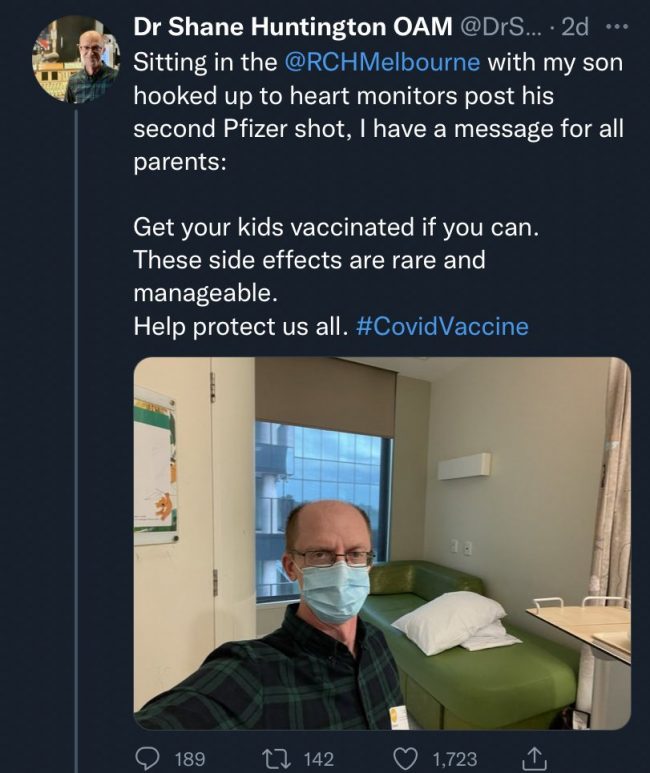
And that’s not to mention the mass hysteria rampant among the New Normals themselves…for example, the parents who are lining up to get their children needlessly “vaccinated” and then rushed into the emergency room with “totally manageable myocarditis.”

Still, as mass hysterical as things are, count on GloboCap to go balls out on the mass hysteria for the next five months. The coming Winter is crunch time, folks. They need to cement the New Normal in place, so they can dial down the “apocalyptic pandemic.” If they’re forced to extend it another year…well, not even the most brainwashed New Normals would buy that.

Or…all right, sure, the most brainwashed would, but they represent a small minority. Most New Normals are not fanatical totalitarians. They’re just people looking out for themselves, people who will go along with almost anything to avoid being ostracized and punished.

But, believe it or not, there is a limit to the level of absurdity they’re prepared to accept, and the level and duration of relentless stress and cognitive dissonance they are prepared to accept.

Most of them have reached that limit. They have done their part, followed orders, worn the masks, got the “vaccinations,” and are happy to present their “obedience papers” to anyone who demands to see them. Now, they want to go back to “normal.” But they can’t, because … well, because of us.

See, GloboCap can’t let them return to “normal” (i.e., the new totalitarian version of “normal”) until everyone (i.e., everyone who matters) has submitted to being “vaccinated” and is walking around with a scanable certificate of ideological conformity in their smartphones.

They would probably even waive the “vaccination” requirement if we would just bend the knee and pledge our allegiance to the WEF, or BlackRock, or Vanguard, or whoever, and carry around a QR code confirming that we believe in “Science,” the “Covidian Creed,” and whatever other ecumenical corporatist dogma.

Seriously, the point of this entire exercise (or at least this phase of this entire exercise) is to radically, irrevocably, transform society into a monolithic corporate campus where everyone has to scan their IDs at every turn of an endless maze of perpetually monitored, eco-friendly, gender-fluid, ideologically uniform, non-smoking, totally meat-free “safe spaces” owned and operated by GloboCap, or one of its agents, subsidiaries, and assigns.

The global-capitalist ruling classes are determined to transform the planet into this fascistic Woke Utopia and enforce unwavering conformity to its valueless values, no matter the cost, and we, “the Unvaccinated,” are standing in their way.

They can’t just round us up and shoot us — this is global capitalism, not Nazism or Stalinism. They need to break us, to break our spirits, to coerce, gaslight, harass, and persecute us until we surrender our autonomy willingly. And they need to do this during the next five months.

Preparations therefor are now in progress.

In the UK, despite a drop in “cases,” and the fact (which the “authorities” have been forced to acknowledge) that the “Vaccinated” can spread the virus just like “the Unvaccinated,” the government is preparing to go to “Plan B” and roll out the social-segregation system that most of Europe has already adopted.

In Germany, the “Epidemic Emergency of National Importance” (i.e., the legal pretense for enforcement of the “Corona restrictions”) is due to expire in mid-November (unless they can seriously jack up the “cases,” which seems unlikely at this point), so the authorities are working to revise the “Infektionsschutzgesetz” (the “Infection Protection Act”) to justify maintaining the restrictions indefinitely, despite the absence of an “epidemic,” or an “emergency.”

And so on. I think you get the picture.

This Winter is probably going to get a little nutty … or, OK, more than a little nutty. In terms of manufactured mass hysteria, it is probably going to make Russiagate, the War on Populism, the Global War on Terror, the Red Scare, and every other manufactured mass-hysteria campaign you can possibly think of look like an amateur production of Wagner’s Götterdammerung.

In other words, kiss reality (or whatever is left of reality at this point) goodbye. The clock is ticking, and GloboCap knows it. If they expect to pull this Great Reset off, they are going to need to terrorize the New-Normal masses into a state of protracted pants-shitting panic and uncontrollable mindless hatred of “the Unvaccinated,” and anyone challenging their rule.

A repeat of the Winters of 2020 and 2021 is not going to cut it. It is going to take more than the now standard repertoire of fake and manipulated statistics, dire projections, photos of “death trucks,” non-overflowing overflowing hospitals, and all the other familiar features of the neo-Goebbelsian propaganda juggernaut we have been subjected to for over 18 months.

They are facing a growing working-class revolt. Millions of people in countries all over the world are protesting in the streets, organizing strikes, walk-outs, “sick-outs,” and mounting other forms of opposition.

Despite the corporate media’s Orwellian attempts to blackout any coverage of it, or demonize us all as “far-right extremists,” the New Normals are very aware that this is happening. And the official narrative is finally falling apart. The actual facts are undeniable by anyone with an ounce of integrity, so much so that even major GloboCap propaganda outlets like The Guardian are being forced to grudgingly admit the truth.

No, GloboCap has no choice at this point but to let loose with every weapon in its arsenal — short of full-blown despotism, which it cannot deploy without destroying itself — and hope that we will finally break down, bend the knee, and beg for mercy.

I don’t know exactly what they’ve got in mind, but I am definitely not looking forward to it. I’m already pretty worn out as it is. From what I gather, so are a lot of you. If it helps at all, maybe look at it this way. We don’t have to take the battle to them. All we have to do is not surrender, withstand the coming siege, and make it to April.

Or, if the strikessick-outs, and “bad weather” continue, it might not even take that long.

How big corporations and Bill Gates took over the UN food Summit

Large corporations and the Bill & Melinda Gates Foundation took over the United Nations Food Systems Summit, abandoning small farmers on behalf of Big Ag companies, endangering food sovereignty.

By Nils McCune and Camila Escalante

Source: The Grayzone

This September 23, the United Nations holds its Food Systems Summit in New York.

Under the guise of the UN system, and despite sleight-of-hand language about “equal opportunities,” this summit represents a hostile takeover of world governance by corporate forces and the billionaire elite.

Today, social movements are standing up for democracy and against big capital’s devastation of their lands, farms, and communities.

The United Nations is based on the idea of multilateralism, where states seek peaceful solutions on the basis of equality and respect, replacing the colonialist institutions that preceded it.

That’s why for decades, the United States government has instead pushed for things like G-7, NATO, and other forms of control over geopolitics.

As far-right governments have pulled back from multilateral institutions like the UN and the WHO, corporate actors have been moving in.

The World Economic Forum and its president Klaus Schwab have silently pushed forward the “Davos Agenda”, now re-packaged as the “Great Reset”, a vast proposal replacing traditional multilateral institutions with secretive, unaccountable bodies run by corporations and the wealthy elite.

Their “multi-stakeholder capitalism” model is based on the idea that public institutions are, by nature, inefficient.

During the neoliberal shock therapy of the 1990s, the World Economic Forum pushed the idea that corporations are more than just profit-seeking vehicles, that they could be socially responsible.

Now Davos would argue that transnational corporations are social actors, which need to be included to make decision-making truly democratic.

In doing so, Davos hijacked the gains of decades of work by popular movements to open up world governance to the demands of civil society – and did so using corporate doublespeak to further entrench elite power.

Gunboat philanthropy

La Vía Campesina is possibly the world’s largest social movement. Made up of 200 million small farmers, peasants, farm workers, and indigenous peoples, it has popularized the idea of food sovereignty as the right of peoples to control and defend their own food systems using healthy, agro-ecological methods.

After years battling against free-trade agreements and the World Bank in the streets of Seattle, Cancun, and Seoul, La Via Campesina made an incursion into institutional politics, helping to draft and carry the UN Declaration on the Rights of Peasants through 18 years of negotiations, until it was passed by the UN General Assembly in December 2018.

This declaration protects the right of rural people to access land, water, seeds, and other resources in order to produce their own food and that of their society.

Worldwide, 70% of food is produced by small farmers, who use only one-quarter of total farmland.

Meanwhile, the Bill and Melinda Gates Foundation created the Alliance for a Green Revolution in Africa, or AGRA, in 2006.

AGRA promised to double yields and incomes for 30 million families while cutting food insecurity by half in 13 African countries by 2020.

Over the ensuing decade, AGRA collected nearly $1 billion in donations, and spent $524 million on programs promoting the use of genetically modified and hybrid seeds, commercial fossil fuel-based fertilizers, and chemical pesticides.

As a formidable corporate lobby, AGRA pushed governments in Africa into contributing another billion dollars annually to subsidize agrichemicals and imported seeds sourced from US and European agribusiness corporations, as well as policies to privatize communal lands and reduce taxes on corporations.

After 14 years of mega-philanthropy’s knee on the neck of Africa, a 2020 Tufts University study showed that, in AGRA’s 13 focus countries, hunger had jumped 30%, as farmers were pushed to abandon nutritious, traditional polycultures to focus on monoculture fields of imported corn seed.

Opposition to AGRA’s corporate takeover of the African countryside is part of what drove La Via Campesina and farmers across the continent to demand a place at the table in UN debates about food.

After the world food crisis of 2008, the UN Committee on World Food Security was reorganized to allow social actors such as La Via Campesina to participate as non-voting delegates in debates about food policy.

Three consecutive UN Special Rapporteurs on the Right to Food have largely endorsed La Vía Campesina’s proposals: redistributive land reform and agroecological farming can end hunger while dramatically reducing agriculture’s contribution to problems like greenhouse gas accumulation in the atmosphere, pollinator population decline, and freshwater scarcity.

The new UN: a public-private partnership

In June 2019, the office of UN General Secretary António Guterres, without previous discussion in the General Assembly or any other intergovernmental process, signed a strategic partnership with the World Economic Forum.

The secretary-general is supposed to be the world’s leading advocate for multilateralism, the idea at the core of the UN. Instead, he has effectively endorsed multi-stakeholderism, the core idea of the Great Reset.

The 2021 UN Food Systems Summit was initiated through a partnership with the World Economic Forum, with limited participation of other UN bodies, such as the Food and Agriculture Organization or the Committee on World Food Security, which traditionally handle food policies.

In contrast to previous food summits, there was no intergovernmental body that convened the summit.

The current president of AGRA, Agnes Kalibata, was named as special envoy to the summit, a clear sign of the hand of the Gates Foundation.

The lack of transparency and corporate agenda of the summit were denounced in an open letter signed by more than 500 civil society organizations in March 2020.

The summit seeks to erase the last 15 years of progress in recognizing human rights in food systems, and instead promotes false solutions like “zero-net emissions”, “soil carbon pricing”, and “a new deal for nature”, that in practice put more control over land, biodiversity, and water in the hands of elite and secretive bodies run by corporations.

Video by La Vía Campesina North America, Nils McCune, and Camila Escalante

The Great Battle for the Future

By Cory Morningstar

Source: Organic Radicals

A nightmare totalitarian industrial world, in which everything living is being poisoned to death and in which dehumanised people are subjected to full-spectrum physical and psychological control by slave-masters they never dare question.

So here is where the modern world and its self-mythologising cult of “progress” was leading us… Who’d have thought it, eh?

The warnings have been there, of course, whether from science fiction writers and filmmakers (They Live!The Terminator,  Equals...), musicians or the dozens of thinkers featured on this website.

They warned us where this would end up if we didn’t do something, but we collectively spurned their advice and here we are, on the very brink of a long-term and probably fatal dystopia.

The important question now is how we are going to get out of this global hi-tech concentration camp.

Part of the answer is that we need to keep alive, and spread as widely as possible, a vision of how the world could be, of another way of living which is utterly different from the sterile and robotic hell currently lined up for us and those who will come after.

It is very much part of the ruling elite’s propaganda to insist that their future is the only future, that no other possibility even exists.

They are always keen to dismiss the idea of a different society as totally fanciful, empty-headed or even positively dangerous, removing us from the protective bliss of the prison they have built around us.

This lie is reinforced in people’s minds by the way that the other, possible, world is increasingly distant from contemporary reality.

It is hard to imagine a transition from where we are today (let alone where we are heading) to where many of us would like to be.

It is particularly hard, even impossible, if you go along with the ruling elite’s deliberate confusion of the passing of time with the strengthening of their industrial profit-system.

If you see “the future” as necessarily an extension of the path that has brought us from the past to the present, then their version seems inevitable. It is therefore crucial to break free from this idea of some kind of predestined vector taking us towards a hyper-industrial destiny.

Industrial capitalist development was never the only possible form which human society could have taken over the last few centuries. The shape our present has taken is not due to the passing of time but to very specific processes and actions which have occurred.

If we want to reconnect with the “other world” in our hearts, and understand why it seems so unattainable, we would therefore do well to look back at how we landed up on the disastrous path of industrialised tyranny.

A key period to analyse is the Middle Ages, when capitalism first started to take over our lives.

Silvia Federici makes some very interesting observations on this period in her book Caliban and the Witch. (1)

She rejects the conventional wisdom that a “transition to capitalism” occurred as some kind of natural social evolution.

Instead, she points out that the power of the ruling elite was being threatened by the growing confidence of the 99%, who were increasingly rebelling against authority and servitude.

With the outright slavery of the Roman Empire left behind, these medieval rebels saw ahead of them a better future, one based on social justice, freedom and local autonomy.

They were on the path leading towards the light, towards genuine social progress rather than to the fake “progress” of technological sophistication and profusion.

But this didn’t go down well with the ruling class, who feared that their power and privilege would be lost for ever.

Instead of escaping from slavery into freedom, our ancestors therefore found themselves engaged in a Great Battle for the Future with the dark forces of tyranny.

This battle raged for centuries all over Europe and in the parts of the world colonised and occupied by the dominant system.

In England the most famous uprising was the peasants’ revolt of 1381, during which radical preacher John Ball told his contemporaries that the time had come when they could “cast off the yoke they have borne so long and win the freedom they have always yearned for”. (2)

But there were plenty of others, such as the Kett’s Rebellion of 1549 in which the rebels seized control of Norwich, then the second biggest city in the country.

The 17th century radicals of the English Revolution, such as Gerrard Winstanley, represent perhaps the last flowering of this wave of revolt.

The Great Battle for the Future was even fiercer on continental Europe. As Federici points out, the uprisings of the Cathars in France and the Anabaptists in Germany were not just about isolated local grievances but represented an ideological and metaphysical challenge to the world of authority, power and property. (3)

Federici argues that capitalism was in fact the reaction of the ruling elite against their potential loss of control.

She writes: “Capitalism was the counter-revolution that destroyed the possibilities that had emerged from the anti-feudal struggle – possibilities which, if realized, might have spared us the immense destruction of lives and the natural environment that has marked the advance of capitalist relations worldwide. This much must be stressed, for the belief that capitalism ‘evolved’ from feudalism and represents a higher form of social life has not yet been dispelled”. (4)

There is a strange echo here with the 20th century, when fascism emerged at a moment when the ruling elite (by this stage firmly capitalist) again faced the threat of popular insurrection.

The parallel even extends to the way in which the medieval bourgeoisie, often depicted as leading the radical onslaught against feudal power, sought common cause with their supposed enemies in the nobility in order to stamp out popular revolt.

This same bourgeoisie, which by the 20th century liked to think of itself as “liberal“, was likewise happy to see the boot of fascism keep the rabble in their place.

Capitalism – the new form taken by malevolent ruling-class domination – subjugated our ancestors by cutting them off from their sources of subsistence and autonomy.

Common land was confiscated – enclosed – making self-sufficiency impossible. Food could no longer be freely gathered or hunted, rivers could no longer be fished, wood for fuel could no longer be picked up in the privatised forests.

People were forced into the money system, forced to earn “wages” just to live, forced into factories and workhouses, reduced to craven dependency on the capitalist system.

Federici describes the period as one of “relentless class struggle” in which “the medieval village was the theater of daily warfare”. (5)

“Everywhere masses of people resisted the destruction of their former ways of existence, fighting against land privatization, the abolition of customary rights, the imposition of new taxes, wage-dependence, and the continuous presence of armies in their neighbourhoods, which was so hated that people rushed to close the gates of their towns to prevent soldiers from settling among them”. (6)

In order to impose the New Normal of capitalism on the unwilling people, the power elite used what Federici terms “social enclosure”, (7) a precursor of today’s “social distancing”.

She writes: “In pursuit of social discipline, an attack was launched against all forms of collective sociality and sexuality including sports, games, dances, ale-wakes, festivals, and other group-rituals that had been a source of bonding and solidarity among workers”. (8)

“Taverns were closed, along with public baths. Nakedness was penalized, as were many other ‘unproductive’ forms of sexuality and sociality. It was forbidden to drink, swear, curse”. (9)

In another striking parallel with the 2020s (and indeed the 1920s/1930s) the rich elite tried to create “a new type of individual” (10) – a servile, malleable and thus profitable type.

To this end it set out to separate us from our bodies and from our very sense of who we are.

“According to Max Weber, the reform of the body is at the core of the bourgeois ethic because capitalism makes acquisition ‘the ultimate purpose of life,’ instead of treating it as a means for the satisfaction of our needs; thus it requires that we forfeit all spontaneous enjoyment of life. Capitalism also attempts to overcome our ‘natural state,’ by breaking the barriers of nature and by lengthening the working day beyond the limits set by the sun, the seasonal cycles, and the body itself, as constituted in pre-industrial society”. (11)

The communal cohesion traditionally woven by, and among, women was specifically targeted by the ruling class in their efforts to disempower and enslave the common people, says Federici.

This took the form of the notorious fearmongering over “witches”, resulting in the murder of untold numbers of innocent women: “The witch-hunt destroyed a whole world of female practices, collective relations and systems of knowledge that had been the foundation of women’s power in pre-capitalist Europe, and the condition for their resistance in the struggle against feudalism”. (12)

She adds: “The witch-hunt deepened the divisions between women and men, teaching men to fear the power of women, and destroyed a universe of practices, beliefs, and social subjects whose existence was incompatible with the capitalist work discipline”. (13)

The witch hunts were thus part of the general philosophical war being waged by industrial capitalism on any way of thinking not flattened and reduced to the pitiful level of its own limited, sterile and life-hating slave-dogma.

Explains Federici: “This is how we must read the attack against witchcraft and against that magical view of the world which, despite the efforts of the Church, had continued to prevail on a popular level through the Middle Ages. At the basis of magic was an animistic conception of nature that did not admit to any separation between matter and spirit, and thus imagined the cosmos as a living organism, populated by occult forces, where every element was in ‘sympathetic’ relation with the rest”. (14)

The primary tool used by the ultra-rich minority to oppress the majority was, of course, the state.

Far from representing some kind of benign collective self-interest, as some absurdly persist in maintaining, the modern state emerged in the 14th century “as the only agency capable of confronting a working class that was regionally unified, armed and no longer confined in its demands to the political economy of the manor”. (15)

Whether claiming to be fighting “heresy”, “witchcraft” or disorder, the ruling elite deployed all the violence and propaganda of its inquisitions, wars and laws to bring the population to heel. And, as we all know to our cost, it won that Great Battle for the Future.

But because its sociopathic greed knows no end, because its “growth” is based on ever-increasing profit for the ultra-rich, it can never stop treading us further and further into the toxic industrial dust of its total control.

Today we have reached another key moment in history, when the ruling elite – under the feeble pretext of combatting a flu virus – hopes to essentially return us to the slave status we escaped a thousand years ago.

All its liberal pretence at “democracy” is going out of the window as the brutal reality of elite power becomes clear to those who have eyes to see.

There will be resistance, you can be sure of that, even if the advance disabling of certain potential sources of dissent means it may take a while for rebels to regroup and find their common voice.

Those of us who do resist will be embarking on another Great Battle for the Future.

We will be fighting for the same world of freedom and humanity and closeness to nature which inspired our ancestors hundreds of years ago.

Moreover, awareness of this historical context will be key to the way we resist.

We can never go back to the past but we can refer back to it and take our sense of direction from it.

It is clear that our defeat in the last Great Battle for the Future (and many subsequent struggles) saw us shunted down the wrong path, away from the bright future of which we dreamed and deeper and deeper into the gloom of enslavement.

We will not be able to reach our lost future by continuing along this path as it can only take us further and further from our desired destination.

The key realisation here is that industrialism, including all its technology and infrastructure, is simply an aspect of capitalism, of the slavery imposed upon us hundreds of years ago when we looked set to break free from the domination of the ruling elite.

Industrialism is not neutral. It is not something that can be turned around and used for our good. It is the prison in which we are locked.

The newnormalist technological tyranny currently being unleashed will hopefully make this inconvenient truth more evident and widely understood.

However, the underlying problem does not lie in industrialism’s excesses but in its very essence and raison d’être, as a means of control and exploitation.

We will not find the better future of which we dream in a world still polluted by factories, airports, motorways, pipelines, pylons, refineries and power stations.

The long-term happiness and self-fulfilment of humankind will not arrive via internet connections, phone networks and electricity supplies, but from their absence.

We need to destroy the whole industrial capitalist machine at the same time as we shake off this latest notching-up of repression, otherwise it will all just happen again and we will never be free.

Our victory in this 21st century Great Battle for the Future has got to be final and conclusive.

1. Silvia Federici, Caliban and the Witch (Brooklyn: Autonomedia, 2004).
2. Peter Marshall, Demanding the Impossible: A History of Anarchism (London: Fontana, 1993), p. 91.
3. See also Paul Cudenec, The Stifled Soul of Humankind (Sussex, Winter Oak Press, 2014).
4. Federici, pp. 21-22
5. Federici, p. 26.
6. Federici, p. 82.
7. Federici, p. 84.
8. Federici, p. 83.
9. Federici, p. 137.
10. Federici, p. 135.
11. Ibid
12. Federici, p. 103.
13. Federici, p. 165.
14. Federici, pp. 141-42.
15. Federici, p. 84.

How America Went From Mom-and-Pop Capitalism to Techno-Feudalism

The crisis of 2020 has created the greatest wealth gap in history. The middle class, capitalism and democracy are all under threat. What went wrong and what can be done?

By Ellen Brown

Source: ScheerPost

In a matter of decades, the United States has gone from a somewhat benign form of capitalism to a neo-feudal form that has created an ever-widening gap in wealth and power. In his 2013 bestseller Capital in the 21st Century, French economist Thomas Piketty declared that “the level of inequality in the US is probably higher than in any other society at any time in the past anywhere in the world.” In a 2014 podcast about the book, Bill Moyers commented:

Here’s one of its extraordinary insights: We are now really all headed into a future dominated by inherited wealth, as capital is concentrated in fewer and fewer hands, giving the very rich ever greater power over politics, government and society. Patrimonial capitalism is the name for it, and it has potentially terrifying consequences for democracy. 

Paul Krugman maintained in the same podcast that the United States is becoming an oligarchy, a society of inherited wealth, “the very system our founders revolted against.” While things have only gotten worse since then thanks to the economic crisis of 2020, it’s worth retracing the history that brought us to this volatile moment.

Not the Vision of Our Founders

The sort of capitalism on which the United States was originally built has been called mom-and-pop capitalism. Families owned their own farms and small shops and competed with each other on a more or less level playing field. It was a form of capitalism that broke free of the feudalistic model and reflected the groundbreaking values set forth in the Declaration of Independence and Bill of Rights: that all men are created equal and are endowed by their Creator with certain inalienable rights, including the rights to free speech, a free press, to worship and assemble; and the right not to be deprived of life, liberty or property without due process. 

It was good in theory, but there were glaring, inhumane exceptions to this idealized template, including the confiscation of the lands of indigenous populations and the slavery that then prevailed. The slaves were emancipated by the US Civil War; but while they were freed in their persons, they were not economically free. They remained entrapped in economic serfdom. Although Black and Indigenous communities have been disproportionately oppressed, poor people were all trapped in “indentured servitude” of sorts — the obligation to serve in order to pay off debts, e.g. the debts of Irish workers to pay for passage to the United States, and the debts of “sharecroppers” (two-thirds of whom were white), who had to borrow from landlords at interest for land and equipment. Today’s U.S. prison system has also been called a form of slavery, in which free or cheap labor is extracted from poor people of color.

To the creditors, economic captivity actually had certain advantages over “chattel” slavery (ownership of humans as a property right). According to an infamous document called the Hazard Circular, circulated by British banking interests among their American banking counterparts during the American Civil War:

Slavery is likely to be abolished by the war power and chattel slavery destroyed. This, I and my European friends are glad of, for slavery is but the owning of labor and carries with it the care of the laborers, while the European plan, led by England, is that capital shall control labor by controlling wages.

Slaves had to be housed, fed and cared for. “Free” men housed and fed themselves.  Free men could be kept enslaved by debt by paying them wages that were insufficient to meet their costs of living. 

From “Industrial Capitalism” to “Finance Capitalism”

The economy crashed in the Great Depression, when Franklin D. Roosevelt’s government revived it and rebuilt the country through a public financial institution called the Reconstruction Finance Corporation. After World War II, the US middle class thrived. Small businesses competed on a relatively level playing field similar to the mom-and-pop capitalism of the early pioneers. MMeanwhile, larger corporations engaged in “industrial capitalism,” in which the goal was to produce real goods and services. 

But the middle class, considered the backbone of the economy, has been progressively eroded since the 1970s. The one-two punch of the Great Recession and what the IMF has called the “Great Lockdown” has again reduced much of the population to indentured servitude; while industrial capitalism has largely been displaced by “finance capitalism,” in which money makes money for those who have it, “in their sleep.” As economist Michael Hudson explains, unearned income, not productivity, is the goal. Corporations take out cheap 1% loans, not to invest in machinery and production, but to buy their own stock earning 8% or 9%; or to buy out smaller corporations, eliminating competition and creating monopolies. Former Greek Finance Minister Yanis Varoufakis explains that “capital” has been decoupled from productivity: businesses can make money without making profits on their products.  As Kevin Cahill described the plight of people today in a book titled Who Owns the World?:

These latter day pharaohs, the planet owners, the richest 5% – allow the rest of us to pay day after day for the right to live on their planet. And as we make them richer, they buy yet more of the planet for themselves, and use their wealth and power to fight amongst themselves over what each possesses – though of course it’s actually us who have to fight and die in their wars. 

The 2020 Knockout Punch 

The final blow to the middle class came in 2020. Nick Hudson, co-founder of a data analytics firm called PANDA (Pandemics, Data and Analysis),  argued in an interview following his keynote address at a March 2021 investment conference:

Lockdowns are the most regressive strategy that has ever been invented. The wealthy have become much wealthier. Trillions of dollars of wealth have been transferred to wealthy people. … Not a single country did a cost/benefit analysis before imposing these measures. 

Policymakers followed the recommendations of the World Health Organization based on predictive modeling by the Imperial College London that subsequently proved to be wildly inaccurate. Later studies have now been done, at least some of which have concluded that lockdowns have no significant effects on case numbers and that the costs of lockdowns substantially outweigh the benefits, in terms not just of economic costs but of lives

On the economic front,  global lockdowns eliminated competition from small and medium-sized businesses, allowing monopolies and oligopolies to grow. “The biggest loser from all this is the middle class,” wrote Logan Kane on Seeking Alpha. By May 2020, about one in four Americans had filed for unemployment, with over 40 million Americans filing jobless claims; and 200,000 more businesses closed in 2020 than the historical annual average. Meanwhile, US billionaires collectively increased their total net worth by $1.1 trillion during the last 10 months of 2020; and 46 people joined the billionaire class. 

The number of “centi-billionaires”– individuals with a net worth of $100 billion or more – also grew. In the US they included:

  • Jeff Bezos, soon-to-be former CEO of Amazon, whose net worth increased from $113 billion in March 2020 to $182 billion in March 2021, up by $70 billion for the year; 
  • Elon Musk, CEO of Tesla and SpaceX, whose net worth increased from $25 billion in March 2020 to $164 billion in March 2021, up by $139 billion for the year; and 
  • Bill Gates, formerly CEO of Microsoft and currently considered the “global vaccine czar,” whose net worth increased to $124 billion in March 2021, up by $26 billion for the year.

Two others are almost centi-billionaires: 

  • The net worth of Mark Zuckerberg, CEO of Facebook, grew from $55 billion in March 2020 to $95 billion in March 2021, up by $40 billion for the year; and 
  • The net worth of Warren Buffett of Berkshire Hathaway grew from $68 billion in March 2020 to $95 billion in March 2021, up by $27.6 billion for the year. 

These five individuals collectively added $300 billion to their net worth just in 2020. For perspective, that’s enough to create 300,000 millionaires, or to give $100,000 to 3 million people. 

Philanthrocapitalism

The need to shield the multibillionaire class from taxes and to change their predatory corporate image has given rise to another form of capitalism, called philanthrocapitalism. Wealth is transferred to foundations or limited liability corporations that are designated as having charitable purposes but remain under the ownership and control of the donors, who can invest the funds in ways that serve their corporate interests. As noted in The Reporter Magazine of the Rochester Institute of Technology

Essentially, what we are witnessing is the transfer of responsibility for public goods and services from democratic institutions to the wealthy, to be administered by an executive class. In the CEO society, the exercise of social responsibilities is no longer debated in terms of whether corporations should or shouldn’t be responsible for more than their own business interests. Instead, it is about how philanthropy can be used to reinforce a politico-economic system that enables such a small number of people to accumulate obscene amounts of wealth.

With $100 billion, nearly anything can be bought – not just land and resources but media and journalists, political influence and legislation, regulators, university research departments and laboratories. Jeff Bezos now owns The Washington Post. Bill Gates is not only the largest funder of the World Health Organization and the Imperial College London but the largest owner of agricultural land in the US. And Elon Musk’s aerospace manufacturer SpaceX has effectively privatized the sky. Astronomers and stargazers complain that the thousands of satellites it has already launched, with many more in the works, are blocking their ability to see the stars.The astronomy professor Samantha Lawler writes in a piece for The Conversation

SpaceX has already received approval for 12,000 Starlink satellites and is seeking approval for 30,000 more. Other companies are not far behind […] The point of the Starlink mega-constellation is to provide global internet access. It is often stated by Starlink supporters that this will provide internet access to places on the globe not currently served by other communication technologies. But currently available information shows the cost of access will be too high in nearly every location that needs internet access. Thus, Starlink will likely only provide an alternate for residents of wealthy countries who already have other ways of accessing the internet […] With tens of thousands of new satellites approved for launch, and no laws about orbit crowding, right-of-way or space cleanup, the stage is set for the disastrous possibility of Kessler Syndrome, a runaway cascade of debris that could destroy most satellites in orbit and prevent launches for decades…. Large corporations like SpaceX and Amazon will only respond to legislation — which is slow, especially for international legislation — and consumer pressure […] Our species has been stargazing for thousands of years, do we really want to lose access now for the profit of a few large corporations? 

Public advocacy groups, such as the Cellular Phone Task Force,  have also objected due to health concerns over increased electromagnetic radiation. But the people have little say over public policy these days. So concluded a study summarized in a January 2021 article in Foreign Affairs. Princeton professor and study co-author Martin Gilens wrote: 

[O]rdinary citizens have virtually no influence over what their government does in the United States. … Government policy-making over the last few decades reflects the preferences … of economic elites and of organized interests. 

Varoufakis calls our current economic scheme “postcapitalism” and “techno-feudalism.” As in the medieval feudal model, assets are owned by the few. He notes that the stock market and the businesses in it are essentially owned by three companies – the giant exchange-traded funds BlackRock, Vanguard, and State Street. Under the highly controversial “Great Reset” envisioned by the World Economic Forum, “you will own nothing and be happy.” By implication, everything will be owned by the techno-feudal lords.

Getting Back On Track

The capitalist model has clearly gone off the rails. How to get it back on track? One obvious option is to tax the uber-rich. As Chuck Collins, author of The Wealth Hoarders: How Billionaires Pay Millions to Hide Trillions (2021), writes in a March 2021 article

A wealth tax would reverse more than a half-​century of tax cuts for the wealthiest households. Billionaires have seen their taxes decline roughly 79 percent as a percentage of their wealth since 1980. The “effective rate” on the billionaire class—the actual percentage paid—was 23 percent in 2018, lower than for most middle-​income taxpayers.

He notes that Sen. Elizabeth Warren (D-​Mass.) and co-authors recently introduced legislation to levy a 2 percent annual tax on wealth starting at $50 million, rising to 3 percent on fortunes of more than $1 billion:

The tax, which would apply to fewer than 100,000 U.S. residents, would raise an estimated $3 trillion over the next decade. It would be paid entirely by multi-​millionaires and billionaires who have reaped the lion’s share of wealth gains over the last four decades, including during the pandemic. 

 Varoufakis contends, however, that taxing wealth won’t be enough. The corporate model itself needs an overhaul. To create a “humanist” capitalism, he says, democracy needs to be brought to the marketplace. 

Politically, one adult gets one vote. But in corporate elections, votes are weighted according to financial investment: the largest investors hold the largest number of voting shares. Varoufakis argues that the proper principle for reconfiguring the ownership of corporations for a market-based society would be one employee, one share (not tradeable), one vote. On that basis, he says, we can imagine as an alternative to our post-capitalist model a market-based democratic society without capitalism.   

Another proposed solution is a land value tax, restoring at least a portion of the land to the “commons.” As Michael Hudson has observed:

There is one Achilles heel in the globalists’ strategy, an option that remains open to governments. This option is a tax on the rental income – the “unearned income” – of land, natural resources and monopoly takings. 

Reforming the banking system is another critical tool. Banks operated as a public utility could allocate credit for productive purposes serving the public interest. Other possibilities include enforcement of anti-monopoly legislation and patent law reform.Perhaps, however, the flaw is in the competitive capitalist model itself. The winners will inevitably capture and exploit the losers, creating an ever-     growing gap in wealth and power. Studies of natural systems have shown that cooperative models are more efficient than competitive schemes. That does not mean the sort of “cooperation” coerced through iron-fisted totalitarian control at the top. We need a set of rules that actually levels the playing field, rewards productivity, and maximizes benefit to society as a whole, while preserving the individual rights guaranteed by the U.S. Constitution.