Saturday Matinee: Tokyo Fist

tokyo-fist-movie-poster-1020471915

“Tokyo Fist” (1995) can be seen as director Shinya Tsukamoto’s surreal precursor to “Fight Club”, but it also features an unsettling mood and body horror reminiscent of the films of David Lynch and David Cronenberg respectively. Added to the mix is Tsukamoto’s unique brand of visceral and hyper-kinetic filmmaking, making Tokyo Fist an unforgettable experience for fans of global cult cinema (though it’s not for the squeamish).

(Click the “CC” button at the bottom right corner of video window while playing to activate English subtitles.)

Preconditions of Revolution in the USA Today

By Robert David Steele

Source: Public Intelligence Blog

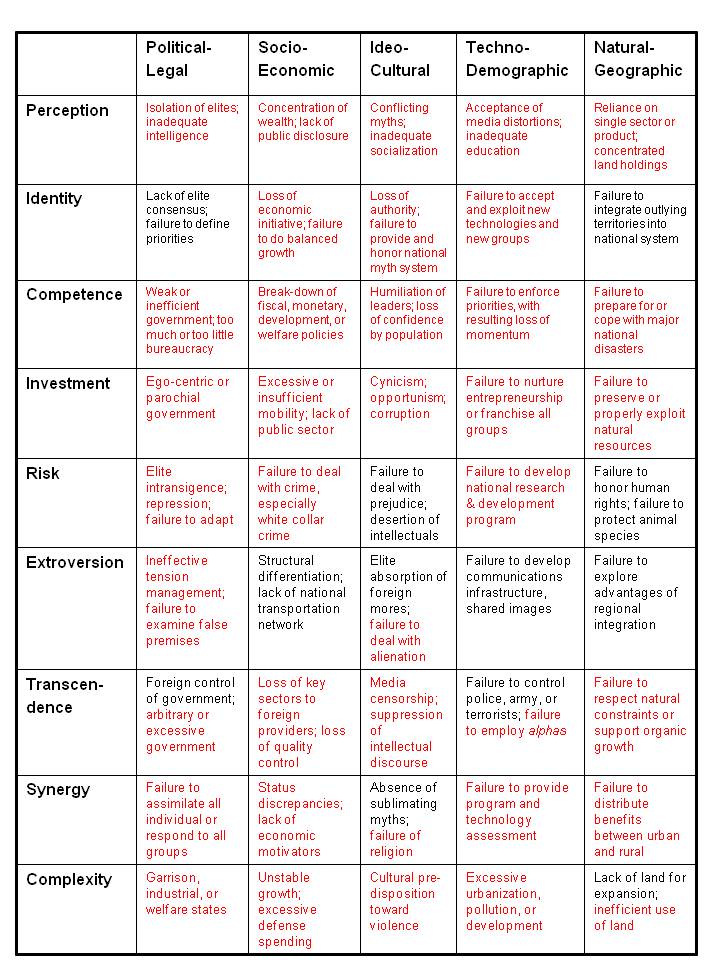
Revolution-Today-USA-1.1-JPEG

SHORT URL: http://tinyurl.com/Steele-Revolution

Phi Beta Iota: To those who have been leveraging the below, thank you for your interest.  It seemed like a good idea to go ahead and post a version of the chart showing in red all of the pre-conditions of revolution in the USA that are now actively present. The failure of leadership to manifest ethics and to nurture education is particularly harmful–white collar criminals do not prosper when the political leadership is ethical and upholds its responsibility to protect the public interest.  The ONLY thing–the one RIGHT thing–that needs to be done to make everything else possible is Electoral Reform (1 Page, 9 Points).  If the various parties and committees and alliances claiming to represent the public interest fail to sponsor this one simple fix, they reveal themselves for what they are: partisan quasi-criminal organizations operating in betrayal of the public trust, with no interest in restoring America the Republic, America the Beautiful.

EDIT:  For those who really do not understand the integrity of the above in today’s context, we will make this explicit:

1.  The country has been run into the ground–the bottom 98% have had their seed corn stolen and eaten by the top 2%.  There is no going back, neither revenge nor expropriation will do.  What has been done is done, get over it.

2.  There isn’t a leader or leadership team or party or “elite” network on the planet that can put the USA back together again [except perhaps We the People Reform Coalition].

3.  HOWEVER, “bottom up” collective intelligence is agile, intuitive, ethical in the aggregate, and so on.  This is REALLY SIMPLE: restore the integrity of the electoral system (local to national) and get out of the way.  This is called Epoch B Leadership.  It is also the root “good” of Advanced Information Operations  You start by empowering your own public and not lying to them.

Graphic: Pre-Conditions of Revolution

Graphic: Revolution Model Simplified

2011 Thinking About Revolution

1976 Thesis: Theory, Risk Assessment, and Internal War: A Framework for the Observation of Revolutionary Potential

Review: Theory, risk assessment, and internal war–A framework for the observation of revolutionary potential

Review: Revolutions and Revolutionary Movements

Revolution @ Phi Beta Iota

Search: davies j 1969 curve

Search: rm maciver the web of government summary

Search: smart nation intelligence reform electoral reform national security reform

We the People Reform Coalition

The Government Killed Martin Luther King Jr.

index

Since today marks the birthday of Martin Luther King Jr. it’s an appropriate time to reflect on his life and legacy but we must also never forget the forces which sought to crush his dream. Because of the work of investigative journalists, we have a clearer idea of the scope of the government’s efforts to discredit and psychologically torment Martin Luther King Jr. such as the following excerpt from an FBI letter to MLK:

King, there is only one thing left for you to do. You know what it is. You have just 34 days in which to do it (this exact number has been selected for a specific reason, it has definite practical significance). You are done. There is but one way out for you. You better take it before your filthy, abnormal fraudulent self is bared to the nation.

Read the complete unredacted FBI letter here: https://www.eff.org/deeplinks/2014/11/fbis-suicide-letter-dr-martin-luther-king-jr-and-dangers-unchecked-surveillance

Given such psychotic threats from the government agency, it’s not much of a stretch to imagine them opting for a more direct approach than trying to bully MLK to commit suicide.

How the Government Killed Martin Luther King, Jr.

By Carl Gibson

Source: Reader Supported News

efore scoffing at this headline, you should know that in 1999, in Memphis, Tennessee, more than three decades after MLK’s death, a jury found local, state, and federal government agencies guilty of conspiring to assassinate the Nobel Peace Prize winner and civil rights leader. The same media you would expect to cover such a monumental decision was absent at the trial, because those news organizations were part of that conspiracy. William F. Pepper, who was James Earl Ray’s first attorney, called over 70 witnesses to the stand to testify on every aspect of the assassination. The panel, which consisted of an even mix of both black and white jurors, took only an hour of deliberation to find Loyd Jowers and other defendants guilty. If you’re skeptical of any factual claims made here, click here for a full transcript, broken into individual sections. Read the testimonies yourself if you don’t want to take my word for it.

It really isn’t that radical a thing to expect this government to kill someone who threatened their authority and had the power to organize millions to protest it. When MLK was killed on April 4, 1968, he was speaking to sanitation workers in Memphis, who were organizing to fight poverty wages and ruthless working conditions. He was an outspoken critic of the government’s war in Vietnam, and his power to organize threatened the moneyed corporate interests who were profiting from the war. At the time of his death, he was gearing up for the Poor People’s Campaign, an effort to get people to camp out on the National Mall to demand anti-poverty legislation – essentially the first inception of the Occupy Wall Street movement. The government perceived him as a threat, and had him killed. James Earl Ray was the designated fall guy, and a complicit media, taking its cues from a government in fear of MLK, helped sell the “official” story of the assassination. Here’s how they did it.

The Setup

The defendant in the 1999 civil trial, Loyd Jowers, had been a Memphis PD officer in the 1940s. He owned a restaurant called Jim’s Grill, a staging ground to orchestrate MLK’s assassination underneath the rooming house where the corporate media alleges James Earl Ray shot Dr. King. During the trial, William Pepper, the plaintiff’s attorney, played a tape of an incriminating 1998 conversation between Jowers, UN Ambassador Andrew Young, and Dexter King, MLK’s son. Young testified that Jowers told them he “wanted to get right with God before he died, wanted to confess it and be free of it.”

On the tape, Jowers mentions that those present at the meetings included MPD officer Marrell McCollough, Earl Clark, an MPD lieutenant and known as the department’s best marksman, another MPD officer, and two men who were unknown to Jowers but whom he assumed to be representatives of federal agencies. While Dr. King was in Memphis, he was under open or eye-to-eye federal surveillance by the 111th Military Intelligence Group based at Fort McPherson in Atlanta, Georgia. Memphis PD intelligence officer Eli Arkin even admitted to having the group in his own office. During his last visit to Memphis in late March of 1968, MLK was under covert surveillance, meaning his room at the Rivermont was bugged and wired. Even if he went out to the balcony to speak, his words were recorded via relay. William Pepper alleges in his closing argument during King v. Jowers that such covert surveillance was usually done by the Army Security Agency, implying the involvement of at least two federal agencies.

Jowers also gave an interview to Sam Donaldson on “Prime Time Live” in 1993. The transcript of the interview was read during the trial, and it was revealed that Jowers openly talked about being asked by produce warehouse owner Frank Liberto to help with MLK’s murder. Liberto had mafia connections, and sent a courier with $100,000 to Jowers, who owned a local restaurant, with instructions to hold the money at his restaurant.

John McFerren owned a store in Memphis and was making a pickup at Liberto’s warehouse at 5:15 p.m. on April 4th, roughly 45 minutes before the assassination. McFerren testified that he overheard Liberto tell someone over the phone, “Shoot the son of a bitch on the balcony.” Other witnesses who testified included café owner Lavada Addison, who was friends with Liberto in the 1970s. She recalled him confiding to her that he “had Martin Luther King killed.” Addison’s son, Nathan Whitlock, also testified. He asked Liberto if he killed MLK, and he responded, “I didn’t kill the nigger but I had it done.” When Whitlock pressed him about James Earl Ray, Liberto replied, “He wasn’t nothing but a troublemaker from Missouri. He was a front man … a setup man.”

The back door of Loyd Jowers’ establishment led to a thick crop of bushes across the street from the Lorraine Motel balcony where Dr. King was shot. On the taped confession to Andrew Young and Dexter King, Jowers says after he heard the shot, Lt. Earl Clark, who is now deceased, laid a smoking rifle at the rear of his restaurant. Jowers then disassembled the rifle, wrapped it in a tablecloth and prepared it for disposal.

The corporate media says it was James Earl Ray who shot MLK, and he did it from the 2nd floor bathroom window of the rooming house across the street from the Lorraine Motel. The official account alleges the murder weapon was dropped in a bundle and abandoned at Dan Canipe’s storefront just before he made his getaway. But even those authorities and media admit that the bullet that tore through MLK’s throat didn’t have the same metallurgical composition as the bullets in the rifle left behind by James Earl Ray. And Judge Joe Brown, a weapons expert called to testify by Pepper in the 1999 trial, said the rifle allegedly used by James Earl Ray had a scope that was never sighted in, meaning that the weapon in question would have fired far to the left and far below the target.

The actual murder weapon was disposed of by taxi driver James McCraw, a friend of Jowers. William Hamblin testified in King v. Jowers that McCraw told him this story over a 15-year period whenever he got drunk. McCraw repeatedly told Hamblin that he threw the rifle over the Memphis-Arkansas bridge, meaning that the rifle is at the bottom of the Mississippi river to this day. And according to Hamblin’s testimony, Canipe said he saw the bundle dropped in front of his store before the actual shooting occurred.

The Conspiracy

To make Dr. King vulnerable, plans had to be made to remove him from his security detail and anyone sympathetic who could be a witness or interfere with the killing. Two black firefighters, Floyd Newsum and Norvell Wallace, who were working at Fire Station #2 across the street from the Lorraine Motel, were each transferred to different fire stations. Newsum was a civil rights activist and witnessed MLK’s last speech to the striking Memphis sanitation workers, “I Have Seen the Mountaintop,” before getting the call about his transfer. Newsum testified that he wasn’t needed at his new assignment, and that his transfer meant that Fire Station #2 would be out of commission unless someone else was sent there in his stead. Newsum talked about having to make a series of inquiries before finally learning that his reassignment had been ordered by the Memphis Police Department. Wallace testified that to that very day, while the official explanation was a vague death threat, he hadn’t once received a satisfactory answer as to why he was suddenly reassigned.

Ed Redditt, a black MPD detective who was assigned to MLK’s security detail, was also removed from the scene an hour before the shooting and sent home, and the only reason given was a vague death threat. Jerry Williams, another black MPD detective, was usually tasked with assembling a security team of black police officers for Dr. King. But he testified that on the night of the assassination, he wasn’t assigned to form that team.

There was a Black Panther-inspired group called The Invaders, who were staying at the Lorraine Motel to help MLK organize a planned march with the striking garbage workers. The Invaders were ordered to leave the motel after getting into an argument with members of MLK’s entourage. The origins of the argument are unclear, though several sources affirm that The Invaders had been infiltrated by Marrell McCollough of the MPD, who later went on to work for the CIA. And finally, the Tact 10 police escort of several MPD cars that accompanied Dr. King’s security detail were pulled back the day before the shooting by Inspector Evans. With all possible obstacles out of the way, MLK was all alone just before the assassination.

The Cover-Up

Around 7 a.m. on April 5, the morning after the shooting, MPD Inspector Sam Evans called Public Works Administrator Maynard Stiles and told him to have a crew destroy the crop of bushes adjacent to the rooming house above Loyd Jowers’ restaurant. This is particularly odd coming from a policeman, since the bushes were in a crime scene area, and crime scene areas are normally roped off, not to be disturbed. The official narrative of a sniper in the bathroom at the rooming house was then reinforced, since a sniper firing from an empty clearing would be far more visible than one hidden behind a thick crop of bushes.

Normally, when a major political figure is murdered, all possible witnesses are questioned and asked to make statements. But Memphis PD neglected to conduct even a basic house-to-house investigation. Olivia Catling, a resident of nearby Mulberry Street just a block away from the shooting, testified that she saw a man leave an alley next to the rooming house across from the Lorraine, climb into a Green 1965 Chevrolet, and speed away, burning rubber right in front of several police cars without any interference. There was also no questioning of Captain Weiden, a Memphis firefighter at the fire station closest to the Lorraine, the same one from which Floyd Newsum had been transferred just a day before.

Memphis PD and the FBI also suppressed the statements of Ray Hendricks and William Reed, who said they saw James Earl Ray’s white mustang parked in front of Jowers’ restaurant, before seeing it again driving away as they crossed another street. Ray’s alibi was that he had driven away from the scene to fix a tire, and these two statements that affirmed his alibi were withheld from Ray’s guilty plea jury.

The jury present at Ray’s guilty plea hearing also wasn’t informed about the bullet that killed MLK having different striations and markings than the other bullets kept as evidence, nor that the bullet couldn’t be positively matched as coming from the alleged murder weapon. Three days after entering the guilty plea, James Earl Ray unsuccessfully attempted to retract it and demand a trial. Incredibly, James Earl Ray turned down two separate bribes, one of which was recorded by his brother Jerry Ray, where he was offered $220,000 by writer William Bradford Huey and the guarantee of a full pardon if he would just agree to have the story “Why I Killed Martin Luther King” written on his behalf.

The Deception

One of the 70 witnesses that William F. Pepper called to testify in King v. Jowers was Bill Schaap, a practicing attorney with particular experience in military law, with bar credentials in New York, Chicago, and DC. Schaap testified at great length about how the government, through the FBI and the CIA, puts people in key positions on editorial boards at influential papers like the New York Times and Washington Post. He describes that although these editorial board members and news directors at cable news outlets may be liberal in their politics, they always take the government’s side in national security-related stories. Before you write that off as conspiracy theory, remember how people like Bill Keller at the New York Times, as well as the Washington Post editorial board, all cheerfully led the march to war in Iraq ten years ago.

Another King v. Jowers witness was Earl Caldwell, a New York Times reporter who was sent to Memphis by an editor named Claude Sitton. Caldwell testified that the orders from his editor were to “nail Dr. King.” In the publication’s effort to sell the story of James Earl Ray as the murderer, the Times cited an investigation into how Ray got the money for his Mustang, rifle, and the long road trip to Tennessee from California. The Times said that according to their own findings as well as the findings of federal agencies, Ray got the money by robbing a bank in his hometown of Alton, Illinois. In Pepper’s closing argument, he says that when he or Jerry Ray talked to the chief of police in Alton, along with the bank president of the branch that was allegedly robbed, neither said they had been approached by the New York Times, or by the FBI. Essentially, the Times fabricated the entire story in order to sell a false narrative that there was no government intervention and that James Earl Ray was a lone wolf.

So for the following 31 years after King’s death, nobody dared to question the constant reiteration of James Earl Ray as the murderer of Martin Luther King. Even 13 years after a jury found the government complicit in a conspiracy to murder the civil rights leader, the complicit media continues to propagate the false narrative they sold us three decades ago and vociferously shout down any alternative theories as to what happened as “conspiracy theory,” framing those putting forth such theories as wackjobs undeserving of any credibility. It’s strikingly similar to how the Washington Post defended their warmongering in a recent editorial commenting on the invasion of Iraq, and had one of their reporters defend the media’s leading of the charge into Iraq.

As we remember Dr. King and the important work he did, we should also reject the official account of his death as loudly as the government and media shout down anyone who tries to contradict their lies. As Edward R. Murrow said, “Most truths are so naked that people feel sorry for them and cover them up, at least a little bit.”


Carl Gibson, 25, is co-founder of US Uncut, a nationwide creative direct-action movement that mobilized tens of thousands of activists against corporate tax avoidance and budget cuts in the months leading up to the Occupy Wall Street movement. Carl and other US Uncut activists are featured in the documentary “We’re Not Broke,” which premiered at the 2012 Sundance Film Festival. He currently lives in Madison, Wisconsin. You can contact him at carl@rsnorg.org, and follow him on twitter at @uncutCG.

Also read:
Who Killed Martin Luther King Jr.?

Martin Luther King assassinated by US Govt: King Family civil trial verdict

Education and the “Progressive” Corporate State

anti_public_education_propaganda_by_8manderz8-d5xz1cj

By Kevin Carson

Source: Center for a Stateless Society

Speaking in Knoxville, Tennessee on January 9 US president Barack Obama unveiled an initiative to provide two years of community college tuition-free, nationwide, to anyone meeting attendance and grade requirements. The idea, inspired by a similar program in Tennessee, aims to make two years of college as universal as high school is now. Obama’s proposal is in keeping, in more ways than one, with traditions going back to the origins of the American corporate state 150 years ago.

Since the mid-19th century, a few hundred large industrial corporations and banks have dominated the American economy. And the American state, functionally, has been closely intertwined with the interests of those corporations. One of its functions is to subsidize the corporate bottom line and artificially prop up the rate of profit by socializing provision of a growing share of inputs — among them the cost of reproducing and training human labor power.

The first statewide public school systems were introduced in New England to meet mill owners’ need for a workforce that was docile, obedient and educated to minimal standards; a function supplemented by education in “100% Americanism” at the turn of the 20th century, and a home economics curriculum in the ’20s and ’30s aimed at processing students into good mass consumers.

As recounted by New Left historian David Noble in America by Design, federal government aid to land grant colleges coincided with the national railroad and industrial corporations’ growing need for trained mechanical and industrial engineers. This trajectory carries through the GI Bill and to Obama’s latest proposal.

These institutional developments were accompanied by the rise of a meritocratic legitimizing ideology which replaced earlier American notions of equality and autonomy. Rather than genuine equality based on widespread economic empowerment and self-employment, the new meritocratic ideology treated step hierarchies of wealth, skill and managerial authority as both normal and necessary, but relied on the ideal of universal education to justify the ideology as “democratic.” With the widespread availability of secondary, higher and technical education, the theory goes, the individual’s rise in the managerial-technical hierarchy is limited only by their own willingness to learn and work. This peculiar American religion combines the existence of deep structural inequalities in wealth and power with the moralistic assumption that everyone gets exactly what they deserve.

The official White House happy talk, predictably, takes the corporate state’s assumptions for granted: “In our growing global economy, Americans need to have more knowledge and more skills to compete — by 2020, an estimated 35 percent of job openings will require at least a bachelor’s degree, and 30 percent will require some college or an associate’s degree.” That it’s the place of the “growing global economy” and the corporate HR departments in it to set the “required” qualifications for labor, and the place of the state’s education system to process people to those standards, goes without saying.

Never mind that globalization, concentration of economic power in the hands of a few giant, capital-intensive corporations, and a wage system that separates labor from both ownership and control of work, are none of them natural or inevitable processes. They all result from the deliberate policies of a state in league with capital.

The real irony is that the system of power Obama’s proposal is designed to serve is doomed to extinction. The revolution in cheap small-scale machine tools means an end to the material rationale for the wage system, and to corporate control of production. Coupled with the rise of open-source or pirated textbooks, free online lectures and syllabi and DIY learning networks, it also means an end to control over access to employment by the unholy alliance of big universities and human resources departments. In an economy where a few months’ wages can purchase a garage factory full of open-source tools and the economy is dominated by commons-based peer production and craft production in self-managed shops, credentialing will be largely stackable and ad hoc, negotiated informally to suit the needs of the groups of people working together.

The days of the educational Cult of Moloch and its human sacrifices are numbered.

Related post: Schools are Becoming Privatized Prisons


The Pro-GMO Lobby: Anti-science and a Politically Motivated Agenda

gmo_crops_genfood_735_350-400x190

By Colin Todhunter

Source: RINF

The pro-GMO lobby claims that there is a scientific consensus on the safety of GM food and therefore the GMO debate is over. It claims that GMOs guarantee higher yields and less pesticide/herbicide use. The claim is also made that GM agriculture has no adverse impact on soil, the nutritional value and health of crops or biodiversity. The industry and its supporters claim that the ‘scientific community’ believes GMOs can only have positive effects and point to research to back this up.

These claims are bogus. Many analyses have highlighted the inadequacies of the research cited by the pro-GMO lobby, not least in terms of methodology, the glossing over of the significance of certain findings and conclusions that do not necessarily fit the evidence provided [1-3]. Moreover, numerous studies demonstrate the often worrying physiological abnormalities derived from ingesting GMOs as well as poor/falling yields, increased pesticide use, lower nutritional values and degraded soil and plant health (etc) associated with GM agriculture [4].

When certain pro-GMO figures proclaim that the debate over GMOs is over, their proclamations are based on propaganda, not science. They say that people who challenge their views are anti-science, politically motivated and are mounting a ‘campaign’ against the industry. Like all good propagandists, this is doublespeak.

Given the existing scientific evidence that challenges the claims of the pro-GMO lobby, a rational and reasonable response would involve applying a precautionary approach to GMOs [5] because there is clearly no scientific consensus. Yet public safety concerns are regarded by the GMO lobby as a barrier to bringing its products to the commercial market and are to be sidelined by all means possible [6-9]. To justify this, it promotes the falsehood that GMOs are ‘substantially equivalent’ to non-GMO products, which is certainly not the case [10].

It is therefore with good reason that concerned people have organised to ensure the precautionary principle is adopted or strengthened and to challenge the industry and officials that are driving the GMO agenda.

It is the GMO sector itself that is politically motivated, anti-science and mounting a campaign in favour of its products. Its faulty science has been challenged, and as a result it is unable to produce the evidence that would convince us that GMOs are safe and provide the benefits claimed. Little wonder the industry hides behind the notion of ‘commercial confidentiality’ to maintain a veil of secrecy over its own research that regulators too often accept at face value [11].

Having failed to win the day with science, it resorts to placing restrictions on independent research into its products, censors findings, intimidates, smears, bribes, uses fakery and has successfully used its wealth and power to hijack regulatory bodies and co-opt bodies and officials who propagate lies on its behalf [12-15]. Yet it is those who highlight and challenge such tactics who are attacked for attempting to derail an industry which likes to portray itself as working for the public interest.

One of the main PR weapons used by the sector is that anti-GMO campaigners are taking food from the mouths of the hungry [16]. Let’s get one thing clear: GMOs are not the answer to feeding the world [17-22] and that type of emotional blackmail will only ever work on the ignorant, misinformed and those who believe the industry’s propaganda.

There is enough scientific evidence to warrant serious concern over GMOs. After all, evidence is mounting that some of these companies may have already been poisoning us for decades with their cocktail of agricultural inputs [23,24].

However, it is easy for the layperson to become confused by an endless parade of studies claiming to back up one or other side of the debate. For that reason, sometimes they have to look beyond science to sharpen their focus. They have to look at motives. They must ask who is controlling the GMO agenda? For what purpose? What is the track record of those involved? Should we ever in a million years trust certain players given their criminal record [25]?

Commercial concerns are driven by profit. Capitalism compels companies to capture and maintain market shares. However, cartels, price rigging, threats, cronyism and having politicians in your back pocket are a much better guarantee to seize and dominate markets than any economic model taught in textbooks and based on the ‘free’ market being determined by supply and demand. Such economic theory is the smokescreen that modern day neoliberalism tries (but fails) to hide behind [26]. As far as the GMO issue is concerned, however, there is much more to it than the need to make a fast buck.

There is a reason why well-known proponents (Rockefeller, Gates) of depopulation and eugenics are involved with the GMO sector; there is a reason why these very people have funded a giant seed bank on an island in the Arctic [27,28]. There is a sinister side to this industry, which points to a heady mix of US geopolitical hegemony based on the global control of agriculture, the hijack of the world’s seeds and food supply and depopulation [29].

If the science around GMOs is confusing to some, then ambiguity is what powerful corporations want: the tobacco industry was happy for the waters to be muddied for decades over the link to lung cancer. But if ambiguity over the efficacy of GMOs does indeed reign, the underlying politics is much clearer to grasp.

colintodhunter.com 

Notes

1] http://gmwatch.org/index.php/news/archive/2014/15669-why-jon-entine-s-trillion-meal-study-won-t-save-us-from-gmo-dangers

2] http://gmwatch.org/index.php/news/archive/2014/15618-biology-fortified-misleads-the-public-on-gmo-safety

3] http://rightbiotech.tumblr.com/post/103665842150/correlation-is-not-causation

4] http://gmomythsandtruths.earthopensource.org/

5] http://www.theguardian.com/science/political-science/2013/jul/08/precautionary-principle-science-policy

6] http://corporateeurope.org/pressreleases/2014/07/agribusiness-biggest-lobbyist-eu-us-trade-deal-new-research-reveals

7] http://corporateeurope.org/trade/2013/05/open-door-gmos-take-action-eu-us-free-trade-agreement

8] http://www.gmfreeze.org/actions/42/

9] http://corporateeurope.org/food-and-agriculture/2014/05/biotech-lobbys-fingerprints-over-new-eu-proposal-allow-national-gmo

10] http://www.i-sis.org.uk/Substantial_Non-Equivalence.php

11] http://gmwatch.org/index.php/news/archive/2014/15519-the-glyphosate-toxicity-studies-you-re-not-allowed-to-see

12]http://indiatoday.intoday.in/story/Monsanto+’faked’+data+for+approvals+claims+its+ex-chief/1/83093.html

13] http://www.globalresearch.ca/gmo-scandal-the-long-term-effects-of-genetically-modified-food-on-humans/14570

14] http://www.gmwatch.org/latest-listing/1-news-items/12715-seralini-vs-fellous-a-gmo-libel-case-over-independent-expertise-and-science

15] http://www.globalresearch.ca/gmo-researchers-attacked-evidence-denied-and-a-population-at-risk/5305324

16] http://www.globalresearch.ca/the-gmo-biotech-lobbys-emotional-blackmail-and-bogus-claims-monsantos-genetically-modified-crops-will-not-feed-the-world/5407080

17] http://www.cban.ca/Resources/Topics/Feeding-the-World

18]http://www.srfood.org/images/stories/pdf/officialreports/20110308_a-hrc-16-49_agroecology_en.pdf

19] http://vivakermani.blogspot.in/2014/07/gm-food-crops-why-india-must-say-no.html

20] http://www.globalresearch.ca/india-genetically-modified-seeds-agricultural-productivity-and-political-fraud/5328227

21] http://unctad.org/en/PublicationsLibrary/tdr2013_en.pdf

22]http://www.unep.org/dewa/agassessment/reports/IAASTD/EN/Agriculture%20at%20a%20Crossroads_Global%20Report%20(English).pdf

23] http://naturalsociety.com/americans-suffering-chronic-disease-due-glyphosate-herbicides-new-study/

24] http://www.tonu.org/2013/12/03/shivchopra_squamish/

25] http://www.wakingtimes.com/2014/06/20/complete-history-monsanto-worlds-evil-corporation/

26] http://www.washingtonsblog.com/2013/05/is-every-market-rigged.html

27] http://www.naturalnews.com/034468_doomsday_seed_vault_secrets.html#

28]http://www.naturalnews.com/035105_bill_gates_monsanto_eugenics.html

29] http://www.globalresearch.ca/menace-on-the-menu-development-and-the-globalization-of-servitude/5416488

The Curtain Rises on Another Act in the Continual Global War on Terror Play

hebdo-shooters

By Wayne Madsen

Source: Strategic Culture Foundation

The attacks in Paris on the editorial offices of the weekly satirical journal Charlie Hebdo and a kosher supermarket have, once again, conveniently turned the attention of the world away from the economic turmoil in the European Union and the extreme unpopularity of its major leaders to the seemingly never-ending «global war on terror».

French President Francois Hollande announced that on January 11, he would march in solidarity on the streets of Paris along with German Chancellor Angela Merkel, British Prime Minister David Cameron, Italian Prime Minister Matteo Renzi, Spanish Prime Minister Mariano Rajoy, Belgian Prime Minister Charles Michel, Ukrainian President Pyotr Poroshenko, Irish Prime Minister Enda Kenny, and the ISIL-enabling Turkish Prime Minister, Ahmet Davitoglu. All of these leaders, facing huge popularity problems at home, were able to use the terrorist attacks in Paris to bolster their own flagging electoral profiles. In addition to the unpopular leaders, NATO Secretary General Jens Stoltenberg, European Council President Donald Tusk, and European Commission chief Jean-Claude Juncker were also scheduled to march in Paris in the grandiose «photo op» to help honor a magazine staff that often lampooned many of these leaders with cartoons that were almost always of a sexual nature.

Once again, the alleged perpetrators of the recent attacks, Franco-Algerian brothers Said and Cherif Kouachi, who were said to have murdered 12 people, including the editor-in-chief of Charlie Hebdo, and Franco-Senegalese Amedy Coulibaly, said to have killed hostages at the supermarket, were well-known to the French police and intelligence services. It was claimed by one of the supermarket customers that Coulibaly said proclaimed that he was from Mali and that he supported ISIL and Palestine. The Kouachis’ names were even included on the American «no-fly list».

The fact that the Kouachis had been involved in recruiting and training jihadist volunteers to fight for the Islamic State of Iraq and the Levant (ISIL) in Syria and had earlier been involved in recruitment efforts for jihadist armies in Iraq and Yemen should have placed a surveillance net over the two brothers. But, as in a previous case in France involving an alleged jihadist terrorist who allegedly killed people at random, the Kouachi brothers, as well as Coulibaly, who was also well-known to the police, were permitted to obtain weapons and other materials without tipping off law enforcement. Coulibaly actually met with French President Nicolas Sarkozy in 2009. Coulibaly worked at a Coca Cola plant in the poor «banlieue» of Grigny, outside of Paris. Coulibaly was one of ten workers selected to meet personally with Sarkozy at the Elysee Palace to discuss youth employment issues. As with the U.S. Secret Service and the American president, French security thoroughly vets those who meet with the French head of state, which makes Coulibaly’s selection to meet Sarkozy even more perplexing. «Le Parisien» quoted Coulibaly as being excited over his meeting with Sarkozy and hoped the French president might help him find him a good job. Coulibaly is said to have first met Cherif Kouachi in 2010. However, Coulibaly supposedly converted to radical Islam while serving time in prison in 2005 for armed robbery. It was in prison that Coulibaly became an adherent of Djamel Beghal, said to be a Franco-Algerian member of Al Qaeda who, in 2001, tried to blow up the U.S. embassy in Paris. Out of all the unemployed and under-employed youth in France, the French president’s security team decided to vet a known follower of an Al Qaeda member to enter the Elysee Palace to meet with Sarkozy. As the French say, «incroyable!»

Pre-attack knowledge by the authorities of an alleged perpetrator was certainly the case in the Merah affair in March 2012 when Mohammed Merah, a French national, was killed by French police. Merah was accused of killing three French paratroopers in Montauban and three students and a teacher at a Jewish school in Toulouse. It was later discovered that not only did the French Central Directorate of Internal Intelligence (DCRI) maintain a thick dossier on Merah, but that French intelligence tried to recruit him as an agent. Merah traveled with ease to Afghanistan and Pakistan with the foreknowledge of French intelligence. The then-governing conservatives of President Nicolas Sarkozy and the opposition, now ruling, Socialist Party conspired to cover up Merah’s links to French intelligence.

The Kouachi brothers are said to have returned from Syria this past summer, where the CIA and French intelligence have been backing Islamist guerrilla groups battling the government of President Bashar al-Assad. The similarities of the Kouachis and Coulibaly to Merah are amazing. All were known to French intelligence before they allegedly carried out their terrorist attacks and all had connections with Al Qaeda groups and affiliates.

Ever since the 1980 time-bombing of the Bologna train station that killed 85 and injured over 200, Western European «false flag» operations have become fairly standardized «boiler plate» operations. This was certainly the case with the three-man professional military assault carried out in a precision manner by the alleged Islamist terrorists on the Paris editorial offices of the satirical journal Charlie Hebdo. Although the two Kouachi brothers, killed by police at a warehouse north of Paris, are said to have carried out the attacks on the newspaper, there is still no explanation of what happened to the third gunman. A third suspect in that attack, a brother-in-law of the Kouachis named Mourad Hamyd, voluntarily turned himself in to the police after he heard his name broadcast by the media. However, Hamyd, 18, was in school at the time of the attack on Charlie Hebdo.

The attack on the Bologna train station began the age of modern false flag attacks. Although in 1980 the Italian government and media originally blamed the bombing on leftist radical Italian guerrillas, it was, in fact, carried out by an underground fascist cell that obtained the bomb materials from hidden caches belonging to the secret NATO «stay behind» paramilitary network known as «Gladio».

Gladio was intended to mobilize guerrilla forces to fight the Soviets in the event of a ground war in Europe. Weapons and materials were hidden underground and in caves throughout Western Europe for future guerrilla assaults on occupying Soviet troops. However, Italian rightists and Zionists attempted to use the discredited Mitrokhin Dossier, allegedly obtained from KGB files, to pin the blame for the Bologna attack on the Soviets acting in concert with radical Arabs, including Palestinian groups. It was later discovered that it was the CIA that funded such news stories in a psychological warfare operation against the Soviets and the Arab countries. From his Paris jail cell in 2005, Ilich Ramirez Sanchez, the famed terrorist known as «Carlos,» revealed that it was the CIA and Mossad that carried out the Bologna bombing and that the Mitrokhin Dossier was being used to «falsify history». Other independent accounts have proven Carlos’s allegation.

Ever since Bologna, the tell-tale signs of Western intelligence false flag operations are extremely evident in attack after attack. By sticking to the same doctrine for over 40 years, Western intelligence fingerprints are becoming as clear as day.

One such tell-tale sign of a false flag operation is the convenient discovery by police of evidence linking attacks to the perpetrators, be they unknowing double agents or patsies who believe in whatever cause has been dangled before them.

One sign of a false flag operation is that «evidence» linking the intended perpetrators to the crime scene is always discovered. French police claim they were able to pin the attack on Kouachis, because Said, the eldest brother, left his French identification card in a black Citroen used as a getaway car. Police would not say whose identification card they found. Some French security experts warned that the ID card may have been purposely planted in the car to confuse the police. Police also conveniently found Molotov cocktails and Islamist jihadist flags inside the getaway car. Alleged 9/11 hijacker Mohammed Atta’s passport was supposedly found in pristine condition in the rubble of the World Trade Center.

Often, the true perpetrators of false flag attacks are masked. This was the case with the three reported gunmen who killed the Charlie Hebdo staff.

There are always other attacks in the region to confuse police. For example, while French police were concentrating their search for the gunmen from northern Paris to the Belgian border, a French police woman was shot and killed in Montrouge, south of Paris. French authorities were quick to say the events south of Paris and at Charlie Hebdo were not linked. Later, it was announced that the two events were linked. Some witnesses at the warehouse and at the newspaper office were convinced that the masked men who turned out to be terrorists were actually counter-terrorism special troops. One man at the warehouse who escaped injury said he shook hands with one of the masked terrorists who he believed was a special policeman. At the same time French police launched their hostage-freeing operations at the warehouse and kosher supermarket, a hostage situation at a jewelry store in Montpellier, in the south of France, was being reported. Police soon said that situation was not connected to the events in the Paris region. Nevertheless, the Montpellier situation conveniently added to the fear factor.

The events in France have given a boost to anti-Islam immigration movements throughout Europe, from the PEGIDA movement and Alternative for Germany (AFD) party in Germany, to the National Front in France, and the UK Independence Party in Britain. Coming so soon after France’s UN Security Council vote to recognize Palestine as a state and the rising political fortunes of the pro-Israel National Front, a «price tag» attack on France, masked as a jihadist terrorist operation, cannot be ruled out.


Related Articles:

Paris Shooting Suspects Under French Radar for YEARS

Who Ordered the Attacks Against Charlie Hedbo?

The Rise of Empathic Consciousness

Collective-Consciousness-1

By Kingsley L. Dennis

Source: Reality Sandwich

For many of us we have been brought up within a social structure that demands we become a ‘productive member’ of our society; thus much emphasis is placed upon developing individual skills so that we can compete with each other for social betterment. Inherent in this is a residual fear that if we open ourselves too much to others we may lose our ‘competitive edge’ and defined sense of individuality. Much of mainstream media (aka propaganda) has exploited the mythological images, collective stereotypes, and subconscious signifiers that play on our collective vulnerabilities and social fears. Knowledge has more or less trickled down to the average person through heavily filtered channels, and most often has been doctored, amended, and/or edited. The end result has been not knowledge but consensus information, or ‘allowed’ information. It has served the elite power structure well that people in general have not awoken to the understanding that humanity possesses incredible capacity and inherent resources for creative expansion and evolutionary development.

Added to this is the fact that Western science, which has asserted itself as the dominant hegemony since the Renaissance, has been at pains to stress that matter is primary and that consciousness is a secondary by-product from our mental activity. The modern worldview which denies the primacy of consciousness is fostering forms of human alienation, both psychological and social. It is a great paradox that modern science, itself a result of human consciousness, has produced a view of the cosmos which has no room for consciousness. Yet human beings are in need of meaning and significance in their lives as much as they are in need of air to breathe and food to eat. This struggle over the conscious mind(s) of humanity, which has been going on in various forms for aeons, is coming to a crux in our present generation. We are in a transition period which sees the expanding awareness and connectivity between individuals worldwide clashing against the increasing authoritarian technocratic ‘surveillance machine.’ The result is that we have now collectively arrived at a critical moment in our evolution of human civilization. Yet any society or civilization which makes the material world its sole pursuit and object of concern cannot but devolve in the long run. It is now necessary to see our future potentials, not the daily news. As Professor Needleman so aptly remarked:

The esoteric is the heart of civilization. And should the outward forms of a human civilization become totally unable to contain and adapt the energies of great spiritual teachings, then that civilization has ceased to serve its function in the universe.[1]

It is therefore imperative that we begin to break-away from non-developmental social conditioning; this includes being conscious of the type of media impacts we are open to. Furthermore, during moments of cultural and social disorder/disequilibrium the human mind often works with an energy and intensity not manifested when social patterns are stable and monotone. At such dynamic periods there can be the realization that no individual is isolated; that each person is interwoven into a vibrant network and web of psychological, emotional, and spiritual interrelations. Such realizations can be heightened during periods, such as now, when it appears that human consciousness is moving through a time of critical transition.

Our self-awareness over the nature of human consciousness has been increasing greatly over the last several decades. The latest findings in the new sciences (especially quantum and neuroscience), in consciousness studies, in the popularity for inner and self-development, etc, all indicate a new awareness emerging within our collective consciousness. That is, energetic change will come through our social and cultural forms, and not by avoiding them. Developmental change on a large scale can occur by creating conscious change from within our daily lives and within our social systems, and not outside of them. By just walking on this planet, holding the focus and intention, we create incredible energy – energy that is shared. We are creating change by just being alive. That is why being without fear is so important. We need not create a black and white film in our heads when in reality we are creating colour. We can make use of the tools that are already available to us, and within us.

There is an exponentially increasing mass of individuals worldwide who are now awakening to the connected empowerment of empathic consciousness. Recent de-stabilizing social events, such as in our financial and political spheres, have drawn people’s focus to the dysfunction of many of the systems that we once gave our trust to. Even the focus on religious extremism in the media has drawn people’s attention not only to the deficit of spiritual values in our major religions but also to how religion is being used as a tool for furthering social, political, and emotional control. This trance-like grip on our collective consciousness is now being stripped away as people awaken to the knowing that there is so much more to our lives than that of a materialistic and consumer-based lifestyle. Yet don’t become frustrated if things don’t happen tomorrow, but trust that changes and shifts are happening over time. The necessity of inner knowing, intuition, self-trust, and integrity, is now critical. And let us remember that humans are biased for compassion and empathy. The awakening of our empathic mind is our natural inheritance.

The Awakening of a Planetary Consciousness

The accelerating changes occurring across our planet right now will have no alternative but to force a mind-change on a global and individual level. We are coming together as a global species like never before; despite what we have been shown and told by the mainstream media. We need to view this in both the immediate and the bigger picture. Due to our relatively short human life span we rarely reflect beyond a generation or two in front of us. We have evolved as a species that reacts to immediate concerns. This served us well in the past when we had survival needs in a restricted world of limited horizons. Yet now we need a perspective that is global at the very least – and even possibly beyond!

If we now look at the bigger picture we will see that a different type of consciousness has been emerging over the past 150 years. That is, since the dawn of the Second Industrial Revolution. The new technologies of the Second Industrial Revolution – the telephone, radar, cinema, automobile and airplane – called for a new reorientation of human perspective. A new perception of the dimensions of space and time began to birth a psychological consciousness – one that wanted to look beyond the borders and horizons of the physical frontier. The 3rd Industrial Revolution, if we wish to call it that, will be a convergence of digital communications combined with a young generation that is more globally aware. This has the potential to catalyze upon this planet a rising empathic, integral consciousness. Also, our global communications will encourage new relations in our extended connectivity. That is, increased multiple relations are likely to stimulate a connected, collaborative consciousness; rather than stepping back into an older consciousness of conflict and control. A planetary citizenry is likely to emerge that will exhibit greater empathy, and which will create a different planetary society within perhaps two generations. Humanity already contains the seeds of these momentous potentials.

Many social changes within the upcoming years will emerge from the creative engagement and innovation of individuals and collectives worldwide – a shift catalyzed within the hearts, spirit, and minds of the people. Externally we may seem like a vast, distant, and separate collection of individuals yet in truth the human family is an intimate, closely entwined species comprised of various cultures. Many of the younger generation now are waking up to this fact. Youngsters the world over are growing up accustomed to having networks of hundreds, perhaps even thousands, of friends across the planet; sharing intimacy and empathizing easily with an international social group of like-minded souls. This younger generation is manifesting, whether conscious of it or not, a non-local level of human relationships. This expanded connectivity is impacting and affecting a change in our psychology and consciousness. We are now being impelled to live in ways that enable all other people to live as well. We are also being compelled to live in ways that respect the lives of others and that respect the right to the economic and cultural development of all people; and to pursue personal fulfilment in harmony with the integrity of nature. These traits may constitute what I refer to as an integral-ecological consciousness: a person acting and behaving as both an individual and as a part of the greater connected whole. Such multiple relations form a more varied, rich and complex life; they also provide a more diverse range of impacts and opportunities to develop the self. As well as providing challenges for developing new skills and learning, our diverse networks can form new friendships and add extra meaning to our lives.

Many young people today are comfortable in expressing themselves with strangers; they explore and express their inner thoughts, feelings, emotions and ideas with hundreds of unknown persons online, from various cultural backgrounds. More and more daily interactions are empathic as we react and share news, stories, and emotional impacts from sources around the world. Empathy is one of the core values by which we create and sustain social life. Exposure to impacts outside of our own local and restrictive environments helps us to learn tolerance, and to live with experiences that are richer and more complex, full of ambiguities, and multiple perspectives. It is a mode of connecting that allows diverse people worldwide to construct a new form of planetary social capital. We have the resources to co-create a planetary human society where once again the focus is on social benefit rather than profit. We can see many examples of this today, such as in online collaborative tools and in the proliferation of local and global projects. The online global community is a model for the new paradigm that illustrates how sharing can work above the individual motive for profit. The values and ethics of communal sharing might seem odd or out-of-place to the old capitalist-consumerist mindset, yet these are the very values that will be on the rise within the coming generations.

The spectacular rise in global communication technologies (Internet and mobile phones especially) reflects a new form of participatory consciousness, especially among younger people. This new model is a distributed one; in other words, it connects people through networks rather than through hierarchical structures. It also represents a more feminine energy that seeks to nurture relationships, and to collaborate, rather than compete and conquer. It is this emerging feminine energy that underlies the rise in global empathy. Furthermore, since people are connecting amongst themselves in multiple relations it impels them to have an active engagement. For those individuals brought-up within the older generation of communication technologies (radio, television, fixed phones), the interaction was either two-way or, for the most part, one way. In this era people were passive receivers, targeted by information they could not engage with. This has now shifted so that the receiver of the communication can be both the user and the producer. Individuals today are shifting from being consumers to prosumers.

We have learnt to democratize our engagement and to activate choice through online social networks, phone messaging, video channels (e.g. You-Tube), and various other broadcast mediums. The younger generation is waking up quickly and learning how to set-up inexpensive, or free, radio sites (podcasts), home websites, newsletters, and are managing their own forms of self-expression. This new model is changing our thinking and behavior patterns. We are now getting used to dealing with multiple connections rather than single ones; and to becoming immersed in diverse relations and not just one-on-one dialogues. We are also being exposed to a myriad of viewpoints, beliefs, identities, and experiences. Within these new arrangements we are being asked to respond and engage with the outside world not in fear or with anxiety but with healthy, creative, and positive energies.

The Arrival of 3 Billion New Minds

We are going to witness a young generation expressing their desire for human betterment through intensified action for social, political, and ecological change. More and more young people are growing up experiencing social relations that transcend space and time, as well as cultures, national boundaries, and local ideologies. This may account for the increasing numbers of young people in developed nations becoming involved in community and social projects and NGOs; such as taking a year out to help in another culture abroad, to learn, experience, and to offer assistance. Volunteering among the young, despite what appears to be the contrary, is on the increase. Young people are even putting themselves into dangerous situations – in conflict zones – to stand up for values of peace, justice, equality, and human rights. Across the world young minds are demanding fair and equal access for all peoples to engage in open communication and free speech. And it appears that many more creative minds will be joining the global conversation as our current generation(s) increasingly ‘wake up.’

In 2012 the planetary population was around 7 billion and the number of registered internet users was 33%, a rise of over 500% from the previous decade. By 2020 world population is set to be 7.8 billion and internet users worldwide is estimated to be 66% – that’s a little under 3 billion new people plugging into the global conversation. In other words, nearly 3 billion new minds will be tapping into the information flows – and that’s many millions of new creative problem solvers, innovators, and visionaries. What is more, the majority of these new minds will be coming online from Asia, the Middle East, and what we refer to as the developing countries. These will be mostly young minds; and minds with necessities, with the urge for social betterment. Can we imagine the collective potential of these creative new minds; many of them thinking outside of the box, and outside of the old patterns?

It is significant that in times of relative social stability, human consciousness plays a lesser role in the behavior of society. However, when a society reaches the limits of its stability then social-cultural systems are sensitive and responsive to even the smallest fluctuations in the consciousness of its citizens. In such times, changes in values, belief sets, perceptions, etc, hold great sway over the future direction of the social situation. Human consciousness becomes a significant stimulus and catalyst for change during these times of social instability (see the history of social revolutions). That is why it is imperative humanity be collectively focused upon positive development and betterment rather than to be coerced, or conditioned, into a fear-based security that resists change. We should not underestimate the capacity for the human mind to adapt and evolve according to social and environmental impacts and influences.

Our modern sense of self-awareness has clearly evolved to root us in our social world: a world of extended relations and social networks. Humanity, it can be said, has been biologically hard-wired to tap into extended social connections and human communication networks. We are also hard-wired to adapt physically in response to experience – new neural processes in our brains can come into being with intentional effort, awareness, and different patterns of concentration. This capacity to create new neural connections, and thus new mental skill sets through experience, has been termed neuroplasticity. The human brain of today has to respond to the incredible amount of energy and information that is flowing through our environments and embedded in our cultural experiences. Thus, how we focus our attention and awareness greatly shapes the structure of our brains. Further, the ability to grow new neural connections is available throughout our lives and not only in our young formative years. This knowledge encourages us to nurture our mindfulness, our self-awareness, and our empathic relations with others. Neuroplasticity also encourages us to be more reflective over our human networks, and to develop those social skills that underlie empathy and compassion. These new ‘wired connections’ are exactly what are becoming activated as individuals increasingly ‘wake up’ to what is happening within our communities, our societies, and upon the planet. Such distributed connections breach cultural and national borders and force us to self-reflect on our identity, values and ethics.

The opportunity is here for change and betterment like never before in our recent history. This means that the responsibility is also here; and these two factors may never be present again at exactly the right moment when they are so badly needed. What the human species may now be witnessing during these years is the rise of intuition, empathy, greater connectivity to the world and to people, and a sense of ‘knowing’ what changes need to be made. Furthermore, within each person is a growing sense of the greater cosmic whole: the realization that humanity exists and evolves within a universe of great intelligence and meaning. This serves to impart within humanity a more profound spiritual impulse. As a new global empathic mind emerges, people worldwide will grow up with new expressions of mindfulness that are more caring, relational, and compassionate. The 21st century is likely to be the era that births and nurtures such an evolving consciousness.

Many of the younger people across the world do not accept the social conditioning of anger, fear, and insecurity of their past generations. They want to reach out for change and betterment. Around the world there are examples of young people rejecting the conflict mentality of their elder generations. In conflict zones especially, where young minds are conditioned into unconditional hatred of fixed enemies, there is a backlash against this old programming. Younger people are reaching out across artificial borders to engage with the so-called ‘enemy’ and to start a new dialogue of peace and reconciliation. Such minds realize that the conflict mentality has no future, and will be left behind if it cannot accept change. Whereas many of those from the older mindset thought that a future meant putting up borders, and viewing the ‘others’ with suspicious eyes; many of today’s young minds see differently. We can see this in youth movements worldwide as there is change emerging in the mindset of young people everywhere. This is especially so in Middle Eastern territories where restrictive regimes are now encountering rising youthful demographics who are not accepting the old mentalities and old ways. A lot of the young people today want the same thing – peace, justice, equality, freedom, etc. There is a new spring in the step of young, tech-savvy, energetic minds that are by-passing the old models. In these years ahead – at least for the next two decades – we will increasingly see the signs of the changing of the old guard (the dinosaurs!). And this time they will not be replaced by those with the same consciousness. With generational change we will see the gradual transition to an era of individuals who think differently, feel differently, connect differently, and who will want to work toward a different world.

Yet we also need to acknowledge that this transition may not be a smooth one – the shifting of one mindset to another rarely is. We have seen this play out many times; think of the scientific revolution as one example. The reaction of the status quo has always been to strengthen its ruling apparatus. In the case of today, this means increased physical and digital surveillance; increased militarization of the state; and violations of individual privacy. And the first wave response from people is generally to fight back – head on. I contest, however, that this form of response also constitutes the old mind. The newer consciousness does not seek conflict. Rather, it seeks to create ways around the current blockages. Or, in the words of Buckminster Fuller – “You never change things by fighting the existing reality. To change something, build a new model that makes the existing model obsolete.” Over time, the old models will fight their way into obsolescence. Those who express the ‘newer mind’ must be patient, positive, and incredibly creative.

In summary, a new narrative is emerging, one where each person is integral to the larger picture; the journey of each one of us being a part of the journey as a whole. This new story informs us that the possibilities are open for humanity to engage in consciously creating its way forward – with harmony, balance and respect to all. This new narrative is part of humanity’s evolving empathic mind and which compels us to seek greater connectivity and meaning in our lives. This most recent human story is one where we create the story of the future.

[1] Jacob Needleman, New Religions (New York: E P Dutton, 1977)

Kingsley L. Dennis, author of The Phoenix Generation: A New Era of Connection, Compassion, and Consciousness