Saturday Matinee: Medianeras (aka Sidewalls)

medianeras-cartel

“Medianeras” (2011) depicts the quirky and serendipitous road to romance between Martin, an agoraphobic web designer, and Mariana, an aspiring architect who live in neighboring apartment buildings in Buenos Aires. Medianeras is the first feature film from writer/director Gustavo Taretto who creates a nice balance of quirkiness and realism in a story that has as much to say about the alienation and chaos of urban life as the humanistic potential of communications technology.

To view with English subtitles, click the “cc” button on the bottom left corner of the video window. Then click the “settings” button next to it, click “Spanish (automatic captions)”, click “translate captions”, scroll to “English” and click “ok”.

After Legalization, Why Can’t People’s Prior Pot Convictions Be Wiped Clean?

marijuana_legal_gavel_620x350

In states where marijuana is now legal, many people still have small-scale possession convictions on their records. Advocates for “expungement” face uphill battles, from Washington state to Washington, DC

By Jake Thomas

Source: Substance.com

Marijuana won in November’s midterm elections, with Oregon, Alaska and the District of Columbia joining Colorado and Washington in legalizing it. But it’s a bittersweet victory for people who have a prior cannabis conviction for doing something that is now legal in their state. For now, efforts to clear pot marks from people’s records in states that have legalized the drug are facing uphill battles.

“It’s pretty much ruined my life at this point,” Aaron Pickel (below), who was busted in Oregon for carrying two to three pounds of pot-infused edibles, told the Oregonian. “I’ve tried pretty hard to find work, and when you’re going against people who have nothing on their record and you do, you’re not going to get it.” Pickel’s California medical marijuana card didn’t get him out of the charges. Although he was slapped with only a $200 fine and no jail time, the 33-year-old now has a felony rap—and stays in his mother’s spare bedroom.

People who have been convicted of misdemeanor and lesser charges for possessing the drug often have a hard time securing housing, jobs and education. Proponents of “expungement”—wiping records clean—argue that the voters of these states made it clear that possessing small amounts of marijuana should not be illegal and therefore people who have prior convictions should get a second chance. Opponents argue that people should abide by laws until they are changed.

The expungement debate does not address the plight of people currently serving time for nonviolent cannabis crimes, however. The ballot measures that legalized pot allow people to carry only small amounts—in the case of Oregon’s Measure 91, up to an ounce. Before the passage of these measures, these amounts wouldn’t be cause to lock someone up in prison—in Oregon, it resulted in a violation and a fine. Someone would need to possess up to four ounces to be charged with a felony. Carrying four ounces is still illegal under Measure 91.

“I’ve tried pretty hard to find work, and when you’re going against people who have nothing on their record and you do, you’re not going to get it,” said Aaron Pickel, who was busted in Oregon for carrying several cookies and other pot-infused edibles.

There were 8 million marijuana-related arrests in the US between 2001 and 2010, according to a 2013 American Civil Liberties Union report. Nearly 36,000 people were arrested in 2010 alone in states and jurisdictions that have recently legalized pot. What’s worse, African-Americans, who already face discrimination in housing, employment and education, make up a disproportionate number of arrests. Nationally, they were 3.7 times as likely to be arrested for marijuana possession than whites in 2010, even though they used marijuana at similar rates.

“There are thousands of people in Washington state who have a misdemeanor marijuana conviction, and it hangs over their head when they apply for jobs or housing or education, and giving them a second chance will remove that obstacle,” says Washington state Rep. Joe Fitzgibbon, a Democrat, who introduced a bill in 2013 that would have cleared the records of people with misdemeanor marijuana convictions.

Fitzgibbon’s legislation ended up stuck in committee. He says that lawmakers apparently want to let the dust settle from pot becoming legal two years ago before further tinkering with marijuana laws. But he got pushback from the state prosecutors’ association, which opposes prior-conviction expungement.

A similar bill failed in the state legislature in Colorado, where pot was also legalized in 2012. But a ruling by the Colorado court of appeals in March could provide limited relief for people with pot convictions. The ruling stemmed from a 2010 court case that involved a woman who was charged with child abuse along with possessing methamphetamine and marijuana. Her lawyer, Brian Emeson, says that he was in the process of appealing her methamphetamine charge when the state legalized marijuana, so he appealed her pot charge as well. The court granted the appeal on the pot charge, removing it from her record.

“Thousands of people in Washington state have a misdemeanor marijuana conviction, and it hangs over their head when they apply for jobs or housing or education, and giving them a second chance will remove that obstacle,” said state Rep. Joe Fitzgibbon.

The ruling only affects people who have an active appeal for a pot possession charge, Emeson says. He estimates that number is anywhere from about a dozen to a hundred. He expects the Colorado supreme court to take up the issue next year and possibly reverse the appeals court ruling.

Emeson says that he was able to separate the marijuana charge from the others in his case, characterizing them as “relatively not that bad.” Emeson acknowledges that child abuse is a serious charge, but he says that courts often see much worse. “It’s impossible for people to ignore really, really bad facts in a case.”

Efforts to provide relief to people with prior pot convictions are likely to be complicated by other crimes on their records. “Most people convicted of marijuana are convicted of other things that are still illegal,” says Sam Kamin, a professor of constitutional law at the University of Denver and one of the nation’s leading experts in marijuana regulation. Their crimes, not surprisingly, often involve possession or trafficking of large amounts of pot or other drugs.

Oregon lawmakers will begin grappling with this problem when they meet in the new year to discuss the implementation of the state’s pot legalization measure, says state Sen. Floyd Prozanski, a Democrat who chairs the senate’s judiciary committee. Prozanski says he does not expect any “blanket bills” that will provide automatic expungement.

People convicted of certain felonies and misdemeanors in Oregon can already petition to have their records expunged after a certain period of time has lapsed. Prozanski says that any effort to provide relief to people with pot convictions will rely on the state’s existing expungement process. Lawmakers may update the expungement process in response to marijuana becoming legal.

However, as in Colorado and Washington state, lawmakers will be mainly focused on implementing legal marijuana, Prozanski says. “[Expungement] is sort of secondary issue to the implementation of Measure 91.”

The situation for people with prior convictions is different in Washington, DC, says Mason Tvert, communications director for the Marijuana Policy Project. In October, the city council passed a bill that would allow people convicted of all crimes and misdemeanors that have become legal to have their records sealed.

“It’s astonishing that some congressional members are so concerned about blocking DC from enacting [its legalization measure]. If cartels and gangs had lobbyists on the Hill, preventing marijuana regulation would be their top legislative priority,” said  the Marijuana Policy Project‘s Mason Tvert.

The District of Columbia had the highest overall marijuana possession arrest rate in the country in 2010. African-Americans are eight times more likely to be arrested for pot than their white counterparts, according to the ACLU.

However, both this bill and the measure that legalized marijuana require approval by the incoming Republican Congress, which has not been sympathetic to marijuana legalization or people convicted of pot crimes. Some have already said they will oppose DC’s legalization measure. “I will consider using all resources available to a member of Congress to stop this action,” Rep. Andy Harris, a Maryland Republican, told the Washington Post.

Making good on that threat, congressional Republicans and Democrats struck a deal on Tuesday to fund the federal government through September that includes provisions upending Initiative 71’s legalization of pot, according to the Washington Post. At press time, advocates were debating whether or not the language in the bill offers a loophole allowing the will of DC voters to go forward.

How this mess will ensnare efforts of people to expunge their prior pot convictions remains to be seen. “There’s some uncertainty surrounding the effect the provision will have on the measure. It could end up being a situation in which the courts will decide,” Tvert wrote in an email. “With all of the issues facing the country, it’s astonishing that some congressional members are so concerned about blocking DC from enacting a widely supported local policy. If cartels and gangs had lobbyists on the Hill, preventing marijuana regulation would be their top legislative priority.”

Pro-pot politicians in a few other states are already taking steps to expunge peoples’ old marijuana convictions should the drug be legalized. One Maryland lawmaker has proposed legislation that would erase any prior marijuana-related offense that becomes legal. A candidate in last year’s Democratic primary for Pennsylvania governor called for legalizing pot and expunging records of people convicted of possessing it.

But one of the biggest victories for advocates of expunging peoples’ past drug records came in the 2014 midterm election in a state where pot legalization wasn’t even on the ballot. California voters approved Measure 47, which automatically and retroactively downgraded some nonviolent felonies, many of them drug-related, to misdemeanors. Some 10,000 people are eligible for immediate release, including many who have been jailed for drug misdemeanors—and, once again, a disproportionate number are African-Americans.

Jake Thomas is a reporter in Spokane, Washington. He has written for the Portland MercuryStreet Roots and numerous other publications. His website is here. He tweets at @jakethomas2009. This is his first piece for Substance.com.

Life in the Algorithm

images

By Douglas Haddow

Source: Adbusters

The searches we make, the news we read, the dates we go on, the advertisements we see, the products we buy and the music we listen to. The stock market. The surveillance society. The police state, and the drones. All guided by a force we never see and few understand.

A series of calculation procedures that come together to constitute capitalism’s secret ingredient — the all holy algorithm, that which binds and optimizes. Those strange numerical gods who decide whether or not you’re a terrorist and what kids’ toy is going to set the market on fire this Christmas. But what are they, where did they come from and how did they get so powerful?

Algorithms are not new. You can trace their origin all the way back to a 9th century Persian mathematician by the name of Muhammad ibn Musa al–Khwarizmi (Algoritmi in Latin) from whom the word derives its name. Then there was Abu Yusaf Ya’qub ibn Ishaq al–Kindi, a contemporary of al–Khwarizmi’s at Baghdad’s House of Wisdom. He discovered and developed the science of frequency analysis, or code–breaking, providing a basis for code breaker Alan Turing to develop his Turing Machine, the theoretical prototype for the 9 billion devices currently sending and receiving signals through the Internet.

When we talk about algorithms, when they come up in conversation, often tied to latent and emerging fears, we’re not talking about the mathematical models behind them, we’re talking about the models that the models were modeled on. Most people have never heard of a polytope, Boolean Logic or the Hirsch Conjecture. But everyone has a credit score, whether they like it or not.

If we want to interrogate the true nature of these numbers, the wizard behind the ghost in the machine, we need to look no further than Adam Smith, that dour Scot who lived with his mum and accidentally created the modern world.

Smith was neither a modernist nor a cosmopolitan. He was an absent’minded hermit who never married, had few friends, suffered from alternating fits of depression and hypochondria, travelled outside Britain on just one occasion and demanded that all his personal writing be burned upon his death. He was the supreme king of unintended consequences, a humble and misunderstood moral philosopher who became the patron saint of greed.

Most famously, and most tragically, Smith was an ambitious writer who got a bit flowery with his language on occasion, and, as a result, his entire legacy was reduced to two words: invisible and hand. As in, the Invisible Hand — that mysterious market force that secretly and surreptitiously guides all our actions and decisions. Or so we’ve been told.

In The Wealth of Nations, the blueprint for what became known as capitalism, Smith drops the phrase but once. It’s situated in a rather dry discussion on trade policy and is used as a metaphor in a straightforward critique of mercantilism’s excessive restrictions.

And that’s it. Just a cursory metaphor used for poetic flourish in an otherwise obscure and forgettable passage. And for the 150 years that followed the book’s publication, that’s exactly what it was — obscure and forgotten. Smith didn’t mention it, his contemporaries didn’t mention it, nor did his critics. Nary a soul on Earth repeated those two words or paid them any heed.

That is, until 1948, when everything changes.

If you look at a Google NGRAM chart of “invisible hand,” you’ll see that there was little to no interest in the phrase up until the 1930s and ’40s, at which point it begins to bubble up a bit, gaining traction in a few peripheral spheres here and there. Then in ’48, Chicago School economist Paul Samuelson writes a book called Economics: An Introductory Analysis, which would go on to become the best–selling economics book of all time.

In his book, Samuelson grabs hold of Smith’s wordplay and freebases meaning from it until a mere metaphor mutates into the economic doctrine that would define the shape and form of global finance for the remainder of the century, and beyond.

“Every individual, in pursuing only his own selfish good, was led, as if by an invisible hand, to achieve the best good for all, so that any interference with free competition by government was almost certain to be injurious,” writes Samuelson. And with that, not only is it justifiable to be callous in the pursuit of wealth, your callousness will somehow, vis–à–vis the invisible hand, uplift those you trample on your way to the top.

Picture Gordon Gekko, hair trickling with high–end product, walking with the gait of limitless sprezzatura, saying, “Greed is right, greed works. Greed clarifies, cuts through and captures the essence of the evolutionary spirit. Greed, in all of its forms; greed for life, for money, for love, knowledge has marked the upward surge of mankind.”

Samuelson would later go on to regret the liberties he took with Smith’s words, but the meme had already been injected into the passive hive mind of economics. What followed was a long and tangled game of economic telephone wherein Smith’s fatalistic conceit gradually took on mythical qualities. From turn of phrase to doctrine, from doctrine to dogma, from dogma to metaphysical law. The invisible hand became the celestial justification of the free market and the economic rationalist’s negation of anything that stood in its way.

Austrian economist Friedrich Hayek even went so far as to develop an entire theory of human interaction based on the myth. It was called Catallactics, and proposed that we did not live within an economy, but rather, a Catallaxy — a complex and self–organizing system in which every individual sent out a constant stream of complex signals that mixed to create overall market behavior.

Knowledge, Hayek argued, was distributed on an individual level, each person containing their own fraction of the whole.

The vast repository of human knowledge was inherently decentralized. Because of this, no central body or government agency could ever hope to contain enough of it to know what was really going on. But if allowed to move freely without meddling, these messages would come together to create order and equilibrium in the market.

This, he argued, is why the government should never meddle in the market. And why order could never be “planned,” and was instead “brought about by the mutual adjustment of many individual economies in a market.” As long as the signals, our private info–snowflakes, could float freely, the market would reach equilibrium.

Through Hayek, dogma became revelation — the invisible hand was not merely a magical presence promising equilibrium, it was also pointing us toward a not–too–distant utopia. And if we didn’t follow the hand? Oppression and despair would follow mankind into a dark hole of tyranny.

Hayek’s ideas spread swiftly through a series of think tanks connected to his economic clique, The Mont Pelerin Society, which counted Karl Popper, Ludwig von Mises and, of course, who else but Milton Friedman among its members. Together they successfully launched what we now call “neoliberalism” into the political consciousness.

Neoliberalism found its champions in Margaret Thatcher and Ronald Reagan. Thatcher regularly corresponded with Hayek and used the slogan There Is No Alternative (TINA) to explain her affection for its concepts. Reagan hired Friedman to be his economic advisor. And together they carried out an economic revolution that smashed trade unions and deregulated and privatized anything and everything that could be guillotined. From this axis of Anglos, it spread to other parts of the Commonwealth, then to Europe, Asia, South America and beyond.

But no matter how much they stripped away government meddling, somehow the “abstract signals” still weren’t getting through. The hand remained clenched and crises endemic. Asia, Argentina, the Eurozone, the 2008 meltdown, the flash crash. The market continually failing to magically self–correct and achieve equilibrium.

The faithful kept their faith and stuck to the program. The crisis, both economic and existential, were met with a recommitment to the faith in the form of austerity and technology and the dream persisted.

The problem was obvious to anyone outside the neoliberal thought–bubble: the invisible hand wasn’t real and it didn’t exist. It never had existed. It wasn’t just invisible, but immaterial, made from the twisted fantasies of economists obsessed with achieving an impossible “equilibrium.” You couldn’t touch it, and it couldn’t touch you.
Until now.

In 2010, when the Dow Jones Industrial dropped 1000 points in under a minute, the biggest one–day point decline in history, it received far less attention then it deserved, because everything returned to normal a few seconds later. Now, miniature flash crashes occur constantly throughout the day. But this crash was a turning point, demonstrating that something had changed. That something was that the neoliberals had achieved what communists, socialists and Christians never could: they made their god real, and in doing so, achieved their utopia. They just didn’t let the rest of us in on it.

The critical flaw in Hayek’s vision of the hand was that a “central body” could never gather enough information. We know this to be untrue, and with big data and the analysis and manipulation of that data through algorithmic equation, the missing link between money and the machine was discovered.

The searches we make, the news we read, the dates we go on, the advertisements we see, the products we buy and the music we listen to. The stock market … All informed by this marriage between mathematics and capital, all working together in perfect harmony to achieve a singular goal — equilibrium. But it’s a curious sort of equilibrium. Less to do with the relationship between supply and demand, and more about the man and the market.

All these algorithms we encounter throughout the day, they’re working toward a greater goal: solving problems and learning how to think. Like the advent and rise of high–frequency trading, they’re part of an optimization trend that leads to a strange brand of perfection: automated profit.

And their current day use, no matter how impressive the specs, is still rooted in 7th century code–breaking. Only now it’s about breaking our individual codes. Throughout the day we send out thousands of our own individual abstract signals and the algorithms figure out how best to streamline our existence into the market’s needs. We’re all just cyphers waiting to get cracked.

This is not the stuff of Orwell and Huxley, but Amazon and the NSA.

There is an overwhelming feeling of inevitability surrounding all of this. With computational capacity still threatening to double every two years, the algorithmic estate will continue to expand and become more sophisticated. All of this development, testing and research is leading to a predictable outcome. Given that they are leading investment and research in the sector, Wall Street financiers will develop the world’s first fully functioning Artificial Intelligence.

If any of this feels inevitable, it’s because it was designed to make us feel that way. If the algorithms that organize the world of money were turned on their head and used to analyze the defects in their guiding philosophy, they would shred it all on one razor sharp fact: the world beyond the market is still a real one. And no matter how sophisticated the math, how brilliant the AI, we will always be living in it.

Outside of The Wealth of Nations, Smith employed the Invisible Hand concept on only two other occasions. Once in his Theory of Moral Sentiments, where he slags off the rich, and the other in the History of Astronomy, where he says:

For it may be observed, that in all Polytheistic religions, among savages, as well as in the early ages of Heathen antiquity, it is the irregular events of nature only that are ascribed to the agency and power of their gods. Fire burns, and water refreshes; heavy bodies descend, and lighter substances fly upwards, by the necessity of their own nature; the invisible hand of Jupiter was never apprehended to be employed in those matters.

These days, the “savages” kick back, polish their yachts and let the machines do their thinking for them. Their god is a primitive and cruel one. Worse yet, it lacks imagination. The future it sees is just an optimized version of the present. Everything that falls within its gaze is predictable, because mathematical sequences are predictable. What remains to be seen is whether or not human beings are as predictable as the machines think we are.

The Cowardly and Despicable American Presstitutes

aa-media-monkeys

By Paul Craig Roberts

Source: Paul Craig Roberts Institute for Political Economy

There is a brouhaha underway about an American journalist who told a story about being in a helicopter in a war zone. The helicopter was hit and had to land. Which war zone and when I don’t know. The US has created so many war zones that it is difficult to keep up with them all, and as you will see, I am not interested in the story for its own sake.

It turns out that the journalist has remembered incorrectly. He was in a helicopter in a war zone, but it wasn’t hit and didn’t have to land. The journalist has been accused of lying in order to make himself seem to be “a more seasoned war correspondent than he is.”

The journalist’s presstitute colleagues are all over him with accusations. He has even had to apologize to the troops. Which troops and why is unclear. The American requirement that everyone apologize for every word reminds me of the old Soviet practice, real or alleged by anti-communists, that required Soviet citizens to self-criticize.

National Public Radio (2-5-15) thought this story of the American journalist was so important that the program played a recording of the journalist telling his story. It sounded like a good story to me. The audience enjoyed it and was laughing. The journalist telling the story did not claim any heroism on his part or any failure on the part of the helicopter crew. It is normal for helicopters to take hits in war zones.

Having established that the journalist had actually stated that the helicopter was hit when in fact it wasn’t, NPR brought on the program a psychologist at the University of California, Irvine, an expert on “false memory.” The psychologist explained various reasons a person might have false memories, making the point that it is far from uncommon and that the journalist is most likely just another example. But the NPR presstitute still wanted to know if the journalist had intentionally lied in order to make himself look good. It was never explained why it made a journalist look good to be in a helicopter forced to land. But few presstitutes get to this depth of questioning.

Now to get to the real point. I was listening to this while driving as it was less depressing to listen to NPR’s propaganda than to listen to the Christian-Zionist preachers. In the previous hour NPR had presented listeners with three reports about civilian deaths in the break-away provinces in eastern and southern Ukraine. The first time I heard the report, the NPR presstitute recounted how explosives had hit a hospital killing 5 people in the break-away Donetsk Republic. The presstitute did not report that this was done by Ukrainian forces, instead suggesting that it could have been done by the “Russian-supported rebels.” He didn’t offer any explanation why the rebels would attack their own hospital. The impression left for that small percentage of informed Americans capable of thought is that presstitutes are not allowed to say that the Washington-backed Ukrainians attacked a hospital.

In all three reports, Secretary of State John Kerry was broadcast saying that the US wanted a diplomatic, peaceful solution, but that the Russians were blocking a peaceful solution by sending tank columns and troops into Ukraine. On my return trip, I heard over NPR Kerry twice more repeating the unsupported claim that Russian tanks and troops are pouring into Ukraine. Obviously, NPR was serving as a propaganda voice that Russia was invading Ukraine.

Think about this for a minute. We have been hearing from high US government officials, including the president himself, for months and months about Russian tank columns and troops entering Ukraine. The Russian government denies this steadfastly, but, of course, we cannot trust the now-demonized Russians. We are not allowed to believe them, because they are positioned as the Enemy, and good patriotic Americans never believe the Enemy.

But how can we help but believe the Russians? If all these Russian tank columns and troops that have allegedly been pouring into Ukraine were real, Washington’s puppet government in Kiev would have fallen sometime last year, and the conflict would be over. Anyone with a brain knows this.

So, we arrive at my point. A journalist told a harmless story and has been roasted alive and forced to apologize to the troops for lying. In the middle of this brouhaha, the US Secretary of State, the President of the United States, innumerable senators, executive branch officials, and presstitutes have repeatedly reported month after month Russian tank columns and troops entering Ukraine. Yet, despite all these Russian forces, the civilians in the break-away provinces of eastern and southern Ukraine are still being slaughtered by Washington’s puppet state in Kiev.

If Russian tanks and troops are this ineffective, why are NATO commanders and neoconservative warmongers warning of the dire danger that Russia poses to the Baltics, Poland, and Eastern Europe?

It doesn’t make any sense, does it?

So the question is: Why are the presstitutes all over some hapless journalist rather than holding accountable the Great Liars, John Kerry and Barak Obama?

The answer is: It is costless to the presstitutes to try to destroy, for totally insignificant reasons–perhaps just for the pleasure of it, like “American Sniper” killing people for fun–one of their own, but they would be fired if they hold Kerry and Obama accountable, and they know it. But they have to get someone, so they eat their own.

A democracy without an honest media cannot exist. In America democracy is a facade behind which operates every evil inclination of mankind. During the past 14 years the American people have supported governments that have invaded, bombed, or droned seven countries, killing, maiming, and displacing millions of people for no reason other than profit and hegemonic power. There is scant sign that this has caused very many Americans sleepless nights or a bad conscience.

When Washington is not bombing and killing, it is plotting to overthrow reformist governments, such as the Honduran government Obama overthrew, and the Venezuelan, Bolivian, Ecuadoran, and Argentine governments that the Obama regime is current trying to overthrow. And, also, of course the democratically elected government in Ukraine that has been supplanted by Washington’s coup.

The new Greek government is in the crosshairs, and so is Putin himself.

Washington and its fawning presstitutes branded the elected Ukrainian government that was a victim of Washington’s coup, “a corrupt dictatorship.” The replacement government consists of a combination of Washington puppets and neo-nazis with their own military forces sporting Nazi insignias. The American presstitutes have been careful not to notice the Nazi insignias.

Ask yourself why a journalist’s false memory episode of an insignificant event is so important to the American presstitutes, while John Kerry’s and Barak Obama’s extraordinary, blatant, blockbuster, and dangerous lies are ignored.

In the event you have forgotten the efficiency of the Russian military, remember the fate of the American and Israeli trained and equipped Georgian Army that Washington sicced on South Ossetia. The Georgian invasion of South Ossetia resulted in the deaths of Russian peace-keeping soldiers and Russian citizens. The Russian military intervened, and the American and Israeli trained and equipped Georgian Army collapsed in five hours. All of Georgia was back in Russian hands, but the Russians withdrew and left the former province of Russia independent, despite the lies from Washington that Putin intends to restore the Soviet Empire.

The only correct conclusion that any American can make is that every statement of the US government and its presstitute media is a blatant lie designed to serve a secret agenda that the American people would not support if they knew of its existence.

Whenever Washington and its whore media speak, they lie.

Dr. Paul Craig Roberts was Assistant Secretary of the Treasury for Economic Policy and associate editor of the Wall Street Journal. He was columnist for Business Week, Scripps Howard News Service, and Creators Syndicate. He has had many university appointments. His internet columns have attracted a worldwide following. Roberts’ latest books are The Failure of Laissez Faire Capitalism and Economic Dissolution of the West and How America Was Lost.

French comedian convicted of ‘supporting terror’

ENQUETE-JUIFS-HISTOIRE-CULTURE

By Ramin Mazaheri

Source: PressTV

Popular French humorist Dieudonné Mbala Mbala has been convicted and fined 30,000 euros for “supporting terrorism speech” in a decision which many say exemplifies the often discriminatory and two-tiered nature of France’s legal system. 

Following the recent terrorist attacks in France, Dieudonné, as he is widely known, posted on Facebook that “Je me sens Charlie Coulibaly” (I feel like Charlie Coulibaly), an apparent reworking of the global “Je suis Charlie” campaign. Coulibaly refers to Amedy Coulibaly, the terrorist responsible for four deaths at a Kosher supermarket in Paris.

The court rejected Dieudonné’s claim that he is a satirist in the same vein as Charlie Hebdo, the French weekly which has sparked worldwide protests on multiple occasions by publishing sacrilegious pictures of Prophet Mohammed.

Both Dieudonné and Charlie Hebdo defend their actions by saying they insult any and all religions, ethnicities and politicians, with plenty of evidence available on the Internet to support their claims.

While Charlie Hebdo has been exonerated for its previous cartoons of Prophet Mohammed, as well as for insulting  former French President Nicolas Sarkozy and the neo-fascist National Front Party, Dieudonné has been repeatedly fined for remarks deemed to incite racial hatred and anti-Semitism, both of which are explicitly banned by French law. Dieudonné and his entourage have been taken to court some 80 times in recent years, and just this week Dieudonné was convicted and forced to pay a fine of 4,000 euros for calling current Prime Minster Manuel Valls a “Mussolini with half Down’s Syndrome”.

Many claim that the lack of a law to ban Islamophobic speeches or the insulting of Islam reflects a state-sanctioned double-standard, and there is little political support apparent to create such laws. That has led to widespread complaints from France’s Muslim community, estimated at 5 to 10 percent of the overall population.

Where Dieudonné and Charlie Hebdo differ greatly is in their favored target: For more than a decade Charlie Hebdo has been openly anti-Palestinian and Islamophobic, while Dieudonné is openly anti-Zionist. Many also believe that Dieudonné satirizes France’s politicians much more forcefully, as Charlie Hebdo’s editors have increased their ties to the conservative UMP party in recent years.

This helps explain Dieudonné’s vast popularity among the youth, Muslim and immigrant communities, as reflected by the hundreds of Dieudonné supporters present at the Palais de Justice in Paris.

“Dieudonné is the same as Charlie Hebdo, except that Dieudonné attacks our society’s ‘untouchables’,” said Enzo Columba, 23, outside Dieudonné’s trial. “In France, you can attack the Blacks, the Arabs, the Muslims, but not the ‘untouchables’, and that’s why Dieudonné is treated differently by the media and the law,’” said Columba.

“He is so popular because he is like us: He is the son of immigrants, he grew up around Paris, and, like so many French youth, he is anti-Zionist,” added Columba.

France has not released updated arrest totals for “supporting terrorism speech” since January 20, when 117 arrests were acknowledged. People have been accused, tried, convicted and sentenced to multi-year prison terms in just 3 days, causing widespread accusations of “hysteria” and “witch-hunts”.

Among the convicted have been alcoholics, homeless people and the mentally ill. Critics contend that the wave of arrests is intended to have a “chilling effect” on all criticism of the government’s policies, as well as to intimidate the Muslim community.

“I’m here to support the liberty of expression, like we had in the past,” said Madame Lamarque, an interested citizen who also awaited the verdict outside the courtroom.

“I think we are losing this freedom, and I don’t understand why,” said Lamarque. “I do not think Dieudonné has been treated like other humorists.”

France made global news this week when an 8-year-old boy was interrogated for 30 minutes by police for allegedly making remarks supporting terrorism. Ahmed, whose last name has not been released, could not even explain what “terrorism” was, and his teachers and school principal have been sharply criticized for involving the police.

“The manner in which this was handled and became so overblown is totally unbelievable,” the head of the French Communist Party, Pierre Laurent, told Press TV.

“We cannot expose a child of 8 years to such a trauma,” said Laurent. “It’s the opposite of the mission of education: To care for and protect children, not to place them under the media’s glare and render them fodder for the public’s judgment.”

Ahmed is in the third grade in the southeastern city of Nice, an affluent region which is also a stronghold of the neo-fascist National Front party.

Related article: https://desultoryheroics.com/2014/01/14/comedian-dieudonne-censored-throughout-france/

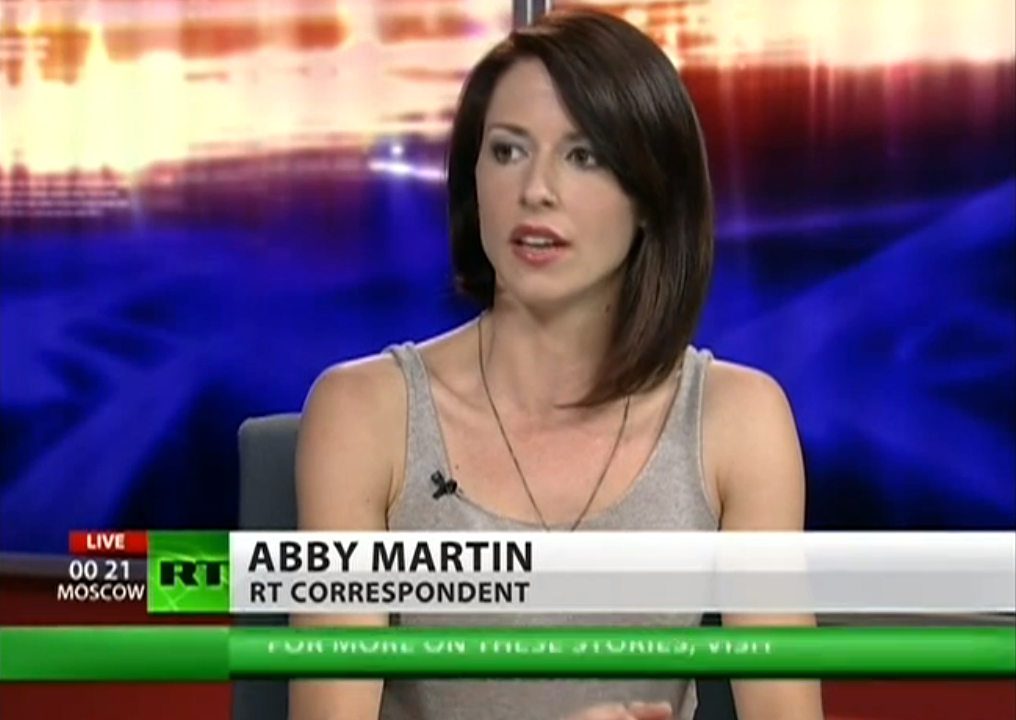
State Department Discusses Banning Alternative Media Outlet

Abby_Martin_RT_correspondent

By Justin King

Source: AntiMedia.org

The US State Department has openly discussed shutting down RT, the Russian news network. Assistant Secretary of State Victoria Nuland was asked about the idea of shutting the company down at a meeting at the Brookings Institute. She said no, paying lip service to the Freedom of Speech, but citing RT’s limited reach as the real reason.

The incident goes to demonstrate exactly how much censorship exists in the United States. RT broadcasts a narrative that is undoubtedly pro-Russian. Now that the pro-Russian narrative is at odds with the Pro-US narrative, the government is willing to openly discuss simply shutting off American access to the network.

This isn’t the first time that RT was targeted by government officials. The Chair of the US Broadcasting Board of Governors equated RT to terrorist groups when he said:

“We are facing a number of challenges from entities like Russia Today which is out there pushing a point of view, the Islamic State in the Middle East and groups like Boko Haram.”

Why would such a question be asked of a State Department official to begin with? Because the US State Department is responsible for large portions of America’s propaganda efforts.

This is the United States of America. We are supposed to have a free press, but if you push a point of view contrary to the government’s, you’re likely to lose your broadcasting license. Regimes in the past held book burnings to remove unfavorable opinions from circulation. The US government doesn’t need to be so boorish. They simply remove the book from libraries or revoke the broadcasting license of the outlet that won’t read the government’s script.

Former CIA Official Lied in Boston Bombing Cover-Up

index

By Daniel Hopsicker

Source: MadCowNews

Former top CIA official Graham Fuller lied in a press interview about his former son-in-law, Ruslan Tsarni, the uncle of “The Brothers Tsarnaev,” Tamerlan, now dead, and Dzhokhar, soon to go on trial in Boston for allegedly planting a homemade pressure-cooker bomb packed with shrapnel near the finish line of the Boston Marathon. 

“A story on the Internet implying possible connections between Ruslan (Tsarni) and the Agency through me is absurd,” Fuller said in an Apr 27 2013 story headlined “Former CIA officer: ‘Absurd’ to link uncle of Boston suspects, Agency,” in Washington-D.C.-based Al-Monitor, which bills itself as the “Pulse of the Middle East.”

Fuller was responding to an exclusive report published here headlined “Was Boston Bombers ‘Uncle Ruslan’ with the CIA?”,which he and reporter Laura Rosen churlishly refused to credit, calling it merely a “story on the Internet” even as they labored to debunk it. Yet it was reported and re-published so widely in the aftermath of the Boston Marathon terror attack that Fuller felt compelled to respond.

Well,  compelled to respond may be a little strong. Still, respond he did, in an interview which marshalled arguments to indicate questioning whether Ruslan Tsarni’s connection with the CIA had been through his famous former father-in-law were not just an exercise in futility. They were absurd

Just to be clear, there is zero evidence to indicate either Uncle Ruslan Tsarni or the CIA hired the Tsarnaev Brothers to blow up Boston.  There is, however, abundant evidence that elements of the U.S. Government have been playing footsie with Chechen terrorists, presumably to divert Russia from committing the kind of rash Neo-Communist Gangster stuff they’d be doing already unless we’re very very  careful.

Here’s a troubling question: If it was blow-back from that campaign which blew up in Boston—throwing covert U.S. support at Chechen terrorists—do you think anyone in the U.S. Government is eager to let the American people in on that no-doubt classified-for-reasons-of-national-security secret?

Why, the very idea seems—to use Mr. Fuller’s word—absurd.

Uncle Ruslan meets ‘the boys’

In his interview, Graham Fuller admitted that a second bombshell disclosure in an exclusive Apr 26, 2013, report headlined Boston bombers’ uncle married daughter of top CIA official, also was true: The Tsarnaev Brothers’ uncle, Ruslan Tsarni, was his former son-in-law.

Tsarni was married to Graham Fuller’s daughter Samantha between 1994 and sometime near the dawn of the millenium, Fuller grudgingly admitted.  Still, he insisted,without explanation, that suggestions that law enforcement should be checking to see if Ruslan Tsarni had “hooked up” with the CIA through Fuller were “absurd.”

It was an odd assertion. At the very moment he was making it, investigators with the FBI—who remained convinced the Tsarnaev Brothers had outside help and support—were in an intensive manhunt to find foreign connections to the case.  Asking questions about links between Ruslan, the CIA, and the bombers would not be seen as out of bounds. Or would they?

Of course, statements by former top CIA officials should be taken with a large grain of salt. Double the salt allowance if the “former” official is still engaged in intrigue in Central Asia.

Hannibal crosses the Alps; Fuller fords his Rubicon

And that’s before discounting fstill further for being widely and infamously known as the man who convinced the Reagan Administration that it would be a neat idea to send a callow Marine Lt. Col. named Oliver North with a cake under one arm and some TOW missiles under the other to a meet-and-greet in Tehran with the Ayatollah.

But back to the body blows being thrown against the credibility of anyone with the temerity of reporting the obvious…

“Fuller retired from the agency almost a decade before the brief marriage,” sniffed Laura Rosen, the reporter  selected to give him a sympathetic hearing.

“I, of course, retired from CIA in 1987,” Fuller offered helpfully, suggesting his Agency past had receded into the far reaches of recorded history, a dimly-remembered time located somewhere just this side of Hannibal crossing the Alps.

If Fuller retired, moved to Florida, and taken up golf while decked out in the vibrant hues of lime-green and canary-yellow sweater-slack combinations favored in the Florida golfing fraternity, he might have a point.

That was not, alas, how Fuller chose to spend his dwindling years. Even today he keeps stirring the pot in Central Asia, a long-time player in what previous generations called the Great Game.

He’s a consultant at Rand Corp; and he’s written a prodigious number of books with Great-Game-y titles: “Turkey & the Arab Spring;” “The Arab Shia’a;” “The Future of Political Islam;” “Turkey’s Kurdish Question;” “The Geopolitics of Islam & the West. “

Kazakh-style crony capitalism, illustrated

Ruslan Tsarni’s former father-in-law isn’t his only link to the CIA. There’s also his decades-long work history, discovered in a press release from a dodgy oil-related company with no assets and a ridiculous name whose President had been somehow lured away from a life-long career with Halliburton.

It reveals that Tsarni had worked in Central Asia for the Agency for International Development (USAID)—a U.S. Government Agency often used for cover by the CIA, including a two-year stint in the former Soviet Republic of Kazakhstan during the “Wild West” days of the early 1990’s, when anything that wasn’t nailed down in that country was up for grabs.

At a time when vast natural resources and enormous fortunes were ‘in play’ during the economic free-for-all in the “Stans” after the collapse of the Soviet Union, 24-year old Ruslan Tsarni was already a ‘player.’

Ruslan Tsarni is once again working (since 2010) working for USAID. Oddly enough, Russia, the country competing with the US for influence in the region, unceremoniously kicked USAID out of the country just months before the Boston Bombing terror attack, for, according to a Putin spokesmen, encouraging his political opposition.

Ruslan Tsarni & the Congress of Chechen International Organizations

In his interview with Laura Rosen, Fuller uncorked a whopper. Said Fuller,“Like all Chechens, Ruslan was very concerned about his native land, but I saw no particular involvement in politics [although] he did try to contact other Chechens around.”

Perhaps Fuller felt that no one would notice. Perhaps he felt immune to fact-checking, a sentiment common among Reagan-era CIA officials. But whatever his motivation, he has been caught in a provable lie.  Ruslan Tsarni, as Fuller well knows, has been up to his neck in Central Asian political intrigue for decades. 

On August 17,1995, while Ruslan Tsarni and Graham Fuller’s daughter Samantha were still virtual newlyweds, Tsarni incorporated a company in Maryland called the “Congress of Chechen International Organizations.” 

Ruslan Tsarni was listed as the company’s resident agent. The group sent aid to Islamic terrorists in Chechnya, including thousands of pairs of combat boots, coordinating its efforts with another so-called “charity,” Benevolence International, designated “financiers of terrorism” by the Treasury Department before being shut down by US Attorney Patrick Fitzgerald.

The company’s listed address, 11114 Whisperwood Ln. Rockville MD., was the home address of former top CIA official s Graham Fuller.

Today, the home remains listed in his wife’s name.

“An impromptu press conference aired live on network television”

With worldwide attention on the upcoming trial of Boston Marathon bombing suspect Dzhokhar Tsarnaev, what facts could possibly be being deliberately de-selected and hidden from view?

In “Long Mile Home” a book about the Boston Marathon Bombing by two Boston Globe reporters,  everything they have to say about Ruslan Tsarni isn’t much:

“On the Friday morning after Tamerlan was  killed, with police still hunting for Dzhokhar, investigators and reporters found their uncle, Ruslan Tsarni, a corporate attorney living outside Washington D.C.

When he emerged after speaking to FBI agents inside his home, he walked up to television cameras and reporters gathered outside looking for the latest in what had become the biggest story in the world. In an impromptu press conference aired live on network television, Tsarni offered condolences to the bombing victims, denounced his nephews, and ordered Dzhokhar to turn himself in.

Asked to explain what provoked the brothers to attack, Tsarni said, “Being losers. Hatred for those who were able to settles themselves. These are the only reasons I can imagine. Anything else—anything to do with religion, with Islam –that’s a fraud. It’s a fake.”

Asked how he felt about the United States, Tsarni said, “I respect this country. I love this country.”

An opinion writer for the Washington Post called his words “inspiring,” and said his press conference was “a moment we all needed.”

The New Yorker said he “looked like he might hunt his nephew down himself.”

That’s it. That’s everything they wrote about Ruslan Tsarni. Nothing about his work overseas for USAID. Nothing about being the former son-in-law of a top CIA official, or about running an organization out of his house that was sending aid to Chechen terrorists. Most of all nothing about his being—at the same time he was calling his nephews “losers”— a guy involved, according to the London Telegraph, in the biggest bank fraud in history.

By anyone’s standards, that’s a lot not to report. The authors must be proud.

“Uncle” Ruslan Tsarni is the elephant in the living room

“News,” someone once wrote, “is selection.”

And selection is always  based on an ideology and an agenda. Just something to remember the next time you’re reading, or watching, the ‘news.’

As jury selection proceeds in Boston in the upcoming trial of Dzhokhar Tsarnaev, the most pressing question about the attack remains one which is so obvious even Time Magazine is asking it: Did They Really Act On Their Own? 

The logical place to start would be with Uncle Ruslan, who’s been married to the daughter of a former top CIA official who remains a”player” in Central Asia’s Great Game.  But, of course, it ain’t gonna happen.

Whether by accident or design, Ruslan Tsarni played the same role in the aftermath of the Boston terror attack played after the 9/11 terror attack by Rudi Dekkers,  manager of Mohamed Atta’s flight school in Venice. And just like Rudi Dekkers before him, his pronouncements were received uncritically.

The mainstream media fawned all over him. He was soon being called “Uncle Ruslan. He  became the primary go-to source on the suspects, peddling his brief about the perfidy and all-around loser nature of his two nephews, one of whom, who he’d helped raise and bring to America, had just been killed in a hail of gunfire with police.

There were no tears for Uncle Ruslan. He was “protected,” and no doubt glad for it.

When Graham Fuller fibbed about Ruslan’s political activities, was it out of personal loyalty, or in support of a larger operation which had Ruslan Tsarni leading every 24-hour news cycle for more than a week during the biggest story of the year? Is there anyone in America who still thinks this happens by accident?

What does this say about the CIA’s ability to mold news coverage of a major event?

Already a valuable asset, Uncle Ruslan hadn’t even executed his most valuable task yet. Tsarni would soon be single-handedly responsible for leading the entire mainstream media of the Western World on a two-week long wild goose chase. Like a Pied Piper for the electronic age, he led the world away from whoever had actually punched the Tsarnaev Brothers ticket to jihad, towards something that didn’t even exist, “a chubby red-haired Armenian Muslim exorcist named Misha.”

More on this in our next story.

Uncle Ruslan’s  network for “international corruption”

When he was pontificating daily on live network television, why had no one thought to ask him about his contemporaneous  involvement in what London newspapers had begun calling “the biggest bank fraud in history?”

That’s the other side, the well-connected oil executive-side, of Ruslan Tsarni, that remains hidden. When one reporter had the bad manners to ask him what he did, Tsarni got touchy, and would say only, “I work for a living.”

End-of-story,CIA-style.

Tsarni is implicated in an international criminal investigation that oddly enough also involves another name currently in the news: Britain’s Prince Andrew, who sold his run-down estate to a Kazakh billionaire banker-turned-fugitive looking for asylum in London who paid Andrew $10 million more than it was worth.

Before he left Almaty for a more exciting life in London, the banker, with Tsarni’s help, had made off with a cool six billion dollars. Six billion. With a “B.”

More on this in our next story too.

When Graham Fuller was caught lying, it confirmed growing suspicions that huge chunks of the truth about the Boston Marathon Bombing—the biggest act of terrorism in America since the 9/11 attack— are deliberately being hidden from view.

In truth, news that another cover-up is underway comes as no great surprise. What is surprising is how much of cover-up, both in the 9/11 and the Boston Marathon terror attacks, was first identified here, in The MadCow Morning News, whose very name points out the surrealistic absurdity of contemporary American journalism.

Novelist Thomas Pynchon put it best: “If they can get you to ask the wrong questions, they don’t have to worry about the answers.”