
A Structural Reevaluation of the Collapse of World Trade Center 7 (Executive Summary)

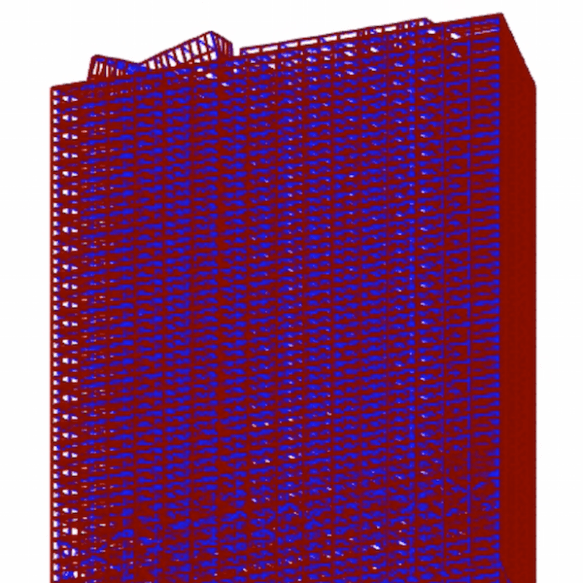
Figure 1 Finite element model of WTC 7 in SAP2000.

By Lead Researcher: J. Leroy Hulsey, Project Team: Feng Xiao (Associate Professor, Nanjing University of Science and Technology), Zhili Quan (Bridge Engineer, South Carolina Department of Transportation)

Source: Institute of Norther Engineering

This report presents the findings and conclusions of a four-year study of the collapse of World Trade Center Building 7 (WTC 7) — a 47-story building that suffered a total collapse at 5:20 PM on September 11, 2001, following the horrible events of that morning. This study was conducted by a three-person team of researchers at the University of Alaska Fairbanks (UAF) Department of Civil and Environmental Engineering with funding provided by Architects & Engineers for 9/11 Truth, Inc., a 501(c)(3) nonprofit organization whose purpose is to conduct research and educate the public about the World Trade Center building collapses on 9/11.

According to the National Institute of Standards and Technology (NIST) — an agency of the U.S. Department of Commerce that investigated the three building failures on 9/11 — the collapse of WTC 7 was the first known instance of the total collapse of a tall building primarily due to fires. However, many independent researchers have studied the collapse of WTC 7 and assembled a body of evidence that raises questions about the validity of NIST’s conclusions.

The objective of this study, therefore, was threefold: (1) Examine the structural response of WTC 7 to fire loads that may have occurred on September 11, 2001; (2) Rule out scenarios that could not have caused the observed collapse; and (3) Identify types of failures and their locations that may have caused the total collapse to occur as observed.

The UAF research team utilized three approaches for examining the structural response of WTC 7 to the conditions that may have occurred on September 11, 2001. First, we simulated the local structural response to fire loading that may have occurred below Floor 13, where most of the fires in WTC 7 are reported to have occurred. Second, we supplemented our own simulation by examining the collapse initiation hypothesis developed by NIST. We also reviewed the collapse initiation hypotheses advanced by private engineering firms whose studies were commissioned as part of litigation related to the collapse of WTC 7. Third, we simulated a number of scenarios within the overall structural system in order to determine what types of local failures and their locations may have caused the total collapse to occur as observed.

Fire Did Not Cause the Collapse of WTC 7

The principal conclusion of our study is that fire did not cause the collapse of WTC 7 on 9/11, contrary to the conclusions of NIST and private engineering firms that studied the collapse.

This conclusion is based upon a number of findings from our different analyses. Together, they show that fires could not have caused weakening or displacement of structural members capable of initiating any of the hypothetical local failures alleged to have triggered the total collapse of the building, nor could any local failures, even if they had occurred, have triggered a sequence of failures that would have resulted in the observed total collapse.

Near-Simultaneous Failure of Every Column Explains the Collapse

The secondary conclusion of our study is that the collapse of WTC 7 was a global failure involving the near-simultaneous failure of every column in the building.

This conclusion is based primarily upon the finding that the simultaneous failure of all core columns over 8 stories followed 1.3 seconds later by the simultaneous failure of all exterior columns over 8 stories produces almost exactly the behavior observed in videos of the collapse, whereas no other sequence of failures that we simulated produced the observed behavior. We cannot completely rule out the possibility that an alternative scenario may have caused the observed collapse; however, the near-simultaneous failure of every column is the only scenario we identified that was capable of producing the observed behavior.

Key Findings Upon Which the UAF Team’s Conclusions Are Based

Approach 1 Findings

•During our nonlinear connection study (Section 2.1.3.2), we discovered that NIST over-estimated the rigidity of the outside frame by not modeling its connections, essentially treating the exterior steel framing as thermally fixed, which caused all thermally-induced floor expansion to move away from the exterior. The exterior steel framing was actually flexible, while the stiffest area resistant to thermal movements, i.e., the point of zero thermal movement, was near the elevator shafts.

•Therefore, during our analysis of WTC 7’s response to fire loading (Section 2.6), we found the overall thermal movements at the A2001 base plate support near Column 79 were not sufficient to displace girder A2001 to the point that it walked off its seat (the initiating failure alleged by NIST). Whereas NIST asserted that the differential westward displacement of girder A2001 relative to Column 79 was 5.5 inches and later revised its calculation to 6.25 inches, we found that the westward displacement of girder A2001 relative to Column 79 would have been less than 1 inch under the fire conditions reported by NIST.

Approach 2 Findings

Under our second approach, we used a solid element model to evaluate the validity of NIST’s collapse initiation hypothesis, introducing a number of assumptions made by NIST that we considered to be invalid or, at best, questionable (Section 3.1). These assumptions included assuming the east exterior wall to be rigid and thermally fixed, assuming shear studs on several beams were broken due to differential thermal movement, assuming no shear studs were installed on girder A2001, and assuming that the bolts fastening girder A2001 to its seats at Columns 44 and 79 were broken (Section 3.1.1). Allowing for these overly generous assumptions, we found the following:

•When girder A2001 is heated to the temperatures assumed by NIST, it expands such that it becomes trapped behind the side plate on the western side of Column 79 as it is pushed to the west by thermally expanding floor beams. This prevents the girder’s web from traveling beyond the bearing seat, thus preventing the girder from walking off its seat (Section 3.2.1).

•NIST, by its own admission, did not include the partial height web stiffeners known to be on girder A2001. In addition to stiffening the web, these stiffeners significantly increase the bending resistance of the flange. In a subsequent analysis where we removed the side plate described in the previous analysis in order to allow for further westward travel of girder A2001, we found that the stresses in the girder flange and stiffener would not be sufficient to cause the flange to fail, thus preventing the girder from walking off its seat (Section 3.2.2).

•In a preliminary collapse initiation hypothesis, NIST posited that beam G3005 buckled because its thermal expansion was restrained by girder A2001. We found that this can happen only when the three lateral support beams S3007, G3007, and K3007 spanning from beam G3005 to the north exterior wall are not included in the model. While these short beams are observed in some of the figures in the NIST report, they are missing from the model(s) used in the thermal and structural analysis shown in the report (Section 3.2.3).

Separate from the NIST investigation, two studies of WTC 7’s collapse were commissioned by opposing sides in the lawsuit “Aegis Insurance Services, Inc. v. 7 World Trade Center Company, L.P.” Experts working in connection with engineering firms Ove Arup & Partners (Arup) and Guy Nordenson and Associates (Nordenson) were retained by the plaintiffs. The engineering firm Weidlinger Associates Inc. (Weidlinger) was retained by the defendants. After evaluating NIST’s collapse initiation hypothesis, we reviewed the Arup, Nordenson, and Weidlinger reports and found the following:

•Arup’s finite element analysis corroborates our finding that girder A2001 would become trapped behind the western side plate of Column 79. However, Arup’s analysis then goes on to contend that the five beams to the east of girder A2001 were heated enough to sag and pull the girder to the east and off of its seats. Putting aside whether this initiating mechanism is valid, we found that Nordenson incorrectly calculated the impact force of the falling girder by considering it as a point load, thus implying an infinite stiffness and no deflection. Calculating the impact force correctly, we found that it is only 34% of the 632,000 lb. force required to shear the girder bearing seat support welds at Floor 12. Therefore, the northeast corner of Floor 12 would not have collapsed if the Floor 13 girder came off its seat at Column 79, and a cascade of floor failures would not ensue.

•The Weidlinger report was prepared as a rebuttal to the Arup and Nordenson reports. Among its points of rebuttal, it corroborates our finding that the falling Floor 13 beam and girder assembly could not break through Floor 12. The Weidlinger report contends instead that Floors 9 and 10 were simultaneously heated to between 750° and 800°C in the exact same area of each floor, eventually causing those floors to fail and triggering a cascade of floor failures down to Floor 5. However, the details of the thermal analysis are not shown in the Weidlinger report, and the thermal analysis has not been made public. It is important to understand that steel structural members reaching temperatures of 750°C due to office fires can be considered extraordinary. Without any analysis provided to substantiate such temperatures, Weidlinger’s collapse initiation hypothesis must be viewed skeptically and can be assumed to have a very low probability of occurrence (Section 3.4.1).

Approach 3 Findings

Under our third approach, we simulated a number of hypothetical scenarios in order to determine what types of local failures and their locations may have caused the total collapse to occur as observed. Based upon a series of analyses, we found the following:

•Columns 79, 80, and 81 did not fail at the lower floors of the building, as asserted by NIST. In order to allow for the observed collapse of the east penthouse approximately 7 seconds prior to the collapse of the rest of the structure, these columns needed to have failed at the upper floors of the building all the way to the penthouse. Yet there were no documented fires above Floor 30. Therefore, fire did not cause the collapse of Columns 79, 80, and 81 nor the collapse of the east penthouse (Section 4.3).

•The hypothetical failure of Columns 79, 80, and 81 — the three easternmost core columns — would not trigger a horizontal progression of core column failures. Therefore, the hypotheses of NIST, Arup/Nordenson, and Weidlinger that the buckling of Column 79 could trigger a progressive collapse of the entire building are invalid, and the collapse of Columns 79, 80, and 81 high in the building was a separate and distinct event (Section 4.4). •Even if we assume the failure of Columns 79, 80, and 81 could lead to the failure of the next row of core columns, the hypothetical failure of Columns 76 to 81 would overload the exterior columns around the southeast of the building, rather than overloading the next row of core columns to the west, which would result in the building tipping to the southeast and not in a straight-down collapse (Section 4.4).

•The hypothetical simultaneous failure of all core columns (but not exterior columns) would cause the building to tip to the southwest rather than causing a straight-down collapse (Section 4.5).

•The simultaneous failure of all core columns over 8 stories followed 1.3 seconds later by the simultaneous failure of all exterior columns over 8 stories produces almost exactly the behavior observed in videos of the collapse. The collapse could have started at Floor 16 and below and produced the same behavior (Section 4.6).

It is our conclusion based upon these findings that the collapse of WTC 7 was a global failure involving the near-simultaneous failure of all columns in the building and not a progressive collapse involving the sequential failure of columns throughout the building.


Read the entire document here: http://ine.uaf.edu/media/222439/uaf_wtc7_draft_report_09-03-2019.pdf

Related videos and follow-up can be found at Architects & Engineers for 9/11 Truth: https://www.ae911truth.org/wtc7

Me, Me, Me – The Neurotic Satisfactions of the Selfie Generation

By Julian Rose

Source: Waking Times

We humans are rather curious creatures, I’ll admit. So many sides to our nature, so many colours to our emotions, so many journeys of our imaginations. But the question must arise, do we learn any more about these traits by making ourselves the perpetual object of our own fascination?

One would certainly assume so based upon the cult of the ‘selfie’ which rages around the world at this particular juncture of human evolution. I am tempted to say ‘devolution’, but going backwards would at least stand the chance of putting us in touch with something tangible, earthy even – whereas to live life as a virtual reality experience with one’s own photographic image as the central point of attraction – fails to provoke my sense of admiration for the human race.

The cult of the selfie has gone so far that reports are now emerging that addicts often put themselves in positions of real danger in order to get the perfect shot. A number have already died as a result of the dare-devil approach to getting the perfect selfie.

If I was to take a relaxed and laid-back view of all this, I might say, “OK, sure, we all need to get our kicks in some form or other, just let it be – let people have fun with their cameras on poles; apart from the excesses we hear about it’s pretty harmless fun isn’t it?”

It would be simple enough to go along with such a prognosis were it not for the fact that the whole thing is surely telling us something more than just what the crazy craze of the moment is. It is telling us something quite profound about an advanced preoccupation with superficiality per se. A kind of ego flattering sport whose popularity has presently reached the point of pandemic.

Is this just a kick-back against a sense of loneliness and sense of insignificance in a world that appears indifferent to the fate of the individual? Is it a wish to be noticed in an age of hyper inflated promotion of the engineered stars of stage, screen, video, social media et al? A range of elevated self-importance that runs from TV chef to porn star to political poser?

Whatever the cause, its ubiquitous nature is undeniable and has added yet more techno baggage to the 21st century tourist’s arsenal of seemingly indispensable smart gizmos. If one isn’t squinting into the illuminated screen of a smart phone while walking through a beautiful landscape, one is posing against the same background smiling cheesily for a selfie. While a discourse with nature herself, the source of all our deepest and most practical needs, is shunned. Left out of the picture, except to the extent that she forms the backdrop to the vanity inflated self.

Here lies a clue to this infliction. Modern day living has contrived to be a virtual reality form of existence, one which has alienated human beings from their roots. The ability to find a deep appreciation for beauty, quiet and the actual power of landscape has been smothered by an electro-smog of self satisfying surface pursuits; the sum total of which have formed a veritable barrier against true instincts, perceptions and genuinely life satisfying experiences.

This is a dangerous state of affairs, because we need these qualities to be at the forefront of our daily lives in order to gain/regain a true sense of equilibrium and balance. To find in ourselves that which gives us the courage and vision we need to negotiate and ultimately to vanquish the miasma of deceptions, twisted truths and outright lies legion at this time.

Those who feel the necessity to surround themselves with stimulants for the nourishment of their superficial selves cannot resist slavery to the controlling powers that be. Cannot resist becoming pawns to the carefully planned sales promotions that make such people feel they ‘must have’ the latest, most advance, most essential addition to the range. It is an addiction which includes uncritical acceptance of the disinformation that forms the great majority of what appears on mainstream television, newspapers, glossy journals and all channels of communication that maintain a wall of conscious-blocking visual and printed fake news and views 24/7.

It’s only a small step from here to open armed acceptance of life in a ‘Smart City’. A life where electromagnetic microwaves come with the very air you breathe. No choice. A place where ‘being monitored’ and ‘monitoring’ form a framework around the chief activities of the day – and no doubt night. A place designed and built for technology addicts, one might surmise. But actually a sinister prison camp for the imposition of a cyborgian programme of control.

It’s a place where no trees will be present because they interrupt the 5G signals which are the controlling motor of everything that happens in this arid world of concrete, glass and microwave radiation. Woe betide you if you should lose your personal chip which gives access to everything you need including your own self autonomous self driving car and the ability to unlock the front door of your home. In a smart city, should you lose or destroy your chip, permission will have to be sought from Big Brother to get back into your house, turn on the lights and open the refrigerator.

The ‘internet of everything’ which is to be the techno-hub of the 5G Smart City, ensures citizens cannot act outside the authority of the centralised computer master control.

Orwellian fantasy? No, already existing reality in its first stages.

But all this will, I presume be a source of frisson to those who willingly accept a fate controlled by anyone other than themselves. Who find such a techno-psychotic existence a direct extension of their fascination with all that comes under the word ‘superficial’. And that brings us full circle back to the exponents of narcissistic selfies, who roam the world camera triggered extension pods so as to photograph themselves against exotic backgrounds and famous works of architecture as though they were just empty cut-outs for a theatre set. After all, for selfie exponents, the only thing of real importance is themselves.

It is a remarkable seductive trait that leads to the entrapment of the spirit and soul of man. The master stroke in all this is that it all appears to be oh so normal – and those who do not conform are regarded with incredulity and relegated to the old pastures rare breeds museum for special research into their strange individualistic traits.

The rare breeds, however, turn out to have strong genes and resistant immune systems. They never abandoned nature in favour of the arid virtual 5G powered smartscape. Instead they organised resistance and were supported by energies that were not recognised or understood by adherents of the smartscape.

They kept alive the torch of justice and truth and they grew in number in spite of the dystopian landscape around them. They retained the collective name ‘humanity’ and the warm feelings that underpin that name – the state we call ‘human’. And in the course of time, they came to nurture back to health the planet that nourished them and to rescue those drowning in the narcissistic electro- magnetic soup of their naive choosing. They heeded the cries of desperation of these prisoners – to find a way back out of their oh so ordinary self-imposed toxic prison. It was only the irredeemable selfie who never made it back to real life. The rest experienced the flowering of a self they never knew existed. An unselfish self.

How successfully this unselfish self had been kept at bay by the distractions and fakery of the now defunct soulless smartscapes of yesteryear. As has been noted many times over the millennia, the only real learning is learning by experience.

Our Vanishing World: Rainforests

By Robert J. Burrowes

Rainforests are a crucial feature of Earth’s biosphere. Apart from being critical to Earth’s climate and vital carbon sinks, the major player in Earth’s hydrological (water) cycle, a massive producer of oxygen and home to most of the world’s species, rainforests are the home of a large indigenous human population. They are also the source of many vital resources, including medicines, used by humans around the world.

However, the vast range of ecological services that rainforests have provided ongoingly for the 400 million years of their existence, and which have been critical to the survival of homo sapiens since we first walked the Earth 200,000 years ago, are not measured and valued by accountants and economists: Have you ever seen a balance sheet or set of national accounts that includes an entry for ‘Value of ecological services taken from nature and on which life and our entire production of goods and services depend’?

Because these services have been available without the need for human management or intervention, and given the primitive conception of accounting and economics that humans use, the ecological services of rainforests are given no monetary value. Hence, essential ecological services are treated as worthless by virtually everyone in the industrialized world. As a result, modern industrialized humans have decided to systematically destroy the rainforests in order to extract a vast amount of short-term profit for the benefit of a few and the temporary satisfaction of many. So if we do not value ecological services such as oxygen and water generation as well as climate and weather-moderating capacities, what is it that we do value by destroying rainforests?

A small proportion of rainforest is logged to provide attractive rainforest timbers – such as teak, mahogany, ebony and rosewood – for a variety of decorative purposes, including making furniture, which can last hundreds of years.

However, a much wider range and vastly greater quantity of rainforest trees are cut or burnt down for purposes such as the following: acquiring timbers used in construction, clearing land to establish cattle farms so that many people can eat cheap hamburgers, clearing land to establish palm oil plantations so that many people can eat processed (including junk) foods based on this oil, clearing land to establish palm oil and soy bean plantations so that some people can delude themselves that they are using a ‘green biofuel’ in their car (when, in fact, these fuels generate a far greater carbon footprint than fossil fuels), mining (much of it illegal) for a variety of minerals (such as gold, silver, copper, coltan, cassiterite and diamonds), and logging to produce woodchips so that some people can buy cheap paper, including cheap toilet paper.

In essence then: We trade the essential life-giving and sustainably-available ecological services of Earth’s rainforests, also home to indigenous peoples and countless wildlife, for hamburgers and other processed junk foods, carbon-intensive ‘biofuels’, paper and some building and furniture materials, as well as some minerals. Obviously, some humans are far from clever at ‘making deals’.

But if you think that is bad, consider this: ‘by one estimate, a hectare of livestock or soy is worth between $25 and $250, while the same hectare of sustainably managed forest can yield as much as $850’ harvesting, depending on the location, such products as medicinal plants, rubber, nuts and fruits while benefitting from a range of ecotourism services and research opportunities. See ‘Rainforest on Fire: On the Front Lines of Bolsonaro’s War on the Amazon, Brazil’s Forest Communities Fight Against Climate Catastrophe’. Of course, you have to know how to manage the forest sustainably to yield this much income but that sort of intelligence is rare and invariably escapes those focused on destruction for short-term profit.

So how bad is this rainforest destruction? Well, worldwide we are currently destroying rainforests for these unsustainable and mainly short-term products at the rate of 80,000 acres each day. See ‘Measuring the Daily Destruction of the World’s Rainforests’.

Moreover, beyond the devastating impact this has on indigenous peoples, forcing increasing numbers of them to leave their destroyed homes in the rainforest to try to survive elsewhere, this rainforest destruction is also the key driver of species extinctions globally with one million species of life on Earth threatened with extinction. As reported in the recent Global Assessment Report on Biodiversity and Ecosystem Services researched and published by the Intergovernmental Science-Policy Platform on Biodiversity and Ecosystem Services (IPBES) – the scientific body which assesses the state of biodiversity and the ecosystem services this provides to society – ‘Nature is declining globally at rates unprecedented in human history. The IPBES Global Assessment ranks, for the first time at this scale, the 5 direct drivers of change in nature with the largest global impact. So what are the culprits behind nature’s destruction?’ Number 1. on the IPBES list is ‘Changes in land and sea use, like turning intact tropical forests into agricultural land’.

Let me briefly illustrate the nature and extent of this destruction by discussing rainforests in just three locations (the Brazilian Amazon, the Democratic Republic of the Congo and Indonesia/West Papua) where the destruction of rainforest was greatest in 2018 – see ‘The World Lost a Belgium-sized Area of Primary Rainforests Last Year’ – and which are representative of elsewhere around the planet where even World Heritage listed areas are ongoingly under threat.

The Brazilian Amazon

While the Amazon in South America occurs in several countries, two-thirds of it lie within the borders of Brazil. Unfortunately, since his fraudulent election in 2018, the neofascist, corrupt and insane president Jair Bolsonaro – see the definition of sanity, which Bolsonaro does not come close to meeting, in ‘The Global Elite is Insane Revisited’ – has promptly eliminated years of painstaking effort by committed indigenous and environmental activists to convince previous governments to protect the Brazilian Amazon from the worst corporate and other depredations.

For just a taste of the documentation on Bolsonaro’s actions in accord with elite interests and to the detriment of indigenous and environmental well-being, see ‘Bolsonaro Caps Natives’ Lands, Pleasing Farmers in One of First Acts’, ‘Rainforest on Fire: On the Front Lines of Bolsonaro’s War on the Amazon, Brazil’s Forest Communities Fight Against Climate Catastrophe’, ‘Bolsonaro’s Clearcut Populism. “The Barbarism has Begun”’, this report from Amazon Watch: ‘Complicity in Destruction II: How northern consumers and financiers enable Bolsonaro’s assault on the Brazilian Amazon’ and ‘Amazon Deforestation Accelerating Towards Unrecoverable “Tipping Point”’.

The key drivers of rainforest destruction in the Amazon are soy production and cattle ranching. Brazilian soy accounted for 14.3% of the country’s total exports, generating $31.0 billion in 2017, while cattle exports accounted for about $5.4 billion. Because Brazil leads the world in exports of both of these commodities, it is the world market for these products that is driving these industries to aggressively expand activities to the detriment of the rainforest and indigenous peoples.

But the Amazon is huge, you might say: Does it matter if we destroy some of it for soy and cattle farming? Well, one recent study suggested that deforestation of 20–25% of the Amazon would be the tipping point beyond which it would cease to be a functioning rainforest ecosystem and this, as you might expect, would be catastrophic. Moreover, recent severe droughts appear to be ‘the first flickers of this ecological tipping point’ suggesting that it is already imminent. See ‘Amazon Tipping Point’.

So, to reiterate, the key driver of rainforest destruction in the Brazilian Amazon is consumer-generated demand for certain products in other parts of the world. And while the US and European countries play critical roles in destruction of the Amazon, China is the largest importer of agricultural products from Brazil so its government and consumers are complicit too. For example, as China’s demand for Brazilian soy surges due to the trade war between the United States and China, ‘it could drive further ecological catastrophe: 13 million hectares (50,000 square miles) in the Amazon and Cerrado could ultimately be cleared to meet this additional demand.’ See ‘Complicity in Destruction II: How northern consumers and financiers enable Bolsonaro’s assault on the Brazilian Amazon’.

The point then, is this: governments and ordinary people (in their role as consumers) in other parts of the world can play a vital role in defending the Amazon and its indigenous peoples – see, for example, Brazil’s Indigenous People Articulation – by choosing what they buy from Brazil. Boycotting rainforest timber, beef and soy bean products are powerful options to consider. But don’t forget, there is no point simply identifying and boycotting Brazilian timbers, beef and soy beans. If you want impact on the total market (to prevent one country’s timber, beef and soy beans being substituted for another’s), then you must boycott them all (unless you can clearly identify the source of the product as local and sustainable). Obviously, this takes commitment. The future of the Amazon depends largely on enough of us making that commitment.

The Democratic Republic of the Congo in Central Africa

The rainforests of the Congo Basin in central Africa are the second largest on Earth. Much of this rainforest lies within the borders of the Democratic Republic of the Congo, crippled by corrupt government for decades and a new president elected earlier this year who has inherited a corrupt and inefficient state apparatus. See ‘Democratic Republic of the Congo: Overview of corruption and anti-corruption’.

Unfortunately, therefore, rainforests in the Congo have long been under siege on several fronts. With rebel soldiers (such as the Rwanda-backed M23), miners and poachers endlessly plundering inadequately protected national parks and other wild places for their resources, illegal mining is rampant, over-fishing a chronic problem, illegal logging (and other destruction such as charcoal burning for cooking) of rainforests is completely out of control in some places, poaching of hippopotami, elephants, chimpanzees and okapi for ivory and bushmeat is unrelenting (often despite laws against hunting with guns), and wildlife trafficking of iconic species (including the increasingly rare mountain gorilla) simply beyond the concern of most people.

The Congolese natural environment – including the UNESCO World Heritage sites at Virunga National Park and the Okapi Wildlife Reserve, together with their park rangers – and the indigenous peoples such as the Mbuti (‘pygmies’) who live in them, are under siege. In addition to the ongoing mining, smaller corporations that can’t compete with the majors, such as Soco, want to explore and drill for oil. For a taste of the reading on all this, see ‘Virunga National Park Ranger Killed in DRC Ambush’, ‘The struggle to save the “Congolese unicorn”’, ‘Meet the First Female Rangers to Guard One of World’s Deadliest Parks’ and ‘The Battle for Africa’s Oldest National Park’.

Unfortunately too, as with rainforests elsewhere, ‘What Happens in the Congo Basin Doesn’t Stay in the Congo Basin’: it impacts on regions across Africa playing a part, for example, in recent droughts in Ethiopia and Somalia causing millions of people to depend on emergency food and water rations. See ‘Congo Basin Deforestation Threatens Food and Water Supplies Throughout Africa’.

As with the Amazon, you have some powerful options to consider if you want to save the Congolese rainforests and their indigenous peoples. Again, refusing to buy rainforest timbers, conflict minerals and wildlife products is a good start but remember that key minerals in your computer and mobile phone are illegally sourced from the Congo so your thoughtful consideration of minimizing how many of these devices you own can play a part too. For a fuller account of this exploitation and its destructive impact on the rainforests and its indigenous peoples, with references to many other sources, see ‘500 years is long enough! Human Depravity in the Congo’.

Indonesia and West Papua

Indonesia has the most extensive rainforest cover in Asia – and is home to hundreds of distinct indigenous languages and over 3,000 animal species including Sumatran tigers, pygmy elephants, rhinoceros and orangutans – but the forests are being systematically degraded and destroyed. Rainforest cover has steadily declined since the 1960s when 82 percent of the country was covered with forest; it is less than 50 percent today. The rainforest is being destroyed by logging, mining, large-scale agricultural plantations (especially for palm oil), colonization, and subsistence activities like shifting agriculture and cutting for fuelwood. Much of the remaining cover consists of logged-over and degraded forest although large areas, including of the island of Kalimantan/Borneo (shared with Malaysia and Brunei), have been stripped bare.

Logging for tropical timbers and pulpwood (to make paper) is the biggest cause of rainforest destruction in the country where as much as 75 percent of the logging is illegal. Indonesia is the world’s largest exporter of tropical timber, which generates more than $US5 billion annually. And more than 48 million hectares (55 percent of the country’s remaining rainforests) are concessioned for logging. Destruction of the rainforest in Indonesia has opened up some of the most remote places on Earth to development: as rainforests in less remote locations have been decimated, timber corporations have stepped up practices on the island of Kalimantan/Borneo and the occupied West Papau, where great swaths of forests have been cleared in recent years. In fact, 20 percent of Indonesia’s logging concessions are in West Papua, despite ongoing resistance by West Papuans.

Unfortunately, the fastest and cheapest way to clear rainforests for plantations is by burning. Hence, every year ‘hundreds of thousands of hectares go up in smoke as developers and agriculturalists feverishly light fires before monsoon rains begin to fall. In dry years – especially during strong el Niño years – these fires can burn out of control for months on end, creating deadly pollution that affects neighboring countries and causes political tempers to flare’. See Indonesian Rainforests’.

Mining operations, including for coal, also have a devastating impact on the rainforests and their peoples. See ‘New report exposes World Bank links to destructive coal mining in Indonesia’. By far the worst of these projects, however, is the gigantic gold, silver, and copper mine in occupied West Papua, run by Freeport-McMoRan. As widely documented, the mining company has dumped appalling amounts of waste into local streams, rendering downstream waterways and wetlands ‘unsuitable for aquatic life’. Relying on large payments to Indonesian police and military officers, the mining operation is ‘protected’; this has resulted in many West Papuans being killed.

The waste from the mine, estimated by Freeport at 700,000 tons each day, covers several square miles and Government surveys have found that tailings from the mines have produced levels of copper and sediment so high that almost all fish have disappeared from vast areas of wetlands downstream from the mine.

Like other powerful corporations in Indonesia (and elsewhere), Freeport-McMoRan is well aware that there is little official interest in its abuses of local people and the environment as long as corrupt officials are given sufficient incentive to ignore them. As elsewhere in many parts of the world, therefore, corporate access to resources includes serious human rights abuses and persistent conflicts between companies and local communities which is ignored by corrupt politicians. See Indonesian Rainforests’.

Apart from the rainforest itself and the millions of people who live in them, destruction of the rainforest threatens the habitat of iconic species like Sumatran tigers and orangutans, as well as many others, and plays a part in destroying the climate too.

But the damage does not stop with the issues noted above. Forests across the world are being destroyed to make fabrics for clothing we wear every day. Fabrics like rayon, viscose and modal are all made from trees and, every year, more than 120 million trees are cut down to make clothing. This is done by companies such as Forever 21, Under Armour, Foot Locker, Prada Group and Michael Kors. You can join the Rainforest Action Network in campaigning to get these laggard companies to adopt responsible sourcing policies for their forest-based fabrics. See ‘Does your clothing contain rainforest destruction?’

Bizarrely, while its incredible rainforests, along with its coral reefs and beaches, play a part in attracting tourists from across the world to see Indonesia’s charismatic native species – such as orangutans, Sumatran tigers, Komodo dragons, whale sharks, sea turtles and manta rays – and to experience its adventure and dive destinations, this tourism also contributes significantly to the destruction as rainforests make way for tourist facilities.

So, as with Brazil and the Congo, you can boycott rainforest products from Indonesia and other countries where rainforests are being destroyed. Along with suggestions made earlier, responsible choices about the clothing you wear and the tourist destinations you choose (or boycott) will all make a difference.

The ‘Big Picture’ Fight for the Rainforests: What can we do?

A great deal. Halting rainforest destruction might be a complex undertaking but it is imperative if we are to have any prospect of preserving life on Earth. So I hope that you will consider the many options I have offered above and those I mention now and do as many as you can, even if you are already working on other critical issues such as the climate and the struggle to end war and the threat of nuclear war.

If you want easy options, you can support the campaign efforts of organizations that defend rainforests, indigenous peoples and wildlife such as the Rainforest Action Network, the Rainforest Information Centre, the Rainforest 4 Foundation and Rainforest Rescue which work closely with indigenous and local communities while campaigning against the governments and corporations destroying rainforests, as well as the banks and insurance companies that support this destruction.

If you recognize the pervasiveness of the fear-driven violence in our world, which also drives the massive over-consumption of resources by people in industrialized countries – see ‘Love Denied: The Psychology of Materialism, Violence and War’ – then consider addressing this directly starting with yourself – see ‘Putting Feelings First’ – and by reviewing your relationship with children. See ‘My Promise to Children’ and ‘Nisteling: The Art of Deep Listening’.

If you want to understand and address the fundamental cause of violence in our world, see Why Violence? and Fearless Psychology and Fearful Psychology: Principles and Practice.

If you wish to campaign strategically in support of indigenous peoples and local communities in their struggles to halt the destruction of Earth’s rainforests. See Nonviolent Campaign Strategy.

The governments and corporations that profit from the destruction of the rainforests are deeply entrenched and not about to give way without strategically focused campaigns to make it untenable and unprofitable for them to do so. This will include convincing key personnel, whether company directors of corporations involved in rainforest destruction, cargo ship owners, trade unionists (in many industries) and the many other agents involved in the rainforest destruction-to-customer supply chain, as well as ordinary consumers of rainforest products, to make conscious choices about the products they supply, use and/or buy. So strategy is imperative if we are to get corrupt and/or conscienceless governments and corporations, as well as people further removed from the source of the destruction, to end their role in rainforest destruction before it is too late.

The big deforestation drivers are timber, palm oil, cattle and soy while mining, oil drilling, clothing and dam construction all play significant roles too, depending on the country. And, as reported by the CDP (formerly the Carbon Disclosure Project): ‘The ABCD (The Archer Daniels Midland Company [ADM], Bunge, Cargill and Louis Dreyfus Company) trader companies have a large impact on countless commodity supply chains. For example, they represent up to 90% of the global grain trade. With a wide array of clients that go from Nestlé to McDonald’s, their role in managing deforestation risk is crucial’ and, so far, grossly inadequate. See ‘Revenue at risk: Why addressing deforestation is critical to business success’ which contains a long list of hundreds of companies (on pages 39-46) which are making zero effective effort to end their rainforest-destroying business practices.

Given the strategic sophistication necessary to tackle this complex problem effectively, if you want to view a 15 minute video of (or read a couple of short articles about) the inspirational Melbourne Rainforest Action Group (MRAG) that successfully led a national campaign from 1988 to 1991 to halt imports of rainforest timber into Australia, you can view it here: ‘Time to Act’.

In those cases where corrupt elites control or occupy countries, such as those controlling Brazil, the Democratic Republic of the Congo and West Papua, it might be necessary to remove these corrupt governments as part of the effort – see Nonviolent Defense/Liberation Strategy – thus helping to restore the political space for local populations to defend rainforests and their rights.

You might also consider joining the global network of people resisting violence in all contexts by signing the online pledge of The Peoples Charter to Create a Nonviolent World.

But if you do nothing else while understanding the simple point that Earth’s biosphere, including its rainforests, cannot sustain a human population of this magnitude of whom more than half endlessly over-consume, then consider accelerated participation in the strategy outlined in The Flame Tree Project to Save Life on Earth.

Or, if none of the above options appeal or they seem too complicated, consider committing to:

The Earth Pledge

Out of love for the Earth and all of its creatures, and my respect for their needs, from this day onwards I pledge that: 

  1. I will listen deeply to children (see explanation above)
  2. I will not travel by plane
  3. I will not travel by car
  4. I will not eat meat and fish
  5. I will only eat organically/biodynamically grown food
  6. I will minimize the amount of fresh water I use, including by minimizing my ownership and use of electronic devices
  7. I will not buy rainforest timber
  8. I will not buy or use single-use plastic, such as bags, bottles, containers, cups and straws
  9. I will not use banks, superannuation (pension) funds or insurance companies that provide any service to corporations involved in fossil fuels, nuclear power and/or weapons
  10. I will not accept employment from, or invest in, any organization that supports or participates in the exploitation of fellow human beings or profits from killing and/or destruction of the biosphere
  11. I will not get news from the corporate media (mainstream newspapers, television, radio, Google, Facebook, Twitter…)
  12. I will make the effort to learn a skill, such as food gardening or sewing, that makes me more self-reliant
  13. I will gently encourage my family and friends to consider signing this pledge.

Feeling overwhelmed? Still prefer something simpler?

I wish I could, in all sincerity, offer you that option. If it were still 1990, I would. But the time for simple actions to make a difference is long past and time is now incredibly short. See ‘Human Extinction by 2026? A Last Ditch Strategy to Fight for Human Survival’.

In essence, you have a choice: understand and act on the crucial importance of rainforests before we destroy their integrity and lose them completely. Or help to accelerate the human rush to extinction as a consequence of failing to do so.


Biodata: Robert J. Burrowes has a lifetime commitment to understanding and ending human violence. He has done extensive research since 1966 in an effort to understand why human beings are violent and has been a nonviolent activist since 1981. He is the author of Why Violence? His email address is flametree@riseup.net and his website is here.


WHY WE’RE A CULTURE OF ADDICTS

By Leslie Garrett

Source: Waking Times

If there’s one constant among addicts of all types, it’s shame. It’s what makes us lie and hide. It’s what keeps us from asking for help – though we don’t think we need it because we’re also good at lying to ourselves.

About why we eat. Or shop. Or gamble. Or drink.

Dr. Gabor Maté knows the feeling well. Maté, a renowned doctor, speaker, and author, has seen it in the heroin-addicted men and women he treats in Vancouver’s Downtown Eastside. He sees it in the behavior of well-respected workaholics. The cosmetic surgery junkies. The power seekers. The ‘I Brake for Garage Sales’ shoppers.

He’s seen it in the mirror.

Maté, author of the groundbreaking book In the Realm of the Hungry Ghosts: Close Encounters with Addiction, believes shame is behind our unwindable ‘war on drugs.’ Our ‘tough on crime’ policies. Our judgment of addicts. Our marginalization of street junkies.

Maté knows, as so many of our spiritual teachers have tried to teach us, that our judgments of others are really all about us.

Maté, who serves as resident doctor at The Portland Hotel, a Vancouver housing project for adults coping with mental illness, addiction, and other challenges, saw himself in the stories of the women and men who, day after day, came to see him for treatment and who slowly, over years, revealed to him their pain.

Those of us still hiding and denying? Gabor Maté sees us too.

Haunted

Gabor Maté was born into the Jewish ghetto of Budapest in 1944, just weeks before the Nazis seized Hungary, to a loving but overwhelmed mother and an absent father, who had been sent to a forced-labor camp. Just months later, his grandparents were killed at Auschwitz. At a year old, he was handed by his mother to a gentile stranger who was assigned his safety.

Maté understands now that those early experiences – or, more accurately, his mother’s frantic state of mind – guided the neural circuitry in his still-developing brain. Impaired circuitry that virtually prescribed a future of addiction and its close cousin, attention-deficit disorder (ADD).

Over years of hearing the stories of street drug users, examining his own past, and putting it together with his medical training, Maté became convinced that – as he says in a recent interview:

both addiction and ADD are rooted in childhood loss and trauma.

It’s a novel – and surprisingly controversial – approach, examining not the addiction but the pain behind it. Fighting not the substance but the circumstances that lead someone to seek out that self-soothing.

Circumstance Over Substance

Addiction, says Maté, is nothing more than an attempt to self-medicate emotional pain.

Absolutely anything can become an addiction… It’s not the external behaviors, it’s our relationship to it.

Maté calls addicts ‘hungry ghosts,’ a reference to one of the six realms of the Buddhist Circle of Life. These hungry ghosts are depicted with large empty bellies, small mouths, thin necks — starving for external satisfaction, seeking to fill but never being full, desperate to be soothed.

We all know that realm, he says, at least some of the time. The only difference between the identified addict and the rest of us is a matter of degrees.

It’s a view that has earned him some critics, not least of which is the Canadian Conservative government, which has sought to shut down the safe-injection site he helps oversee. The conventional medical community certainly hasn’t embraced his ideas. Addiction is typically viewed through one of two lenses: as a genetic component or as a moral failure.

Both, says Maté, are wrong.

And he says he’s got the brain science to prove it.

“A Warm, Soft Hug”

Maté points to a host of studies that clearly show how neural circuitry is developed in early childhood. Human babies, more than any other mammals, do most of their maturing outside the womb, which means that their environment plays a larger role in brain development than in any other species.

Factor in an abusive, or at least stressful, childhood environment and you’ve produced impaired brain circuitry – a brain that seeks the feel-good endorphins and stimulating dopamine that it is unable, or poorly able, to produce on its own. A brain that experiences the first rush of heroin as a “warm, soft hug,” as a 27-year-old sex trade worker described it to Maté.

It’s the adversity that creates this impaired development, says Maté, not the genetics emphasized by the medical community.

And our response to addicts – criminalization, marginalization, ostracism – piles on that adversity, fueling the addictive behavior.

The good news is that addiction can be prevented, but only if you start early. Maté writes in Hungry Ghosts:

[Prevention] needs to begin in the crib, and even before then… in the social recognition that nothing is more important for the future of our culture than the way children develop.

What about those children who are now addicted adults? Unprecedented brain research has revealed that brains can, essentially, be rewired. He continues:

Our brains are resilient organs… Some important circuits continue to develop throughout our entire lives, and they may do so even in the case of a hard-core drug addict whose brain ‘never had a chance’ in childhood.

What’s more, Maté, unlike many of his medical counterparts, factors in our potential for recovery, even transformation:

something else in us and about us: it is called by many names, ‘spirit’ being the most democratic and least denominational.

The Illusion of Choice

We’d like to think that addicts have a choice, that they can just choose to stop — even if it’s hard.

But Maté insists that the ability to choose is limited by the addict’s physiology and personal history. He states:

The more you’re driven by unconscious mechanisms, because of earlier defensive reaction to trauma, the less choice you actually have… Most people have much less choice in things than we actually recognize.

These unconscious impulses are why we find ourselves with our hands in a bag of chocolate after an argument with our spouse. It’s why we’re on Craigslist arranging a sexual encounter while our wife sleeps beside us. It’s why a respected medical doctor finds himself lying to his wife. Again.

“‘Have you been obsessing and buying?’ she’s asked me a number of times in the past few weeks,” Maté writes in Hungry Ghosts. “I look directly at my life partner of thirty-nine years and I lie. I tell myself I don’t want to hurt her. Nonsense. I fear losing her affection. I don’t want to look bad in her eyes. I’m afraid of her anger. That’s what I don’t want.”

For years, Maté struggled with a shopping addiction, spending thousands of dollars on classical music CDs in a single spree, then unable to resist the impulse to do it again weeks later after promising his wife he’d stop. It’s an addiction he refers to as wearing ‘dainty white gloves’ compared to the grinding drug abuse of his Downtown Eastside patients.

But, he writes, “I’ve come to see addiction not as a discrete, solid entity – a case of either you’ve got it or you don’t got it – but as a subtle and extensive continuum.”

Unless we become fully aware of the drivers of our addiction, he says, we’ll continue to live a life in which ‘choice’ is an illusion.

“Passion Creates, Addiction Consumes”

Is there a difference between a drug addiction and being hooked on a behavior — like sex? The medical community continues to debate the question, but Maté is adamant.

All addictions, whether to drugs or to behaviors such as compulsive sexual acting out, involve the same brain circuits, the same brain chemicals and evoke the same emotional dynamics… Behavior addictions trigger substances internally. So (behavior addicts) are substance addicts.

Where do we draw the line between addiction and, well, passion? What about the Steve Jobs of the world, who drive themselves — and others — to push harder, work longer, produce more and do everything better?

Daniel Maté, Gabor’s son and an editor of his books, says:

A lot of people make wonderful contributions to the world at their own cost… We often lionize unhealthy things.

To determine whether we’re serving a passion or feeding an addiction, Daniel Maté suggests that it comes down to a simple question, answered honestly: Are you free or are you not free?

His father takes it further.

What function is the addiction performing in your life? What questions is it answering . . . and how do we restore that?

Or, as he writes in Hungry Ghosts, “Passion creates, addiction consumes.”

Compassion for the Addict — and Ourselves

Responding to addiction requires us not only to care for the body and mind but also the soul, Maté says. The spiritual element of his practice is critical, he says, not only to understand the hard-core street addict but also our own struggle.

We lack compassion for the addict precisely because we are addicted ourselves in ways we don’t want to accept and because we lack self-compassion. – Gabor Maté

And so we treat the addict as an ‘other’ – this criminal, this person making poor choices – to whom we can feel superior.

Compassion is understanding, and to understand is to forgive.

We need, he says, to turn compassion into policy.

Maté summed it up nicely in a 2010 talk at Reed College:

To . . . point the finger at that street-corner drug addict who’s in that position because of that early trauma is blind to say the very least… I think that if we developed a more compassionate view of addiction and a more deep understanding of the addict and if we recognized the similarities between the ostracized addict at the social periphery and the rest of society, and if we did so with compassion both for them and for the rest of us, we would not only have more efficient, more successful drug treatment programs, we would also have a better society.

Embodied Spirituality: The Truth Shall Set You Free

By Jack Adam Weber

Source: Collective Evolution

For myself, spirituality means aligning with what is true, or most likely true. This means looking at what is true through the lens of my unique experience and self-reflection (subjectively) and what is true in the world (objectively).

Living in accord with what’s true means I have to confront lots of things that are tough to stomach and that I’d prefer weren’t true. I practice resiliency by enduring this discovery process. It takes courage, humility, sensitivity, insight, intellectual rigor, emotional intelligence, and flexibility—in essence, all of me.

Why does it require all of me to be honest?

Because we humans have evolved to stick to our beliefs, even though many of them are false. We, in fact, experience a dopamine rush (a feel-good neurotransmitter in our brains) when we affirm our beliefs, even if they are wrong. So, confronting false beliefs about myself and the world means I have to endure some degree of feeling badly, some emotional turmoil, cognitive dissonance, and reorientation of my world. When I challenge many of my false beliefs, I encounter nothing short of transformation on all levels. Sounds like a bona fide spiritual path to me.

The Power of (False) Belief

This being human is a guesthouse,
Every morning a new arrival.
A joy, a depression, a meanness,
some momentary awareness comes
as an unexpected visitor.

—Rumi

When we don’t align with what’s true about ourselves, interpersonally, and in the world, we develop false beliefs. And we like to assert these false beliefs. Using evidence and acknowledging reality can help us let go of our false beliefs. We receive this information subjectively through self-reflection and what others share with us (which we also need to sort through for false projections). We receive true information about objective reality by direct observation and through evidence.

Ascertaining inconvenient truths means we have to let go of our self-administered dopamine addiction (by lying to ourselves and others when wrong) and experience feeling badly temporarily. We have to accept new visitors to the guesthouse of our psyche if we want to be more honest. If we can’t do this, we cut ourselves short of our potential.

We can’t be as loving and kind when we’re deluded about what’s true, subjectively and objectively. If I can’t accept that I am more self-serving than I think I am, I will continue to unconsciously put myself first at the expense of others. If I can’t acknowledge that smoking cigarettes, synthetic chemicals in perfumes, or spraying RoundUp is harmful, I am more likely to condone their use, which causes harm.

To change belief structures includes a collapse of our sense of self, trust, safety, belonging, and our perceived survival. This is also why many cling so dearly to their beliefs; even war can seem like a better option than to adjust ourselves to reality. Reality seems pretty powerful this way! If we adopt reality as our guru, we have a powerful teacher on our side to wake us up. So, a willingness to embody our humanness can be a path to greater compassion and peace. Embodied spirituality means being fully human—accepting and working skillfully with all our thoughts, emotions, physical issues, and relationships.

When we don’t embody our spirituality, we don’t take as good care of the Earth, which is the extension of our own bodies. In the age of environmental collapse, an earthy and embodied relationship to life that apprehends what is true helps us heal what’s ill. Like missing a medical diagnosis, how can we treat what what we can’t bear to admit and accurately diagnose? Honesty is therefore the first step to healing and embodying our lives.

Being Human is Very Spiritual

We, in fact, need nothing more than everyday honest living for spirituality to put us on a path of massive transformation.The more we can let go of spiritual loftiness and encounter our ordinary humanness, the more resilient and honest we become. Ironically, it is precisely this difficult growth that has given rise to many spiritual and religious paths that abandon the ordinary, grounded world of embodied living, as complex as it is. These spiritual paths thrive on what is highly likely untrue. They try to escape the pain of everyday living by denying what’s painful, which is called spiritual bypassing. With skillfulness, wisdom, and support we can navigate what’s honestly human while not bypassing.

Learning to welcome and tolerate all manner of emotions and inconvenient truths to our guesthouse allows us to align with reality, especially welcoming what makes us feel badly. It’s important to align both with the good and the ugly because when we ignore the ugly and painful, it goes unhealed and untended. Our precious biosphere suffering under the weight of our pollution is a prime example. What we don’t want to look at, we can’t address. Turning our heads and hearts away from it creates more pain and ugliness.

The New Age dictum, “What you put your attention on grows,” fails to acknowledge the importance of embracing what’s ugly and painful. A wiser, more embodied version might go: “The negative things you put your attention on allow you to see reality and address it before it takes over beyond the point of repair.” Look at the plastic pollution issue or climate change as examples. Acknowledging both sides of the coin is more important than choosing only the bright side of life in order to remain happy, which is short-lived when we’re in denial of the dark side. Wanting to remain happy at the expense of not seeing reality (except when we need a recharge break from honestly facing it) is fear in disguise that ultimately comes back to bite us. It also bites us in the moment because this denial cuts us off from our deeper hearts—our compassion and empathy—which are stirred by painful realities.

We can’t know everything, of course. Nor can we be right all the time. But we can be aligned enough with everyday reality (what matters at the end of the day) to make a difference and eliminate unnecessary suffering. We just have to be willing to be selfless enough to stop avoiding necessary pain to the degree we do.

Science & Critical Thinking

Scientific consensus is the primary arbiter of what’s objectively true in the world; what we subjectively experience is not as good a measure of what’s objectively true. “I like apples” is a subjective truth. No one can disprove this; it’s a personal truth. It is not the purview of science to disprove a subjective experience. Yet, if I claim that everyone likes apples just because I experience their yumminess, this is imposing a personal truth onto external reality. And, it’s not true—we know not everyone likes apples, and nothing is wrong with them for not liking them. It is the purview of science to demonstrate that not everyone likes apples, and simple common sense will do in a pinch.

Of course, there is bad science, like the junk (dishonest) science produced by many corporations such as Big Pharma and Bayer-Monsanto with regard to GMOs. So, when I say science, I mean good, peer-reviewed (and not conflict-of-interest and corporate-funded), consensus science. And yes, many scientific truths are always in flux, but many scientific discoveries do not change because they have stood the test of many challenges. Think about the law of gravity and the laws of thermodynamics. Many who want to protect their sense of self and ego deem all science to be manipulative, dishonest, and just another belief system. This is just not true. If it were, the device on which you are reading this article would not function because it’s constructed as a result of the collaboration of many scientific laws that have not been debunked and instead stood the test of time.

Consider another example: If I experience a vision during a medicine journey or receive a message in a dream one night that has personal meaning to me, I might conclude it’s true for everyone, or true in the world. Let’s say a blue dragon with white polka-dots tells me that aliens are communicating to humanity by way of trees. Well, before I know if this is true or not, I’d have to investigate its veracity. I don’t deem it true simply because I had a subjective experience that conveyed it was. This way, I can tentatively receive this bit of intuitive knowledge and seek to determine if it’s true. Intuition tips me off to what is possible, not necessarily what is true.

Confounding subjective and objective truth is one of the biggest faux pas we make, especially in spiritual circles.

Science shows us what’s most likely true beyond our own intuition, beliefs, and biases. Even with science’s errors and its dishonest publishing politics, good scientific consensus is still the best tool we have for determining what’s true about the natural world, not our subjective experiences. We have to be skillful and aware not to automatically deem our subjective experiences as objective truths. This helps us align with reality, keep an appropriately open mind, and helps everyone get along better because we’re not feuding over what’s objectively true.

“What’s True for Me”

When everyone feels entitled to their opinion—”what’s true for me”—we end up with lots of personal beliefs and memes that aren’t true. “Personal truth” or “what’s true for me” is a subjective truth. Your like of apples doesn’t mean anything about the external world, such as my opinion of apples. If I don’t trust politicians or my landlord, this doesn’t mean they are untrustworthy. I need objective evidence to prove or verify my distrust. Or I can just own this hunch and honestly call it so, while knowing it might not be true. This discernment between subjective and objective truth helps prevent assumptions and dogmas. This also sounds pretty spiritual to me.

If someone sheds distressing light on a politician I like or my best friend, I’m likely to become defensive because my sense of self and orientation in the world, as well as my emotional security, are invested in these beliefs. If my belief structures are challenged, all of what that belief system keeps in place becomes shaky. And this is just too scary for most of us, so much so that we defend against it or attack and assault others because of it. We often make the mistake of imposing “what’s true for me” onto what’s true for everyone or what’s true in the world.

“What’s true for me”  beliefs can’t automatically be extended to external reality unless we have evidence beyond our own subjective perception to deem them so. If I believe the world is flat and this is “what’s true for me,” that doesn’t fly. This is to make a subjective truth objectively factual. This is what leads to conflict and living in fantasy. Just look at religious and many New Age beliefs as examples. They are not different from our personal beliefs about the nature of reality that are also false and cause us to act in egoic, violent ways.

What’s True “Out There”

Good science to determine the mostly likely and factual objective knowledge offers us the opportunity to dismantle our egos and illusions. Science and critical thinking show us that many of our “what’s true for me” opinions about the world are wrong. Notice I am not talking about personal feelings and preferences, but rather our statements of fact about the world.

Objective truths implicitly challenge us to change, to transform ourselves. It takes spiritual-emotional courage to accept these facts, which builds resiliency the more we practice aligning with what is both subjectively and objectively true. The sun appears to go down over the horizon; the Earth appears flat. Via science, we know these subjective observations are not true. Using my intuition to make such conclusions is a wrong use of this faculty. If my intuition tells me there is more to the story, then I can investigate it for other evidence. This, in fact, is how many scientific discoveries occur. Intuition and science are not mutually exclusive. In fact, they are allies as long as we don’t assume what’s subjectively true to be objectively true, and vice versa.

Many people dismiss science precisely because its conclusions fly in the face of what they’d prefer to believe. This results in intellectual dishonesty and spiritual delusion. Our emotional bents and grudges—especially those resulting from our hurt and wounds that have generated anger, fear, pain and thus, bias—prevent us from being intellectually honest, unless we recognize the dynamic by which we deceive ourselves and we set about to be more honest. This requires enduring the discomfort of being humbled and sacrificing a temporary dopamine rush for the truth.

To be able to accept truth therefore requires that we deal with our emotional baggage and triggers, because this is the primary driver for our intellectual dishonesty and spiritual laziness. Many of us would fall apart if we discovered that parts of our worldview are untrue. That could result in a spiritual emergency, akin to a healing crisis, which ultimately improves us and makes us more effective in the world.

Warriorship

This is why spiritual warriorship—aligning myself with what is most likely objectively and subjectively true—requires I be emotionally and intellectually rigorous and courageous. It means that I listen to scientific consensus and not discard it because I’d like to believe something else. It means that I listen to the opinions of others and gain perspective on myself (while also honestly and humbly sorting out projections and displacements of other people’s biases). It means that I genuinely and honestly consider interpersonal facts about which I might have an incorrect opinion. And it means that I notice the whispers inside me that tell me when I am being dishonest or hiding from the truth, with white lies tolerated now and again.

Many spiritual paths involve giving over one’s will and beliefs to a guru. Yet, that guru can be corrupt and deluded and conflate subjective and objective truths. For example, feeling “one with all” in meditation doesn’t mean that we are all one in a black or white way—without appropriate boundaries, individual needs, and different tolerances and sensibilities. In this sense, aligning ourselves with what is most likely true, subjectively and objectively, is a robust spiritual path—because, much like a guru, it forces us to align with truth and withstand the breakdown of some part of our existing paradigm. This is death and rebirth work, for sure. Again, this sounds pretty spiritual to me.

Detachment from reality by remaining stuck in one’s self-centered and deluded beliefs doesn’t help the planet or help us show up for one another. Consider our government’s failure to acknowledge the widespread harm of key pesticides, or the neurotoxic chemicals in perfumes and scented products, despite the scientific evidence and the fact that many of these products are banned in the EU and other, more sensible places than America. This creates crimes of global proportion because of the actions (and inactions) and resulting injury that a denial of the facts causes. Or consider a smaller-scale example. If someone doesn’t appreciate you, despite evidence to the contrary they choose not to see, they will treat you poorly and create unnecessary suffering for you and themselves.

Embodied Spirituality

To live an embodied spirituality—where we are in alignment with reality and what’s as true as we can glean— means we have to give up many of our fantasies and wishful thinking. It means we have to tend intimately to our emotional lives and the hidden aches and wounds that hide us from the truth. We find these hidden places when we descend into and become more conscious of our bodies (this is a key aspect of the “body” part of “embodied spirituality”). We have to practice critical thinking to align with external reality, what’s known as “intellectual honesty.” Emotional and intellectual honesty are the pillars that produce spiritual honesty.

When we practice emotional healing, good thinking, and care for the greater good, we inhabit our bodies more fully. Belonging to ourselves this way connects us to the body of the Earth, so we can treat it with the same integrity with which we treat ourselves . This way, spirituality begins with our (extra)ordinary humanness and self-healing and extends to the ordinary, extraordinary world around us in the same vein of integrity.

It’s easy to live in a fantasy world, believing what’s convenient, what feeds our biases, puffs up our superiority, denies what makes us uncomfortable, and propels our hate. These convenient, false beliefs also protect our core wounds and our need to belong in the world at any cost. The problem is that believing in what’s untrue damages the world because it guides our actions and inaction.

Science and everyday evidence are beautiful because they bypass our bias and opinion; they don’t care what we believe or what injures our ego. They’re impartial. Sounds like the work of a good guru to me. When we get humility, courage, honesty, good thinking, and passion all working in harmony and assuming their appropriate roles for truth-discerning, we get integration, which begets integrity. These psycho-spiritual capacities are the cornerstone of an embodied spirituality, which is simply to be an exquisitely integrated and aware human being who genuinely cares about oneself and the world . . . enough to be willing to suffer disillusionment to align with and serve it.

When we align our subjective and objective truths, we live in more harmony, not only with ourselves but with every other precious, living thing. What better path could we take than to strive for an embodied, earthy life in the age of environmental collapse? For, the collapse of the natural world may indeed be due to our collective, personal collapse of integrity—the abandonment of our own embodiment.

Surveillance Capitalism

By John Bucher

Source: Adbusters

The alarm beside your bed rings, triggered by an event in your calendar. The smart thermostat in your bedroom senses your motion and turns on the hot water, reporting your movements to a central database at the same time.

News and social updates ping your phone, with your decision whether to click them carefully monitored (and parameters adjusted accordingly). How far and where your morning run takes you, the conditions of your commute, the contents of your text messages, the words your smart speaker overhears, the actions you make under all-seeing cameras, your impulse purchases, your online searches (and selections) of dates and mates – all recorded, rendered as data, uploaded to the cloud, processed, and analyzed. This happens so often and so extensively that we become numb, forgetting that this is not some dystopian imagining of the future. It’s the present.

Welcome to surveillance capitalism.

Google and Facebook might not call to mind the belching smoke stacks and child labourers of the Industrial Revolution, but their leaders have revealed themselves to be as ruthless and profit-seeking as any Gilded Age tycoon. Instead of mining the natural landscape, however, surveillance capitalists extract their raw material from human experience.

“Google is a shape-shifter, but each shape manifests the same aim: to hunt and capture raw material.

Baby, wonʼt you ride my car? Talk to my phone? Wear my shirt? Use my app?”

Fortunately for them, the surveillance matrix of present-day capitalism provides plenty of inputs to work with. It should; they built it. We are the source of what technologists call “data exhaust” — the informational by-products of our every connected movement and decision. As it happens, very little of the data is interesting or important on its own. So why are surveillance capitalists vacuuming it up from every corner of our lives? Because at scale, it furnishes a startlingly accurate picture of human behaviour. Behaviour modification is a numbers game, and the prediction algorithms are hungry for ever more of your data.

You know the old saw that if the service is free, the product is you? Turns out it isn’t true.

To the Googles and Facebooks of the world, people are neither customer nor product. We are more like the elephant, that most majestic mammal—or, at least, part of one. What surveillance capitalists are really interested in is our behaviour, our preferences—our ivory. And when, like poachers, they get it, are they inclined to worry about what happens to the rest of the elephant?

No, to the Googles and Facebooks of the world, we aren’t even the product. We are the abandoned carcass.

The Making of a Monster: We’re All Lab Rats in the Government’s Secret Experiments

By John W. Whitehead

Source: The Rutherford Institute

“But these weren’t the kind of monsters that had tentacles and rotting skin, the kind a seven-year-old might be able to wrap his mind around—they were monsters with human faces, in crisp uniforms, marching in lockstep, so banal you don’t recognize them for what they are until it’s too late.” — Ransom Riggs, Miss Peregrine’s Home for Peculiar Children

The U.S. government, in its pursuit of so-called monsters, has itself become a monster.

This is not a new development, nor is it a revelation.

This is a government that has in recent decades unleashed untold horrors upon the world—including its own citizenry—in the name of global conquest, the acquisition of greater wealth, scientific experimentation, and technological advances, all packaged in the guise of the greater good.

Mind you, there is no greater good when the government is involved. There is only greater greed for money and power.

Unfortunately, the public has become so easily distracted by the political spectacle coming out of Washington, DC, that they are altogether oblivious to the grisly experiments, barbaric behavior and inhumane conditions that have become synonymous with the U.S. government.

These horrors are being meted out against humans and animals alike.

It’s heartbreaking enough when you hear about police shooting family dogs that pose no threat—beloved pets that are “guilty” of little more than barking, or wagging a tag, or racing towards them in greeting—at an alarming rate somewhere in the vicinity of 500 dogs a day.

What I’m about to share goes beyond heartbreaking to horrifying.

For instance, did you know that the U.S. government has been buying hundreds of dogs and cats from “Asian meat markets” as part of a gruesome experiment into food-borne illnesses? The cannibalistic experiments involve killing cats and dogs purchased from Colombia, Brazil, Vietnam, China and Ethiopia, and then feeding the dead remains to laboratory kittens, bred in government laboratories for the express purpose of being infected with a disease and then killed.

It gets more gruesome.

The Department of Veterans Affairs has been removing parts of dogs’ brains to see how it affects their breathing; applying electrodes to dogs’ spinal cords (before and after severing them) to see how it impacts their cough reflexes; and implanting pacemakers in dogs’ hearts and then inducing them to have heart attacks (before draining their blood). All of the laboratory dogs are killed during the course of these experiments.

It’s not just animals that are being treated like lab rats by government agencies.

“We the people” have also become the police state’s guinea pigs: to be caged, branded, experimented upon without our knowledge or consent, and then conveniently discarded and left to suffer from the after-effects.

Back in 2017, FEMA “inadvertently” exposed nearly 10,000 firefighters, paramedics and other responders to a deadly form of ricin during simulated bioterrorism response sessions. In 2015, it was discovered that an Army lab had been “mistakenly” shipping deadly anthrax to labs and defense contractors for a decade.

While these particular incidents have been dismissed as “accidents,” you don’t have to dig very deep or go very back in the nation’s history to uncover numerous cases in which the government deliberately conducted secret experiments on an unsuspecting populace—citizens and noncitizens alike—making healthy people sick by spraying them with chemicals, injecting them with infectious diseases and exposing them to airborne toxins.

At the time, the government reasoned that it was legitimate to experiment on people who did not have full rights in society such as prisoners, mental patients, and poor blacks.

In Alabama, for example, 600 black men with syphilis were allowed to suffer without proper medical treatment in order to study the natural progression of untreated syphilis. In California, older prisoners had testicles from livestock and from recently executed convicts implanted in them to test their virility. In Connecticut, mental patients were injected with hepatitis.

In Maryland, sleeping prisoners had a pandemic flu virus sprayed up their noses. In Georgia, two dozen “volunteering” prison inmates had gonorrhea bacteria pumped directly into their urinary tracts through the penis. In Michigan, male patients at an insane asylum were exposed to the flu after first being injected with an experimental flu vaccine. In Minnesota, 11 public service employee “volunteers” were injected with malaria, then starved for five days.

In New York, dying patients had cancer cells introduced into their systems. In Ohio, over 100 inmates were injected with live cancer cells. Also in New York, prisoners at a reformatory prison were also split into two groups to determine how a deadly stomach virus was spread: the first group was made to swallow an unfiltered stool suspension, while the second group merely breathed in germs sprayed into the air. And in Staten Island, children with mental retardation were given hepatitis orally and by injection to see if they could then be cured.

As the Associated Press reports, “The late 1940s and 1950s saw huge growth in the U.S. pharmaceutical and health care industries, accompanied by a boom in prisoner experiments funded by both the government and corporations. By the 1960s, at least half the states allowed prisoners to be used as medical guinea pigs … because they were cheaper than chimpanzees.”

Moreover, “Some of these studies, mostly from the 1940s to the ’60s, apparently were never covered by news media. Others were reported at the time, but the focus was on the promise of enduring new cures, while glossing over how test subjects were treated.”

Media blackouts, propaganda, spin. Sound familiar?

How many government incursions into our freedoms have been blacked out, buried under “entertainment” news headlines, or spun in such a way as to suggest that anyone voicing a word of caution is paranoid or conspiratorial?

Unfortunately, these incidents are just the tip of the iceberg when it comes to the atrocities the government has inflicted on an unsuspecting populace in the name of secret experimentation.

For instance, there was the U.S. military’s secret race-based testing of mustard gas on more than 60,000 enlisted men. As NPR reports, “All of the World War II experiments with mustard gas were done in secret and weren’t recorded on the subjects’ official military records. Most do not have proof of what they went through. They received no follow-up health care or monitoring of any kind. And they were sworn to secrecy about the tests under threat of dishonorable discharge and military prison time, leaving some unable to receive adequate medical treatment for their injuries, because they couldn’t tell doctors what happened to them.”

And then there was the CIA’s MKULTRA program in which hundreds of unsuspecting American civilians and military personnel were dosed with LSD, some having the hallucinogenic drug slipped into their drinks at the beach, in city bars, at restaurants. As Time reports, “before the documentation and other facts of the program were made public, those who talked of it were frequently dismissed as being psychotic.”

Now one might argue that this is all ancient history and that the government today is different from the government of yesteryear, but has the U.S. government really changed?

Has the government become any more humane, any more respectful of the rights of the citizenry?

Has it become any more transparent or willing to abide by the rule of law? Has it become any more truthful about its activities? Has it become any more cognizant of its appointed role as a guardian of our rights?

Or has the government simply hunkered down and hidden its nefarious acts and dastardly experiments under layers of secrecy, legalism and obfuscations? Has it not become wilier, more slippery, more difficult to pin down?

Having mastered the Orwellian art of Doublespeak and followed the Huxleyan blueprint for distraction and diversion, are we not dealing with a government that is simply craftier and more conniving that it used to be?

Consider this: after revelations about the government’s experiments spanning the 20th century spawned outrage, the government began looking for human guinea pigs in other countries, where “clinical trials could be done more cheaply and with fewer rules.”

In Guatemala, prisoners and patients at a mental hospital were infected with syphilis, “apparently to test whether penicillin could prevent some sexually transmitted disease.” In Uganda, U.S.-funded doctors “failed to give the AIDS drug AZT to all the HIV-infected pregnant women in a study… even though it would have protected their newborns.” Meanwhile, in Nigeria, children with meningitis were used to test an antibiotic named Trovan. Eleven children died and many others were left disabled.

The more things change, the more they stay the same.

Case in point: back in 2016, it was announced that scientists working for the Department of Homeland Security would begin releasing various gasses and particles on crowded subway platforms as part of an experiment aimed at testing bioterror airflow in New York subways.

The government insisted that the gases released into the subways by the DHS were nontoxic and did not pose a health risk. It’s in our best interests, they said, to understand how quickly a chemical or biological terrorist attack might spread. And look how cool the technology is—said the government cheerleaders—that scientists can use something called DNATrax to track the movement of microscopic substances in air and food. (Imagine the kinds of surveillance that could be carried out by the government using trackable airborne microscopic substances you breathe in or ingest.)

Mind you, this is the same government that in 1949 sprayed bacteria into the Pentagon’s air handling system, then the world’s largest office building. In 1950, special ops forces sprayed bacteria from Navy ships off the coast of Norfolk and San Francisco, in the latter case exposing all of the city’s 800,000 residents.

In 1953, government operatives staged “mock” anthrax attacks on St. Louis, Minneapolis, and Winnipeg using generators placed on top of cars. Local governments were reportedly told that “‘invisible smokescreen[s]’ were being deployed to mask the city on enemy radar.” Later experiments covered territory as wide-ranging as Ohio to Texas and Michigan to Kansas.

In 1965, the government’s experiments in bioterror took aim at Washington’s National Airport, followed by a 1966 experiment in which army scientists exposed a million subway NYC passengers to airborne bacteria that causes food poisoning.

And this is the same government that has taken every bit of technology sold to us as being in our best interests—GPS devices, surveillance, nonlethal weapons, etc.—and used it against us, to track, control and trap us.

So, no, I don’t think the government’s ethics have changed much over the years. It’s just taken its nefarious programs undercover.

The question remains: why is the government doing this? The answer is always the same: money, power and total domination.

It’s the same answer no matter which totalitarian regime is in power.

The mindset driving these programs has, appropriately, been likened to that of Nazi doctors experimenting on Jews. As the Holocaust Museum recounts, Nazi physicians “conducted painful and often deadly experiments on thousands of concentration camp prisoners without their consent.”

The Nazi’s unethical experiments ran the gamut from freezing experiments using prisoners to find an effective treatment for hypothermia, tests to determine the maximum altitude for parachuting out of a plane, injecting prisoners with malaria, typhus, tuberculosis, typhoid fever, yellow fever, and infectious hepatitis, exposing prisoners to phosgene and mustard gas, and mass sterilization experiments.

The horrors being meted out against the American people can be traced back, in a direct line, to the horrors meted out in Nazi laboratories. In fact, following the second World War, the U.S. government recruited many of Hitler’s employees, adopted his protocols, embraced his mindset about law and order and experimentation, and implemented his tactics in incremental steps.

Sounds far-fetched, you say? Read on. It’s all documented.

As historian Robert Gellately recounts, the Nazi police state was initially so admired for its efficiency and order by the world powers of the day that Herbert Hoover, then-head of the FBI, actually sent one of his right-hand men, Edmund Patrick Coffey, to Berlin in January 1938 at the invitation of Germany’s secret police, the Gestapo.

The FBI was so impressed with the Nazi regime that, according to the New York Times, in the decades after World War II, the FBI, along with other government agencies, aggressively recruited at least a thousand Nazis, including some of Hitler’s highest henchmen.

All told, thousands of Nazi collaborators—including the head of a Nazi concentration camp, among others—were given secret visas and brought to America by way of Project Paperclip. Subsequently, they were hired on as spies, informants and scientific advisers, and then camouflaged to ensure that their true identities and ties to Hitler’s holocaust machine would remain unknown. All the while, thousands of Jewish refugees were refused entry visas to the U.S. on the grounds that it could threaten national security.

Adding further insult to injury, American taxpayers have been paying to keep these ex-Nazis on the U.S. government’s payroll ever since. And in true Gestapo fashion, anyone who has dared to blow the whistle on the FBI’s illicit Nazi ties has found himself spied upon, intimidated, harassed and labeled a threat to national security.

As if the government’s covert, taxpayer-funded employment of Nazis after World War II wasn’t bad enough, U.S. government agencies—the FBI, CIA and the military—have since fully embraced many of the Nazi’s well-honed policing tactics, and have used them repeatedly against American citizens.

It’s certainly easy to denounce the full-frontal horrors carried out by the scientific and medical community within a despotic regime such as Nazi Germany, but what do you do when it’s your own government that claims to be a champion of human rights all the while allowing its agents to engage in the foulest, bases and most despicable acts of torture, abuse and experimentation?

When all is said and done, this is not a government that has our best interests at heart.

This is not a government that values us.

Perhaps the answer lies in The Third Man, Carol Reed’s influential 1949 film starring Joseph Cotten and Orson Welles. In the film, set in a post-WW II Vienna, rogue war profiteer Harry Lime has come to view human carnage with a callous indifference, unconcerned that the diluted penicillin he’s been trafficking underground has resulted in the tortured deaths of young children.

Challenged by his old friend Holly Martins to consider the consequences of his actions, Lime responds, “In these days, old man, nobody thinks in terms of human beings. Governments don’t, so why should we?

“Have you ever seen any of your victims?” asks Martins.

“Victims?” responds Limes, as he looks down from the top of a Ferris wheel onto a populace reduced to mere dots on the ground. “Look down there. Tell me. Would you really feel any pity if one of those dots stopped moving forever? If I offered you twenty thousand pounds for every dot that stopped, would you really, old man, tell me to keep my money, or would you calculate how many dots you could afford to spare? Free of income tax, old man. Free of income tax — the only way you can save money nowadays.”

As I make clear in my book Battlefield America: The War on the American People, this is how the U.S. government sees us, too, when it looks down upon us from its lofty perch.

To the powers-that-be, the rest of us are insignificant specks, faceless dots on the ground.

To the architects of the American police state, we are not worthy or vested with inherent rights. This is how the government can justify treating us like economic units to be bought and sold and traded, or caged rats to be experimented upon and discarded when we’ve outgrown our usefulness.

To those who call the shots in the halls of government, “we the people” are merely the means to an end.

“We the people”—who think, who reason, who take a stand, who resist, who demand to be treated with dignity and care, who believe in freedom and justice for all—have become obsolete, undervalued citizens of a totalitarian state that, in the words of Rod Serling, “has patterned itself after every dictator who has ever planted the ripping imprint of a boot on the pages of history since the beginning of time. It has refinements, technological advances, and a more sophisticated approach to the destruction of human freedom.”

In this sense, we are all Romney Wordsworth, the condemned man in Serling’s Twilight Zone episode “The Obsolete Man.”

The Obsolete Man” speaks to the dangers of a government that views people as expendable once they have outgrown their usefulness to the State. Yet—and here’s the kicker—this is where the government through its monstrous inhumanity also becomes obsolete. As Serling noted in his original script for “The Obsolete Man,” “Any state, any entity, any ideology which fails to recognize the worth, the dignity, the rights of Man…that state is obsolete.

How do you defeat a monster? You start by recognizing the monster for what it is.

A belief in meritocracy is not only false: it’s bad for you

By Clifton Mark

Source: Aeon

‘We are true to our creed when a little girl born into the bleakest poverty knows that she has the same chance to succeed as anybody else …’ Barack Obama, inaugural address, 2013

‘We must create a level playing field for American companies and workers.’ Donald Trump, inaugural address, 2017

Meritocracy has become a leading social ideal. Politicians across the ideological spectrum continually return to the theme that the rewards of life – money, power, jobs, university admission – should be distributed according to skill and effort. The most common metaphor is the ‘even playing field’ upon which players can rise to the position that fits their merit. Conceptually and morally, meritocracy is presented as the opposite of systems such as hereditary aristocracy, in which one’s social position is determined by the lottery of birth. Under meritocracy, wealth and advantage are merit’s rightful compensation, not the fortuitous windfall of external events.

Most people don’t just think the world should be run meritocratically, they think it is meritocratic. In the UK, 84 per cent of respondents to the 2009 British Social Attitudes survey stated that hard work is either ‘essential’ or ‘very important’ when it comes to getting ahead, and in 2016 the Brookings Institute found that 69 per cent of Americans believe that people are rewarded for intelligence and skill. Respondents in both countries believe that external factors, such as luck and coming from a wealthy family, are much less important. While these ideas are most pronounced in these two countries, they are popular across the globe.

Although widely held, the belief that merit rather than luck determines success or failure in the world is demonstrably false. This is not least because merit itself is, in large part, the result of luck. Talent and the capacity for determined effort, sometimes called ‘grit’, depend a great deal on one’s genetic endowments and upbringing.

This is to say nothing of the fortuitous circumstances that figure into every success story. In his book Success and Luck (2016), the US economist Robert Frank recounts the long-shots and coincidences that led to Bill Gates’s stellar rise as Microsoft’s founder, as well as to Frank’s own success as an academic. Luck intervenes by granting people merit, and again by furnishing circumstances in which merit can translate into success. This is not to deny the industry and talent of successful people. However, it does demonstrate that the link between merit and outcome is tenuous and indirect at best.

According to Frank, this is especially true where the success in question is great, and where the context in which it is achieved is competitive. There are certainly programmers nearly as skilful as Gates who nonetheless failed to become the richest person on Earth. In competitive contexts, many have merit, but few succeed. What separates the two is luck.

In addition to being false, a growing body of research in psychology and neuroscience suggests that believing in meritocracy makes people more selfish, less self-critical and even more prone to acting in discriminatory ways. Meritocracy is not only wrong; it’s bad.

The ‘ultimatum game’ is an experiment, common in psychological labs, in which one player (the proposer) is given a sum of money and told to propose a division between him and another player (the responder), who may accept the offer or reject it. If the responder rejects the offer, neither player gets anything. The experiment has been replicated thousands of times, and usually the proposer offers a relatively even split. If the amount to be shared is $100, most offers fall between $40-$50.

One variation on this game shows that believing one is more skilled leads to more selfish behaviour. In research at Beijing Normal University, participants played a fake game of skill before making offers in the ultimatum game. Players who were (falsely) led to believe they had ‘won’ claimed more for themselves than those who did not play the skill game. Other studies confirm this finding. The economists Aldo Rustichini at the University of Minnesota and Alexander Vostroknutov at Maastricht University in the Netherlands found that subjects who first engaged in a game of skill were much less likely to support the redistribution of prizes than those who engaged in games of chance. Just having the idea of skill in mind makes people more tolerant of unequal outcomes. While this was found to be true of all participants, the effect was much more pronounced among the ‘winners’.

By contrast, research on gratitude indicates that remembering the role of luck increases generosity. Frank cites a study in which simply asking subjects to recall the external factors (luck, help from others) that had contributed to their successes in life made them much more likely to give to charity than those who were asked to remember the internal factors (effort, skill).

Perhaps more disturbing, simply holding meritocracy as a value seems to promote discriminatory behaviour. The management scholar Emilio Castilla at the Massachusetts Institute of Technology and the sociologist Stephen Benard at Indiana University studied attempts to implement meritocratic practices, such as performance-based compensation in private companies. They found that, in companies that explicitly held meritocracy as a core value, managers assigned greater rewards to male employees over female employees with identical performance evaluations. This preference disappeared where meritocracy was not explicitly adopted as a value.

This is surprising because impartiality is the core of meritocracy’s moral appeal. The ‘even playing field’ is intended to avoid unfair inequalities based on gender, race and the like. Yet Castilla and Benard found that, ironically, attempts to implement meritocracy leads to just the kinds of inequalities that it aims to eliminate. They suggest that this ‘paradox of meritocracy’ occurs because explicitly adopting meritocracy as a value convinces subjects of their own moral bona fides. Satisfied that they are just, they become less inclined to examine their own behaviour for signs of prejudice.

Meritocracy is a false and not very salutary belief. As with any ideology, part of its draw is that it justifies the status quo, explaining why people belong where they happen to be in the social order. It is a well-established psychological principle that people prefer to believe that the world is just.

However, in addition to legitimation, meritocracy also offers flattery. Where success is determined by merit, each win can be viewed as a reflection of one’s own virtue and worth. Meritocracy is the most self-congratulatory of distribution principles. Its ideological alchemy transmutes property into praise, material inequality into personal superiority. It licenses the rich and powerful to view themselves as productive geniuses. While this effect is most spectacular among the elite, nearly any accomplishment can be viewed through meritocratic eyes. Graduating from high school, artistic success or simply having money can all be seen as evidence of talent and effort. By the same token, worldly failures becomes signs of personal defects, providing a reason why those at the bottom of the social hierarchy deserve to remain there.

This is why debates over the extent to which particular individuals are ‘self-made’ and over the effects of various forms of ‘privilege’ can get so hot-tempered. These arguments are not just about who gets to have what; it’s about how much ‘credit’ people can take for what they have, about what their successes allow them to believe about their inner qualities. That is why, under the assumption of meritocracy, the very notion that personal success is the result of ‘luck’ can be insulting. To acknowledge the influence of external factors seems to downplay or deny the existence of individual merit.

Despite the moral assurance and personal flattery that meritocracy offers to the successful, it ought to be abandoned both as a belief about how the world works and as a general social ideal. It’s false, and believing in it encourages selfishness, discrimination and indifference to the plight of the unfortunate.