“League of Gods” (2016) is a Hong Kong/Chinese production directed by Koan Hui (co-screenwriter of The Blade) and starring Jet Li, Tony Leung, Fan Bingbing, Louis Koo, Huang Xiaoming, Angelababy, Wen Zhang, and Jacky Heung. It’s an adaptation of Fengshen Yanyi, a 16th century novel by Xu Zhonglin widely viewed as one of the great works of Chinese literature. The story is a mythologized retelling of the fall of the Shang dynasty combining elements of history, folklore and fantasy and has previously been adapted as a manga, anime, TV series and video game.
“Uncanny Valley” (2015, dir. Federico Heller) uses a documentary format and virtual reality scenarios to depict a frightening world in which damaged individuals rely on VR as a means to escape their depressing social reality while being used by the state.
“Hyper-Reality” (2016, dir. Keiichi Matsuda) depicts an average day in the life of a struggling precariat woman, that is, until she’s gang stalked by virtual and physical predators.
“Attack the Block” (2011) is a British sci-fi/horror/comedy written and directed by Joe Cornish. The plot takes place in London on Guy Fawkes night following a teenage street gang who, with the help of neighbors, drug dealers, a nurse and college student, hatch a scheme to save their city from an alien invasion. The film was produced from the creators of Shaun of the Dead and features a cameo by Nick Frost as well as a stand-out lead performance (and film debut) by John Boyega who later played Finn in Star Wars: The Force Awakens.
“Mars Attacks!” (1996) is a satirical alien invasion film directed by Tim Burton and starring a surprisingly large cast of familiar actors. It’s easy to forget that Burton, now a friend of the establishment, once made films with a misanthropic subversive element. This is in full view in Mars Attacks! which (similar to Verhoeven’s Starship Troopers) embraces its inherently xenophobic premise and pushes it over-the-top to skewer society’s most cherished institutions (ie. government, media, religion, and business). The movie bombed when first released but perhaps it was just a little ahead of its time?
Watch the full film here.
Carnival of Souls is a 1962 American independent horror film starring Candace Hilligoss. The film was produced and directed by Herk Harvey for an estimated $33,000. Carnival of Souls did not gain widespread attention when originally released as a double feature with The Devil’s Messenger. Today, however, it is regarded as a cult classic. Its plot follows a young woman whose life is disturbed after a car accident, finding herself drawn to the pavilion of an abandoned carnival.
Set to an organ score by Gene Moore, Carnival of Souls relies more on atmosphere than on special effects to create a mood of unease and foreboding. The film has a large cult following and is occasionally screened at film and Halloween festivals. It has been cited as an important influence on the films of both David Lynch and George A. Romero.
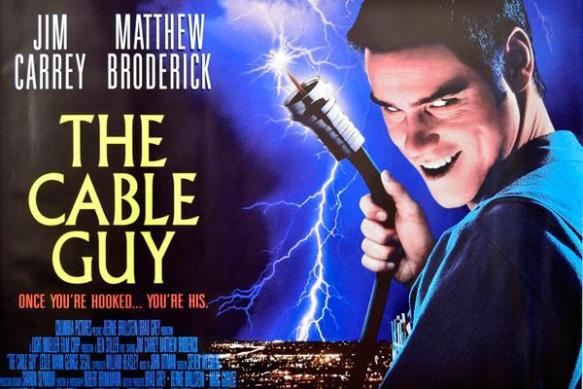
“The Cable Guy” (1996) is a dark satire written by Judd Apatow and directed by Ben Stiller which straddles the line between comedy and psychological thriller. Jim Carrey (still in the midst of his rapid rise to fame) stars as Chip Douglas who, after setting up free cable for Steven (Matthew Broderick) begins to behave in increasingly comical yet unsettling and stalker-like behavior to attach himself to his new “friend”. The film features metacommentary on Hollywood narrative tropes while effectively using them in the service of a cautionary tale about mass-media obsession and social alienation.
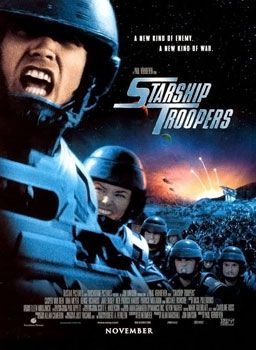
Paul Verhoeven and Edward Neumeier, the writer/director team behind the original Robocop returned a decade later with an equally satirical vision mocking while paying homage to propagandistic and militaristic Hollywood tropes: “Starship Troopers” (2007). The story follows a new recruit and his circle of friends as they go through training and onto the battlefield in a war against hostile aliens. It’s a story told countless times before and since but rarely with as much self-awareness and overtly fetishized fascism.
Welcome to Terminal City-one of only five livable places left on Earth.
Telegenic Mayor Ross Glimore (Peter Breck, The Big Valley, Shock Corridor), is king of all media, and rules as a virtual dictator. To maintain his grip on power he must stage an election, and for that he needs fresh fear. Enter Alex Stevens (Mark Bennett), a fed-up, cynical newspaper delivery boy who happens to witness Glimore run over one of his own supporters in his car, and leave the scene of the accident.
Glimore and his Rove-wellian henchman Bruce Coddle (Jello Biafra) hatch a plot to brand Alex “the #1 terrorist threat” (based on his connection to rock’n’roll music which, along with meat, is banned) to cow Terminal City into submission and steal another tabloid election.
Alex flees underground, where he stumbles into a resistance movement led in part by his newfound friend Beatrice (Lisa Brown), and a fugitive brain-damaged goalie from the Glimore-owned hockey team, unforgettably portrayed by two-time Genie Award® winner Germaine Houde (Best Performance by an Actor in a Supporting Role, Les bons Débarras 1980, Best Performance by an Actor in a Supporting Role, Un Zoo la Nuit 1987).
Alex finds himself caught up in a plot to bring Glimore down, with the not-so-secret police (D.O.A.’s Joe Keithley and pro-wrestling legend Gene Kiniski) hot on the trail.



 After the Crash