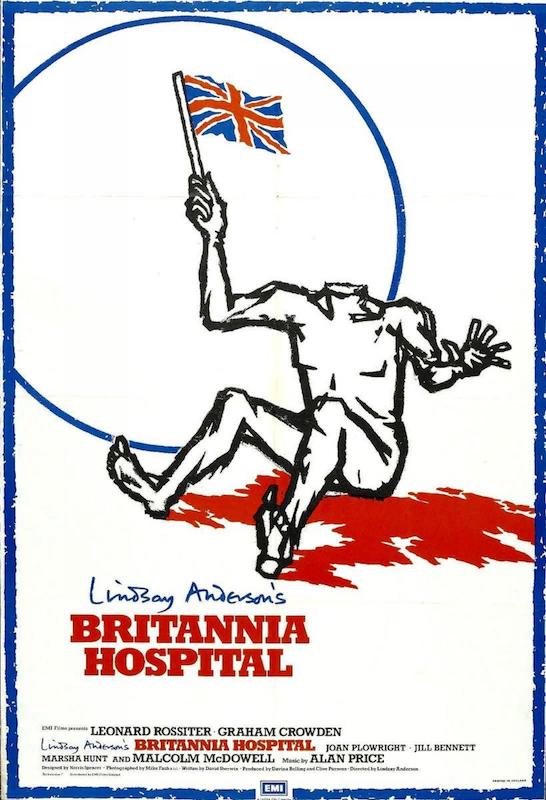
“Britannia Hospital” (1982) is the third installment of director Lindsay Anderson’s “Mick Travis Trilogy”. Like the other films in the series, it’s a dark comedy following a particularly eventful chapter in the life of Mick Travis (Malcolm McDowell) as he confronts various disturbing and absurd aspects of Britain and western society in general. In Britannia Hospital, Travis is a muckraking investigative journalist covertly filming a documentary on the prestigious Britannia Hospital as it faces a variety of challenges including the opening of a new wing, the arrival of the Queen Mother and other dignitaries, and protesters opposing an African dictator’s stay at the hospital as well as extravagant meals for VIP guests. As he gets further into his investigation Travis becomes embroiled in a secret transhumanist project directed by the head of the new wing. The Film’s central thesis is summed up by the following statement from Lindsay Anderson:
“The absurdities of human behaviour as we move into the Twenty-first Century are too extreme — and too dangerous — to permit us the luxury of sentimentalism or tears. But by looking at humanity objectively and without indulgence, we may hope to save it. Laughter can help.”
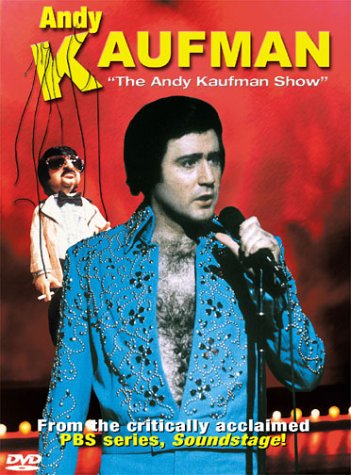
Holy moly! In 1983, just a year before his death of lung cancer—an event some people dispute ever happened—Andy Kaufman was given the bountiful gift of an hour of PBS programming time in the form of a segment of the music series Soundstage.
It’s a revelation.
Kaufman used his hour to create a mind-boggling critique of talk shows and the entertainment complex writ large. The show is presented out of phase: we see the inexplicable final, hysterical moments of the program, perhaps holding out the promise that we’ll find out what the fuck was going on at the very end. Kaufman sings an inane farewell song and credits roll—then the program starts up again.
One of the first things Kaufman does is ask the home viewer to go get a piece of cellophane from the kitchen—and then sits on the lip of the audience bleachers and waits 30 seconds in ballsy silence while that task is accomplished. (Just in case there are any stragglers, he then briefly jacks the volume and shouts at the home viewers to hurry up.)
You don’t need me to tell you all the gags in advance, but boy, they are beautiful. What’s sometimes forgotten about Kaufman is that for all of his daring experimentation, he was almost always very funny. Nobody had better mastery over the mirth that could be extracted from an awkward turn of phrase or an uncomfortable pause.
They gave him an installment of the PBS concert series Soundstage, for which he was invited to fill an hour as he saw fit and, since this was public television and no serious money was involved, he saw fit to contrive the most elliptical and surreal refraction of existential realities that he had ever attempted. He spent the better part of June working at the WTTW production facilities in Chicago, where the series was produced and where he plotted strategem as he went along, with George and Lynne Margulies and Elayne Boosler as his sounding board. He would begin the show at the end and start again near the middle and utilize ideas learned as a child from watching Winky-Dink and You, wherein viewers were instructed to put cellophane on the television screen and draw on it to help him out of jams. He would have himself arrested and thrown into television court (all with cartoon backdrop) and defend whatever broadcast transgressions he had so far commited on the program. He would have an interviewing desk that was now seven feet high (calling no attention to this) from which he would imperiously interview Elayne, wherein they (candidly, no, really) traversed what had gone wrong with their relationship—“Sometimes I would wake in the morning,” he told her, “and I’d think I’d like to tell you that we’re gonna break up. I’d say, Well, I gotta tell her tonight—we’re gonna break up!” The Clifton puppet would meanwhile stalk the desktop and serve as sidekick.
If you have any yen at all for the outer reaches of experimental comedy, this is a must-see.
Oh—since it’s Kaufman we’re talking about here, don’t take anything for granted. Make sure you watch the program to the very end.
“Summer Wars” (2009) is a sci-fi anime directed by Mamoru Hosoda (The Girl Who Leapt Through Time) and animated by Madhouse studio. The film’s plot follows Kenji Koiso, an eleventh-grade math prodigy who, while visiting his friend Natsuki’s great-grandmother, is falsely implicated in the hacking of a virtual world by a rogue AI called Love Machine. With the help of his community, Kenji must undo the damage and prevent the AI’s spread into the real world.
“The Parallax View” (1974) is a conspiracy thriller directed by Alan Pakula and written by Lorenzo Semple Jr. (Three Days of the Condor). The plot centers on reporter Joe Frady (Warren Beatty) who, while investigating claims from an ex-girlfriend who witnessed a political assassination, uncovers a plot involving the mysterious Parallax Corporation run by a network of shadowy power elites. One of a number of films of the era (including Executive Action and Winter Kills) which conveyed political assassination theories through a fictional narrative.
“Nothing” (2003) is an existential comedy and third feature film from director Vincenzo Natali (Cube). The plot follows two friends and roommates: Andrew, an antisocial travel agent who works from home, and Dave, a prototypical office drone. After experiencing the worst day of their lives, they somehow will the world outside of their house out of existence. While this creates a temporary respite it also leads to new problems mainly in the form of boredom and cabin fever. Will the two protagonists manage to keep their sanity and find their way out of nothingness?
“Cube” (1997) is an existential Canadian sci-fi feature film debut from director and co-writer Vincenzo Natali. The minimalist plot focuses on a group of strangers forced to navigate and survive a series of cube-shaped rooms which are more often than not rigged with deadly surprises. Besides the variety of bizarre and unexpected traps, the film’s main source of tension lies in the question of whether the group’s diversity of backgrounds and personalities will lead to their salvation or mutual extinction.
Shadows Of Liberty reveals the extraordinary money and power behind the news media dictating censorship, cover‐ups and corporate control.
Filmmaker Jean‐Philippe Tremblay takes an intrepid journey through the dark corridors of the American media landscape where global conglomerates call the shots. For decades their overwhelming influence has distorted journalism and compromised its values.
In highly revealing stories, renowned journalists, activists and academics give insider accounts of a broken media system. Controversial news reports are suppressed, people are censored for speaking out, and lives are shattered as the arena for public expression is turned into a private profit zone.
Tracing the story of media manipulation through the years, Shadows Of Liberty poses a crucial question: why have we let a handful of powerful private corporations write the news? We’re left in no doubt, ‘…what will save us is when we really know what’s going on, media not filtered through the lens or the microphone of a corporation.’
“Tokyo Blood” (1993) is an anthology film consisting of four experimental shorts directed by Gakuryû Ishii (formerly known as Sogo Ishii) thematically connected by the theme of entrapment in Tokyo’s urban landscape and desire to escape. The opening film, “Street Noise” is an impressionistic audio/visual collage depicting an anonymous salaryman’s state of mind as he breaks down from sensory overload. The second vignette, “Bicycle” follows the journey of two young strangers bonded by alienation who aimlessly explore the city by bike after a chance encounter. The third chapter begins as a parody of structuralist film theory (not unlike early works by Peter Greenaway) but soon descends into the hyper-kinetic chaos reminiscent of films by fellow Japanese avant-garde director Shinya Tsukamoto (The Tetsuo Trilogy). The concluding film, “Heart of Stone” is seemingly a transmission from a post-human feature combining the styles of Chris Marker’s essay films and Craig Baldwin’s found-footage narratives.