Based on Chuck Palahniuk’s novel of the same name, a film that was initially a commercial failure is now widely considered a cult classic and a philosophical marvel. Fight Club is one of the most important films of its generation and one of Fincher’s best. This thought-provoking masterpiece scratches the surface of various philosophical concepts and makes its audience think.
It is still as relevant as ever, perhaps even more so than before. Emasculation, Consumerism, beauty standards, identity, chaos vs order — these philosophical concepts are perhaps even more topical today than they’ve ever been.
Philosophically radical, this is a film that condemns the society of consumerism. As Edward Norton’s character says: “It’s just, when you buy furniture, you tell yourself, that’s it.
That’s the last sofa I’m gonna need. Whatever else happens, I’ve got that sofa problem handled.”
Fight Club also takes a critical look at beauty standards for men and women both and at advertisements that are served to us through mass media. Identity and alter-ego are philosophical concepts on which Fight Club is based on. Tyler Durden (Brad Pitt’s character) is what the narrator (Edward Norton’s character) wants to be.
The ideal alpha male. A leader of men. Tyler Durden gradually appears throughout the movie, emerging from the narrator’s subconscious and almost destroying him in the process.
Order vs chaos
Order, anarchy and chaos are perhaps the most prominent theme of Fight Club. At one point, Tyler Durden says: “It’s only after we’ve lost everything that we’re free to do anything.” Although primarily a critique of consumerism, this is a rejection of order and an acceptance of chaos.
When the underground fight club evolves into Project Mayhem and starts pouring into the outside world, members of it begin to dismantle every societal concept, causing controlled, deliberate and channeled chaos. Installing anarchy and rejecting every societal norm that had turned them into slaves. This is how they attempt to set themselves free, but the main protagonist loses himself in the chaos, initially merging with his alter-ego and then rejecting it.
In today’s America, where controlled chaos is caused by the media and fed to the panicked public, Fight Club resembles a warped house of mirrors in which the reflection of today’s America is seen.
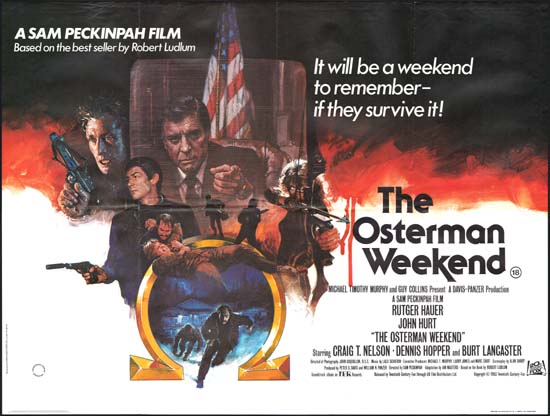
When this movie originally came out, five years after CONVOY (a muddled, but in many ways spectacular entertainment), many critics moaned that Peckinpah had yet again displayed his diminished talent. A Ludlum spy thriller, pulp material, given the Peckinpah stamp was not to be taken seriously, period. What nonsense. To begin with, all of Peckinpah’s films spring from pulp, and all of them, even the least successful ones, buck and spin with the way Sam applies his vision to the genre conventions he’s messing with.
In simple terms, a Peckinpah movie always illustrates the world according to Sam; like a novelist writing in first person, Sam’s point of view is the movie’s. And that’s why they endure today. In THE OSTERMAN WEEKEND, Peckinpah focuses Ludlum’s cold war spy antics into a exploration of urban paranoia and governmental abuse. Video as a means to manipulate perception is one of the themes he exploits here, but that’s not his main thrust. A group of affluent characters come together for a weekend that turns into a surreal nightmare. The trappings of success that surround this group are not in any way secure enough to withstand the violent, reckless games played on them by a rouge CIA agent (played by John Hurt) who’s motive is personal revenge. And that motive, the revenge that fuels his need, in actual fact, has absolutely nothing to do with the affluent group he’s playing with. Like the gods in Greek tragedy, the Hurt character uses the Osterman Weekend and its players as pawns, stepping stones, as a way to get at his real goal, the head of the CIA. This notion obviously strikes a chord in Peckinpah; the vision is certainly domestic, but the idea is epic: in the privacy of our homes a kind of virus colors our perceptions and poisons friendships, creates anarchy, and causes death. And the virus – where does it come from? Our own back yard – the CIA.
The film is charged with a constant underlying tension that holds and holds until all hell breaks loose and the affluent house becomes a battle ground. Visually, the movie is stunning. But then, so was CONVOY, but this time Peckinpah has harnessed what he shows and what he wants to say in a simple, tightly wound spy thriller package, Watching the movie today, it’s hard to believe that some of the notions that seemed more like the paranoiac mechanics of a potboiler in 1983 have actually come true and don’t seem quite as far fetched. By all accounts, Sam Peckinpah was a terribly difficult man, but he was also a visionary film maker who’s work gets better and better as the years pass. THE OSTERMAN WEEKEND is not the bad film critics at the time bitched about, and it’s not the sad conclusion to a career that started out brimming with possibility. It’s a splendid, brilliant – better than brilliant – work of American art by a true American artist: a giant. The world according to Sam is a world that will be looked at a hundred years from now; it will inspire debate, continual analysis, and be ranked with the major artist of the entire 20th century. By 1983,Peckinpah’s health may have diminished, but as a film maker he was still powerful and strong as hell.
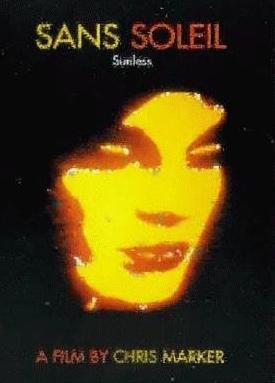
“Sans Soliel” (1983) is an experimental film by acclaimed French director Chris Marker which compiles footage recorded in various countries around the world and presents it in collage-like form. The movie features no synchronized sound, but instead ties the various segments together with music and voice-over narration pondering such topics as memory, technology and society. As the scenes shift, locations range from Japan to Iceland to Africa, creating a truly international work.
Yet when Bass got a chance to actually direct, he didn’t make slick movies with simple plots and great visuals, as you might expect. Instead, he made profoundly trippy movies with great visuals. His one and only feature film, Phase IV(1974), is a deeply weird movie about evolution. Think of it as a low-budget 2001: A Space Odyssey. With ants. The movie was butchered by scared distributors and consequently, it bombed at the box office.
The film centers on a tribe of robe-sporting people who live for only a mere eight days. If you’re an infant on a Monday, you will be elderly by the time the next Monday rolls around. At the opening, a nameless child is born as his elders ask in hushed tones, “Is this the one?” Of course he is. The reason he and his tribe have a shorter shelf life than grocery store sushi has something to do with a gate that blocks life sustaining light. “Beyond the great gate,” intones one elder, “people live 20,000 days or more.” The problem is that gate is five or so days away by foot.
So after a very brief training montage, the youth sets off across strange and fanciful landscapes that recall Yes album covers. Along the way, he faces down a beast that looks like a bear crossed with a lamprey, plays a video game with a Yeti on top of a ziggurat, and stumbles across a wizened old man who only the previous week was the tribe’s golden boy.
The movie is incredibly, hilariously dated, so much so that it goes right past kitsch into something close to sublime. If you remember watching, and loving, The Dark Crystal, Beast Master, Krull and Tron in your youth, you must check this out.
“Winter Kills” (1979) is a darkly humorous conspiracy thriller directed by William Richert and based on the novel of the same name by Richard Condon. The plot follows a fictional version of the JFK assassination (president Kegan in the film) and the efforts of his half-brother (played by Jeff Bridges) to uncover the convoluted conspiracy behind it. Other cast members include John Huston, Anthony Perkins, Eli Wallach, Richard Boone, Toshirō Mifune, Sterling Hayden, Dorothy Malone, Belinda Bauer, Ralph Meeker, Elizabeth Taylor, Berry Berenson and Susan Walden. The majority of the film was photographed by cinematographer Vilmos Zsigmond (Close Encounters) and the production designer was Robert F. Boyle (North by Northwest). Winter Kills was initially a box office bomb but has since become a cult classic.
It’s November 2016, and Richard Kelly is sat in a Los Angeles restaurant dining with a newspaper journalist. They talk a little about the cult consensus surrounding the reissue of his 2001 debut, Donnie Darko, but the main topic on the table is Kelly’s reemergence following a long period of inactivity. Both writer and subject are eager to discuss the director’s ill-fated second feature, Southland Tales, which celebrates its tenth anniversary this year.
Endeavouring to reappraise the film, the journalist would later dub it “a pre-game show for the next decade of global misery” when he finally put pen to paper. Revisiting Southland Tales in 2017, however, it’s not only the speculative powers of the film that sing. What also resonates is the quiet conflict between commercial and contextual providence when we’re trying to read popular cinema, to hold it up against the world.
Kelly’s playbook, defined as it is by hypothetical disorder, frames an associative reservoir of contemporary symbolisms in which critics will swim. Searching for a sense of the inherent value of Southland Tales, some look for its hidden depths; others, the flat veneer of its surface. But the absence of consensus around the film feels entirely appropriate.
Taking the newsfeed as a stylistic turn, Southland Tales weaves together various subplots, dead-ends, and vignettes in the form of a rolling newscast. Set against the backdrop of nuclear war in America – the bomb having landed in Abilene, Texas – we find a country in meltdown. State borders are closed, and extensions of the Patriot Act have allowed intelligence services to function unmonitored. On the west coast, a neo-Marxist revolution is falling into chaotic failure around Venice Beach, and an actor named Boxer Santaros (Dwayne Johnson) – having married the debutante of some Republican house of cards – has lost his memory. Now hiding out in Los Angeles, he runs with Krysta Now (Sarah Michelle Gellar), an ambitious and entrepreneurial ex-porn star.
Together, Gellar and Johnson are penning a screenplay, a cop movie entitled ‘The Power’. But amid its attention to the trappings of genre, the script holds some answers to a spiritual foreboding prompted by an impending energy crisis stayed, only, by the numinous capabilities of a scientist (Wallace Shawn). A figure shrouded in a fog of incense, mystic vagaries and influence owing to the financial backing of a mysterious German multinational.
Seann William Scott stars as two police officers who are not allowed to meet, should they rupture a temporal continuum, and the film is ambiently scored by hotel lobby-era Moby. Justin Timberlake, playing a misanthropic Iraq War veteran, establishes the dynamics of the film’s dénouement. Rather than place or time, Timberlake instead reads us a bastardisation of the Book of Revelation fused, throughout, with misquotes from high-modernist poetry. Repeatedly, he tells us that “this is the way the world ends.”
Southland Tales is a time capsule flirting with end-of-history ideologues. It is a joke on the very idea of the running order of recent history. Self-identifying as a parable playing on a cultural implosion of operatic proportions, it runs as a look-book of early 21st century anxieties. It’s a speculative three-act riff on the catastrophic failings of the last 10 years, a fever dream in two hours and twenty-five minutes. Kelly’s film is a carrion call for a new culture of private consumption. Its characters can do little but watch one another, and the film milks its ignoble examination of mass consumerism through depiction of a dystopian reality defined by tragic inevitability and heavy self-consciousness. “I feel like sometimes things just need time to marinate,” Kelly has said; he always wanted us to read the film forwards.
This is a murky film, no question, but Kelly has suggested that key to understanding its meaning is the intellectual scope of its centrepiece scene: a three-minute dance routine. Around the halfway mark, a doped-out Timberlake slips into an opiate induced coma. In a fantasy sequence – blood down his shirt, Budweiser in hand – he dances through a thoroughly 20th century panorama, a pinball arcade, flanked by a chorus of dancers all legs and vinyl. He looks straight down the camera, lip-syncing his way through The Killer’s ‘All These Things That I’ve Done’, whose anthemic drive is matched only by the empty opacity of its lyrics. “All these things that I’ve done” – the song is about meaning read backwards, the ownership of experience, an inversion of the speculation showcased throughout Southland Tales. The engagement of its terms here feels like a play on use-value; it’s a psalm for our private habits as viewers.
If watching rather than knowing is our active-verb in Southland Tales, then the song proves vital. Meaningless in its aim for universalism, a pop song only resonates in the right room, when played in the right context, and recalling it – personalising its terms – becomes a statement of value. That’s a perfect picture of the vitality of Southland Tales – a vigorous piece of pulp for the 21st century, it courts that very idea. It wants to be used; the film wants to mount a consideration of the cumulative character of meaning, how popular cinema is always contingent on popular feeling.
At first, what we have seems like a mess of ideas. But give it time, let those ideas marinate, and we’re left with something more. Kelly’s joke, still intact 10 years later, is that there will always be a solitary ‘I’ as far as consumption is concerned. In 2007, Southland Tales was simply out of step, waiting for new platforms for personal entertainment, for the semiotic carry-on instigated by streaming cultures. It’s a film honed for the minute when cinema would feel more like a private habit than a public spectacle.
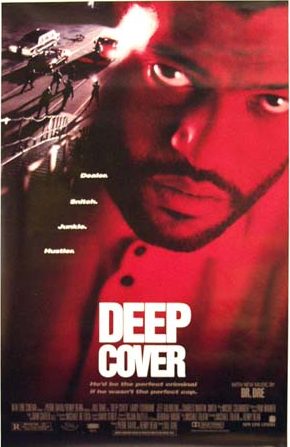
“Deep Cover” (1992) is a neo-noir crime thriller directed by Bill Duke with a screenplay by Michael Tolkin (The New Age) and Henry Bean. Larry Fishburne plays an undercover police officer on the verge of going rogue with an attorney/drug trafficker played by Jeff Goldblum. The film is notable for its accurate depiction of the US government’s involvement in the spread of narcotics throughout the nation’s inner cities. Also notable is a great soundtrack featuring Dr. Dre and Snoop Dogg.
GRASSO: When our esteemed editor-in-chief recommended we look this week at the little-heralded-nor-remembered Endangered Species from 1982, I was cautiously optimistic. A B-movie starring Robert Urich, JoBeth Williams, Paul Dooley, and Hoyt Axton about cattle mutilations, shot on location in Colorado and Wyoming? I consider myself well-versed in movies about UFOs from the late ’70s and early ’80s, and the fact I’d never heard of this one was a real shock. To my further shock, the film was amazing: fascinating as both a time capsule of the early Reagan years and as a piece of weird outsider art/conspiratorial agitprop. In fact, in Mutant Chat this week I called Endangered Species “the last great 1970s political conspiracy thriller”; with a few days to mull over this assessment, I stand by it even more assertively. Endangered Species seamlessly and expertly weaves together all the threads of cattle mutilation lore as they currently stood in 1982, all while engaging the kind of B-plots that are characteristic of similar movies from this time period: a shoehorned (and slightly icky) romance between the two leads, a plucky teenage character for the teens in the audience to identify with, and a good chunk of edgy blood and gore (not just from the aforementioned mutilated cattle).
So I just have to ask before getting into the details and why I loved this trashy piece of late-night ’80s cable fare—Kelly, how in the hell did you find out about this thing?
ROBERTS: I remember this flick from the video store, but I never watched it (not that I remember, anyway) until about a year ago. Conspiracy films became a genre unto themselves after Watergate, as did UFO films after 1977’s Close Encounters. Endangered Species merges both—one of the few examples of such before The X-Files (1980’s Hangar 18, produced by exploitation experts Sunn Classic Pictures, is another). The campy elements are there, for sure, but overall I agree with you, Mike: this is a very interesting portrait of ramped-up paranoia during the high Cold War period that hits a surprising number of now well-known genre staples: “silent” black helicopters, chemical and germ warfare, keeping up with the Russians, moving vans that disguise shadowy government conspirators, references to satanism. Although the script can’t quite live up to the premise, the opening sequence that moves from a herd of cows in rural Colorado to a herd of humans rushing through the streets of NYC makes the point perfectly clear: our government makes no distinction between cows and people; we are all dumb beasts whose purpose is to be sacrificed for the preservation of the bastards in power.
MCKENNA: Jesus but it’s been a while since I last saw a mainstream film that felt as out-of-control as Endangered Species. I had a vague recollection of watching it, but apparently it was one of those false memories engendered by spending too long staring at the VHS covers down the rental shop, hence it was totally new to me. It comes on like an aggressive cross between a self-aware B-movie and an oddball independent cinema artifact, so it’s no surprise that director Alan Rudolph was a protégé of Robert Altman. Prior to Endangered Species, Rudolph had made a string of low-budget, intelligent, critically acclaimed films in a variety of genres. And Endangered Species is fucking great, despite the many odd and sometimes unpleasant things about it, which include what can’t help feeling like a bit of a cavalier attitude to animal welfare and Robert Urich’s awful yet incongruously multifaceted “hero” Ruben Castle. Castle is one of the most irritating and borderline repellent protagonists I can remember seeing posited as a good guy and romantic lead, despite which he’s given to flashes of grace and insight. Given Rudolph’s smarts, it’s intriguing to wonder if the character wasn’t a deliberate piss-take of bullheaded thuggish machismo—in fact, it’s sometimes hard to tell whether Endangered Species is actually stupid or just playing at it.
You mention Close Encounters, Kelly, and in some ways the whole film almost feels like a compelling satire-mashup of Spielbergian motifs, from the casting right down to the Sugarland Express-like motorcade of cars that provides the film with one of its most memorable images, as well as the disguised trucks containing government technology, like the ones used to ferry Francois Truffaut’s benevolent scientific staff across the US, though here ferrying something much less benign.
Rudolph’s direction is lucid and kinetic, the editing surprising, the acting pretty great, and the script off the wall enough to have its moments, but what is perhaps most surprising about it— especially given how early on it’s made clear that the UFOs are a cover for military–industrial complex shenanigans—is that Endangered Species somehow manages to remain oddly frightening (thanks in part to a deeply unsettling score by Gary Wright) and convincingly transfers the eerie atmosphere initially engendered by the non-sequitur aerial shots of rampaging livestock and rumors of heifer-lasering ETs to government conspiracies equally inhuman and incomprehensible.
GRASSO: Kelly, you’re right: this really is a sui generis artifact of ufology at the outset of the ’80s, one that really bridges two distinct eras in the field. As the 1980s progressed, tales of close encounters were rapidly leaving behind encounters of J. Allen Hynek’s third kind (where entities can be sensed or glimpsed) and becoming more and more likely to be abductions where perceptions of the experiencer’s sense of reality were changed: i.e., encounters of Jacques Vallée’s fourth kind. The suspicion that the U.S. government might be in some ways covering up or working in cahoots with the UFOs also dates from the 1980s, as the Majestic-12 hoax documents began circulating a year or two after Endangered Species was released. (One of Majestic-12’s biggest proponents, investigative reporter Linda Moulton Howe, was also one of the earliest journalists to cover the cattle mutilation phenomenon.)
But ultimately I can’t think of another film from this period that is so decidedly Valléean in its almost fractal unfolding of putative UFO phenomena. In his 1979 Messengers of Deception, Vallée spends quite a bit of time looking at cattle mutilations in the American West. At the time, the classic mutilation event was over a decade old: the case of Snippy the Horse in 1967. Vallée examines how the costly mystery of the cattle mutilation phenomenon in the latter half of the ’70s gradually turned these ranchers from initially believing that UFOs were responsible to eventually believing some kind of government conspiracy were behind the mutilations. These streams of anti-government conspiratorial thought obviously flowed together with existing suspicion of government interference in ranching and land management in the West that would feed into the militia movements of the 1990s and beyond. (It’s interesting to note that JoBeth Williams’ Sheriff Harry character deputizes the entire town at the end of the film to confront the shadowy base on the edge of town; the idea of the posse comitatus was hugely inspirational to the anti-government militias forming in the West at this time.)
But let’s concede this much to the ranchers: their cattle were dying, and they had some reason to suspect government experiments. In Endangered Species, the paramilitary forces are abducting and experimenting on cattle to test biological weapons to be used against the Soviets. (This is probably the best place to note that both Peter Coyote’s and Dan Hedaya’s black ops operatives emit real sleazy menace in every scene they’re in; they don’t get much screen time, but for me they were by far the best part of the film.) These mysterious operatives are utterly dedicated to these experiments for “patriotic” reasons. In Coyote’s confrontation with Hoyt Axton’s big-time rancher, it’s obvious that Axton’s character’s patriotism was a big reason for his collaboration with the cattle mutilators (“I’m a patriot, Steele; I’d do anything for my country”), but after the murder of town newspaper editor Paul Dooley to keep the coverup intact, the black ops boys have gone too far for his tastes. “And you’re not in Guatemala takin’ pot-shots at barefoot natives,” Axton says to Coyote, putting the black ops conspirators firmly in the sphere of the CIA. It’s no surprise that Axton eventually dies a gruesome death; after a black-bag teamtaints his toothbrush with a mysterious agent, his guts literally fall out of him as an out-of-control hemorrhagic illness ravages his system. Obviously, we’re meant to be reminded of the kinds of domestic ops performed by CIA programs like MKUltra here, but it’s also interesting to see a bioweapon on screen in 1982 that is very similar to the Ebola virus (discovered by scientists in 1976). Government conspiracies involving Ebola/Marburg viruses were also au courant in the 1990s, as were beliefs that the U.S. government either had deliberately engineered or released the AIDS virus into the U.S. population at the end of the 1970s.
ROBERTS: I need to mention E.T.: the Extra-Terrestrial here. Released exactly two months before Endangered Species, Spielberg’s film also featured government agents (in this case, the FBI) spying on American citizens and actively seeking to keep the truth from them, prepared to use violence if necessary. Ultimately, the agents are portrayed as benevolent, even paternalistic, their boss (played by Peter Coyote!) revealed to be much like idealistic kid-hero Elliott—as well as a potential father figure to him. Endangered Species does not cop out in such a way (as Spielberg did in 2002 when digitally replacing the FBI’s guns in the chase scene with walkie-talkies, a tragic mistake he later rectified), and is much more disturbing because of it, as you guys mention. While a number of popular ’80s films take on the military-industrial complex and conspiracy, to some degree—TheManhattan Project (1986), The Philadelphia Experiment (1984), WarGames (1983), No Way Out (1987)—only John Carpenter’s They Live (1988) and Endangered Species offer an outright rejection of Reagan’s manipulative idealism.
The film missed an opportunity with JoBeth Willams (who had just starred in 1981’s Poltergeist), whose character we expect to be a man when she’s introduced as newly elected sheriff “Harry.” The camera follows her as she walks to the podium to get sworn in, her long hair tucked up under her hat. For a while, Harry gets to show off her investigatory chops, and even challenges Urich’s claim to hero status, until the predictable “Does she ever wear a dress?” comment gets trotted out, and she takes a backseat to a stock character (the burned-out, drunk NYC cop who’s dictating his first hard-boiled novel into a mini tape recorder).
MCKENNA: It’s true, the very talented JoBeth Willams isn’t used anywhere near as well as she could have been, and the situations the script puts her in range from patronizing to offensive, but despite that she still manages to give a performance that radiates humanity and realness. Playing Urich’s daughter, Marin Kanter (who also appeared inLadies and Gentlemen, the Fabulous Stains the same year) is great too, as are all the various minor characters who evoke a convincing milieu of dickhead provincial bureaucracy.
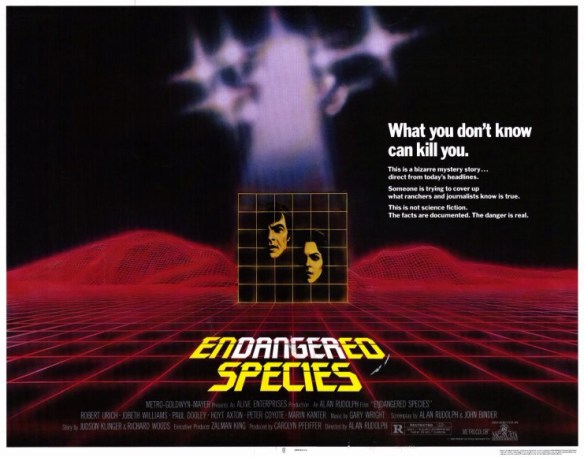
In fact, Endangered Species is such a monster that even the poster’s a rocker, bringing together the lights in the sky from the alternate posters for E.T. with a light-grid (which appears in the film as part of the black ops tech used by the baddies) reminiscent of 1981’s Looker, giving it something of the feel of a summa of the zeitgeist. The whole thing quite clearly bears the greasy fingerprints of its executive producer, Zalman King. Better known for his screenplay for 1986 wank-fest 9½ Weeks and the erotic thrillers he subsequently directed, King had given a great performance four years previous to Endangered Species as the protagonist of Jeff Lieberman’s Blue Sunshine—another sort-of-countercultural horror-conspiracy movie—and was one of those people who seemed in some strange way to have the pulse of the unwholesome side of the popular culture, for better or worse. Endangered Species is yet more proof of that odd talent.
Another thing that struck me was the language used by the villains of the piece—a realistic-sounding form of the clinically euphemistic combat talk (which, like the conversations between scientists in 1980’s Altered States, makes you aware you are listening to professionals) that has now become commonplace but that feels surprisingly ahead-of-its-time in the context of the film. It not only gives Endangered Species a sheen of accuracy but also makes you wonder just how much this compellingly detached way of speaking about death and killing—because it is compelling, unfortunately—has contributed to normalizing, to whatever small extent, the kind of thinking that lies behind it.
GRASSO: As I said at the outset, Endangered Species feels a lot more like ’70s thrillers such as The Parallax View or Three Days of the Condor than your typical 1980s VHS fare. Even the ambiguous ending pretty much assures us that greater and more momentous injustices committed by U.S. government-aligned forces will likely continue, long after the credits roll. But it does diverge from those classic 1970s conspiracy thrillers in an important way: instead of the protagonists being crusading journalists (Paul Dooley’s newspaper editor dies about halfway through), the protagonists here are a pair of cops. JoBeth William’s Sheriff Harriet character, as mentioned before, is a woman who can get things done and has the nominal trust of her fellow Coloradans (even if there is the whiff of sexism around the way she is treated at a climactic town meeting). But Robert Urich’s vacationing New York City cop is straight out of street-level 1970s films. While he’s not the same kind of maverick hero as Al Pacino’s Serpico, he’s a salt-of-the-earth schlub, reminiscent of ’70s protagonists such as Walter Matthau in The Taking of Pelham One-Two-Three. But ultimately both protagonists are cops, and I think that’s worth noting as we move from the Nixonian Seventies to the Reaganite Eighties.
To echo what Richard said above, the film certainly is visually interesting for its budget and limitations. The high plains landscapes and slowly decaying small-town streets evoke the period exceptionally well, when America’s small towns were beginning to feel the hollowing out by global capital. The implicit confluence of shadowy government forces with local and international capitalists (in form of Axton’s rancher, the sinister big rigs, and the cattle mutilators’ headquarters, a U.S. missile silo eventually sold into private hands after the first round of U.S.-Soviet arms treaties in the late ’60s) is probably one of the most interesting sub rosa themes in the film. The film’s editing, especially around the repeated ubiquitous cattle abductions by helicopter, is solid as well. And the occasional use of computer graphics eschew the frequent cheesiness inherent in most ’80s films and give us a believable look at what the advanced surveillance and medical systems that the black ops personnel use might look like. Even Gary Wright’s offbeat synth score helps convey a feeling of technological alienation (although I chuckled at the inclusion of a character singing along to “Dream Weaver” on the radio). I maybe wouldn’t go so far to say that Endangered Species is a lost classic, but it’s a fascinating document that tells us more about the state of American conspiracy theorizing in the early 1980s than a lot of bigger, better-known films from the period.




 After the Crash