This Is a Financial Extinction Event

By Charles Hugh Smith

Source: Of Two Minds

The lower reaches of the financial food chain are already dying, and every entity that depended on that layer is doomed.

Though under pressure from climate change, the dinosaurs were still dominant 65 million year ago–until the meteor struck, creating a global “nuclear winter” that darkened the atmosphere for months, killing off most of the food chain that the dinosaurs depended on. (See chart below.)

The ancestors of modern birds were one of the few dinosaur species to survive the extinction event, which took months to play out.

It wasn’t the impact and shock wave that killed off dinosaurs globally–it was the “nuclear winter” that doomed them to extinction. As plants withered, the plant-eating dinosaurs expired, depriving the predator dinosaurs of their food supply.

This is a precise analogy for the global economy, which is entering a financial “nuclear winter” extinction event. As I’ve been discussing for the past few months, costs are sticky but revenues and profits are on a slippery slope.

Businesses still have all the high fixed costs of 2019 but their revenues are sliding as the “nuclear winter” weakens consumer spending, investment in new capacity, etc.

Despite all the hoopla about a potential vaccine, no vaccine can change four realities: one, consumer sentiment has shifted from confidence to caution and from spending freely to saving. This is the financial equivalent of “nuclear winter”: there is no way to return to the pre-impact environment.

Two, uncertainty cannot be dissipated, either. There are no guarantees a vaccine will be 99% effective, that it will last more than a few months, that it won’t have side-effects, etc. There are also no guarantees that consumers will resume their care-free spending ways as credit tightens, incomes decline, risks emerge and the need for savings becomes more compelling.

Three, consumer behavior and uncertainty have already changed, and so businesses that cannot survive on much lower revenues won’t last long enough to emerge from the “nuclear winter” of uncertainty and a shift in sentiment.

Four, assets based on 2019 revenues, profits and demand are now horrendously overvalued, and the repricing of all assets will bring down the predators, i.e. the banks.

As I’ve noted here before, the top 10% of households account for almost 50% of consumer spending. These households are older, and own the majority of assets –between 80% and 90% of stocks, bonds, business equity, rental real estate, etc. This is the demographic with the most to lose in returning to care-free air travel, jamming into crowded venues and cafes, etc.

This demographic has “been there, done that” and foregoing fine dining, sports events, concerts, cruises, etc. is not much a burden and may actually be a relief.

Meanwhile, the entire food chain of landlords, banks, local government, employees, etc. depends on enterprises returning to 100% of 2019 revenues. As tenants stop paying rent, landlords default on mortgages, sending banks into insolvency, leaving local government with less tax revenues and employees with fewer job prospects.

To a degree few appreciate, the “recovery” since 2009 has been dependent on over-spending, over-borrowing and over-speculating: as spending, borrowing and speculation all pull back to what would have been “normal” levels two generations ago, the economy collapses because it’s become completely dependent on over-spending, over-borrowing and over-speculating.

As consumers and businesses retrench, borrowing declines while defaults and bankruptcies eviscerate bank profits and balance sheets. As spending declines, businesses with high fixed costs and pre-pandemic business models (crowding people together in close quarters, etc.) cannot generate enough revenues to survive. As the collateral of commercial real estate and profit streams collapse, assets are repriced all down the food chain, reversing the wealth effect: as people feel poorer, they borrow and spend less, creating a feedback loop of lower valuations, lower spending, lower profits, lower borrowing all of which feed back into each other, pushing everything lower.

The lower reaches of the financial food chain are already dying, and every entity that depended on that layer is doomed: the small business die-off will bring down distributors, banks, landlords, and employment, and as the this layer collapses then the top predators will starve to death as well: Big Tech, healthcare, higher education, tourism, local tax revenues, etc.

The clouds are spreading and thickening, and the dawn sky is tinted an ominous red. This is a financial extinction event, and the Fed’s pathetic shamans can’t reverse history.

Americans Have Already Skipped Payments On More Than 100 Million Loans, And Job Losses Continue To Escalate

By Michael Snyder

Source: Economic Collapse Blog

Those that have been hoping for some sort of a “V-shaped recovery” have had their hopes completely dashed.  U.S. workers continue to lose jobs at a staggering rate, and economic activity continues to remain at deeply suppressed levels all over the nation.  Of course this wasn’t supposed to happen now that states have been “reopening” their economies.  We were told that things would soon be getting back to normal and that the economic numbers would rebound dramatically.  But that is not happening.  In fact, the number of Americans that filed new claims for unemployment benefits last week was much higher than expected

Weekly jobless claims stayed above 1 million for the 13th consecutive week as the coronavirus pandemic continued to hammer the U.S. economy.

First-time claims totaled 1.5 million last week, higher than the 1.3 million that economists surveyed by Dow Jones had been expecting. The government report’s total was 58,000 lower than the previous week’s 1.566 million, which was revised up by 24,000.

To put this in perspective, let me once again remind my readers that prior to this year the all-time record for a single week was just 695,000.  So even though more than 44 million Americans had already filed initial claims for unemployment benefits before this latest report, there were still enough new people losing jobs to more than double that old record from 1982.

That is just astounding.  We were told that the economy would be regaining huge amounts of jobs by now, but instead job losses remain at a catastrophic level that is unlike anything that we have ever seen before in all of U.S. history.

With the addition of this latest number, a grand total of nearly 46 million Americans have now filed initial claims for unemployment benefits since the COVID-19 pandemic began.

If you can read that statement and still believe that the U.S. economy is not imploding, I would like to know what you are smoking, because it must be pretty powerful.

Some of the things that we are seeing happen around the country right now are absolutely nuts.  For example, earlier this week in Kentucky it was being reported that people were waiting in line for up to 8 hours to talk with a state official face to face about their unprocessed unemployment claims…

This wasn’t supposed to happen.

By now, the U.S. economy was supposed to be roaring back to life and we were supposed to be entering a new golden age of American prosperity.

Unfortunately, the truth is that more bad economic news is hitting us on a continual basis, and that isn’t going to change any time soon.

Over the past few days, we have learned that Hilton is laying off 22 percent of its corporate staff, and AT&T has announced that it will be eliminating 3,400 jobs and closing 250 stores…

The wireless carrier AT&T is cutting 3,400 jobs and shutting down 250 stores over the next few weeks, according to a statement from the Communications Workers of America, a union representing AT&T workers.

The AT&T Mobility and Cricket Wireless retail closures will affect 1,300 jobs, while the other layoffs are said to be affecting technical and clerical workers.

Needless to say, all of these job losses are having a tremendous ripple effect throughout the economy.

Without paychecks coming in, a lot of Americans are having a really tough time paying their bills, and the Wall Street Journal is reporting that payments have already been skipped on more than 100 million loans…

Americans have skipped payments on more than 100 million student loans, auto loans and other forms of debt since the coronavirus hit the U.S., the latest sign of the toll the pandemic is taking on people’s finances.

The number of accounts that enrolled in deferment, forbearance or some other type of relief since March 1 and remain in such a state rose to 106 million at the end of May, triple the number at the end of April, according to credit-reporting firm TransUnion.

Wow.

To me, that is an almost unimaginable number, and it has become clear that a tremendous amount of pain is ahead for the financial institutions that are holding these loans.

A lot of people out there are going to keep hoping that there will be some sort of an economic rebound, but the cold, hard reality of the matter is that fear of COVID-19 is going to keep a large segment of the population from resuming normal economic activities for the foreseeable future.  And it certainly doesn’t help that the number of confirmed cases in the U.S. has been steadily rising over the past couple of weeks and that the mainstream media has been endlessly warning that a “second wave” is coming.

If you doubt what I am saying, just look at what is happening to the restaurant industry.  We had started to see a small bit of improvement in the numbers, but now fear of a “second wave” has caused restaurant traffic to start cratering again

After three months of slow but consistent improvement in restaurant dining data in the US and across the globe, in its latest update on “the state of the restaurant industry”, OpenTable today reported the biggest drop in seated restaurant diners (from online, phone and walk-in reservations) since the depth of the global shutdown in March.

As shown in the OpenTable graphic below, on Sunday, June 14, restaurant traffic suddenly tumbled, sliding from a -66.5% y/y decline as of June 13 to -78.8% globally.

This was mostly due to a sharp drop in US restaurant diners, which plunged by 13% – from -65% to -78% – the biggest one day drop since the start of the shutdown in the US, and the second biggest one day drop on record.

Business travel is another area where we are seeing signs of big trouble ahead.  The following comes from Yves Smith

Business travel is not coming back any time soon. People are getting accustomed to Zoom. And word may also get out that domestic flying is much worse than it used to be, which will be a deterrent to those who might be so bold as to want to get on a plane. That is a fundamental blow to airlines, airport vendors, hotels, restaurants, and convention centers. Hotel occupancy in April was 24.5% which if anything seems high based on my personal datapoints. The pricings I see say that hotel operators are not expecting much if any improvement through the summer.

Like many of you, I wish that economic conditions would go back to the way they used to be, but that simply is not going to happen.

Yes, we will see economic numbers go up and down over the coming months, but a return to “the good times” is not in the cards.

And what hardly anyone realizes is that this is just the beginning of our problems, and I am working on a new project right now which will explain why this is true in great detail.

So stay tuned, because things are about to get really, really “interesting”.

Meet BlackRock, the New Great Vampire Squid

By Ellen Brown

Source: Web of Debt

BlackRock is a global financial giant with customers in 100 countries and its tentacles in major asset classes all over the world; and it now manages the spigots to trillions of bailout dollars from the Federal Reserve. The fate of a large portion of the country’s corporations has been put in the hands of a megalithic private entity with the private capitalist mandate to make as much money as possible for its owners and investors; and that is what it has proceeded to do.

To most people, if they are familiar with it at all, BlackRock is an asset manager that helps pension funds and retirees manage their savings through “passive” investments that track the stock market. But working behind the scenes, it is much more than that. BlackRock has been called “the most powerful institution in the financial system,” “the most powerful company in the world” and the “secret power.” It is the world’s largest asset manager and “shadow bank,” larger than the world’s largest bank (which is in China), with over $7 trillion in assets under direct management  and another $20 trillion managed through its Aladdin risk-monitoring software. BlackRock has also been called “the fourth branch of government” and “almost a shadow government”, but no part of it actually belongs to the government. Despite its size and global power, BlackRock is not even regulated as a “Systemically Important Financial Institution” under the Dodd-Frank Act, thanks to pressure from its CEO Larry Fink, who has long had “cozy” relationships with government officials.

BlackRock’s strategic importance and political weight were evident when four BlackRock executives, led by former Swiss National Bank head Philipp Hildebrand, presented a proposal at the annual meeting of central bankers in Jackson Hole, Wyoming, in August 2019 for an economic reset that was actually put into effect in March 2020. Acknowledging that central bankers were running out of ammunition for controlling the money supply and the economy, the BlackRock group argued that it was time for the central bank to abandon its long-vaunted independence and join monetary policy (the usual province of the central bank) with fiscal policy (the usual province of the legislature). They proposed that the central bank maintain a “Standing Emergency Fiscal Facility” that would be activated when interest rate manipulation was no longer working to avoid deflation. The Facility would be deployed by an “independent expert” appointed by the central bank.

The COVID-19 crisis presented the perfect opportunity to execute this proposal in the US, with BlackRock itself appointed to administer it. In March 2020, it was awarded a no-bid contract under the Coronavirus Aid, Relief, and Economic Security Act (CARES Act) to deploy a $454 billion slush fund established by the Treasury in partnership with the Federal Reserve. This fund in turn could be leveraged to provide over $4 trillion in Federal Reserve credit. While the public was distracted with protests, riots and lockdowns, BlackRock suddenly emerged from the shadows to become the “fourth branch of government,” managing the controls to the central bank’s print-on-demand fiat money. How did that happen and what are the implications?

Rising from the Shadows

BlackRock was founded in 1988 in partnership with the Blackstone Group, a multinational private equity management firm that would become notorious after the 2008-09 banking crisis for snatching up foreclosed homes at firesale prices and renting them at inflated prices. BlackRock first grew its balance sheet in the 1990s and 2000s by promoting the mortgage-backed securities (MBS) that brought down the economy in 2008. Knowing the MBS business from the inside, it was then put in charge of the Federal Reserve’s “Maiden Lane” facilities. Called “special purpose vehicles,” these were used to buy “toxic” assets (largely unmarketable MBS) from Bear Stearns and American Insurance Group (AIG), something the Fed was not legally allowed to do itself.

BlackRock really made its fortunes, however, in “exchange traded funds” (ETFs). It gained trillions in investable assets after it acquired the iShares series of ETFs in a takeover of Barclays Global Investors in 2009. By 2020, the wildly successful iShares series included over 800 funds and $1.9 trillion in assets under management.

Exchange traded funds are bought and sold like shares but operate as index-tracking funds, passively following specific indices such as the S&P 500, the benchmark index of America’s largest corporations and the index in which most people invest. Today the fast-growing ETF sector controls nearly half of all investments in US stocks, and it is highly concentrated. The sector is dominated by just three giant American asset managers – BlackRock, Vanguard and State Street, the “Big Three” – with BlackRock the clear global leader. By 2017, the Big Three together had become the largest shareholder in almost 90% of S&P 500 firms, including Apple, Microsoft, ExxonMobil, General Electric and Coca-Cola. BlackRock also owns major interests in nearly every mega-bank and in major media.

In March 2020, based on its expertise with the Maiden Lane facilities and its sophisticated Aladdin risk-monitoring software, BlackRock got the job of dispensing Federal Reserve funds through eleven “special purpose vehicles” authorized under the CARES Act. Like the Maiden Lane facilities, these vehicles were designed to allow the Fed, which is legally limited to purchasing safe federally-guaranteed assets, to finance the purchase of riskier assets in the market.

Blackrock Bails Itself Out

The national lockdown left states, cities and local businesses in desperate need of federal government aid. But according to David Dayen in The American Prospect, as of May 30 (the Fed’s last monthly report), the only purchases made under the Fed’s new BlackRock-administered SPVs were ETFs, mainly owned by BlackRock itself. Between May 14 and May 20, about $1.58 billion in ETFs were bought through the Secondary Market Corporate Credit Facility (SMCCF), of which $746 million or about 47% came from BlackRock ETFs. The Fed continued to buy more ETFs after May 20, and investors piled in behind, resulting in huge inflows into BlackRock’s corporate bond ETFs.

In fact, these ETFs needed a bailout; and BlackRock used its very favorable position with the government to get one. The complicated mechanisms and risks underlying ETFs are explained in an April 3 article by business law professor Ryan Clements, who begins his post:

Exchange-Traded Funds (ETFs) are at the heart of the COVID-19 financial crisisOver forty percent of the trading volume during the mid-March selloff was in ETFs ….

The ETFs were trading well below the value of their underlying bonds, which were dropping like a rock. Some ETFs were failing altogether. The problem was something critics had long warned of: while ETFs are very liquid, trading on demand like stocks, the assets that make up their portfolios are not. When the market drops and investors flee, the ETFs can have trouble coming up with the funds to settle up without trading at a deep discount; and that is what was happening in March.

According to a May 3 article in The National, “The sector was ultimately saved by the US Federal Reserve’s pledge on March 23 to buy investment-grade credit and certain ETFs. This provided the liquidity needed to rescue bonds that had been floundering in a market with no buyers.”

Prof. Clements states that if the Fed had not stepped in, “a ‘doom loop’ could have materialized where continued selling pressure in the ETF market exacerbated a fire-sale in the underlying [bonds], and again vice-versa, in a procyclical pile-on with devastating consequences.” He observes:

There’s an unsettling form of market alchemy that takes place when illiquid, over-the-counter bonds are transformed into instantly liquid ETFs. ETF “liquidity transformation” is now being supported by the government, just like liquidity transformation in mortgage backed securities and shadow banking was supported in 2008.

Working for Whom?

BlackRock got a bailout with no debate in Congress, no “penalty” interest rate of the sort imposed on states and cities borrowing in the Fed’s Municipal Liquidity Facility, no complicated paperwork or waiting in line for scarce Small Business Administration loans, no strings attached. It just quietly bailed itself out.

It might be argued that this bailout was good and necessary, since the market was saved from a disastrous “doom loop,” and so were the pension funds and the savings of millions of investors. Although BlackRock has a controlling interest in all the major corporations in the S&P 500, it professes not to “own” the funds. It just acts as a kind of “custodian” for its investors — or so it claims. But BlackRock and the other Big 3 ETFs vote the corporations’ shares; so from the point of view of management, they are the owners. And as observed in a 2017 article from the University of Amsterdam titled “These Three Firms Own Corporate America,” they vote 90% of the time in favor of management. That means they tend to vote against shareholder initiatives, against labor, and against the public interest. BlackRock is not actually working for us, although we the American people have now become its largest client base.

In a 2018 review titled “Blackrock – The Company That Owns the World”, a multinational research group called Investigate Europe concluded that BlackRock “undermines competition through owning shares in competing companies, blurs boundaries between private capital and government affairs by working closely with regulators, and advocates for privatization of pension schemes in order to channel savings capital into its own funds.”

Daniela Gabor, Professor of Macroeconomics at the University of Western England in Bristol, concluded after following a number of regulatory debates in Brussels that it was no longer the banks that wielded the financial power; it was the asset managers. She said:

We are often told that a manager is there to invest our money for our old age. But it’s much more than that. In my opinion, BlackRock reflects the renunciation of the welfare state. Its rise in power goes hand-in-hand with ongoing structural changes; in finance, but also in the nature of the social contract that unites the citizen and the state.

That these structural changes are planned and deliberate is evident in BlackRock’s August 2019 white paper laying out an economic reset that has now been implemented with BlackRock at the helm.

Public policy is made today in ways that favor the stock market, which is considered the barometer of the economy, although it has little to do with the strength of the real, productive economy. Giant pension and other investment funds largely control the stock market, and the asset managers control the funds. That effectively puts BlackRock, the largest and most influential asset manager, in the driver’s seat in controlling the economy.

As Peter Ewart notes in a May 14 article on BlackRock titled “Foxes in the Henhouse,” today the economic system “is not classical capitalism but rather state monopoly capitalism, where giant enterprises are regularly backstopped with public funds and the boundaries between the state and the financial oligarchy are virtually non-existent.”

If the corporate oligarchs are too big and strategically important to be broken up under the antitrust laws, rather than bailing them out they should be nationalized and put directly into the service of the public. At the very least, BlackRock should be regulated as a too-big-to-fail Systemically Important Financial Institution. Better yet would be to regulate it as a public utility. No private, unelected entity should have the power over the economy that BlackRock has, without a legally enforceable fiduciary duty to wield it in the public interest.

The financialization of the end of the world

By Kurt Cobb

Source: resilience

For those who are fans of cartoons from The New Yorker magazine and consistent readers of this blog, you might be able to guess my two favorite cartoons. In the first one, a man in a coat and tie stands at a podium and tells his unseen audience the following: “And so, while the end-of-the-world scenario will be rife with unimaginable horrors, we believe that the pre-end period will be filled with unprecedented opportunities for profit.”

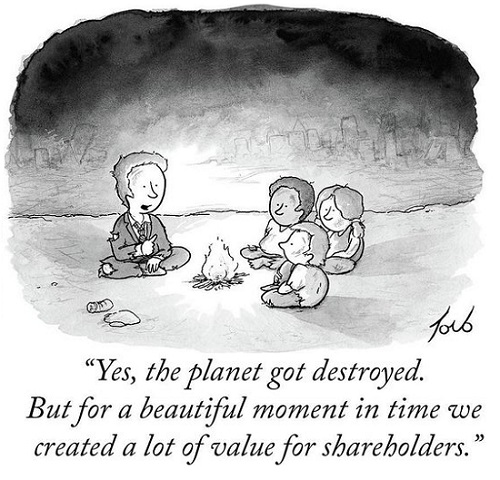
In the second, a man in a tattered suit sits cross-legged near a campfire with three children listening to him intently as he says this: “Yes, the planet got destroyed. But for a beautiful moment in time we created a lot of value for shareholders.”

Now, in the you-can’t-make-this-stuff-up category, financial writer Paul Farrell used the caption from the first cartoon in a 2015 piece for MarketWatch entitled: “Your No. 1 end-of-the-world investing strategy.” The subheading is: “How to pick stocks for the near term when long-term trends say collapse is near.” The subhead actually seems like it might be another caption from a New Yorker cartoon (or possibly one from The Onion). Why exactly would you invest in stocks—as opposed to seeds of food crops and sturdy garden implements—”when long-term trends say collapse is near”? But I’ll put that down to bad headline writing.

In Farrell’s defense, he frequently used his column in MarketWatch to warn his readers of the coming collapse of modern civilization if we don’t change our ways. He was obliged to give investment advice, of course, because that’s what the column was for.

Few other investment gurus are as intellectually honest as Farrell. Among prominent investment managers, only Jeremy Grantham comes close to understanding the scope of the challenges we face. Grantham wrote a piece in 2013 called “The Race of Our Lives” that outlines the myriad challenges humans face. He starts with a discussion of the fall of civilizations. (He updated his views in 2018.)

One would think that the coronavirus pandemic would allow for some sober reflection among those in the financial community as the pandemic-induced crash of the economy and the markets has called into question the stability of practically all the arrangements of modern civilization. Instead, the focus is on how stock markets could be back at or near all-times highs at the beginning of what is arguably the next Great Depression.

The New Yorker cartoons linked above appropriately characterize the madness that grips late-stage civilizations as their pillars begin to fall. Instead of attempting to adapt to new realities, every attempt is made to maintain the current fragile system. The trillions of dollars pumped into the world financial system by central banks and governments in the wake of the pandemic have done little except stoke renewed financial bubbles in practically all financial markets (and thereby bailed out the mostly wealthy owners of financial assets).

The disconnect is hard to miss. The latest reading of the U.S. Federal Reserve Bank of Atlanta’s GDPNow indicator, which is frequently updated as new data becomes available, now predicts that U.S. GDP will contract by 45.5 percent in the current quarter. (The number is annualized and seasonally adjusted.)

Even so the NASDAQ Composite Index hit a new all-time high earlier this month just three months after the recent trough reached during the crash. The S&P 500 is now very close to a new all-time high. Neither development makes sense in the middle of the worst economic downturn since the Great Depression. For comparison, it took more than two years for the NASDAQ Composite from the bottom in 2009 during the Great Financial Crisis to regain its 2007 highs. It took the S&P 500 more than four years.

Of course, the financialization of everything continues. Vaccine makers are in line for government funds. Naturally, it takes money to develop a vaccine. But drug makers aren’t in the business of keeping people healthy. They are in the business of making money. In the United States at least they are helped by the fact that they aren’t liable if their vaccine kills or injuries someone. And, executives in one money-losing pharmaceutical firm cashed in stock right after their company goosed the shares significantly higher with a very preliminary announcement about the company’s coronavirus vaccine research.

When it comes to real estate, it used to be that people bought it for income and as a store of value. Now firms buy real estate mostly with borrowed money and try to make gains mostly through property price appreciation. Often the real estate loans are packaged into securities that are sold and resold as part of the giant Wall Street and worldwide financial casino.

One of the surest signs of the financialization of everything and the growing disconnect of finance from reality is the credit default swap (CDS). The CDS is essentially insurance for loans and bonds. The buyer pays the seller a premium every month. If the instrument insured defaults, the seller provides a predetermined payment to reimburse the CDS buyer. Now here’s the weird thing: An investor doesn’t even have to own the loan or bond to insure it. It’s like me taking out an insurance policy on your home against fire when I have no ownership or interest in the home. In fact, I have every incentive to make sure your house burns down. Do you see any problem with that?

For normal insurance, the buyer must have an insurable interest. Typically, this means the buyer must actually own the thing he or she is insuring. The CDS, on the other hand, is an ideal instrument for those who want to bring on a financial end-of-the-world scenario. The buyers have every reason to want the economy to go down the drain as their payments may be 10 or even 20 times their initial investment.

Many wealthy people fear and even believe an end-of-the-world scenario is possible or probable. Some think they can hold up in luxury bunkers until the dust clears. But what if, when the dust clears, their wealth is gone and the financial world they used to inhabit has vanished.

Perhaps they will sit around campfires telling their grandchildren about the old days when finance was king and the real economy of goods and services was just a place where rubes got their daily bread—while, of course, simultaneously providing an outsized portion to the rich.

Another Bank Bailout Under Cover of a Virus

By Ellen Brown

Source: Web of Debt

Insolvent Wall Street banks have been quietly bailed out again. Banks made risk-free by the government should be public utilities.  

When the Dodd Frank Act was passed in 2010, President Obama triumphantly declared, “No more bailouts!” But what the Act actually said was that the next time the banks failed, they would be subject to “bail ins” – the funds of their creditors, including their large depositors, would be tapped to cover their bad loans.

Then bail-ins were tried in Europe. The results were disastrous.

Many economists in the US and Europe argued that the next time the banks failed, they should be nationalized – taken over by the government as public utilities. But that opportunity was lost when, in September 2019 and again in March 2020, Wall Street banks were quietly bailed out from a liquidity crisis in the repo market that could otherwise have bankrupted them. There was no bail-in of private funds, no heated congressional debate, and no public vote. It was all done unilaterally by unelected bureaucrats at the Federal Reserve.

“The justification of private profit,” said President Franklin Roosevelt in a 1938 address, “is private risk.” Banking has now been made virtually risk-free, backed by the full faith and credit of the United States and its people. The American people are therefore entitled to share in the benefits and the profits. Banking needs to be made a public utility.

The Risky Business of Borrowing Short to Lend Long

Individual banks can go bankrupt from too many bad loans, but the crises that can trigger system-wide collapse are “liquidity crises.” Banks “borrow short to lend long.” They borrow from their depositors to make long-term loans or investments while promising the depositors that they can come for their money “on demand.” To pull off this sleight of hand, when the depositors and the borrowers want the money at the same time, the banks have to borrow from somewhere else. If they can’t find lenders on short notice, or if the price of borrowing suddenly becomes prohibitive, the result is a “liquidity crisis.”

Before 1933, when the government stepped in with FDIC deposit insurance, bank panics and bank runs were common. When people suspected a bank was in trouble, they would all rush to withdraw their funds at once, exposing the fact that the banks did not have the money they purported to have. During the Great Depression, more than one-third of all private US banks were closed due to bank runs.

But President Franklin D. Roosevelt, who took office in 1933, was skeptical about insuring bank deposits. He warned, “We do not wish to make the United States Government liable for the mistakes and errors of individual banks, and put a premium on unsound banking in the future.” The government had a viable public alternative, a US postal banking system established in 1911. Postal banks became especially popular during the Depression, because they were backed by the US government. But Roosevelt was pressured into signing the 1933 Banking Act, creating the Federal Deposit Insurance Corporation that insured private banks with public funds.

Congress, however, was unwilling to insure more than $5,000 per depositor (about $100,000 today), a sum raised temporarily in 2008 and permanently in 2010 to $250,000. That meant large institutional investors (pension funds, mutual funds, hedge funds, sovereign wealth funds) had nowhere to park the millions of dollars they held between investments. They wanted a place to put their funds that was secure, provided them with some interest, and was liquid like a traditional deposit account, allowing quick withdrawal. They wanted the same “ironclad moneyback guarantee” provided by FDIC deposit insurance, with the ability to get their money back on demand.

It was largely in response to that need that the private repo market evolved. Repo trades, although technically “sales and repurchases” of collateral, are in effect secured short-term loans, usually repayable the next day or in two weeks. Repo replaces the security of deposit insurance with the security of highly liquid collateral, typically Treasury debt or mortgage-backed securities. Although the repo market evolved chiefly to satisfy the needs of the large institutional investors that were its chief lenders, it also served the interests of the banks, since it allowed them to get around the capital requirements imposed by regulators on the conventional banking system. Borrowing from the repo market became so popular that by 2008, it provided half the credit in the country. By 2020, this massive market had a turnover of $1 trillion a day.

Before 2008, banks also borrowed from each other in the fed funds market, allowing the Fed to manipulate interest rates by controlling the fed funds rate. But after 2008, banks were afraid to lend to each other for fear the borrowing banks might be insolvent and might not pay the loans back. Instead the lenders turned to the repo market, where loans were supposedly secured with collateral. The problem was that the collateral could be “rehypothecated,” or used for several loans at once; and by September 2019, the borrower side of the repo market had been taken over by hedge funds, which were notorious for risky rehypothecation. Many large institutional lenders therefore pulled out, driving the cost of borrowing at one point from 2% to 10%.

Rather than letting the banks fail and forcing a bail-in of private creditors’ funds, the Fed quietly stepped in and saved the banks by becoming the “repo lender of last resort.” But the liquidity crunch did not abate, and by March the Fed was making $1 trillion per day available in overnight loans. The central bank was backstopping the whole repo market, including the hedge funds, an untenable situation.

In March 2020, under cover of a national crisis, the Fed therefore flung the doors open to its discount window, where only banks could borrow. Previously, banks were reluctant to apply there because the interest was at a penalty rate and carried a stigma, signaling that the bank must be in distress. But that concern was eliminated when the Fed announced in a March 15 press release that the interest rate had been dropped to 0.25% (virtually zero). The reserve requirement was also eliminated, the capital requirement was relaxed, and all banks in good standing were offered loans of up to 90 days, “renewable on a daily basis.” The loans could be continually rolled over. And while the alleged intent was “to help meet demands for credit from households and businesses at this time,” no strings were attached to this interest-free money. There was no obligation to lend to small businesses, reduce credit card rates, or write down underwater mortgages.

The Fed’s scheme worked, and demand for repo loans plummeted. Even J.P. Morgan Chase, the largest bank in the country, has acknowledged borrowing at the Fed’s discount window for super cheap loans. But the windfall to Wall Street has not been shared with the public. In Canada, some of the biggest banks slashed their credit card interest rates in half, from 21 percent to 11 percent, to help relieve borrowers during the COVID-19 crisis. But US banks have felt no such compunction. US credit card rates dropped in April only by half a percentage point, to 20.15%. The giant Wall Street banks continue to favor their largest clients, doling out CARES Act benefits to them first, emptying the trough before many smaller businesses could drink there.

In 1969, Prime Minister Indira Gandhi nationalized 14 of India’s largest banks, not because they were bankrupt (the usual justification today) but to ensure that credit would be allocated according to planned priorities, including getting banks into rural areas and making cheap financing available to Indian farmers.  Congress could do the same today, but the odds are it won’t. As Sen. Dick Durbin said in 2009, “the banks … are still the most powerful lobby on Capitol Hill. And they frankly own the place.”

Time for the States to Step In

State and local governments could make cheap credit available to their communities, but today they too are second class citizens when it comes to borrowing. Unlike the banks, which can borrow virtually interest-free with no strings attached, states can sell their bonds to the Fed only at market rates of 3% or 4% or more plus a penalty. Why are elected local governments, which are required to serve the public, penalized for shortfalls in their budgets caused by a mandatory shutdown, when private banks that serve private stockholders are not?

States can borrow from the federal unemployment trust fund, as California just did for $348 million, but these loans too must be paid back with interest, and they must be used to cover soaring claims for state unemployment benefits. States remain desperately short of funds to repair holes in their budgets from lost revenues and increased costs due to the shutdown.

States are excellent credit risks – far better than banks would be without the life-support of the federal government. States have a tax base, they aren’t going anywhere, they are legally required to pay their bills, and they are forbidden to file for bankruptcy. Banks are considered better credit risks than states only because their deposits are insured by the federal government and they are gifted with routine bailouts from the Fed, without which they would have collapsed decades ago.

State and local governments with a mandate to serve the public interest deserve to be treated as well as private Wall Street banks that have repeatedly been found guilty of frauds on the public. How can states get parity with the banks? If Congress won’t address that need, states can borrow interest-free at the Fed’s discount window by forming their own publicly-owned banks. For more on that possibility, see my earlier article here.

As Buckminster Fuller said, “You never change things by fighting the existing reality. To change something, create a new model that makes the old model obsolete.” Post-COVID-19, the world will need to explore new models; and publicly-owned banks should be high on the list.

Re-Opening the Economy Won’t Fix What’s Broken


By Charles Hugh Smith

Source: Of Two Minds

Re-opening a fragile, brittle, bankrupt, hopelessly perverse and corrupt “normal” won’t fix what’s broken.

The stock market is in a frenzy of euphoria at the re-opening of the economy. Too bad the re-opening won’t fix what’s broken. As I’ve been noting recently, the real problem is the systemic fragility of the U.S. economy, which has lurched from one new extreme to the next to maintain a thin, brittle veneer of normalcy.

Fragile economies cannot survive any impact with reality that disrupts the distortions that are keeping the illusion of “growth” from shattering. For the past two decades, every collision with reality cracked the illusion, and the “fix” was to duct-tape the pieces together with new extremes of money-creation, debt, risk and speculative excess.

While the stock market has soared, the real world falls apart. If your region needs a new bridge built, count on about 20 years to get all the “stakeholders” to agree and get the thing actually built. Count on the cost quintupling from $500 million to $2.5 billion. Count on corners being cut as costs skyrocket, so those cheap steel bolts from China that are already rusting before the bridge is even finished? Oops. Replacing them will add millions to the already bloated budget.

Want to add a passenger stop on an existing railroad line? Count on 20 years to get it done. The complexity thicket of every regulatory agency with the power to say “no” basically guarantees the project will never get approved, because every one of these bureaucracies justifies its existence by saying “no.” Sorry, you need another study, another environmental review, and so on.

Need a new landfill? I hope you started the process 15 years ago, so you’ll get approval in only five more years. Every agency with the power to say “no” will stretch out the approval, so they have guaranteed “work” for another decade or two.

Did your subway fares double? Was the excuse repairing a crumbling system? Did the work get done on budget and on time? You must be joking, right? All the fare increase did was cover the costs of skyrocketing salaries, pensions and administrative costs. Repairs to the tracks and cars– that’s extra. Let’s float a $1 billion bond so nobody have to tighten their belts, and have riders pay for it indirectly, through higher taxes to pay the exorbitant costs of 20 years of interest on the bond.

Have you been thrown off your bicycle by the giant potholes in the city’s “bike lanes”? The city reluctantly admits that these streets that haven’t been maintained for decades–yes, decades. The city once paid for street maintenance out of its general budget, but alas, that’s been eaten up by skyrocketing salaries, pensions and administrative costs, so now we need to float $100 million bond to fund filling potholes. If all goes according to plan (ha-ha), we should be able to re-pave the streets that have been crumbling for 20 years in… the next 20 years.

These real-world examples are just four of thousands of manifestations of a broken system. Rather than make tough choices that drain power and wealth from vested interests, we simply borrow more money, in ever increasing amounts, to keep the entrenched interests and elites happy.

There are two “solutions” in the status quo: dump the debt on taxpayers or on powerless debt-serfs–for example, college students. (See chart below of the $1.6 trillion that’s stripmining student debt-serfs.) Who benefits from selling all the municipal bonds, bundled student loans, etc. to investors starving for a yield above 0.1%? Wall Street, of course.

The problem is that while debt has soared, productivity and earned income have stagnated. The statistical narrative has been ruthlessly gamed to hide the erosion of living standards, but even with the bogus “low inflation” of official statistics, wages for the bottom 95% have stagnated for decades.

Measures of productivity have also been gamed to mask the ugly reality that the vast majority of the U.S. economy is stagnating under the weight of interest payments on debt, mal-investments in speculative gambles, higher junk fees and taxes, crushing regulatory compliance, high costs imposed by monopolies and cartels and a well-cloaked decline in the quality of just about everything the bottom 95% uses or owns.

What little productivity gains have been made have been skimmed by the top 5%. Coupled with the Federal Reserve’s single-minded goosing of the one signaling device it controls, the stock market, the top 0.1% in America own more wealth than the bottom 80%.

If productivity stagnates and winners take all, the wages of the bottom 95% cannot rise. Real wealth is only created by increases in the productivity of labor and capital; everything else is phantom wealth.

The only way stagnant incomes can support more debt is if interest rates decline. Presto, the Fed dropped interest rates to near-zero a decade ago. Of course you and I can’t actually borrow millions for 0.1%; that privilege is reserved for financiers and other financial parasites and predators.

Debt-serfs were able to refinance their crushing mortgages to save a few bucks, and so they can afford to 1) take on more debt and 2) pay higher taxes to fund the ballooning public debt.

Every one of these extremes has increased the systemic fragility of the American economy. This fragility is reflected in the impoverishment of the bottom 95%, the thin line between solvency and bankruptcy, the decay of public trust in institutions run for the benefit of entrenched interests, and the quickening erosion of America’s social contract.

Re-opening a fragile, brittle, bankrupt, hopelessly perverse and corrupt “normal” won’t fix what’s broken.


Private gain must no longer be allowed to elbow out the public good

By Dirk Philipsen

Source: aeon

Adam Smith had an elegant idea when addressing the notorious difficulty that humans face in trying to be smart, efficient and moral. In The Wealth of Nations (1776), he maintained that the baker bakes bread not out of benevolence, but out of self-interest. No doubt, public benefits can result when people pursue what comes easiest: self-interest.

And yet: the logic of private interest – the notion that we should just ‘let the market handle it’ – has serious limitations. Particularly in the United States, the lack of an effective health and social policy in response to the coronavirus disease (COVID-19) outbreak has brought the contradictions into high relief.

Around the world, the free market rewards competing, positioning and elbowing, so these have become the most desirable qualifications people can have. Empathy, solidarity or concern for the public good are relegated to the family, houses of worship or activism. Meanwhile, the market and private gain don’t account for social stability, health or happiness. As a result, from Cape Town to Washington, the market system has depleted and ravaged the public sphere – public health, public education, public access to a healthy environment – in favour of private gain.

COVID-19 reveals a further irrational component: the people who do essential work – taking care of the sick; picking up our garbage; bringing us food; guaranteeing that we have access to water, electricity and WiFi – are often the very people who earn the least, without benefits or secure contracts. On the other hand, those who often have few identifiably useful skills – the pontificators and chief elbowing officers – continue to be the winners. Think about it: what’s the harm if the executive suites of private equity, corporate law and marketing firms closed down during quarantine? Unless your stock portfolio directly profits from their activities, the answer is likely: none. But it is those people who make millions – sometimes as much in an hour as healthcare workers or delivery personnel make in an entire year.

Simply put, a market system driven by private interests never has protected and never will protect public health, essential kinds of freedom and communal wellbeing.

Many have pointed out the immorality of our system of greed and self-centred gain, its inefficiency, its cruelty, its shortsightedness and its danger to planet and people. But, above all, the logic of self-interest is superficial in that it fails to recognise the obvious: every private accomplishment is possible only on the basis of a thriving commons – a stable society and a healthy environment. How did I become a professor at an elite university? Some wit and hard work, one hopes. But mostly I credit my choice of good parents; being born at the right time and the right place; excellent public schools; fresh air, good food, fabulous friends; lots of people who continuously and reliably provide all the things that I can’t: healthcare, sanitation, electricity, free access to quality information. And, of course, as the scholar Robert H Frank at Cornell University so clearly demonstrated in his 2016 book on the myth of the meritocracy: pure and simple luck.

Commenting on how we track performance in modern economies – counting output not outcome, quantity not quality, prices not possibilities – the US senator Robert F Kennedy said in 1968 that we measure ‘everything, in short, except that which makes life worthwhile’. His larger point: freedom, happiness, resilience – all are premised on a healthy public. They rely on our collective ability to benefit from things such as clean air, free speech, good public education. In short: we all rely on a healthy commons. And yet, the world’s most powerful metric, gross domestic product (GDP), counts none of it.

The term ‘commons’ came into widespread use, and is still studied by most college students today, thanks to an essay by a previously little-known American academic, Garrett Hardin, called ‘The Tragedy of the Commons’ (1968). His basic claim: common property such as public land or waterways will be spoiled if left to the use of individuals motivated by self-interest. One problem with his theory, as he later admitted himself: it was mostly wrong.

Our real problem, instead, might be called ‘the tragedy of the private’. From dust bowls in the 1930s to the escalating climate crisis today, from online misinformation to a failing public health infrastructure, it is the insatiable private that often despoils the common goods necessary for our collective survival and prosperity. Who, in this system based on the private, holds accountable the fossil fuel industry for pushing us to the brink of extinction? What happens to the land and mountaintops and oceans forever ravaged by violent extraction for private gain? What will we do when private wealth has finally destroyed our democracy?

The privately controlled corporate market has, in the precise words of the late economics writer Jonathan Rowe, ‘a fatal character flaw – namely, an incapacity to stop growing. No matter how much it grew yesterday it must continue to do so tomorrow, and then some; or else the machinery will collapse.’

To top off the items we rarely discuss: without massive public assistance, late-stage extractive capitalism, turbocharged by private interest and greed, would long be dead. The narrow kind of macroeconomic thinking currently dominating the halls of government and academia invokes a simpleminded teenager who variously berates and denounces his parents, only to come home, time and again, when he is out of ideas, money or support. Boeing, Goldman Sachs, Bank of America, Exxon – all would be bust without public bailouts and tax breaks and subsidies. Every time the private system works itself into a crisis, public funds bail it out – in the current crisis, to the tune of trillions of dollars. As others have noted, for more than a century, it’s a clever machine that privatises gains and socialises costs.

When private companies are back up and running, they don’t hold themselves accountable to the public who rescued them. As witnessed by activities since the 2008 bailouts at Wells Fargo, American Airlines and AIG, companies that have been rescued often go right back to milking the public.

By focusing on private market exchanges at the expense of the social good, policymakers and economists have taken an idea that is good under clearly defined and very limited circumstances and expanded it into a poisonous and blind ideology. Now is the time to assert the obvious: without a strong public, there can be no private. My health depends on public health. My freedom depends on social freedom. The economy is embedded in a healthy society with functional public services, not the other way around.

This moment of pain and collapse can serve as a wakeup call; a realisation that the public is our greatest good, not the private. Look outside the window to see: without a vibrant and stable public, life can quickly get poor, nasty, brutish and short.

Corporate Looting as ‘Rescue Plan,’ Robber Barons as ‘Saviors’

By Joshua Cho

Source: FAIR.org

For a perfect illustration of how corporate media function as ruling class propaganda, watch how they spin a titanic upward redistribution of wealth as a “rescue plan” for the US economy, and paint a robber baron like US Treasury Secretary Steve Mnuchin as a “savior” of the American public.

In discussions of the (officially) estimated $2.2 trillion Coronavirus Aid, Relief and Economic Security (CARES) Act—the largest government spending program in US history—before it was signed into law on March 27, corporate media largely abandoned the pretense of serving as watchdogs on behalf of the public in order to advocate for protecting and enriching the fortunes of their owners.

Instead of scrutinizing the bill as the robbery in progress that it is—as an understandable story with identifiable victims and victimizers—corporate media sold the CARES Act as an urgent necessity required to combat the coronavirus pandemic for everyone. Like the previous corporate bailout during the Great Recession (Extra!, 1/09), corporate media avoided raising questions about the necessity of having the government bail out large corporations, or whether the bill could be restructured to serve people rather than profits.

According to the Committee for a Responsible Budget, while the CARES Act dedicated $290 billion in direct payments to people and $260 billion in expanded unemployment benefits, it dedicated $300 billion in tax breaks and $875 billion in loans to big and small businesses—more than two dollars for corporations for every dollar for people, in other words.

When corporate media reported on negotiations and deliberations over the CARES Act, they either hailed it as a bipartisan achievement, or else shamed politicians who accurately pointed out that it overwhelmingly benefited corporations at the expense of workers. On the day the CARES Act was signed into law, NPR (3/27/20) praised the bill as “the largest rescue package in American history and a major bipartisan victory for Congress.”

Reporting in real-time, the Washington Post (3/24/20) spun the CARES Act as an attempt to “address the coronavirus crisis,” with the aim of “flooding the economy with capital to revive businesses and households.” When there was Democratic pushback over the Senate GOP bill for being “disproportionately tilted toward helping companies,” the Post described this as “partisan rancor and posturing on Capitol Hill” that blocked “the rescue bill.” The Post concern-trolled those who supported better legislation, and derided House Democrats’ putative attempts to chart their own “competing piece of legislation,” because “it could take even longer to arrive at a bipartisan consensus that can pass both chambers and get signed into law.”

The New York Times (3/22/20) made it clear that protecting workers and imposing conditions on handing out trillions in taxpayer dollars were frivolous reasons to oppose the legislation, as the Times cast Senate Democrats as villains for ostensibly opposing the bill because it “failed to adequately protect workers or impose strict enough restrictions on bailed-out businesses.” The Times described the “party-line vote” as a “stunning setback” for both the Trump administration’s “ambitious timeline” and “the rescue package,” and warned Democrats that they “risked a political backlash” if “they are seen as obstructing progress on a measure that is widely regarded as crucial to aid desperate Americans and buttress a flagging economy.”

The Times also drew parallels to the “spectacle in 2008,” when the House defeated a “$700 billion Wall Street bailout that aimed to stabilize the financial system amid a global meltdown.” Even in 2020, the Times is still spinning the upward redistribution of wealth from taxpayers to the big banks that caused the crisis as an ostensible success that saved what corporate media consider to be “the economy” (Extra!, 10/10).

Days later, the Times’ “As Coronavirus Spread, Largest Stimulus in History United a Polarized Senate” (3/26/20) spun the 96-to-0 Senate vote in favor of the bill as a heroic bipartisan compromise on legislation “intended to get the nation through the crippling economic and health disruptions being inflicted on the world by the coronavirus.” The Times leaned into corporate media’s civility fetish designed to demobilize opposition to the Trump regime (FAIR.org, 8/1/18, 12/22/19) when it depicted Democratic opposition to Senate Republicans’ “corporate giveaway” legislation as politically reckless and harmful to the country’s interests:

It was a shocking and politically perilous decision in the middle of a paralyzing national crisis, a moment when lawmakers are traditionally expected to put aside differences for the good of the country, or face a political backlash.

By contrast, in the false balance endemic in news coverage in the Trump era, the Times portrayed Senate Republicans as reasonable leaders who were “willing to momentarily abandon their small-government zeal” in the interest of “sealing a quick deal with Democrats” (GQ, 12/10/19; Washington Post, 4/27/12). Though the legislation didn’t include a necessary suspension of rent, utility and mortgage payments, or guarantee monthly payments, as advised by many economists, the Times spun it as a legislative victory for Senate Democrats:

In the end, Democrats won what they saw as significant improvements in the measure through their resistance, including added funding for healthcare and unemployment, along with more direct money to states. A key addition was tougher oversight on the corporate bailout fund, including an inspector general and congressionally appointed board to monitor it, disclosure requirements for businesses that benefited, and a prohibition on any of the money going to Mr. Trump’s family or his properties — although they could still potentially benefit from other provisions.

The problem with this triumphant Democratic ResistanceTM narrative is that it happens to be false. Politico’s report (3/26/20) on the negotiations over what it also hailed as a “rescue package” revealed that the final bill largely reflected the Senate Republicans’ “unemployment insurance and direct payments schemes” as “originally outlined,” with Sen. Mitch McConnell claiming that the CARES Act was a bill that was “largely, not entirely but largely, produced by Republicans in consultation with the Democratic minority.”

The Democratic leadership’s lack of concern with proper oversight of the bailout funds was also exposed when Speaker Nancy Pelosi chose her first-term congressmember friend Donna Shalala as part of the five-member oversight panel, despite her numerous conflicts of interest, evident lack of expertise or reported interest in the job (American Prospect, 4/18/20).

The American Prospect’s David Dayen has done some of the best reporting on the CARES Act, and he’s observed (3/25/20) how means-testing the $1,200 stimulus payments by basing it off IRS data in 2018 and 2019 was designed to limit the number of Americans who can receive it. The miserly one-time $1,200 stimulus payment will primarily reach Americans who already have direct deposit information on file with the IRS, with the unbanked (who happen to be the poorest) having to wait up to four months for paper checks, and who will be lucky to remain at the same address during that time without a suspension of rent payments.

While Democratic leaders like Pelosi opposed emergency universal basic income—and delayed payments to set up a bureaucracy ostensibly dedicated to make sure wealthy Americans don’t get anything—the richest Americans are in fact receiving an average stimulus payment of $1.7 million in the form of a millionaire tax cut.

Dayen has noted how the official “$500 billion” provided by the CARES Act to bailout large corporations is actually underreporting the enormity of the federal government’s corporate giveaway, as Trump regime officials like Larry Kudlow and Steve Mnuchin admitted their intent to leverage the Federal Reserve’s emergency lending authority to turn $500 billion into a $4.5 trillion money cannon aimed at large corporations.

What was in actuality a $6 trillion spending package had few conditions attached to the largesse given to large corporations, as the money can still go to mergers, executive compensation and paying dividends to shareholders, with no requirement that they keep employing workers to receive this handout.

It’s hard to overstate the injustice and scale of this upward redistribution of wealth. Commenting on 2008’s bailout, economist Richard Wolff (Guardian, 11/4/13) pointed out how funding the bailout through borrowing money effectively transfers wealth upward from regular taxpayers to rich bondholders, because the government is borrowing money from—and paying interest to—large corporations and the rich that it could have taxed them for instead. Rather than letting shareholders be wiped out first, according to the ostensible rules of capitalism—where they are supposed to bear the risk, instead of the government—the government is shoveling money to tax-dodging corporations like Boeing who admit to not needing these funds.

By borrowing the money for a program that prioritizes saving the rich, rather than printing money to fund an emergency universal basic income for the people like Rep. Rashida Tlaib’s proposal, the government is effectively paying the rich for saving them. The fact that these viable alternative stimulus proposals weren’t enacted is inexcusable. Especially when the Federal Reserve is hinting its willingness to increase the money supply by buying unlimited debt to fund the CARES Act, the fact that the necessary funds magically appear to fund corporate bailouts instead of necessary social programs (like Medicare for All) exposes the “How are you going to pay for it?” talking point as a fraud (Extra!, 6/12).

Pam and Russ Martens of Wall Street on Parade (3/26/20) observed how the CARES Act also allows the Fed to create “Special Purpose Vehicles” and hide this money from their balance sheets, allowing them to avoid the FOIA requests used to the expose the enormity of the $29 trillion bailout from 2008, in addition to repealing public meeting and recordkeeping requirements for Fed-related programs. This allows the Fed to evade transparency and accountability by holding meetings in secret.

But when corporate media aren’t busy spinning massive corporate robbery of taxpayer money as a rescue package for “the economy,” they’re busy spinning robber barons like Mnuchin as heroic “saviors” instead. Reuters’ “This Is No 2008: Mnuchin Borrows From Paulson’s Economic Crisis Playbook” (3/20/20) depicted Mnuchin as an unlikely hero thrust into the role of solving the US’ economic woes, as they reported:

US Treasury Secretary Steven Mnuchin has stepped into the breach as the Trump administration’s point man to rescue the economy from coronavirus devastation, taking on the role his former Goldman Sachs boss, Hank Paulson, played over a decade ago.

Mnuchin has closely followed the financial crisis playbook used by Paulson when he led the Treasury Department in 2008, reactivating Federal Reserve credit market backstops and asking Congress for $1 trillion to prop up companies and consumers as the economy grinds to a halt due to the spread of the virus.

Apparently, for Reuters, there is only one “playbook” to be followed for all economic crises: massive taxpayer-funded giveaways to large corporations, and crumbs for everyone else. The report contained praise from official sources praising Mnuchin for being “pragmatic” and “rising to the occasion,” with few questions beyond whether he can succeed in his noble mission, as Reuters wondered whether Mnuchin can “strong-arm executives or influence President Donald Trump to take the drastic steps the unprecedented crisis may demand.” Whether Mnuchin and the Trump regime are actually trying to “rescue the economy” is apparently unquestionable, even though Mnuchin would dismiss record-breaking levels of unemployment as “not relevant” only a few days later (Common Dreams, 3/26/20).

The Wall Street Journal’s “How Mnuchin Became Washington’s Indispensable Crisis Manager” (3/31/20) also peddled this fictitious savior narrative when it reported that “Mnuchin has become Washington’s indispensable deal-maker in trying to keep the crisis from throwing the world’s largest economy into the deepest downturn since the Great Depression,” while shepherding “a pair of rescue bills through Congress.”

The Journal depicted Mnuchin’s ability to retain Trump’s confidence while working with Democrats as something that will be “all the more needed in the weeks ahead as the pandemic is expected to worsen,” in order to “get things done in partisan Washington.” Those “skills” didn’t seem to manifest when additional funding for state and local governments, and expanded food stamp benefits needed to rescue people, were left out of the “Phase 3.5” coronavirus legislation last week (Intercept, 4/22/20).

The Washington Post’s “The Dealmaker’s Dealmaker: Mnuchin Steps In as Trump’s Negotiator, but President’s Doubts Linger With Economy in Crisis” (3/27/20) also praised Mnuchin’s efforts to “bridge divides” and forge bipartisan “agreements.” While to the Post’s credit, the piece noted how the “Treasury Department’s demands have often appeared to represent the interests of big business rather than workers,” its overall thrust was encapsulated by its subhead: “Can his economic rescue plan quickly stabilize an economy headed toward calamity?”

The New York Times’ “How Powell and Mnuchin Became the Duo in Charge of Saving the Economy” (3/31/20) reported on Mnuchin’s “vital partnership” with Fed chair Jerome Powell, echoed the “unlikely hero” narrative, and described their efforts as “critical not only to workers and businesses,” but also to Trump’s “re-election” chances:

The coronavirus poses the most significant economic threat since at least 2008, thrusting Mr. Mnuchin and Mr. Powell into key roles in determining whether the United States economy suffers a short, manageable slowdown or enters a deep and painful recession.

When the Times briefly acknowledged concerns about the massive concentration in power and newfound influence in Powell and Mnuchin’s hands, and questions about the integrity of the “oversight” process, it treated the CARES Act favoring big corporations over workers as a hypothetical scenario, rather than a plain fact.

In a unique situation where workers and small business owners have the shared interest in not being wiped out by the pandemic, how else does one characterize the disproportionately stricter conditions placed on small businesses to retain workers to receive bailout money—while big corporations have no such limitations—except as a plan to save big corporations over workers? The Times’ later reports (4/22/20, 4/26/20) on big corporations receiving bailout money intended for small businesses, and receiving concierge service for coronavirus aid at their expense, should’ve been predictable—as it was to some observers in real time (American Prospect, 3/25/20).

Throughout this coverage, it’s quite telling who counts as “the economy” and what measures are considered “necessary” or “adequate,” because it reveals who corporate media consider to be disposable (working class America), and who needs “saving” (large corporations and the American oligarchy). With the CARES Act, corporate media reversed the narrative in a truly Orwellian fashion, portraying corporate looting of the Treasury as necessary to “rescue the economy,” while the main questions regarding “savior” officials like Mnuchin are whether his plans to “save the economy” can succeed. When 26 million Americans lost their jobs between March 18 and April 22, while the wealth of US billionaires increased by $308 billion (more than 10%), there’s no other way to look at corporate media spin as anything but ruling class propaganda to legitimize saving capital while letting people die (In These Times, 4/6/20).