The Existential Threat of Algorithmic Trading

flatline

Most of us are well aware of the problem of human labor being displaced by technology. The Thought Infection blog recently posted an informative overview of how even jobs we might not immediately think of as being at risk of obsolescence are steadily being encroached upon by technology. In this follow up article, he explains how automation has an especially destabilizing effect on the financial sector and economic system.

Excerpt:

The advent of algorithmic trading extends the game that has always existed in markets, but now the speed is faster, the stakes are higher and we can’t be sure who is in control. 

The manipulation abilities of trading algorithms may already (and if not, soon will) extend beyond this kind of inter-algorithmic effects. Given that trading algorithms can act on human informational sources, such as Twitter, as news is released, it is not outlandish to imagine that these algorithms could also be producing information in an effort to manipulate the market. Given that algorithms are becoming better at turning basic information into natural language, it seems possible that an algorithm could be designed to Tweet out false information about a company to try to depress the stock price.

If we take the ketchup manufacturer again and we imagine they are in a precarious position due to a new bill to remove subsidies for tomato growing. Imagine a bunch of tweet/comment/news bots aimed at pushing the public dialogue to make it seem that the subsidies are going to be removed. If massively parallelized, this kind of attack on public sentiment could have a significant effect on the ketchup manufacturer and provide an opportunity for major profits. I think it’s likely this kind of algorithmic sentiment manipulation is already happening on some level.

Even this kind of sentiment manipulation is only a drop in the bucket compared to what may become possible in the near future. The astounding profits which can be made in this kind of algorithmic trading is driving huge investment in artificial intelligence. In the near future, algorithmic traders will be capable of much more complex manipulations to try to move market prices.

…Perhaps by identifying those congressmen who are on the fence about subsidies, a targeted campaign to manipulate the opinions of those in said congressman’s district could have a real effect on the outcome for ketchup manufacturers. This may seem a bit ridiculous, but even a tiny effect on the perceptions and opinions of one individual can make a big difference if spread across a wide enough group.

Read the full article here: http://thoughtinfection.com/2014/01/05/the-deep-end-of-decoupling-the-existential-threat-of-algorithmic-trading/

What he speculates could be our greatest threat in the future is not Terminator-like cybernetic weapons but “an army of Gordon Gekko-bots capable of manipulating every aspect of our legal and political systems in an aim to maximize market profits.”

Swiss to Vote on Basic Income for All

_71790439_71789396

Switzerland is one of the world’s wealthiest countries per capita, and also one of the most democratic. It’s the only European country with true direct democracy in which all citizens have to do is gather 100,000 signatures calling for a vote to hold a nationwide referendum with a binding result. Last November, Swiss citizens created the so-called 1:12 referendum, which would limit the wages of top executives so they couldn’t earn more in a month than lower paid employees do in a year. That proposal lost the vote, but early next year they’ll have an opportunity to decide on an equally radical referendum: a $2,800 basic income for every adult, whether employed or unemployed. There is currently no minimum wage in Switzerland, but there will also be a vote on that next year.

Anger about salaries and fairness has surged among Swiss voters because some of their biggest banks including UBS are responsible for speculative investment bubbles and continue to pay top executives huge bonuses while reporting huge losses. According to Bloomberg News, Switzerland is home to at least five of Europe’s top 20 paid executives. The inequality pay ratio in Switzerland is 1:194 (while in the U. S., average CEO to average worker compensation was 1:243 in 2010).

The idea of a Basic Income or Universal Wages are not only supported by Marxists and Communists, but have have been gaining traction among Libertarians as well. A great post at Thought Infection recently made an argument for such proposals from a civil libertarian perspective:

Freedom in the 21st century should mean freedom from having to engage in productive work simply to meet your basic needs for comfort and dignity. 

At one time, the ready availability of jobs amply filled the need for a basic access to a comfortable and dignified life, but precipitous technological and economic changes erode this dynamic further each day. The function of the economy has never been to provide gainful employment to people, but simply to provide material goods. As the economy manages to produce more with less human labor, we must create new mechanisms aimed specifically that maintaining and raising the minimum level of comfort and dignity to everyone in a society…

…Worse than just being immoral, the desperate poverty of the lower classes is both immoral and useless. It is not a lack of money that compels the great successes of the modern age, but rather the availability of opportunities. It is because healthy, well-fed people were able to get a good education that allowed us to realize the great miracles of the modern age (eg, the internet, smart phones, Google, etc…). 

We must rebalance the right of society to compel people into productive work with the obligation of society to support its citizens. It should be noted that basic income is not aimed at the unrealisitic and undesirable goal of unfettered access for all to every luxury of the world. Freedom from work does not mean the right to luxury; it simply sets a baseline below which no person should fall. Basic income seeks to strike a fair balance between allowing the benefit of work to coexist with a system aimed at delivering dignity and opportunity for all in a society.

Beyond just better enabling access to opportunities, basic income will also allow people the freedom to live as they choose; to explore unpaid work in the form of volunteering, participating in creative projects, or starting new business ventures. Some argue that there would be less incentive for people to start businesses and be productive, but it could just as easily be argued that it would remove the disincentive from the high-risk, high-reward ventures that are so valuable to modern society…

…Requiring people to live so much of their life working simply to earn a basic income is a waste of human potential and bad for progress. By eliminating the obligation to work just for simple survival, basic income would allow a new dynamic expansion of human freedom and human potential.

A society compelled to perfect cohesion and homogeneity lacks the dynamism to compete in the modern world. New ideas can only come into being at the chaotic interface between contrasting worldviews and lifestyles. In a world where progress is completely reliant on our ability to innovate and create new ideas, we should be seeking to maximize the spectrum of lifestyles which can be expressed within the society. By removing the need to work just to live, we will let people explore their true potential, and we will realize the untold benefits of a new dynamism.  

And this brings us to the real reason that I think basic income will happen soon, not only because it is morally the right thing to do (which it is), but because it makes good sense economically. Just as slavery ended when factories made the economic model of slavery obsolete, we will move towards basic income because it makes good economic sense for the modern innovation economy.

Dynamic, creative and competitive economies of today must seek to stretch the social fabric to its limits. Basic income will serve to reinforce this fabric and enable the risky ventures that will power us forward in the 21st century.

Read the full article here: http://thoughtinfection.com/2013/12/15/basic-income-means-basic-freedom/


83 Numbers From 2013 That Are Almost Too Crazy to Believe

global-economic-crisis

Michael Snyder of The Economic Collapse blog recently compiled a long list of astounding social-economic statistics from the past year. They paint a bleak picture of the future of our current economic system and unless major changes are made, the numbers will only worsen in 2014. There’s probably many more indicators left off the list, but just a small sampling of what’s on it would be enough to worry even the most die-hard optimists:

#1 Most people that hear this statistic do not believe that it is actually true, but right now an all-time record 102 million working age Americans do not have a job.  That number has risen by about 27 million since the year 2000.

#2 Because of the lack of jobs, poverty is spreading like wildfire in the United States.  According to the most recent numbers from the U.S. Census Bureau, an all-time record 49.2 percent of all Americans are receiving benefits from at least one government program each month.

#3 As society breaks down, the government feels a greater need than ever before to watch, monitor and track the population.  For example, every single day the NSA intercepts and permanently stores close to 2 billion emails and phone calls in addition to a whole host of other data.

#4 The Bank for International Settlements says that total public and private debt levels around the globe are now 30 percent higher than they were back during the financial crisis of 2008.

#5 According to a recent World Bank report, private domestic debt in China has grown from 9 trillion dollars in 2008 to 23 trillion dollars today.

#6 In 1985, there were more than 18,000 banks in the United States.  Today, there are only 6,891 left.

#7 The six largest banks in the United States (JPMorgan Chase, Bank of America, Citigroup, Wells Fargo, Goldman Sachs and Morgan Stanley) have collectively gotten 37 percent larger over the past five years.

#8 The U.S. banking system has 14.4 trillion dollars in total assets.  The six largest banks now account for 67 percent of those assets and all of the other banks account for only 33 percent of those assets.

#9 JPMorgan Chase is roughly the size of the entire British economy.

#10 The five largest banks now account for 42 percent of all loans in the United States.

#11 Right now, four of the “too big to fail” banks each have total exposure to derivatives that is well in excess of 40 trillion dollars.

#12 The total exposure that Goldman Sachs has to derivatives contracts is more than 381 times greater than their total assets.

#13 According to the Bank for International Settlements, the global financial system has a total of 441 trillion dollars worth of exposure to interest rate derivatives.

#14 Through the end of November, approximately 365,000 Americans had signed up for Obamacare but approximately 4 million Americans had already lost their current health insurance policies because of Obamacare.

#15 It is being projected that up to 100 million more Americans could have their health insurance policies canceled by the time Obamacare is fully rolled out.

#16 At this point, 82.4 million Americans live in a home where at least one person is enrolled in the Medicaid program.

#17 It is has been estimated that Obamacare will add 21 million more Americans to the Medicaid rolls.

#18 It is being projected that health insurance premiums for healthy 30-year-old men will rise by an average of 260 percent under Obamacare.

#19 One couple down in Texas received a letter from their health insurance company that informed them that they were being hit with a 539 percent rate increase because of Obamacare.

#20 Back in 1999, 64.1 percent of all Americans were covered by employment-based health insurance.  Today, only 54.9 percent of all Americans are covered by employment-based health insurance.

#21 The U.S. government has spent an astounding 3.7 trillion dollars on welfare programs over the past five years.

#22 Incredibly, 74 percent of all the wealth in the United States is owned by the wealthiest 10 percent of all Americans.

#23 According to Consumer Reports, the number of children in the United States taking antipsychotic drugs has nearly tripled over the past 15 years.

#24 The marriage rate in the United States has fallen to an all-time low.  Right now it is sitting at a yearly rate of just 6.8 marriages per 1000 people.

#25 According to a shocking new study, the average American that turned 65 this year will receive $327,500 more in federal benefits than they paid in taxes over the course of their lifetimes.

#26 In just one week in December, a combined total of more than 2000 new cold temperature and snowfall records were set in the United States.

#27 According to the U.S. Census Bureau, median household income in the United States has fallen for five years in a row.

#28 The rate of homeownership in the United States has fallen for eight years in a row.

#29 Only 47 percent of all adults in America have a full-time job at this point.

#30 The unemployment rate in the eurozone recently hit a new all-time high of 12.2 percent.

#31 If you assume that the labor force participation rate in the U.S. is at the long-term average, the unemployment rate in the United States would actually be 11.5 percent instead of 7 percent.

#32 In November 2000, 64.3 percent of all working age Americans had a job.  When Barack Obama first entered the White House, 60.6 percent of all working age Americans had a job.  Today, only 58.6 percent of all working age Americans have a job.

#33 There are 1,148,000 fewer Americans working today than there was in November 2006.  Meanwhile, our population has grown by more than 16 million people during that time frame.

#34 Only 19 percent of all Americans believe that the job market is better than it was a year ago.

#35 Just 14 percent of all Americans believe that the stock market will rise next year.

#36 According to CNBC, Pinterest is currently valued at more than 3 billion dollars even though it has never earned a profit.

#37 Twitter is a seven-year-old company that has never made a profit.  It actually lost 64.6 million dollars last quarter.  But according to the financial markets it is currently worth about 22 billion dollars.

#38 Right now, Facebook is trading at a valuation that is equivalent to approximately 100 years of earnings, and it is currently supposedly worth about 115 billion dollars.

#39 Total consumer credit has risen by a whopping 22 percent over the past three years.

#40 Student loans are up by an astounding 61 percent over the past three years.

#41 At this moment, there are 6 million Americans in the 16 to 24-year-old age group that are neither in school or working.

#42 The “inactivity rate” for men in their prime working years (25 to 54) has just hit a brand new all-time record high.

#43 It is hard to believe, but in America today one out of every ten jobs is now filled by a temp agency.

#44 Middle-wage jobs accounted for 60 percent of the jobs lost during the last recession, but they have accounted for only 22 percent of the jobs created since then.

#45 According to the Social Security Administration, 40 percent of all U.S. workers make less than $20,000 a year.

#46 Approximately one out of every four part-time workers in America is living below the poverty line.

#47 After accounting for inflation, 40 percent of all U.S. workers are making less than what a full-time minimum wage worker made back in 1968.

#48 When Barack Obama took office, the average duration of unemployment in this country was 19.8 weeks.  Today, it is 37.2 weeks.

#49 Investors pulled an astounding 72 billion dollars out of bond mutual funds in 2013.  It was the worst year for bond funds ever.

#50 Small business is rapidly dying in America.  At this point, only about 7 percent of all non-farm workers in the United States are self-employed.  That is an all-time record low.

#51 The six heirs of Wal-Mart founder Sam Walton have as much wealth as the bottom one-third of all Americans combined.

#52 Once January 1st hits, it will officially be illegal to manufacture or import traditional incandescent light bulbs in the United States.  It is being projected that millions of Americans will attempt to stock up on the old light bulbs before they are totally gone from store shelves.

#53 The Japanese government has estimated that approximately 300 tons of highly radioactive water is being released into the Pacific Ocean from the destroyed Fukushima nuclear facility every single day.

#54 Back in 1967, the U.S. military had more than 31,000 strategic nuclear warheads.  That number is already being cut down to 1,550, and now Barack Obama wants to reduce it to only about 1,000.

#55 As you read this, 60 percent of all children in Detroit are living in poverty and there are approximately 78,000 abandoned homes in the city.

#56 Wal-Mart recently opened up two new stores in Washington D.C., and more than 23,000 people applied for just 600 positions.  That means that only about 2.6 percent of the applicants were ultimately hired.  In comparison, Harvard offers admission to 6.1 percent of their applicants.

#57 At this point, almost half of all public school students in America come from low income homes.

#58 Tragically, there are 1.2 million students that attend public schools in the United States that are homeless.  That number has risen by 72 percent since the start of the last recession.

#59 According to a Gallup poll that was recently released, 20.0 percent of all Americans did not have enough money to buy food that they or their families needed at some point over the past year.  That is just under the all-time record of 20.4 percent that was set back in November 2008.

#60 The number of Americans on food stamps has grown from 17 million in the year 2000 to more than 47 million today.

#61 Right now, one out of every five households in the United States is on food stamps.

#62 The U.S. economy loses approximately 9,000 jobs for every 1 billion dollars of goods that are imported from overseas.

#63 Back in 1950, more than 80 percent of all men in the United States had jobs.  Today, less than 65 percent of all men in the United States have jobs.

#64 According to one survey, approximately 75 percent of all American women do not have any interest in dating unemployed men.

#65 China exports 4 billion pounds of food to the United States every year.

#66 Overall, the United States has run a trade deficit of more than 8 trillion dollars with the rest of the world since 1975.

#67 The number of Americans on Social Security Disability now exceeds the entire population of Greece, and the number of Americans on food stamps now exceeds the entire population of Spain.

#68 It is being projected that the number of Americans on Social Security will rise from 57 million today to more than 100 million in 25 years.

#69 Back in 1970, the total amount of debt in the United States (government debt + business debt + consumer debt, etc.) was less than 2 trillion dollars.  Today it is over 56 trillion dollars.

#70 Back on September 30th, 2012 our national debt was sitting at a total of 16.1 trillion dollars.  Today, it is up to 17.2 trillion dollars.

#71 The U.S. government “rolled over” more than 7.5 trillion dollars of existing debt in fiscal 2013.

#72 If the U.S. national debt was reduced to a stack of one dollar bills it would circle the earth at the equator 45 times.

#73 When Barack Obama was first elected, the U.S. debt to GDP ratio was under 70 percent.  Today, it is up to 101 percent.

#74 The U.S. national debt is on pace to more than double during the eight years of the Obama administration.  In other words, under Barack Obama the U.S. government will accumulate more debt than it did under all of the other presidents in U.S. history combined.

#75 The federal government is borrowing (stealing) roughly 100 million dollars from our children and our grandchildren every single hour of every single day.

#76 At this point, the U.S. already has more government debt per capita than Greece, Portugal, Italy, Ireland or Spain.

#77 Japan now has a debt to GDP ratio of more than 211 percent.

#78 As of December 5th, 83 volcanic eruptions had been recorded around the planet so far this year.  That is a new all-time record high.

#79 53 percent of all Americans do not have a 3 day supply of nonperishable food and water in their homes.

#80 Violent crime in the United States was up 15 percent last year.

#81 According to a very surprising survey that was recently conducted, 68 percent of all Americans believe that the country is currently on the wrong track.

#82 Back in 1972, 46 percent of all Americans believed that “most people can be trusted”.  Today, only 32 percent of all Americans believe that “most people can be trusted”.

#83 According to a recent Pew Research survey, only 19 percent of all Americans trust the government.   Back in 1958, 73 percent of all Americans trusted the government. [While it’s unfortunate we can’t trust government, it’s a good thing that more are now aware of reasons why we shouldn’t trust it.]


War on the Poor Continues With Planned Pension Cuts in Detroit and Illinois

130614134247-detroit-protest-620xa

Yesterday Federal bankruptcy court judge Steven Rhodes ruled that Detroit is insolvent and eligible for a Chapter 9 debt restructuring. This gives the city the go-ahead to cut retirement benefits as part of its restructuring plan, despite pensions being explicitly protected by the state constitution.

Learn more about the situation in Detroit at Detroit Inquiry.

Judge Rhodes’s decision serves as a precedent for city and state governments across the country to carry out a similar policies. Just hours after the Detroit ruling, both chambers of the Illinois legislature also passed an unconstitutional pension reform bill that would steal money from the pension plans Illinois state workers paid for, reduce and suspend cost-of-living increases and limit their salaries.

Such acts of class warfare demonstrate how the government/corporate machine views the 99% as merely a source of wealth and cannon fodder. Once they find cheaper labor and more prosperous markets elsewhere and once soldiers return home after fighting their wars, we’re worth even less to them. Judging from their actions, the corporatocracy has no loyalty, trust and respect for us. Why should we give them any loyalty, trust and respect if it’s not reciprocated?

Detroit Bankruptcy Timeline:

2011

March 16: Michigan’s Public Act 4 emergency manager law goes into effect.

Nov. 16: Detroit Mayor Dave Bing says the city could run out of cash by April 2012 and have a potential shortfall of $45 million by the end of the fiscal year June 30.

Dec. 2: State Treasurer Andy Dillon orders a preliminary financial review of Detroit. The move sparks protests against Michigan Public Act 4, the emergency manager law that expanded EM powers.

Dec. 21: Dillon announces “probable financial stress” in Detroit and recommends Snyder send a team to review city finances.

2012

Jan. 10: Former State Treasurer Andy Dillon gives Mayor Dave Bing until the first week of February to submit a financial plan to avoid an emergency manager.

March 13: A 25-page proposed consent agreement is given to the City Council.

March 21: A state review team declares Detroit in a “severe financial emergency.”

March 23: The Michigan Court of Appeals reverses an Ingham County judge’s ruling that barred the state from entering a consent agreement with Detroit.

April 4: The City Council, 5-4, approves a consent agreement.

April 5: Gov. Rick Snyder and Bing sign the agreement.

June 15: A nine-member oversight board created under the consent agreement holds its first meeting.

Aug. 2: A proposed repeal of Public Act 4 is placed on the Nov. 6 ballot and the law immediately is suspended. Public Act 72, the prior 1990 law that grants fewer powers to emergency financial mangers, is reinstated.

Nov. 7: Public Act 4 is repealed in the general election.

Dec. 10: Detroit’s Financial Advisory Board calls for a 30-day review of the city’s finances under Public Act 72.

Dec. 14: A state review of Detroit finances finds “a serious financial problem.”

Dec. 27: Snyder signs a new emergency manager bill, Public Act 436, which is to take effect March 28.

2013

Jan. 3: An audit shows Detroit has a $327 million accumulated deficit as of June 30.

Feb. 19: A state team reviewing Detroit’s finances determines the city is in a financial emergency with “no satisfactory” plan to resolve it.

March 1: Snyder announces plans to bring an emergency manager to Detroit.

March 9: The council makes a formal request for an appeal hearing in Lansing.

March 12: Detroit officials fail to convince the state’s Emergency Loan Board that a satisfactory plan in place to address Detroit’s fiscal crisis without an emergency manager.

March 14: Snyder appoints Kevyn Orr as Detroit emergency manager. He takes office March 25 for the job, which pays $275,000 per year. State officials hope he can complete his job within 18 months.

March 26: Public Act 436 goes into effect and opponents file a lawsuit in U.S. District Court in Detroit, arguing the legislation deprives citizens of “constitutionally protected rights” and dilutes their vote.

May 13: Orr submits a preliminary financial and operating plan to the state Treasury Department, saying Detroit’s cash-flow crisis makes it “insolvent.”

June 14: Orr unveils to creditors his plans to restructure the city’s finances and avoid bankruptcy.

June 20: Orr holds closed-door meetings with union officials to discuss a restructuring proposal that includes health care and pension cuts and launches a probe of the city’s pension funds amid concerns about corruption, spending and management.

July 5: The city files a lawsuit against Syncora Guarantee Inc., in an attempt to recover $11 million a month in casino payments and taxes that Detroit claims are being improperly withheld by the insurance company.

July 15: Orr submits a quarterly financial report to the state saying the city’s financial condition “continues to be dire.”

July 17: The city’s two pension funds sue Snyder July 17 to block him from authorizing what would be the biggest municipal bankruptcy in U.S. history on claims it would violate retirees’ constitutional right to a pension.

July 18: Orr files a petition for municipal bankruptcy in U.S. District Court’s Eastern District in Detroit.

July 19: The case is assigned to U.S. Bankruptcy Judge Steven Rhodes.

July 24: Rhodes freezes all lawsuits against the city challenging the legality of Detroit’s bankruptcy filing.

Aug. 2: Rhodes creates a committee to represent city retirees.

Aug. 5: Orr announces he has contracted with Christie’s, the New York-based international auction house, to appraise the collection of the Detroit Institute of Arts.

Aug. 13: Chief U.S. District Judge Gerald Rosen is appointed to mediate disputes between the city and creditors.

Sept. 26: An audit commissioned by Orr reveals the city’s pension funds lost more than $125 million on real estate deals and gave questionable bonus payments to employees.

Oct. 9: Gov. Rick Snyder is questioned under oath about his decision to authorize the largest municipal bankruptcy in U.S. history. Snyder is the first sitting governor in modern Michigan history to face a sworn deposition.

Oct. 11: Orr announces the city has secured a $350 million loan agreement with Barclays to pay off a pension related-debt and finance city service improvements while Detroit is in bankruptcy.

Oct. 15: In a report to Dillon, Orr says the city’s financial condition remains dire but cash flow improved during the first quarter since the bankruptcy filing.

Oct. 25: Detroit’s eligibility trial begins before Judge Rhodes in Detroit’s federal courthouse.

Nov. 6: Judge Rhodes denies the NAACP’s request to pursue a lawsuit against Gov. Rick Snyder’s administration over the constitutionality of the emergency manager law.

Nov. 8: The city’s nine-day eligibility trial ends.

Nov. 8: Orr postpones a proposed health care initiative for retirees until Feb. 28 under an agreement with the city and retiree committee created through bankruptcy proceedings.

Nov. 13: A city union representing Detroit’s EMTs reaches a five-year, out-of-court contract agreement with Orr.

Nov. 25: Rhodes in a court filing announces he will decide Dec. 3 whether Detroit can proceed with its Chapter 9 bankruptcy filing.

Nov. 26: A group of creditors ask for an independent evaluation of the Detroit Institute of Arts collection.

Nov. 27: Judge Rhodes halts Detroit’s efforts to fix its broken streetlight system after discovering one of the city’s law firms involved in the bankruptcy case also represents the new Public Lighting Authority, a potential conflict of interest.

Nov. 27: A trial over Detroit’s plan to seek a $350 million bankruptcy loan is pushed back amid new objections by creditors. Judge Rhodes and attorneys representing the city and several creditors agreed in principle to delay the trial to Dec. 17-19.

Dec. 3: Rhodes delivers decision on bankruptcy eligibility.

(Timeline: Associated Press)

Economic Bubbles Take From the Poor, Give to the Rich

sachs-bubbles

At the Economic Populist Blog, Robert Oak posted an excellent analysis of the Pew Research report, A Rise in Wealth for the Wealthy; Declines for the Lower 93%, based on Census data on wealth taken since the so-called economic recovery after 2009. Oak highlighted one of the most important findings of the report:

During the first two years of the nation’s economic recovery, the mean net worth of households in the upper 7% of the wealth distribution rose by an estimated 28%, while the mean net worth of households in the lower 93% dropped by 4%.

In other words, what the report shows is that there was never an economic recovery for most people other than the wealthy 1%. The economic bubble and resultant policies effectively served as a mechanism to transfer wealth from the poor to the wealthy.

According to Michael Snyder at the Economic Collapse blog, it’s extremely likely that we’re about to witness another massive transfer of wealth to the 1% judging from the following 15 signs:

#1 Bob Shiller, one of the winners of this year’s Nobel Prize for economics, says that “bubbles look like this” and that he is “most worried about the boom in the U.S. stock market.”

#2 The total amount of margin debt has risen by 50 percent since January 2012 and it is now at the highest level ever recorded.  The last two times that margin debt skyrocketed like this were just before the bursting of the dotcom bubble in 2000 and just before the financial crisis of 2008.  When this house of cards comes crashing down, things are going to get very messy

“When the tablecloth gets pulled out from under the place settings, you’re going to have a lot of them crash and smash on the floor,” said Uri Landesman, president of Platinum Partners hedge fund. “That margin’s going to get pulled and everyone’s going to have to cover. That’s when you get really serious corrections.”

#3 Since the bottom of the market in 2009, the Dow has jumped 143 percent, the S&P 500 is up 165 percent and the Nasdaq has risen an astounding 213 percent.  This does not reflect economic reality in any way, shape or form.

#4 Market research firm TrimTabs says that the S&P 500 is “very overpriced” right now.

#5 Marc Faber recently told CNBC that “we are in a gigantic speculative bubble”.

#6 In the United States, Google searches for the term “stock bubble” are at the highest level that we have seen since November 2007 – just before the last stock market crash.

#7 Price to earnings ratios are very high right now…

The Dow was trading at 17.8 times the past four quarters of earnings of its 30 components, according to The Wall Street Journal on Friday. That was up from 13.7 times its earnings a year ago. The S&P 500 is trading at 18.7 times earnings. The Nasdaq-100 Index is trading at 21.5 times earnings. At the very least, the ratios are signaling that stock prices are rich.

#8 According to CNBC, Pinterest is currently valued at more than 3 billion dollars even though it has never earned a profit.

#9 Twitter is a seven-year-old company that has never made a profit.  It actually lost 64.6 million dollars last quarter.  But according to the financial markets it is currently worth about 22 billion dollars.

#10 Right now, Facebook is trading at a valuation that is equivalent to approximately 100 years of earnings, and it is currently supposedly worth about 115 billion dollars.

#11 Howard Marks of Oaktree Capital recently stated that he believes that “markets are riskier than at any time since the depths of the 2008/9 crisis”.

#12 As Graham Summers recently noted, retail investors are buying stocks at a level not seen since the peak of the dotcom bubble back in 2000.

#13 David Stockman, a former director of the Office of Management and Budget under President Ronald Reagan, believes that this financial bubble is going to end very badly

“We have a massive bubble everywhere, from Japan, to China, Europe, to the UK.  As a result of this, I think world financial markets are extremely dangerous, unstable, and subject to serious trouble and dislocation in the future.”

#14 Bob Janjuah of Nomura Securities believes that there “could be a 25% to 50% sell off in global stock markets” over the next couple of years.

#15 According to Tyler Durden of Zero Hedge, the U.S. stock market is repeating a pattern that we have seen many times before.  According to him, we are experiencing “a well-defined syndrome of ‘overvalued, overbought, overbullish, rising-yield’ conditions that has appeared exclusively at speculative market peaks – including (exhaustively) 1929, 1972, 1987, 2000, 2007, 2011 (before a market loss of nearly 20% that was truncated by investor faith in a new round of monetary easing), and at three points in 2013: February, May, and today.”

Read the full article here: http://theeconomiccollapseblog.com/archives/15-signs-that-we-are-near-the-peak-of-an-absolutely-massive-stock-market-bubble

Inside the Psyche of the 1%

na50_3514938_1_px_470_

Don Fitz, editor of Synthesis/Regeneration, recently wrote an illuminating overview of what current scientific studies can tell us about psychopaths in positions of power. In the following passage he examines why the psychiatric establishment has focused less on “successful psychopathy” than on other anti-social personality disorders:

The concept of “successful psychopath” is not new. An early text described “complex psychopaths” who were very intelligent and included unscrupulous politicians and businessmen. [6] By the 1970s it was more widely recognized that “this category includes some successful businessmen, politicians, administrators.” [7] In other words, the unsuccessful psychopath might go to jail for swindling dozens of people with home improvement scams while successful psychopaths might swindle millions with bank deals, get bailed out by friends in government, and never spend a day in jail.

Perhaps the most fascinating aspect of the medicalization of the disorder is how the psychiatric establishment departed from science in order to grant partial exemption from being characterized as psychopaths to the wealthy. According to the Diagnostic and Statistical Manual of the American Psychiatric Association, in order to receive a diagnosis of “anti-social personality disorder” (i.e., psychopathy) a person must exhibit at least 3 of 7 listed behavior patterns. These include “arrest,” “physical fights or assaults,” and “failure to sustain consistent work behavior.” [8] This means that those who can pay off cops (or never have charges pressed against them due to their social status), or pay someone else to commit violence on their behalf, or own companies instead of having to work for a living are all less likely to receive an official label of “psychopath.”

An increasing number of psychologists are becoming aware that traditional research was limited by the bias of only looking at people in jail. One wrote that subjects in psychopathy research “were usually institutionalized at the time of testing, and consequently our research may not accurately capture the internal structure and dynamics of the successful antisocial or psychopathic individual.” [9]

Support for the concept of successful and unsuccessful psychopaths is provided by the discovery that the “Psychopathic Personality Disorder” syndrome actually has two factors. [10] Statistical analyses have revealed an “emotional detachment” factor, which includes superficial charm and skill at manipulating others, as well as an “anti-social behavior” factor, which includes poor impulse control and the tendency to engage in activities that are illegal.

Multiple studies have confirmed that run-of-the-mill psychopaths (often studied while in jail) score particularly high on anti-social behavior while successful psychopaths score higher on emotional detachment factors. For example, Babiak [11] looked at “industrial psychopaths” and found that they scored higher on “emotional” factors than “deviant life style” factors. Functioning smoothly in the corporate world, they had a “charming façade” that allowed them to easily manipulate others.

In a study of “disordered personalities at work” other researchers [12] were able to give personality tests to business managers and chief executives. They contrasted their personality scores to psychiatric patients and “mentally disordered offenders.” Compared to the mental patients, the corporate executives showed greater “emotional” components of personality disorder and less “acting out” (such as aggressiveness).

There were no clear-cut differences between “psychopaths” and “normals.”
The authors concluded that “participants drawn from the non-clinical population [i.e., business managers] had scores that merged indiscernibly with clinical distributions.” There were no clear-cut differences between “psychopaths” and “normals.” The most likely explanation of psychopathy is that, like any other personality dimension, it has a bell-shaped curve: a few people have almost none of the characteristics, most people have some characteristics of psychopathy, and a few people have a lot. The most visible outlets for people high on psychopathy scales are petty con artists and corporate conniving. Operating in different worlds, their psychopathy expresses itself in different ways.

Now that it is clear that a streak of psychopathy runs through the 1%, it would be worthwhile to go back to those who espouse that “there is no ethic which requires we treat him [the psychopath] as we treat other adults” and ask if that would apply to corporate psychopaths as well. Will editors of scholarly volumes seek out articles heaping abuse on the 1% with the same vigor with which they find articles despising prison inmates? Will academics proclaim that “public health needs” dictate that we suspend civil liberties of corporate executives even if they “have not been convicted of any crime?” Will professors compare the “needed treatment” of the 1% to the “necessary slaughter” of animals?

Since academics know very well where funding for their research comes from, my guess is that they will be a wee bit less harsh on the corporate class than the jailed burglar who provides no grant money. We can be confident that the Tea Party will not be proposing that, if corporate psychopaths who blast the tops off of mountains wreak a thousand times the havoc of petty thieves who steal copper wire from air conditioners, then their punishments should be 1000 times as great.

Yet, it is important not to overstate the evidence and suggest that every capitalist is a psychopath. Not all corporate executives score high on scales of psychopathy. This is likely because many actually believe their ideology of greed makes for a better world.

Fitz also offers plausible explanations for various studies indicating that, on average, test subjects of a higher income have lower levels of empathy while test subjects of a lower income have higher levels of empathy:

Compassion reflects the opposite of psychopathy. When those with wealth and power plan to strangle social security, they never say they intend to hurt people, but rather they want to help them stand on their own. When corporations drive native people from forests, they tell us it is part of their grand scheme to stop climate change. Are we to believe that they are just as compassionate as everyone else…but that they reveal their compassion in their own way? There is now good evidence that there are, in fact, class differences in levels of compassion.

Social class could be linked to compassion more than to any other emotion.
By definition, the rich and powerful have more material resources and spend more of their time telling others what to do. Those with fewer material resources get told what to do. As a result, the rich value independence and autonomy while those with less money think of themselves as more interdependent with others. [13] In other words, the rich prize the image of the “rugged individual” while the rest of us focus on what group we belong to.

How do people explain the extremely unequal distribution of wealth? Those with more money attribute it to “dispositional” causes—they believe that people get rich because their personality leads them to work harder and get what they deserve. Those with less money more often attribute inequality to “external” factors—people’s wealth is due largely to events beyond their control, such as being born into a rich family or having good breaks in life. [14]

People with fewer financial resources live in more threatening environments, whether from potential violence, being unable to pay medical bills, or fearing the possibility of being evicted from their homes. This means that social classes differ in the way that they view the world from an early age. Children from less financially secure homes respond to descriptions of threatening and ambiguous social scenarios with higher blood pressure and heart rate. [15] Adults with lower incomes are also more reactive to emotional situations than are those with more money.

This means that people with fewer financial resources are more attentive to others’ emotions. Since low income people are more sensitive to emotional signals, they might pay more attention to the needs of others and show more altruism in response to suffering.

This was the thinking behind research linking higher income to less compassion. In one study people either watched a neutral video or one depicting a child suffering from cancer. People with lower income had more change in their heart rate and reported feeling more compassion. But they did not rate other emotions as higher. Social class could be linked to compassion more than to any other emotion. [16]

In another study, people reported their emotions toward a partner when the two of them went through a hypothetical job interview. Lower income people perceived more distress in their partners and expressed more compassion toward them. Again, they did not report more intense feelings of other emotions. Nor did participants show more compassion toward people with the same income level as their own. [17]

Like most psychological research, these findings are limited by their use of university students. This makes it hard to conclude that their findings apply to those not in school. Of course, it is quite possible that effects would be even stronger in situations that are far more intense than the somewhat mild experiences that occur in psychological laboratories. A greater problem is interpreting psychological findings as showing absolute differences between groups rather than shades of grey.

It would not be accurate to claim that research proves that the 1% have no compassion while all of the 99% do. But it strongly implies that the 1% feel less compassion, whether watching a videotape of suffering or participating in a live social interaction. Also, lab studies are consistent with findings that people with fewer financial resources give a higher proportion of what they do have to charity. In economic game research, they give more to others. [18]

The greatest reason is the huge jump in happiness as people move out of poverty …
This line of research confirms that (1) people with fewer financial resources identify with a larger “in-group;” (2) “attention to and recognition of suffering is a prerequisite step before compassion can take place;” and (3) “moral emotion is not randomly distributed across social classes…” [19] Compassion toward the suffering of others is less likely among the 1%.

He follows this with a recap of studies indicating how once the accumulation of wealth and material possessions get people above poverty level, it generally doesn’t correlate to increased levels of happiness. There tends to be a “tolerance” effect for happiness derived from wealth while social connection and altruism are more important for sustained happiness for most non-psychopaths. In his conclusion, Fitz argues that for corporate psychopaths, obtaining wealth and power is an addiction with harmful consequences for everyone and the entire planet, and it’s a societal problem requiring nothing less than a cultural transformation to solve:

The 1% could easily find compassion getting in their way as their actions affect an increasing number of lives. Gaining enough wealth to move out of poverty makes a significant difference in the life satisfaction of a person who has little. Gaining the same amount of wealth has no effect on the happiness of the very rich. They must grab the wealth of many impoverished people in order to have a perceptible increase in happiness. As for a drug addict, the rush from an increase in material possessions of those who already have more than enough is merely a temporary fix.

Soon they will have to prevent even more from rising out of poverty if they are to get another short-term happiness rush. Whether the rush is from the actual possessions or the power that they manifest, it still won’t be enough. They must increase the rate of wealth accumulation that they push through their veins. If those with spectacular quantities of obscene wealth are to get their next high, they cannot merely snort enough happiness objects to prevent masses of people from rising out of poverty—they have to manipulate markets to grind an ever-increasing number into poverty.

The petty psychopath and the grand corporate psychopath seek happiness through the act of obtaining material possessions as much as having them. A major difference between them is that the grand psychopath has the ability to cause so much harm. Even more important, the amount of harm that corporate psychopaths cause grows at an exponential rate. Their financial schemes are no longer millions or billions, but now trillions. Not content to drive individual farmers off their land, they design trade deals that force entire countries to plow under the ability to feed their own people and replace it with cash crops to feed animals or produce biofuels.

Finding that the pollution of small communities generates insufficient funds, they blow off the tops of mountain ranges for coal, raze boreal forests for tar sands, attack aquatic ecosystems with deep sea drilling, and contaminate massive natural water systems by mining gold or fracking for gas. While the petty psychopath may become proficient enough to become a godfather, the grand psychopath is driven not merely to planetary destruction but to a frenetic increase in the rate of destruction at precisely the moment when the tipping point of climate change is most haunting. A natural question might seem to follow: Would getting rid of the current batch of corporate psychopaths benefit the world greatly? Actually, no. It would do no good whatsoever because what psychologists call the “reward contingencies” of the corporate world would still exist. The fact that capitalism prizes accumulation of wealth by the few at the expense of the many would mean that, even if the worst corporate criminals disappeared, they would soon be replaced by marketplace clones.

Progressives should avoid using the same “categorical” model so adored by right wing theorists for its utility in hating the poor. A much better explanation for psychopathy among the 1% is that the corporate drive to put profits before all else encourages norms of manipulating people without compassion. The more readily corporate leaders succumb to this mind set, the more likely they will be to climb the ladder. As the corporate mentality dominates society, it reproduces its attitudes and expectations of behavior throughout every organization, institution and individual it touches.

In challenging what the market does to our souls, Alan Nasser said it so well:

A certain kind of society tends to produce a certain kind of person. More precisely, it discourages the development of certain human capacities and fosters the development of others. Aristotle, Rousseau, Marx and Dewey were the philosophers who were most illuminating on this. They argued that the postures required by successful functioning in a market economy tend to insinuate themselves into those areas of social intercourse which take place outside of the realm of the market proper. The result, they claimed, was that the arena for potentially altruistic and sympathetic behavior shrinks over time as society is gradually transformed into a huge marketplace. [35]As mentioned, there are differences in compassion and types of psychopathy between high and low income people. But the differences are not large. Perhaps, even in the corporate board room, many feel the old norms of group loyalty. It is also possible that differences are small, not because of the unwillingness of corporate executives to be ultra-manipulative, but because capitalism pushes everyone toward a “use people” mode.

Thus, building a new society involves going beyond equalizing material wealth. It means changing the core nature of interpersonal relationships. This requires vastly reducing the emphasis on material possessions. Relationships of people to people can never flourish as long as relationships of people to objects reign supreme.

As long as society continues to be deeply divided between those who tell others what to do and those who get told, it will not be possible to establish the emotional sharing that is the basis of widespread altruism. If the 1% are to develop the same level of understanding of others that the 99% has, they will need to walk in their shoes. If they continue to be the ones who live their lives telling others what to do while the rest of us continue being told what to do, they will not develop levels of compassion typical of the 99%.

This means that in office jobs, they should be able to share the joys of typing letters rather than ordering others to type for them. If we decide mining is necessary, those who are now the 1% should get to know that work life. In work at home, they should not be excluded from washing toilets but should participate in the same human activities as the rest of society. Creating a world of universal compassion requires a world of shared experiences.

Read the full article here: http://www.greens.org/s-r/60/60-06.html

Rushkoff on the Economy

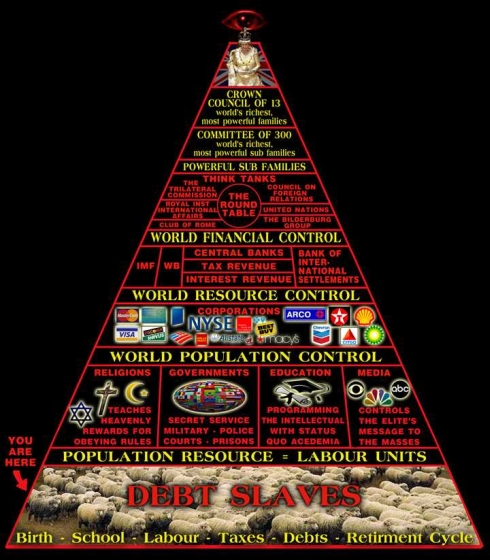
pyramid_of_power

I’ve been reading Douglas Rushkoff’s “Present Shock: When Everything Happens Now” and have by coincidence just reached a chapter of the book covering the topic of currencies and the economy as Washington D.C. attempts to avoid another default. I found similar writings from Rushkoff on the same topic in two articles published by Arthur Magazine. As can be seen from these excerpts, they’re helpful for understanding our current situation:

Local currencies favored local transactions, and worked against the interests of large corporations working from far away. In order to secure their own position as well as that of their chartered monopolies, monarchs began to make local currencies illegal, and force locals to instead use “coin of the realm.” These centralized currencies worked the opposite way. They were not earned into existence, they were lent into existence by a central bank. This meant any money issued to a person or business had to be paid back to the central bank, with interest.

What does that do to an economy? It bankrupts it. Think of it this way: A business borrows 1000 dollars from the bank to get started. In ten years, say, it is supposed to pay back 2000 to the bank. Where does the other 1000 come from? Some other business that has borrowed 1000 from the bank. For one business to pay back what it owes, another must go bankrupt. That, or borrow yet another 1000, and so on.

An economy based on an interest-bearing centralized currency must grow to survive, and this means extracting more, producing more and consuming more. Interest-bearing currency favors the redistribution of wealth from the periphery (the people) to the center (the corporations and their owners). Just sitting on money—capital—is the most assured way of increasing wealth. By the very mechanics of the system, the rich get richer on an absolute and relative basis.

The biggest wealth generator of all was banking itself. By lending money at interest to people and businesses who had no other way to conduct transactions or make investments, banks put themselves at the center of the extraction equation. The longer the economy survived, the more money would have to be borrowed, and the more interest earned by the bank.

[…]Commerce is good. Commerce is not the problem. Monopolies are.

Except in a few rare cases, corporate charters and centralized currency were never intended to promote commerce. They were intended to prevent locals and non-chartered entities from creating and exchanging value. They are not extensions of the free market, but efforts at extracting value from the free market. Corporate monopoly charters were extended to a king’s favorite companies in return for shares. Then, no one else was allowed to do business in that industry. Centralized currency forced businesses to run their revenue through the king’s coffers. Likewise, in its current form, centralized currency is more akin to a ponzi scheme of interest rates, each borrower paying up to the banker above him.

Both of these innovations—corporate charters and centralized currency—tend towards resource exploitation rather than innovation. They are extractive in nature, not productive. And, more importantly, these particular innovations cause wealth to end up being generated through speculation rather than creation. They cause scarcity, not abundance. Over time, it becomes easier to make money by having money than by doing anything. And this was the pure, stated intent of centralized currency and banking in the early Renaissance: to keep the wealthy wealthy, in the face of a rising merchant class.

This isn’t some extremist perspective. It’s just historical fact, though largely forgotten and seemingly refuted by our collective false memory of the Renaissance’s greatness. If you’re interested in finding out more about this, or seeing the evidence on which my research is based, take a look at the best historians writing about the era: Fernand Braudel (The Wheels of Commerce: Civilization and Capitalism: 15th-18th Century, Volume 2, Univ. of California Press, 1992), Carlo M. Cipolla (Before the Industrial Revolution: European Society and Economy, 1000-1700, WW Norton, 1994) or Bernard A. Lietaer, whose book On Human Wealth used to be available for free download off his site, but doesn’t seem to be anymore. In these books, you can find out about the sustainable local economic systems of the Late Middle Ages, learn that the Black Plague actually began after mandated centralized currency had impoverished Europe, and find support of my contention that cathedrals were built with local money before the Renaissance, not Vatican money during the Renaissance.

I highly recommend checking out both articles here (as well as his most recent book “Present Shock”):

http://arthurmag.com/2009/03/16/let-it-die-rushkoff-on-the-economy/

http://arthurmag.com/2009/03/23/hack-money-hack-banking-rushkoff-on-the-economy/

More voices of sanity (Nicole Voss and Laurence Boomert) calling for an overhaul of the monetary system can be heard on the C-Realm podcast :