The Over-Criminalization of American Life

By Charles Hugh Smith

Source: Of Two Minds

The over-criminalization of America has undermined justice, the rule of law and legal egalitarianism.

While the corporate media devotes itself to sports, entertainment, dining out and the latest political kerfuffle, America has become the Over-Criminalization Capital of the World. The proliferation of laws and administrative regulations, federal, state and local, that carry criminal penalties has swollen into the tens of thousands.

The number of incarcerated Americans exceeds 2.3 million, with the majority being non-violent offenders–often for War on Drugs offenses.

Holly Harris has written an important summary of this profoundly destabilizing trend: The Prisoner Dilemma: Ending America’s Incarceration Epidemic (Foreign Affairs, registration required).

The over-criminalization of America is a relatively recent trend. As Harris notes:

It wasn’t always like this. In 1972, for every 100,000 U.S. residents, 161 were incarcerated. By 2015, that rate had more than quadrupled, with nearly 670 out of every 100,000 Americans behind bars.

The over-criminalization of America is rooted in federal laws and regulations, and state and local governments have followed suite. here is Harris’s account:

The burgeoning U.S. prison population reflects a federal criminal code that has spiraled out of control. No one—not even the government itself—has ever been able to specify with any certainty the precise number of federal crimes defined by the 54 sections contained in the 27,000 or so pages of the U.S. Code. In the 1980s, lawyers at the Department of Justice attempted to tabulate the figure “for the express purpose of exposing the idiocy” of the criminal code, as one of them later put it. The best they were able to come up with was an educated guess of 3,000 crimes. Today, the conservative Heritage Foundation estimates that federal laws currently enumerate nearly 5,000 crimes, a number that grows every year.

Overcriminalization extends beyond the law books, partly because regulations are often backed by criminal penalties. That is the case for rules that govern matters as trivial as the sale of grated cheese, the precise composition of chicken Kiev dishes, and the washing of cars at the headquarters of the National Institutes of Health. State laws add tens of thousands more such crimes. Taken together, they push the total number of criminally punishable offenses in the United States into the hundreds of thousands. The long arm of the law reaches into nearly every aspect of American life. The legal scholar Harvey Silverglate has concluded that the typical American commits at least three federal felonies a day, simply by going through his or her normal routine.

Federal policies reward states for building prisons and mandating harsher sentences:

…federal incentives for states that safely decrease their prison populations and reconsider ineffective sentencing regimes…would represent a stark reversal of legislation signed into law by President Bill Clinton in 1994, which did just the opposite, offering federal dollars to states that imposed harsher criminal penalties and built more prisons, which contributed to the explosion of incarceration rates during the past two decades.

How did we become a Gulag Nation of tens of thousands of laws and regulations and mandatory harsh sentences for non-violent crimes–a society imprisoned for administrative crimes that aren’t even tried in our judiciary system? I would suggest two primary sources:

1. The relentless expansion of central-state power over every aspect of life. As I describe in my book Resistance, Revolution, Liberation: A Model for Positive Change, the state has only one ontological imperative: to expand its power and control. There are no equivalent mechanisms for reducing the legal/regulatory burdens imposed by the state; various reforms aimed at reducing the quantity of laws and regulations have not even made a dent in the over-criminalization of America.

The second dynamic is the political reality that the easiest way for politicos to be seen as “doing something” is to pass more laws and regulations criminalizing an additional aspect of life. The state and its elites justify the state’s relentless expansion of power and control by claiming problems can only be solved by centralizing power further and increasing the number and severity of penalties.

Criminalization is the ultimate expansion of the state’s monopoly on coercive violence. As the state expands its power to imprison or punish its citizens for an ever-wider range of often petty infractions, increasingly via a bureaucratic administrative process that strips the citizens of due process, another pernicious dynamic emerges: the informal application and enforcement of formal laws and regulations.

In other words, the laws and regulations are enforced at the discretion of the state’s officials. This is the systemic source of driving while black: a defective tail-light gets an African-American driver pulled over, while drivers of other ethnic origin get a pass.

This is also the source of America’s systemic blind eye on white-collar crimes while the War on Drugs mandates harsh sentences with a cruel vengeance. When there are so many laws and regulations to choose from, government officials have immense discretion over which laws and regulations to enforce.

Prosecutors seeking to increase their body count will use harsh drug laws to force innocents to accept plea bargains, while federal prosecutors don’t even pursue white-collar corporate fraud on a vast scale.

The over-criminalization of America has undermined justice, the rule of law and the bedrock notion that everyone is equal under the law, i.e. legal egalitarianism.

The over-criminalization of America breeds corruption as the wealthy and powerful evade the crushing burden of over-regulation by either buying political favors in our pay-to-play “democracy” (money votes, money wins) or by hiring teams of attorneys, CPAs, etc. to seek loopholes or construct a courtroom defense.

Meanwhile, the peasantry are offered a harsh plea bargain.

The over-criminalization of America is one core reason why the status quo has failed and cannot be reformed. That is the title of one of my short works, Why Our Status Quo Failed and Is Beyond Reform, which explains why the ceaseless expansion of centralized power leads to failure and collapse.


Beyond Violence and Nonviolence

By Ben Case

Source: ROAR Magazine

The argument over violence and nonviolence — one of the oldest and most divisive on the left — is back. Broken windows, mass arrests and one well-timed punch marked Donald Trump’s inauguration alongside massive nonviolent marches. In the weeks since, demonstrators converged on international airports, adding weight to a heated judicial fight over a sweeping ban on refugees and immigrants from seven countries, and fiery protests outside a famed hate-monger’s talk at Berkeley cancelled the event and forced the speaker to flee under police escort.

Against the backdrop of a renascent fascist menace, the mix of tactical approaches has brought renewed fervor to the violence-vs-nonviolence debate. The dispute has been calcified into fixed positions, where it becomes less about persuading others to a strategic position and more about winning a point for one’s team.

Despite claims to the contrary, the current arguments over violence and nonviolence are based more in personal belief than in strategy. It is perfectly reasonable for an individual to dislike, be frightened of, or not want to participate in violent actions. To others, violent resistance on the part of the oppressed is inherently virtuous — and given social realities, the desire to break and burn things is understandable. But these personal positions should not be confused with strategic logic. In this debate, it does immense harm to the movement to represent personal sentiments as empirical fact.

Lucid strategic thinking is crucial in the present moment, and this type of quarrel is extremely destructive. It is time for movements to update frameworks for understanding disruptive actions, and that means thinking beyond the archaic violence-nonviolence dichotomy.

Nonviolence and Civil Resistance

The violence-nonviolence framework as we know it emerged from a twentieth-century context in which the paradigm for political revolution was armed struggle. Whether drawing inspiration from ideologically Maoist and Guevarist guerrilla strategies or theories of decolonization, revolutionaries took up arms and went to war with the state.

Original adherents to the doctrine of nonviolence, mostly pacifists, objected to acts of violence on a moral and historically religious basis. Gandhi’s philosophy of satyagraha, often translated as “adherence to Truth” or “truth force,” which means social change through and as the practice of nonviolence, was deeply influential for pacifists as an alternative to the dominant model of guerrilla warfare. In this view, nonviolence is valued over political victory, since enacting violence in order to achieve a material goal would not be victory at all.

The field of civil resistance studies changed the approach of “nonviolentism.” Gene Sharp, the founder of the field, separated Gandhi’s theory of nonviolent organizing from his theory of nonviolent spirituality. This new approach of “strategic nonviolence” argues for the use of nonviolent action as a political tool based on its superior strategic efficacy. Strategic nonviolentists distinguish themselves from “moral” or “principled” nonviolentists, who argue for nonviolence based on its inherent virtue. Here the value is placed on political victory, with nonviolent action understood to be the most effective method of achieving it.

Civil resistance studies has identified social and political dynamics that mass movements use to create material leverage in wildly lopsided power struggles with authoritarian regimes. The idea is to locate the “pillars of support” — the systemically loadbearing institutions — for a regime and to strategically dismantle them, focusing on the importance of mass noncooperation, polarizing populations through dramatic actions, and the backfiring effect of police repression.

In a moment when strategic thinking is desperately needed, the civil resistance framework is a powerful one. But the strategic nonviolent approach lags behind contemporary realities. The twentieth-century image of a revolutionary was the guerrilla unit facing off against the army; today it is the crowd facing off against lines of riot police. Of course, leftist armed struggle still exists, but it is increasingly framed as armed self-defense rather than armed conquest of the state, as in the Rojava Revolution and the Zapatista movement.

When guerrilla war was the prevailing method of revolutionary struggle, broadly distinguishing between violent and nonviolent strategy made more sense, because the strategic orientation of street protests was so dissimilar from that of warfare. In the emerging paradigm of revolutionary mass protest movements, whether or not any property is destroyed in a specific action is an entirely different issue, and far less consequential.

By Any Means Necessary

The use of low-level violent actions such as rioting and property destruction is often termed “diversity of tactics.” Like nonviolence, the defense of violent tactics can have both strategic and moral sides to it, and they can be equally difficult to separate.

Despite the objection that nonviolence depends on morality, arguments for the use of diversity of tactics frequently center on moral claims as well. For example, a common refrain is that the violence of breaking windows pales in comparison to the violence perpetrated by the state. While this is manifestly true, it does not constitute a strategic argument. A violent action being morally justifiable as a reaction to or defense from institutional violence does not mean that that type of action most effectively counters the institutional violence.

Malcolm X’s famous statement that “we want freedom by any means necessary” is frequently referenced to defend the use of diversity of tactics, classically juxtaposed to King’s nonviolence. However, the last word in Malcolm X’s sentence receives less attention than it should. The word “necessary” implies a strategic logic — by whichever means are required to achieve a particular goal — but in and of itself this approach does not point to a strategy. (It is worth noting that Malcolm X did not engage in any political violence himself.) Arguments for diversity of tactics might convince an activist that violence can be necessary, but questions of how and when those actions are strategically applied remain.

On the other hand, the study of civil resistance has focused on how and when certain tactics are most effective, but the field’s vestigial attachment to a totalizing concept of nonviolence limits its usefulness. Nonviolence is marketed as not only the most effective but the only viable method of political struggle. This position demands strict adherence to nonviolent discipline, as any act that can be reasonably perceived as violent is understood to help the enemy. Since violent actions nearly always occur at some point in large-scale social movements, a great deal of energy is wasted on hand-wringing over how these actions are hurting nonviolent efforts.

Focusing on What Works

The single most important study in civil resistance is published in Erica Chenoweth and Maria Stephan’s 2011 book Why Civil Resistance Works: The Strategic Logic of Nonviolent Conflict. Their claim is striking: nonviolent movements are almost twice as likely as violent ones to achieve “maximalist” political goals (overthrowing a leader, ousting a foreign occupation or seceding from a territory). This work has become the centerpiece of the assertion that nonviolence is more effective than violence.

Chenoweth and Stephan’s argument is based on a global dataset, Nonviolent and Violent Conflicts and Outcomes (NAVCO), which catalogues and compares uprisings between 1900 and 2006 based on whether or not the primary method was violent or nonviolent. The problem is that this study ignores riots and property destruction.

In fact, Chenoweth and Stephan’s study does not compare violence with nonviolence in the way those terms are used in movements today — it compares warfare to mass protests. According to the authors, NAVCO’s “violent” category comprises civil wars, while the nonviolent category is composed of campaigns that do not harm or threaten to harm opponents. Movements are ultimately categorized based on a campaign’s primary method of struggle, and the data contains no variables for any type of violent action that falls below the threshold for war.

NAVCO does include a variable for the “radical flank effect,” which in this case means an armed struggle being waged in the same country as a civilian protest movement. For example, during the civilian anti-Marcos protests in the Philippines in the 1980s, there was a separate armed insurgency going on at the same time elsewhere in the country — that is a radical flank in NAVCO data. This has nothing to do with the effect of protesters breaking windows or scuffling with police.

Indeed, campaigns in NAVCO’s nonviolent category contain prominent acts of violence. For example, the First Palestinian Intifada, iconically associated with people throwing rocks at soldiers, is listed as nonviolent because the movement was primarily nonviolent. The “Bulldozer Revolution” in Serbia, so named because activists used a bulldozer to break through police barricades at a crucial moment during climactic protests, allowing crowds to storm and burn government buildings, is also classified as nonviolent.

For the most part, activists today do not seriously discuss taking up arms and going to the mountains to wage guerrilla warfare. Instead, contemporary arguments over nonviolent discipline center around activities like smashing windows, throwing projectiles at police and punching neo-Nazis. To date, Chenoweth’s research does not address these actions whatsoever. Unfortunately, it is misrepresented as being directly relevant to the diversity of tactics debate, including by the researchers themselves, and has become the go-to reference for advocates of strict nonviolent discipline.

The gap between Chenoweth and Stephan’s findings and how they are presented is symptomatic of structural problems in the civil resistance field at large. The prevailing trend has been to ignore the types of actions that do not fit the theory. When violent actions occur, they are not investigated with the balanced, systematic analysis given to nonviolent actions, but are brushed off as random or unfortunate breaks from nonviolent discipline.

Between “Strategic” and “Nonviolence”

Though civil resistance studies claims to investigate which strategies are most effective for achieving a movement’s objectives, its conceptual framework ultimately emerged from a Gandhian view of political struggle. Sharp explained Gandhi’s movement in terms of its strategic approach and eventually abandoned the moral pacifism, but the foundational core of the field is still based on a theory of change constructed around the practice of spiritual nonviolence.

The term “strategic nonviolence” contains the contradiction within itself. A strategy that begins by assuming that a certain approach is correct is not actually a strategy but a belief. Civil resistance theorists claim to be motivated purely by the effectiveness of their approach, but if effectiveness is truly the goal, then one must be open to all possibilities that might prove to be effective in a given circumstance. If one rejects a priori all possibilities that are not nonviolence, then what is called strategy is actually selective evidence to support a preexisting conclusion.

While pacifism was never fully purged from strategic nonviolence, the attempt to abandon the moral foundation of nonviolence has had troubling consequences. Without a guiding ideology, that which is deemed to be most strategic can come to stand in for that which is just and correct. In other words, focusing exclusively on how movements win the next battle can obscure the meaning of the war. Ironically, moral nonviolentists like Gandhi and King were far more sympathetic to violent actions that were understood to be on the side of justice than strategic nonviolentists are to a broken bank window.

Rather than taking cues from Gandhi and King, who humanized and allied themselves with all resistance to oppression even when they disagreed with the methods, today’s strategic nonviolentists are quick to deride, abandon and even incriminate activists engaging in property destruction or self-defense. The loss of principle may have allowed strategic nonviolentists to pursue valuable research on effective tactics, but it has also led to a callous attitude towards fellow activists — one that is distinctly un-strategic in its approach to polarizing public opinion around systemic oppression.

Strategic Thinking Beyond Violence and Nonviolence

Like Chenoweth’s research, the field of civil resistance claims to do a lot more than it does — but what it does do is significant. The articulation of simple, user-friendly approaches for dismantling institutional targets using creative nonviolent disruption is important and needed. Research that illuminates how social movements effectively create widespread social and political change is one of the best uses of academic resources.

Unsurprisingly, there is evidence that violent actions generate greater police repression. At least one study suggests that mainstream tolerance for police repression of protests, especially violent ones, is quite high. These are important factors for activists to anticipate and strategize around, but this type of backlash does not necessarily undermine movements. In fact, state repression and polarizing public opinions are part of the cycle of disruption that is required for radical social change.

There are also many reasons to believe that use of limited violence, especially property destruction and community self-defense, might enhance a movement’s power. In addition to sometimes being strategic tools, acts of violence as collective resistance can be important components of consciousness-building and radicalization for many people, an effect that is sometimes overlooked by more clinical studies based on political outcomes. And far from being insulated from one another, there are often fluid interactions between more and less violent elements of movements — and those who participate in them.

Any tactic, whether or not it involves violence, has potential benefits and costs. Just as a riot might damage some people’s perception of a movement, it might galvanize others. A permitted demonstration led by liberal figureheads could play well on TV, but might also suck resources without challenging power. And of course there are differences in tactical impact between shorter term and broader strategic goals. The point is, violence is not necessarily the deciding factor in whether or not an action is strategic.

It is not about which team wins symbolic points in the violence-nonviolence debate; it is about how different groups’ tactical approaches can work in harmony to build power. In the context of today’s movements, the broad argument over violence and nonviolence is at best a distraction. At worst, it promotes a good protester/bad protester narrative that helps the state divide and conquer movements. We need a fresh approach.

Key principles of civil resistance such as noncooperation, mass participation, polarization and the backfiring effect are important and useful. If the blanket exclusion of all violent action is left aside, these principles are theoretically open to a much broader range of strategies and tactics than strict nonviolence currently admits.

Movement strategist Frances Fox Piven sees riots as a form of noncooperation in the routines of civic life. Riots can also dramatize and bring mass attention to serious issues in precisely the way civil resistance advocates. And it might turn out that the backfiring effect has more to do with disproportionate repression than the complete lack of violence on the part of protesters. For example, riots in Ferguson brought police militarization into national focus.

Importantly, these possibilities do not imply an inversion of nonviolent discipline, like some kind of violent discipline. Certainly there are many circumstances in which nonviolent actions are appropriate and effective. Contrary to what some diversity of tactics advocates claim, more violence does not necessarily indicate a more successful movement. But neither necessarily does less violence. We need dynamic strategic models — rooted in principles of solidarity, autonomy and equity — that can accommodate a spectrum of disruptive and prefigurative action.

The rhetoric and meanings of violence can and should be debated, but those meanings are no longer attached to distinct forms of political struggle. It does not make analytical sense to categorize movements or actions into two artificial, opposing categories based on whether or not activists do anything that can be called violence. The civil resistance playbook says that when there is protester violence, nonviolent groups should try to enforce nonviolent discipline or distance themselves. But this response is based less in strategic logic than in a stubborn and unfounded belief that any violence at all is necessarily a movement-stopper.

The moment is urgent. In terms of strategy, the violence-nonviolence dichotomy has outlived its usefulness. Organizers should not evaluate actions based on whether or not there is anything that could be interpreted as violence, but rather based on the potential of those actions to disrupt oppressive systems, build power and win short-term goals that can lead to long-term victory.

Another Unsolvable Issue for Americans

Mass Incarceration, Prison Labor in the United States

By John Stanton

Source: Dissident Voice

The Federal Prison Industries (FPI) under the brand UNICOR operates approximately 52 factories (prisons) across the United States. Prisoners manufacture or assemble a number of products for the US military, homeland security, and federal agencies according to the UNICOR/FPI website.  They produce furniture, clothing and circuit boards in addition to providing computer aided design services and call center support for private companies.

UNICOR/FPI makes its pitch for employing call center support personnel to firms thinking about off-shoring their call center functions. The logic is that, hey!, they may be prisoners, but it’s keeping the jobs in the USA that matters. Fair enough. That approach cuts out the middleman though, those Americans desperate for any kind of work but, through no fault of their own, are not behind prison bars and employable by UNICOR/FPI.

Sure, it seems a heartless statement and there are any number of angles to take on why the USA is the world’s number one incarcerator: Capitalism, racism, social and political injustice, a pay-as-you-go legal system, bone-headed policy makers, prison lobbyists, the death penalty, employment/unemployment, drugs, gangs, costs/prices and a host of behavioral, psychological and environmental issues that I have missed.

Inevitably the black hole that is money eventually sucks in and corrupts everyone from those in local communities desperate for the work a prison facility provides to those investors who profit from the prison industry. They earn their livelihoods and take their profits from the misery and labor squeezed from their human property — those prisoners who self-destructed and others who are serving terms way too long for the crime committed.

For the Love of Money

From October 2016 through March 2017, UNICOR/FPI sold $252,414,987 million worth of goods and services.

The prison labor industry is very keen on promoting its role in assembling the US military’s widely used Single Channel Ground and Airborne Radio System (SINCGARS). In January defense contractor Harris Corp. was awarded a $403 million contract by the US Defense Logistics Agency for spare parts supporting tactical radio systems, which includes SINCGARS.

UNICOR/FPI is a major supplier of SINCGARS radios, mounts, antennas, and installation and repair kits and when hard-mounted, our SINCGARS equipment meets rigorous military standards for shock and vibration in aircraft and tactical vehicles, such as Bradley’s and Humvees. Through our nationwide network of factories and trained technicians, we have successfully met aggressive production and distribution needs for this crucial communication equipment in Middle East military operations.

Some of the purchases by the US Department of Defense include $14.8 million for electronic components, $887 thousand for communications equipment, $26.7 million for office furniture, $27.1 million for special purpose clothing and $7.5 million for body armor. The Department of Homeland Security spent $372,255 on administrative support. The Executive Office of the US President spent $389 for signs and identification plates.

Fight Fire with Inmates

According to a Mother Jones article in 2015 somewhere between 30 and 40 percent of California’s forest firefighters are state prison inmates with some 4,000 working at any one time on fire lines. So dependent on the inmates was California that prison reforms that would see the release of some of the incarcerated firefighters were put on hold for fear of losing the manpower to fight California blazes. Then California attorney general Kamala Harris, now a US Senator, was behind the effort to keep the “cheap” firefighters behind bars,

Prison reform advocates have raised concerns that the state is so reliant on the cheap labor of inmate firefighters that policymakers may be slow to adopt prison reforms as a result. The concern was magnified last fall, when lawyers for state Attorney General Kamala Harris argued that extending an early prison-release program to “all minimum custody inmates at this time would severely impact fire camp participation—a dangerous outcome while California is in the middle of a difficult fire season and severe drought.” Harris has since said she was “troubled” by the argument, and the state has ruled that minimum custody inmates, including firefighters, are eligible for the program so long as it proves not to deplete the numbers of inmate firefighters.

US Immigration and Customs Enforcement detains women, men, children, and LGBTQI individuals in over 200 county jails and for-profit prisons, according to the grass roots group CIVIC. Some of these individuals include legal permanent residents with longstanding family and community ties, asylum-seekers, and victims of human trafficking.

It was former President Bill Clinton (Democrat) who started to load up detention centers and jails with immigrants, CIVIC noted.

In 1996, President Bill Clinton signed the Antiterrorism and Effective Death Penalty Act (AEDPA) and the Illegal Immigration Reform and Immigrant Responsibility Act (IIRIRA), which doubled the number of people in immigration detention from 8,500 each day in 1996 to 16,000 in 1998. Today, the detention population has increased fourfold to approximately 34,000 individuals each day, due in part to a congressionally mandated lock-up quota.

President Donald Trump’s (Republican) animosity to immigrants is well known. He and his aptly named attorney general Jefferson Beauregard Sessions will make sure detention centers and prisons are overfilled with men, women and children from Mexico, Central and South America. Trump and Session’s maniacal quest wage war on crime, drugs and terrorism will likely ensure that many thousands more will find themselves locked away and working for UNICOR/FPI or lining the pockets of private prison company owners.

Immigrants Too

The non-profit group Towards Justice reported that a lawsuit is moving forward pitting private prison corporation against immigrants who were forced into labor while in detention.

For the first time in history, a federal court allowed a class of immigrant detainees to jointly proceed with forced labor claims against the country’s second-largest private prison provider. Judge Kane in the District of Colorado certified a class of between 50,000 and 60,000 current and former immigrant detainees held at GEO’s Aurora, Colorado detention facility since 2004. These individuals, some of whom were found to legally reside in this country after months in detention, allege that they were forced to clean the detention center without pay and under threat of solitary confinement. This practice allowed GEO to reduce labor costs at the Aurora facility, where it employs just one custodian to maintain a detention center that houses up to 1,500 people at a time.

Everyone Has Their Hands in the Pie

In January 2017, the Prison Policy Initiative (prisonpolicy.org) worked up a study titled Following the Money of Mass Incarceration. It shines the light on some of the unsettling reasons why the USA will never be able to reduce its reliance on mass incarceration. Those who depend on money that the prison industry provides will never give it up. It’s not just private companies but local communities, bondsmen, unions all the way up to the US Department of Defense who collect fees or purchase UNICOR/FPI products and services at dirt cheap prices.

Bail bond companies that collect $1.4 billion in nonrefundable fees from defendants and their families actively work to block reforms that threaten its profits, even if reforms could prevent people from being detained in jail because of their poverty. Specialized phone companies win monopoly contracts and charge families up to $24.95 for a 15-minute phone call. Commissary vendors that sell goods to incarcerated people — who rely largely on money sent by loved ones — is an even larger industry that brings in $1.6 billion a year. 38 towns and cities in the U.S., more than 10% of all revenue is collected from court fines and fees. In St. Louis County, five towns generated more than 40% of their annual revenue from court fines and fees in 2013.

The over-incarceration of Americans is just one more vexing issue, piled on many—Afghanistan, Syria, education, Trump/Clinton’s health care, taxes–in which US citizens find themselves trapped and unable to reach across the pro/con divide and cause change.

Recordings Reveal FBI Gave Man a Rifle, Urged Him to Carry Out Mass Shooting to ‘Defend Islam’

By Matt Agorist

Source: The Free Thought Project

It’s become a near-weekly occurrence. Somewhere in some state, the FBI will announce that they’ve foiled yet another terrorist plot and saved lives. However, as the data shows, the majority of these cases involve psychologically diminished patsies who’ve been entirely groomed, armed, and entrapped by FBI agents. Simply put, the FBI manufactures terror threats and then takes credit for stopping them.

But what happens when they take it too far? What happens if the FBI actually tells someone to conduct a mass shooting? Well, in Milwaukee, WI, we are seeing this unfold first hand.

A little over two years ago, Samy Mohamed Hamzeh, 25, found himself in the midst of an FBI sting. Little did he know that he was being groomed for terrorism by the same government who claims to fight terrorism.

Hamzeh was born in the U.S. but lived much of his childhood in Jordan before moving to Milwaukee when he was 19. For four years, Hamzeh lived an entirely normal life, until one day, he was contacted by people who wanted to radicalize him and give him weapons.

The group, entirely controlled by the FBI was plotting to shoot up the Humphrey Scottish Rite Masonic Center during an event.

In February of 2016, the FBI announced they had foiled a terror plot by a man who was planning to kill at least 30 people to “defend Islam.” Americans cheered, and everyone felt safer — the FBI had saved us from extremists once again.

However, that’s not how things actually happened.

For months, two corrupt FBI informants goaded Hamzeh into obtaining weapons. According to his attorneys, hundreds of hours of recorded conversations show the FBI pressed Hamzeh into getting these weapons and eventually began pushing him to carry out a mass shooting.

Despite the intense peer pressure from people pretending that they were mass murderers, Hamzeh resisted. He didn’t even want the guns. Now, his attorneys have filed a motion to get him released on bond because they say he’s been set up.

The informants, the motion states, “frequently lobbied Hamzeh to get a machine gun despite his repeated protests that all he wanted was a legal handgun to protect himself.”

In spite of the FBI claiming Hamzeh was going to carry out a mass shooting — they were attempting to force him to do — the recordings, according to his attorneys, show he resisted and adamantly refused to ever participate in violence.

Even after the FBI announced their foiled terror plot, they were unable to charge Hamzeh with anything other than possessing a machine gun and a silencer. And even these items had been essentially shoved into his lap by the FBI.

As the Journal-Sentinel reports, a psychiatrist who evaluated Hamzeh in jail concluded he does not fit a profile of someone who would kill strangers and “has a strong moral code with a very prominent conscience and empathy.”

“There is also no evidence that Hamzeh ever made any plans or was doing anything other than making empty boasts to express his resentment about Israel or to gain attention,” reads their brief in support of the bond motion.

Hamzeh has now been in jail for a year and a half because the FBI tried to make him carry out a mass shooting that he didn’t want to do. And, he could be there much longer as each of the charges for the weapons — that he also did not want — carry 10 years a piece.

If Hamzeh never had any intention of carrying out a terror attack and the weapons were forced on him by the FBI, why on Earth would this be on the news and touted as some foiled plot?

Well, the answer to that is simple.

Former FBI assistant director Thomas Fuentes actually reveals the answer as he defends the tactics used by the FBI to set up poverty-stricken men by offering them large sums of money and weapons to commit crimes.

After he defended the FBI’s role in bribing poor, mentally diminished people to get them to commit crimes, he let out a bombshell statement, confirming what many of us already know.

“If you’re submitting budget proposals for a law enforcement agency, for an intelligence agency, you’re not going to submit the proposal that ‘We won the war on terror and everything’s great,’ cause the first thing that’s gonna happen is your budget’s gonna be cut in half,” states Fuentes. “You know, it’s my opposite of Jesse Jackson’s ‘Keep Hope Alive’—it’s ‘Keep Fear Alive.’ Keep it alive.”

There you have it. The FBI puts Americans in danger by grooming otherwise entirely innocent people into doing harm — so they can keep fear alive.

But what would’ve happened if Hamzeh would’ve actually carried out this shooting that the FBI was trying to force on him? Would the FBI still claim they had informants attempting to groom him? Would they admit to forcing him to accept weapons?

David Steele, a 20-year Marine Corps intelligence officer, the second-highest-ranking civilian in the U.S. Marine Corps Intelligence, and former CIA clandestine services case officer, had this to say about these most unscrupulous operations:

“Most terrorists are false flag terrorists, or are created by our own security services. In the United States, every single terrorist incident we have had has been a false flag, or has been an informant pushed on by the FBI. In fact, we now have citizens taking out restraining orders against FBI informants that are trying to incite terrorism. We’ve become a lunatic asylum.”

Indeed, we’ve become a lunatic asylum.


The Unifying Force of War Abolition

By David Swanson

Source: Let’s Try Democracy

Remarks at United National Antiwar Coalition in Richmond, Virginia, on June 18, 2017.

It’s not unusual for an activist, focused on one of the millions of worthy causes out there, to try to recruit other activists to that particular cause. That’s not exactly what I want to do. For one thing, if we are going to succeed we are going to have to recruit millions of new people into activism who are not now active at all.

Of course I do favor types of activism that eliminate the need for more activism, such as campaigns to make voter registration automatic or to index the minimum wage to the cost of living. But for the most part I want everyone to keep doing what inspires them. Only, I think I know a way to shift our emphases and unite out movements, a way that doesn’t usually occur to us.

It’s not unusual for an activist to think that their particular field is the unifying top priority.

For example:

If we don’t get the money out of politics how can we enact or enforce any laws not favored by money? We’ve legalized bribery for godsake! What else matters until we fix that?

Or:

If we don’t create credible democratic independent media, we can’t communicate. Door knocking can’t defeat television. We only know that Cindy Sheehan went to Crawford or Occupyers went to Wall Street because corporate television chose to tell us. Why have elections if we can’t tell the truth about the candidates?

Or:

Excuse me, the earth is cooking. Our species and many others are losing their habitats. If it’s not already too late, now is the time to decide whether we will have great grandchildren at all. If we don’t have any, what will it matter what kind of elections or television networks they have?

One can go on and on in this vein, as well as in claiming that one societal evil precedes and causes another. Racism or militarism or extreme materialism is the disease and the others are the symptoms.

All of this is also not exactly what I want to do. I want us to work on everything and use every means of unifying. I want us to recognize how each problem contributes to others and vice versa. Hungry scared people can’t end climate change. A culture that puts a trillion dollars a year into mass-killing of distant dark-skinned people can’t build schools or end racism. Unless we redistribute wealth, we cannot redistribute power. We can’t create media unless we have something important to say. We can’t protect the earth’s climate while steadfastly ignoring the top consumer of petroleum on earth because criticizing the military would be inappropriate. But we will go on ignoring it if we don’t create good media. We have to do it all, and there are various ways in which we can become more united, more strategic, and potentially more effective.

The way that I think we don’t pay enough attention to lies in developing a focus on complete and total war abolition, elimination of all weapons and militaries, all bases, all aircraft carriers, missiles, armed drones, generals, colonels, and if necessary all senators from Arizona.

Why war abolition? I’ll give you 10 reasons.

  1. It actually makes sense. The reasonable position of opposing some wars and cheering for others, but cheering for the troops even in the bad wars doesn’t attract a lot of energy because it doesn’t make any sense. Jeremy Corbyn just won votes by pointing out that wars generate terrorism, they are counter-productive on their own terms, endangering us rather than protecting us. They need to be replaced with diplomacy, aid, cooperation, the rule of law, the tools of nonviolence, the skills of de-escalation of conflict. Claiming that wars are sort of good but shouldn’t be overdone makes no sense at all — what is the point of them if not to win them? And if wars make murder OK, why is torture so unacceptable? And if bombs dropped by piloted planes are OK, what’s wrong with drones? And if Anthrax is barbaric, why are White Phosphrous and Napalm civilized? None of it makes any sense, which is one reason the top killer of U.S. troops is suicide. You know how to properly love the troops, end all war and give them life options that don’t make them want to kill themselves.
  2. Nuclear apocalypse is a growing danger on a par with climate chaos and will continue to grow unless war abolition succeeds.
  3. The biggest destroyer of water, air, land, and atmosphere that we have is militarism. It’s war or planet. Time to choose.
  4. War kills first and foremost by removing resources from where they are needed, including from famines and disease epidemics created by war. Any activism that seeks funding for any human or environmental needs has to look to ending war. It is where all the money is, more money every single year than could be taken once and only once from the billionaires.
  5. War creates secrecy, surveillance, classification of public business, warrantless spying on activists, patriotic lying, and illegal actions by secret agencies.
  6. War militarizes local police, making the public into an enemy.
  7. War fuels, just as it is fueled by, racism, sexism, bigotry, hatred, and domestic violence. It teaches people to solve problems by shooting guns.
  8. War divides humanity at a time when we must unite on major projects if we are to survive or prosper.
  9. A movement to abolish all war, all weapons, and all atrocities that flow out of war can unite opponents of the crimes of one government or group with the opponents of the crimes of another. Without equating all crimes with each other, we can unite as opponents of war rather than of each other.
  10. War is the primary thing our society does, it sucks down the majority of federal discretionary spending, its promotion permeates our culture. It is the very foundation of the belief that ends can justify evil means. Taking on the myths that sell us war as necessary or inevitable or glorious is an ideal way of opening our minds to rethinking what we’re doing on this little planet.

So let’s not work for an environmentally sensitive military into which women have the equal right to be drafted against their will. Let’s not oppose the weapons that are wasteful or don’t kill well enough. Let’s build a broad multi-issue movement in which one of the unifying factors is the cause of eliminating in its entirety the institution of organized mass murder.

How Fear of Russia Misleads Americans

NSA whistleblower Thomas Drake sees grave dangers in the U.S. government and media exaggerating foreign threats as a means to mislead and control the American public, reports Dennis J Bernstein.

By Dennis J Bernstein

Source: Consortium News

Russia has been made “the go-to scapegoat” for distracting Americans from the serious problems afflicting the U.S. government, says Thomas Drake, a former senior executive at the National Security Agency who blew the whistle on multi-billion-dollar waste and violations of the rights of citizens through secret mass surveillance programs after 9/11.

As retaliation, the Obama Administration indicted Drake in 2010 as the first whistleblower since Daniel Ellsberg charged with espionage, carrying a possible 35-year prison term. However, in 2011, the government’s case against him collapsed and he went free in a plea deal. He became the recipient of the 2011 Ridenhour Truth-Telling Prize.

I sat down with Thomas Drake on June 3, 2017, at the home of ConsortiumNews editor Robert Parry in Arlington, Virginia, on the occasion of the awarding of the 2016 Gary Webb Freedom of the Press Award to Oliver Stone.

Dennis Bernstein: I want to ask you about a story. ConsortiumNews has offered quite a different perspective on the relationship between the U.S. government and Russia [questioning the allegations about] Trump collaborating with Putin. What’s your take on this story? Do you think that ConsortiumNews is onto something in terms of really questioning that whole line?

Thomas Drake: Yes. This hyperbolic narrative that is posited almost to the point of hysteria. They would say that Russians are behind everything. “It’s all the Russians’ fault and you can blame Russia.” It’s just pure political pretension and there is a significant amount of propaganda behind it.

It’s intended to distract. It’s intended to keep people from really looking at some of the deeper truths of our own government and so it is very convenient for the political elites, on both sides of what has become the Democratic/Republican divide, which in fact is not a divide; it’s two sides of the same coin, with slightly different narrative – to project all the blame on Russia and particularly the hyper-conflation of the littlest thing that would appear to be that Trump is ruining the country or Trump is the worst thing that has ever happened. Just really taking this
way, way beyond the pale.

And ConsortiumNews — having written for ConsortiumNews going back several years now as a result of my case and mass domestic surveillance and government abuse of power — is one of the few – it’s surreal for me to say this right now – it’s one of the few alternative media outlets who have the courage to stand up to the elite narrative and get behind this hyper-partisan politicization of blaming it all on external entities.

And, in this case, Russia has become the go-to scapegoat, frankly. And it’s easy to simply focus on that as your excuse without having to concern yourself with the deeper trends in terms of the darker history of American politics.

And Gary Webb – I am quite familiar with his case. Remember he had his own profession turn on him because they wanted to curry favor with power and they wanted to have access to power. So it was full access press and power is an aphrodisiac. Henry Kissinger said that. …

DB: Access press, as in, if you don’t say the right thing […] they can toss you into prison.

TD: Yep, precisely. And so you’re willing to overlook what may be done under the cover or blanket of government, the government structure. And so ConsortiumNews is one of the few. …

I was sort of the pre-Snowden Snowden. …

DB: He cites you for opening that door….

TD: Well, he has said there wouldn’t have been him without me. And he has cited a number of people who have preceded him, right? And I was there at the foundation, at this extraordinary willful violation of, in secret, of what I call the subversion of the Constitution. Really, it was a silent coup against the Constitution….

DB: What are the multiple dangers of the way in which information is used now, and slanted to support policy as opposed to inform?

TD: Well, it’s self-interest. It’s largely self-interest driven. You have, what I have sometimes called Gov-Corp, which is a combination of government and corporations and it’s an extraordinarily pathological relationship because they feed on each other. One protects the other and when you have the government corrupting itself to serve very powerful interests at the expense of public interests, guess what? Something has to give and what gives is public transparency. What gives is accountability. What gives is responsible power. What gives is the promise. What gives is “we the people”, right?

Power just… generally at least, power is about the people and it’s pathological, and so unfortunately the checks and balances that have in the past – Ellsberg is eyewitness to this — he’s certainly a key person by simply standing up with his colleague Edgar Russo, standing up to power in terms of the bright and shiny light called Vietnam, right? He clearly brought into the public purview what was really going on with Vietnam and, ultimately, as we know, I was a very young teen growing up in the ’70s. He was already in his early 40s at the time. That, yeah, the government can use power… and that, yeah, power does tend to corrupt. Lord Acton was right.

So, what became known as the imperial presidency of Nixon, this era makes that era look like a hyper type of person, especially post-9/11. It’s just extremely concerning. It’s what I would call the devolution of democracy and constitutional rights following 9/11 and Ellsberg has said and I have said, what was actually unlawful and unconstitutional has been made legal from his time.

And the old, what became the infamous statement made by Nixon, “You know, if the President says it’s okay, it’s not illegal.” I heard almost those exact same words when I confronted the lead attorney in the Office of General Counsel. That was the first week in October 2001. I had already found out about the massive domestic surveillance program that had been unleashed. And I confronted him and he said, “This is great. The White House has approved the program. It’s all legal.” …. The hairs on the back of my neck were like…. I’m having major flashbacks… Wait a minute, just because the White House approves it, it makes it okay? I mean, history is not kind. He says,” Yep, we’re the executive agent – all approved. Yes. Don’t ask any more questions.”

So, because the White House approved it, then it’s okay to violate the Constitution. All those checks were put in place as a result of the … president resigning, the standing committees and intelligence House and the Senate, the Foreign Intelligence Surveillance Act and a whole lot of others, right? So that was the check and balance, right? Nah, just, hey 9/11, the failure of the government to provide the common defense. 3,000 people murdered that day. It should never have happened. It really should never have happened. And so we are going to use that as sort of a reverse false flag. We’re going to use that as an excuse, because, “Hey, after all, the Constitution is not a suicide pact… you know, we don’t know where the enemy is.”

So just this weird, everything is existential now. We now know how the enemy is because of 9/11. And so it’s weird for me, having been brought up as a very young lad during the Cold War and remembering alarms going off and they’d turn off the lights and block the hall and face your lockers, right? The air raid sign drills and fears of the nuclear winter. It’s like these people want a World War 2.0.

We have far more in common with the Russians than we don’t. We have far in common than our own disputes. I assume there are some differences, right? I recognize, I am well aware, in terms of historical notes, but hey we have far more in common than we have difference.

DB: I guess what we all have in common is the state of the Earth at this point.

TD: The state of the Earth? We are the third rock from the sun. I mean, this is our home. The world is a much smaller place, in part because of technology and in part because we find out that, yeah, we really are dependent on each other.

And yet there is this addiction to conflict. There is this addiction to have threats. There is this addiction to divide. And this is not pretty. I mean, human history, the dark side of human history, and if the 20th century is not an optic lesson, then I don’t know what is….. I could go back to any of the others, in terms of written history that we know of, right? And yet here we are. And so, to me it is a sign of an empire….

The U.S. is an empire… and it is a sign of an empire that is losing it. And so, just like the Roman Empire, I mean, if you go back to the rise and fall of the Roman Empire, you know…. Those who don’t learn the lessons of the past are doomed to repeat them.

DB: Well, and the beat goes on. We’re going to let you join the party.

TD: The beat does go on. Yeah.

DB: But as we speak, there’s a major bombing, frightening bombing in Iran today.

TD: I did not know that. Wow.

DB: After the President of the United States is in Saudi Arabia. When is the last time you heard of a major suicide bomb in Iran?

TD: Not in Iran, no.

DB: So, here we go and who knows what comes next, who know what that’s going to bring in that part of the world. We thank you for all of your courage and all the suffering you did for all of us so we could know more. Thank you very much.

TD: Yeah. No. I have really become a warrior for peace. That’s what I have become. Ultimately it’s about who we are as human beings and who we are for each other and after all it is us, right? And in terms of U.S. culture and background, I think Pogo was right. We have met the enemy and the enemy is us. We are our own worst enemies.

It’s just that, for some of us, it’s critical to hold power accountable. We recognize we don’t govern ourselves very well. If you put people over others, yeah, bad things happen. But bad things tend to happen. And it’s that whole control, power. It’s all about — psychopathy is an area of study that I increasingly have as an issue, because of this idea that people gaining pleasure from the distress of others. So, it’s a disease. It really is. And some of us, at great sacrifice, weren’t going to just sit idly by and watch it all happen.

I care deeply about who we are as human beings. And I’ve spent a lot of time in front of college students and high school students and civic auditoriums and small group settings and churches and college campuses talking about these things. These are things that matter.https://consortiumnews.com/2017/06/20/how-fear-of-russia-misleads-americans/

America’s Real Red Scare

The Slow-Motion Collapse of the American Empire

By William J. Astore

Source: TomDispatch.com

Jump into your time machine and let me transport you back to another age.

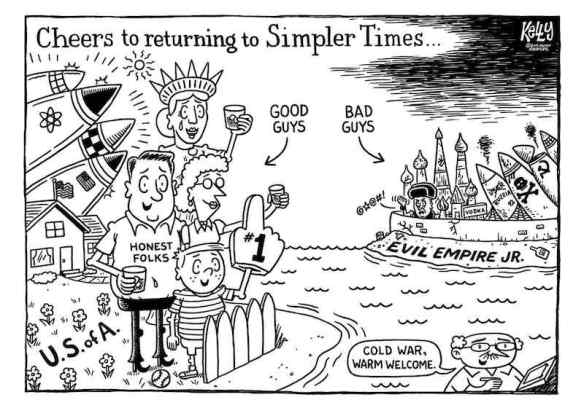
It’s May 2001 and the Atlantic Monthly has just arrived in the mail.  I’m tantalized by the cover article.  “Russia is finished,” the magazine announces.  The subtitle minces no words: “The unstoppable descent into social catastrophe and strategic irrelevance.”  Could it be that the country I had worried most about as a military officer during all those grim years of the Cold War, the famed “Evil Empire” that had threatened us with annihilation, was truly kaput, even in its Russian rather than Soviet guise?

Sixteen years later, the article’s message seems just a tad premature.  Today’s Russia surely has its problems — from poverty to pollution to prostitution to a rickety petro-economy — but on the geopolitical world stage it is “finished” no longer.  Vladimir Putin’s Russia has recently been enjoying heightened influence, largely at the expense of a divided and disputatious superpower that now itself seems to be on an “unstoppable descent.”

Sixteen years after Russia was declared irrelevant, a catastrophe, finito, it is once again a colossus — at least on the American political scene, if nowhere else.  And that should disturb you far less than this: more than a generation after defeating the Soviet Union in the Cold War, the United States of 2017 seems to be doing its level best to emulate some of the worst aspects of its former foe and once rival superpower.

Yes, the U.S. has a Soviet problem, and I’m not referring to the allegations of the moment in Washington: that the Trump campaign and Russian officials colluded, that money may have flowed into that campaign via Russian oligarchs tied to Putin, that the Russians hacked the U.S. election to aid Donald Trump, that those close to the president-elect dreamed of setting up a secret back channel to Moscow and suggested to the Russian ambassador that it be done through the Russian embassy, or even that Putin has a genuine hold of some sort on Donald Trump.  All of this is, of course, generating attention galore, as well as outrage, in the mainstream media and among the chattering classes, leading some to talk of a new “red scare” in America.  All of it is also being investigated, whether by congressional intelligence committees or by former FBI director — now special counsel — Robert Mueller.

When it comes to what I’m talking about, though, you don’t need a committee or a counsel or a back channel or a leaker from some intelligence agency to ferret it out.  Whatever Trump campaign officials, Russian oligarchs, or Vladimir Putin himself did or didn’t do, America’s Soviet problem is all around us: a creeping (and creepy) version of authoritarianism that anyone who lived through the Cold War years should recognize.  It involves an erosion of democratic values; the ever-expanding powers exercised by a national security state operating as a shadow government and defined by militarism, surveillance, secrecy, prisons, and other structures of dominance and control; ever-widening gaps between the richest few and the impoverished many; and, of course, ever more weapons, along with ever more wars.

That’s a real red scare, America, and it’s right here in the homeland.

In February, if you remember — and given the deluge of news, half news, rumor, and innuendo, who can remember anything these days? — Donald Trump memorably compared the U.S. to Russia.  When Bill O’Reilly called Vladimir Putin “a killer” in an interview with the new president, he responded that there was little difference between us and them, for — as he put it — we had our killers, too, and weren’t exactly innocents abroad when it came to world affairs.  (“There are a lot of killers. You think our country’s so innocent?”)  The president has said a lot of outlandish things in his first months in office, but here he was on to something.

My Secret Briefing on the Soviet Union

When I was a young lieutenant in the Air Force, in 1986 if memory serves, I attended a secret briefing on the Soviet Union. Ronald Reagan was president, and we had no clue that we were living through the waning years of the Cold War.  Back then, believing that I should know my enemy, I was reading a lot about the Soviets in “open sources”; you know, books, magazines, and newspapers.  The “secret” briefing I attended revealed little that was new to me. (Classified information is often overhyped.)  I certainly heard no audacious predictions of a Soviet collapse in five years (though the Soviet Union would indeed implode in 1991).  Like nearly everyone at the time, the briefers assumed the USSR would be our archenemy for decades to come and it went without saying that the Berlin Wall was a permanent fixture in a divided Europe, a forever symbol of ruthless Communist oppression.

Little did we know that, three years later, the Soviet military would stand aside as East Germans tore down that wall.  And who then would have believed that a man might be elected president of the United States a generation later on the promise of building a “big, fat, beautiful wall” on our shared border with Mexico?

I wasn’t allowed to take notes during that briefing, but I remember the impression I was left with: that the USSR was deeply authoritarian, a grim surveillance state with an economy dependent on global weapons sales; that it was intent on nuclear domination; that it was imperialist and expansionist; that it persecuted its critics and dissidents; and that it had serious internal problems carefully suppressed in the cause of world mastery, including rampant alcohol and drug abuse, bad health care and declining longevity (notably for men), a poisoned environment, and an extensive prison system featuring gulags.  All of this was exacerbated by festering sores overseas, especially a costly and stalemated war in Afghanistan and client-states that absorbed its resources (think: Cuba) while offering little in return.

This list of Soviet problems, vintage 1986, should have a familiar ring to it, since it sounds uncannily like a description of what’s wrong with the United States today.

In case you think that’s an over-the-top statement, let’s take that list from the briefing — eight points in all — one item at a time.

1. An authoritarian, surveillance state: The last time the U.S. Congress formally declared war was in 1941.  Since then, American presidents have embarked on foreign wars and interventions ever more often with ever less oversight from Congress.  Power continues to grow and coalesce in the executive branch, strengthening an imperial presidency enhanced by staggering technologies of surveillance, greatly expanded in the aftermath of the 9/11 terrorist attacks.  Indeed, America now has 17 intelligence agencies with a combined yearly budget of $80 billion.  Unsurprisingly, Americans are surveilled more than ever, allegedly for our safety even if such a system breeds meekness and stifles dissent.

2. An economy dependent on global weapons sales: The U.S. continues to dominate the global arms trade in a striking fashion.  It was no mistake that a centerpiece of President Trump’s recent trip was a $110 billion arms deal with Saudi Arabia.  On the same trip, he told the Emir of Qatar that he was in the Middle East to facilitate “the purchase of lots of beautiful military equipment.”  Now more than ever, beautiful weaponry made in the U.S.A. is a significant driver of domestic economic growth as well as of the country’s foreign policy.

3. Bent on nuclear domination: Continuing the policies of President Obama, the Trump administration envisions a massive modernization of America’s nuclear arsenal, to the tune of at least a trillion dollars over the next generation.  Much like an old-guard Soviet premier, Trump has boasted that America will always remain at “the top of the pack” when it comes to nuclear weapons.

4. Imperialist and expansionist: Historians speak of America’s “informal” empire, by which they mean the U.S. is less hands-on than past imperial powers like the Romans and the British.  But there’s nothing informal or hands-off about America’s 800 overseas military bases or the fact that its Special Operations forces are being deployed in 130 or more countries yearly.  When the U.S. military speaks of global reach, global power, and full-spectrum dominance, this is traditional imperialism cloaked in banal catchphrases.  Put differently, Soviet imperialism, which American leaders always professed to fear, never had a reach of this sort.

5. Persecutes critics and dissidents: Whether it’s been the use of the Patriot Act under George W. Bush’s presidency, the persecution of whistleblowers using the World War I-era Espionage Act under the Obama administration, or the vilification of the media by the new Trump administration, the U.S. is far less tolerant of dissent today than it was prior to the Soviet collapse.  As Homeland Security Secretary and retired four-star Marine General John Kelly recently put it, speaking of news stories about the Trump administration based on anonymous intelligence sources, such leaks are “darn close to treason.”  Add to such an atmosphere Trump’s attacks on the media as the “enemy” of the people and on critical news stories as “fake” and you have an environment ripe for the future suppression of dissent.

In the Soviet Union, political opponents were often threatened with jail or worse, and those threats were regularly enforced by men wearing military or secret police uniforms.  In that context, let’s not forget the “Lock her up!” chants led by retired Lt. General Michael Flynn at the Republican National Convention and aimed at Donald Trump’s political opponent of that moment, Hillary Clinton.

6. Internal problems like drug abuse, inadequate health care, and a poisoned environment: Alcoholism is still rife in Russia and environmental damage widespread, but consider the U.S. today.  An opioid crisis is killing more than 30,000 people a year.  Lead poisoning in places like Flint, Michigan, and New Orleans is causing irreparable harm to the young.  The disposal of wastewater from fracking operations is generating earthquakes in Ohio and Oklahoma.  Even as environmental hazards proliferate, the Trump administration is gutting the Environmental Protection Agency.  As health crises grow more serious, the Trump administration, abetted by a Republican-led Congress, is attempting to cut health-care coverage and benefits, as well as the funding that might protect Americans from deadly pathogens.  Disturbingly, as with the Soviet Union in the era of its collapse, life expectancy among white men is declining, mainly due to drug abuse, suicide, and other despair-driven problems.

7. Extensive prison systems: As a percentage of its population, no country imprisons more of its own people than the United States.  While more than two million of their fellow citizens languish in prisons, Americans continue to see their nation as a beacon of freedom, ignoring Guantánamo Bay, Cuba.  In addition, the country now has a president who believes in torture, who has called for the murder of terrorists’ families, and who wants to refill Guantánamo with prisoners.  It also has an attorney general who wants to make prison terms for low-level drug offenders ever more draconian.

8. Stalemated wars: You have to hand it to the Soviets.  They did at least exhibit a learning curve in their disastrous war in Afghanistan and so the Red Army finally left that country in 1989 after a decade of high casualties and frustration (even if its troops returned to a land on the verge of implosion).  U.S. forces, on the other hand, have been in Afghanistan for 16 years, with the Taliban growing ever stronger, yet its military’s response has once again been to call for investing more money and sending in more troops to reverse the “stalemate” there.  Meanwhile, after 14 years, Iraq War 3.0 festers, bringing devastation to places like Mosul, even as its destabilizing results continue to manifest themselves in Syria and indeed throughout the greater Middle East.  Despite or rather because of these disastrous results, U.S. leaders continue to over-deploy U.S. Special Operations forces, contributing to exhaustion and higher suicide rates in the ranks.

In light of these eight points, that lighthearted Beatles tune and relic of the Cold War, “Back in the USSR,” takes on a new, and far harsher, meaning.

What Is to Be Done?

Slowly, seemingly inexorably, the U.S. is becoming more like the former Soviet Union.  Just to begin the list of similarities: too many resources are being devoted to the military and the national security state; too many over-decorated generals are being given too much authority in government; bleeding-ulcer wars continue unstanched in Afghanistan, Iraq, and elsewhere; infrastructure (roads, bridges, pipelines, dams, and so on) continues to crumble; restless “republics” grumble about separating from the union (Calexit!); rampant drug abuse and declining life expectancy are now American facts of life. Meanwhile, the latest U.S. president is, in temperament, authoritarian, even as government “services” take on an increasingly nepotistic flavor at the top.

I’m worried, comrade!  Echoing the cry of the great Lenin, what is to be done?  Given the list of symptoms, here’s one obvious 10-step approach to the de-sovietization of America:

1. Decrease “defense” spending by 10% annually for the next five years.  In the Soviet spirit, think of it as a five-year plan to restore our revolution (as in the American Revolution), which was, after all, directed against imperial policies exercised by a “bigly” king.

2. Cut the number of generals and admirals in the military by half, and get rid of all the meaningless ribbons, badges, and medals they wear.  In other words, don’t just cut down on the high command but on their tendency to look (and increasingly to act) like Soviet generals of old.  And don’t allow them to serve in high governmental positions until they’ve been retired for at least 10 years.

3. Get our military out of Afghanistan, Iraq, and other war-torn countries in the Greater Middle East and Africa.  Reduce that imperial footprint overseas by closing costly military bases.

4. Work to eliminate nuclear weapons globally by, as a first step, cutting the vast U.S. arsenal in half and forgetting about that trillion-dollar “modernization” program.  Eliminate land-based ICBMs first; they are no longer needed for any meaningful deterrent purposes.

5. Take the money saved on “modernizing” nukes and invest it in updating America’s infrastructure.

6. Curtail state surveillance.  Freedom needs privacy to flourish.  As a nation, we need to remember that security is not the bedrock of democracy — the U.S. Constitution is.

7. Work to curb drug abuse by cutting back on criminalization.  Leave the war mentality behind, including the “war on drugs,” and focus instead on providing better treatment programs for addicts.  Set a goal of cutting America’s prison population in half over the next decade.

8. Life expectancy will increase with better health care.  Provide health care coverage for all using a single-payer system.  Every American should have the same coverage as a member of Congress.  People shouldn’t be suffering and dying because they can’t afford to see a doctor or pay for their prescriptions.

9. Nothing is more fundamental to “national security” than clean air and water.  It’s folly to risk poisoning the environment in the name of either economic productivity or building up the military.  If you doubt this, ask citizens of Russia and the former Soviet Republics, who still struggle with the fallout from the poisonous environmental policies of Soviet days.

10. Congress needs to assert its constitutional authority over war and the budget, and begin to act like the “check and balance” it’s supposed to be when it comes to executive power.

There you have it.  These 10 steps should go some way toward solving America’s real Russian problem — the Soviet one.  Won’t you join me, comrade?


William J. Astore, a retired lieutenant colonel (USAF) and history professor, is a TomDispatch regular.  His personal blog is Bracing Views.

3 Questions You’re Never Supposed to Ask After a Terrorist Attack

By Isaac Davis

Source: Waking Times

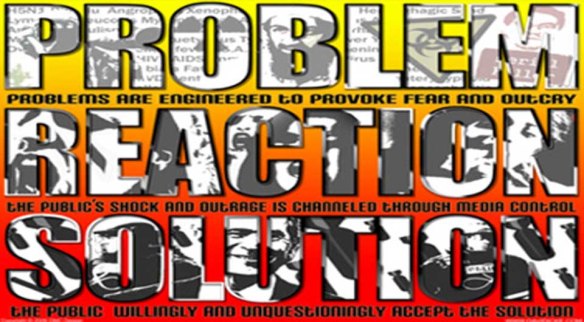
In a world where defense budgets are astronomical and wars of occupation and destabilization never end, political leaders in the UK and in Europe want you accept street level terror as the new everyday normal. The attacks are unstoppable, they say, and the world must embrace this hopelessness with faith that the government is doing all it can to create a better, safer world. Run, hide, and call the authorities, for you are helpless in this reality, so they say. But who creates and sustains this reality?

Terrorism is defined as the use of violence in the pursuit of political aims, and as politicians respond to terrorism by holding news conferences, posing, grandstanding, eulogizing, weeping for the cameras, applauding first responders and proposing legislation, so many of the important questions which can help guide us out of such a gloomy future are going unasked and unanswered. And these questions are always the same for any of these attacks, be it the London attacks, Manchester, Orlando, the Boston marathon, 7/7 or 9/11.

Here are three things we should be always ask about when Islamic terror , all of which are fair questions for any of the major terror attacks happening in Western nations.

1. In what ways do Western governments contribute to the problem of Islamic terror?

The media wants you to believe that this type of terror is unrelated to government policies and actions, thus attempting to divorce them from the greater context of geopolitics and the decades long push toward globalist world government. But how do Western governments contribute to the problem of terrorism?

Do never-ending occupations of Middle Eastern conditions and the wrecking of stable nations contribute to terrorism? Does supplying arms and financial support to known terrorist organizations make attacks in Western nations more likely? Does bombing infrastructure, hospitals and civilians in foreign nations play a role? Does promoting and supporting the massive influx of Middle Eastern and African migrants into Western nations have an effect? Does permitting known radicals and others on terror watch lists to operate freely in the West make it more likely that events like the London Bridge attack will occur? Does preventing and punishing people for speaking out in defense of their own nations and customs contribute to the situation?

2. How does government benefit from the reaction to the problem?

Terror creates fear, insecurity, panic, uncertainty, chaos, anger, hate and irrationality, and none are more easily lorded over than those living in terror. Historically, governments make exceptional gains in power and authority when their citizens are psychologically abused.

3. What is the pre-packaged government solution to the problem?

In the case of the London Bridge attacks, the very next day, UK Prime Minister Theresa May called for government regulation of the internet, a demand which is now being echoed by wise politicians and pundits. But this measure was already being floated, it just a dramatic push for it to gain popularity.

Whether it is the Patriot Act, the pre-planned invasion of Afghanistan, calls to restrict the 2nd Amendment, greater government surveillance, increased spending on war and police state security measures, the detainment of innocent people or torture of detainees, the government always has a solution in place before an attack happens.

Final Thoughts

Accepting terror as the norm is absolutely unacceptable and must be totally rejected by people who wish to live in peace and prosperity, which will forever remain impossible while government is allowed to contribute and benefit from terror.