They Live, We Sleep: A Dictatorship Disguised as a Democracy

leadtheylive1

By John W. Whitehead

Source: The Rutherford Institute

“You see them on the street. You watch them on TV. You might even vote for one this fall. You think they’re people just like you. You’re wrong. Dead wrong.”—They Live

We’re living in two worlds, you and I.

There’s the world we see (or are made to see) and then there’s the one we sense (and occasionally catch a glimpse of), the latter of which is a far cry from the propaganda-driven reality manufactured by the government and its corporate sponsors, including the media.

Indeed, what most Americans perceive as life in America—privileged, progressive and free—is a far cry from reality, where economic inequality is growing, real agendas and real power are buried beneath layers of Orwellian doublespeak and corporate obfuscation, and “freedom,” such that it is, is meted out in small, legalistic doses by militarized police armed to the teeth.

All is not as it seems.

This is the premise of John Carpenter’s film They Live (1988), in which two migrant workers discover that the world’s population is actually being controlled and exploited by aliens working in partnership with an oligarchic elite. All the while, the populace—blissfully unaware of the real agenda at work in their lives—has been lulled into complacency, indoctrinated into compliance, bombarded with media distractions, and hypnotized by subliminal messages beamed out of television and various electronic devices, billboards and the like.

It is only when homeless drifter John Nada (played to the hilt by the late Roddy Piper) discovers a pair of doctored sunglasses—Hoffman lenses—that Nada sees what lies beneath the elite’s fabricated reality: control and bondage.

When viewed through the lens of truth, the elite, who appear human until stripped of their disguises, are shown to be monsters who have enslaved the citizenry in order to prey on them. Likewise, billboards blare out hidden, authoritative messages: a bikini-clad woman in one ad is actually ordering viewers to “MARRY AND REPRODUCE.” Magazine racks scream “CONSUME” and “OBEY.” A wad of dollar bills in a vendor’s hand proclaims, “THIS IS YOUR GOD.”

When viewed through Nada’s Hoffman lenses, some of the other hidden messages being drummed into the people’s subconscious include: NO INDEPENDENT THOUGHT, CONFORM, SUBMIT, STAY ASLEEP, BUY, WATCH TV, NO IMAGINATION, and DO NOT QUESTION AUTHORITY.

This indoctrination campaign engineered by the elite in They Live is painfully familiar to anyone who has studied the decline of American culture. A citizenry that does not think for themselves, obeys without question, is submissive, does not challenge authority, does not think outside the box, and is content to sit back and be entertained is a citizenry that can be easily controlled.

In this way, the subtle message of They Live provides an apt analogy of our own distorted vision of life in the American police state, what philosopher Slavoj Žižek refers to as dictatorship in democracy, “the invisible order which sustains your apparent freedom.”

We’re being fed a series of carefully contrived fictions that bear no resemblance to reality. The powers-that-be want us to feel threatened by forces beyond our control (terrorists, shooters, bombers). They want us afraid and dependent on the government and its militarized armies for our safety and well-being. They want us distrustful of each other, divided by our prejudices, and at each other’s throats. Most of all, they want us to continue to march in lockstep with their dictates.

Tune out the government’s attempts to distract, divert and befuddle us and tune into what’s really going on in this country, and you’ll run headlong into an unmistakable, unpalatable truth: the moneyed elite who rule us view us as expendable resources to be used, abused and discarded.

In fact, a 2014 study conducted by Princeton and Northwestern University concluded that the U.S. government does not represent the majority of American citizens. Instead, the study found that the government is ruled by the rich and powerful, or the so-called “economic elite.” Moreover, the researchers concluded that policies enacted by this governmental elite nearly always favor special interests and lobbying groups.

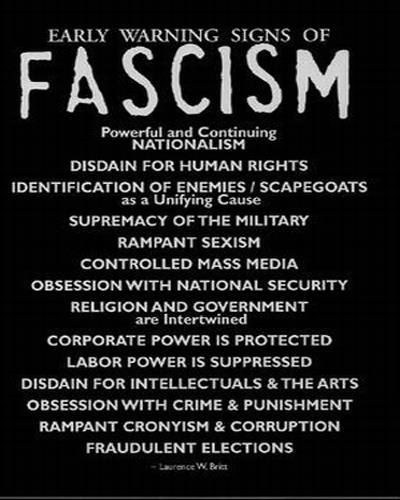
In other words, we are being ruled by an oligarchy disguised as a democracy, and arguably on our way towards fascism—a form of government where private corporate interests rule, money calls the shots, and the people are seen as mere subjects to be controlled.

Consider this: it is estimated that the 2016 presidential election could cost as much as $5 billion, more than double what was spent getting Obama re-elected in 2012.

Not only do you have to be rich—or beholden to the rich—to get elected these days, but getting elected is also a surefire way to get rich. As CBS News reports, “Once in office, members of Congress enjoy access to connections and information they can use to increase their wealth, in ways that are unparalleled in the private sector. And once politicians leave office, their connections allow them to profit even further.”

In denouncing this blatant corruption of America’s political system, former president Jimmy Carter blasted the process of getting elected—to the White House, governor’s mansion, Congress or state legislatures—as “unlimited political bribery… a subversion of our political system as a payoff to major contributors, who want and expect, and sometimes get, favors for themselves after the election is over.”

Rest assured that when and if fascism finally takes hold in America, the basic forms of government will remain. As I point out in my book Battlefield America: The War on the American People, fascism will appear to be friendly. The legislators will be in session. There will be elections, and the news media will continue to cover the entertainment and political trivia. Consent of the governed, however, will no longer apply. Actual control will have finally passed to the oligarchic elite controlling the government behind the scenes.

By creating the illusion that it preserves democratic traditions, fascism creeps slowly until it consumes the political system. And in times of “crisis,” expediency is upheld as the central principle—that is, in order to keep us safe and secure, the government must militarize the police, strip us of basic constitutional rights, criminalize virtually every form of behavior, and build enough private prisons to house all of us nonviolent criminals.

Clearly, we are now ruled by an oligarchic elite of governmental and corporate interests. We have moved into “corporatism” (favored by Benito Mussolini), which is a halfway point on the road to full-blown fascism.

Vast sectors of the economy, government and politics are managed by private business concerns, otherwise referred to as “privatization” by various government politicians. Just study modern government policies. “Every industry is regulated. Every profession is classified and organized,” writes economic analyst Jeffrey Tucker. “Every good or service is taxed. Endless debt accumulation is preserved. Immense doesn’t begin to describe the bureaucracy. Military preparedness never stops, and war with some evil foreign foe, remains a daily prospect.”

In other words, the government in America today does whatever it wants.

Corporatism is where the few moneyed interests—not elected by the citizenry—rule over the many. In this way, it is not a democracy or a republican form of government, which is what the American government was established to be. It is a top-down form of government and one which has a terrifying history typified by the developments that occurred in totalitarian regimes of the past: police states where everyone is watched and spied on, rounded up for minor infractions by government agents, placed under police control, and placed in detention (a.k.a. concentration) camps.

For the final hammer of fascism to fall, it will require the most crucial ingredient: the majority of the people will have to agree that it’s not only expedient but necessary. But why would a people agree to such an oppressive regime? The answer is the same in every age: fear.

Fear makes people stupid.

Fear is the method most often used by politicians to increase the power of government. And, as most social commentators recognize, an atmosphere of fear permeates modern America: fear of terrorism, fear of the police, fear of our neighbors and so on.

The propaganda of fear has been used quite effectively by those who want to gain control, and it is working on the American populace.

Despite the fact that we are 17,600 times more likely to die from heart disease than from a terrorist attack; 11,000 times more likely to die from an airplane accident than from a terrorist plot involving an airplane; 1,048 times more likely to die from a car accident than a terrorist attack, and 8 times more likely to be killed by a police officer than by a terrorist, we have handed over control of our lives to government officials who treat us as a means to an end—the source of money and power.

We have allowed ourselves to become fearful, controlled, pacified zombies.

In this regard, we’re not so different from the oppressed citizens in They Live. Most everyone keeps their heads down these days while staring zombie-like into an electronic screen, even when they’re crossing the street. Families sit in restaurants with their heads down, separated by their screen devices and unaware of what’s going on around them. Young people especially seem dominated by the devices they hold in their hands, oblivious to the fact that they can simply push a button, turn the thing off and walk away.

Indeed, there is no larger group activity than that connected with those who watch screens—that is, television, lap tops, personal computers, cell phones and so on. In fact, a Nielsen study reports that American screen viewing is at an all-time high. For example, the average American watches approximately 151 hours of television per month.

The question, of course, is what effect does such screen consumption have on one’s mind?

Psychologically it is similar to drug addiction. Researchers found that “almost immediately after turning on the TV, subjects reported feeling more relaxed, and because this occurs so quickly and the tension returns so rapidly after the TV is turned off, people are conditioned to associate TV viewing with a lack of tension.” Research also shows that regardless of the programming, viewers’ brain waves slow down, thus transforming them into a more passive, nonresistant state.

Historically, television has been used by those in authority to quiet discontent and pacify disruptive people. “Faced with severe overcrowding and limited budgets for rehabilitation and counseling, more and more prison officials are using TV to keep inmates quiet,” according to Newsweek.

Given that the majority of what Americans watch on television is provided through channels controlled by six mega corporations, what we watch is now controlled by a corporate elite and, if that elite needs to foster a particular viewpoint or pacify its viewers, it can do so on a large scale.

If we’re watching, we’re not doing.

The powers-that-be understand this. As television journalist Edward R. Murrow warned in a 1958 speech:

We are currently wealthy, fat, comfortable and complacent. We have currently a built-in allergy to unpleasant or disturbing information. Our mass media reflect this. But unless we get up off our fat surpluses and recognize that television in the main is being used to distract, delude, amuse, and insulate us, then television and those who finance it, those who look at it, and those who work at it, may see a totally different picture too late.

This brings me back to They Live, in which the real zombies are not the aliens calling the shots but the populace who are content to remain controlled.

When all is said and done, the world of They Live is not so different from our own. As one of the characters points out, “The poor and the underclass are growing. Racial justice and human rights are nonexistent. They have created a repressive society and we are their unwitting accomplices. Their intention to rule rests with the annihilation of consciousness. We have been lulled into a trance. They have made us indifferent to ourselves, to others. We are focused only on our own gain.”

We, too, are focused only on our own pleasures, prejudices and gains. Our poor and underclasses are also growing. Racial injustice is growing. Human rights is nearly nonexistent. We too have been lulled into a trance, indifferent to others.

Oblivious to what lies ahead, we’ve been manipulated into believing that if we continue to consume, obey, and have faith, things will work out. But that’s never been true of emerging regimes. And by the time we feel the hammer coming down upon us, it will be too late.

5 Reasons Why Anarchy Would be an Improvement in Human Governance

goldman-quote

By Gary ‘Z’ McGee

Source: Waking Times

“Give a man a gun and he’ll rob a bank. Give a man a bank and he’ll rob the world.” –Unknown

Give people just a little bit of knowledge and courage and they will track down those greedy-ass bankers and hold them accountable. All we need is just a little courageous anarchy. The problem, the crux, the fly in the ointment: most people are not courageous enough, and most people don’t want to learn anything that attacks their all-too-precious worldview. Yes, the very worldview that is keeping people indebted to an immoral, unhealthy, unsustainable, unjust system of human governance, is precisely the worldview that the majority of people are clinging to. Indeed, most people, even though they would probably say otherwise, would rather be kissed with a lie than slapped with the truth. They would rather deny facts that tarnish their worldview than reject the deceit that upholds it. But as Martin Luther King, Jr. said, “Human progress is neither automatic nor inevitable. Every step toward the goal of justice requires sacrifice, suffering, and struggle; the tireless exertions and passionate concern of dedicated individuals.”

Healthy human evolution requires authentic vigilance. It requires a consistent upheaval of the status quo. This requires proactive human beings who are willing to be authentically vigilant and consistently rebellious. It requires courageous interdependent individuals who dare to recondition the status-quo-junky original condition. It turns out that the wisdom gained from anarchy is precisely the ability to distinguish between sacrifice that is transformative and healthy from mere suffering caused by the state that we’ve allowed because we were too cowardly or too unimaginative to think of a healthier way to live. Like Stefan Molyneux said, “Never, ever underestimate the degree to which people will scatter themselves into a deep fog in order to avoid seeing the basic realities of their own cages. The strongest lock on the prison is always avoidance, not force.”

Here are five reasons why anarchy will improve human governance and thereby cultivate a healthy human evolution.

1.) It Has Inherent Checks and Balances

“Failure shows us the way –by showing us what isn’t the way.”Ryan Holiday

This one alone is reason enough to give anarchy a try again. The other four are just icing on the cake. I say “again” because human beings lived in hunter-gatherer groups that were characterized by what anthropologists call Fierce Egalitarian Anarchy. They not only shared things, they demanded that things be shared: meat, shelter, and protection… this was simply the best way to mitigate risk in a survival context in a world with limited resources.

Fierce egalitarianism and primal politics (tribal anarchy) worked exceptionally well for the human race for 95% of our existence on this planet. Indeed, it’s one of the only reasons why we’ve survived as long as we have.

In an amazing game theory study by Duéñez-Guzmán-Sadedin on the topic of police corruption, they concluded that once a police system becomes entrenched, nothing can stop it from eventually becoming corrupt, with the result being a population of gullible sheep and hypocritical overlords. But they didn’t stop the study there. They decided to tweak it ever so slightly. In the words of Suzanne Sadedin: “The results were startling. By making a few alterations to the composition of the justice system, corrupt societies could be made to transition to a state called ‘righteousness’. In righteous societies, police were not a separate, elite order. They were everybody. When virtually all of society stood ready to defend the common good, corruption didn’t pay. Similarly, as it turns out, social norms in hunter-gatherer societies are enforced by the whole group rather than any specially empowered individuals.”

This is a critical aspect of anarchy: that everyone is free to be as moral, or as amoral, as they need to be in order to maintain a healthy cosmic, ecological, and social order. Freedom is primary. Health is secondary. Understanding how everything is connected is third. And immorality is not tolerated.

The monumental problem with our Statist society is that we are not taught to be as moral or as amoral as we need to be in order to maintain a healthy cosmic, ecological, and social order. In fact, statism purposefully forces whatever the state decrees to be healthy, as healthy, whether or not it is actually healthy according to cosmic law. This creates an exorbitant amount of problems.

2.) It Would Nullify Debt Slavery and Eliminate Poverty

“When plunder becomes a way of life for a group of men living in a society, they create for themselves in the course of time a legal system that authorizes it and a moral code that glorifies it.”Frederic Bastiat

How does our legal system authorize plunder? It allows banks to create fiat money out of thin air and then charge interest on it, which keeps the poor wallowing in poverty, and entrenches the rich in corruptible power structures based upon immoderate wealth.

How does our moral code glorify plunder? It pushes militarization, creates profit prisons, creates “war heroes” out of violent psychopaths, and makes war itself a profitable endeavor. It puts profit over people, equity over equality, transforms elections into auctions, and creates a fundamentally unsustainable and unhealthy money first, human heart second, mentality. Like Naseem Nicholas Taleb said, “Those who do not think that employment is systematic slavery are either blind or employed.”

How does anarchy flip the tables on the authorization and glorification of plunder? It prevents plunder from ever becoming possible because anarchy-based modes of governance are engineered in such a way that groups never get to the point of concentrated centers of power. The monopolization of power never gets to the point to where it becomes corrupt, because of controlled leveling mechanisms such as reverse dominance and wealth expiation. Like Jim Dodge said, “Anarchy doesn’t mean out of control; it means out of their control.” Whoever “they” may be: monopolizing corporations, overreaching governments, tyrants.

Self-aware critical thinker beware: political propaganda, especially in regards to war, money, government, and law, are designed to keep you conditioned and brainwashed into believing whoever is in power is being moral and just with their power. But as George Orwell warned, “Political language is designed to make lies sound truthful and murder respectable, and to give an appearance to solidity to pure wind.”

Have no illusions: within the current systems of human governance, poverty is a business. Profits are made on the labor of the poor, the consumption of the poor, and the debt of the poor. Anarchy is a system of human governance built to lift people out of poverty and into freedom. It gives people hope for a more balanced future of human prosperity. Like Raymond Williams advised, “To be truly radical is to make hope possible rather than despair convincing.”

3.) It Would Be Eco-Morally and Ecologically Healthier and More Sustainable

“The best teachers are those who show you where to look, but don’t tell you what to see.” –Alexandra K.Trenfor

Authority tells you what to see, and therefore must be questioned. Authority is telling you that it’s okay to live immoderate, over-indulgent, violent, ecocidal lifestyles. It’s not okay, because it is fundamentally unhealthy and leads to unsustainable devolution. In a system of human governance that is systematically transforming livingry into weaponry, it is the supreme duty of all healthy, moral, compassionate, eco-conscious, indeed anarchist, people to question authority to the nth degree.

Such audacious questioning has the potential to create robust eco-centric communities based upon permaculture, wellness, creativity, and a sacred economy that takes the interconnectedness of all things into deep consideration. It incentivizes individuals who value human flourishing, environmental flourishing, permaculture, sustainable building, alternative education, and nature-based wellness.

The cornerstone of anarchist modes of human governance is the deep understanding of the interdependence of all living things. As Nikola Tesla proclaimed, “Every living being is an engine geared to the wheelwork of the universe. Though seemingly affected only by its immediate surroundings, the sphere of external influence extends to infinite distance.”

An anarchist society divorced from the oppressive Big Brother bitch-slap of Statism, reveals a society that is capable of preserving the moral Golden Mean and the middle-way, as opposed to the immoral, suffocating greed of state politics. It will uncover a society that exemplifies the Golden Ratio of nature, as opposed to the state’s expropriation of nature and nature-based cultures.

4.) It Would Result in the Expiation of Power and Wealth Through an Ethics of Reciprocity

“A freedom that is interested only in denying freedom must be denied.”Simone De Beauvoir

The ultimate leveling mechanism inherent within anarchist modes of human governance is the ethics of reciprocity combined with the expiation of power.

Anthropologist Christopher Boehm has proposed a social theory that anarchist, egalitarian hunter-gatherers maintained equality through a leveling mechanism he calls Reverse Dominance: a social system of checks and balances that maintains egalitarian ethos while preventing a dominance hierarchy from forming. Reverse dominance hierarchies are broken down into four different leveling mechanisms: public opinion, ridicule, disobedience, and ostracism. These mechanisms work because human beings are social creatures and hugely influenced by peer pressure and social acceptance.

Anarchist modes of human governance are largely based upon shame as a regulatory method. Within such a society individuals are socially, morally, and ecologically compelled to expiate their power and reciprocate wealth because the alternative is the risk of shaming, ridicule, and/or ostracism. Like A.C. Grayling explained it, “The first task is to win something; the second, to banish the feeling that has been won; otherwise it is a burden.” In order for power and wealth not to become a psychological burden within anarchist systems, the powerful and the wealthy must be able to expiate and reciprocate their power and wealth, lest people become oppressed, and entire systems become corrupt.

But this does NOT mean that skill, courage, intelligence and perseverance are not rewarded. Anarchy does not imply socialism. Ours is a cultural problem. We’ve been raised to believe in the false ideal of greed. We’ve been conditioned to own. Our culture has become ego-centric, as opposed to eco-centric. It has become ownership-based, as opposed to relationship-based.

But prestige and merit can still be highly strived for values within an anarchist society that practices expiation of wealth and the ethics of reciprocity.

As I wrote in Breaking out of a Broken System, “Eco-moralism tames capitalism through holistic checks and balances. Ego-moralism jumpstarts communism through proactive citizenry. What we’re left with is a healthy anarchism with an egalitarian ethos which is less about capital and one-upmanship and more about respect for what is borrowed. It is less about ownership and more about relationships. It is ethical, spiritual, and diverse; as opposed to egotistical, religious, and homogenized by nationalism. Eco-moralism helps us pierce through the smoke and mirrors of hyper-reality and into the way reality actually is: interconnected and interdependent. Ego-moralism helps us become more motivated by revealing that our egos are actually tools towards leveraging a healthy balance between cosmos and psyche.”

Anarchists are crazy enough to think they can change the world, which is precisely why they will.

5.) It Would Create Compassionate, Humble, but Courageous Leadership

“To really understand something is to be liberated from it. Dedicating one’s self to a great cause, taking responsibility, and gaining self-knowledge is the essence of being human. A predatory capitalist’s greatest enemy, and humanity’s greatest ally, is the self-educated individual who has read, understood, delays their gratification, and walks around with their eyes wide open.” –The Four Horsemen, documentary

Anarchist modes of human governance create precisely the type of self-educated, autodidactic individual that predatory capitalist’s and pacifist socialist’s fear. As Louis G. Herman wrote, “When individuals try to balance self-interest with a consideration of the bigger picture, they discover, as Socrates did, that deep self-interest actually includes concern for the good of the whole.” An individual (ego) acting on the good of the whole (eco) is a force of nature first, a person second, which provides them the phenomenal power of standing on the shoulders of giants while also wearing a wide array of masks of self-mastery.

If we can combine fierce egalitarian primal politics along with the type of progressive self-interested people who are capable of considering the bigger interdependent picture, then we have a recipe for a healthy, prestigious anarchic leadership. We have a blueprint for authentically venerated and wise leadership that has the potential to transform the currently unlivable human world into a livable one. Like MLK Jr. said, “The hope of a secure livable world lies with disciplined nonconformists, who are dedicated to justice, peace, and brotherhood. The trailblazers in human, academic, scientific, and spiritual freedom have always been nonconformists. In any cause that concerns the progress of mankind, put your faith in the nonconformist.”

Indeed, it is typically the nonconformist who is the one testing the outer limits of the human imagination: stretching comfort zones, shattering mental paradigms, and flattening status quo boxes that those hooked on conformity so desperately try to think outside of. As Henry David Thoreau said, in true anarchist leadership form, “I was not designed to be forced. I will breathe after my own fashion. Let us see who is the strongest.”


Related videoThis has to be the best 5 minutes ever aired on Fox News (that may seem like faint praise but it’s a rare treat to find such an on point rant anywhere on cable television):

US fall from virtuous republic to tragic-comic empire described exactly by Roman historians

fascism1

By Carl Herman

Source: The Daily Censored

The ancient Greek historian, Polybius, celebrated the Roman republic of ~ 150 BC under its constitution with balance of powers among the Senate, two elected consuls, and the general citizens:

“Such being the power that each part has of hampering the others or co-operating with them, their union is adequate to all emergencies, so that it is impossible to find a better political system than this.”  – The Histories, Book VI, Section V: On the Roman Constitution at its Prime

Americans and people around the world were equally proud of the United States Constitution as “impossible to find a better political system than this.”

About 100 years after Polybius’ account, Rome’s republic had descended into oligarchic competition for power. Contemporary to Julius Caesar, the Roman historian and government insider Sallust blasted the decline of virtue in government:

“To those who had easily endured toils, dangers, and doubtful and difficult circumstances, ease and wealth, the objects of desire to others, became a burden and a trouble. At first the love of money, and then that of power, began to prevail, and these became, as it were, the sources of every evil. For avarice subverted honesty, integrity, and other honorable principles, and, in their stead, inculcated pride, inhumanity, contempt of religion, and general venality. Ambition prompted many to become deceitful; to keep one thing concealed in the breast, and another ready on the tongue; to estimate friendships and enmities, not by their worth, but according to interest; and to carry rather a specious countenance than an honest heart. These vices at first advanced but slowly, and were sometimes restrained by correction; but afterwards, when their infection had spread like a pestilence, the state was entirely changed, and the government, from being the most equitable and praiseworthy, became rapacious and insupportable.” – Conspiracy of Catiline, The Argument

The most prolific Roman historian, Livy, witnessed Rome’s transition into dictatorial empire with Augustus Caesar as first emperor. In his preface to address 700 years of Roman history:

“I have no doubt that the earliest origins and the immediately succeeding period will give less delight to the majority of readers who are hurrying to these recent times in which the might of a most powerful people has long been destroying itself.

… I shall seek this additional reward for my labor (recounting all Rome’s history) so that I may turn away from the contemplation of the evils that our age has seen for so many years.” – The History of Rome, Preface

Tacitus wrote ~ 100 AD, a century into empire. Emperors proclaimed to the public that their government still upheld the highest ideals of their Republic, claiming expanding empire was only and always in “self-defense.”

Emperor Domitian’s assassination in 96 AD (among ~22 murdered emperors), allowed Tacitus to write The Agricola, a biographical text of his father-in-law contrasting claimed virtue of Roman military and citizenry with the emperor’s utterly corrupt despotism.

Importantly, this text describes the problem of virtuous Romans within a psychopathic government. Tacitus describes Agricola attempting to uphold virtue; but without recognition of any evil in serving an expanding dictatorial empire. Tacitus seems to assume the ideal of mos maiorum, “custom/virtue of Roman forefathers” will eventually triumph over the evil of present “leadership.”

In Agricola’s campaign as military and political leader of Roman Britain to expand the empire to modern Scotland from 78 – 84 AD, Tacitus recorded a speech he attributes to Scottish rebel-leader, Calgacus, to voice how those of virtue characterized Roman empire under corrupt emperors:

“It is no use trying to escape their arrogance by submission or good behavior. Robbers of the world, having by universal plunder exhausted the land, their drive is greed. If the enemy be rich, they are rapacious; if poor, they lust for domination. Neither rule of the East nor West can satisfy them. Alone among men, they crave with equal eagerness poverty and riches. To plunder, slaughter, seize with false pretenses, they give the lying name ‘empire.’ And where nothing remains but a desert, they call that ‘peace.’ ” – Tacitus, The Agricola and the Germania (analyses herehere)

Roman imperialists called Calgacus and those who preferred independence from evil empire a name: barbarus. This is translated today as “barbarian,” but its context for using unconventional warfare to oppose the most powerful military in its day is better translated in today’s language with a different word:

Terrorist.

Indeed, Obama combines these terms to call ISIS “barbaric terrorists.”

American Founders created the US Constitution in light of Roman Republic design (herehere, among dozens), and aware previous republics had always self-destructed from corruption within their own nations. Among many of the Founders’ admonitions, James Madison was clear that citizen responsibility was essential to maintain a republic, no matter how well the Constitution was designed:

“A mere demarcation on parchment of the constitutional limits (of government) is not a sufficient guard against those encroachments which lead to a tyrannical concentration of all the powers of government in the same hands.”  – James Madison, Federalist Paper #48, 1788.

On September 18, 1787, just after signing the US Constitution, Benjamin Franklin met with members of the press. He was asked what kind of government America would have. Franklin warned: “A republic, if you can keep it.” In his speech to the Constitutional Convention, Franklin admonished: “This [U.S. Constitution] is likely to be administered for a course of years and then end in despotism… when the people shall become so corrupted as to need despotic government, being incapable of any other.”  – The Quotable Founding Fathers, pg. 39.

These warnings extend to all social science teachers of the present:

“As educators in the field of history–social science, we want our students to… understand the value, the importance, and the fragility of democratic institutions. We want them to realize that only a small fraction of the world’s population (now or in the past) has been fortunate enough to live under a democratic form of government.” – History-Social Science Framework for California Public Schools, pgs. 2, 7-8

US/UK/Israel today: Current Middle East armed attacks are proclaimed by US/UK/Israel “leaderships” as self-defense, just as Rome claimed. US “leaders” claim to uphold America’s highest ideals of freedom while removing almost all Constitutional Rights, as did Roman emperors. Corruption today, as in Rome, is rampant.

US/UK/Israel wars today are not even close to legal, and based on lies known to be false as they are told. Engaging in unlawful Wars of Aggression is the very opposite of a virtuous republic limited in power under its constitution. This is easy to verify for those with about an hour to look:

Solutions learned from the past applied to the present: Tacitus’ argument was to wait-out tyranny in confidence public virtue of past ideals would triumph.

Tacitus was wrong.

A stronger solution would be critical mass recognition by the public of corruption in an Emperor’s New Clothes analogy, arrests, and a clear forum for whistleblowers to disclose the full extent of corruption.

In today’s world of tragic-comic US/UK/Israel corrupt empire, I propose the solution of:

  • public demand for “leader” arrests. An arrest lawfully stops crimes.
  • Truth & Reconciliation to encourage criminal minions to become whistleblowers so we can best discover the extent of the crimes waged by the .01% upon the 99.99%.
  • With removed criminal oligarchs and corporate media who “covered” these crimes, we’d have honest opportunity for available economic solutions that would transform our beautiful, but historically dominated planet.

**

Note: I make all factual assertions as a National Board Certified Teacher of US Government, Economics, and History, with all economics factual claims receiving zero refutation since I began writing in 2008 among Advanced Placement Macroeconomics teachers on our discussion board, public audiences of these articles, and international conferences. I invite readers to empower their civic voices with the strongest comprehensive facts most important to building a brighter future. I challenge professionals, academics, and citizens to add their voices for the benefit of all Earth’s inhabitants.

**

Carl Herman is a National Board Certified Teacher of US Government, Economics, and History; also credentialed in Mathematics. He worked with both US political parties over 18 years and two UN Summits with the citizen’s lobby, RESULTS, for US domestic and foreign policy to end poverty. He can be reached at Carl_Herman@post.harvard.edu

Note: Examiner.com has blocked public access to my articles on their site (and from other whistleblowers), so some links in my previous work are blocked. If you’d like to search for those articles other sites may have republished, use words from the article title within the blocked link. Or, go to http://archive.org/web/, paste the expired link into the box, click “Browse history,” then click onto the screenshots of that page for each time it was screen-shot and uploaded to webarchive. I’ll update as “hobby time” allows; including my earliest work from 2009 to 2011 (blocked author pages: herehere).


The Human Aversion to “Doing the Right Thing”

war-is-when-you-government-tells-you-who-the-enemy-is

Does Anyone Want to Make the World a Better Place?

Coincidence, Chaos, & Archetypes in Our Science-Fictional World

4153262_orig

By Eric Wargo

Source: The Nightshirt

You don’t have to be a hardheaded materialist skeptic or an atheist to be troubled by the idea of synchronicity. The fundamental mystery—or really, outrage—of synchronicities is they seem arranged, stage managed, in a way that is impossible without imagining an active higher intelligence taking interest in guiding us and arranging the events of the wider world to produce unmistakeably uncanny outcomes. Even if we believe in God, many people aren’t comfortable living in a world of miracles and signs.

This was the problem faced by Philip K. Dick, whose Christianity couldn’t countenance fully divine meddling in his psyche and life. The story had to be more complex and also more rational. Hence, he tended to think that the synchronicities he experienced in 1974 reflected his own enlarged self haunting him from an orthogonal dimension of time, perpendicular to the four spacetime dimensions we ordinarily experience.

My last post sparked an interesting discussion in the comments about the apparent role of coincidence in synchronicities if they are really, as I argued, cases of misrecognized precognition or premonition. For instance, even if Jung’s famous scarab arriving at the window of his office was a purely random event that his patient had dreamed about the night before, there is still a coincidental element to it: Why a scarab, which has an archetypal meaning connected to the patient’s therapeutic situation, as opposed to some other insect?

Here’s where I think we really need to take seriously the revised picture of time that Dick grappled with through his 8-year frenetic journaling in his Exegesis: What is the connection between the archetypal world and the multidimensional nature of time? In a Eureka moment (not unlike the hundreds recorded by the manic Dick), I think I figured it out: Archetypes are an illusory effect produced by our failure to recognize self-confirmatory actions (feedback loops) made possible by the looping nature of time. Temporal feedback loops amplify the personal significance of symbolic formations, which (because we fail to recognize psi) appear as somehow objective or external to us.

For reasons I discussed in my Psi of Regret post, most information from the future should be negated by one’s own and others’ willed actions; but in a minority of cases, a self-confirming feedback effect could arise which would actually intensify or amplify the significance of the stimulating event in the future. This would happen specifically when that event involves a minor random coincidence (which are myriad) and/or fulfills some kind of unconscious thought or desire we had harbored.

Through this time-loop mechanism, minor coincidences, when they resonate with our own personal meanings and priorities, can be the nuclei of major significant moments (synchronicities) as well as meta-symbols (archetypes). Small coincidences, in other words, may be like grains of sand around which time’s oyster builds Platonic-Jungian pearls.

Bootstrapping Ourselves Toward Meaning

The idea of information from the future reaching us in the present should be unproblematic to parapsychologists and Forteans, yet we still tend to think of it somehow as a very special case. But if we grant the experimental results of Daryl Bem and Dean Radin and the observations of J.W. Dunne and others, then information must indeed be constantly rippling backwards in the time stream; this would have to produce all the paradoxical effects familiar from time travel stories in science fiction: doubling or multiplication or intensification of information (not unlike what happens in the interesting 2004 sci-fi film Primer), as well as self-cancelling effects such as I discussed in the context of Dune Messiah, and perhaps even wholesale self-negation (the famous grandfather paradox). If I am right about the future not being etched in stone (or glass, as in the Minkowski glass football)—that is, as subject to free will—then precognitive material cannot be about what is definitely going to happen but about what is probabilistic, and much of that information will be rendered inaccurate by our willed actions, and thus we would have no way of knowing it (i.e., because it didn’t come true or wasn’t close enough to how events unfolded to be discernible). It wouldn’t even be information, just noise.

However, in special circumstances, for instance when there is a slight perceived (and random) coincidence, such as between a specific genus of insect and the theme of therapeutic rebirth, it could instead have the effect of entraining our actions to the signal, in turn amplifying the felt significance of the signal into the past, generating a precognitive or premonitory experience which in turn feeds forward to intensify the uncanniness of the stimulating event, in turn boosting the signal into the past, and so on … The result would be an informatic/emotional time-loop feedback effect centered on what emerges as a truly uncanny, meaningful, and even decisive coincidence (the ’synchronicity’) that could even alter the course of a person’s life in a significant fashion going forward.

Within Jung’s larger and less radical paradigm of “individuation,” the unconscious is ever seeking out opportunities to progress and develop and change toward wholeness, and its capitalization on significant coincidences provides a way for the individual to bootstrap him/herself toward integration. The unconscious has no sense of time, so it doesn’t recognize this operation of atemporal time-looping—that is, the artificiality of the apparent coincidence (i.e., the fact that the person him/herself created the apparent coincidence through his/her actions and attributed it to objective external reality). The tendency of ‘synchronistic’ events to have a recursive, fractal, or self-similar quality, in some way being ‘about’ the whole notion of synchronicity or coincidence, reflects the tendency of the coincidence-receptive person to be attuned to coincidences in the first place. It is, quite literally, self-fulfilling prophecy.

Jung and Plato Must Die (that Psi May Live)

Thus the kinds of events that spark an emotional ripple into the past will be ones that support the ‘prophetic enjoyment’ I mentioned in the last post: Synchronicities are self-confirming effects produced by misrecognized precognition within an overall attitude of receptivity to mystery, magic, and meaningful coincidence. Belief in synchronicity produces synchronicity, which further reinforces the belief. In a larger sense, this mechanism may underlie the “law of attraction” in all its forms. It really is just like the “strange attractor” in Chaos Theory (and which is also identical to what Lacan and Žižek call the “symptom”).

What this suggests—and this is my Eureka—is that “archetypes” as such—as well as the Platonic world of “forms” that Dick suggested was the “fifth dimension” (printing out archetypes on the paper of history as on an IBM Selectric typewriter)—are really an illusory or anamorphic effect produced by not seeing or recognizing these self-confirmatory time loops, these informational/emotional eddies in the spacetime continuum, and failing to see our own role in feeding them through our perceptions and actions. We ourselves make meaning, including the intensified meaningful nuclei in the collective unconscious that so fascinated Jung and that formed the centerpiece of Platonic metaphysics.

At times, Dick came close to saying this: He suggested that synchronicities occur because we in the future are time traveling, cultivating our own development; that our own enlarged consciousess has the power to “stage manage” not because it is a white-bearded deity sitting up in a cloud reaching down and playing with us like chess pieces, but because of the nature of time itself. Coincidences may be the product of time tampering, our own time tampering in the future.

Where I’m departing from this notion is in emphasizing misrecognition and the role of the unconscious: Instead of our future (conscious) selves meddling in the past, our unconscious minds are constantly receiving and reacting to future information without knowing it comes from the future; through our actions, we thus sometimes confirm this information, particularly when it resonates with our priorities and unconscious beliefs about meaning or our own significance in the bigger cosmic picture. That sort of information will act as an ‘attractor’ in the Chaos Theory sense and give rise to the illusion of BIG coincidences and the meta-symbols that are necessary (in Jungian thinking) to make sense of them.

We live in a world that curves and bifurcates and loops back on itself, and these loopings and crossings and doublings and cancellations exert a shaping force on our lives and larger events via what we call psi, but we (a) think linearly and do not believe in time travel, (b) generally disbelieve in psi, and (c) fail to include the knower in the known even when we do believe in those possibilities. Consciously being open to coincidence and ‘larger meaning’ but failing to recognize our own role in creating significant moments, we inevitably imagine a Higher Knower who recognizes and certifies these eternal forms or archetypes, stage-managing these amazing occurrences as signals or signposts for us. But this is a mistake.

I’m suggesting we kill both Jung and Plato here in one stroke … maybe even God. Not only synchronicities but also archetypes and Ideal Forms are illusions caused by our failure to recognize the truly science-fictional way that informational-emotional time loops may intensify the potency of confluent events and symbols in our lives, and the role we ourselves play in the process.

We live in a science-fictional universe. To move forward, we need to recognize that fact.

Neoliberalism Is Changing Our World Without Our Even Noticing

neo_liberalism_devolution_via_permanentculturenow.com_

Wendy Brown charts the ‘stealth revolution’ that’s transforming every aspect of society — and now has democracy in its sights.

By Hans Rollmann

Source: PopMatters

‘Neoliberalism’ is a much confused and maligned term these days. Progressive activists deploy it derisively as a general sort of derogatory label; learned professors write articles on the topic without really saying anything more penetrating. It’s as over-used an idiom as globalization (or as capitalism and socialism were 70 years ago). Even Anti-Flag take up the subject in their 2012 track “The Neoliberal Anthem”: “Strap in and watch the world decay!” they proclaim. Blunt, but not inaccurate.

Yet for all its confounded usages, what exactly does it signify?

In a 2013 review essay in the Los Angeles Review of Books that is more useful – if less straightforward – than Anti-Flag, Michael W. Clune described neoliberalism as “an economic doctrine that favors privatization, deregulation, and unfettered free markets over public institutions and government.” (”What Was Neoliberalism?”, 26 February 2013)

But it’s much more than that. Now, in Undoing the Demos: Neoliberalism’s Stealth Revolution, political theorist Wendy Brown contributes a truly useful text on an over-wrought topic, and one which focuses not only on the economic manifestations of neoliberalism, but on its broader effects on our political and social thinking. “Neoliberalism is a distinctive mode of reason, of the production of subjects, a ‘conduct of conduct,’ and a ‘scheme of valuation,’” she writes. It’s a mode of thinking, and the manner in which it emerges can be infinitely varied. We must be alert to neoliberalism’s “inconstancy and plasticity”, she warns, and its ability to reconfigure itself in new guises. Neoliberalism “takes diverse shapes and spawns diverse content and normative details, even different idioms. It is globally ubiquitous, yet disunified and nonidentical with itself in space and over time.” It’s a slippery beast, in other words – hard to define and even harder to see when it’s happening.

Brown’s work is an important and vital contribution at this time insofar as it takes aim at the beating heart of neoliberalism: its insinuation in the very institutions and identities which were hitherto used to limit its spread; institutions which, it was once hoped, would sustain deeper and more profound values implicit to democratic society and human sociality.

Brown is less interested than other scholars in the grim economics of neoliberalism: what she focuses on is its implicit threat to democracy. She opens her book by charting the emergence and contestation between ‘homo politicus’ and ‘homo oeconomicus’; between the human who uses politics to shape their world, and the human who is driven by self-interest and sees the world as always already shaped by economics. French philosopher Michel Foucault discussed this dichotomy in his 1978-79 College de France lectures on the Birth of Biopolitics, and Brown analyzes what Foucault saw – and failed to see – about this early emergence of neoliberal rationality.

In a superb if lamentably short section on gender she also discusses the question: “Does homo economicus have a gender? Does human capital? Is there a femina domestica invisibly striating or supplementing these figures…?” Her point is that “liberalism’s old gender problem is intensified by neoliberalism”, or that neoliberalism impacts women with particular vehemence.

Having discussed Foucault’s early charting of neoliberal political rationality, and expanded on his ideas in light of neoliberalism’s trajectory in the past 30 years, Brown analyzes some modern examples of neoliberalism’s diverse expressions. She looks at how it has insinuated itself in governance – in the notion of building consensus, rather than appreciating contestation; in the depoliticization of government; in the valorization of benchmarking and best practices. All of these deliver destructive blows against democratic political will, against the notion that humans can determine their own destiny and ought to shape their own reality. Instead of making their own decisions, governments appoint ‘external consultants’ to tell them what they should be doing; instead of inventing new ideas and ways of doing things, governments survey ‘best practices’ and see what everyone else is doing. It represents, in many ways, the triumph of mediocrity.

Neoliberal rationality infects law and legal reason, as well. Brown offers an in-depth analysis of the Citizens United case, which protected the right of corporations and the wealthy to dominate democratic elections in the US with their overwhelming power of capital. She also offers one of the best and most thorough analyses of how neoliberal rationality is destroying higher education: the post-WWII dream of an educated and equal society has been twisted into an economistic view, which holds that universities exist only to enhance capital; and that the purpose of an education is not to become better able to contribute to the broader political community, but rather to enhance one’s own ability to generate further capital.

Brown’s book is theoretical yet accessible; it’s an important and vital interjection which reveals and casts bare the neoliberal rationality that increasingly governs our world.

Dismantling Neoliberal Rationality

There’s an implicit warning in Brown’s text, which she addresses briefly but is worth some additional reflection. Audre Lorde famously cautioned against using the master’s tools to dismantle the master’s house, and increasingly this is precisely the direction in which efforts to limit the ravages of neoliberal thinking have turned, using economistic arguments in an effort to preserve institutions and principles that are premised on other-than-economistic values. Some examples serve to illustrate this.

In the ‘80s and ‘90s, public-private partnerships (P3’s) emerged as a neoliberal strategy transferring control and responsibility for public infrastructure – roads, bridges, hospitals, schools – into private hands. The basic argument held that the private sector, not beholden to political interests but rather to principles of efficiency and maximization of cost and utility, would prove more efficient custodians of public infrastructure. This neoliberal argument piggybacked nicely onto the drive to lower taxes. In an environment where lower taxes resulted in reduced state budgets, maximizing cost and efficiency would ensure public dollars stretched as far as possible.

This argument was received sympathetically by a public which had been worked up (by conservative pundits and politicians) into a collective sense of outrage over personal tax obligations and a sense of diminishing consumer power. It struck an affective chord, even though it was not based on any solid research. Yet P3’s became a dominant and accepted approach to building and maintaining public infrastructure and services.

In the past decade, efforts to fight back against public-private partnerships have achieved some limited success and have taken as their point of departure the fact that these partnerships are in fact not very efficient or effective. The private sector, it turns out, is often even more inefficient and ineffective than the public sector, given that it is driven by values such as greed and profit as opposed to public accountability. Analyses of several P3 projects have revealed massive cost over-runs, invariably subsidized by taxpayers to a cost far in excess of what it would have cost the state to produce the infrastructure on its own. (”The Problem with Public-Private Partnerships”, by Toby Sanger and Corina Crawley, CCPA, 1 April 2009) Contractual stipulations often guarantee corporate profits at public expense, requiring the state to assume all the risk, using public funds to rescue projects when private partners fail or walk away, and in some cases even using public funds to top-up corporate profits that fail to meet agreed-upon projections. (”Ontario Auditor breaks new ground with review of public private partnerships methodology”, by Keith Reynolds, Policy Note, 5 January 2015)

All this is true, and revealing the truly ineffective and inefficient nature of P3s has been critical to turning them back in many cases. However, there’s a problem with this. These campaigns against P3s adopt the same economistic principles as were used to promote the notion of P3s in the first place: namely, that efficiency, cost maximization and capital enhancement ought to be the driving principles of the demos, or public state. The implicit argument is that P3s are wrong not because they transfer public ownership into private hands, but because they do so inefficiently and at the expense of the taxpayer. Granted, there is often a reference to P3s being ‘unaccountable’ to the public, but this is rarely interrogated or explored as deeply as it should be. In fact, it ought to lie at the core of public resistance to P3s. Public-private partnerships are wrong simply because the state ought never to allow public goods to fall under private control, even if it might save more money. Economization ought never to hold sway over the values, principles and political power of the public.

Similarly, neoliberal logic has infected other efforts to fight back against neoliberal initiatives. Labour unions – a common target of neoliberalism—are increasingly defended on the basis that they benefit the economy (through ensuring consistent and safe workplace practices as well as strong wages to bolster consumer spending in the community), rather than on the simpler basis that workers deserve the right to control their working conditions. Efforts to reduce tuition fees for out-of-province/state or international students are often predicated on the notion that their economic contribution to the local economy exceeds the value of their fiscal contribution to the university through tuition fees. Nowhere – or rarely – is the argument presented that post-secondary ought to be a public good and universal right in and of itself.

The danger, in other words, is that efforts to resist neoliberalism are increasingly being expressed in such a way that they serve to entrench and legitimize neoliberal values – economization, efficiency, capital enhancement—rather than questioning or challenging the desirability and social and political consequences of those values in the first place.

Brown acknowledges the urgency of the problem. It’s quite possible, she observes, for neoliberal economic policy to be paused or reversed but for “the deleterious effects of neoliberal reason on democracy” to survive, undermining the potential for substantive, entrenched change. Without tackling neoliberal reason, neoliberal economics and governance will inevitably emerge again. It is the ongoing sense of surrender to the inevitability of economics; of the bottom line; of finance as key determiner of what is politically possible, that dooms the political potential of democracy. Although only emerging at the end of the book, this is one of the key lessons it offers: that efforts to resist or reverse the ravages of neoliberal economics are fatally flawed when “NGOs, nonprofits, schools, neighborhood organizations, and even social movements that understand themselves as opposing neoliberal economic policies may nonetheless be organized by neoliberal rationality.”

Fascism’s Forbidden Face

Brown comes close to a forbidden truth in closing. She notes, with great delicacy and hesitation, the similarities between neoliberal rationality and fascism. “This is not to say that neoliberalism is fascism or that we live in fascist times,” comes the inevitable caveat. But what if it is an emerging form of fascism?

One of the troubling trends that’s emerged in recent decades and needs to be challenged more forcefully is the notion that it’s intellectually taboo, inaccurate or excessive to call something ‘fascist’, or to draw analogies to fascist states like Nazi Germany. An example of this taboo is ‘Godwin’s Law’ – the notion that referring to Hitler (or by extension, fascism broadly) destroys the credibility of your argument. It’s a trendy term, but intellectually dangerous. The fact is, fascism was – and is – very real, and the notion that no one should talk about fascism as seriously emerging in the present day is very much a product of our neoliberal era.

In fact we do need to talk about it. The skepticism with which the term ‘fascism’ is treated; the dismissal of arguments which make reference to Nazis, all collaborate in erasing and masking the very real resemblances that exist between historical fascism and contemporary forms of governance like neoliberalism. In its demand for self-sacrifice to the heartless whole – a demand iterated, for instance, in the sacrifice of millions of homeowners and mortgage defaulters in order to save the banks during the subprime mortgage crisis – neoliberal rationality resembles the demand for citizen self-sacrifice that characterized fascism.

George Orwell (in his remarkable book review of Adolf Hitler’s Mein Kampf) warned against underrating the emotional appeal of fascism. While socialism and even capitalism offered a vision of the good life – fewer working-hours, health and education, leisure and pleasure – people appear inevitably lured by the attraction of struggle and self-sacrifice. “Whereas Socialism, and even capitalism in a more grudging way, have said to people ‘I offer you a good time,’ Hitler has said to them ‘I offer you struggle, danger and death,’ and as a result a whole nation flings itself at his feet,” he wrote. The same could easily be said of neoliberalism: people have a remarkable knack of voting for economic tough-guys who promise to make life harder on individuals and communities in order to ‘save the economy’, whatever that’s supposed to mean.

Brown’s book is essential reading not only for academics but for anyone concerned with our collective political future, and with the defense of democratic politics. Her book ends on a grim note: “Despair” is the title of its final section. Brown has eloquently elucidated the problem, and made a profound contribution to understanding the complex nature of neoliberal rationality and its threat to democracy.

So what is the solution? Brown doesn’t have one, but notes there is no alternative but to keep struggling to find an alternative. We have reached a state of “civilizational despair”, she writes; modernism is dead and with it the hope and belief that we can create a better world. How do we counter this despair, and re-inject hope and alternatives into the world? Such a task “is incalculably difficult, bears no immediate reward, and carries no guarantee of success. Yet what, apart from this work, could afford the slightest hope for a just, sustainable, and habitable future?”


Hans Rollmann is a writer and editor based in Eastern Canada. He’s a columnist, writer and opinions editor with the online news magazine TheIndependent.ca as well as editor of Landwash, a journal of literary and creative arts published out of Newfoundland and Labrador. His work has appeared in a range of other publications both print and online, from Briarpatch Magazine to Feral Feminisms. In addition to a background in radio-broadcasting, union organizing and archaeology, he’s currently completing a PhD in Gender, Feminist & Women’s Studies in Toronto. He can be reached by email at hansnf@gmail.com or @hansnf on Twitter.


Sumerian Economics

sumerian-king-list

By Peter Lamborn Wilson

Source: Reality Sandwich

Public secret: everyone knows but no one speaks. Another kind of public secret: the fact is published but no one pays attention.

A cuneiform tablet called The Sumerian King List states that “kingship first descended from heaven in the city of Eridu,” in the south of Sumer. Mesopotamians believed Eridu the oldest city in the world, and modern archaeology confirms the myth. Eridu was founded about 5000 BC and disappeared under the sand around the time of Christ.

Eridu’s god Ea or Enki (a kind of Neptune and Hermes combined) had a ziggurat where fish were sacrificed. He owned the ME, the fifty-one principles of Civilization. The first king, named “Staghorn,” probably ruled as Enki’s high priest. After some centuries came the Flood, and kingship had to descend from heaven again, this time in Uruk and Ur. Gilgamesh now appears on the list. The flood actually occurred; Sir Leonard Wooley saw the thick layer of silt at Ur between two inhabited strata.

Bishop Ushher once calculated according to the Bible that the world was created on October 19th 4004 BC at 9 o’clock in the morning. This makes no Darwinian sense, but provides a good date for the founding of the Sumerian state, which certainly created a new world. Abraham came from Ur of the Chaldees; Genesis owes much to the Enuma Elish (Mesopotamian Creation Myth). Our only text is late Babylonian but obviously based in a lost Sumerian original. Marduk the wargod of Babylon has apparently been pasted over a series of earlier figures beginning with Enki.

Before the creation of the world as we know it a family of deities held sway. Chief among them at the time, Tiamat (a typical avatar of the universal Neolithic earth goddess) described by the text as a dragon or serpent, rules a brood of monsters and dallies with her “Consort” (high priest) Kingu, an effeminate Tammuz/Adonis prototype. The youngest gods are dissatisfied with her reign; they are “noisy,” and Tiamat (the text claims) wants to destroy them because their noise disturbs her slothful slumber. In truth the young gods are simply fed up with doing all the shitwork themselves because there are no “humans” yet. The gods want Progress. They elect Marduk their king and declare war on Tiamat.

A gruesome battle ensues. Marduk triumphs. He kills Tiamut and slices her body lengthwise in two. He separates the halves with a mighty ripping heave. One half becomes sky above, the other earth below.

Then he kills Kingu and chops his body up into gobs and gobbets. The gods mix the bloody mess with mud and mold little figurines. Thus humans are created as robots for the gods. The poem ends with a triumphalist paean to Marduk, the new king of heaven.

Clearly the Neolithic is over. City-god, war-god, metal-god, vs. country-goddess, lazy goddess, garden goddess. The creation of the world equals the creation of civilization, separation, hierarchy, masters and slaves, above and below. Ziggurat and pyramid symbolizes the new shape of life.

Combining Enuma elish and the King List we get an explosive secret document about the origin of civilization not as gradual evolution towards inevitable future, but as violent coup, conspiratorial overthrow of primordial rough-egalitarian Stone Age society by a crew of black magic cult cannibals. (Human sacrifice first appears in the archaeological record at Ur III. Similar grisly phenomena in the first few Egyptian dynasties.)

About 3100 writing was invented at Uruk. Apparently you can witness the moment in the strata: one layer no writing, next layer writing. Of course writing has a prehistory (like the State). From ancient times a system of accounting had grown up based on little clay counters in the shapes of commodities (hides, jars of oil, bars of metal, etc.) Also glyptic seals had been invented with images used heraldically to designate the seals’ owners. Counters and seals were pressed into slabs of wet clay and the records were held in Temple archives-probably records of debts owed to the Temple. (In the Neolithic Age the temples no doubt served as redistribution centers. In the Bronze Age they began to function as banks.)

As I picture the invention of real writing took place within a singly brilliant family of temple archivists over three or four generations, say a century. The counters were discarded and a reed stylus was used to impress signs in clay, based on the shapes of the old counters, and with further pictograms imitated from the seals. Numbering was easily compacted from rows of counters to number-signs. The real break-through came with the flash that certain pictographs could be used for their sound divorced from their meaning and recombined to “spell” other words (especially abstractions). Integrating the two systems proved cumbersome, but maybe the sly scribes considered this an advantage. Writing needed to be difficult because it was a mystery revealed by gods and a monopoly of the New Class of scribes. Aristocrats rarely learned to read and write — a matter for mere bureaucrats. But writing provided the key to state expansion by separating sound from meaning, speaker from hearer, and sight from other senses. Writing as separation both mirrors and reinforces separation as “written,” as fate. Action-at-a-distance (including distance of time) constitutes the magic of the state, the nervous system of control. Writing both is and represents the new “Creation” ideology. It wipes out the oral tradition of the Stone Age and erases the collective memory of a time before hierarchy. In the text we have always been slaves.

By combining image and word in single memes or hieroglyphs the scribes of Uruk (and a few years later the pre-dynastic scribes of Egypt) created a magical system. According to a late syncretistic Greco-Egyptian myth, when Hermes-Toth invents writing he boasts to his father Zeus that humans never need forget anything ever again. Zeus replies, “On the contrary my son, now they’ll forget everything.” Zeus discerned the occult purpose of the text, the forgetfulness of the oral/aural, the false memory of the text, indeed the lost text. He sensed a void where others saw only a plenum of information. But this void is the telos of writing.

Writing begins as a method of controlling debt owed to the Temple, debt as yet another form of absence. When full-blown economic texts appear a few strata later we find ourselves already immersed in a complex economic world based on debt, interest, compound interest, debt peonage as well as outright slavery, rents, leases, private and public forms of property, long distance trade, craft monopolies, police, and even a “money-lenders bazaar.” Not money as we understand it yet, but commodity currencies (usually barley and silver), often loaned for as much as 33 1/3rd % per year. The Jubilee or periodic forgiveness of debts (as known in the Bible) already existed in Sumer, which would have otherwise collapsed under the load of debt.

Sooner or later the bank (i.e. the temple) would solve this problem by obtaining the monopoly on money. By lending at interest ten or more times its actual assets, the modern bank simultaneously creates debt and the money to pay debt. Fiat, “let it be.” But even in Sumer the indebtedness of the king (the state) to the temple (the bank) had already begun.

The problem with commodity currencies is that no one can have a monopoly on cows or wheat. Their materiality limits them. A cow might calve, and barley might grow, but not at rates demanded by usury. Silver doesn’t grow at all.

So, the next brilliant move, by King Croesus of Lydia (Asia Minor, 7th century BC) was the invention of the coin, a refinement of money just as the Greek alphabet (also 7th cen.) was a refinement of writing. Originally a temple token or souvenir signifying one’s “due portion” of the communal sacrifice, a lump of metal impressed with a royal or temple seal (often a sacrificial animal such as the bull), the coin begins its career with mana, something super-natural, something more (or less) than the weight of the metal. Stage two, coins showing two faces, one with image, the other with writing. You can never see both at once, suggesting the metaphysical slipperiness of the object, but together they constitute a hieroglyph, a word/image expressed in metal as a single meme of value.

Coins might “really” be worth only their weight in metal but the temple says they’re worth more and the king is ready to enforce the decree. The object and its value are separated; the value floats free, the object circulates. Money works the way it works because of an absence not a presence. In fact money largely consists of absent wealth-debt — your debt to king and temple. Moreover, free of its anchor in the messy materiality of commodity currencies, money can now compound unto eternity, far beyond mere cows and jars of beer, beyond all worldly things, even unto heaven. “Money begets money,” Ben Franklin gloated. But money is dead. Coins are inanimate objects. Then money must be the sexuality of the dead.

The whole of Greco-Egypto-Sumerian economics compacts itself neatly into the hieroglyphic text of the Yankee dollar bill, the most popular publication in the history of History. The owl of Athena, one of the earliest coin images, perches microscopically on the face of the bill in the upper left corner of the upper right shield (you’ll need a magnifying glass), and the Pyramid of Cheops is topped with the all-seeing eye of Horus or the panopticonical eye of ideology. The Washington family coat of arms (stars and stripes) combined with imperial eagle and fasces of arrows, etc.; a portrait of Washington as Masonic Grand Master; and even an admission that the bill is nothing but tender for debt, public or private. Since 1971 the bill is not even “backed” by gold, and thus has become pure textuality.

Hieroglyph as magic focus of desire deflects psyche from object to representation. It “enchains” imagination and defines consciousness. In this sense money constitutes the great triumph of writing, its proof of magic power. Image wields power over desire but no control. Control is added when the image is semanticized (or “alienated”) by logos. The emblem (picture plus caption) gives desire or emotion an ideological frame and thus directs its force. Hieroglyph equals picture plus word, or picture as word (“rebus”), hence hieroglyph’s power and control over both conscious and unconscious — or in other words, its magic.

Inside the Belly of the Beast

banksy-dreams-cancelled-b223-colour-white-40366-55087_medium

The Manifold Crises Threatening Higher Education

By Vince Chernak and Henry A. Giroux

Source: Counterpunch

When Western University president Amit Chakma’s jaw-dropping income was posted recently on the Sunshine list, it put a spotlight on the inequities and conflicts that exist in the contemporary university between the administration and faculty, contract instructors and students. The corporatization of the university means the administrators are well off, while those responsible for actual education, doing the teaching, are struggling to survive.

But that may just be the tip of iceberg in this scandal. Prof. Henry Giroux, a renowned and formative thinker in critical pedagogy notes that the role of the university president has diminished into a fundraising machine and is just part of the disturbing decline in the university. “What we need to do is reimagine that the university is a place to think,” he says, “a place for peace, a place that has something to say about critical thought, about educating people to being engaged citizens. I think the public nature of the university is under siege.”

The McMaster University Professor for Scholarship in the Public Interest is the author of over 60 books, including the recent Zombie Politics and Culture in the Age of Casino Capitalism, Dangerous Thinking in the Age of the New Authoritarianism, Neoliberalism’s War on Higher Education, and The Violence of Organized Forgetting. Giroux discusses how we might retake agency in our universities and in the zombie culture at large.

Vince Chernak: Is it fair to say this situation of discord between administration and faculty is not unique to Western?

Henry A. Giroux: No, it’s a trend that’s highlighted both in the United States and the United Kingdom, but also increasingly true in Canada. What we basically see is a business model taking over the universities in which power is being concentrated more and more in the hands of administrators and faculty are basically becoming more powerless. I think the real issue here is as Noam Chomsky points out is what you have is a model in which labour costs are being reduced and what’s being increased at the same time is labour servility. I think this increasing casualization of faculty is horrendous in terms of its implications; not only are faculty powerless, their incomes are increasingly being reduced. Now, that’s not as bad in Canada as it is in the U.S. In the U.S. 70 percent of faculty are either part-time or non-tenure track. That’s horrendous. That basically is about the death of the university in my estimation as a critical institution.

So you have a neo-liberal model at work there and increasingly now under the Conservative government in the U.K. that really is destroying education as a public good. It’s no longer seen as a public good, it’s seen as a training centre for corporate interests.

VC: You’ve said 10 years ago that the university president has become a technocratic fund-raising machine. That wouldn’t have been the case a few decades ago?

HG: If you look at the university presidents of the ’60s and ’70s what you see are a number of people who are well known for producing big ideas. People who wrote books about the university, who saw it as a public good. Or at least were struggling with what it meant to maintain it as a public good in an economy that was increasingly coming into the power of financial interests. But I think what we increasingly see now is presidents being reduced to fund raisers. Of course fund raising is important but what you want to see is presidents who have some sense of vision, that can provide a model of what it means to talk about the university in ways that suggest it’s connected to public life, that address important social problems, that it’s a public good, a public trust. This is not what the Harper administration wants from universities, he wants to turn them basically into car factories. I think you have a lot of university presidents in Canada who are caught in the middle of that, who don’t buy that assessment. Certainly not the president of McMaster University. But at the same time I think the pressures are so overwhelming to instrumentalize the university, to turn it into a business culture and at the same time, produce a faculty that’s practically powerless is an ongoing problem that has to be addressed.

VC: It might be that the vociferous outrage here in London isn’t so much about Chakma bringing in a half-million or a million a year in salary, but that his job mostly entails just such fundraising and that he and the board of governors supporting him are out of touch with the real issues on campus. Before a non-confidence vote Chakma even admitted that. But when government support has been in decline, is that such a bad thing—to hire the guy who’s going to bring in revenues? What are the alternatives?

HG: The faculty have to mobilize, along with the students, like they did in the’60s and take the university back. The university is a site of struggle. I think those people who are most affected, the faculty and students, have got to find ways to link up with social movements outside of the university to be able to educate the public, mobilize, do everything they can to say, ‘Look, sorry, the model that we have now defining the university is a model that is not healthy for democracy, and it’s not healthy for students and faculty. Faculty are more than casual labour, students are more than customers and the university is more than simply a training centre for big business.’

We can’t become like Margaret Thatcher, we can’t fall into the argument that there’s no alternative. What we need to do is reimagine that the university is a place to think, a place for peace, a place that has something to say about critical thought, about educating people to being engaged citizens. I think the public nature of the university is under siege.

VC: Faculty and students are agitating to get the board of governors to see that they have lost sight of the purpose of the university. And while Chakma has said he will work diligently to understand the complaints, he recently declined a meeting with the faculty of Media and Information Studies because the faculty allowed media to observe. He’s in damage control mode and his advisors are clearly trying to protect “the brand.” It looks like administration isn’t just suppressing critical and creative thinking from the faculty, they’re almost at war with faculty.

HG: It’s sad to say that when the administrators shut down any possibility for dialogue, when administrations withdraw into cocoon-like gated communities in which they’re always on the defensive, I think that it’s probably not unreasonable to say that this is not just about an assault, this looks like a war strategy. It looks like power is functioning in such a way as to both stamp out dissent and at the same time concentrate itself in ways in which it’s not held accountable.

HG: You’ve noted the branding extends down to the student body: “the school looks like a mall.” The students are branded, and the curriculum is written by corporations. “Where are the public spaces for young people to learn a discourse that’s not commodified?” you ask. “To think about non-commodifiable values like trust, justice, honesty, integrity, caring for others, compassion. There’s no room for the imagination, for creativity.”

VC: That’s an enormously important issue. If the university is going to be a space that takes seriously what it means to educate young people to be critically engaged citizens it can’t construct the university around a set of structures and spaces and organizing principles that seem to suggest the opposite of that — that basically they’re just consumers. The reason that that’s so deadly is that when you instrumentalize and commodify the university like that and you just see students as clients who have to make choices for the marketplace, you’re really talking about the death of a formative culture that is essential for educating people to live in a real democracy. So the issue is not just that branding is becoming an organizing principle of the universities, the real issue is, at what cost? What price is paid for that? What kind of disservice do we do to students? For instance, I was reading today that between 2001 and 2013 the Koch Foundation provided $70 million to 400 campuses — they’re buying faculty, they’re buying courses — in some cases, some of these major corporations have suggested that they’ll give a donation but everyone in the freshman class has to read Atlas Shrugged. What happens when a university is so susceptible that corporate interests step in and decide who is going to be hired, what’s going to be taught? That’s truly the death of the university.

VC: One thing that’s come up under scrutiny through this Western scandal is the prioritizing of STEM (science, technology, engineering, medicine) faculty funding. I believe German post-secondary education may involve such a split between humanities and the technical or professional streams. Do we have an outmoded idea of the university, one that needs a fundamental restructuring?

HG: I think it’s outmoded, entirely. I’ll give you an example. People often talk about health faculties as simply being instrumentalized faculties, professional faculties that are really bogged down in doing practical things. If you look at health faculties today like at McMaster, they’re involved in community work, public services, interdisciplinary work…so I think that when administrators begin to separate these faculties out in ways in which they say things like, ‘Well, the humanities and liberal arts are concerned about things that are non-instrumental, non-functional, we need to diminish their power in the university… the real work is being done by professionals,’ I think that’s a joke and it’s a misrepresentation. The organizing principles in the liberal arts are so entrenched now in the professional faculties that you can’t separate them anymore. It doesn’t make any sense: nuclear scientists are obviously going to have to take in ethical considerations, right? Professional people don’t work in an ethical void. The liberal arts, people can’t simply live in gated communities and write in languages that nobody can understand. There’s going to be a melding, a bleeding into each other in these faculties in ways in which we say, okay, how do we merge questions of public values and professional skills.

But let me go back to your question. You’re right in the sense that increasingly what we see administrations doing are favouring STEM faculties as an excuse to diminish and eliminate the liberal arts and humanities. I’ll give you one example that is unbelievable. In the States you have a governor that’s instituted a policy in which he said that if you take a course that’s in the field of business, that has a direct application to the business world, we will lower your tuition. If you take courses in the liberal arts then you’re going to pay a higher tuition. Can you believe this?

VC: A lot of kids might be avoiding university these days for more practical trade school or college training that’ll lead to employment. Distinguish the value of education versus training.

HG: When I claim that education is simply a form of training I think that what I’m arguing is that you get people sort of educated to learn very specific skills in ways that completely remove from larger socio- political and economic conditions or questions or disciplines, so that people are learning how to be plumbers but they’re not learning about the nature of work and what it means to have meaningful work in a society. I think that when you place the emphasis on simply a kind of instrumental rationality and you refuse to deal with larger questions, conceptual questions about what it means to be well-rounded educationally and what it means to get a general education and what it means to be able to cross disciplines, what it means to learn how to govern and not simply be governed, I think something terrible happens and that distinction is very important. Education is not simply about an immediate fix, i.e., getting a job. Education is about preparing people for life, it’s about preparing people for the future. And I’ll tell you something else, even the rationale that education is training is not good because often the skills people get in five years, those skills are obsolete. Who wants a doctor who can’t think? I mean we don’t want to turn out Joseph Mengele. You want to have people who have some sense of compassion, who understand the world in terms of power relations, who understand that their work is always enmeshed in political relations and relations of power and never can escape from questions of ethical and social responsibility. When we cut that element of education out, I don’t know what you have. You basically have training schools. I don’t want to create mechanics, I want to create people who can think but also can fix your car.

VC: In his book, Shop Class as Soulcraft: an Inquiry into the Value of WorkMatthew Crawford notes that much of work today is mere training in following rote procedures, conceived by a systems engineer and perhaps better done by robots than humans. He argues that there can be more human excellence in working with your hands, in practical work that involves actual thinking and coming up with creative solutions.

HG: John Dewey said the same thing, he said in true experience people learn how to think. Multiple things happen when you have to solve problems and you put things together and you apply them to the real world. We do see a lot of that in the university but I think those economic, political and religious fundamentalists who really see the university as a threat… you know, look, the kind of discussion that we’re having in some ways has to have a historical context and I think that what we often forget is that in the ’60s something happened that blew the lid off the conservative mentality. All of a sudden the ’60s were an era of enormous turbulence, people were struggling over the meaning and the purpose of the university, they were arguing for more ethnic and racial representation, they wanted to broaden courses in what was available in terms of academic disciplines in ways that had something to do with the real world, and all of a sudden the university opened up in a way in which all kinds of people were now coming to the university, in the past they were excluded, ethnic groups, religious groups, minorities.

The right never got over this. I mean they never got over this. That’s why you have the Powell Memo of the 1970s saying that the right has to get together and do something about these cultural apparatuses including schools so that we indoctrinate people for capitalism, we don’t let this happen again. I think that much of what we see all over North America and increasingly in Europe is the legacy of that backlash. This is really a counter-revolution. When you talk about doubling up the salaries, all that, I get it, yeah it’s offensive morally and politically but there’s a larger issue here. When you put the context together what’s happening all over North America you have to say two things, you have to say, one, the university as a site for creating the formative cultures that make a democracy possible is a) under siege, that’s for sure. Democracy is dangerous, and the institutions that produce people who engage in it basically are dangerous. Secondly, neoliberalism as we know it is not just about the governing of the market, it’s about the governing of all social life.

VC: Let’s mention zombies for a bit: zombies are back in a big way in the cultural zeitgeist since at least the beginning of the recession in ’09. You referenced them in Zombie Politics and Culture in the Age of Casino Capitalism. I think originally George Romero cheekily used this metaphor for the numbed conspicuous consumer in the ‘60s and the age of the Cold War threat of nuclear annihilation. Tell us how the zombie is recast in your book in contemporary times.

HG: The zombies suggest two or three things. At one level, zombie becomes a metaphor for talking about the way in which life is being sucked out of a society by a financial elite who really represent the walking dead. They really have produced a death-saturated age, and in that sense the zombies, they’re unthinking, they’re unfeeling, they have no sense of the social and I think in that sense they’re reproducing both an enormous amount of misery and violence in the world and also against the planet itself. Secondly I talk about zombies in ways that suggest a kind of sleeplessness, people basically are so tied to simply surviving that in some ways they have no… time has become an utter deprivation rather than a luxury. They’re so focused on just simply staying alive as opposed to the ’50s and the ’60s when people talked about moving up, that they’ve become zombie-like in the kind of political comas that they find themselves in. They lose all sense of agency, at least a kind of agency that would be individual, collective and engaged towards addressing the world in which they live in. I think we don’t even need to use the word ‘zombie’, we can say this is a population marked by horrible precarity. I mean, we see it in students who are so burdened by debt now that their radical imagination has been eliminated. They’ve become zombies in a sense. They’ve become zombies as victims. And I think ‘zombies as victims’ because it becomes very difficult for them to think about anything else than simply paying back this debt and being able to survive. When you live in a world in which survival of the fittest is the only logic available to you, that’s a form of depoliticization.

VC: One could say we’re living in an age of mass psychopathy, madness. From the short-term thinking of governments, self-serving corporations and down to the wretched individual waiting to win the lottery, we seem to be in a very dark place culturally. Is this a terminal state of the human condition?

HG: No, no, no, it’s not terminal. I mean we see all kinds of movements that basically are fighting against this, and let me just say something about that, it’s an important question. I think first of all you can’t sort of universalize power as only a form of despair. Power is also a form of resistance and I think that what we see all over the world right now, we have seen movements fighting against this kind of neoliberal ‘juggernaut’, we see that with Podemos in Spain, Syriza in Greece, we see it with the Black Lives Matter movement, we see it all over the United States. I think young people are waking up. I’m actually more optimistic than I’ve been in a long time. I think the contradictions of neoliberal capitalism are now so severe, so unbelievable that nobody’s fooled anymore, it’s difficult to be fooled. You know when you don’t have food, you don’t have health care, you don’t have social provisions, people are chipping away at your life to make your life miserable, eliminating the conditions that would enable some sense of security, then it seems to me the space of politics opens up in a way like we haven’t seen before. Now, it doesn’t offer any guarantees, I mean, people could become Nazis, right? They could be like Golden Dawn in Greece, they could join right-wing movements. But I do think that space is opening up, that the alternative media is opening up, I think that a lot of youth movements are now all of a sudden mobilizing in ways to try addressing the most immediate problems they find themselves in, there’s an environmental movement. But the real issue here is not whether we have resistance. There’s resistance. It’s local, it’s invested, it’s serious, but it’s got to be unified. I think from the Occupy movement to the Quebec student movement, what we’ve seen is that these movements tend to fizzle out quickly. They need focus. There’s no long-term organization. The other side of this is that we don’t talk about power enough. There’s an enormous attempt to sort of talk about leaderless revolutions. I’ll be honest, I don’t know what that means. I don’t know what it means to claim that everybody is empowered, that we don’t need organizations to sort of address the issues that we find ourselves in. We’ve got to rethink something about horizontal power, to seize it in ways that suggest that power has to be seized. You have to fight for it. Do you really believe these ruling classes are going to sort of just step down? And that’s not a call for violence; that’s a call for non-violence. That’s a call for street actions, for mobilizations, people developing third parties, trying to imagine political systems outside of the traditional liberal notion of capitalism. Liberalism is dead. It’s dead. It’s simply a center-right movement now. It’s all about accommodation with Obama being the ultimate spectacle of that accommodation. And so the time does exist for reinventing the very meaning of politics and what that might mean.

VC: Do you think the digital revolution we’re going through is aiding that process?

HG: I think it has enormous potential, I really do. I think it has an enormous amount of potential. I think it has to be seized. I mean right now that revolution is in the hands of both the surveillance industry and people who in fact are wedded to privatization, putting everything up on the web, from if you wiped your baby today to when you went to the movies last night. I think that what people have to realize is that that site itself is not about entertainment, it’s not just about happiness, it’s not about instant pleasure, it’s also a site of struggle and that we know the cultural apparatuses that dominate neoliberal societies are really in the hands of financial elites. We need to educate a generation of young people who are not just cultural critics but are also cultural producers. They have to learn these technologies. They have to learn to create their own radio stations, they have to learn how to do alternative media, they have to learn how to open up alternative sites. I look at sites like TruthDig and TruthOut and Counterpunch. These sites are growing like you can’t imagine because there are very few sites that are offering up the kind of alternative languages and modes of understanding that young people really need. They need a new language. The alternative media offers enormous possibilities for that.

VC: You gave a talk at Fanshawe College last year, “A World Beyond Violence in Media.”

HG: What I was trying to say is that we need to really reclaim the radical imagination, we need to rethink the world in terms that don’t simply define it through exchange values, through privatization, commodification, deregulation. We need to invent new modes of solidarity, we need to reclaim public values, public trust, we need to reclaim a sense of the common good and we need to do it globally. We need a new understanding of politics, one that refuses to equate capitalism with democracy. I think that one of the great changes that marks the 21st century is that power is global and politics is local. The global elite, they’re not indebted to anybody, they don’t believe in political concessions anymore because they float. They’re not tied to nation states, and I think there’s an enormous need to really rethink democracy in global terms and not just simply local terms, that’s not going to work. And I think one of the greatest things we’re beginning to see is, if you look at the movements that are now developing against police brutality, I mean these kids are talking to people in Mexico, they’re talking to youth groups in France. What the internet has opened up is the possibility for creating global alliances and I think that that matters. The real crisis that we face is not simply about the crisis of economics, it’s about the crisis of ideas. The crisis of ideas does not match the crisis of economics. And I think that’s an educational and pedagogical issue. We need to make education central to politics. Central. And I don’t just simply mean that we need to recognize that education takes place outside of the schools, I think it means that we need to build those kind of sites, those kind of cultural apparatuses in which education is crucial in which it mobilizes people, it educates people, and it offers a sense of alternative and a space for agency that we haven’t seen before.

VC: You have a new book, Dangerous Thinking in the Age of the New Authoritarianism. There’s a quote, “There are no dangerous thoughts. Thinking itself is dangerous.”

HG: t comes from Hannah Arendt. One of the things that Arendt said that I love is, she said at the base of fascism was a kind of thoughtlessness. An inability to think. An inability to understand the world in terms that related different issues, that brought things together. I think what we have to recognize is, thinking is not simply a by-product of actions, it has to inform action, and thinking has to be central to how we talk about a whole range of things from education to a number of public spheres. Thinking is so crucial in that once you eliminate it or you place it under siege or you repress dissent, then what you do is you create the foundation for a kind of authoritarianism in which thinking is seen as dangerous. And I think we’re increasingly seeing that. I think that thinking is dangerous in many places, not only in the most authoritarian states like Iran and others that we can mention but increasingly in the West. When you have a Harper government that wants to censor what scientists are saying about climate change, who are criticizing it and saying it’s man-made, that’s thinking that’s dangerous. You have in the United States the head of the Senate committee on the environment who says that only God can change the environment — believe me, that’s not just an argument for religious fundamentalism, that’s an argument against critical thinking itself.

A Shorter Version of this interview appeared in the London Yodeller.

Vince Chernak writes for the London Yodeller. 

Henry A. Giroux currently holds the McMaster University Chair for Scholarship in the Public Interest in the English and Cultural Studies Department and a Distinguished Visiting Professorship at Ryerson University. His most recent books are America’s Education Deficit and the War on Youth (Monthly Review Press, 2013) and Neoliberalism’s War on Higher Education (Haymarket Press, 2014). His web site is www.henryagiroux.com.