During this year, the U.S. Government has allocated $112 billion to Ukraine, in order to defeat Russia in the battlefields of Ukraine. Russia allocates normally $60 billion per year for its entire military, but this year has increased that 40% to $84 billion, because of its invasion of Ukraine. Russia invaded Ukraine because, on 17 December 2021, Russia had demanded that the U.S. Government and its NATO anti-Russian military alliance stop trying to place its missiles on and near Russia’s borders (especially in Ukraine, which is the nearest of all bordering nations to Moscow); and, on 7 January 2022 America and NATO said no. Russia then invaded Ukraine on 24 February 2022, in order to prevent Ukraine from becoming a launch-pad for U.S. missiles. That’s what the war in Ukraine is — and always has been — about, from the Russian viewpoint: not being faced with U.S. missiles that are only a five-minute missile-flight-time away from Russia’s central command in Moscow.
Whereas Russia’s objective is to not become nuclearly checkmated by America placing its missiles that close to Moscow, America’s objective is to nuclearly checkmate Russia in order to capture the world’s largest and most resource-rich country — to force Russia to capitulate and become another U.S. ‘ally’ (that is, vassal-nation).
President Biden had requested Congress to add $38 billion more this year for Ukraine than the $67 billion that was funded earlier in the year, but Congress decided to increase his requested amount by $7 billion (almost a 20% increase in his suggested increase), so that there will be a total of $45 billion added to the $67 billion previously allocated, for a total U.S. allocation to Ukraine this year of $112 billion. That amount is $28 billion more than Russia will have spent this year for all of its military — the vast majority of which Russian military expenditure isn’t being allocated to the war in Ukraine, but instead to other aspects of Russia’s defense against the threat to its national security from America and its allies. America alone has been spending annually on its military around 20 times what Russia has been spending on its; and, in order to make America’s expenditure appear not to be so gargantuan as it actually is, large portions of it are being paid out from other federal Departments than the Defense (or Aggression) Department, but the total annual U.S. military expenditures have, for over a decade, been over a trillion dollars per year.
Investigative historian Eric Zuesse’s new book, AMERICA’S EMPIRE OF EVIL: Hitler’s Posthumous Victory, and Why the Social Sciences Need to Change, is about how America took over the world after World War II in order to enslave it to U.S.-and-allied billionaires. Their cartels extract the world’s wealth by control of not only their ‘news’ media but the social ‘sciences’ — duping the public.
Central bankers and international corporate financiers have long been pretending to hate the very concept of cryptocurrencies like Bitcoin and Etherium while at the same time investing heavily in blockchain technologies and infrastructure. The purpose of the ruse is not clear, but more than likely it was an attempt at mass reverse psychology – “We don’t like crypto and digital currencies because we supposedly have no control over them; free market proponents should embrace them blindly because that is how you will beat us.”
In the meantime, while major banking firms are investing billions into various blockchain products, central banks and global institutions like the BIS and IMF have been developing their own systems. In fact, the BIS notes with enthusiasm that around 90% of central banks around the world are already in the process of adopting CBDCs.
But why would anyone want to use government and establishment bank controlled cryptocurrencies when they have access to Bitcoin and dozens of other coins that are supposedly independent? Why trade freedom for more centralization?
First, existing cryptocurrencies are not as free as many people believe, with ample government tracking of blockchain transactions in place for years, the notion of the completely anonymous crypto user is a bit of a fantasy, and the idea that a product such as Bitcoin is going to “bring down” the central banks is becoming less realistic by the year.
Second, the crypto market is highly unstable in part because it is still very limited. While crypto use in America is higher than most other countries with around 12% of people using it as an investment (not as a currency), the rest of the world is mostly uninterested with an estimated global footprint of around 4%. Of that 4% only a handful of people actually own the majority of the market; these people are known as “whales” and they have the ability to tip the market up or down with little effort.
This happens in many other trade commodities and paper currencies also. The point is, crypto is not immune to manipulation.
Third, crypto is enticing to people because of the quick profits that can be had, but massive losses are also a danger. The overall crypto market has plunged by $2 trillion in the past year alone – Over 60% of its value. The implosion of huge trading companies like FTX also undermines the stability of the market and usually it’s the average investor that ends up suffering the consequences.
All of these factors and more can be used by banking elites as a rationale for the implementation of CBDCs and global regulation of crypto trading. And, if the bloodbath in existing coins continues, people may even welcome CBDCs as a “safe” investment or currency system.
The investment losses in blockchain products along with the scandals in exchanges is a rather convenient opportunity for the banking establishment to promote their own currencies as a replacement. In the wake of the FTX event, multiple international banks including JP Morgan and Goldman Sachs have called for government regulation and a shift over to CBDCs.
The US House has scheduled hearings on FTX with an emphasis on regulation. In Europe, globalist Christine Lagarde and the ECB are calling for global cooperation on monitoring and controlling cryptocurrencies. Lagarde wants a “digital Euro” to take the place of existing coins and blames FTX and the larger market losses on lack of oversight.
Numerous crypto analysts are also demanding regulation, calling crypto “broken and useless” until governments step in to mediate (control) trade. This is the exact opposite of what crypto activists originally intended over a decade ago when Bitcoin was in its infancy, and digital trade back then was sold as some kind of revolution against the banking oligarchy. However, it’s easy to see where this is all going.
It means even more pervasive centralization. With paper currencies at least there is true anonymity, but with CBDCs the existence of the blockchain ledger precludes any and all privacy in trade. Not only that, but the institutional ability to cut off people from their wealth and economic access is going to be profound. If you think corporate and government led cancel culture is bad now, just wait until they can freeze your digital accounts at a moment’s notice because of something you said on social media. And, in a cashless society there are few alternatives beyond some kind of black market.
CBDCs mean the total death of any economic freedom the public has left, and central banks are exploiting disasters like FTX to make that death happen even faster.
Greed is a powerful motivation to be an ardent believer in the central banking cult.
The ideal cult convinces its followers that it isn’t a cult, it’s simply the natural order of things. In current terms, this normalizes insane behaviors and beliefs. Sacrificing youth to appease the gods isn’t a cult; it’s simply the natural order of things. If we don’t sacrifice youth, bad things will happen, so we have to follow the natural order of things.
Despite the lofty claims made by our rational mind, we want to hear and obey the voices of the gods. This non-rational desire is the root of cults and episodes of mass hysteria, i.e. the madness of crowds.
Humanity is in the grip of the secular cult of central banking. The cult’s seers and prophets periodically emerge with arcane signs and readings, offering divinations to guide the followers.
The motivation to believe the cult is the natural order of things is powerful: greed. Those who heed the oracles of the cult enrich themselves, unbelievers impoverish themselves.
Rationalists outside the cult discern the structure of the cult and its core beliefs. The cult creates credit and “money” out of thin air and distributes it to the few extremely wealthy to further expand their wealth. These few do not improve productivity or the well-being of the many; they use the cult’s gifts to exploit the cult’s rigged casino of speculation to maximize their private gains.
In other words, the cult benefits the few at the expense of the many while proclaiming it benefits everyone. This is of course insane. The cult’s core beliefs are: 1) enriching the already-rich magically trickles down benefits to the masses, and 2) this vast enrichment of the already-wealthy is cost-free. The economy prospers with no downside or consequences other than the glorious expansion of wealth at the top and the trickle-down of sweet goodness to the masses.
This is of course insane. The costs are borne by the masses and by the socio-economic system, which is now in thrall to a cult that has made the economy dependent on an ever-expanding credit bubble which feeds an ever-expanding asset bubble, which then enables a further expansion of credit which then fuels ever-higher assets prices.
And so on, forever, because the cult and its ever-expanding bubble are the natural order of things. If we don’t sacrifice the many to benefit the few, the sun will stop rising and the Earth will be cast into endless shadow.
This is of course insane, but greed is a powerful motivation to be an ardent believer in the central banking cult. Expanding credit based on the expanding collateral of asset bubbles, each feeding the other, is held up not as insane but as a financial perpetual-motion machine, overseen and managed by the seers and prophets of the central bank cult. Followers heeding the cult’s oracles become rich, non-believers and skeptics become impoverished.
Alas, cults and bubbles both come to an inglorious end. What seemed self-evidently true for the ages is revealed as a brief moment of self-serving delusion, supported by the immense powers of greed and the madness of crowds.
Do you hear the voices of the gods? Yes, yes, oh yes.
In Brave New World, author Aldous Huxley wrote that the slaves of the future are happy. Drugged and genetically modified, their personalities are blunted and their bodies and minds configured by a technocracy whose scientists design humans to maximise their outputs for the benefit of the ruling classes.
Outside the world of fiction, the World Economic Forum (WEF) is an umbrella of multibillion-dollar, mostly US-based corporations and billionaires; a think tank in which the rulers of the world meet to discuss and try to shape the general direction of the global order. With permanent strikers in the US, for instance, refusing to work in what the late anthropologist David Graeber eloquently called “bullshit jobs,” the WEF’s academics and researchers understand that they could lose their grip on power. Global financial inequalities are widening as anti-democratic sentiments grow within “democratic” societies, whose populations realise that they have no control over their lives.
Rather than risk revolutions in numerous countries from strikers – now called The Great Resignation – the WEF seeks to ideologically capture potential revolutionary leaders and re-programme them to favour the WEF system (e.g., Greta Thunberg’s platform at the annual conference). The businesses that fund and join WEF’s Davos meetings recognise that real estate remains the physical basis on which profitable assets are constructed. Under slogans like the Great Reset, the Fourth Industrial Revolution, and Build Back Better, WEF elites want to cement their new world order.
But what will that new order look like for non-elites? Unlike the present global malaise, the “new normal” – or “next normal” as WEF elites are calling it – aims to use hi-technology and data collection to tailor environments to the needs and wishes of the public who will be expected to participate in “sustainable” infrastructure and be data points for constant public health monitoring.
Like the hapless victims of Huxley’s dystopia, tomorrow’s society will be happily enslaved, at least in the minds of WEF planners. Workspaces will blur the lines between personalisation and professionalism, feelings of being cheated by the system will be reconceived as consuming less to help the environment, and the pains of reality will be soothed with immersion into joyous, incessant virtual reality like Facebook’s new Meta concepts.
Build Back Better
Mega-wealth in the global economy is a house of cards: it consists of digits on bank account computer screens that increase when the rich buy and sell repackaged debts to each other. When the gravy train derails every decade or so, the public bails out the perpetrators. Yet, the three main bases on which the intangible economy is constructed are tangible: precious metals, hydrocarbons, and real estate.
The new rulers of the world are the asset managers who hold the stocks, shares, bonds, and portfolios of the banks, hedge funds, insurers, pension companies, and real estate holdings. They include BlackRock, State Street, UBS, and Vanguard. Their fake wealth would not exist without the physical ownership of land. Real estate is the skin of the balloon in which they blow the hot air of money markets.
The WEF corporations understand the importance of real estate in relation to wealth inequality and uber-profits. They also understand that the younger generations are getting more and more desperate. In terms of size, housing quality is leading to mental health issues as younger people live and work in increasingly crowded and expensive cities. Not only is property ownership a dream for the majority of young westerners, renting is becoming harder as owners are reluctant to let their property to people in the insecure work of the expanding gig economy.
WEF corporations fear a brain and labour drain from cities as work-from-home youngsters flee to the countryside where dwellings are bigger and cheaper. The WEF notes that cities generate 80 per cent of global GDP, yet their revenues (e.g., from local taxes and property sales) are expected to fall as fewer people use public transport and reduced council budgets lead to disinvestment from public services. Asset companies want to keep workers locked into cities and are looking to redesign urban hellholes to make them more appealing: eco-friendly, health conscious, and tailored to the psychology of the individual.1
WEF authors say that the new agenda will take place via “an increase in public-private cooperation,” meaning the taxpayer foots the bill, as usual. New urban slums will be greenwashed and prettied via the harnessing of personalised big tech data collection for “customisation.” While the rich continue to plunder, the working classes will have to get used to “adaptive reuse”; an eco-friendly normalisation of second-hand products; or “pre-loved” as they now call them. The WEF says that, “The private sector can also play an instrumental role in helping the public sector craft legislation that is viable for business.” What could possibly go wrong?
WEF emphasises that a whole tenth of global GDP is concentrated in a single sector: real estate. Commenting on the above, Christian Ulbrich, Global Chief Executive Officer and President of the real estate services company JLL, confirms: “The world will look different in the coming years; our cities and urban centres especially so.”2
On greenwashing in response to public pressure, Ahmed Galal Ismail, Chief Executive Officer of the holding company Majid Al Futtaim Properties, says “global investors, pension funds and financial institutions are demanding that their investee companies incorporate, track and report ESG [environmental, social and governance] performance into the risk-adjusted returns that they deliver.”3
As we shall examine in more detail, artificial intelligence and the instantaneous advertising and automated services markets are exploding. In so-called smart homes, the wishes and intentions of the occupant will be sales opportunities for programmed machines, from fridges to heating systems, as the very biology of the tenant is tracked and analysed under the PR-friendly cover of public health monitoring.
Under counter-Covid biosurveillance, prospective AI in smart homes might also be tailored to provide commercial services. AI could, for instance, offer to adjust the solar-controlled room temperature if in-home cameras sense that the occupant might be too hot or cold. “Autonomous buildings autotune, adapting to dynamic indoor and outdoor conditions, create optimal working conditions.” Through bastardised communitarianism designed by WEF to prevent the poor from ever attaining wealth under the slogan of “equity,” the buildings will be designed with “cost-sharing mechanisms.”
Existing examples, not yet fully authoritarian like the above, include the hub at Causeway, Boston, Massachusetts: a mixed-use revitalisation project that includes heat-regulating glass, airflow-supported balconies, and local food production. Another is Hong Kong’s Taikoo Place: an interconnected business hub. Citing patents per head of population, the WEF notes that increased population density – i.e., big cities – is linked to increased creativity and productivity. But the people who do the hard work don’t share in the patent wealth. Taxpayers, for instance, funded the vaccines that low-paid nurses administer, yet big pharma reaps the rewards.
In other words, they want people crammed into cities to boost innovation, but they also want to polish the turd of urbanisation by making dystopian dives look like efficient, modern pockets of eco-friendly mingling.
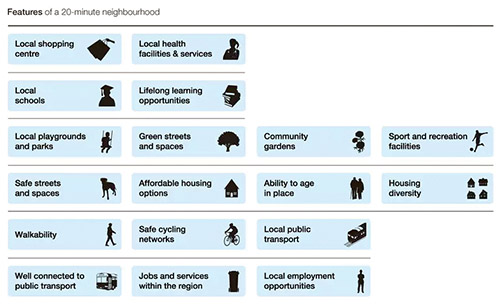
For instance, knowing that most people prefer the more relaxed atmosphere of villages to crowded and impersonal cities, the government of Victoria, Australia supports the 20 Minute City concept in which the village – grocer, butcher, baker, pharmacy, health clinic, bus stop – is integrated into the city.4
“Sustainable McDonald’s” is an oxymoron, yet Australia once again serves as a testbed for the Fourth Industrial Revolution (4IR) with “sustainable” fast-food outlets that allegedly cut CO2 emissions by a third. The solar-powered “smartly” ventilated takeaway/restaurant in Melton South is a prototype for other sites. Through Podium, Australia is also pioneering the end-to-end digitisation of real estate: from design, purchase, lease, and construction, to repurchase, letting, contract, and the new age of tailored living. This will create a new blockchain for real estate markets.
In this part of the new world order, constant labour is normalised. “From focus zones to work cafes, the space integrates ‘external’ elements such as coworking and the home office.” Happy slaves must also be healthy slaves. Design concepts include an “ergonomically supportive home office with limited distractions.” There will be a “blend of social spaces with productivity enablers,” such as colleagues who give unconscious prompts to others to work harder. This will be achieved through the design of the building itself. For instance, computers on which people work might be strategically placed near the coffee machine so that the idler sees their colleagues labouring and is prompted to return to work. Exercise machines might be placed near the snack bar so that workers tempted by candy are also guilted into doing a few minutes’ exercise before returning to their toil.
The Fourth Industrial Revolution
Covid has given WEF corporations the chance to integrate public health concepts via constant social biosurveillance in their existing 4IR agenda. Over the last few decades, the phrase “new normal” became normal as politicians, intellectuals, and the media sought to brainwash us into believing that terrorism would make total surveillance and travel restrictions a new normal, as would limitations on freedom and growth caused by anthropogenic climate change.
Since Covid, the WEF asks: “What will the ‘next normal’ look like?” (Emphasis added). WEF’s message is confused. On the one hand, its authors lessen mental health concerns by promoting community, but on the other, they note that the structure of the socioeconomic order will increase isolation. Facebook is notorious for keeping people isolated in echo chambers, but the new Meta rebranding, as we shall see, will blend isolation and community in augmented, virtual reality (VR) settings. The happy slave will be alone in their tiny, greenwashed hovel but feel emotionally connected with friends in a VR universe.
When it comes to online shopping, there will be less “face-to-face interaction.” The last-minute deliveries spurred by Covid “will persist beyond the pandemic”5 and be delivered by the kinds of people whom the WEF envisages occupying the above properties. Jab mandates for working people are part of the “next normal,” and patents on the vaccines are of primary interest to the mega-rich. But the WEF is less interested in ensuring the safety and efficacy of Covid vaccines and more concerned with bolstering “vaccine confidence.” Even though the jab appears to be effective only in reducing hospitalisations, the WEF was quick to ask how its thought leaders could work to promote “trust” in big pharma’s rushed products.6
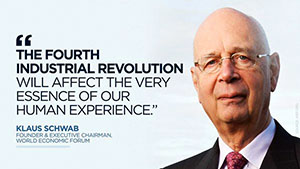
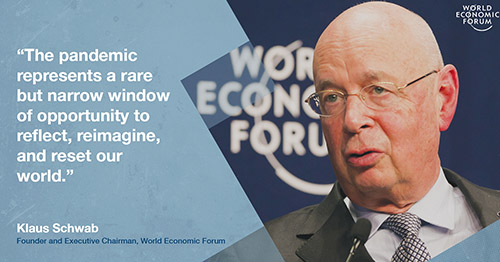
It is important to distinguish between words and actions. Sometimes, WEF founder and chairman Klaus Schwab speaks truth and horrifies those familiar with his words. Examples include references to microchipping the population and replacing humans with robots.7 At other times, Schwab seems to say the opposite, acknowledging that what is erroneously called “capitalism” – which actually means state-backed monopoly corporatism – has damaged the younger generations, stagnated the middle classes, and fuelled the climate crisis. In order to look good and paint the global elite’s WEF as some kind of progressive or “woke” (as the right-wing say) face of “capitalism,” Schwab points out that which is wrong with the “capitalist” order.
The reality is that pretty words and agreement with those injured by profit-driven corporatism is a cover. It is as if an abuser consoles their victim while continuing to abuse them. In his introduction to the WEF’s report on youth, Schwab plays this game, writing things many of us would agree with: that long-term planning is better than short-term profit and that intergenerational parity is better than growing inequality.8
As part of its pyramid structure, the WEF claims that its global reach on this issue was over two million people, the vast majority of whom were journalists, intellectuals, businesspeople, and community leaders; in other words, rungs on the ladder of hierarchy, not ordinary people. These so-called cultural leaders will shape the doctrines for those below them through entertainment, education, media, and the workplace.
The report pays lip service to getting corporations to disinvest from fossil fuels and working with Generation Z’s thought leaders to create a new agenda for sustainability. In reality, it is the same old monopoly corporatism in which ordinary people are the flotsam and jetsam in the plans of those higher than them in the social order. For example, one Lab held in Luxembourg concluded that the WEF should decide what is or is not ethical consumption: “It would be unfair and naïve to put all the burden on consumers having to educate themselves in order to avoid greenwashing.”9
If, for instance, someone decides not to buy the latest Apple gadget because ‘child mining’ in Congo extracted the device’s coltan, ‘forced labour’ in China created the product, ‘air miles’ brought the item to the West, and ‘tax avoidance’ enables the company to be a monopoly, a WEF messaging campaign might greenwash and claim that the gadget’s production was ethical and its carbon footprint neutral.
Another event in Australia concluded that the WEF should harness the wisdom of indigenous people when promoting the new agenda so that people resonate with ancient ways of living whilst continuing to work for corporate overlords.
This is a form of mind control in which the labouring masses have internal freedom and believe they participate in a spiritual society, when in fact the limits of their reality are set by superiors who pretend to consult with and gain the approval of those they are controlling. The Davos Lab’s Millennium Manifesto is jam-packed with empty verbiage such as, “We will ask big questions to advance bold solutions.”10
The Great Reset
Another aspect of the WEF agenda is what Schwab calls the Great Reset: a professed plan to promote economic and social equity while cementing the structures that guarantee worsening inequality. In addition to trapping working people in properties designed to enhance their productivity and monetise their idiosyncrasies (like the AI temperature control example above), the revolutionary potential of the exploited classes as well as their dissatisfaction will, if the WEF planners get their way, be quelled by the promotion of transhumanism and virtual reality, in which humanity is “reset” to begin anew with biological and digital enhancements.
One of the methods of control is trapping people in social media bubbles. After US President Donald Trump came to power (2017–21) and threatened the neoliberal agenda, ideological managers such as mainstream media, think tanks, and political unions, took action against what they call “fake news.” Fact-check organisations have morphed into the guardians of neoliberal elites. Often “populists” like Trump and his supporters lie, misreport, and publish fake news. Fact-checkers expose those lies, but they have a deeper agenda.
In most cases, so-called fact-checkers simply argue over interpretations of truth, which the fact-checkers then use to delegitimise real populism. The ideological basis from which they operate promotes the agenda of the World Economic Forum and others. But who fact checks the fact-checkers? Researchers have uncovered their connections to the political, corporate, and media establishment. In this revolving door system, former mainstream corporate media editors and journalists take up new roles as self-professed fact-checkers whose targets are those opposed to the neoliberal order.
In addition, social media have, for years, been on a deplatforming crusade as part of “woke washing” (while keeping oppressive and prejudicial structures in place) and under the influence of the intelligence services. In their evidence to US Congress after the 6 January Capitol insurrection, both Facebook co-founder Mark Zuckerberg and Twitter co-founder Jack Dorsey confirmed that because of “security” concerns, domestic US intelligence agencies advised (i.e., leaned on) them to deplatform accounts, including the President’s.
All of the above serves to blandify social media content and constrain users to the boundaries of what is acceptable within neoliberal culture. Anything too progressive (e.g., the World Socialist Web Site) or regressive (e.g., Breitbart News) is censored, pushing the entire user base of hundreds of millions of people into a giant corporate-approved echo chamber (e.g., CNN, New York Times).
This process is called “digital literacy” by the WEF and others. Without “digital literacy,” people might fall for dangerous “fake news” (i.e., news not approved by WEF corporations). But people might also create and share real news and real information that does not fall within the bounds of accepted neoliberal ideology, such as questioning the efficacy of big pharma-produced vaccines or pointing out the serious problems with the corporate-political elite. In making the world “digitally literate,” the WEF employs doublethink: “Steps must be taken to prevent abuse and harm while maintaining the freedom to openly exchange ideas.”11
Slaving for the ultra-rich in personally-tailored smart cities, the younger generations censored into the neoliberal sheep pen by social media will, according to the WEF model, augment their capacities with technology. The transhumanist agenda is specifically harnessed for the older, infirm generations who have gone from being useless eaters – from the WEF perspective – to potential data points for augmentative technologies. As part of the WEF propaganda campaign, the organisation is preparing to “Articulate the potential benefits of artificial intelligence,” particularly for the older generations.12
For “older” people, which we assume means the over-60s, WEF suggests placing representatives in the design process, the reasoning being that over-60s tend to have different aesthetic tastes, practical preferences, and physical and cognitive requirements to young people. The young are born into the new technological changes, and those changes become part of their environment. In contrast, the over-60s must adapt. Pursuing profit, companies are using the WEF as a vehicle to help turn the over-60s into transhumanist augmentation technology consumers: home-help robots, implants for better eyesight, time-released painkillers, etc. The WEF does not seek solutions for ending the collection and selling of personal data but rather for more transparency. This way companies can cheat consumers whilst being honest that they are cheating them. The aim is to make consumers feel less angry because they appreciate the honesty.
WEF suggests that companies “Disclose the data being collected.” They hope that older people will thus be more willing to have their information sold. The WEF also wants to “Obtain meaningful consent.” The clue is in the word “meaningful,” suggesting that up until now, consent has not been meaningful. One of the more insidious agendas is to “Design for appropriate trust.” Just as they seek to make the younger generations “digitally literate,” i.e., keep them in a mental prison, WEF corporations aim to protect the elderly from “deception,”13 but not the deceptions on which their system is built.
The WEF is aware that the general public might, if left on their own, form groups, communities, parties, and movements that spread an anti-“capitalist” message and develop new social models. If such a long-term grassroots revolution succeeded, it would not only hurt the profits of the owner-classes but threaten the system they spent so long developing. Repackaging profit-driven agendas as some form of third position between capitalism and socialism is achieved, in part, by rhetorically emphasising “corporate responsibility.”14
The WEF also seeks to capture potential revolutionaries by appealing to “social justice.” The WEF intellectuals are aware that young people tend to be driven more than old people by outrage. The right-wing dismisses these young, conscious activists as “social justice warriors.” Instead of encouraging people to change the system in their own image, WEF intellectuals want to make people feel like they have – without actually having – input into their conditions. “[R]ecognising, co-designing, partnering and learning with impacted stakeholders… must be at the centre of any corporate action on equity and social justice in our unequal world.”15
Another factor profitable to the corporate class is social impact bonds. Historically, the underclasses – those below the working classes – were a financial negative. They claimed benefits, needed free healthcare, public housing, etc. The working classes laboured, the middle classes paid the most relative taxes, and the rich lived off the labour of the poor, profits generated by the consuming middle classes, and hording through tax avoidance.
But over the last decades, banks figured out ways of profiting from the underclasses: social impact bonds. Under such systems, government cuts back on social welfare and relies instead on charities to keep offenders out of prison and reach homelessness reduction targets, etc. The banks that fund the charities are then reimbursed by government, and the loans of the banks are serviced by taxpayers. This social impact bond system creates an incentive to have a permanent underclass and champion the alleged virtues of “charity” instead of systemic change that brings genuine inclusivity and democratic empowerment.16 Gerbrand Haverkamp, Executive Director of the World Benchmarking Alliance, is quoted as saying: “[W]e need businesses that can profitably solve societal problems, without profiting from societal harms.”17 This model incentivises the creation of a permanent underclass.
Engineered ‘Life’ In Fake Worlds
There is a sinister, occultic element to the WEF’s agenda. Certain members who currently practice what they believe to be online “meme magic(k)” are also involved in the development of Facebook’s VR world: the Metaverse.
A near-billionaire developer and Trump supporter, Palmer Luckey, used social media to boost Trump’s profile and deflate his rival Hillary Clinton in the run-up to the 2016 US presidential election. Luckey made his fortune selling the Oculus VR headset to Zuckerberg. Luckey’s benefactor, a lobby called Nimble America, believed that “meme magic is real.” The Millennial generation started to use images with text circulated online to boost their agendas and attack their enemies (memes). One famous meme was Pepe the Frog, an innocent cartoon hijacked by racists and right-wingers (usually both) to signal their political allegiances. The cultists behind the spread of such memes believed that they could invoke spiritual power (“meme magic(k)” to vanquish enemies. Pepe, to give one of many examples, is drawn with light reflecting in both eyes in the shape of a Freemasonic dot-triangle.
Regardless of his involvement or lack of involvement in such practices, the executive director of Oculus, Jason Rubin, sent his 50-page report on the Metaverse to Zuckerberg. Just as US military planners devised a “shock and awe” terror campaign to inflict on the Iraqi people in 2003, Rubin said that “shock and awe” tactics would condition the user to accept their new digital life in the Metaverse. CNBC has seen leaked policy documents: “It imagined users floating through a digital universe of virtual ads, filled with virtual goods that people buy.”18
Chillingly (no pun intended), FB Oculus’s Michael Abrash says: “It all started with Snow Crash,” the futuristic ‘90s novel written by Neal Stephenson. The Guardian, which picked up the Abrash quote, conveniently omits a crucial detail about the novel: that the fictional online world on which the new scheme is based contains a mind virus that can infect users as they merely look at the screen. Likening it to Snow Crash, though providing no evidence, certain individuals claim that the Pepe meme that evolved into something else has, for many years, contained a hidden mind virus.
Whether the mind virus is real or not is beside the point. Certain online occultists, including Luckey, are using the fear of mind control, coupled with what Rubin calls “shock and awe,” to get users to submit to the dialectic: a “progressive” Zuckerberg world order of Joe “Build Back Better” Biden in a virtual reality, or a more overtly fascistic world order of “meme magic(k)” and mind warfare using Trump as a frontman.
Part of the Trump meme war and the fake news hysteria surrounding the President had the effect of making ‘truth’ a vague and flexible concept. As the concept of truth becomes fuzzy, that which is real is set to become fuzzier. WEF says of Meta: “This could manifest itself in several ways, but many experts believe that ‘extended reality’ (XR) – the combination of augmented, virtual and mixed reality – will play an important role.”19 The WEF hopes that once we have been bombarded into the new system, we will all be Huxleyan happy slaves in their Brave New World, playing with intangible VR toys and mingling with avatars of our loved ones.
About the Author
Dr T.J. Coles is an associate researcher at the Organisation for Propaganda Studies, a columnist with Axis of Logic, a contributor to numerous publications (including CounterPunch and Truthout) and the author of several books including Manufacturing Terrorism (Clairview Books), Human Wrongs (iff Books) and Privatized Planet (New Internationalist).
12. WEF,” Insight Report, August 2021, www3.weforum.org/docs/WEF_ Designing_Artificial_Intelligence_Technologies_for_Older_Adults_2021.pdf
13. Ibid.
14. WEF, Business for Social Responsibility and Laudes Foundation, Insight Report, September 2021, www3.weforum.org/docs/WEF_Lighthouse_ Action_Social_Justice_Stakeholder_Inclusion_2021.pdf
Over the last few years, an unwelcome phrase has grown to plague American consumers and producers alike: supply chain issues. The recurring term is frequently offered by mainstream economists as the go-to explanation for record inflation, while the Biden Administration has seemingly twisted it into a sign of economic recovery. Commerce Secretary Gina Raimondo states,
“What we have here is a demand issue. The economy is doing better… People have money in their pocket. They’re spending that money. Demand is through the roof… Supply has to catch up.”
Although Raimondo said this back in October 2021, inflation has only worsened from an annual rate of 6.2 percent to 7.7 percent more than twelve months later, leading one to wonder if the Secretary is right that inflation is a matter of supply chains adjusting to an increase in wealth. Yet as it turns out, in the words of the Mises Institute’s Ryan McMaken, “the administration’s defenders are right about consumer demand and spending – even if for the wrong reasons.”
That is, although we’re indeed witnessing a large spike in demand (which is perhaps best quantified by changes in nominal GDP), this increase in demand is a symptom of a larger problem: the massive expansion of the money supply under the watch of the Federal Reserve and the White House. The implications of this unprecedented expansion are two-fold, not only stirring this increase in “demand” but contributing to supply chain issues through the distortion of price signals.
The Money Supply and Demand
With state governments responding to the rise of Covid-19 by imposing lockdowns and forcibly closing “non-essential businesses,” both the Fed and the Trump and Biden Administrations stepped in with an extraordinarily expansive monetary and fiscal policy, respectively.
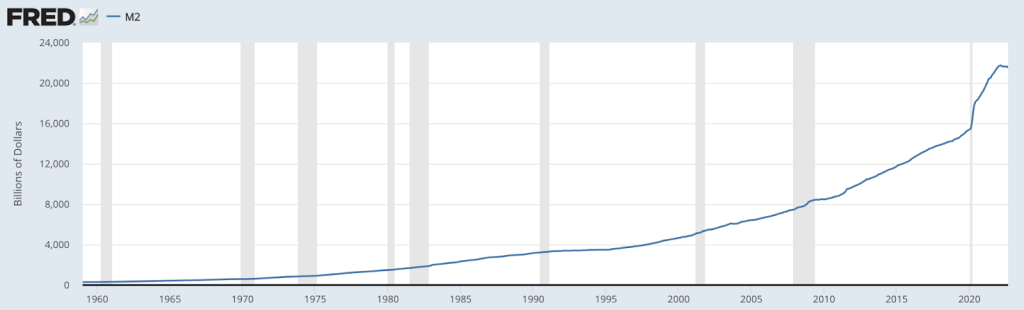
M2 is a figure for the money supply, which surged by more than $6.2 trillion, a 40 percent increase, between February 2020 and February 2022. This is the result of a variety of initiatives, from the Fed’s quantitative easing and purchase of over $2 trillion in assets to new federal programs such as stimulus checks, PPP loans, and the $1.9 trillion American Rescue Plan Act.
Through these ventures that flooded the economy with new cash, Americans indeed had more money in their pockets. The problem is, obviously, that such money soon became worth a lot less. That’s because an increase in the money supply, without a corresponding increase in economic output, means an increase in prices, with more money chasing roughly the same quantity of goods.
This is where Raimondo serves to mislead viewers in her comments; just because Americans have more money, doesn’t mean they’re any wealthier. There certainly is a large spike in demand, but that doesn’t represent an increase in the real wealth of Americans, but an increase in the amount of money they have access to thanks to an unprecedented monetary expansion.
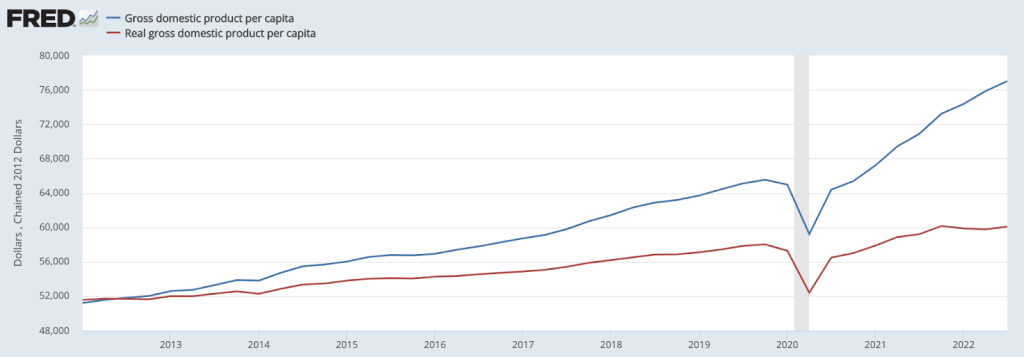
This is perhaps best represented by comparing nominal to real GDP per capita, which is a rough proxy for standard of living:
If you were to look only at nominal GDP per capita (the blue line) you would think that the average American’s wealth has increased greatly since the pandemic. This, however, is incredibly misleading, because it doesn’t take into account inflation and the decreasing value of the dollar.
Inflation and Price Signals
The large demand increase noted by Raimondo and other economists does not reflect a growing economy and an increase in wealth but an increase in the money supply which has created upward pressure on prices. Yet just as the Biden Administration declares that “supply has to catch up,” the ability for producers to do so has been greatly strained by inflation (not to mention the aforementioned lockdowns).
That’s because of the role prices—which economist Alex Tabarrok refers to as “a signal wrapped up in an incentive” —play in coordinating economic activity. Changes in prices usually convey changes in the scarcity and demand for different goods, products, and resources. When the price of something in a company’s supply chain increases, this hurts the company’s profitability and incentivizes it to economize and find a more efficient alternative.
On a macro scale, economic growth (or recovery) comes through thousands, if not millions, of businesses and firms finding new ways to innovate and maximize profits, which is the result of comparing the prices of alternative inputs and production methods. Inflation, by raising the general price level of the economy and often affecting the price of each good differently, can cause economic discoordination and confusion because prices no longer reflect changing efficiencies and scarcities.
Even if inflation impacted all prices equally, we still wouldn’t know to what extent a rise in the price of a certain resource reflects actually important information about it, given that the rate of inflation is always changing and can only be measured in hindsight.
In the context of the last few years, this has meant that firms have essentially been blindfolded, piecing back together supply chains forcibly closed during the pandemic without the ability for prices to convey the efficiency of competing alternatives. This is exactly why “supply chain issues” has continued to be a lingering excuse for inflation and shortages, with Volkswagen chief executive Oliver Blume going so far as to say that, “Challenges to our supply chains will become the rule, not the exception.”
Nor is this a relatively recent phenomenon. Paul Volcker, the late Fed Chairman notable for remedying the United States’ last encounter with runaway inflation in the late 1970s and early 1980s, observed that, “The inflationary process itself brought so many dislocations, and stresses and strains that you were going to have a recession sooner or later.”
Given the fact that the United States technically entered a recession during the first half of 2022—at least according to a common definition of recession—Volcker’s words proved prescient. Not only has an unprecedented monetary expansion under the purview of the Fed and White House triggered a dangerous period of inflation; the inflation has also caused disruptions to the supply chain, which agencies (ironically) use as a scapegoat for inflation.
Now, with economic growth stagnant and inflation persisting at high levels, the fate of supply, demand, and the price signals that they convey rests in the hands of the problems’ culprits.
For years, and particularly since the beginning of Russia’s military offensive in Ukraine, the United States, the European Union – and their allies – have provided Kiev with $126 billion worth of aid, a number almost equal to the country’s entire GDP but Olga Sukharevskaya reports that officials and oligarchs have diverted much of the financial support sent to Kiev __________________________
Since the beginning of Russia’s military offensive in Ukraine, the United States, the European Union – and their allies – have provided Kiev with $126 billion worth of aid, a number almost equal to the country’s entire GDP. Moreover, millions of Ukrainians have found refuge in the EU where they were given housing, food, work permits, and emotional support. The scope is huge, even by western standards. Considering that the bloc has been funding Kiev while coping with an economic and energy crisis of its own, the assistance is perhaps especially notable.
Kiev bases its endless funding requests on the collapse of its economy, due to the war, and its need to “resist Russian aggression.” But is the aid reaching its intended destination?
The Monaco Battalion
While Ukraine has undergone a general mobilization affecting all men under the age of 60, many former and current high-ranking officials, politicians, businessmen, and oligarchs have moved to safety abroad – mainly to the EU.
The mass flight of Ukrainian elites started even prior to the armed conflict. On February 14, 2022, 37 deputies from the Ukrainian president’s parliamentary faction “Servant of the People” suddenly went “missing.” Had MPs not been banned from leaving the country the very next day, others would’ve definitely joined them. Meanwhile, former officials and oligarchs enjoyed more freedom to move around. According to the Italian newspaper La Repubblica, 20 business jets took off from Kiev’s Boryspol airport on the 14th as well.
Tycoons were at the front of the line. Entrepreneur and MP Vadim Novinsky, businessmen Vasily Khmelnitsky and Vadim Stolar, Vadim Nesterenko, and Andrey Stavnitzer all left the country on charter flights. Millionaire politician Igor Abramovich booked a private flight to Austria for 50 people – taking relatives, business partners, and fellow party members aboard. Oligarchs flew from Kiev to Nice, Munich, Vienna, Cyprus, and other EU destinations. Another group of businessmen took off from Odessa on private planes. The owner of Vostok Bank departed for Israel, while the head of the Transship group flew to Limassol. An ex-governor of the Odessa region, Stalkanat’s Vladimir Nemirovsky, also left the country.
In the summer and early fall of 2022, ‘Ukrainska Pravda’ prepared several investigative documentaries about fit-for-service Ukrainian billionaires and officials spotted vacationing on the Côte d’Azur during the war. A movie with the ironic title “The Monaco Battalion” shows Ukrainian oligarchs resting at their villas, mansions, and on yachts. In the first part, we see businessman Konstantin Zhevago, who is included on Interpol’s wanted list, relaxing on his private yacht worth $70 million. The yacht graces the shoreline of the Côte d’Azur as Zhevago’s family disembarks. Kharkov entrepreneur Alexander Yaroslavsky, who promised to sell his yacht and transfer the funds towards the restoration of Kharkov, can be seen sailing alongside.
‘Ukrainska Pravda’ journalists also got a glimpse of the Surkis brothers in France, who’re currently renting apartments worth €2 million per year. Meanwhile, a $300,000 Bentley belonging to Ukrainian businessman Vadim Ermolaev was spotted near the casino in Monaco, and Eduard Kohan, the co-founder of Euroenergotrade, was seen at one of Monte Carlo’s chic hotels.
A whole colony of Ukrainian oligarchs has apparently taken up residence in the elite French commune of Cap-Ferrat. Land developer Vadim Solar, oligarchs Dmitry Firtash, Vitaly Khomutynnik, and Sergey Lovochkin are among those enjoying high life in the middle of the war. The Cap-Ferrat villa once belonging to King Leopold II of Belgium was bought by the richest Ukrainian oligarch Rinat Akhmetov. His neighbors are Alexander Davtyan, President of the Investment Group DAD LLC, and Vladislav Gelzin, a former deputy of the Donetsk Regional Council.
As the creators of the film repeatedly emphasize, deputies and businessmen of “pro-Russian” parliamentary factions left the country during the war. Yet many active supporters of the current government also prefer to defend their homeland from abroad.
‘Ukrainska Pravda’ managed to interview Andrei Kholodov, an MP from Vladimir Zelensky’s faction “Servant of the People”, from his current residence in Vienna. The Austrian capital was also chosen by nationalist Nikita Poturaev and Sergei Melnichuk, a former head of the Aidar battalion known for war crimes reported by Amnesty International. The former head of the Constitutional Court of Ukraine, 59-year-old Alexander Tupitsky, and the 45-year-old ex-prosecutor general of Ukraine Ruslan Ryaboshapka also preferred foreign “trenches.”
Members of the Ukrainian parliament are in no hurry to adopt vitally important laws for the country during wartime. According to the Telegram channel “Volyn News,” as of March 11, 2022, more than 20 MPs had moved abroad for unspecified reasons. The geography is extensive: Great Britain, Poland, Qatar, Spain, France, Austria, Romania, Hungary, UAE, Moldova, Israel, etc. In March, the Prosecutor General’s Office of Ukraine launched an investigation into the actions of six parliamentarians who have remained abroad.
Apparently, neither war nor punishment can put Ukrainian legislators to work. Only 99 deputies out of 450 attended the session of the Parliament on July 20. Presumably distracted by summer, the Côte d’Azur, the Maldives, and yachts… As for defending Ukraine itself – just leave it to the foreign volunteers, they say.
Where’s all the military and humanitarian aid going?
Some western benefactors have recently noticed that most of the military and humanitarian aid never reaches Ukraine’s army or ordinary citizens.
In an original documentary, CBS reported that about 70% of military aid failed to find its way to the intended beneficiaries and donor countries are often unable to control its intended use. According to the creators of the report, some of the weapons are sold on the black market. As US Marine Corps veteran Andy Milburn said, “I can tell you unarguably that on the frontline units these things are not getting there. Drones, Switchblades, IFAKs. They’re not, alright. Body armor, helmets, you name it.”
The Grayzone writes that weapons and humanitarian aid provided by the West to the Ukrainian military is being stolen along the way and never reaches the soldiers. At the same time, Ukrainian MPs recently gave themselves a 70% pay raise. The author of the piece argues that billions of dollars from the USA and the EU have been diverted.
A Ukrainian soldier named Ivan told journalists about western funds never reaching the front: “Imagine telling an American soldier that we are using our personal cars in the war, and we’re also responsible for paying for repairs and fuel. We’re buying our own body armor and helmets. We don’t have observation tools or cameras, so soldiers have to pop their heads out to see what’s coming, which means at any moment, a rocket or tank can tear their heads off.”
Samantha Morris, a medical doctor from the US, drew attention to the theft of medical supplies and the overall corruption: “The lead doctor at the military base in Sumy has ordered medical supplies from and for the military at different points in time, and he has had 15 trucks of supplies completely disappear,” she said. The doctors couldn’t even set up courses for medical assistants until a friend of the Sumy region governor interceded.
CNN talked to a retired US colonel who said that Ukrainian troops are short on supplies. Small arms, medical equipment, field hospitals and a lot more are under the control of private organizations – more concerned about stealing money than saving the lives of their compatriots.
As Stephen Myers, a former member of the US Department of State Advisory Committee on International Economic Policy, insisted, “There is little to prevent a field commander from diverting some of the equipment to buyers, aka the Russians, the Chinese, the Iranians or whomever, while claiming the equipment and weapons were destroyed…”
Thousands of tons of humanitarian aid is being stolen. In September, the National Anti-Corruption Bureau of Ukraine (NABU) proved that the head of the Office of the President, Andrei Yermak, his deputy Kirill Tymoshenko, the head of “The Servant of the People” faction David Arakhamiya and his friend Vemir Davityan were behind the large-scale theft of humanitarian aid in the Zaporozhye region. Zaporozhye officials Starukh, Nekrasova, Sherbina, and Kurtev only superficially carried out the task of distributing aid. In six months, they organized the theft of 22 sea containers, 389 railway cars, and 220 trucks. Humanitarian aid was sold in ATB and Selpo – supermarkets owned by Gennady Butkevich and Vladimir Kostelman, respectively. Of course, Tymoshenko, Nekrasova and Davityan all became “refugees” and found asylum in Vienna.
Admittedly, not everyone is on the run. Andrei Yarmolsky, the scandalous former deputy head of the Volyn regional administration – accused of stealing humanitarian aid, supplying defective bulletproof vests, and illegally moving men out of the country – was promoted. He now works for the National Security and Defense Council.
Medical supplies are also being stolen. The Telegraph reportsthat “some of the donated supplies later made their way onto the hospitals’ pharmacy shelves: priced, and listed for sale”. Health workers appropriate medicine, bandages, and medical equipment, and resell them to patients for whom they were intended to be free, the article says.
A similar story was told by the aforementioned doctor Dr Morris: “I got a call from a nurse at a military hospital in Dnipro. She said the president of the hospital had stolen all the pain medications to resell them, and that the wounded soldiers being treated there had no pain relief. She begged us to hand-deliver pain medications to her. She said she would hide them from the hospital president so that they’d reach the soldiers. But who can you trust? Was the hospital president really stealing the medications, or was she trying to con us into giving her pain medications for her to sell or use? Who knows. Everyone is lying.”
War for some, Gucci for others
Enormous cash flows from Western countries are continuously used by corrupt Ukrainian officials for personal enrichment and to acquire luxury goods.
In a recently busted corruption scheme, Odessa customs smuggled shirts, backpacks, sports shoes, belts, and other luxury items by Givenchy, Gucci, Polo, Dolce & Gabbana, Michael Kors, Chanel, Louis Vuitton, and Armani under the guise of army equipment. The documents, declaring the cargo as “for the needs of the Armed Forces of Ukraine,” were signed by the acting head of the Odessa customs Vitaly Zakolodyazhny. According to MP Alexander Dubinsky, this is a common theft scheme. “The work of the customs is unsatisfactory because while some are fighting at the front, others are making money under the guise of their customs uniforms,” the parliamentarian said.
To take another example, in May 2022, Western countries abolished customs duties for Ukraine. Within a week, over 14,000 passenger cars were imported into the country. As the Deputy Minister of Infrastructure Mustafa Nayem commented, “Considering we’re a country at war, our partners in Poland, Slovakia, and Romania were quite surprised by this fast-paced upgrade to our vehicle fleet.”
As they go about acquiring luxurious clothes and cars, the thieves are also taking care to withdraw capital from Ukraine.
According to the Bureau of Economic Security of Ukraine, Ukraine’s budget is missing UAH 4.5 billion worth of taxes from agrotraders: “In August-September 2022, almost 12 million tons of grain crops and oil estimated at UAH 137 billion were exported through the customs territory of Ukraine. Of these, almost 4 million tons were exported by fake companies existing only on paper.” Moreover, “most of the non-resident companies to which grain is exported are high-risk and involved in criminal investigations.” Is this the “grain deal” that the global community is actively cheering? It looks like Ukrainian fraudsters are corrupting not just their own country, but foreign states as well. And this is just one example out of many.
When the Surkis brothers left Ukraine, they took $17 million with them. But that’s just a trifle compared to the “heroes of the Euromaidan.” According to former People’s Deputy of Ukraine Oleg Tsarev, after the outbreak of hostilities leading Ukrainian politicians sent both their capital and their families abroad.
He mentions that the parents and relatives of President Vladimir Zelensky and his wife all left the country. Zelensky’s predecessor, former president Petr Poroshenko, moved not just his children but also about a billion US dollars in cash to the UK.
The same applies to other major Ukrainian officials: former Minister of Internal Affairs Arsen Avakov, the head of the Office of the President Andriy Yermak, the second President of Ukraine Leonid Kuchma, the former Prime Minister of Ukraine Arseniy Yatsenyuk and many others all took their families and fortunes, estimated at around a billion dollars, out of the country. And that’s not to mention the numerous politically-affiliated oligarchs.
Scammers of smaller stature can “individually join the EU” as well. A system of bribery allows military-age males to leave the country. According to Izvestia, the fee is currently between $8,000 and $10,000. The Ukrainian media also actively reports on people paying to cross the border.
***
The sympathy of Westerners towards a country at war is understandable. But while some countries are doing their upmost to aid Ukraine – even while facing an economic crisis themselves – corrupt Ukrainian officials are using the funding to amass personal fortunes and live the high life at fancy resorts. And all at the expense of taxpayers in the West.
In 2015, Arseniy Yatsenyuk, upon leaving the post of the Prime Minister of Ukraine, openly declared that he had become a billionaire. It is yet to be seen how many new Ukrainian super rich tycoons – nurtured by foreign military aid – will appear in the West by the end of the conflict.
Crypto is finally interesting with the collapse of FTX exposing a political network. These were no seaside Millennials building sand-castles with other people’s money. The justly-named Sam Bankman-Fried was the second biggest donor in the midterms.
The firm crashed last week when depositors tried to withdraw $6 billion. As the money’s been used to fund derivative bets, it may have a knock-on effect. This is no simple Ponzi or trading fraud as the press is pretending.
The setup is spooky from its connections, timings and complexity, to the firms’ logos. It bears an uncanny resemblance to the upscale Theranos viral testing fraud. A crypto pioneer warns of an intelligence sex trafficking ring and promptly drowns.
Individual parts of the story, while suggestive of corruption or wrongdoing, do not tell of the sheer extent of collusion, or the span of this network. For that you need a lofty perspective.
To begin in a spirit of caution, let’s start with a post on one of the Reddit crypto threads: “So much of this FTX meltdown has been connected to various braindead conspiracy theory bullshit at this point. I don’t like the WEF, but this is neither surprising nor consequential to me and I’m highly suspicious of anyone who is suddenly shouting, I knew it! This goes all the way to the top!”
The individual, one g_squidman, says there is no reason to assume Ukrainian officials were siphoning aid money into black money markets; that FTX being located in a tax haven is a “Panama Papers type of conspiracy”; that the crisis serves as a pretext to destroy crypto; that the media lionized FTX out of nowhere; or that its connection to top financial watchdogs might mean it was somehow a deep state project.
“There’s no global deepstate that appointed FTX with the responsibility to make you eat bugs.”
There you have the classic conflation of issues intended to ridicule anyone asking questions. Often there’s a mention of the Moon landings, though not this time.
It was just one greedy billionaire stealing other people’s money — nothing to see. That is what the state corporate media said about Jeffrey Epstein: that it was just one greedy billionaire feeding his sex addiction.
Behind the screen
However this Reditor’s tone of the “only adult in the room” betrays a poor appreciation for how the media or politics works. Neither grants easy access. It is rationed — that is the source of its power. You do not gain publicity or political connections overnight as did Sam Bankman-Fried. By the way, I will hereinafter call him Sam, for the SBF acronym is too reminiscent of Saudi Arabia’s MBS, who has genuine wealth and power.
Look at his family connections plastered across Twitter. Did Sam’s sudden prominence generate those connections or is it the other way around — those connections were behind his rise?
We have watched for three years as events and personages emerge, as from behind a screen, taking their place in ongoing events, like an actor opening the next scene. Much of this cast enriches a narrative or an operation that’s already underway, and they advance rather than hinder its objectives.
As somone once said, if events were random, wouldn’t the little guy win just once in a while?
It does go to show how tiny a world it is — money going to Ukraine’s government, which employs FTX, a new broker loudly promoted by the corporate media and the World Economic Forum, that same broker donating to the Democratic Party and that funds research to bash Ivermectin and promote pandemics; a broker launched by two recent graduates, whose parents work with key government regulators — but it’s not a world that you or I could enter with ease. [1]
People follow celebrities so closely that they mistake them for friends: those on the screen slap each other on the back and share coffee; we imagine ourselves joining in.
Likewise followers of the crypto space — in which Sam is a celebrity if only for his notoriety — can fall for the illusion. His trademark tousled hair and cargo shorts add to the familiarity. Yet that should be a warning (not proof, of course) that he was cast for the role.
Every time a tech entrepreneur dons a black tennis shirt it seems they’re trying to sell something — because they are! They are the sales jocks pushed to the front. The world stage has only just seen the back of tousled Boris Johnson. Tousled Trudeau is still smarming his charm.
The team
To cut to the chase, Mark Wetjen has been FTX head of policy and regulatory strategy since Nov 2021. He served as Commodity Futures Trading Commissioner under President Barack Obama from 2011. He was deputy to the Gary Gensler, until the latter became Securities and Exchange Commisioner.
If the penny hasn’t dropped: how could the government not have known that FTX was a fraud for at least a year?
Sam met Gensler at the SEC several times over regulatory issues — perhaps linked to FTX’s acquisition of U.S.-based crypto lender BlockFi, which already had the regulatory approval, to see if this could be extended as an umbrella to cover FTX.
No evidence has emerged that Gensler did anything wrong — actually he has a reputation for slow-walking a regulatory framework that would encourage the crypto industry.
The U.S. is inconsistent in its regulation of crypto exchanges, banning in particular those it considers anonymous. While authorities do not recognize crypto as legal tender, they regard it as a value transaction and thus subject to tax.
Then, in early 2022, Sam met the chairman of the Federal Reserve.
A FOIA request shows that around midday on Feb 1, 2022, Federal Reserve Chairman Jerome Powell was scheduled to meet with: Sam Bankman-Fried, CEO and founder, Brett Harrison, president, Ryne Miller, general counsel, and Mark Wetjen, head of policy and regulatory strategy, FTX US and Zach Dexter, CEO, FTX US Derivatives. [2]
The World Economic Forum (WEF) helped promote FTX. Sam was a speaker at Davos last year, on a panel with Google financial chief Ruth Porat and Bill Winters, CEO of the London-based financial giant Standard Chartered. The WEF has since deleted a web page that listed FTX as a partner. [3]
Sam’s aunt Linda Fried is a Columbia University epidemiologist. The WEF funded her study into brain aging in 2012 and she sits on the WEF’s Council for Human Enhancement. Her husband is an expert in AIDS.
Brother Gabriel works for Sen Chuck Schumer and runs an organisation, Guarding Against Pandemics. FTX funded a trial that dismissed Ivermectin as a pandemic treatment. Sam’s foundation also gave $5 m to ProPublica to investigate “biosecurity and public health preparedness.”
Their mother, Barbara, runs Mind The Gap, that uses statistical models to calculate how Democratic donors can have the “greatest marginal impact.” It was launched two weeks after then Sen Joe Biden announced his presidential run. FTX head of ventures Amy Wu used to worked for the Clinton Foundation. Sam himself was the biggest donor to the Democratic Party in 2021-22 after George Soros.
Father, Joseph Bankman, is a Stanford University law professor who has advised Sen Elizabeth Warren on the drafting of legislation.
This past April Sam sat on a panel with President Bill Clinton and former British prime minister Tony Blair at an event in the Bahamas.
Trade organizations the Chamber of Progress and the Association of Digital Asset Markets on which FTX representatives sat, have deleted references.
The attempt is underway to rewrite history.
Nobody wants to admit
Gary Gensler’s relationship goes deeper. Gensler was, and still is, an economics professor at MIT where his boss was the father of Caroline Ellison, head of FTX sister company Alameda. U.S. Representative Tom Emmer is questioning his relationship with Sam’s parents. Gensler was finance chair for Hillary Clinton’s presidential campaign.
Comment from the investment world: the New York Post quotes an investor close to FTX as saying, “This is like a Madoff situation… almost everyone in tech and Hollywood invested in this thing, Now no one wants to admit to it.”
But the most predictable response comes from The New York Times. It published 2,200 words without mentioning Sam’s funding the Democratic Party as its second biggest donor, or anything about SEC head Gensler or his connections with the parents of Sam and Caroline Ellison, nothing about the WEF or the political associations of other employees, nor, of course, about Ukraine.
The NYT spoke to Sam, but got little new information. It rehashed the story of the crypto trading company Alameda, founded in 2017, FTX in 2019 as a place to store crypto purchases, and a cryptocurrency token FTT to trade on the platform.
Alameda took loans to invest in other ventures but when the market slid and creditors recalled their loans, Alameda used customer deposits at FTX to cover its debts. CoinDesk revealed that Alameda had a large amount of FTT, sparking a collapse in the price of the token. [4]
Yet these two companies, FTX and Alameda, have more than 70 subsidiaries and may have invested in 160 other companies.
The deputy head of crypto for Ukraine, Alex Bornyakov, deputy minister of digital transformation, denied the country had converted any U.S. aid on FTX, though it had used the platform to convert crypto donations into fiat money. [5]
Is there any other way to say, this goes right to the top?
Pushy saviours
The investment firm Sequoia Capital, which has lost money on its FTX investment, had an article on its website: “Sam Bankman-Fried has a Saviour Complex — and Maybe You Should Too.”
Though it’s since removed the article, the choice of words is telling, for there’s a lot of saviour complex around, from Greta Thunberg, King Charles and Bono, to Bill Gates, Klaus Schwab, Al Gore and Yuval Harari.
Perhaps the latter is currently the most prominent. An article from March fact checks Yuval Harari and shows where his key themes fall apart.
It turns out he makes claims for genes that are simply not true: the idea that you can edit health or cognitive abilites completely ignores the environmental variables that play a parallel role.
He says under-the-skin surveillance will monitor our emotions but this is physiognomical nonsense; people vary hugely in their emotional responses.
His claim that scientists perceive the universe as a flow of data — meaning that AI machines will inevitably rule us — is likewise bunk. Scientists do not hold such a view.
Why, therefore is Harari pushing this? It aligns with the commercial interest of Silicon Valley and tech companies in a way that Shoshana Zuboff, who coined the phrase surveillance capitalism, does not. [6]
The clue is that Harari’s book is being forced on all generations as if it were public information messaging, aka, propaganda.
“In October of 2021, Harari released Volume 2 of the graphic adaptation of Sapiens. Coming up next are a Sapiens children’s book, Sapiens Live, an immersive experience, and a multi-season TV show inspired by Sapiens. Our Populist Prophet is relentless in his search for new followers—and with them new heights of fame and influence.”
Darshana Narayanan writes that he is a science populist. He is worse than that. Harari, whether he knows it or not, is a marketing man for the surveillance capitalists of Silicon Valley. There is nothing organic about Yuval Harari.
One last daquiri
Which brings us back to Sam.
As FTX sank with the sun last Friday its executives claimed that hackers had stolen the last remaining $600-900 million.
At least half of it was reportedly transferred to a company that Sam held privately. Yet it’s far from clear that any amount of money can get him off the hook, as the boats return to the shore laden with marlin.
The question is whether Sam used his parents’ political ties to launch his own financial vehicle, or whether he was manipulated — the fall guy in an operation he could not fathom, for it was deep.
Could it be that Sam and his squeeze, Caroline Ellison, were just the Harry Potter cast that was put in place to deceive the Millenial crypto speculators? The world is a polluted pool where only the poisoned thrive.
The private equity manager Alex Krainer has drawn comparisons between the FTX affair and that of Theranos and privileged-brat founder Elizabeth Holmes who is currently being sentenced for fraud. [7]
The difference seems to be that Theranos blood test was supposed to be ready for the pandemic. The board was stacked with deep state perennials: Kissinger, Shultz, Perry, Nunn. When Holmes’ fraud was exposed, the PCR test had to be coopted instead. Its inventor Kary Mullis died conveniently and the German “virologist” Christian Drosten declared PCR a test for Covid.
While we have told the bald facts of political connection we cannot finish our poolside daquiri without one additional, speculative shot.
Two weeks ago a 29 year-old crypto pioneer, the co-founder of stablecoin platform MakerDAO, was discovered drowned off the beach in Puerto Rico.
Nikolai Mushegian, raised in Kansas by immigrants from Russia, was found hours after his final Tweet on Oct 28, 2022:
“CIA and Mossad and pedo elite are running some kind of sex trafficking entrapment blackmail ring out of Puerto Rico and caribbean islands. They are going to frame me with a laptop planted by my ex gf who was a spy. They will torture me to death.” [8]
Feel free to explore the similarity of the FBI’s publication of pedo symbols with the FTX and Alameda logos.
And recall Sam’s meeting with two compromised former national leaders in the photograph at the top of this newsletter.
Tie it in with the U.S. southern border policy that is allowing gangs to traffick unaccompanied children, which the administration flies by plane, often at night, to cities across the U.S..
Finally, ask if the financing of such an operation could be allowed to happen through traceable financial accounts.
But maybe the $32 billion company really did emerge from the daydream of two star crossed lovers on a tropical beach, an intense experience — and over too soon.
Thanks to the FTX swindle, we now know the cost of a get out of jail free card in America: $40 million, paid to political elites. It seems even get out of jail free cards have suffered from inflation.
With hefty “donations” (heh) to elites, all wrong-doing is swept under a very capacious carpet. Jeffrey Epstein sprinkled a few million on the elites of Harvard, and he was ushered into this elite circle as an intimate pal. The fact that he was a rapacious predator of children was of no concern. A few million showered on the right people and causes makes evil and criminality disappear.
If a financier looter showers $40 million on “the right people,” mouths the “correct” phrases and issues empty promises to give away his looted billions, he becomes an instant golden boy of the right elites who have the power to protect him from consequences.
This is how America works now: in-your-face corruption is not just accepted, it’s glorified. Let’s score America’s wealth and power elites, regardless of party or political persuasion:
Integrity: zero.
Austerity: zero.
Restraint: zero.
Humility: zero.
Responsibility: zero.
Accountability: zero.
Sacrifice for the common good: zero.
Thrift: zero.
A society whose elites are so self-serving, corrupt, unaccountable and devoid of any sense of good and evil is doomed. Consider the bleatings of America’s power elite on the FTX swindle. Let’s have congressional hearings on this remarkable “financial event” that caught everyone by surprise, etc.
Translation: let’s stage some political theater to cloak the fact that the looters are being protected from consequences. We all know what happens if you’re caught selling a nickel bag on the street: you get a tenner in a hellhole prison.
But if you bribed the right people, you can swindle billions of dollars and walk free as an insincerely apologetic victim of your own success. Golly gee, I don’t understand what happened to all that money, even though I’m not exactly shy about declaring my own genius.
For reasons lost on the rest of us, investigations by the Securities and Exchange Commission (SEC) and the U.S. Department of Justice (DOJ) always come up empty. Gee, the looting was complicated and we can’t figure out who might have broken the laws against fraud, collusion, embezzlement, malfeasance, etc., so we’re letting everyone off the hook.
Or some sleazy, unaccountable intelligence agency is referenced in whispers that the looters are “assets” and therefore untouchable. Where exactly is the rule of law in a society where bribes, political pressure and having knowledge of elites’ skeletons in the closet melt away accountability and consequences?
The rule of law in America is an illusion, a useful myth promoted by PR hacks to cover the tracks of their employers. Corporate wrong-doing–swindles, collusion, fraud, embezzlement, malfeasance–is off the charts, but nobody is responsible. The criminal corporations are duly fined, a tiny clawback of their looting that’s written off as a cost of doing business.
There are two systems of “justice” in America: one which grants elites freedom from consequences of their toxic criminality and another one for the rest of us that imprisons hundreds of thousands in the War on Drugs Gulag.
What all the entrenched insiders in America’s parasitic, predatory elites and institutions don’t dare admit is that to protect themselves from consequence, we’ve had to sacrifice everything else. Having stripped the nation of the essential foundation of a just, enduring social order–accountability, consequence, rule of law and a grasp of the difference between good and evil–there’s nothing left but sound and fury, as if they’re hoping the endless political circuses and trails of bread crumbs will forever distract us from their plunder and the injustices of the irredeemably corrupt America they’ve fashioned to protect their wealth and power.
To paraphrase Lao Tzu, if one insists on an extreme of corruption and injustice, that extreme will not dwell long.







 After the Crash
