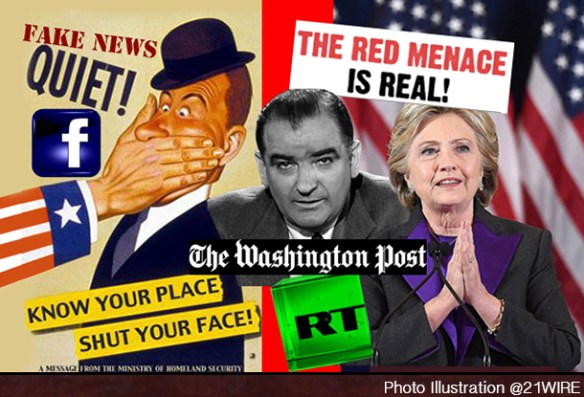
American Apocalypse: The Government’s Plot to Destabilize the Nation Is Working


By John W. Whitehead

Source: The Rutherford Institute

“The most dangerous man to any government is the man who is able to think things out … without regard to the prevailing superstitions and taboos. Almost inevitably he comes to the conclusion that the government he lives under is dishonest, insane, intolerable.” — H. L. Mencken

The U.S. government is working hard to destabilize the nation.

No, this is not another conspiracy theory.

Although it is certainly not far-fetched to suggest that the government might be engaged in nefarious activities that run counter to the best interests of the American people, doing so will likely brand me a domestic terrorist under the FBI’s new classification system.

Observe for yourself what is happening right before our eyes.

Domestic terrorism fueled by government entrapment schemes. Civil unrest stoked to dangerous levels by polarizing political rhetoric. A growing intolerance for dissent that challenges the government’s power grabs. Police brutality tacitly encouraged by the executive branch, conveniently overlooked by the legislatures, and granted qualified immunity by the courts. A weakening economy exacerbated by government schemes that favor none but a select few. An overt embrace of domestic surveillance tactics if Congress goes along with the Trump Administration’s request to permanently re-authorize the NSA’s de-activated call records program. Heightened foreign tensions and blowback due to the military industrial complex’s profit-driven quest to police and occupy the globe.

The seeds of chaos are being sown, and it’s the U.S. government that will reap the harvest.

Mark my words, there’s trouble brewing.

Better yet, take a look at “Megacities: Urban Future, the Emerging Complexity,” a Pentagon training video created by the Army for U.S. Special Operations Command.

The training video is only five minutes long, but it says a lot about the government’s mindset, the way its views the citizenry, and the so-called “problems” that the government must be prepared to address in the near future through the use of martial law.

Even more troubling, however, is what this military video doesn’t say about the Constitution, about the rights of the citizenry, and about the dangers of locking down the nation and using the military to address political and social problems.

The training video anticipates that all hell will break loose by 2030—that’s barely ten short years away—but the future is here ahead of schedule.

We’re already witnessing a breakdown of society on virtually every front.

By waging endless wars abroad, by bringing the instruments of war home, by transforming police into extensions of the military, by turning a free society into a suspect society, by treating American citizens like enemy combatants, by discouraging and criminalizing a free exchange of ideas, by making violence its calling card through SWAT team raids and militarized police, by fomenting division and strife among the citizenry, by acclimating the citizenry to the sights and sounds of war, and by generally making peaceful revolution all but impossible, the government has engineered an environment in which domestic violence is becoming almost inevitable.

The danger signs are screaming out a message

The government is anticipating trouble (read: civil unrest), which is code for anything that challenges the government’s authority, wealth and power.

According to the Pentagon training video created by the Army for U.S. Special Operations Command, the U.S. government is grooming its armed forces to solve future domestic political and social problems.

What they’re really talking about is martial law, packaged as a well-meaning and overriding concern for the nation’s security.

The chilling five-minute training video, obtained by The Intercept through a FOIA request and made available online, paints an ominous picture of the future—a future the military is preparing for—bedeviled by “criminal networks,” “substandard infrastructure,” “religious and ethnic tensions,” “impoverishment, slums,” “open landfills, over-burdened sewers,” a “growing mass of unemployed,” and an urban landscape in which the prosperous economic elite must be protected from the impoverishment of the have nots.

And then comes the kicker.

Three-and-a-half minutes into the Pentagon’s dystopian vision of “a world of Robert Kaplan-esque urban hellscapes — brutal and anarchic supercities filled with gangs of youth-gone-wild, a restive underclass, criminal syndicates, and bands of malicious hackers,” the ominous voice of the narrator speaks of a need to “drain the swamps.”

Drain the swamps.

Surely, we’ve heard that phrase before?

Ah yes.

Emblazoned on t-shirts and signs, shouted at rallies, and used as a rallying cry among Trump supporters, “drain the swamp” became one of Donald Trump’s most-used campaign slogans.

Far from draining the politically corrupt swamps of Washington DC of lobbyists and special interest groups, however, the Trump Administration has further mired us in a sweltering bog of corruption and self-serving tactics.

Funny how the more things change, the more they stay the same.

Now the government has adopted its own plans for swamp-draining, only it wants to use the military to drain the swamps of futuristic urban American cities of “noncombatants and engage the remaining adversaries in high intensity conflict within.”

And who are these noncombatants, a military term that refers to civilians who are not engaged in fighting?

They are, according to the Pentagon, “adversaries.”

They are “threats.”

They are the “enemy.”

They are people who don’t support the government, people who live in fast-growing urban communities, people who may be less well-off economically than the government and corporate elite, people who engage in protests, people who are unemployed, people who engage in crime (in keeping with the government’s fast-growing, overly broad definition of what constitutes a crime).

In other words, in the eyes of the U.S. military, noncombatants are American citizens a.k.a. domestic extremists a.k.a. enemy combatants who must be identified, targeted, detained, contained and, if necessary, eliminated.

In the future imagined by the Pentagon, any walls and prisons that are built will be used to protect the societal elite—the haves—from the have-nots.

If you haven’t figured it out already, we the people are the have-nots.

Suddenly it all begins to make sense.

The events of recent years: the invasive surveillance, the extremism reports, the civil unrest, the protests, the shootings, the bombings, the military exercises and active shooter drills, the color-coded alerts and threat assessments, the fusion centers, the transformation of local police into extensions of the military, the distribution of military equipment and weapons to local police forces, the government databases containing the names of dissidents and potential troublemakers.

The government is systematically locking down the nation and shifting us into martial law.

This is how you prepare a populace to accept a police state willingly, even gratefully.

You don’t scare them by making dramatic changes. Rather, you acclimate them slowly to their prison walls.

Persuade the citizenry that their prison walls are merely intended to keep them safe and danger out. Desensitize them to violence, acclimate them to a military presence in their communities, and persuade them that there is nothing they can do to alter the seemingly hopeless trajectory of the nation.

Before long, no one will even notice the floundering economy, the blowback arising from military occupations abroad, the police shootings, the nation’s deteriorating infrastructure and all of the other mounting concerns.

It’s happening already.

The sight of police clad in body armor and gas masks, wielding semiautomatic rifles and escorting an armored vehicle through a crowded street, a scene likened to “a military patrol through a hostile city,” no longer causes alarm among the general populace.

Few seem to care about the government’s endless wars abroad that leave communities shattered, families devastated and our national security at greater risk of blowback.

The Deep State’s tactics are working.

We’ve allowed ourselves to be acclimated to the occasional lockdown of government buildings, Jade Helm military drills in small towns so that special operations forces can get “realistic military training” in “hostile” territory, and  Live Active Shooter Drill training exercises, carried out at schools, in shopping malls, and on public transit, which can and do fool law enforcement officials, students, teachers and bystanders into thinking it’s a real crisis.

Still, you can’t say we weren’t warned about the government’s nefarious schemes to lock down the nation.

Back in 2008, an Army War College report revealed that “widespread civil violence inside the United States would force the defense establishment to reorient priorities in extremis to defend basic domestic order and human security.” The 44-page report went on to warn that potential causes for such civil unrest could include another terrorist attack, “unforeseen economic collapse, loss of functioning political and legal order, purposeful domestic resistance or insurgency, pervasive public health emergencies, and catastrophic natural and human disasters.”

In 2009, reports by the Department of Homeland Security surfaced that labelled right-wing and left-wing activists and military veterans as extremists (a.k.a. terrorists) and called on the government to subject such targeted individuals to full-fledged pre-crime surveillance. Almost a decade later, after spending billions to fight terrorism, the DHS concluded that the greater threat is not ISIS but domestic right-wing extremism.

Meanwhile, the government has been amassing an arsenal of military weapons for use domestically and equipping and training their “troops” for war. Even government agencies with largely administrative functions such as the Food and Drug Administration, Department of Veterans Affairs, and the Smithsonian have been acquiring body armor, riot helmets and shields, cannon launchers and police firearms and ammunition. In fact, there are now at least 120,000 armed federal agents carrying such weapons who possess the power to arrest.

Rounding out this profit-driven campaign to turn American citizens into enemy combatants (and America into a battlefield) is a technology sector that has been colluding with the government to create a Big Brother that is all-knowing, all-seeing and inescapable. It’s not just the drones, fusion centers, license plate readers, stingray devices and the NSA that you have to worry about. You’re also being tracked by the black boxes in your cars, your cell phone, smart devices in your home, grocery loyalty cards, social media accounts, credit cards, streaming services such as Netflix, Amazon, and e-book reader accounts.

All of this has taken place right under our noses, funded with our taxpayer dollars and carried out in broad daylight without so much as a general outcry from the citizenry.

And then you have the government’s Machiavellian schemes for unleashing all manner of dangers on an unsuspecting populace, then demanding additional powers in order to protect “we the people” from the threats.

Seriously, think about it.

The government claims to be protecting us from cyberterrorism, but who is the biggest black market buyer and stockpiler of cyberweapons (weaponized malware that can be used to hack into computer systems, spy on citizens, and destabilize vast computer networks)? The U.S. government.

The government claims to be protecting us from weapons of mass destruction, but what country has one the deadliest arsenals of weapons of mass destruction and has a history of using them on the rest of the world? The U.S. government. Indeed, which country has a history of secretly testing out dangerous weapons and technologies on its own citizens? The U.S. government.

The government claims to be protecting us from foreign armed threats, but who is the largest weapons manufacturer and exporter in the world, such that they are literally arming the world? The U.S. government. For that matter, where did ISIS get many of their deadliest weapons, including assault rifles and tanks to anti-missile defenses? From the U.S. government.

The government claims to be protecting the world from the menace of foreign strongmen, but how did Saddam Hussein build Iraq’s massive arsenal of tanks, planes, missiles, and chemical weapons during the 1980s? With help from the U.S. government. And who gave Osama bin Laden and al-Qaida “access to a fortune in covert funding and top-level combat weaponry”? The U.S. government.

The government claims to be protecting us from terrorist plots, but what country has a pattern and practice of entrapment that involves targeting vulnerable individuals, feeding them with the propaganda, know-how and weapons intended to turn them into terrorists, and then arresting them as part of an elaborately orchestrated counterterrorism sting? The U.S. government.

For that matter, the government claims to be protecting us from nuclear threats, but which is the only country to ever use a nuclear weapon in wartime? The United States.

Are you getting the picture yet?

The U.S. government isn’t protecting us from terrorism.

The U.S. government is creating the terror. It is, in fact, the source of the terror.

Just think about it for a minute: Cyberwarfare. Terrorism. Bio-chemical attacks. The nuclear arms race. Surveillance. The drug wars.

Almost every national security threat that the government has claimed greater powers in order to fight—all the while undermining the liberties of the American citizenry—has been manufactured in one way or another by the government.

Did I say Machiavellian? This is downright evil.

We’re not dealing with a government that exists to serve its people, protect their liberties and ensure their happiness. Rather, these are the diabolical machinations of a make-works program carried out on an epic scale whose only purpose is to keep the powers-that-be permanently (and profitably) employed.

It’s time to wake up and stop being deceived by government propaganda.

Mind you, by “government,” I’m not referring to the highly partisan, two-party bureaucracy of the Republicans and Democrats.

I’m referring to “government” with a capital “G,” the entrenched Deep State that is unaffected by elections, unaltered by populist movements, and has set itself beyond the reach of the law.

I’m referring to the corporatized, militarized, entrenched bureaucracy that is fully operational and staffed by unelected officials who are, in essence, running the country and calling the shots in Washington DC, no matter who sits in the White House.

Be warned: in the future envisioned by the government, we will not be viewed as Republicans or Democrats. Rather, “we the people” will be enemies of the state.

For years, the government has been warning against the dangers of domestic terrorism, erecting surveillance systems to monitor its own citizens, creating classification systems to label any viewpoints that challenge the status quo as extremist, and training law enforcement agencies to equate anyone possessing anti-government views as a domestic terrorist.

What the government failed to explain was that the domestic terrorists would be of the government’s own making, and that “we the people” would become enemy #1.

As I make clear in my book, Battlefield America: The War on the American People, we’re already enemies of the state.

You want to change things? Start by rejecting the political labels and the polarizing rhetoric and the “us vs. them” tactics that reduce the mass power of the populace to puny, powerless factions.

Find common ground with your fellow citizens and push back against the government’s brutality, inhumanity, greed, corruption and power grabs.

Be dangerous in the best way possible: by thinking for yourself, by refusing to be silenced, by choosing sensible solutions over political expediency and bureaucracy.

When all is said and done, the solution to what ails this country is really not that complicated: decency, compassion, common sense, generosity balanced by fiscal responsibility, fairness, a commitment to freedom principles, and a firm rejection of the craven, partisan politics of the Beltway elites who have laid the groundwork for the government’s authoritarian coup d’etat.

Let the revolution begin.


The Real Big Brother

By Eric Zuesse

Source: Consortium News

Jeff Bezos is the owner of The Washington Post, which leads America’s news-media in their almost 100 percent support and promotion of neoconservatism, American imperialism and wars. This includes sanctions, coups, and military invasions against countries that America’s billionaires want to control but don’t yet control — such as Venezuela, Syria, Iran, Russia, Libya, and China.

These are aggressive wars against countries which have never aggressed against the United States. They are not, at all, defensive, but the exact opposite. It’s not necessarily endless war (even Hitler hadn’t planned that), but war until the entire planet has come under the control of the U.S. Government, a government that is itself controlled by America’s billionaires, the funders of neoconservatism and imperialism — in both major American political parties, think tanks, newspapers, TV networks, etcetera.

Bezos has been a crucial part of neoconservatism, ever since, at the June 6-9 2013 Bilderberg meeting, he arranged with Donald Graham, the Washington Post’s owner, to buy that newspaper, for $250 million. Bezos had already negotiated, in March of that same year, with the neoconservative CIA Director, John Brennan, for a  $600 million ten-year cloud computing contract that transformed Amazon corporation, from being a reliable money-loser, into a reliably profitable firm.

That caused Bezos’s net worth to soar even more (and at a sharper rate of rising) than it had been doing while it had been losing money. He became the most influential salesman not only for books, but for the CIA, and for such mega-corporations as Lockheed Martin. Imperialism has supercharged his wealth, but it didn’t alone cause it. Bezos might be the most ferociously gifted business-person on the planet.

Some of America’s billionaires don’t care about international conquest as much as he does, but all of them at least accept neoconservatism; none of them, for example, establishes and donates large sums to, anti-imperialistic organizations; none of America’s billionaires is determined to end the reign of neoconservatism, nor even to help the fight to end it, or at least to end its grip over the U.S. government. None. Not even a single one of them does.

Plutocrat Bezos at the Pentagon with then Defense Secretary Ash Carter, May 2016. (Wikimedia Commons)

But many of them establish and donate large sums to neoconservative organizations, or run neocon organs such as The Washington Post.  That’s the way billionaires are, at least in the United States. All of them are imperialists. They sponsor it; they promote it and hire people who do, and demote or get rid of people who don’t. Expanding an empire is extremely profitable for its aristocrats, and always has been, even before the Roman Empire.

Bezos wants to privatize everything around the world that can become privatized, such as education, highways, health care, and pensions. The more that billionaires control those things, the less that everyone else does; and preventing control by the public helps to protect billionaires against democracy that would increase their taxes and government regulations that would reduce their profits by increasing their corporations’ expenses. So, billionaires control the government in order to increase their takings from the public.

With the help of the war promotion of  The Washington Post, Bezos is one of the world’s top personal sellers to the U.S. military-industrial complex. He controls and is the biggest investor in Amazon corporation, whose Web Services division supplies all cloud-computing services to the Pentagon, CIA and NSA. (He’s leading the charge in the most advanced facial recognition technology too.)

In April there was a headline, “CIA Considering Cloud Contract Worth ‘Tens of Billions’,” which contract could soar Bezos’s personal wealth even higher into the stratosphere, especially if he wins all of it (as he previously did).

He also globally dominates, and is constantly increasing his control over the promotion and sale of books and films, because his Amazon is the world’s largest retailer (and now also one of the largest publishers, producers and distributors.) That, too, can have a huge impact upon politics and government, indirectly, by promoting the most neocon works helping to shape intellectual discourse (and voters’ votes) in the country.

Bezos is crushing millions of retailers by his unmatched brilliance at controlling one market after another as Amazon or as an essential middleman for — and often even a controller of — Amazon’s retail competitors.

He is a strong believer in “the free market”, which he has mastered perhaps better than anyone. This means that Bezos supports the unencumbered ability of billionaires, by means of their money, to control and eventually absorb all who are less powerful than they.

Because he is so enormously gifted himself at amassing wealth, he has thus-far been able to rise to the global top, as being one of the world’s most powerful individuals. The wealthiest of all is King Salman— the owner of Saudi Arabia, whose Aramco (the world’s largest oil company) is, alone, worth over a trillion dollars. (Forbes and Bloomberg exclude monarchs from their wealth-rankings.)

In fact, Bloomberg is even so fraudulent about it as to have headlined on Aug. 10, “The 25 wealthiest dynasties on the planet control $1.4 trillion” and violated their tradition by including on their list one monarch, King Salman, whom they ranked at #4 as owning only $100 million, a ludicrously low ‘estimate’, which brazenly excluded not just Aramco but any of the net worth of Saudi Arabia.

Bloomberg didn’t even try to justify their wacky methodology, but merely presumed the gullibility of their readers for its acceptance. That King, therefore, is at least seven times as rich as Bezos is. He might possibly be as powerful as Bezos is. The supreme heir is lots wealthier even than the supreme self-made billionaire or “entrepreneur” is.

Certainly, both men are among the giants who bestride the world in our era. And both men are libertarians — champions of the belief that property rights (of which, billionaires have so much) are the basis of all rights, and so they believe that the wealthiest people possess the most rights of all, and that the poorest people have the least, and that all persons whose net worths are negative (having more debts than assets) possess no rights except what richer people might donate to or otherwise grant to them, out of kindness or otherwise (such as familial connections).

This — privatization of everything — is what libertarianism is: a person’s worth is his or her “net worth” — nothing else. That belief is pure libertarianism. It’s a belief that many if not most billionaires hold. Billionaires are imperialistic because they seek to maximize the freedom of the super-rich, regardless of whether this means increasing their takings from, or ultimately impoverishing, everyone who isn’t super-rich. They have a coherent ideology. It’s based on wealth. The public instead believes in myths that billionaires enable to be promulgated.

Like any billionaire, Bezos hires and retains employees and other agents who do what he/she wants them to do. This is their direct power. But billionaires also possess enormous indirect power by means of their interdependencies upon one-another, as each large corporation is contractually involved with other corporations, especially with large ones such as they; and, so, whatever power any particular billionaire possesses is actually a shared power, along with the others. (An example was the deal Bezos made with Graham.)

Collectively, they network together, even with ones they might never even have met personally, but only through their representatives, and even with their own major economic competitors. This is collective power which billionaires possess in addition to their individual power as hirers of employees and other agents.

Whereas Winston Smith, in the prophetic allegorical novel 1984, asked his superior and torturer O’Brien, “Does Big Brother exist?”

“‘Of course he exists. The Party exists. Big Brother is the embodiment of the Party.’

‘Does he exist in the same way as I exist?’

‘You do not exist,’ said O’Brien.”

This collective power is embodied by Bezos as well as any billionaire does.  A few of the others may embody it too, such as Bill Gates, Warren Buffett, Larry Ellison, Mark Zuckerberg, Charles Koch, Sergey Brin, Michael Bloomberg, George Soros,  and Jack Dorsey.  They compete against each other, and therefore have different priorities for the U.S. government; but, all of them agree much more than they disagree in regards to what the Government “should” do (especially that the U.S. military should be expanded — at taxpayer’s expense, of course, not their own).

Basically, Big Brother, in the real world is remarkably coherent and unified — far more so than the public is — and this is one of the reasons why they control Government, bypassing the public.

Here is how all of this plays out, in terms of what Bezos’s agents have been doing:

His Amazon pays low to no federal taxes because the Federal Government has written the tax-laws to encourage companies to do the types of things that Bezos has always wanted Amazon to do.

The U.S. government consequently encourages mega-corporations through taxes and regulations to crush small firms by making it harder for them to grow. That somewhat locks-in the existing aristocracy to be less self-made (as Bezos himself was, but his children won’t be).

Elected politicians overwhelmingly support this because most of their campaign funds were donated by super-rich individuals and their employees and other agents. It’s a self-reinforcing system. Super-wealth controls the government, which (along with the super-wealthy and their corporations) controls the public, which reduces economic opportunity for them. The end-result is institutionally reinforced extreme wealth-inequality, becoming more extreme all the time.

The billionaires are the real Big Brothers. And Bezos is the biggest of them all.

Russiagate: The Miserable Truth

in Washington, DC on April 14, 2004. Robert Mueller named special prosecutor for Russia probe, Washington DC, USA – 17 May 2017 (Rex Features via AP Images)

By Barry Kissin

Source: OpEdNews.com

Introductory Disclaimer: I have never voted Republican for Federal office and I deplore most of what Fox News has to offer. I am currently registered Democrat in order to vote in the Presidential primary for either Bernie Sanders or Tulsi Gabbard.

Going on three years ago, on Nov. 12, 2016, my local newspaper, the Frederick News-Post, published my letter that stated: “Hillary Clinton was a terrible candidate. In an effort to deflect attention from the DNC rigging of her primary contest with Bernie Sanders, she resorted to somehow blaming the Russians. This was part of a pathological pattern, whose ultimate purpose was and is to remove the main obstacle (Russia under Putin) to neo-con schemes for global domination.”

We do not want to further demonize Russia (or Iran). This is unwarranted and dangerous to human survival. Its purpose is to aggressively assert American Empire against all limitations and to justify the astronomical sums we spend on war and weapons.

Hillary touted that all of our 17 intelligence agencies concluded with “high confidence” that the Russians meddled in our election for Trump’s benefit. False. The assessor was John Brennan, then spy-in-chief, who put together a secret panel of his choices from FBI, CIA and NSA in order to produce his miserable invention of the who, how and why the Russians did their dastardly meddling.

See Washington Post, June 23, 2017: “CIA Director John Brennan first alerts the White House in early August [2016] that Russian President Vladimir Putin had ordered an operation to defeat or at least damage Hillary Clinton and help elect her opponent, Donald Trump” based on what Brennan claimed was some source “deep inside the Russian government that detailed Russian President Vladimir Putin’s direct involvement in a cyber campaign”. Which source had supplied “Putin’s specific instructions on the operation’s audacious objectives”? No evidence has ever been produced backing up any of this.

Enter Mueller, a “deep state” hack if there ever was one. It bears mentioning that Mueller is the grandnephew of Richard Bissel, second in command at the CIA when JFK fired him after the Bay of Pigs fiasco. Mueller is married to the granddaughter of General Charles Cabell, third in command at the CIA, also fired by JFK; Mueller’s wife is also a grandniece of Earl Cabell, Mayor of Dallas when JFK was assassinated there, who was recently uncovered to have been a CIA asset. Small world.

Mueller’s career is replete with the production of disinformation and cover-ups. My community, home of Fort Detrick, got a dose of Mueller at work in the Amerithrax investigation. That investigation is the one in which Mueller framed Detrick scientist Bruce Ivins for sending the anthrax letters in order to cover up that the weaponization of the anthrax attack was a unique CIA technology.

On behalf of his current handlers, Mueller sang and danced his way into various indictments, most of which truly had nothing to do with Russiagate, but he couldn’t pull off even trying to nail Trump for collusion.

Of course, this isn’t the end of it. Pathetically, Democrats are pretending that Russiagate was nevertheless worthwhile (thus compounding the stupidity) on the basis that Trump obstructed justice, and also that we now know we have to protect our precious Presidential election from the Russians.

Obstructed what? Obstructed an investigation into the fabricated charge of collusion? Mueller just testified (on July 24) that whatever Trump did, it neither curtailed nor hindered his investigation, which after more than two years could neither find nor manufacture any evidence of collusion.

But now let’s drill down into this mantra of Russian meddling. According to the Mueller report, there were two facets: 1.) hacking of the DNC emails then sourcing to Wikileaks; and 2.) social media campaign. The social media campaign is a joke. The hacking story is more serious.

According to Mueller, it was the Russian company Internet Research Agency (IRA) that on behalf of the Russian government conducted the Facebook campaign. At page 25 of Vol. 1, Mueller informs us that this Russian company purchased 3,500 ads for a total expenditure of $100,000, which I ask you to compare to the $81 million spent on Facebook ads by the Trump and Clinton campaigns.

It’s sillier than that. According to Facebook’s testimony before Congress, most of the ads the IRA purchased were after the election and most said nothing about either Hillary or Trump. But they tended to promote “divisiveness” according to Mueller. Absurd!

We also now have a recently unsealed ruling by the U.S. District Court for D.C. that ordered Mueller to cease and desist from claiming that IRA was acting on behalf of the Kremlin – his linchpin claim — supported by no substantive evidence.

The most credible analyst of the hacking story has been completely (and deliberately) ignored by mainstream media. The implications of his analysis are so unsettling (dangerous) that even most alternative media avoid acknowledging him. But I believe “unsettling” is necessary to the process of waking up from the fairy tales Americans rely on, so I will lay out the truth about the stolen emails. This truth is simple and clear and unsettling.

The “most credible analyst” is named William Binney. He is a 32-year veteran of the NSA who, when he left the NSA in 2001, was the “Technical Leader” for intelligence, the senior technical analyst at the NSA. Binney resigned and blew the whistle when he discovered that his surveillance program was being used to spy on Americans without probable cause. Binney went on to co-found Veteran Intelligence Professionals for Sanity (VIPS) comprised of our smartest and bravest intelligence veterans whose very first effort in Feb., 2003 was to debunk Colin Powell’s UN presentation and to warn against “a war [upon Iraq] for which we see no compelling reason and from which we believe the unintended consequences are likely to be catastrophic.”

The VIPS forensic analysis of the hacking story in all of its painstaking detail can be accessed at ConsortiumNews.com. Here is a takeaway: On July 5, 2016, the intrusion into the DNC emails transferred data at an average speed of 22.7 megabytes per second, a speed that far exceeded the capability of the Internet as of July 2016. The speed of that data transfer corresponds with the speed of copying to a thumb drive (memory stick). Thus, there was no hack via the internet; it was a leak by someone with physical access to a DNC computer or server, most probably an insider.

We know who that insider was. His name, Seth Rich; a 27-year old DNC staffer who supported Bernie Sanders, and who was murdered in Washington, D.C on July 10, 2016. Two gun shots in the back. D.C. police said Rich was the victim of a “random burglary,” but nothing was taken, not his expensive watch, nor his money, nor his credit cards, nor his cell phone.

On August 9, 2016, Julian Assange was interviewed on Dutch TV in a segment available on YouTube at https://www.youtube.com/watch?v=Kp7FkLBRpKg Without violating the Wikileaks cardinal rule of never revealing sources, Assange came as close as he could to identifying Seth Rich as the source of the DNC emails. On that same date, Wikileaks offered a $20,000 reward for information leading to the conviction of Rich’s killer or killers.

William Binney informs us that in response to a FOIA request seeking records of communications between Seth Rich and others including Julian Assange, the NSA revealed that it has 15 documents, 32 pages of relevant records, but that it is all classified.

Next witness, Seymour Hersh. Wikipedia: “Hersh first gained recognition in 1969 for exposing the My Lai Massacre and its cover-up during the Vietnam War, for which he received the 1970 Pulitzer Prize for International Reporting. During the 1970s, Hersh covered Watergate for The New York Times and revealed the clandestine bombing of Cambodia. In 2004, he reported on the US military’s mistreatment of detainees at Abu Ghraib prison. He has won two National Magazine Awards and five George Polk Awards. In 2004, he received the George Orwell Award. More recently, Hersh uncovered that Obama, and Trump in 2017, blamed chemical attacks in Syria on Assad as a pretext for bombing Syria when in fact the chemical attacks were staged by the “rebels” we support.

In Nov. 2016, when Hersh did not realize he was being recorded, the recording became available months later on youtube at https://www.youtube.com/watch?v=rwMKFnzLoxQ , here’s what Hersh said: “All I know comes off an FBI report”. Paraphrasing : The D.C. police got a warrant to search Rich’s apartment. They seized his computer and turned it over to the FBI’s cyber unit. What the [FBI] report says is that sometime in late spring/early summer, [Seth Rich] makes contact with Wikileaks. That’s in his computer; [Rich]; had submitted some juicy emails from the DNC. He offered an extensive sample”, and said, “I want money; anyway Wikileaks got access.

Hersh goes on to say: “Brennan’s an a**hole. I’ve known all these people for years. I have somebody on the inside who will go and read a file for me. This person is unbelievably accurate and careful. He’s a very high level guy. It’s a Brennan operation. [Russiagate] was an American disinformation operation.”

Seth Rich had to be eliminated before Russiagate could be perpetrated.

State Secrets and the National-Security State

By Jacob G. Hornberger

Source: Activist Post

Inadvertently released federal documents reveal that U.S. officials have apparently secured a secret indictment against Julian Assange, the head of WikiLeaks who released secret information about the internal workings of the U.S. national-security establishment. In any nation whose government is founded on the concept of a national-security state, that is a cardinal sin, one akin to treason and meriting severe punishment.

Mind you, Assange isn’t being charged with lying or releasing false or fraudulent information about the U.S. national-security state. Everyone concedes that the WikiLeaks information was authentic. His “crime” was in disclosing to people the wrongdoing of the national-security establishment. No one is supposed to do that, even if the information is true and correct.

It’s the same with Edward Snowden, the American contractor with the CIA and the NSA who is now relegated to living in Russia. If Snowden returns home, he faces federal criminal prosecution, conviction, and incarceration for disclosing secrets of the U.S. national-security establishment. Again, his “crime” is disclosing the truth about the internal workings of the national-security establishment, not disseminating false information.

Such secrecy and the severe punishment for people who disclose the secrets to the public were among the things that came with the conversion of the federal government to a national-security state.

Recall that when the U.S. government was called into existence by the Constitution, it was a type of governmental structure known as a limited-government republic. Under that type of governmental structure, the federal government’s powers were extremely limited. The only powers that federal officials could lawfully exercise were those few that were enumerated in the Constitution itself.

Under the republic form of government, there was no enormous permanent military establishment, no CIA, and no NSA, which are the three components of America’s national-security state. The last thing Americans wanted was that type of government. In fact, if Americans had been told that the Constitution was going to bring into existence a national-security state, they never would have approved the deal and would have continued operating under the Articles of Confederation, a type of governmental system where the federal government’s powers were so few that it didn’t even have the power to tax.

Under the republic, governmental operations were transparent. There was no such thing as “state secrets” or “national security.” Except for the periodic backroom deals in which politicians would make deals, things generally were open and above-board for people to see and make judgments on.

That all changed when the federal government was converted from a limited-government republic to a national-security state after World War II. Suddenly, the federal government was vested with omnipotent powers, so long as they were being exercised by the Pentagon, the CIA, or the NSA in the name of “national security.”

Interestingly enough, the conversion of the federal government to a national-security state was not done through constitutional amendment. Nonetheless, the federal judiciary has long upheld or simply deferred to the exercise of omnipotent powers by the national-security establishment.

An implicit part of the conversion was that the Pentagon, the CIA, and the NSA would be free to exercise their omnipotent powers in secret. Secrecy has always been a core element in any government that is structured as a national-security state, especially when it involves dark, immoral, and nefarious powers that are being exercised for the sake of “national security.”

One action that oftentimes requires the utmost in secrecy involves assassination, which is really nothing more than legalized murder. Not surprisingly, many national-security officials want to keep their role in state-sponsored murder secret. Another example is coups initiated in foreign countries. U.S. officials bend over backwards to hide their role in such regime-change operations. And then there are the surveillance schemes whereby citizens are foreigners are spied up and monitored. Kidnapping, indefinite detention, and torture are still more examples.

Of course, these are the types of things that we ordinarily identify with totalitarian regimes. The reason for that is that a national-security state governmental system is inherent to totalitarian regimes. For example, the Nazi government, which was a national-security state too, had an enormous permanent military establishment and a Gestapo, which wielded the powers of assassination, indefinite detention, torture, and secret surveillance. And not surprisingly, to disclose the secrets of German’s national-security state involved severe punishment.

But it’s not just Nazi Germany. There are many other examples of totalitarian regimes that are based on the concept of national security and structured as a national-security state. Chile under Pinochet. The Soviet Union. Communist China. North Korea. Vietnam. Egypt. Pakistan. Iraq. Afghanistan. Saudi Arabia. Turkey, Myanmar. And the United States. The list goes on and on.

And every one of those totalitarian regimes has a state-secrets doctrine, the same doctrine that the Pentagon, CIA, and NSA have.

A newspaper in Vietnam, which of course is ruled by a communist regime, reported that a Vietnamese citizen named Phan Van Anh Vu was sentenced to 9 years in prison for “deliberately disclosing state secrets.”

A website for the Committee to Protect Journalists reported that the Chinese communist regime charged a Chinese journalist named Yang Xiuqiong with “illegally providing state secrets overseas.” The Chinese Reds have also charged a prominent environmental activist named Liu Shu with “revealing state secrets related to China’s counterespionage work.”

The military dictatorship in Myanmar convicted two Reuters reporters for violating the country’s law that prohibits the gathering of secret documents to help an enemy.

RT reports that the Russian military will “launch obligatory courses on the protection of state secrets starting next year.

US News reports that the regime in Turkey is seeking the extradition from Germany of Turkish journalist Can Dunbar, who was convicted of revealing state secrets.

Defenders of Assange and Snowden and other revealers of secrets of the U.S. national security state point to the principles of freedom of speech and freedom of the press to justify their disclosures.

I’ve got a better idea: Let’s just dismantle America’s decades-long, nightmarish Cold War-era experiment with the totalitarian structure known as a national-security state and restore a limited-government republic to our land.


Tomgram: Danny Sjursen, Ringing in a New Year of War

By Tom Engelhardt

Source: TomDispatch.com

On December 9th, the Washington Post covered Donald Trump’s offhand, if long expected, announcement of the ousting of retired Marine General John Kelly from an embattled White House. Its report focused on the chief of staff’s “rocky tenure” there with a nod to his many merits, among them that he “often talked the president out of his worst impulses.” Buried deep in the piece, though, was a single line that caught my eye (and possibly that of no one else on this planet): “Kelly told others that among his biggest accomplishments was keeping the president from making rash military moves, such as removing troops from sensitive zones.”

It was admittedly neither a direct quote, nor attributed to anyone, nor elaborated on in the rest of the piece. So that’s all we know, not whether Kelly took particular pride in stopping the president from removing American troops from, say, Syria, or Iraq, or Afghanistan, or for that matter Niger. But however passing and non-specific that line may have been, it seemed to catch something striking about these last two years, a time when those in the mainstream opposition to the president have come to love so many of the retired generals and former heads of outfits like the National Security Agency and the CIA, and have turned them into the equivalent of security blankets for the rest of us. They were the men (because they were all men) intent on talking Donald Trump out of “his worst impulses” and so, in the phrase of the era, they were the “adults in the room.”

Thanks to the wars and other shenanigans that those “adults” had already been so deeply involved in and the money — more than $5 trillion of it — squandered on them, they were also the men who helped generate the dissatisfaction that gave Donald Trump his opening in the first place. And now, having been part of the problem, they are in full chorus condemnation of Donald Trump’s most recent solution: to withdraw American troops from Syria (and soon evidently from Afghanistan as well).  We — that is, the country whose actions were crucial in creating ISIS in the first place — are now the only “bulwark” against its return.  That goes without saying, of course, among Republicans, Democrats, the national security elite, America’s generals, and that last “adult” in the room, Secretary of Defense James Mattis — or at least it did until, days ago, he resigned in protest.  And as U.S. Army major and TomDispatch regular Danny Sjursen suggests in his year-ending piece, as that one Washington Post line about Kelly indicates, they worked awfully hard to ensure that President Trump wouldn’t withdraw from any part of the mess they made. With that thought in mind and withdrawals about to be under way on an increasingly grim planet, Happy New Year! Tom

The World According to the “Adults in the Room”
A Year of Forever War in Review
By Danny Sjursen

Leave it to liberals to pin their hopes on the oddest things. In particular, they seemed to find post-Trump solace in the strange combination of the two-year-old Mueller investigation and the good judgment of certain Trump appointees, the proverbial “adults in the room.” Remember that crew? It once included Secretary of State Rex Tillerson, the former ExxonMobil CEO, and a trio of active and retired generals — so much for civilian control of the military — including Secretary of Defense Jim Mattis, National Security Advisor H.R. McMaster, and White House Chief of Staff John Kelly. Until his sudden resignation, Mattis was (just barely) the last man standing. Still, for all these months, many Americans had counted on them to all but save the nation from an unpredictable president. They were the ones supposedly responsible for helming (or perhaps hemming in) the wayward ship of state when it came to foreign and national security policy.

Too bad it was all such a fantasy. As Donald Trump wraps up his second year in the Oval Office, despite sudden moves in Syria and Afghanistan, the United States remains entrenched in a set of military interventions across significant parts of the world. Worse yet, what those adults guided the president toward was yet more bombing, the establishment of yet more bases, and the funding of yet more oversized Pentagon budgets. And here was the truly odd thing: every time The Donald tweeted negatively about any of those wars or uttered an offhand remark in opposition to the warfare state or the Pentagon budget, that triumvirate of generals and good old Rex went to work steering him back onto the well-worn track of Bush-Obama-style forever wars.

All the while, a populace obsessed and distracted by the president’s camera-grabbing persona seemed hardly to notice that this country continued to exist in a state of perpetual war. And here’s the most curious part of all: Trump wasn’t actually elected on an interventionist military platform. Sure, he threw the hawkish wing of his Republican base a few bones: bringing back waterboarding as well as even “worse” forms of torture, bombing “the shit” out of ISIS, and filling Guantánamo with “some bad dudes.” Still, with foreign policy an undercard issue in a domestically focused campaign to “Make America Great Again,” most Trump supporters seemed to have little stomach for endless war in the Greater Middle East — and The Donald knew it.

Common Sense on the Campaign Trail

Despite his coarse language and dubious policy positions, candidate Trump did seem to promise something new in foreign policy. To his credit, he called the 2003 Iraq War the “single worst decision ever made” (even if his own shifting position on that invasion was well-documented). He repeatedly tweeted his virulent opposition to continuing the war in Afghanistan and regularly urged President Obama to stay out of Syria. And to the horror of newly minted Cold War liberals, he even suggested a détente with Russia.

Like so much else in his campaign, none of this was from the standard 2016 bullet-point repertoire of seasoned politicians. Sure, Donald Trump lacked the requisite knowledge and ideological coherence usually considered mandatory for serious candidates, but from time to time he did — let’s admit it — offer some tidbits of fresh thinking on foreign policy. However blasphemous that may sound, on certain international issues the guy had a point compared to Hillary, the hawk.

During his presidency, traces of his earthy commonsense still showed up from time to time. In August 2017, for instance, when announcing yet another escalation in the Afghan War, he felt obliged to admit that his original instinct had been to “pull out” of it, adding that he still sympathized with Americans who were “weary of war.”  He sounded like a man anything but confident of his chosen course of action — or at least the one chosen for him by those “adults” of his. Then, last week, he surprised the whole business-as-usual Washington establishment by announcing an imminent withdrawal of U.S. troops from Syria.  Whether he reverses himself, as he’s been apt to do, remains unknown, but here was at least a flash of his campaign-style anti-interventionism.

How, then, to explain the way a seemingly confident candidate had morphed into a hesitant president — until his recent set of decisions to pull troops out of parts of the Greater Middle East — at least on matters of war and peace? Why those nearly two years of bowing to the long-stale foreign policy thinking that had infused the Bush-Obama years, the very thing he had been theoretically running against?

Well, pin it on those adults in the room, especially the three generals. As mid-level and senior officers, they had, after all, cut their teeth on the war on terror. It and it alone defined their careers, their lives, and so their thinking. Long before Donald Trump came along, they and their peer commanders had already been taken hostage by the interventionist military playbook that went with that war and came to define the thinking of their generation. That was how you had to think, in fact, if you wanted to rise in the ranks.

The adults weren’t, for the most part, political partisans. Then again, neither was the militarist playbook they were following. Both Hillary Clinton and Jeb Bush had been selling exactly the same snake oil in 2016. Only Trump — and to some extent Bernie Sanders — had offered a genuine alternative. Nevertheless, the Trump administration sustained that same policy of forever war for almost two full years and the grown-ups in the room were the ones who made it so. Exhibit A was the Greater Middle East.

The Same Old Playbook

While George W. Bush favored a “go-big” option of regime change, massive military occupation, and armed nation-building, Barack Obama preferred expanded drone strikes, increased military advisory missions, and — in the case of Libya — a bit of light regime-changing. In Trump’s first two years in office, the U.S. military seemed to merge aspects of the losing strategies of both of those presidents.

If Trump’s gut instinct was to skip future “dumb” Iraq-style wars, “pull out” of Afghanistan, and avoid regional conflict with Russia, his grown-up advisers pushed him in exactly the opposite direction. They chose instead what might be called the more strategy: more bombing, more troops, more drone strikes, more defense spending, more advisors, more everything. And if a war seemed to be failing anyway, the answer came straight from that very playbook, as in Afghanistan in 2017: a “surge” and the need for yet more time. As a result, America’s longest-ever war grew longer still with no end faintly in sight.

Given such thinking, it’s odd to recall that those adults in the room were, once upon a time, reputed to be outside-the-box thinkers. Secretary Mattis was initially hailed as such an avid reader and devoted student of military history that he was dubbed the “warrior monk.” H.R. McMaster was similarly hailed for having written a book critical of U.S. strategy in Vietnam (though wrong in its conclusions). Both Democrats and Republicans in Washington were similarly convinced that if anyone could bring order to the Trump administration, it would be the ever-responsible John Kelly.

Let’s review, then, the advice that these innovators offered the president in his first two years in office and the results in the Greater Middle East, starting with that presidential urge to pull out of Iraq. You won’t be surprised to learn that U.S. troops are still ensconced there in an ongoing fight against what’s suddenly a growing ISIS insurgency (now that its “caliphate” is no more). Nor has Washington taken any meaningful steps to bolster the legitimacy of the Shia-dominated Baghdad government, which portends an indefinite Sunni-based insurgency of some sort (or sorts) and a possible Kurdish secession.

In Syria, rather than downsize the U.S. military mission in the interest of Trump’s stated wish for détente with Russia and his urge to get the troops out “like very soon,” his administration had more than stayed put. It essentially chose to go with an indefinite American occupation of eastern Syria, including up to 4,000 mainly Special Operations forces backing predominantly Kurdish rebels there. In fact, only recently Mattis and other “senior national security officials” reportedly tried unsuccessfully to talk the president out of his recent tweeted proclamation to end the American role in Syria and withdraw those troops from the country as, it seems, is now happening. In this, he clearly wants to avoid the ongoing risk of war with both Russia and NATO ally Turkey, not to speak of Iran. The Turks continue to threaten to invade the northern Syrian region controlled by those U.S.-backed Kurds, while Russian forces had, alarmingly, exchanged fire with U.S. troops more than once along the Euphrates River buffer zone. The Syrian mission was all risk and no reward, but the adults in the room continued to work feverishly to convince the president that to pull out might create a new “safe haven” not just for ISIS but also for the Iranians.

In Afghanistan, whatever Trump’s “instinct” may have been, after many meetings with his “cabinet and generals,” or what he called his “experts,” the president decided on a new escalation, a mini-surge in that then 17-year-old war. To that end, he delegated yet more decision-making to the very generals who were so unsuccessful in previous years and they proceeded to order the dropping of a record number of bombs, including the first-ever use of the largest non-nuclear ordnance in the Air Force arsenal, the so-called Mother of all Bombs. The results were the very opposite of reassuring. Indeed, the U.S. and its Afghan allies may be headed for actual military defeat, as the Taliban controls or contests more districts than ever, while Afghan government casualties have become, in the phrase of an American general, “unsustainable.”

Now, in a rebuke to those very experts and adults, the president will apparently remove half the U.S. troops in Afghanistan. After so many years of fruitless war, this sensible decision raised immediate alarm among the hawks in Congress and in the rest of the Washington national security establishment.  That decision, plus pulling the plug on the Syrian operation, apparently proved to be a red line for the last adult left standing and Jim Mattis promptly resigned in protest.  For the outgoing secretary of defense, it seems that complicity in Saudi war crimes in Yemen and the murder of Washington Post columnist and Saudi citizen Jamal Khashoggi were passing events.  Trump’s willingness to try to end the American role in two failing, dubiously legal quagmires, however, proved to be the general’s breaking point.

Elsewhere, the Trump team has moved ever closer to a regime-change policy in Iran, especially after the replacement of Tillerson and McMaster by the particularly Iranophobic duo of Mike Pompeo and John Bolton as secretary of state and national security advisor. Still, don’t blame any looming Iran disaster on them. Washington had unilaterally pulled out of the Obama-negotiated nuclear deal with that country well before they arrived on the scene. While the grown-ups might not have been quite as amenable to war with Iran as Bolton and Pompeo, they couldn’t countenance détente for even a second.

And, of course, all those adults in the room supported U.S. complicity in the Saudi-led terror bombing and starvation of Yemen, the poorest Arab country. They also favored sustained ties with Saudi Arabia and its increasingly brutal crown prince, Mohammed bin Salman. Indeed, despite the recent murder and dismemberment of Washington Post columnist and Saudi citizen Jamal Khashoggi in that country’s embassy in Istanbul, Turkey, and the Senate’s increasing disenchantment with the war in Yemen, Mattis remained a vocal supporter of the Saudis. Just before the Senate recently voted to pull U.S. military assistance for the Saudi war, he joined Pompeo in urging that chamber not to abandon Riyadh. In addition, key senators called Mattis’s testimony “misleading” because he “downplayed” the Saudi crown prince’s role in the murder, ignoring the conclusion of the CIA that the prince was indeed “complicit” in it.

So when it comes to outside-the-box thinking about the Greater Middle East almost two years into the president’s first term, the U.S. remains ensconced in a series of distinctly inside-the-box and unwinnable wars across the region.  Trump, however, now appears ready to change course, at least in Syria and Afghanistan, perhaps out of frustration with the ever-so-conventional mess the adults left him in.

A Militarized Planet

Elsewhere, matters are hardly more encouraging. At a global level, the grown-ups have neither tempered the president’s more bizarre policies nor offered a humbler, more modest military approach themselves. The result, as the country enters 2019, is an increasingly militarized planet. Mattis’s own National Defense Strategy (NDS), released in January 2018, represents a blatant giveaway to the domestic arms industry, envisioning as it does a world eternally on the brink of Great Power war.

On that planet of the adults, the U.S. must now prepare for threats across every square inch of the globe. Far from the military de-escalation hinted at by candidate Trump (and suggested again in a recent tweet of his), Mattis’s “2-2-1 policy” has the Pentagon ramping up for potential fights with two “big” adversaries (China and Russia), two “medium” opponents (Iran and North Korea), and one “sustained” challenge (conflicts and terrorism across the Greater Middle East). Few have asked whether such a strategy is faintly sustainable, even with a military budget that dwarfs that of any other power on the planet.

In fact, the implementation of that NDS vision is clearly leading to a new arms race and a burgeoning Cold War 2.0. Washington is already engaged in a spiraling trade war with Beijing and has announced plans to pull out of a key Cold War nuclear treaty with Russia, while developing a new group of treaty-busting intermediate range nuclear missiles itself. In addition, at the insistence of his military advisers, the president has agreed to back an Obama-era “modernization” program for the U.S. nuclear arsenal now estimated to cost at least $1.6 trillion over the next three decades.

So much for a Republican insistence on balanced budgets and decreased deficits. Furthermore, climate-change denial remains the name of the game in the Trump administration and, in this singular case, the adults in the room could do nothing about it. Despite earlier Pentagon reports that concluded man-made climate change presents a national security threat to the country, the Trump administration has ignored such claims. It has even insisted upon substituting the term “extreme weather” for “climate change” in current defense reports. Here, the grown-ups do indeed know better — the military has long been focused on the dangers of climate change — but have dismally failed to temper the president’s anti-science policies.

So, as 2018 comes to a close, thanks to the worldview of those grown-ups and the pliability of Trump’s own ideology (except when it comes to climate change), Washington’s empire of bases, its never-ending war on terror, and its blank-check spending on the military-industrial complex were more firmly entrenched than ever.  It will fall to the president — if indeed he proves to be serious when it comes to a course change — to begin the long work of (modestly) undoing a planet of war.

The Last Adult?

Looking toward 2019 in a world on edge, here are a couple of thoughts on our future. Expect that Robert Mueller’s future report will find many things to focus on, including plenty of collusion with women, but — whatever the Russians did and whatever the desires of those around candidate Trump may have been — no actual collusion of substance with Moscow in election 2016. That will undoubtedly break the hearts of liberals everywhere and ensure — despite the best efforts of a new Democratic House — a full Trump term (or two!). Furthermore, whatever “blue-wave” Democrats do domestically, they are unlikely to present a coherent, alternative foreign-policy vision. Instead, prepare to watch them cede that territory (as always) to Trump and the Republicans. Meanwhile, at least until 2021, they will continue to lament the absence of those “adults in the room” and their supposed ability to preserve a respectable foreign policy, which, of course, would have meant war all the way to the bank.

Maybe it’s time to start thinking of those adults as the tools (and often enough the future employees) of a military-industrial-congressional complex that feeds Americans ample servings of endless war, year after year, decade after decade. In truth, in this century presidents change but the failing policies haven’t.

Call it the deep state, the swamp, or whatever you like, but bottom line: during Trump’s first two years in office, there wasn’t, until now, any serious rethinking of American foreign and military policy, not in terms of peaceableness anyway. Trump’s original adults in the room set the table for endless war. Their replacements clearly intended to devour plentiful helpings of the same dishes. Make no mistake, if it were up to those adults, the United States would be ringing in this New Year with yet another copious serving of militarism.  It still may.

I must admit that I find myself in a lonely spot as 2018 ends. I’ve been serving in the U.S. Army during this period, while dissenting from prevailing foreign policy. After spending 18 years in uniform, including tours of duty in both the Afghan and the Iraq wars, and observing a slew of retired generals and policymakers who oversaw those very wars champion yet more (failed) conventional thinking, forgive me for wondering, from time to time, if I weren’t the last true adult in the room.

A New World Order: Brought to you by the Global-Industrial Deep State

By John W. Whitehead

Source: Intrepid Report

“There are no nations. There are no peoples . . . There is only IBM and ITT and AT&T, and DuPont, Dow, Union Carbide and Exxon. Those are the nations of the world today. The world is a collage of corporations, inexorably determined by the immutable by-laws of business.”—Network (1976)

There are those who will tell you that any mention of a New World Order government—a power elite conspiring to rule the world—is the stuff of conspiracy theories.

I am not one of those skeptics.

What’s more, I wholeheartedly believe that one should always mistrust those in power, take alarm at the first encroachment on one’s liberties, and establish powerful constitutional checks against government mischief and abuse.

I can also attest to the fact that power corrupts, and absolute power corrupts absolutely.

I have studied enough of this country’s history—and world history—to know that governments (the U.S. government being no exception) are at times indistinguishable Civilfrom the evil they claim to be fighting, whether that evil takes the form of terrorism, torture, drug traffickingsex trafficking, murder, violence, theft, pornography, scientific experimentations or some other diabolical means of inflicting pain, suffering and servitude on humanity.

And I have lived long enough to see many so-called conspiracy theories turn into cold, hard fact.

Remember, people used to scoff at the notion of a Deep State (a.k.a. Shadow Government), doubt that fascism could ever take hold in America, and sneer at any suggestion that the United States was starting to resemble Nazi Germany in the years leading up to Hitler’s rise to power.

We’re beginning to know better, aren’t we?

The Deep State (“a national-security apparatus that holds sway even over the elected leaders notionally in charge of it”) is real.

We are already experiencing fascism, American-style.

Not with jackboots and salutes, as Robert Kagan of the Brookings Institution notes, “but with a television huckster, a phony billionaire, a textbook egomaniac ‘tapping into’ popular resentments and insecurities, and with an entire national political party—out of ambition or blind party loyalty, or simply out of fear—falling into line behind him.”

And the United States is increasingly following in Nazi Germany’s footsteps, at least in the years leading up to Hitler’s rise to power.

Given all that we know about the U.S. government—that it treats its citizens like faceless statistics and economic units to be bought, sold, bartered, traded, and tracked; that it repeatedly lies, cheats, steals, spies, kills, maims, enslaves, breaks the laws, overreaches its authority, and abuses its power at almost every turn; and that it wages wars for profit, jails its own people for profit, and has no qualms about spreading its reign of terror abroad—it is not a stretch to suggest that the government has been overtaken by global industrialists, a new world order, that do not have our best interests at heart.

Indeed, to anyone who’s been paying attention to the goings-on in the world, it is increasingly obvious that we’re already under a new world order, and it is being brought to you by the Global-Industrial Deep State, a powerful cabal made up of international government agencies and corporations.

It is as yet unclear whether the American Police State answers to the Global-Industrial Deep State, or whether the Global-Industrial Deep State merely empowers the American Police State. However, there is no denying the extent to which they are intricately and symbiotically enmeshed and interlocked.

This marriage of governmental and corporate interests is the very definition of fascism.

Where we go wrong is in underestimating the threat of fascism: it is no longer a national threat but has instead become a global menace.

Consider the extent to which our lives and liberties are impacted by this international convergence of governmental and profit-driven interests in the surveillance state, the military industrial complex, the private prison industry, the intelligence sector, the technology sector, the telecommunications sector, the transportation sector, and the pharmaceutical industry.

All of these sectors are dominated by mega-corporations operating on a global scale and working through government channels to increase their profit margins: Walmart, Alphabet (formerly Google), AT&T, Toyota, Apple, Exxon Mobil, Facebook, Lockheed Martin, Berkshire Hathaway, UnitedHealth Group, Samsung, Amazon, Verizon, Nissan, Boeing, Microsoft, Northrop Grumman, Citigroup . . . these are just a few of the global corporate giants whose profit-driven policies influence everything from legislative policies to economics to environmental issues to medical care.

The U.S. government’s deep-seated and, in many cases, top secret alliances with foreign nations and global corporations are redrawing the boundaries of our world (and our freedoms) and altering the playing field faster than we can keep up.

Global surveillance

Spearheaded by the National Security Agency (NSA), which has shown itself to care little for constitutional limits or privacy, the surveillance state has come to dominate our government and our lives.

Yet the government does not operate alone.

It cannot.

It requires an accomplice.

Thus, the increasingly complex security needs of our massive federal government, especially in the areas of defense, surveillance and data management, have been met within the corporate sector, which has shown itself to be a powerful ally that both depends on and feeds the growth of governmental bureaucracy.

Take AT&T, for instance. Through its vast telecommunications network that crisscrosses the globe, AT&T provides the U.S. government with the complex infrastructure it needs for its mass surveillance programs. According to The Intercept, “The NSA considers AT&T to be one of its most trusted partners and has lauded the company’s ‘extreme willingness to help.’ It is a collaboration that dates back decades. Little known, however, is that its scope is not restricted to AT&T’s customers. According to the NSA’s documents, it values AT&T not only because it ‘has access to information that transits the nation,’ but also because it maintains unique relationships with other phone and internet providers. The NSA exploits these relationships for surveillance purposes, commandeering AT&T’s massive infrastructure and using it as a platform to covertly tap into communications processed by other companies.”

Now magnify what the U.S. government is doing through AT&T on a global scale, and you have the “14 Eyes Program,” also referred to as the “SIGINT Seniors.” This global spy agency is made up of members from around the world (United States, United Kingdom, Australia, Canada, New Zealand, Denmark, France, Netherlands, Norway, Germany, Belgium, Italy, Sweden, Spain, Israel, Singapore, South Korea, Japan, India and all British Overseas Territories).

Surveillance is just the tip of the iceberg when it comes to these global alliances, however.

Global war profiteering

War has become a huge money-making venture, and America, with its vast military empire and its incestuous relationship with a host of international defense contractors, is one of its best buyers and sellers. In fact, as Reuters reports, “[President] Trump has gone further than any of his predecessors to act as a salesman for the U.S. defense industry.”

The American military-industrial complex has erected an empire unsurpassed in history in its breadth and scope, one dedicated to conducting perpetual warfare throughout the earth. For example, while erecting a security surveillance state in the U.S., the military-industrial complex has perpetuated a worldwide military empire with American troops stationed in 177 countries (over 70% of the countries worldwide).

Although the federal government obscures so much about its defense spending that accurate figures are difficult to procure, we do know that since 2001, the U.S. government has spent more than $1.8 trillion in the wars in Afghanistan and Iraq (that’s $8.3 million per hour). That doesn’t include wars and military exercises waged around the globe, which are expected to push the total bill upwards of $12 trillion by 2053.

The illicit merger of the global armaments industry and the Pentagon that President Dwight D. Eisenhower warned us against more than 50 years ago has come to represent perhaps the greatest threat to the nation’s fragile infrastructure today. America’s expanding military empire is bleeding the country dry at a rate of more than $15 billion a month (or $20 million an hour)—and that’s just what the government spends on foreign wars. That does not include the cost of maintaining and staffing the 1,000-plus U.S. military bases spread around the globe.

Incredibly, although the U.S. constitutes only 5% of the world’s population, America boasts almost 50% of the world’s total military expenditure,spending more on the military than the next 19 biggest spending nations combined. In fact, the Pentagon spends more on war than all 50 states combined spend on health, education, welfare, and safety. There’s a good reason why “bloated,” “corrupt” and “inefficient” are among the words most commonly applied to the government, especially the Department of Defense and its contractors. Price gouging has become an accepted form of corruption within the American military empire.

It’s not just the American economy that is being gouged, unfortunately.

Driven by a greedy defense sector, the American homeland has been transformed into a battlefield with militarized police and weapons better suited to a war zone. Trump, no different from his predecessors, has continued to expand America’s military empire abroad and domestically, calling on Congress to approve billions more to hire cops, build more prisons and wage more profit-driven war-on-drugs/war-on-terrorism/war-on-crime programs that pander to the powerful money interests (military, corporate and security) that run the Deep State and hold the government in its clutches.

Global policing

Glance at pictures of international police forces and you will have a hard time distinguishing between American police and those belonging to other nations. There’s a reason they all look alike, garbed in the militarized, weaponized uniform of a standing army.

There’s a reason why they act alike, too, and speak a common language of force.

For example, Israel—one of America’s closest international allies and one of the primary yearly recipients of more than $3 billion in U.S. foreign military aid—has been at the forefront of a little-publicized exchange program aimed at training American police to act as occupying forces in their communities. As The Intercept sums it up, American police are “essentially taking lessons from agencies that enforce military rule rather than civil law.”

Then you have the Strong Cities Network programFunded by the State Department, the U.S. government has partnered with the United Nations to fight violent extremism “in all of its forms and manifestations” in cities and communities across the world. Working with the UN, the federal government rolled out programs to train local police agencies across America in how to identify, fight and prevent extremism, as well as address intolerance within their communities, using all of the resources at their disposal. The cities included in the global network include New York City, Atlanta, Denver, Minneapolis, Paris, London, Montreal, Beirut and Oslo.

What this program is really all about, however, is community policing on a global scale.

Community policing, which relies on a “broken windows” theory of policing, calls for police to engage with the community in order to prevent local crime by interrupting or preventing minor offenses before they could snowball into bigger, more serious and perhaps violent crime.

It sounds like a good idea on paper, but the problem with the broken windows approach is that it has led to zero tolerance policing and stop-and-frisk practices among other harsh police tactics.

When applied to the Strong Cities Network program, the objective is ostensibly to prevent violent extremism by targeting its source: racism, bigotry, hatred, intolerance, etc. In other words, police—acting ostensibly as extensions of the United Nations—will identify, monitor and deter individuals who exhibit, express or engage in anything that could be construed as extremist.

Of course, the concern with the government’s anti-extremism program is that it will, in many cases, be utilized to render otherwise lawful, nonviolent activities as potentially extremist. Keep in mind that the government agencies involved in ferreting out American “extremists” will carry out their objectives—to identify and deter potential extremists—in concert with fusion centers (of which there are 78 nationwide, with partners in the private sector and globally), data collection agencies, behavioral scientists, corporations, social media, and community organizers and by relying on cutting-edge technology for surveillance, facial recognition, predictive policing, biometrics, and behavioral epigenetics (in which life experiences alter one’s genetic makeup).

This is pre-crime on an ideological scale and it’s been a long time coming.

Are you starting to get the picture now?

We’re the sitting ducks in the government’s crosshairs.

On almost every front, whether it’s the war on drugs, or the sale of weapons, or regulating immigration, or establishing prisons, or advancing technology, if there is a profit to be made and power to be amassed, you can bet that the government and its global partners have already struck a deal that puts the American people on the losing end of the bargain.

Unless we can put the brakes on this dramatic expansion, globalization and merger of governmental and corporate powers, we’re not going to recognize this country 20 years from now.

It’s taken less than a generation for our freedoms to be eroded and the police state structure to be erected, expanded and entrenched.

Rest assured that the U.S. government will not save us from the chains of the global police state.

The current or future occupant of the White House will not save us.

For that matter, anarchy, violence and incivility will not save us.

Unfortunately, the government’s divide and conquer tactics are working like a charm.

Despite the laundry list of grievances that should unite “we the people” in common cause against the government, the nation is more divided than ever by politics, by socio-economics, by race, by religion, and by every other distinction that serves to highlight our differences.

The real and manufactured events of recent years—the invasive surveillance, the extremism reports, the civil unrest, the protests, the shootings, the bombings, the military exercises and active shooter drills, the color-coded alerts and threat assessments, the fusion centers, the transformation of local police into extensions of the military, the distribution of military equipment and weapons to local police forces, the government databases containing the names of dissidents and potential troublemakers—have all conjoined to create an environment in which “we the people” are more divided, more distrustful, and fearful of each other.

What we have failed to realize is that in the eyes of the government, we’re all the same.

In other words, when it’s time for the government to crack down—and that time is coming—it won’t matter whether we voted Republican or Democrat, whether we marched on Washington or stayed home, or whether we spoke out against government misconduct and injustice or remained silent.

When the government and its Global-Industrial Deep State partners in the New World Order crack down, we’ll all suffer.

If there is to be any hope of freeing ourselves, it rests—as it always has—at the local level, with you and your fellow citizens taking part in grassroots activism, which takes a trickle-up approach to governmental reform by implementing change at the local level.

One of the most important contributions an individual citizen can make is to become actively involved in local community affairs, politics and legal battles. As the adage goes, “Think globally, act locally.”

America was meant to be primarily a system of local governments, which is a far cry from the colossal federal bureaucracy we have today. Yet if our freedoms are to be restored, understanding what is transpiring practically in your own backyard—in one’s home, neighborhood, school district, town council—and taking action at that local level must be the starting point.

Responding to unmet local needs and reacting to injustices is what grassroots activism is all about. Attend local city council meetings, speak up at town hall meetings, organize protests and letter-writing campaigns, employ “militant nonviolent resistance” and civil disobedience, which Martin Luther King Jr. used to great effect through the use of sit-ins, boycotts and marches.

And then, as I make clear in my book A Government of Wolves: The Emerging American Police State, if there is any means left to us for thwarting the government in its relentless march towards outright dictatorship, it may rest with the power of communities and local governments to invalidate governmental laws, tactics and policies that are illegitimate, egregious or blatantly unconstitutional.

Nullification works.

Nullify the court cases. Nullify the laws. Nullify everything the government does that flies in the face of the principles on which this nation was founded.

We could transform this nation if only Americans would work together to harness the power of their discontent.


Constitutional attorney and author John W. Whitehead is founder and president of The Rutherford Institute. His book A Government of Wolves: The Emerging American Police State is available online at www.amazon.com. Whitehead can be contacted at johnw@rutherford.org. Information about The Rutherford Institute is available at www.rutherford.org.

Trump’s new cyber strategy seeks global dominion over internet

Source: RT.com

Setting the global standard for online behavior, preserving American dominance, political and economic interests, punishing ‘malicious actors’ like Russia and China: these are the ambitious goals of the new US cyber-strategy.

The White House published the 40-page document on Thursday afternoon, the first comprehensive cyber strategy in 15 years. The strategy’s core assumption is that the US created the internet and that Washington must maintain the dominant role in defining, shaping and policing cyberspace in much the same way as it does the globe.

All strategies are but broad outlines of general measures and overall objectives, and this one is no different. Beyond merely defending US computer networks – that’s just the first part, devoted to protecting the “American People, the Homeland, and the American Way of Life” – it wants to promote US economic prosperity while advancing influence around the world and achieving “peace through strength” as well.

The Trump administration’s approach to cyberspace is “anchored by enduring American values, such as the belief in the power of individual liberty, free expression, free markets, and privacy,” the strategy says right at the start.

It also takes as an article of faith that Russia, China, Iran, and North Korea use “cyber tools to undermine our economy and democracy, steal our intellectual property, and sow discord in our democratic processes.

Having signed on to this central assertion of Russiagate-peddlers, the Trump administration lays out the ways in which it intends to achieve its pie-in-the-(cyber)sky objectives.

‘Securing US democracy’

The Department of Homeland Security, a vast bureaucracy established after 9/11, is supposed to centralize management and oversight of federal computer networks, with the notable exceptions of those belonging to the Pentagon and the intelligence community. Reforms are supposed to make government networks more secure, reliable and efficient, while federal contracting will drive improvements in both products and services. This is the same process that has produced the F-35, a trillion-dollar clunker.

Those obsessed with seeing Russian hackers behind every voting machine might be interested in page nine, where the strategy proposes to “secure our democracy” by… offering training and risk management to state and local governments “when requested.” Admittedly, there isn’t much more the federal government can do to protect election systems, aside from securing the network infrastructure.

A particularly interesting tidbit here is also that law enforcement will “work with private industry to confront challenges presented by technological barriers, such as anonymization and encryption technologies” to obtain “time-sensitive evidence.” This is basically a rehash of former FBI Director James Comey’s perpetual refrain about the need for backdoor access to encrypted products and services.

The most (in)famous example of this was when the FBI took Apple to court over accessing the San Bernardino terrorist suspect’s iPhone, then hiring an Israeli company to crack the device, only to find… nothing of interest.

Privacy and civil rights advocates will be overjoyed to hear that Trump also wants to “update electronic surveillance and computer crime statutes” to make sure law enforcement can gather more evidence of cyber crimes and “impose appropriate consequences upon malicious cyber actors.”

‘Promoting American prosperity’

The second pillar talks a lot about the US government sponsoring innovation and creating jobs, but its key objective is to “promote the free flow of data across borders” (p.15). And if “repressive regimes” use US-made cybersecurity tools to “undermine human rights,” Washington will expose and counter them.

No word on whether that will apply to Google’s work in China, or Twitter, YouTube and Facebook’s throttling of speech that runs counter to their executives’ politics.

‘Preserving peace through strength’

Pillar three is where things get offensive – literally. Its objective is to “identify, counter, disrupt, degrade, and deter behavior in cyberspace that is destabilizing and contrary to national interests” while preserving US “overmatch.”

In addition to authorizing offensive cyber operations against suspected bad actors, the strategy proceeds from the assumption that the world craves US leadership, and envisions Washington promoting a “framework of responsible state behavior in cyberspace” based on international law and “voluntary non-binding norms.”

A coalition of like-minded states, led by the US would “coordinate and support each other’s responses to significant malicious cyber incidents.”

How? Well, through intelligence sharing, but also “buttressing of attribution claims, public statements of support for responsive actions taken, and joint imposition of consequences against malign actors.”

If that sounds a bit like what happened after the UK accused Russia, without evidence, of using a chemical agent to poison ex-spy Sergei Skripal and his daughter in Salisbury, and the US and other allies just took Whitehall’s word for it… that’s because it does.

‘Advancing US influence’

That leads us to the fourth and final pillar, advancing US influence around the globe. Accusing China not only of wanting to create a closed, censored internet by exporting that model elsewhere, the strategy envisions US evangelizing for a “free and open” internet.

Washington “will continue to work with like-minded countries, industry, civil society, and other stakeholders to advance human rights and Internet freedom globally and to counter authoritarian efforts to censor and influence Internet development,” the strategy says.

Does that mean the State Department intends to challenge the new EU copyright rules that would effectively outlaw memes and charge a “link tax”? Somehow that seems highly… unlikely.

Still Waiting for Evidence of a Russian Hack

More than two years after the allegation of Russian hacking of the 2016 U.S. presidential election was first made, conclusive proof is still lacking and may never be produced, says Ray McGovern.

By Ray McGovern

Source: Consortium News

If you are wondering why so little is heard these days of accusations that Russia hacked into the U.S. election in 2016, it could be because those charges could not withstand close scrutiny. It could also be because special counsel Robert Mueller appears to have never bothered to investigate what was once the central alleged crime in Russia-gate as no one associated with WikiLeaks has ever been questioned by his team.

Veteran Intelligence Professionals for Sanity — including two “alumni” who were former National Security Agency technical directors — have long since concluded that Julian Assange did not acquire what he called the “emails related to Hillary Clinton” via a “hack” by the Russians or anyone else. They found, rather, that he got them from someone with physical access to Democratic National Committee computers who copied the material onto an external storage device — probably a thumb drive. In December 2016 VIPS explained this in some detail in an open Memorandum to President Barack Obama.

On January 18, 2017 President Obama admitted that the “conclusions” of U.S. intelligence regarding how the alleged Russian hacking got to WikiLeaks were “inconclusive.” Even the vapid FBI/CIA/NSA “Intelligence Community Assessment of Russian Activities and Intentions in Recent U.S. Elections” of January 6, 2017, which tried to blame Russian President Vladimir Putin for election interference, contained no direct evidence of Russian involvement.  That did not prevent the “handpicked” authors of that poor excuse for intelligence analysis from expressing “high confidence” that Russian intelligence “relayed material it acquired from the Democratic National Committee … to WikiLeaks.”  Handpicked analysts, of course, say what they are handpicked to say.

Never mind. The FBI/CIA/NSA “assessment” became bible truth for partisans like Rep. Adam Schiff (D-CA), ranking member of the House Intelligence Committee, who was among the first off the blocks to blame Russia for interfering to help Trump.  It simply could not have been that Hillary Clinton was quite capable of snatching defeat out of victory all by herself.  No, it had to have been the Russians.

Five days into the Trump presidency, I had a chance to challenge Schiff personally on the gaping disconnect between the Russians and WikiLeaks. Schiff still “can’t share the evidence” with me … or with anyone else, because it does not exist.

WikiLeaks

It was on June 12, 2016, just six weeks before the Democratic National Convention, that Assange announced the pending publication of “emails related to Hillary Clinton,” throwing the Clinton campaign into panic mode, since the emails would document strong bias in favor of Clinton and successful attempts to sabotage the campaign of Bernie Sanders.  When the emails were published on July 22, just three days before the convention began, the campaign decided to create what I call a Magnificent Diversion, drawing attention away from the substance of the emails by blaming Russia for their release.

Clinton’s PR chief Jennifer Palmieri later admitted that she golf-carted around to various media outlets at the convention with instructions “to get the press to focus on something even we found difficult to process: the prospect that Russia had not only hacked and stolen emails from the DNC, but that it had done so to help Donald Trump and hurt Hillary Clinton.”  The diversion worked like a charm.  Mainstream media kept shouting “The Russians did it,” and gave little, if any, play to the DNC skullduggery revealed in the emails themselves. And like Brer’ Fox, Bernie didn’t say nothin’.

Meanwhile, highly sophisticated technical experts, were hard at work fabricating “forensic facts” to “prove” the Russians did it.  Here’s how it played out:

June 12, 2016: Assange announces that WikiLeaks is about to publish “emails related to Hillary Clinton.”

June 14, 2016: DNC contractor CrowdStrike, (with a dubious professional record and multiple conflicts of interest) announces that malware has been found on the DNC server and claims there is evidence it was injected by Russians.

June 15, 2016: “Guccifer 2.0” affirms the DNC statement; claims responsibility for the “hack;” claims to be a WikiLeaks source; and posts a document that the forensics show was synthetically tainted with “Russian fingerprints.”

The June 12, 14, & 15 timing was hardly coincidence. Rather, it was the start of a pre-emptive move to associate Russia with anything WikiLeaks might have been about to publish and to “show” that it came from a Russian hack.

Enter Independent Investigators

A year ago independent cyber-investigators completed the kind of forensic work that, for reasons best known to then-FBI Director James Comey, neither he nor the “handpicked analysts” who wrote the Jan. 6, 2017 assessment bothered to do.  The independent investigators found verifiable evidence from metadata found in the record of an alleged Russian hack of July 5, 2016 showing that the “hack” that day of the DNC by Guccifer 2.0 was not a hack, by Russia or anyone else.

Rather it originated with a copy (onto an external storage device – a thumb drive, for example) by an insider — the same process used by the DNC insider/leaker before June 12, 2016 for an altogether different purpose. (Once the metadata was found and the “fluid dynamics” principle of physics applied, this was not difficult to disprove the validity of the claim that Russia was responsible.)

One of these independent investigators publishing under the name of The Forensicator on May 31 published new evidence that the Guccifer 2.0 persona uploaded a document from the West Coast of the United States, and not from Russia.

In our July 24, 2017 Memorandum to President Donald Trump we stated, “We do not know who or what the murky Guccifer 2.0 is. You may wish to ask the FBI.”

Our July 24 Memorandum continued: “Mr. President, the disclosure described below may be related. Even if it is not, it is something we think you should be made aware of in this general connection. On March 7, 2017, WikiLeaks began to publish a trove of original CIA documents that WikiLeaks labeled ‘Vault 7.’ WikiLeaks said it got the trove from a current or former CIA contractor and described it as comparable in scale and significance to the information Edward Snowden gave to reporters in 2013.

“No one has challenged the authenticity of the original documents of Vault 7, which disclosed a vast array of cyber warfare tools developed, probably with help from NSA, by CIA’s Engineering Development Group. That Group was part of the sprawling CIA Directorate of Digital Innovation – a growth industry established by John Brennan in 2015. [ (VIPS warned President Obama of some of the dangers of that basic CIA reorganization at the time.]

Marbled

“Scarcely imaginable digital tools – that can take control of your car and make it race over 100 mph, for example, or can enable remote spying through a TV – were described and duly reported in the New York Times and other media throughout March. But the Vault 7, part 3 release on March 31 that exposed the “Marble Framework” program apparently was judged too delicate to qualify as ‘news fit to print’ and was kept out of the Times at the time, and has never been mentioned since.

“The Washington Post’s Ellen Nakashima, it seems, ‘did not get the memo’ in time. Her March 31 article bore the catching (and accurate) headline: ‘WikiLeaks’ latest release of CIA cyber-tools could blow the cover on agency hacking operations.’

“The WikiLeaks release indicated that Marble was designed for flexible and easy-to-use ‘obfuscation,’ and that Marble source code includes a “de-obfuscator” to reverse CIA text obfuscation.

“More important, the CIA reportedly used Marble during 2016. In her Washington Post report, Nakashima left that out, but did include another significant point made by WikiLeaks; namely, that the obfuscation tool could be used to conduct a ‘forensic attribution double game’ or false-flag operation because it included test samples in Chinese, Russian, Korean, Arabic and Farsi.”

A few weeks later William Binney, a former NSA technical director, and I commented on Vault 7 Marble, and were able to get a shortened op-ed version published in The Baltimore Sun.

The CIA’s reaction to the WikiLeaks disclosure of the Marble Framework tool was neuralgic. Then Director Mike Pompeo lashed out two weeks later, calling Assange and his associates “demons,” and insisting; “It’s time to call out WikiLeaks for what it really is, a non-state hostile intelligence service, often abetted by state actors like Russia.”

Our July 24 Memorandum continued:  “Mr. President, we do not know if CIA’s Marble Framework, or tools like it, played some kind of role in the campaign to blame Russia for hacking the DNC. Nor do we know how candid the denizens of CIA’s Digital Innovation Directorate have been with you and with Director Pompeo. These are areas that might profit from early White House review.  [ President Trump then directed Pompeo to invite Binney, one of the authors of the July 24, 2017 VIPS Memorandum to the President, to discuss all this.  Binney and Pompeo spent an hour together at CIA Headquarters on October 24, 2017, during which Binney briefed Pompeo with his customary straightforwardness. ]

“We also do not know if you have discussed cyber issues in any detail with President Putin. In his interview with NBC’s Megyn Kelly he seemed quite willing – perhaps even eager – to address issues related to the kind of cyber tools revealed in the Vault 7 disclosures, if only to indicate he has been briefed on them. Putin pointed out that today’s technology enables hacking to be ‘masked and camouflaged to an extent that no one can understand the origin’ [of the hack] … And, vice versa, it is possible to set up any entity or any individual that everyone will think that they are the exact source of that attack.

“‘Hackers may be anywhere,’ he said. ‘There may be hackers, by the way, in the United States who very craftily and professionally passed the buck to Russia. Can’t you imagine such a scenario? … I can.’

New attention has been drawn to these issues after I discussed them in a widely published 16-minute interview last Friday.

In view of the highly politicized environment surrounding these issues, I believe I must append here the same notice that VIPS felt compelled to add to our key Memorandum of July 24, 2017:

“Full Disclosure: Over recent decades the ethos of our intelligence profession has eroded in the public mind to the point that agenda-free analysis is deemed well nigh impossible. Thus, we add this disclaimer, which applies to everything we in VIPS say and do: We have no political agenda; our sole purpose is to spread truth around and, when necessary, hold to account our former intelligence colleagues.

“We speak and write without fear or favor. Consequently, any resemblance between what we say and what presidents, politicians and pundits say is purely coincidental.” The fact we find it is necessary to include that reminder speaks volumes about these highly politicized times.