Raising Awareness: Why We Shouldn’t Take It For Granted

THINK_for_yourself_Question_Everything_Anonymous_raising_awareness__113654

By Tim Hjersted

Source: Films for Action


A dangerous thing can occur when you start learning about what’s really going on in the world. The problems start to seem so complex, and you’re just one person, doubts begin to creep in. You sincerely want to help change the world, but from all this knowledge you start to believe that the world is too out of control and too big to change, so you end up not doing anything.


What aspiring change-agents can easily forget is that there is a large amount of meaningful groundwork that still needs to be laid. Many conscious people may take it for granted, but there is still a lot of important information people aren’t aware of yet. A friend recently admitted, “I take for granted that the mainstream media implicitly neglects serious philosophical concerns about the crises we collectively face, as a species, as a unified human family. I apologize for my demeanor in assuming this was common knowledge.”


Yeah. It’s good to remember. All of us at one point in time were not aware of all the knowledge we’re aware of now. All of us were asleep at one point too, and remembering this builds our own empathy and humility when getting into discussions with people. It also helps us remember how important this first step is in the process of building the mass-movement necessary to realize our idealistic dreams.


Just imagine what would happen if an entire city had seen The Corporation. Just imagine what would be possible if everyone in the country was aware of how unhealthy the mainstream media was for our future and started turning to independent sources in droves.


It really does start with getting informed, and there’s lots of subject matter to cover. Our country has to come to terms with the true history of the United States. It has to learn about basic ecology. It needs to understand the basic truths about peak oil, the monetary system, the Federal Reserve, the truth about capitalism and governments. Our society needs a new story to belong to. The old story of empire and dominion over the earth has to be looked at in the full light of day – all of our ambient cultural stories and values that we take for granted and which remain invisible must become visible. And all of this knowledge and introspection, questioning, and discovery is essential for a cultural transformation that addresses root causes. This knowledge is vitally necessary. Taken together, this knowledge, which is documented throughout the 1000 videos on the Films For Action website, will lay the foundation on which the next paradigm will be built, post empire.


After becoming familiar with these understandings over the years, it may be easy to internalize, accept, and then be occasionally shocked at how crazy our culture still is. Lots of ‘givens’ that activists take for granted still need to go mainstream.


That’s where you come in. Don’t complain about the mainstream media failing to inform people. Become the media. Become a walking, talking distro of quality information that your friends can trust. Who needs FOX and CNN, after all, when you’ve got your friends?


Host film screenings, forward articles and videos, buy and burn copies of documentaries to give to your elected officials and school faculty, promote Films For Action. Get the information out in to your community and you will be laying the foundation for a local movement for mass societal, environmental and economic change.


All you have to do (the first easy thing) is plant the seeds. The community (as the seeds grow) will help with watering, weeding, expanding the garden, harvesting and so on. Social change is a social effort, after all, and you won’t be doing this alone. I’ve often said, why struggle working on these issues with a small group of 10 to 15, when we could be working with a collaboration of 15,000? If we lay the foundation, recruit an army of “culture gardeners,” things are going to start happening organically, both organized and spontaneously, all across the cities where we live.


People that are new to this culture of creative activism often ask me, “Yea, I’m on board. I get it. But what can I do?” If we’ve been involved in this work for some time, part of our responsibility is to offer people tangible ways they can plug in. But the second thing we have to convey is: no one can answer this question but you. Everyone is an expert on their own life. What’s your passion? You are the best one to decide the best use of your time and efforts. No one is going to know better than you what your unique gifts and skills are.


And hey, if it takes you some time to figure this out. That’s okay. Simmer on it for a minute. Let it stew. While you’re figuring things out you can always continue disseminating information. I spent about two years learning about this jigsaw puzzle called changing the world before I figured out a path of action that I could really commit myself to. Of all the issues I could work on, I decided that the problem of the media was the number one bottleneck impeding the progress of every other issue. Focus on education and raising awareness. Break this bottleneck and the rest will follow.

A lot of people knock raising awareness as being too abstract. But when you consider it as a strategic first step in the larger picture, taken concurrently with other actions, I don’t think we can underestimate its significance.


Rejecting the Vomit of the Government and Corporate-stream Media

Dont-trust-the-corporate-media-426x240-300x162

By Larry Pinkney

Source: Intrepid Report

“Hide nothing from the masses of our people. Tell no lies. Expose lies whenever they are told. Mask no difficulties, mistakes, failures. Claim no easy victories.”—Amilcar Cabral

“If a nation expects to be ignorant and free in a state of civilization, it expects what never was and never will be.”—Thomas Jefferson

Let us get one thing crystal clear: We in the the United States of America, do not live in an informed genuine people’s ‘democracy’ nor do we have a government or mass media that is honest and transparent that serves the needs, interests, and aspirations of everyday ordinary Black, White, Brown, Red, and Yellow people.

It is time to cease being in denial and dispense with mythology.

The government of this nation is owned and operated, in real terms, by the power elite of giant avaricious corporations, including the corporate-stream ‘news’ media. In fact, the U.S. government, including so-called ‘elected’ representatives, has become, in reality, nothing more than a corporate clone, replete with self-serving pimping political parasites intent upon keeping everyday ordinary people dis-informed, divided, and controlled on the de facto plantations of the Democrat and Republican parties.

The politicians of this nation from Barack Obama on down, including both Democrats and Republicans, have repeatedly demonstrated that they are adroit at lying, dividing, and manipulating—not truth telling. They are irreconcilably wedded to a corrupt and dishonest corporate-owned political system, taking their cues from the relatively tiny, filthy rich, national and global power elite—always at the enormous economic, physical, and psychological expense of the everyday ordinary people of this nation and those throughout our precious Mother Earth.

These elected so-called people’s ‘representatives’ in the executive and legislative branches of the corporate-owned U.S. government are in essence anything but genuine representatives of the struggling masses of everyday ordinary people of all colors and both genders. They are stage props in the political theater of the absurd—keeping people perpetually divided, manipulated, and controlled in a corrupt political system that has gone absolutely berserk. And the judicial branch, has for the most part, become a terrible and sick joke—acting essentially as ping-pong systemic rubber stamps.

Corporate-stream vomit

The U.S. corporate-stream media, which includes ABC, CBS, NBC, PBS, MSNBC, FOX, etc., constantly disinform and lie by omission to the everyday people of this nation by presenting the regurgitated and lopsided narrative of a greedy, war mongering power elite. This is nothing more than packaged corporate-stream vomit being rammed down the throats of everyday ordinary people by the corporate-stream media in service to the thought police and systemic gatekeepers of the Democrat and Republican plantation.

Why does the corporate-stream media continue to serve the masses of people a diet of lies and distortions, i.e., a diet of vomit? What purpose does it serve?

The U.S. so-called ‘mainstream’ media are essentially owned and/or controlled by only five major corporations. These corporations are in turn owned and/or controlled by a small and powerful power elite whose objective is not to honestly inform the masses of people—but rather to shape and thereby control public opinion. These corporations are in turn wedded to other corporations that make huge profits of blood money from manufacturing weapons of destruction in the air, in space, on land, and in the seas. Thus, the drums of war are virtually always being pounded—in the name of allegedly protecting an economic, political and social ‘democracy’ that, we the people, of this nation do not in the main enjoy. The objective of the corporate-stream media is to keep pumping the vomit to the people in order to ensure that the blood money from war profits of, for example, Boeing, General Electric, Honeywell, etc., continue unabated. This reality has nothing to do with so-called ‘national security’ or ‘democracy’—but everything to do with the reaping of enormous profits for the national and global power elite, at the immense expense of humanity, both nationally and globally.

Another objective of the corporate-stream media is to seek to discredit those persons who seek to expose the lies, distortions, and/or frame-ups, etc., by the government and its various local, state, and federal police and so-called ‘intelligence’ agencies. The courts, of course, also play a major role in in attempting to legitimize systemic actions to discredit, silence, imprison, or otherwise ‘neutralize’ political activists who are organizers and truth-tellers in this nation. There are no limits to the depths of dirty tricks and set-ups that the government, with the support of the corporate-stream media and the courts, will utilize in attempts to neutralize, discredit, and silence persons who oppose its agenda. They just keep pumping out the vomit to be consumed by everyday ordinary people.

Finally, another potent objective of the corporate-stream media (including the ‘entertainment’ industry) is to distract from the truth and to distort it in every conceivable fashion. U.S. and British television networks are particularly notorious in, for example, propagating drama shows and so-called sitcoms that attempt to distract people from the obvious while utterly distorting historical and contemporary reality. The corporate-stream media moguls are keenly aware of how the narrative and agenda of the power elite can be stealthily propagated in the seemingly innocuous name of ‘entertainment.’ Being entertained is one thing but being subliminally brainwashed is quite another.

Lie after lie after lie

The immense damage and impact of and by the corporate-stream media on the minds and daily lives of everyday people should never be underestimated.

The words of the martyred South African political activist Steve Biko are worth remembering and internalizing: “The most potent weapon in the hands of the oppressor is the mind of the oppressed.”

If we do not critically think for ourselves then we are slaves—systemic slaves of all colors.

Whether it’s about this nation, Libya, Palestine, Syria, Somalia, or the Ukraine (Obama Regime Engaged in MH17 Cover Up, by Donn Marten), etc., we the ‘American’ people, are fed a diet of lie after lie, after lie, after lie by the corporate-owned U.S. government and the corporate-stream U.S. media.

Even as joblessness, home foreclosures, prison incarceration, homelessness, the so-called ‘national debt,’ and corporate glut and domination, etc., reach virtually unprecedented heights, the corporate-stream media would tell us that conditions are somehow getting better for the masses of everyday people in drone man Obama’s NDAA, NSA, ‘kill list,’ surveillance/de facto police state. We are expected to suck up the corporate-stream media’s vomit despite what we see and experience firsthand in our families and communities. I reiterate: If we do not critically think for ourselves then we are slaves!

Moreover, those relatively ‘fortunate’ few in this nation who are able to attend colleges and universities are also force-fed a diet of corporate-stream vomit by ‘educational’ institutions that are increasingly corporate owned and/or controlled and are largely beholden to promoting a corporate narrative and agenda. This is not real education and it is certainly not an environment wherein critical thinking is seriously encouraged, supported, and promoted. Indeed, critical thinking, just as in the larger U.S. society, is, in actuality, considered to be subversive. Notwithstanding the outrageous debt that most students are compelled to incur in order to attend these colleges and universities, far from being educated, they are being brainwashed to be systemic cogs—good little obedient, non-critically thinking corporate slaves.

As bloody conflicts and wars persist, at the behest of the national and global corporate power elite, decimating our planet’s natural environment, ravaging Mother Earth and her people, the time is upon us to creatively, consistently, and collectively act in the interest of ourselves and the rest of everyday ordinary humanity. This is not a matter of choice—it is a matter of absolute necessity.

We in this nation are not Democrats or Republicans—we are victims of the Democrats and Republicans. It is time to stop being their victims and find the ways and means together to relegate those pimping political parasites (and their corporate-stream media) to the dustbin of history.

What must we the people do?

The situation in this nation is dire but not hopeless. Here are some ideas of what we can do as individuals and collectively:

  1. We should immediately start to utilize critical thinking. To do so is, in and of itself, a necessary and revolutionary step. Thomas Jefferson correctly stated that, “Every generation needs a new revolution.” This 21st century generation must act now if there is even to be yet another generation.
  2. We should treat the corporate-stream media for what it is, understanding that its objective is to keep us disinformed, manipulated, and controlled. However, we should also share our insights with our friends, neighbors, and other associates—while simultaneously listening to their perspectives with a view towards creatively ways to develop and/or support viable alternatives to the corporate-stream media and be consistent.
  3. We should remember to use plain, simple, down-to-earth language when communicating our observations, ideas, and goals—keeping in mind that if we truly want to change this rotten system, we must endeavor to be in ourselves that which we want to see in a more humane and just society for which we are striving.

It is important to remember that this cynical political system thrives upon and exacerbates human weaknesses. Thus, we should strive to recognize our own strengths, weaknesses, and limitations as we organize and communicate with one another.

We everyday ordinary people must consistently utilize a very large dose of creativity as we aid one another to debunk and disengage from the poisonous vomit of the corporate-stream media. The task before us is an imperative one for this nation and humankind as a whole. In the paraphrased words of Amilcar Cabral, we must “tell no lies to the people and claim no easy victories.”

Remember: Each one, reach one. Each one, teach one. Onward then, my sisters and brothers. Onward!!!

Intrepid Report Associate Editor Larry Pinkney is a veteran of the Black Panther Party, the former Minister of Interior of the Republic of New Africa, a former political prisoner and the only American to have successfully self-authored his civil / political rights case to the United Nations under the International Covenant on Civil and Political Rights. In connection with his political organizing activities, Pinkney was interviewed in 1988 on the nationally televised PBS News Hour, formerly known as The MacNeil / Lehrer News Hour. Pinkney is a former university instructor of political science and international relations, and his writings have been published in various places, including The Boston Globe, the San Francisco BayView newspaper, the Black Commentator, Global Research (Canada), LINKE ZEITUNG (Germany), and Mayihlome News (Azania/South Africa). For more about Larry Pinkney see the book, Saying No to Power: Autobiography of a 20th Century Activist and Thinker, by William Mandel [Introduction by Howard Zinn]. (Click here to read excerpts from the book.)


RIP Robin Williams (July 21, 1951 – August 11, 2014)

Robin_Williams_2008
Actor and comedian Robin Williams died yesterday at age 63, reportedly by suicide. He will be remembered for his charitable work with Comic Relief, contributions to numerous films including (my favorites of his) Club Paradise, Death to Smoochy and World’s Greatest Dad, and of course his ability to improvise hilariously absurd monologues with a rapidfire delivery. Like the best comedians he was also a comforting voice for generations of weirdos and outsiders.


James Tracy Answers Questions About Conspiracy Theories

conspiracy-theory-definition

By Jaime Ortega

Source: The Daily Journalist

James Tracy teaches courses at Florida Atlantic University examining the relationship between commercial and alternative news media and socio-political issues and events.

1. There is a certain danger in the way conspiracy theories have eroded social media, especially on such platforms as YouTube.  Do people distrust mainstream television, radio, and print media?

First of all, we have to seriously think about what we mean by “conspiracy theories” before delving into such a discussion. What are the term’s origins?  How and why is it used?  Without nailing these things down at the outset any discussion of such communicative and sociopolitical dynamics tends toward the nonsensical and comes to eventually become absorbed in the discourse it is seeking the examine or critique.

A cursory look at reportage and commentary in major US news media from the late 1800s through the 1950s indicates that the term “conspiracy theory” is used sporadically in stories on criminal and court proceedings.  In the late 1960s, however, there is a major spike in usage of the term, specifically in items discussing criticism of the Warren Commission Report—President Lyndon Johnson’s commission mandated to investigate the assassination of President John F. Kennedy.  On January 4, 1967 the Central Intelligence Agency issued a memorandum that became known as Document 1035-960.  The communique was directed at the Agency’s foreign bureaus recommending the deployment of the term by “media assets” to counter critics of the Warren Commission.  The main strategy involved suggestion that such individuals and their inquiries were flawed by slipshod methods and ulterior motives.  The then-foremost Warren Commission critic and JFK assassination researcher Mark Lane was even referenced in the document.

This document was indicative of an apparent strategy via press and public relations maneuvers to undermine New Orleans District Attorney Jim Garrison’s then-fledgling investigation of the assassination.  1035-960 explained quite rightly that the CIA had a substantial investment in the credibility of the Warren Report.  Press reportage of Garrison’s ongoing probe revealed a heavy bias from the very outlets that had been long-compromised by Agency-friendly owners, editors, and reporters.  These included NBC and CBS networks, in addition to Time and Newsweek magazines, where the disparaging coverage of Garrison and his inquiry reached truly farcical proportions.

Though he was repeatedly and vociferously decried as a “conspiracy theorist,” a corrupt and opportunistic politician, and even mentally deranged by such outlets, Garrison has been vindicated by the historical record.  For example, we now know, through copious records released as a result of the John F. Kennedy Assassination Records Review Board, that the CIA was intimately involved in the assassination and cover-up, as were other US government agencies.  Yet the same news media that denounced Garrison almost fifty years ago still tout the legitimacy of the Warren Commission Report.

Since the Garrison episode, but in an especially pronounced fashion over the past twenty years, the conspiracy theory label is routinely mobilized by major corporate media to denigrate honest and intelligent individuals who bring forth important questions on vital events and issues.  Keep in mind that most major media still have often strong ties to the US intelligence and military communities.  With this in mind, a rational citizenry has an obligation to scrutinize what is reported and analyzed in corporate media, and balance their observations and conclusions by considering reportage of foreign and independent alternative media. In this regard the Internet provides a wealth of opportunity.  One needs only exercise the fundamental principles of logic to locate and assess quality information and research.

At the end of the day what we have in the “Conspiracy theory/ist” label is a psychological warfare weapon that has from the perspective of its creators been overwhelmingly effective.  Here is a set of words that is used to threaten, discipline and punish the intellectual class—mainly journalists and academics—who might question or otherwise refuse to tow the party line.  Using the term to designate pedestrian skeptics and researchers is redundant.  After all, as Orwell said, “The proles don’t count.”

Thus, unless we forthrightly interrogate the phrase and its unfortunate history we will be prone to the same confusion and misdirection that its originators
intended.

2. We did a poll here at The Daily Journalist a few weeks back, and the results indicated that 60% of people believed there was US government involvement in the Boston Marathon bombings, in addition to the events of September 11.  When people suspect their own government is involved on these attacks in US soil, what comes to mind?

It is cause for optimism because the US government was almost without question involved in the Boston Marathon bombing and the events of September 11, 2001.  Major media were also complicit in wide-scale public acceptance of the official narrative put forth concerning each incident.

For example, with the Boston bombing the New York Times played a key role in persuading the nation’s professional class and intelligentsia that a terror drill using actors, complete with a multitude of gaffes and outright blunders, was genuine.  In reality there were no severed limbs, no deaths, no injuries from shrapnel—only pyrotechnics and actors responding on cue. This is not only my view, but also that of multiple independent researchers and even former CIA officer Robert David Steele.

The Federal Bureau of Investigation is well-known for entrapping and otherwise orchestrating such events to justify its own existence.  With the Boston bombing there were numerous federal, state and local agencies involved in an exercise that had been taking place in the city annually over the past few years with a similar scenario.  A plan for what would become the Boston Marathon bombing was authored by Director of Boston’s Emergency Medical Services Richard Serino in 2008.  Serino was tapped by President Obama in 2009 to become Deputy Administrator of the Federal Emergency Management Agency and there are photos of him directing the aftermath of the April 15, 2013 “bombing.”

The public is being asked to believe that two Chechen immigrants expertly devised extremely sophisticated and deadly explosives with consumer fireworks, scrap metal and pressure cookers.  No such refractory ordnance was found at the scene because no thorough forensic investigation ever took place.  The entire affair was a photo shoot and an opportunity for federal authorities to gauge public response to a military-style lockdown in a major metropolitan region.

With such a transparently phony event being proffered as “real” one needs to ask what the other 40% in your poll are actually thinking.  One can fool some of the people some of the time, and there’s still a significant portion of the population—including those who are highly educated, who can’t imagine it’s own government could be so corrupt.   This is a testament to the continued effectiveness of our educational and media apparatuses, each of which emphasize an unhistorical worldview and unquestioning deference to authority figures.

3. Modern media seems to have commercialized and sold its soul to sponsors, and media giants that profit from investments.  Is modern day news a fictional representation of reality?  Are journalists allowed to do their job of investigating serious cases?  Is there an agenda to not report on stories with higher impact?

If a news media outlet gets most of its revenue from advertising it is to a significant degree compromised.  If its main revenue source is advertising and its owned by a transnational corporate conglomerate, “compromised” is not sufficiently powerful enough of a term to describe the given outlet’s probable journalistic vulnerabilities.  It should be barred from tying the term “journalism” to any of its information-related activities.

When we use the term, “transnational corporate conglomerate,” which is often used to denote companies like News Corp and Viacom, we should include the US and British governments, each of which are in the practice of imperial expansion while either subsidizing or forthrightly funding news media.  All such powerful entities understand the importance of concealing, disseminating, and using information to shape public opinion in ways that will be favorable to its corporate and policy interests.  Walter Lippmann describes how this dynamic played out in World War One.  Such powerful corporations and governments shouldn’t even be involved in journalism, unless of course they describe what they are doing in honest and appropriate terms, which is often, as your question suggests, entertainment and public relations masquerading as journalism.

The best journalism today is being produced by independent writers and news media.  At present there is a renaissance taking place in this regard because of the internet.  Corporate news media don’t want to invest the money in true journalism because for them it’s a net loss anyway they figure.  If major outlets fund investigative journalistic ventures and there’s little impact on readership (and thus advertising/revenue) then there’s no return on investment.  On the other hand, if such investigative work is genuine and worthwhile, it’s often delving into areas that reveal how political or economic power operate, which can bring complaints or retaliation from influential entities.  Real investigative journalism from mainstream outlets has been subdued for decades because of this very dynamic.

4. It’s hard not to distrust the government in some cases.  Take for example, the assassination of John F. Kennedy or CIA involvement in the Watergate scandal, to name a few.  Has the government have to change its ways for people not to believe in conspiracies?

The US government doesn’t have to care a great deal about what the public thinks so long as it has major news media that’s committed to producing a steady stream of non-journalism and infotainment to distract the people from considering the things that really impact on their lives.  Events such as 9/11 and the Boston Marathon bombing aren’t questioned by such media because those media are more or less part of the operations.  As was the case almost 50 years ago with figures such as Mark Lane and Jim Garrison, those asking serious questions and conducting potentially meaningful research are dismissed within the parameters of permissible dissent as “conspiracy theorists,” at least long enough for a majority of the public to stop caring and forget.

What is somewhat new is how the government and psychiatry are now involved in psychologizing the practice or tendency of asking questions about or interrogating disputed events.  In other words, certain interests want to deem “conspiracy theorizing” as mental illness, or otherwise associate it with aberrant and perhaps violent behavior.  In other words, ponder ideas that certain forces deem beyond question and one runs the risk of being institutionalized, losing their job, and so on.

We saw this take place in the case of upstate New York school teacher Adam Heller, who, under the direction of the FBI, was involuntarily institutionalized and later fired from his tenured teaching position simply because of private exchanges where he discussed his views on the Sandy Hook massacre and probable government involvement in weather modification.  We have to keep in mind that the punitive use of psychiatry to punish thought crimes was common practice in the darkest days of the Soviet Union.  Now it’s emerging here.  In this way, government is changing its ways in order to force its own versions of reality on the public.

5. Looking at this from a logical perspective, overall, is it harder to trust the government over the conspiracy theorist?

The US government is responsible for devising and publicizing some of the most outrageous conspiracy theories in modern history while it accuses independent journalists and authors of being conspiracy theorists.  The major political assassinations of the 1960s (JFK, RFK, MLK) were all government operations, and “patsies” were produced with untenable scenarios accompanying the overall events.  The Gulf of Tonkin incident, the Oklahoma City bombing, 9/11, and the Boston Marathon bombing were all “false flag” terror events that were intentionally misrepresented to the American public.  One need look no further than the plans for Operation Northwoods, or the attack on the USS Liberty, to develop a distinct understanding of how certain forces within government regard the public and those who fight their wars.

6. Conspiracy theories through the use of social media could cause irreparable effects on the future of mainstream news media because they report on stories, where journalists might not have done a good job or gone deep enough reporting.  When there is distrust, what follows next for the future and credibility of most media outlets, particularly if people believe media such as YouTube?

Again, we need to be precise.  YouTube is a medium with a multitude of “channels,” information, interpretations, and perspectives.  Some are potentially reliable and others may be dubious. This is, again, where education and, more specifically, the ability to employ logic and reasoning come to the fore.  How can we distinguish between good information and analysis versus that which is unhelpful or even purposefully misleading.

Many researchers who use YouTube or blogs are sincere in what they are seeking to do, which is relate ideas and information to broader public.

They may not be professionally-trained journalists, yet they are also subject to often profuse commentary and criticism from peers in a given research community examining a particular issue or event.  This process of scrutiny frequently yields fruitful exchanges where new information and insights are collectively revealed.  The participants may not have gone to graduate school to study politics or the media, and yet many of these exchanges are much more intense than that which takes place between a journalist and her editor as they vet a potential story.  There’s something going on there.  Of course, this assumes that those involved are serious in their participation, which is usually the case.  This depends on the quality and sincerity of participants.  The comments sections of many mainstream online news outlets can be bereft of serious exchanges.

In my view, certain YouTube channels or blogs are successful and worth checking out as forms of citizen journalism because they have something of substance along the lines described above to offer.

Mainstream commercial journalism has been challenged by counter forces since at least the early 1990s.  An initial challenge came from Hollywood in Oliver Stone’s JFK film.  That project incensed many establishment journalists and their institutions because it contested their fundamental investment and propagation of the flawed “lone gunman/magic bullet” explanation of the event ensconced in the Warren Report.

If truth be told, Stone’s screenplay is among the most accurate renderings of the Garrison investigation and the events surrounding the murder itself.  This is because it was based on key works by Colonel L. Fletcher Prouty, journalist Jim Marrs, and Garrison himself.  JFK was in retrospect the initial last rights of mainstream journalism proper, which sold its soul to protect John Kennedy’s executioners.  The advent of the internet and Gary Webb’s brilliant exposé of the role played by the CIA in the crack cocaine epidemic vis-à-vis Webb’s excoriation by his own journalistic peers confirmed corporate journalism’s absolute demise.

7. Do conspiracy theorists have a solid opinion of the problems they observe when interpreting raw data, or is such data made to create propaganda to feed their belief systems?

There is sometimes an undue amount of paranoia among some conspiracy researchers that can contribute to flawed observations and analysis.  Again, this is where one must use careful discretion to interpret between worthwhile information and evaluation versus misguided and poorly-conceived study.

Because conspiracy research communities have no institutional bearings or specific research theories and traditions, as do academic schools of thought that take the shape of “disciplines” or “fields” with often considerable organizational and financial resources, there is a tendency toward infighting and fractiousness.  This is much more so the case than in academe where such disagreements, in the rare event they are exhibited, are often subsumed in other actions that enforce ideological conformity.  These include the refusal by scholarly organizations and their publications to entertain countervailing analyses and, ultimately, the denial of employment, promotion, tenure, and meaningful professional relationships.  Compulsory toleration of peers is entirely absent given the voluntary nature of conspiracy research collectives.  At the same time, a critical sense that comes with researching government conspiracies, combined with known attempts by government to “cognitively infiltrate” such research communities, can sometimes lead to unwarranted suspicion of colleagues or public figures and their motives.

8. Since the rise of conspiracies is higher than ever before, and un-education accompanies this, how do you think it will affect the government’s relationship with its citizens, particularly if government credibility vanished?  Could there be a future uprising of people who will oppose the government?

As my above responses suggest, I am unconvinced that interest or acceptance of “conspiracy theories” has any correlation with a lack of intelligence or education.  In fact, some recent research suggests that entertaining conspiratorial explanations of reality—meaning that one does not take what their political leaders offer as explanations of policies or events—is likely indicative of a higher intelligence and simply good citizenship.

I’m not sure if there is any more credibility left for the government to lose, at least among those inclined to rebel in the first place.  I think it’s important for us to keep in mind that the government is regarded by some as paternal or maternal protectors.  President Franklin Roosevelt was emblematic of the welfare state—a savior of the common man—even though he further established the banking sector’s control over the country and laid the groundwork for the present technocracy.  Since the Roosevelt administration and the aggressive expansion of the government in the post-World War Two era we have largely had a government by cult of personality.  For example, Barack Obama is the equivalent of a rock star, nevermind his family’s ties to the intelligence community and otherwise opaque background.  Like other recent presidents, his personality and charisma supersede public realization of the actual policies and trade deals he is enacting on the behalf of his sponsors—mostly powerful, anti-democratic interests.

As this response is written, the United States is arguably being undermined by the Obama administration’s politicization and exploitation of the nation’s immigration policies.  The notion that such maneuvers will ultimately change the overall constitution of the American polity is subsumed by Obama’s simple rejoinder, “Let’s give these people a break.”  Enough of the population is trusting enough of Obama to dismiss his critics.  Many of those who know better are too afraid of either being called “racists” or “conspiracy theorists.”  And so it goes.

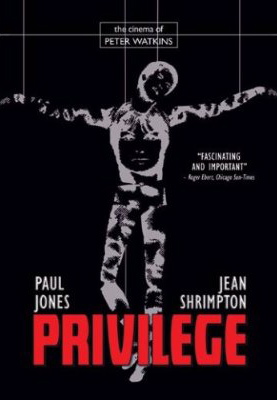
Saturday Matinee: Privilege

2647priv
Source: Dangerous Minds

‘Privilege’: Peter Watkins powerful antidote to 1960s pop hysteria

Set sometime in a none too distant future, Peter Watkins’ debut feature Privilege from 1967 told the story of god-like pop superstar Steven Shorter, who is worshiped by millions and manipulated by a coalition government to keep the youth “off the streets and out of politics.”

Inspired by a story from sitcom writer Johnny Speight (creator of Till Death Us Do Part which was remade in America as All in the Family), Privilege was an antidote to Swinging Sixties’ pop naivety. While Speight may have had a more biting satirical tale in mind, screenwriter Norman Bogner together with director Watkins made the film a mix of “mockumentary” and political fable, which was a difficult balance to maintain over a full ninety minutes without falling into parody.

Though it has its faults, Watkins succeeded overall, and presented the viewer with a selection of set pieces that later influenced scenes in Stanley Kubrick’s A Clockwork Orange, Lindsay Anderson’s O, Lucky Man! and Ken Russell’s Tommy.

Watkins also later noted how his film:

….was prescient of the way that Popular Culture and the media in the US commercialized the anti-war and counter-culture movement in that country as well. Privilege also ominously predicted what was to happen in Margaret Thatcher’s Britain of the 1980s – especially during the period of the Falkland Islands War.

On its release, most of the press hated it as Privilege didn’t fit with their naive optimism that pop music would somehow free the workers from their chains and bring peace and love and drugs and fairies at the bottom of the garden, la-de-da-de-dah, no doubt.

In fact Privilege was at the vanguard of a series of similarly styled films (see above) that would come to define the best of British seventies cinema. The movie would also have its fair share of (unacknowledged) influence on pop artists like David Bowie and Pink Floyd, while Patti Smith covered the film’s opening song “Set Me Free.”

What’s also surprising is how the film’s lead, Paul Jones (then better known as lead singer of Manfred Mann) never became a star. As can be seen from his performance here as Steven Shorter, Jones could have made a good Mick Travis in If…, or Alex in A Clockwork Orange.

Jones went onto make the equally good The Committee but (shamefully) little work came thereafter apart from reading stories on children’s TV.

Ah, the fickle nature of fame, but perhaps he should have known that from playing Steven Shorter.

Beyond Propaganda: Discourse of War and Doublethink. “When the Lie Becomes the Truth”

aa-Dees-mass-media-matrix1

By Jean-Claude Paye and Tülay Umay

Source: Global Research

Since the attacks of September 11, we are witnessing a transformation of the way the media report the news. They lock us in the unreal. They base truth not on the coherence of a presentation, but on its shocking character. Thus, the observer remains petrified and cannot establish a relation to reality.

The media are lying to us, but at the same time, they show us that they are lying. It is no longer a matter of changing our perception of facts in order to get our support, but to lock us in the spectacle of the omnipotence of power. Showing the annihilation of reason is based on images that serve to replace facts. Information no longer focuses on the ability to perceive and represent a thing, but the need to experience it, or rather to experience oneself through it.

From Bin Laden to Merah, through the “tyrant” Bashar al-Assad, media discourse has become the permanent production of fetishes, ordering surrender to what is “given to see.” The injunction does not aim, as propaganda, to convince. It simply directs the subject to give flesh to the image of the “war of civilizations”. The discursive device of “War of Good against Evil,” updating the Orwellian doublethink process must become a new reality that de-structures our entire existence, of everyday life in global political relations.

Such an approch has become ubiquitous, especially regarding the war in Syria. It consists of cancelling a statement at the same time as it is pronounced, while maintaining what has been previously given to see and hear. The individual must have the ability to accept opposing elements, without raising the existing contradiction. Language is thus reduced to communication and cannot fulfill its function of representation. The deconstruction of the faculty to symbolize prevents any protection vis-à-vis the real to which we are in submission.

Enunciating a Statement And its Opposite at the Same Time

In the reports on the conflict in Syria, the double think procedure is omnipresent. Stating at the same time a thing and its opposite produces a decay of consciousness. It is no longer possible to perceive and analyze reality. Unable to put emotion at a distance, we cannot but feel the real and thus be submitted to it.

Opponents of the regime of Bashar al-Assad are dubbed “freedom fighters” and Islamic fundamentalist enemies of democracy at the same time. It is the same with regard to the use of chemical weapons by belligerents. The media, in the absence of evidence, express certainty as to the Syrian regime’s responsability, although they mention the use of such weapons by the “rebels”. In particular, they relayed the statements of magistrate Carla Del Ponte, a member of the UN independent commission of inquiry into violence in Syria, who said, on May 5, 2013 on Swiss television, “According to the testimonies we have gathered, the rebels have used chemical weapons, making use of sarin gas.” This magistrate, who is also the former prosecutor of the International Criminal Tribunal for the former Yugoslavia can hardly be called indulgent toward the “regime of Bashar Assad.” “Our investigations should be further developed, verified and confirmed through new evidence, but according to what we have established so far, it is the opponents who used sarin,” she added. [1]

The White House, for its part, did not want to consider this evidence and has always expressed an opposite position. Thus, as regards the August 21 Ghouta massacre, it released a statement explaining that there is “little doubt” of the use by Syria of chemical weapons against its opposition. The statement added that the Syrian agreement to allow the UN inspectors in the area is “too late to be credible.”

Reduction of qualitative to quantitative.

Following the use, August 21, 2013, of chemical weapons in the suburbs of Damascus, Kerry reiterated the “strong certainty” of the United States concerning the liability of the Syrian regime. A U.S. intelligence report, released by the White House and said to rely on “multiple” sources, also said that the Syrian government used nerve gas in the attack, the use of which by the rebels is “highly unlikely”. [2]

The individual is placed outside the differentiating power of language. That which is qualitative, that which is certain, is reduced to that which is quantitative, to the “different degrees of certainty” expressed previously by Obama or the “high certainty” pronounced by J. Kerry. The “very little doubt”, as to the liability of the Syrian regime, also mirrors the “highly unlikely” responsibility attributed to opponents. Quality is thereby restricted to a quantitative difference. Quality, that which is, becomes at the same time, that which is not or at least that which may not be, because it no longer expresses a certainty, but a certain amount or degree of certainty or doubt. The opposites, “certainty” and “doubt” become equivalent. The qualitative difference is reduced to a quantitative gap. There is no longer any quality other than that of measurement.

This reduction of qualitative to quantitative has otherwise already invaded our daily lives. We no longer refer to the poor but to the “less fortunate”. Similarly, we no longer encounter invalids, but “less able persons”. The least skilled jobs are now given names that deny de-qualification. Thus, a cleaning woman becomes a ” housekeeper”, the cashier disappears in favour of the “sales assistant” and garbage Collector are now called « sanitation worker ».

The separating power of language is annihilated. Words are turned into verbal phrases that build a homogenized world. We are in a world in which everyone is advantaged. No more are there qualitative differences between human beings, but only quantitative differences. The vision of a world of perfect homogeneity where only equals exist, no longer differing other than quantitatively, was already foreseen by George Orwell in Animal Farm: « All are equal, but some would be more so than others » « [3].

Absolute Certainty in the Absence of Evidence.

The word, which describes and differentiates things, is replaced by an image, by that which is everything at the same time as being nothing. Instead of a word referring to an object, degrees of certainty concern only the feelings of the speaker. These verbal phrases are not intended to designate objective things, but to place the person who receives the message in the perspective of the speaker, to lock them in the warped meaning created by the latter.

Expressed certainty can detach itself from facts and present itself as purely subjective. It does not refer to an observation, but refers to a condition posing as objective through a quantization operation.

The certainty of U.S. and French authorities also distinguishes itself in that it is built on equivocal data, on the invocation of evidence of liability of the Syrian regime, although they recall the impossibility of knowing who struck and how chemical weapons were used. It is no longer possible to construct an objective certainty, because the observation of facts is defused and leaves room for the stupefaction of the observer. Expressed certainty no longer separates true from false, since the ability to judge is suspended.

Precisely, subjective and objective certainty is undifferentiated. It is not a matter of believing what is stated, but of believing the authority who speaks, no matter what he says. Statements of Presidents Obama and Holland are immediately given as absolute certainty, ie: they occupy the place that Descartes gives to God “as a principle guaranteeing the objective truth of subjective experience…” [4]. The matter of going through the steps of objective verification, through the judgment of existence, does not arise to the extent that certainty is set free from all spatial and temporal constraints. It is posited in the absence of limits, in the absence of what psychoanalysis calls the “Third Person”, the place of the Other. [5]

Removal of the “Third Person”

Absolute certainty, posing as the be all and end all, installs a denial of reality, that which escapes us. It does not recognize loss. Constituting “we” is no longer possible because it can only be formed from that which is missing. The monad, for its part, lacks nothing because it is fused with state power. Fetishes fabricated by “the news” fill the void of reality, occupy the place of that which is missing and operate a denial of the third party.

Absolute certainty is opposed to the establishment of a symbolic order integrating the “third person” [6], the domain of language. The proper function of language is to signify that which is real, knowing that the word is not reality itself, but that by which it is represented. Jacques Lacan expresses this necessity with his aphorism “the thing must be lost in order to be represented”. [7]

On the contrary, absolute certainty attaches words to things and does not take into account their relationships. In the absence of a ’third person’, it prevents any real articulation with the symbolic. This absence of linkage is the formation of a social psychosis wherein that which is stated by power becomes reality. The deficiency also allows the emergence of a perverse structure that reverses the speech act and prevents identifying the reality of the psychosis.

Enrolling us in psychosis, the discourse of French and American authorities originates in perverse denial. It constitutes a coup against language “coup because disavowal is situated at the logical basis of language” [8]. Denial of reality is realized by a commodification of words and a procedure of cleavage. The cynical coup is this: “pervert that by which law is articulated, make language the reasonable discourse of unreason” [9] as with “humanitarian war” or “counter-terrorism”.

Counter-terrorism legislation is presented as rational actions to dismantle the law in favour of the fabrication of images. U.S. law is particularly rich in these pictorial constructions, such as the “lone wolf”, a lone terrorist related to an international movement, the “enemy combatant” or “unlawful belligerent” that exist, because they are designated as such by the U.S. President. The enemy combatant, as illegal belligerent, may be a U.S. citizen who has never been on a battlefield and whose “military action” amounts to an act of protest against a military engagement. Deviation from that which is stated by the powers that be is no longer possible. Similarly, any protection against its real threat is removed. The reality manifests itself without dissimilation and can henceforth petrify us.

The suppression of the Third Person reducing the individual to a monad, no longer having an Other outside of state power, allows authority, especially as regards discourse on the war in Syria, to produce a new reality. Evidence of the guilt of the Syrian regime exists, because authority says so.

A “disturbing strangeness”.

The absence of a “third person” settles us in transparency, in a never-never land beyond language. It removes the relationship between interior and exterior. The expression of the omnipotence of the U.S. President, his will to break free from the constraints of language and of any judicial order, reveals our condition, its reduction to “naked life.” There then occurs “a special kind of scary” Freud calls Unheimliche [10], a term which has no equivalent in French and which can as well be translated as “disturbing strangeness” and as “disturbing familiarity.”

It would be, as defined by Schelling, something that should have remained hidden and which has reappeared. Unveiled, worldly things appear in their raw presence as Real. Where the individual believed himself at home, he suddenly feels driven from his home and becomes strangely foreign to himself. The inside of our condition, our annihilation is thrown out and appears to us as a plaything of the U.S. executive branch. The staging of our division, “disturbing strangeness”, becoming that which is most familiar to us, suppresses intimateness by replacing it.

Freud suggests a dissociation of the ego. The latter is then pulverised and can no longer display the Real, the threat that petrifies it. Freud speaks of the formation of a stranger “I” that can turn itself into moral conscience and treat the other part as an object [11].

This mechanism reappears as the return of the repressed archaic, that which is intended to hide the distress of the nursing child. The “disturbing strangeness”, produced by Obama’s speech is of the same order. It instrumentalises what happened in Iraq in order to prevent us from forgetting our impotence. Thus, it reinforces “the permanent return of the same” constitutive of a sense of “disturbing strangeness” or disturbing familiarity. The process of repetition presents itself as an inexorable process, like a power that we cannot confront.

Jacques Lacan confirms this reading. Echoing the work of Freud on the “disturbing strangeness”, he shows that anxiety arises when the subject is facing the “lack of lack” that is to say, an all-powerful otherness that invades the self to the point of destroying every faculty of desire. [12]

In fact, the two translations, the first highlighting the strangeness, the second its familiar character, make each highlight one aspect of this particular anxiety that one can also deal with thanks to the notion of transparency. Interior and exterior confusing themselves, the individual is at once struck by the strangeness of seeing his impotence, by his interior deprivation exhibited outside himself and by the colonization of his intimacy by the spectacle, become familiar, of the enjoyment of the other.

Denial and Splitting of the Ego.

Dissociation is an archaic defense attempt when faced with a power with which one cannot cope. This disintegration of the Ego allows the return of a “déjà vu”. The Superego calls one to see oneself as an infant, as one who does not speak, thus causing a feeling of “disturbing strangeness”.

Faced with the imperative need to believe in the responsibility of Bashar Assad, the individual must suspend contrary information and treat it as if it did not exist. He proceeds to a denial of all that is different, then couched in the regressive position, that of the umbilical union with the mother, a stage preceding language, before the appearance of the function of the father. [13]

The denial of the contradiction between a thing and its opposite, the responsibility of the Syrian government and the use of chemical weapons by the rebels, is the act of denying the reality of perception seen as dangerous because the individual would then have to face the omniscience displayed by the powers that be. To contain the anxiety produced by the “disturbing strangeness”, the subject is forced to juxtapose two opposing and parallel ways of reasoning. The individual then has two incompatible unlinked visions. The denial of the opposition between these two elements removes any confliction; because there coexists within oneself two opposing statements that are juxtaposed without influencing each other. This denial rests on what psychoanalysis calls the “splitting of the ego.”

The cleavage gives one the opportunity to live on two different levels, placing side by side, on the one hand, “knowledge”, the use of sarin gas by the rebels, and on the other hand a dodging of confrontation with a suspension of information. This is to prevent any struggle, any symbolism in order to enjoy the full omnipotence of the powers that be. In the absence of a perceived lack in what one is told, one finds oneself beneath the conflict in an annulment of any judgment.

Orwell has also highlighted this procedure in his definition of “doublethink.” It consists in the following: “to hold simultaneously two opinions which cancel each other out, knowing them to be contradictory and believing in both of them,” while being able to forget, « whatever it was necessary to forget, then to draw it back into memory again at the moment when it was needed ». Then one must forget, ie: “consciously to induce unconsciousness, and then, once again, to become unconscious of the act of hypnosis you have just performed. ” [14]

Cleavage is recurrent in the speech surrounding the war in Syria. Things here are regularly affirmed, at the same time as that which contradicts them without a relationship being established between the different enunciations. Contrary to statements by Carla Del Ponte, Washington would first have arrived, “with varying degrees of certainty,” at the conclusion that the Syrian government forces had used sarin gas against their own people. However, Barack Obama, at the same time, said the United States didn’t know ” how [these weapons] were used, when they were used or who used them” [15]. The operation places the subject in fragmentation, unable to react to the nonsense of what is said and shown. One cannot cope with a certainty that is claimed in the absence of evidence.

The logical reversal of language building becomes a manifestation of the power of the U.S. executive. It exhibits a capacity to overcome any language organisation and thus all symbolic order. The absurdity reclaimed by the statement is as a coup against the logical basis of language. It henceforth has a petrification effect on people and captivates them in psychosis.

Notes

[1] « Les rebelles syriens ont utilisé du gaz sarin, selon Carla Del Ponte », Le Monde.fr avec Reuters, le 6 mai 2013.

[2] « Syrie : les États-Unis ont la “forte certitude” que Damas a eu recours à des armes chimiques », Le Monde.fr, le 30 août 2013.

[3] « All are equal but some than others », Georges Orwell, in Animal Farm.

[4] Charles-Éric de Saint Germain, L’Avènement de la vérité Hegel, Kierkegaard, Heidegger, L’Harmattan 2003, p. 37.

[5]Dominique Temple, “Lacan et la réciprocité”, 2008, http://dominique.temple.free.fr/reciprocite.php?page=reciprocite_2&id_article=202

[6] Le « Tiers » est ce qui défusionne l’enfant de la mère, lui donnant ainsi accès au champ du langage et de la parole. Il permet l’assujettissement du sujet à un ordre symbolique.

[7] Jacques Lacan, « Fonction et champ de la parole et du langage en psychanalyse » – in : Écrits 1, Le Seuil, Paris, 1966.

[8] Houriya Abdellouahed, « La tactilité d’une parole. Le pervers et la substance », in Cliniques méditerranéennes N° 72,  Érès , p.5, http://www.cairn.info/revue-cliniques-mediterraneennes-2005-2.htm

[9] Op. Cit., p. 8.

[10] Unheimliche est un adjectif substantivé, formé à partir de deux termes : le préfixe Un, exprimant la privation et l’adjectif heimlich (familier). La traduction « l’inquiétante étrangeté », d’abord proposée par Marie Bonaparte, ne tient compte ni de la familiarité signifié par heimlich, ni de la négation marquée par le Un. Aussi d’autres traductions ont été proposées telle que « l’inquiétante familiarité ». Lire les remarques préliminaires de François Stirn à la traduction de Une inquiétante étrangeté, par Marie Bonaparte et E. Marty, Profil Textes Philosophiques, Philosophie, octobre 2008, www.esparedes.pt/escola/images/freud_etrangete.pdf

[11] Le partage en deux éléments séparés a pour conséquence « que l’un participe au savoir, aux sentiments et aux expériences de l’autre, de l’unification à une autre personne, de sorte que l’on ne sait plus à quoi s’en tenir quant au moi propre, ou qu’on met le moi étranger à la place du Moi propre —donc dédoublement du Moi, division du Moi, permutation du Moi— et enfin, le retour permanent du même », S. Freud, « Inquiétante étrangeté et clivage », in L’Inquiétante étrangeté et autres essais, Gallimard 1988, p. 236.

[12] Régine Detambel, « Sigmund Freud, L’inquiétante étrangeté  autres essais, http://www.detambel.com/f/index.php?sp=liv&livre_id=656

[13] « Inquiétante étrangeté et clivage », http://theses.univ-lyon2.fr/documents/getpart.php?id=lyon2.2002.ravit_m&part=66598

[14] « Retenir simultanément deux opinions qui s’annulent alors qu’on les sait contradictoires et croire à toutes deux… Oublier tout ce qu’il est nécessaire d’oublier, puis le rappeler à sa mémoire quand on en a besoin, pour l’oublier plus rapidement encore. Surtout, appliquer le même processus au processus lui-même. Là, était l’ultime subtilité. Persuader consciemment l’inconscient, puis devenir ensuite inconscient de l’acte d’hypnose que l’on vient de perpétrer. La compréhension même du mot « double pensée » impliquait l’emploi de la double pensée. »,  George Orwell, 1984, première partie, chapitre III, Gallimard Folio 1980, p.55

[15] « Les rebelles syriens ont utilisé du gaz sarin, selon Carla Del Ponte », Op. Cit.


This article was first published on our French language website www.mondialisation.ca

Article in French :

Discours de la guerre et double pensée. L’exemple de la Syrie. Mondialisation.ca, 29 of June of 2014

Saturday Matinee: Get to Know Your Rabbit

MV5BMTYwODkxMjIxNF5BMl5BanBnXkFtZTYwNTU3NzM5._V1_SX214_AL_

“Get to Know Your Rabbit”(1972) is an offbeat comedy Brian DePalma directed early in his career about a successful but unsatisfied corporate executive Beeman (Tommy Smothers) who quits his job to become a tap dancing magician under the mentorship of Mr. Delesandro (Orson Welles). When his new venture becomes a successful corporation, Beeman finds his path has come full circle. The film features a brief uncredited cameo by cult character actor Timothy Carey as a cop.

Top AIDS Researchers Killed in Malaysia Airlines Crash

Source: Cryptogon

Utopia, Series 2 Episode 1, 14 July 2014, Channel4, Britain: “We have to plant a bomb on board the plane and we have to kill all of them.”

Utopia is probably the best show I’ve ever seen on TV. The first two episodes from series 2 were recently broadcast in Britain.

Most people outside of Britain won’t have ever heard of Utopia, so I’ll just write a couple of sentences about it in case you need some context. Utopia is a show about the granddaddy of all “conspiracy theories”: A forced reduction in the population of planet earth. This is accomplished by Janus, a bioweapon that sterilizes most people and is delivered as a vaccine during a bogus flu pandemic.

No, it’s not a documentary. *wink*

So I’m leaning back in my chair, enjoying the Series 2 opener, drinking some tea, eating an apple and…

I’ll just type out some dialog from Series 2 Episode 1:

Assistant: The network lab in Tel Aviv, one of the men worked out the RNA codes for Janus. He has an idea of what it does.

Milner: Has he told anyone?

Assistant: Half the lab, as many as fifty people. We’re not sure exactly who yet but we have it locked down.

Milner: Do you have a plane ready?

Assistant: TWA 841 heading to JFK. We’ve told them they’re going to be debriefed by the CIA.

Milner: We know what we have to do then. We have to bring it down. We have to plant a bomb on board the plane and we have to kill all of them.

A few days later, we read that some of the world’s top AIDS researchers were killed in the Malaysia Airlines shoot-down incident.

Obviously, this is just another coincidence, like Neo’s passport or Sandy Hook labeled “Strike Zone” In Dark Knight Rises.

People in Britain can watch Utopia on the Channel4 Website. If you’re outside of Britain, you’ll have to look into bypassing the absurd geoblocking that Channel4 uses. I’m not going to get into that here, but there are countless sites out there that can help you.

Via: Time:

About 100 people traveling to a global AIDS conference in Australia were on board the Malaysia Airlines flight that crashed and killed 298 people in eastern Ukraine, reports the Sydney Morning Herald.

The researchers, health workers and activists were on their way to the International AIDS Conference in Melbourne. Among the victims planning to attend was Dutch national Joep Lange, a top AIDS researcher and former International AIDS Society president. Briton Glenn Thomas, a spokesperson for the World Health Organization and a former BBC journalist, was also on flight MH17.

The International AIDS Society expressed sadness over the news that its colleagues were on the Malaysian jetliner.

While the medical field mourns the lives of those killed, experts like Associate Professor Brian Owler, federal president of the Australian Medical Association, also fear that breakthroughs in HIV/AIDS research will now be stalled.

“The amount of knowledge that these people who died on the plane were carrying with them and the experiences they had developed will have a devastating impact on HIV research,” Owler told TIME.

“The amount of time it takes to get to a stage where you can come up with those ideas cannot be replaced in a short amount of time. So it does set back work for a cure and strategic prevention of HIV/AIDS very significantly,” he said.