Culture, Self and Law

By Darren Allen

Source: Off-Guardian

This is an extract from Self and Unself, Darren Allen’s new ‘philosophy of all and everything’. Some of the terms herein — consciousness, self, ego, etc — may appear somewhat mysterious or abstract as they are explained in earlier sections of the book.

Self produces manifest culture, and then that culture shapes self. First, self is externalised as an expression — some kind of act or presentation. The expression appears as an object, a thing in the world, which is related to other objects, which are then reappropriated by man back into the self.

A band releases an album, a building company constructs a block of flats, an advertising agency puts up hoardings around town, an individual recounts a few anecdotes. The songs, the dwellings, the signs and the stories become part of a world which then shapes those within that world.

If self is unselfish this process ultimately begins “beyond” culture, with consciousness, to which the reappropriated modifications are subject to some kind of evaluation — I can reject the bullshit music, the ugly council estate, the advertising lies and the witless jibber-jabber.

If, however, self is fundamentally egoic, consciousness is given no freedom to operate, and the caddis case is formed almost entirely from without, walling up inner quality, and with it, genuine individuality.

First self speaks, then the words get set in stone, then the stone speaks to the self, writing its words back into the human heart, which speaks again.[1] If there is freedom to speak, and to be heard, and to walk away, this dialogue (or dialectic) is fruitful and serves man.

But, just as if one person screws another down and forces words into her head it is no longer a conversation, so if society (culture plus self, or selves) fills its schools and lines its streets with messages that all say the same thing, with no way of escape, then we are no longer individuals participating in a society, but stackable storage units for whomever or whatever is filling us with the things we are forced to feel, eat, look at, think about and energetically engage with; in short, build our selves with.

Culture was once built from nature, and, more intimately, from the unselfish origin of that which nature and culture have in common. This is why pre-civilised man considered nature and culture to be identical. The more culture came to be built from itself, the less it served the essence of man, until it came to compel man to accept its objective validity or suffer the consequences. Not in an overt tyrannical sense, but in the unalterable fact of its existence.

You can think away culture or pretend it doesn’t matter — ignore, say, the rules of language or pretend that they are dispensable, but you will be punished, mocked, excluded, brought back into line or killed. Likewise, if your social self is at odds with your individual self, then all kinds of problems are on their way. This does not mean that I must be something other than my social self, but that I am continually compelled to harmonise the two, and if I can’t — if I cannot be in the world who I feel I really am—then I will suffer in the world, as everyone who is honest does.

Ego keeps this suffering at bay by endlessly affirming its social self. As that most unreal and egoic of sources, the average Teevee-American has it, ‘I am a cop, it’s what I do…’ ‘I am a mother, it’s what I do…’ Or, alternatively, ‘This is my town, these are my people’.

Such a ‘self’ is not something which is invented, it is there, ‘inside me’. I look inside and see that I am the cop or mother that society takes me to be (or, for the fake outsider, that I wish society to take me to be). And I have no desire to be anything else. Not that there is anything wrong with inhabiting a role, nor with identifying with a community, nor that there aren’t always elements of self that do not fit into what is required by the social world; rather that ego hides from itself in its social representation.

Man may be psychologically and spiritually deformed by his activity within the egoic group or institution, he may work in a mechanical manner, in mediated environments, in order to produce or manage things which have no recognisable human meaning, and he may be forced to conceal his horror and disgust behind an upbeat mask of emotional management, but if there is no truth beyond a self-constructed from the group, he will defend his deformity, and consequent duplicity and misery, as truth.

All criticisms of the group are taken to be criticisms of the self — ‘I am mortally offended by your prejudice’ — and all criticisms of the self are taken to be prejudice against the group — ‘It’s not because you are repulsed by my moral deformity, it’s because you are racist/homophobic/anti-white/anti-American etc’.

The seamless unity of self and society in the egoic mind explains man’s total blindness to systemic constraints, and to the fundamental paradigms of the system. They are one with his ego, which is why, today for example, man spends so much time thinking and talking about voting, about reforming teaching, about having fairer laws, about creating cleaner motorways and so on and so forth; but not a word on how disabling democracy is, or education, or law, or transport, or the encompassing system, which is as invisible to him as water is to a fish, or anger is to a van driver.

*

The social self and its inner component, the personality, are maintained through communication, through constant confirmation (either explicit or implied) of who I am to others. When there is nobody to validate my personality, it dies, which is why solitude is so necessary to people with character — who need to periodically let their personality wither away in winter so that spring life might grow—and so terrifying to people without character, who must exist in a constant stress of forced blooming for the world.

Likewise, if a critical avenue of personality-confirming communication is permanently disrupted—if a lover leaves, or a mother dies, or self is forced to live in another country, cut off from its culture—the whole world crumbles. The egoic self, forged through the shared reality created with a partner, a family or a society, is ripped out.

This is why people stay in abusive relations and in abusive societies. Leaving the objective world of the known is to be plunged into chaos, a fate worse than death for ego, which may even choose death in preference.

Loss of self-reinforcing dialogue is not just a threat to the individual self, but to the social body, which provides all kinds of ritualised means by which the disrupted self is expected to deal with its disarray and return soothed and placated to the ‘normal’ world. A spouse torn apart by the death of a partner is fine, we can accept and sympathise; but if the grief is too noisy or outstays its welcome, then the social world will take measures to exclude it, quarantine the infection as it were, and remove conspicuous misery from the scene, so that production and consumption can smoothly proceed.[2]

For the same reason, madness, bizarre dreams and visions, psychotropic intoxication, spiritual extremism and all other exits from the system—including literally leaving it to gad off into the forest—are to be bricked up, or, if that’s not possible, managed by society, which deals with the void by projecting a screen of rationalisations onto it.[3] Your visionary dream was a message from Satan, or a repressed desire, or a random brain signal, your glorious experience of the fundamental oneness of creation was a message from Allah, or a crazed illusion, or confirmation of your status as our Mystic Cham.

All of these validations are gratefully taken up by the ego, which cannot bear to be cut off, alone (or alone with unself), and prefers to masochistically submit itself to The Worldview — or, on behalf of that world, to sadistically control others — rather than have to face any kind of reality beyond the boundaries of the social known.

Just as society is threatened by loss of face and loss of reason, so it must also deal with the danger of men and women rebelling against their internalised role; finding, for example, that being a nice obedient little wife, or the upwardly-mobile manager of a car-rental firm, is something of a burden, and that they’d rather be members of a non-stop erotic cabaret or hunting-and-gathering in Botswana.

It’s fine for a man to masturbate to high-budget porn, or for a woman to spend a month on safari, but to actually do something about their dreams, particularly the genuinely wild ones, is out of the question, and again, if substitutes are not functioning, the machinery of social meaning must step in to make sure such desires are suppressed or channelled into something ‘productive’, or at least that the dreamer is reminded that if they are not, he can expect to pay an horrendously high price to realise them.

*

The most potent and pervasive threat to selfish society is not in this or that criticism, loss or disruption, but in consciousness itself; which is everywhere and at all times. Consciousness must therefore be continually suppressed, and man’s relation to it, to ever-present unselfish quality, continually managed.

This is largely done, on a social level, through laws, legitimations, taboos and totems. These are the rules of society — the ‘walls’ of cliched thought, feeling, sensation and activity — which range from everyday non-verbal norms of behaviour (we greet in such and such a way, we react to bad news in such and such a way), through more explicit linguistic formulations of what is right and proper (the shared ethics of society, encoded in its wisdom, its maxims, its proverbs and even its jokes), through the art, myths and folk tales of a culture (by which we learn what is appropriate or tasteful, and what is to be condemned), through the explicit legal codes of a civilisation or of its various institutions, up to, finally, the various sacred justifications or secular theories which explain, in the most abstract sense, why things are as they are.

Although all these legitimations are constantly in conflict, they work as a whole to order men and women’s responses to their own conscious impulses and the context they find themselves in. In a selfless society, these ‘orders’ are soft guidelines (or, if you prefer, flexible human laws) — useful and necessary, but fluid, and at the service of the individual.

In an egoic society, the individual must serve the laws, legitimations and taboos. If he breaks them — if he smiles when he should frown, does what the gods say never to do, questions evolution, utters the magical ‘n’ word or sends a magnet in the post — he’ll be punished.

Note that men and women must be continually reminded of these justifications and continually enjoined to affirm their commitment to them, just as communities of belief must be continually reinforced and protected. Human beings are never far away from their original nature, and easily forget what has been programmed into them from without.

This is why ritualised laws of defilement, containment of outsiders (physical or ideological), and, above all, walling off experiences of unreality (dream, madness, apostatic transcendence, death and love; even taking a shit puts one outside the bounds of history and religion and must be legitimately dealt with) play such an important, ongoing role in all ideological systems.

Today, in the West, continual reinforcement takes the form of constant affirmations of the goodness and rightness of a highly invasive, technocratic, global market-economy and of constant reminders that without the various ideological totems required to engage in it—tolerance, respect, pacifistic acceptance, keeping two meters apart from one’s fellows and keeping your trousers on in the supermarket—everything would fall apart and we’d all drown in a flood of anarcho-fascism, or die of a medieval lurgy, or be overwhelmed by the Beast.

If it looks like these reminders aren’t taking hold, then their intensity is stepped up and penalties for contravention escalate and intensify until you get your mind right.

Laws, legitimations, taboos and totems, being self-justifying and self-created, are entirely causal. The notion of law is coterminous with the notion of causality; a non-causal law is a contradiction in terms. In reality there are, ultimately, no laws in nature, in consciousness or in human affairs, because there is, ultimately, no causality in them; the world today was no more caused by the world yesterday than the morning was caused by the night before.

The laws we find in history (e.g. Hegel’s or Marx’s), or in nature (e.g. Aristotle’s or Newton’s), or in society (e.g. Confucius’ or Comte’s), or in consciousness (e.g. Leibniz’s or Freud’s), are products of self, and therefore only applicable to self; occasionally useful, as facts and causes are, but with zero qualitative truth.

The truth of an individual or society moving through ‘time’, like that of a tree, like the meaning of an act or the essence of reality, are invisible to causal consideration, which can only perceive a tumult of interrelated bits and pieces, slices and sections, and shrink-wrapped events, never the whole; which means it can never give an appropriate response to the whole (except by accident) which becomes impossible as soon as laws are set, and [directly or indirectly] enforced.

This is why people without direct experience of reality, isolated from it by money, power, fame, technology or drugs, rely on laws and legitimations, and give them the same existential status as experience. When it comes to right or wrong, for example, they cannot trust their experience, because they do not have experience, and so they cleave to factual-casual calculation.

Property is inviolable, therefore stealing is wrong; a man steals an apple, therefore he must be punished, no matter how wealthy the supermarket he steals from. Context — the history of the supermarket, the functioning of the market, the state of society — and consciousness — compassion for the man, empathic understanding of his life — cannot be allowed into consideration. To do so would disrupt one’s entire life.

The brutal inflexibility of the law-abider is sometimes seen as a ‘lack of imagination’, but imagination is part of the abstract schema that the law-maker appeals to, the series of ideas codified as The Law; it is wrong to lie, it is wrong to kill, it is wrong to steal.

When these ideas harden into eternal truths — when, in the management phase of civilisation, they are codified or written down, in holy texts or in statute books, or in the consciences of men and women — they serve, and can only serve, that which is incapable of abandoning facticity and causality, the inherently dishonest, selfish and violent ego. This is why you can’t trust a law-abider.

Self and Unself is available in the usual places, and on Darren Allen’s bookshop.

Notes:-

[1] Peter Berger and Thomas Luckman, The Social Construction of Reality.[back]

[2] Ernest Goffman, The Presentation of Self in Everyday Life.[back]

[3] Peter Berger, The Sacred Canopy.[back]
Stand Up to Tyranny: How to Respond to the Evils of Our Age

By John W. Whitehead & Nisha Whitehead

Source: The Rutherford Institute

“The church must be reminded that it is not the master or the servant of the state, but rather the conscience of the state. It must be the guide and the critic of the state, and never its tool. If the church does not recapture its prophetic zeal, it will become an irrelevant social club without moral or spiritual authority.”—Martin Luther King Jr. (A Knock at Midnight, June 11, 1967)

In every age, we find ourselves wrestling with the question of how Jesus Christ—the itinerant preacher and revolutionary activist who died challenging the police state of his time, namely, the Roman Empire—would respond to the moral questions of our day.

For instance, would Jesus advocate, as so many evangelical Christian leaders have done in recent years, for congregants to “submit to your leaders and those in authority,” which in the American police state translates to complying, conforming, submitting, obeying orders, deferring to authority and generally doing whatever a government official tells you to do?

What would Jesus do? 

Study the life and teachings of Jesus, and you may be surprised at how relevant he is to our modern age.

A radical nonconformist who challenged authority at every turn, Jesus spent his adult life speaking truth to power, challenging the status quo of his day, pushing back against the abuses of the Roman Empire, and providing a blueprint for standing up to tyranny that would be followed by those, religious and otherwise, who came after him.

Those living through this present age of government lockdowns, immunity passports, militarized police, SWAT team raids, police shootings of unarmed citizens, roadside strip searches, invasive surveillance and the like might feel as if these events are unprecedented. However, the characteristics of a police state and its reasons for being are no different today than they were in Jesus’ lifetime: control, power and money.

Much like the American Empire today, the Roman Empire of Jesus’ day was characterized by secrecy, surveillance, a widespread police presence, a citizenry treated like suspects with little recourse against the police state, perpetual wars, a military empire, martial law, and political retribution against those who dared to challenge the power of the state.

A police state extends far beyond the actions of law enforcement.  In fact, a police state “is characterized by bureaucracy, secrecy, perpetual wars, a nation of suspects, militarization, surveillance, widespread police presence, and a citizenry with little recourse against police actions.”

Indeed, the police state in which Jesus lived (and died) and its striking similarities to modern-day America are beyond troubling.

Secrecy, surveillance and rule by the elite. As the chasm between the wealthy and poor grew wider in the Roman Empire, the ruling class and the wealthy class became synonymous, while the lower classes, increasingly deprived of their political freedoms, grew disinterested in the government and easily distracted by “bread and circuses.” Much like America today, with its lack of government transparency, overt domestic surveillance, and rule by the rich, the inner workings of the Roman Empire were shrouded in secrecy, while its leaders were constantly on the watch for any potential threats to its power. The resulting state-wide surveillance was primarily carried out by the military, which acted as investigators, enforcers, torturers, policemen, executioners and jailers. Today that role is fulfilled by the NSA, the FBI, the Department of Homeland Security and the increasingly militarized police forces across the country.

Widespread police presence. The Roman Empire used its military forces to maintain the “peace,” thereby establishing a police state that reached into all aspects of a citizen’s life. In this way, these military officers, used to address a broad range of routine problems and conflicts, enforced the will of the state. Today SWAT teams, comprised of local police and federal agents, are employed to carry out routine search warrants for minor crimes such as marijuana possession and credit card fraud.

Citizenry with little recourse against the police state. As the Roman Empire expanded, personal freedom and independence nearly vanished, as did any real sense of local governance and national consciousness. Similarly, in America today, citizens largely feel powerless, voiceless and unrepresented in the face of a power-hungry federal government. As states and localities are brought under direct control by federal agencies and regulations, a sense of learned helplessness grips the nation.

Perpetual wars and a military empire. Much like America today with its practice of policing the world, war and an over-arching militarist ethos provided the framework for the Roman Empire, which extended from the Italian peninsula to all over Southern, Western, and Eastern Europe, extending into North Africa and Western Asia as well. In addition to significant foreign threats, wars were waged against inchoate, unstructured and socially inferior foes.

Martial law. Eventually, Rome established a permanent military dictatorship that left the citizens at the mercy of an unreachable and oppressive totalitarian regime. In the absence of resources to establish civic police forces, the Romans relied increasingly on the military to intervene in all matters of conflict or upheaval in provinces, from small-scale scuffles to large-scale revolts. Not unlike police forces today, with their martial law training drills on American soil, militarized weapons and “shoot first, ask questions later” mindset, the Roman soldier had “the exercise of lethal force at his fingertips” with the potential of wreaking havoc on normal citizens’ lives.

A nation of suspects. Just as the American Empire looks upon its citizens as suspects to be tracked, surveilled and controlled, the Roman Empire looked upon all potential insubordinates, from the common thief to a full-fledged insurrectionist, as threats to its power. The insurrectionist was seen as directly challenging the Emperor.  A “bandit,” or revolutionist, was seen as capable of overturning the empire, was always considered guilty and deserving of the most savage penalties, including capital punishment. Bandits were usually punished publicly and cruelly as a means of deterring others from challenging the power of the state.  Jesus’ execution was one such public punishment.

Acts of civil disobedience by insurrectionists. Starting with his act of civil disobedience at the Jewish temple, the site of the administrative headquarters of the Sanhedrin, the supreme Jewish council, Jesus branded himself a political revolutionary. When Jesus “with the help of his disciples, blocks the entrance to the courtyard” and forbids “anyone carrying goods for sale or trade from entering the Temple,” he committed a blatantly criminal and seditious act, an act “that undoubtedly precipitated his arrest and execution.” Because the commercial events were sponsored by the religious hierarchy, which in turn was operated by consent of the Roman government, Jesus’ attack on the money chargers and traders can be seen as an attack on Rome itself, an unmistakable declaration of political and social independence from the Roman oppression.

Military-style arrests in the dead of night. Jesus’ arrest account testifies to the fact that the Romans perceived Him as a revolutionary. Eerily similar to today’s SWAT team raids, Jesus was arrested in the middle of the night, in secret, by a large, heavily armed fleet of soldiers.  Rather than merely asking for Jesus when they came to arrest him, his pursuers collaborated beforehand with Judas. Acting as a government informant, Judas concocted a kiss as a secret identification marker, hinting that a level of deception and trickery must be used to obtain this seemingly “dangerous revolutionist’s” cooperation. 

Torture and capital punishment. In Jesus’ day, religious preachers, self-proclaimed prophets and nonviolent protesters were not summarily arrested and executed. Indeed, the high priests and Roman governors normally allowed a protest, particularly a small-scale one, to run its course. However, government authorities were quick to dispose of leaders and movements that appeared to threaten the Roman Empire. The charges leveled against Jesus—that he was a threat to the stability of the nation, opposed paying Roman taxes and claimed to be the rightful King—were purely political, not religious. To the Romans, any one of these charges was enough to merit death by crucifixion, which was usually reserved for slaves, non-Romans, radicals, revolutionaries and the worst criminals.

Jesus was presented to Pontius Pilate “as a disturber of the political peace,” a leader of a rebellion, a political threat, and most gravely—a claimant to kingship, a “king of the revolutionary type.” After Jesus is formally condemned by Pilate, he is sentenced to death by crucifixion, “the Roman means of executing criminals convicted of high treason.”  The purpose of crucifixion was not so much to kill the criminal, as it was an immensely public statement intended to visually warn all those who would challenge the power of the Roman Empire. Hence, it was reserved solely for the most extreme political crimes: treason, rebellion, sedition, and banditry. After being ruthlessly whipped and mocked, Jesus was nailed to a cross.

As Professor Mark Lewis Taylor observed:

The cross within Roman politics and culture was a marker of shame, of being a criminal. If you were put to the cross, you were marked as shameful, as criminal, but especially as subversive. And there were thousands of people put to the cross. The cross was actually positioned at many crossroads, and, as New Testament scholar Paula Fredricksen has reminded us, it served as kind of a public service announcement that said, “Act like this person did, and this is how you will end up.”

Jesus—the revolutionary, the political dissident, and the nonviolent activist—lived and died in a police state. Any reflection on Jesus’ life and death within a police state must take into account several factors: Jesus spoke out strongly against such things as empires, controlling people, state violence and power politics. Jesus challenged the political and religious belief systems of his day. And worldly powers feared Jesus, not because he challenged them for control of thrones or government but because he undercut their claims of supremacy, and he dared to speak truth to power in a time when doing so could—and often did—cost a person his life.

Unfortunately, the radical Jesus, the political dissident who took aim at injustice and oppression, has been largely forgotten today, replaced by a congenial, smiling Jesus trotted out for religious holidays but otherwise rendered mute when it comes to matters of war, power and politics.

Yet for those who truly study the life and teachings of Jesus, the resounding theme is one of outright resistance to war, materialism and empire.

Ultimately, as I point out in my book Battlefield America: The War on the American People, this is the contradiction that must be resolved if the radical Jesus—the one who stood up to the Roman Empire and was crucified as a warning to others not to challenge the powers-that-be—is to be an example for our modern age.

After all, there is so much suffering and injustice in the world, and so much good that can be done by those who truly aspire to follow Jesus Christ’s example.

We must decide whether we will follow the path of least resistance—willing to turn a blind eye to what Martin Luther King Jr. referred to as the “evils of segregation and the crippling effects of discrimination, to the moral degeneracy of religious bigotry and the corroding effects of narrow sectarianism, to economic conditions that deprive men of work and food, and to the insanities of militarism and the self-defeating effects of physical violence”—or whether we will be transformed nonconformists “dedicated to justice, peace, and brotherhood.”

As King explained in a powerful sermon delivered in 1954, “This command not to conform comes … [from] Jesus Christ, the world’s most dedicated nonconformist, whose ethical nonconformity still challenges the conscience of mankind.”

Furthermore:

We need to recapture the gospel glow of the early Christians, who were nonconformists in the truest sense of the word and refused to shape their witness according to the mundane patterns of the world.  Willingly they sacrificed fame, fortune, and life itself in behalf of a cause they knew to be right.  Quantitatively small, they were qualitatively giants.  Their powerful gospel put an end to such barbaric evils as infanticide and bloody gladiatorial contests.  Finally, they captured the Roman Empire for Jesus Christ… The hope of a secure and livable world lies with disciplined nonconformists, who are dedicated to justice, peace, and brotherhood.  The trailblazers in human, academic, scientific, and religious freedom have always been nonconformists.  In any cause that concerns the progress of mankind, put your faith in the nonconformist!

…Honesty impels me to admit that transformed nonconformity, which is always costly and never altogether comfortable, may mean walking through the valley of the shadow of suffering, losing a job, or having a six-year-old daughter ask, “Daddy, why do you have to go to jail so much?”  But we are gravely mistaken to think that Christianity protects us from the pain and agony of mortal existence.  Christianity has always insisted that the cross we bear precedes the crown we wear.  To be a Christian, one must take up his cross, with all of its difficulties and agonizing and tragedy-packed content, and carry it until that very cross leaves its marks upon us and redeems us to that more excellent way that comes only through suffering.

In these days of worldwide confusion, there is a dire need for men and women who will courageously do battle for truth.  We must make a choice. Will we continue to march to the drumbeat of conformity and respectability, or will we, listening to the beat of a more distant drum, move to its echoing sounds?  Will we march only to the music of time, or will we, risking criticism and abuse, march to the soul saving music of eternity?

The Government’s War on Free Speech: Protest Laws Undermine the First Amendment

By John W. Whitehead & Nisha Whitehead

Source: The Rutherford Institute

“If freedom of speech is taken away, then dumb and silent we may be led, like sheep to the slaughter.”— George Washington

It’s a given that the government is corrupt, unaccountable, and has exceeded its authority.

So what can we do about it?

The first remedy involves speech (protest, assembly, speech, prayer, and publicity), and lots of it, in order to speak truth to power.

The First Amendment, which is the cornerstone of the Bill of Rights, affirms the right of “we the people” to pray freely about our grievances regarding the government. We can gather together peacefully to protest those grievances. We can publicize those grievances. And we can express our displeasure (peacefully) in word and deed.

Unfortunately, tyrants don’t like people who speak truth to power.

The American Police State has shown itself to be particularly intolerant of free speech activities that challenge its authority, stand up to its power grabs, and force it to operate according to the rules of the Constitution.

Cue the rise of protest laws, the police state’s go-to methods for muzzling discontent.

These protest laws, some of which appear to encourage violence against peaceful protesters by providing immunity to individuals who drive their car into protesters impeding traffic and use preemptive deadly force against protesters who might be involved in a riot, take intolerance for speech with which one might disagree to a whole new level.

Ever since the Capitol protests on Jan. 6, 2021, state legislatures have introduced a broad array of these laws aimed at criminalizing protest activities. Yet while the growing numbers of protest laws cropping up across the country are being marketed as necessary to protect private property, public roads or national security, they are a wolf in sheep’s clothing, a thinly disguised plot to discourage anyone from challenging government authority at the expense of our First Amendment rights.

It doesn’t matter what the source of that discontent might be (police brutality, election outcomes, COVID-19 mandates, the environment, etc.): protest laws, free speech zones, bubble zones, trespass zones, anti-bullying legislation, zero tolerance policies, hate crime laws, etc., aim to muzzle every last one of us.

However, as Human Rights Watch points out, these assaults on free speech are nothing new. “Various states have long-tried to curtail the right to protest. They do so by legislating wide definitions of what constitutes an ‘unlawful assembly’ or a ‘riot’ as well as increasing punishments. They also allow police to use catch-all public offenses, such as trespassing, obstructing traffic, or disrupting the peace, as a pretext for ordering dispersals, using force, and making arrests. Finally, they make it easier for corporations and others to bring lawsuits against protest organizers.

Make no mistake: while many of these laws claim to be in the interest of “public safety and limiting economic damage,” these legislative attempts to redefine and criminalize speech are a backdoor attempt to rewrite the Constitution and render the First Amendment’s robust safeguards null and void.

For instance, there are at least 205 proposed laws being considered in 45 states that would curtail the right to peacefully assemble and protest by expanding the definition of rioting, heightening penalties for existing offenses, or creating new crimes associated with assembly.

No matter how you package these laws, no matter how well-meaning they may sound, no matter how much you may disagree with the protesters or sympathize with the objects of the protest, these proposed laws are aimed at one thing only: discouraging dissent.

In Alabama, lawmakers are pushing to allow individuals to use deadly force near a riot. Kentucky, Missouri and New Hampshire are also considering similar stand your ground laws to justify the use of lethal force in relation to riots.

In Arizona, legislators want to classify protests involving seven or more people as felonies punishable by up to two years in jail. Under such a law, traditional, nonviolent forms of civil disobedience—sit-ins, boycotts and marches—would be illegal.

In Arkansas, peaceful protesters who engage in civil disobedience by occupying any government property after being told to leave could face six months in jail and a $1000 fine.

In Minnesota, where activists continue to protest the death of George Floyd, who was killed after police knelt on his neck for eight minutes, individuals who are found guilty of any kind of offense in connection with a peaceful protest could be denied a range of benefits, including food assistance, education loans and grants, and unemployment assistance.

Oregon lawmakers wanted to “require public community colleges and universities to expel any student convicted of participating in a violent riot.” In Illinois, students who twice infringe the rights of others to engage in expressive activities could be suspended for at least a year.

Proposed laws in at least 25 states, including Oklahoma, Mississippi, and Florida, would give drivers the green light to “accidentally” run over protesters who are preventing them from fleeing a riot. Washington wants to levy steeper penalties against protesters who “swarm” a vehicle, punishing them for a repeat offense with up to 40 years in prison and a $100,000 fine.

Responding to protests over the Keystone Pipeline, South Dakota enabled its governor and sheriffs to prohibit gatherings of 20 or more people on public land if the gathering might damage the land. At least 15 other states have also adopted or are considering legislation that would levy harsher penalties for environmental protests near oil and gas pipelines.

In Iowa, all it takes is for one person in a group of three of more people to use force or cause property damage, and the whole group can be punished with up to 5 years in prison and a $7,500 fine.

Obstruct access to critical infrastructure in Mississippi and you could be facing a $10,000 fine and a seven-year prison sentence.

North Carolina law would have made it a crime to heckle state officials. Under this law, shouting at a former governor would constitute a crime.

In Connecticut, you could be sentenced to five years behind bars and a $5,000 fine for disrupting the state legislature by making noise or using disturbing language.

Indiana lawmakers wanted to authorize police to use “any means necessary” to breakup mass gatherings that block traffic. Lawmakers have since focused their efforts on expanding the definition of a “riot” and punishing anyone who wears a mask to a peaceful protest, even a medical mask, with 2.5 years in prison and a $10,000 fine.

Georgia wants to ban all spontaneous, First Amendment-protected assemblies and deny anyone convicted of violating the ban from receiving state or local employment benefits.

Virginia wants to subject protesters who engage in an “unlawful assembly” after “having been lawfully warned to disperse” with up to a year of jail time and a fine of up to $2,500.

Missouri made it illegal for public employees to take part in strikes and picketing, only to have the law ruled unconstitutional in its entirety.

Oklahoma created a sliding scale for protesters whose actions impact or impede critical infrastructure (including a telephone pole). The penalties range from $1,000 and six months in a county jail to $100,000 and up to 10 years in prison. And if you’re part of an organization, that fine goes as high as $1,000,000.

Talk about intimidation tactics.

Ask yourself: if there are already laws on the books in all of the states that address criminal or illegal behavior such as blocking public roadways, trespassing on private property or vandalizing property—because such laws are already on the books—then why does the government need to pass laws criminalizing activities that are already outlawed?

What’s really going on here?

No matter what the politicians might say, the government doesn’t care about our rights, our welfare or our safety.

Every despotic measure used to control us and make us cower and comply with the government’s dictates has been packaged as being for our benefit, while in truth benefiting only those who stand to profit, financially or otherwise, from the government’s transformation of the citizenry into a criminal class.

In this way, the government conspires to corrode our core freedoms purportedly for our own good but really for its own benefit.

Remember, the USA Patriot Act didn’t make us safer. It simply turned American citizens into suspects and, in the process, gave rise to an entire industry—private and governmental—whose profit depends on its ability to undermine our Fourth Amendment rights.

In much the same way that the Patriot Act was used as a front to advance the surveillance state, allowing the government to establish a far-reaching domestic spying program that turned every American citizen into a criminal suspect, the government’s anti-extremism program criminalizes otherwise lawful, nonviolent activities such as peaceful protesting.

Clearly, freedom no longer means what it once did.

This holds true whether you’re talking about the right to criticize the government in word or deed, the right to be free from government surveillance, the right to not have your person or your property subjected to warrantless searches by government agents, the right to due process, the right to be safe from soldiers invading your home, the right to be innocent until proven guilty and every other right that once reinforced the founders’ belief that this would be “a government of the people, by the people and for the people.”

Not only do we no longer have dominion over our bodies, our families, our property and our lives, but the government continues to chip away at what few rights we still have to speak freely and think for ourselves.

Yet the unspoken freedom enshrined in the First Amendment is the right to think freely and openly debate issues without being muzzled or treated like a criminal.

In other words, if we no longer have the right to voice concerns about COVID-19 mandates, if we no longer have the right to tell a Census Worker to get off our property, if we no longer have the right to tell a police officer to get a search warrant before they dare to walk through our door, if we no longer have the right to stand in front of the Supreme Court wearing a protest sign or approach an elected representative to share our views, if we no longer have the right to protest unjust laws or government policies by voicing our opinions in public or on social media or before a legislative body—no matter how politically incorrect or socially unacceptable those views might be—then we do not have free speech.

What we have instead is regulated, controlled speech, and that’s what those who founded America called tyranny.

On paper, we may be technically free.

In reality, however, we are only as free as a government official may allow.

As the great George Carlin rightly observed: “Rights aren’t rights if someone can take them away. They’re privileges. That’s all we’ve ever had in this country, is a bill of temporary privileges. And if you read the news even badly, you know that every year the list gets shorter and shorter. Sooner or later, the people in this country are gonna realize the government … doesn’t care about you, or your children, or your rights, or your welfare or your safety… It’s interested in its own power. That’s the only thing. Keeping it and expanding it wherever possible.”

In other words, we only think we live in a constitutional republic, governed by just laws created for our benefit.

As I make clear in my book Battlefield America: The War on the American People, we live in a dictatorship disguised as a democracy where all that we own, all that we earn, all that we say and do—our very lives—depends on the benevolence of government agents and corporate shareholders for whom profit and power will always trump principle. And now the government is litigating and legislating its way into a new framework where the dictates of petty bureaucrats carry greater weight than the inalienable rights of the citizenry.

Remember: if the government can control speech, it can control thought and, in turn, it can control the minds of the citizenry.

2020: The Year the Tree of Liberty Was Torched

By John W. Whitehead

Source: The Rutherford Institute

“The people are unaware. They’re not educated to realize that they have power. The system is so geared that everyone believes the government will fix everything. We are the government.”—John Lennon

No doubt about it: 2020—a terrible, horrible, no good, very bad year for freedom—was the culmination of a terrible, horrible, no good, very bad decade for freedom.

Government corruption, tyranny, and abuse coupled with a Big Brother-knows-best mindset and the COVID-19 pandemic propelled us at warp speed towards a full-blown police state in which nationwide lockdowns, egregious surveillance, roadside strip searches, police shootings of unarmed citizens, censorship, retaliatory arrests, the criminalization of lawful activities, warmongering, indefinite detentions, SWAT team raids, asset forfeiture, police brutality, profit-driven prisons, and pay-to-play politicians were accepted as the norm.

Here’s just a small sampling of the laundry list of abuses—cruel, brutal, immoral, unconstitutional and unacceptable—that have been heaped upon us by the government over the past two decades and in the past year, in particular.

The government failed to protect our lives, liberty and happiness. The predators of the police state wreaked havoc on our freedoms, our communities, and our lives. The government didn’t listen to the citizenry, refused to abide by the Constitution, and treated the citizenry as a source of funding and little else. Police officers shot unarmed citizens and their household pets. Government agents—including local police—were armed to the teeth and encouraged to act like soldiers on a battlefield. Bloated government agencies were allowed to fleece taxpayers. Government technicians spied on our emails and phone calls. And government contractors made a killing by waging endless wars abroad.

The American President became more imperial. Although the Constitution invests the President with very specific, limited powers, in recent years, American presidents (Trump, Obama, Bush, Clinton, etc.) claimed the power to completely and almost unilaterally alter the landscape of this country for good or for ill. The powers that have been amassed by each successive president through the negligence of Congress and the courts—powers which add up to a toolbox of terror for an imperial ruler—empower whoever occupies the Oval Office to act as a dictator, above the law and beyond any real accountability. The presidency itself has become an imperial one with permanent powers.

Militarized police became a power unto themselves, 911 calls turned deadly, and traffic stops took a turn for the worse. Lacking in transparency and accountability, protected by the courts and legislators, and rife with misconduct, America’s police forces continued to be a menace to the citizenry and the rule of law. Despite concerns about the government’s steady transformation of local police into a standing military army, local police agencies acquired even more weaponry, training and equipment suited for the battlefield. Police officers were also given free range to pull anyone over for a variety of reasons and subject them to forced cavity searches, forced colonoscopies, forced blood draws, forced breath-alcohol tests, forced DNA extractions, forced eye scans, forced inclusion in biometric databases.

The courts failed to uphold justice. With every ruling handed down, it becomes more apparent that we live in an age of hollow justice, with government courts more concerned with protecting government agents than upholding the rights of “we the people.” This is true at all levels of the judiciary, but especially so in the highest court of the land, the U.S. Supreme Court, which is seemingly more concerned with establishing order and protecting government agents than with upholding the rights enshrined in the Constitution. A review of critical court rulings over the past two decades, including some ominous ones by the U.S. Supreme Court, reveals a startling and steady trend towards pro-police state rulings by an institution concerned more with establishing order and protecting the ruling class and government agents than with upholding the rights enshrined in the Constitution.

COVID-19 allowed the Emergency State to expand its powers. What started out as an apparent effort to prevent a novel coronavirus from sickening the nation (and the world) became yet another means by which world governments (including our own) could expand their powers, abuse their authority, and further oppress their constituents. While COVID-19 took a significant toll on the nation emotionally, physically, and economically, it also allowed the government to trample our rights in the so-called name of national security, with talk of mass testing for COVID-19 antibodies, screening checkpoints, contact tracing, immunity passports, forced vaccinations, snitch tip lines and onerous lockdowns.

The Surveillance State rendered Americans vulnerable to threats from government spies, police, hackers and power failures. Thanks to the government’s ongoing efforts to build massive databases using emerging surveillance, DNA and biometrics technologies, Americans have become sitting ducks for hackers and government spies alike. Billions of people have been affected by data breaches and cyberattacks. On a daily basis, Americans have been made to relinquish the most intimate details of who we are—our biological makeup, our genetic blueprints, and our biometrics (facial characteristics and structure, fingerprints, iris scans, etc.)—in order to navigate an increasingly technologically-enabled world.

America became a red flag nation. Red flag laws, specifically, and pre-crime laws generally push us that much closer towards a suspect society where everyone is potentially guilty of some crime or another and must be preemptively rendered harmless. Where many Americans go wrong is in naively assuming that you have to be doing something illegal or harmful in order to be flagged and targeted for some form of intervention or detention. In fact, all you need to do these days to end up on a government watch list or be subjected to heightened scrutiny is use certain trigger words (like cloud, pork and pirates), surf the internet, communicate using a cell phone, limp or stutterdrive a car, stay at a hotel, attend a political rally, express yourself on social mediaappear mentally ill, serve in the militarydisagree with a law enforcement officialcall in sick to work, purchase materials at a hardware store, take flying or boating lessons, appear suspicious, appear confused or nervous, fidget or whistle or smell bad, be seen in public waving a toy gun or anything remotely resembling a gun (such as a water nozzle or a remote control or a walking cane), stare at a police officer, question government authority, appear to be pro-gun or pro-freedom, or generally live in the United States. Be warned: once you get on such a government watch list—whether it’s a terrorist watch list, a mental health watch list, a dissident watch list, or a red flag gun watch list—there’s no clear-cut way to get off, whether or not you should actually be on there.

The cost of policing the globe drove the nation deeper into debt. America’s war spending has already bankrupted the nation to the tune of more than $20 trillion dollars. Policing the globe and waging endless wars abroad hasn’t made America—or the rest of the world—any safer, but it has made the military industrial complex rich at taxpayer expense. The U.S. military reportedly has more than 1.3 million men and women on active duty, with more than 200,000 of them stationed overseas in nearly every country in the world. Yet America’s military forces aren’t being deployed abroad to protect our freedoms here at home. Rather, they’re being used to guard oil fields, build foreign infrastructure and protect the financial interests of the corporate elite. In fact, the United States military spends about $81 billion a year just to protect oil supplies around the world. This is how a military empire occupies the globe. Meanwhile, America’s infrastructure is falling apart.

Free speech was dealt one knock-out punch after another. Protest laws, free speech zones, bubble zones, trespass zones, anti-bullying legislation, zero tolerance policies, hate crime laws, shadow banning on the Internet, and a host of other legalistic maladies dreamed up by politicians and prosecutors (and championed by those who want to suppress speech with which they might disagree) conspired to corrode our core freedoms, purportedly for our own good. On paper—at least according to the U.S. Constitution—we are technically free to speak. In reality, however, we are only as free to speak as a government official—or corporate entities such as Facebook, Google or YouTube—may allow. The reasons for such censorship varied widely from political correctness, so-called safety concerns and bullying to national security and hate crimes but the end result remained the same: the complete eradication of free speech.

The Deep State took over. The American system of representative government has been overthrown by the Deep State—a.k.a. the police state a.k.a. the military/corporate industrial complex—a profit-driven, militaristic corporate state bent on total control and global domination through the imposition of martial law here at home and by fomenting wars abroad. The “government of the people, by the people, for the people” has perished. In its place is a shadow government, a corporatized, militarized, entrenched bureaucracy that is fully operational and staffed by unelected officials who are, in essence, running the country and calling the shots in Washington DC, no matter who sits in the White House. Mind you, by “government,” I’m not referring to the highly partisan, two-party bureaucracy of the Republicans and Democrats. Rather, I’m referring to “government” with a capital “G,” the entrenched Deep State that is unaffected by elections, unaltered by populist movements, and has set itself beyond the reach of the law. This is the hidden face of a government that has no respect for the freedom of its citizenry. This shadow government, which “operates according to its own compass heading regardless of who is formally in power,” makes a mockery of elections and the entire concept of a representative government.

The takeaway: Everything the founders of this country feared has come to dominate in modern America. “We the people” have been saddled with a government that is no longer friendly to freedom and is working overtime to trample the Constitution underfoot and render the citizenry powerless in the face of the government’s power grabs, corruption and abusive tactics.

So how do you balance the scales of justice at a time when Americans are being tasered, tear-gassed, pepper-sprayed, hit with batons, shot with rubber bullets and real bullets, blasted with sound cannons, detained in cages and kennels, sicced by police dogs, arrested and jailed for challenging the government’s excesses, abuses and power-grabs, and then locked down and stripped of any semblance of personal freedom?

No matter who sits in the White House, politics won’t fix a system that is broken beyond repair.

For that matter, protests and populist movements also haven’t done much to push back against an authoritarian regime that is deaf to our cries, dumb to our troubles, blind to our needs, and accountable to no one.

So how do you not only push back against the government’s bureaucracy, corruption and cruelty but also launch a counterrevolution aimed at reclaiming control over the government using nonviolent means?

You start by changing the rules and engaging in some (nonviolent) guerilla tactics.

Take your cue from the Tenth Amendment and nullify everything the government does that flies in the face of the principles on which this nation was founded. If there is any means left to us for thwarting the government in its relentless march towards outright dictatorship, it may rest with the power of juries and local governments to invalidate governmental laws, tactics and policies that are illegitimate, egregious or blatantly unconstitutional.

In an age in which government officials accused of wrongdoing—police officers, elected officials, etc.—are treated with general leniency, while the average citizen is prosecuted to the full extent of the law, nullification is a powerful reminder that, as the Constitution tells us, “we the people” are the government.

For too long we’ve allowed our so-called “representatives” to call the shots. Now it’s time to restore the citizenry to their rightful place in the republic: as the masters, not the servants.

Nullification is one way of doing so.

America was meant to be primarily a system of local governments, which is a far cry from the colossal federal bureaucracy we have today. Yet if our freedoms are to be restored, understanding what is transpiring practically in your own backyard—in one’s home, neighborhood, school district, town council—and taking action at that local level must be the starting point.

Responding to unmet local needs and reacting to injustices is what grassroots activism is all about. Attend local city council meetings, speak up at town hall meetings, organize protests and letter-writing campaigns, employ “militant nonviolent resistance” and civil disobedience, which Martin Luther King Jr. used to great effect through the use of sit-ins, boycotts and marches.

The power to change things for the better rests with us, not the politicians.

As long as we continue to allow callousness, cruelty, meanness, immorality, ignorance, hatred, intolerance, racism, militarism, materialism, meanness and injustice—magnified by an echo chamber of nasty tweets and government-sanctioned brutality—to trump justice, fairness and equality, there can be no hope of prevailing against the police state.

We could transform this nation if only Americans would work together to harness the power of their discontent and push back against the government’s overreach, excesses and abuse.

As I make clear in my book Battlefield America: The War on the American People, the police state is marching forward, more powerful than ever.

If there is to be any hope for freedom in 2021, it rests with “we the people.”

What If the Christ Child Had Been Born in the American Police State?

By John W. Whitehead

Source: The Rutherford Institute

“When the song of the angels is stilled, when the star in the sky is gone, when the kings and princes are home, when the shepherds are back with their flocks, the work of Christmas begins: to find the lost, to heal the broken, to feed the hungry, to release the prisoner, to rebuild the nations, to bring peace among the people, to make music in the heart.” ― Howard Thurman

The Christmas story of a baby born in a manger is a familiar one.

The Roman Empire, a police state in its own right, had ordered that a census be conducted. Joseph and his pregnant wife Mary traveled to the little town of Bethlehem so that they could be counted. There being no room for the couple at any of the inns, they stayed in a stable (a barn), where Mary gave birth to a baby boy, Jesus. Warned that the government planned to kill the baby, Jesus’ family fled with him to Egypt until it was safe to return to their native land.

Yet what if Jesus had been born 2,000 years later?

What if, instead of being born into the Roman police state, Jesus had been born at this moment in time? What kind of reception would Jesus and his family be given? Would we recognize the Christ child’s humanity, let alone his divinity? Would we treat him any differently than he was treated by the Roman Empire? If his family were forced to flee violence in their native country and sought refuge and asylum within our borders, what sanctuary would we offer them?

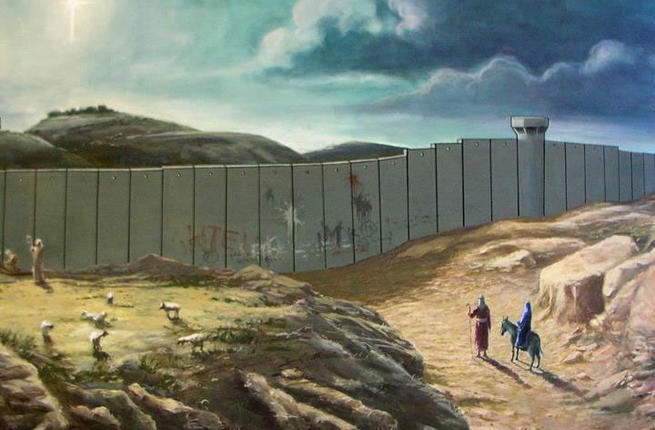
A singular number of churches across the country have asked those very questions in recent years, and their conclusions were depicted with unnerving accuracy by nativity scenes in which Jesus and his family are separated, segregated and caged in individual chain-link pens, topped by barbed wire fencing.

Those nativity scenes were a pointed attempt to remind the modern world that the narrative about the birth of Jesus is one that speaks on multiple fronts to a world that has allowed the life, teachings and crucifixion of Jesus to be drowned out by partisan politics, secularism, materialism and war, all driven by a manipulative shadow government called the Deep State.

The modern-day church has largely shied away from applying Jesus’ teachings to modern problems such as war, poverty, immigration, etc., but thankfully there have been individuals throughout history who ask themselves and the world: what would Jesus do?

What would Jesus—the baby born in Bethlehem who grew into an itinerant preacher and revolutionary activist, who not only died challenging the police state of his day (namely, the Roman Empire) but spent his adult life speaking truth to power, challenging the status quo of his day, and pushing back against the abuses of the Roman Empire—do about the injustices of our  modern age?

Dietrich Bonhoeffer asked himself what Jesus would have done about the horrors perpetrated by Hitler and his assassins. The answer: Bonhoeffer was executed by Hitler for attempting to undermine the tyranny at the heart of Nazi Germany.

Aleksandr Solzhenitsyn asked himself what Jesus would have done about the soul-destroying gulags and labor camps of the Soviet Union. The answer: Solzhenitsyn found his voice and used it to speak out about government oppression and brutality.

Martin Luther King Jr. asked himself what Jesus would have done about America’s warmongering. The answer: declaring “my conscience leaves me no other choice,” King risked widespread condemnation when he publicly opposed the Vietnam War on moral and economic grounds.

Even now, despite the popularity of the phrase “What Would Jesus Do?” (WWJD) in Christian circles, there remains a disconnect in the modern church between the teachings of Christ and the suffering of what Jesus in Matthew 25 refers to as the “least of these.”

Yet this is not a theological gray area: Jesus was unequivocal about his views on many things, not the least of which was charity, compassion, war, tyranny and love.

After all, Jesus—the revered preacher, teacher, radical and prophet—was born into a police state not unlike the growing menace of the American police state. When he grew up, he had powerful, profound things to say, things that would change how we view people, alter government policies and change the world. “Blessed are the merciful,” “Blessed are the peacemakers,” and “Love your enemies” are just a few examples of his most profound and revolutionary teachings.

When confronted by those in authority, Jesus did not shy away from speaking truth to power. Indeed, his teachings undermined the political and religious establishment of his day. It cost him his life. He was eventually crucified as a warning to others not to challenge the powers-that-be.

Can you imagine what Jesus’ life would have been like if, instead of being born into the Roman police state, he had been born and raised in the American police state?

Consider the following if you will.

Had Jesus been born in the era of the America police state, rather than traveling to Bethlehem for a census, Jesus’ parents would have been mailed a 28-page American Community Survey, a mandatory government questionnaire documenting their habits, household inhabitants, work schedule, how many toilets are in your home, etc. The penalty for not responding to this invasive survey can go as high as $5,000.

Instead of being born in a manger, Jesus might have been born at home. Rather than wise men and shepherds bringing gifts, however, the baby’s parents might have been forced to ward off visits from state social workers intent on prosecuting them for the home birth. One couple in Washington had all three of their children removed after social services objected to the two youngest being birthed in an unassisted home delivery.

Had Jesus been born in a hospital, his blood and DNA would have been taken without his parents’ knowledge or consent and entered into a government biobank. While most states require newborn screening, a growing number are holding onto that genetic material long-term for research, analysis and purposes yet to be disclosed.

Then again, had Jesus’ parents been undocumented immigrants, they and the newborn baby might have been shuffled to a profit-driven, private prison for illegals where they first would have been separated from each other, the children detained in make-shift cages, and the parents eventually turned into cheap, forced laborers for corporations such as Starbucks, Microsoft, Walmart, and Victoria’s Secret. There’s quite a lot of money to be made from imprisoning immigrants, especially when taxpayers are footing the bill.

From the time he was old enough to attend school, Jesus would have been drilled in lessons of compliance and obedience to government authorities, while learning little about his own rights. Had he been daring enough to speak out against injustice while still in school, he might have found himself tasered or beaten by a school resource officer, or at the very least suspended under a school zero tolerance policy that punishes minor infractions as harshly as more serious offenses.

Had Jesus disappeared for a few hours let alone days as a 12-year-old, his parents would have been handcuffed, arrested and jailed for parental negligence. Parents across the country have been arrested for far less “offenses” such as allowing their children to walk to the park unaccompanied and play in their front yard alone.

Rather than disappearing from the history books from his early teenaged years to adulthood, Jesus’ movements and personal data—including his biometrics—would have been documented, tracked, monitored and filed by governmental agencies and corporations such as Google and Microsoft. Incredibly, 95 percent of school districts share their student records with outside companies that are contracted to manage data, which they then use to market products to us.

From the moment Jesus made contact with an “extremist” such as John the Baptist, he would have been flagged for surveillance because of his association with a prominent activist, peaceful or otherwise. Since 9/11, the FBI has actively carried out surveillance and intelligence-gathering operations on a broad range of activist groups, from animal rights groups to poverty relief, anti-war groups and other such “extremist” organizations.

Jesus’ anti-government views would certainly have resulted in him being labeled a domestic extremist. Law enforcement agencies are being trained to recognize signs of anti-government extremism during interactions with potential extremists who share a “belief in the approaching collapse of government and the economy.”

While traveling from community to community, Jesus might have been reported to government officials as “suspicious” under the Department of Homeland Security’s “See Something, Say Something” programs. Many states, including New York, are providing individuals with phone apps that allow them to take photos of suspicious activity and report them to their state Intelligence Center, where they are reviewed and forwarded to law-enforcement agencies.

Rather than being permitted to live as an itinerant preacher, Jesus might have found himself threatened with arrest for daring to live off the grid or sleeping outside. In fact, the number of cities that have resorted to criminalizing homelessness by enacting bans on camping, sleeping in vehicles, loitering and begging in public has doubled.

Viewed by the government as a dissident and a potential threat to its power, Jesus might have had government spies planted among his followers to monitor his activities, report on his movements, and entrap him into breaking the law. Such Judases today—called informants—often receive hefty paychecks from the government for their treachery.

Had Jesus used the internet to spread his radical message of peace and love, he might have found his blog posts infiltrated by government spies attempting to undermine his integrity, discredit him or plant incriminating information online about him. At the very least, he would have had his website hacked and his email monitored.

Had Jesus attempted to feed large crowds of people, he would have been threatened with arrest for violating various ordinances prohibiting the distribution of food without a permit. Florida officials arrested a 90-year-old man for feeding the homeless on a public beach.

Had Jesus spoken publicly about his 40 days in the desert and his conversations with the devil, he might have been labeled mentally ill and detained in a psych ward against his will for a mandatory involuntary psychiatric hold with no access to family or friends. One Virginia man was arrested, strip searched, handcuffed to a table, diagnosed as having “mental health issues,” and locked up for five days in a mental health facility against his will apparently because of his slurred speech and unsteady gait.

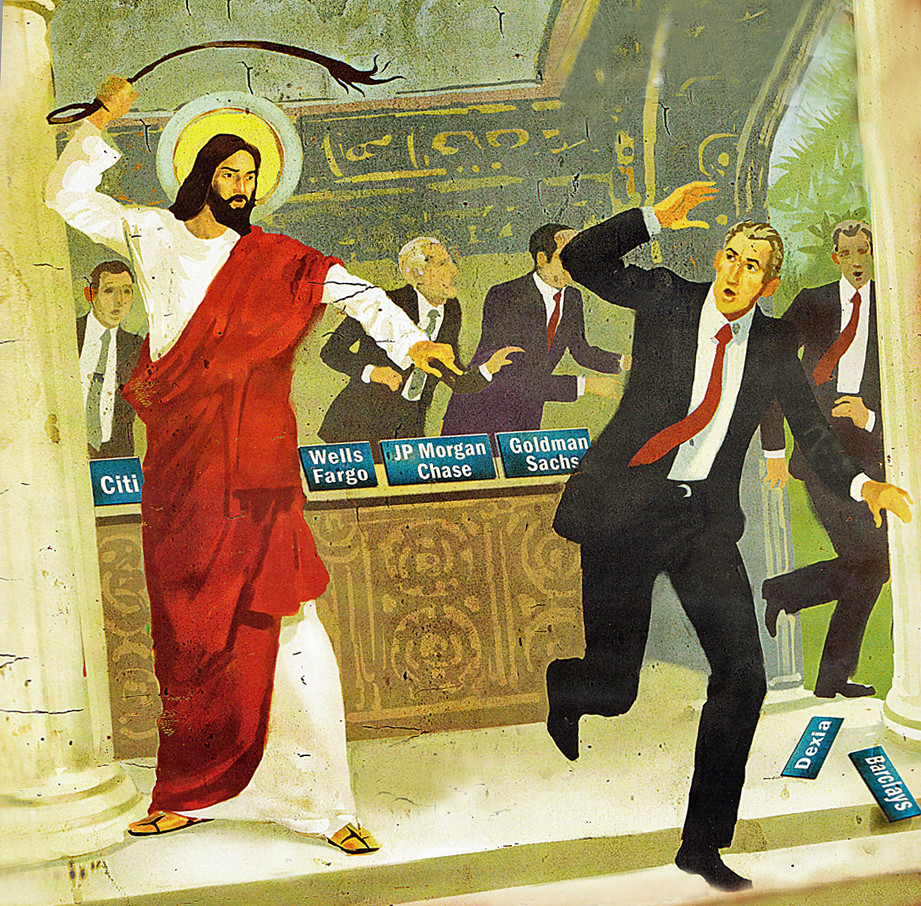
Without a doubt, had Jesus attempted to overturn tables in a Jewish temple and rage against the materialism of religious institutions, he would have been charged with a hate crime. Currently, 45 states and the federal government have hate crime laws on the books.

Had anyone reported Jesus to the police as being potentially dangerous, he might have found himself confronted—and killed—by police officers for whom any perceived act of non-compliance (a twitch, a question, a frown) can result in them shooting first and asking questions later.

Rather than having armed guards capture Jesus in a public place, government officials would have ordered that a SWAT team carry out a raid on Jesus and his followers, complete with flash-bang grenades and military equipment. There are upwards of 80,000 such SWAT team raids carried out every year, many on unsuspecting Americans who have no defense against such government invaders, even when such raids are done in error.

Instead of being detained by Roman guards, Jesus might have been made to “disappear” into a secret government detention center where he would have been interrogated, tortured and subjected to all manner of abuses. Chicago police have “disappeared” more than 7,000 people into a secret, off-the-books interrogation warehouse at Homan Square.

Charged with treason and labeled a domestic terrorist, Jesus might have been sentenced to a life-term in a private prison where he would have been forced to provide slave labor for corporations or put to death by way of the electric chair or a lethal mixture of drugs.

Indeed, as I show in my book Battlefield America: The War on the American People, given the nature of government then and now, it is painfully evident that whether Jesus had been born in our modern age or his own, he still would have died at the hands of a police state.

Thus, as we draw near to Christmas with its celebrations and gift-giving, we would do well to remember that what happened on that starry night in Bethlehem is only part of the story. That baby in the manger grew up to be a man who did not turn away from evil but instead spoke out against it, and we must do no less.

Our Frustrations Run Far Deeper Than Covid Lockdowns

By Charles Hugh Smith

Source: Of Two Minds

The reality is the roulette wheel is rigged and only chumps believe it’s a fair game.

It’s easy to lay America’s visible frustrations at the feet of Covid lockdowns or political polarization, but this conveniently ignores the real driver: systemic unfairness. The status quo has been increasingly rigged to benefit insiders and elites as the powers of central banks and governments have picked the winners (cronies, insiders, cartels and monopolies) and shifted the losses and risks onto the losers (the rest of us).

We now live in the world the 19th-century French economist Frederic Bastiat so aptly described: “When plunder becomes a way of life for a group of men in a society, over the course of time they create for themselves a legal system that authorizes it and a moral code that glorifies it.”

As I noted in The One Chart That Predicts our Future, ours is a two-tier society and economy with a broken ladder of social mobility for those trying to reach the security of the technocrat class and a well-greased slide for everyone who trips and slides from relative security down to the ever-expanding ALICE-precariat class: assets limited, income constrained, employed.

As Bastiat observed, those rigging the system to benefit themselves always create a legal system that lets them off scot-free and a PR scheme that glorifies their predation as well-deserved rewards that are the natural due of their enormous appetite for hard work and innovation.

You know, hard work and innovation like this:

JPMorgan Makes $1 Billion From Gold Trading After Paying $1 Billion Fine For Manipulating Gold Trading.

Embezzling a couple billion dollars also earns you a get out of jail free card: none of the perps in Wall Street’s skims, scams and frauds ever gets indicted, much less convicted, and none of Wall Street’s legalized looters ever goes to prison.

And this is a fair and just system? Uh, right. Meanwhile, the reality is the roulette wheel is rigged and only chumps believe it’s a fair game. Those who know it’s rigged have essentially zero agency (control / power) or capital to demand an unrigged game or finagle their way into the elite class doing the skimming.

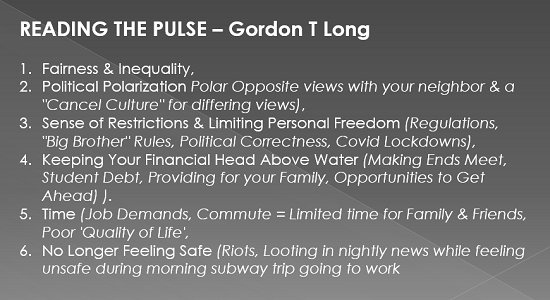
The net result is soaring frustration with a patently unfair system that’s touted as the fairest in the entire world. Gordon Long and I do a deep dive into the frustrations with systemic unfairness in our new video, The Frustrations of Unfairness Are Reaching a Boiling Point.

The key takeaway in my view is the unfairness isn’t limited to the economy, society or politics– it’s manifesting in all three realms. It isn’t just frustration with domestic issues–the global economic order is also a source of unfairness and powerlessness.

We each drew up a list of specific drivers of unfairness / frustration. Here’s my list:

And here’s Gordon’s list:

There is much more in our presentation. These are the dynamics that are tearing apart our social cohesion and that will soon start destabilizing the economy–regardless of how much “money” the Federal Reserve prints.

First Comes A Rolling Civil War

Biden is on a double precipice of the worst-ever economic depression coupled with imminent explosions of social rage

By Pepe Escobar

Source: The Unz Review

The massive psyops is ongoing. Everyone familiar with the

Transition Integrity Project (TIP) knew how this would imperatively play out. I chose to frame it as a think tank gaming exercise in my Banana Follies column. This is a live exercise. Yet no one knows exactly how it will end.

US intel is very much aware of well-documented instances of election fraud. Among them: NSA software that infiltrates any network, as previously detailed by Edward Snowden, and capable of altering vote counts; the Hammer supercomputer and its Scorecard app that hacks computers at the transfer points of state election computer systems and outside third party election data vaults; the Dominion software system, known to have serious security issues since 2000, but still used in 30 states, including every swing state; those by now famous vertical jumps to Biden in both Michigan and Wisconsin at 4am on November 4 (AFP unconvincingly tried to debunk Wisconsin and didn’t even try with Michigan); multiple instances of Dead Men Do Vote.

The key actor is the Deep State, which decides what happens next. They have weighed the pros and cons of placing as candidate a senile, stage 2 dementia, neocon warmonger and possible extorsionist (along with son) as “leader of the free world”, campaigning from a basement, incapable of filling a parking lot in his rallies, and seconded by someone with so little support in the Dem primaries that she was the first to drop out.

The optics, especially seen from vast swathes of the imperial-interfered Global South, may be somewhat terrible. Dodgy elections are a prerogative of Bolivia and Belarus. Yet only the Empire is able to legitimize a dodgy election – especially in its own backyard.

Welcome to the New Resistance

The GOP is in a very comfortable position. They hold the Senate and may end up picking up as may as 12 seats in the House. They also know that any attempt by Biden-Harris to legislate via Executive Orders will have…consequences.

The Fox News/ New York Post angle is particularly enticing. Why are they suddenly supporting Biden? Way beyond internal family squabbles worthy of the Successionsaga, Rupert Murdoch made it very clear, via the laptop from hell caper, that he has all sorts of kompromat on the Biden family. So they will do whatever he wants. Murdoch does not need Trump anymore.

Nor, in theory, does the GOP. Former CIA insiders assure of serious backroom shenanigans going on between GOP honchos and the Biden-Harris gang. Trade-offs bypassing Trump – which most of the GOP hates with a vengeance. The most important man in Washington will be in fact GOP Senate majority leader Mitch McConnell.

Still, to clear any lingering doubts, a vote recount would be absolutely necessary in all 6 contested states – WI, MI, PA, GA, NV and AZ. Through hand counting. One by one. The DoJ would need to act on it, immediately. Not gonna happen. Recounts cost a ton of money. There’s no evidence Team Trump – on top of it short of funds and manpower – will be able to convince Daddy Bush asset William Barr to go for it.

While relentlessly demonizing Trump for spreading “a torrent of misinformation” and “trying to undermine the legitimacy of the US election”, mainstream media and Big Tech have declared a winner – a classic case of pre-programming the sheep multitudes.

Yet what really matters is the letter of the law. State legislatures decide whose electors go to the Electoral College to appoint the President.

Here it is – Article II, Section 1, Clause 2: Each state shall appoint electors “in such Manner as the Legislature Thereof May Direct.”

So this has nothing to do with governors, not to mention the media. It’s up to GOP state legislatures to act accordingly. The drama may roll out for weeks. The first step of the Electoral College procedure takes place on December 14. The final determination will only happen in early January.

Meanwhile, talk of a New Resistance is spreading like wildfire.

Trumpism, with 71 million + votes, is firmly established as a mass movement. No one in the GOP commands this kind of popular appeal. By sidelining Trumpism, the GOP may be committing seppuku.

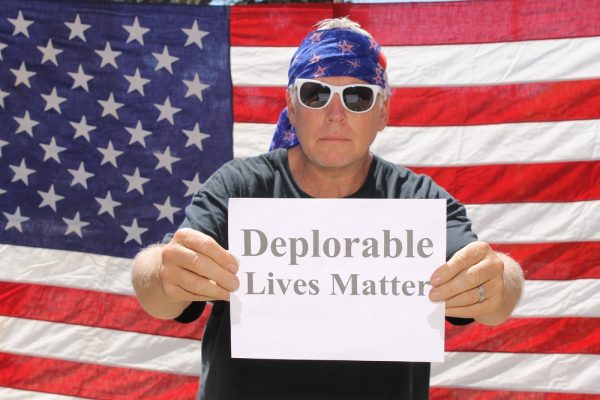
So what will Deplorables do?

The always indispensable Alastair Crooke hits the nail on the head in a powerful essay: Trump is the President of Red America. And depending on how the scripted (s)election tragicomedy develops next, the Deplorables are bound to become The Ungovernables.

Crooke references a crucial parallel evoked by historian Mike Vlahos, who shows how the current American saga mirrors Ancient Rome in the last century of the Republic, pitting the Roman elite against the Populares – which today are represented by Red (Trumpist) America:

“This was a new world, in which the great landowners, with their latifundia [the slave-land source of wealth], who had been the ‘Big Men’ leading the various factions in the civil wars, became the senatorial archons that dominated Roman life for the next five centuries — while the People, the Populares, were ground into a passive — not helpless — but generally dependent and non-participating element of Roman governance: This sapped away at the creative life of Rome, and eventually led to its coming apart.”

So as much as the Dem machine had wanted it, Trump is not yet Imperator Caesar Augustus, whom the Greeks called Autokrator (autocrat), but was a de facto monarch. The American Augustus, Tiberius and most of all Caligula is still further on down the road. He will definitely be a benign, humanitarian imperialist.

In the meantime, what will imperial Big Capital do?

The West, and especially the American Rome, is on the edge of a double precipice: the worst economic depression ever, coupled with imminent, myriad, uncontrollable explosions of social rage.

So the Deep State is reasoning that with Biden – or, sooner rather than later, Supreme shakti and Commander-in-Chief Maa Durga Kamala – the path gets smoother towards the Davos Great Reset. After all, to reset the chess pieces, first the chessboard must be knocked over. This will be one step beyond Dark Winter – which not accidentally was evoked by teleprompter-reading Biden himself on the final presidential debate. The script gets ominously closer to the Rockefelller Foundation’s 2010 Lock Step.

Meanwhile, Plan B is kept in ready, steady, go mode: the lineaments of a global rampage, focused on “malign” Russia’s sphere of influence to satisfy a “revived” NATO and the military-industrial complex, which selected the now media-appointed President-Elect in the first place because he’s no more than a pliant cardboard figure.

America After the Election: A Few Hard Truths About the Things That Won’t Change

By John W. Whitehead

Source: The Rutherford Institute

“If liberty means anything at all, it means the right to tell people what they do not want to hear.”—George Orwell

The American people remain eager to be persuaded that a new president in the White House can solve the problems that plague us.

Yet no matter who wins this presidential election, you can rest assured that the new boss will be the same as the old boss, and we—the permanent underclass in America—will continue to be forced to march in lockstep with the police state in all matters, public and private.

Indeed, it really doesn’t matter what you call them—the Deep State, the 1%, the elite, the controllers, the masterminds, the shadow government, the police state, the surveillance state, the military industrial complex—so long as you understand that no matter which party occupies the White House in 2021, the unelected bureaucracy that actually calls the shots will continue to do so.

In the interest of liberty and truth, here are a few hard truths about life in the American police state that will persist no matter who wins the 2020 presidential election. Indeed, these issues persisted—and in many cases flourished—under both Republican and Democratic administrations in recent years.

Police militarization will continue. Thanks to federal grant programs allowing the Pentagon to transfer surplus military supplies and weapons to local law enforcement agencies without charge, police forces will continue to be transformed from peace officers to heavily armed extensions of the military, complete with jackboots, helmets, shields, batons, pepper-spray, stun guns, assault rifles, body armor, miniature tanks and weaponized drones. “Today, 17,000 local police forces are equipped with such military equipment as Blackhawk helicopters, machine guns, grenade launchers, battering rams, explosives, chemical sprays, body armor, night vision, rappelling gear and armored vehicles,” stated Paul Craig Roberts, former Assistant Secretary of the Treasury. “Some have tanks.”

Overcriminalization will continue. In the face of a government bureaucracy consumed with churning out laws, statutes, codes and regulations that reinforce its powers and value systems and those of the police state and its corporate allies, we will all continue to be viewed as petty criminals, guilty of violating some minor law. Thanks to an overabundance of 4,500-plus federal crimes and 400,000-plus rules and regulations, it is estimated that the average American actually commits three felonies a day without knowing it. In fact, according to law professor John Baker, “There is no one in the United States over the age of 18 who cannot be indicted for some federal crime.” Consequently, we now find ourselves operating in a strange new world where small farmers who dare to make unpasteurized goat cheese and share it with members of their community are finding their farms raided, while home gardeners face jail time for daring to cultivate their own varieties of orchids without having completed sufficient paperwork. This frightening state of affairs—where a person can actually be arrested and incarcerated for the most innocent and inane activities, including feeding a whale and collecting rainwater on their own property—is due to what law scholars refer to as overcriminalization.

Jailing Americans for profit will continue. At one time, the American penal system operated under the idea that dangerous criminals needed to be put under lock and key in order to protect society. Today, as states attempt to save money by outsourcing prisons to private corporations, imprisoning Americans in private prisons run by mega-corporations has turned into a cash cow for big business. In exchange for corporations buying and managing public prisons across the country at a supposed savings to the states, the states have to agree to maintain a 90% occupancy rate in the privately run prisons for at least 20 years. Such a scheme simply encourages incarceration for the sake of profits, while causing millions of Americans, most of them minor, nonviolent criminals, to be handed over to corporations for lengthy prison sentences which do nothing to protect society or prevent recidivism. Thus, although the number of violent crimes in the country is down substantially, the number of Americans being jailed for nonviolent crimes such as driving with a suspended license is skyrocketing.

Poverty will continue. Despite the fact that we have 46 million Americans living at or below the poverty line16 million children living in households without adequate access to food, and at least 900,000 veterans relying on food stamps (mind you, these are pre-COVID numbers, which have only got worse during this pandemic), enormous sums continue to be doled out for presidential excursions (taxpayers have been forced to pay at least $100 million so that Donald Trump could visit his golf clubs and private properties more than 500 times during his four years in office).

Endless wars that enrich the military industrial complex will continue. Having been co-opted by greedy defense contractors, corrupt politicians and incompetent government officials, America’s expanding military empire is bleeding the country dry at a rate of more than $15 billion a month (or $20 million an hour)—and that’s just what the government spends on foreign wars. That does not include the cost of maintaining and staffing the 1000-plus U.S. military bases spread around the globe. Incredibly, although the U.S. constitutes only 5% of the world’s population, America boasts almost 50% of the world’s total military expenditure, spending more on the military than the next 19 biggest spending nations combined. In fact, the Pentagon spends more on war than all 50 states combined spend on health, education, welfare, and safety. Yet what most Americans fail to recognize is that these ongoing wars have little to do with keeping the country safe and everything to do with enriching the military industrial complex at taxpayer expense. Consider that since 2001, Americans have spent $10.5 million every hour for numerous foreign military occupations, including in Iraq and Afghanistan.

Police shootings of unarmed Americans will continue. No matter what our party politics, race, religion, or any other distinction used to divide us, we all suffer when violence becomes the government’s calling card. Remember, in a police state, you’re either the one with your hand on the trigger or you’re staring down the barrel of a loaded gun. At least 400 to 500 innocent people are killed by police officers every year. Indeed, Americans are now eight times more likely to die in a police confrontation than they are to be killed by a terrorist. Americans are 110 times more likely to die of foodborne illness than in a terrorist attack. Police officers are more likely to be struck by lightning than be made financially liable for their wrongdoing. As a result, Americans are largely powerless in the face of militarized police.

SWAT team raids will continue.  More than 80,000 SWAT team raids are carried out every year on unsuspecting Americans for relatively routine police matters. Nationwide, SWAT teams have been employed to address an astonishingly trivial array of criminal activity or mere community nuisances including angry dogs, domestic disputes, improper paperwork filed by an orchid farmer, and misdemeanor marijuana possession, to give a brief sampling. On an average day in America, over 100 Americans have their homes raided by SWAT teams. There has been a notable buildup in recent years of SWAT teams within non-security-related federal agencies such as the Department of Agriculture, the Railroad Retirement Board, the Tennessee Valley Authority, the Office of Personnel Management, the Consumer Product Safety Commission, the U.S. Fish and Wildlife Service, and the Education Department.

The government’s war on the American people will continue.  “We the people” are no longer shielded by the rule of law. While the First Amendment—which gives us a voice—is being muzzled, the Fourth Amendment—which protects us from being bullied, badgered, beaten, broken and spied on by government agents—is being disemboweled. Consequently, you no longer have to be poor, black or guilty to be treated like a criminal in America. All that is required is that you belong to the suspect class—that is, the citizenry—of the American police state. As a de facto member of this so-called criminal class, every U.S. citizen is now guilty until proven innocent. The oppression and injustice—be it in the form of shootings, surveillance, fines, asset forfeiture, prison terms, roadside searches, and so on—will come to all of us eventually unless we do something to stop it now.

Government corruption will continue.  The government is not our friend. Nor does it work for “we the people.” Americans instinctively understand this. When asked to name the greatest problem facing the nation, Americans of all political stripes ranked the government as the number one concern. In fact, almost eight out of ten Americans believe that government corruption is widespread. Our so-called government representatives do not actually represent us, the citizenry. We are now ruled by an oligarchic elite of governmental and corporate interests whose main interest is in perpetuating power and control. Congress is dominated by a majority of millionaires who are, on average, fourteen times wealthier than the average American.

The rise of the surveillance state will continue. Government eyes are watching you. They see your every move: what you read, how much you spend, where you go, with whom you interact, when you wake up in the morning, what you’re watching on television and reading on the internet. Every move you make is being monitored, mined for data, crunched, and tabulated in order to form a picture of who you are, what makes you tick, and how best to control you when and if it becomes necessary to bring you in line. Police have been outfitted with a litany of surveillance gear, from license plate readers and cell phone tracking devices to biometric data recorders. Technology now makes it possible for the police to scan passersby in order to detect the contents of their pockets, purses, briefcases, etc. Full-body scanners, which perform virtual strip-searches of Americans traveling by plane, have gone mobile, with roving police vans that peer into vehicles and buildings alike—including homes. Coupled with the nation’s growing network of real-time surveillance cameras and facial recognition software, soon there really will be nowhere to run and nowhere to hide.

The erection of a suspect society will continue. Due in large part to rapid advances in technology and a heightened surveillance culture, the burden of proof has been shifted so that the right to be considered innocent until proven guilty has been usurped by a new norm in which all citizens are suspects. This is exemplified by police practices of stopping and frisking people who are merely walking down the street and where there is no evidence of wrongdoing. Making matters worse are Terrorism Liaison Officers (firefighters, police officers, and even corporate employees) who have been trained to spy on their fellow citizens and report “suspicious activity,” which includes taking pictures with no apparent aesthetic value, making measurements and drawings, taking notes, conversing in code, espousing radical beliefs and buying items in bulk. TLOs report back to “fusion centers,” which are a driving force behind the government’s quest to collect, analyze, and disseminate information on American citizens.

Government tyranny under the reign of an Imperial President will continue. The Constitution invests the President with very specific, limited powers: to serve as Commander in Chief of the military, grant pardons, make treaties (with the approval of Congress), appoint ambassadors and federal judges (again with Congress’ blessing), and veto legislation. In recent years, however, American presidents have anointed themselves with the power to wage war, unilaterally kill Americans, torture prisoners, strip citizens of their rights, arrest and detain citizens indefinitely, carry out warrantless spying on Americans, and erect their own secretive, shadow government. The powers amassed by each past president and inherited by each successive president—powers which add up to a toolbox of terror for an imperial ruler—empower whomever occupies the Oval Office to act as a dictator, above the law and beyond any real accountability. The grim reality we must come to terms with is the fact that the government does whatever it wants, freedom be damned. More than terrorism, more than domestic extremism, more than gun violence and organized crime, the U.S. government has become a greater menace to the life, liberty and property of its citizens than any of the so-called dangers from which the government claims to protect us. This state of affairs has become the status quo, no matter which party is in power.

The government’s manipulation of national crises in order to expand its powers will continue. “We the people” have been the subjected to an “emergency state” that justifies all manner of government tyranny and power grabs in the so-called name of national security. Whatever the so-called threat to the nation—whether it’s civil unrest, school shootings, alleged acts of terrorism, or the threat of a global pandemic in the case of COVID-19—the government has a tendency to capitalize on the nation’s heightened emotions, confusion and fear as a means of extending the reach of the police state. Indeed, the government’s answer to every problem continues to be more government—at taxpayer expense—and less individual liberty.

The bottom line is this: nothing taking place on Election Day will alleviate the suffering of the American people. Unless we do something more than vote, the government as we have come to know it—corrupt, bloated and controlled by big-money corporations, lobbyists and special interest groups—will remain unchanged. And “we the people”—overtaxed, overpoliced, overburdened by big government, underrepresented by those who should speak for us and blissfully ignorant of the prison walls closing in on us—will continue to trudge along a path of misery.

As I point out in my book Battlefield America: The War on the American People, these problems will continue to plague our nation unless and until Americans wake up to the fact that we’re the only ones who can change things for the better and then do something about it. If there is to be any hope of restoring our freedoms and reclaiming control over our government, it will rest not with the politicians but with the people themselves.

After all, Indeed, the Constitution opens with those three vital words, “We the people.”

What the founders wanted us to understand is that we are the government.

There is no government without us—our sheer numbers, our muscle, our economy, our physical presence in this land. There can also be no police state—no tyranny—no routine violations of our rights without our complicity and collusion—without our turning a blind eye, shrugging our shoulders, allowing ourselves to be distracted and our civic awareness diluted.

No matter which candidate wins this election, the citizenry and those who represent us need to be held accountable to this powerful truth.